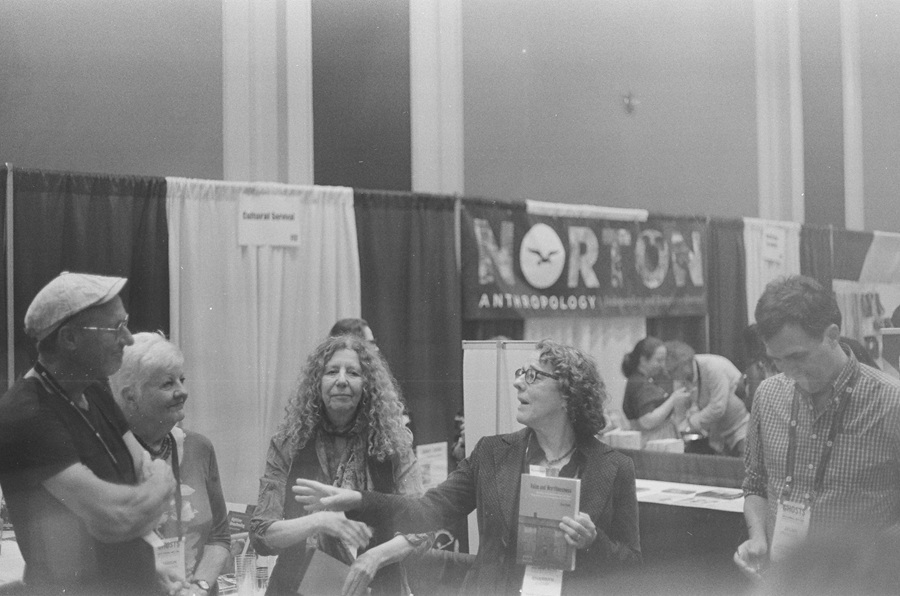
Image 1: (from left to right) Don Kalb, Marion Berghahn, Ida Susser, Sharryn Kasmir and Jaume Franquesa at the launch of Value and Worthlessness at the AAA annual meeting on November 21, 2025. Photo by Stefan Voicu
Don Kalb first sent me Value and Worthlessness: The Rise of the Populist Right and Other Disruptions in the Anthropology of Capitalism in manuscript form. I had read most of the chapters in their original publications and welcomed the chance to revisit familiar arguments and scenes. What I did not anticipate was the emotional force of the collection, particularly chapters two through four. I was struck by the intimacy of the life story of Polish worker-activist Krysztof Zadrozny, who suffered the defeat of his and his Solidarnosc comrades’ aspirations for shopfloor democracy in their white goods factory. I was also affected by the refrain of Maria van de Velde’s self-description— “I have always been dumb”—which poignantly punctuates her account of exploitation and abuse in industrial Eindhoven, Netherlands in the mid twentieth century. Don uses the evocative phrase “close to the skin” to describe his close accounts of people rendered “worthless” through relations of capital accumulation (Kalb 2025, p. 127) but I think something more significant is at stake in the kind of empathy on display. A more capacious concept may be in order, both to identify a consequential feature of his writing and to make a broader claim for Marxist anthropology. I suggest the notion of “Marxian intimacy” to name this intellectual terrain.
To advance the concept, I begin with an excerpt from Zadrozny’s conversation with Don and his colleagues in 1998. Zadrozny reflected on the closing of political horizons during Poland’s post-socialist transition and remembered,
People were willing. There was zest. We could have been building a new society. And I think that this is what the Poles expected to happen. […] There was this rebuilding atmosphere and people had the will to switch to another system and to other habits too. But I guess it didn’t work out too well. Wild capitalism emerged […] it was not the human relations that we craved (Kalb 2025, p. 90)
His sorrow is neither nostalgic nor self-pitying; it is a reckoning with the forces that cut off political possibility. Zadrozny understands the historical conditions under which the project of building a post-socialist society slipped beyond the reach of Polish workers, and worth was stripped from their labor, their communities, and their democratic aspirations. He remembers with painful acuity how worthlessness was produced through the violent reordering of value under emergent market relations. With “Marxian intimacy,” I seek to characterize a text that inhabits the emotional currents of a life lived amidst capitalist crises and that points to the causes of the upheavals. It lays bare the “hidden histories of devaluation, and the hidden injuries of dispossession” (Kalb 2025, p. 65) as deeply felt individual and common experiences. Beyond humanitarian feeling, or the empathy of ethnographic encounter with which our discipline of anthropology is replete, this form of intimacy gives us to know how a life course emerges through layered relations of value and class. Don recounts Zadrozny’s experience not to render legible the moral world of an illiberal cultural “other”—that would be merely an extension of the liberal anthropological cannon and its emic perspective—but as part of his comparative project whose purpose is to explain the rise of the populist right in Poland and elsewhere.
Don conducted his dissertation research in the manufacturing city of Eindhoven, under the shadow of the Philips conglomerate. There, Philips worker Maria van de Velde declared to him, “This is my own history, but it is worthless!” Her exclamation arose from the combination of gendered kinship relations, labor regimes, corporate paternalism, and the arc of patriarchal capitalism speaking through an individual biography. Read alongside the story of the Polish worker-activist, these become diagnostic accounts of worthlessness as a historically produced relation, shaped by deindustrialization, dispossession, financialization, and segmentation of labor markets. Attending to these biographies requires the methodological ambition to identify the mechanisms through which lives are devalued and to articulate those “hidden histories” (Kalb 2025, p. xii).
Don takes the phrase “articulating hidden histories” from the title of an edited volume on the intellectual legacy of anthropologist Eric Wolf (Schneider and Rapp 1995). He shares Wolf’s imperative for anthropology to become a discipline whose meta project is to grasp the totality of capitalist social relations, to apprehend capitalism as a more than 500-year, globe-spanning system within which its objects of study—i.e. cultures—are produced in fields of power. As a child among textile workers in central Europe in the 1930s, Wolf witnessed firsthand how capitalist crisis upended everyday life (Wolf 1982, p. 402.) That experience “formed the central question of his anthropology: how to account for the emergence and persistence of a system whose dynamically unfolding relations can catapult […] everyday life into an abyss of uncertainty as if by an act of nature like an earthquake” (Schneider 1995, p. 16; see Kasmir forthcoming.) Don’s informants lived through similar world-shaking events.
Wolf also sought to explain the rise of extreme ideologies, including National Socialism in Germany, and the intersections of power and the differentiation and deployment of social labor that breathed life into them (Wolf 1999.) Don’s orientation is likewise toward the political “other” rather than anthropology’s well-trod cultural “other” (Kalb 2025, p. xii.) Illiberal mobilizations and right-wing populism, he argues, take shape among populations who are undergoing devaluation, both in their material lives and in discursive fields that mark them as unworthy. His ethnographic sights are set on the dialectic between everyday life and global political economy and between meaning-making and the see-saw of capital expansion and abandonment. Marxian intimacy reconstructs those intersections, exposing their effects, including the resentment and racism that are “part of a cauldron of vindictive feelings about hierarchy, value, and worthlessness, […] amid austerity and a drive for national competitiveness” (Kalb 2025, p. 165). For Zadrozny, a decisive moment was the betrayal of Solidarnosc worker-activists by technocratic elites and the installation of a neoliberal value regime that thwarted the “human relations that we craved,” yet a longer trajectory of dispossession, rather than any single event, had set the course.
Maria van de Velde’s devaluation was produced by exploitation at work and mistreatment within her family. Don recounts her daily routine in detail to draw us close to the drudgery it imposed,
She got up at 5.30 in the morning. Set the table for everyone. Took a bus at 6.30. Started work at 7.30. Worked well above the norm and arrived home again at 5.30 p.m. Tidied up the house, which was often a mess, and started peeling potatoes for dinner. She cleaned up the dishes afterward and went to bed totally exhausted (Kalb 2025, p. 101)
Maria repeatedly reaches for an explanation for her misery. And she turns from the knowable causes of her mistreatment at the hands of her employers and those of her sister, mother and father, and she offers instead that she was “dumb.” This pivot is abrupt, and it interrupts her search for answers:
But I have always been really dumb[…] They used to say I was just dumb. […] My father was often drunk and aggressive. Nellie, my second-oldest sister, was in fact running the household. […] I had to do everything (Kalb 2025, p. 101)
It was work, work, and work again. Maybe it is true that I have always been dumb, like they used to say (Kalb 2025, p. 103)
She lists the record of neglect and mistreatment and then wipes it away with self-deprecation, “I have always been dumb.” Reconstructing the social relations that produced her suffering therefore requires concerted attention. Don parses her individual biography and the structural causes that shape it. “Maria’s subjection was more multiple and her relationships with her parents more difficult than was probably the case with most other working-class girls. It made her feel she was ‘dumb.’” (Kalb 2025, p. 105)
In a dense narration of common events and circumstances of proletarian life in the region, Maria’s story is deeply moving above all for the intense tension it evokes between hostility and intimacy, fear and respect, trust and distrust, which all social relations seem to have been imbued with (Kalb 2025, p. 103)
Maria’s story is deeply moving because it conveys the experience of female proletarian life in the region, formed by class and gender, and because it is embedded in the structural pain that accompanies those collective conditions.
Intimacy is not a word we often hear associated with Marxist theory, yet the ethnographic chapters in this volume show that a deep emotional register may be one of its unremarked strengths. Don writes against culturalist empathy because it emphasizes morals and emic perspectives, while failing to explain the dynamics of value and devaluation. We feel profoundly for Maria and Zadrozny. The urgency that confronts us as we read their life stories goes beyond personal compassion to give rise to the imperative to remake the conditions that determine value and worth.
Sharryn Kasmir is Professor of Anthropology at Hofstra University. She has done fieldwork in the Basque region of Spain and in the southern United States. Her research and writing focuses on capitalism and working class lives and politics.
References
Kalb, Don. 2025. Value and Worthlessness: The Rise of the Populist Right and Other Disruptions in the Anthropology of Capitalism. New York, Oxford: Berghahn Books.
Kasmir, Sharryn. Forthcoming 2026. “The New Laborers: Revisiting the Last Chapter of Europe and the People Without History Fifty Years Hence” In Don Kalb and Luisa Steur, Eds. In the Tracks of Marxist Anthropology: Fifty years of Eric Wolf’s ”Europe and the People Without History”. New York, Oxford: Berghahn Books.
Schneider, Jane. 1995. “Introduction: The Analytical Strategies of Eric Wolf”, In Jane Schneider and Rayna Rapp, Eds. Articulating Hidden Histories: Exploring the Influence of Eric Wolf. Berkeley: University of California Press, 3-31.
Jane Schneider and Rayna Rapp, Eds. 1995. Articulating Hidden Histories: Exploring the Influence of Eric Wolf. Berkeley: University of California Press.
Wolf, Eric, 1982. Europe and the People without History. Berkeley: University of California Press.
Wolf, Eric. 1999. Envisioning Power: Ideologies of Dominance and Crisis. Berkeley: University of California Press.
Cite as: Kasmir, S. 2026. “Marxian Intimacy” Focaalblog, April 22.
Image 1: (from left to right) Don Kalb, Marion Berghahn, Ida Susser and Sharryn Kasmir at the launch of Value and Worthlessness at the AAA annual meeting on November 21, 2025. Photo by Stefan Voicu
Having the opportunity to say a few words about the work of an esteemed colleague and an intellectual reference like Don Kalb is a rare privilege. Value and worthlessness: The rise of the populist right and other disruptions in the anthropology of capitalism is a fantastic book, worthy of discussion and celebration. It compiles some of the greatest hits that this public intellectual committed to his time has written in the last two decades or so (and the best of his work is just very, very good!) and ultimately stands as an energizing, unapologetic, and much-needed call and manifesto for an anthropology of capitalism.
I would like to say a bit more about what is meant by that (“an anthropology of capitalism”), but first I should describe the main contents of the book, which give a good sense of the author’s range of interests and the systematic character of his intellectual pursuits. The articles in the book could, in my mind, be divided into three groups. First, the ethnographic pieces, which masterfully disclose the interweaving of intimate and distant processes in the lives lived within the society of capital in Europe: from the uncovering of the hidden histories of flexible familism in the Eindhoven of the Phillips corporation to those underpinning the shift to the right of the Polish industrial proletariat, subsequently integrated in a comparative analysis of the “world-systemic production of worthlessness” in what is one my favorite chapters of the book; and from there to the ethnographic examination (with Oana Mateescu) of the webs of life of the urban youth at the center of the IT boom in Central and Eastern Europe, exploring the postsocialist dispossession, neoliberal policies and urban class inequality that loom behind that boom.
Next to those, we have a series of chapters that theorize the epochal transformations of capitalism in the twenty-first century. We can find in this group, inter alia, a salutary dissection and tearing apart of the concept of “global middle class”, a must-read discussion on the value theory of labor and an insightful piece where Kalb proposes the concept of double devaluations – which identifies the combination of economic and social-political-discursive devaluation of particular places, activities and peoples – to understand the rise of the populist right.
The third and final group is composed by a series of polemical, utterly enjoyable diatribes, where Kalb reminds us that the kind of materialist anthropology that this book and journals like Focaal cultivate and cherish occupies a subaltern position within the discipline and that it needs to be defended – and that one must do so with “no apologies”. These chapters are high-caliber critical engagements with and against generally well-chosen enemies, ranging from those with whom we need have no business – from the culture concept and its webs of meaning to the hyperpoliticization of identities, and from ontological theory to the anthropology of morality – to those we need to dialogue with because of their intellectual stature and a certain affinity of purpose (I especially recommend the pages where Kalb discusses the work of Marcel Mauss and David Graeber) in seeking anti-systemic alternatives to capitalism.
This array of greatest hits is framed by a preface and two masterful chapters where Kalb gives us all the necessary tools for the practice of a careful but uninhibited Marxist anthropology. In speaking about his seminal historical ethnographic work in the Netherlands, he describes the motivation to find the hidden history of Eindhoven thus: “That was precisely the attraction. Finding out things that people somehow know or sense, but cannot easily talk about for lack of a public vocabulary. That lack was in turn caused by the failure of an organic intelligentsia to notice local silences and give meaning to them” (Kalb 2025, p. xvii). Like them, the materialist anthropologists to whom this book is addressed all too often tend to lack a vocabulary. Kalb knows that, and this book goes a long way in furnishing it. “Class”, “labor” and “capital” pepper the text, as they should, but the list of terms goes deeper: “hidden histories”, “webs of life”, “structured contingency”, etc., as well as the many insightful concepts that come out of his sustained discussion of value, such as “double devaluations”, “worthlessness” and “dialectical value regimes”. Some will perhaps argue that many of these terms are not new. To that, I would answer that this may actually be the point. For this book shows to us that we already have the terms, that they come from a robust and deep tradition of Marxist and Marxist-inspired anthropology and broader social thought. All that is needed is to use that treasure chest imaginatively and to systematically deploy our terms to “reveal the hidden connections among different aspects of life” (Kalb 2025, p. 15) under capitalism to ultimately contribute to its transformation. Kalb calls it “an interdisciplinary Marxist anthropology of the present” (Kalb 2025, p. 3). Indeed.
In fact, this book’s contribution to this “anthropology of the present” is not limited to the furnishing of vocabulary, far from it. In the introduction, it offers a history of anthropology in the twenty-first century, connecting it to the key moments in the capitalist transformations of the last quarter century that should be compulsory reading in any course of anthropological theory. Among the many merits of this historical-theoretical tour de force, my favorite one is Kalb’s dispelling of the worn, nefarious myth that Marxist anthropologists are economic reductionists. As he argues, it’s rather the opposite. Take the example of “class”: yes, class is key to understand webs of life under capitalism, of course, but only on the condition that it is not reduced to a “singularly economic category” and is instead approached as a “complex social relationship”: “Class … refers to the relational … fields of force that put pressure on, and set limits to, the forms and practices by which we reproduce our lives” (Kalb 2025, p. 23). This approach to class is linked to an understanding of capitalism as a totality: “a set of social relations, a social form, and a type of society. This is a society that is organized, legally, institutionally, and relationally, to feed and sustain a capitalist economy that is fetishistically imagined as separate from it” (Kalb 2025, p. 17). Those that reduce capitalism to “an economy” contribute to that fetishization. To do an anthropology of the present, thus, one must necessarily be ready to do an anthropology of capitalism, for it is not possible to understand the common lives in which we are interested without having a grasp of the immanent tendencies of that totality that we call capitalism. In short, an anthropology of the (historical) present is an anthropology of capitalism, and vice versa.
Throughout this book, Don Kalb gives us vocabulary, theory and a clear sense of purpose together with precious examples of how to put them at the service of the analysis of the concrete. Yet, I would say that this book does something even more important than all that. Ida Susser’s dedication in the book’s back cover puts it eloquently: “Value and Worthelessness”, she writes, “synthesizes the original, courageous, and exhilarating work of Don Kalb. A vital Marxist anthropology for the present”. Indeed, vital and courageous are the right words. For I would say that vitalistic courage is the main gift that we get from this book. It gives us courage against the tendency to be risk-averse and the temptation to come up with a few fancy derivative terms that may garner us citations but do little else. It gives us courage to call ourselves Marxist anthropologists and to speak about and for the present. With no apologies. For this, we salute you, comrade Kalb.
Jaume Franquesa is Professor of Anthropology at University at Buffalo, SUNY. His research focuses on political economy, energy, and environmental transformations. He studies how renewable energy developments and infrastructure expansion reshape landscapes, livelihoods, and power relations, particularly in Southern Europe.
References
Kalb, Don. 2025. Value and Worthlessness: The Rise of the Populist Right and Other Disruptions in the Anthropology of Capitalism. New York, Oxford: Berghahn Books.
Cite as: Franquesa, J. 2026. “For an anthropology of capitalism” Focaalblog April 21.
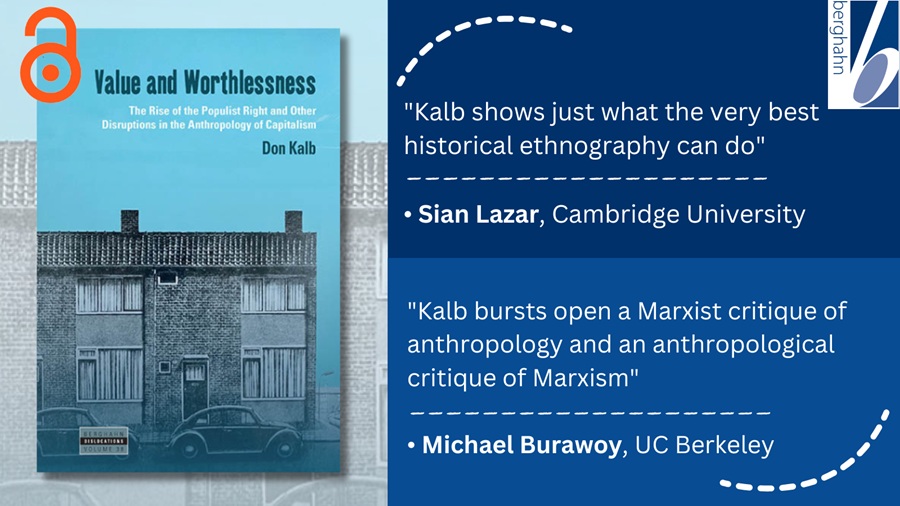
Image 1: Value and Worthlessness cover and review blurbs from Sian Lazar and Michael Burawoy
This text is not about the huffing and puffing you would expect. Although Don Kalb is Dutch, his new book, Value and Worthlessness: The Rise of the Populist Right and Other Disruptions in the Anthropology of Capitalism is about a different kind of huffing and puffing. Kalb borrows this expression from E.P. Thompson to foreground the messy realities on which the hegemony of the capitalist law of value rests. Let me quote him at length on this:
Rather than being the assured outcome of successive market equilibria, this immanent historical tendency [the law of value] was always also the contingent outcome of ongoing class struggles at all levels in the system, and throughout all its various, evolving and interlocking institutional domains; and this against a turbulent background of recurrent economic crisis and violent ruptures (Kalb 2025, p. 54)
In Value and Worthlessness, Kalb has set out to do something that nobody has attempted to do since the 1970s. He develops a programmatic line of Marxist research in anthropology and outlines a conceptual toolbox that binds together political economy, social history, and ethnography. Kalb began his career in the late 1980s, during the last flickers of a once popular Marxist anthropology, but remained unapologetically Marxist, centering his work on an expanded notion of class to understand the globalization of capital at a time when the discipline was rapidly spiraling out of control into the language-games of culture. Now, bringing together his fieldwork with workers from the Philips factory in the company town of Eindhoven, with post-socialist Solidarność workers from the Polar factory in Wroclaw, and, accompanied by Oana Mateescu, with cognitive workers from Cluj’s booming IT industry, he develops an anthropological theory of capitalism and the methodological guidelines to pursue it.
Kalb does a lot of huffing and puffing himself in the book, describing social processes that unfold in and across capitalist times and spaces. I invited Jaume Franquesa, Sharryn Kasmir and Ida Susser, three leading US-based Marxist anthropologists, to write down the reflections on the book they shared during the launch of Value and Worthlessness at the 2025 AAA annual meeting. In the texts gathered in this feature, each of them celebrates the book while extending it in a distinct direction. Kasmir theorizes Kalb’s ethnographic method as “Marxian intimacy,” Susser presses him to take counter-hegemonic culture and processes of commoning more seriously, and Franquesa salutes the book as a courageous manifesto that equips Marxist anthropologists with vocabulary and purpose.
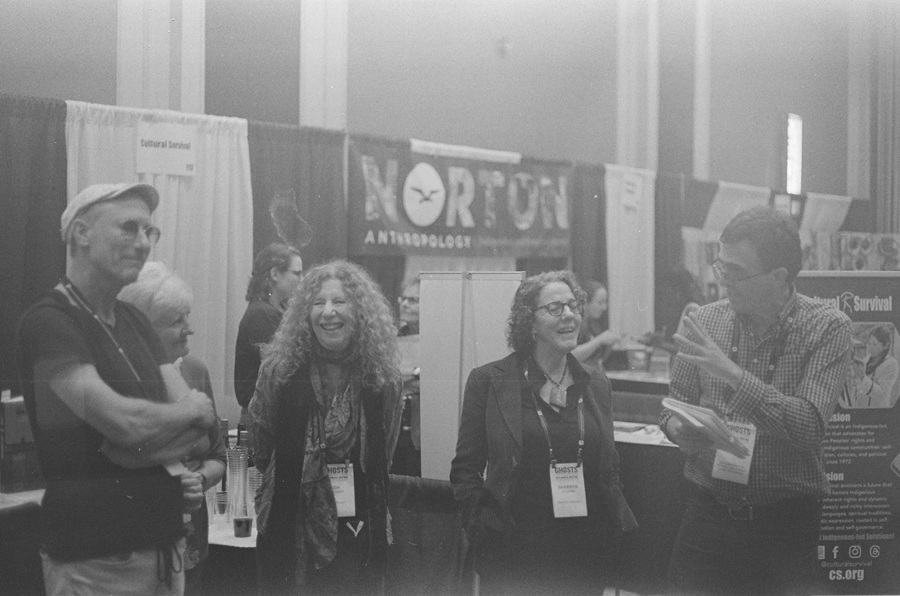
Image 2: (from left to right) Marion Berghahn, Don Kalb, Ida Susser and Sharryn Kasmir at the launch of Value and Worthlessness at the AAA annual meeting on November 21, 2025. Photo by author
On top of their brilliant interventions, I want to outline three other important contributions this book makes.
First, Kalb proposes to view capitalism as an unevenly structured totality, a system that produces internal differences on which it feeds. Those readers of the book knowledgeable in post-Marxist theory, as well as the “less marxists” anthropologists Kalb takes aim at, will likely huff and puff at this idea. For half a century, Marxist theory has been constructed around the idea that capitalism is incomplete, that there is something external to it and the thrust of capitalism’s law of value is sucking in these outside spaces brimming with counter-hegemonic possibilities. Kalb instead starts from the common sense observation that contemporary capitalism has commodified everything. Directly or indirectly, the majority of the world’s population is now exploited by a minority that accumulates capital. Capital is insidious, as Kalb (2024) argues in the introduction to the edited volume that could be read as a companion to Value and Worthlessness, and the new frontiers of value are manufactured mainly through spectacular accumulations followed by violent processes of devaluation. There is no way out of capitalism except through it. Marx’s argument that the bourgeoisie produces its own gravediggers never rang more true than today and between the lines of Kalb’s book one can read a repositioning of the redefined working class at the center of the struggle for a better world.
Second, Kalb wants to extricate Graeber’s radical anthropology from Mauss’ influence. He argues that because of this influence Graeber’s work on value is unable to account for class struggle and the multi-scalar structure of capitalism, misleading him into a somewhat voluntaristic political position. Kalb argues radical anthropologists should replace Mauss with Trotsky. According to Kalb, not only is the latter’s History of the Russian Revolution more ethnographic than anything Mauss wrote, but Trotsky, as opposed to the academically embedded ‘nepo baby’ Mauss, is probably a better model of politically engaged thinker. Moreover, neither Mauss in the 1920s-1930s, nor Graeber in the 2010s-2020s anticipated the rise of the fascist right. Both Trotsky and Kalb sounded the alarm on these worrisome developments early on (see Kalb 2009, Kalb and Halmai 2011, Trotsky 1971). Not coincidentally the structured unevenness defining Kalb’s capitalist totality is drawn from Trotsky’s theory of uneven and combined development and it is sharply opposed to Mauss’ expressive totality. However, it’s undeniable that Graeber was a model of a politically engaged anthropologist, highly influential, and quite the opposite of a ‘nepo baby’. The anarcho-socialist politics he promoted, coupled with the enduring, although questionable, image Trotsky carries as responsible for crushing Kronstadt, will probably require more huffing and puffing to replace Mauss and the kind of activist politics anthropologists are willing to engage in.
Third, in his engagement with Graeber and his theory of value, Kalb brings David Harvey’s political economy down into the muddled realities of “emplaced anthropological huffing and puffing” (Kalb 2025, p. 54) and proposes a new anthropological theory of capitalist value. Graeber’s value theory aimed to collapse the distinction between value, as in economic value, and values, as in social and cultural values. In his Toward an Anthropological Theory of Value (Graeber 2001) he develops the theoretical framework for this project, but only in Debt (Graeber 2011) he fully explores the implications of the argument. Debt, Graeber shows, is not only an economic value, but permeates and frames all social relations. Graeber shows how one can find debt defining the relation between God and humans in the oldest religious text, as well as between friends in everyday life. Kalb rejects both the value/values distinction, as well as the reduction of both to one single value that Graeber advances. Instead, he proposes to look at value and values as being in a “dynamic relational totality” he calls “value regime” or “dialectical value regime”. Analysing the vernacular narratives of worth and worthlessness in The Netherlands and Poland, Kalb shows how workers’ values emerge alongside or in opposition to the accumulation imperatives of a specific industry, in a specific time and space, and always in conjunction with the abstract forces of capitalism’s law of value. Through this engagement with intimate experiences of capitalism, “Marxian intimacy” as Kasmir beautifully puts it, Kalb builds a theoretical foundation for the understanding of the rise of the populist Right in Europe and develops the concept of double devaluations, of both value and values, whose importance Franquesa highlights in his text.
Whether readers will huff and puff or nod in agreement while reading Kalb’s take on totality, Trotsky versus Mauss, regimes of value, or the critical junctions that led to the rise of the populist Right, matters less than the importance this book should have in any attempt to research contemporary capitalism. Like all great books, this is one critical anthropologists must reckon with, debate, criticize and use to advance our understanding of the current conjuncture.
The photos I took at the book launch got a bit damaged when I developed the film I shot them on. Coincidence? Maybe…They look a bit haunted, which kind of fits the 2025 AAA annual meeting theme of Ghosts. In these photos Don Kalb, Jaume Franquesa, Sharryn Kasmir, and Ida Susser seem to be those specters of marxism haunting a conference where sessions on Marxism and communism, conjured nowadays by right-wing leaders as if it was still the Cold War, were strangely missing.
Stefan Voicu is a social anthropologist researching transformations of property and class relations under financialized capitalism. He is one of the FocaalBlog editors.
References
Graeber, David. 2001. Toward an Anthropological Theory of Value: The False Coin of Our Own Dreams. Palgrave.
Graeber, David. 2011. Debt: The First 5,000 Years. Melville House.
Kalb, Don. 2009. ‘Conversations with a Polish populist: Tracing hidden histories of globalization, class, and dispossession in postsocialism (and beyond).’ American Ethnologist 36(2), 207-223.
Kalb, Don. 2024. Insidious Capital. Frontlines of Value at the End of a Global Cycle. Berghahn Books.
Kalb, Don. 2025. Value and Worthlessness: The Rise of the Populist Right and Other Disruptions in the Anthropology of Capitalism. Berghahn Books.
Kalb, Don and Gábor Halmai. Eds. 2011. Headlines of Nation, Subtexts of Class. Working Class Populism and the Return of the Repressed in Neoliberal Europe. Berghahn Books.
Trotsky, Leon. 1971. The Struggle Against Fascism in Germany. Pathfinder Books.
Cite as: Voicu, S. 2026. “Huffing and Puffing with a Marxist Anthropologist” Focaalblog April 20. https://www.focaalblog.com/2026/04/20/stefan-voicu-huffing-and-puffing-with-a-marxist-anthropologist/
Image 1: Chanting “White lives matter!” and “You will not replace us!” and “Jews will not replace us!” several hundred white nationalists and white supremacists carrying torches marched in a parade through the University of Virginia campus 11 August 2017, photo by Evelyn Hockestein for The Washington Post
This discussion paper offers two contributions to our collective discussion on the theme of fascism: (a) an integrated set of elements comprising our definition of the concept; and (b) abbreviated notes on the applicability of each element to the present moment (see also Gordon and Webber 2023)
We argue that fascism is a mass movement rooted in the radicalizing petty bourgeoisie, or middle class. Fascist movements may participate in the bourgeois electoral arena, but ultimately the source of their strength and the centre of their political action is in the streets and the exercise of extra-legal violence. While outside of existential crises the bourgeoisie is not favourably disposed to fascists (some exceptions notwithstanding) the bourgeoisie may nevertheless appeal to them in an effort to impose order in such moments if political alternatives are unavailable or insufficient. The threat of fascism is co-extensive with capitalism – and not simply one of its stages – because capitalism systematically produces crises that profoundly destabilize the social order and its class relations. The possibility of fascism deepens when such crises reach a civilizational scale and become irresolvable on the terms of capital (i.e. the restoration of profitability and capitalist hegemony) either through bourgeois democratic means or other forms of authoritarianism, such as military dictatorship. Historically, a feature of those crises and obstacle to their resolution includes partially weakened but undefeated, mass revolutionary forces. As long as there is capitalism, then, the fascist threat remains alive. The intensity of the threat obviously has its ebbs and flows, but it never disappears.
As the definition outlined above would suggest, our preferred point of departure in what follows is a critical return to – but also extension beyond – the classical Marxist theories of fascism, particularly that of Leon Trotsky. In our view, two elements common to most classical Marxist theories of fascism need to be abandoned. The first is the unjustified view that fascism is specific to the kind of inter-imperial rivalry characteristic of the early twentieth century, and the related point that fascism is limited to countries of the imperialist core. The second is the connection of fascism to a “stage” of “monopoly capital,” a theory that was incorrect at the time and is equally without value today. Finally, we also believe that the interrelated phenomena of colonialism, racism, and white supremacy need to be fully integrated into the foundational elements of fascism identified by classical Marxists and synthesized below.
This is the master logic around which the seven elements of our concept of fascism and its potential development into a movement that can contest for power are articulated. We agree with Geoff Eley’s (2021) methodological point on the necessity of “portability” in any conceptualization of fascism that is to be of continued relevance across different historical periods, even as we disagree with his substantive characterization of the present conjuncture. Hence, we intend our concept of fascism as sufficiently abstract to be portable across different times and spaces of the industrial capitalist epoch, but nonetheless sufficiently coherent so as to be able to distinguish the phenomenon of fascism from other closely related phenomena.
First, with regard to context, the rise of fascism requires a severe and sustained crisis of capitalism beyond the mere immediate “conjunctural fluctuations,” and which makes the normal process of capitalist accumulation difficult if not impossible (Mandel 1971). Fascism’s historical role is to radically alter social, political, and economic conditions in order to facilitate a renewal of stable accumulation to the benefit, especially, of big capital. This is the master element whose logic articulates the other elements into a coherent totality. Clearly, the global crisis that erupted in 2008 and the economic stagnation that followed for much of the world – the worst slump in global production and trade since the 1930s, and one compounded by the economic impact of the Covid-19 pandemic – meets this contextual requirement.
Second, it is necessary that there be a foreboding sense of civilizational degeneration on the scale (but without necessarily the same content) that shaped the political zeitgeist from which classical fascism emerged. Such degeneration radicalizes the petty bourgeoisie. Most pertinent in the inter-war period was the crisis of global imperialism, culminating in the brutality and devastation of the First World War and inurement towards violence. Militarism crystallized in the European psyche generally, and especially among those who gravitated to fascism. The anxieties and traumas of postwar life, amidst economic volatility, were in turn successfully transformed by fascism into a focused hatred of Communism and alien others (Traverso 2017). Muted elements of this contextual factor exist in an incipient manner today, taking most dramatic form in the ecological crisis, the inurement to large-scale needless death and debilitation associated with the management of the COVID pandemic, the heightening of inter-imperial rivalries, the onset of major new wars, and a widespread cultural pessimism reminiscent of classically pre-fascist sentiment. Yet the sense of civilizational degeneration today is not yet comparable in scale to that of the era in which classical fascism was forged.
Third, the crisis of capitalist accumulation must develop into a crisis of bourgeois democracy. The historical context generative of the rise of fascism was one in which social classes deviated from their traditional political parties, and “the immediate situation became delicate and dangerous,” with an acute crisis of authority, “or general crisis of the state” (Thomas 2011). Today, clearly, there is a widespread international context of bourgeois democratic decline and weakening of traditional parties, but not yet the proliferation of the actual overthrow of bourgeois democratic regimes and the installation of military dictatorships – with some important exceptions, such as the counter-revolutionary wave in the Middle East – much less fascist dictatorships.
The fourth element of fascism – the inadequacy of traditional military dictatorship – flows immediately from the third. Traditional forms of police and military repression and dictatorial rule reveal themselves to be inadequate in the face of a strong working-class movement or an unreliable military. As a reactionary and militarized mass movement, with a capacity to mobilize supporters in the streets and electorally, fascism offers a solution. In the current context, by contrast, traditional forms of police and military repression within bourgeois democratic parameters, or in some cases military dictatorship (whether temporary, or longer term), have proved sufficient for the reproduction of capitalist rule.
The fifth component has to do with the petty bourgeois composition of fascism’s mass base. While inter-war European fascism drew cross-class support, at its core it was a petty-bourgeois movement of small business owners, rural landowners, managers, civil servants, professionals, and military and ex-military members. More and more, this radicalizing middle class was drawn to a revanchist politics premised on fortifying the nation, martial discipline, and order. Because of its precarious class location within the capitalist hierarchy, nestled uneasily between a globally ambitious set of large capitalists and an internationalist working-class movement, the petty bourgeoisie is disposed to conflating itself and its interests with those of the nation and to a conservative politics. The petty bourgeoisie is also a sufficiently large section of society to constitute the basis of a mass movement. The contemporary far-right draws heavily on petty-bourgeois radicalization, but the petty-bourgeoisie has not been mobilized and transformed into mass movements willing and capable of regularly engaging in organized paramilitary violence.
Sixth, before fascists are able to take power, with support from the bourgeoisie, they must first alter the balance of forces in their favor by inflicting partial setbacks on movements of the exploited and oppressed. We can call this theweakening, short of defeat, of the revolutionary threat from below.The revolutionary threat once posed by the proletariat may have dissipated, and any civil war scenario between the classes may have abated, but the organizational capacity of the workers’ movement to resist the depression of wages and increases in exploitation through normal means persists. In most of the world where the far-right has strengthened it has not done so in response to a revolutionary threat of any kind, so fascist violence has not been necessary to deliver a weakening-short-of-defeat of such a threat. In the major exception, the revolutionary wave in the Middle East, the counter-revolutions assumed traditional forms rather than fascist ones.
Seventh, and finally, there is assimilation into the bourgeois state and the restoration of capitalist stability. With its victory fascism is “to a large extent assimilated into the bourgeois state apparatus” and thus the most extreme, unassimilable elements of the movement, are of necessity liquidated (Mandel 1971: 20). Fascist rule is put to the task of restoring capitalist stability. Observing the sharp increase of capitalist profits under the Nazis, Mandel notes that while some capitalists, such as those in the arms industry, benefited more than their compatriots, “there clearly emerges a collective economic interest of the capitalist class” (Mandel 1971: 16). The winner in all of this was not a fraction of German capital but large German capital as a whole, which remained very much under the command of the German bourgeoisie, rather than the state or the fascists (Neumann 2009: 435-36, 613). Nowhere in the world have fascists captured state power, and so nowhere have they subsequently been assimilated into the bourgeois state. While some far-right parties with fascist roots have entered into government or hold the balance of power in government in parts of Europe, presently they act within the parameters of bourgeois democracy rather than seek to overthrow it (even if they wish to weaken it).
Todd Gordon is an Associate Professor at Wilfrid Laurier University and an editor of Midnight Sun. He has written on the Freedom Convoy for Midnight Sun and Studies in Political Economy.
Jeffery R. Webber is a political economist with research interests in Latin America, Marxism, social theory, the history of the Left, international development, capitalism and nature, imperialism, the politics of class and social oppression, and social movements.
References
Eley, Geoff. 2021. “What Is Fascism and Where Does It Come From?,” History Workshop Journal 91, no. 1: 1–28.
Gordon, Todd, and Jeffery R. Webber. 2023. “The Authoritarian Disposition: Capitalism, Liberalism, Fascism,” Spectre, Issue 8, Fall 2023: 42-55.
Mandel, Ernest. 1971. “Introduction,” in The Struggle Against Fascism in Germany, by Leon Trotsky. New York: Pathfinder.
Neumann, Franz L. 2009. Behemoth: The Structure and Practice of National Socialism, 1933-1944. Chicago: Ivan R. Dee.
Thomas, Peter D. 2011. The Gramscian Moment: Philosophy, Hegemony and Marxism. Chicago: Haymarket Books.
Traverso, Enzo. 2017. Fire and Blood: The European Civil War, 1914-1945. London: Verso.
Cite as: Gordon, Todd & Webber Jeffery R. 2024. “The Return of Fascism?” Focaalblog, 29 January. https://www.focaalblog.com/2024/01/29/todd-gordon-and-jeffery-r-webber-the-return-of-fascism/
One of the lowest moments of my undergraduate studies in Economics
back in the 1990s happened whilst reading Tom Peters’ Liberation Management
(1992), where the management guru/McKinsey-associate proposes to abolish the
tedious, repetitive, and pointless jobs associated with bureaucratic and
hierarchical capitalism, and create instead leaner horizontal, collectivist, and
autonomous structures, based on meaningful, self-directed, and relationally
expanded workers’ actions. I thought to myself: “These bloody managers are
appropriating even creativity!” Indeed, that was the beginning of what
Boltanski and Chiappello (2005) later called ‘the new spirit of capitalism’.
The same charismatic spirit of capitalist reformation echoes in David Graeber’s
Bullshit Jobs (2019) despite it being an attempt to actually eliminate
it.
Graeber’s Bullshit Jobs is based on the article ‘On
the Phenomenon of Bullshit Jobs’, published in 2013 on the blog of Strike!
magazine, an umbrella of militant left-wing organizations, which is now closed.
The original Strike! page received more than one million hits, and
within a week, was translated into a least a dozen languages. In 1930, John
Maynard Keynes predicted that, by century’s end, technology would have advanced
sufficiently that countries like Great Britain or the United States would have
achieved a 15-hour work week. And yet it
didn’t happen. Instead, David argues, “technology has been marshalled, if
anything, to figure out ways to make us all work more” and more importantly, on
effectively pointless jobs. Crowds of people, in Europe and North America in
particular, spend their entire working lives performing tasks they secretly
believe do not really need to be performed. This situation creates deep moral
and spiritual damage, “it is a scar across our collective soul” David argues.
Yet no one talks about it. Keynes’ promised utopia resurged briefly in the
1960s – remember Andre Gorz’s Farewell to the working-class (1980)? Yet,
it never materialised.
The standard line today is that Keynes didn’t predict the massive increase in consumerism, which rebooted the productive economy, in tandem with the financialization of poverty. Instead, David links the proliferation of bullshit jobs to the explosion of the financial economy. The turning point was the economic deregulation of the 1980s, associated with the new spirit of capitalism, when “the children of the 1960s, used their ideology of cultural liberation, to break the unions and implement the regime of flexible production”. And yet, as I have highlighted in my opening paragraph, flexible production was precisely the result of the managerialist orchestration of expanded and more meaningful tasks for the workforce, and of the sense of expanded agency associated with such “job expansion” – the delusional experience of the new financialised subjects – which Bullshit Jobs advocates as a means against financial capitalism. Moreover, finance, and the new forms of extractivism associated with it, generates not just bullshit jobs, but also a feudal social system, based on a weirdly sadomasochist protestant work ethics in which the performance of boring and useless jobs and of actions totally separated form real life leads to salvation and economic remuneration whereas the jobs with higher social value are systematically devalued and underpaid. The aim of Bullshit Jobs is to show that neoliberalism is a political project, of the dystopian kind, and not an economic one. In fact, unlike classical capitalism, which was about profit and sound economics, financial capitalism is inherently inefficient and bureaucratic, as is shown by its declining rate of growth worldwide.
By showing that capitalism is a cultural and ideological
social construction, which we unconsciously reproduce every day, Bullshit
Jobs opens a potential space of collective refusal. By understanding the
performative dimensions of economics, we can appreciate that, if we decide so,
we can produce a different society, first, by eliminating bullshit jobs. The
policy of Universal Basic Income is a possible means to such end.
On the difference between bullshit jobs and shit jobs
Bullshit jobs
involve being paid by someone else either on waged or salaried basis for jobs “that
are so completely pointless, unnecessary, or pernicious that even the employee
cannot justify its existence”. They are jobs of smokes and mirrors. They are
white collar jobs, full of perks and status, honour, and prestige. But those who
perform them knows they are meaningless. In fact, the job holder must pretend
their job is important. So, bullshit jobs always contain a degree of falsity
and pretence. “The lives of bullshit workers are based on lies”. Shit jobs are
the opposite of bullshit. They are jobs that are needed but are not well paid.
Jobs that are of benefit to society. They are blue collar and paid by the hour.
Undignified, but meaningful. Typically, they consist in the ‘reproductive jobs’
of looking after people, which involve care, empathy and emotional labour (Graeber
2019, 14). Bullshit
and shit jobs cut the private public divide, in the same way they equally
flourish under capitalism and under socialism.
There are five types of bullshit jobs:
Flunky jobs exist only or primarily to make
someone else feel or look important. They are the jobs of the servants,
clients, sycophants, the entourage of those at the top of the feudal retainers.
David writes: “imagine that a crowd of indigent, runaways, orphans, criminals,
women in desperate situations and other disparate people gather around your
mansion…. The obvious thing to do is to slap a uniform on them and assign them
to minor task to justify their existence…. Such roles tend to multiply in
economies based on rent extraction” (Graeber 2019, 29). Flunkies are modern
versions of servants and maids, which David notes, have disappeared in the north
Atlantic world.
Goonies are people whose jobs have an
aggressive element: telemarketers, corporate lawyers, lobbyist. Working in advertising,
marketing and publicity, goonies are always dissatisfied, even if their jobs
tend to earn them six-figure salaries.
Duct tapers are workers who make
up for inefficiencies in the system. For instance: IT workers inputting
information into excel spread sheets; programmers making different hardware
compatible or female administrative assistants, who end up doing a lot of work
for their (male) bosses, and with their affective labour, soothing their egos.
Box tickers prepare reports and reproduce the
bureaucratic apparatus of monitoring, surveillance, and performance assessment
of work bureaucracies.
Taskmasters are the managers who formulate the
strategic mission, assess business performances, compose grids of career progression,
and keep the bullshit system alive.
Humorously parodying the kind of pointless categorizations
that populate the bullshit workplace, David’s classification is loose and
unground. On a closer inspection, it turns out that most bullshit jobs he
mentions are in fact, shit jobs. Take for instance the IT workers who fix and
repair programs or make different platforms compatible – the duct tapers. They
may be bullshit jobs, but they are central in the reproduction of value under
platform capitalism (Srnicek, 2016). The workers for the Amazon Mechanical Turk,
a crowdsourced platform for so-called “post-human intelligence tasks”, which
outsources small and alienating digital work are paid an average of 15 dollars
per day, for anything between two and ten hours work, 100 hits per day. Platform
capitalism is the productive side of finance, the new site of capitalist value
creation and extraction, fully entangled with global industrial production,
their digital infrastructures and automation systems. Amazon, Facebook and
Google and their shareholders don’t think these jobs are bullshit and won’t let
these jobs go without a fight. Or
think of the Flunkies such as porters, security
guards, maids, freelance care workers.
These ‘shit shit jobs’ are neither blue collar nor white collar but
pertain to an unregulated and highly exploitative service economy, which also
proliferates with the proliferation of finance.
The confusion seems to stem from the fact that David’s
classification focuses on work, rather than on labour, which depoliticises the issue
at stake because it discounts the social relation of production, that is, the
field of articulations, negotiations and struggles around which some human
actions are deemed to acquire more value than others, and underpin the social
constructions of skills, tasks, and actions as building-blocks of the whole
ritual edifice of bourgeois micro-economics.
Marxism in anthropology has never been too popular, but the
attack to productivism and labour value theory in anthropology, from James
Ferguson’s book on redistribution, Li Puma and Lee’s on financial circulation,
to various analysis on the productivity of the informal economies of slums, has
had the bizarre effect of generating a vast market for popular books about
work – whose more recent examples are Jan
Lucassen’s (2021) monumental book The Story of Work a New History of Humankind
and anthropologist James Suzman’s (2021) blockbuster book Work: A Deep
History from Stone Age to the Age of Robots. Like David, Suzman has become
a celebrity anthropologist, outspoken about the pointlessness of contemporary
work mental and material structures and advocating the 15 hours a week from the
perspective of the ‘stone age economics’ of the Ju/Hoansi bushmen of Namibia’s
Kalahari desert, which he studied during his PhD in anthropology at Edinburgh
university, started after he resigned as senior manager in the diamond mining
giant De Beers. Now Suzman runs Antropos ltd, a think-tank that offers ‘anthropological approaches
to present-day problem-solving’ at a corporate rate of up to £1,400 per day –
half for NGOs (Hunt, 2020).
These culturalist and evolutionary studies of work undervalue the
historical materialist aspects of labour, which Marx considers as a real
abstraction that is both material and ideological – economic and political.
Marxist labour theory of value says that capitalism is a political
and economic construction that systematically undervalues and exploits those
actions that are attached to a wage relation, which itself is a form of human
devalorization. It is not the content of the action that matters. It is the
relationships of production that matter, both at the local and global
levels, in the entanglement between finance and industry, centres and
peripheries, which generate complex entanglements of bullshit, shit, and shit
shit jobs.
Besides, David’s argument that the economy of late capitalism
is uneconomical, assumes that capitalism, at least at some point, was about
economics rather than power and that the economy (or capitalism?) can be fixed,
morally and productively, with an efficient work reorganization and that this
reorganization consists in sorting out which jobs are more important than
others. First, reproductive jobs are more important than productive ones,
productive from the point of view capital. But when you look at his
classification, nearly all jobs are reproductive, in fact the very problem of
productivism, David argues, is that it forgets that the vast majority of the
working-class fixes, maintains, looks after – machines, people and objects –
rather than heroically fighting on the production line. David’s intuition about
the value of maintenance and reproductive labour is a very important one. But,
if nearly all human actions are reproductive in large sense, reproductive of the
existent world and of existent institutions, how can we distinguish between
those which reproduce capitalism such as unpaid housework, and those which reproduce
life outside it?
Instead of looking at how the value of work is socially constructed through the wage relation, David considers the degree of satisfaction afforded by different work, tasks or actions, satisfaction which is directly related to their different affordance of agency and freedom. The emphasis here is on the morality or ethics of freedom rather than the politics of labour, which resonates with Tom Peters’ ideology of freedom management, that is, the idea that work can be abolished or freed, without abolishing capitalist social relations (on this issue see also Ana Cecilia Dinerstein and Harry Pitts, 2021).
In fact, according to David, there is a clear moral divide
between bullshit jobs and shit jobs. Shit jobs are morally satisfying and
meaningful, whereas bullshit work is immoral, alienating and ultimately
dissatisfying because it leaves the bullshitter without agency and creativity
and such lack of agency clashes with humans’ natural tendency to find pleasure
in seeing one’s action reaching its imagined end. But why is care work so satisfying
despite it involving so little agency? Or can a sense of agency emerge from
empowering other people’s actions or in the realization that all actions are
ultimately equally powerless because deeply relational? An analysis of the
social relations surrounding the evaluation of actions, and of the ethical
performativity of value, as in Michael Lambek’s (2013) article ‘The Value of
Performative Acts’, would have helped here.
Work as protestant ideology or ethics
But it turns out that freedom at work is heavily
constrained by the morality of the time.
David is interested in the morality of labour of Northern
Europe and North America and in its specific Christian protestant trajectory, and
he explicitly leaves out the aristocratic and patriarchal vision of labour held
in the Mediterranean
and in ancient Greece, whereby physical labour is only for serfs and women. This
historically and geographically essentialising classification, which
characterises so much Mediterranean anthropology of the 1980s, doesn’t make
much sense from the point of view of labour history.
In the feudal
economy of Northern Europe, dominated by the Puritan and Protestant ethical
framework, paid and waged labour were a form of education and disciplining of
the working-class, of training to show good manners, limited to the initial
part of one’s life. Its Judeo-Christian vision of humanity, which Sahlins
(1996) highlights so well in his ‘The Sadness of Sweetness’, meant that work had
to be self-mortifying, sacrificial and redemptive. In such male dominated
society, human production is seen as an emulation of the heavenly process of
world creation and reproductive labour is considered a mirror, although
derivative, of the productive labour of men and God.
Capitalism
transformed service into a permanent relation of wage labour but salvaged the ideology
of feudalism. In fact, both managerialism and feudalism are forms of
abstraction from real production, in which appropriation and distribution of
goods, rather than actual production, creates elaborated ranked hierarchy. “Financial
capitalism isn’t really capitalism but a form of rent extraction, where the
internal logic are different from capitalism… since economic and political
imperatives have come to merge… now it resembles managerial feudalism” (Graeber
2019, 181). But were previous forms of capitalism just economical? Is not
always profit a form of rent extraction? David criticises the classical
assumption shared by both Marxist and bourgeois economists that under feudalism
the political and the economical blur because extraction is based on legal
principle, whereas in capitalism the economical is abstracted from the
political. In fact, he argues, capitalist economics, including work
organization, is an entirely political construction. This depiction of Marxism
is disingenuous. Marx clearly describes capitalism as a political construction,
in which the fictions and abstractions of capital, embodied as much in bourgeois
economics as in the material organization of the factory, become real.
More importantly,
according to David, under financial capitalism, human life becomes
progressively abstracted and surreal, which turns the ethics of Protestantism
into a weird sadomasochistic ideology, in which the relation between social
benefits and level of compensation is turned upside down; “people should be
compensated for horrible jobs because meaningful jobs are already compensating”
(Graeber 2019, 213). Productive labour becomes a form of punishment á la
Foucault.
David’s Marxism
David’s Weberian and Foucauldian understanding of contemporary
capitalism as a weird form of moral punishment and productive madness is a
radical change of direction from his previous Marxist analysis of capitalist labour
as an inverted form of slavery (Graeber 2006). There, David’s argument of the
historical entanglement of capitalism and slavery was part of a broader
reflection on structural Marxism, system theory and the political economy
approach in anthropology (Sidney Mintz, Eric Wolf and Eric Williams) and
engagement with the radical black Marxism of Cedric Robinson. Particularly,
David shows that capitalism and slavery share the following traits: both rely on a separation of the
place of social (re)production of the labour force, and the place where that
labour-power is realized in production – in the case of slavery, this is achieved
by transporting laborers bought or stolen from one society into another one; in
capitalism, by separating the domestic sphere (the sphere of social production)
from the workplace.
The transfer happens
by exchanging human powers for money. One effect of that transfer is ‘social
death’, in the sense of the devaluation if not annihilation of the community
ties and kinship relations and their separation from the workplace. The
financial transaction in both cases produces abstract labour, which is
pure creative potential and the sheer power of creation. The ideology of
freedom which conflicts with how most societies take it for granted that no
human is completely free or completely dependent, rather, all have different
degrees of rights and obligations. The modern ideal of political liberty, in
fact, has historically tended to emerge from societies with extreme forms of
chattel slavery.
Such Marxist
analysis of the entanglement of capitalism and slavery, tells us much more
about contemporary forms of feudal management, the systematic devaluation of
reproductive labour and the social construction of unfreedom, than the Weberian
approach of Bullshit Jobs.
Reproductive
labour
The central theoretical reference in David’s theory of
reproductive labour is the feminist scholar Nancy Folbre (2020). For Nancy Folbre,
patriarchy is the systematic devaluation of the power of reproducing life by
women or alien men such as slaves, which is achieved through three main mechanisms:
(1) the creation of property rights and laws that limits the circulation of
people and put it under male control; (2) restrictions of rights of women
children and sexually non-conforming individuals and (3) under-remuneration of
care work.
For Folbre slavery and capitalism are not just moral or cultural
systems (associated with patriarchy, aristocracy, caste, or race) or simply
work structures (in which factories and plantations mirror each other), but are
interrelated political and economic systems in which the wage relation is
entangled with and reinforced by conflicting ideological construction of
personhood and forms of evaluation of human action. The link between slavery,
devaluation of reproductive labour and capitalism is made by Meillassoux (1986)
in his anthropology of slavery, which shows how the systematic devaluation of
the labour of slaves and the denial of their reproductive powers become a
generalised and sustainable economic system only when slavery becomes entangled
in merchant capitalism; in the same way in which the systematic devaluation of
working-class labour can only be sustainable through the systematic denial of
the reproductive labour of women.
Finance
Another Marxist trope in Bullshit Jobs is the link between finance,
abstraction, and alienation, whereby the FIRE sectors (Finance, Insurance,
Real Estate) systematically create abstractions and abstracted organizations
which hire ‘complicators’ to increase financial abstractions and the
speculation connected to them. Finance creates meaningless ritual and new age gurus,
“who paint abstraction as reality, forgetting that there are some things more
real than others”. Marx describes capitalism as a form of
labour abstraction – CMC to MCM – and finance as a multiplication of such
abstract logic. The Marxist philosopher Moishe Postone (1993) considered the
abstracted and impersonal kind of work David associates with bullshit labour as
the materialization of the commodity form – a real abstraction of capital. But David
discusses the proliferation of finance, abstraction and rent extraction as unreasonable
and unrealistic deviations from classical capitalism and precisely because
unrealistic, to be easily overcome. Even if unrealistic, contemporary forms of
rentier capitalism, of the kind described by Christopher Brett (2021) or by Lisa
Adkins, Melinda Cooper and Martijn Konings (2020) cannot be challenged simply
through work re-organizations or wage redistribution, because it is deeply
attached to assets inequality and on feudal power relations which capitalism
constantly re-produces, via its impersonal machine.
Solidarity
But the best part of the book are the descriptions of the
creative strategies of resistance of this new precarised and dispossessed class
of bullshitters consisting of Wikipedia ghost-writers, occupational poets, toilet
graffiti artists, deluded rock stars, professional dropouts, and gossipers. It
is precisely in the creative agency of these workers, and in David’s empathy
towards them, that the book’s call to action emerges. After all, the book is
based on interviews with individuals who had read David’s original article and
identified with his political project of demystifying the corporate world. That
is, the book is based on a sense of solidarity between David and the
bullshitters. In this sense, Bullshit Jobs’ greatest potential is as a work of
fiction or an ethnography of direct action, which in defiance of the tragic post-workerist
sociological narrative, gives voice to the creative withdrawal, artistic desires,
and post-capitalist fantasies of platform workers – whose anti-heroic politics
resonates with that of the lost people of Madagascar.
David’s optimism reflected the hopes about the end of
capitalism that opened after the economic crisis of 2008 and embodied in the UK
by Corbynism with which David had a strong affiliation. At the time, even the gigantic
productivist trade union UNITE supported the elimination of bullshit jobs via
the Universal Basic Income as a way into what Aaron Bastani (2020) imagined as a
‘fully automated luxury communism’.
This sense of hope was wiped out by the recent global
pandemic, which, if anything, widened the gap between overpriced bullshit jobs
and undervalued shit jobs. On the one hand, the lawyers, corporate accountants,
the platform managers, the internet influencers and gurus. On the other, the
Amazon Turkers, the IT engineers who build new Zoomified working environments, or
install powerful optical Internet cables in middle class neighbourhood, the gig
workers who deliver groceries, parcels, or health services; the nurses,
teachers, and carers who continue to be responsible for the reproduction of
life. Deadly on humans, the global pandemic didn’t singlehandedly eliminate any
useless job or revaluate productive labour. If anything, it introduced the new
category of spectral labour, the labour of nurses who are both underpaid and
operate daily under deadly working conditions. If a pandemic cannot change
capitalism, interstitial changes, operating ‘through the cracks of capitalism’,
as John Holloway (2010) would say, or
cultural prefigurations of ‘what could be’, to use a term of Murray Bookchin
(1971), won’t do that either.
I have been working on Universal Basic Income project in Brazil
for some time, and I must say that the problematic associated with Bullshit
Jobs alerted me of the perils of thinking that work can be eliminated with targeted
policy measures without the elimination of capitalist social relations. From
where we stand now, and looking back at 2013, when the article was written,
seems to glance into a different era, one of intellectual hope and political
mobilization, so fully embodied in David’s charismatic figure of scholar and
activist. His call to action, as hard to follow as it may seem, continues to
strongly resonate with me.
Massimiliano Mollona is Associate Professor at
the Department of the Arts at Bologna University and Visiting Research
Fellow at the Anthropology Department, in Goldsmiths College, London. He
specializes on the anthropology of class, labour and political economy, and the
anthropology of art. Mollona is currently working on an ethnography
of Universal Basic Income (UBI) in Marica’ Brazil, in collaboration with
economists from the Federal Fluminense University of Rio de Janeiro.
Ferguson, James. 2015. To Give a Men a Fish.
Reflections on the New Politics of Distribution. Duke University Press.
Dinerstein Ana Cecilia and Harry Pitts. 2021. A World
Beyond Work? Labour, Money and the Capitalist State between Crisis and Utopia.
Bingley: Emerald Publishing.
Folbre, Nancy. 2020. The Rise and Decline of
Patriarchal Systems. An Intersectional Political Economy. London: Verso.
Graeber, David. 2006. Turning Modes of
Production inside Out: Or Why Capitalism is a Transformation of Slavery. Critique
of Anthropology, 26(1): 61-85.
Graeber, David. 2019. Bullshit Jobs. A
Theory. London: Penguin Books.
Gorz, Andre. 1980. Farewell to the
working-class. London: Pluto Press.
Suzman, James, Work: A Deep History from Stone Age to the Age of Robots. London: Penguin Press.
Cite as: Mollona, Massimiliano. 2022. “Why the End of Work Will Not Be the End of Capitalism.” FocaalBlog, 22 February. https://www.focaalblog.com/2022/02/22/massimiliano-mollona-why-the-end-of-work-will-not-be-the-end-of-capitalism/
The last two decades in
anthropology would have been dramatically less exciting without David Graeber. Given
David’s prominent association with the Occupy rebellions and with the Western
Left more generally, this is even true for the Western world at large. With the
publication of his debt book (Graeber 2010) – also exactly a decade ago – as
Keith Hart once said, David became the most famous anthropologist among the
general public of our age, taking that long empty seat next to Margaret Mead
(and Levi Strauss perhaps). With the launch of the ‘Society for Ethnographic
Theory’, the HAU journal and the turn towards Open Access publishing, David,
now world famous, once more stirred up anthropology as well as academia more
broadly. It feels a bit weird to say this about an anthropologist of the gift,
but David literally made history by attacking established centers and practices
of power and wealth.
While some in this series of
seminars knew him well as a direct colleague or friend, I only ran into David a
couple of times. I felt it was not easy to get to know him. He seemed a bit
solipsistic, drawn into conversation with himself, sometimes mumbling and
laughing privately about the sudden insights he seemed to run into while doing
so. If you had not been introduced to that intimate conversation before, it was
not so easy to enter it, I felt. He and I never had the time to get to that
point, for which I am sorry.
I remembered these few moments
of mutual awkwardness while rereading Toward an Anthropological Theory of
Value (Graeber 2001). Its style of writing reminded me of David’s internal
conversations and his moments of private enjoyment. The narrative of this book
meanders, feels sometimes elliptic (as it does in all his books). The flow of
the argument regularly gets punctuated. Jolts of joyful energy seem to pull the
author in multiple unexpected directions. The possible connections that emerge
from the words that he happened to choose, seem to seduce him to leave the path
and get into the bush around it. David, who celebrates creative freedom, is
certainly the Zizek of anthropology. As with Zizek, things can become very
detailed within a narrative that was already far from linear. As a reader you may
feel you are being unduly slowed down, even taken advantage of. But David can also
take you by the hand while making a reckless jump, allowing you for a moment to
tower over a conceptual landscape where most people would normally be lost, and
you are struck by the sudden clarity of perception. I now imagine that such apparently
reckless jumps produced his moments of private enjoyment.
My discussion here of Toward
an Anthropological Theory of Value must be short. I will leave the bush aside
– the book has long chapters on gift giving societies in Melanesia, Madagascar
and among Amerindians, some of it very interesting, some of it less compelling
for non-specialists – and I will focus on the landscapes that emerge during those
conceptual jumps. This book is not just representative of his writing style and
his counterintuitive rhythm of discovery. It also partly lays out the tool kit
of concepts, perspectives, and issues that was going to dominate his later work.
In fact, it offers in embryo his full program of research. What is then David’s
theory of value? How do Marx and Mauss cohabit in it? How do his very outspoken
Chicago teachers, Marshall Sahlins and Terence Turner, figure? What are its
possibilities and blind spots?
David developed his
‘anthropological theory of value’ against the intellectual and political
background of what he calls ‘the bleak 1990s’. He is very explicit about it:
neoliberal hegemony, globalized capitalism, economics as dominant social
imaginary, post-structuralism, and the reduction of politics to ‘creative
consumption’ and identity, both in anthropology and other social disciplines.
While structure and history had gone out of fashion, he writes, action and
agency had become cynically equated in social theory to mere individual market
choices. Before 1989, Bourdieu had worked out ‘habitus’ as the connecting
concept between structure and agency (and Giddens had been busy with similar
issues). Graeber swiftly passes him by for the focus on dominance and power games
that underlie Bourdieu’s project, in David’s eyes another symptom of the
cynicism that he saw around him. For David, at this point in his career, it
still seemed paradigmatic that anthropologists are dealing with people in relatively
egalitarian societies and with people who desire (a core concept for him) to precisely
escape such power games. David proposes ‘value’ as the point where structure
and agency meet. After an interesting interlude on Roy Bashkar (and critical
realism) and his thinking in terms of forces, tendencies, and processes rather
than objects he emphasizes that his value does exactly that: setting open-ended
dialectical processes in motion. What is this value and what are the
anthropological traditions that help him shape it up?
The shortest way to answer
that question is to bring in that concept that is all but foundational for David’s
work: ‘constituent imagination’. While he borrows that term from Italian
autonomous Marxism (Virno and Negri), he links it to a long anthropological
pedigree that connects Klyde Kluckhohn, Marshall Sahlins, Terence Turner, Louis
Dumont, and others, all of whom are discussed in interesting and original ways
here. Value then emerges as what people tell themselves they find important in
the realization of their lives, not very different from the common-sense
meaning of value in various European languages. David’s value is emic,
idealist, and dynamic. While his notion seems initially not very different from
let’s say Talcott Parsons, David wouldn’t be Graeber if he didn’t loudly refuse
the implied structural functionalism: David’s value emphatically doesn’t work
to solidify stable social reproduction. On the contrary, it feeds the social
imagination, both collectively and individually, and it is both agonistic and
liberating. In the social processes that it sets in motion people die, strive,
love, compete, believe, pray, moralize, estheticize, sacrifice, fetishize, and
whatnot. Value is about making differences, and about ranking and proportioning
them. De Saussure’s structuralism may be essential for how our language and imagination
works, but David, following his teacher Terence Turner, adroitly embraces Vygotsky’s
‘generative structuralism’ and shifts the weight from langue to parole
and towards ‘signifying material action’. Hence his interest in ethnohistory
and the telling and remembering of histories. Stories become part of
‘constituent imagination’ in action, the practiced struggle for individual and
collective autonomous becoming and in how these struggles are being remembered.
In the end he concedes that his
foundational notion of value is perhaps not that different from Dumont, a student
of Levi Strauss and the ultimate theorist of hierarchy, except for its emphasis
on process, action, and agency. And while the structure of our social
imagination is certainly ‘a totality’ of the Saussurian kind and as such fully embedded
in the existing structuration of our societies, as well as fundamental for how
we teach our children and reproduce ourselves, it is clear to David that this
is a totality ridden by ambivalence and contradiction. There are inevitably
contradictions between desires and pragmatic realities. ‘Constituent
imagination’ often seems more the property, desire, and practice of individuals
or groups and moieties within societies than of societies as a whole.
Where is Marcel Mauss here,
David’s most basic theoretical and political inspiration? Mauss appears at all
levels of David’s approach. David spends some very interesting pages introducing
him as the key thinker for a non-cynical anthropology and for a humanist Left,
who famously rejected the Bolsheviks for their recourse to state terror,
authoritarianism, and bureaucratic diktat. In the book, Mauss of course appears
as the quintessential theorist of the gift and of egalitarian societies, which,
as I said, are for David at this point still the self-evident object of
anthropology. David may criticize him for his romanticism, but he fully embraces
his notion of ‘everyday communism’ as the glue of human sociality. Then there
is also the basic methodological notion of the ‘total prestation’ where the
full quality, the core values, of a whole society are reflected in each and
every of its parts, including the imaginations and actions of its members.
David does not discuss it explicitly, but if I’m not mistaken, he does seem to
think that Mauss’ approach may be too static for his purposes. The constituent values
for which people once congregated as a distinct group or society, may become corrupted
over time and people seek repair, interpretations will differ, agonistic and
liberating conflict will ensue. Holism, for David, therefore, does not take
away the dialectics. On the contrary, it feeds them and is fed by them.
In all this Graeber seems to
follow Terence Turner closely. And indeed, in a much later preface to a
collection of Turner’s essays (2017) David remarked that he wrote his value
book to make the notoriously complex texts of Turner understandable for a wider
public. The book was thus originally intended as a gift to Turner.
But Turner was strong on Marx,
indeed perhaps the most outspoken Marxist in the anthropology of the 1990s. And
Marx was strong on totality and dialectics too, but of a less idealistic kind. David
in this book sets a Turnerian Marx into a dynamic conversation with Mauss. How
does that work out? A Marxist will immediately wonder how the thoroughly
idealist concept of value as constitutive imagination that Graeber is on to
will relate to Marx’s similarly dialectical but certainly not idealist
conceptions of (use, exchange, and surplus) value. Most importantly, how does
it relate to Marx’s ‘law of value’, which is Marx’s short formula for talking
about the social relations of capitalist accumulation.
Graeber is sympathetic to the
young Marx who wrote on behalf of the emancipation of humans from their
self-constructed religious fetishes which he wanted them to begin to see as the
mere products of their own powers of creative imagination rather than as the gods
that they had to obey. This indeed corresponds perfectly to David’s own agenda
as his long and interesting discussions of fetishism show. But the post 1848 Marx
of capital and labor receives rather short shrift. David repeatedly complains
about the ‘convoluted language’ of Marxists. He does not like the Marxian
vocabularies and prefers for example to talk about ‘creative powers’ rather
than about labor (a concept that hardly appears in this book on value). Marx
for David is mainly interesting, he says, for his approach to money – and here
we find an early announcement of the coming book on debt. So, not capital, not
labor, but money. He emphasizes that for Marx value and money are not the same,
but in the next pages Marx’s value disappears and David gets stuck with money
and prices, which are of course a holistic system too. With Terence Turner, he
embraces the idea that ‘socially necessary labor time’ – a core element of
Marx’s ‘law of value’ – is also inevitably a cultural construct but the
discussions about that centrally important concept for Marx are not referenced
in this book as they are by Turner (2008). Nor does David seem aware that this concept
helps Marx to discover a particular relational form of value under capitalism
that consistently operates behind people’s back and is therefore ontologically
something rather different than a self-conscious ‘constituent’ value choice. In
Chicago David was apparently not exposed to Moishe Postone. He also does not seem
aware of the important value debates among Marxist theorists of the 1970s (in
particular Diane Elson 1979, whom Turner had read closely). Considering the
number of pages dedicated to such discussions in this book, Marx’s value appears
intellectually far less compelling then Kluckhohn’s, Parson’s or Dumont’s
value. ‘Socially necessary labor time’ in David’s handling is then in the next
moment reduced to a rather static cultural concept for determining, via prices,
how important we find particular items of consumption as compared to other
items of consumption (cars: 7% of yearly consumer expenditures in the US in the
late nineties). David’s Marx, surprisingly, seems in the end not to be about
capital and labor but primarily about consumption, not unlike the way David’s
teacher Marshall Sahlins looked at capitalism in ‘Culture and Practical Reason’
(1976).
It is also as if David at once
forgets about his discussion of Roy Bhaskar and his own declared embrace of
forces, tendencies, and processes. ‘Socially necessary labor time’ in Marx is a
dynamic dialectical relation between abstract capital and abstract labor that
produces immanent tendencies and is indeed also a dynamic dialectical cultural
construct. It is the basis for Marx’s ‘law of value’, which Marx knew well was
not a law but a tendency. As labor does its daily work for capital, labor productivity
would systematically be driven up because of the competition among capitals and
of the class struggle with labor, via mechanization, automation, and the
overall capitalization of life. Over time labor would lose any sovereignty over
its own conditions of life and social reproduction. Apart from being
disciplined in its wage claims and lifestyles, lest capital would move to
cheaper and more hardworking places, labor would also be forced into (paying
for) ever more education or face devaluation and degradation. And of course, it
would have to face the inescapable uncertainties of life and status. The same
would be true for cities, regions, and states that failed to compete within a
globalizing capitalism and would therefore literally be up for grabs. All of
this, including the geographically uneven and war-mongering repercussions, is a
logical part of Marx’s ‘law of value’. David could have used Mauss and the gift
to give a deeper anthropological and relational twist to Marx’s rather flat
notion of use value. But Marx is never allowed in this book to play on his own
unique strengths: in the end both capital and labor, the two elementary
positions whose combination produces not just use values and exchange values
but, crucially, surplus value, the very returns to capital that are the key
driver of social change in a capitalist world, simply disappear. According to
David Harvey (2018), Marx sees capital as ‘value on the move’. But in this book
that sort of value is just moved out – only to be rediscovered big time and with
‘anarchist concreteness’ in David’s later work on debt and bullshit jobs.
Constituent imagination is
David’s core concept. It was a concept that came from Italian Marxist
post-operaismo authors who were impressed by labor’s refusal to work for
capital in the Italy of the seventies and eighties after they had lost a series
of violent confrontations. Young workers now preferred to seek the creation of
autonomous worlds of life and labor outside the wage nexus. This is shortly
mentioned by Graeber, and he imagines, like James Scott, that his egalitarian kinship
groups similarly refused to further engage with hierarchical power centers and simply
moved out to constitute their own desired societies inspired by constituent
egalitarian imagination. Clearly, this is a further radicalization of the
original concept, which talks about evading the wage nexus but does not carry any
hint at a mass exodus out of Egypt towards a promised land and a new separate
society, to use an image. David even argues that all societies at some point
were formed out of such mass rejection of earlier power centers and were
therefore always founded on constituent imagination. This to me seems like an
extravagant claim, largely untestable, and suspiciously supportive of David’s
theoretical purposes. However, Italian Marxists such as Antonio Negri always
kept the development of capital and the state in dynamic tension with the
autonomous desires of his multitudes, which were indeed urban subjects rather
than spread out kin-groups in marginal spaces. In Graeber’s Value book that dynamic
tension disappears. David’s egalitarians are on their own, engaging in a
similar constitutive mytho-praxis that has inspired Marshall Sahlins’s work
(see also Jonathan Parry’s discussion of Lost People for a similar
disappearance of the IMF and therefore of global capital in David’s analysis of
recent Malagasy histories).
Image 2: Screenshot of David Graeber’s tweet responding to Arjun Appadurai’s critique of his book on debt.
David in this book firmly dismisses Appadurai’s ‘regimes of value’ notion (1986) for his neoliberal fixation on consumption. Appadurai recently returned the compliment by claiming that David’s anthropology was an entirely traditional one. David did a fantastic job in giving 21st century anthropology a new pride in focusing on egalitarian desires and popular values of autonomy in rejection of the rule of capital. But Appadurai is unfortunately right in one way: the values David envisions are emic, singular, particular, idealist, and deeply place-based and return us to classic bounded fieldwork and a bounded notion of culture. The book has no references to Wolf, Wallerstein, or anyone else dealing with space and multiscalar dynamic analysis of the dialectical value processes associated with globalized capital and the ensuing popular counter politics and desires. Except for a journalistic type of political economy, there is in fact hardly any serious political economy at all here, not even an anthropological political economy – a school that traces itself back to leading scholars like Wolf, Mintz, and Leacock, always largely ignored by both Graeber and Sahlins. David later improved marvelously on that lack with the Debt book (but see for example Kalb 2014), which, importantly, also brought long run and deep global histories back into anthropology. But while that book appears to have been incubated during the writing of this text on value via David’s interest in Marx and money, it is not yet conceptually or methodologically anticipated, and I do wonder how David later looked back on this very traditional anthropological theory of value he develops here.
David was a magnificent and
creative utopian and moralist. He was uniquely in tune with the resistant
Western mood of the times, from the alter-globalists to Occupy, including in
his embrace of the ethos of the mass refusals and moral outcries that we have
seen in the last twenty years, often driven by the desire for autonomy and the
condemnation of the overall bleakness of things. But he did not at all
anticipate the rise of the populist right, which is also very much about value
and values, and indeed loudly proclaims a desire for the resurrection of
(white, male, majoritarian etc.) hierarchy (see Kalb 2021 for further
discussion). The rise of the right in many places after the failed rebellions
of 2011 must be understood from within the failures of the ‘horizontalist’
mobilizations of which David and many of us were a part and which at that point
seemed to have an elective affinity with the anthropology of egalitarianism. Nor
does David’s book on value anticipate a situation where core central bankers
and enlightened economists write books about the economics of the green
transition with ‘value’ prominently in the title while making a claim to the
heritage of the value-driven popular risings that David sees himself part of (Carney
2020; Mazzucato 2019). And finally, in the excitement of retrieving some pride
for the traditions of the discipline, in David’s book on value we also seem to
have forgotten some of the earlier advances in ‘the anthropology of complex
societies’ and of ‘world society’, including some Marxist ones which are very precisely
about value.
Don Kalb is founding editor of Focaal and FocaalBlog and a professor of social anthropology at the University of Bergen, where he leads the ‘Frontlines of Value’ project.
Appadurai, Arjun. 1986.
“Introduction: commodities and the politics of value” In The Social Life of Things: Commodities in
Cultural Perspective, edited by Arjun Appadurai, 3-36. Cambridge: Cambridge
University Press.
Carney, Marc. 2020. Value(s):
Building a better world for all. William Collins: Dublin.
Elson, Diane. 2015 (1979). Value:
The Representation of Labour in Capitalism. London: Verso
Graeber, David.
2001. Toward an anthropological theory of value: the false coin of our
own dreams. New York: Palgrave.
Graeber, David.
2010. Debt: the first 5,000 years. Brooklyn, N.Y.: Melville House.
Harvey, David. 2018. Marx,
Capital and the Madness of Economic Reason. London: Profile books
Kalb, Don. 2014. “Mavericks:
Harvey, Graeber, and the reunification of anarchism and Marxism in world
anthropology.“ Focaal 69: 113-134.
Kalb, Don. 2021. “The
neo-nationalist ascendancy: further thoughts on class, value and the return of
the repressed.” Social Anthropology 29 (2): 316-328.
Mazzucato, Mariana. 2019. The
Value of Everything: Making and Taking in the Global Economy. London:
Penguin.
Sahlins, Marshall.
1976. Culture and practical reason. Chicago: University of Chicago
Press.
Terence Turner.
2008. “Marxian Value Theory: An Anthropological Perspective.” Anthropological Theory 8 (1): 43-56.
Turner, Terence. 2017. The Fire of the Jaguar. Chicago: HAU Books.
Cite as: Kalb, Don. 2021. “Constituent Imagination versus the Law of Value: On David Graeber’s ‘Anthropological Theory of Value’.” FocaalBlog, 13 December. https://www.focaalblog.com/2021/12/13/don-kalb-constituent-imagination-versus-the-law-of-value-on-david-graebers-anthropological-theory-of-value.
‘Value’ is the one central theme that runs throughout and conjoins all of David Graeber’s writings. This week focuses on his first book, whose original title, eventually flipped around by the editor, was The False Coin of our own Dreams: Towards an anthropological theory of value. While Chris Gregory delves into the core of what David meant by ‘false coin of our own dreams’, Don Kalb casts a critical lens of his conception of ‘value’ and the constituent imagination. As the first considers David’s work in relation to the economists and their images of wealth, the second looks at its place among the Marxists, drawing a combined picture that situates David’s most challenging book in a refined comparative perspective.
These conversations first took place at the LSE Research Seminar on Anthropological Theory, and are published as a FocaalBlog feature in tribute to the life and work of David Graeber.
Alpa Shah is Professor of Anthropology at LSE, convenes a research theme at
the LSE International Inequalities Institute and is author of the
award-winning Nightmarch: Among India’s Revolutionary Guerrillas.
Chris Gregory is an Emeritus Professor of Anthropology at
the University of NSW. He specialises in the political and economic
anthropology of Asia and the Pacific.
Don Kalb is founding editor of Focaal and Focaalblog and a professor of social anthropology at the University of Bergen, where he leads the ‘Frontlines of Value’ project.
For the first time since El Salvador’s mid-20th century military dictatorship, a single political party dominates both the legislative and executive branches of the government, and by all accounts aims to control the judiciary soon as well. The Nuevas Ideas or “New Ideas” party, the political vehicle of populist president Nayib Bukele, recently used its new supermajority in the Salvadoran Legislative Assembly to unconstitutionally expel five supreme court judges. It will soon replace them with new appointees, presumably picked by Bukele, in a move that social movement activists are denouncing as a “technical coup.”
Unlike the military dictatorships that dominated
El Salvador up until its bloody civil war, however, Bukele’s government is
nominally democratic. Bukele was elected president in 2018 and will serve a
five-year term, after which he is supposed to leave office for good.
Legislative and municipal elections in El Salvador delivered his party, branded
distinctively with a bold “N” the stands for both “Nuevas Ideas” and
“Nayib”, a resounding majority.
The elections marginalized both the centre-left FMLN, former communist guerrillas, and the traditional right ARENA, anti-communists organized by former military junta members. Bukele claimed to have “turned the page” on the postwar two-party system that characterized El Salvador’s political reality following the 1992 Peace Accords. Bukele has repeatedly claimed that he is “neither left nor right” and described both sides of the country’s bloody civil war as equally criminal, despite evidence to the contrary.
Yet in spite of a nominal democratic mandate (problematized by mass abstentionism in recent Salvadoran elections) and a post-ideological veneer, Bukele has much in common with other right-wing authoritarians in the region, such as Jair Bolsanaro – whose son and advisor tweeted supportively of the sacking of the supreme court. The instrumentalization of legislative proceedings to consolidate power also bears similarity to the tactic of lawfare used in Brazil and elsewhere by the Latin American far right. Bukele’s tendency to both issue government decrees and launch harassment campaigns against his perceived enemies via twitter has also prompted comparisons to Donald Trump.
Bukele has political power, and all signs suggest that the repressive elements of the state stand behind him – in some cases, literally, as when he stormed the legislature last year, attempting to force the assembly to approve his Territorial Control Plan and secretive US$109 million loan to upgrade the country’s police armaments. Yet in the name of security and order, he needs to consolidate more.
Speaking in the aftermath of the move to overturn the judiciary, a participant told me, “This is a strategy that could be regionalized.” The move is consistent with the strategy of “autogolpe” or “self-coup” used by other civilian governments with close military ties to kneecap and paralyze opposition, often in the name of rooting out designated enemies. Turkish president and fellow right-wing populist Recep Tayyip Erdogan may have attempted a similar strategy in 2016, and if Eduardo Bolsanaro’s comments are any indication, there is potentially appetite for it in Brazil.
Bonapartism, Bukeleism
Bukele’s personalist leadership, claims to be post-ideological, and appeals to an abstract Salvadoran people, all reflect what Italian communist Antonio Gramsci called “caesarism,” or what Marx, in The Eighteenth Brumaire, called Bonapartism. Like these historical regimes, Bukele’s rise was precipitated by a crisis. El Salvador is a microcosm of the global economic, ecological, health, political and social crises that have prompted a meteoric rise of right-wing populism around the world.
Gramsci called these conditions, which can precipitate reaction or revolution, organic crises. Organic crises usually lead to a rejection of established political parties, economic policies, and value systems. Such crises are transnational in their origins but also intimately local. El Salvador’s domestic crisis reflects global and regional trends of collapsing party systems, increased securitization, and growing disaffection with globalization and accumulation-by-dispossession. Using the framework of an organic crisis, my research situates the rise of right-wing populism in Central America within the global rise of populism.
For populism experts in the liberal tradition, like Cas Mudde and Cristobal Kaltwasser, populism signals a degeneration of the health of liberal democracy and liberal institutions. Populism’s emphasis on majoritarianism leaves little room for liberal pluralism and reduces politics to a Schmittian dichotomy of “friends” and “enemies.” On the other hand, following Ernesto Laclau and Chantal Mouffe, some on the Left see the rise of populism as a positive, calling for socialists to seize the “populist moment” to rally “the people” to a left-populism.
Both these perspectives focus on the ideological anatomy of populism, tracing its political reasoning and descriptive effects. This is insufficient to explain Bukele. On the one hand, if we rely on liberal accounts of populism, we end up reproducing simplistic narratives of democratic backslide and the Latin caudillo. On the other hand, Laclau and Mouffe’s discursive analysis fails to make a link between the “superstructural” language of nation, sovereignty, order, and belonging that we find in right-wing populism, and the world of production, finance, and recessions.
El Salvador’s organic crisis
Bukele and his party, Nuevas Ideas, emerged out of the 2011 indignados protests, named after the Spanish mobilizations of the same name. While initially buoying the left, middle-class Salvadoran indignadosquickly became disillusioned by the FMLN. Bukele, an ex-FMLNista himself, in many ways capitalizes on the unfulfilled anti-corruption demands of the indignados. His response in office to this crisis, though punitive, also reflects this popular disillusionment with the postwar Salvadoran political system.
Out-migration has for the past three decades acted as a kind of release valve for social pressures in Central America, pushing peasants and workers dispossessed by capitalist development north towards the United States and buoying Central American economies with billions in remittances. But as William Robinson points out, mounting ecological, social, and economic dispossession, combined with slumping economic growth and rising foreign debt (even before the COVID-19 pandemic, which has only made the slump worse), and a labour market unable to absorb the remaining dispossessed population, have pushed the region towards implosion.
Organic crises lay bare fundamental contradictions in the system that the ruling classes are unable to resolve, provoking resorts to open force. Central American countries, aided by the United States through the Alliance for Prosperity and Regional Security Initiative, have responded to simmering unrest and growing social movements with escalating violence and repression. Military and police aid nominally supports anti-gang efforts and the regularization of immigration—favourite talking points of Bukele.
While in neighbouring Guatemala this stewing crisis, exacerbated by the COVID-19 pandemic, has escalated into anti-systemic protests, Bukele has kept a lid on the pot through a mix of emergency welfare provisions and increasing militarization. Bukele’s mixing of highly-publicized social supports and punitive populism is again a consistent Bonapartist strategy of weathering the interregnum by attempting to simultaneously reconcile and repress social conflict.
Image 1: Bukele receives the baton of command from the Armed Forces of El Salvador at an official event. Photo via Wikimedia Commons.
Crisis, protection, and sovereignty
Even as they are assailed by COVID-19 deaths, right-wing populists in Latin America are rebounding, signaling a potential future for right-wing populism in the ‘post-COVID’ world. Sociologist Paolo Gerbaudo recently argued that post-COVID politics will be defined by the theme of ‘protection’ – from epidemics, from climate change, from crime and instability. Don Kalb has argued on this blog that current protection measures are facilitating the formation of a new ‘techno-capital’ post-COVID regime of accumulation with new kinds of contestations.
Bukele’s El Salvador foreshadows a possible post-COVID political environment dominated by right-wing populism. Like his preceding controversial actions, Bukele’s autogolpe is being justified with a mix of militaristic and pseudo-religious language—demonizing his enemies and framing the fight against corruption and organized crime in terms of literal warfare to secure the sovereignty of the country.
Throughout the Global South, pandemic measures that prioritize repression over healthcare and bolster existing over-policing have led to the peripheralization of neighbourhoods and the stripping of meaningful citizenship from villainized populations. In the context of widespread dispossession in El Salvador, the state’s longstanding mano duro approach to crime, and now Bukele’s autogolpe, these measures signal an even more repressive kind of capital accumulation coming out of the COVID crisis.
Bukele also benefits from a demoralized left that has strained relationships with its base and social movements. El Salvador is thus also a cautionary tale when it comes to simplistic calls for a left alternative – be it to reclaim populism or reclaim the politics of protection. The marginalization of the leftist FMLN is not for lack of trying to appropriate populist or protectionist language – the outgoing FMLN government of Salvador Sanchez Ceren also attempted to combine punitive anti-crime legislation with progressive social programs, as well as symbolic gestures like refusing to take up residence in the presidential palace, converting it into a public venue.
The late Ralph Sprenkels and Hillary Goodfriend have both pointed out that the FMLN’s collapse was not due to being inadequately populist, but rather due to frayed internal organization, clientelism and corruption, and a strategy in power that prioritized pragmatism over a transformational program. Enthusiasm for left-populism or left-protectionism should thus be tempered by a serious diagnosis of the organizations, from grassroots to party leaderships, that are supposed to carry a left alternative to power.
Social struggles persist outside the FMLN, however. Bukele’s hostile attacks on public sector employees have prompted strikes, and at the time of writing, protests against the autogolpe, hunger movements and other mobilizations are beginning to make cracks in what Bukele insists is his popular mandate. Whether Bukele’s right-wing populism will totter like it has in neighbouring Guatemala or whether his autogolpe will consolidate a new authoritarian state remains an open question, one worthy of attention for anthropologists interested in the new contours and contestations of the present moment.
Abram Lutes is a graduate researcher at the Carleton University Institute of Political Economy in Ottawa, Canada. His research interests include Gramscian theory, world-systems theory, social movements, and populism. At the time of writing, he is conducting digital fieldwork on El Salvador and Guatemala.
Antonini, Francesca. 2020. The Concepts
of Bonapartism and Caesarism from Marx to Gramsci. Caesarism and
Bonapartism in Gramsci. Brill. https://doi.org/10.1163/9789004441828_002.
Gusterson, Hugh. 2017. “From Brexit to
Trump: Anthropology and the Rise of Nationalist Populism.” American
Ethnologist 44 (2): 209–14. https://doi.org/10.1111/amet.12469.
Rey-Araujo, Pedro. 2019. “Grounding
Populism upon Political Economy: Organic Crises in Social Structures of
Accumulation Theory.” Science & Society 83 (January): 10–36. https://doi.org/10.1521/siso.2019.83.1.10.
Rodrik, Dani. 2018. “Populism and the
Economics of Globalization.” Journal of International Business Policy 1
(1–2): 12–33. https://doi.org/10.1057/s42214-018-0001-4.
Torrez, Clara
Guardado, and Ellen Moodie. 2020. “La Línea, Los Indignados, and the
Post-Postwar Generation in El Salvador.” The
Journal of Latin American and Caribbean Anthropology
25 (4): 590–609. https://doi.org/10.1111/jlca.12498.
Cite as: Lutes, Abram. 2021. “Anatomy of an Autogolpe: On the consolidation of Nayib Bukele’s power in El Salvador.” FocaalBlog, 26 May. https://www.focaalblog.com/2021/05/26/abram-lutes-anatomy-of-an-autogolpe-on-the-consolidation-of-nayib-bukeles-power-in-el-salvador/
By now, the main contours of the recent events in Rakhine State, in western Myanmar, are well-known. On August 25, an insurgent group calling itself the Arakan Rohingya Salvation Army (ARSA) (previously Harakah al-Yaqin) attacked police posts in northern Rakhine, eliciting a broad counterinsurgency response from the Myanmar military that has displaced over 400,000 Rohingya people into Bangladesh. As in previous cycles of violence, the Myanmar military, or Tatmadaw, has reportedly targeted civilians in its “clearance operations,” leading to allegations of killings, rape, and the burning of villages. The UN’s human rights body has referred to this latest outbreak of violence as “a textbook example of ethnic cleansing.”
This interview with Susan Buck-Morss took place at the City University of New York (CUNY) Graduate Center on May 12 2015. Buck-Morss is Distinguished Professor of Political Philosophy at the Graduate Center and has been a towering figure in continental theory since her publication of The Origin of Negative Dialectics in 1977. Her books include Hegel, Haiti, and Universal History (2009), Thinking Past Terror: Islamism and Critical Theory on the Left (2003), Dreamworld and Catastrophe: The Passing of Mass Utopia in East and West (2000), and The Dialectics of Seeing: Walter Benjamin and the Arcades Project (1991). In this interview with Zoltán Glück for FocaalBlog, Professor Buck-Morss talks about her formative years of political radicalization, the difficulties of teaching the radical tradition, and the political significance of crowds. Continue reading →