Tag Archives: right-wing

Erik Bähre: Becoming sovereign: Brazil’s far-right election victory

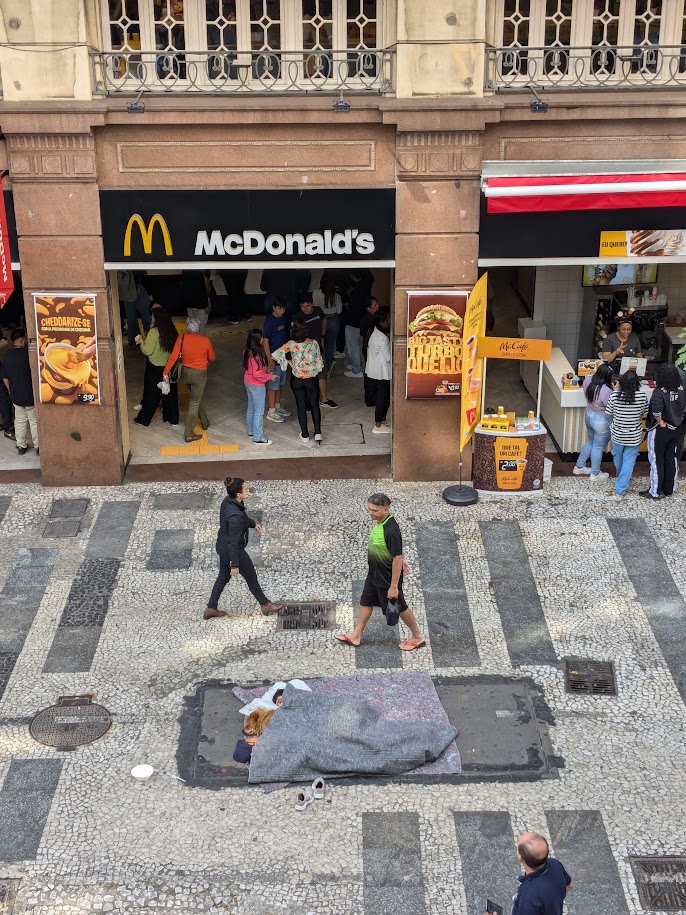
Image 1: Sleeping and eating in São Paulo’s inner city in 2024. Photo by author

The far right and extreme right scored a sweeping victory in Brazil’s elections on 4 October. The presidency will be decided in a run-off on 25 October, but even if Flávio Bolsonaro loses – which seems unlikely – the elections are an unprecedented success for Brazil’s far right. Far-right candidates for governor, the Senate and the state and federal legislatures did very well. Bolsonaro’s Liberal Party (PL) won 121 Chamber seats, making it the biggest party in the Lower House. In several parts of Brazil, especially the South, voters could only choose between right-wing and far-right candidates. A record of 33 million voters stayed at home. Only in the Northeast of Brazil, the poorest and racially most diverse part of the country, did the Workers’ Party (PT) – Lula’s party – win.

Why? It baffles me that the far right continues to do so well and that many seem to vote against their personal economic interests. They also cast a vote against their concerns for safety and security. They vote for someone who de facto goes against their cherished Christian agenda of family and church; they vote against their geopolitical interests and against national sovereignty too. Many voted for an economic agenda that, as many can see, has deepened poverty in neighboring Argentina. What do ‘Bolsonaristas’, whose leader is serving a 27-year prison sentence for attempting a coup d’état and for plotting to murder his political opponents, care about when they go to the polls?

Family values, sex parties and 8 billion Euro

The hypocrisy of the far right is not a weakness: it is part of its appeal. Take Flávio Bolsonaro. He says he wants a country that is guided by Christian family values; he calls the Christian family the cornerstone of society and opposes abortion rights, queer rights and sex before marriage – we know the rhetoric all too well. He likens his campaign to a religious war against the evil left, as if he were a crusader. But what does Flávio himself do? His former business partner has accused him of taking part in parties with sex workers, organised for him and his friends. These parties were allegedly not isolated events but part of a wider web of corruption. He is under investigation by the Supreme Court for corruption and money laundering in connection with Banco Master, a bank whose fraudulent collapse left an 8 billion euro hole in Brazil’s deposit guarantee fund and cost pension funds an estimated 2 billion euro. The bank’s owner is suspected of having channeled millions into a biopic about Flávio’s father (see also Nunes 2026 on Bolsonaro’s 2022 campaign donations). Do people really imagine that their finances and Christian morality are in good hands with this man? I believe most people who vote for him know better. They see the hypocrisy – and my point is that this is precisely why they vote for him.

A clean city

I regularly spend time in São Paulo, where one of the main concerns of the Paulistanos is safety. The far right appeals to these concerns and promises to ‘clean up’ the city. They promise to remove the criminals, the homeless, the drug addicts and other so-called ‘vagabundos’. Time and again they promise to be tough on crime. Both São Paulo’s mayor and the state governor support Bolsonaro and have had years to show what they are worth. Yet the homeless and drug addicts are still there. They used to get together in an area called ‘Cracolandia’ until brutal police operations drove them out. But they are not gone. They now sleep, beg, and use drugs all over the city. When I walk through São Paulo’s city centre, I constantly have to watch my step to avoid human faeces. If anything, the city feels less safe in recent years, especially for women and at night. Far-right politicians have had the opportunity to show how tough on crime they are but they have failed. Paulistanos see this every day, and they complain about it – yet they vote for them again.

Rights to the city

A third example of far-right failure, again from São Paulo. São Paulo’s street carnival is organised by so-called ‘blocos de carnaval’. These blocos are neighbourhood organisations that put together impressive floats with music and dance. Some ‘mega blocos’ draw crowds of over a million people. ‘Acadêmicos do Baixo Augusta’ is São Paulo’s largest mega bloco. For carnival they dress up, play samba and other festive music from Brazil, and parade through the streets of the city. They festively demonstrate inclusivity and show that everyone has the right to the city: queer, black, women, men – all celebrate together. The far right and conservatives object to racial inclusion and what they call ‘gender ideology’. Their politics leave little room for such an inclusive carnival. Instead of supporting the blocos, the city gave the stage to a show by Scottish DJ Calvin Harris. Calvin Harris’s electronic dance music has no Brazilian roots but appeals to a young, white, ‘middle-class’ audience. And where did the municipality schedule it? Exactly on the same street and on the same day as Baixo Augusta’s parade. The city was warned time and again that this was going to be dangerous. Over a million people were expected for Baixo Augusta alone; drawing an even larger crowd to the same street was not safe. What made it worse was that the police had closed off Praça Roosevelt, a nearby square. It was cordoned off with three-meter-high metal panels guarded by police. This left even less space. The mayor did not listen, said that all would be fine, and Calvin Harris drew an estimated million plus young people. It was chaos. On social media people could see youngsters being crushed by the crowd. They had nowhere to go. Some were injured, others fell over the metal barricades that the municipality had put up. The police tried to push youngsters back and when that did not work they started beating them with their batons. In effect, the mayor marginalised Baixo Augusta and the inclusivity it stands for. And everybody could see the incompetence as mostly white youngsters were crushed. And what do people do after having witnessed the violence inflicted on their kids? They vote for the far right, again.

Why vote for failure?

These three vignettes stand for major themes of the elections. The promise that your finances and Christian morality are in good hands: failed. The promise to be tough on crime and make the city feel safe again: failed. The promise to roll back ‘gender ideology’ and ‘identity politics’ and go against racial inclusivity: in the end, it was all so poorly organised that white kids were the ones actually beaten up by the police. To be clear, this is of course not my agenda. I am looking at it from the perspective of far-right voters. Why vote for these Bolsonaristas when they so clearly failed to deliver what you care about, even in a city so firmly in far-right hands?

Hypocrisy as sovereignty

Don Kalb (2025) would approach this through conjuncture, class and capital in which culture wars become a necessary ‘displacement’ of political and economic contradictions. Symbolism and worldviews are no smokescreens: they shape their own reality through which people define personhood. I suggest that we need to read the hypocrisy through Giorgio Agamben’s (1998) figures of the sovereign and the homo sacer. The sovereign, Agamben argues following Carl Schmitt, is the one who decides on the state of exception. The homo sacer, in Roman law, was a person who could be killed with impunity. It is a life without legal or political protection. The sovereign can thus decide when the laws and rules that govern society can be suspended. The hypocrisy is, in fact, an act of sovereignty. The rule of law does not matter when Flávio Bolsonaro says he is fighting a spiritual war for the family while allegedly having parties with sex workers – people that his own rhetoric barely recognises as human beings. He can say that he takes care of your household budget and cost of living while being investigated over his ties to a banking fraud that cost Brazilians billions of euros. Far-right politicians can say they are tough on crime but make the city even less safe. This hypocrisy does not undermine the far right; on the contrary, the far right thrives on it. It symbolises the sovereign status that Bolsonaristas aspire to. They are the ones who decide when the rule of law can be suspended and which lives count. Sometimes this is quite literally so. Someone told me about a dinner party he had attended. Over a glass of beer, one of the guests – who, as usual, was carrying his gun – casually said something like: ‘You know what I would like to do tonight? Go out on the street and just kill someone, just someone, for fun!’ The sovereign needs the homo sacer, those who can be killed without it counting as murder.

Image 2: Screenshot from ‘Mais de 560 mil votos! A deputada mais votada da história de Santa Catarina’ by Metrópolis Oficial (TikTok 4/10 2026) https://vm.tiktok.com/ZGdCNxuvx/

Silenced and amplified voices

This misogynist, racist, queerphobic and classist discourse spreads via social media, which amplifies the division between ‘us’ and ‘them’. Even those working at the margins of the economy, who like to see themselves as entrepreneurs (think of Uber drivers) are drawn to it. But social media posts circulate differently. I was sent a post on TikTok about the investigations into Flávio Bolsonaro. The post was gone within minutes, before I could see it. Chavoso da USP, the pseudonym of Thiago Torres Moura Santos, is a sociologist, left-wing activist and influencer who fiercely and eloquently speaks out against politicians who criminalise the poor and working class. With his oversized sportswear, Oakley sunglasses, tattoos on his neck and face, he stays true to the working class and funk culture of the urban periphery. He had more than a million followers on Instagram until November last year, when Meta blocked his account without giving an explanation. His voice, so popular among young people from the periphery, is now harder to find and Meta has also blocked other left-wing influencers.

Digital capital has openly aligned with the Right. Social media are, as Don Kalb puts it, the far right’s ‘increasingly well-funded ideological base’ (2026: 6). Júlia Zanatta has just been re-elected to the Chamber of Deputies for the state of Santa Catarina, with a record 560,000 votes. She is vehemently against abortion, supports the Bolsonaristas who were staging a coup d’état in January 2023, and strongly opposes so-called ‘identity politics’, except her own. Her appearance and style speak for themselves. She wears her hair in braids wrapped around the crown of her head, often decorated with flowers. It is a style that evokes the Bund Deutscher Mädel of the Nazi era, an aesthetic that was central to the Nazi ideal of femininity. On TikTok we can see how she took to the streets to celebrate her victory. Surrounded by enthusiastic supporters and expensive cars she walks the streets with a whip in her hand, beating the road in front of her. She screams: ‘This is historic, this is a lot of votes! I want more votes! It went with the whip!’ To give these words more force she cracks her whip again. Is ‘this went with the whip’ only an innocent way to claim a massive and smooth victory? Or is it less innocent in a land that was the last to abolish slavery in the Americas? The imagery of the plantation overseer (feitor) – who whips whoever stands in his way and decides over other people’s lives – is palpable. Rodrigo Nunes (2026) traces how ‘the overseer hired to discipline the plantation workforce became, after abolition, the police officer’. Slavery is not a relic here but continues to resonate in fantasies about social and moral order. Images like these circulate freely on social media and are defended by people who argue that you need to see them in context. But which context?

Dignity on Credit

Why is this important not only to wealthy Brazilians, but also the middle-class? The dignity of the middle-class hinges upon unsustainable consumption patterns that make the distinction between us and them ever more fragile (Pinheiro-Machado and Scalco 2020). The newest iPhone and car must be bought on credit at extremely high interest rates. Credit cards charge more than 400% per year as financial inclusion has become ‘financial expropriation’ (Rugitsky 2026). Their lifestyle is only possible because of cheap labour: restaurant cooks, waiters, Uber drivers, nannies and domestic workers. They are also needed as ‘the other’ against whom one can feel superior. I have often heard people refer to ‘their’ worker as a useless pawn (peão). As if life were a game of chess in which pawns are easily sacrificed for the king.

Lula and the PT campaigned to shorten the working week from six to five days. He campaigned for the dignity of workers and their families and is known for many successful poverty alleviation programs. But, as Kalb (2026) would anticipate, the middle class perceives this as a threat – not only financially, because it raises labour costs for a ‘squeezed middle’ (Toneto 2026), but also, and perhaps even more so, I would argue, because it undermines the sovereign’s freedom to decide over the lives of others. At the same time, Lula is humiliated for being a Northeasterner who came to São Paulo to shine shoes and work in the factory (Bähre and Gomes 2018). The poverty-alleviation programs Lula put in place (with all their limitations) and the partly successful emancipation of women, Brazilians of color and queer people are seen as a threat to the correct hierarchy and middle class identity. The elections have to reinstate the boundary between ‘us’ and ‘them’. Moreover, I would not be surprised that this social media discourse encourages people to stop voting, disillusioned. While voting is compulsory in Brazil, more than 33 million people – 21 per cent of the electorate – did not vote: a record number.

A sovereign needs a homo sacer

A sovereign is nothing without a homo sacer. Voting for the Bolsonaristas shows that you are, or at least aspire to be, someone who decides when and where the law can be suspended; someone who rules, or aspires to rule, over the dignity and the lives of others. Someone who handles the whip. Ironically, the far right’s failure to deliver is precisely what fuels its success. Hypocrisy performs sovereignty. This is the logic behind the far right. You show that you can decide over homo sacer.


Erik Bähre is a cultural anthropologist at Leiden University whose work explores the moral and political dimensions of economic life, with a particular focus on the nexus of care and finance. His most recent research is on health, insurance and the family in Brazil.


References

Agamben, Giorgio, 1998. Homo Sacer: Sovereign Power and Bare Life, Stanford: Stanford University Press.

Bähre, Erik and Fabíola Gomes, 2018. “Humiliating the Brazilian poor: The iconoclasm of former president Lula”, Anthropology Today 34.

Kalb, Don, 2025. “Introduction: Counterrevolution within and against the Counterrevolution”, in Walden Bello and Don Kalb (eds.), Backlash: The Global Rise of the Radical Right, London: Pluto Press.

Nunes, Rodrigo, 2026. “Brazil: The Future of the Far Right”, interview by Carlos Pérez, Equator, 30 September.

Pinheiro-Machado, Rosana and Lucia Scalco, 2020. “From Hope to Hate: The Rise of Conservative Subjectivity in Brazil,” HAU 10(1).

Rugitsky, Fernando, 2026. “Battleground Brazil”, Sidecar (New Left Review), 2 October.

Toneto, Rodrigo, 2026. “Fiscal Democracy”, Phenomenal World, 19 March.


Cite as: Bähre, E. 2026. “Becoming sovereign: Brazil’s far-right election victory” Focaalblog October 10. https://www.focaalblog.com/2026/10/09/erik-bahre-becoming-sovereign-brazils-far-right-election-victory/


Don Kalb: Anthropological Use Value for an Anticapitalist Left

Image 1: Don Kalb and Marion Berghahn at the launch of Value and Worthlessness at the AAA annual meeting on November 21, 2025. Photo by Stefan Voicu

What a joy to be hugged, celebrated, and criticized by stellar colleagues who intimately know the stakes of invoking Marx in more than a fleeting way in anthropology; stakes that may be higher here than in other social disciplines. Theoretically and methodologically, anthropology is deeply imbricated in liberal and less liberal idealisms, with a stark belief in cultural contingency, and rather wild about the idiography of cultural difference, alterity, and autonomy. If the discipline moves Left, it naturally inclines towards anarchism, mutualism, ethics, radical versions of rights and humanitarianisms or posthumanitarianisms beyond the regular liberal offer, rather than to Marxism and political economy with all their system thinking. The anthropological desire is definitely for a human self that is autonomously thriving on ‘the outside to capital’.

This is largely how the discipline has fared during the worldwide political contestations of the 2000s. Hence the importance of a public anthropologist like David Graeber, who had the genius to catch the Left spirit of the time in the 2000s, before that time itself was fully aware of it. The soon to be coming counter revolution, however, was less noticed by David, or by our discipline at large, though the right wing backlash was smoldering already during the Left wing years. Anthropology only caught up with it, in shock, when the radical Right was already comfortably seated on the plush of Western governmental power, increasingly determining not just ‘policy’ but a full-fledged program of defensive-aggressive Western civilizational supremacy. Unpleasantly surprised, and aware of their own vulnerability, anthropologists at once realized they had long preferred to study ‘people like us’ (nice Left-wanting people) and had ignored questions about labor, class, right wing political anger, and fascism. The inside to capital was blowing back as a boomerang. Ten years later, this still describes our deeply worrying situation.

Admittedly, those of us who were located in, and working on postsocialist Eastern Europe (CEE) were somewhat better prepared than the Western and Southern liberal mainstream. We had seen the counter revolution of the illiberal Right taking shape in the late 1990s and early 2000s already. CEE, it turned out, possibly to our own surprise, was not the liberal laggard of Western imagination, but an illiberal avantgarde that would soon be followed by the West and many places of the South.

The political sociologist David Ost and myself were among the first to notice the deep class dynamics behind the process, dynamics that I later sought to succinctly capture with the concept of ‘double devaluation’, for which Jaume Franquesa salutes me. I love Jaume’s sudden observation that actually none of the concepts that are central to ‘Value and Worthlessness’ (Kalb 2025) are new, that the book is just an unapologetic argument for anthropological Marxism consistently worked out: class, labor, capital, dispossession, social reproduction…imperialism. These days I lay more emphasis than I used to on devaluation and on value, value regimes, and an anthropologically informed dialectical take on the law of value, what Voicu rightly calls my ‘huffing and puffing’. These concepts were less common in the anthropological structural marxisms of the 1970s (though I owe Jonathan Friedman, a survivor of structural Marxism 1970s style, for having pushed me along this path without him being much aware of it, I guess), but Jaume is so right: nothing new, really, just an update of an existing Marxist toolkit and a modest anthropological rethinking under new circumstances and with new problems at hand, within and against a drastically transformed capitalist totality of social relations as compared to the one that produced the 1970s Marxist upsurge. My categories and approach are tuned into that new reality and coined in order to help explain the radical right wing political backlash in CEE and anywhere, in anthropological ways, that is.

I want to emphasize that I have never felt much for the overt structuralisms of those days. At every turn I try to dip my approach to value (“value and values, value regimes”) in what I call relational realism: relations that can be studied, ‘life in and as action’ on worldwide, as well as regional, national, and intimate levels; levels that are dialectically imbued with each other as in multi-scalar relationships; relations with others on which we depend and that shape who we are and who we can and want to be. Hence the ‘structured totality’. Hence also Trotsky, not just for his combined and uneven development, which, as Stefan Voicu rightly notes, is essential, but also his early gesture towards multiscalar analysis as expressed in the distinctions he made between ‘algebraic, arithmetic, and molecular’ scales of analysis, a vision Eric Wolf would later set to work in his ‘faces of power’ (without ever citing Trotsky). There is a big and urgent anthropological project in bringing this multiscalar dialectical edifice of value, including the ‘systemic production of worthlessness’, to work ‘close on the skin’ in the biographies, actions and experiences of our key fieldwork interlocutors; helping to bring their hidden histories into view in ways that under normal circumstances are not usually revealed to them.

‘Intimate Marxism’, Sharryn Kasmir calls the result and she likes it; a profound observation plus a seductive name. Thank you, Sharryn. ‘Intimate Marxism’, almost an oxymoron given popular and anthropological prejudices against a Marxism believed to be preternaturally given to obscurantist or even violent abstractions. Marxist anthropology might want to embrace ‘Marxist intimacy’ as a key element of our mission as compared to other Marxisms, but also, and perhaps more importantly, in relation to liberal anthropologies, as Sharryn suggests. We are seeing avowedly ‘liberal’ anthropological approaches to fascism these days that thrive on and all but seem to fetishize what I am tempted to characterize as mere ‘spoken words’, utterances derived from interviews and social media content, without much of an effort to create a compelling understanding of the speaker’s whole, lived, emplaced social life as it unfolds in time and space, with all its contradictions, desires, fears, angers, disappointments, suffering, private victories. Intimate Marxism searches for the full human claim to a worthy and meaningful life beyond inevitably rather random moments of utterance, life with others, and within and against the ‘inside to capital’. This is an ambition that comes with a strong recommendation here, and with a sense of both urgency and patience, to get behind and beyond the facile fascist (etc.) surface. Words are so easily spoken and scribbled up these days, a massive social media – that is, digital capitalist – driven overproduction; a flow of half-digested fuzzy signifiers for people to just show they keep up with the socially necessary speed of circulation (and with their neighbors). But what the hell do they really mean when spoken?

Image 2: Don Kalb and Marion Berghahn at the launch of Value and Worthlessness at the AAA annual meeting on November 21, 2025. Photo by Stefan Voicu

This brings me to the point where I must engage with Ida Susser’s critique that in Value and Worthlessness I am weak on Gramsci, commoning, counter hegemony, ‘Left wing culture’. First, I am puzzled that I have apparently failed to show that my key informant Zadrozny – a person around whom a much broader story is told in my work on Poland – was precisely that type of an outspoken and important organic intellectual that she wants me to look for and that she strangely thinks is missing in my approach. As far as I know that problematic is right there in the middle; it’s what the whole story is about. Zadrozny was a lifelong key actor and organizer within a broad and powerful commoning movement for worker self-management, comprising at various points tens to hundreds of thousands of people, first against the ‘really existing socialist’ state, then against the neoliberal state, both of which would dispossess local workers of their self-managed factory commons (which included much more than those factories: credit, family benefits, kindergartens, health clinics, holiday camps, media!!). All of this is described though perhaps not really studied, it is more a starting point for another type of study, one that helps explain the puzzle of why this all lands on the radical Right side of the political spectrum. I am puzzled that Ida thinks I am neglecting Gramsci, hegemony, counter hegemony, commoning, and organic intellectuals. Maybe it is this: Many of my Western and in particular American friends have always found it hard to understand that the East European illiberal right was not an authoritarian imposition by the state or capital but an actual mass organic counter movement Polanyi style, as well as a counter hegemonic movement Gramsci style, against respectively authoritarian socialist and neoliberal state impositions. It is true that I do not study Left wing culture in Poland in the 2000s, that is because Right wing culture was the big issue and for us Western as well as Eastern analysts the big puzzle.

In Poland worker-led Solidarnosc ended up on the radical Right, just like the mass protests against the privatizations of health and pensions in Hungary in the early 2000s ended up with Orban’s Civic Circles and, in the Northeast of the country, now with a racist twist, with Jobbik. Western Gramscians often find it difficult to understand that there is no automatic affinity between commoning and the Left. The Left is a possibility, not more than that. But what if a self-nominated so called Left in power is your enemy? Regional histories, national public legacies, and relations of power produce crucial differentiations here. In France, the Yellow Vests could have moved rightwards too but in the end, partly as a consequence of street-commoning, as Ida’s (2026) new book shows, they ended up in a Left coalition. That Left coalition may not be strong enough though to keep the radical Right out of power in France: kindred processes of double devaluation as the ones I have observed in CEE are playing themselves out in that nation too, as elsewhere. Populist Lefts and Rights and their organic intellectuals and commoning practices are trying to capture and articulate that popular experience of double devaluation, both attacking the liberal center. As in CEE, in France the Right often dominates in the provinces and the rural areas, in particular those that have long stagnated and have seen big out-migrations. In CEE whole states as such have seen massive outmigrations and have indeed generated dominant, even hegemonic, right wing illiberal regimes in power. In France, the Left can compete in the big cities and sometimes in the provincial centers, such as in the recent electoral victory in Roubaix. More broadly, we should not ignore the fact that Gramsci is entirely embraced by the illiberal international nationalist Right and alt-right.

Being located in and working on CEE, I had to confront the objective of explaining the rise of the radical Right from the deeper popular experiences from which it was assembled. That included the commoning practices, but my curiosity went beyond the overt political organizing, which was established long before I arrived in the late 1990s: what happened to these well-organized manufacturing workers who went from Trotskyism against ‘neoliberal-Stalinism’ in the early 80s to radical illiberal nationalism against neoliberalism in fifteen years’ time? What was the popular experience, the hidden history, that helped to explain this political journey? That is what my approach in the ethnographic chapters helps do. Though I firmly believe that political outcomes are in the end somewhat contingent, they do happen by definition in regionally inflected and embedded ways – as part of the regional insertion into global capital accumulation and class formation; that is, they happen in relation to identifiable and describable value regimes. In the CEE postsocialist peripheries, where a neoliberal Left was hegemonic in the 1990s and 2000s, it meant that they overwhelmingly ended up on the radical right, as part of a counter hegemonic illiberal nationalist alternative. In France, in the core of the EU, with one of the most extensive welfare states in the region, the Yellow Vests in the end moved Left, but whole working class areas in the North and the East of the country moved right too, as they have been doing elsewhere in Europe and much of the world. CEE turned out to be an illiberal avant-garde. But we now also know, with the recent developments in Hungary, that such illiberal regimes too can succumb under their own contradictions, as seems to be happening with Trump and MAGA already.

Local commoning and its outcomes are not determined locally. Nor are what Ida Susser calls ‘political cultures’. Capitalism is a fast moving multiscalar edifice, no outside to that, even though any location has its fundamental specificities as part of its spatiotemporal insertion in the whole, which includes the socio-political histories and ‘political cultures’ of that insertion. That was also true for the South African anti-apartheid fight that Ida invokes; an invocation that is much to the point here. Would Southern Africa have seen the end of the Apartheid state in 1994 without the Polish 1989? Without the Soviet Union having gone bust? With the Apartheid regime still being seen among the Western ruling class as the last bulwark against a violently spreading African communism supported by the Soviet Union (Angola, Mozambique…South Africa)? We cannot be sure but quite possibly not. With communism and the Soviet Union all but gone, de Klerk was encouraged by domestic and international capital and the West at large to negotiate with the ANC. And Poland had delivered the example of the Roundtable. Thus, Poland and South Africa were again linked at the hip as two of the most ideologically and geopolitically significant ‘peaceful democratic transitions’ within an ever more neoliberal US led globalizing capitalism; both of them officially declared successes, but both also failing as inclusive democratic capitalisms for the many; both, as a consequence, ultimately giving rise to strong illiberal populist counter formations, in South Africa the Zuma faction within the ANC, in Poland, populist Solidarnosc against its former dissident anti-communist intellectuals, now the political elite. That new neoliberal Polish state elite and its wider hegemonic public culture and civil society was hellbent on telling the working class that they were just ‘worthless Poles’ who deserved the whip of capital pure and simple. These workers didn’t willingly agree and the Law and Justice regime was the biting result; an illiberal nationalist Right that was very unfriendly against leading liberals but that did reduce poverty and did push up the whole national economy by setting up a natalist/familialist welfare state against the loud protestations of the so called Left that this could only be economic suicide.

The fight, here and there, preferably combined, continues. But for now, the Left, too liberal, too neoliberal, too bienpensant, and in its more radical versions too much tempted towards the outside of capital, has lost. Is this overdetermined, I hear my friend Ida Susser ask? I hesitate and would love to say no. I actually whisper it, but then I see myself jump up and hear me exclaim loudly that there are no voluntarist escapes. Just pulling ourselves up on our belts and start organizing and commoning? No. My hope for counter hegemony does not start by confirming the importance of existing Left wing cultures because that is, as far as it goes, self-evident. It starts with listening very carefully to our ‘lost’ interlocutors in the field and with getting to grips with why ‘we’ ended up beaten by a popular force that ‘we’ used to associate with outright darkness and that we had imagined to have died out well before this 21st century had even started. And here we are. And this while capital and empire are going completely off the leash. Our deeply troubled predicament requires us to move the new global populist Left well beyond the limits of the liberal, limits that are so powerfully inscribed into the system and that will certainly not be overthrown by the illiberals, that is the power of property as capital, a power that is beyond the reach of any constitutional national democracy, and at the same time reject the utopian escape towards the outside to capital. That is why we need a full out rethinking of capitalism and its liberal and illiberal guardians, preferably in anthropologically informed ways. The well-trodden paths of the Left are exhausted. Call what we need revolution please. Some of that is tried in my book. Much more is needed.


Don Kalb is Professor of Social Anthropology at the University of Bergen, founding editor of Focaal and Focaalblog. His latest books are Value and Worthlessness: The Rise of the Populist Right and Other Disruptions in the Anthropology of Capitalism (Berghahn Books, 2025), and, co-edited with Walden Bello, Backlash: The Global Rise of the Radical Right (Pluto Press, 2026).


References

Kalb, Don. 2025. Value and Worthlessness: The Rise of the Populist Right and Other Disruptions in the Anthropology of Capitalism. New York, Oxford: Berghahn Books.

Susser, Ida. 2026. The Yellow Vests and the Battle for Democracy. Taking to the Streets of Paris in the 21st Century. New York: Routledge.


Cite as: Kalb, D. 2026. “Anthropological Use Value for an Anticapitalist Left” Focaalblog May 5. https://www.focaalblog.com/2026/05/05/don-kalb-anthropological-use-value-for-an-anticapitalist-left/