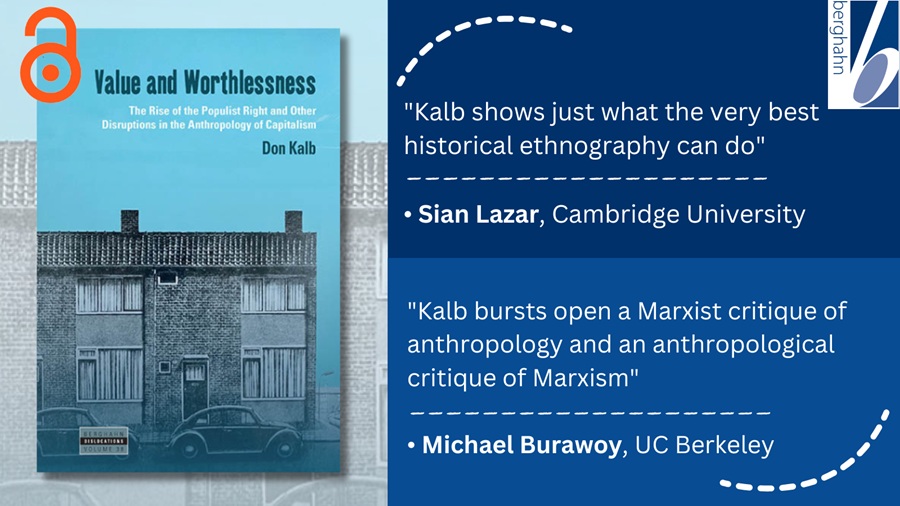
This text is not about the huffing and puffing you would expect. Although Don Kalb is Dutch, his new book, Value and Worthlessness: The Rise of the Populist Right and Other Disruptions in the Anthropology of Capitalism is about a different kind of huffing and puffing. Kalb borrows this expression from E.P. Thompson to foreground the messy realities on which the hegemony of the capitalist law of value rests. Let me quote him at length on this:
Rather than being the assured outcome of successive market equilibria, this immanent historical tendency [the law of value] was always also the contingent outcome of ongoing class struggles at all levels in the system, and throughout all its various, evolving and interlocking institutional domains; and this against a turbulent background of recurrent economic crisis and violent ruptures (Kalb 2025, p. 54)
In Value and Worthlessness, Kalb has set out to do something that nobody has attempted to do since the 1970s. He develops a programmatic line of Marxist research in anthropology and outlines a conceptual toolbox that binds together political economy, social history, and ethnography. Kalb began his career in the late 1980s, during the last flickers of a once popular Marxist anthropology, but remained unapologetically Marxist, centering his work on an expanded notion of class to understand the globalization of capital at a time when the discipline was rapidly spiraling out of control into the language-games of culture. Now, bringing together his fieldwork with workers from the Philips factory in the company town of Eindhoven, with post-socialist Solidarność workers from the Polar factory in Wroclaw, and, accompanied by Oana Mateescu, with cognitive workers from Cluj’s booming IT industry, he develops an anthropological theory of capitalism and the methodological guidelines to pursue it.
Kalb does a lot of huffing and puffing himself in the book, describing social processes that unfold in and across capitalist times and spaces. I invited Jaume Franquesa, Sharryn Kasmir and Ida Susser, three leading US-based Marxist anthropologists, to write down the reflections on the book they shared during the launch of Value and Worthlessness at the 2025 AAA annual meeting. In the texts gathered in this feature, each of them celebrates the book while extending it in a distinct direction. Kasmir theorizes Kalb’s ethnographic method as “Marxian intimacy,” Susser presses him to take counter-hegemonic culture and processes of commoning more seriously, and Franquesa salutes the book as a courageous manifesto that equips Marxist anthropologists with vocabulary and purpose.

On top of their brilliant interventions, I want to outline three other important contributions this book makes.
First, Kalb proposes to view capitalism as an unevenly structured totality, a system that produces internal differences on which it feeds. Those readers of the book knowledgeable in post-Marxist theory, as well as the “less marxists” anthropologists Kalb takes aim at, will likely huff and puff at this idea. For half a century, Marxist theory has been constructed around the idea that capitalism is incomplete, that there is something external to it and the thrust of capitalism’s law of value is sucking in these outside spaces brimming with counter-hegemonic possibilities. Kalb instead starts from the common sense observation that contemporary capitalism has commodified everything. Directly or indirectly, the majority of the world’s population is now exploited by a minority that accumulates capital. Capital is insidious, as Kalb (2024) argues in the introduction to the edited volume that could be read as a companion to Value and Worthlessness, and the new frontiers of value are manufactured mainly through spectacular accumulations followed by violent processes of devaluation. There is no way out of capitalism except through it. Marx’s argument that the bourgeoisie produces its own gravediggers never rang more true than today and between the lines of Kalb’s book one can read a repositioning of the redefined working class at the center of the struggle for a better world.
Second, Kalb wants to extricate Graeber’s radical anthropology from Mauss’ influence. He argues that because of this influence Graeber’s work on value is unable to account for class struggle and the multi-scalar structure of capitalism, misleading him into a somewhat voluntaristic political position. Kalb argues radical anthropologists should replace Mauss with Trotsky. According to Kalb, not only is the latter’s History of the Russian Revolution more ethnographic than anything Mauss wrote, but Trotsky, as opposed to the academically embedded ‘nepo baby’ Mauss, is probably a better model of politically engaged thinker. Moreover, neither Mauss in the 1920s-1930s, nor Graeber in the 2010s-2020s anticipated the rise of the fascist right. Both Trotsky and Kalb sounded the alarm on these worrisome developments early on (see Kalb 2009, Kalb and Halmai 2011, Trotsky 1971). Not coincidentally the structured unevenness defining Kalb’s capitalist totality is drawn from Trotsky’s theory of uneven and combined development and it is sharply opposed to Mauss’ expressive totality. However, it’s undeniable that Graeber was a model of a politically engaged anthropologist, highly influential, and quite the opposite of a ‘nepo baby’. The anarcho-socialist politics he promoted, coupled with the enduring, although questionable, image Trotsky carries as responsible for crushing Kronstadt, will probably require more huffing and puffing to replace Mauss and the kind of activist politics anthropologists are willing to engage in.
Third, in his engagement with Graeber and his theory of value, Kalb brings David Harvey’s political economy down into the muddled realities of “emplaced anthropological huffing and puffing” (Kalb 2025, p. 54) and proposes a new anthropological theory of capitalist value. Graeber’s value theory aimed to collapse the distinction between value, as in economic value, and values, as in social and cultural values. In his Toward an Anthropological Theory of Value (Graeber 2001) he develops the theoretical framework for this project, but only in Debt (Graeber 2011) he fully explores the implications of the argument. Debt, Graeber shows, is not only an economic value, but permeates and frames all social relations. Graeber shows how one can find debt defining the relation between God and humans in the oldest religious text, as well as between friends in everyday life. Kalb rejects both the value/values distinction, as well as the reduction of both to one single value that Graeber advances. Instead, he proposes to look at value and values as being in a “dynamic relational totality” he calls “value regime” or “dialectical value regime”. Analysing the vernacular narratives of worth and worthlessness in The Netherlands and Poland, Kalb shows how workers’ values emerge alongside or in opposition to the accumulation imperatives of a specific industry, in a specific time and space, and always in conjunction with the abstract forces of capitalism’s law of value. Through this engagement with intimate experiences of capitalism, “Marxian intimacy” as Kasmir beautifully puts it, Kalb builds a theoretical foundation for the understanding of the rise of the populist Right in Europe and develops the concept of double devaluations, of both value and values, whose importance Franquesa highlights in his text.
Whether readers will huff and puff or nod in agreement while reading Kalb’s take on totality, Trotsky versus Mauss, regimes of value, or the critical junctions that led to the rise of the populist Right, matters less than the importance this book should have in any attempt to research contemporary capitalism. Like all great books, this is one critical anthropologists must reckon with, debate, criticize and use to advance our understanding of the current conjuncture.
The photos I took at the book launch got a bit damaged when I developed the film I shot them on. Coincidence? Maybe…They look a bit haunted, which kind of fits the 2025 AAA annual meeting theme of Ghosts. In these photos Don Kalb, Jaume Franquesa, Sharryn Kasmir, and Ida Susser seem to be those specters of marxism haunting a conference where sessions on Marxism and communism, conjured nowadays by right-wing leaders as if it was still the Cold War, were strangely missing.
Stefan Voicu is a social anthropologist researching transformations of property and class relations under financialized capitalism. He is one of the FocaalBlog editors.
References
Graeber, David. 2001. Toward an Anthropological Theory of Value: The False Coin of Our Own Dreams. Palgrave.
Graeber, David. 2011. Debt: The First 5,000 Years. Melville House.
Kalb, Don. 2009. ‘Conversations with a Polish populist: Tracing hidden histories of globalization, class, and dispossession in postsocialism (and beyond).’ American Ethnologist 36(2), 207-223.
Kalb, Don. 2024. Insidious Capital. Frontlines of Value at the End of a Global Cycle. Berghahn Books.
Kalb, Don. 2025. Value and Worthlessness: The Rise of the Populist Right and Other Disruptions in the Anthropology of Capitalism. Berghahn Books.
Kalb, Don and Gábor Halmai. Eds. 2011. Headlines of Nation, Subtexts of Class. Working Class Populism and the Return of the Repressed in Neoliberal Europe. Berghahn Books.
Trotsky, Leon. 1971. The Struggle Against Fascism in Germany. Pathfinder Books.
Cite as: Voicu, S. 2026. “Huffing and Puffing with a Marxist Anthropologist” Focaalblog April 20. https://www.focaalblog.com/2026/04/20/stefan-voicu-huffing-and-puffing-with-a-marxist-anthropologist/