Political upheavals can feel like riding a roller coaster – exhilarating at the beginning, full of adrenaline rush, until it suddenly stops. This is what happened to the biggest protests against Prabowo administration and its erratic policies in late August-early September last year (Anugrah and Putri 2025). Mass arrests of protesters (including dissenting netizens), declining momentum of the protest demands, and deadly floods in Sumatra due to extractivist deforestation (Syaifullah and Adawiah 2026) virtually put major demonstration activities on halt. Compounding these structural hurdles was the lackluster move of liberal influencers and public figures whose naive political steps – such as overreliance on fanbase mobilization and engagement in an appeasement dialogue with a few members of parliament (MPs) – effectively contributed to the moderation of an otherwise brewing struggle.
As the basic reformist demands of the protests – cancellation of proposed raise of allowances for the MPS, end to police violence, and people’s welfare and labor rights – remain unmet, people continue to struggle for their livelihood. Repression made post-protest mobilization riskier, but certainly the mute compulsion of capital (Mau 2023) was another major factor that kept people away from the streets. When the brief possibility of political shake-ups subsided, it made sense to focus on one’s livelihood amid growing socio-economic precariousness (Subianto 2025).
What happened then in these “morning after” moments? During our field observations we noticed that: 1) post-August mobilization and activism exist, albeit in more moderate forms and intensity, 2) the prevalence of liberal activism and its vacuous impacts reveals its limits, and 3) the movement’s losing momentum suggests the need to be aware of the material conditions of activists and the broader public as a prerequisite for future mobilization.
Post-August activism: resilient, yet defensive
A major reason behind the decline of the movement was the mass arrests and criminalization of the protestors by the state. Comprehensive data on arrests across Indonesian cities was difficult to access, but in one key case six people, including three activists and two ordinary citizens, were arrested and charged for “inciting riots” by uploading images and narratives from the protests on their social media. In fact, they were simply expressing their opinions and frustration – in other words, their constitutional rights – concerning corrupt practices by political elites and state institutions. Initially, the six individuals were denied access to legal assistance or contact with their lawyers; some of them were even arrested violently by the police.
A joint report by three human rights/legal aid organizations showed that this repression was the biggest crackdown on youth activism since the downfall of the New Order dictatorship in 1998, with thousands arrested (later mostly released) and more than 700 arrestees unjustly brought to the court (KontraS, YLBHI, LBH 2026)
However, many others who were arrested by the police did not receive significant public attention. Several factors may have contributed to this lack of visibility, including difficulty in reporting the case, their lack of “shiny” credentials compared to more established activists, or the fact that they reside in smaller cities or regions distant from major cities.
Amid this criminalization of dissent, other activists, CSOs, legal aid lawyers, and scholar-activists have focused on online public campaigning, organizing small-scale protests demanding the release of detained activists and protestors and showing moral support through prison visits. Notably, legal aid lawyers have worked hard to provide legal assistance to release the detained activists. Legal scholar Eryanto Nugroho (2025) describes these initiatives as a sign of resilience by progressive civil society groups and activists in the face of state crackdown. While we agree with certain parts of his analysis, the idea of resilient activism should be contextualized and qualified.
Drawing insights from geographers Danny McKinnon and Kate Driscoll Derickson (2012), we conceptualize resilient activism as the potential and capacity of the collective to anticipate and recover from challenging situations. In the aftermath of protests, it is important not to glorify this resilience. Then, take a step back and investigate resourcefulness, that is, the possibilities of communal actions with an attention to uneven distribution of resources within the movement. To this, we would also add that Indonesian social movements and activists should (re)start the discussion on building collective self-defense under growing state surveillance and repression.
What else can we and other people do in this time of intensified repression and precarity? How could we act within (and hopefully beyond) our means? As the political momentum declined, we noticed that most of our activist comrades focused on other tasks, such as organizing public discussions and taking the role of trainers in popular education activities. Moreover, in response to the government’s denial of responsibility and lack of response to Sumatra’s socio-ecological catastrophe, environmental movements and activists have underlined the political nature of the disaster that is rooted in state-sponsored and corporate-led extractivism and campaigned for structural policy changes (see also Syaifullah and Adawiah 2026).
This situation shows that resilient activism is essentially a survival mechanism during times of limited options, an ongoing struggle amid the repression, precarity, and uncertainty. It is both a sign of potential longevity and desperation.
Liberal Activism: A Stumbling Block
The decline of the movement requires us to look at the political economy of activism during and after the protests. One analysis correctly points out differences in material conditions and cultural capital among protesting groups: while student groups and civil society organizations (CSOs) – not to mention unions and other grassroots movements – did the heavy lifting of “street fighting” and actual organizing, it was the influencers who reached the broader audience, gained oppositional credentials, and had the privilege to meet the MPs (Damayana 2025).
Some activist and organizer friends whom we talked with lamented this fact, especially when the national parliament preferred to engage with the influencers rather than labor unions and representatives.
This means those who worked the hardest and sacrificed the most during the protests – and arguably had the most effective street mobilizational power – were sidelined by the most media-savvy, celebrity-like figures. This also means the more radical challenge to the existing power structure was effectively eclipsed by much more moderate demands.
The curious rise of influencers as liberal commentariat is emblematic of development processes in peripheral capitalist countries such as Indonesia, where the neoliberalization of universities, research institutes, and the civil society sector has intensified class differentiation among cognitive workers (Anugrah 2025). In this context, liberal influencers, who hoarded – in other words, accumulated – knowledge and cultural capital became successful members of the professional managerial class (PMC) (Liu 2021) who labor in online content creation as “critical” commentators.
Amid fragmentation of social movements, cooptation of student activists by bourgeois political elites, low union density, and yet simultaneously rising political consciousness among the broader student population (Aminuddin and Ramadlan 2022), it is unsurprising that liberal influencers found a captive audience. In the marketplace of ideas and influence, they rule and win followers though they remain “fleeting,” divorced from concrete social forces and bases and lack any strategic materialist analysis, let alone political tactics.
A closer look at their profile and politics confirms such observation. For example, Malaka Project, a media platform of liberal influencers, is a business project with links to corporate sponsors. Other liberal influencers have their own vehicles such as consultancy firm Think Policy and English-based media channel What Is Up Indonesia (WIUI), two platforms with neoliberal economists and policy consultants among their board.
Politically, they zigzag between approaching the government when it was deemed as “reformist” particularly during the Joko Widodo (Jokowi) presidency and supporting anti-government protests when they were dissatisfied with it. As of now, their attention seems to have shifted to launching their publishing initiative at a Jakarta-based shopping mall, winning “40 under 40” award from the Indonesian branch of Fortune Magazine, and commenting on current affairs.
Of course, this can be seen as a public relations strategy to make activism palatable for the (petit)-bourgeois polite society, presumably from a place of good heart. But it is also reasonable to ask whether such strategies will a) broaden the pro-democratic coalition against hazardous government policies or b) force the elites to give some concessions to the public – the answers to which, in our view, are highly questionable.
To be fair, the Indonesian CSO sector is also donor-dependent and sometimes complicit in the moderation of movement agenda, such as in the context of anti-corruption advocacy during the Jokowi Presidency (Mudhoffir 2023). However, it is still deeply connected with grassroots social movements and bases and altogether they operate in the same social milieus. Unfortunately, this is not the case with liberal influencers.
In this context, the call for broad civil society unity should be qualified. Campaigners, including influencers, have a role in raising political awareness or even fundraising for disaster relief, but as we have argued previously (Anugrah and Putri 2025) the command for collective actions should remain in the hands of grassroots and working-class movements and actors for a meaningful change – redistributive concessions and restoration of basic democratic rights – to happen. Influencers are neither organic thinkers nor vanguard activists – it is social movements and the working people who should control them and not the other way around.
Wither Political Momentum?
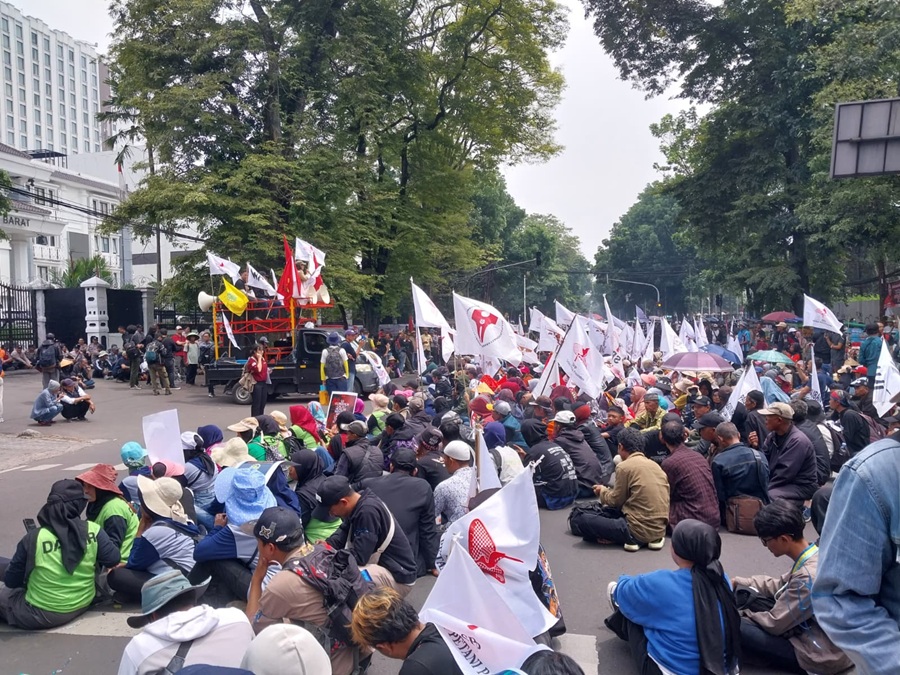
What remains of the August protests? Is it now the time to conduct a “post-mortem” analysis of the movements? Much of the massive protest activities had indeed ended and the public attention had shifted to other pressing issues, especially post-disaster recovery in Sumatra and Indonesia’s controversial participation in the Trumpist Board of Peace. However, this is not the end of it.
This current protest cycle might end, but this will not be the last one. Seen from a longer perspective, it is the last iteration of recent mass movements since the 2019 protests. Though organizers and the working people are currently on retreat, it is not far-fetched to speculate that another movement might erupt in the (near) future. Ongoing structural impoverishment of average Indonesians and erratic policies of the ruling class will keep triggering mass demonstrations.
Here we reiterate the need to be cognizant of the material basis of activism. Liberal activism has its own limits and, dare we say, cul-de-sac. We also have to admit that this tendency sadly is also embraced by the more progressive sections of civil society. Celebrity culture, which can be self-serving, remains practiced by chronically-online activists and self-styled progressive influencers. Another liberal tendency for unnecessary moderation can be seen in the decision of a senior cultural activist-turned-bureaucrat to take the helm of the directorship of Megawati Institute, a think-tank named after Megawati, the matriarch-for-life of the Indonesian Democratic Party and, as political scientist Jeffrey Winters (2013) puts it, a hidden oligarch. It is difficult to see how exactly such a decision will help the advancement of democratic class struggle.
Therefore, any conversation on “strategic alliance” between broad civil society elements should start from recognizing the fact that in the current context, most grassroots activists and mass bases are precarious in terms of their livelihood and socio-cultural/political capital. Further, there should be a serious discussion on curbing (petit-bourgeois) celebrity tendencies in the so-called “progressive” circles.
For now, major protest activities are indeed on decline, but other activist initiatives continue. This includes not only advocacy for the unjustly arrested, but also a whole range of activist works – movement meetings and gatherings, smaller-scale protests, public discussions on today’s pressing issues and progressive/radical literature, and popular education initiatives.
These activities have their own limitations. For example, a local farmers’ protest in front of the West Java provincial government and parliament that one of us (Iqra) observed on 9 December 2025 remained centered on local land rights issues. While this was clearly important, it missed the opportunity to link local issues with broader, more expansive national-level demands.
Nevertheless, this type of work helps social movements to keep going and build up their momentum. In one instance, we participated in a critical agrarian studies training as facilitators and found it to be an engaging forum connecting young activists and researchers across regions to reflect on their advocacy and research experience. Such initiatives can serve as seeds for further mobilization.
Recent policy blunders of the populist Prabowo administration and elite repression of popular activism might intensify the growth of such seeds. Hundreds of protesters representing student groups, social movements, and CSOs protested Indonesia’s participation in the Board of Peace and called for international solidarity for the Palestinians and against imperialism. The horrific acid attack against the young human rights advocate Andrie Yunus toward the end of Ramadhan (Hermawan and Hamid 2026) also prompted a number of national and international solidarity campaigns and protests for Yunus and democratic rights in Indonesia. At the very least, these realities convinced the public that they are right to be skeptical of the false promises of the state and the ruling class.
As we had witnessed directly, the longevity of protest movements depends on the hidden labor of ordinary citizens, precarious activists, and the most exploited and marginalized strata of society. They will, once again, launch and hopefully lead future struggles.
Acknowledgements: We would like to thank the Agrarian Resource Center (ARC) which hosted us during our recent fieldwork in Indonesia and our comrades at Forum Islam Progresif (FIP) for their insights.
Iqra Anugrah is a Trapezio MSCA Seal of Excellence Fellow at the Department of Foreign Languages, Literatures and Modern Cultures at the University of Turin. He holds affiliate positions at the International Institute for Asian Studies (IIAS) in Leiden and the Institute for Economic and Social Research, Education, and Information (LP3ES) in Jakarta. An interdisciplinary political theorist, his current project on multi-strand conservatism in Indonesia is funded by Fondazione Compagnia di San Paolo.
Rachma Lutfiny Putri is a Wenner-Gren Wadsworth International Fellow and a PhD candidate at the Department of Social and Cultural Anthropology at Vrije Universiteit (VU) Amsterdam. She is also a Visiting Fellow at Populi Center. Her dissertation project examines the question of value in the waste recycle chain in Bandung, Indonesia.
References
Aminuddin, M. Faishal, and M. Fajar Shodiq Ramadlan. 2022. ‘Aktivisme mahasiswa 10 tahun terakhir: banyak golput, menjaga jarak dari politik praktis, tapi peka isu demokrasi dan HAM.’ The Conversation, April 22. Accessed March 23, 2026.https://theconversation.com/aktivisme-mahasiswa-10-tahun-terakhir-banyak-golput-menjaga-jarak-dari-politik-praktis-tapi-peka-isu-demokrasi-dan-ham-174409.
Anugrah, Iqra, and Rachma Lutfiny Putri. 2025. ‘The Ruling Elites Put Democracy under Duress in Indonesia – and the People are Fighting Back.’ BLISS, September 16. Accessed January 26, 2026. https://issblog.nl/2025/09/16/the-ruling-elites-put-democracy-under-duress-in-indonesia-and-the-people-are-fighting-back/.
Anugrah, Iqra. 2025. “Critical Scholars as Professional Managerial Class: A Structural and Personal Reflection from Indonesia and Beyond.” TRaNS: Trans -Regional and -National Studies of Southeast Asia 13 (2): 224-246.
Damayana, Gita Putri. 2025. ‘Influencers vs CSOs in a backsliding democracy: insights from the August protests.’ Indonesia at Melbourne, September 30. Accessed March 23, 2026. https://indonesiaatmelbourne.unimelb.edu.au/influencers-vs-csos-in-a-backsliding-democracy-insights-from-the-august-protests/.
Hermawan, Ary, and Usman Hamid. 2026. ‘Acid attack on KontraS activist signals resurgence of New Order-style fascism.’ Indonesia at Melbourne March 16. Accessed March 23 2026. https://indonesiaatmelbourne.unimelb.edu.au/acid-attack-on-kontras-activist-signals-resurgence-of-new-order-style-fascism/.
KontraS, YLBHI, LBH. 2026. Laporan Komisi Pencari Fakta (KPF): Operasi Pembungkaman Kaum Muda Terbesar Sejak Reformasi. Jakarta: Komisi Pencari Fakta.
Liu, Catherine. 2021. Virtue Hoarders: The Case against the Professional Managerial Class. Minneapolis: University of Minnesota Press.
MacKinnon, Danny, and Kate Driscoll Derickson. 2012. “From Resilience to Resourcefulness: A Critique of Resilience Policy and Activism.” Progress in Human Geography 37 (2): 253-270.
Mau, Søren. 2023. Mute Compulsion: A Marxist Theory of the Economic Power of Capital. New York and London: Verso Books.
Mudhoffir, Abdil Mughis. 2023. “The Limits of Civil Society Activism in Indonesia: The Case of the Weakening of the KPK.” Critical Asian Studies 55 (1): 62-82.
Nugroho, Eryanto. 2025. ‘Indonesian civil society shows resilience in the face of ‘activist hunt’ crackdown.’ Indonesia at Melbourne, November 11. Accessed March 23, 2026. https://indonesiaatmelbourne.unimelb.edu.au/indonesian-civil-society-shows-resilience-in-the-face-of-activist-hunt-crackdown/
Subianto, Benny. 2025. ‘Indonesia’s precariat protests call for stability.’ East Asia Forum, October 29. Accessed March 23, 2026. https://eastasiaforum.org/2025/10/29/indonesias-precariat-protests-call-for-stability/.
Syaifullah, Khalid, and Wardatul Adawiah. 2026. ‘Asking, and Asking Again: Understanding the Roots of Ecological Disasters in Sumatra.’ FocaalBlog, March 11. Accessed March 23, 2026. https://www.focaalblog.com/2026/03/11/khalid-syaifullah-wardatul-adawiah-asking-and-asking-again-understanding-the-roots-of-ecological-disasters-in-sumatra/.
Winters, Jeffrey. 2013. “Oligarchy and Democracy in Indonesia.” Indonesia 96: 11-33.
Cite as: Anugrah, I. and Lutfiny Putri, R. 2026. “A Revolt that never was? On the aftermath of the 2025 Indonesian protests” Focaalblog April 2. https://www.focaalblog.com/2026/04/02/iqra-anugrah-and-rachma-lutfiny-putri-a-revolt-that-never-was-on-the-aftermath-of-the-2025-indonesian-protests/