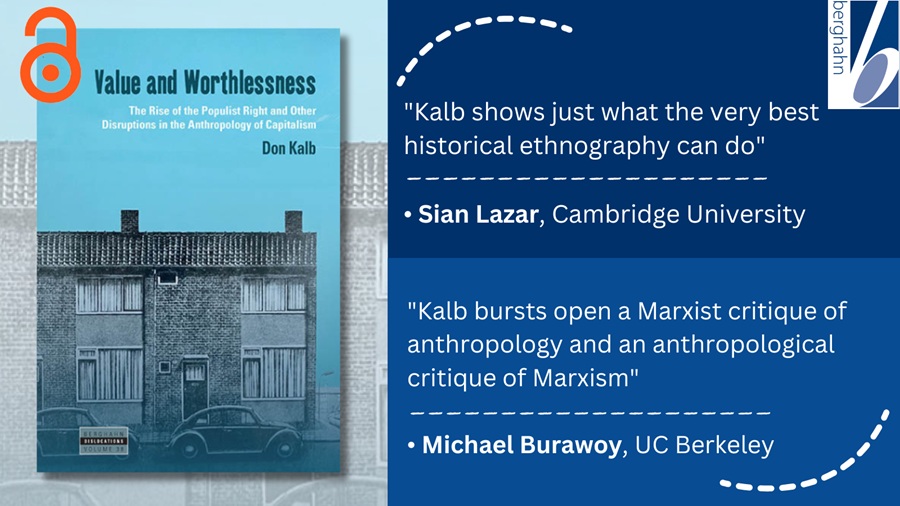
Don Kalb first sent me Value and Worthlessness: The Rise of the Populist Right and Other Disruptions in the Anthropology of Capitalism in manuscript form. I had read most of the chapters in their original publications and welcomed the chance to revisit familiar arguments and scenes. What I did not anticipate was the emotional force of the collection, particularly chapters two through four. I was struck by the intimacy of the life story of Polish worker-activist Krysztof Zadrozny, who suffered the defeat of his and his Solidarnosc comrades’ aspirations for shopfloor democracy in their white goods factory. I was also affected by the refrain of Maria van de Velde’s self-description— “I have always been dumb”—which poignantly punctuates her account of exploitation and abuse in industrial Eindhoven, Netherlands in the mid twentieth century. Don uses the evocative phrase “close to the skin” to describe his close accounts of people rendered “worthless” through relations of capital accumulation (Kalb 2025, p. 127) but I think something more significant is at stake in the kind of empathy on display. A more capacious concept may be in order, both to identify a consequential feature of his writing and to make a broader claim for Marxist anthropology. I suggest the notion of “Marxian intimacy” to name this intellectual terrain.
To advance the concept, I begin with an excerpt from Zadrozny’s conversation with Don and his colleagues in 1998. Zadrozny reflected on the closing of political horizons during Poland’s post-socialist transition and remembered,
People were willing. There was zest. We could have been building a new society. And I think that this is what the Poles expected to happen. […] There was this rebuilding atmosphere and people had the will to switch to another system and to other habits too. But I guess it didn’t work out too well. Wild capitalism emerged […] it was not the human relations that we craved (Kalb 2025, p. 90)
His sorrow is neither nostalgic nor self-pitying; it is a reckoning with the forces that cut off political possibility. Zadrozny understands the historical conditions under which the project of building a post-socialist society slipped beyond the reach of Polish workers, and worth was stripped from their labor, their communities, and their democratic aspirations. He remembers with painful acuity how worthlessness was produced through the violent reordering of value under emergent market relations. With “Marxian intimacy,” I seek to characterize a text that inhabits the emotional currents of a life lived amidst capitalist crises and that points to the causes of the upheavals. It lays bare the “hidden histories of devaluation, and the hidden injuries of dispossession” (Kalb 2025, p. 65) as deeply felt individual and common experiences. Beyond humanitarian feeling, or the empathy of ethnographic encounter with which our discipline of anthropology is replete, this form of intimacy gives us to know how a life course emerges through layered relations of value and class. Don recounts Zadrozny’s experience not to render legible the moral world of an illiberal cultural “other”—that would be merely an extension of the liberal anthropological cannon and its emic perspective—but as part of his comparative project whose purpose is to explain the rise of the populist right in Poland and elsewhere.
Don conducted his dissertation research in the manufacturing city of Eindhoven, under the shadow of the Philips conglomerate. There, Philips worker Maria van de Velde declared to him, “This is my own history, but it is worthless!” Her exclamation arose from the combination of gendered kinship relations, labor regimes, corporate paternalism, and the arc of patriarchal capitalism speaking through an individual biography. Read alongside the story of the Polish worker-activist, these become diagnostic accounts of worthlessness as a historically produced relation, shaped by deindustrialization, dispossession, financialization, and segmentation of labor markets. Attending to these biographies requires the methodological ambition to identify the mechanisms through which lives are devalued and to articulate those “hidden histories” (Kalb 2025, p. xii).
Don takes the phrase “articulating hidden histories” from the title of an edited volume on the intellectual legacy of anthropologist Eric Wolf (Schneider and Rapp 1995). He shares Wolf’s imperative for anthropology to become a discipline whose meta project is to grasp the totality of capitalist social relations, to apprehend capitalism as a more than 500-year, globe-spanning system within which its objects of study—i.e. cultures—are produced in fields of power. As a child among textile workers in central Europe in the 1930s, Wolf witnessed firsthand how capitalist crisis upended everyday life (Wolf 1982, p. 402.) That experience “formed the central question of his anthropology: how to account for the emergence and persistence of a system whose dynamically unfolding relations can catapult […] everyday life into an abyss of uncertainty as if by an act of nature like an earthquake” (Schneider 1995, p. 16; see Kasmir forthcoming.) Don’s informants lived through similar world-shaking events.
Wolf also sought to explain the rise of extreme ideologies, including National Socialism in Germany, and the intersections of power and the differentiation and deployment of social labor that breathed life into them (Wolf 1999.) Don’s orientation is likewise toward the political “other” rather than anthropology’s well-trod cultural “other” (Kalb 2025, p. xii.) Illiberal mobilizations and right-wing populism, he argues, take shape among populations who are undergoing devaluation, both in their material lives and in discursive fields that mark them as unworthy. His ethnographic sights are set on the dialectic between everyday life and global political economy and between meaning-making and the see-saw of capital expansion and abandonment. Marxian intimacy reconstructs those intersections, exposing their effects, including the resentment and racism that are “part of a cauldron of vindictive feelings about hierarchy, value, and worthlessness, […] amid austerity and a drive for national competitiveness” (Kalb 2025, p. 165). For Zadrozny, a decisive moment was the betrayal of Solidarnosc worker-activists by technocratic elites and the installation of a neoliberal value regime that thwarted the “human relations that we craved,” yet a longer trajectory of dispossession, rather than any single event, had set the course.
Maria van de Velde’s devaluation was produced by exploitation at work and mistreatment within her family. Don recounts her daily routine in detail to draw us close to the drudgery it imposed,
She got up at 5.30 in the morning. Set the table for everyone. Took a bus at 6.30. Started work at 7.30. Worked well above the norm and arrived home again at 5.30 p.m. Tidied up the house, which was often a mess, and started peeling potatoes for dinner. She cleaned up the dishes afterward and went to bed totally exhausted (Kalb 2025, p. 101)
Maria repeatedly reaches for an explanation for her misery. And she turns from the knowable causes of her mistreatment at the hands of her employers and those of her sister, mother and father, and she offers instead that she was “dumb.” This pivot is abrupt, and it interrupts her search for answers:
But I have always been really dumb[…] They used to say I was just dumb. […] My father was often drunk and aggressive. Nellie, my second-oldest sister, was in fact running the household. […] I had to do everything (Kalb 2025, p. 101)
It was work, work, and work again. Maybe it is true that I have always been dumb, like they used to say (Kalb 2025, p. 103)
She lists the record of neglect and mistreatment and then wipes it away with self-deprecation, “I have always been dumb.” Reconstructing the social relations that produced her suffering therefore requires concerted attention. Don parses her individual biography and the structural causes that shape it. “Maria’s subjection was more multiple and her relationships with her parents more difficult than was probably the case with most other working-class girls. It made her feel she was ‘dumb.’” (Kalb 2025, p. 105)
In a dense narration of common events and circumstances of proletarian life in the region, Maria’s story is deeply moving above all for the intense tension it evokes between hostility and intimacy, fear and respect, trust and distrust, which all social relations seem to have been imbued with (Kalb 2025, p. 103)
Maria’s story is deeply moving because it conveys the experience of female proletarian life in the region, formed by class and gender, and because it is embedded in the structural pain that accompanies those collective conditions.
Intimacy is not a word we often hear associated with Marxist theory, yet the ethnographic chapters in this volume show that a deep emotional register may be one of its unremarked strengths. Don writes against culturalist empathy because it emphasizes morals and emic perspectives, while failing to explain the dynamics of value and devaluation. We feel profoundly for Maria and Zadrozny. The urgency that confronts us as we read their life stories goes beyond personal compassion to give rise to the imperative to remake the conditions that determine value and worth.
Sharryn Kasmir is Professor of Anthropology at Hofstra University. She has done fieldwork in the Basque region of Spain and in the southern United States. Her research and writing focuses on capitalism and working class lives and politics.
References
Kalb, Don. 2025. Value and Worthlessness: The Rise of the Populist Right and Other Disruptions in the Anthropology of Capitalism. New York, Oxford: Berghahn Books.
Kasmir, Sharryn. Forthcoming 2026. “The New Laborers: Revisiting the Last Chapter of Europe and the People Without History Fifty Years Hence” In Don Kalb and Luisa Steur, Eds. In the Tracks of Marxist Anthropology: Fifty years of Eric Wolf’s ”Europe and the People Without History”. New York, Oxford: Berghahn Books.
Schneider, Jane. 1995. “Introduction: The Analytical Strategies of Eric Wolf”, In Jane Schneider and Rayna Rapp, Eds. Articulating Hidden Histories: Exploring the Influence of Eric Wolf. Berkeley: University of California Press, 3-31.
Jane Schneider and Rayna Rapp, Eds. 1995. Articulating Hidden Histories: Exploring the Influence of Eric Wolf. Berkeley: University of California Press.
Wolf, Eric, 1982. Europe and the People without History. Berkeley: University of California Press.
Wolf, Eric. 1999. Envisioning Power: Ideologies of Dominance and Crisis. Berkeley: University of California Press.
Cite as: Kasmir, S. 2026. “Marxian Intimacy” Focaalblog, April 22.