Tag Archives: Don Kalb

Don Kalb: Anthropological Use Value for an Anticapitalist Left

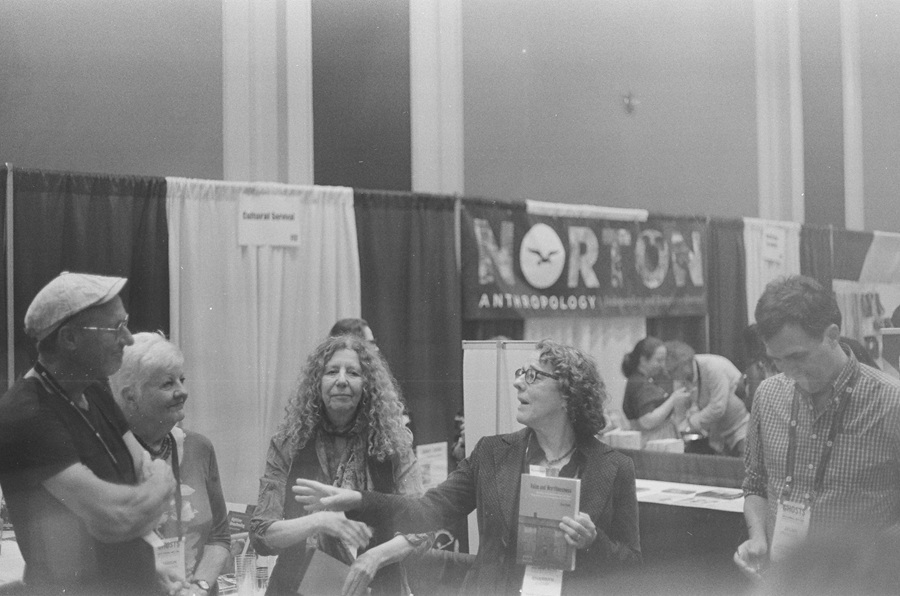
Image 1: Don Kalb and Marion Berghahn at the launch of Value and Worthlessness at the AAA annual meeting on November 21, 2025. Photo by Stefan Voicu

What a joy to be hugged, celebrated, and criticized by stellar colleagues who intimately know the stakes of invoking Marx in more than a fleeting way in anthropology; stakes that may be higher here than in other social disciplines. Theoretically and methodologically, anthropology is deeply imbricated in liberal and less liberal idealisms, with a stark belief in cultural contingency, and rather wild about the idiography of cultural difference, alterity, and autonomy. If the discipline moves Left, it naturally inclines towards anarchism, mutualism, ethics, radical versions of rights and humanitarianisms or posthumanitarianisms beyond the regular liberal offer, rather than to Marxism and political economy with all their system thinking. The anthropological desire is definitely for a human self that is autonomously thriving on ‘the outside to capital’.

This is largely how the discipline has fared during the worldwide political contestations of the 2000s. Hence the importance of a public anthropologist like David Graeber, who had the genius to catch the Left spirit of the time in the 2000s, before that time itself was fully aware of it. The soon to be coming counter revolution, however, was less noticed by David, or by our discipline at large, though the right wing backlash was smoldering already during the Left wing years. Anthropology only caught up with it, in shock, when the radical Right was already comfortably seated on the plush of Western governmental power, increasingly determining not just ‘policy’ but a full-fledged program of defensive-aggressive Western civilizational supremacy. Unpleasantly surprised, and aware of their own vulnerability, anthropologists at once realized they had long preferred to study ‘people like us’ (nice Left-wanting people) and had ignored questions about labor, class, right wing political anger, and fascism. The inside to capital was blowing back as a boomerang. Ten years later, this still describes our deeply worrying situation.

Admittedly, those of us who were located in, and working on postsocialist Eastern Europe (CEE) were somewhat better prepared than the Western and Southern liberal mainstream. We had seen the counter revolution of the illiberal Right taking shape in the late 1990s and early 2000s already. CEE, it turned out, possibly to our own surprise, was not the liberal laggard of Western imagination, but an illiberal avantgarde that would soon be followed by the West and many places of the South.

The political sociologist David Ost and myself were among the first to notice the deep class dynamics behind the process, dynamics that I later sought to succinctly capture with the concept of ‘double devaluation’, for which Jaume Franquesa salutes me. I love Jaume’s sudden observation that actually none of the concepts that are central to ‘Value and Worthlessness’ (Kalb 2025) are new, that the book is just an unapologetic argument for anthropological Marxism consistently worked out: class, labor, capital, dispossession, social reproduction…imperialism. These days I lay more emphasis than I used to on devaluation and on value, value regimes, and an anthropologically informed dialectical take on the law of value, what Voicu rightly calls my ‘huffing and puffing’. These concepts were less common in the anthropological structural marxisms of the 1970s (though I owe Jonathan Friedman, a survivor of structural Marxism 1970s style, for having pushed me along this path without him being much aware of it, I guess), but Jaume is so right: nothing new, really, just an update of an existing Marxist toolkit and a modest anthropological rethinking under new circumstances and with new problems at hand, within and against a drastically transformed capitalist totality of social relations as compared to the one that produced the 1970s Marxist upsurge. My categories and approach are tuned into that new reality and coined in order to help explain the radical right wing political backlash in CEE and anywhere, in anthropological ways, that is.

I want to emphasize that I have never felt much for the overt structuralisms of those days. At every turn I try to dip my approach to value (“value and values, value regimes”) in what I call relational realism: relations that can be studied, ‘life in and as action’ on worldwide, as well as regional, national, and intimate levels; levels that are dialectically imbued with each other as in multi-scalar relationships; relations with others on which we depend and that shape who we are and who we can and want to be. Hence the ‘structured totality’. Hence also Trotsky, not just for his combined and uneven development, which, as Stefan Voicu rightly notes, is essential, but also his early gesture towards multiscalar analysis as expressed in the distinctions he made between ‘algebraic, arithmetic, and molecular’ scales of analysis, a vision Eric Wolf would later set to work in his ‘faces of power’ (without ever citing Trotsky). There is a big and urgent anthropological project in bringing this multiscalar dialectical edifice of value, including the ‘systemic production of worthlessness’, to work ‘close on the skin’ in the biographies, actions and experiences of our key fieldwork interlocutors; helping to bring their hidden histories into view in ways that under normal circumstances are not usually revealed to them.

‘Intimate Marxism’, Sharryn Kasmir calls the result and she likes it; a profound observation plus a seductive name. Thank you, Sharryn. ‘Intimate Marxism’, almost an oxymoron given popular and anthropological prejudices against a Marxism believed to be preternaturally given to obscurantist or even violent abstractions. Marxist anthropology might want to embrace ‘Marxist intimacy’ as a key element of our mission as compared to other Marxisms, but also, and perhaps more importantly, in relation to liberal anthropologies, as Sharryn suggests. We are seeing avowedly ‘liberal’ anthropological approaches to fascism these days that thrive on and all but seem to fetishize what I am tempted to characterize as mere ‘spoken words’, utterances derived from interviews and social media content, without much of an effort to create a compelling understanding of the speaker’s whole, lived, emplaced social life as it unfolds in time and space, with all its contradictions, desires, fears, angers, disappointments, suffering, private victories. Intimate Marxism searches for the full human claim to a worthy and meaningful life beyond inevitably rather random moments of utterance, life with others, and within and against the ‘inside to capital’. This is an ambition that comes with a strong recommendation here, and with a sense of both urgency and patience, to get behind and beyond the facile fascist (etc.) surface. Words are so easily spoken and scribbled up these days, a massive social media – that is, digital capitalist – driven overproduction; a flow of half-digested fuzzy signifiers for people to just show they keep up with the socially necessary speed of circulation (and with their neighbors). But what the hell do they really mean when spoken?

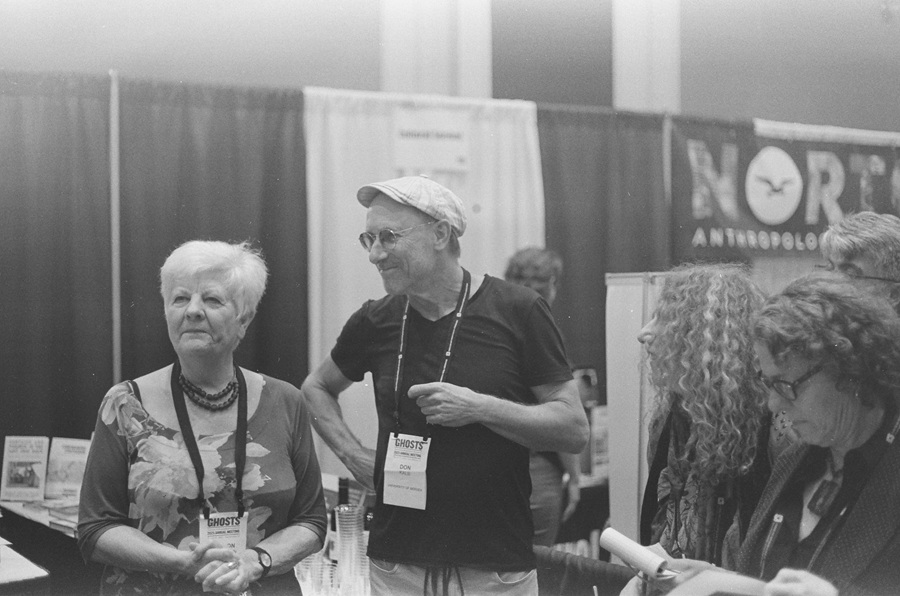
Image 2: Don Kalb and Marion Berghahn at the launch of Value and Worthlessness at the AAA annual meeting on November 21, 2025. Photo by Stefan Voicu

This brings me to the point where I must engage with Ida Susser’s critique that in Value and Worthlessness I am weak on Gramsci, commoning, counter hegemony, ‘Left wing culture’. First, I am puzzled that I have apparently failed to show that my key informant Zadrozny – a person around whom a much broader story is told in my work on Poland – was precisely that type of an outspoken and important organic intellectual that she wants me to look for and that she strangely thinks is missing in my approach. As far as I know that problematic is right there in the middle; it’s what the whole story is about. Zadrozny was a lifelong key actor and organizer within a broad and powerful commoning movement for worker self-management, comprising at various points tens to hundreds of thousands of people, first against the ‘really existing socialist’ state, then against the neoliberal state, both of which would dispossess local workers of their self-managed factory commons (which included much more than those factories: credit, family benefits, kindergartens, health clinics, holiday camps, media!!). All of this is described though perhaps not really studied, it is more a starting point for another type of study, one that helps explain the puzzle of why this all lands on the radical Right side of the political spectrum. I am puzzled that Ida thinks I am neglecting Gramsci, hegemony, counter hegemony, commoning, and organic intellectuals. Maybe it is this: Many of my Western and in particular American friends have always found it hard to understand that the East European illiberal right was not an authoritarian imposition by the state or capital but an actual mass organic counter movement Polanyi style, as well as a counter hegemonic movement Gramsci style, against respectively authoritarian socialist and neoliberal state impositions. It is true that I do not study Left wing culture in Poland in the 2000s, that is because Right wing culture was the big issue and for us Western as well as Eastern analysts the big puzzle.

In Poland worker-led Solidarnosc ended up on the radical Right, just like the mass protests against the privatizations of health and pensions in Hungary in the early 2000s ended up with Orban’s Civic Circles and, in the Northeast of the country, now with a racist twist, with Jobbik. Western Gramscians often find it difficult to understand that there is no automatic affinity between commoning and the Left. The Left is a possibility, not more than that. But what if a self-nominated so called Left in power is your enemy? Regional histories, national public legacies, and relations of power produce crucial differentiations here. In France, the Yellow Vests could have moved rightwards too but in the end, partly as a consequence of street-commoning, as Ida’s (2026) new book shows, they ended up in a Left coalition. That Left coalition may not be strong enough though to keep the radical Right out of power in France: kindred processes of double devaluation as the ones I have observed in CEE are playing themselves out in that nation too, as elsewhere. Populist Lefts and Rights and their organic intellectuals and commoning practices are trying to capture and articulate that popular experience of double devaluation, both attacking the liberal center. As in CEE, in France the Right often dominates in the provinces and the rural areas, in particular those that have long stagnated and have seen big out-migrations. In CEE whole states as such have seen massive outmigrations and have indeed generated dominant, even hegemonic, right wing illiberal regimes in power. In France, the Left can compete in the big cities and sometimes in the provincial centers, such as in the recent electoral victory in Roubaix. More broadly, we should not ignore the fact that Gramsci is entirely embraced by the illiberal international nationalist Right and alt-right.

Being located in and working on CEE, I had to confront the objective of explaining the rise of the radical Right from the deeper popular experiences from which it was assembled. That included the commoning practices, but my curiosity went beyond the overt political organizing, which was established long before I arrived in the late 1990s: what happened to these well-organized manufacturing workers who went from Trotskyism against ‘neoliberal-Stalinism’ in the early 80s to radical illiberal nationalism against neoliberalism in fifteen years’ time? What was the popular experience, the hidden history, that helped to explain this political journey? That is what my approach in the ethnographic chapters helps do. Though I firmly believe that political outcomes are in the end somewhat contingent, they do happen by definition in regionally inflected and embedded ways – as part of the regional insertion into global capital accumulation and class formation; that is, they happen in relation to identifiable and describable value regimes. In the CEE postsocialist peripheries, where a neoliberal Left was hegemonic in the 1990s and 2000s, it meant that they overwhelmingly ended up on the radical right, as part of a counter hegemonic illiberal nationalist alternative. In France, in the core of the EU, with one of the most extensive welfare states in the region, the Yellow Vests in the end moved Left, but whole working class areas in the North and the East of the country moved right too, as they have been doing elsewhere in Europe and much of the world. CEE turned out to be an illiberal avant-garde. But we now also know, with the recent developments in Hungary, that such illiberal regimes too can succumb under their own contradictions, as seems to be happening with Trump and MAGA already.

Local commoning and its outcomes are not determined locally. Nor are what Ida Susser calls ‘political cultures’. Capitalism is a fast moving multiscalar edifice, no outside to that, even though any location has its fundamental specificities as part of its spatiotemporal insertion in the whole, which includes the socio-political histories and ‘political cultures’ of that insertion. That was also true for the South African anti-apartheid fight that Ida invokes; an invocation that is much to the point here. Would Southern Africa have seen the end of the Apartheid state in 1994 without the Polish 1989? Without the Soviet Union having gone bust? With the Apartheid regime still being seen among the Western ruling class as the last bulwark against a violently spreading African communism supported by the Soviet Union (Angola, Mozambique…South Africa)? We cannot be sure but quite possibly not. With communism and the Soviet Union all but gone, de Klerk was encouraged by domestic and international capital and the West at large to negotiate with the ANC. And Poland had delivered the example of the Roundtable. Thus, Poland and South Africa were again linked at the hip as two of the most ideologically and geopolitically significant ‘peaceful democratic transitions’ within an ever more neoliberal US led globalizing capitalism; both of them officially declared successes, but both also failing as inclusive democratic capitalisms for the many; both, as a consequence, ultimately giving rise to strong illiberal populist counter formations, in South Africa the Zuma faction within the ANC, in Poland, populist Solidarnosc against its former dissident anti-communist intellectuals, now the political elite. That new neoliberal Polish state elite and its wider hegemonic public culture and civil society was hellbent on telling the working class that they were just ‘worthless Poles’ who deserved the whip of capital pure and simple. These workers didn’t willingly agree and the Law and Justice regime was the biting result; an illiberal nationalist Right that was very unfriendly against leading liberals but that did reduce poverty and did push up the whole national economy by setting up a natalist/familialist welfare state against the loud protestations of the so called Left that this could only be economic suicide.

The fight, here and there, preferably combined, continues. But for now, the Left, too liberal, too neoliberal, too bienpensant, and in its more radical versions too much tempted towards the outside of capital, has lost. Is this overdetermined, I hear my friend Ida Susser ask? I hesitate and would love to say no. I actually whisper it, but then I see myself jump up and hear me exclaim loudly that there are no voluntarist escapes. Just pulling ourselves up on our belts and start organizing and commoning? No. My hope for counter hegemony does not start by confirming the importance of existing Left wing cultures because that is, as far as it goes, self-evident. It starts with listening very carefully to our ‘lost’ interlocutors in the field and with getting to grips with why ‘we’ ended up beaten by a popular force that ‘we’ used to associate with outright darkness and that we had imagined to have died out well before this 21st century had even started. And here we are. And this while capital and empire are going completely off the leash. Our deeply troubled predicament requires us to move the new global populist Left well beyond the limits of the liberal, limits that are so powerfully inscribed into the system and that will certainly not be overthrown by the illiberals, that is the power of property as capital, a power that is beyond the reach of any constitutional national democracy, and at the same time reject the utopian escape towards the outside to capital. That is why we need a full out rethinking of capitalism and its liberal and illiberal guardians, preferably in anthropologically informed ways. The well-trodden paths of the Left are exhausted. Call what we need revolution please. Some of that is tried in my book. Much more is needed.


Don Kalb is Professor of Social Anthropology at the University of Bergen, founding editor of Focaal and Focaalblog. His latest books are Value and Worthlessness: The Rise of the Populist Right and Other Disruptions in the Anthropology of Capitalism (Berghahn Books, 2025), and, co-edited with Walden Bello, Backlash: The Global Rise of the Radical Right (Pluto Press, 2026).


References

Kalb, Don. 2025. Value and Worthlessness: The Rise of the Populist Right and Other Disruptions in the Anthropology of Capitalism. New York, Oxford: Berghahn Books.

Susser, Ida. 2026. The Yellow Vests and the Battle for Democracy. Taking to the Streets of Paris in the 21st Century. New York: Routledge.


Cite as: Kalb, D. 2026. “Anthropological Use Value for an Anticapitalist Left” Focaalblog May 5. https://www.focaalblog.com/2026/05/05/don-kalb-anthropological-use-value-for-an-anticapitalist-left/

Ida Susser: The Value of a Left Culture in Combating Worthlessness

Image 1: (from left to right) Don Kalb, Marion Berghahn, Ida Susser, Sharryn Kasmir and Jaume Franquesa at the launch of Value and Worthlessness at the AAA annual meeting on November 21, 2025. Photo by Stefan Voicu

Let me first say that I have been waiting for Don Kalb’s new book for a long time! Kalb has been a leading theorist of the growth of the Right in Eastern Europe and elsewhere for many years. Many of us have heard him speak with an overarching and comprehensive vision of the conjunctures and historical dynamics which have led to the current era. He has several key articles which outline the shifting politics of Europe over the past decades and connect them to the interactions of financial capitalism with state and global processes. Here, finally, Kalb has brought these interventions together in a vibrant synthesis.

Through the concepts of value and worthlessness, Kalb illuminates the theoretical links between his early work in the Philips factory under the regime of industrial capitalism in the Netherlands with his ethnographic perspective on post-socialist Poland and his latest work on the rise of the right in relation to the regime of financial capital. Discarded by capital as they are no longer needed, or forced to work in dismal and demeaning circumstances, people come to perceive themselves as worthless while capital extracts its own value.

I cannot possibly summarize the arguments and insights contained in every chapter of this book. I am only grateful that Don has brought these together for us to think about as an assembly of exciting ideas. Here I will focus on a few central themes he addresses and the ways in which his approaches reshape anthropology.

Class

Kalb’s early work in the Philips factory generates a holistic view of class which is fundamental to political economy. My own work (Susser [1982] 2012), based on a similar stress on family, work and social reproduction focused on the key importance of women’s contributions to community and class struggle in neighborhood movements. I remember well how difficult it was, within the social sciences, including anthropology, to find ways to talk about the gendered division of labor, class and agency. Theorists such as Eric Wolf and others maintained an analysis of class, relying on the point of production. Marxist feminists from the 1970s demanded that we conceptualize class in terms of the family in interaction with gendered inequality in spheres beyond the point of production, such as the home and urban space, and also began to stress race and intersectionality as elaborated by abolitionists.

Kalb’s analysis of Philips combines these underlying themes into a classic extended case analysis of social reproduction at a particular conjuncture of capital. He convincingly makes the case for what he calls “flexible familism” which shows the way in which patriarchy was directly implicated in the strategies corporations enforced to extract surplus labor from working class daughters. Through an in-depth analysis of an emotionally wrenching interview, he discusses the controlling and sometimes abusive relations between fathers and daughters. He complicates Gramsci’s discussion of Fordism based on the reinforcement of the patriarchal nuclear family by showing the ways in which industry may invoke different family relations under specific conditions. In the light of this research, he calls for an “expanded” view of class which comprehends the significance of domestic divisions within a broader vision of the processes of capital.

The rise of the Right

In his work on the changing hegemony of the world order, Kalb not only offers an exhilarating analysis of the rise of the global financial regime but he translates its consequences for working class members of Solidarity in post-socialist Poland. Through the analysis of a detailed series of interviews outlining the life history of Krysztof Zadrozny, once a leading activist in Solidarity, Kalb shows how Zadrozny and other activists found themselves “worthless” in post-socialist Poland in the face of corporate investment and the degradation of the nation-state to competitive states within global capital. He explains “the losers of socialism” in much more penetrating terms than simply the fall of the Soviet Union and the imposition of neoliberalism by the West. National unions and workers no longer wielded much power as millions of workers worldwide were sucked into industrial capital at fractions of the wages of earlier workers in the centers of capital. As a consequence, Zadrozny, failed by communism and as he sees it, betrayed by the social democrats, turns to the right.

I agree strongly with Kalb that the turn to the right in Eastern Europe and elsewhere has little to do with immigration or the hatred of the Roma. Such themes may be the content of the right wing populist agenda and the “whispers” of populist autocrats from the Right, they draw their influence from the rage generated in structural processes of class and capital. Nevertheless, I would explain the turn to the right, not only in terms of the repressive history of the Soviet Union and the selling out by the socialists, but as much by the loss of community among the leading activists and the working population. Kalb’s situational analysis of enlightening interviews in both The Netherlands and Poland captures the life and perspectives of the individual within a hidden network of class and worker mobilizations. I argue that to explain whether workers in a particular historical situation move to the left or the right, one might investigate further the neighborhood and community scale: the rituals, social gatherings, party networks and human interactions which give meaning to collective solidarity

My book,The Yellow Vests and the Battle for Democracy (Susser 2026), follows an enigmatic and massive uprising in France in 2018, when hundreds of thousands of people who had never mobilized before, rushed into the streets of Paris initially protesting a new gas tax. I show that this movement could have gone to the Left or the Right. It was the social environment and in fact, the intense engagement of activists and local organizations at the grassroots level that inspired a unified humanistic and inclusive vision which helped to counteract the overwhelming individualistic pressures of neoliberalism.

Following Kalb’s research on the disappointments which contributed to the growth of the Right, we need further analysis of the processes which lead to counter-hegemonic movements along along with a strategic focus on the formation of organic intellectuals as a collective endeavor. The aim of my book on the Yellow Vests was to follow the possible generation of an historic bloc inspired by organic intellectuals as a foundation for a war of position.

Wars of position

In his overall analysis, Kalb takes no prisoners. He is clearly critical of the theorists who banish political economy from the anthropological terrain and insist on the purely symbolic cultural perspective, but he also wants to clarify his objections to ideas of the commons and the formation of common institutions within capitalism. This concern derives from his evaluation of the deceit and betrayals evident in the formation of workers cooperatives in post-socialism. The cooperatives in which workers expressed such hope were sold out by some of their own previous leaders who adopted the neoliberal phantasm of shock, later repudiated even by its initial promoter Jeffrey Sachs, as the means to a successful transition.

In spite of the experiences outlined by Kalb which clearly generated despair, my research suggests that, in his rejection of the commons, he may be throwing the baby out with the bathwater. The Yellow Vests participated in street protests and occupations as a consequence of a deep sense of desperation similar to the “losers of socialism” and also of rage. Nevertheless, many experienced fundamental changes in their sense of hope and collective possibilities as they fought for a commons or took part in commoning, living in common, sharing in common and generating visions of the common for the transformation of civil society. Although the immediate collective excitement was temporary, I argue that many people changed in their subjective understandings of identity and collective engagement and participated in a cascade of later movements led by different fragments of subaltern groups and leaning towards social justice. Without such processes I see no way for transformation to occur from capitalism towards a more socially just and democratic state or system.

Kalb offers few mechanisms for such a transition in this book, although he has always been concerned with social movements as captured in the introduction to the prescient volume Worldwide Mobilizations he co-edited with Massimiliano Mollona (Kalb and Mollona 2018). He attributes change to class struggle, but how people are mobilized collectively and how that class struggle comes about, or then continues, is not discussed in the latest book. Certainly, no violent class struggle in highly industrialized capitalist societies, even less industrialized countries such as Iran, assures any form of democratic transition. For example, in South Africa, where I conducted fieldwork intermittently over a period of twenty years (Susser 2009), although the ANC and the Communist Party engaged in armed struggle for nearly thirty years, the turning points for the end of apartheid and liberation, are worth recalling: a massive series of strikes in the mines, a church opposed to apartheid, and even children in protest against a watered down curriculum, running out of their classrooms to be fired at by cannons in the streets, combined with international sanctions on both the South African government, corporations which traded with South Africa and participation in international events such as the Olympics . We shouldn’t underestimate the costs of the armed struggle, not only in regard to the number of deaths, but also of the young men who lost years of education and faced a grueling route back into civil society. Throughout southern Africa, veterans of the wars of Independence faltered at the margins of society and many failed to achieve stable jobs and a future in the newly created nations.

During those thirty years, perhaps inspired by the armed struggle, the institutions of civil society generated a counter-hegemonic discourse powerful enough to unseat the white supremacist government. Let us not forget the majority of social scientists, Marxists such as Harold Wolpe and Michael Burawoy included, who understood capitalist profits in South Africa to be dependent upon an apartheid regime, and specifically the migrant workers who were consigned to segregated homelands and formed the fundamental cheap workforce for the gold, platinum and other mines. Liberation in South Africa did not fully confront global or even national capitalist investment, and the gap between rich and poor has been enforced in other ways. However, it destroyed the fascist rule of apartheid, upending the racist policy of “homelands” and the colonial control of mineworkers, which had included chain gangs.

Thus, I would strongly argue that Gramsci’s point about a war of position and the creation of a counter-hegemonic discourse and practice are key to any transformation of capitalism. This realization puts questions of culture back front and center within any analysis of capitalism and the conjuncture of political economy with the historical moment. For these reasons, I would argue that Kalb’s clairvoyance and sharply focused analysis would benefit from further incorporation of the cultural and historical interplay of ideas with political economy which he clearly acknowledges.

Prefigurative politics

Taking the idea of prefigurative experiences and the emergence of a unified vision, or concrete utopia for Gramsci, fully into account in any broad analysis is difficult. Kalb has long criticized the anarchism and lack of political economy in the writing of David Graeber, who based his book on Debt firmly in the writing of Marcel Mauss. In this major work, Graeber makes the argument, based on Mauss’s ideas of the gift and reciprocity, that we need to reformulate the idea of debt to recognize that it is a cultural tool of power that can be redefined through political change. Graeber’s claims rely largely on people changing their minds and seeing things differently, no matter the historical moment or the political structures.

In the final chapters of the book Kalb goes straight to the horse’s mouth with his critique of Mauss. He questions his reputation as an ethnographer, as Mauss never in fact did ethnography, or as a theorist. Kalb is eminently convincing that Mauss can in no way be presented as a progressive or informed analyst of his era, and certainly not of the context in which the Russian Revolution took place. Kalb shows that by attempting to reframe Mauss as a source for a radical anthropological theory, Graeber’s work fails to account for the complexities of global capitalism. However, I would suggest that Kalb also needs to recognize more explicitly the power of cultural hegemony and the continuing importance of Graeber’s work in generating a counter-hegemonic vision within a prefigurative community context.

Value and worthlessness

I have only scratched the surface of the multiple challenging and exciting theoretical contributions and original formulations represented by this book. Overall, Kalb addresses culture through his rethinking of value within capitalism and the links he makes between his concepts of value and worthlessness. Through his insightful analyses of his informants’ experiences, he delineates a nuanced and convincing interpretation of the interplay of culture and political economy in their views of the world. There is no question this book is an absolute requirement for understanding the world today – and it shows brilliantly what anthropology combined with political economy and a comprehensive grasp of the global, the state and the local can provide for us all.


Ida Susser is Distinguished Professor of Anthropology at Hunter College and the Graduate Center, City University of New York. She has published on popular mobilizations, social movements, and the urban commons in the United States, Europe, and Southern Africa.


References

Kalb, Don. 2025. Value and Worthlessness: The Rise of the Populist Right and Other Disruptions in the Anthropology of Capitalism. New York, Oxford: Berghahn Books.

Kalb, Don, and Massimiliano Mollona, eds. 2018. Worldwide Mobilizations: Class Struggles and Urban Commoning. New York, Oxford: Berghahn Books.

Susser, Ida. 2009. AIDS, Sex, and Culture: Global Politics and Survival in Southern Africa. Oxford: Wiley-Blackwell.

Susser, Ida. 2026. The Yellow Vests and the Battle for Democracy. Taking to the Streets of Paris in the 21st Century. New York: Routledge.

Susser, Ida. [1982] 2012. Norman Street. Poverty and Politics in an Urban Neighbourhood. Oxford University Press.


Cite as: Susser, I. 2026. “The Value of a Left Culture in Combating Worthlessness” Focaalblog, April 23.

Sharryn Kasmir: Marxian Intimacy

Image 1: (from left to right) Don Kalb, Marion Berghahn, Ida Susser, Sharryn Kasmir and Jaume Franquesa at the launch of Value and Worthlessness at the AAA annual meeting on November 21, 2025. Photo by Stefan Voicu

Don Kalb first sent me Value and Worthlessness: The Rise of the Populist Right and Other Disruptions in the Anthropology of Capitalism in manuscript form. I had read most of the chapters in their original publications and welcomed the chance to revisit familiar arguments and scenes. What I did not anticipate was the emotional force of the collection, particularly chapters two through four. I was struck by the intimacy of the life story of Polish worker-activist Krysztof Zadrozny, who suffered the defeat of his and his Solidarnosc comrades’ aspirations for shopfloor democracy in their white goods factory. I was also affected by the refrain of Maria van de Velde’s self-description— “I have always been dumb”—which poignantly punctuates her account of exploitation and abuse in industrial Eindhoven, Netherlands in the mid twentieth century. Don uses the evocative phrase “close to the skin” to describe his close accounts of people rendered “worthless” through relations of capital accumulation (Kalb 2025, p. 127) but I think something more significant is at stake in the kind of empathy on display. A more capacious concept may be in order, both to identify a consequential feature of his writing and to make a broader claim for Marxist anthropology. I suggest the notion of “Marxian intimacy” to name this intellectual terrain.

To advance the concept, I begin with an excerpt from Zadrozny’s conversation with Don and his colleagues in 1998. Zadrozny reflected on the closing of political horizons during Poland’s post-socialist transition and remembered,

People were willing. There was zest. We could have been building a new society. And I think that this is what the Poles expected to happen. […] There was this rebuilding atmosphere and people had the will to switch to another system and to other habits too. But I guess it didn’t work out too well. Wild capitalism emerged […] it was not the human relations that we craved (Kalb 2025, p. 90)

His sorrow is neither nostalgic nor self-pitying; it is a reckoning with the forces that cut off political possibility. Zadrozny understands the historical conditions under which the project of building a post-socialist society slipped beyond the reach of Polish workers, and worth was stripped from their labor, their communities, and their democratic aspirations. He remembers with painful acuity how worthlessness was produced through the violent reordering of value under emergent market relations. With “Marxian intimacy,” I seek to characterize a text that inhabits the emotional currents of a life lived amidst capitalist crises and that points to the causes of the upheavals. It lays bare the “hidden histories of devaluation, and the hidden injuries of dispossession” (Kalb 2025, p. 65) as deeply felt individual and common experiences. Beyond humanitarian feeling, or the empathy of ethnographic encounter with which our discipline of anthropology is replete, this form of intimacy gives us to know how a life course emerges through layered relations of value and class. Don recounts Zadrozny’s experience not to render legible the moral world of an illiberal cultural “other”—that would be merely an extension of the liberal anthropological cannon and its emic perspective—but as part of his comparative project whose purpose is to explain the rise of the populist right in Poland and elsewhere.

Don conducted his dissertation research in the manufacturing city of Eindhoven, under the shadow of the Philips conglomerate. There, Philips worker Maria van de Velde declared to him, “This is my own history, but it is worthless!” Her exclamation arose from the combination of gendered kinship relations, labor regimes, corporate paternalism, and the arc of patriarchal capitalism speaking through an individual biography. Read alongside the story of the Polish worker-activist, these become diagnostic accounts of worthlessness as a historically produced relation, shaped by deindustrialization, dispossession, financialization, and segmentation of labor markets. Attending to these biographies requires the methodological ambition to identify the mechanisms through which lives are devalued and to articulate those “hidden histories” (Kalb 2025, p. xii).

Don takes the phrase “articulating hidden histories” from the title of an edited volume on the intellectual legacy of anthropologist Eric Wolf (Schneider and Rapp 1995). He shares Wolf’s imperative for anthropology to become a discipline whose meta project is to grasp the totality of capitalist social relations, to apprehend capitalism as a more than 500-year, globe-spanning system within which its objects of study—i.e. cultures—are produced in fields of power. As a child among textile workers in central Europe in the 1930s, Wolf witnessed firsthand how capitalist crisis upended everyday life (Wolf 1982, p. 402.) That experience “formed the central question of his anthropology: how to account for the emergence and persistence of a system whose dynamically unfolding relations can catapult […] everyday life into an abyss of uncertainty as if by an act of nature like an earthquake” (Schneider 1995, p. 16; see Kasmir forthcoming.) Don’s informants lived through similar world-shaking events.

Wolf also sought to explain the rise of extreme ideologies, including National Socialism in Germany, and the intersections of power and the differentiation and deployment of social labor that breathed life into them (Wolf 1999.) Don’s orientation is likewise toward the political “other” rather than anthropology’s well-trod cultural “other” (Kalb 2025, p. xii.) Illiberal mobilizations and right-wing populism, he argues, take shape among populations who are undergoing devaluation, both in their material lives and in discursive fields that mark them as unworthy. His ethnographic sights are set on the dialectic between everyday life and global political economy and between meaning-making and the see-saw of capital expansion and abandonment. Marxian intimacy reconstructs those intersections, exposing their effects, including the resentment and racism that are “part of a cauldron of vindictive feelings about hierarchy, value, and worthlessness, […] amid austerity and a drive for national competitiveness” (Kalb 2025, p. 165). For Zadrozny, a decisive moment was the betrayal of Solidarnosc worker-activists by technocratic elites and the installation of a neoliberal value regime that thwarted the “human relations that we craved,” yet a longer trajectory of dispossession, rather than any single event, had set the course.

Maria van de Velde’s devaluation was produced by exploitation at work and mistreatment within her family. Don recounts her daily routine in detail to draw us close to the drudgery it imposed,

She got up at 5.30 in the morning. Set the table for everyone. Took a bus at 6.30. Started work at 7.30. Worked well above the norm and arrived home again at 5.30 p.m. Tidied up the house, which was often a mess, and started peeling potatoes for dinner. She cleaned up the dishes afterward and went to bed totally exhausted (Kalb 2025, p. 101)

Maria repeatedly reaches for an explanation for her misery. And she turns from the knowable causes of her mistreatment at the hands of her employers and those of her sister, mother and father, and she offers instead that she was “dumb.” This pivot is abrupt, and it interrupts her search for answers:

But I have always been really dumb[…] They used to say I was just dumb. […] My father was often drunk and aggressive. Nellie, my second-oldest sister, was in fact running the household. […] I had to do everything (Kalb 2025, p. 101)

It was work, work, and work again. Maybe it is true that I have always been dumb, like they used to say (Kalb 2025, p. 103)

She lists the record of neglect and mistreatment and then wipes it away with self-deprecation, “I have always been dumb.” Reconstructing the social relations that produced her suffering therefore requires concerted attention. Don parses her individual biography and the structural causes that shape it. “Maria’s subjection was more multiple and her relationships with her parents more difficult than was probably the case with most other working-class girls. It made her feel she was ‘dumb.’” (Kalb 2025, p. 105)

In a dense narration of common events and circumstances of proletarian life in the region, Maria’s story is deeply moving above all for the intense tension it evokes between hostility and intimacy, fear and respect, trust and distrust, which all social relations seem to have been imbued with (Kalb 2025, p. 103)

Maria’s story is deeply moving because it conveys the experience of female proletarian life in the region, formed by class and gender, and because it is embedded in the structural pain that accompanies those collective conditions.

Intimacy is not a word we often hear associated with Marxist theory, yet the ethnographic chapters in this volume show that a deep emotional register may be one of its unremarked strengths. Don writes against culturalist empathy because it emphasizes morals and emic perspectives, while failing to explain the dynamics of value and devaluation. We feel profoundly for Maria and Zadrozny. The urgency that confronts us as we read their life stories goes beyond personal compassion to give rise to the imperative to remake the conditions that determine value and worth.


Sharryn Kasmir is Professor of Anthropology at Hofstra University. She has done fieldwork in the Basque region of Spain and in the southern United States. Her research and writing focuses on capitalism and working class lives and politics.


References

Kalb, Don. 2025. Value and Worthlessness: The Rise of the Populist Right and Other Disruptions in the Anthropology of Capitalism. New York, Oxford: Berghahn Books.

Kasmir, Sharryn. Forthcoming 2026. “The New Laborers: Revisiting the Last Chapter of Europe and the People Without History Fifty Years Hence” In Don Kalb and Luisa Steur, Eds. In the Tracks of Marxist Anthropology: Fifty years of Eric Wolf’s Europe and the People Without History. New York, Oxford: Berghahn Books.

Schneider, Jane. 1995. “Introduction: The Analytical Strategies of Eric Wolf”, In Jane Schneider and Rayna Rapp, Eds. Articulating Hidden Histories: Exploring the Influence of Eric Wolf. Berkeley: University of California Press, 3-31.

Jane Schneider and Rayna Rapp, Eds. 1995. Articulating Hidden Histories: Exploring the Influence of Eric Wolf. Berkeley: University of California Press.

Wolf, Eric, 1982. Europe and the People without History. Berkeley: University of California Press.

Wolf, Eric. 1999. Envisioning Power: Ideologies of Dominance and Crisis. Berkeley: University of California Press.


Cite as: Kasmir, S. 2026. “Marxian Intimacy” Focaalblog, April 22.

Stefan Voicu: Huffing and Puffing with a Marxist Anthropologist

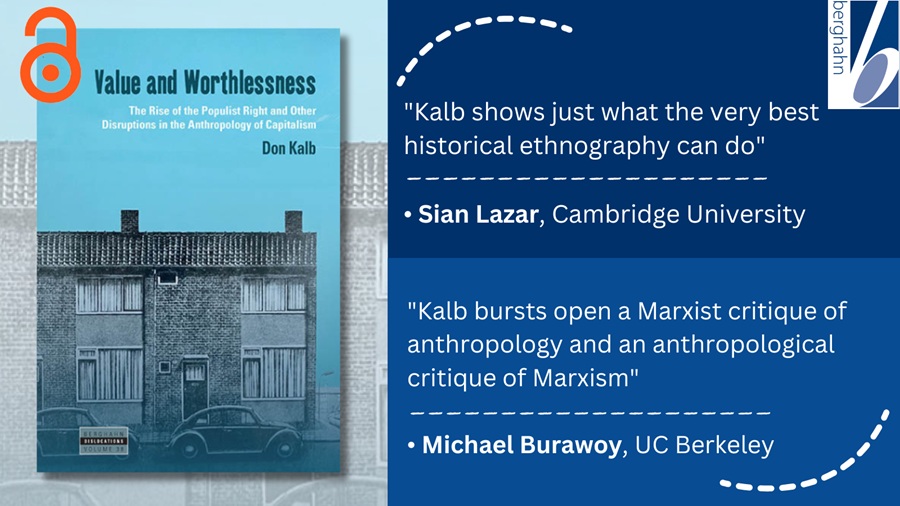
mage 1: Value and Worthlessness cover and review blurbs from Sian Lazar and Michael Burawoy
Image 1: Value and Worthlessness cover and review blurbs from Sian Lazar and Michael Burawoy

This text is not about the huffing and puffing you would expect. Although Don Kalb is Dutch, his new book, Value and Worthlessness: The Rise of the Populist Right and Other Disruptions in the Anthropology of Capitalism is about a different kind of huffing and puffing. Kalb borrows this expression from E.P. Thompson to foreground the messy realities on which the hegemony of the capitalist law of value rests. Let me quote him at length on this:

Rather than being the assured outcome of successive market equilibria, this immanent historical tendency [the law of value] was always also the contingent outcome of ongoing class struggles at all levels in the system, and throughout all its various, evolving and interlocking institutional domains; and this against a turbulent background of recurrent economic crisis and violent ruptures (Kalb 2025, p. 54)

In Value and Worthlessness, Kalb has set out to do something that nobody has attempted to do since the 1970s. He develops a programmatic line of Marxist research in anthropology and outlines a conceptual toolbox that binds together political economy, social history, and ethnography. Kalb began his career in the late 1980s, during the last flickers of a once popular Marxist anthropology, but remained unapologetically Marxist, centering his work on an expanded notion of class to understand the globalization of capital at a time when the discipline was rapidly spiraling out of control into the language-games of culture. Now, bringing together his fieldwork with workers from the Philips factory in the company town of Eindhoven, with post-socialist Solidarność workers from the Polar factory in Wroclaw, and, accompanied by Oana Mateescu, with cognitive workers from Cluj’s booming IT industry, he develops an anthropological theory of capitalism and the methodological guidelines to pursue it.

Kalb does a lot of huffing and puffing himself in the book, describing social processes that unfold in and across capitalist times and spaces. I invited Jaume Franquesa, Sharryn Kasmir and Ida Susser, three leading US-based Marxist anthropologists, to write down the reflections on the book they shared during the launch of Value and Worthlessness at the 2025 AAA annual meeting. In the texts gathered in this feature, each of them celebrates the book while extending it in a distinct direction. Kasmir theorizes Kalb’s ethnographic method as “Marxian intimacy,” Susser presses him to take counter-hegemonic culture and processes of commoning more seriously, and Franquesa salutes the book as a courageous manifesto that equips Marxist anthropologists with vocabulary and purpose.

Image 2: (from left to right) Marion Berghahn, Don Kalb, Ida Susser and Sharryn Kasmir at the launch of Value and Worthlessness at the AAA annual meeting on November 21, 2025. Photo by author

On top of their brilliant interventions, I want to outline three other important contributions this book makes.

First, Kalb proposes to view capitalism as an unevenly structured totality, a system that produces internal differences on which it feeds. Those readers of the book knowledgeable in post-Marxist theory, as well as the “less marxists” anthropologists Kalb takes aim at, will likely huff and puff at this idea. For half a century, Marxist theory has been constructed around the idea that capitalism is incomplete, that there is something external to it and the thrust of capitalism’s law of value is sucking in these outside spaces brimming with counter-hegemonic possibilities. Kalb instead starts from the common sense observation that contemporary capitalism has commodified everything. Directly or indirectly, the majority of the world’s population is now exploited by a minority that accumulates capital. Capital is insidious, as Kalb (2024) argues in the introduction to the edited volume that could be read as a companion to Value and Worthlessness, and the new frontiers of value are manufactured mainly through spectacular accumulations followed by violent processes of devaluation. There is no way out of capitalism except through it. Marx’s argument that the bourgeoisie produces its own gravediggers never rang more true than today and between the lines of Kalb’s book one can read a repositioning of the redefined working class at the center of the struggle for a better world.

Second, Kalb wants to extricate Graeber’s radical anthropology from Mauss’ influence. He argues that because of this influence Graeber’s work on value is unable to account for class struggle and the multi-scalar structure of capitalism, misleading him into a somewhat voluntaristic political position. Kalb argues radical anthropologists should replace Mauss with Trotsky. According to Kalb, not only is the latter’s History of the Russian Revolution more ethnographic than anything Mauss wrote, but Trotsky, as opposed to the academically embedded ‘nepo baby’ Mauss, is probably a better model of politically engaged thinker. Moreover, neither Mauss in the 1920s-1930s, nor Graeber in the 2010s-2020s anticipated the rise of the fascist right. Both Trotsky and Kalb sounded the alarm on these worrisome developments early on (see Kalb 2009, Kalb and Halmai 2011, Trotsky 1971). Not coincidentally the structured unevenness defining Kalb’s capitalist totality is drawn from Trotsky’s theory of uneven and combined development and it is sharply opposed to Mauss’ expressive totality. However, it’s undeniable that Graeber was a model of a politically engaged anthropologist, highly influential, and quite the opposite of a ‘nepo baby’. The anarcho-socialist politics he promoted, coupled with the enduring, although questionable, image Trotsky carries as responsible for crushing Kronstadt, will probably require more huffing and puffing to replace Mauss and the kind of activist politics anthropologists are willing to engage in.

Third, in his engagement with Graeber and his theory of value, Kalb brings David Harvey’s political economy down into the muddled realities of “emplaced anthropological huffing and puffing” (Kalb 2025, p. 54) and proposes a new anthropological theory of capitalist value. Graeber’s value theory aimed to collapse the distinction between value, as in economic value, and values, as in social and cultural values. In his Toward an Anthropological Theory of Value (Graeber 2001) he develops the theoretical framework for this project, but only in Debt (Graeber 2011) he fully explores the implications of the argument. Debt, Graeber shows, is not only an economic value, but permeates and frames all social relations. Graeber shows how one can find debt defining the relation between God and humans in the oldest religious text, as well as between friends in everyday life. Kalb rejects both the value/values distinction, as well as the reduction of both to one single value that Graeber advances. Instead, he proposes to look at value and values as being in a “dynamic relational totality” he calls “value regime” or “dialectical value regime”. Analysing the vernacular narratives of worth and worthlessness in The Netherlands and Poland, Kalb shows how workers’ values emerge alongside or in opposition to the accumulation imperatives of a specific industry, in a specific time and space, and always in conjunction with the abstract forces of capitalism’s law of value. Through this engagement with intimate experiences of capitalism, “Marxian intimacy” as Kasmir beautifully puts it, Kalb builds a theoretical foundation for the understanding of the rise of the populist Right in Europe and develops the concept of double devaluations, of both value and values, whose importance Franquesa highlights in his text.

Whether readers will huff and puff or nod in agreement while reading Kalb’s take on totality, Trotsky versus Mauss, regimes of value, or the critical junctions that led to the rise of the populist Right, matters less than the importance this book should have in any attempt to research contemporary capitalism. Like all great books, this is one critical anthropologists must reckon with, debate, criticize and use to advance our understanding of the current conjuncture.

The photos I took at the book launch got a bit damaged when I developed the film I shot them on. Coincidence? Maybe…They look a bit haunted, which kind of fits the 2025 AAA annual meeting theme of Ghosts. In these photos Don Kalb, Jaume Franquesa, Sharryn Kasmir, and Ida Susser seem to be those specters of marxism haunting a conference where sessions on Marxism and communism, conjured nowadays by right-wing leaders as if it was still the Cold War, were strangely missing.


Stefan Voicu is a social anthropologist researching transformations of property and class relations under financialized capitalism. He is one of the FocaalBlog editors.


References

Graeber, David. 2001. Toward an Anthropological Theory of Value: The False Coin of Our Own Dreams. Palgrave.

Graeber, David. 2011. Debt: The First 5,000 Years. Melville House.

Kalb, Don. 2009. ‘Conversations with a Polish populist: Tracing hidden histories of globalization, class, and dispossession in postsocialism (and beyond).’ American Ethnologist 36(2), 207-223.

Kalb, Don. 2024. Insidious Capital. Frontlines of Value at the End of a Global Cycle. Berghahn Books.

Kalb, Don. 2025. Value and Worthlessness: The Rise of the Populist Right and Other Disruptions in the Anthropology of Capitalism. Berghahn Books.

Kalb, Don and Gábor Halmai. Eds. 2011. Headlines of Nation, Subtexts of Class. Working Class Populism and the Return of the Repressed in Neoliberal Europe. Berghahn Books.

Trotsky, Leon. 1971. The Struggle Against Fascism in Germany. Pathfinder Books.


Cite as: Voicu, S. 2026. “Huffing and Puffing with a Marxist Anthropologist” Focaalblog April 20. https://www.focaalblog.com/2026/04/20/stefan-voicu-huffing-and-puffing-with-a-marxist-anthropologist/

Don Kalb: HAU not: For David Graeber and the anthropological precariate

When HAU was launched, my grad students at Central European University were celebrating. Open access! Finally, a breach in the wall that separated the haves from the have-nots. Their local universities in Asia, Africa, and Eastern Europe hardly had the resources to pay for these Western journals offered at extortionate prices by the likes of Elsevier, Springer, Oxford, Chicago. Indeed, even CEU did not have sufficient means to pay all the subscriptions that scholars were asking for. Now the have-nots would finally have unlimited access. More, the HAU journal preached what it imagined itself to embody: self-conscious intellectual revolution in the apparently newly found horizontalist mode: Occupy anthropology! For the intellectual assertion of the commons! My rightly rebellious students loved it. And went on producing some great open access undertakings—but not in academia—that helped to feed the ongoing mobilizations in their countries (most prominently: http://www.criticatac.ro/lefteast). They had all my support while we continued to disagree about HAU.

Continue reading

Don Kalb: The EU at 60: the Treaty of Rome is a smoke screen

This post is part of a feature on anthropologists on the EU at 60, moderated and edited by Don Kalb (Central European University and University of Bergen).

The EU commemorates its 60th birthday today (25 March 2017), at a time when the institution is more contested than ever. The 1957 Treaty of Rome was an indisputable step toward undergirding the Western part of the continent of Europe with a set of international institutions that would help to secure peace, prosperity, and shared social citizenship—the sort of internationalism that had been urged by the likes of Keynes and Monnet long before the war. This happened against a historical background of half a century of deep, recurrent crisis, escalating class conflict, rivalry, and revenge that had unleashed industrialized destruction on an unprecedented scale. Without any irony, therefore, two loud cheers, please, for the Treaty of Rome and what it sought to secure. This is the basis of what majorities on the continent still like to imagine, defend, and wish to become part of, as their common and cherished symbolic home.

Continue reading