Reading Don’s Value and Worthlessness (hereafter VAW)has been one of the peak experiences of my intellectual life. VAW promises to become one of the key texts in the Marxist anthropology of the 21st century. It displays Don’s rigorous Marxist theorizing, his study of the history of capitalism, and an ethnographic epistemology grounded in dialectical moves from the concreteness of lives laboring under capitalism “up” to the abstractions of theory, and then back “down” to the concrete to illuminate these lives. All this Don boisterously juxtaposes with a series of cogent yet cranky and highly enjoyable polemics against David Graeber, Marcel Mauss, moral anthropology, ontological anthropology, and other anthropological culturalisms.
Theoretically, in VAW Don has set out key conceptual contributions to any present and future Marxist anthropology: the law of value, the dialectic of use value and exchange value, double devaluations, critical junctions, hidden histories, uneven and combined development, insidious capital, and value regimes; and ethnographically: flexible familism (Eindhoven), post-socialist “worthless Poles” (Wroclaw), and the “politics of leftovers” (Cluj). VAW is quite clearly a book audaciously put together from decades of keen and incisive Marxist theorizing, historical analysis, and long-term ethnographic research – all of it infused with Don’s compassion for working people.
Above all, reading VAW made explicit to me the realization that I had long left unexamined about the history of postwar capitalism: As Don puts it (Kalb 2025:55), “What if there is no outside to capital? What if we have to start from the assumption that the whole of social life and the planet has now been usurped by the rough rule of capital…?” Don’s devastating critique in VAW (Kalb 2025:3-12, 18-19, 40-58) of prefigurative idealist anarchism and David Graeber’s work puts paid to the idea that today anyone in the world is “outside capitalism.” Everyone alive today finds themselves in some relationship to it – the vast majority of people for the worse, entangled in its deleterious effects. Uneven proletarianization of an increasing majority of the world’s human population as “broadly working-class” (Kalb 2025:187-188) is now universal, including among global Northern academics.
How is Marxist ethnography Illuminated by the history of capitalism — and of social movements?
I have read with great interest the FocaalBlogtexts by Stefan Voicu, Jaume Franquesa, Sharryn Kasmir, and Ida Susser on VAW, as well as Don’s rejoinder. Don’s commentators all offer important insights, but I want to focus on the heated debate between Ida and Don. Ida argues that commoning, and the presence of organic intellectuals articulating a counter hegemony are characteristic signs of the emergence of a leftist movement in the case of the Yellow Vests. Don’s rejoinder trenchantly takes exception to Ida’s argument by arguing that these phenomena were also present within the rightwing neonationalist movements of CEE workers he has studied, and are thus not diagnostic of the left.
This contention between Ida and Don is consequential. Here Don deals a doubly unfair hand to Ida. First, while Don has the advantage of the retrospective comparative histories of post-1980s CEE workers’ movements allowing him over time (1997-2007; Kalb 2025:73) to draw his brilliant inferences about how double devaluation is connected to the emergence of right wing movements; Ida in her very recent ethnography of the Yellow Vests (Susser 2026), whose history still remains largely “hidden,” has no such retrospective to draw on. Second, unlike the two decades post-socialist period that Don studied, Ida’s fieldwork on the Yellow Vests comes out of the recent accelerated political instabilities of the interregnum’s Polanyian counter movements on the left and right in the 2020s. Ida’s findings are necessarily provisional. That said, Ida argues cogently from her ethnography that the processes of Yellow Vests’ commoning and solidarity building combined with the efforts of its organic intellectuals show the attempt to build a leftist counter hegemony against the savage abuses of the French neoliberal state. Although the outcome is as yet unclear, Ida persuasively shows that what we see so far is that the Yellow Vests have turned to the left. Her assessment deserves our respectful attention.
Also worthy of respect is Ida’s discussion of counterhegemonic ideology by organic intellectuals who can be instrumental in forming leftist social movements. Such an ideology when combined with workers’ material resources can limit the effects of double devaluations (Kalb 2025: 29) in generating a turn to the right. These resources include workers’ labor power outside the wage-labor relation; income streams such as pensions and state transfer payments (e.g. for food, health care); knowledges, skills, tools, machines, land, etc. for collective provisioning; and the aid and assistance of allies, including agencies of the liberal state. Counterhegemonic ideologies that draw on collective histories (e.g., “Black Lives Matter,” “resisting fascism”) can armor workers against the individualism and isolating humiliations crucial to their devaluation (e.g., “you’re not productive, you deserve to be fired,” “you’re worthless”). I present one such example below. What is now needed in my view is open-minded critical discussion about leftist social movements in formation – generously framed between comrades.
The Use Value of Workers’ Labor Power: For Whom?
Like any masterpiece, VAW invites the reader to ask questions which the author has pointed to but not followed up on. In any event, reading VAW has helped this reader refine them. Don’s work (Kalb and Mollona 2018:1-29; Kalb 2024) makes clear his deep commitment to the analysis and critical support of the “urban insurrections” of 2011, more recent ones, and ones on their way, and more broadly to understanding the conditions that make them possible. What are these conditions, from whence do they arise, and what are their implications for research? In this context, I’d like to look briefly at what my book (Nonini and Holland 2024) and others (e.g. Susser 2026) might have to say about one of his least developed, even neglected, topics.
This is the use value of labor power exerted by the broadly defined working classes, but not as Karl Marx in Capital v.1 and Don in VAW refer to it – the use value of the labor power of workers for the capitalist in the process of appropriating surplus value – but instead the use value of waged and unwaged workers’ labor power for themselves and for those on whom they depend and who depend in turn on them in what Don refers to as the “biographical” process of social reproduction. Lebowitz (2003: 145) points to workers’ “’absolutely necessary’” private labor “outside the sphere of capital,” i.e., outside the domain of the wage-labor relation and its appropriation of surplus value – so in this sense “beyond capital.”
Let’s put this in the context of the current conjuncture. In a recent article Don (Kalb 2024: 3) has pointed to “traces of reversal” in the 2020s of labor’s losses under globalization and suggests that “a new cycle of labor may be in the offing.” This began surprisingly in the US “where unions have declined more than anywhere else”, but where schoolteachers, academics, and Hollywood writers in 2021 went successfully on strike, and then in 2023 United Auto Workers went out on strike against the Big Three auto manufacturers in “a militant labor mobilization the like of which have not been seen since the 1970s.” US labor’s actions initiated against Tesla in the US led to solidarity strikes against Tesla by Swedish, Danish and Norwegian trade unionists (Kalb 2024:3-4).
Will these manifestations of recent labor “unrest” consolidate into the emergence of a Polanyian counter movement on the left? If the labor activism of the 2020s is like periods in the past when leftist social movements have risen, we would expect this would be manifestly evident in ferocious organizing within labor unions and in antiracist, women’s, housing and environmental movements, extending labor’s power through strikes, consumer boycotts, and street and legal battles, and eventual capitalist concessions — in line with the law of value. But this will occur only to the extent that these shifts can draw on the collective resources of the broadly defined working class itself. Strikers on picket lines need meals prepared for them; families with workers on strike require child and elder care, etc.
I submit that these collective resources are being brought together (in part) through a shift in how workers act in very material ways to show they “value” the use value of their own labor power not only by denying it to the capitalist in the sphere of production, but also by expanding its uses within the social reproduction of everyday life toward collective, militant and disruptive ends. Neither working people nor their labor power are mere “objects” of capital. As Marx (1976:283) pointed out, in the course of class struggle over time, the worker “acts upon external nature and changes it, and in this way he simultaneously changes his own nature.” In doing so workers develop new needs that capital produces but cannot satisfy (e.g., higher wages, healthy air, clean water, adequate housing, nutritional food) (Lebowitz 2003: 178-189).
It is in this sphere of social reproduction that we can look for shifts in how workers labor to care for one another, organize collectively, make and sustain commons, find ways of defining and manifesting new needs and new kinds of collective consumption, and undertake the self- and collective-production and use of (petty) surplus. These can buttress a successful counterattack by the broad working-class on capital.
But many workers may not do some or any of these things. There are no guarantees. Their responses to declining capitalist hegemony in the US may be destructive, individualist, or racist, xenophobic, or even draw some to Trumpist neonationalism (Nonini 2026). As politically committed scholars, we need to understand what “works” and what doesn’t under these conditions.
Working people in the southern US have adapted their living labor outside the wage-labor relation to building their collective capacities and meeting their collective needs to resist capitalist attacks. In the US South, where anti-labor laws prevail, these collective actions of resistance have emerged from churches, antiracist and women’s organizations.
Commons, Needs, Consumption, and Petty Surplus in Rural Eastern North Carolina
Let me be more specific with a brief example from my recent book, Food Activism Today: Sustainability, Climate Change, and Social Justice (Nonini and Holland 2024). The book came out of a collaborative research project set in four different sites in North Carolina during 2009-2011. One of the sites was located in a three-county area within what is called the Black Belt of eastern coastal North Carolina.
In 2009, the few hundred residents of Clarketon, Edgecombe County, were African-Americans, descendants of slaves. Clarketon’s adults were dirt-poor, and owned little property if any other than a few acres of farmland. Other than undertaking very small-scale farming, they either labored in a nearby poultry processing plant or were otherwise unwaged/unemployed, retired or disabled. Within the three counties of the extended field site, they were surrounded by a hostile patchwork of large white-owned “commodity farms,” dotted by small towns each controlled by a very few white corporate managers, local business proprietors and landowners. These towns were situated on a landscape defaced by six prisons holding at least 2,000 prisoners, including a prison centered on a large 3,500 acre prison farm that grew and processed poultry and food crops, and another prison with two “Correction Enterprise” industrial plants producing optical products and printed documents. Both prisons’ industries depended on “convicts”’ expropriated labor power to produce commodities – and expropriated excess surplus value (Ibid., 260-263, 278).
Older adults of Clarketon still had memories of local whites violently attacking them as high schoolers in the 1960s that ended Jim Crow and school segregation. Above all, they said, they feared for “the youth,” their teenage and older children, who faced the dire prospect of being hirable only as low-end minimum-wage service workers in the fast food industry, of joining “gangs,” or being incarcerated in the same prisons that confined many siblings and elder relatives (Ibid.).
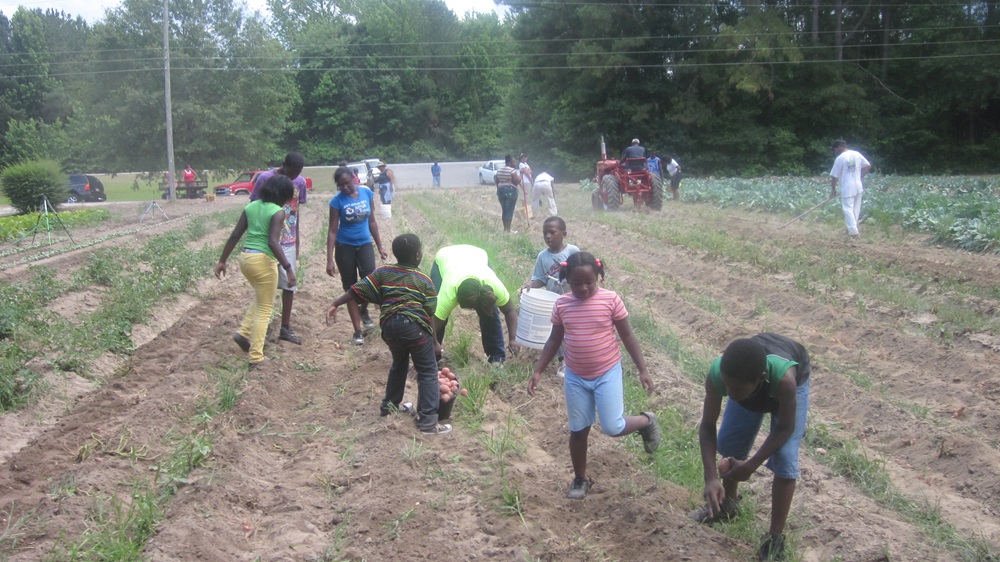
The center of residents’ social, religious and working lives outside of wage labor was the Clarketon Baptist Chapel Church and its Garden, both overseen by Reverend Richard Hemmings. The garden consisted of more than 11 acres of land donated by a parishioner of the church, and cultivated by its youth. “The Rev” (Hemmings) brought together a staff consisting of a garden manager, a beekeeper, a tractor mechanic and several retirees as volunteers to carry out a major objective of the church and its garden. This was to teach 15 to 20 Clarketon youth not only how to cultivate the garden and grow crops, but also how to distribute the produce they grew – to provide themselves with produce they could sell for income at a local farmers market to save money earned for their college costs – thus creating surplus for their own use – or keep as food which they could give to their own families to consume, or donate gratis to poorer disabled and retired residents, who were otherwise deficient in food. In doing so, the Rev was teaching youth (and garden staff) a key lesson: it was imperative that food production and distribution be done collectively and be based on solidarity with other Clarketon residents –other youth, elders, family members, and neighbors – through the making of a commons around farmland, collective labor and food production, while also shifting how they thought and acted with respect to their needs and consumption (Ibid., 262-277). As “the Rev” put it about consumption, “you gotta maximize your food, as you gotta cook your own food. You’re not gonna come out of poverty buying [fast food from your] spending money” (Ibid., 266).
Through these simultaneously social and material aspects of food provisioning the Rev taught the youth to develop their own their labor power to achieve the collective goal of contributing to the food security of Clarketon residents, while showing youth how to prepare and protect themselves as they grew older to engage an antagonistic white population who sought to harm them and deemed them worthless, disposable, criminal, and cut off from “society.”
The Rev contrasted this “’Afrocentric economy’” of co-responsibility and mutual support with a “’Eurocentric mindset… of less than, greater than… The struggle [between] the wealthy and the middle class and the poor.… I want to live where there are no classes. There are human beings. When money is the driving factor, then there is a lot of people excluded from the table. The job [i.e. wage labor and exploitation]. That’s how we get poor people’” (Ibid. 272). The Rev’s rejection of a “Eurocentric mindset” in favor of an “Afrocentric economy” is the articulation of a counterhegemonic ideology against US racial capitalism. The Rev is acting as an organic intellectual who connects the youth of Clarketon to one another and to the making of a commons and of community solidarity. In so doing, Rev Hemmings exemplifies the “blues epistemology” that Clyde Woods (1998: 29-39) observed operating among enclaved African-Americans in the rural southern US: the knowledge of a world where the African-American community was assailed on all sides by a hostile white majority, and the imperative in the face of such outside hostility to sustain the integrity of the ‘social dynamics’ of the Black community that suffered racial abuse” (ibid., 278).
Thinking Critically about the Use Value of Workers’ Labor Power
I conclude by turning to Don’s discussion of use values within the biographical processes of social reproduction. Don writes about the place of use-values within social reproduction in an insightful and even moving way – but in my view, too abstractly, ungrounded, and in need of more incisive elaboration toward movement building on the left:
“What we need to develop is an idea of use value as those material and immaterial values embedded in the standards, activities, sites, and essential relationships of our daily as well as long-term social reproduction. You can call them relational use values. We should look at this type of use value dynamically and perceptually. Biographies, collective and individual, are to a considerable extent about the production, reproduction, and indeed accumulation of use values within a shared commons… Accumulation of such relational use values is often experienced as a form of belonging [and]… encapsulates something like social ‘personhood.’ Use value, so conceived, is much of what moves us and what makes us move as we try to produce a life worth living” (Kalb 2025:28).
In the interest of dialogue, based on reflections from the Clarketon Garden project, I offer three provocations about Don’s characterization of use values and social reproduction.
First, it is imperative to distinguish the labors of social reproduction that “function” for capitalism (Weiss 2022) from those that do not (or primarily do not) when workers exert their labor power for their own autonomous practices of commons-making, sharing and care for others outside their time working for capital. An all too common functionalism that assumes that processes of social reproduction “function” only on behalf of capital is vastly different from Marx’s dialectical approach that insists on the two-sided examination of mutual interactions and reciprocal effects between phenomena (Ollman 1993: 31-38, 134-137).
Second, Don writes, we should look at use values within workers’ social reproduction “dynamically and perceptually.” Thus we must consider the use value of their own autonomous labor power within the simultaneous temporal registers of their biographies and the history of capitalism as working people not only transform the material world, but also themselves, leading them to have new needs – needs they become aware of, but that the violence of capitalist exploitation and expropriation denies them from satisfying.
Lastly, a major objective of Marxist-informed ethnography should be to carefully identify how working people respond to capitalist outrages by forming new solidarities among themselves as they collectively discover their new shared needs, learn how to consume together, make commons, and seek to produce surplus outside capitalist control by drawing on their own living labor in long-term projects that build the social movements of the left.
Don Nonini is Professor Emeritus of Anthropology, University of North Carolina, Chapel Hill. His research interests include class and state formation in colonial and postcolonial Malaysia, and class and racial politics in the Southern U.S. He is currently working on a book on racial capitalism and its ecopolitics.
References
Kalb, D. and M. Mollona (2018). Worldwide mobilizations : Class struggles and urban commoning. New York: Berghahn Books
Kalb, D. (2024). “Tilly reversed? Another cycle of labor and socialism is possible.” International Labor and Working-Class History: 1–9.
Kalb, D. (2025). Value and worthlessness: The rise of the Populist right and other disruptions in the anthropology of capitalism. New York, Berghahn.
Lebowitz, M. (2003) Beyond Capital: Marx’s Political Economy of the Working Class. (2nd ed.). Houndmills, UK and New York: Palgrave Macmillan.
Marx, K. (1976). Capital : A critique of political economy (Volume 1), with an Introduction by Eugene Mandel, translated by Ben Fowkes. London and New York, Penguin Books.
Nonini, D. (2026). “The Trumpist movement: A class-based counterrevolution against those who would strand the assets of capital? In Backlash: The Global Rise of the Radical Right, D. Kalb and W. Bello, eds. London: Pluto Press, pp. 254-279.
Nonini, D. M. and D. Holland (2024). Food Activism Today: Sustainability, Climate Change, and Social Justice. New York: New York University Press.
Ollman, B. (1993). Dialectical Investigations. New York: Routledge.
Polanyi, K. The Great Transformation. Boston: Beacon Press.
Susser, I. (2026). The Yellow Vests and the Battle for Democracy Taking to the Streets of Paris in the 21st Century. New York: Routledge.
Weiss, H. (2022 ). “Social reproduction is the reproduction of capitalism.” Focaal—Journal of Global and Historical Anthropology 93: 105–111.
Woods, C. (1998). Development arrested: The blues and plantation power in the Mississippi Delta. London: Verso.
Cite as: Nonini, D. 2026. “How is Workers’ Labor Power “Inside” Yet “Beyond” Capital?” Focaalblog July 7. https://www.focaalblog.com/2026/07/07/don-nonini-how-is-workers-labor-power-inside-yet-beyond-capital/