
Tag Archives: Gramsci

Ida Susser: The Value of a Left Culture in Combating Worthlessness

Image 1: (from left to right) Don Kalb, Marion Berghahn, Ida Susser, Sharryn Kasmir and Jaume Franquesa at the launch of Value and Worthlessness at the AAA annual meeting on November 21, 2025. Photo by Stefan Voicu

Let me first say that I have been waiting for Don Kalb’s new book for a long time! Kalb has been a leading theorist of the growth of the Right in Eastern Europe and elsewhere for many years. Many of us have heard him speak with an overarching and comprehensive vision of the conjunctures and historical dynamics which have led to the current era. He has several key articles which outline the shifting politics of Europe over the past decades and connect them to the interactions of financial capitalism with state and global processes. Here, finally, Kalb has brought these interventions together in a vibrant synthesis.

Through the concepts of value and worthlessness, Kalb illuminates the theoretical links between his early work in the Philips factory under the regime of industrial capitalism in the Netherlands with his ethnographic perspective on post-socialist Poland and his latest work on the rise of the right in relation to the regime of financial capital. Discarded by capital as they are no longer needed, or forced to work in dismal and demeaning circumstances, people come to perceive themselves as worthless while capital extracts its own value.

I cannot possibly summarize the arguments and insights contained in every chapter of this book. I am only grateful that Don has brought these together for us to think about as an assembly of exciting ideas. Here I will focus on a few central themes he addresses and the ways in which his approaches reshape anthropology.

Class

Kalb’s early work in the Philips factory generates a holistic view of class which is fundamental to political economy. My own work (Susser [1982] 2012), based on a similar stress on family, work and social reproduction focused on the key importance of women’s contributions to community and class struggle in neighborhood movements. I remember well how difficult it was, within the social sciences, including anthropology, to find ways to talk about the gendered division of labor, class and agency. Theorists such as Eric Wolf and others maintained an analysis of class, relying on the point of production. Marxist feminists from the 1970s demanded that we conceptualize class in terms of the family in interaction with gendered inequality in spheres beyond the point of production, such as the home and urban space, and also began to stress race and intersectionality as elaborated by abolitionists.

Kalb’s analysis of Philips combines these underlying themes into a classic extended case analysis of social reproduction at a particular conjuncture of capital. He convincingly makes the case for what he calls “flexible familism” which shows the way in which patriarchy was directly implicated in the strategies corporations enforced to extract surplus labor from working class daughters. Through an in-depth analysis of an emotionally wrenching interview, he discusses the controlling and sometimes abusive relations between fathers and daughters. He complicates Gramsci’s discussion of Fordism based on the reinforcement of the patriarchal nuclear family by showing the ways in which industry may invoke different family relations under specific conditions. In the light of this research, he calls for an “expanded” view of class which comprehends the significance of domestic divisions within a broader vision of the processes of capital.

The rise of the Right

In his work on the changing hegemony of the world order, Kalb not only offers an exhilarating analysis of the rise of the global financial regime but he translates its consequences for working class members of Solidarity in post-socialist Poland. Through the analysis of a detailed series of interviews outlining the life history of Krysztof Zadrozny, once a leading activist in Solidarity, Kalb shows how Zadrozny and other activists found themselves “worthless” in post-socialist Poland in the face of corporate investment and the degradation of the nation-state to competitive states within global capital. He explains “the losers of socialism” in much more penetrating terms than simply the fall of the Soviet Union and the imposition of neoliberalism by the West. National unions and workers no longer wielded much power as millions of workers worldwide were sucked into industrial capital at fractions of the wages of earlier workers in the centers of capital. As a consequence, Zadrozny, failed by communism and as he sees it, betrayed by the social democrats, turns to the right.

I agree strongly with Kalb that the turn to the right in Eastern Europe and elsewhere has little to do with immigration or the hatred of the Roma. Such themes may be the content of the right wing populist agenda and the “whispers” of populist autocrats from the Right, they draw their influence from the rage generated in structural processes of class and capital. Nevertheless, I would explain the turn to the right, not only in terms of the repressive history of the Soviet Union and the selling out by the socialists, but as much by the loss of community among the leading activists and the working population. Kalb’s situational analysis of enlightening interviews in both The Netherlands and Poland captures the life and perspectives of the individual within a hidden network of class and worker mobilizations. I argue that to explain whether workers in a particular historical situation move to the left or the right, one might investigate further the neighborhood and community scale: the rituals, social gatherings, party networks and human interactions which give meaning to collective solidarity

My book,The Yellow Vests and the Battle for Democracy (Susser 2026), follows an enigmatic and massive uprising in France in 2018, when hundreds of thousands of people who had never mobilized before, rushed into the streets of Paris initially protesting a new gas tax. I show that this movement could have gone to the Left or the Right. It was the social environment and in fact, the intense engagement of activists and local organizations at the grassroots level that inspired a unified humanistic and inclusive vision which helped to counteract the overwhelming individualistic pressures of neoliberalism.

Following Kalb’s research on the disappointments which contributed to the growth of the Right, we need further analysis of the processes which lead to counter-hegemonic movements along along with a strategic focus on the formation of organic intellectuals as a collective endeavor. The aim of my book on the Yellow Vests was to follow the possible generation of an historic bloc inspired by organic intellectuals as a foundation for a war of position.

Wars of position

In his overall analysis, Kalb takes no prisoners. He is clearly critical of the theorists who banish political economy from the anthropological terrain and insist on the purely symbolic cultural perspective, but he also wants to clarify his objections to ideas of the commons and the formation of common institutions within capitalism. This concern derives from his evaluation of the deceit and betrayals evident in the formation of workers cooperatives in post-socialism. The cooperatives in which workers expressed such hope were sold out by some of their own previous leaders who adopted the neoliberal phantasm of shock, later repudiated even by its initial promoter Jeffrey Sachs, as the means to a successful transition.

In spite of the experiences outlined by Kalb which clearly generated despair, my research suggests that, in his rejection of the commons, he may be throwing the baby out with the bathwater. The Yellow Vests participated in street protests and occupations as a consequence of a deep sense of desperation similar to the “losers of socialism” and also of rage. Nevertheless, many experienced fundamental changes in their sense of hope and collective possibilities as they fought for a commons or took part in commoning, living in common, sharing in common and generating visions of the common for the transformation of civil society. Although the immediate collective excitement was temporary, I argue that many people changed in their subjective understandings of identity and collective engagement and participated in a cascade of later movements led by different fragments of subaltern groups and leaning towards social justice. Without such processes I see no way for transformation to occur from capitalism towards a more socially just and democratic state or system.

Kalb offers few mechanisms for such a transition in this book, although he has always been concerned with social movements as captured in the introduction to the prescient volume Worldwide Mobilizations he co-edited with Massimiliano Mollona (Kalb and Mollona 2018). He attributes change to class struggle, but how people are mobilized collectively and how that class struggle comes about, or then continues, is not discussed in the latest book. Certainly, no violent class struggle in highly industrialized capitalist societies, even less industrialized countries such as Iran, assures any form of democratic transition. For example, in South Africa, where I conducted fieldwork intermittently over a period of twenty years (Susser 2009), although the ANC and the Communist Party engaged in armed struggle for nearly thirty years, the turning points for the end of apartheid and liberation, are worth recalling: a massive series of strikes in the mines, a church opposed to apartheid, and even children in protest against a watered down curriculum, running out of their classrooms to be fired at by cannons in the streets, combined with international sanctions on both the South African government, corporations which traded with South Africa and participation in international events such as the Olympics . We shouldn’t underestimate the costs of the armed struggle, not only in regard to the number of deaths, but also of the young men who lost years of education and faced a grueling route back into civil society. Throughout southern Africa, veterans of the wars of Independence faltered at the margins of society and many failed to achieve stable jobs and a future in the newly created nations.

During those thirty years, perhaps inspired by the armed struggle, the institutions of civil society generated a counter-hegemonic discourse powerful enough to unseat the white supremacist government. Let us not forget the majority of social scientists, Marxists such as Harold Wolpe and Michael Burawoy included, who understood capitalist profits in South Africa to be dependent upon an apartheid regime, and specifically the migrant workers who were consigned to segregated homelands and formed the fundamental cheap workforce for the gold, platinum and other mines. Liberation in South Africa did not fully confront global or even national capitalist investment, and the gap between rich and poor has been enforced in other ways. However, it destroyed the fascist rule of apartheid, upending the racist policy of “homelands” and the colonial control of mineworkers, which had included chain gangs.

Thus, I would strongly argue that Gramsci’s point about a war of position and the creation of a counter-hegemonic discourse and practice are key to any transformation of capitalism. This realization puts questions of culture back front and center within any analysis of capitalism and the conjuncture of political economy with the historical moment. For these reasons, I would argue that Kalb’s clairvoyance and sharply focused analysis would benefit from further incorporation of the cultural and historical interplay of ideas with political economy which he clearly acknowledges.

Prefigurative politics

Taking the idea of prefigurative experiences and the emergence of a unified vision, or concrete utopia for Gramsci, fully into account in any broad analysis is difficult. Kalb has long criticized the anarchism and lack of political economy in the writing of David Graeber, who based his book on Debt firmly in the writing of Marcel Mauss. In this major work, Graeber makes the argument, based on Mauss’s ideas of the gift and reciprocity, that we need to reformulate the idea of debt to recognize that it is a cultural tool of power that can be redefined through political change. Graeber’s claims rely largely on people changing their minds and seeing things differently, no matter the historical moment or the political structures.

In the final chapters of the book Kalb goes straight to the horse’s mouth with his critique of Mauss. He questions his reputation as an ethnographer, as Mauss never in fact did ethnography, or as a theorist. Kalb is eminently convincing that Mauss can in no way be presented as a progressive or informed analyst of his era, and certainly not of the context in which the Russian Revolution took place. Kalb shows that by attempting to reframe Mauss as a source for a radical anthropological theory, Graeber’s work fails to account for the complexities of global capitalism. However, I would suggest that Kalb also needs to recognize more explicitly the power of cultural hegemony and the continuing importance of Graeber’s work in generating a counter-hegemonic vision within a prefigurative community context.

Value and worthlessness

I have only scratched the surface of the multiple challenging and exciting theoretical contributions and original formulations represented by this book. Overall, Kalb addresses culture through his rethinking of value within capitalism and the links he makes between his concepts of value and worthlessness. Through his insightful analyses of his informants’ experiences, he delineates a nuanced and convincing interpretation of the interplay of culture and political economy in their views of the world. There is no question this book is an absolute requirement for understanding the world today – and it shows brilliantly what anthropology combined with political economy and a comprehensive grasp of the global, the state and the local can provide for us all.


Ida Susser is Distinguished Professor of Anthropology at Hunter College and the Graduate Center, City University of New York. She has published on popular mobilizations, social movements, and the urban commons in the United States, Europe, and Southern Africa.


References

Kalb, Don. 2025. Value and Worthlessness: The Rise of the Populist Right and Other Disruptions in the Anthropology of Capitalism. New York, Oxford: Berghahn Books.

Kalb, Don, and Massimiliano Mollona, eds. 2018. Worldwide Mobilizations: Class Struggles and Urban Commoning. New York, Oxford: Berghahn Books.

Susser, Ida. 2009. AIDS, Sex, and Culture: Global Politics and Survival in Southern Africa. Oxford: Wiley-Blackwell.

Susser, Ida. 2026. The Yellow Vests and the Battle for Democracy. Taking to the Streets of Paris in the 21st Century. New York: Routledge.

Susser, Ida. [1982] 2012. Norman Street. Poverty and Politics in an Urban Neighbourhood. Oxford University Press.


Cite as: Susser, I. 2026. “The Value of a Left Culture in Combating Worthlessness” Focaalblog, April 23.
Abram Lutes: Anatomy of an Autogolpe: On the consolidation of Nayib Bukele’s power in El Salvador

For the first time since El Salvador’s mid-20th century military dictatorship, a single political party dominates both the legislative and executive branches of the government, and by all accounts aims to control the judiciary soon as well. The Nuevas Ideas or “New Ideas” party, the political vehicle of populist president Nayib Bukele, recently used its new supermajority in the Salvadoran Legislative Assembly to unconstitutionally expel five supreme court judges. It will soon replace them with new appointees, presumably picked by Bukele, in a move that social movement activists are denouncing as a “technical coup.”

Unlike the military dictatorships that dominated El Salvador up until its bloody civil war, however, Bukele’s government is nominally democratic. Bukele was elected president in 2018 and will serve a five-year term, after which he is supposed to leave office for good. Legislative and municipal elections in El Salvador delivered his party, branded distinctively with a bold “N” the stands for both “Nuevas Ideas” and “Nayib”, a resounding majority.

The elections marginalized both the centre-left FMLN, former communist guerrillas, and the traditional right ARENA, anti-communists organized by former military junta members. Bukele claimed to have “turned the page” on the postwar two-party system that characterized El Salvador’s political reality following the 1992 Peace Accords. Bukele has repeatedly claimed that he is “neither left nor right” and described both sides of the country’s bloody civil war as equally criminal, despite evidence to the contrary.

Yet in spite of a nominal democratic mandate (problematized by mass abstentionism in recent Salvadoran elections) and a post-ideological veneer, Bukele has much in common with other right-wing authoritarians in the region, such as Jair Bolsanaro – whose son and advisor tweeted supportively of the sacking of the supreme court. The instrumentalization of legislative proceedings to consolidate power also bears similarity to the tactic of lawfare used in Brazil and elsewhere by the Latin American far right. Bukele’s tendency to both issue government decrees and launch harassment campaigns against his perceived enemies via twitter has also prompted comparisons to Donald Trump.

Bukele has political power, and all signs suggest that the repressive elements of the state stand behind him – in some cases, literally, as when he stormed the legislature last year, attempting to force the assembly to approve his Territorial Control Plan and secretive US$109 million loan to upgrade the country’s police armaments. Yet in the name of security and order, he needs to consolidate more.

Speaking in the aftermath of the move to overturn the judiciary, a participant told me, “This is a strategy that could be regionalized.” The move is consistent with the strategy of “autogolpe” or “self-coup” used by other civilian governments with close military ties to kneecap and paralyze opposition, often in the name of rooting out designated enemies. Turkish president and fellow right-wing populist Recep Tayyip Erdogan may have attempted a similar strategy in 2016, and if Eduardo Bolsanaro’s comments are any indication, there is potentially appetite for it in Brazil.

Bonapartism, Bukeleism

Bukele’s personalist leadership, claims to be post-ideological, and appeals to an abstract Salvadoran people, all reflect what Italian communist Antonio Gramsci called “caesarism,” or what Marx, in The Eighteenth Brumaire, called Bonapartism. Like these historical regimes, Bukele’s rise was precipitated by a crisis. El Salvador is a microcosm of the global economic, ecological, health, political and social crises that have prompted a meteoric rise of right-wing populism around the world.

Gramsci called these conditions, which can precipitate reaction or revolution, organic crises. Organic crises usually lead to a rejection of established political parties, economic policies, and value systems. Such crises are transnational in their origins but also intimately local. El Salvador’s domestic crisis reflects global and regional trends of collapsing party systems, increased securitization, and growing disaffection with globalization and accumulation-by-dispossession. Using the framework of an organic crisis, my research situates the rise of right-wing populism in Central America within the global rise of populism.

For populism experts in the liberal tradition, like Cas Mudde and Cristobal Kaltwasser, populism signals a degeneration of the health of liberal democracy and liberal institutions. Populism’s emphasis on majoritarianism leaves little room for liberal pluralism and reduces politics to a Schmittian dichotomy of “friends” and “enemies.” On the other hand, following Ernesto Laclau and Chantal Mouffe, some on the Left see the rise of populism as a positive, calling for socialists to seize the “populist moment” to rally “the people” to a left-populism

Both these perspectives focus on the ideological anatomy of populism, tracing its political reasoning and descriptive effects. This is insufficient to explain Bukele. On the one hand, if we rely on liberal accounts of populism, we end up reproducing simplistic narratives of democratic backslide and the Latin caudillo. On the other hand, Laclau and Mouffe’s discursive analysis fails to make a link between the “superstructural” language of nation, sovereignty, order, and belonging that we find in right-wing populism, and the world of production, finance, and recessions.

El Salvador’s organic crisis

Bukele and his party, Nuevas Ideas, emerged out of the 2011 indignados protests, named after the Spanish mobilizations of the same name. While initially buoying the left, middle-class Salvadoran indignadosquickly became disillusioned by the FMLN. Bukele, an ex-FMLNista himself, in many ways capitalizes on the unfulfilled anti-corruption demands of the indignados. His response in office to this crisis, though punitive, also reflects this popular disillusionment with the postwar Salvadoran political system.

Out-migration has for the past three decades acted as a kind of release valve for social pressures in Central America, pushing peasants and workers dispossessed by capitalist development north towards the United States and buoying Central American economies with billions in remittances. But as William Robinson points out, mounting ecological, social, and economic dispossession, combined with slumping economic growth and rising foreign debt (even before the COVID-19 pandemic, which has only made the slump worse), and a labour market unable to absorb the remaining dispossessed population, have pushed the region towards implosion.

Organic crises lay bare fundamental contradictions in the system that the ruling classes are unable to resolve, provoking resorts to open force. Central American countries, aided by the United States through the Alliance for Prosperity and Regional Security Initiative, have responded to simmering unrest and growing social movements with escalating violence and repression. Military and police aid nominally supports anti-gang efforts and the regularization of immigration—favourite talking points of Bukele.

While in neighbouring Guatemala this stewing crisis, exacerbated by the COVID-19 pandemic, has escalated into anti-systemic protests, Bukele has kept a lid on the pot through a mix of emergency welfare provisions and increasing militarization. Bukele’s mixing of highly-publicized social supports and punitive populism is again a consistent Bonapartist strategy of weathering the interregnum by attempting to simultaneously reconcile and repress social conflict.

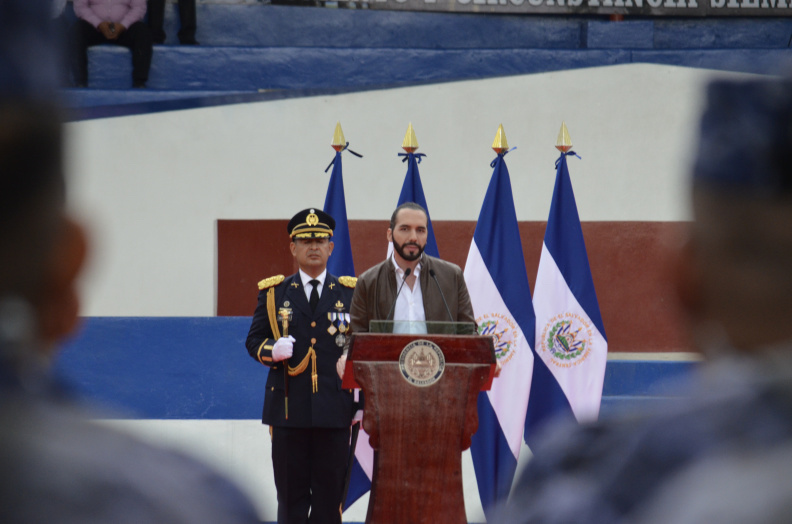
Seen from the audience, a man speaks from an official podium with a uniformed officer and four El Salvadorian flags behind him.
Image 1: Bukele receives the baton of command from the Armed Forces of El Salvador at an official event. Photo via Wikimedia Commons.

Crisis, protection, and sovereignty

Even as they are assailed by COVID-19 deaths, right-wing populists in Latin America are rebounding, signaling a potential future for right-wing populism in the ‘post-COVID’ world. Sociologist Paolo Gerbaudo recently argued that post-COVID politics will be defined by the theme of ‘protection’ – from epidemics, from climate change, from crime and instability. Don Kalb has argued on this blog that current protection measures are facilitating the formation of a new ‘techno-capital’ post-COVID regime of accumulation with new kinds of contestations.  

Bukele’s El Salvador foreshadows a possible post-COVID political environment dominated by right-wing populism. Like his preceding controversial actions, Bukele’s autogolpe is being justified with a mix of militaristic and pseudo-religious language—demonizing his enemies and framing the fight against corruption and organized crime in terms of literal warfare to secure the sovereignty of the country.

Throughout the Global South, pandemic measures that prioritize repression over healthcare and bolster existing over-policing have led to the peripheralization of neighbourhoods and the stripping of meaningful citizenship from villainized populations. In the context of widespread dispossession in El Salvador, the state’s longstanding mano duro approach to crime, and now Bukele’s autogolpe, these measures signal an even more repressive kind of capital accumulation coming out of the COVID crisis.

Bukele also benefits from a demoralized left that has strained relationships with its base and social movements. El Salvador is thus also a cautionary tale when it comes to simplistic calls for a left alternative – be it to reclaim populism or reclaim the politics of protection. The marginalization of the leftist FMLN is not for lack of trying to appropriate populist or protectionist language – the outgoing FMLN government of Salvador Sanchez Ceren also attempted to combine punitive anti-crime legislation with progressive social programs, as well as symbolic gestures like refusing to take up residence in the presidential palace, converting it into a public venue.

The late Ralph Sprenkels and Hillary Goodfriend have both pointed out that the FMLN’s collapse was not due to being inadequately populist, but rather due to frayed internal organization, clientelism and corruption, and a strategy in power that prioritized pragmatism over a transformational program. Enthusiasm for left-populism or left-protectionism should thus be tempered by a serious diagnosis of the organizations, from grassroots to party leaderships, that are supposed to carry a left alternative to power.

Social struggles persist outside the FMLN, however. Bukele’s hostile attacks on public sector employees have prompted strikes, and at the time of writing, protests against the autogolpe, hunger movements and other mobilizations are beginning to make cracks in what Bukele insists is his popular mandate. Whether Bukele’s right-wing populism will totter like it has in neighbouring Guatemala or whether his autogolpe will consolidate a new authoritarian state remains an open question, one worthy of attention for anthropologists interested in the new contours and contestations of the present moment.


Abram Lutes is a graduate researcher at the Carleton University Institute of Political Economy in Ottawa, Canada. His research interests include Gramscian theory, world-systems theory, social movements, and populism. At the time of writing, he is conducting digital fieldwork on El Salvador and Guatemala.


Bibliography

AFP. n.d. “El Salvador Lawmakers Sack Top Prosecutor, Supreme Court Judges” Deutsche Welle. Accessed May 25, 2021. https://www.dw.com/en/el-salvador-lawmakers-sack-top-prosecutor-supreme-court-judges/a-57406228.

Alfonsi, Sharyn. 15 December 2019. “‘Our Whole Economy Is in Shatters’: El Salvador’s President Nayib Bukele on the Problems Facing His Country.” n.d. Accessed May 25, 2021. https://www.cbsnews.com/news/el-salvador-president-nayib-bukele-the-60-minutes-interview-2019-12-15/.

Antonini, Francesca. 2020. The Concepts of Bonapartism and Caesarism from Marx to Gramsci. Caesarism and Bonapartism in Gramsci. Brill. https://doi.org/10.1163/9789004441828_002.

Arevalo, Amaral; Wenham, Clare. 13 April 2020. “Covid-19 in El Salvador: Safeguarding Public Health or Restricting Human Rights?” LSE Latin America and Caribbean Blog (blog) https://blogs.lse.ac.uk/latamcaribbean/2020/04/13/covid-19-in-el-salvador-safeguarding-public-health-or-restricting-human-rights/.

Batz, Giovanni. n.d. “Alliance for Prosperity?” CulAnth: Society for Cultural Anthropology. Accessed May 17, 2021. https://culanth.org/fieldsights/alliance-for-prosperity.

Brigida, Anna-Cat. n.d. “El Salvador Constitutional Crisis Ushers in ‘Period of Darkness.’” Al Jazeera. Accessed May 25, 2021. https://www.aljazeera.com/news/2021/5/4/el-salvador-constitutional-crisis-ushers-in-period-of-darkness.

Bell, David A. 2020. “Fascism or Caesarism?” Public Seminar. August 27, 2020. https://publicseminar.org/essays/fascism-or-caesarism/.

Cameron, Maxwell A. 1998. “Self-Coups: Peru, Guatemala, and Russia.” Journal of Democracy 9 (1): 125–39. https://doi.org/10.1353/jod.1998.0003.

Caribe, Comisión Económica para América Latina y el. 2018. Centroamérica y la República Dominicana: evolución económica en 2017 y perspectivas para 2018. Balance preliminar. CEPAL. https://www.cepal.org/es/publicaciones/43254-centroamerica-la-republica-dominicana-evolucion-economica-2017-perspectivas-2018.

Copeland, Nicholas. 16 December 2020. “In Guatemala, Resignations Are Not Enough.” NACLA. Accessed May 25, 2021. https://nacla.org/news/2020/12/16/guatemala-resignations-are-not-enough.

Cuellar, Jorge E. 2 March 2020. “Nayib Bukele and the Punitive Option in El Salvador.” 2020. The Abusable Past (blog). https://www.radicalhistoryreview.org/abusablepast/nayib-bukele-and-the-punitive-option-in-el-salvador/.

Cuellar, Jorge E. 5 June 2020. “On Waving the White Flag.” Social Text. Accessed May 25, 2021. https://socialtextjournal.org/periscope_article/on-waving-the-white-flag/.

El Faro. 2020. Exigencias Feministas Contra Bukele y Sus Militares. https://www.youtube.com/watch?v=-R9zbUAEmIE.

Gerbaudo, Paolo. 22 April 2021. “Why the Battle between Left and Right Protectionism Will Shape the Post-Covid World.” n.d. Accessed May 14, 2021. https://www.newstatesman.com/international/2021/04/why-battle-between-left-and-right-protectionism-will-shape-post-covid-world.

Gies, Heather. 2 November 2018. “Once Lush, El Salvador Is Dangerously Close to Running out of Water.” National Geographic. Accessed May 25, 2021. https://www.nationalgeographic.com/environment/article/el-salvador-water-crisis-drought-climate-change.

Goodfriend, Hillary. 2019. “El Salvador’s Backslide.” Jacobin.  Accessed May 25, 2021. https://jacobinmag.com/2019/02/el-salvador-fmln-nayib-bukele.

Gusterson, Hugh. 2017. “From Brexit to Trump: Anthropology and the Rise of Nationalist Populism.” American Ethnologist 44 (2): 209–14. https://doi.org/10.1111/amet.12469.

InSight Crime. 21 June 2019. “El Salvador Flirts with ‘Mano Dura’ Security Policies Again.” 2019. InSight Crime (blog). https://insightcrime.org/news/analysis/el-salvador-flirts-with-mano-dura-security-policies-again/.

InSight Crime. 18 October 2011. “Central America Regional Security Initiative (CARSI).” 2011. InSight Crime (blog). https://insightcrime.org/uncategorized/central-america-regional-security-initiative/.

Kalb, Don. 1 June 2020. “Covid, Crisis, and the Coming Contestations.” n.d. Accessed May 14, 2021. http://www.focaalblog.com/2020/06/01/don-kalb-covid-crisis-and-the-coming-contestations/.

Kitroeff, Natalie. 2020. “Young Leader Vowed Change in El Salvador but Wields Same Heavy Hand.” The New York Times, May 5, 2020, sec. World. https://www.nytimes.com/2020/05/05/world/americas/el-salvador-nayib-bukele.html.

Laclau, Ernesto. 2005. On Populist Reason. London ; New York: Verso.

Lagarde, Mylene; Masferrer, Manuel S.; Herl, Carlos. 16 October 2020. “El Salvador’s COVID-19 Response Is Storing up Health and Economic Problems for the Worse-off.” LSE Latin America and Caribbean Blog (blog). 2020. https://blogs.lse.ac.uk/latamcaribbean/2020/10/16/el-salvadors-covid-19-response-is-storing-up-health-and-economic-problems-for-the-worse-off/.

Levenson, Z. 2020. “An Organic Crisis Is Upon Us.” Spectre Journal. Accessed March 26, 2021, from: (https://spectrejournal.com/an-organic-crisis-is-upon-us/)

Marx, Karl. 1937. 18th Brumaire of Louis Bonaparte. 1852. Moscow, USSR: Progress Publishers. Accessed May 17, 2021. https://www.marxists.org/archive/marx/works/1852/18th-brumaire/ch01.htm.

Mowforth, Martin, 28 December 2014. “Global Pressures on Central America.” 2014. The Violence of Development (blog). https://theviolenceofdevelopment.com/global-pressures-on-central-america/.

Mudde, Cas, and Cristobal Rovira Kaltwasser. 2017. Populism: A Very Short Introduction. Oxford University Press.

Orozco, Manuel. 2018. “Las Remesas a América Latina y el Caribe en 2017” El Dialogo. Washington, DC: Inter-American Dialogue. https://www.thedialogue.org/wp-content/uploads/2018/02/Remesas-a-ALC-2017.pdf

Orozco, Manuel. 2018. Central American Migration: Current Changes and Development Implications. Washington, DC: Inter-American Dialogue.

Redacción Nacionales. 1 May 2021. “Se consuma el golpe de Estado a la Sala de lo Constitucional.” 2021. Diario Co Latino (blog). May 2, 2021. https://www.diariocolatino.com/se-consuma-el-golpe-de-estado-a-la-sala-de-lo-constitucional/.

Reuters. 3 February 2019. “Nayib Bukele gana presidencia de El Salvador y pone fin a 30 años de bipartidismo.” El Financiero. Accessed May 25, 2021. https://www.elfinanciero.com.mx/mundo/nayib-bukele-gana-presidencia-de-el-salvador-y-pone-fin-a-30-anos-de-bipartidismo/.

Rey-Araujo, Pedro. 2019. “Grounding Populism upon Political Economy: Organic Crises in Social Structures of Accumulation Theory.” Science & Society 83 (January): 10–36. https://doi.org/10.1521/siso.2019.83.1.10.

Robinson, William. 28 January 2019.“The Second Implosion of Central America.” NACLA. Accessed May 17, 2021. https://nacla.org/news/2019/01/28/second-implosion-central-america.

Rodrik, Dani. 2018. “Populism and the Economics of Globalization.” Journal of International Business Policy 1 (1–2): 12–33. https://doi.org/10.1057/s42214-018-0001-4.

Shadi, Hamid. 2018. “Left Populism and the Rediscovery of Agonistic Politics.” American Affairs Journal 2 (4): 187–201. https://americanaffairsjournal.org/2018/11/left-populism-and-the-rediscovery-of-agonistic-politics/

Stott, Michael. 2020. “Pandemic Politics: The Rebound of Latin America’s Populists.” Financial Times, September 23, 2020. https://www.ft.com/content/3c24bf86-2c47-4939-9477-cefd655d4d48.

Sprenkels, Ralph. 2019. “The FMLN’s Electoral Implosion in El Salvador: A Fiasco Foretold?” PoLAR: Political and Legal Anthropology Review (blog). April 15, 2019. https://polarjournal.org/2019/04/15/the-fmlns-electoral-implosion-in-el-salvador-a-fiasco-foretold/.

Torres, Eder. 14 September 2019. “Salvadoran Unions Confront Right-Wing Populist Government.” People’s Voice. Accessed May 25, 2021. http://peoplesvoice.ca/2019/09/14/salvadoran-unions-confront-right-wing-populist-government/.

Torrez, Clara Guardado, and Ellen Moodie. 2020. “La Línea, Los Indignados, and the Post-Postwar Generation in El Salvador.” The Journal of Latin American and Caribbean Anthropology 25 (4): 590–609. https://doi.org/10.1111/jlca.12498.

Willis, Graham D.; Davis, Diane E. 2021. “Urban Sovereignty in the Age of Pandemics: Illicit Actors and the Crisis of Governance.” PoLAR: Political and Legal Anthropology Review (blog). February 10, 2021. https://polarjournal.org/2021/02/10/urban-sovereignty-in-the-age-of-pandemics-illicit-actors-and-the-crisis-of-governance/.

Vinx, Lars. 2019. “Carl Schmitt.” In The Stanford Encyclopedia of Philosophy, edited by Edward N. Zalta, Fall 2019. Metaphysics Research Lab, Stanford University. https://plato.stanford.edu/archives/fall2019/entries/schmitt/.


Cite as: Lutes, Abram. 2021. “Anatomy of an Autogolpe: On the consolidation of Nayib Bukele’s power in El Salvador.” FocaalBlog, 26 May. https://www.focaalblog.com/2021/05/26/abram-lutes-anatomy-of-an-autogolpe-on-the-consolidation-of-nayib-bukeles-power-in-el-salvador/

Kate Crehan: Gramsci/Trump: Reflections from a fascist jail cell

Antonio Gramsci, condemned by Benito Mussolini to twenty years in prison, wrote his celebrated prison notebooks while sitting in a succession of fascist jails. He reflects on some of the following questions: why is Mussolini in power, while he and so many other leftists are in prison, dead, or in exile? What explained the defeat of the once powerful Italian left? How could fascist and other right-wing forces be defeated? Twenty-first century America is not mid- twentieth-century Italy, and Donald Trump is not Mussolini. Nonetheless, for those seeking to understand Trump’s electoral victory, and searching for ways that this American-produced, authoritarian populist might be effectively challenged, Gramsci’s notebooks make interesting reading.

Continue reading