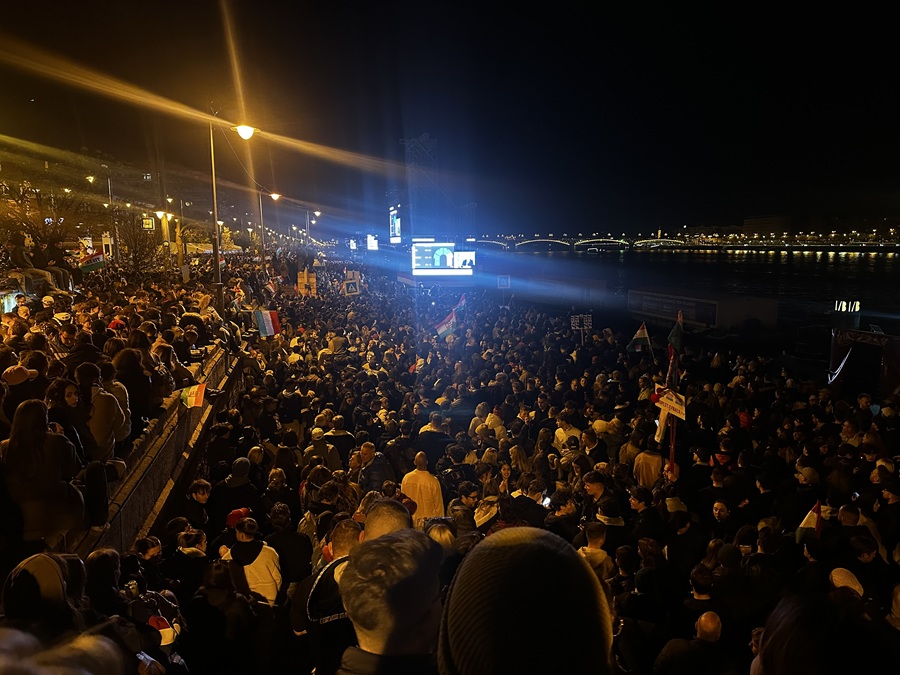
On the night of 12 April, in the wake of the landslide victory of the Tisza Party, Hungary erupted into collective euphoria. Images from election night quickly spread across global media, capturing an outpouring of emotion as people took to the streets not only in Budapest, but across the country. Many who experienced that night, including myself, felt they were witnessing a historic moment. This was not simply a parliamentary election producing a new government, it was a vote for full regime and elite change. Once again, Hungarians expressed a strong sense of belonging to their European allies and the illiberal and autocratic regime of Viktor Orbán, along with its left-liberal “progressive” opposition, was replaced.
This collective catharsis also reflected a deeper sentiment: for the first time in decades, Hungarians could truly claim the outcome as their own. Unlike earlier transformation shaped by global forces – such as the collapse of the Soviet Union – this result was driven by domestic political agency. In that sense, it felt like a belated regime change of 1990, when many Hungarians felt more anxious than relieved – rightly so – and did not perceive themselves as active participants in a transformation largely driven by external forces. It is telling that voter turnout in the first free elections of 1990 was only 65 per cent, while in other parts of the former Soviet bloc it exceeded 90 per cent.
This time, turnout approached 80 per cent. The Tisza Party secured a parliamentary supermajority with 53 per cent of the vote, while Fidesz received only 38 per cent. With this result, Péter Magyar (Prime Minister of Hungary) and his government received unprecedented legitimacy, which, of course, comes with enormous responsibility. There is immense social pressure to begin with a clean slate. It is therefore no surprise that the newly appointed head of the Prime Minister’s Office announced that one of the first measures would be the opening of socialist-era agent files, along with the establishment of an Asset Recovery Office to reclaim stolen assets and public funds misused by the Orbán regime.
What happened to the old opposition?
Since the crushing defeat of the Orbán regime, a number of essays, op-eds, and articles have already appeared, and deeper analyses and academic studies will certainly follow, seeking to draw lessons from the Hungarian case on how to defeat illiberal autocratic regimes (see also Pulay 2026). While the European Union and much of the world shared in Hungarian euphoria with a sense of relief, international and domestic commentators have expressed concern (Scheiring 2026) over the disappearance of left-liberal and progressive forces from the new Hungarian parliament, fearing that these perspectives would not be genuinely represented by Tisza. Many felt, understandably, that only various shades of the Right would now remain in parliament. Others saw Tisza’s victory as final proof of the country’s deeply conservative nature (Szakolczai and Eilenberger 2026).
However, by 2026, the left-liberal opposition’s work had become completely hollowed out. Opposition parties were reduced to a largely reactive identity-political force that, willingly or unwillingly, sustained Orbán’s Fidesz system while having long lost their social base, including the working class. It is revealing that, with the exception of the mass protests triggered by the so-called “slave law” (Overtime Act) (Szombati 2018) at the end of 2018, this opposition never meaningfully engaged with topics such as workers’ rights. Nor did they confront the underlying material and cultural forces of “double devaluation” (Kalb 2023) that had produced the class base of Orbán’s illiberalism in the first place.
At the same time, Orbán had meticulously created a system in which room was allowed for dwarf opposition parties focused on identity politics, thus maintaining at least the appearance of a functioning liberal democracy. The dynamic resembled a predictable political choreography between Fidesz and its opposition. The 2025 ban on Pride by Orbán, followed by the decision to organize the event with the support of left-liberal opposition politicians, was a case in point. Rather than joining the Pride march, Magyar and Tisza party continued to focus on its campaign centered primarily on economic and social issues. Their strategy aimed to address the concerns of a broader segment of society in order to unify the opposition. Magyar also understood that the persistence of these cultural wars at the center of political debate, cultivated for more than a decade by both Orbán and his opponents, had made regime change impossible.
Although the election swept away the left-liberal parties and their political elite alongside Fidesz, voters and politicians committed to leftist values did not disappear. Instead, they joined Tisza and its broader grassroots movement.
The rise of a counterhegemonic force from within
In recent years, Orbán’s illiberal hegemony had already begun to erode. In the wake of the COVID-19 crisis, Russia’s invasion of Ukraine, the drying up of European Union funds for Hungary, and a long series of poor governmental decisions, the economy has been in a bad shape for some time, causing significant material stagnation. Orbánism recorded the highest cumulative inflation in the EU since 2020, with prices rising by 57 per cent. The stark contrast between the material reality of average Hungarians and the unhinged corruption and extreme wealth of Orbán and his cronies became increasingly difficult to conceal. His hegemony was collapsing and the raw domination that had increasingly underpinned it was in plain sight (Éber 2025).
Amid the economic and moral exhaustion of the regime, the counter force emerged from within: Péter Magyar was an insider and for many years a loyal cadre of the Orbán regime. The landslide victory of Magyar’s Tisza Party – and its ability to bring about regime change – was preceded by two years of intensive work centered on a sustained nationwide tour and engagement with local communities. During this period, Magyar established dialogue with the rural majority, moving from village to village and from town to town. This experience distilled the core themes of his campaign.
Out of these encounters, local communities – civil society in its original sense – began organizing themselves into one of the largest grassroots movements of recent decades: the so-called “Tisza szigetek” (Tisza islands), which became the social backbone of the Tisza Party. Crucially, these were not formally part of the party, nor were they created by it. Rather, they were catalyzed by the emergence of Péter Magyar and the Tisza Party, evolving into a parallel social formation alongside it (Borbáth 2026).
Importantly, the main concerns of this social base centered on material issues: the dire poverty of workers, wage conditions, entrenched clientelism, working conditions, systemic corruption, and the erosion of public institutions essential to social reproduction such as health and education. These concerns formed the unifying core of Tisza’s campaign and produced a potentially counter hegemonic focus on everyday material concerns away from Orbán’s increasingly fictitious identity politics.
Nevertheless, these issues were in fact far from new. As a social anthropologist focusing on small business owners and conducting fieldwork in the countryside between 2015 and 2016 – at the height of the so-called migration crisis – I observed that the main concerns of my interlocutors revolved around much the same issues – even as people lived amid Fidesz’s hate propaganda and xenophobic hostility toward migrants, and the country was saturated with government posters conveying anti-Brussels hate messages.
Even during the relatively favourable global conjuncture between 2010 and 2019, when foreign capital and EU funds were flowing in, the structural problems of the economy and the labour market had persisted, particularly the extremely low taxation of capital, reaching as low as 3 per cent (Scheiring 2020) and the relatively high taxation of labour, despite the new flat tax (Scharle and Szikra 2015), which contributed to low incomes, a high level of undeclared employment and impeded formal job creation in small and medium-sized businesses. As a result, my interlocutors, small business owners, were often confronted with labour related issues, while self-employed workers were constantly hustling, working multiple shifts and combining various jobs simply to make ends meet. People managed to get by largely at the cost of self-exploitation. Meanwhile, formal labour became more flexibilized than ever, giving way to informal paternalistic mechanisms of labour control and surveillance (Szücs 2021). Fidesz’s ideology promoted a “work-based society” while curtailing workers’ interests. The so-called progressive side, meanwhile, had long abandoned the working class as well.
Contrary to the claim that the decline of left-liberal parties reflects an inherently conservative Hungarian society, value-mapping surveys indicate that majority of Hungarians lean economically left, with egalitarian and redistribution-supporting values remaining dominant, while only a small minority holds strong market-liberal views (Bíró-Nagy et al. 2022). This was clearly reflected in Tisza’s campaign and became the source of its success. To frame social and economic concerns, Tisza drew on national symbols and shared cultural references – Hungarian flags were everywhere. The reappropriation and rearticulation of the nation against an Orbánism that had turned it de facto against the demos proved a powerful mobilising any unifying tool, though it was often misinterpreted as evidence of an inherently conservative orientation.
The use of national symbols, including the Hungarian flag, may appear banal, but in a country where from the late 1990s the first Orbán government instrumentalised them for division, their reappropriation for democratic purposes carried a deeply liberating meaning for many Hungarians. It signified not ethno-national exclusion or national security vis a vis foreign forces, but rather a sense of popular democratic revival.
The new Tisza government was just inaugurated, so any full assessment of its policies remains premature. However, its general direction is already clear: strengthening ties with the European Union and reintegrating into its institutions; playing a more active role in Central European politics – Poland and Austria were the first to be visited after Brussels; diversifying energy sources in order to reduce dependence on Russia; rebuilding the rule of law and institutional frameworks, including going after misspent public money; restoring checks and balances; revitalizing the economy; strengthening public sectors such as education and healthcare; and reducing social inequalities.
Preliminary lessons learned
Liberal-left parties became embedded within Orbán’s illiberal system and failed, over sixteen years, to establish an effective counterhegemonic force, in fact replicating Orbán’s identity politics from the other side. Their focus on identity politics – largely shaped by Western liberal frameworks – proved politically powerless in the Hungarian context. The rediscovery of the material concerns of the broader population was crucial in Tisza’s victory.
A relentless presence on the ground, combined with the catalysis of a bottom-up grassroots movement, helped to counterbalance the omnipresent, increasingly AI-driven, fear-based propaganda of Fidesz. At the same time, the election was smartly framed as a choice between East and West, to which the Hungarian majority, always already pro-European, responded strongly. The Hungarian case demonstrates that what counts as “progressive” is context-specific, shaped by history, socio-political structure, and culture. Rather than relying on a priori assumptions of what progressive politics is and how progressive forces should respond to far-right and authoritarian challenges, it shows that credible political alternatives must be locally anchored and socially meaningful in order to succeed.
Luca Szücs is an anthropologist with a PhD from the Martin Luther University Halle-Wittenberg and the Max Planck Institute for Social Anthropology. After working at the International Labour Organization (ILO) headquarters in Geneva, she now works as an independent consultant on labour-related topics. Her research and writing explore the changing world of work, as well as the politics, society, and culture of Eastern Europe through historical and ethnographic perspectives.
References:
Éber, Márk Áron. 2025. “Viktor Orbán’s politics of knowledge, intellectuals, and institutions in the light of Gramsci’s ideas.” In Laboratorio dell’ISPF 22. http://www.ispf-lab.cnr.it/system/files/ispf_lab/documenti/2025_BRM.pdf
Bíró-Nagy, András et al. 2022. Magyarország értéktérképe 2022. Friedrich-Ebert-Stiftung – Policy Solutions. https://real.mtak.hu/155579/1/Policy%20Solutions_Magyarorsz%C3%A1g%20%C3%89rt%C3%A9kt%C3%A9rk%C3%A9pe%202022.pdf
Borbáth, Endre. 2026. “Explaining Tisza’s Hungarian breakthrough” The Loop, April 12. https://theloop.ecpr.eu/explaining-tiszas-hungarian-breakthrough/
Kalb, Don. 2023. “Double devaluations: Class, value and the rise of the right in the Global North.” Journal of Agrarian Change, 23(1), 204–219.
Pulay, Gergely. 2026. “Post-feudalism and post-fascism at the end of the Orbán-regime in Hungary” FocaalBlog, May 6. https://www.focaalblog.com/2026/05/06/gergely-pulay-post-feudalism-and-post-fascism-at-the-end-of-the-orban-regime-in-hungary/
Scharle, Ágota and Dorottya Szikra. 2015. “Recent Changes Moving Hungary Away from the European Social Model” in The European Social Model in Crisis: Is Europe Losing Its Soul?, edited by Daniel Vaughan-Whitehead. Cheltenham: Edward Elgar.
Scheiring, Gábor. 2020. The Retreat of Liberal Democracy: Authoritarian Capitalism and The Accumulative State in Hungary. Cham: Palgrave Macmillan.
Scheiring, Gábor. 2026. “Democracy After Orbánism?” Jacobin, May 5. https://jacobin.com/2026/05/hungary-magyar-democracy-orbanism-technocrat
Szakolczay, Árpád and Wolfram Eilenberger: “What does Péter Magyar’s election mean for Hungary and Europe?” University of St. Gallen Newsroom April 16. https://www.unisg.ch/en/newsroom/what-does-peter-magyars-election-mean-for-hungary-and-europe/
Szombati, Kristóf. 2018. “Protesting the “slave law” in Hungary: The erosion of illiberal hegemony?” Focaalblog, December 28. https://www.focaalblog.com/2018/12/28/kristof-szombati-protesting-the-slave-law-in-hungary-the-erosion-of-illiberal-hegemony/
Szücs, Luca. 2021. “Moral Economy and Mutuality at Work: Labour Practices in Tobacco Shops”. Pp. 57 – 75 in Moral Economy at Work, Ethnographic Investigations in Eurasia, edited by Lale Yalçın-Heckmann. Berghahn: New York – Oxford.
Cite as: Szücs, L. 2026. “Populism in retreat? Lessons from Orbán’s downfall” Focaalblog, May 13. https://www.focaalblog.com/2026/05/13/luca-szucs-populism-in-retreat-lessons-from-orbans-downfall/
Discover more from FocaalBlog
Subscribe to get the latest posts sent to your email.