The far right and extreme right scored a sweeping victory in Brazil’s elections on 4 October. The presidency will be decided in a run-off on 25 October, but even if Flávio Bolsonaro loses – which seems unlikely – the elections are an unprecedented success for Brazil’s far right. Far-right candidates for governor, the Senate and the state and federal legislatures did very well. Bolsonaro’s Liberal Party (PL) won 121 Chamber seats, making it the biggest party in the Lower House. In several parts of Brazil, especially the South, voters could only choose between right-wing and far-right candidates. A record of 33 million voters stayed at home. Only in the Northeast of Brazil, the poorest and racially most diverse part of the country, did the Workers’ Party (PT) – Lula’s party – win.
Why? It baffles me that the far right continues to do so well and that many seem to vote against their personal economic interests. They also cast a vote against their concerns for safety and security. They vote for someone who de facto goes against their cherished Christian agenda of family and church; they vote against their geopolitical interests and against national sovereignty too. Many voted for an economic agenda that, as many can see, has deepened poverty in neighboring Argentina. What do ‘Bolsonaristas’, whose leader is serving a 27-year prison sentence for attempting a coup d’état and for plotting to murder his political opponents, care about when they go to the polls?
Family values, sex parties and 8 billion Euro
The hypocrisy of the far right is not a weakness: it is part of its appeal. Take Flávio Bolsonaro. He says he wants a country that is guided by Christian family values; he calls the Christian family the cornerstone of society and opposes abortion rights, queer rights and sex before marriage – we know the rhetoric all too well. He likens his campaign to a religious war against the evil left, as if he were a crusader. But what does Flávio himself do? His former business partner has accused him of taking part in parties with sex workers, organised for him and his friends. These parties were allegedly not isolated events but part of a wider web of corruption. He is under investigation by the Supreme Court for corruption and money laundering in connection with Banco Master, a bank whose fraudulent collapse left an 8 billion euro hole in Brazil’s deposit guarantee fund and cost pension funds an estimated 2 billion euro. The bank’s owner is suspected of having channeled millions into a biopic about Flávio’s father (see also Nunes 2026 on Bolsonaro’s 2022 campaign donations). Do people really imagine that their finances and Christian morality are in good hands with this man? I believe most people who vote for him know better. They see the hypocrisy – and my point is that this is precisely why they vote for him.
A clean city
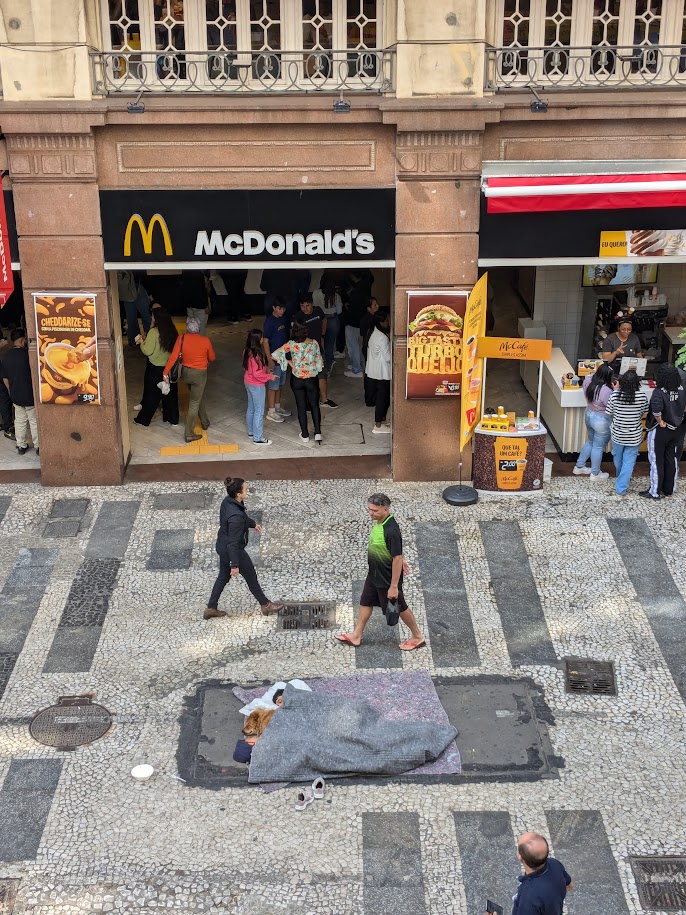
I regularly spend time in São Paulo, where one of the main concerns of the Paulistanos is safety. The far right appeals to these concerns and promises to ‘clean up’ the city. They promise to remove the criminals, the homeless, the drug addicts and other so-called ‘vagabundos’. Time and again they promise to be tough on crime. Both São Paulo’s mayor and the state governor support Bolsonaro and have had years to show what they are worth. Yet the homeless and drug addicts are still there. They used to get together in an area called ‘Cracolandia’ until brutal police operations drove them out. But they are not gone. They now sleep, beg, and use drugs all over the city. When I walk through São Paulo’s city centre, I constantly have to watch my step to avoid human faeces. If anything, the city feels less safe in recent years, especially for women and at night. Far-right politicians have had the opportunity to show how tough on crime they are but they have failed. Paulistanos see this every day, and they complain about it – yet they vote for them again.
Rights to the city
A third example of far-right failure, again from São Paulo. São Paulo’s street carnival is organised by so-called ‘blocos de carnaval’. These blocos are neighbourhood organisations that put together impressive floats with music and dance. Some ‘mega blocos’ draw crowds of over a million people. ‘Acadêmicos do Baixo Augusta’ is São Paulo’s largest mega bloco. For carnival they dress up, play samba and other festive music from Brazil, and parade through the streets of the city. They festively demonstrate inclusivity and show that everyone has the right to the city: queer, black, women, men – all celebrate together. The far right and conservatives object to racial inclusion and what they call ‘gender ideology’. Their politics leave little room for such an inclusive carnival. Instead of supporting the blocos, the city gave the stage to a show by Scottish DJ Calvin Harris. Calvin Harris’s electronic dance music has no Brazilian roots but appeals to a young, white, ‘middle-class’ audience. And where did the municipality schedule it? Exactly on the same street and on the same day as Baixo Augusta’s parade. The city was warned time and again that this was going to be dangerous. Over a million people were expected for Baixo Augusta alone; drawing an even larger crowd to the same street was not safe. What made it worse was that the police had closed off Praça Roosevelt, a nearby square. It was cordoned off with three-meter-high metal panels guarded by police. This left even less space. The mayor did not listen, said that all would be fine, and Calvin Harris drew an estimated million plus young people. It was chaos. On social media people could see youngsters being crushed by the crowd. They had nowhere to go. Some were injured, others fell over the metal barricades that the municipality had put up. The police tried to push youngsters back and when that did not work they started beating them with their batons. In effect, the mayor marginalised Baixo Augusta and the inclusivity it stands for. And everybody could see the incompetence as mostly white youngsters were crushed. And what do people do after having witnessed the violence inflicted on their kids? They vote for the far right, again.
Why vote for failure?
These three vignettes stand for major themes of the elections. The promise that your finances and Christian morality are in good hands: failed. The promise to be tough on crime and make the city feel safe again: failed. The promise to roll back ‘gender ideology’ and ‘identity politics’ and go against racial inclusivity: in the end, it was all so poorly organised that white kids were the ones actually beaten up by the police. To be clear, this is of course not my agenda. I am looking at it from the perspective of far-right voters. Why vote for these Bolsonaristas when they so clearly failed to deliver what you care about, even in a city so firmly in far-right hands?
Hypocrisy as sovereignty
Don Kalb (2025) would approach this through conjuncture, class and capital in which culture wars become a necessary ‘displacement’ of political and economic contradictions. Symbolism and worldviews are no smokescreens: they shape their own reality through which people define personhood. I suggest that we need to read the hypocrisy through Giorgio Agamben’s (1998) figures of the sovereign and the homo sacer. The sovereign, Agamben argues following Carl Schmitt, is the one who decides on the state of exception. The homo sacer, in Roman law, was a person who could be killed with impunity. It is a life without legal or political protection. The sovereign can thus decide when the laws and rules that govern society can be suspended. The hypocrisy is, in fact, an act of sovereignty. The rule of law does not matter when Flávio Bolsonaro says he is fighting a spiritual war for the family while allegedly having parties with sex workers – people that his own rhetoric barely recognises as human beings. He can say that he takes care of your household budget and cost of living while being investigated over his ties to a banking fraud that cost Brazilians billions of euros. Far-right politicians can say they are tough on crime but make the city even less safe. This hypocrisy does not undermine the far right; on the contrary, the far right thrives on it. It symbolises the sovereign status that Bolsonaristas aspire to. They are the ones who decide when the rule of law can be suspended and which lives count. Sometimes this is quite literally so. Someone told me about a dinner party he had attended. Over a glass of beer, one of the guests – who, as usual, was carrying his gun – casually said something like: ‘You know what I would like to do tonight? Go out on the street and just kill someone, just someone, for fun!’ The sovereign needs the homo sacer, those who can be killed without it counting as murder.

Silenced and amplified voices
This misogynist, racist, queerphobic and classist discourse spreads via social media, which amplifies the division between ‘us’ and ‘them’. Even those working at the margins of the economy, who like to see themselves as entrepreneurs (think of Uber drivers) are drawn to it. But social media posts circulate differently. I was sent a post on TikTok about the investigations into Flávio Bolsonaro. The post was gone within minutes, before I could see it. Chavoso da USP, the pseudonym of Thiago Torres Moura Santos, is a sociologist, left-wing activist and influencer who fiercely and eloquently speaks out against politicians who criminalise the poor and working class. With his oversized sportswear, Oakley sunglasses, tattoos on his neck and face, he stays true to the working class and funk culture of the urban periphery. He had more than a million followers on Instagram until November last year, when Meta blocked his account without giving an explanation. His voice, so popular among young people from the periphery, is now harder to find and Meta has also blocked other left-wing influencers.
Digital capital has openly aligned with the Right. Social media are, as Don Kalb puts it, the far right’s ‘increasingly well-funded ideological base’ (2026: 6). Júlia Zanatta has just been re-elected to the Chamber of Deputies for the state of Santa Catarina, with a record 560,000 votes. She is vehemently against abortion, supports the Bolsonaristas who were staging a coup d’état in January 2023, and strongly opposes so-called ‘identity politics’, except her own. Her appearance and style speak for themselves. She wears her hair in braids wrapped around the crown of her head, often decorated with flowers. It is a style that evokes the Bund Deutscher Mädel of the Nazi era, an aesthetic that was central to the Nazi ideal of femininity. On TikTok we can see how she took to the streets to celebrate her victory. Surrounded by enthusiastic supporters and expensive cars she walks the streets with a whip in her hand, beating the road in front of her. She screams: ‘This is historic, this is a lot of votes! I want more votes! It went with the whip!’ To give these words more force she cracks her whip again. Is ‘this went with the whip’ only an innocent way to claim a massive and smooth victory? Or is it less innocent in a land that was the last to abolish slavery in the Americas? The imagery of the plantation overseer (feitor) – who whips whoever stands in his way and decides over other people’s lives – is palpable. Rodrigo Nunes (2026) traces how ‘the overseer hired to discipline the plantation workforce became, after abolition, the police officer’. Slavery is not a relic here but continues to resonate in fantasies about social and moral order. Images like these circulate freely on social media and are defended by people who argue that you need to see them in context. But which context?
Dignity on Credit
Why is this important not only to wealthy Brazilians, but also the middle-class? The dignity of the middle-class hinges upon unsustainable consumption patterns that make the distinction between us and them ever more fragile (Pinheiro-Machado and Scalco 2020). The newest iPhone and car must be bought on credit at extremely high interest rates. Credit cards charge more than 400% per year as financial inclusion has become ‘financial expropriation’ (Rugitsky 2026). Their lifestyle is only possible because of cheap labour: restaurant cooks, waiters, Uber drivers, nannies and domestic workers. They are also needed as ‘the other’ against whom one can feel superior. I have often heard people refer to ‘their’ worker as a useless pawn (peão). As if life were a game of chess in which pawns are easily sacrificed for the king.
Lula and the PT campaigned to shorten the working week from six to five days. He campaigned for the dignity of workers and their families and is known for many successful poverty alleviation programs. But, as Kalb (2026) would anticipate, the middle class perceives this as a threat – not only financially, because it raises labour costs for a ‘squeezed middle’ (Toneto 2026), but also, and perhaps even more so, I would argue, because it undermines the sovereign’s freedom to decide over the lives of others. At the same time, Lula is humiliated for being a Northeasterner who came to São Paulo to shine shoes and work in the factory (Bähre and Gomes 2018). The poverty-alleviation programs Lula put in place (with all their limitations) and the partly successful emancipation of women, Brazilians of color and queer people are seen as a threat to the correct hierarchy and middle class identity. The elections have to reinstate the boundary between ‘us’ and ‘them’. Moreover, I would not be surprised that this social media discourse encourages people to stop voting, disillusioned. While voting is compulsory in Brazil, more than 33 million people – 21 per cent of the electorate – did not vote: a record number.
A sovereign needs a homo sacer
A sovereign is nothing without a homo sacer. Voting for the Bolsonaristas shows that you are, or at least aspire to be, someone who decides when and where the law can be suspended; someone who rules, or aspires to rule, over the dignity and the lives of others. Someone who handles the whip. Ironically, the far right’s failure to deliver is precisely what fuels its success. Hypocrisy performs sovereignty. This is the logic behind the far right. You show that you can decide over homo sacer.
Erik Bähre is a cultural anthropologist at Leiden University whose work explores the moral and political dimensions of economic life, with a particular focus on the nexus of care and finance. His most recent research is on health, insurance and the family in Brazil.
References
Agamben, Giorgio, 1998. Homo Sacer: Sovereign Power and Bare Life, Stanford: Stanford University Press.
Bähre, Erik and Fabíola Gomes, 2018. “Humiliating the Brazilian poor: The iconoclasm of former president Lula”, Anthropology Today 34.
Kalb, Don, 2025. “Introduction: Counterrevolution within and against the Counterrevolution”, in Walden Bello and Don Kalb (eds.), Backlash: The Global Rise of the Radical Right, London: Pluto Press.
Nunes, Rodrigo, 2026. “Brazil: The Future of the Far Right”, interview by Carlos Pérez, Equator, 30 September.
Pinheiro-Machado, Rosana and Lucia Scalco, 2020. “From Hope to Hate: The Rise of Conservative Subjectivity in Brazil,” HAU 10(1).
Rugitsky, Fernando, 2026. “Battleground Brazil”, Sidecar (New Left Review), 2 October.
Toneto, Rodrigo, 2026. “Fiscal Democracy”, Phenomenal World, 19 March.
Cite as: Bähre, E. 2026. “Becoming sovereign: Brazil’s far-right election victory” Focaalblog October 10. https://www.focaalblog.com/2026/10/09/erik-bahre-becoming-sovereign-brazils-far-right-election-victory/