All posts by Focaal Web Editor

Stephen Campbell: On the dialectics of capitalist expansion: An interview with Christopher Krupa

In April 2022, University of Pennsylvania Press published A Feast of Flowers: Race, Labor, and Postcolonial Capitalism in Ecuador, by University of Toronto anthropologist Christopher Krupa. Tracing the expansion of capitalism in the largely rural, agrarian canton of Cayambe, Krupa’s book is an historically informed ethnography of Ecuador’s cut flower industry. In the interview below, Focaalblog co-editor Stephen Campbell talks with the author about this important new monograph.
Book cover of A Feast of Flowers

Stephen Campbell: First, thank you for agreeing to talk with me about your new book. A Feast of Flowers is brilliant on many levels—most broadly as a theoretically sophisticated contribution to anthropological political economy. To start, I’d like to ask about the book’s background. Could you say a bit on how you came to this project? What were the initial research interests that led you to studying Cayambe’s cut flower industry?

Chris Krupa: Thanks for your kind words about the book, Stephen. I know this is an ethnographic cliché, but I actually didn’t begin this project with the intention of studying the cut flower industry, at least not directly. Since the mid-90s, I’d been spending time living in indigenous communities around Cayambe and had become fascinated with both the political work of territorialized communities and the technical details of indigenous agrarian practice. I was invested in the debates occurring in Marxist anthropology at the time about rural societies, things like the articulation of modes of production and simple commodity production literatures, and was always keeping an eye on the massive export plantation sector then starting to engulf the whole region.

I started trying to map out the complex ways in which any one thing I was interested in—a community, let’s say, or a small plot of commercial onions—was becoming intelligible only as one part of a complex and dynamic social formation that included things like flower plantations and foreign currency markets in them. I found that no matter how I composed this map, capital always seemed to enter my analysis as a kind of disruptive externality, turning the anthropological project into a rather obvious moral tabulation of the violence effected by capitalist expansion, something one could do well enough without much ethnographic or historical research at all.

At the time, we were getting a lot of really competent studies of indigenous political practice in Ecuador by scholars who quite explicitly positioned their scholarship as a contribution to a kind of radical democracy project of expanding the presence of indigenous activism, something that joined with similar projects in other parts of the world. The more time I spent with these movements, the more curious I became about our opponents, which also resonated with the questions the activist-intellectuals I was living and working with were posing to me.

What we didn’t have, and don’t often get, I think, when the terms of contestation are so neatly drawn, are in-depth studies of how power actually works in a historically-specific social formation. This is particularly true, I think, of capital, especially when the dynamics of local capitalist practice seem to express broader patterns going on worldwide, such as, in this case, the expansion of labor-extensive production systems in the Global South dedicated to making specialized goods for Northern consumers.

Through a series of accidents, I managed to get invited to do research inside a flower plantation, which led to further invitations (after many, many refusals), and which kind of opened up this completely bewildering insider’s view of how wealth is made in a place like rural Ecuador today. This was something that the indigenous federations and communities I was aligned with and living in were far more interested in than anything I might have to say about what they were doing. Figuring this out became a major part of my research and took me well over a decade to really piece together, as Part I of the book tracks. It also, I think, tells a different kind of story about how rapid capitalist expansion happened in places like the indigenous highlands of Ecuador in the late 20th century.

SC: The book covers a lot of ground—from a global history of financialisation since the 20th century, to a survey of Ecuadorian race thinking, to industrial psychology, to workplace labour processes. The unifying thread running through the book, however, in my reading, is the dialectics of capitalist expansion. Would that be a fair gloss of the book’s overall conceptual contribution? Or how would you most succinctly state the book’s primary theoretical concerns?

CK: That works. One thing I really wanted to do with the book was provide a deep ethnographic account of primitive accumulation, one that could at least aspire to treating primitive accumulation with all the nuance evident in Marx’s retheorization of it. The crucial thing for me was to address with equal complexity the two inseparable processes Marx identifies as making up primitive accumulation. On the one hand, there are the brute material processes under-girding the consolidation of capitalist class relations and the increasingly narrow organization of these relations and their reproductive capacities around emergent forms of commodity production and capital accumulation. On the other hand, there is the assemblage of a new register of history that reconfigures historical positionings like past, present, and future or then/now distinctions or senses of historical arc and momentum, as well as frames of historical action and intervention, around these material transformations such that broader issues of being and becoming and so on can’t but be inflected with one’s positioning in a new capitalist historicity. There’s been a tendency to emphasize the first of these processes over the second and to reduce everything in that to somewhat shorthanded notions of dispossession, with land theft or things matching the metaphysics of property seizure becoming the iconic, foundational, scene of capitalist arising.

In northern Ecuador, the juridical weight of its rural community system has rendered indigenous land unavailable for capitalist expropriation, and the whole history of land ownership is an important part of the story. But more than that, the constellation of actors and forces and interests that came together in rapidly developing this plantation system in and around indigenous territories in northern Ecuador (which turned the country from a non-producer of commercial flowers to the third largest global exporter of them in only a few years) was infinitely greater than what can be explained by a single violently explosive event like a land grab. It involved all the forces you mention, Stephen, and I wanted to be able to trace out the interactions between these in detail to really outline what this part of primitive accumulation, the first set of processes I mention above, really looked like in this one case, as a model for how such things might be coming together in other parts of the world.

Because so much of this information is secret or not publicly available or just hard to get is probably why we tend to get rather truncated stories of capitalist process—and why it also took me over ten years to write this part of the book. But attending to the other part of this, capital’s interventions into historical production, is equally important because it allows us to see how the people directing these processes situate them in a local reality—what they imagine that to be, why they think it is that way, and how the work they are doing will intervene into that. It is where the foundational logics of capitalist accumulation get de-abstracted, rendered socially specific and concrete, and shape the way that very human component of primitive accumulation—turning people who aren’t wage workers into them—gets actualized and justified in one way or another. And it is where questions arising in our attention to the first set of processes—like, in my case, why the science of industrial psychology figures so prominently in shaping plantation labor systems and securitizing the borders between capital’s inside and outside—get answered. So, all of this, this expanded definition of primitive accumulation and its attendant ethnographic critique of capitalist historicity, is perhaps what I’d say shapes any conceptual or theoretical contributions the book may offer.

SC: You’ve framed your book as a contribution to understanding post-colonial capitalism in general. But you also delve, in much detail, into the specificity of Cayambe’s cut flower industry and its situatedness in Ecuadorian history and in Ecuadorian race thinking. Is there something particular about this case that renders it especially helpful in illuminating the workings of post-colonial capitalism more broadly?

CK:  Yes, I think there is but I should probably clarify what I mean by “postcolonial capitalism”. This is a term of specification not generalization. On the one hand, it is meant to push for a specification of the components of a given capitalist system that draw their force from their invocation of frameworks devised to advance or stabilize a prior colonial system. This involves a pluralization of both capitalism and colonialism and the tracing out of historical continuities between these in their unique historical assemblages.

For instance, it matters a good deal that the Spanish conquest of the northern Andes did not advance through a singularly genocidal agenda and that it wasn’t just the land, as a potentially vacant resource, that was valued. Indigenous people were needed, as both tribute-paying subjects and as workers in the Crown’s labor drafts, in mining operations throughout the colonial Andes, on the agrarian and domestic operations of settlers, and in all kinds of jobs that settlers wanted done for them. The violence of conquest regularly returned to the question of how to fold indigenous subjects most productively into dominant economic and political agendas and reap value from that way.

This orientation comes to define the ways hacienda complexes operated when they took over the entire rural Andes and absorbed indigenous populations into them as resident peons after Independence. And this sets up a particular approach to capitalist development in the 20th century, which itself builds on over 100 years of dominant political thinking in Ecuador that united questions of economy and race, of capitalist expansion and indigeneity, into a single question that then shapes the capitalist-expansion-as-indigenous-salvation script organizing plantation hiring practices, labor processes, and so on, as I discuss throughout the book. So that’s one part of what I mean, which is a kind of broad methodological orientation.

The other part is more specific, in that I use the term “postcolonial capitalism” to characterize a form of capitalism that folds a certain claim to historical intervention into its operational rationality, specifically presenting itself and its expansion as curative of the lingering colonial residues haunting the present. In other words, I don’t use the term “postcolonial” here as an objective descriptor—obviously, if I were to try to locate the mis-en-scene of capitalist arising in highland Ecuador, it could certainly be debated whether “postcolonial” is most effective for capturing its complex temporal register. Similarly, if I were trying to offer a political perspective on that same process, it is open to debate if postcoloniality would best capture that.

Instead, I use the term here to identify what might be called an ideological framework appropriated by capital itself to position itself historically and to overlay the violence of expansion with a claim, drawing on ideas about progressive futurity and temporal momentum, to beneficent social good. Here, the colonial legacy up for grabs is indigenous abjection, the equation of indigeneity with misery and exclusion, and even the relevance of racializing terms like indigeneity at all. Capital’s claim is to finally get over all this—this is what its expansion promises. “Postcolonial capitalism” points to the interactive co-existence of these contradictory processes—the appropriation of colonial residues into the core operational procedures of an expanding capitalist system and the claim that this system is uniquely qualified to eradicate colonial residues from the places it expands into.  

SC: The term “racial capitalism” appears in the book’s introduction, though it’s not a concept to which you explicitly return. Yet, the dialectics of race and capitalism is definitely one of the book’s central concerns. How would you situate your book in relation to the growing literature on racial capitalism? What do you see as your book’s primary contribution to this literature?

CK: Right, well as I’ve said above, one of the core historical threads running through the book is the deep connections between the economic and racial sciences and agendas in Ecuador, and of political projects fusing the two together as a pretext for various sorts of interventions into indigenous territories. By the early 20th century, the idea of “capitalism” in Ecuador becomes hard to think outside of its figuration as a liberating force for highland indigenous people bound in different ways to hacienda enclosures. Capitalism emerges as the solution to what was referred to as the “Indian Problem,” and today’s flower plantations are heirs to this mission. The ethnographic work inside flower plantations in the latter chapters of the book show how this agenda is set in motion in plantation labour systems.

But at another level, I’ve been admittedly quite influenced by the ways early American contributors to the literature on racial capitalism based their use of the concept on a searing critique of the millennialism under-girding conventional capitalist history. Their re-tracing of the rise of capitalist class relations out of post-abolition efforts to continue the economic structure of slavery opens up a pretty important discussion of the inherently racializing character of the location “labour” itself. It also points to our need to continually ferret out the historically specific ways that capitalism disguises the violence inherent to its routine operations. As I show in the book, the social work of primitive accumulation rests entirely on both of these processes in its historical reconstruction of the pre-labouring poor as marked by forms of consequential and often essentialized difference that are progressively overcome by their proletarianization. This is a central narrative trope inherent to primitive accumulation as a genre of elite historicity.

SC: Race is central to your theorisation of post-colonial capitalism. Yet, it struck me that the large white and mestizo populations of Latin America distinguish this region from most post-colonial countries in Asian and Africa. Is that a relevant distinction to make? Would you nonetheless say that the dialectics of race and capitalism that you trace in the book play out similarly in post-colonial contexts elsewhere in the global South?

CK: I can’t answer that question, but I think that’s the sort of fine-grained ethnographic and historical question that I hoped to offer one more source of inspiration for with this book.

SC: One thing that stood out for me was how deeply Hegelian the book is. You write, for example, of “the plantation as an object constituted by relations with forces outside it,” of “the flower as negation,” of narrative frames “located neither entirely inside nor outside” the domain of capital, of “mediation between inner and outer worlds,” of a site of knowledge creation “dialectically related to its opposite,” and of a form of capital accumulation “whose ‘outside is essential,’ of its essence.” This Hegelian dimension is not explicitly named as such in the book. Could you elaborate on how an understanding of Hegelian logic informed your research analysis and writing? Was this an approach you had in mind before you started the project, or was it something that developed over the course of research and writing?

CK: Good catch, Stephen. Guilty. I think one of the most consequential things I did during my graduate training was participate in a slow, page-by-page, group reading, led by Neil Larsen, of Hegel’s Phenomenology, followed immediately by doing the same with Capital V.1. I also, having received zero training in field methods during my graduate education, brought Bertell Ollman’s Alienation with me to the field and used that as my field methods training instead. It’s all there, I suppose, in Ollman’s Hegelian reading of Marx’s method, and it’s striking how well that book works as a primer in ethnographic methodology if you’re interested in the sort of things you and I might be interested in.

Ollman’s reading of Marx centers on his dialectical phenomenology, his radical critique of the object, his explosion of metaphysical notions of presence, and of suchness being an effect of overlapping webs of relations, which logically exist prior to and become determinate of things themselves. How to set all this in dynamic motion as an ethnographer? was a question I asked myself throughout fieldwork and there were a lot of missteps in it along the way. Writing the book, I think I was best able to work through this in the chapters on interiority, especially in the overlaps between notions of psychological interiority that can only be grasped through processes of exteriorization like projection, capital’s outwardly expansive dynamics that only work through processes of interiorizing its externalities, the shifting spatial dynamics codifying capitalist/non-capitalist locations, and the scientific efforts to construct a profile of the inner life of indigenous people as preludes to various forms of external intervention upon them.

SC: One of the recurring themes in your discussion of post-colonial capitalism is the notion of difference. Difference has also been a key theme in the anthropology of capitalism that is influenced by J.K. Gibson Graham. Yet, whereas Gibson-Graham, and the anthropologists whom they’ve influenced, employ a Deleuzian notion of autonomous difference, your book advances an explicitly relational understanding of difference—specifically, of differences that are “internally related.” Would you say that this is a relevant distinction to make? Could you elaborate on your understanding of difference, especially as it pertains to the theorisation of capitalist expansion?

CK: Let me answer this in a slightly different way than I think you might intend. The book is an anthropological critique of political economy and its topic is capitalism. I am not interested in attempting a general theory of something like difference, though I do draw from some of my teachers who were. Difference enters the analytic because it was there from the start. There from the start because the lineage I trace of capitalist thought in Ecuador, right up to the present, begins with, and never ceases to ponder, the question of what the imposition of things like free labour contracts or monetary remuneration of hourly wages or disciplined, routinized labour routines, or regularized working hours might mean for effecting a (spiritual, moral, political) transformation of indigenous society.

The reverse was also true—at a certain point in the late 1800s, questions about what indigenous people are, why they are that way, how they might become different, and so on, get completely entwined with questions about the ways these markers of indigenous difference are determined by the hacienda enclosures to which they are imagined to be universally bound, stimulating the question of what, then, would become of indigenous people, and indigeneity itself as a category of difference, were the haciendas to be replaced by capitalist forms of production. There from the start also because primitive accumulation, as a genre, locates the foundational act of capitalist emergence in an encounter with difference, that is, with a description of a population retroactively constituted as pre-labour and defined by certain features that are magically transformed through their absorption into the project of capitalist expansion. Those originary features are bad or pathological, their transformed conditions are good or curative. This is a pretty standard trope in primitive accumulation’s narrative form, as I said earlier.

To follow your distinction, an “autonomous” notion of difference is as central to capitalist method as a “relational” one is to its critique. The urban and rural poor are so because they are given to sloth and the wasteful expenditure of time, says the former. Time thrift only marks the pre-labouring subject with difference because their potential labour-power is being valued in measured temporal units for your profit, says the latter, who addresses the former as a predator. Difference is there from the start. So is its critique.

SC: To close, could you say a bit about what are you working on now? What is your next project?

CK: I’m currently writing an anthropological history of the late Cold War years in Ecuador, focusing on the way a small guerrilla movement was used by the proto-neoliberal state to justify an expansive campaign of terror. It’s also about the Cold War prison and the intimate solidarities of revolutionary practice, and attempts to do all this through an analytic method that I associate with older Marxist literary criticism.

SC: Thank you so much for taking the time to do this interview. I encourage interested readers of this interview to check out the full book, which is available at the University of Pennsylvania Press website, and elsewhere.


Christopher Krupa is Associate Professor in the Department of Anthropology at the University of Toronto (Scarborough). He has researched and written on Andean Ecuador for over 15 years. He is co-editor (with David Nugent) of State Theory and Andean Politics: New Approaches to the Study of Rule (2015), and author of A Feast of Flowers: Race, Labor, and Postcolonial Capitalism in Ecuador (2022).


Cite as: Campbell, Stephen. 2022. “On the dialectics of capitalist expansion: An interview with Christopher Krupa.” Focaalblog 6 October. https://www.focaalblog.com/2022/10/06/stephen-campbell-on-the-dialectics-of-capitalist-expansion-an-interview-with-christopher-krupa/

akshay khanna & Alice Tilche: The Political Voice and The Revolutionary

This is the fourth in our series of blogposts in relation to the Budhan podcast project, a community led initiative that has sought to capture the experiences of some of the most marginalised communities in India during the COVID19 pandemic.

In the previous blogposts we reflected primarily on  Season 1 of our series, at a community speaking of, sometimes enacting their own experience of pain, and at the key role of the aesthetic in offering glimpses of that which cannot be spoken – through hyper-real and melodramatic performances. As an attempt by members of the Chhara DNT community to make sense of its own experience, and bolster its response to the pandemic, a primary audience for Season 1 had been somehow internal. Taking Season 2 as our focus, in this post we consider the challenges of a marginalised group speaking of the plight of other marginalised groups, as artists step out of the community to document the experiences of other DNT groups. We look at how that which could not be spoken becomes expressed through the political voice as marginalised communities make claims (to resources, equality, visibility) in the context of the pandemic.

Materiality of a season

The material conditions of production of season 2 differ substantially from season 1. In season 2, we have a team with greater technical expertise, having worked on ten episodes in lockdown conditions, and now supported by more substantial funding and professional equipment. The actors who had enacted plays, songs and monologues are now standing behind the camera, as directors in their own right. Although theatre performances continue being used, there is a clearer shift towards the realist documentary form – a shift that goes alongside the reimagination of the audience. If in the early episodes the audience was most explicitly the Chhara community itself, and the subject and the audience intermingled in ways that unsettled the mode of audienceship, in Season 2, the subject is more clearly demarcated. The audience is equally sequestered outside of the frame – if not an ‘outside gaze’, in a simple sense, the audience is seated outside the process of the film. The films, in other words are not speaking ‘to one‘s own’, but rather to an abstract audience constituted of diverse positionalities. The narrative voice (whether of the anchor, or of Budhan Theatre (BT) and other performers who take on the role of the anchor in some episodes) is also one that is familiar to the documentary form – the audience is being introduced to the community, their history and struggles. As such, even though the films continued to be made by indigenous film makers, this was a gaze of members of one marginalised community onto others.

We are now also at a different point in the unfolding of the pandemic. Most of the shooting that features in season 2 was done after the first wave of the pandemic had subsided and when it became possible to move out of the confines of closed spaces and neighbourhoods. A lot of the footage is outdoors, in streets, in neighbourhoods and in temporary settlements of nomadic communities. By the time we arrived at the stage of editing, however, India was thrown deep into the devastating second wave of the Delta variant, when the country faced a shortfall of oxygen, vaccines, medicines and wood to burn the dead. In such a situation it was neither possible to base the films simply on the footage already collected, nor was it possible to return to the field. What we have then is the juxtaposition of footage, of interviews and performances shot ‘between waves’, and online interviews carried out as the second wave unfurled. A creative response to this situation can be seen in episode 7 based on the experiences of the Pardhi community in Maharashtra, wherein montages of still photographs are juxtaposed with videos of online interviews, where the smart phone is included in the frame to make the materiality of production visible.

The Political Voice

Episodes of season 2 articulate an explicit political voice. There are clear demands being made, which are easier for the audience to identify. The actors, and the interviewees are composed, their speech is political, their words well-chosen and addressed outwards – the interviewee looking straight into the camera.  In the episodes, we hear about a shift to begging, which as an activity further criminalises the community, putting lives and livelihoods at risk, and that this labour falls entirely on women. We learn about the deepening educational gap given by digital education, about living in poverty, about evictions and resettlements, about (lack of) livelihood and the overall exclusion of these communities from the mechanisms through which humanitarian support was extended by state and civil society alike. These issues are all being articulated as demands rather than laments or complaints with a recognisable aesthetics. We point here to the specificity of the unambiguity of a political voice that makes explicit demands, laying out frameworks of (in)justice and demanding the interlocution of the state. Perhaps it is the case that by this time the dust had settled on the extent of suffering brought about by the neglect of the state in enforcing a lockdown without warning or preparation (see in particular the episode ‘We wanted to go back’, focussed on the suffering of the millions of ‘migrant workers’ who walked thousands of kilometres to get home), the spectacular inefficiency of the state in preparing for the second wave, the extent of death and suffering this caused, and the continuities between this violence and the long history of social and political abjection.

The political voice of the podcast is diverse in its articulation, and the aesthetic difference between its forms is instructive of the complexity of the DNT political subject. The clearest political demands are made from the chair. There are plastic chairs where interviewees sit – chairs placed outside of households, where interviewees sit holding onto their arms, projecting their voices with clarity. The chair is a key symbol of authority, especially in rural India and in poor urban settings, where entire settlements may only have one chair available that is shared for important guests. Elevated from the floor, sitting on a chair also means not sitting on dirt, and is as such loaded with the political connotations of hierarchy and pollution. Demands made from the chair, with a few exceptions, are articulated by men.

Other voices, largely those of women, speak instead from the floor: sitting or squatting on the mud floors of their kitchens, and sometimes on charopais, the woven beds where entire families sleep in the open. Their demands from the floor are more like laments: ‘what can we do sir’, some conclude, addressing the interviewer behind the camera. Their apparent helplessness should however not be mistaken with passivity. In fact, if there is a resignation to one’s condition of abject poverty, a resignation that it will not change, there is also a resolution to do what it takes to survive. During the pandemic, many of the women we see ran entire households on their own, defying lockdown restrictions to beg. If the men made demands from chairs and women laments from the floor, women were the one who actively defied authority as men had to take on more passive roles (for being more easy targets of police retaliation, but also out of a sense of entitlement to ‘better’ work i.e. they would not take up household chores). From the floor, women’s voices conform to societal expectations (reproduced within communities) of a certain passivity attached to their behaviour, that same ‘passivity’ that allows them more easily than men to circumvent the law, even as this exacerbates the risk of social and sexual violence (Episode 4 features archived footage of a mob lynching of a Madari woman accused of ‘child lifting’ and an account of the gang rape and murder of another, for instance). Spoken as monologues (from the chair or the floor), these speeches have what Bakhtin calls the quality of the dialogue – they are addressed to one and in fact multiple audiences. At one level they are addressed to the immediate listener, a member of BT behind the camera asking questions – who, for many of the communities, is also seen as a patron (with political and humanitarian connections). At another level they are addressed to a more abstract authority of the state. This distinction between the chair voice and the floor voice also speaks to the relationship between the signifying voice and vocality outside referential meaning (Weidman 2014), and of the gendered differentiation in the aesthetic deployments of the political voice.

Performance as Ethnographic Layer

The articulation of a political voice reconfigures the function of other elements of the podcast assemblage. As an instance here we focus on the role of theatrical performance. As compared to the role of sublimation, enabling a glimpse of ‘that which cannot be spoken’, performances here play a very different role – that of  re-enacting through hyper-realisation. The first episode of the season focussed on the Bahurupia community of itinerant performers demonstrates this well. The episode features two performances: the first is drawn from the community’s own traditional repertoire, while the second is a performance by one of BT’s lead actors, Ruchika Kodekar. The interview of a Bahurupia community leader and actor, talking about the vanishing art of the community, and the abuses they endure, is intercut with scenes of their community performances enacted for the camera, of (male) actors dressed like monkeys, gurus or women performing characters from modern Hindu epics. This is a stunning interview and framing, with the camera moving between the lead actor wearing full makeup, a side actor who speaks in all seriousness with a bloody eye drawn over a white foundation, and the scene of the performance itself. These scenes from the community are then themselves intercut with Ruchika’s performance, dressed up as Kali Mata (with a blue face, her tongue sticking out, a nose ring and nose chain) performing in the middle of Chharanagar, paraphrasing, offering back to both the community and the viewer another version of the interview:

I am mother

And I am hungry,

My children are also hungry,

My husband (gharwala) is also hungry

Hunger and struggle have very old connections

Ruchika’s performance is intercut with interviews from the community now focussed on the experience of women who, during the pandemic, bore the brunt of earning livelihood for the whole community by begging, subjecting themselves to police violence and the risk of infection. A pregnant woman tells of how she went begging when nine months pregnant, walking for miles, and how she was beaten up by the police. As she recounts her story, Kali Mata echoes it, returning to the public these experiences:

When the pandemic came everything stopped,

There was no work

And no grains of food to eat

I was pregnant at the time

I was hungry

And with me, my children were hungry too

When I asked for food, then I received sticks

After falling down, I had to go back

You entertain yourself with TV and mobile phones

But I am born artist

Yes, a born artist

Which you call Bahurupia

I feed my family by showing my art

But today I am receiving sticks instead of food.

Kali Mata’s performance is filmed in slow motion, with a focus on the actress’ blue face, her facial expressions, her tongue sticking out. At times, when the camera moves back it reveals a small audience around her, gathered from the street where the act is being filmed. The slow-motion choice, (which was in fact the fixing of a technical glitch in which voice and images failed to sync), lends this piece a grave and dramatic style supported by a suspense-kind of background music. The image and words of the deity embodied are in themselves ponderous, as though the cosmic, the mythological had manifested in the mundane. It is beautiful, grotesque, and evokes the terrifying power of the Mother’s justice. The uncanny presence of a street audience, of the everyday, at the corner of the frame makes them all the more so.

In the case of both performances, we see the creative use of intercutting as a technique, a to and fro movement between temporalities in such a way as to create contiguity, meaning and affect within each temporality and beyond their sum. The intercut here produces a rich ethnographic layer, which picks up, reinterprets, transforms and hyper-realises the political voice, setting the stage for the revolutionary voice. It is important here to recognise that this technique lies in continuity with a longer tradition in BT’s theatre practice, which takes real-life stories and re-enacts them both to communities and to power: for communities in order to heal shared experiences of pain and create a movement; to power in order to make claims but also to achieve redemption. The interpretative work of BT theatre is made evident, there is a real that the hyper-real performances directly refer to. In film, through the intercut, these are made adjacent, enmeshed in each other.

The Revolutionary Voice

In the initial episodes of season 2 the documentary form is prevalent and the political voice – although augmented via performances – remains composed. As we move through the series, through the peak of the pandemic in India, we also see a shift from a more respectable voice to an unruly one (khanna 2012, Shankland et al 2011) – one that, paying witness to the sheer dispossession of the participants eventually, calls for a revolution. In episode 9, focussed on one of the most deprived Muslim-DNT communities that we encounter in the series, we are thrown back to the often-appearing theme of the threshold between animal and human. “They treat us like animals”, so the episode is called – a line repeated by different interviewees, alongside descriptions of chronic hunger, backbreaking work and a life confined to the most abject poverty with no possibility of redemption for oneself or the next generation. “Our children are not very smart”, the woman seated on the mud floor of her house declares, having grown up with food for two days out of four. “We have to live under this oppression”. Instead of echoing and augmenting the resigned voices of interviewees through performance, performers intercut their speech with a parallel dialogue calling on those who care to overrule the powerful.

“Those who care about the weak should speak,

We should change the world

It should scream

It should feel that those fighting hunger won’t get tired

The fire in the belly gets into the head

If some food goes into their belly, then there will be victory”

There is a shift in tone and addressivity (Bakhtin). If in the performance of Episode one the actress speaks in the first person as the interviewee, here actors address the audience head on. “Would you not get food and stay quiet? One must speak up”. They speak here almost to a ‘superaddressee’, that third person other than the speaker and the listener who listens sympathetically and understands justly.


References

Bakhtin, Michael. 1981. The Dialogic Imagination. M. Holquist (ed.), Austin: University of Texas Press.

Khanna, A. Seeing Citizen Action through an ‘Unruly’ Lens. Development 55, 162–172 (2012).

Khanna, akshay. 2012.  Seeing Citizen Action through an ‘Unruly’ Lens. Development 55, 162–172.

Shankland, Alex, Danny Burns, Naomi Hossain, Akshay Khanna, Patta Scott-Villiers and Mariz Tadros. 2011. Unruly Politics: A manifesto. Brighton: IDS (mimeo).

Weidman, Amanda. 2014. Anthropology and Voice, Annual Review of Anthropology , 43: 1, 37-51


akshay khanna is a Delhi-based Social Anthropologist, International Development Consultant, theatre practitioner and amateur chef, with training in Law and Medical Anthropology and the author of Sexualness (2016, New Text), which tells a story of Queer movements in India, develops a framework to think the sexual from the global south, and introduces Quantum Physics into the study of the sexual.

Alice Tilche is a lecturer in Anthropology and Museum Studies at the University of Leicester, UK. Her research at the intersection of art and activism employs visual, collaborative and arts-based methods to research social transformations – including work on the cultural politics of indigeneity, migration, nationalism and most recently Covid-19. Alice’s book Adivasi Art and Activism: curation in a nationalist age was published with Washington University Press in 2022. Her collaborative film projects including Sundarana (2011), Broken Gods (2019) and Budhan-Podcast (2021) have been selected for a number of international film screenings and festivals.


Cite as: Tilche, Alice and khanna, akshay. 2022. “The Political Voice and The Revolutionary.” Focaalblog, 3 October. https://www.focaalblog.com/2022/10/03/akshay-khanna-alice-tilche-the-political-voice-and-the-revolutionary/

Mahmudul H. Sumon: What do we learn from hybrid governance in Bangladesh’s garments sector?

Global production networks, as we know today, have repeatedly failed to ensure the rights of workers and their health and safety. These failings have been exposed time and again whenever there has been a disaster. To address these failings, transnational activists have long been arguing for various types of multi-sectoral initiatives (MSIs) in global supply chains that involve private companies, trade union networks from both the global south and north, and national governments. Against this general backdrop and the emergence of some types of MSIs, questions for labor rights activists and critical researchers have become pertinent. What should be our position on transnational regulatory mechanisms or hybrid mechanisms in the “upstream” of the supply chains? What kind of organizational and legal relations should such regimes have; especially so vis-à-vis the state in which they operate? Could such agreements improve workplace health and safety? What role could they have in ensuring workers’ rights?

In this brief essay, I particularly focus on Bangladesh’s ready-made garment industry (RMG) and discuss the plight of one such MSI; the Bangladesh Accord that came into effect after two cataclysmic industrial disasters, namely the Tazreen fire and Rana Plaza building collapse. While thinking through some of the questions, I show that this much-coveted initiative, developed and imagined in the transnational spheres of activism, has faced resistance from key stakeholders of the RMG sector in Bangladesh (i.e., the BGMEA, the representatives of garments employer’s association). I argue that the country’s business elite associated with the RMG sector has been instrumental in facilitating the transformation of the Accord into a national corporate venture, making sure that their interests are protected. In the absence of any political will from the state (in the neoliberal order political will perhaps is an outdated idea), I contend that hybrid governance initiatives are somewhat destined to fail given the government’s strong dependence on the business class for its export earnings (i.e., the state business nexus). The story of Bangladesh Accord’s rise and fall or its continued existence under a new name precisely points to the strong leverage that the country’s business class enjoy over the state.

The emergence of the Bangladesh Accord

The Bangladesh Accord is a legally binding agreement between global brands and retailers on the one hand  and IndustriALL Global Union, UNI Global Union, and their Bangladesh-based affiliate unions on the other hand. The signatories aim to work towards a safe and healthy garment and textile industry in Bangladesh. It came into effect after two cataclysmic events, namely the Tazreen Factory fire (2012) and the Rana Plaza building collapse (2013), which killed 119 and 1134 workers respectively and injured many more. Over 220 companies signed the five-year Accord, and by May 2018 the work of the Bangladesh Accord had achieved significant progress for safer workplaces that covered millions of Bangladeshi garment workers. To maintain and expand the progress achieved under the 2013 Accord, over 190 brands and retailers signed the 2018 Transition Accord with the global unions, a renewed agreement that entered into effect on 1 June 2018.

Some international rights organizations and campaign groups have been instrumental in materializing the Accord in Bangladesh. Many believed it would provide a unique opportunity for a collaboration between national and international rights groups and labor rights organizations on the one hand and international retailers and brands on the other hand to begin a ‘fire and building’ inspection regime in Bangladesh. For labor-rights activists working in the global north, a legally binding agreement between brands and trade unions had been a long-standing demand to transition from the previous voluntary standard for garment production to a “binding” standard.

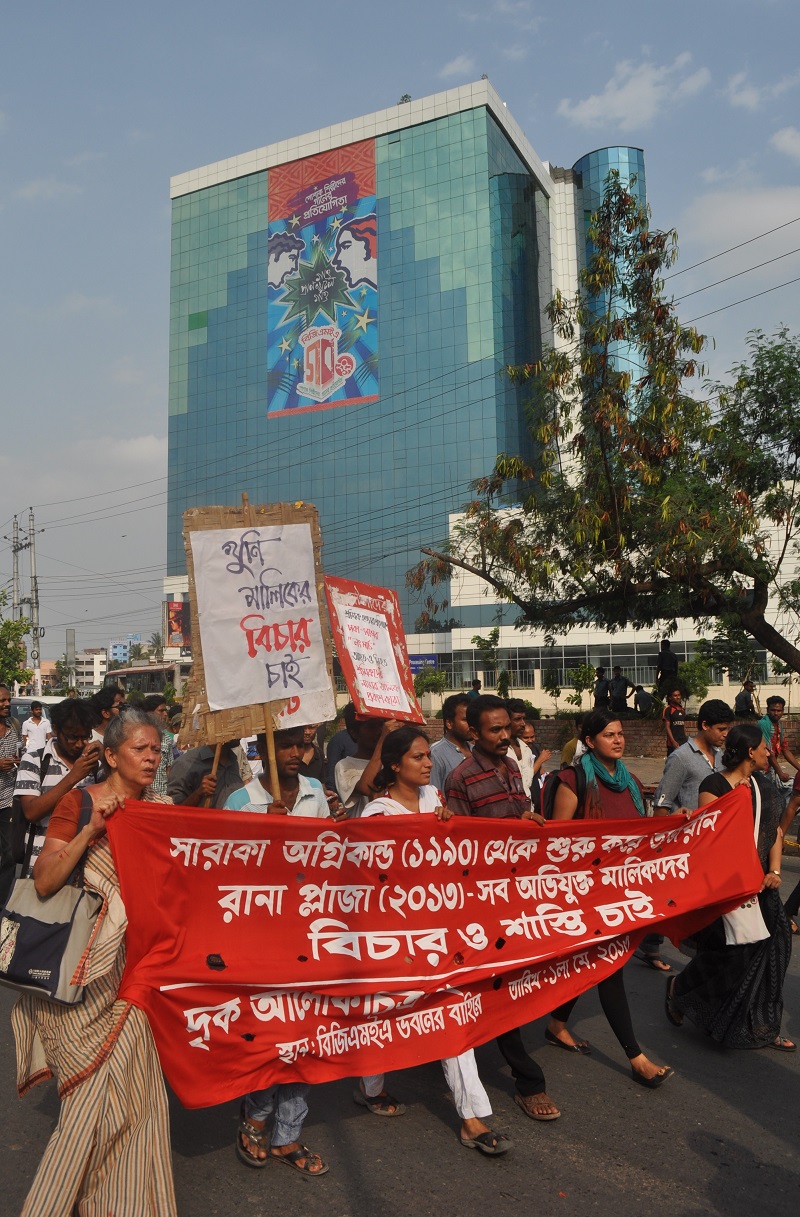
Activists chanting slogans for punishment of all the accused owners of garment factories starting from the Saraka fire (1990s) to Tazreen fire and Rana Plaza collapse (2013) in Dhaka on May-Day 2013 (photo by Mahmudul H. Sumon)

In design, the Accord is best understood as multi-stakeholder-oriented, with scopes for the participation of activists and civil society, both national and transnational.

Although private governance has been a timeworn mechanism in the garment export sector and has been in use for many years in different forms to assess supplier conduct, scholars have noted some differences between private governance and the newly installed Bangladesh Accord. The Accord has been an experiment in “co-governed private regulation” that included global union federations in addition to foreign brands and had the potential to challenge the relations of power between labor and employers.

The stated objective of the Bangladesh Accord has been to introduce an inspection regime aiming for “a safe and sustainable Bangladeshi Ready-Made Garments (“RMG”) industry in which no worker needs to fear fires, building collapses, or other accidents that could be prevented with reasonable health and safety measures” (quoted from the Accord on Fire and Building Safety in Bangladesh text dated May 13, 2013). However, the said inspections have been limited to factories from where the signatory brands of the Accord sourced their products. The Accord had built-in training programs for what it called the workers’ “empowerment” and “awareness” and had plans for the sustainability of the project.

A look back at the period immediately after the Rana Plaza disaster reveals that when it comes to labor reforms, the Bangladeshi government (i.e., the Ministry of Commerce and the Ministry of Labour and Employment) mostly reacted to the situation, responding foremost to the demands put forward by the European Union and the USA. Curiously, the US embassy in Dhaka made a lot of the noises to bring in changes in the labor law for issues such as freedom of association of the workers and easing rules for the EPZs so that worker’s rights were protected. On the face of it, the government complied with these demands, as reflected in amendments to the Bangladesh Labour Law in 2013 (which first came into effect in 2006). In government documents, the main concern for these amendments was slated as “workers’ safety, welfare, and rights and promoting trade unionism and collective bargaining”. The National Occupational Health and Safety Policy was also adopted by the government in 2013. In total, the government reported 76 amended sections and 8 new sections incorporated in the Bangladesh Labour Act. The government also changed the EPZ legislation and introduced rights to unionization which were previously withheld.

The BGMEA smear campaign against the Bangladesh Accord

In the first five years of its mandate, the Bangladesh Accord secured a remediation process for a good number of factories and was deemed “successful” by transnational observers. But as time elapsed and the disaster faded from international public memory it became apparent that the remediation requirements enforced by the Accord administration were not welcomed by factory owners and particularly not by the Bangladesh Garment Manufacturers and Exporters Association (BGMEA). More and more “voices” that criticized the Accord appeared in public discussions, pamphlets, and workshops organized by the factory owning elite and their representatives in Dhaka.

The BGMEA is the trade body that looks after the interests of local capitalists in the sector. It enjoys leverage over the government because of the export earnings from garment manufacturing. Their semi-clandestine campaign against the Accord indicates new safety procedures were not easy to flout and turned out to be a “costly” endeavor for local factory owners. Industry leaders showed detest for the new mechanisms publicly in newspaper op-eds. During a workshop organized by an international non-governmental organization working in Dhaka, one owner of a group of factories with an important position in the BGMEA demanded that factory owners should have the option for “self-governance” (statement from the managing director of a renowned group of industries in a day-long policy event space organized by Friedrich-Ebert-Stiftung (FES), Dhaka (n.d.), personal observation). 

There is clear evidence to suggest that throughout the implementation period of the Accord, the relationship between the BGMEA and the Accord enforcement teams deteriorated. Important representatives of the government evaluated the Accord’s new governance regime as “interfering” with the state’s affairs. At one roundtable discussion held in Dhaka in July 2018, an official from the Ministry of Labour and Employment stated that they were willing to cancel the Accord’s provisions for good. It is worthwhile to note that during the implementation period of the Accord, the opinions expressed by the Minister of Commerce closely matched those of the BGMEA and the business elite of the country. Enforcement of the Accord has been dubbed as “excesses” by a government key spokesperson, indicating how the government simply dovetailed BGMEA on matters of workplace safety. While the BGMEA’s detest for the Accord perfectly fits with the logic of capitalism in the garment sector, what should we make of the government’s detest for the Accord?

The links between government and BGMEA

As the Accord’s tenure drew to a close and an extension was on the table, the friction came out in the open. After news reports that the BGMEA was committed to bringing all the “different regimes” of governance under one roof, the association developed a proposal to this effect for government approval. As recent as August 2019 the BGMEA is on record to have brought allegations against the Accord for its “going alone” policy even though the association committed to a cooperation between the Accord team and the BGMEA’s “local entrepreneurs and experts”. Indeed, the signatories to the Accord’s extension on 21 June 2017 agreed to continue a fire and building safety program in Bangladesh until midnight of May 31, 2021, after which the task would be handed over to a national regulatory body supported by the International Labor Organization.

In January 2020, a deal was struck between the Accord associations and the BGMEA to establish a Ready-Made Garment Sustainability Council (RSC) which would replace the Accord and operate within the regulatory framework of the laws of Bangladesh. Some international labour rights groups and networks made allegations in a witness signatories’ brief that the RSC’s takeover of the Accord’s Bangladesh operations was an upshot of a “protracted campaign” by the Government of Bangladesh and factory owners against the Accord. Among other things, that employers’ campaign included a court case against the Accord, sued by one disgruntled garment factory owner in Dhaka.

At the inauguration of the RSC, the new initiative was praised as an unprecedented “national” supply chain initiative, adding a flair of nationalism in business. The Accord press statement on the transition said, “RSC is a newly established not-for-profit company in Bangladesh created and governed by global apparel companies, trade unions, and manufacturers.” It was officially registered on May 20, 2020, to be “a permanent safety monitoring and compliance body in the RMG sector in Bangladesh.” All the signatory companies and unions of the Accord and the BGMEA agreed to establish the RSC through a Memorandum of Understanding (MoU) signed on May 8, 2019. It was also stipulated that the “RSC will continue with factory inspections, remediation monitoring, safety training, and a safety & health complaints mechanism at the RMG factories supplying to Accord signatory companies” and that the programs “will be implemented following the protocols and procedures developed by the Accord, which have also been inherited by the RSC.” The statement further noted

With the transition of the Accord’s Bangladesh office and operations to the RSC, the RSC becomes the organization implementing the in-country safety inspections and programs of the legally binding 2018 Transition Accord agreement between global companies and unions. To ensure the provisions of the 2018 Transition Accord on remediation, inspections, training, and complaints programs are fully and adequately implemented, the Accord International Secretariat based in Amsterdam will cooperate with and support the RSC.

RSC released the following press release now found on its newly established website.

Today the functions of the Bangladesh offices of the Accord on Fire and Building Safety in Bangladesh have transitioned to the RMG Sustainability Council (RSC), a permanent national [organisation] with equal representation from RMG manufacturers, global apparel companies, and trade unions representing garment workers.

The press release quoted three people representing three parties of the RSC Board of Directors. Dr. Rubana Huq, the then President of the BGMEA and industry representative on the RSC Board of Directors, said “The RSC is an unprecedented national initiative and through our collective efforts with the brands and trade unions, we will make sure that Bangladesh remains one of the safest countries to source RMG products from.” China Rahman, General Secretary of the IndustriALL Bangladesh Council and trade unions representative on the RSC Board of Directors, said, “Together with our Bangladeshi trade union affiliates, we will help ensure workers in RMG factories have safe workplaces and have access to remedy to address safety concerns and exercise the right to safe workplaces. We will work to ensure that workers […] have trust in the newly established RSC”. Roger Hubert, Regional Head for Bangladesh, Pakistan and Ethiopia for the multinational high-street retailer H&M and brand representative on the RSC Board of Directors, said: “With the establishment of the RSC, brands can continue to honour their supply chain responsibilities that they have committed to through the Accord signed with the trade unions. The RSC will provide the assurance that workplace safety will continue to be addressed throughout out Bangladeshi RMG supply chain.” Dr. Huq was categorical in stating that the RSC received its license for operation from the commerce ministry and had taken over ACCORD’s current office and offered all existing staff members to join the RSC.

Uncertain futures under corporate control

After Bangladesh Accord’s transition to a new name there has not been much in the news about ongoing activities. The Accord’s continued operation with new arrangements under the Ministry of Commerce indicates the business elite’s close ties with the ruling political party in Bangladesh. It points to the local power nexus that are at play and business interests prevailing over all other considerations, something commonly seen in literature on global production networks. For all the symbolism involved with the RSC and its “new beginnings”, it is apparent that a truce has been found for the time being. Paradoxically, the “new” developments may resemble a move towards a structural power approach to the problem at hand, where the state’s role is seen as paramount. But in the absence of any political will from the state’s ruling political block, one cannot be too hopeful.


Mahmudul H Sumon is a Professor at the Department of Anthropology, Jahangirnagar University, Bangladesh. He can be contacted at: sumonmahmud@juniv.edu.


Cite as: Sumon, Mahmudul H. 2022. “What do we learn from hybrid governance in Bangladesh’s garments sector?” Focaalblog, 13 September. https://www.focaalblog.com/2022/09/14/mahmudul-h-sumon-what-do-we-learn-from-hybrid-governance-in-bangladeshs-garments-sector/

akshay khanna & Alice Tilche: That which cannot be spoken

This is the third of our series of blogposts in relation to the Budhan Podcast project. In earlier posts we have looked at narrations of collective suffering and the re-embodiments engendered by the shift from theatre to film. In this post we turn our attention to a particular feature of the emergent form of film, that of sublimation. 


A forum theatre1 workshop conducted as part of the project produced two short plays centered on various experiences of the participants, of discrimination based on tribal identity, caste, gender, colour and class. One of these related to a young Chhara man’s experience as a reporter for a television channel. At the beginning we hear his conversation with his father, who had invested in his children’s education so that they did not fall back into the business of bootlegging, which characterises a large part of the economy of Chharanagar. ‘It is most important’, the father says when the protagonist informs him that he has been called for an interview at the channel, ‘that you represent our people. Society and the state think of us only as criminals, as thieves, as those in the daaru (alcohol) business. This must change’. He enters the interview, after negotiating the suspicions of the guard at the door, and being intimidated by aggressive expressions of social capital by upper caste candidates in the waiting room. The idiom through most of this had been humour – miscommunication, caricature, cheeky references to contemporary political moments, luring the audience into the story and marking a mutual unreadability between the characters on stage. The protagonist sits down, nervously, in front of his prospective colleagues and bosses.  

‘What is your name?’, they ask. ‘Govind’, he replies. ‘Yes, we know, we have read your application, but what is your name?’. Here emerges a curious fact – Govind has dropped his surname. He goes simply by the name Govind.

The question ‘what is your name?’ in India is much more than about what one is to be called. It is the first question that one is asked – for it is through one’s surname that one’s caste is ascertained, one’s relative position in the interaction, and thus one’s status and terms of engagement. There is a long history of people, especially those from oppressed castes and tribes strategically changing their names. In the 1970s and 1980s, socialist movements such as the ‘JP movement’, led to people dropping their surnames en masse so as to disable the privilege function of caste. Today’s young generation of Ambedkarites of different caste backgrounds do the same and it is not uncommon to come across students and young professionals fighting formal systems that require a caste name as a prerequisite for entry and recognition. 

On the insistence of the interviewers, Govind lets out that his ‘full name’ is in fact Govind Chhara. He is from Chharanagar, the interviewers confirm, where there is daaru business, and crime. The interviewers seem unconcerned with the fact that Govind’s expertise is in culture, that he himself is an actor and is interested in covering cinema and art. Even as they eventually give him a job, this has a very specific remit – he is to give them stories from within the world of crime. The rest of the play traces his journey through the crime beat, his engagements with the police who assume that he is intimate with petty criminals, the various ways in which his identity comes to define his career in journalism, leading ultimately to a resignation and a hard-hitting monologue about casteism.  

The play had been performed and now it was time for the forum to take over as members of the audience (in this case from the community) are invited to enact other strategies in dealing with the situation that was just been performed on stage. The first person to come on stage to do things differently happened to be Dakxin. Dakxin who sometimes goes by the name Bajrange, and sometimes by Chhara. Who has taken pride in his name and written and spoken eloquently about the art of theft. It is for the art of being invisible that his ancestors had been hired by kings as spies in the colonial era, it is for their art of theft that they formed a critical part of the early resistance to British rule, and were ultimately branded as Criminal Tribes. Dakxin came onto stage to express a completely different persona to that of Govind: confident, emphasising his name, and, knowing how television works, making a case for himself by offering them connections with the real leaders of crime, the big corporate houses.  

‘What was the difference in the strategy we just saw?’, I asked as the Joker, the figure in forum theatre who facilitates discussion between audience and stage. And in the discussion that followed what articulated was a crucial dilemma for not just the DNT movement, but for struggles of most marginalised and despised groups – How does one relate to the ‘injurious’ name, the name that marks us as criminals, as oppressed castes, as queers, as minority religions? Do we pick it up and instil pride in it, do we emphasise our otherness, or do we disavow the name, or indeed disavow our difference itself? Do we embrace sanitised forms of address or hold on to, and reinvigorate our ‘states of injury’ as names of pride?  

There are multiple elements to this dilemma, but in this post we hone in on the imperative of respectability in representation. This, we find, has been an underlying tension in the podcast series. On one hand we see the framing of the Chhara self (and of other DNT communities) as respectable citizens, speaking purely of the violence visited upon DNT communities, demanding witness to their struggles for survival and worthy for that reason of dignity. This is the voice of dignified victimhood structurally expected in the documentary form, especially where film is conceptualised as an antidote to injurious stereotypes. It is the impeccable saree of the widow we encountered in our second blogpost, it is the quantified data on school dropouts in policy briefs, it is the measured tone of activists laying down facts which might speak for themselves. It is the face of the unfairly marginalised evoking a moral economy.  

This, in turn produces the affect, if not the figure, of the somehow justifiably marginalised. This is the other face. This is the face of the women who run the production side of the alcohol business, the young man who chooses to work in the business of bootlegging, or indeed of petty theft. In other contexts, this is the sex worker who refuses to occupy the palatable image of victimhood, the working-class queer who emphasises her sexualness publicly (rather than the desexualised ‘good gay’ that the law is willing to accommodate in the realm of citizenship), it is the Adivasi community that maintains its non-vegetarianism and alcohol consumption in the face of either Gandhian or Hindutva imperative of transformation into upper caste Hindu aspirational forms. The public transcript, to borrow a phrase from James Scott (1990), in other words, effectively, and at times aggressively, pushes a fundamental truth of being into the realm of the hidden transcript. It creates that which cannot be spoken.  

That which cannot be spoken, does not, however, disappear. It insists, it rearticulates. Episode 4 of the first season of the podcast, titled ‘History of pre and post-independence’ was made specifically to commemorate ‘Vimukti Divas’, the 31st of August, the anniversary of the day in 1952, 4 years after India has itself gained independence from British rule, when the Criminal Tribes Act of 1871 was finally repealed. This is now celebrated as the actual Independence Day by millions of people from De-notified Tribes. The episode is a melange of historical retellings tracing the political and legal history of DNTs, interviews with community leaders and most remarkably a conversation between two old women recollecting their childhoods and the various shifts in lives and livelihood. This is all mostly in the measured tone of the respectable citizen. The rupture in the episode, however, comes in the form of a compelling rap song, Hun Janmjat Chor Kada Tiya (‘I was not born a criminal’) a collaboration between young men from Chharanagar, and Bhantu musicians from Maharashtra, that brings the history of DNT and nomadic tribes into lyrical manifestation, starting with the period before criminalisation and laying out the various ways in which the promise of post-coloniality, and of citizenship has been denied. In the song we find a striking disjuncture between spoken word and image, as the chorus ‘I am not a criminal’ contrasts with the affect of the song, the anger in its choreography and the unapologetic ‘bad boy’ aesthetic. Here, for the first time in the series we see that other self, one that expresses a pride in being able to feed one’s people through the art of theft, which expresses anger at the failure of the state and the violence meted upon its people, one that expresses a revolutionary impulse without being tamed in to a policy negotiation. Scott’s hidden transcript has ruptured onto the main stage, partly in words, but most effectively as aesthetic. 

This combination of the respectable, measured voice and a revolutionary voice unfettered by the imperatives of palatability emerges throughout the podcast series. This category of that which cannot be spoken is not, of course limited to the question of respectability. We saw in earlier blogposts, something similar with the experience of pain and the melodramatisation necessary for conveying the experience of death and loss during the pandemic. In the context of indigenous film, a similar technique has been discussed in terms of hyper-realisation. Drawing on Anishinaabe scholar Gerald Vizenor, Biddle and Lea (2018) for instance conceptualise of a “hyper-real of survivance” that uses art (including practices of artificial intensification and faking with the truth) “to make the real more real, when the real is itself what is at risk, at stake: namely, Indigenous history, language, presence”. It is an “hyper-real of survivance” in contexts of erasure of indigenous life and experience and in the absence of responsible media journalism. The striking recurrence here is the role of aesthetics in the expression of that which cannot be spoken, whether this be through music, through dramatic performances and monologues, through evocative cut-aways, soundtrack, poetry or indeed techniques in camera work and editing.  

Freud’s notion of ‘Sublimation’ is a useful starting point for a theoretical meditation on the relationship between these voices as articulating in the podcasts. We may reframe ‘sublimation’ for our purposes, as a mechanism through which an impulse that is too terrifying, or is culturally ‘inappropriate’ to express, re-articulates in another form that is culturally acceptable. In Freud this process is evidence of maturity, whereby the sexual dimension of an ‘infantile erotic wish’ is dispelled in favour of socially acceptable behaviour (Laplanche and Plantis 431-34, cf Buckner). In Freud, we already see this as one of the ‘origins of artistic activity’ (Freud and Strachey, 1905[1953], p. 238). Rather than an evasion of the impulse, its denial, projection or displacement, here we see its transformation, significantly carrying within it the kernel of the impulse itself. There are multiple critiques of Freud’s theory of course, the most striking of which is perhaps Oswald de Andrade’s notion of anthropofagia, a form of cannibalism, as articulating in his 1928 piece, at the same time as we see the publication of Breton’s Surrealist manifesto. The Brazilian artist does not simply reject or resist the idiom of the coloniser, but rather ‘consumes’ it, transforms it and utilises it (Maddox 2014). What we see here is a resistance to the cleaving of the civilised from the savage, and the inversion of the teleology – the indigenous ‘consume’ the coloniser, just as the idiom of respectability is deployed in the podcasts, and yet transformed by their being engulfed in an aesthetic of hyper-realisation. 

A second frame here is the Lacanian approach seeing the inevitable failure of the Symbolic in articulating the Real. Here we see the Real, which by definition cannot be symbolised, constantly returning to haunt the attempts at representation. This haunting in the podcasts is through ruptures generated by aesthetics, a subtle (and often not so subtle) reminder that the voice of respectable victimhood is a failure of representation that nevertheless indexes that which cannot be spoken. The rap song thus ruptures through the respectability of the symbolic and sustains it as an always incomplete object.  

A final theoretical resonance lies with Deleuze’s meditation on the notion of discourse, where he insists that in Foucault’s Archaeological project, every stratum must be understood to be a relationship between the ‘articulable’ (the realm of word, what can be said, what can be written), and the ‘visible’ (that which can be seen). In modernity the articulable gains primacy, and yet, argues Deleuze, “visibilities…remain irreducible to statements and remain all the more so for developing a passion for the action of statements.” (Deleuze 1988:43) What then is the relationship here, between that which is said and that which is made visible? Deleuze conceptualises ‘two lights’, again in reference to Foucault. “…a first light opens up things and brings forth visibilities as flashes and shimmerings, which are the ‘second light’…” (Deleuze 1988:50). The first light, in other words, is the condition for the second being sensed. It is the visible (here, the aesthetic, the musical, the aural) that allows for the articulable (the words of the respectable marginalised) to be experienced beyond itself. In indigenous film we thus see this strategy of surrounding that which can be said, with the aesthetic of that which cannot, which enables the colonised to consume the coloniser and utilise it, for the Real to rupture through the symbolic, refusing erasure through civility. 


Biddle, Jennifer L. and Lea, Tess. Hyperrealism and Other Indigenous Forms of ‘Faking It with the Truth’, in Visual Anthropology Review, 34 ( 1): 5–14. https://doi.org/10.1111/var.12148

Deleuze, Gilles. 1988. Foucault (trans by Seán Hand) Minneapolis: University of Minnesota Press.

Freud, Sigmund (1905 [1953]), trans. James Strachey, The Standard Edition of the Complete Psychological Works of Sigmund Freud, Vol. VII, London: The Hogarth Press. p. 238

Laplanche, Jean. 1997. Aims of the Psychoanalytic Process, JEP: European Journal of Psychoanalysis, 5, Spring-Fall.  

Maddox, John T. 2014. AfroReggae: “Antropofagia,” Sublimation, and Intimate Revolt in the “Favela” Hispania,  97 (3): 463-476

Scott, James C. (1990), Domination and the Arts of Resistance: Hidden Transcripts, New Haven: Yale University Press.


akshay khanna is a Delhi-based Social Anthropologist, International Development Consultant, theatre practitioner and amateur chef, with training in Law and Medical Anthropology and the author of Sexualness (2016, New Text), which tells a story of Queer movements in India, develops a framework to think the sexual from the global south, and introduces Quantum Physics into the study of the sexual.

Alice Tilche is a lecturer in Anthropology and Museum Studies at the University of Leicester, UK. Her research at the intersection of art and activism employs visual, collaborative and arts-based methods to research social transformations – including work on the cultural politics of indigeneity, migration, nationalism and most recently Covid-19. Alice’s book Adivasi Art and Activism: curation in a nationalist agewas published with Washington University Press in 2022. Her collaborative film projects including Sundarana (2011), Broken Gods (2019) and Budhan-Podcast (2021) have been selected for a number of international film screenings and festivals.

We very much welcome questions and feedback @ alice.tilche@leicester.ac.uk and xaefis@gmail.com


Cite as: Tilche, Alice and khanna, akshay. 2022. “That which cannot be spoken.” Focaalblog, 5 September. https://www.focaalblog.com/2022/09/05/alice-tilche-akshay-khanna-that-which-cannot-be-spoken/

Valentina Napolitano & Kristin Norget: Pope Francis, Reconciliation, and the State

At the end of July, a remarkable event unfolded in three distinct but significant sites in Canada. Pope Francis, the Argentinian current supreme pontiff of the Roman Catholic Church, travelled to Maskwacis, Ste. Anne de Beaupré and Iqaluit on his “penitential pilgrimage” in Turtle Island (the Indigenous name for North America), an historic visit intended to allow for “forgiveness” for the heinous acts at Catholic Residential Schools which for over almost a century (1885-1996) separated thousands of Indigenous children from their families and communities and subjected them to awful physical, emotional, and sexual abuse.

The event earned some attention in the media internationally and in Canada, where it monopolized national and local airwaves and the Internet. The media drummed up popular fascination, in “will he, or won’t he?” fashion, with the potential Apology from the Pope – a possibility planted earlier this year in March when a delegation of members of 32 First Nations, Métis and Inuit communities visited the Vatican and met with the Pope to share their experience in residential schools and express the importance of a formal papal declaration of apology in their homeland. Part of the delegation’s aim was a call for the rescinding of the 1492 Treaty of Tordesillas and its accompanying “Doctrine of Discovery”, which originally endowed early Christian explorers the legal authorization to occupy and extract from a supposed ‘terra nullius’.

We draw attention to the need for anthropologists and other scholars to recognize the importance of what is at stake in this papal event as a culmination of colonial histories and processes that are not merely “religious”. While many may read the papal visit as simply an enactment by an archaic religious institution breathing its last breaths on the global stage, there is much more at work here that touches on the most pressing issues of our day concerning (self-)sovereignty, governance and decolonization, and the powerful hidden theopolitical economy of bodies, blood and soil, and the commons that underlies them. As such, this papal visit and other prominent public Church performances also invoke, implicitly though distinctly, themes familiar to many anthropologists in our thinking and research: debt and guilt, capitalism and care, denizen-ship and vulnerability.

A Pope is never a single story, nor a truly singular individual. Technically, the Pope is the Bishop of Rome, in straight lineal descent from Saint Peter, making him a unique combination of the historical person, the geopolitical configuration of the Church (as sovereign of the Vatican City State), and the liturgical, “God-manifested” investiture of the Pontificate. While many regarded the Second Vatican Council (1962-1965) as marking a pivotal rejuvenation of the Church and a welcome modernizing shift toward reform and social engagement, the two pontificates that followed Vatican II dampened any such hopes. Both Pope (and now Saint) John Paul II (1978-2005) and Pope Benedict XVI (2005-2013) manifested ambiguous stances toward Indigenous people and the deep histories of violence, neglect, and exploitationin the Americas.

John Paul II, personally invested in a post-cold war politics of anti-communism, was a staunch defender of ‘human life’ as a universal value rather than something to be understood as mediated by social and cultural specificities. He travelled to some 120 countries and oversaw an unprecedented surge in the canonization of new saints, including in the Americas. Yet in this continent he also undid years of efforts by more ‘progressive’ Church factions in promoting participatory democracy, land rights advocacy, human and Indigenous rights, and in the fight against poverty and neoliberal policies of international structural adjustment – the broad canvas of programs that theologically and pastorally became known as part of the movement of Liberation Theology. John Paul II’s geopolitical orientation toward Turtle Island could be summed up by his words during a brief visit in 1984 where, in Ste. Anne de Beaupré, he stated, rather elliptically, “We know that Jesus Christ makes possible reconciliation between peoples, with all its requirements of conversion, justice and social love. If we truly believe that God created us in his image, we shall be able to accept one another with our differences and despite our limitations and our sins.” Reconciliation for this pope was thus fundamentally a repairing enabled by the sweeping of vexing “differences” and past evils under the supposedly apolitical carpet of a transcendent universal (European) catholicity.

In contrast to his predecessor, Benedict XVI appeared more interested in the “Arab world” rather than the Americas, which he visited only briefly twice (Brazil in 2007, and Mexico in 2012, en route to Cuba). In travels to Lebanon, Syria, and Germany he worked to encourage, not always successfully, Christian-Muslimdialogue, visibly more at ease as a theologian rather than a pastor surrounded by a crowd. More generally, he had an infamous role in partly covering priestly sexual abuse before becoming Pope, but also, perhaps unknown to many, while Pope, tried to address the abuses committed within and by members of new 19th and 20th century religious Orders (such as the Congregation of the Legionaries of Christ and their founder Marcial Maciel) that had been much in the grace of John Paul II.  The “traditionalism”–in both theological orthodoxy and disposition – of this German Pope also served to bolster the “old”, pre-Reformation Orders within the church and affirmed the Christian roots of Europe and its ‘civilization’. Yet when Benedict XVI met a First Nations delegation visiting the Vatican in 2009 (headed by then National Chief of the Assembly of First Nations, Phil Lafontaine), the pontiff expressed a heartfelt shame and sorrow for the suffering of those living with the tragic legacy of Catholic residential schools, and blessed sacred medicine brought by delegation members. However, the Pope’s utterance of remorse took place on Vatican soil, as part of a private visit, not an act of attempted reconciliation on Turtle Island.

When Francis became Pope, however, the world expected something different. As the first Latin American Pope, with a theological and pastoral proximity to the poor and the “peripheries” (though with an unclear association with Argentina’s military regime while Provincial of the Jesuits in Buenos Aires), it was thought he could open the magisterium of the Church to an embracing of the divorced, homosexuality, the ordination of women priests, and the tackling of priestly sexual abuses, while setting in motion a concrete system of reparation. Now, amid the ninth year of his pontificate, an opening on these matters has been only partial.

Nevertheless, Pope Francis has called attention to capitalism’s “culture of waste” and our universal denizen-ship on the earth as “our common home”; in 2015 he met for over three weeks with Indigenous communities in the Amazon toward mobilizing clergy and others for an “Integral Ecology” of “pastoral, cultural, and ecological conversion” in the interests of Indigenous survival. In addition, he has pointed to the aging, “grandfather”–like nature of European societies which he urges must rejuvenate their ancient cultural values by means of new immigrant blood.

These overtures have been appreciated especially by non-Catholics, attracted by their ethically driven politics of inclusion and active collective responsibility in a time of increasing individualist populist politics world-wide. Conservative Catholics, however, have portrayed Francis as a mere pastoral figure rather than one with true theological gravitas, a breaker of traditions rather than an architect of authentic intra-church alliances. Moreover, the ambiguity of this Pope from the Americas is precisely regarding its Indigenous peoples:  they are beloved as ‘primordial’ caretakers of the earth and holders of ancestors’ wisdom yet remain trapped in the romanticizing gaze of Francis in his own embodiment of an immigrant European in the New World.

The most striking image in the just-completed Turtle Island papal pilgrimage is the frail, wheel-chaired body of Francis as the agent of avowed penitence. The popular enthrallment with the highly mediatized story of the papal visit, not just in Canada but worldwide, points to a collective desire for a punctual, perlocutionary healing, as if the spoken apology “for deplorable evil” could perform the erasure of the stubborn stain of guilt not just for the Church. In this context, the Pope as the Church’s metonymic leader becomes the proxy for non-indigenous Canadian society at large (the latter, after all, tacitly accepted the colonial assimilationist system that allowed the unspeakable abuses of Indigenous children to take place).

Indeed, at the very start of his visit this unique (as both the first Jesuit and non-European) Pope could be seen solemnly and pensively cradling his chin and mouth in his hand as if hesitant about the words he would soon be expected to utter. Later, in Maskwacis, he was enveloped in a soundscape of sacred chanting and drumming, grinning as he donned an Indigenous ceremonial headdress. The moment displayed a willful audaciousness typical of the Church, justified by the familiar theological principle of Humanitas – a vitalization of ‘cultures’ under a universal umbrella that sees all members of those Cultures as children of God. Yet, the apparent seamlessness of this harmonious scene later became undone by the raw, devastating, impromptu spectacle of a lone woman, Si Pih Ko, powerfully singing, in Cree, her fist raised to the sky, an alternative version of Canada’s national anthem known as “Our Village”, rebuking the papal presence while protesting the death of her brother in prison.  

Image 1: Chief Wilton Littlechild and Pope Francis, Maskwacis, Alberta, July 26, 2022 (photo by Guglielmo Mangiapane, Reuters; the authors are grateful for the right to publish the image here)

If, as Carl Schmitt says, all political concepts are secularized theological ones, Pope Francis’s  recurring gestures of apology for “cultural destruction” came crashing to a ground of (missed) interpellations and apologies, while he continued to offer his fragile body for a performative Church and State healing of indigenous lives ravaged by the violence of genocide – a word the pontiff spoke only when he was safely on the plane back to Rome.

Thus, the concept of reconciliation by Pope Francis was affectively mobilized through the soil, commons, soundscapes, and bodies as these hinged on the ultimate sacrifice of Christ’s crucifixion and a human/divine suffering that were, in this highly mediatized visit, notably devoid of Marian iconicity. In this framework, the singular yet communal suffering of First Nations, Métis and Inuit peoples becomes part of the ‘universal’ redemptive incarnation and blood of Christ, and, by extension, the healing sovereignty of the Canadian state.

The much-anticipated apology for the methodical cruelty of educational Catholic missions, and the Catholic Church’s role in past and ongoing colonialism, cannot be understood simply through an anthropological lens of battles for and refusal of modern state (self-)sovereignty. This 2022 papal journey through Turtle Island made glaringly evident that a colonial Church infrastructure is deeply engrained in a Christianity of the modern Canadian state, as the Canadian Conference of Catholic Bishops made clear by orchestrating, albeit not in line with Pope Francis’s will, an estranging Eucharistic Mass performed in Latin (an archaic norm abandoned post-Vatican II) in Edmonton’s Commonwealth stadium on July 26. Throughout this visit we beheld an aging papal body answering Indigenous calls for the dis-entangling of Catholic colonial violence through his encounter with the sacred soundscape, walking the soil (even if in a wheelchair), and in his public acts of listening.

‘True’ reconciliation remains a matter of the return of stolen gifts and livelihoods, requiring a new articulation between economies of suffering and indebtedness. From the perspective of Catholic theology, indebtedness is intrinsic to the tension between guilt and debt, where guilt is the unavoidable condition of being born as human (fallen from Eden), and debt is enjoined by God’s gift of life that cannot ever be fully repaid. The tension of guilt and debt in their eternal production of indebtedness is a “vital” theological hinge and a primary force of a capitalist market that functions as a never-ending fulfillment of drives and desires. Reconciliation then is also a much-needed breaking of precisely this theological hinge

Yet, in a way that was perhaps unperceived by many, this papal visit with and beyond the Indigenous peoples of Turtle Island affords the possibility that “reconciliation” is not only a matter of voicing and representation, sovereignty and its ongoing unravelling, or retribution and (unmade) apologies. It also a political, theological, and cosmological matter of a mystery of incarnation, in its particular bodily forms of fragility—a fragility now more than ever common to all living beings. As potent as this mystery of incarnation may be for healing, it may not be enough.


Valentina Napolitano is Professor of Anthropology and Connaught Scholar at the University of Toronto. Valentina Napolitano’s work weaves together anthropology, political theology, and Critical Catholic Studies.  She is currently focusing on a book on mysticism and politics in the 21st century.

Kristin Norget is Associate Professor of Anthropology at McGill University. Her current research interests are concerned with mediatization and contemporary strategies of evangelization of the Roman Catholic Church focused on Mexico and Peru. She has also published on issues of indigeneity and Catholic liberation theology in Mexico.


Cite as: Valentina Napolitano and Kristin Norget. 2022. “Pope Francis, Reconciliation, and the State.” Focaalblog, 12 August. https://www.focaalblog.com/2022/08/12/valentina-napolitano-kristin-norget-pope-francis-reconciliation-and-the-state/

Don Nonini: The China Conundrum and The Current Conjuncture

Strategic Ambivalence or Disguised Conflict? China’s Reactions to Russia’s War on Ukraine and to Covid

Why does China’s response so far to the Russian invasion of Ukraine “not add up”? On one hand, China has refused to condemn the Russian invasion of Ukraine, has pushed its own state-controlled media to promote only pro-Russian propaganda, and even republished false reports by the Russian state media. China abstained from a UN Security Council resolution in March 2022 that condemned the Russian invasion. Meanwhile, the Chinese Foreign Minister Wang Yi recently announced that China and Russia “will always maintain strategic focus and steadily advance our comprehensive strategic partnership of coordination for a new era,” especially in the energy trade (Quoted in Torigian 2022). And it is an open secret that Xi Jinping gave his assent – or at the very least knew and did not demur – when he heard of Putin’s intention to invade Ukraine during the latter’s visit to Beijing at the recent Winter Olympics.

On the other hand, the same article notes that President Xi Jinping of China said that he was “pained” to see “flames of war reignited in Europe.” While not condemning the Russian invasion, China has not actively supported it, and instead has called for peace talks and “maximum restraint” (Torigian 2022). It has appealed for all parties to respect pre-existing “sovereign” borders. Nor has China so far provided much economic support to Russia, other than continuing their long-standing trade in oil and gas – nor given any military assistance. And the Asian Infrastructure Investment Bank, in which the PRC holds 27% decisive voting power, halted its work in Russia and Belarus in protest at the invasion of Ukraine (Torigian 2022). What’s going on?

What appears to be ambivalence or failure of the Chinese state to “get its act together”, its confused or contradictory messaging may actually reflect an internal lack of consensus toward the Russian invasion and occupation of Ukraine at the top of the PRC leadership. It may also indicate a current shift in the balance of power within the Politburo of the Chinese Communist Party – away from the extraordinary concentration of power by President Xi Jinping toward  a willingness by other members of the Politburo to impose limits on it after his probable reelection as CCP General Secretary at the Party Congress held later in 2022. There are signs of profound dissatisfaction within these top Party circles, reflecting broader economic, social, and political contradictions within China that have emerged over the last years, as Xi has consolidated his increasingly autocratic rule, undermined adversaries, and done his part to destabilize détente with the EU and the United States.

George Soros recently went so far as to say that Xi may not be reelected to a third term as President at the Twentieth National Congress this fall. Soros stated, “Contrary to general expectations Xi Jinping may not get his coveted third term because of the mistakes he has made. But even if he does, the Politburo may not give him a free hand to select the members of the next Politburo. That would greatly reduce his power and influence and make it less likely that he will become ruler for life” (Ren 2022). 

Then, the day after Ren’s report for Bloomberg.com, we read in the New York Times of Premier Li Keqiang’s recent speech that implied (if not explicitly so) that Xi’s “zero Covid” policies have led to a catastrophic slowdown in the Chinese economy – during the first three months of 2022 there has been a decline in the Chinese GDP rate of growth to 4.8%, well below the official target of 5.5%. This has been precipitated by a two-month lockdown ordered by Xi that brought the everyday life and economic activity of an infuriated population of Shanghai to a standstill for more than two months, as well as episodic lockdowns in other cities which stopped assembly lines, trapped workers, interrupted the movement of goods and confined millions of Chinese to their homes. At a teleconference to more than 100,000 officials across China, Li announced “We must seize the time window and strive to bring the economy back to the normal track” (P. Mazur and A. Stevenson, New York Times, May 26, 2022).  

The key message to take home from this is that China’s #2 highest ranking official has just stepped out in public to implicitly criticize the Covid lockdown policies mandated by China’s #1 highest ranking official – President  Xi Jinping.  There are certain things that are unforgivable in the contemporary PRC, and Xi’s and his faction’s single-handed slowing of the country’s economic growth may be one of them. Whether this is the first step to Xi being ushered out the door to an honorable retirement rather than being reelected to a third presidential term remains to be seen.  

Theoretically, this example points to the importance of investigating the contradictions of illiberal Chinese capitalism that characterizes the corporate Party-oligarchic state in which it is situated.

Deconstructing Socialism’s Deconstruction, Chinese Style

Are (post-) socialist states fundamentally alike? The Chinese Communist Party and its leading intellectuals in the years in the 1990s gave this question much thought. Shambaugh (2008) demonstrates the careful attention after Tiananmen in 1989 with which high-ranking CCP cadres and intellectuals (e.g., from the Chinese Academy of the Social Sciences, and the Central Party School) observed the changes arising from liberalization and “shock therapy” in Eastern Europe and the Soviet Union. They observed the dogmatism of the Soviet nomenklatura, the  overreliance on heavy industry, the neglect of agriculture, and the militarization of the national economy with great interest, and reflected on this as they witnessed the USSR’s fall (Shambaugh 2008:41-86). From these observations, they drew lessons concerning the maintenance of the CCP’s power in China. Li Jingjie, director of the CASS Soviet-Eastern Institute, for example, distilled several of these: “Concentrate on productivity growth,” “be ideologically flexible and progressive,” “seek not only to strengthen confidence in the power of the state [but], more important, [the] material living standards of the people,” among other insights (quoted in Shambaugh 2008:76).

A Post-Socialist Developmental State with Chinese characteristics

What came out of these deliberations of the CCP in the late 1980s-1990s? In particular, unlike the Central and Eastern European late socialist countries, the highest circles of the CCP were determined that the party continue to maintain its ruling position within the state apparatus and organize the national economy, rather than give way to neoliberal penetration by graduates of the University of Chicago School of Economics, and those of similar ilk (Bolesta 2015:230-244).  China’s post-socialist developmental state trajectory has been similar to those of earlier capitalist states (e.g., 19th and 20th-century western Europe, the United States), while very distinct from the post-socialist political systems of Eastern Europe and Russia. Unlike what occurred in these countries, “retaining an authoritarian state was also aimed at creating a strong and capable state… the authorities have attempted to strengthen power and control… over society and the business sector” (Bolesta 2015:232). This has allowed for a gradual and highly planned set of state programs for evolving from a socialist to a capitalist economy.

Being authoritarian and illiberal, however, is not the same as being unaccountable to the “masses” of the working class, rural peasants, and since the early 2000s, the new urban professional managerial classes of China. The “attentive” party-state (Perry 2012) is above all attentive to maintaining its legitimacy among the rural population subject to dispossession, and increasingly among the growing urban middle classes and professionals whose numbers form the new base of the CCP.  Largely, as one might expect, the CCP above all seeks to maintain and increase the standard of living of both the rural and urban populations, ameliorate the environmental disasters that afflict millions of affluent urban residents, and pay specific attention to the protests of thousands of small farmers dispossessed from their land and striking workers exploited in the industrial workplaces. The party has ultimately been willing to bend when large numbers of residents display the capacity for disorder and discontent in public, led by leaders willing to face down beatings by police and to travel to Beijing to petition central cadres and high officials in ministries to redress the injustices committed against them by corrupt local officials. Responsive, yes. Democratic? Not so much.

Morphing into the Chinese Corporate Party-State

The Chinese Party-state takes the form of a corporate-oligarchic structure in that the CCP simultaneously acts as a coordinated body to maintain its power through its deployment of the wealth it extracts, particularly at its highest circles, through securing the loyalty of the population, while seeking to meet the goals of national development undertaken under the “conditionality” of post-socialism, which require playing a role within global capitalism.

The CCP is a heterogeneous organization with approximately 86 million members distributed territorially across the PRC, and is organized in a spatially differentiated bureaucratic hierarchy that mirrors both the official state bureaucracy and private corporate and civil-society organization bureaucracies in tens of thousands of locales. Only a broad summary of how its predatory and developmental practices interact can be given here, given the sheer size of the Chinese population, its heterogeneity, and its regional/macroregional differentiation.  

For the purposes of this essay, I  focus on two defining characteristics of the emergent Party-corporate state — the institutional dominance of large-scale state-owned enterprises managed by the highest circles of the CCP, and the shift by the local corporatist Party-state from investing in  industrial enterprises during the 1990s-2000s toward land speculation and real estate development, and its implications for rural dispossession. 

Political Crisis and Economic Stagnation

China is experiencing the aftermath of the global financial crisis of 2007-2008 which has led to a decline in the rate of capitalist profits, a worldwide realization crisis, the indebtedness of populations and states outside of China, widespread financial speculation in areas essential to social reproduction/human livelihoods (e.g., in energy, foodstuffs, farmland), and compounded, worsening ecological disasters arising from climate change. These global/planetary processes are ones that China’s corporate party-state will have to confront while it is managing its own internal transitions.

In the case of the CCP up to the present, this has entailed managing (and accumulating capital from) the large-scale State-Owned Enterprise (SOE) sector. According to Smith (2015:45), “Thirty-five years after the introduction of market reforms, China’s government still owns and controls the commanding heights of the economy: banking, large-scale mining and manufacturing, heavy industry, metallurgy, shipping, energy generation, petroleum and petrochemicals, heavy construction and equipment, atomic energy, aerospace, telecommunications, vehicles…, aircraft manufacturer, airlines, railways, biotechnology, military production and more.”

These leading state-owned enterprises are managed by the “princelings”, taizibang, the descendants of the first generation of the highest CCP leaders, who have become the most wealthy and powerful members of the Chinese ruling class. As Smith (2015:50) characterizes them, “princelings often are heads of giant conglomerates which themselves own dozens or even hundreds of individual SOEs. Presumably this gives them access to multiple income streams and ample opportunities to plunder the government’s ever-growing treasure.” The princelings form the upper class in the PRC.

Nonetheless, their investments now face diminishing returns as China’s industrial capacity, while still the largest in the world, is plagued by rising costs of labor and environmental controls. Chinese industry is troubled by intense competition and profit crises. Most recently, the Covid pandemic, and the state’s “zero-Covid” response to it imposed by Xi Jinping in particular — total urban lockdown as in 2021-2022 in Shanghai  and in other large cities  — has caused extended shutdowns in industrial production and long-distance supply chains, both critical for its exports.

In so far as their control over the state-owned enterprise sector constitutes the basis of their power, the relatively small Party elite of princelings faces questions about their own reproduction as capitalists and as their continued power at the highest levels of the CCP.  While most will continue to accumulate within the slowing SOE industries, they will compensate by investing capital in China’s burgeoning financial sector. Their turn away from industrial production and its basis in political power is a destabilizing force. Beyond their control over state-owned enterprises, they will continue to exert their capacity to extract rents from privately-owned capitalist enterprises, but their capacity to do so will depend upon their extended political power.  In contrast, those the princelings have targeted in the past, the owners and managers in the privately-owned capitalist sectors in services, high-tech production, and real estate, will be drawn into the middle and upper ranks of the CCP, and seek to increasingly wield power on their own. All this is taking place as economic and social destabilizations are beginning to emerge, such as the failure of large numbers of young Chinese graduates to find work, “brain drain”, flight overseas, and increasing incidences of bailan (withdrawal by discouraged youth from the labor market), which are increasingly presenting a threat to CCP legitimacy.

Under the circumstances, a tendency towards developing and assuming control of increasingly predatory Mafia-like organizations in the absence of more productive uses of their capital, presents a serious risk to the princelings and their many clients.

The Local Corporatist State: Financialization and Dispossession in Rural and Peri-urban Areas

Jean Oi (1995) describes the ways in which local entrepreneurs during the 1980s-1990s came together with local-level Party cadres and established the Township and Village Enterprises (TVEs). This represented the systematic emergence of the local entrepreneurial corporatist state around small-scale industrialization in rural and peri-urban areas. What I want to point to was the logical progression of the local corporatist state as the countryside became increasingly financialized from the mid-1990s onward. Development funds continued to be drawn from increased local tax revenues, supplemented by prioritized development funds sent down by provincial and central state agencies and state banks (So and Chu 2016: 67-69). But after the 2007-2008 financial crisis, the influx of funding from central government and state banks began to turn from small-scale industrial to large-scale real estate development, and from investment in industry to speculation in land by developers with the collusion of local officials.

The pattern has been one in which farmers with lands on the edges of nearby growing rural townships found themselves (often repeatedly) facing displacement from their farmland, often with little or no financial compensation, dispossessed by party and state cadres acting in collusion with well-funded real estate developers and construction firms. Farmers resisting eviction from their lands have faced violent attacks by organized criminal gangs working with developers and protected by local officials (Vukovich 2019: 167-198).  

Much productive farmland has thus been taken out of production. Speculation in new residential and commercial real estate has led to dramatic overbuilding, while large numbers of displaced landless farmers have out-migrated to regional cities for precarious wage labor.  Vukovich (2019) writes of the rise of financial capital to a dominant position within the Chinese economy  as the expropriation of farmers’ land for urban development in thousands of periurban villages throughout the country has become the type-case for dispossession.

Vukovich notes that the process is reaching its spatial and physical limits in terms of China’s still un-expropriated farmland: “Urbanization or the pushing of surplus rural labor into the ever-expanding cities and export processing zones is likewise reaching its limits. The chief limit being that this model of growth does nothing to actually develop the countryside…Those urban jobs done by millions of migrant workers… still do not by and large pay an adequate wage for the laborers to stay” (Vukovich 2019:192). 

The consequences have been not only human but also environmental catastrophes – loss of farmland, flooding due to torrential rains on eroded lands, inadequate disposal of human and animal wastes, and lowered quality and quantity of the rural water supply.  

So far, the CCP has prevented complete disaster by allowing farmers to retain family and collective property rights in land – thus making it legally inalienable through the market — but outright confiscation is working with even greater effect. The result is the accelerating degradation in the capacity of hundreds of millions of rural farmers to continue their own reproduction. 

Making China Great Again? – The Costs of Revanchism

Returning to the ethnographic vignette that began this essay — China’s response to the Russian invasion of Ukraine: its apparent incoherence (as viewed from outside) cannot be understood independently of attending to the conjunction of trends and events characterizing China’s simultaneous financial, economic and environmental crises as these have intersected with the pandemic and Xi’s “Zero-Covid” response to it.  On one hand, Xi Jinping is not only a nationalist (as arguably all CCP officials are), but one who seeks  a “great rejuvenation of the Chinese nation” (zhonghua minzu weida fuxing) through a successful quest to become a “wealthy and powerful country” (fuqiang guojia) vis-à-vis the West and Japan (Heilmann 2017: 54-55). In Xi’s narrative, this recuperates China from its national humiliation (guochi) at the hands of Western and Japanese imperialisms during the 19th and 20th centuries.  Xi’s autocratic and highly ambitious strategy to accomplish this objective places him ideologically squarely alongside Putin – both sympathetic to a common quest to recover past imperial greatness and civilization vis-à-vis the West. This may well explain China’s refusal at the UN to vote to condemn Russia’s invasion, its repetition of Putin’s lies about the war in China’s state-controlled media, and to defiantly commit to continuing China’s and Russia’s longstanding trade in oil and gas. However, Xi well knows that in this liquid partnership China has the upper hand: in net terms, the tribute flows from Moscow to Beijing.   

On the other hand, Li Keqiang, a technocrat and economist by training, has since his election to Premier in 2013 been responsible for the macroeconomic management of the Chinese economy (Brown 2017: 216). His influence in the Politburo has often been overridden by Xi’s heavy-handed decisions (Heilmann 2017: 165-166, 169-170, 173-174).  However, within his scope of power, Li has been active in setting China’s policies around trade and Chinese investments overseas, where China’s commitment to “nonintervention” and its partners’ sovereignty is closely watched in Europe, Africa, and Latin America, and set against the sordid history of the IMF’s and World Bank’s interventions. Thus Li could argue successfully for China to use its decisive voting shares in the Asian Infrastructure Investment Bank to halt the bank’s operations in Russia and Belarus, to call for peace talks between Russia and Ukraine, and to refuse to supply economic or military aid to Russia, despite Xi’s and Putin’s shared revanchist sentiments against an imperialist West. Such aid would not only have triggered economic sanctions by the U.S. and probably EU, but also suspicions of Chinese intentions among its potential trading partners in Latin America and Africa.

As to China’s response to Russia’s war on Ukraine, its incoherence-segue to-conflict between Xi and Li within the Party-state enters into critical junctions with global and temporal processes of political and economic change (Kalb and Tak 2005). Over the last decade, the profitable returns to China’s export industries have declined. Its state banks have made huge Keynesian investments in infrastructure (bullet trains, etc.) to reflate the Chinese economy. It has experienced a stock market crash in 2015 and 2021, been pushed into defensive mode by the worsening of trade and diplomatic relations with the U.S. and EU, and over the last two years has experienced large-scale failures of privately-owned real estate companies backstopped by Chinese state banks. This is where the two longer-term trends mentioned above — decline in SOE industries with resulting dangers for the princelings, and the increased dispossession of rural farmers from their land — come in. The Chinese economy has moved into a precarious state.

And then there has been Covid and Xi’s autocratic response to it.  This was a first-order economic disaster, and everyone in China knew who its author was. It was under these circumstances that Li as China’s #2 could come out from under the shadow of Xi as #1 to declare that “we must strive to bring the economy back to the normal track.” 

Since at least the end of the USSR, top CCP cadres have recognized that those fetishized GDP growth numbers matter, as does the support of the growing urban upper-middle class for the Party’s continued survival.  They recognize that “producing economic growth [is] the most powerful source of [the Party’s] legitimacy. . . [Its] failure to continue delivering a good material standard of living for people would result in its falling from power” (Brown 2016: 215).  

If the situation is now increasingly perceived by CCP leaders as a choice between the Party’s survival and Xi Jinping’s as its leader, there can be no doubt about its outcome.

References

Bolesta, A. (2015). China and post-socialist development. Bristol, England ; Chicago, Illinois, Policy Press.

Brown, K. (2016). CEO, China: The Rise of Xi Jinping. London, I.B. Tauris & Co. Ltd.

Heilmann, S., Ed. (2017). China’s political system. Lanham, MD, Rowman & Littlefield.

Kalb, D. and H. Tak (2005). Critical junctions : Anthropology and history beyond the cultural turn. New York, Berghahn Books.

Oi, J. (1995). “The role of the local state in China’s transitional economy.” The China Quarterly 144: 1132-1149.

Perry , E. (2012). “The illiberal challenge of authoritarian China.” Journal of Democracy 8(2): 3-15.

Shambaugh, D. L. (2008). China’s Communist Party : Atrophy and adaptation. Washington, D.C.,Berkeley, Woodrow Wilson Center Press; University of California Press.

Smith, R. (2015). “China’s communist-capitalist ecological apocalypse.” Real-world Economics Review 71: 19-59.

So, A. Y. and Y.-W. Chu (2016). The global rise of China. Cambridge, UK, Polity Press.

Vukovich, D. F. (2019). Illiberal China: The ideological challenge of the People’s Republic of China. Singapore, Palgrave McMillan.


Don Nonini is Professor Emeritus of Anthropology, University of North Carolina, Chapel Hill.  He is the author and editor of numerous books, peer-reviewed articles, and chapters on the Chinese diaspora in Southeast Asia, on local politics and food politics in the United States, and on the commons.  He can be contacted at  dnonini@email.unc.edu.


Cite as: Nonini, Don. 2022. “The China Conundrum and The Current Conjunctures of Global Capitalism.” Focaalblog, 11 July. https://www.focaalblog.com/2022/07/11/don-nonini-the-china-conundrum-and-the-current-conjuncture/

Focaalblog: New Times? Confronting the Escalating Crises of Global Capitalism

Karl Polanyi Research Center for Global Social Studies and the Commission on Global Transformations and Marxian Anthropology – IUAES, in cooperation with the Working Group for Public Sociology ‘Helyzet’, Capitalism Nature Socialism, Focaal – Journal of Global and Historical Anthropology, and FocaalBlog, organized a conference on the 26-27 May, 2022, in Budapest, addressing the escalating crises of global capitalism.

Since 1989, processes of neoliberal globalization, financialization, the erosion of welfare states, and the decline of ‘the standard labor contract’, have produced deepening inequalities and hierarchies, long time hidden under the mantra of ‘freedom’ and ‘democracy’. Privatization, gentrification, dispossession, devaluation, and displacement have increased in a multitude of settings despite intermittent mass mobilizations, which were often seen as ‘middle class’. The undermining of democratic possibilities has reinforced the super-exploitation of diverse groups in many places. Globalization, technological speed up and the platformization of labor-markets are threatening ‘middle class’ jobs’ in North and South. Deepening exploitation of labor is increasingly intersected with aggressive rent taking by monopoly sections of capital and states. Issues of nationalism, racism, antisemitism, and xenophobia, sometimes interwoven with waves of migration, have resurfaced, in tandem with the resulting authoritarianism. Accelerating climate change is being addressed in pro-capitalist ways, likely leading to further inequalities, displacements, and challenges to survival. Global imperial rivalries are intensifying and generating new cold wars and ‘global wars’, increasingly of a purportedly ‘civilizational nature’, like the Ukrainian calamity that is playing itself out on the EU border. 

The late Immanuel Wallerstein predicted that politics in this ‘decisive era of the world-system’ will be ever more volatile as inescapable choices must be made about democratic or authoritarian solutions. Most of our problems are well known and anticipated, but narrow ideas about ‘proven causation’ and ‘concluding evidence’ paralyze any decision making on behalf of established interests, while national publics are being fed lies and deceptions, both by the technocrats and the ‘authoritarians’ and right-wing populists. Crisis moments are steadily dealt with ‘unprepared’ and in fire-fighting mode. Left wing grassroots movements are specialized on small scale practical utopias but large-scale breakthroughs for the Left seem out of reach.

If this describes roughly where we are now, what can we expect next? Can we responsibly extrapolate and speculate? What sort of a global capitalism might we be inhabiting in thirty years from now? What can we discover as its likely core tendencies, elements, and relations? What modes of resistance are people experimenting with? What are the visions and opportunities to build a more equal and just society? Where is the new counter politics, where are the new counter movements?

Roundtable on War

Taras Fedirko (University of St Andrews) Militarized civil society and the economy of war in Ukraine

Volodymyr Arthiuk (University of Oxford) The expected war: scales of conflict around Ukraine from February 2014 to February 2022

Denys Gorbach (Sciences Po) Identitarian landscapes in Ukraine before and during the war

Volodymyr Ischenko (Free University Berlin) Madman’s war? Ideology, hegemony crisis, and the dynamics of depoliticization in Russians’ support for the invasion of Ukraine

– moderated by Don Kalb (University of Bergen)

Roundtable on Migration

Attila Melegh (Corvinus University/Polanyi Center) Migration turn and the crisis of capitalism.,

Noémi Katona (Centre for Social Science, Hungarian Academy of Sciences/Helyzet) The division of reproductive labor in global capitalism: the case of migrant care workers in Europe,

Béla Soltész (Eötvös Loránd University), “The wanted, the unwanted and the invisible. Interpreting distinctions and selectivity of Hungarian migration policy”

 Nina Glick Schiller (Manchester University), Has Migration Studies Lost Its Subject?  Migration Studies, Global Disorders, and Shared Precarities

 – moderated by Diana Szántó (Artemisszio Foundation/Polanyi Center)

Roundtable on ‘Illiberal capitalism’ I

Luisa Steur (University of Amsterdam) Cuba Update

Marc Morell (University of Bergen) On transformative movements in neither authoritarian nor egalitarian but flawed paths. A Maltese illustration

Attila Antal (Eötvös Loránd University) Illiberalism as Emergency Governance

Gábor Scheiring (Bocconi University) The national-populist mutation of neoliberalism in East-Central Europe

– moderated by Attila Melegh (Corvinus University/Polanyi Center)

Roundtable on ‘Illiberal capitalism’ II

Florin Poenaru (University of Bucharest) Tanks, tankies and think-tanks. Anthropological vignettes from the Romanian garrison

Jeff Maskovsky (The City University of New York) Not Yet Fascist: The Journey from Neoliberalism to Corporate Authoritarianism of the United States

Ágnes Gagyi (University of Gothenburg) Bridge position and regime fixes: semi-peripheral contexts to “illiberalism” in Hungary

Bruno de Conti (University of Campinas) Bolsonaro: the economic agenda behind the smoke screen

– moderated by Dorottya Mendly (Corvinus University)

Roundtable on Our Futures

David Harvey (The City University of New York)

Michael Burawoy (UC Berkely)

Ida Susser (The City University of New York)

Don Kalb (University of Bergen)

 – moderated by Mary Taylor (The City University of New York)


Cite as: Focaalblog. 2022. “New Times? Confronting the Escalating Crises of Global Capitalism.” Focaalblog, 5 July. https://www.focaalblog.com/2022/07/05/don-kalb-new-times-confronting-the-escalating-crises-of-global-capitalism/

Céline Cantat: The reception spectacle: on Ukrainian displacement and selective empathy at Europe’s borders

Since the beginning of the Russian offensive on Ukraine on February 24th, over 5 million people have registered for temporary protection programmes and other schemes across Europe. By and large, Ukrainians have been granted access to assistance, and extended legal statuses allowing them to enter and settle in EU Member States. While this unusual generosity on the part of European States should be applauded, it has given rise to a range of questions about the differentiated treatment of Ukrainians as compared to other displaced groups. A result of this configuration, the many issues surrounding the engagement with Ukrainian displacement have been mainly framed in comparative terms: How have Ukrainians been received in comparison to refugees who arrived in 2015? Why have Ukrainians been allowed to settle in Europe when there are thousands stuck at the Belarus-Polish border? Why have non-Ukrainians fleeing Ukraine been treated differently? Consequently, the public debate has been largely dominated by calls for the inclusion of Ukrainians, suddenly considered to be Europe’s own, flanked by denunciations of the EU’s selective indignation as hypocritical and racist.

Image 1: Direction sign for Ukrainians Welcome Center at Paris-Beauvais Airport (France), photo by author

Beyond official responses by states and their institutions, civilian and grassroots reactions have also been polarised across such lines. When, in early March 2022, I visited Budapest’s train stations, where a range of NGOs and networks of residents were gathering to welcome people fleeing Ukraine, the question of the specific qualities and perceived features of people arriving were central to conversations. A volunteer with a Hungarian Church NGO, pointing in the direction of a woman and her three children, stated: “Look, they are tired, they are vulnerable women and children: they are the real refugees”. He went on to explain that he also came out to help people passing through Budapest in the summer 2015 even though, according to him, many at the time were not refugees but, “migrants or Islamic terrorists”. When I highlighted that, to my knowledge, what legally identified a refugee was the conflict or persecution they were fleeing from, rather than undefined notions of worth connected to their perceived gender, age, or religion, he emphasized that some people deserved asylum while others did not. 

Clearly, the discourse reiterated by some of the volunteers in Budapest went beyond their personal feelings: it built on categories produced by the European border and asylum regime over the last three to four decades. A cornerstone of that is the meticulous construction of a separation between (deserving) refugees and (undesirable) migrants. Within the category of refugees there is a further hierarchisation of deservedness, with different types of assistance (e.g., resettlement to the EU versus humanitarian aid abroad) being extended based on racialised profiling of their capacity for integration into the imagined community of Europe. In the volatile context of the “migration crisis” declared in the region in 2015, this discourse has gained centrality in Hungary and other Central and Eastern European countries. Injunctions to distinguish between “bad migrants” and “good refugees” became articulated with local regimes of social valuation and their racialised, gendered, class- and religion-based hierarchies in the context of regional capitalist transitions. This is closely connected to their own paths of ‘Europeanisation’: former Eastern bloc countries were unequally included into its regional divisions of labour, and have themselves been subjected to, and productive of, racializing dynamics. ‘Becoming European’ has involved claims to superiority, modernity, and whiteness, which have led to the renewed marginalisation’s of various groups – both domestic and non-domestic – and has given rise to articulate forms of racism.

In other words, unequal treatment of different displaced groups is not new and does not happen in a vacuum: even if the refugee as a legal construction claims to be a universal figure, it is in reality always embedded in local social relations. Quite the opposite, a longue durée examination of the relation between states and displacement shows that it has always been a story of selective engagement: systematically, the way states engage with certain groups teaches us more about their projects and political architectures than about the displaced individuals themselves. It is therefore important to go beyond moralised assessments of Europe’s current response to Ukrainian displacement, and to reflect on how states interpellate people moving across borders in relation to specific moral and political economies, which are themselves underpinned by broader projects such as nation-building and capital accumulation. From this perspective, the questions raised by the Ukrainian displacement in Europe become: under which circumstances do states welcome or reject displaced people? How is refugee reception shaped by larger historical processes and their legacy, including state-building, capital expansion and related projects such as colonial domination? How do moral hierarchies and constructions of race, gender, class, and religion, in the receiving states and nations, structure responses to displacement? 

Statecraft and the reception spectacle

As I have argued elsewhere (Cantat 2015), the refugee as a category and a figure is shaped and made in ways that are congenial to furthering states’ aims. My point is not that formal frames overdetermine responses to displacement. Yet informal initiatives still respond to dominant discursive and political reception regimes: the space for creative responses remains moulded by their opposition and denunciation of overarching power structures. To further reflect on the parallels and contrasts between current responses to Ukrainian displacement and engagement with previous episodes of forced mobility, I will reflect on specific displacement episodes and assess how the figure of the refugee has been built historically. This historicization will help us understand the differences and similarities in states’ mechanisms of interpellation of different groups, both over time and across categories.

A classic example in recent history of how the category of the refugee has been shaped by states’ circumstances can be found in the Geneva Convention itself. Presented as a text with universal validity in order to protect people fleeing persecution, the definition of the refugee in fact (re)produces a very specific figure: that of a man fleeing the USSR in the context of the Cold War aiming to join the capitalist West. The restrictive criteria outlined in the Convention regarding refugee status constantly prove to be inadequate for providing appropriate protection to people fleeing a range of violent situations. First, of course, those fleeing economic violence and devastation, considered outside the scope of asylum. But also, those fleeing different configurations of political and social persecution that do not abide by the vision of the world underpinning the Convention.

Going back into past displacements, something which, as noted by Philip Marfleet (2007), neither historians nor refugee scholars are particularly good at for different reasons, allows us to assert yet more clearly that histories of exiles are always underpinned by states’ demands for hospitality or hostility to different groups. Besides, neither hospitality nor rejection are homogeneous circumstances, and states may often be ready to accommodate refugees without actually welcoming them, for instance by allowing people to integrate within labour markets while at the same encouraging discourses of exclusion or refusing them legal statuses and protections. Discursive constructions of displaced populations intersect both with the valuation regimes and social hierarchies that structure host states’ biopolitical architectures, by which I mean regimes of race/gender/class (etc.) as articulated with the geopolitics and interstate relations of the moment.

An important example of this can be found in the stories of Huguenot displacements in the 16th and 17th centuries. The flight of 200 000 Huguenots to Geneva, Holland, and England, as they feared persecution from the French absolutist Catholic authorities of the time, is often seen as one of the earliest episodes of contemporary refuge, not because Huguenots were the first group to flee a territory due to violence, but because they were chased away by a state project and received by other states defining themselves against that. It is understood that the word “refugee” entered vernacular language for the first time during this episode. The emerging English and Dutch states promoted openness to those refugees, who came from relatively wealthy commercial backgrounds, including the slave trade, and spectacularized their welcoming attitude as a proof of their attachment to liberalism and religious freedom. This self-presentation was central to their opposition to the French absolutist state. In England, while historical sources show widespread popular hostility towards the Huguenots, the state engaged in a mass sympathy campaign, explaining to people that welcoming Huguenots was a matter of national pride and of, indeed, upholding values of tolerance.

The discourse of brotherhood was also framed in terms of religious proximity. But such categories of belonging are not static. They are insufficient for understanding reception attitudes: we need to recognize racialization, legitimization, and differentiation as dynamic and contingent processes that evolve across time and according to political circumstances. In fact, 50 years later, the Palatines, another group of Protestants fleeing Germany, was seeking refuge in England. Coming from a formally allied and Protestant state, they were received with great hostility. Many were placed in what are believed to be the first refugee camps of contemporary England, along the Thames, before being resettled to Ireland and British America. A highly polarised political debate with similar arguments as those that we now hear regarding the merits of migration and the (im)possibility of integration emerged in England at the time. This underlines that there is nothing new or specific about the unequal treatment of different displaced groups. It also shows that selective empathy tells us very little – perhaps nothing – about groups per se, their circumstances, needs or characteristics: it would be misleading to try to identify reasons for this differentiated treatment in specific qualities of individuals. What is at stake, always, in the relation between state authorities and displaced people is various forms of statecraft and state power.

The famous notion of “border spectacle”, which Nicholas de Genova (2013) has usefully mobilised to examine how exclusion is staged at the border to showcase the state as the protector of a national public that is simultaneously coalesced, has already taught us a lot about how the nation/state/citizen triad is produced in relation to displacement, exile, and borders. Similar observations can be drawn from other episodes where welcoming and hospitality become spectacularized by state authorities. Questions we must ask ourselves to understand selective empathy are never about whether people deserve a better treatment or not, but always about how their inclusion or rejection promote specific state projects at any given moment.

Ukrainian displacement and European belonging

In the case of Ukrainian displacement, discourses about Europe, whiteness, and European belonging have secured people access to reasonable reception conditions. In this context, grassroots reception practices have also been numerous, diverse, and consistent. They have been able to assert themselves publicly in ways that have been altogether forbidden and impossible in other displacement episodes, which were often characterised by the criminalisation of informal aid. This, together with the adoption of legal frameworks allowing Ukrainians fleeing Ukraine (but no other groups!) to cross EU national borders and choose where to settle, can be applauded as not only a uniquely welcoming set of policies but in fact the first properly coherent approach that the EU has ever adopted in relation to displacement. This is a welcome shift from the securitizing response usually reserved to those seeking asylum, which is not just chaotic but also, on many occasions, lethal.

There already are, however, serious issues to consider when we look at the way Ukrainians are being received in Europe. First, the activation of temporary protection schemes, has not meant access to regular (and more protective) asylum regimes. Second, across Europe, the bulk of reception work has been delegated to civilian networks and small-scale organisations. This is the result of decades of neoliberal sub-contracting of public responsibilities to private actors. This continued delegation of responsibility has meant the revival of aid networks formed in 2015: the flexibility and responsiveness of these loser structures, easily reactivated via social networks, was crucial for the execution of reception activities in the first weeks of the conflict. However, as everywhere, the capacity of civil society to fill gaps left by withdrawing states has its obvious limits. We are already seeing how the tide is turning, with volunteers becoming less willing to host the displaced in their homes and tiring from daily assistance activities. In the absence of a coordinated state response this can only deteriorate.

As we have seen in Greece for example, there is no more efficient way to turn popular sympathy into hostility than letting a situation worsen without states providing adequate support to both exiles and host communities. Importantly, while grassroots support activities do not always reproduce government categories developed by states and institutions, they always produce and navigate a sense that practising solidarity is a messy business in contexts of limited resources (Cantat 2018, 2020, 2021). Distributive dilemmas always involve representations, typologies, and moral economies, where (consciously or not) people’s deservingness is assessed by those who have to decide whom and how to help in specific contexts.

In fact, there is nothing inherently progressive to grassroots assistance as compared to state support or the formal aid sector: such initiatives follow their own politics and ethics, build specific socialities and respond to different circumstances. Often, when those circumstances are not clarified, e.g., when people are moved to help by unexamined desires to do good, informal support can fuel extremely unbalanced and unequal power relations. Those may be even more difficult to contest as they take place outside a formalised aid relation where roles are clearly defined and distributed: they might come together with powerful discourses that neutralise criticism, be it religious charity, claims to horizontality, or demands for gratitude. Even when relations are clarified, it is hard to escape combination and hybridization in solidarity practices: doing good and progressive politics usually exist together and this can make people who are the object of help very vulnerable.

This vulnerability is made more problematic because citizens of host countries have been moved into assisting Ukrainians in the name of moral imperatives, rather than because it is considered a public service that states ought to provide to people based on their statuses. If Ukrainians are now being supported in the name of some unstable construction of European belonging, then it begs the question: how long will Ukrainians remain so white? Europeanness is not a homogeneous and stable condition: the EU has produced shades of European belonging where Eastern Europe has always been seen as less belonging, less European, and somehow less legitimate – even for those countries who have become member states. The example of the Brexit campaign is just another reminder of how strong intra-European racism remains.

In the current context of the EU’s mobilisation against Russia, Ukrainians’ Europeanness is strongly asserted, but it could just as well be tempered, questioned, or sacrificed when geopolitics evolve. If so, the lack of deployment of proper state support and the overreliance on popular assistance will become highly problematic. We already see processes of differentiated inclusion unfolding with questions around the type of access that Ukrainians get to different social spheres: for instance, in Hungary, work permits are not needed for certain types of jobs where there are shortages – mostly manual, in the agrarian sector and catering, but also in IT. This in fact reiterates previous labour migration patterns whereby racialised Ukrainian labour has been allowed in the country in order to serve specific industries.

The direction in which Ukrainian instrumentality to the EU’s ideological and economic structures will evolve is far from obvious. Above all, the situation demands that we insist on the continuity of solidarity on the ground of a real grassroots internationalism and that we keep demanding public support for all displaced groups.

Céline Cantat is Visiting Lecturer in Migration Studies and Academic Director for the Masters in Environmental Policy and in Energy Transitions at the Paris School of International Affairs, Sciences Po.

This text was developed as part of the EASA fundraising webinar Humanitarian responses to the 2022 Russian war on Ukraine: anthropological perspectives, 07/06/2022, convened by Ela Drazkiewicz and Mariya Ivancheva, and co-sponsored by SIEF and AAA’s SOYUZ, Society for the Anthropology of Europe.

References

Cantat, Céline (2021) “Refugee Solidarity Along the Balkan Route”, Journal of Refugee Studies, 34 (2), 1348–1369.

Cantat, Céline (2020) “The Rise and Fall of Migration Solidarity in Belgrade”, movements. Journal for Critical Migration and Border Regime Studies, 5 (1), http://movements-journal.org/issues/08.balkanroute/05.cantat–the-rise-and-fall-of-migration-solidarity-in-belgrade.html.

Cantat, Céline (2015) “Contesting Europeanism: Discourses and Practices of Pro-Migrant Groups in the European Union”. PhD Thesis, roar.uel.ac.uk/4618/  

Cantat, Céline (2018) “The politics of refugee solidarity in Greece: Bordered identities and political mobilization”, MigSol Working Paper, 2018/1, https://cps.ceu.edu/sites/cps.ceu.edu/files/attachment/publication/2986/cps-working-paper-migsol-d3.1-2018.pdf

De Genova, Nicholas (2013) “Spectacles of migrant ‘illegality’: the scene of exclusion, the obscene of inclusion”, Ethnic and Racial Studies, 36 (7), 1180-1198,

Marfleet, Philip (2007) “Refugees and History: Why We Must Address the Past”, Refugee Survey Quarterly, 26 (3), 136–148.


Cite as: Cantat, Céline. 2022. “The reception spectacle: on Ukrainian displacement and selective empathy at Europe’s borders.” Focaalblog, 28 June. https://www.focaalblog.com/2022/06/28/celine-cantat-the-reception-spectacle-on-ukrainian-displacement-and-selective-empathy-at-europes-borders/

Ida Susser: Melenchon: the creation of a left political bloc

On June 19, 2022, the united left party, NUPES (New Ecological and Social Popular Union), cobbled together by Jean-Luc Melenchon in less than two months, won enough seats to become the official opposition in the French National Assembly. How should we understand the growth of this left alliance in France which seems to have taken political pundits by surprise?

Since 2015, I have been conducting ethnographic research on progressive social transformation in Paris and, in fact, documenting the emergence of the counter-hegemonic bloc represented in this alliance. I have focused on what has been called “commoning” (Nonini 2007; Stavrides 2015; Susser 2016, 2017, 2018; Dardot and Laval 2019), the process of creating commons, to consider the ways in which this form of popular contestation is transforming political subjects, generating collective ethics, and reconfiguring democracy.

Image 1: Jean-Luc Melenchon delivering a speech at the NUPES convention on 7 May 2022, photo by Hugo Rota

Two aspects of commoning help to illuminate the current elections. The first is the creation of a new political subject and a political vision through a process of sharing and community activities. The second is the process of thresholding or crossing of transitional space that led to alliances among groups who had not previously recognized common interests. I argue that both aspects contributed to the creation of a public oriented in the direction of social justice, inclusivity and a collaborative left leaning political bloc.

To illustrate these processes, I focus on the Gilets Jaunes, a movement which emerged in November 2018.  From the start there was much debate in France and internationally about whether to characterize the Gilets Jaunes as right or left in the context of Brexit, Trump, and most significantly, Marine Le Pen, head of the extreme right party in France (Rogozinski 2019, Balibar 2019 and many others). It is this dilemma that made these protests particularly important from an analytic and practical political perspective.

Historical Conjuncture and Crisis

In 2016, the Socialist government of Francois Hollande, with Emmanuel Macron as economy minister, initiated legislation to change the labor laws. Although policies to reduce public spending and increase the flexibility of employment had been gradually implemented for some time, this major effort by a Socialist government to change the labor laws set off a political crisis.

Because of this crisis, a new era of street protest emerged in Paris. The first of the protests was Nuit Debout, which began on March 31, 2016. This movement echoed the historic squares occupations of Southern Europe in 2011, although it took place five years later.  As previously, in Spain, the call to action was initially to join the unions in support of the traditional labor laws that a socialist government proposed to relax.

The attempt to change the labor laws, and the protests in response, dramatically undermined the legitimacy of the Socialist Party. The political conjuncture of this event with allegations of fraud on the traditional right opened the way for a new political configuration in France. In this vacuum, the newly created party led by Macron, the left party created by Jean-Luc Melenchon in 2012, and the marginal far right, reincarnated by Marine Le Pen, re-oriented the national arena.

Taking advantage of the wide-open field, in May 2017, Macron, without a traditional party but strongly supported by corporate funding, was elected President for the first time. He rapidly began to implement far-reaching changes. In the interests of workforce flexibility, he weakened employment security and later tried to alter the calculation of union pensions as well as increase the age for pension entitlements. Student admissions to public universities were re-organized and health workers and teachers faced layoffs. The threat of worker disciplining in the interests of capital became widely feared. Each change was accompanied by massive social movements and street uprisings.

Over the years of the first Macron presidency, many different groups under different kinds of pressures opposed the new changes. Resistance took the form of both organized strikes and wildcat worker strikes, the occupation of squares, student sit ins and street rebellions. In November 2018, the Gilets Jaunes uprising began. Finally in 2019, a mass movement was organized by unions to oppose the dismantling of the national pension plans. I analyze the Gilets Jaunes within this broader historical arena as well as in contrast or comparison with the protest movements I have been observing in the United States.

The Gilets Jaunes and Commoning

The Gilets Jaunes began as a one issue protest, against the gas tax. The message was spread through Facebook, and other platforms. Still organizing around one issue, the protesters began to meet in real time, at roundabouts, crossroads and along highways in many parts of France. Next, Gilets Jaunes took to the streets of Paris in enormous and unprecedented marches on successive Saturdays for over eighteen months.

As people who lived near one another but had not necessarily met before began to meet regularly, they began to build a shared sense of community. Starting out as a mixture of pensioners, and many poor and disabled people from the provinces, including disengaged socialists and Le Pen supporters, the Gilets Jaunes can be seen as negotiating positions over time. Negotiations took place within the space of the commoning experience during the occupations, the general assemblies, the assemblies of assemblies and the massive Saturday demonstrations.

Image 2: Gilets Jaunes – Acte IX at Place de l’Etoile in Paris on 12 January 2019, photo by Olivier Ortelpa

The community was built in multiple ways: by barbecues and picnics, by bringing children to play in the environment, by building cabins, sometimes making them comfortable for wintry stays. Saturday afternoons were spent grouping close together in the cold to keep warm in wind, rain and snow, and some Saturday evenings around fires and in cabins. Gilets Jaunes wrote personal statements and commentaries on the backs of their vests. They spray painted slogans and arrayed tags, posters, and banners as well as other forms of graffiti (Le Comité de soutien 31 2019) along the routes of the demonstrations. The yellow vests and the songs such as the ever-present “On est la” generated a sense of belonging and became a signal that Gilets Jaunes were present in whatever guise they happened to be. Over time, singing the song simply indicated that people emulated and echoed the Gilets Jaunes in other demonstrations.  Experiences such as this can be seen as the commoning process of the Gilet Jaunes.

Through meeting several times, a week, sharing narratives, singing Gilets Jaunes songs and, dressing in the familiar yellow vests, group members built a, possibly fragile, sense of solidarity in ways that crisscrossed over divisions of family, income, color, and age, and maintained a strong belief that the disabled were part of the community. Negotiations involved a recognition that poverty and distress need not be shameful but were a product of changing circumstances and uncaring or destructive government policies. As a result, in difficult, often physically uncomfortable, conditions, principles of cooperation were established along with a belief in horizontalism and an aversion to political leaders.

Où sont les neiges d’antan? (Where are the snows of yesteryear?)

Analysts have discussed the solidarity of factory floors or assembly lines and even nostalgia with respect to that solidarity (Muehlenbach 2017). Following Lefebvre there has also been a recognition of the solidarity of the streets and public spaces (Lefebvre 1971, Harvey 2012, Susser and Tonnelat 2013). The experience of the Gilets Jaunes points to the creation of a critical public at the roundabouts which generated or echoed the affect of the lost village community.

Such nostalgia has historically generated conservatism as well as revolutionary ideas (Susser 2008, Williams 1983). The question became, in what ways would this community be invested with emotions? It could generate an exclusive nationalism (as today in Hungary, Romania, or Poland) or a wider sharing sense of the needs of the poor and disabled.

In an ever-evolving process, people came to the roundabouts and talked among one another of their economic challenges and domestic hardship. They managed to escape the individual humiliations of poverty and household desperation, of their unrelenting work for not enough pay, their exhaustion and lack of belief in their own or their children’s future. Instead, they talked collectively about the degradation of everyday life – the loss of a village center, a post office, a bakery, and a public square; the loss of local schools; the need to drive long distances for employment and childcare; and the endless drudgery of work which did not allow sufficient time or provide the means to help their children, their elderly or disabled neighbors and relatives or meet their friends (Susser 2020). Their nostalgia recalled the loss of a social existence centered around local services and a secure welfare state and became the basis of their rage against Macron’s neoliberal policies.

Thresholding

The second aspect of commoning which contributed to a progressive or left positioning on the spectrum was what has been called thresholding (Stavrides 2015). Analysts (Stavrides 2015) have talked of “thresholds” to distinguish commoning from more right wing or nationalist movements claiming territory. The idea was that open doors or thresholds connected different groups which allowed for inclusivity while at the same time recognizing ethnic and other identities upon which the different groups were based. If commoning creates groups which are built on experiences of sharing in new ways, thresholds are a basis for sharing across groups. Thresholding be understood in much the same way as rites of passage which Arnold Van Gennep (1960) saw as taking place in three stages, separation, transition, and incorporation (see also Turner 1958).

We might consider moments of liminality, such as occupations, freezing afternoons at roundabouts or possibly the common experience of violence in the streets as the moments of separation and transition. These represent challenging and bonding processes taking place in liminal or temporarily undefined space. In sharing such trying circumstances, people cross thresholds of trust and build bridges across unusual groups, in processes of incorporation.  Thus, what might be understood as prefigurative politics which emerged in the practice of street protests included both commoning and the recognition of many autonomous groups working together: In other words, inclusivity, and thresholds to new populations.

Environment, convergence, and thresholding

Thresholding among the Gilets Jaunes occurred with respect to the environmental movement. Emmanuel Macron had announced the gas tax as an effort to curb the use of this gas for environmental reasons. Consequently, the Gilets Jaunes protest against the gas tax was interpreted by the government and the media as a protest against ecology. Over the next two years, much time and effort were put into convergence. Environmentalists who were also Gilets Jaunes and others who organized joint marches, teach ins and conferences worked to counteract stereotypes and to build thresholds between the two movements.

In February 2019, the environmental movement staged a demonstration on a Saturday afternoon in Paris which the Gilets Jaunes joined. They started together. However, after the first few blocks the Gilets Jaunes parted ways from the permitted route of the ecological demonstration and made their way on a “wild” protest (undeclared) towards the Champs Élysées. Later all the groups met again listening to passionate speeches at La Place de la République. Some youthful Gilets Jaunes were sitting in the square wearing flowers in their hair reminiscent of green protests over many decades. After about 6pm, as dusk settled, violence suddenly erupted, traffic was stopped, and the square was closed off by police. From the point of view of the Gilets Jaunes, the violence was in response to police arrests in the square.

In spite, or possibly because, of the evening clashes, this demonstration clearly opened portals between the Gilets Jaunes and the environmentalists. From early 2019, “The end of the month and the end of the world” became a characteristic slogan of the Gilets Jaunes. Climate activists continued their efforts towards convergence. The Gilets Jaunes never became a climate movement, but the polarization claimed by the government was not supported by later events. Rites of passage in shared marches and other experiences had opened thresholds for collaboration.

Police brutality and thresholds of race

As I described in a previous post in FocaalBlog (Susser 2020), the #BlackLivesMatter protests in the US were followed by massive demonstrations against police brutality in France. Although police brutality was a long-time theme of the Gilets Jaunes, this time the Paris protests, while including the Gilets Jaunes, focused specifically on the brutality against youth and people of color. This recognition of common problems represented newly possible thresholding between the Gilets Jaunes and people of color from the banlieues.

Here, thresholds were opened between so-called but no longer stable working classes, the imagined middle classes also at risk of instability, and the super-exploited subjects divided by racism, sexism, colonialism, citizenship, and other forms of historical subordinations.

Joint marches between Gilets Jaunes and people of color most subject to police brutality were not an ongoing phenomenon but again this demonstrated the opening of a portal for common understandings.

Image 3: “Who protects us from the police?” Gilets Jaunes protest in Tours on 12 January 2019, photo by Guillame70

Unions and strikes: thresholding on the left

Many Gilets Jaunes were suspicious of unions and many unions refused to officially march with Gilets Jaunes. However, despite this contentious relationship, there were collaborative efforts on May Day marches and elsewhere. Gilets Jaunes picketed many early mornings with bus drivers when they were out on strike. After the strike, the bus drivers organized a barbecue in front of a bus headquarters for Gilets Jaunes who had come out on those cold winter mornings: one of many thresholding events among strikers and Gilets Jaunes.

The silence of others: a more controversial example of thresholding

While there was openness among the Gilets Jaunes about not having enough to live on and many domestic challenges, Gilets Jaunes avoided talking about the politics of left and right. Their reticence over political persuasions was not surprising in the polarized political situation of France. In 2017, Macron had successfully used the fear of fascism and the history of the Vichy government to mobilize voters in opposition to Marine Le Pen in the second-round elections.

In 2018, as hundreds of thousands of Gilets Jaunes poured into Paris from the provinces, both Le Pen, on the extreme right, and Jean-Luc Melenchon, on the left, pledged support. Reporters and participants claimed that in ACTE 3, Le Pen nationalists led the assault on the Arc de Triomphe. The international leftist Black Bloc may have led the attack on the elite restaurant Le Fouquet a few months later. The participation of many on the left in the protests, and the roundabouts over time led to a movement that called for a diverse democratic voice and the extreme right became marginalized.

While the Gilets Jaunes expressed their rage in breaking windows and other property and participated in attacks on the Arc de Triomphe and Le Fouquet, they did not accept political leadership from either the far right or the left. Silence with respect to political affiliation and the rejection of an official leadership remained a determined response.

Although disagreeing in fundamental ways, Gilets Jaunes were more or less uniform in their hatred of Macron. They believed that he was “stealing the state” with his privatization policies and cutbacks in funding for services and public employment.  They blamed the government for the destruction of a middle-class lifestyle either for themselves or for their children.

Collaboration for a political bloc was not based on a romantic image of common identity. Rather it was built on a restrained acceptance of political difference in a common rage about the loss of accustomed living conditions. This contrasts sharply with the US where polarization between left and right has become more extreme.

Trump, class, and thresholds in the United States

Although the presidential campaign of Bernie Sanders certainly raised the possibility (Susser 2018), no political bloc has yet emerged to work across the vicious polarization in the United States. Trump demonstrators also come from the shrinking middle class and displaced affluent working class partially represented in the Gilets Jaunes. However, they have moved to the right and responded to the Trumpian rhetoric of anti-immigrants, whispered racism, antisemitism and now even the adoption of theories of the Great Replacement. What can explain these different reactions to some similar circumstances?

Analysts have been concerned that Gilets Jaunes, like Trump supporters, were opening an avenue for the antisemitism, racism, and anti-immigrant rhetoric expressed by the growing far right. Indeed, in recognition of the popularity of Le Pen, Macron adopted some rightwing exclusive rhetoric. A popular surge to the right was a frightening possibility. However, the Gilets Jaunes did not evolve into a movement fundamentally based on hatred of the other. Instead, as a movement they focused their desperation and rage against Macron’s shredding of the welfare state and reduction in investment in areas outside gentrified Paris (Hazard 2020). They demanded a more receptive democracy and not an authoritarian state.

Conclusions

As political pundits have finally noticed, a new political bloc or a working class with consciousness or agency is emerging. Commoning and the generation of shared values as well as thresholding across autonomous groups were particularly significant in the long-term building of this oppositional left bloc. An important part of this thresholding was the ability to by-pass the polarization of the extreme right and the extreme left. This unusual collaboration, rarely the product of any explicit negotiations, allowed the extraordinary and inspirational mass movement of the Gilets Jaunes to avoid the exclusive and racist nationalism evident in the US.

In the presidential elections of 2022, Le Pen, as in 2017, made it through to the second round. However, Melenchon came in a close third. Macron, lacking the broad support evident in 2017, relied on the anti-fascism of the left to pull him through the second round. The power of the left to support Macron against Le Pen was finally negotiated into NUPES, a united left front for the deputy elections for the National Assembly in June 2022. 

In the June elections, NUPES won enough seats to become an official opposition and deny Macron his majority in the National Assembly. Some of Macron’s nominated ministers did not even make it into the Assembly. Macron was no longer able to pass the much-hated changes in pensions or his other policies. Marine Le Pen also won more seats than previously.   Nevertheless, the success of NUPES clearly represents an unheard-of situation in the fifth French Republic where the President is generally rubber stamped by a weak National Assembly. This new powerful counter-hegemonic political bloc should come as no surprise. It has been formed over five years of extraordinary protest including the collaborative politics of commoning, thresholding and silence in the Gilets Jaunes collective efforts. The forthcoming regime will have to take these progressive voices into account.

Ida Susser is Distinguished Professor of Anthropology at Hunter College and the Graduate Center, City University of New York. Her most recent book is The Tumultuous Politics of Scale, co-edited with Don Nonini.

References

Balibar, Etienne. 2019. Le sens du face-à-face. In Joseph Confavreux (ed.). Le Fond de l’Air Est Jaune. Editions Seuil

Dardot, Pierre and Christian Laval. 2019. Common: On Revolution in the 21st Century. Bloomsbury Publishing.

Hazard, Benoit. 2020. Lorsque les ‘sans-parts’ se rallient au ‘pouvoir vivre’. Ethnographie des associations des gilets jaunes sur les ronds-points de l’Oise. Condition Humaine/ Condition Politique 1 https://revues.mshparisnord.fr/chcp/index.php?id=237#text

Lefebvre, Henri 2003. The Urban Revolution. University of Minnesota Press.

Muehlebach, Andrea. 2017. The Body of Solidarity. Heritage, Memory, and Materiality in Post-Industrial Italy. Comparative Studies of Society and History 59(1), 96-126.

Comité de soutien 31. 2019. La rue etait noire de jaunes – 500 slogans, tags, affiches, pancartes, dessins, photos, banderoles….  Éditions du croquant.

Nonini, Donald M. (ed.) 2007. The Global Idea of ‘The Commons’. Berghahn

Books.

Rogozinski, Jacob. 2019. Démocratie Sauvage. Lignes 59, 23-36.

Stavrides, Stavros. 2015. Common Space as Threshold Space: Urban Commoning in Struggles to Re-Appropriate Public Space. Footprint 9(1), 9–19.

Susser, Ida. 2016. Considering the urban commons: Anthropological approaches to social movements. Dialectical Anthropology 40(3), 183–198.

Susser, Ida. 2017. Commoning in New York City, Barcelona, and Paris: Notes and Observations from the Field. Focaal 79, 6-22.

Susser, Ida. 2018 Re-envisioning Social Movements in the Global City: from Fordism to the neoliberal era. In Don Kalb and Mao Mollona (eds.). Worldwide Urban Mobilizations. Class struggles and Urban Commoning. Berghahn Books.

Susser, Ida. 2020. Covid, police brutality and race: are ongoing French mobilizations breaking through the class boundaries? FocaalBlog, December 3, https://www.focaalblog.com/2020/12/03/ida-susser-covid-police-brutality-and-race-are-ongoing-french-mobilizations-breaking-through-the-class-boundaries/

Susser, Ida. 2021. “They are Stealing the State”. Commoning and the Gilets Jaunes in France. In Moritz Ege and Johannes Moser (eds.). Urban Ethics. Conflicts Over the Good and Proper Life in Cities. Routledge.

Susser Ida, and Stéphane Tonnelat. 2013. Transformative cities: The three urbans

commons. Focaal 66,105-121.

Turner, Victor. 1958. Schism and Continuity. Manchester University Press.

Van Gennep, Arnold. 1960. The Rites of Passage.University of Chicago Press.

Williams, Raymond. 1983. Culture and Society, 1780–1950. Columbia University

Press.


Cite as: Susser, Ida. 2022. “Melenchon: the creation of a left political bloc.” Focaalblog, 21 June. https://www.focaalblog.com/2022/06/21/ida-susser-melenchon-the-creation-of-a-left-political-bloc/

Alice Tilche & akshay khanna: Embodying emotions in theatre and film

This is the second in our series of blogposts in relation to the Budhan podcast project, a community led initiative that has sought to capture the experiences of some of the most marginalised communities in India during the COVID19 pandemic. In this post we focus on a fundamental transformation engendered through the project – a shift from Budhan Theatre’s (BT) embodied practice of theatre to that of film production.


It is with a heavy heart that Siddharth began rehearsing his first solo performance, a monologue based on an article written by Roxy Gagdekar, on the death of his brother-in-law – a young lawyer and one of the first Corona victims in the Chhara community. We are in the middle of India’s first lockdown: the outer borders of Chharanagar, a primarily Chhara neighbourhood of Ahmedabad, are all shut, with police patrolling entry and exit of people and goods from the community. There is a retreat to the domain of the household and the podcasts delve into to the realm of interiority, physically, affectively and aesthetically. The camera in these episodes, filmed indoors, focusses on details of hands, faces, objects surrounding actors and interviewees.

The room has faded blue pastel walls, a few everyday objects in the blurry background. The frontal camera angle starts by framing the full  body, but as the drama unfolds, it zooms in focussing on the face, the expression of pain, the tears. The performance, which builds up over more than ten minutes is raw, painful, melodramatic. 

“I had promised my father that I would keep my sister happy. But I failed” cries the character when he reaches the hospital to find his brother-in-law dead. “Where did my Umesh go? Leaving me alone. My Umesh” cries the sister beating her chest with her hands. “Sister, sorry. I could not save your Umesh. You believed in me and my network. But I failed this test.” (…) “This coronavirus took all of our happy moments. Even after the death of my brother-in-law, I cannot hug you. I cannot even wipe your tears. Because you, sister, are corona positive…” Free from the tripod, at the height of the melodrama, the camera gets closer and closer, as the actor falls on his knees sobbing in agony, his glasses flung to one corner, hands reaching towards the camera for help. Soft music of plucked violin strings and low tones increases the tension – music designed by the composer to ‘visualise pain’. The episode ends in classic BT theatrical style, no anchor, no finale, leaving the audience uncomfortable, to remain with pain, injustice, and sans resolution.

Siddharth struggled with this performance, he tells us when we interview him about it. It had to be shot over and over again. And this was not just the closeness of the story to his own experience. It was about acting for the camera. As a theatre performer, he would project his voice, unsuited to the lapel mike attached to his t-shirt. Used to an audience, he found it hard to keep the emotional momentum in an empty room with no immediate feedback, the absence of the to and fro of energy that is so crucial to community theatre. “In film, you face the camera instead of the audience”, he explains. “In theatre, you use all the stage, and all of your voice to get your message to the audience (….). In film, if you want to say ‘this is the moon’ you show it. In theatre, you say: ‘this is the moon’ and show audiences by feeling it. It is by feeling what hides in your heart that the audience will understand and open up their imagination”. This is a glimpse into the complexity of the shift from stage to camera, from theatre to podcast – it is not ‘merely’ a change in medium, but about the very nature of the affective exchange, the intersubjective experience of performance, intensified in its affect for the dire conditions the performance mobilises.

The shift to the digital, or more precisely, the expansion of the digital to enclose life itself (khanna 2019), [1] was already under way before the pandemic and must be understood as part of a historical materialist churning of modes and relations of production and consumption, and the conditions of consciousness. The digital enclosure engendered by the pandemic, was preceded in India by the far-reaching implications of demonetisation – a political stunt that involved de-recognition of 90% of the currency in a cash intensive economy that was at the time predominantly informal.[2] Demonetisation made access to a smartphone essential for even the smallest of transactions (Kaur and Walia 2021), accelerated the ‘penetration’ of smartphones and made them perhaps the most significant tool for political manipulation (Farooq 2018) and the production of political subjectivity (khanna 2019). It also caused a shift in the modes of engagement with cultural forms and entertainment, moving away from the television and undermining the viability of theatre even further (Yadav and Srivastava 2020).     

Several of the communities whose stories feature in the series have traditionally made their living out of street performances. The Bahurupi, Nat and Madari tribes for instance, are predominantly nomadic tribes, moving between villages, states and cities, performing street theatre, acrobatics and dance. Movement being a defining feature of their life and livelihood, its de facto criminalisation during COVID lockdowns made these traditional forms of performance impossible, leaving no livelihood option but begging. This invited violence from mainstream society and the police, in a rearticulation of the underlying logic of caste and notions of pollution that structure Indian society (Guru and Sarukkai 2019), whereby these communities faced specific stigma, being seen as carriers of the virus (Behera and Dasani 2020). During the pandemic, with the smartphone becoming the key site for entertainment, the death of traditional forms of entertainment has been accelerated. It is in this broader context that BT’s shift from theatre to film making is of critical importance.

The story here is of a particular transformation – of a form of realist theatre that emerged from the struggles of an indigenous community, to an emergent form of film that holds together diverse influences and genres: documentary styles that reference a tradition of Indian realist and political documentaries, activist filmmaking and activist theatre, interviews, performances, songs and poetry. Since its inception in 1996, BT has performed hundreds of plays on social and political issues: from police brutality, to forced evictions and communal violence. BT’s work is embedded in communities’ struggles with members directly involved in mobilising on rights violation, legal disputes and in providing support to affected groups. During the pandemic, they also organised to distribute food rations, oxygen and medical kits, offering a form of security in the midst of precarity. In this history, theatre and film have always been interwoven. BT’s artistic director, Dakxin Bajrange is also a prolific documentary filmmaker. In 2009, Bajrange set up his own film production company, Nomad Movies, which he describes as a ‘media unit’ of Budhan Theatre, with the shared aim to be a platform for the struggle of different marginalised communities. To him, theatre and film are the same thing.  “It is only a different space”, he says, “one is digital, and one is physical. But otherwise, it is the same thing. It is about speaking about others’ pain as a way to also understand one’s own.” To other members of the group, however, the move from theatre to film marked a fundamental shift in their artistic practice. While the shift to the digital was quite natural a younger, social media savvy generation, for older members it involved a bigger leap both in terms of technology and artistic expression.

As we reflect with performers on the transformation of the theatrical form, we see at least four interrelated elements at play – temporality, space, intersubjectivity and concerns over the politics of spectatorship. In the realist street theatre performed by BT props, lighting and set design were minimised to render truth more real – to focus on the issues at stake. One actor recalls his resistance to the insistence of his teachers at drama school for more elaborate set-design. Instead, he employed minimal use of props and dim lighting to evade audiences’ escape to a fantasy world. His plays are political, he says, about reality rather than fantasy. Being forced to focus on the actors rather than the set, audiences had to engage with their raw bodies, their emotions, their pain. The body and the voice are centred as actors physically occupy a space, the stage, the square to impress their message on the audience, the message of revolution, for example. The synchronous connection of the bodies of actors and the bodies of audiences – so central especially to the street theatre performed by BT – is crucial to the emotive exchange. And it is in this dance of feelings, between performers and audiences, that the element of improvisation also becomes so important.

Compared to the synchronic interplay of the actor and the audience in theatre, in film the relationship with the audience is both deferred to another time, separated from the performance by a series of interventions, of frame, sound, editing and juxtaposition, and presupposed before the performance. The figuration of space and objects is, as well fundamentally transformed. On the one hand the continuous use of space is often replaced by alogical or discontinuous uses of space, with the change of shot as the basic unit of film construction (Sontag 1960: 29). On the other, the props that actors had so carefully avoided in their realist political theatre, became central to the filming process both in the context of filming performances and interviews. The sovereignty of the body comes to be shared with these other technologies, for a body moving in the wrong light would not make it through the lens; the meaning of an interview in which participants narrate their own real-life stories, could be easily lost in a dark frame. In the absence of raw bodies, actors-as-directors found themselves now thinking a lot about those very things that they before cast aside, experimenting with light from different angles to convey truth.

The video-podcast format, and its digital circulation through social media, also changed possibilities for spectatorship, leading to new concerns over censorship. BT plays have always been political, with actors fearlessly performing in front of police stations, at sites of violence. While these performances had their digital afterlives, featuring as part of documentaries or on youtube channels, their reach was limited. With film, people and places became more exposed, with direct repercussions. In Chharanagar, the threat of police violence is real. Making a film focussed on the community, and therefore documenting livelihood activities deemed illegal, could result in a police raid hours after its release. One way to get around this was to fictionalise, yet the material remained embedded in the community. In this respect the podcast production process was, more than the traditional theatre format, subject to a local politics of what can be shared, while responding to external expectations. In some of the episodes the more powerful statements relating to the failure of the state to address the vulnerabilities of communities were edited out for their potential to create problems for those who spoke, but also for the projects’ sponsors in a time where the ability of organisations to receive foreign funds was becoming increasingly curtailed. Filming issues of marginal livelihoods, and more controversial topics to do with the alcohol business, community quarrels, gender politics, restrictions on intimacies and marriage, was also subject to community censorship. As a community within a community, BT had to  account for different sensitivities – those who supported their documentation efforts, and those who resented any ‘negative’ portrayal of the community as non-representative and damaging to their reputation and wellbeing.

That which cannot be said, does not, however, simply disappear. It insists, it rearticulates in other forms and places, in unexpected ways, within the body of the film. This happens through a range of mechanisms including sublimation and aesthetic play. Our next blogpost will look at these rearticulations.

References:

Farooq, Gowhar (2018), “Politics of Fake News: How WhatsApp Became a Potent Propaganda Tool in India”, Media Watch 9 (1): 106-117

Guru, Gopal and Sundar Sarukkai (2019) Experience, caste and the everyday social, New Delhi, India Oxford University Press

Kaur, Sandeep and Nidhi Walia (2021), “Did Demonetisation Help India’s Transition to the Digital Economy?”, IASSI-Quarterly, Vol. 40 Issue 2: 305-318.

Yadav, Mamta and Manish Srivastava (2020), “A Study of Changing Consumer Trends in The Entertainment Industry”, IRE Journals Volume 4 Issue 4 (October) pp. 9-16.

khanna, akshay (2019), “‘Crisis in the Queer Project – political subjectivity in a time of digital enclosure’  atReconference- Rethink, Reimagine, Reboot, Conference organized by CREA, in Kathmandu, April, 2019

Sardana, MMK (2018), ‘Formalising the Indian Economy on the Wings of Demonetisation, GST and Technology’, ISID Discussion Note, DN2018/02, February 2018. accessible at: https://isid.org.in/wp-content/uploads/2019/10/DN1802.pdf 

Behera, M., & Dassani, P. (2021). Livelihood vulnerabilities of tribals during COVID-19: challenges and policy measures. Economic and Political Weekly, 56(11), 19-22

akshay khanna is a Delhi-based Social Anthropologist, International Development Consultant, theatre practitioner and amateur chef, with training in Law and Medical Anthropology and the author of Sexualness (2016, New Text), which tells a story of Queer movements in India, develops a framework to think the sexual from the global south, and introduces Quantum Physics into the study of the sexual.

Alice Tilche is a lecturer in Anthropology and Museum Studies at the University of Leicester, UK. Her research at the intersection of art and activism employs visual, collaborative and arts-based methods to research social transformations – including work on the cultural politics of indigeneity, migration, nationalism and most recently Covid-19. Alice’s book Adivasi Art and Activism: curation in a nationalist age was published with Washington University Press in 2022. Her collaborative film projects including Sundarana (2011), Broken Gods (2019) and Budhan-Podcast (2021) have been selected for a number of international film screenings and festivals.

We very much welcome questions and feedback @ alice.tilche@leicester.ac.uk and xaefis@gmail.com


[1] khanna identifies ‘digital enclosure’ as a process through which political subjectivity comes to be enclosed within the digital, and through which the possibility of its articulation outside of the digital is either foreclosed or made subject to articulations and logics in the digital.

[2] It is estimated that prior to demonetisation the informal economy accounted for 52% of the national GDP and employed about 75% of the workforce (Sardana 2018). A report released by the State Bank of India in late 2021, suggests that the informal economy now accounts for less than 20% of the GDP.


Cite as: Tilche, Alice and Khanna, Akshay. 2022. “Embodying emotions in theatre and film.” Focaalblog, 16 June. https://www.focaalblog.com/2022/06/16/alice-tilche-akshay-khanna-embodying-emotions-in-theatre-and-film/