Tag Archives: crisis

Sanne Derks, Martijn Koster and Stephanie Ketterer: Crumbling down: Visualizing housing and imagining the state in Havana

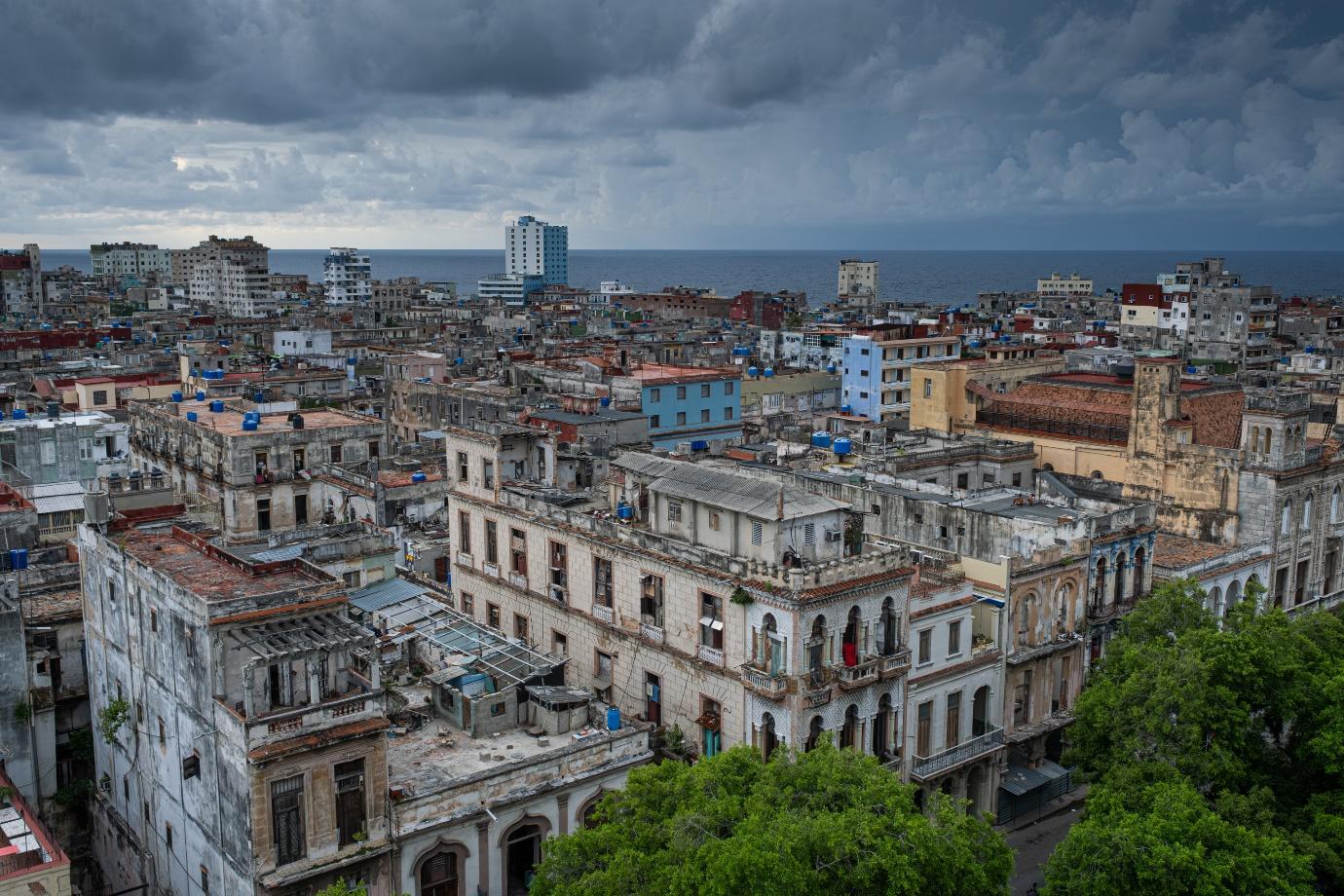
Image 1: View over Habana Vieja. Photo by Sanne Derks

“Ironic, isn’t it? Socialism is supposed to take care of the poor. But here in Cuba, if you don’t have money, you don’t have rights. I assure you that if I had 1,000 dollars, I would give 500 to one bureaucrat, and 500 to another, and within 72 hours they would show up with a mansion to live in.” Maryanelli folds her arms. Her eyes spit fire. Barefoot she stands in the doorway of her usofructo,a small housing unit provided by the state, in the dilapidated neighbourhood of Habana Vieja. She is a hotel housekeeper. She tells how happy she is with the tips that tourists leave behind for her. Now Maryanelli tries to catch some air outside, because the heat is unbearable inside. The fan is not working due to power cuts which have become a daily occurrence in her block. Anger manifests in Maryanelli’s voice as she explains: “They summoned me to leave. The usofructo I am staying in will be demolished, because of the risk of collapse. It is the third time already, as my previous places have collapsed also. And now they send me to this cute patrimonial building, but I refuse to go. I will never get property papers there. As it is a patrimonial building it will always remain the property of the state, whereas I want a permanent place to stay with my two children.” She lights a cigarette and continues as she exhales: “You know what? The state promised us a house already in 1969, after my grandmothers’ house collapsed. They gave us this file, black on white. I inherited this right to a home from my grandmother, who was sent to a shelter. And here I am, nearly 60 years later, three collapses further, and still no house to live in…”

In Cuba, since the instalment of the Revolutionary regime in 1959 the state has promised to take care of housing for its citizens. The right to housing is enshrined in the constitution of the socialist country which is currently facing one of the most severe crises in its history due to external and internal factors (Boudreault-Fournier & Gauthier, 2024; Köhn, 2024). Challenges include post-covid recovery, monetary reforms, a bankrupt government and even stricter sanctions from the US than at any time in the last sixty years, the most recent consequence of which is the current oil embargo. These factors have led to hyperinflation, scarcity of food, electricity, gasoline and water, as well as social unrest. As always, both the state’s and peoples’ struggles are multiscalar (Kalb and Mollona, 2018; Mollona, 2014) and include those for housing (Acosta et al., 2020). Long before this most recent crisis it had already been difficult to find a decent and safe place to live in Havana (Carter 2008), but the state’s current obvious incapacity to address its housing problems engenders more and more criticism from the residents. People are increasingly openly blaming the government for its failure to manage basic needs such as housing, electricity or water (Derks, 2024). Under the current circumstances, neither the socialist state nor the impoverished residents have the means to maintain the city centre’s old colonial buildings. While the state blames the ongoing shortage of materials to the embargo imposed by the US (since the 1960s), many working-class residents have lost patience and now blame the socialist state for not providing the necessary services, materials or adequate salaries for housing maintenance that socialism has historically held out as a promise.

It is not easy to find official, reliable, statistics on housing collapses and the condition of buildings in the Cuban capital Havana. According to official figures, approximately 35% of buildings in Cuba are in poor condition (Leiva, 2024), and 850,000 residential structures need maintenance and repairs, but we expect these figures to be higher. An architect who works as a street-level bureaucrat in the Housing Department of Habana Vieja—we call him Pedro— estimates that as much as 70% of the houses in Havana Vieja need immediate repair or may collapse. A recent internal document with statistics on the housing stock for the city of Havana reports a total of 550,000 homes in the capital, of which 121,000 are in poor condition and 129,000 are in ‘regular’ condition, meaning they need maintenance to prevent further deterioration. This would imply that almost half of the buildings in the city are currently in need of repair.

Yearly, Havana faces 1,000 partial or full collapses. For decades the capital has had the largest number of collapses, deaths caused by collapse, and the largest housing deficit in Cuba. Only in the past half year, several deadly collapses were reported in Habana Vieja. Havana’s proximity to the sea, heavy rainfall, and hurricanes increase the need for proper and regular maintenance of its buildings. After hurricane San Rafael (2024) 460 collapses were registered. Havana is also dealing with a significant housing shortage. In 2017, Castellanos (2017) quoted the city’s Shelters Director, who said that 35,000 families, totalling 116,000 people, lived in shelters, and another 34,000 were in need of it. The average stay in shelters, the Director said, is no less than 20 years.

In Cuba, speaking about housing is speaking about the state. For her current research on state-resident relations in the field of housing in Havana, anthropologist and documentary photographer Derks has conducted fieldwork in Havana for 10 months since 2025. During this period, she took the photographs featured in this essay, visited working-class residents, and followed street-level bureaucrats responsible for monitoring the condition of buildings in Havana. Since 2005, she has stayed in Cuba regularly for different projects and has lived in Havana since 2023. Over these 20 years she has witnessed the city crumble. Koster visited Cuba three times between 2018 and 2025 for shorter periods in which he carried out fieldwork with Derks. Ketterer visited Cuba in 2025 and works closely with the others on this project.

For this blog, we build on Gupta’s (1995) approach to understanding the state as constructed through peoples’ imagination and their everyday practices. We further draw inspiration from Navaro-Yashin’s (2002) work on the faces of the state: the various forms in which state representatives present the state to the people through practices, discourses and institutions. We have studied the various faces and imaginaries of the state as they are given shape among residents who experience housing problems. We also analysed how street-level-bureaucrats working in the Housing Department of Habana Vieja come to embody the state in diverse and contradictory ways during their face-to-face encounters with residents.

Currently, most of the attention focused on Cuba centres on the geopolitical situation and the measures taken by the US government against Cuba and other countries in the region. In this essay, while we take this geopolitical context into account, we focus primarily on the daily reality as experienced by working-class residents and bureaucrats in Havana, and on their ambiguous views of the state. Residents, such as Maryanelli, blame the state for not providing housing—or, more generally, for not taking good care of them. At the same time, they clearly still expect the state to fulfil its socialist promises of housing and other basic necessities. Bureaucrats represent the state when they visit residents, explain policies and make promises. Yet, they also often distance themselves from the state, aware of its shortcomings in practice, often prompted by the housing problems they face in their own personal lives.

In addition to describing people’s ambiguous views and practices, we present a selection of Derks’ photos to visualize them. The photos show the material reality of buildings and people’s practices, while also capturing present-day imaginaries of a state that is increasingly contested and visibly crumbling. They “take us deeper into the sensory knowledge” (Crowder and Cartwright 2021:3) of housing and residents’ imaginaries of the state and “operate as a form of collage, with images being read individually and also within a wider visual narrative” (Sutherland 2016:115). As Squire (2016) suggests in her photo essay in Focaalblog, photography makes it possible to break through linear narratives in written texts and showcase heterogeneous, complex realities effectively. In addition, as we show in this essay, visualizing housing as a basic human need and a primary government responsibility, as claimed by Cuban socialism, may contribute to a deeper understanding of people’s imaginations of the state. Housing, as a convergence of matter and meaning, seems to coincide with peoples’ imaginaries of the state: instead of providing the promised shelter and care, things are collapsing.
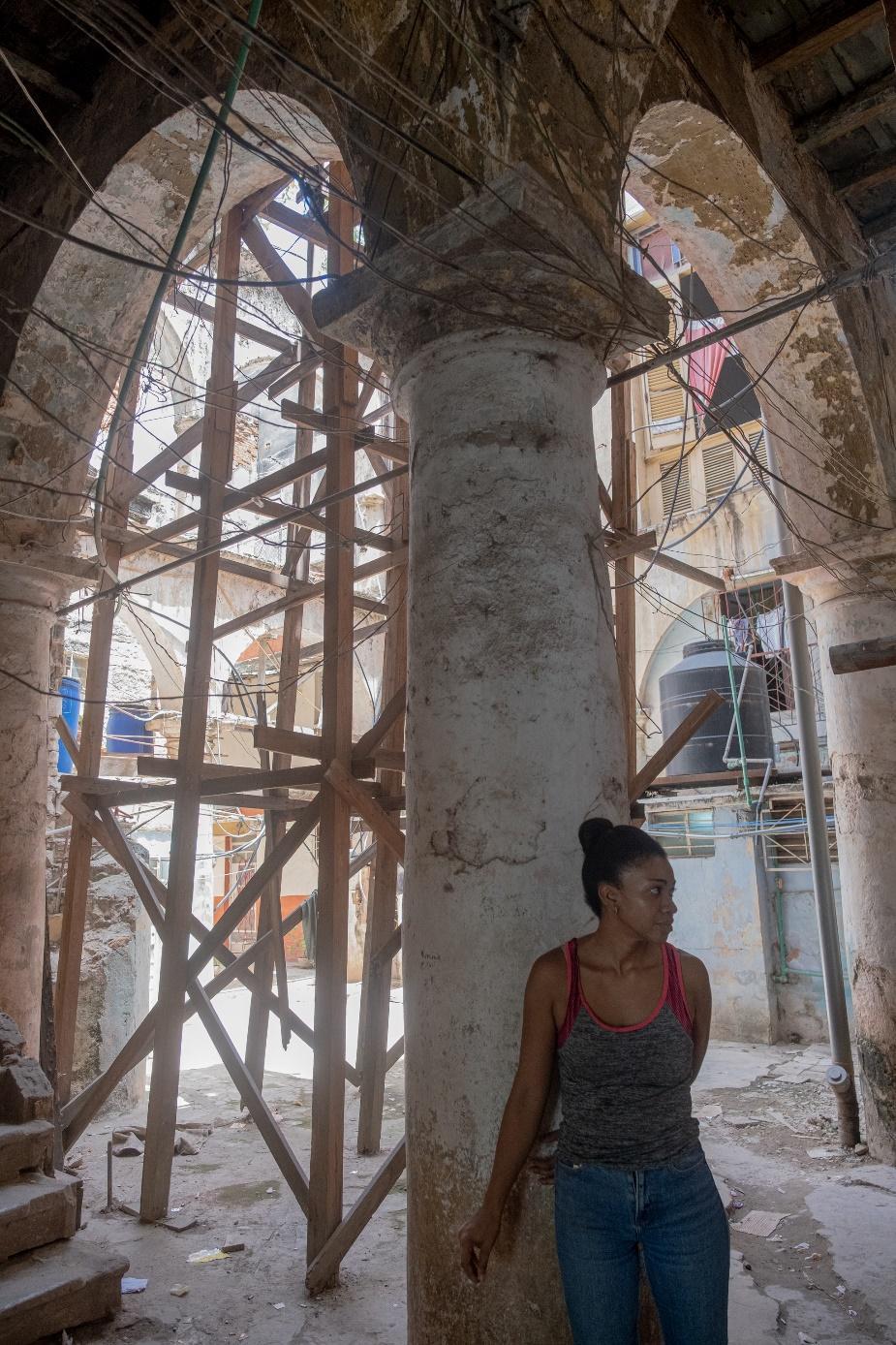
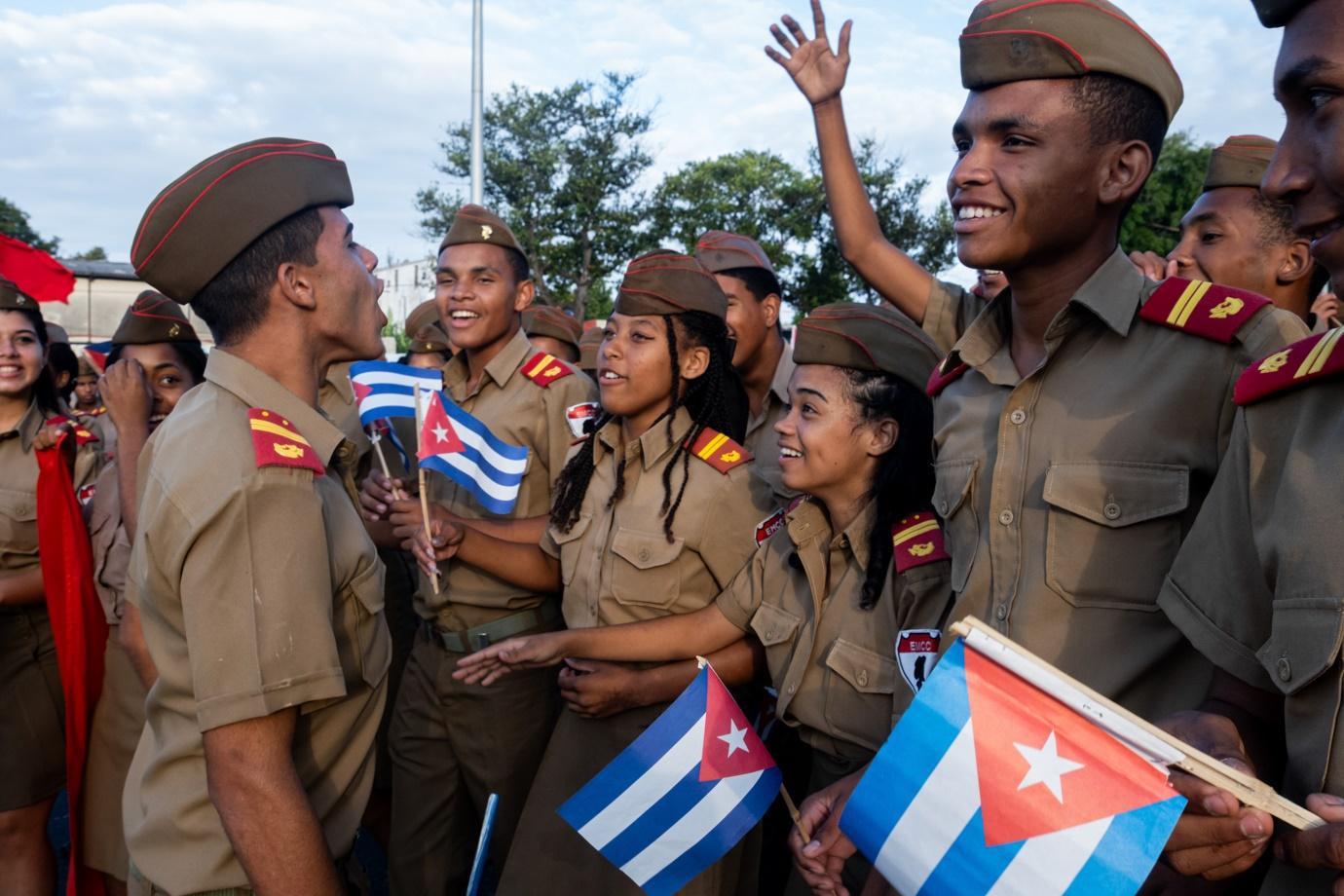
Image 2: A resident stands in the patio of a precarious solar, an old colonial building in which several families reside. This one is at high risk of collapsing. In an attempt to find a temporary solution, the state decided to strut the space to delay collapse and prevent immediate eviction. This photo viscerally illustrates how, under current circumstances, the Cuban state is no longer able to fulfil one of its core promises: the right to decent, affordable and safe housing. Photo by Sanne Derks
Image 3: Cadets sing and shout during the 1st of May Parade in Havana in 2025. The imaginary of the state expressed during this national celebration exudes revolutionary values such as solidarity and unity, and pays tribute to the workers. The celebration’s coherent, unifying and optimistic discourse is a world apart from the material conditions of the houses Derks photographed and the experiences of the residents we talked to, most of whom live under precarious circumstances, lacking safe homes, water, electricity and the resources to obtain sufficient and healthy food. Photo by Sanne Derks
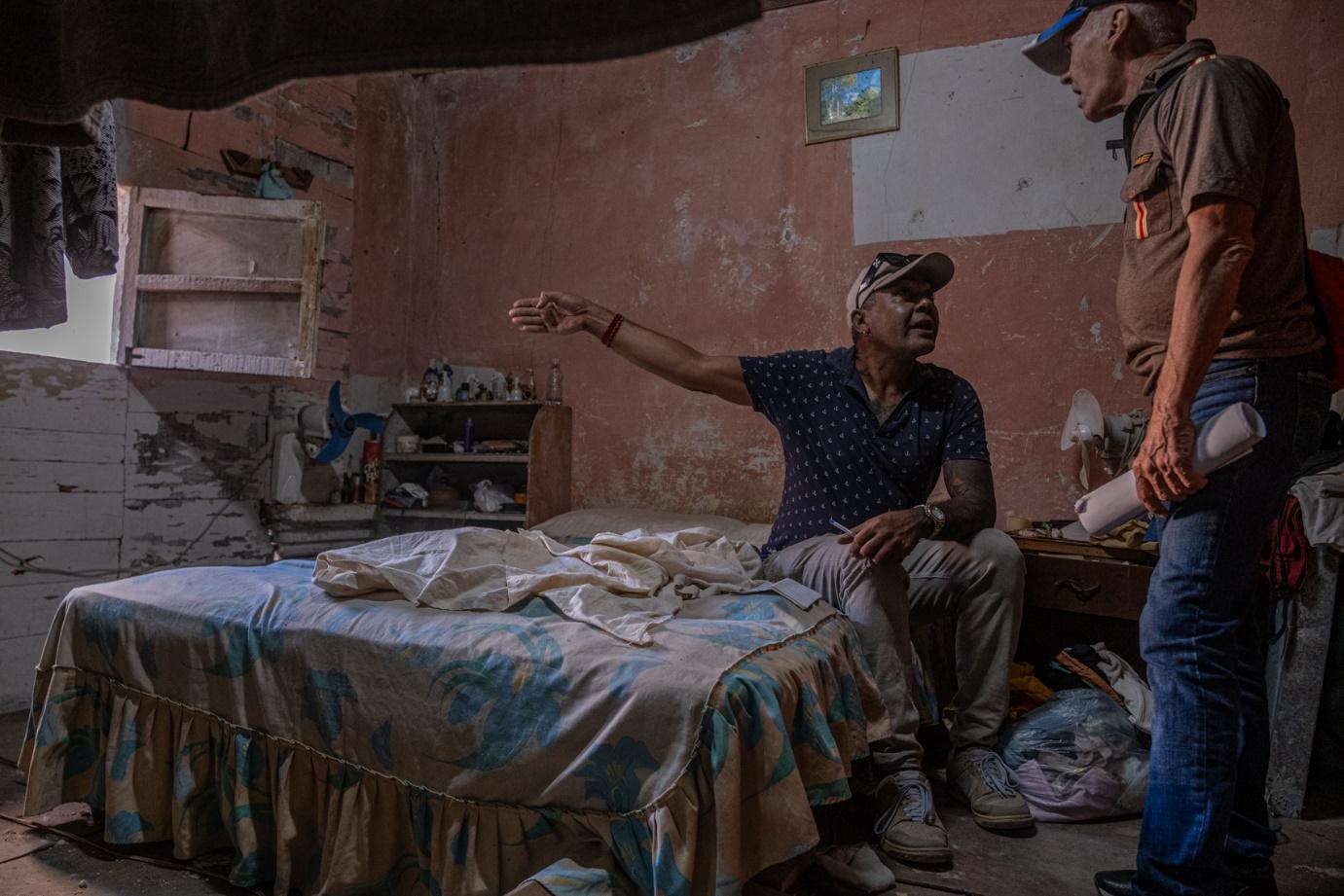
Image 4: Pedro, whom we introduced above, is a 65-old street-level bureaucrat who works for the Housing Department in Habana Vieja as an arquitecto de emergencia, an emergency architect. When houses collapse, or are in danger of collapsing, he is immediately sent to the site to draw up a technical report on the condition of the building. He can issue a repair order or a complete or partial demolition order. At present, however, the former almost never happens, because houses are in such poor condition. After a demolition order, he also notifies the Housing Department that the residents must be sent to a shelter, although there are hardly any places available. Ironically, Pedro’s own house is in a generally precarious state and has a leaking roof. He cannot afford a mattress for the folding bed on which he sleeps. Many street-level bureaucrats live under similar circumstances. While they represent the socialist state as bureaucrats in their visits to residents, in our interviews they often present themselves as disconnected from—and even abandoned by—the state. One of them told us: “I feel betrayed. I have worked for the Housing Department my entire life, but I do not have a solid roof over my head. There is nothing social about socialism.” Photo by Sanne Derks
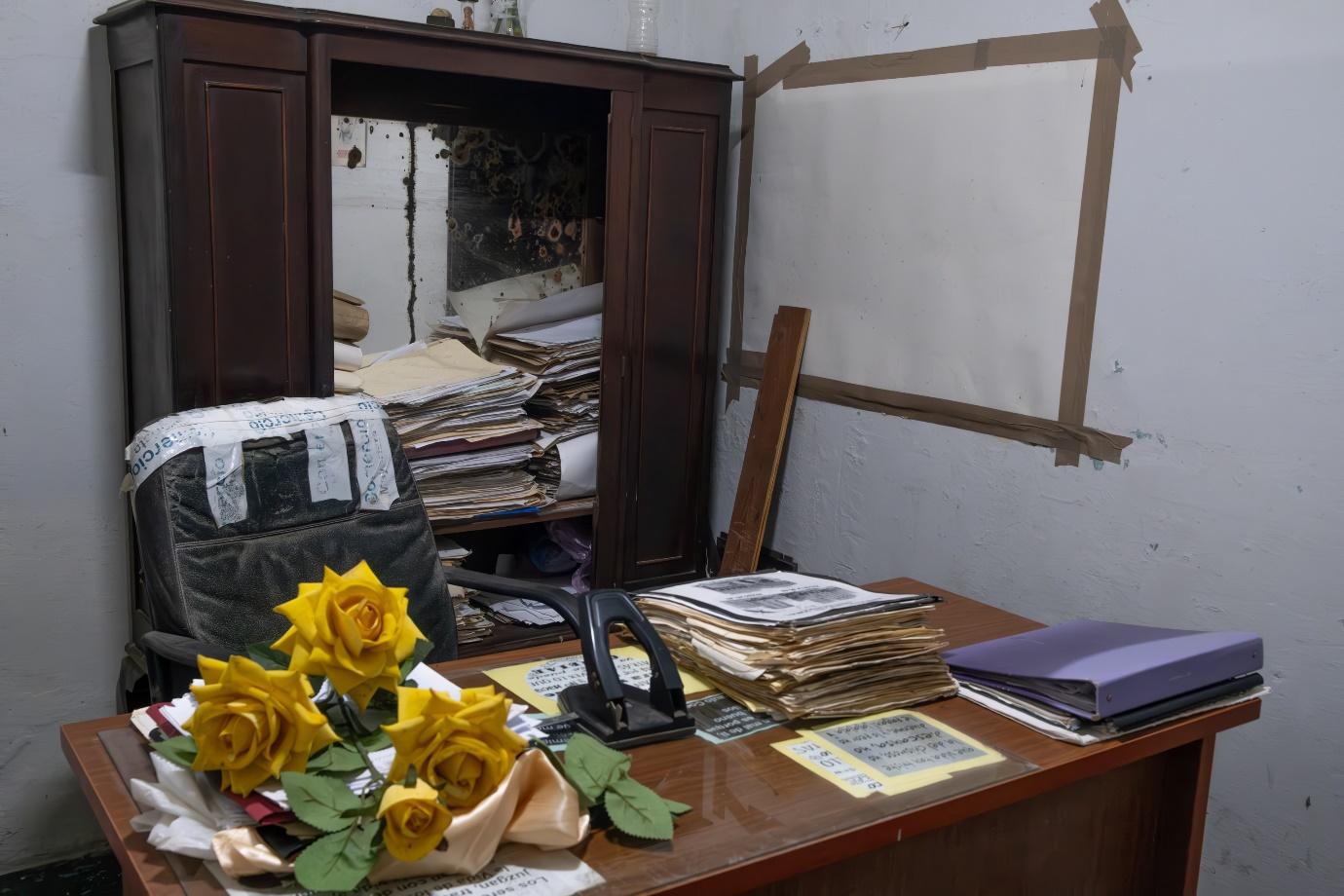
Image 5: In the Housing Department of Habana Vieja, bureaucrats often complain about the bad working conditions: There are frequent power outages, no computers, no ventilation and no daylight. An endless chain of paperwork dictates lengthy and often never-ending procedures. Working-class residents tell us that they have lost their trust in Cuban bureaucracy. Reasons they mention for their discontent are corruption—bureaucrats often try to earn extra money a la izquierda (under the table)—the long time to process complaints and requests, and the general inefficiency of the system. Photo by Sanne Derks
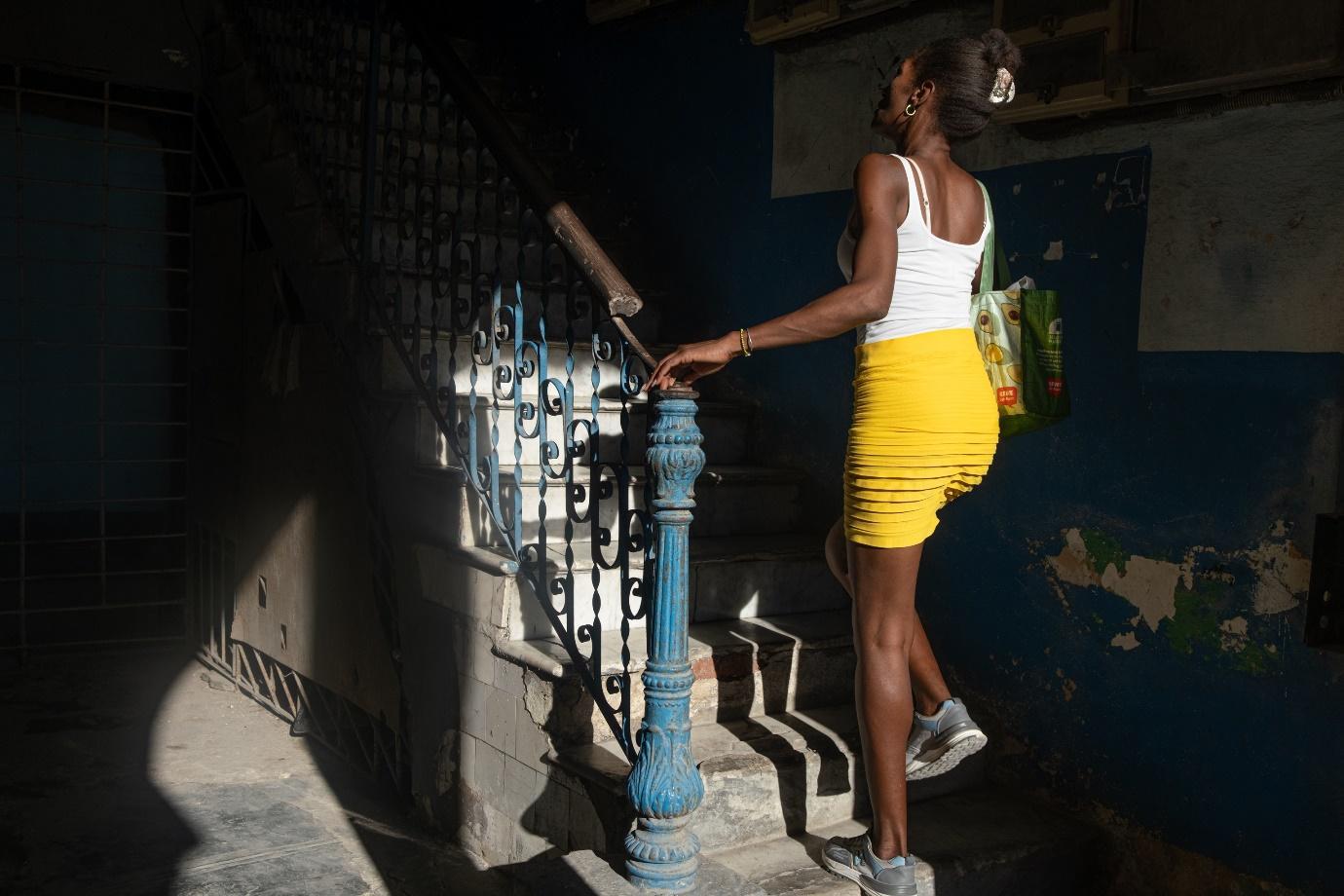
Image 6: A street-level bureaucrat we call Claudia, who also works for the Housing Department of Havana Vieja, climbs the old staircase of a multi-family building at the emblematic Prado Street in Habana Vieja to visit the residents. She visits residents who are experiencing conflicts related to cohabitation. She listens to peoples’ complaints, collects testimonies and tries to mediate in housing-related disputes. When people get angry with her—which frequently happens—she uses her position as a state representative and says: “Shouting at a state functionary is a crime under the Cuban constitution, and if you continue to shout, you will end up in prison.” In more private conversations, she describes herself as dissociated from the state. She says she feels “enslaved by the state.” Recently, she confronted her superiors and told them: “I haven’t had gas for several days. You have the contacts and the position to solve this, but none of you care. And I am supposed to care about other residents’ problems when I can’t even cook a meal in my own home?” Photo by Sanne Derks
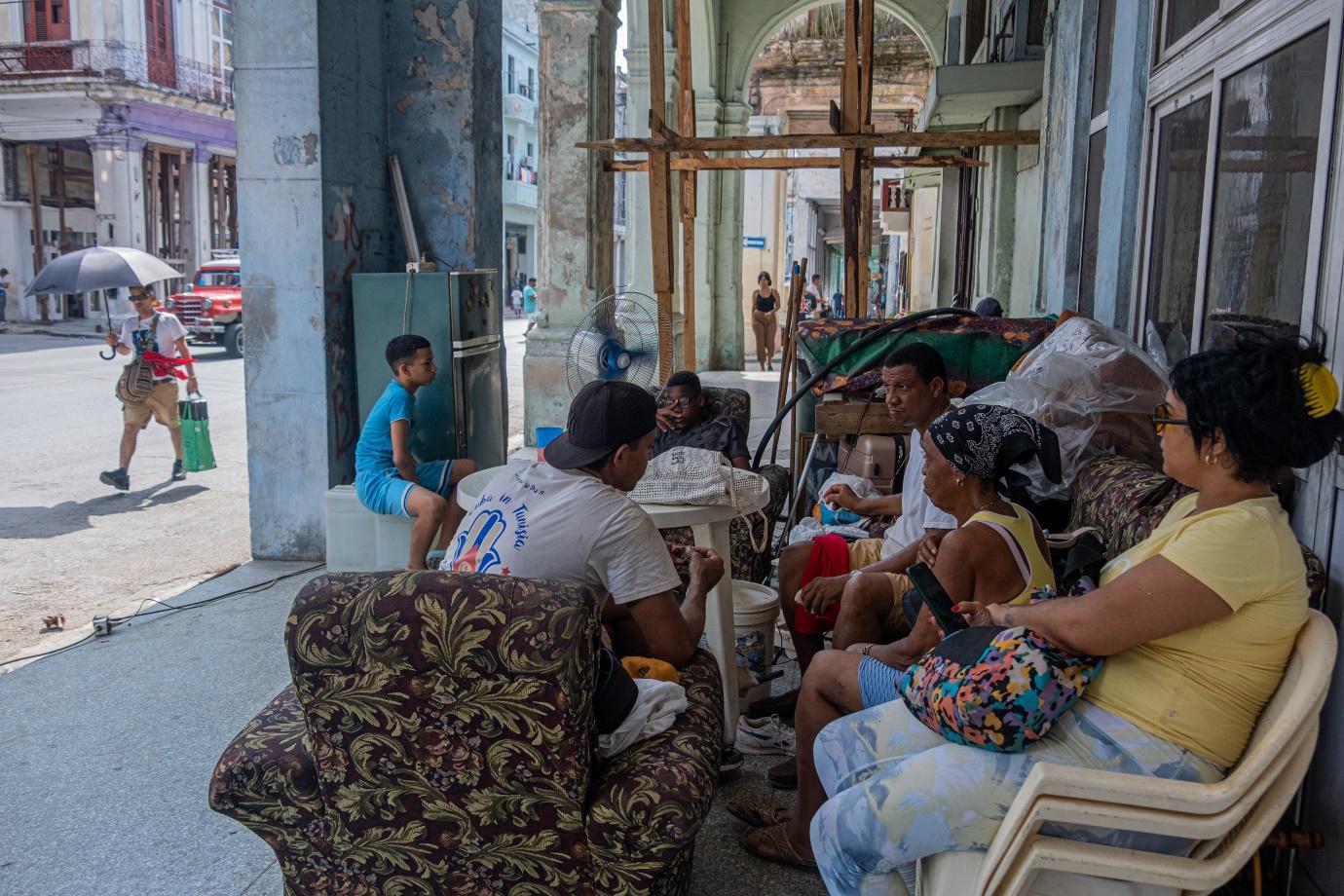
Image 7: A family sits with all their belongings in the colonnade in front of their collapsed house in Habana Centro. They tell us they live here on the street to pressure the government to take care of them. They waited for three days for the bureaucrats to take them to another place. The fridge is connected to an extension cord that they installed themselves. Their situation illustrates how people, on the one hand, continue to make claims on the socialist state and, on the other hand, take matters into their own hands—how they still relate to the idea of socialism, yet at the same time feel deeply frustrated by it. Photo by Sanne Derks
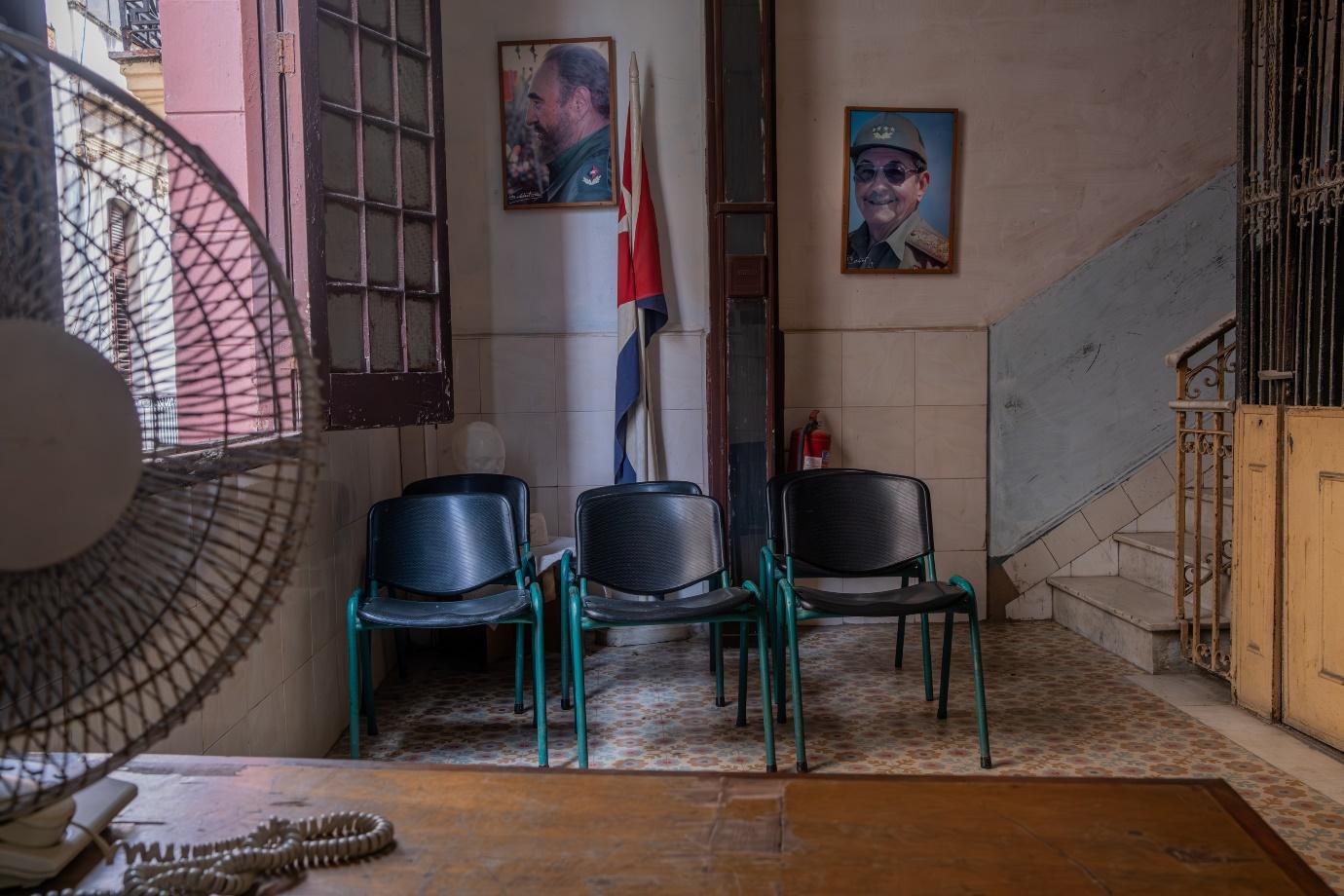
Image 8: The Urban Planning Department of Habana Vieja monitors compliance with building regulations. It has a waiting room where waiting can take forever. Habana Vieja is an overpopulated municipality. Overpopulation has forced residents to build creatively inside and outside their homes in search of more living space. Residents come to the Urban Planning Department when they require legal approval of construction work they wish to carry out. However, as bureaucratic processes are cumbersome, many people prefer to build illegally and pay a fine, or bribe a bureaucrat afterwards, rather than go through the time-consuming legal procedures necessary for obtaining a permit. Photo by Sanne Derks
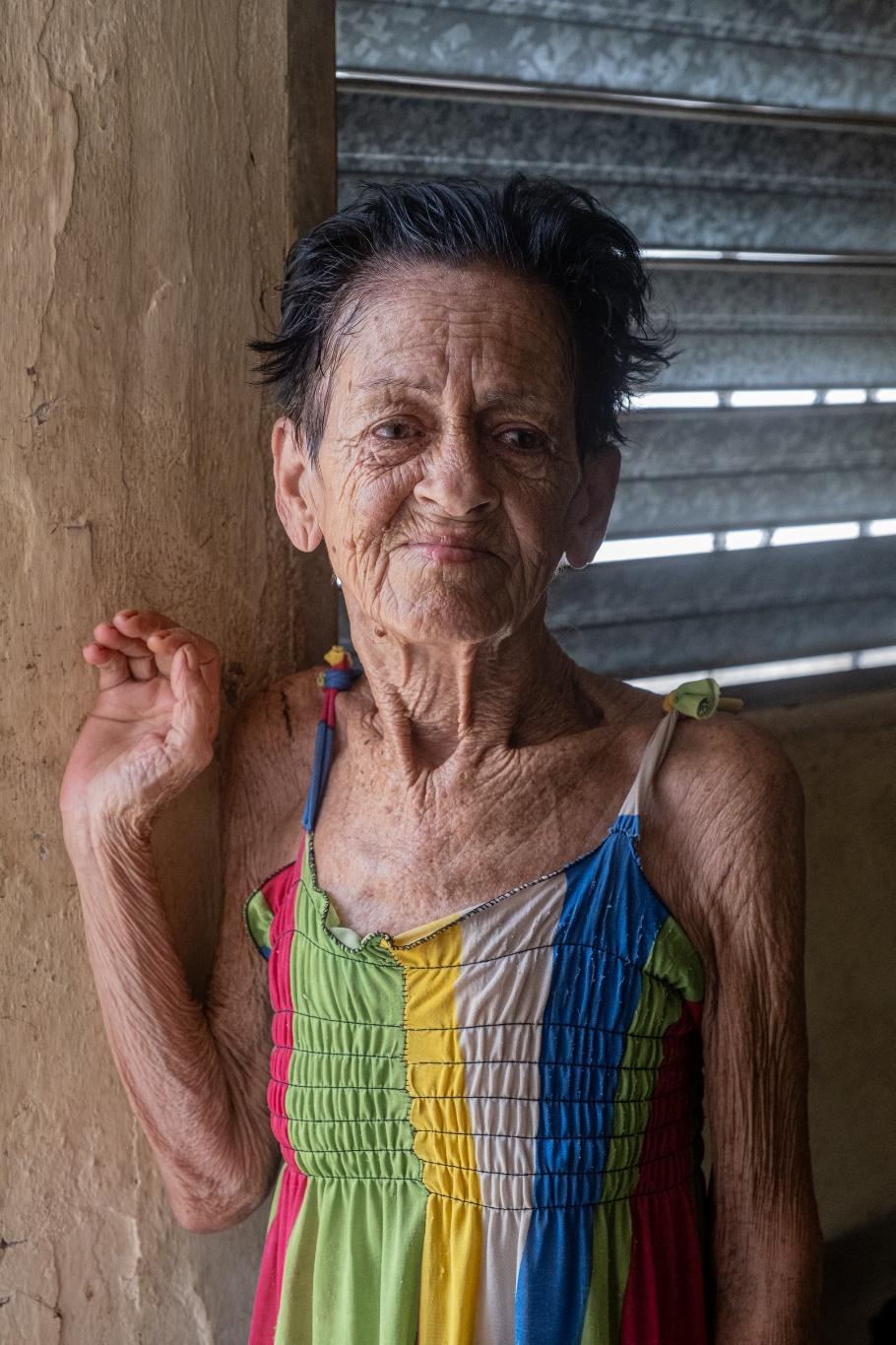
Image 9: Retired Yolanda lives in a shelter in Havana’s periphery about 10 km from Habana Vieja. When her house collapsed more than 11 years ago, the Housing Department promised to find her a new home within 6 months. After 11 years, she has lost hope. The roof of her shelter is made of fibre cement, which means it is extraordinarily hot in her house. “If I could say something to the bureaucrats of the Housing Department,” she says, “I would invite them to my house and stay in the unbearable heat for 20 minutes. So they can experience what I have to go through day by day.” Photo by Sanne Derks
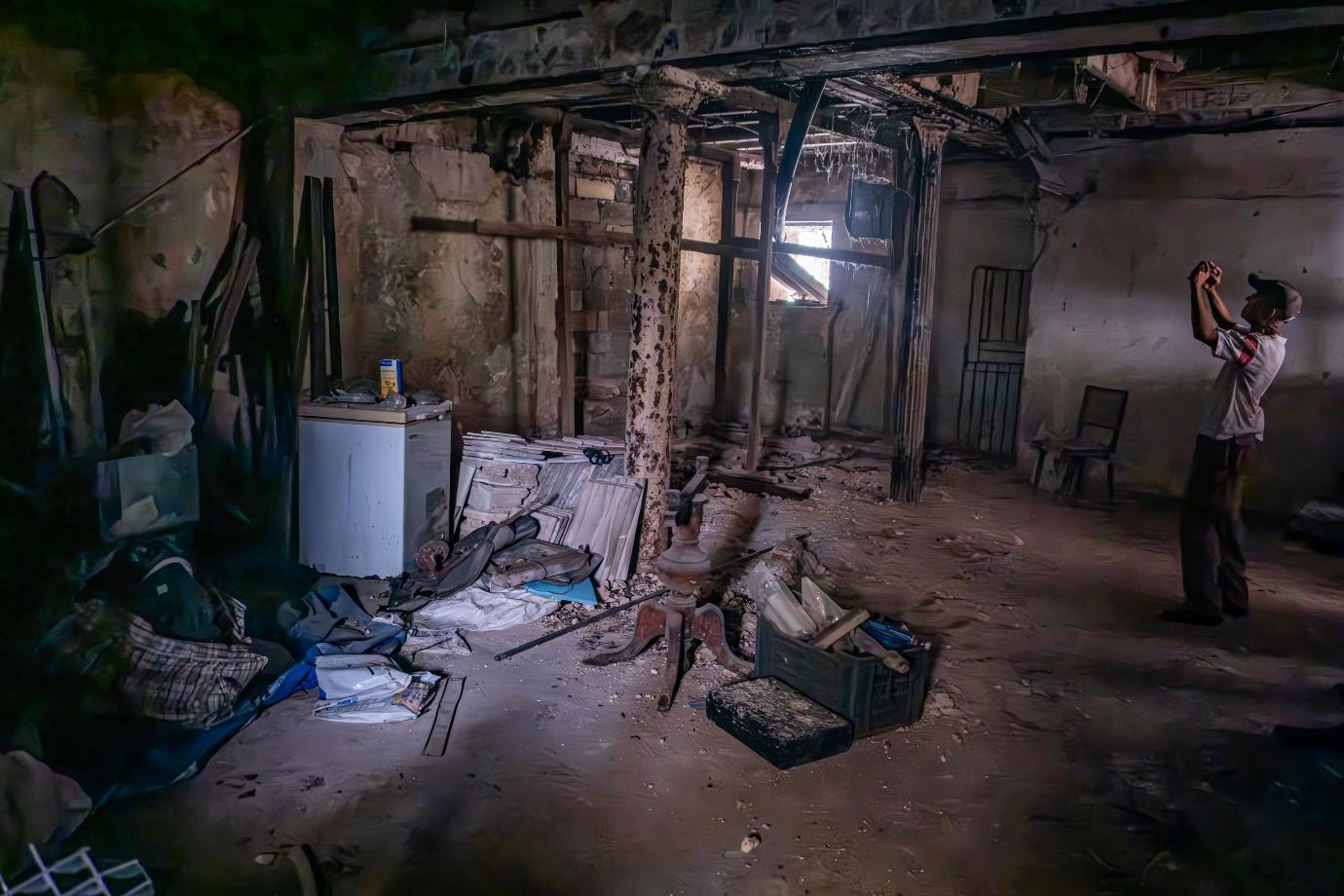
Image 10: For a technical report, Pedro takes a picture of a floor that needs to be demolished. Bureaucrats find creative ways to increase their side incomes from such assessments. One bureaucrat told us how he collaborates with a private construction company and a private demolition company at the same time. If the building is ‘repairable’ he tries to convince his superiors to work with the construction company and takes a percentage. “But it has to be credible. And if I need money urgently, I sometimes give a demolition order. They [the demolition company] give me less, but it is quick and at least it’s something.” Pedro also says that bureaucrats nowadays give more demolition orders than necessary, just to get money quickly and survive on a daily basis. Photo by Sanne Derks
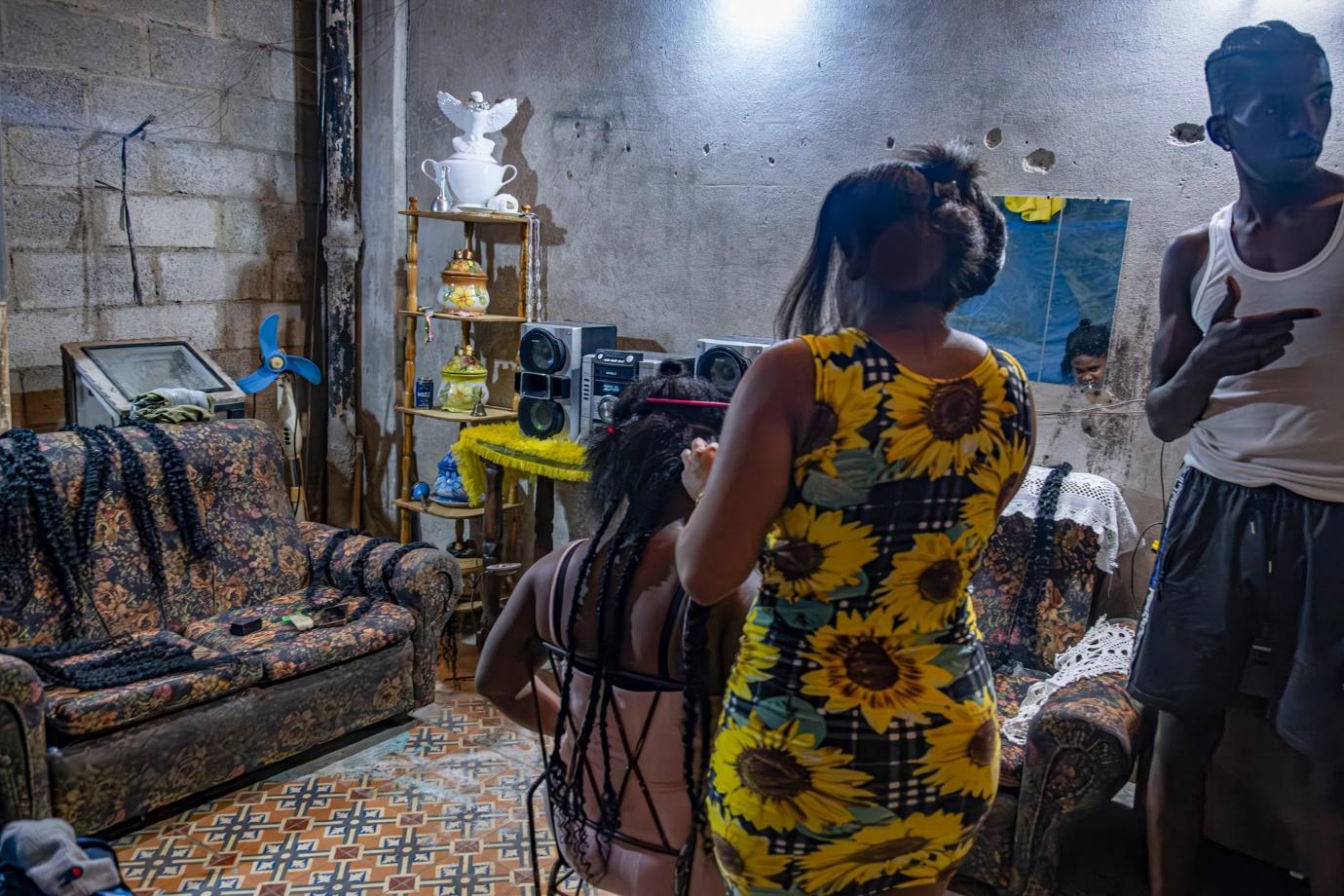
Image 11: The people in this shelter live in Monte street, which used to be a commercial area. By law, it is forbidden to use commercial areas for housing, but the state does it anyway, because of lack of space for the number of people needing shelter. These buildings often lack adequate living conditions such as toilets or kitchens. In 2019, the state introduced a law encouraging people to create basic amenities at their own expense, in exchange for property rights. The conditions for this were extended and simplified in 2025. Several residents told us, realistically, that they see this as a way for the state to gradually transfer responsibility to the residents, because it acknowledges that it no longer has the resources to provide for their housing. At the same time, they see it as an opportunity to get ownership, become more independent from the state, and maybe have more opportunities in life. Photo by Sanne Derks
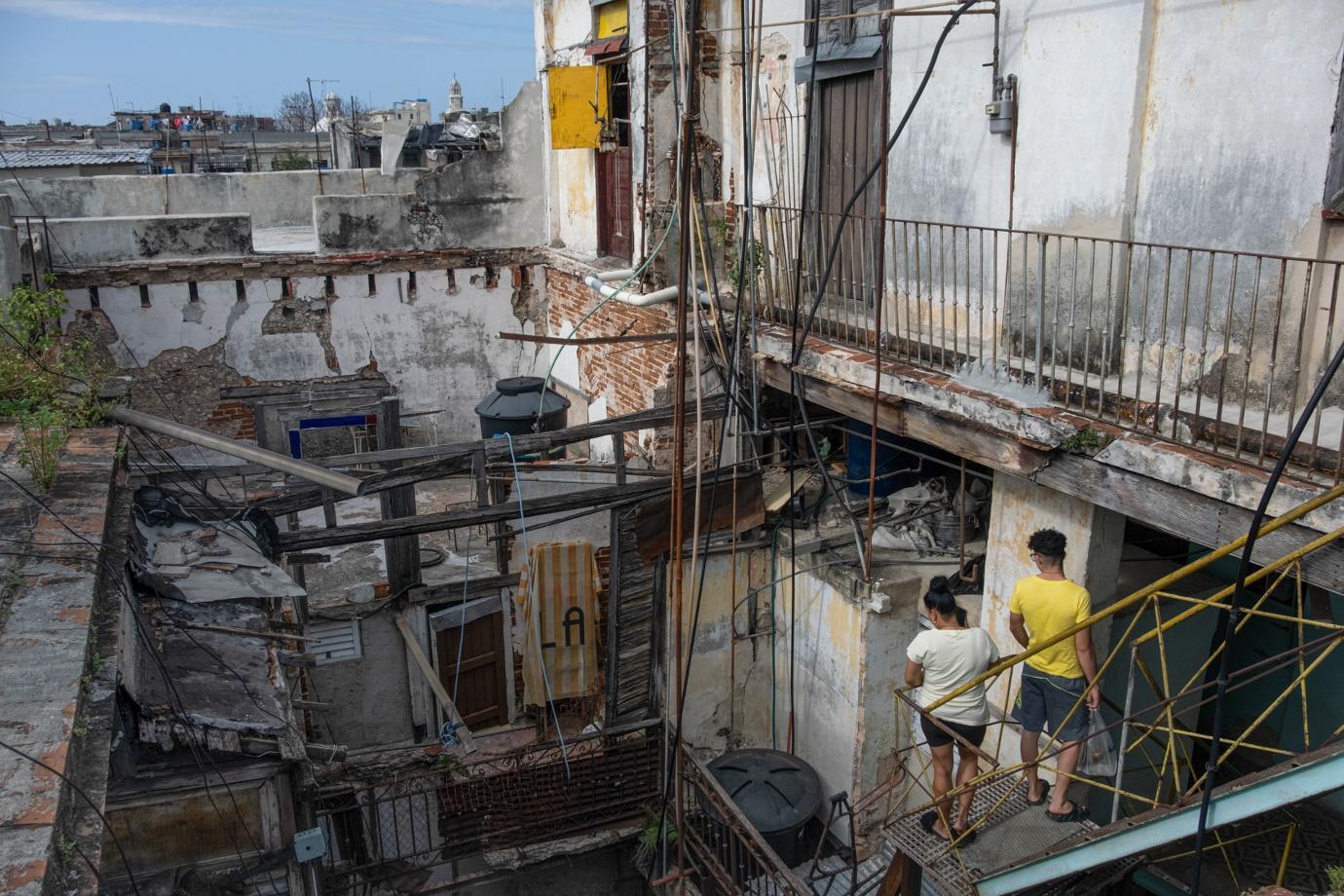
Image 12: A couple descends from a makeshift staircase in a crumbling building in Habana Vieja. Although the socialist state promises housing for all, the realistic possibility of having a decent home is increasingly becoming a privilege solely for people with money. The current crisis condemns the growing group who have nothing to offer or bribe, whether it be money or social networks, to wait it out, often until their homes collapse. Photo by Sanne Derks

These photographs and our broader research on housing in Havana demonstrate how people experience and imagine the state during the current crisis. Facing the deteriorating housing conditions in the city, they give expression to their—largely very critical—ideas about the state. Even state employees openly criticize the state for not providing for the population, and for failing to pay a decent salary to civil servants. They also use this criticism to legitimize the bribes they receive. These bribes create an ambivalent relationship between residents and street-level bureaucrats. On the one hand, the bribes give residents (who can afford them) a certain degree of control over their situation and the opportunity to smoothen or expedite otherwise endless processes. On the other hand, they reinforce negative feelings about the state which obviously does not work unconditionally for everyone—contrary to its official socialist narrative and within a complex context of extremely limited resources.

As we have shown, the Cuban state at this point offers no or only make-shift solutions to housing issues. The houses in the photos in this essay embody this failure. Buildings collapse or are demolished, leaving less and less space to house people, while more and more of them are homeless or living in high-risk situations. At the same time, both working-class residents and street-level bureaucrats keep on claiming certain rights—to housing and other basic necessities—from the socialist state that they may not claim in other Caribbean countries. They (still) perceive the state as a possible and desired provider of goods and services—and the street-level bureaucrats also reproduce this ‘face’ of the state in their interactions with residents. At the same time, both residents and bureaucrats see the socialist state as an institution that falters with regard to housing as well as with the revolution in general.

The research, including the photography, for this essay are part of the POPULAR project, which is financed through the European Research Council (ERC) under the Horizon Europe research and innovation program (Consolidator Grant, agreement no. 101087109).


Sanne Derks is an anthropologist and documentary photographer, based in Havana, Cuba. Currently, she is a postdoctoral researcher at Wageningen University, the Netherlands, where she focuses on shifting imaginaries of the state around housing struggles in Havana. She holds a master’s in psychology (2003, Radboud University), a PhD in Anthropology (2009, Radboud University), and a master’s in Photojournalism (2016, Universidad Autónoma de Barcelona).

Martijn Koster is an Associate Professor in the Sociology of Development and Change Group, Wageningen University. His research interests include (in)formal resident-state relationships, politics, housing, and urban development. Currently, he is PI of POPULAR, a research project with ethnographic case studies in Havana (Cuba), Medellín (Colombia) and Recife (Brazil), financed through an ERC Consolidator Grant.

Stephanie Ketterer is a political anthropologist and Associate Professor with the Sociology of Development and Change Group, Wageningen University. Her research interests lie at the intersections of the anthropology of the state, infrastructures, and datafication. She just launched a new NWO-Vidi project on everyday politics surrounding rural data centers.


References

Acosta, R., F. Eiró, I. Koch & M. Koster (2020). Introduction: Urban struggles: governance, resistance, and solidarity. FocaalBlog, July 2. https://www.focaalblog.com/2020/07/02/raul-acosta-flavio-eiro-insa-koch-and-martijn-koster-introduction-urban-struggles-governance-resistance-and-solidarity/

Angulo Leiva, J. E. (2024). Señas y sombras del proceso de recuperación tras los recientes eventos naturales. Granma,December 18.

Boudreault-Fournier, A. & Gauthier, M. (2024). ‘Inflation as pressure: coping mechanisms from Eastern Cuba.’ Focaalblog, December 10. https://www.focaalblog.com/2024/12/10/alexandrine-boudreault-fournier-and-melissa-gauthier-inflation-as-pressure-coping-mechanisms-from-eastern-cuba/

Carter, T. F. (2008). Of spectacular phantasmal desire: Tourism and the Cuban state’s complicity in the commodification of its citizens. Leisure Studies, 27(3): 241–257.

Castellanos, D. (2017). Havana is collapsing. Diario de Cuba, May 4.

Crowder, J. W. & E. Cartwright (2021). Thinking through the photo essay: Observations for medical anthropology. Medicine Anthropology Theory, 8(1): 1-13.

Derks, S. (2024). Manifiesto del Agua. Beerse: Studio Another Day, Daneels.

Gupta, A. 1995. Blurred Boundaries: The discourse of corruption, the culture of politics, and the imagined state. American Ethnologist, 22(2): 375-402.

Kalb, D. & M. Mollona. (2018). Introductory thoughts on anthropology and urban insurrection. Kalb, D. & M. Mollona. (eds.) Worldwide mobilizations: Class struggles and urban commoning. New York and Oxford: Berghahn Books, 1-30.

Köhn, S. (2024). ‘Tokens of survival: the rise of crypto gaming in Cuba’s inflationary economy.’ FocaalBlog, December 10. https://www.focaalblog.com/2024/12/10/steffen-kohn-tokens-of-survival-the-rise-of-crypto-gaming-in-cubas-inflationary-economy/

Mollona, M. (2014). The Brazilian ‘June’ revolution: Urban struggles, composite articulations, and new class analysis. FocaalBlog, October 28. https://www.focaalblog.com/2014/10/28/massimiliano-mollona-the-brazilian-june-revolution-urban-struggles-composite-articulations-and-new-class-analysis/

Navaro-Yashin, Y. (2020). Faces of the state: Secularism and public life in Turkey. Princeton, NJ: Princeton University Press.

Sutherland, P. (2016). The photo essay. Visual Anthropology Review, 32(2): 115-121.

Squire, V. (2016). 12 days in Lampedusa: The potential and perils of a photo essay. FocaalBlog, 11 January https://www.focaalblog.com/2016/01/11/vicki-squire-12-days-in-lampedusa-the-potential-and-perils-of-a-photo-essay/


Cite as: Derks, S., Koster, M., and Ketterer, S. 2026. “Crumbling down: Visualizing housing and imagining the state in Havana” Focaalblog, May 25. https://www.focaalblog.com/2026/05/25/sanne-derks-martijn-koster-and-stephanie-ketterer-crumbling-down-visualizing-housing-and-imagining-the-state-in-havana/
Ståle Wig, Sian Lazar and Eva van Roekel: The social life of inflation: introduction

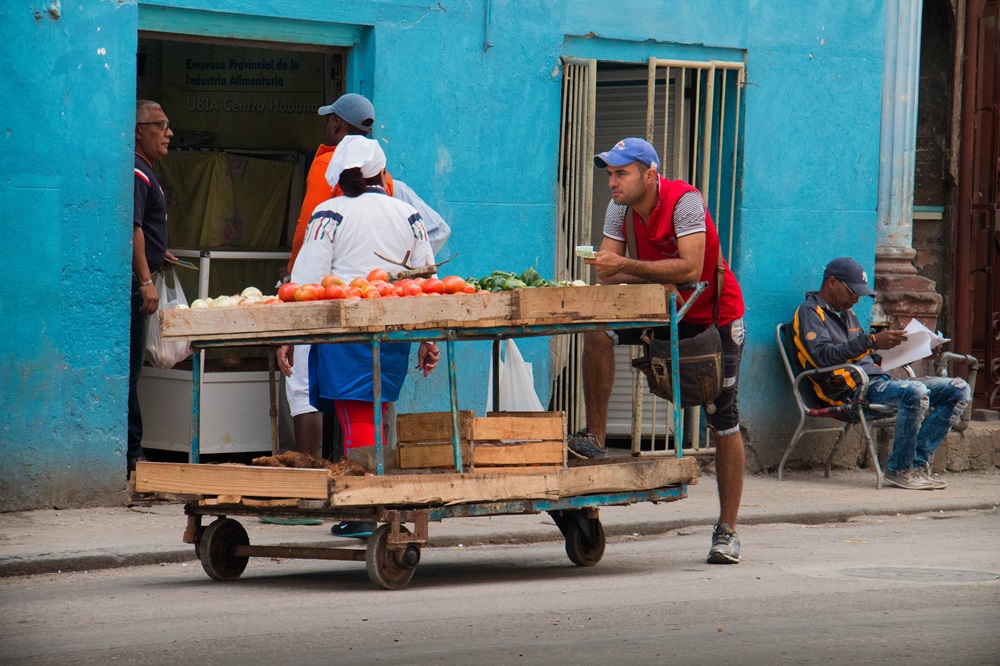
Image 1: Fruit and vegetables sales in Havana, Cuba, where inflation has sky-rocketed in recent years. Photo by Ingrid Evensen

After a period of relatively low inflation in many economies in the Global North, inflation has once again become a major world concern. The COVID-19 pandemic, which disrupted supply chains and labor markets, combined with increased government spending and rising energy prices due to the war in Ukraine, has contributed to a global surge in prices. Unsurprisingly, public debates have centered on how to stall this development. Bankers, policymakers, and economists negotiate which economic levers to pull, and when, to stabilize the prices. Amid discussions about rising interest rates, new monetary policy and government price caps, where does anthropology fit in? What can anthropology add to the academic study of inflation?

This blog series invites colleagues to explore the realities of inflation through ethnographic studies in their areas of expertise. How does global inflation effect people’s everyday lives? How do ordinary people navigate and experience price rises? Inflation, it turns out, is a fitting topic for anthropological research. The ethnographic method, known to focus on the fine-grained textures of everyday life, is suited to analyze not only why and how inflation occurs, but also how people try to sustain their lives and find new ways to attract and store value when the usefulness of their national currency starts melting away—like “a piece of chocolate in hand on a hot day,” as one disgruntled Cuban business owner recently put it.

As this collection reminds us, the causes and effects of inflation are discussed not only in government meeting rooms, Central Bank offices, or behind closed doors at lavish G7 summits but also in roadside cafes in Kashmir, among motorcycle delivery drivers in Beirut, high-school students in Caracas, and by aspiring tech entrepreneurs in Kigali. How inflation manifests in everyday conversations is of particular interest to anthropological research, because the way soaring prices become politicized—in other words, who or what is blamed for inflation—shapes its broader social and political consequences. Whether dissatisfaction with rising prices is expressed through electoral voting, union organizing, migration, or political protests, the everyday experience, framing and understanding of inflation remains crucial to its effects.

While inflation is on one level inherently political and moral, it is often perceived as technical, arguably due to the dominance of economics approaches to the issue. This very technicality can in turn have political effects. Based on fieldwork among aspiring tech entrepreneurs in Rwanda, Alexandrine Royer, for instance, describes how inflation becomes a way for disgruntled citizens to express political frustrations. As the Rwandan government has turned increasingly authoritarian, many are wary of openly directing their discontent at political leaders. “Inflation talk” (Amri 2023), being seemingly apolitical in nature, offers a safer avenue for articulating their concerns and complaints. The anthropology of inflation is well-suited to attune to these processes – investigating what political and moral modes of understanding underlie talk about and action directed at inflation. A striking case in this regard is Argentina, where the new president, a self-proclaimed anti-establishment candidate, rose to power by attributing the responsibility for inflation to his political opponents, as described by Sian Lazar and Dolores Señorans in their blog piece.

Another area for anthropological research concerns how ordinary people both produce and respond to prices. Arguably, since the work of historian E.P. Thompson (1971), economic anthropologists have recognized that even a seemingly technical issue like the pricing of goods is shaped by social and political processes beyond the economic forces of supply and demand. As Thompson famously showed, bread is not just another commodity but part of the “moral economy” of the working class, a share of the common good to which people feel they have a rightful claim. The makeup of the moral economy differs across geography and history. Drawing on field research in Pakistan, Quirin Rieder investigates the fascinating case of tea prices in rural Kashmir, showing how ordinary people may not only react to and protest inflation but also contribute, to some extent, to shaping the phenomenon itself. As it turns out, there are limits to how much people will accept to pay for a cup of tea, or indeed other staple items, like a basket of eggs, a bottle of water, or a pack of tampons.

Ethnographic research can reveal how such consumer preferences are defined by specific social and political histories, which in turn shape people’s reactions to, and attempts to handle, inflation. The point may seem obvious but is worth emphasizing. Not only does inflation unfold in economies that are historically and socially constituted, but as Neiburg (2023: 10) has put it, inflation itself is a “social and cultural fact”. Culturally and historically constituted notions of “the normal life”, and a “life worth living” will always contribute to shaping the experience of rising prices. For many, inflation is a crisis, a rupture from ordinary life. Yet contrary to the assumption that inflation is always an inherently negative phenomenon, Daromir Rudnyckyj’s provocative blog piece suggests that it is not universally perceived as a “problem.”

A third area of interest suggested by the case studies in this collection centers on how people navigate monetary instability and plurality. As Harry Pettit points out in his case study from Beirut, monetary instability will often set off a messy battle for the control over the circulation of cash as well as the digital infrastructures that facilitate economic transactions. In a related vein, Van Roekel draws on field research in Venezuela to ask how Venezuelans navigate and assess their de facto multi-currency economy of foreign bank notes, crypto currencies, and gold after a decade of hyperinflation. In several cases, people find, or even invent, new sources of value, or turn to new techniques of storing and circulating value, when the national currency start to lose worth. A final, fascinating example comes from Cuba, a country that only in recent years has experienced the effects of inflation, as described in two separate blog entries by Alexandrine Boudreault-Fournier and Mélissa Gauthier, and Steffen Köhn. Here, the ongoing economic crisis and triple-digit inflation rates have inspired Cubans to turn to “play-to-earn” crypto games online, to access digital currencies. Runaway inflation and economic crises are breeding grounds for new digital experimentation with money and exchange creating niches for makeshift economic survival, speculation and quick profit, while reproducing historical conditions of vulnerability, inequality and “crypto-colonialism” (Rosales et al. 2024).

Combined, the ethnographic studies in this blog series on the social life of inflation reveal the potential of an anthropology of inflation to inquire economies from below. This effort has only just begun.


This text is part of the feature The Social Life of Inflation edited by Sian Lazar, Evan van Roeckel, and Ståle Wig.


Ståle Wig is a Postdoctoral Fellow at the University of Oslo, and author of the forthcoming book, The struggle for the market. Life and hustle in Cuba’s new economy (Pennsylvania University Press).

Sian Lazar is Professor of Social Anthropology at the University of Cambridge. Her latest book is How we Struggle: A Political Anthropology of Labour (Pluto Press)

Eva van Roekel is assistant professor in cultural anthropology at Vrije Universiteit Amsterdam. She is author of the monograph Phenomenal Justice. Violence and Morality in Argentina (Rutgers University Press).


References

Amri, M. (2023). “Inflation as Talk, Economy as Feel: Notes Towards an Anthropology of Inflation”. Anthropology of the Middle East18(2), 27-45.

E.P. Thompson (1971). “The Moral Economy of the English Crowd in the Eighteenth Century.” Past & Present 50 (1): 76–136.

Neiburg, F. (2023). “Inflation: Pragmatics of money and inflationary sensoria. economic sociology. perspectives and conversations”, 24(3), 9-17.

Rosales, A., van Roekel, E., Howson, P., & Kanters, C. (2024). “Poor miners and empty e-wallets: Latin American experiences with cryptocurrencies in crisis”. Human Geography17(1), 43-54. https://doi.org/10.1177/19427786231193985


Cite as: Ståle Wig, Sian Lazar and Eva van Roekel 2025 “The social life of inflation: introduction” Focaalblog 10 December. https://www.focaalblog.com/2024/12/10/stale-wig-sian-lazar-and-eva-van-roekel-the-social-life-of-inflation-introduction/

Don Nonini: The China Conundrum and The Current Conjuncture

Strategic Ambivalence or Disguised Conflict? China’s Reactions to Russia’s War on Ukraine and to Covid

Why does China’s response so far to the Russian invasion of Ukraine “not add up”? On one hand, China has refused to condemn the Russian invasion of Ukraine, has pushed its own state-controlled media to promote only pro-Russian propaganda, and even republished false reports by the Russian state media. China abstained from a UN Security Council resolution in March 2022 that condemned the Russian invasion. Meanwhile, the Chinese Foreign Minister Wang Yi recently announced that China and Russia “will always maintain strategic focus and steadily advance our comprehensive strategic partnership of coordination for a new era,” especially in the energy trade (Quoted in Torigian 2022). And it is an open secret that Xi Jinping gave his assent – or at the very least knew and did not demur – when he heard of Putin’s intention to invade Ukraine during the latter’s visit to Beijing at the recent Winter Olympics.

On the other hand, the same article notes that President Xi Jinping of China said that he was “pained” to see “flames of war reignited in Europe.” While not condemning the Russian invasion, China has not actively supported it, and instead has called for peace talks and “maximum restraint” (Torigian 2022). It has appealed for all parties to respect pre-existing “sovereign” borders. Nor has China so far provided much economic support to Russia, other than continuing their long-standing trade in oil and gas – nor given any military assistance. And the Asian Infrastructure Investment Bank, in which the PRC holds 27% decisive voting power, halted its work in Russia and Belarus in protest at the invasion of Ukraine (Torigian 2022). What’s going on?

What appears to be ambivalence or failure of the Chinese state to “get its act together”, its confused or contradictory messaging may actually reflect an internal lack of consensus toward the Russian invasion and occupation of Ukraine at the top of the PRC leadership. It may also indicate a current shift in the balance of power within the Politburo of the Chinese Communist Party – away from the extraordinary concentration of power by President Xi Jinping toward  a willingness by other members of the Politburo to impose limits on it after his probable reelection as CCP General Secretary at the Party Congress held later in 2022. There are signs of profound dissatisfaction within these top Party circles, reflecting broader economic, social, and political contradictions within China that have emerged over the last years, as Xi has consolidated his increasingly autocratic rule, undermined adversaries, and done his part to destabilize détente with the EU and the United States.

George Soros recently went so far as to say that Xi may not be reelected to a third term as President at the Twentieth National Congress this fall. Soros stated, “Contrary to general expectations Xi Jinping may not get his coveted third term because of the mistakes he has made. But even if he does, the Politburo may not give him a free hand to select the members of the next Politburo. That would greatly reduce his power and influence and make it less likely that he will become ruler for life” (Ren 2022). 

Then, the day after Ren’s report for Bloomberg.com, we read in the New York Times of Premier Li Keqiang’s recent speech that implied (if not explicitly so) that Xi’s “zero Covid” policies have led to a catastrophic slowdown in the Chinese economy – during the first three months of 2022 there has been a decline in the Chinese GDP rate of growth to 4.8%, well below the official target of 5.5%. This has been precipitated by a two-month lockdown ordered by Xi that brought the everyday life and economic activity of an infuriated population of Shanghai to a standstill for more than two months, as well as episodic lockdowns in other cities which stopped assembly lines, trapped workers, interrupted the movement of goods and confined millions of Chinese to their homes. At a teleconference to more than 100,000 officials across China, Li announced “We must seize the time window and strive to bring the economy back to the normal track” (P. Mazur and A. Stevenson, New York Times, May 26, 2022).  

The key message to take home from this is that China’s #2 highest ranking official has just stepped out in public to implicitly criticize the Covid lockdown policies mandated by China’s #1 highest ranking official – President  Xi Jinping.  There are certain things that are unforgivable in the contemporary PRC, and Xi’s and his faction’s single-handed slowing of the country’s economic growth may be one of them. Whether this is the first step to Xi being ushered out the door to an honorable retirement rather than being reelected to a third presidential term remains to be seen.  

Theoretically, this example points to the importance of investigating the contradictions of illiberal Chinese capitalism that characterizes the corporate Party-oligarchic state in which it is situated.

Deconstructing Socialism’s Deconstruction, Chinese Style

Are (post-) socialist states fundamentally alike? The Chinese Communist Party and its leading intellectuals in the years in the 1990s gave this question much thought. Shambaugh (2008) demonstrates the careful attention after Tiananmen in 1989 with which high-ranking CCP cadres and intellectuals (e.g., from the Chinese Academy of the Social Sciences, and the Central Party School) observed the changes arising from liberalization and “shock therapy” in Eastern Europe and the Soviet Union. They observed the dogmatism of the Soviet nomenklatura, the  overreliance on heavy industry, the neglect of agriculture, and the militarization of the national economy with great interest, and reflected on this as they witnessed the USSR’s fall (Shambaugh 2008:41-86). From these observations, they drew lessons concerning the maintenance of the CCP’s power in China. Li Jingjie, director of the CASS Soviet-Eastern Institute, for example, distilled several of these: “Concentrate on productivity growth,” “be ideologically flexible and progressive,” “seek not only to strengthen confidence in the power of the state [but], more important, [the] material living standards of the people,” among other insights (quoted in Shambaugh 2008:76).

A Post-Socialist Developmental State with Chinese characteristics

What came out of these deliberations of the CCP in the late 1980s-1990s? In particular, unlike the Central and Eastern European late socialist countries, the highest circles of the CCP were determined that the party continue to maintain its ruling position within the state apparatus and organize the national economy, rather than give way to neoliberal penetration by graduates of the University of Chicago School of Economics, and those of similar ilk (Bolesta 2015:230-244).  China’s post-socialist developmental state trajectory has been similar to those of earlier capitalist states (e.g., 19th and 20th-century western Europe, the United States), while very distinct from the post-socialist political systems of Eastern Europe and Russia. Unlike what occurred in these countries, “retaining an authoritarian state was also aimed at creating a strong and capable state… the authorities have attempted to strengthen power and control… over society and the business sector” (Bolesta 2015:232). This has allowed for a gradual and highly planned set of state programs for evolving from a socialist to a capitalist economy.

Being authoritarian and illiberal, however, is not the same as being unaccountable to the “masses” of the working class, rural peasants, and since the early 2000s, the new urban professional managerial classes of China. The “attentive” party-state (Perry 2012) is above all attentive to maintaining its legitimacy among the rural population subject to dispossession, and increasingly among the growing urban middle classes and professionals whose numbers form the new base of the CCP.  Largely, as one might expect, the CCP above all seeks to maintain and increase the standard of living of both the rural and urban populations, ameliorate the environmental disasters that afflict millions of affluent urban residents, and pay specific attention to the protests of thousands of small farmers dispossessed from their land and striking workers exploited in the industrial workplaces. The party has ultimately been willing to bend when large numbers of residents display the capacity for disorder and discontent in public, led by leaders willing to face down beatings by police and to travel to Beijing to petition central cadres and high officials in ministries to redress the injustices committed against them by corrupt local officials. Responsive, yes. Democratic? Not so much.

Morphing into the Chinese Corporate Party-State

The Chinese Party-state takes the form of a corporate-oligarchic structure in that the CCP simultaneously acts as a coordinated body to maintain its power through its deployment of the wealth it extracts, particularly at its highest circles, through securing the loyalty of the population, while seeking to meet the goals of national development undertaken under the “conditionality” of post-socialism, which require playing a role within global capitalism.

The CCP is a heterogeneous organization with approximately 86 million members distributed territorially across the PRC, and is organized in a spatially differentiated bureaucratic hierarchy that mirrors both the official state bureaucracy and private corporate and civil-society organization bureaucracies in tens of thousands of locales. Only a broad summary of how its predatory and developmental practices interact can be given here, given the sheer size of the Chinese population, its heterogeneity, and its regional/macroregional differentiation.  

For the purposes of this essay, I  focus on two defining characteristics of the emergent Party-corporate state — the institutional dominance of large-scale state-owned enterprises managed by the highest circles of the CCP, and the shift by the local corporatist Party-state from investing in  industrial enterprises during the 1990s-2000s toward land speculation and real estate development, and its implications for rural dispossession. 

Political Crisis and Economic Stagnation

China is experiencing the aftermath of the global financial crisis of 2007-2008 which has led to a decline in the rate of capitalist profits, a worldwide realization crisis, the indebtedness of populations and states outside of China, widespread financial speculation in areas essential to social reproduction/human livelihoods (e.g., in energy, foodstuffs, farmland), and compounded, worsening ecological disasters arising from climate change. These global/planetary processes are ones that China’s corporate party-state will have to confront while it is managing its own internal transitions.

In the case of the CCP up to the present, this has entailed managing (and accumulating capital from) the large-scale State-Owned Enterprise (SOE) sector. According to Smith (2015:45), “Thirty-five years after the introduction of market reforms, China’s government still owns and controls the commanding heights of the economy: banking, large-scale mining and manufacturing, heavy industry, metallurgy, shipping, energy generation, petroleum and petrochemicals, heavy construction and equipment, atomic energy, aerospace, telecommunications, vehicles…, aircraft manufacturer, airlines, railways, biotechnology, military production and more.”

These leading state-owned enterprises are managed by the “princelings”, taizibang, the descendants of the first generation of the highest CCP leaders, who have become the most wealthy and powerful members of the Chinese ruling class. As Smith (2015:50) characterizes them, “princelings often are heads of giant conglomerates which themselves own dozens or even hundreds of individual SOEs. Presumably this gives them access to multiple income streams and ample opportunities to plunder the government’s ever-growing treasure.” The princelings form the upper class in the PRC.

Nonetheless, their investments now face diminishing returns as China’s industrial capacity, while still the largest in the world, is plagued by rising costs of labor and environmental controls. Chinese industry is troubled by intense competition and profit crises. Most recently, the Covid pandemic, and the state’s “zero-Covid” response to it imposed by Xi Jinping in particular — total urban lockdown as in 2021-2022 in Shanghai  and in other large cities  — has caused extended shutdowns in industrial production and long-distance supply chains, both critical for its exports.

In so far as their control over the state-owned enterprise sector constitutes the basis of their power, the relatively small Party elite of princelings faces questions about their own reproduction as capitalists and as their continued power at the highest levels of the CCP.  While most will continue to accumulate within the slowing SOE industries, they will compensate by investing capital in China’s burgeoning financial sector. Their turn away from industrial production and its basis in political power is a destabilizing force. Beyond their control over state-owned enterprises, they will continue to exert their capacity to extract rents from privately-owned capitalist enterprises, but their capacity to do so will depend upon their extended political power.  In contrast, those the princelings have targeted in the past, the owners and managers in the privately-owned capitalist sectors in services, high-tech production, and real estate, will be drawn into the middle and upper ranks of the CCP, and seek to increasingly wield power on their own. All this is taking place as economic and social destabilizations are beginning to emerge, such as the failure of large numbers of young Chinese graduates to find work, “brain drain”, flight overseas, and increasing incidences of bailan (withdrawal by discouraged youth from the labor market), which are increasingly presenting a threat to CCP legitimacy.

Under the circumstances, a tendency towards developing and assuming control of increasingly predatory Mafia-like organizations in the absence of more productive uses of their capital, presents a serious risk to the princelings and their many clients.

The Local Corporatist State: Financialization and Dispossession in Rural and Peri-urban Areas

Jean Oi (1995) describes the ways in which local entrepreneurs during the 1980s-1990s came together with local-level Party cadres and established the Township and Village Enterprises (TVEs). This represented the systematic emergence of the local entrepreneurial corporatist state around small-scale industrialization in rural and peri-urban areas. What I want to point to was the logical progression of the local corporatist state as the countryside became increasingly financialized from the mid-1990s onward. Development funds continued to be drawn from increased local tax revenues, supplemented by prioritized development funds sent down by provincial and central state agencies and state banks (So and Chu 2016: 67-69). But after the 2007-2008 financial crisis, the influx of funding from central government and state banks began to turn from small-scale industrial to large-scale real estate development, and from investment in industry to speculation in land by developers with the collusion of local officials.

The pattern has been one in which farmers with lands on the edges of nearby growing rural townships found themselves (often repeatedly) facing displacement from their farmland, often with little or no financial compensation, dispossessed by party and state cadres acting in collusion with well-funded real estate developers and construction firms. Farmers resisting eviction from their lands have faced violent attacks by organized criminal gangs working with developers and protected by local officials (Vukovich 2019: 167-198).  

Much productive farmland has thus been taken out of production. Speculation in new residential and commercial real estate has led to dramatic overbuilding, while large numbers of displaced landless farmers have out-migrated to regional cities for precarious wage labor.  Vukovich (2019) writes of the rise of financial capital to a dominant position within the Chinese economy  as the expropriation of farmers’ land for urban development in thousands of periurban villages throughout the country has become the type-case for dispossession.

Vukovich notes that the process is reaching its spatial and physical limits in terms of China’s still un-expropriated farmland: “Urbanization or the pushing of surplus rural labor into the ever-expanding cities and export processing zones is likewise reaching its limits. The chief limit being that this model of growth does nothing to actually develop the countryside…Those urban jobs done by millions of migrant workers… still do not by and large pay an adequate wage for the laborers to stay” (Vukovich 2019:192). 

The consequences have been not only human but also environmental catastrophes – loss of farmland, flooding due to torrential rains on eroded lands, inadequate disposal of human and animal wastes, and lowered quality and quantity of the rural water supply.  

So far, the CCP has prevented complete disaster by allowing farmers to retain family and collective property rights in land – thus making it legally inalienable through the market — but outright confiscation is working with even greater effect. The result is the accelerating degradation in the capacity of hundreds of millions of rural farmers to continue their own reproduction. 

Making China Great Again? – The Costs of Revanchism

Returning to the ethnographic vignette that began this essay — China’s response to the Russian invasion of Ukraine: its apparent incoherence (as viewed from outside) cannot be understood independently of attending to the conjunction of trends and events characterizing China’s simultaneous financial, economic and environmental crises as these have intersected with the pandemic and Xi’s “Zero-Covid” response to it.  On one hand, Xi Jinping is not only a nationalist (as arguably all CCP officials are), but one who seeks  a “great rejuvenation of the Chinese nation” (zhonghua minzu weida fuxing) through a successful quest to become a “wealthy and powerful country” (fuqiang guojia) vis-à-vis the West and Japan (Heilmann 2017: 54-55). In Xi’s narrative, this recuperates China from its national humiliation (guochi) at the hands of Western and Japanese imperialisms during the 19th and 20th centuries.  Xi’s autocratic and highly ambitious strategy to accomplish this objective places him ideologically squarely alongside Putin – both sympathetic to a common quest to recover past imperial greatness and civilization vis-à-vis the West. This may well explain China’s refusal at the UN to vote to condemn Russia’s invasion, its repetition of Putin’s lies about the war in China’s state-controlled media, and to defiantly commit to continuing China’s and Russia’s longstanding trade in oil and gas. However, Xi well knows that in this liquid partnership China has the upper hand: in net terms, the tribute flows from Moscow to Beijing.   

On the other hand, Li Keqiang, a technocrat and economist by training, has since his election to Premier in 2013 been responsible for the macroeconomic management of the Chinese economy (Brown 2017: 216). His influence in the Politburo has often been overridden by Xi’s heavy-handed decisions (Heilmann 2017: 165-166, 169-170, 173-174).  However, within his scope of power, Li has been active in setting China’s policies around trade and Chinese investments overseas, where China’s commitment to “nonintervention” and its partners’ sovereignty is closely watched in Europe, Africa, and Latin America, and set against the sordid history of the IMF’s and World Bank’s interventions. Thus Li could argue successfully for China to use its decisive voting shares in the Asian Infrastructure Investment Bank to halt the bank’s operations in Russia and Belarus, to call for peace talks between Russia and Ukraine, and to refuse to supply economic or military aid to Russia, despite Xi’s and Putin’s shared revanchist sentiments against an imperialist West. Such aid would not only have triggered economic sanctions by the U.S. and probably EU, but also suspicions of Chinese intentions among its potential trading partners in Latin America and Africa.

As to China’s response to Russia’s war on Ukraine, its incoherence-segue to-conflict between Xi and Li within the Party-state enters into critical junctions with global and temporal processes of political and economic change (Kalb and Tak 2005). Over the last decade, the profitable returns to China’s export industries have declined. Its state banks have made huge Keynesian investments in infrastructure (bullet trains, etc.) to reflate the Chinese economy. It has experienced a stock market crash in 2015 and 2021, been pushed into defensive mode by the worsening of trade and diplomatic relations with the U.S. and EU, and over the last two years has experienced large-scale failures of privately-owned real estate companies backstopped by Chinese state banks. This is where the two longer-term trends mentioned above — decline in SOE industries with resulting dangers for the princelings, and the increased dispossession of rural farmers from their land — come in. The Chinese economy has moved into a precarious state.

And then there has been Covid and Xi’s autocratic response to it.  This was a first-order economic disaster, and everyone in China knew who its author was. It was under these circumstances that Li as China’s #2 could come out from under the shadow of Xi as #1 to declare that “we must strive to bring the economy back to the normal track.” 

Since at least the end of the USSR, top CCP cadres have recognized that those fetishized GDP growth numbers matter, as does the support of the growing urban upper-middle class for the Party’s continued survival.  They recognize that “producing economic growth [is] the most powerful source of [the Party’s] legitimacy. . . [Its] failure to continue delivering a good material standard of living for people would result in its falling from power” (Brown 2016: 215).  

If the situation is now increasingly perceived by CCP leaders as a choice between the Party’s survival and Xi Jinping’s as its leader, there can be no doubt about its outcome.

References

Bolesta, A. (2015). China and post-socialist development. Bristol, England ; Chicago, Illinois, Policy Press.

Brown, K. (2016). CEO, China: The Rise of Xi Jinping. London, I.B. Tauris & Co. Ltd.

Heilmann, S., Ed. (2017). China’s political system. Lanham, MD, Rowman & Littlefield.

Kalb, D. and H. Tak (2005). Critical junctions : Anthropology and history beyond the cultural turn. New York, Berghahn Books.

Oi, J. (1995). “The role of the local state in China’s transitional economy.” The China Quarterly 144: 1132-1149.

Perry , E. (2012). “The illiberal challenge of authoritarian China.” Journal of Democracy 8(2): 3-15.

Shambaugh, D. L. (2008). China’s Communist Party : Atrophy and adaptation. Washington, D.C.,Berkeley, Woodrow Wilson Center Press; University of California Press.

Smith, R. (2015). “China’s communist-capitalist ecological apocalypse.” Real-world Economics Review 71: 19-59.

So, A. Y. and Y.-W. Chu (2016). The global rise of China. Cambridge, UK, Polity Press.

Vukovich, D. F. (2019). Illiberal China: The ideological challenge of the People’s Republic of China. Singapore, Palgrave McMillan.


Don Nonini is Professor Emeritus of Anthropology, University of North Carolina, Chapel Hill.  He is the author and editor of numerous books, peer-reviewed articles, and chapters on the Chinese diaspora in Southeast Asia, on local politics and food politics in the United States, and on the commons.  He can be contacted at  dnonini@email.unc.edu.


Cite as: Nonini, Don. 2022. “The China Conundrum and The Current Conjunctures of Global Capitalism.” Focaalblog, 11 July. https://www.focaalblog.com/2022/07/11/don-nonini-the-china-conundrum-and-the-current-conjuncture/

Don Kalb: Covid, Crisis, and the Coming Contestations

Don Kalb, University of Bergen

At some point in late January I told my family over WhatsApp with the Marxist bluster they usually enjoy from me that if Covid was to come to the West it would be the end of capitalism. Wuhan was already in lockdown and a red alert was sounding for many other places in China, followed by South Korea and Iran.

Continue reading

Andrea Tollardo: No return to old normalities: Reflections on a time of passage in locked down Italy

At the end of February, the center of Italian capital encountered an unexpected problem. Not an unforeseeable one, but one that was not previously thought possible in the highly integrated European tertiary hub of Lombardy. Some weeks of contradictory official announcements passed by. Local and central governments, experts, and politicians first closed the few institutions that remained under public control after several years of privatization of public services, such as schools and libraries, and then came up with city marketing campaigns such as #MilanoNonSiFerma or #BergamoNonSiFerma (Milan/Bergamo doesn’t stop) intended to push everyone to keep the service sector and the productive economy up and running. Finally, at the end of the first week of March, the government frantically urged everyone in Italy to enact so-called social distancing and isolation at home.

Continue reading

William Suárez-Gómez and Ismael García-Colón: Puerto Rico: Resistance in the world’s oldest colony

In July 2019, Puerto Rico was in turmoil. An organic movement asking for the resignation of Governor Ricardo Rosselló emerged throughout this US colonial territory. After 12 days of mass protests, the governor resigned on 24 July. The international media portrayed his resignation as a successful and peaceful outcome. This is the first time that protests and the will of Puerto Ricans removed an elected governor from office. Yet, his resignation may only be the beginning of an uphill battle against those who benefit from corruption and austerity.

Continue reading

Victor Albert: Brazil’s Homeless Workers’ Movement is an assertive social work organization

On 21 October, Jair Bolsonaro, the now president-elect of Brazil, made an announcement via his smartphone that was transmitted to crowds of supporters gathered in São Paulo: “Criminals of the MST [Landless Workers’ Movement], criminals of the MTST [Homeless Workers’ Movement], your actions will be classified as terrorism.” This was delivered as part of a broader threat made to the Left (Mollona 2018)—singling out Fernando Haddad, his Workers’ Party (Partido dos Trabalhadores) opponent in the presidential race, who he promised could “rot in jail” together with the currently imprisoned former President Luiz Inácio “Lula” da Silva—which would be “cleansed” after he assumed presidential office.

Continue reading

Stephen P. Reyna: Is Mr. Trump a legitimacy crisis?

In the wake of Donald Trump’s presidential inauguration, one US representative, John Lewis, fueled widespread media debates with a claim that he does not believe Mr. Trump to be a “legitimate” president. In a time when the many antagonizing executive orders and cabinet choices make these debates from mid-January appear like yesterday’s news, it is worth reconsidering them with a closer look at the concept of legitimacy itself.

Continue reading

Carlos E. Chardón: Masking Puerto Rican state failure

spcWith the recent default on debt payment (see Franqui Rivera and Colón-Garcia 2015), Puerto Rico became a failed state. State failure is the inability or incapacity of a government to provide services it determines are absolutely necessary to its population. Thus, if a government tries to provide services it deems necessary for its population and cannot pay for them or does not have the structure to deliver them, it can drive itself into failure. It is said it is overstretched and that it does not have the income to provide what it promised. This is the case of Puerto Rico—an island in the Caribbean that became a United States colony in 1898 and has been, since after World War II, a US territory with partial autonomy (all federal laws and regulations apply unless specifically exempted from them, but it is not a federal state and lacks any voting representation in the federal government).
Continue reading

Lisa Jahn & Sarah Molinari: New developments in Puerto Rican economic readjustment?

This commentary comes from a discussion panel hosted on Tuesday, September 8, by the Center for Latin American, Caribbean, and Latino Studies (CLACLS) at the Graduate Center, CUNY, featuring the authors of the recent FocaalBlog article “Puerto Rico Is NOT Greece: Notes on the Role of Debt in US Colonialism,” Ismael García-Colón and Harry Franqui-Rivera. The authors were joined by Héctor R. Cordero-Guzmán on the panel moderated by Teresita Levy.
Continue reading