Tag Archives: History

Katharina Lange: Uses of the Past by Representatives of Syria’s tribal groups (asha’ir) – the Wulda example

On December 8, 2025, a brief video video was disseminated on You Tube, X and other social media to mark the first anniversary of the overthrow of the Asad regime. For just over three minutes, it showed a speech delivered by an older man wearing a black headband (‘agal) with a red-checkered headcloth and a long robe (gallabiya) with a suit jacket. Identified as Sheikh Hamed al-Faraj al-Salama in the video’s title, the speaker is framed by two large flags of the Syrian revolution and the new Syria, green-white-black with three red stars in the white field. They were held up by a silent and unmoving group of sixteen young men, some dressed in camouflage, others in black. In front, to Sheikh Hamed’s right hand (or more precisely, his right knee), we see two little boys in civilian clothing.
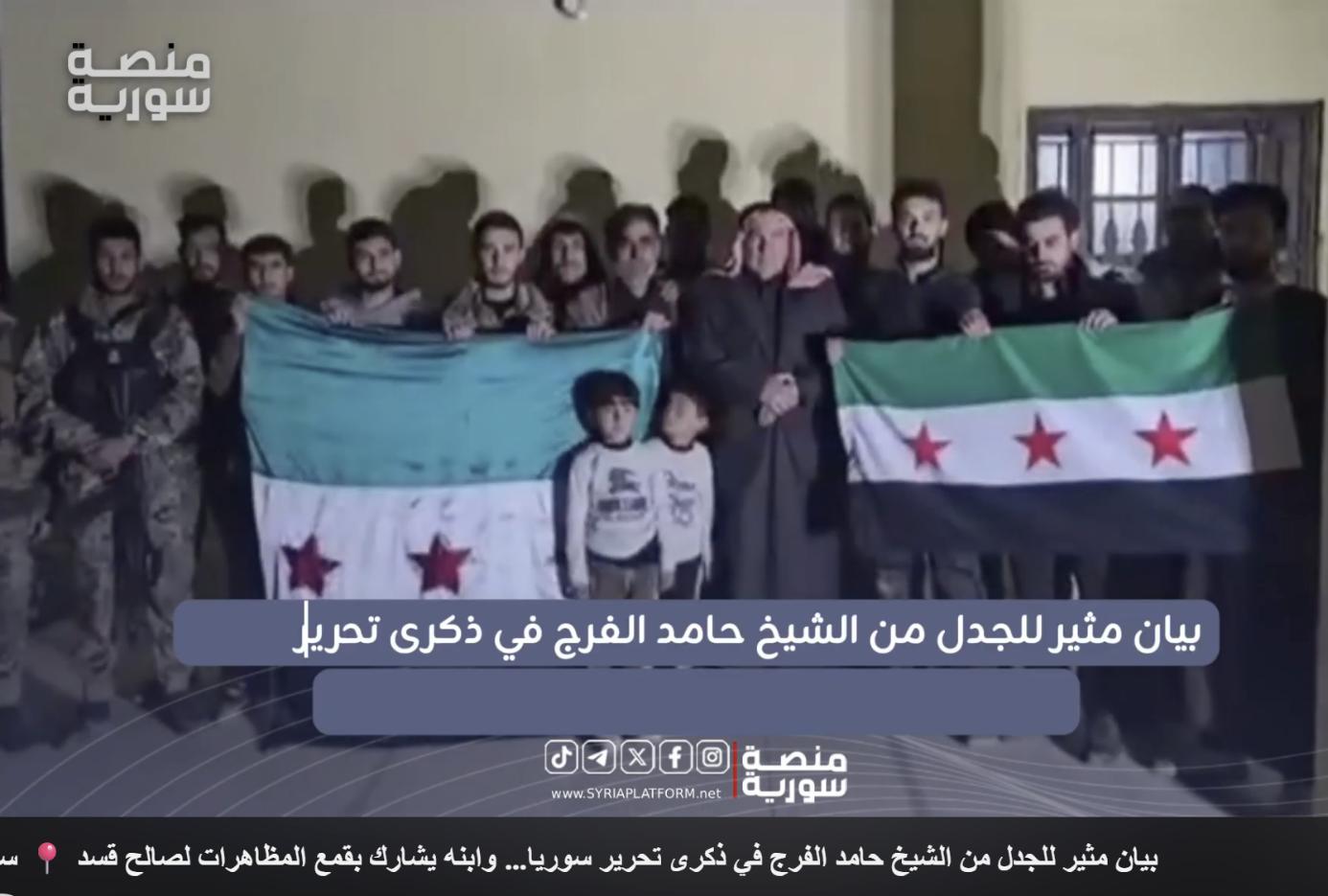
Image 1: A still from a video uploaded on Youtube, and X (among other platforms) on December 8, 2025 (still by the author).

The speaker begins his speech by marking the occasion that prompts the publication of the video:

“Today we celebrate the first anniversary of the fall of the defunct Ba’athist regime in Syria. We congratulate our people and everyone on this occasion, from […] the guesthouse (madafa) of the Wulda – the very guest house [he gestures to the house behind the group] where my father and my younger brother were killed by shelling from the Tabqa airport artillery […] we have stood with the Revolution since its beginning […] we fought in all the battles against the defunct [Baathist] regime […] We are patriots. My grandfather was exiled to Kamaran Island for three years for the sake of this people’s livelihood, and we are ready to make every sacrifice for our people.”

These first seconds of the video thus allow for a political as well as social positioning – the speaker politically aligns not only himself, but a “we” that includes “al-Wulda”, one of Syria’s tribal groups (asha’ir / Sing. ashira), with the victorious Syrian revolution. Terms such as “madafat al-Wulda” i.e. the guesthouse or reception hall of the Wulda, and the clothes worn by Sheikh Hamed, point to this tribal identity, while the educated accent in which the speech is delivered, as well as the dark suit jacket worn over the gallabiya, add a layer of Syrian urbanity.

This entry interrogates how the past has been referenced to underline present-day political claims among some of Syria’s tribal communities (asha’ir or qaba’il) in the Euphrates valley upstream of Raqqa. As an example, I focus on the Wulda ashira, in which I have been interested for a long time. This post is based on fieldwork I conducted in Syria between 2001 and 2011, and a short visit in May 2025.

The Wulda are one of numerous tribal or descent-based social groups which have long served as a fundamental structuring factor for social belonging in Syria’s eastern and southern parts. People who identify as belonging to one of these tribal groups are tied into long genealogies through the male line (although, as I have argued elsewhere, female perspectives are an essential if invisibilized component of this history). Reflecting segmentary models of social order, the Wulda specifically are made up of a number of smaller descent groups (confusingly, also referred to as asha’ir) among them the Nasser (from whom Sheikh Hamed himself has descended), the Ghanim, the Bu M’sarra, the Turn, ‘Ili, etc. Each of them, again, consists of distinct clans and families. In turn, the larger unit of the Wulda itself (like neighbouring groups such as the Afadla or the Sabkha) forms part of the Bu Sha’ban who in turn trace descent from the Zubaid and eventually, the Qahtanite Arabs whose roots lie in Yemen.

The ability to trace one’s genealogy to these ancient roots is particularly important given the collective classification of the Wulda (and other tribes) as “shawaya”, a classificatory term that has historically been distinct both from “sedentaries” (hadar) and also from the Bedouin who can claim Arab authenticity, strong genealogies, and nobility. The term itself is most often explained as a derivative of “shat”, sheep, indicating that “shawaya” were originally herders of small livestock. The term has also been used pejoratively, as an insult to designate the tribal inhabitants of Syria’s Eastern regions who are sometimes feared, but also looked down upon as backward, less civilized, wild and potentially violent.

For a critical intellectual readership, talk of tribes, asha’ir or qaba’il, and descent-based models of social belonging may seem outdated – or even, particularly among (some) anthropologists, suspicious of a dangerously exoticising and Orientalising view of at least part of the Syrian population. Yet for those who identify as a descendant of this milieu, genealogies and narratives about particular groups and ancestors are often a source of fierce pride. Moreover, in times where state structures are weak or even absent, the social networks created by tribal belonging and genealogy serve as a real and vital resource for social solidarity and mutual support.

Genealogies, anecdotes and icons of the tribal past, are a matter of great interest and debate in this region, as well as Syria’s tribal milieu more generally. Thus, to a local audience, Sheikh Hamed’s videotaped reference to his grandfather and his enforced exile immediately evoked a familiar discourse. This reference draws from a well-known narrative that has been told and retold to cement the status of the Wulda as a “patriotic” (watani) tribe. Its roots go back to the colonial era in Syria, the period of the French mandate (1920-1946).
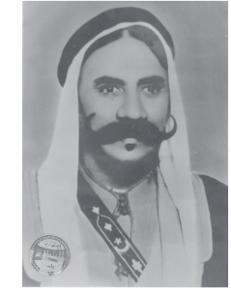
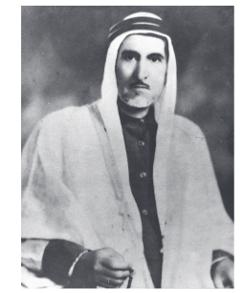
Sheikh Hamed’s grandfather, Muhammad al-Faraj al-Salama (d. 1972) was one of the two paramount sheikhs representing the Wulda tribe during this era, alongside his equally famous cousin, Sheikh Shawakh al-Bursan (d. 1981), whose portrait, featuring a memorable, pointed mustache, has become popular as an iconic image of tribal masculinity on social media, proudly referred to especially by people identifying with the Wulda. The “exile” which is mentioned in the video refers to an event from the 1940s. In July 1941, the administration of Syria had been taken over by the British and the Free French. Before the background of the Second World War, they imposed strict regulations on Syrian cultivators regarding the production and marketing of wheat, which was considered a strategic resource. In 1943, Sheikh Muhammad, who was one of the regions large landowners, was found guilty of “grain hoarding” – i.e., hiding part of the wheat harvest from the authorities. Together with other notables, among them the Shammar sheikh, Daham al-Hadi, he was sent into exile on Qamaran Island in the Red Sea, from where he returned in 1945.

This event has retrospectively been celebrated by members of the Wulda tribe as an example of anti-colonial resistance by the Sheikh and, by extension, the Wulda, underlining their self-ascribed credentials as a “patriotic” tribe. Besides conflicts and battles involving other members of the Wulda, notably the other famous Wulda sheikh of the mandate era, Sheikh Shawakh al-Bursan, Sheikh Muhammad’s exile was one of the moments of Wulda history that was mentioned repeatedly during my fieldwork.

During the 2000s, a number of books authored by writers who for the most part originated from Syria’s tribal milieu themselves amplified such historical perspectives, which had hitherto been transmitted mainly orally. While the books had limited circulation (editions were typically printed by local publishing houses with 1000 or 2000 copies), after 2011, these (and other) iconic references to particularist, tribal histories were made more widely accessible through social media, which during the revolution became a forum for debates, controversies, and political (self)positionings hitherto unheard of for Syria. Beyond textual and discursive sources, images serve as references to Arab tribal values. Among them, visual indications of generosity and hospitality (videos of receptions in tribal guest houses, images of coffee pots, large metal trays or rows of big cooking pots come to mind).

The video from December 2025, cited at the beginning of this text, is an example of such a political self-positioning. In his statement, Sheikh Hamed makes more or less explicit reference to his controversial position as a vocal supporter of the Kurdish-led Autonomous Administration of North and East Syria and its Syrian Democratic Forces. To counter accusations of “treason”, Sheikh Hamed gestures to descent and tribal history, emphasizing that his understanding of patriotism encompasses the wellbeing of all components of Syrian society (in other words: Kurds as well as Arabs).

The position of the Wulda with regard to Arab-Kurdish politics in the Syrian Jazira (the land between Euphrates and Tigris; i.e., for Syria, the territory east of the Euphrates) has a long and complex history that is directly related to their geography. Historically, for the past two hundred years at least the Wulda have settled on both banks of the Euphrates river upstream of Tabqa. Until the mid-twentieth century, most households derived their income from a combination of seasonally mobile raising of small livestock (mostly sheep), as well as seasonal farming near the river. This gradually was replaced by a sedentary lifestyle and year-round agriculture. The construction of the Euphrates Dam at Ṭabqa, officially inaugurated in 1973, and the ensuing flooding of this part of the Euphrates valley marked a decisive rupture. The emerging reservoir submerged up to three hundred villages, displacing an estimated number of at least 60 000 to 70 000 individuals. A significant part of these so-called “submerged Arabs” (“Arab al-Ghamr” or “Maghmurin”), the majority of whom identified with different branches of the Wulda, were resettled in the Syrian Jazira on lands that had previously been farmed by ethnic Kurds. As Arabization measure and “Syria’s greatest social engineering project” of the Baathist era, a chain of thirty-nine new villages now formed the so-called “Arab belt”.

While the Arab belt villages have been governed by the Kurdish-led AANES since 2012, most Wulda villages on the Euphrates between 2013 and 2017 were ruled by the so-called Islamic State of Iraq and Syria (ISIS) as part of its “Caliphate” centered in Raqqa. Since its demise, the area around Raqqa and the Jazira more generally became part of the AANES governed territories – a situation that is changing dramatically just as this blog post is being written.

For the Autonomous Administration, the co-optation of the Arab tribes of the Jazira was an important political goal; and not least, more than half of the Syrian Democratic Forces (SDF) were estimated to be Arab tribal fighters. Among other measures, tribal representatives were included in local councils. In 2017 Sheikh Mahmoud Shawakh al-Bursan of the Wulda, distant cousin of Sheikh Hamed and son of above-mentioned anti-colonial hero, Sheikh Shawakh al-Bursan, was appointed to co-chair (together with a female Kurdish civil engineer, Leila Mustafa) the Raqqa Civilian Council (RCC).

Sheikh Mahmud’s and Sheikh Hamed’s public support for the AANES and the SDF can be seen as a pragmatic position, echoing earlier accommodations of Baathist structures. However, in light of the political polarization between Arab and Kurdish sides in the Syrian conflict, and wide-spread anti-Kurdish sentiment, Sheikh Hamed’s support for the AANES has also been explicitly criticized as “betrayal” of the Arab cause. Thus, Sheikh Hamed’s speech of December 2025 can also be understood as a way to counter this criticism by balancing support for the AANES with equal support for the new leaders of Syria.

While a more detailed account of the different positions taken by men who claim to speak in the name of the Wulda, or the Bu Sha’ban, cannot be given here, it is important to note that the above-mentioned Wulda notables’ declarations of support for AANES are countered by others who have lent support to political and paramilitary forces on other sides of the conflict in Syria. Thus, in a familiar historical pattern, representatives of the Wulda and related groups have politically aligned with different, even opposing sides. Tribal fighters who identify as members of “the Bu Shaaban” or other descent groups related to the Wulda have also inscribed themselves into formalised structures of the Syrian revolution, including the HTS.

Among the tribal notables who have vocally opposed the AANES is Sheikh Abd al-Qadir al-Bursan, another descendant of famous anti-colonial hero, Sheikh Shawakh. Using social media, Sheikh Abd al-Qadir has repeatedly called on the tribal fighters of the Euphrates valley to rise up in arms against the SDF – most recently in the January 2026 war between the two sides. To support his political agenda, he, too, draws on the anti-colonial history of the Wulda, and especially the role played by above-mentioned, famous Shawakh al-Bursan, who is remembered locally for his armed opposition to French mandate forces. In the case of Sheikh Abd al-Qadir, this past is invoked mainly through visual means. Besides clothes that are typically worn by tribesmen of a certain social status, Sheikh Abd al-Qadir cultivates a mustache that closely resembles that of Sheikh Shawakh, creating immediate visual associations between the two men.
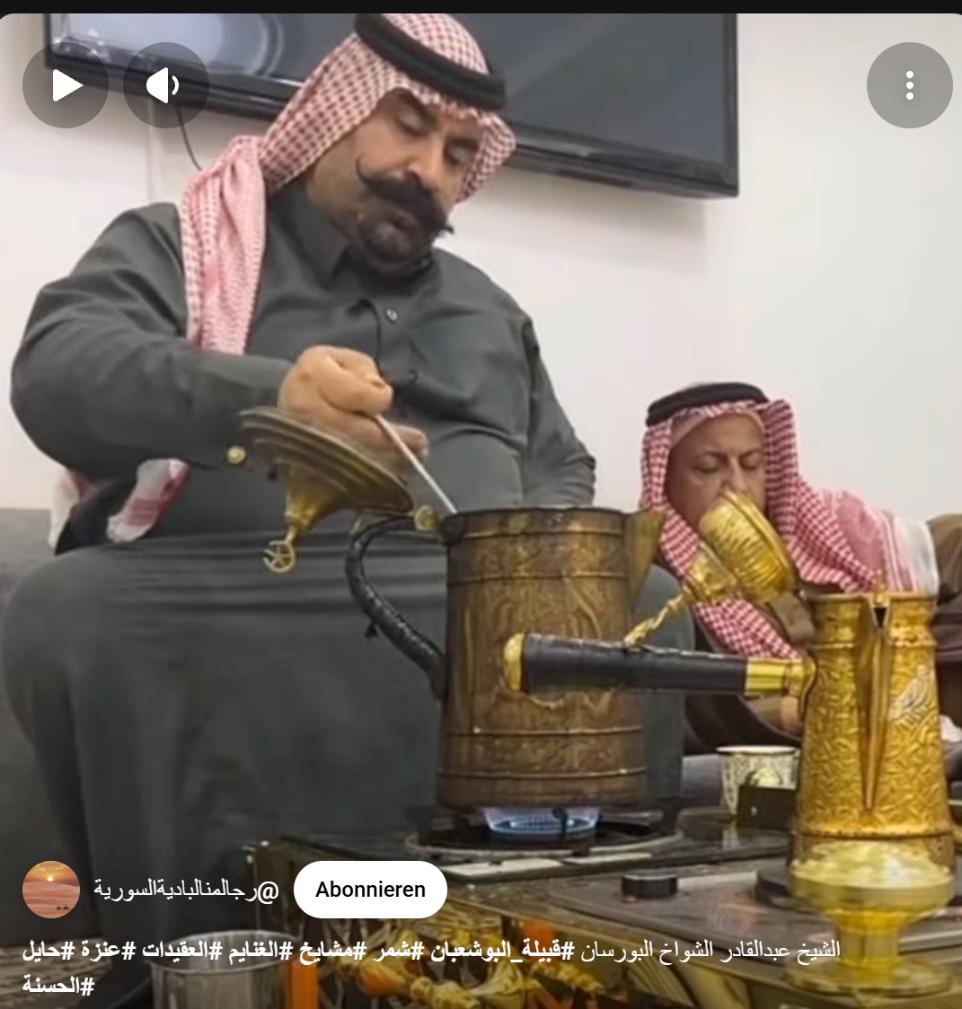
Image 4: A still from a video uploaded to social media shows Sheikh Abd Al-Qadir wearing clothes typically worn by tribesmen of a certain status and sporting a moustache resembling that of Sheikh Shawakh al-Bursan brewing coffee (still by the author).

A final point that must be noted but cannot be explored here in detail is the gendered nature of this digital universe: the images and iconic references to tribal history described here project a distinctly male image of history as well as politics in the Syrian Jazira. From this vantage point, a particular image of tribal masculinity is an integral part of these references (strongly contrasting with otherwise gendered images of female activists and fighters, for instance – but not exclusively – characteristic of Kurdish representations).

The Syrian uprising against the Asad regime, which has transformed Syrian society in so many ways, has also impacted the role of Syria’s tribal groups. Men who position themselves as members of Syria’s tribal milieu legitimize and mobilize support for different, even opposed political positions in (post)revolutionary Syria by referencing well-known tropes and images of tribal history – expressing values such as “patriotism”, hospitality, masculinity, courage – that are well familiar from earlier decades. But the persistence of these symbols and tropes despite the considerable changes that this region has seen over the past fifteen years should not be taken as an indication that Arab tribal identity is unchanging or even timeless. Rather, the value attributed to certain symbols of social belonging based on descent and genealogy can be seen as a response to unstable and changeable political orders on the ground.


Katharina Lange is a senior research fellow at Leibniz-Zentrum Moderner Orient (ZMO) in Berlin with fieldwork experience in Syria and Iraq’s Kurdistan Region, among others. Her current research focuses on oral and gendered histories, rural and agrarian lives, and the impact of war and violence on livelihoods in northern Syria.


Cite as: Lange, K. 2026. “Uses of the Past by Representatives of Syria’s tribal groups (asha’ir) – the Wulda example” Focaalblog, April 6. https://www.focaalblog.com/2026/04/06/katharina-lange-uses-of-the-past-by-representatives-of-syrias-tribal-groups-ashair-the-wulda-example/

Kræn Kielsgaard: Rewriting Syria´s history – the case of Israel in Syrian schoolbooks after December 8, 2024

Image 1: Syrian postage stamp commemorating the Yom Kippur War, 1998. Author unknown, copyright expired. Source: Wikimedia commons

This post examines how the new Syrian state seeks to reconstruct public memory through revisions of public-school curricula in a period of profound political and social transformation after December 8, 2024. It unfolds how education, and more specifically official historiography, are employed by the new state as symbolic tools through which the former regime is delegitimized as not authentically Arab. It focuses particularly on how the new state achieves this through a reconfiguration of the portrayal of Israel and of the historical relationship between Israel and Syria. Israel has figured prominently as an enemy character in official rhetoric and legitimization efforts of the Assad regimes. The post discusses how this has changed with the new al-Shara regime and suggests that a realpolitikal emphasis on non-antagonism towards Israel as well as an agenda to downplay the achievements of the previous regime is at the heart of these changes.

Background – revision of schoolbooks

On December 8, 2024, the rule of Bashar al-Assad came to an end after 14 years of uprising and civil war when the Islamist militia Hayat Tahrir al-Sham and its allies marched into Damascus and the former president fled to Moscow. A major priority of the new regime´s reconstruction efforts has been dedicated to education. This has included physical reconstruction as the war has left more than 7000 schools destroyed and more than 2 million children without schooling (Vignal, 2021). It has also entailed revisions of Syrian schoolbooks with a specific focus on differentiating the content from the former regime´s curricula.

In early January 2025, the Syrian ministry of Education of the recently installed caretaker government published 12 pages via its official Facebook page bringing immediate changes to all levels of Syrian schoolbooks (Syrian Ministry of Education, 2025). It also announced that the subject National Education would be cancelled all together and that Religious Educationi would substitute it as a graded course (Mortensen, 2025). The new minister of education Nadhir al-Qaderi explained in an interview in February that the course would be replaced by a new one, and that the ministry was working on “creating a genuine, nationalistic subject that will raise a Syrian people on the basis of citizenship and a real national feeling.” (al-Arabi, 2025). The curricula revisions generated strong criticism. The ministry was accused of transgressing its mandate as an interim caretaker government, and of Islamizing Syrian education and changing its history (al-Jadid, 2025). Al-Qaderi defended the changes saying that it was necessary to erase references to and “wrongful understandings” of the former regime. But the changes went further than just removing the old flag and pictures and quotes of the former president(s). They included deleting pictures of figurines of pre-Islamic Gods from history books (in addition to the word āliha “Gods”), leaving out the theory of evolution from biology and changing nationalistic formulations such as “in defense of the homeland” to the religious wording “in defense of belief” (BBC News عربي, 2025).

A new Minster of Education took office in March 2025, and in October 2025 the revisions were implemented in the new textbooks that were distributed to the schools and uploaded to the ministry´s curricula website. In some cases, the revisions went further than the “emergency changes” announced by the caretaker government in January. However, the minister has insisted that the changes are only “deletions” – most recently in an interview with the state-run Ikhbariyya TV in December 2025 (al-Ikhbariyya, 2025). New paragraphs were added to contemporary Syrian history describing the 2011 revolution, its goals, and major events leading up to the revolution like the Kurdish intifada in 2004 (also known as Qamishli Uprising), the Damascus declaration and the regional context of Arab uprisings in Tunisia and Egypt. Other changes include removals of whole chapters that are not related to the former regime like a paragraph on the Alepine Nineteenth-century thinker and reformer, al-Kawakibi. Yet, the revisions are moderate as they have been based on the 2013-versions of Syrian schoolbooks and thus bypass major revisions by the Assad-regime in 2017 that aimed at promoting a version of Syrian history emphasizing Syria as a land of religious coexistence where Islam was but one of several religious traditions shaping Syrian culture and nationhood (Mortensen, 2026). Also, the 2017 versions have a more thematic and skills-oriented approach, whereas the older versions are classic chronological textbooks.

The revision process has not been very transparent. Whereas the older schoolbooks listed the authors, this is not the case with the revised versions. Furthermore, it is not clear how the emergency revisions from January turned into the revisions that we now see in the books. One thing that is certain is that this should not be seen as the final product but a “work in progress”. Still, it reflects what the new regime deems relevant information and framings of historical periods for a new generation of Syrians. Therefore, it is not surprising that the textbooks that underwent the most substantial revisions were history books. This is a pattern recognizable from other states emerging from political rupture where historiography is mobilized to rework public memory (Wertsch, 2002; Fukuoka, 2023; Lavabre, 2009; Greene, 2013).

The relationship with Israel

A major revision—closely linked to Syria’s position within the international and regional order and, simultaneously, a key component of the former regime’s legitimization strategy (Beetham, 1991) —concerns the reinterpretation of the wars with Israel and Syria’s role in the Arab world under the former regime. The two Assads consistently portrayed Syria as the final bulwark against Israeli hegemony in the Middle East and as a central member of the Iranian-led “resistance axis” (a narrative it maintained until its very last days). For several years the pan-Arab Baath-flag – identical to the Palestinian flag due to their shared origins in the 1916 Arab revolt – was the most common on public buildings until the Syrian flag gradually substituted it as part of an effort to downplay pan-Arab Baathist rhetoric after Bashar took power in 2000. In Syria under Bashar al-Assad – especially after the 2006 war between Israel and Hezbollah – pictures of Hasan Nasrallah (then head of Hezbollah) and Iranian leaders became ubiquitous and state sponsored demonstrations against Israel in the streets of Damascus during the wars on Gaza were a common sight. Syria also hosted several Palestinian factions -PFLP, PFLP-DC and Hamas that, however, fell out with the regime in 2012 over its public endorsement of the Syrian revolution (Danin, 2012). The Golan Heights that were occupied by Israel in 1967 and annexed by Israel in 1981 were a daily feature on Syrian state tv. News segments celebrated the steadfastness of the Syrian citizens in the Golan and emphasized that Syria had a rightful and lawful claim to the area. This intensified especially after the Trump administration’s recognition of the annexation in 2019.

A central pillar in this state promoted narrative was the surprise attack on Israel that Syria launched in October 1973 (Tishreen in Arabic) in coordination with Egypt. Although the war ultimately proved a strategic failure, it was carefully embedded in official state ideology through school curricula, commemorative events, a major memorial complex in Damascus, and the naming of hundreds of state institutions, neighborhoods, and even a dam in Northern Syria. In older history textbooks, the war was described as “one of the greatest achievements of the Corrective Movement” (12th grade, 2013).ii To underscore its significance, a national Tishreen Day was celebrated annually from 1973 in schools, in the public squares all over Syria and in state media where a reporter in the street would ask ordinary Syrians about their memories from the war (Syrian Ministry of Interior, 2020). After the 2011 revolution, the commemoration was adapted to the new reality as the Syrian army’s efforts to repress the uprising were presented as retaking lost areas from an enemy that was working in the service of the Zionist enemy.

Under the new al-Shara regime, this national holiday has been abolished by presidential decree along with the Martyrs Day that commemorated the execution of Syrian and Lebanese nationalist activists by the Ottoman governor in 1916 (Souriaalghad, 2025). Also, public institutions such as Tishreen University in Latakia have been renamed (Burhan, 2025), as has the official newspaper, now titled Freedom الحرية)). The official name of the war in state discourse has been changed to the “1973 War” instead of the celebratory “the Tishreen War of Liberation”, a shift that was already announced in the January 2025 revisions that were published on Facebook.

Overall, the description of Israel has not undergone significant changes, but the framing of Syrian-Israeli relations has changed in schoolbooks. A comparison of new and old versions of the history and the social studies curricula reveals that the books’ authors are still exploring what language to appropriate and how to forge a coherent narrative around the historically fraught relationship between Israel and Syria.

In the 12th grade history curriculum, we see that the description of the 1967 Israeli surprise attack on Egypt, Jordan and Syria has been changed from “the Zionist entity with the support of imperialist forces launched a widescale aggression on the Arabic states neighboring occupied Palestine (Syria, Jordan, and Egypt” (12th grade, 2013). This framing emphasized the centrality of Palestine to the conflict and sought to delegitimize the Israeli claim to statehood. In contrast, the revised version adopts a more neutral tone. It states: “Israel started the war against Egypt, Jordan, and Syria on June 6, 1967.” (12th grade, 2025).” The new version also describes the war as the al-Naksa (“the setback”). This term typically signifies the collective trauma of the defeat and contains a critique of the Arab political systems that situates their shortcomings as a partial explanation of the defeat (Bilal, 2017). While the older versions explicitly attributed the war to the inherent expansionist motive of the Zionist ideology – stating that “Zionism adopts aggression as a way to expand” – the new versions only partially retain this explanation. It notes that the attack was in “accordance with [Zionism’s] expansionist and aggressive nature” and thereby preserves only elements of the previous framing.

Regarding the terminology employed to describe the State of Israel, a degree of continuity is evident. Though the neutral “Israel” or “the Israeli Army” are added in the new versions, numerous instances of more ideologically charged language persist, including “the Zionist Entity”, “the Zionist Enemy”, and “the Zionist terrorist Enemy”. The latter in a chapter on children´s rights in 5th-grade social studies where Israel is sidelined with the Assad regime as perpetrators of crimes against children (Social Studies, 5th-grade, 2025, pp.41).

While we see some continuities in how Israel is described, the role of Syria as an actor in this conflict has been subject to significant revision. Most notably, responsibility for Syria’s territorial losses is now attributed to Hafez al-Assad in several books. The revised texts assert that Israel occupied the Golan Heights in collusion with Hafez al-Assad, who, according to the new history books for 12th and 9th grades, declared the territory occupied a day before the actual event occurred. In the 12th grade book this information is added in a yellow information box on the left side of the page. Hence, it is highlighted as particularly relevant information. By contrast, in the 9th grade book the information is part of the main body of text that states that the Syrian Golan was occupied “in collusion with the Syrian Defense Minister at that time (Hafez al-Assad)” (Ministry of Education, 9th grade, 2025, pp. 30). Significantly, this claim has been put forward previously as well. It was made in an Al-Jazeera documentary on the 1967 war broadcast in 2015 (al-Jazeera 2015) and gained widespread currency in opposition circles even though many Syrians would dismiss it as a conspiracy theory.

The same narrative trope – presenting the Assad-regime as secretly collaborating with Israel and undermining the Palestinian cause – is evident in chapters on modern Lebanese history as well. Here, we find the claim that the Sabra and Shatila massacres, perpetrated by the Lebanese Phalange militia, was in fact committed in cooperation with the Syrian regime. It is also mentioned that the former regime intervened in Lebanon and committed massacres against the Palestinian people. Here the 1976 Tel al-Zatar massacre is highlighted without including the Lebanese militia that did the actual killing. Whereas the Syrian forces were without doubt implicated in the siege of and killings at Tel al-Zatar camp this was not the case with Sabra and Shatia, which were besieged by the Israeli army that had launched a full-scale invasion of Lebanon that year (Khalidi, 2021).

This narrative is part of an attempt at presenting the former regime as acting against broader Arab interests through its alliance with Iran against the “brotherly” Iraq (here adopting typical pan-Arab discourse), and through the assassination of former Lebanese prime minister Rafiq al-Hariri – as well as other Lebanese “nationalists” like Kamal Jumblatt. The Syrian revolution, with its conclusion in the 2024 liberation, is described as restoring “the authentic Arab face of Syria” (12th grade, 2025, pp. 56). One could say that the new material in certain ways competes with the older versions over being more Arab. Cultural Arabism is thus still presented as a normative ideal in the new books.

Geo-political, regional and internal concerns at the heart of revisions of schoolbooks

The most sweeping changes to Syrian schoolbooks concern the war between Syria and Egypt on one side and Israel on the other. The term Tishreen is among those banned and has been systematically removed from textbooks and public discourse. Through my comparative reading of history textbooks, I only found a single use of this term (in a chapter on Russian history, referring to Soviet support for the Tishreen Liberation War) that has somehow escaped the editors´ attention. In the new textbooks, the 1973 war is mentioned only briefly, in connection with Hafez al-Assad’s rise to power in 1970. Here, the war is characterized as a “show war,” with “illusory victories” intended “to legitimize his rule” and “consolidate his power” (9th grade, 2025, pp. 111).

Nevertheless, the texts introduce a degree of ambiguity and, at times, seem internally inconsistent in their attempt at undermining the victory claims of the Assad-regime while criticizing Israeli behavior. For instance, the short paragraph in the 12th-grade book on the war has only been slightly revised from “The Tishreen liberation war in 1973 embodies Arabic Solidarity” (12th -grade, 2013 pp. 56) to “the 1973 war embodies solidarity” (12th grade, 2025, pp. 54). Even though the book argues that the war was a “propaganda war” with the aim of” conferring legitimacy to [Hafez Al-Assad’s] rule” the paragraph also mentions the military contributions of several other Arab states. The regional backing during and after the war is preserved again in an information box on the oil crisis that notes Saudi Arabia’s support for Syria and Egypt, which, according to both versions, “restored the Arab umma’s agency and prestige.” (8th-grade, 2025, pp. 111). The new materials thus seek to balance recognition of Syria’s regional backing as a “frontline state” with the portrayal of Israel as a genuine geostrategic threat while avoiding unnecessary provocation of Israel.

Since December 8, Israel has bombed both military and civilian infrastructure and occupied territory beyond the demilitarized zone established between Syria and Israel in 1974 (Chughtai & Haddad, 2025). A recent example of the consequences of heightened rhetoric occurred in October 2025, when the Ministry of Culture in Aleppo planned an event commemorating October 7, which was subsequently raised in the UN Security Council by the Israeli representative. Similar scrutiny will likely be directed at the new educational materials, as has already been observed regarding Saudi Arabia (Gold & Al Lawati, 2023) and the Palestinian Authority (Moughrabi, 2001) where comparable trends toward normalization of relations with Israel and gradual de-escalation of anti-Israel rhetoric have emerged.

It is too early to predict how the Syrian-Israeli relationship will evolve. Yet, the textbook revisions make one point clear: the al-Shara regime cannot entirely escape the legacy of Syrian-Israeli relations and the historic enmity between the two states. Hence, the revised versions of the history books to some extent retain older framings. Several factors will shape this trajectory, including whether the ongoing rounds of negotiations between Israel and the new leadership in Damascus result in a security agreement or even some degree of normalization. What is certain, however, is that the era of hostile rhetoric against Israel and the instrumentalization of the Palestinian cause as a pillar of regime legitimacy has ended. Ahmad al-Shara can tap into alternative and way more potent claims of revolutionary legitimacy, as well as the promise to bring back the state and the country to its people and bring Syria out of its political and economic isolation.


Kræn Kielsgaard. I am a Phd fellow at the Institute of Cross-cultural and Regional Studies, University of Copenhagen, where I study how Syria´s ongoing nation- and state- building efforts since December 8, 2024, take shape through education reform. I first visited Syria in 2007 and moved to live there between 2009 and 2011 as part of my Arabic studies at the University of Aarhus. I have worked with translation, interpretation and teaching Arabic at the University of Copenhagen before starting my doctoral research in September 2025.


References

Al-Arabi. (2025, February 6). لقاءخاصمعوزيرالتربيةالسورينذيرمحمدالقادري| حواراتدمشق [Video]. YouTube. https://www.youtube.com/watch?v=Z_Wy38zSCnA

Al-Ikhbariyya. (2025, December 26). اللقاءالكامللوزيرالتربيةوالتعليممحمدعبدالرحمنتركوعلىشاشةالإخبارية [Video]. YouTube. https://www.youtube.com/watch?v=xVWfN80h6yo

Al-Jadid. (2025, January 2). جدل واسع على منصات التواصل بعد الإعلان عن تعديل المناهج في سورية. العربيالجديد. https://www.alaraby.co.uk/entertainment_media

Al-Jazeera. (2015, July 27). هضبة الجولان.. سقطت أم سُلمت؟

هضبة الجولان.. سقطت أم سُلمت؟ | استقصائية | الجزيرة نت

BBC News عربي. (2025, January 2). المناهجفيسوريا: منالبعثيةإلىالإسلاموية. . . كيفتفاعلروادمواقعالتواصلمعتعديها؟. https://www.bbc.com/arabic/articles/cly4vznxnlzo

Beetham, D. (1991). The legitimation of power. https://doi.org/10.1007/978-1-137-36117-2

Bilal, ´A. (2017). في تشريح الهزيمة: حرب يونيو 1967 بعد خمسين عاما

Burhan, H. (2025, June 19). مراسيمرئاسيةبتغييراسمجامعتيتشرينوالبعثوتعيينرئيسلجامعةحمص.

الإخبارية السورية. مراسيم رئاسية بتغيير اسم جامعتي “تشرين والبعث” وتعيين رئيس لجامعة حمص – الإخبارية السورية

Chughtai, A., & Haddad, M. (2025, December 9). Israel attacked Syria more than 600 times over the past year. Al Jazeera. https://www.aljazeera.com/news/2025/12/9/israel-attacked-syria-more-than-600-times-over-the-past-year

Danin, R. (2012, February 29). Hamas breaks from Syria. Council on Foreign Relations. https://www.cfr.org/blog/hamas-breaks-syria

Fukuoka, K. (2023). History Education in M. Mälksoo (Ed.), Handbook on the Politics of Memory (1st ed., pp. 285–302). Edward Elgar Publishing.

Gold, H., & Al Lawati, A. (2023, June 19). Saudi Arabia is quietly changing its textbooks. Could that lead to acceptance of Israel? CNN. https://edition.cnn.com/2023/06/19/middleeast/saudi-textbooks-israel-mime-intl/index.html

Greene, A. L. (2017). Creating a Nation Without a Past. SensePublishers EBooks, 101–125

Khalidi, R. (2021). Sabra and Shatila massacre: Evidence from the Kahan Papers. Institute for Palestine Studies. https://www.palestine-studies.org/en/node/232060

Mortensen, R. L. (2025, February 11). Den syriske stat har altid brugt skolebøger til politisk indoktrinering og positionering. Information. https://www.information.dk/debat/2025/02/syriske-stat-altid-brugt-skoleboeger-politisk-indoktrinering-positionering

Mortensen, R. L. (2026). Syriske skolebøger i historiefaget. Babylon Nordisk Tidsskrift for Midtøstenstudier, 23(1), 6–17. https://doi.org/10.5617/ba.13126

Moughrabi, F. (2001). The politics of Palestinian textbooks. Journal of Palestine Studies, 31(1), 5–19. https://doi.org/10.1525/jps.2001.31.1.5

Syrian Ministry of Education – Syria. (2025). General. http://www.moed.gov.sy/general

Syrian Ministry of Education. (2025, January 2). [Facebook page]. Facebook. https://www.facebook.com/profile.php?id=100064316544313

Syrian Ministry of Education. (2013). History, 8th grade, language track. Syrian Ministry of Education.

Syrian Ministry of Education. (2025). History, 8th grade, language track. Syrian Ministry of Education.

Syrian Ministry of Education. (2013). History, 9th grade, language track. Syrian Ministry of Education.

Syrian Ministry of Education. (2025). History, 9th grade, language track. Syrian Ministry of Education.

Syrian Ministry of Education. (2025). History, 12th-grade (3rd level), language track. Syrian Ministry of Education.

Syrian Ministry of Education. (2013). History, 12th-grade (3rd level), language track. Syrian Ministry of Education

Syrian Ministry of Education. (2025). Social Studies, 5th grade. Syrian Ministry of Education.

Syrian Ministry of Interior, (2020, October 6). ذكرى حرب تشرين التحريرية (السادس من تشرين الأول) [Video]. YouTube. https://www.youtube.com/watch?v=8H6QstK9EcI

Souriaalghad. (2025, 24. oktober). تغيير المناهج التعليمية في سوريا: إعادة كتابة الذاكرة الوطنية أم إصلاح تربوي حقيقي؟. سوريا الغد. https://www.souriaalghad.com/syrian-curriculum-reform-memory-vs-education/

Wertsch, J. V. (2002). Voices of collective remembering. In Cambridge University Press eBooks. https://doi.org/10.1017/cbo9780511613715

i The curriculum is divided into Islamic Education for Muslims and Christian education for Christian.

ii The corrective movement in Baath parlance signifies Hafez al-Assad´s coup in 1970 against his former Baathist companions from the military.


Cite as: Kielsgaard, K. 2025. “Rewriting Syria´s history – the case of Israel in Syrian schoolbooks after December 8, 2024” Focaalblog, March 20. https://www.focaalblog.com/2026/03/20/kraen-kielsgaard-rewriting-syrias-history-the-case-of-israel-in-syrian-schoolbooks-after-december-8-2024/

Birgitte S. Holst: Introduction: Uses of the past in the post-Assad political transition in Syria


Image1: In what remains of a public building in Darayya, Damascus, a wall painting of Hafez and Basel Al-Assad (Bashar Al-Assad’s late father and brother) is scratched as the building stands empty, April 2025. © Birgitte Holst

Since Bashar Al-Assad was overthrown as President of Syria in early December 2024, the political situation in the country has been volatile. Although a new group of powerholders have taken over, their grip on power is far from complete just as some Syrians are unsure or worried about what such a complete grip on power might entail. As Syrians have endeavoured to navigate this volatile period, the past has emerged as significant in several ways. Understood as both specific renditions of historical events and as particular experiences of life in Syria under first Hafez and then Bashar Al-Assad but also before, the past has been a point of contestation in itself, it has been invoked as a justification for various political claims and projects, and it has been employed as a framework through which to interpret unfolding events.

This has taken various forms. For instance, in the first months after the toppling of the Assad-regime it took the form of contestations over how the very distant past of the pre-Islamic history of the area we today know as Syria should be presented to Syrian school children as somehow formative of the Syria they now live in (see Kielsgaard this feature). There have also been frequent references to the atrocities committed under Assad rule with various groups and individuals making demands about how to enact justice for that (see Al-Khalili, Masoud – both in this feature). Moreover, many Syrians (professional analysts and non-analysts alike) have invoked examples of how Ahmad Al-Sharaa and his group HTS (Hay’a Tahrir Al-Sham) have ruled in Idleb (where the group held control for several years) to assess/predict how the group was likely to rule from Damascus (e.g., Kalam 2024).

Hence, from very early on in the post-Assad period in Syria, the past featured prominently in Syrians’ attempts to navigate the political transition, including formulating political claims and visions for the future of Syria as a nation/homeland/state. The contributions to this feature examine these diverse uses of the past by various groups of Syrians with the purpose of unravelling some of the complexities of the ways in which the past is shaping the present in Syria but is also shaped by the present. Accordingly, while much attention is presently devoted to questions of how Syria’s new rulers herald continuations or discontinuations of the geopolitical, economic and religious landscape as it looked before the overthrow of the Assad-regime (e.g., Tuğal 2025), this feature rather dives into the question of how various groups of Syrians (including the government) invoke the Assad-years and other pasts to navigate the present.

The past, political identities and political turmoil

On the one hand, the past arguably figures prominently in many processes of identity formation and constructions of political projects. Charles Taylor (1989) argued that to know who we are, we must know how we have become and where we are going. Similarly, scholars of nationalism have suggested that nationalists often point to a specific rendition of the past that allows them to argue that the nation is a continuation of previous groups in a different form. This claim regarding the nation in turn allows nationalists to make political demands on behalf of one such earlier group, which they portray as central to national becoming (e.g. Hobsbawm 1983; Smith 1971). Ideas akin to Taylor’s have also been used in various analyses of how political parties claim a coherent group identity through reference to the past and through their agendas for the future (e.g., Bryan 2000).

On the other hand, the context of political transition in the aftermath of a radical break with a previous political order often appears to intensify such processes. In the wake of the collapse of a regime that prohibited or heavily circumscribed contestation of the officially prescribed line of historical rendition, we often see a profusion of engagements with the past. These engagements pertain to questions of who was a victim of what, but also to questions of what events are significant, how they should be interpreted and especially what this means for who “we” are (Krawatzek and Soroka 2021). Moreover, when a political order is upended, uncertainty about the future often follows and as events in the present evolve in unforeseen directions, new perspectives on the past might emerge (Thomassen and Forlenza 2017). This impacts the construction of identities and also of political projects that are caught up in ongoing redefinitions of past, present and future.

In Syria, we have, for instance, seen that past grievances have led to renewed violence which in turn led to new claims about victimhood as well as new political agendas. Hence, while the current Syrian government seems to be heading towards institutionalising their particular version of the connections between past, present and future for Syria, the present moment offers a unique opportunity to grasp the multifaceted ways in which various Syrians are coming to understand these connections and use them to navigate the current political situation. This feature unravels some central aspects of these processes.

Key developments during the first post-Assad year

Overall, the contributions to this feature make clear that while the new government is institutionalising its multidimensional vision of Syria’s past, present and future, this happens in a context of numerous counter stories.

One way in which the past is invoked is to formulate a national identity or a state identity. The new government has taken several steps to designate a direction. As discussed by Kræn Kielsgaard in his contribution, changes to school curricula were one of the first items on the agenda and was initiated already in December 2024. So far, this work has mainly been about editing out any improper references to the Assads while remodelling religious education to the standards of the new Islamist rulers. In addition to amending schoolbooks, in early autumn 2025 the government proclaimed that several national holidays would be scrapped in favour of new ones. Among the cancelled holidays were Martyrs Day and Tishreen Independence Day. Martyrs Day refers to 16 Arab Nationalist Syrians hung by the Ottomans in 1916. Cancelling it may indicate a distancing from Arab Nationalism and a simultaneous toning down of any criticism of the Ottomans (who were Sunni). Tishreen Independence Day marks a victory in the October war in 1973 (against Israel). Cancelling it indicates that no achievement under the Assads should be celebrated. Instead, 8th December, the date when Bashar Al-Assad was toppled in 2024, and 18th March, the date when the revolution began in 2011, are new holidays celebrating achievements of the new government.

While such changes institutionalise a specific national memory (cf. Connerton 2010) that aligns with the religious and political agendas of the new rulers, the government also appears to support (or at least not be against) less institutionalised forms of memory production. Government supporters have, from the early days of the post-Assad period, been saying that the overthrow of Assad rule by a coalition of Arab Sunni Islamist groups (headed by HTS) amounts to a return of the Umayyads. The Umayyad Caliphate was one of the first Sunni Islamic Caliphates and was led from Damascus. Invoking a reference to it underlines the Sunni character of the new rulers. It, moreover, connects Ahmad Al-Sharaa and his government not only with a glorious Sunni past but also with the successful eviction from Damascus of what many Sunnis perceived to be Shia occupiers. During the civil war, the Assad-regime received support from Iran and Shia militias (often of Iraqi origin) were stationed in Damascus. This was a source of much distress among many Sunnis (especially Islamists). They now invoke the reference to the Umayyads also as a way of marking the overthrow of this perceived occupation.

Against this very Sunni vision of the new Syrian state, leading minority figures and also secular intellectuals (Sunni or otherwise) posit that Syria is historically an ethnic and religious mosaic. They hope that this vision can take a prominent place in the definition of the Syrian nation and state in the coming years (e.g., Haj Saleh 2025). That suggestion finds a perhaps surprising resonance with the new government’s continued emphasis on the rich cultural heritage of Syria. As discussed by Christine Crone in her contribution to this feature, the state-controlled news site SANA (Syrian Arab News Agency) continues to produce content that celebrates the diverse parts of Syria’s past. As such, although Syria’s new rulers appear to want to emphasise that the state is now led by Sunnis and that their claim to power is justified by the revolution, they also leave space for claims-making based on the multifaceted history of the area.

In addition to invocations of the past that impart particular messages about the character of the new Syrian nation and state, the past is also invoked by various groups of Syrians in ways that indicate the specific political agendas or models of rule they believe the new government should implement. One issue at the forefront of many Syrians’ concerns is the question of how to rectify the violations committed by the Assad-regime. As Charlotte Al-Khalili shows in her contribution, different Syrians have diverging wishes for how justice should be served in response to these crimes. While some hope for justice through legal routes, others argue that access to knowledge or socio-economic reconstruction of Syria would be more just approaches. Zoya Masoud moreover discusses how the crimes committed under the Assads form the grounds of claims of exclusive victimhood that in turn reignite rifts between Syrians as they lead to a lack of recognition of crimes committed after Assad.

Some groups of Syrians are, however, also invoking slightly more distant pasts as models to think with regarding the question of what kind of new political structure to erect in Syria. As Thomas Pierret analyses in his contribution, the Sunni Ulama (that is, the leading Sunni clerics in Syria) are invoking mainly the 1950s and 1960s, when Syria was newly independent, as a model for rule. Although one might expect the Ulama to highlight instead past periods of Islamic rule, Pierret suggests that they prefer the 1950s and 1960s because this was a time when the Ulama was listened to by politicians and given a freer hand.

Besides the Ulama, some parts of another group of Syrians (that this feature does not discuss in detail) are also invoking the 1950s as a model for rule. This regards what one could call the secular intellectuals who are at present attempting to find their feet in a new reality where the Assad-regime that many of them opposed has been overthrown by religious Sunnis rather than secular Syrians. This group is not unified, and they do not have a coherent position on the new rulers. Some individuals do, however, attempt to impact decisions by the new government. One such attempt emerged already in December 2024 when Syrian filmmaker Ali Atassi (2024) argued that Syria’s interim government should temporarily reinstate the 1950 constitution. This constitution, he suggested, would allow for free elections. After elections, the work to draft a new constitution could start as this work would then be undertaken by democratically elected officials. He pointed out that this exact model has been used before, in 1954 and 1961 respectively, and that there was no reason to do things differently now.

The near and the slightly more distant past is thus invoked in diverse and conflicting ways by different Syrians to make specific political claims about the kinds of actions a new government must take.

Lastly, the past is also used by Syrians to navigate the present volatility. In that regard, Syrians’ responses to the massacres of Alawis in March 2025 and then Druze in July 2025, both at the hands of government affiliated militias, must be highlighted.

Although the massacres had particular political motivations and therefore arguably did not amount to a threat to all minorities, all minorities were affected by them in the sense that the violence roused fears of further attacks on others. Christians are a case in point. When I visited Damascus in February 2025, the Christians I talked to were wary about the prospects of Sunni Islamist rule but also referred to the ways in which minorities had been promised some self-governance in their villages and towns as the Islamist coalition came and left during the “Deterrence of the Aggression” advance (when Bashar Al-Assad was overthrown). Citing these acts of the new government to allow minorities self-determination, the Christians I talked to expressed hope for the future. When I returned to Damascus in April 2025, the massacres on Alawis along the coast had shifted perspectives. People now talked about renewed persecution at the hands of Sunnis. Many invoked examples of sectarian violence unleashed by Islamist militias during the war and some even referred back to 1860 when around 5000 Christians were killed by (predominantly) Sunnis in Damascus. In June 2025, after the bombing of the Mar Elias Church in Damascus, the Patriarch of Antioch and all the East for the Greek Orthodox Church, John 10 Yazigi, made this reference as well. The fear among the Christians I talked to in April was that this historical persecution would continue in the future.

What I want to highlight about this is that while previous persecution of minorities was most likely always in the back of the minds of my Christian interlocutors, the massacres along the coast made them invoke this history actively as a lens through which the present could be understood and the future predicted. As discussed by Salam Said and Maria Kastrinou in their contribution, the Syrian Druze after the massacres committed against them in Suwayda are invoking the past in another way. On the one hand, they are attempting to comprehend how the past of (overall) inter-sectarian conviviality could be shattered so profoundly in the space of a few days. On the other hand, some are invoking historical references to understand what kinds of destruction of the national fabric is unfolding at present. Hence, in divergent ways Christians and Druze are relying on the past as a compass with which to navigate uncertainty, but this does not relieve that uncertainty.

While the massacres are crucial, Katharina Lange (in the final contribution) points to the significant issue that the toppling of Bashar Al-Assad has not entailed significant changes for everyone. She describes how Syrians in some parts of Syria that were neglected by Assad and are also neglected by the new government have invoked the past of tribal political leadership customs to fill the void of an absent state and position themselves in relation to competing powerholders. Hence, Lange’s post demonstrates that the past is not only a navigational tool for those who are caught up in the current changes in the country but also for Syrians who experience the present time as very similar to the recent past.

The significance of the past in the political present

While not exhaustive, the developments unfolded above are some of the key examples of the uses the past is put to by Syrians in the present period. Interrogating these uses, as the posts in this feature do, is significant because the new government, various political actors and divergent groups and communities in Syria have not yet solidified their approach. There is a space to make changing claims. While they may not be listened to, they show us how divergent Syrians are coming to see themselves in relation to Syria past, present and future.


References

Atassi, Ali. 2024. “تفعيل دستور 1950 كمظلة للمرحلة الانتقالية في سورية”. Al Jumhuriya. https://aljumhuriya.net/ar/2024/12/18/%d8%aa%d9%81%d8%b9%d9%8a%d9%84-%d8%af%d8%b3%d8%aa%d9%88%d8%b1-1950/

Bryan, Dominic. 2000. Orange Parades: The Politics of Ritual, Tradition and Control. Pluto Press.

Connerton, Paul. 2010. How Societies Remember. Cambridge: Cambridge University Press.

Haj Saleh, Yassin. 2025. ”الوطنية السورية وبدائلها”. Al Jumhuriya. https://aljumhuriya.net/ar/2025/09/02/%d8%a7%d9%84%d9%88%d8%b7%d9%86%d9%8a%d8%a9-%d8%a7%d9%84%d8%b3%d9%88%d8%b1%d9%8a%d8%a9-%d9%88%d8%a8%d8%af%d8%a7%d8%a6%d9%84%d9%87%d8%a7/

Hobsbawm, Eric. 1983. “Introduction: Inventing Traditions”. In Eric Hobsbawm and Terence Ranger (eds.) The Invention of Tradition. New York: Cambridge University Press.

Kalam. 2024. “Who are HTS? The New Rulers of Syria – with Orwa Ajjoub.” Kalam podcast. December 2024. https://open.spotify.com/episode/6p8VU2HL3fdcbXReN9XvuC

Krawatzek, Félix and George Soroka. 2021. “Circulation, Conditions, Claims: Examining the Politics of Historical Memory in Eastern Europe”. East European Politics and Societies and Cultures 36(1): 198–224

Smith, Anthony. 1971. Theories of Nationalism. London: Duckworth.

Taylor, Charles. 1989. Sources of the Self. Cambridge, MA: Harvard University Press.

Thomassen, Bjørn and Rosario Forlenza. 2017 (2013). “The Pasts of the Present: World War II Memories and the Construction of Political Legitimacy in Post–Cold War Italy”. In Christian Karner (ed.) The Use and Abuse of Memory. New York: Routledge.

Tuğal, Cihan. 2025. “The Evolution of Hay’at Tahrir Al-Sham and Syria’s Future.” Spectre Journal. https://spectrejournal.com/the-evolution-of-hayat-tahrir-al-sham-and-syrias-future/


Birgitte S. Holst is an associated researcher at Leibniz-Zentrum Moderner Orient, Berlin (ZMO). She is an anthropologist focusing on processes of political and social change with a special emphasis on Syria. Her first monograph Authoritarianism, Displacement and Syrian Family Life: Reckoning with the State (Berghahn Books) will be published in 2026.


Cite as: Holst, B. 2026. “Introduction: Uses of the past in the post-Assad political transition in Syria” Focaalblog March 20. https://www.focaalblog.com/2026/03/20/birgitte-s-holst-introduction-uses-of-the-past-in-the-post-assad-political-transition-in-syria/

Valentina Napolitano & Kristin Norget: Pope Francis, Reconciliation, and the State

At the end of July, a remarkable event unfolded in three distinct but significant sites in Canada. Pope Francis, the Argentinian current supreme pontiff of the Roman Catholic Church, travelled to Maskwacis, Ste. Anne de Beaupré and Iqaluit on his “penitential pilgrimage” in Turtle Island (the Indigenous name for North America), an historic visit intended to allow for “forgiveness” for the heinous acts at Catholic Residential Schools which for over almost a century (1885-1996) separated thousands of Indigenous children from their families and communities and subjected them to awful physical, emotional, and sexual abuse.

The event earned some attention in the media internationally and in Canada, where it monopolized national and local airwaves and the Internet. The media drummed up popular fascination, in “will he, or won’t he?” fashion, with the potential Apology from the Pope – a possibility planted earlier this year in March when a delegation of members of 32 First Nations, Métis and Inuit communities visited the Vatican and met with the Pope to share their experience in residential schools and express the importance of a formal papal declaration of apology in their homeland. Part of the delegation’s aim was a call for the rescinding of the 1492 Treaty of Tordesillas and its accompanying “Doctrine of Discovery”, which originally endowed early Christian explorers the legal authorization to occupy and extract from a supposed ‘terra nullius’.

We draw attention to the need for anthropologists and other scholars to recognize the importance of what is at stake in this papal event as a culmination of colonial histories and processes that are not merely “religious”. While many may read the papal visit as simply an enactment by an archaic religious institution breathing its last breaths on the global stage, there is much more at work here that touches on the most pressing issues of our day concerning (self-)sovereignty, governance and decolonization, and the powerful hidden theopolitical economy of bodies, blood and soil, and the commons that underlies them. As such, this papal visit and other prominent public Church performances also invoke, implicitly though distinctly, themes familiar to many anthropologists in our thinking and research: debt and guilt, capitalism and care, denizen-ship and vulnerability.

A Pope is never a single story, nor a truly singular individual. Technically, the Pope is the Bishop of Rome, in straight lineal descent from Saint Peter, making him a unique combination of the historical person, the geopolitical configuration of the Church (as sovereign of the Vatican City State), and the liturgical, “God-manifested” investiture of the Pontificate. While many regarded the Second Vatican Council (1962-1965) as marking a pivotal rejuvenation of the Church and a welcome modernizing shift toward reform and social engagement, the two pontificates that followed Vatican II dampened any such hopes. Both Pope (and now Saint) John Paul II (1978-2005) and Pope Benedict XVI (2005-2013) manifested ambiguous stances toward Indigenous people and the deep histories of violence, neglect, and exploitationin the Americas.

John Paul II, personally invested in a post-cold war politics of anti-communism, was a staunch defender of ‘human life’ as a universal value rather than something to be understood as mediated by social and cultural specificities. He travelled to some 120 countries and oversaw an unprecedented surge in the canonization of new saints, including in the Americas. Yet in this continent he also undid years of efforts by more ‘progressive’ Church factions in promoting participatory democracy, land rights advocacy, human and Indigenous rights, and in the fight against poverty and neoliberal policies of international structural adjustment – the broad canvas of programs that theologically and pastorally became known as part of the movement of Liberation Theology. John Paul II’s geopolitical orientation toward Turtle Island could be summed up by his words during a brief visit in 1984 where, in Ste. Anne de Beaupré, he stated, rather elliptically, “We know that Jesus Christ makes possible reconciliation between peoples, with all its requirements of conversion, justice and social love. If we truly believe that God created us in his image, we shall be able to accept one another with our differences and despite our limitations and our sins.” Reconciliation for this pope was thus fundamentally a repairing enabled by the sweeping of vexing “differences” and past evils under the supposedly apolitical carpet of a transcendent universal (European) catholicity.

In contrast to his predecessor, Benedict XVI appeared more interested in the “Arab world” rather than the Americas, which he visited only briefly twice (Brazil in 2007, and Mexico in 2012, en route to Cuba). In travels to Lebanon, Syria, and Germany he worked to encourage, not always successfully, Christian-Muslimdialogue, visibly more at ease as a theologian rather than a pastor surrounded by a crowd. More generally, he had an infamous role in partly covering priestly sexual abuse before becoming Pope, but also, perhaps unknown to many, while Pope, tried to address the abuses committed within and by members of new 19th and 20th century religious Orders (such as the Congregation of the Legionaries of Christ and their founder Marcial Maciel) that had been much in the grace of John Paul II.  The “traditionalism”–in both theological orthodoxy and disposition – of this German Pope also served to bolster the “old”, pre-Reformation Orders within the church and affirmed the Christian roots of Europe and its ‘civilization’. Yet when Benedict XVI met a First Nations delegation visiting the Vatican in 2009 (headed by then National Chief of the Assembly of First Nations, Phil Lafontaine), the pontiff expressed a heartfelt shame and sorrow for the suffering of those living with the tragic legacy of Catholic residential schools, and blessed sacred medicine brought by delegation members. However, the Pope’s utterance of remorse took place on Vatican soil, as part of a private visit, not an act of attempted reconciliation on Turtle Island.

When Francis became Pope, however, the world expected something different. As the first Latin American Pope, with a theological and pastoral proximity to the poor and the “peripheries” (though with an unclear association with Argentina’s military regime while Provincial of the Jesuits in Buenos Aires), it was thought he could open the magisterium of the Church to an embracing of the divorced, homosexuality, the ordination of women priests, and the tackling of priestly sexual abuses, while setting in motion a concrete system of reparation. Now, amid the ninth year of his pontificate, an opening on these matters has been only partial.

Nevertheless, Pope Francis has called attention to capitalism’s “culture of waste” and our universal denizen-ship on the earth as “our common home”; in 2015 he met for over three weeks with Indigenous communities in the Amazon toward mobilizing clergy and others for an “Integral Ecology” of “pastoral, cultural, and ecological conversion” in the interests of Indigenous survival. In addition, he has pointed to the aging, “grandfather”–like nature of European societies which he urges must rejuvenate their ancient cultural values by means of new immigrant blood.

These overtures have been appreciated especially by non-Catholics, attracted by their ethically driven politics of inclusion and active collective responsibility in a time of increasing individualist populist politics world-wide. Conservative Catholics, however, have portrayed Francis as a mere pastoral figure rather than one with true theological gravitas, a breaker of traditions rather than an architect of authentic intra-church alliances. Moreover, the ambiguity of this Pope from the Americas is precisely regarding its Indigenous peoples:  they are beloved as ‘primordial’ caretakers of the earth and holders of ancestors’ wisdom yet remain trapped in the romanticizing gaze of Francis in his own embodiment of an immigrant European in the New World.

The most striking image in the just-completed Turtle Island papal pilgrimage is the frail, wheel-chaired body of Francis as the agent of avowed penitence. The popular enthrallment with the highly mediatized story of the papal visit, not just in Canada but worldwide, points to a collective desire for a punctual, perlocutionary healing, as if the spoken apology “for deplorable evil” could perform the erasure of the stubborn stain of guilt not just for the Church. In this context, the Pope as the Church’s metonymic leader becomes the proxy for non-indigenous Canadian society at large (the latter, after all, tacitly accepted the colonial assimilationist system that allowed the unspeakable abuses of Indigenous children to take place).

Indeed, at the very start of his visit this unique (as both the first Jesuit and non-European) Pope could be seen solemnly and pensively cradling his chin and mouth in his hand as if hesitant about the words he would soon be expected to utter. Later, in Maskwacis, he was enveloped in a soundscape of sacred chanting and drumming, grinning as he donned an Indigenous ceremonial headdress. The moment displayed a willful audaciousness typical of the Church, justified by the familiar theological principle of Humanitas – a vitalization of ‘cultures’ under a universal umbrella that sees all members of those Cultures as children of God. Yet, the apparent seamlessness of this harmonious scene later became undone by the raw, devastating, impromptu spectacle of a lone woman, Si Pih Ko, powerfully singing, in Cree, her fist raised to the sky, an alternative version of Canada’s national anthem known as “Our Village”, rebuking the papal presence while protesting the death of her brother in prison.  

Image 1: Chief Wilton Littlechild and Pope Francis, Maskwacis, Alberta, July 26, 2022 (photo by Guglielmo Mangiapane, Reuters; the authors are grateful for the right to publish the image here)

If, as Carl Schmitt says, all political concepts are secularized theological ones, Pope Francis’s  recurring gestures of apology for “cultural destruction” came crashing to a ground of (missed) interpellations and apologies, while he continued to offer his fragile body for a performative Church and State healing of indigenous lives ravaged by the violence of genocide – a word the pontiff spoke only when he was safely on the plane back to Rome.

Thus, the concept of reconciliation by Pope Francis was affectively mobilized through the soil, commons, soundscapes, and bodies as these hinged on the ultimate sacrifice of Christ’s crucifixion and a human/divine suffering that were, in this highly mediatized visit, notably devoid of Marian iconicity. In this framework, the singular yet communal suffering of First Nations, Métis and Inuit peoples becomes part of the ‘universal’ redemptive incarnation and blood of Christ, and, by extension, the healing sovereignty of the Canadian state.

The much-anticipated apology for the methodical cruelty of educational Catholic missions, and the Catholic Church’s role in past and ongoing colonialism, cannot be understood simply through an anthropological lens of battles for and refusal of modern state (self-)sovereignty. This 2022 papal journey through Turtle Island made glaringly evident that a colonial Church infrastructure is deeply engrained in a Christianity of the modern Canadian state, as the Canadian Conference of Catholic Bishops made clear by orchestrating, albeit not in line with Pope Francis’s will, an estranging Eucharistic Mass performed in Latin (an archaic norm abandoned post-Vatican II) in Edmonton’s Commonwealth stadium on July 26. Throughout this visit we beheld an aging papal body answering Indigenous calls for the dis-entangling of Catholic colonial violence through his encounter with the sacred soundscape, walking the soil (even if in a wheelchair), and in his public acts of listening.

‘True’ reconciliation remains a matter of the return of stolen gifts and livelihoods, requiring a new articulation between economies of suffering and indebtedness. From the perspective of Catholic theology, indebtedness is intrinsic to the tension between guilt and debt, where guilt is the unavoidable condition of being born as human (fallen from Eden), and debt is enjoined by God’s gift of life that cannot ever be fully repaid. The tension of guilt and debt in their eternal production of indebtedness is a “vital” theological hinge and a primary force of a capitalist market that functions as a never-ending fulfillment of drives and desires. Reconciliation then is also a much-needed breaking of precisely this theological hinge

Yet, in a way that was perhaps unperceived by many, this papal visit with and beyond the Indigenous peoples of Turtle Island affords the possibility that “reconciliation” is not only a matter of voicing and representation, sovereignty and its ongoing unravelling, or retribution and (unmade) apologies. It also a political, theological, and cosmological matter of a mystery of incarnation, in its particular bodily forms of fragility—a fragility now more than ever common to all living beings. As potent as this mystery of incarnation may be for healing, it may not be enough.


Valentina Napolitano is Professor of Anthropology and Connaught Scholar at the University of Toronto. Valentina Napolitano’s work weaves together anthropology, political theology, and Critical Catholic Studies.  She is currently focusing on a book on mysticism and politics in the 21st century.

Kristin Norget is Associate Professor of Anthropology at McGill University. Her current research interests are concerned with mediatization and contemporary strategies of evangelization of the Roman Catholic Church focused on Mexico and Peru. She has also published on issues of indigeneity and Catholic liberation theology in Mexico.


Cite as: Valentina Napolitano and Kristin Norget. 2022. “Pope Francis, Reconciliation, and the State.” Focaalblog, 12 August. https://www.focaalblog.com/2022/08/12/valentina-napolitano-kristin-norget-pope-francis-reconciliation-and-the-state/

Derek Hall: Russia’s Invasion of Ukraine: A Response to David Harvey

David Harvey’s February 25 FocaalBlog post is presented as “An Interim Report” on  “Recent Events in the Ukraine”. Harvey’s essay effectively covers some of the core forces that have led to Russia’s invasion of Ukraine, from the devastating impact of 1990s shock therapy in Russia to Russian reactions to NATO’s bombing of Serbia in 1999 and NATO’s incorporation of new members in central and eastern Europe. As a response in real time to the full-scale invasion of a nation of 40 million people by a nuclear-armed great power, however, it is analytically inadequate and misleading and politically and ethically flawed.

Continue reading

David Graeber LSE Tribute Seminar: Debt

Chair: Alpa Shah

Discussants: Keith Hart & Maka Suarez

In 2011, David published Debt: The First 5000 Years, a book that would establish him as one of the major contemporary critics of our current economic paradigm. Around the same time, he contributed to the creation of Occupy Wall Street, a movement that made the book all the more timely and important. Debt is a sweeping historical account of ‘human economies’ and an exposé of the moral foundations of modern economics. In dialogue with a range of influential economic thinkers, Keith Hart critically assesses the significance of the book as an exemplary work of ‘anthropology of unequal society.’ Maka Suarez weaves the theoretical insights of Debt into her own ethnography of Spain’s largest movement for the right to housing (La PAH), analysing how La PAH exposes the kind of politicised debt relations that are the historical focus of David’s book.  


These conversations first took place at the LSE Research Seminar on Anthropological Theory, and are published as a FocaalBlog feature in tribute to the life and work of David Graeber.


Alpa Shah is Professor of Anthropology at LSE, convenes a research theme at the LSE International Inequalities Institute and is author of the award-winning Nightmarch: Among India’s Revolutionary Guerrillas.

Keith Hart is Centennial Professor of Economic Anthropology at the LSE, Visiting Professor in the Centre for the Advancement of Scholarship at the University of Pretoria, and co-director of the Human Economy Programme. His research has been on economic anthropology, Africa, money, and the internet. His latest book is Self in the World. Connecting Life’s Extremes.

Maka Suarez is Assistant Professor in the Department of Anthropology at the University of Oslo, a fellow at the Institute for Advanced Study, Princeton, and a co-director of Kaleidos – Center for Interdisciplinary Ethnography at the University of Cuenca.

Fiona Murphy: Irish State to seal records of Mother and Baby Homes for 30 years: Urgent call for action

Tiny bodies, the remains of little children entombed without name or mercy, are uncovered in Tuam, a small Irish town in Co. Galway in the west of Ireland, at the site of a former Bon Secours Mother and Baby Home in 2017. The excavation, part of a Mother’s and Baby’s Home commission of inquiry (set up in 2015), precipitated by the tireless research of a local historian Catherine Corless, uncovered an eerie underground structure demarcated into 20 chambers (possibly a sewage tank) containing the children’s remains. The commission stated that ‘multiple remains’ were found, but some estimates run as high as in the region of 800. The home was run by the Catholic Bon Secours order of nuns from 1925 to 1961, one of many on the island of Ireland at that time. Now in Oct 2020, even before the Commission of inquiry publishes their long-delayed report (original deadline Feb 2018 due now Oct 30th, 2020), the Irish State has stated it intends on sealing the Mother and Baby records for 30 years.  

Continue reading

Antonio De Lauri: Times of walls: The politics of fencing in the contemporary world

In his well-known poem “Mending Wall” (1914), Robert Frost effectively depicted the act of walling:

Before I built a wall I’d ask to know
What I was walling in or walling out,
And to whom I was like to give offense.

He will not go behind his father’s saying,
And he likes having thought of it so well
He says again, “Good fences make good neighbors.”

Continue reading

Leo Grob: Ruptures, Consolidations, Continuities: Reconsidering Global Economic Processes since 1945

This conference report was first published in H-Soz-Kult; the full conference program can be found here.

The 1970s increasingly move into the spotlight of contemporary history research. The decade is often portrayed as one of profound change, a radical rupture driven by watershed moments such as the oil crisis or the end of the Bretton Woods system of fixed currency exchange rates. This is not only the major take on the decade in recent publications by historians such as “Nach dem Boom” (Doering-Manteuffel and Raphael 2010) or “Age of Fraction” (Rodgers 2011), but also a well-established analytical approach across the social sciences and humanities (some of the most widely cited works in this regard are Harvey 1990, 2005). The international conference “Ruptures, Consolidations, Continuities: Reconsidering Global Economic Processes since 1945,” held at the Centre of Global Studies at the University of Bern, thus was a timely project to engage this paradigm. Over two-and-a-half days, researchers from the social sciences and the humanities came together to question the big “-isms” of 20th century-periodizations, such as Fordism, Post-Fordism, Keynesianism, and Neoliberalism.
Continue reading

Joe Trapido: Epochs and continents: Potlatch, articulation, and violence in the Congo

This post is part of the Modes of Production feature moderated and edited by Patrick Neveling and Joe Trapido.

From the sixteenth century onward, European trading networks grew ever more extensive. In some places, they displaced or directly subjugated the indigenous population early on. In others, merchants entered trading relationships with locals. In some parts of Asia, these traders interacted with forms of social organization that had affinities with Europe—dense populations with large merchant classes, and states that extracted tribute over large areas (Wolf 1997: 73–101). In other places, power and resources were distributed according to very different rules: in particular, wealth was more directly related to the person. This is not to say that these places lacked markets or currency;  they often held large markets and had an amazing diversity of objects for mediating transactions, but these objects are better seen as an element of, or adjunct to, the value of the person. I am calling such societies human modes of production.1
Continue reading