Tag Archives: Cold War

Astrea Nikolovska: Geopolitics Socks

Image 1: Gift shop window in Belgrade, May 2025, photo by Astrea Nikolovska

In the mid-2010s, the tourist center of Belgrade was full of various souvenirs featuring the image of Vladimir Putin. T-shirts, hoodies, mugs, pins, and magnets were sold at every souvenir stand. It was not particularly surprising, given that Serbian people have long felt a particular closeness to Russia. The Pan-Slavic idea of a brotherhood rooted in similarities in language, script, and a shared “Slavic soul” still carries emotional weight in Serbian popular imagination (Đorđević et al. 2023). It also should not be forgotten that, in and around the 2010s, Putin was not yet the image of evil he represents today. In 2008, he danced with George W. Bush in Sochi, exchanged gifts and understanding for 16 years with Angela Merkel, and remained a regular interlocutor and a “victim” of Emmanuel Macron’s “charm.” At that time, he was still seen as an authoritarian, but one the West could work with. Even though the annexation of Crimea in 2014 and the war in Eastern Ukraine framed Putin as “the bad guy,” he was the kind of bad guythatthe “West” could still do business with. A decade later, despite Putin’s fall from grace in the eyes of the “West,” in Serbia, the situation did not change much. His face continues to fill souvenir shelves across Belgrade: Putin on mugs, Putin on T-shirts, and now, additionally, Putin on socks. But he is no longer alone.Putin on socks in 2025 comes in the company of Donald Trump, Kim Jong-un, Muammar Gaddafi, Viktor Orbán, and many other strongmen of similar provenance.

Although these socks are sold in a country that has been historically and currently entangled with many of these political figures (Bieber and Tzifakis 2019), having itself a leader worthy of being included in this gallery (Dufalla and Metodieva 2024), they are not part of any sort of state propaganda or institutionalized narrative. They are a pop-cultural, vernacular object that emerged from below. Stumbling upon a souvenir stall where the faces of Kim Jong Un and Trump sit alongside those of Harry Potter, Lionel Messi, and Van Gogh’s auto portrait, the first impression is one of absurdity. What in the world is happening here? How did all these faces come together on a souvenir stall in Belgrade, on no less than a sock? But as philosophy and theatre have taught us (Bennett 2015), absurdity emerges not from nonsense, but from the collapse of sense itself, in that very instant when categories blur and meaning no longer holds.

The absurdity here reveals an ongoing collapse of the symbolic order, the contemporary political and social momentum in which distinctions between fiction and politics, villain and hero, history and fantasy, and most importantly, “East and West,” no longer hold (Hall 2018, Krastev and Holmes 2019). In Serbia, a country that has been navigating complex alignments, these socks can be seen as tokens of political ambivalence; they neither celebrate the politicians depicted on them nor entirely ridicule them. They become a site where contemporary contradictions are literally woven together. Stepping into them, one also steps into a world where politics is increasingly driven by affect and spectacle, rather than ideology or coherence (Mouffe 2014).

In contrast to “Western” contexts, where affiliations with NATO, the EU, or the UN impose tighter boundaries around political belonging, Serbia inhabits a more fluid, contradictory position. It resists simple categorization due to its decades-long historical association with Yugoslavia. Until the nominal end of the Cold War, Serbia was part of a socialist, non-aligned federation that positioned itself outside both NATO and the Soviet bloc, nurturing the legacy of sovereignty, self-reliance, and skepticism toward global power structures (Stubbs 2023). During the 1990s, the violent disintegration of Yugoslavia, followed by the UN embargo and international isolation, further complicated this legacy. The NATO bombing in 1999, executed without UN Security Council approval, deepened public resentment toward “Western” institutions and reinforced a sense of betrayal by the global order, and made space for many conspiracy theories about the plans in the “West” to destroy the “East” (Byford and Billig 2001). At the same time, Serbia remained formally tied to many of these same “Western” institutions, borrowing from the World Bank and IMF, belonging to the UN, maintaining the accession dialogue with the EU, and even participating in NATO military exercises. Serbia also actively nurtures political, economic, and cultural ties with Russia and China, deepening its entanglement in competing global projects and imaginaries. These overlapping allegiances do not cancel each other out; instead, they coexist simultaneously, producing a geopolitical orientation that is neither fixed nor static, but ambiguous, ambivalent, and situational.

Image 2: Souvenir stall at the Belgrade fortress Kalemegdan, May 2025, photo by Astrea Nikolovska

This uneasy coexistence of resentment and dependence largely shapes how political symbols like Vladimir Putin and other strongmen emerge as popular objects. In 2010, when Putin made his first appearance around Belgrade’s tourist offer, Radio Free Europe published a short article claiming the Putin souvenirs are part of “Putin mania.” When something is proclaimed “mania,” it often suggests a kind of irrational collective obsession. But can the proliferation of memorabilia featuring Putin’s face truly be dismissed as irrational or delusional? Calling it mania makes it seem like a passing craze or emotional overreaction. Still, this label overlooks the deeper context in which it emerged. It pathologizes a behavior that is not a symptom of a psychological disorder, but rather a popular expression that challenges the dominant hegemonic order that tries to fix identities into clear categories, such as moral, good, and evil, rational and irrational, or, in this case, geopolitical.

In that sense, these socks can be seen not as simple glorification of the strongmen whose images they carry, but as products of the political and ideological confusion, often accompanied by ambivalence, irony, nostalgia, resistance, or general frustration with the world that rapidly gets complicated and devoid of language and politics to articulate the complexities. All of these conditions also frame contemporary populisms (Mazzarella 2019). The socks, therefore, represent a reified form of populism from below, a grassroots aesthetic practice that captures the contradictions, disillusionments, and ambivalences of the current geopolitical moment. In the absurd pairing of figures like Putin, Trump, Kim Jong-un, Messi, Van Gogh, and Harry Potter, these socks stage a kind of chaotic equivalence, flattening political, historical, and moral distinctions into a fashion/tourist garment. This flattening, however, does not have to be a celebration of authoritarianism, nor an explicit critique; it is something messier: an affective disorder sublimed into an everyday object as mundane as a sock.

The garment itself contributes to the absurdity of this whole story. Their physical position intensifies the sense of ambivalence, as the political message here is displaced from the more traditional messages written on T-shirts or baseball caps. The images of the strongmen are pushed down to earth, below eye-level messaging, on garments that can be easily shown or hidden, intimate, but importantly, often associated with dirt and stench. This shift leaves the meaning of the socks open to varieties of decoding (Davis 1992). Should they be taken seriously or dismissed as a joke? Are they bought and worn in admiration, irony, provocation, or simply for fun? The answer is never fully settled, and it is precisely this unresolved quality that makes them such apt carriers of contemporary populist feeling.

While not a typical space of political speech, socks as a fashion garment carry potential for subversion. They sit low on the body, close to the ground, and often partially hidden, yet they offer a recognised space for subversion within otherwise regulated outfits. In many corporate and professional environments, where suits and shirts are standardized, socks become one of the few tolerated sites of individuality. When I lived in London in 2009–2010, I noticed men in almost identical dark suits whose only visible departure from the dress code was brightly coloured or patterned socks. The rest of the outfit signalled obedience, but the socks remained as the space of individuality, a small insistence on not being fully absorbed by the uniform.

Today, socks also have a momentum and represent a symbolic battleground. For younger generations, especially Gen Z, socks have become a highly visible fashion surface, a place where logos, images, and slogans circulate as markers of taste, irony, or stance. Online, there is an entire “sock war” between millennials and Gen Z: while millennials are presupposed to favour short, invisible socks, Gen Z insists on longer, visible socks that are meant to be seen. The fashion industry has followed this shift, building whole lines and trends around socks as statement pieces rather than neutral accessories.

Strongman socks in Belgrade tap into the longer history of socks as a space for expression of individuality and the current Gen Z-driven fashion moment. They occupy a small but symbolically dense zone in the outfit, where political images can be worn without fully declaring themselves, and where individuality, irony, and unease can be articulated in a small but persistent way. They can be shown or kept hidden, treated as “just a joke” or as a quiet statement, depending on context. Anti-hegemonic yet non-revolutionary, the socks reflect the logic of populism that speaks not in programs, but in symbols; not in policies, but in feelings (Moffitt 2016). They do not offer a clear alternative, but use fashion as a field to symbolically challenge the existing order (Hebdige 1979). They capture the mood of collapse, the sense that something is ending, but nothing coherent is taking its place. And in doing so, they allow the publics, both local and international, to laugh, recoil, recognize, and step into the confusion together.
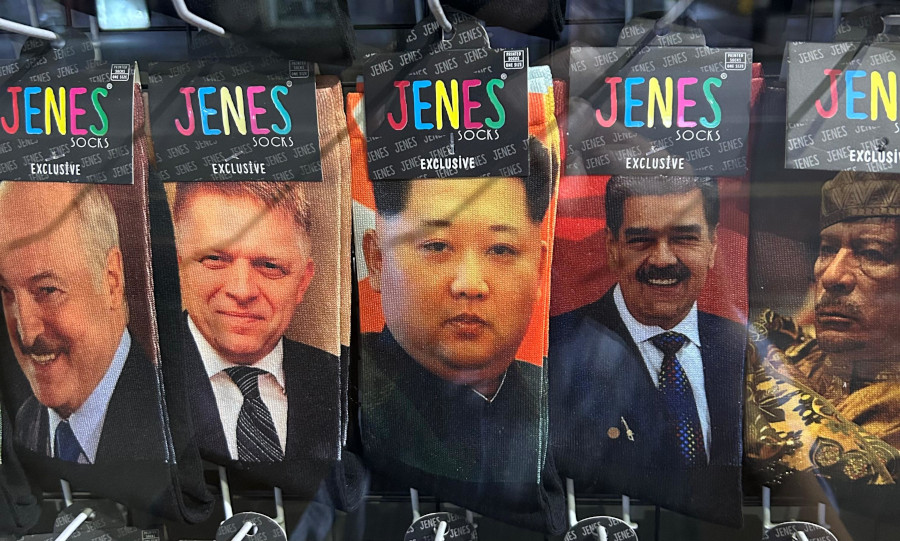
Image 3: Gift shop in Belgrade, June 2025, photo by Nikola Mijović

When I asked the souvenir vendor who buys these socks, he replied lightly: “Our people, and tourists equally.” This shared consumer interest suggests that the contradictions and political taboos these objects embody extend far beyond Serbia. The political ambivalence is global. The sense of ideological disorientation, the collapse of clear moral or geopolitical categories, is something many people feel. However, in most places, it remains unspoken, not because it does not exist, but because the vocabulary that could express it is not available. The categories invented during the Cold War, such as “East” and “West,” as well as liberal and authoritarian, good and evil, security and threat, no longer capture the complexity of the moment. The boundaries that once organized the world as Cold War binaries, moral hierarchies, and communist versus democratic geopolitical allegiances are rapidly blurring. The “West’s” presumed moral superiority is increasingly challenged, not only by the powers like China or Russia or the rise of South-Asian, African, and Latin American economies, but from within, as demands to reckon with colonial violence, historical erasures, and structural inequalities intensify. The very institutions that claim to uphold universal values, such as the UN, NATO, ICJ, ICC, and the EU, are viewed in many places as partial, self-interested, or inconsistent.

After Hamas’s attack on October 7, 2023, Israel launched a large-scale military attack on Gaza. As the death toll among Palestinian civilians rose and humanitarian organizations raised alarm over war crimes and genocide, many “Western” governments remained silent or offered unwavering support to Israel. Many observers noted the double standards of “Western” powers. The double standard casts doubt not only on the “West’s” credibility but on the very idea of universal human rights, suggesting that some lives are more grievable than others, and some civilian casualties more politically useful. The vocabulary of international law, human rights, and humanitarian intervention, once mobilized to justify the post-1989 liberal order, now seemed hollow, selectively applied, or brutally ignored. The invasion of Ukraine and then the attack on Gaza reactivated language, fears, and geopolitical imaginaries of the Cold War. Still, this time, the clarity of the ideological divide had eroded. In 2025, the global stage appears more complex than ever, caught between nostalgia for a past structure and the inability to define or navigate the present one. Liberalism no longer feels like a neutral, impassive pillar, but like one political option among many, often failing to account for people’s lived experiences of inequality, disillusionment, or humiliation.

Image 4: Gift shop in Belgrade, June 2025, photo by Nikola Mijović

Serbia, however, and Belgrade in particular, offers a space where that confusion is not only visible, but lived and openly consumed. The state itself occupies an in-between position, not fully aligned with any of the powers, and this liminal stance seems to enable a kind of open market for ambiguity. In Belgrade, the things that cannot be articulated elsewhere, such as the political contradictions, the uncomfortable affinities, and the guilty fascinations, are not silenced and repressed, but sold at eye level for a few euros on socks. To wear Victor Orban, Saddam Hussein, or Kim Jong-un on one’s feet is not necessarily to endorse them. It is to participate in a new kind of meaning-making, one that is bodily, ironic, and resistant to simple interpretation. These objects blur the line between joke and statement, between mockery and nostalgia. They reflect a world where people no longer trust the categories handed down from above, where “East” and “West,” “good” and “bad,” “rational” and “irrational,” no longer hold explanatory power.

And for that that cannot be named, the socks speak instead.They articulate confusion not through clear-cut discourse, but through juxtaposition. On one stall, Trump, Orban, Kim Jong-un, and Messi coexist without hierarchy, commentary, or context. The socks do not explain; they stage. They do not tell people what to think, but rather reflect what people already feel, joke about, or cannot yet fully articulate. Not sure how to feel about the 2025 Nobel Peace Prize? Have a pair of Maduro socks!

By placing dictators and pop icons side by side, by turning power into fashion, and by refusing to explain themselves, these socks expose the very contradictions that liberal democracies try to hide: that moral clarity is unstable, that ideology is marketable, and that political feeling is messy, unresolved, and often absurd. They testify to the change in the rules of the game once invented and refereed by the winners of World War II. They, however, do not proclaim new political loyalties, but instead give form to a spectacularized disorientation in which current politics is driven less by ideology than by affect, aesthetics, and irony. Like memes or graffiti, they operate through juxtaposition and absurdity, recalling the logic of what Laclau (1996) named the empty signifier, a symbol whose power lies in its ambiguity, able to unify diverse and even contradictory demands by standing in for a broader sense of discontent, without anchoring itself to a single fixed meaning.

A version of this text was originally published on the MEMPOP project blog.


Astrea Nikolovska is an associated researcher on the ERC project “Memory and Populism from Below” (MEMPOP), hosted by the Institute of Ethnology at the Czech Academy of Sciences. Her research interests are devoted to the visible and invisible legacies of the Cold War, questions of sovereignty, counter-liberalism, the aesthetics of commemoration, and popular forms of politics. She holds a PhD from the Department of Sociology and Social Anthropology at the Central European University, and has an interdisciplinary background in theatre and cultural studies.


References

Bennett, Michael Y. 2015. The Cambridge Introduction to Theatre and Literature of the Absurd. Cambridge Introductions to Literature. Cambridge: Cambridge University Press.

Bieber, Florian, and Nikolaos Tzifakis. 2019. The Western Balkans as a Geopolitical Chessboard? Myths, Realities and Policy Options. Policy Brief. Graz: The Balkans in Europe Policy Advisory Group (BiEPAG). https://www.biepag.eu/wp-content/uploads/2021/07/The_Western_Balkans_as_a_Geopolitical_Chessboard.pdf.

Byford, Jovan, and Michael Billig. 2001. “The Emergence of Antisemitic Conspiracy Theories in Yugoslavia during the War with NATO.” Patterns of Prejudice 35(4):50–63.

Davis, Fred. 1992. Fashion, Culture, and Identity. Chicago, IL: Chicago University Press.

Đorđević, Vladimir, Mikhail Suslov, Marek Čejka, Ondřej Mocek, and Martin Hrabálek. 2023. “Revisiting Pan-Slavism in the Contemporary Perspective.” Nationalities Papers 51(1):3–13.

Dufalla, Jacqueline, and Asya Metodieva. 2024. “From Affect to Strategy: Serbia’s Diplomatic Balance during the Russia-Ukraine War.” Southeast European and Black Sea Studies 0(0):1–20.

Hall, Stuart. 2018. “The West and the Rest: Discourse and Power (1992).” Pp. 141–84 in Essential Essays, Volume 2: Identity and Diaspora, edited by D. Morley. Durham, NC: Duke University Press.

Hebdige, Dick. 1979. Subculture: The Meaning of Style. London and New York: Routledge.

Krastev, Ivan, and Stephen Holmes. 2019. The Light That Failed: A Reckoning. London: Penguin Randomhouse.

Laclau, Ernesto. 1996. Emancipation(s). London: Verso.

Mazzarella, William. 2019. “The Anthropology of Populism: Beyond the Liberal Settlement.” Annual Review of Anthropology 48(Volume 48, 2019):45–60.

Moffitt, Benjamin. 2016. The Global Rise of Populism: Performance, Political Style, and Representation. 1st ed. Redwood City, CA: Stanford University Press.

Mouffe, Chantal. 2014. “By Way of a Postscript.” Parallax 20(2):149–57.

Stubbs, Paul, ed. 2023. Socialist Yugoslavia and the Non-Aligned Movement: Social, Cultural, Political, and Economic Imaginaries. Montreal, Quebec: McGill-Queen’s University Press.


Cite as: Nikolovska, Astrea 2025. “Geopolitics Socks” Focaalblog November 17. https://www.focaalblog.com/2025/11/17/astrea-nikolovska-geopolitics-socks/
David Harvey: Remarks on Recent Events in the Ukraine: An Interim Statement

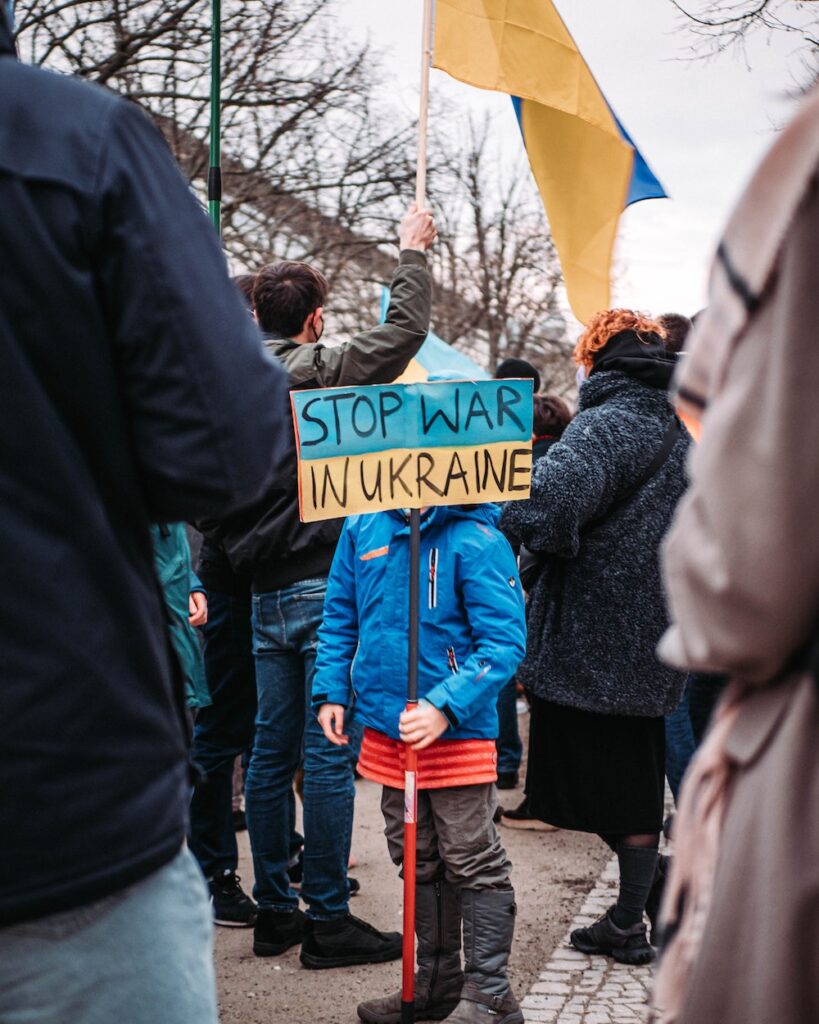
Image 1: Young girl protesting the war in Ukraine, photo by Matti.

This is a provisional text David Harvey prepared for the 2022 American Association of Geographers Annual Meeting. He allowed us, nevertheless, to publish it here because of the escalating Russia-Ukraine crisis.

Continue reading

Samuel W. Rose: Disconnected Development Studies: Indigenous North America and the Anthropology of Development

The purpose of this work is to examine and elaborate on the relationship between the people of Native North America and the material and ideological content of developmentalism as examined within the fields of anthropology and Native American or Indigenous studies. I observe that Indigenous North American peoples are frequently excluded from discussions of economic development within anthropology. I try to reconcile this situation and reinsert native peoples into the anthropology of development by demonstrating the historical and political continuities between United States Indian Policy with the exported ‘development apparatus’. In doing so, I follow Neveling (2017) and others in pushing back against postdevelopment’s dematerialization of development and its emphasis on development as discourse. Instead, I argue that a historical materialist or political economic approach (Rose 2015, 2017, 2018) that conceptualizes development in the terms of Neveling’s (2017) “political economy machinery” better explains the situation of Indigenous North American peoples and the processes that make and unmake their lives.

The overall point here is that in order to properly understand the political economic basis and ideological dimensions to the Post-War developmentalism project it is necessary to understand and examine the history of those political economic models and the history of those ideological dimensions. While there likely were developmentalist antecedents in the policies of the European empires, a major distinctive feature of post-war developmentalism is that it was rooted in the political economy and hegemonic position of the United States. As such, it is crucial to understand the local antecedents for American developmentalist policies, which necessarily brings us to Indigenous peoples as they were the early laboratories of these policies and political economic models.

Contextual Disconnect

On the global level, the sub-discipline of the anthropology of development has flourished in the last half century, along with the interdisciplinary field of development studies. In that time, prominent anthropological works have been produced within the sub-discipline that have had a broad impact within anthropology and influence beyond their own regional and disciplinary scope. Some of these classics include the works of Arturo Escobar (1995), James Ferguson (1990), Akhil Gupta (1998), David Mosse (2005), and Tania Murray Li (2007). These works describe the transformative effects of ‘development’, especially on the role of state policies, on the regions formerly grouped together as the “Third World” (i.e. Africa, South and Southeast Asia, Latin America), which are now more conventionally referred to as the global South. The field of the anthropology of development, along with the interdisciplinary field of development studies, has remained almost exclusively “Third World” focused. Chibber (2013) observes that this isolation in the form of the lack of thorough comparative engagement between capitalist development in Western Europe and capitalist development in the Third World has led to an inaccurate and romanticized portrayal of each in postcolonial studies of Third World development. While I generally agree with Chibber’s critique, I wish to move into a different context. The anthropological literature on development in the global South is also disconnected from the anthropological literature on what would otherwise be called ‘development’ in what was at one time called the “Fourth World” (i.e. stateless nations), especially in regard to Indigenous peoples in North America. This disconnect actually goes both ways. Jessica Cattelino’s (2008) book is likely the most popular anthropological work on Indigenous economic development in Native North America in the last several decades. Even though her ethnography on (capitalist) economic development within the Seminole Nation of Florida was published after the texts of those aforementioned prominent anthropology of development authors, and deals with many similar issues around development such as the intricacies and problematics of sovereignty, governmentality, and possible alternative modernities, she does not utilize them or the other work from this subfield. Furthermore, Tania Murray Li’s (2010) comparative discussion of the relationship between capitalism and dispossession in different regions does not include Native North America despite the lengthy and ongoing history of dispossession of Indigenous peoples in North America in relation to both colonial policies of the past as well as contemporary processes of neoliberal capitalism and state (re)formation in the United States and Canada. Instead of including Native North America as another case study alongside Africa, India, and Southeast Asia, she mentions Indigenous people in the Anglo settler states (i.e. Canada, Australia, New Zealand, United States) or CANZUS countries (Cornell 2015) only once and in passing, and does so with the effect of driving a further wedge between them by saying that the processes of class differentiation were different among Indigenous peoples in those locations. Similarly, David Mosse’s (2013) summary article on the state of the subfield is telling of its geographic orientation as there is no mention of Indigenous North America at all and only a passing mention of development in Europe. The point is that these works are not drawing from and are not in dialogue with each other. There is a disconnect between anthropological studies of development in the global South with those on the economics and development of Indigenous people in the Anglo settler states even though (as I will argue) they share certain commonalities and histories.

Developmentalism and Native North America

The general scholarly consensus is that the modern ‘development apparatus’ and the pseudo-utopian vision that is the modernist-developmentalist paradigm began with the Truman administration after the Second World War, the emergence of the United States as a superpower, and actions taken within the context of the Cold War in needing to make capitalism more appealing for the (newly) former colonies in comparison to the political economic model of the Soviet Union and then later China (Ferguson 1990; Escobar 1995; Cowen and Shenton 1996; Rist 2008; Kiely 2007). As Escobar (1995: 3-4) states:

The Truman doctrine initiated a new era in the understanding and management of world affairs, particularly those concerning the less economically accomplished countries of the world. The intent was quite ambitious: to bring about the conditions necessary to replicating the world over the features that characterized the “advanced” societies of the time—high levels of industrialization and urbanization, technicalization of agriculture, rapid growth of material production and living standards, and the widespread adoption of modern education and cultural values.

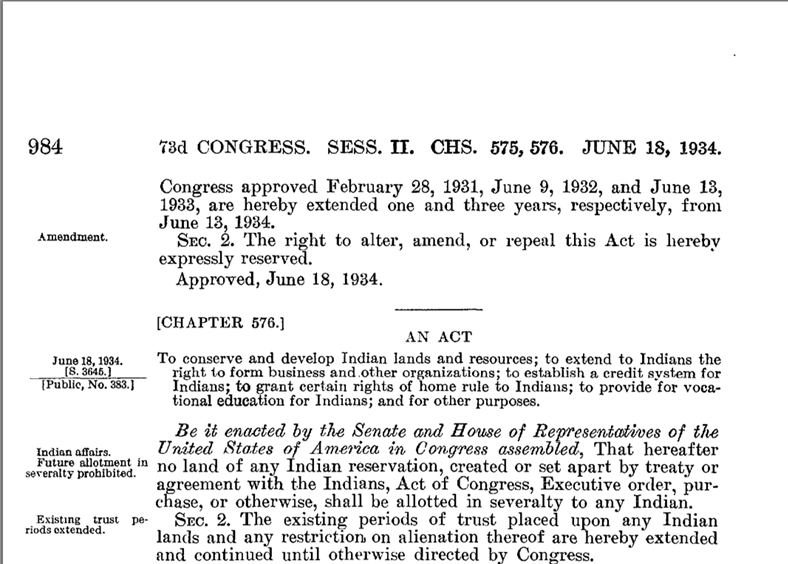
The disconnect between the subfields is especially problematic here because while the Truman administration does mark a shift in global development policy, scholars of Native North America would observe that the Truman administration also constituted a dramatic (and infamous) shift in United States Indian Policy. These two phenomena are not disconnected. When the Truman administration began exporting this pseudo-utopian vision of the glories of capitalism, technology, and Western modernity to the world, United States Indian Policy shifted away from similar policies of bureaucratization, technicalization, and industrialization for tribal governments. These policies were based around the creation and support of local/Indigenous bureaucratic institutions that would in essence aid internally in the development of Native American societies toward a form of collectively managed capitalism, which was intended to bring them as societies into the modern world. Although it had antecedents in United States Indian Policy in the nineteenth century (Miner 1989) stretching back even to the Jefferson administration’s ‘civilization’ program, this type of internal developmentalism began in a comprehensive manner with the administration of Franklin Roosevelt in the early 1930s and crystallized around the Indian Reorganization Act of 1934 (Jorgensen 1978). The Act, as the product of the political economy of the United States of the period, was therefore in accordance with the interests of the American bourgeoisie (Littlefield 1991), and brought about the transformation of Native American societies by formally institutionalizing capitalism within bureaucratic tribal governments. In many locations, it had the effect of solidifying political power over Indigenous communities by the emergent Indigenous bourgeoisie (Schröder 2003; Nagata 1987; Ruffing 1979; Rose 2014).

The Truman administration marked the shift in Indian Policy away from Reorganization and towards Termination (Duthu 2008; Fixico 1986). The Termination period involved a series of policies that sought to formally complete the integration or incorporation of Indigenous peoples into the American mainstream political economy by means of subjecting them to the authority of the States, physically relocating them off reservations and to urban areas, and ending—or terminating—the political and legal standing of Indigenous governments in the eyes of the United States (Duthu 2008). In short, the Termination era represents a shift in the orientation of developmentalism for native peoples: from one where their own local bureaucratic institutions were fostered as the means to bring native people into capitalist modernity, to one where these same institutions were viewed as the impediments to their achievement of modernity. It represents a shift from the policies of internal developmentalism to an external developmentalism.


Image 1: Screenshot of 48 Stat. 984 (Pub. Law 73-383), part of the Indian Reorganisation Act of 1934 (https://govtrackus.s3.amazonaws.com/legislink/pdf/stat/48/STATUTE-48-Pg984.pdf, taken 10 Nov 2020)

The internal developmentalist policies of Indian Reorganization bear a resemblance to the modernist-developmentalism that the United States exported to the world during the Truman administration. It is my contention that the development apparatus and the modernist-developmentalist paradigm are direct successors to the long history of United States Indian Policy and these efforts. The Truman administration’s shift to a policy of global scope meant that they were to export what is in essence the same civilizing project except they did so in the language of development and modernity. However, by the 1970s, Indian Policy would shift back toward internal developmentalism in the periphery except this time under the label of self-determination (Duthu 2008). This represents an oscillation of developmentalism in the center and in the periphery corresponding to periods of expansion and contraction of American political economy (Friedman 1994). For native peoples, internal developmentalism marks a period of peripheralization as the center contracts, while termination and assimilation mark a period of external developmentalism and reincorporation into the center as it expands.

Similarly, the geographic contexts must be comparatively examined to draw out these historical parallels to better understand the historical and contemporary dimensions of capitalist development. For example, at around the same time that James Ferguson (1990) was famously discussing the “anti-politics machine” and how development (even ‘failed’ development) is linked not simply to an expansion of capitalism but to the expansion of state power, Marxist anthropologist Alice Littlefield (1991: 219) was writing that

Studies and critiques of these major policy shifts [in US Indian Policy] have frequently noted that the assimilation policies often failed to assimilate, and that self-determination policies often failed to provide for meaningful self-determination. Looking beyond the discourse of the reformers who claimed credit for these policy shifts, it can be observed that material interests of various sectors of American capital were often well-served by the workings of particular policies.

While I recognize and agree with Neveling’s (2017) critiques of the theoretical and empirical dimensions of Ferguson’s work in his overemphasis on discourse to the exclusion of political economic context, the crucial point here for me is to understand that the underlying processes being described are not dissimilar. These two works are describing a singular process or a singular political economic machinery, except that it is occurring at different times and in different places. Ferguson is describing “development” in Lesotho in the middle to late twentieth century, while Littlefield is describing “civilization”, “assimilation”, and “self-determination” in the United States as applied to Native Americans in the nineteenth and twentieth centuries.

Further Research

We do not have the space here to delve into a detailed examination of each of the finer points. Rather, my purpose with this piece was to try to begin to connect these disparate areas and fields of study and put them into dialogue with each other. Further comparative study would better elucidate the parallels and lines of divergence in the operation of capitalist development and the experiences of peoples within this machinery. This would lead to a greater understanding and greater insights into the history and operation of capitalist development as a global project and singular machinery.


Samuel W. Rose is an independent scholar based in Schenectady, NY. He received his PhD in Cultural Anthropology from the State University of New York at Buffalo in 2017. His dissertation was entitled Mohawk Histories and Futures: Traditionalism, Community Development, and Heritage in the Mohawk Valley. His research has focused on the indigenous populations of eastern North America, community and economic development, political economy, and issues of race, identity, and the politics of history. His work has appeared in journals such as Anthropological Theory, Dialectical Anthropology, Critique of Anthropology, and the Journal of Historical Sociology.


References

Cattelino, Jessica. (2008). High Stakes: Florida Seminole Gaming and Sovereignty. Durham, NC: Duke University Press.

Chibber, Vivek. (2013). Postcolonial Theory and the Specter of Capital. New York: Verso.

Cornell, Stephen. (2015). Processes of Native Nationhood: The Indigenous Politics of Self-Government. The International Indigenous Policy Journal 6(4), Article 4.

Cowen, M.P. and R.W. Shenton. (1996). Doctrines of Development. New York: Routledge.

Duthu, N. Bruce. (2008). American Indians and the Law. New York: Penguin.

Escobar, Arturo. (1995). Encountering Development: The Making and Unmaking of the Third World. Princeton, NJ: Princeton University Press.

Ferguson, James. (1990). The Anti-Politics Machine: “Development”, Depoliticization, and Bureaucratic Power in Lesotho. New York: Cambridge University Press.

Fixico, Donald. (1986). Termination and Relocation: Federal Indian Policy, 1945-1960. Albuquerque: University of New Mexico Press.

Friedman, Jonathan. (1994). Cultural Identity and Global Process. Thousand Oaks, CA: SAGE Publications.

Gupta, Akhil. (1998). Postcolonial Developments: Agriculture in the Making of Modern India. Durham, NC: Duke University Press.

Jorgensen, Joseph G. (1978). A Century of Political Economic Effects on American Indian Society, 1880-1980. Journal of Ethnic Studies 6(3): 1-82.

Kiely, Ray. (2007). The New Political Economy of Development: Globalization, Imperialism, Hegemony. New York: Palgrave MacMillan.

Li, Tania Murray. (2007). The Will to Improve: Governmentality, Development, and the Practice of Politics. Durham, NC: Duke University Press.

Li, Tania Murray. (2010). Indigeneity, Capitalism, and the Management of Dispossession. Current Anthropology 51(3): 385-414.

Littlefield, Alice. (1991). Native American Labor and Public Policy in the United States. In Alice Littlefield and Hill Gates (eds.), Marxist Approaches in Economic Anthropology (p. 219-232).  Lanham, MD: University Press of America.

Miner, H. Craig. (1989). The Corporation and the Indian: Tribal Sovereignty in Indian Territory, 1865-1907. Norman: University of Oklahoma Press.

Mosse, David. (2005). Cultivating Development: An Ethnography of Aid Policy and Practice. New York: Pluto Press.

Mosse, David. (2013). The Anthropology of International Development. Annual Review of Anthropology 42: 227-246.

Nagata, Shuichi. (1987). From Ethnic Bourgeoisie to Organic Intellectuals: Speculations on North American Native Leadership. Anthropologica 29(1): 61-75.

Neveling, Patrick. (2017). The Political Economy Machinery: Toward a Critical Anthropology of Development as a Contested Capitalist Practice. Dialectical Anthropology 41(2): 163:183.

Rist, Gilbert. (2008). The History of Development: From Western Origins to Global Faith, 3rd Edition. New York: Zed Books.

Rose, Samuel W. (2014). Comparative Models of American Indian Economic Development: Capitalist versus Cooperative in the United States and Canada. Critique of Anthropology 34(4): 377-396.

Rose, Samuel W. (2015). Two Thematic Manifestations of Neotribal Capitalism in the United States. Anthropological Theory 15(2): 218-238.

Rose, Samuel W. (2017). Marxism, Indigenism, and the Anthropology of Native North America: Divergence and a Possible Future. Dialectical Anthropology 41(1): 13-31.

Rose, Samuel W. (2018). The Historical Political Ecological and Political Economic Context of Mohawk Efforts at Land Reclamation in the Mohawk Valley. Journal of Historical Sociology 31(3): 253-264.

Ruffing, Lorraine Turner. (1979). The Navajo Nation: A History of Dependence and Underdevelopment. Review of Radical Political Economics 11(2): 25-43.

Schröder, Ingo W. (2003). The Political Economy of Tribalism in North America: Neotribal Capitalism?. Anthropological Theory 3(4): 435-456.


Cite as: Rose, Samuel W. 2020. “Disconnected Development Studies: Indigenous North America and the Anthropology of Development.” FocaalBlog, 17 November. http://www.focaalblog.com/2020/11/17/samuel-w-rose-disconnected-development-studies-indigenous-north-america-and-the-anthropology-of-development/

Ling-I Chu and Jinn-Yuh Hsu: Cold War islands and the rebordering of the nation/state: Kinma in the Taiwan Strait

Across the globe, the Cold War abruptly delineated new borders and defined friends and enemies. Yet, there are few regions in which this was as pronounced as in the Taiwan Strait, where several groups of islands, commonly called Kinmen and Matsu (or Kinma, as abbreviated here), are located in close proximity to the southeastern coast of mainland China yet have been controlled by Taiwan since the final days of the Chinese civil war (see Figure 1). From then onward, the lives and times of the inhabitants of Kinma were destined to be forever different. This post explores through the lens of bordering how the changing strategic role of Kinma throughout the Cold War and since has defined not only the lives of islanders but also the performance of Taiwan’s state sovereignty and national identities. This brings to light that Kinma was central to the nation/state’s self-representation in “border-ordering” and to the configuration of citizen-subjects in “border-othering” and that both processes have been catalysts for a reconfiguration of the Taiwanese nation/state from the 1980s onward.

Continue reading

Leo Grob: Ruptures, Consolidations, Continuities: Reconsidering Global Economic Processes since 1945

This conference report was first published in H-Soz-Kult; the full conference program can be found here.

The 1970s increasingly move into the spotlight of contemporary history research. The decade is often portrayed as one of profound change, a radical rupture driven by watershed moments such as the oil crisis or the end of the Bretton Woods system of fixed currency exchange rates. This is not only the major take on the decade in recent publications by historians such as “Nach dem Boom” (Doering-Manteuffel and Raphael 2010) or “Age of Fraction” (Rodgers 2011), but also a well-established analytical approach across the social sciences and humanities (some of the most widely cited works in this regard are Harvey 1990, 2005). The international conference “Ruptures, Consolidations, Continuities: Reconsidering Global Economic Processes since 1945,” held at the Centre of Global Studies at the University of Bern, thus was a timely project to engage this paradigm. Over two-and-a-half days, researchers from the social sciences and the humanities came together to question the big “-isms” of 20th century-periodizations, such as Fordism, Post-Fordism, Keynesianism, and Neoliberalism.
Continue reading