What do transitional justice aspirations look like a year after the downfall of the Assad regime for Syrians in the country? What can transitional justice mean for a people who have lived through several decades of an extremely brutal dictatorship? If the violence of the Assad regime culminated after the start of the 2011 revolution, the methods used by the son, Bashar, had already been tried by his father, Hafez. It was under the latter that the security apparatus, the infamous mukkhabarat services and Syria’s prison archipelago were established (Seurat, 1989; Munif, 2020). Methods of mass repressions against civilians and any kind of political opposition had already been trialled in the 1980s, leading to the siege of the city of Hama that resulted in the killing of over 20,000 civilians and its widespread destruction. The prison of Tadmor (Palmyra) was already infamous for its large-scale torture and killings of political opponents and the massacre of hundreds of them orchestrated by Hafez al Assad’s brother in 1980 (e.g., Khalifa, 2007; Al-Sarraj 2011).
In the fourteen years that spanned from the beginning of the Syrian revolution until the downfall of the regime on December 8, 2024, over 600,000 Syrians were killed, more than 140,000 were jailed, disappeared and tortured in the regime’s prisons. While only 1,300 detainees were freed from the regime’s jails in December 2024, mass graves have been found in different locations, rendering the hope that some of the remaining disappeared might still be alive rather elusive. Many towns and cities were heavily destroyed through the use of heavy weaponry by the regime and its Russian and Iranian allies, leading to widespread “urbicide” (Munif, 2020).
In this context of extreme political violence and mass atrocities, where should a process of transitional justice start? And how can it operate in a country that still has to rebuild itself, with a population in dire need as the vast majority lives below the poverty line; and as violence has not stopped in all parts of the country? Moreover, how does this violent past appear in the present transitional phase in Syria?
A year after the downfall of the Assad regime, my interlocutors – the majority of whom live in the Southern city of Daraa, which has long been considered a revolutionary stronghold, as the revolution started there on 18th of March 2011 – are questioning the slowness of the transitional justice process. In most of the discussions I have had on this topic since my first field-trip in the country on January 2025, it is the question of the detainees and the missing that is central.
These discussions have led me to look at aspirations and claims for justice in post-Assad Syria. In a research project recently started in the country’s south, I ask: What ideas and practices of justice emerge during and after mass atrocities? How can we think of justice in contexts of mass political violence beyond the global frame of “transitional justice” and beyond a universal-secular idea of international law? The project explores local ideas and practices of justice focusing on different temporalities, spaces and modalities of justice.
What I present in this blog is work-in-progress based on fieldwork that I have started inside Syria in the spring of 2025. It presents questions and hypotheses that have emerged from conversations in the city of Daraa, but also from discussions that happened with long-term Syrian interlocutors and friends I met during fieldwork in Gaziantep and Beirut and who were still displaced at the time (see Al-Khalili 2023).
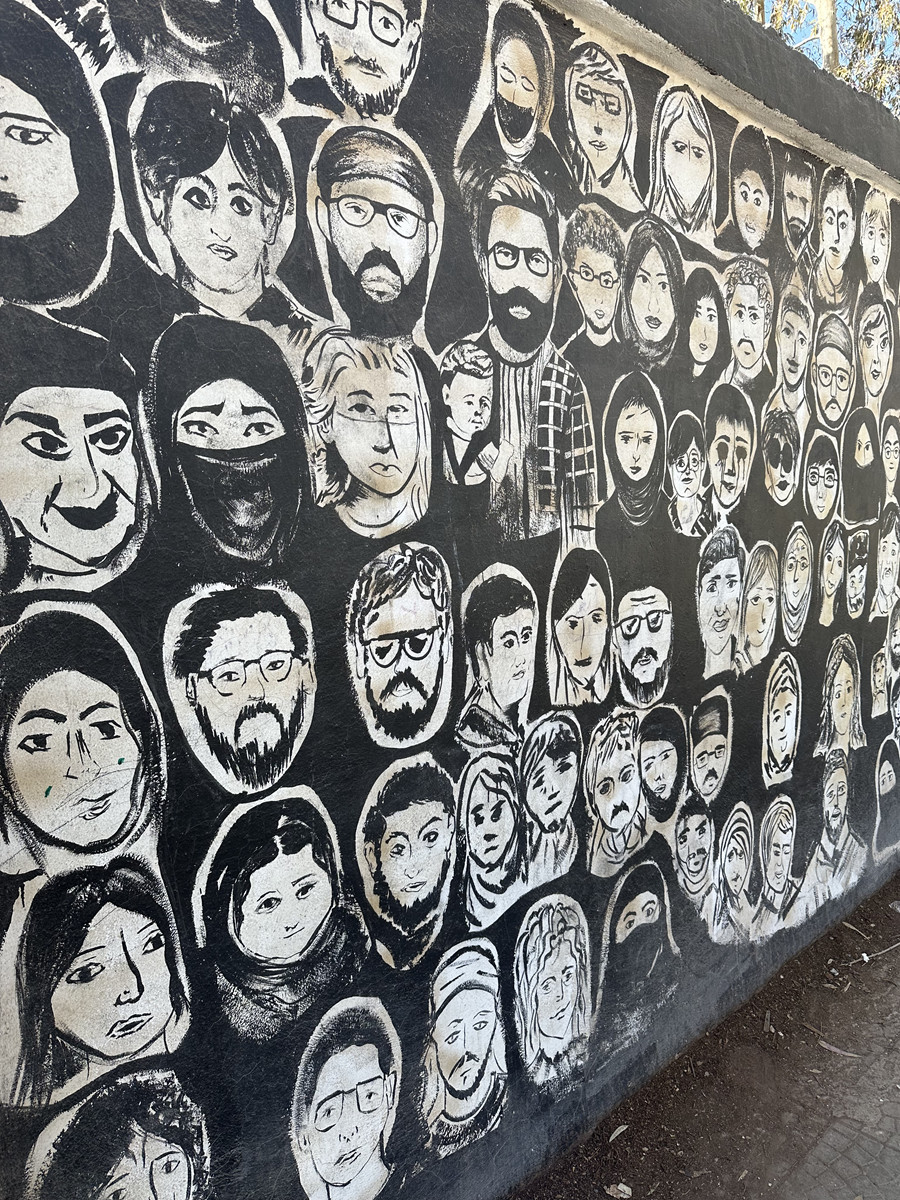
With the overthrow of the Assad regime, the families of those detained and/or disappeared and their advocates have started to occupy the streets of Syria’s towns and cities, protesting, holding meetings and circulating pictures of the missing. Relatives of detainees and disappeared persons have formed committees and organisations in exile and former victims of torture have sought justice in foreign courts. Some of these claims have been successful, with condemnations of those responsible for the torture of prisoners in Assad’s jails heard in landmark cases in French and German courts. With the downfall of the regime, the hope to put these perpetrators on trial in Syrian courts has become more present, but has not become a reality yet, despite the new government and the UN launching specialist commissions to look into the disappeared files, following classic transitional justice paths and top-down approaches (e.g., Kent 2016).
Working in areas that have been marked by the arrest and enforced disappearance of many, I had expected to hear much more about acts of revenge, demands of accountability and legal prosecutions. In the country’s north where I visited friends and interlocutors, daily killings of shabbiha (pro-regime thugs) took place in the city of Aleppo, and demands of accountability and actions against the return of shabbiha in the city of Idleb (Al-Khalili 2025). But in Daraa, where such extra-judiciary killings have happened in 2018, and where most people claim “we don’t have shabbiha here”, considering them either gone after the Liberation or dead before, my interlocutors seemed primarily concerned with uncovering truth and demanded concrete acts that would impact the regime-supporters’ everyday lives and their livelihood. In their claims, they place justice on a collective rather than individual scale and in the social rather than the legal domain.
These scales and domains are, however, not fixed and unique but rather dynamic. Social justice can be seen as both claims for truth and demands of reconstruction. The truth that interlocutors demand often appears as an individual claim when expressed by relatives of missing while reconstruction seems to operate on a collective scale. But these two scales are permeable and become interchangeable and juxtaposing. Such fluidity and multiplicity are also linked to the very nature and intensity of the violence that has unfolded on the Syrian people over the last decades.
Exploring the justice claims of my interlocutors and the situation inside Syria, transitional justice appears first of all to be a social matter: it is about reconstructing social trust and the social fabric, as well as social reparations. Justice thus means to open the archives and learn about the fate of the disappeared and to support those who have lost everything supporting the revolution and fleeing their homes. Those who have fled because of their involvement in the revolution and have then lived in precarious conditions as a result of the destruction of their neighbourhoods, in the rebuilding of a home, of their city and to help them start a new life.
The disappeared: archives, truth-seeking and reparations
Back in December 2024, with news of the opposition forces’ advance through Syria, many of my interlocutors displaced outside the country were particularly impatient to hear of the fates of the country’s many detainees, as they feared they might have been killed before they could be liberated. The opening of the regime’s prisons and security branches reignited hope, as relatives of detained and disappeared people dared to believe they might reunite with their loved ones, or at least learn about their fate (see Al-Khalili & Al-Khalili 2025).
Despite doubts and fear, many hoped to reunite with their detained relatives, leading many detainees’ families to rush to the newly opened prisons. This search for answers and the immense hope of locating detained relatives or discovering the truth about their fate for their relatives.Yet, these early hopes quickly faded away; indeed, if demands for truth, justice and accountability multiply as Syrians can finally speak out, they do not have a legal framework for their claims to be examined yet. Moreover, these don’t seem to be among the government’s immediate priorities.
Over a year after the downfall of the Assad regime, time has now come for many of my interlocutors to question the new government’s actions. Sentiments that I keep hearing– especially among my interlocutors who have missing relatives, but also from lawyers and civil society organisations – conclude “there is no law”, “we don’t have a constitution” and “how can we seek justice?”
Frustration over the new government’s dealing with these issues, and with the withholding of information, is something that I also heard among mothers of the disappeared. One of them, Umm Ayman, a teacher in her sixties whose son has been missing since 2012, told me:
“The state (al dawleh) is now saying that the transitional justice process is over and that we just need to turn the page. But what page? We haven’t even learned about our sons’ fate! … Where is the information (al malumat)? The state has all the information; why is the new government not telling us anything about the detainees’ fates?” She then spoke about her disappeared son: “Imagine that I have been searching for my son for 12 years! I haven’t stopped searching! My son was arrested on December 29, 2012 … We don’t even know what happened to him – I just want to know so my heart eases a little. I want to know where he was for the last 12 years. I want to have answers. I want to know if he is alive or dead, and if he died when and how he died. I want his body! Where are the bodies?”
Such demands for truth were echoed by many. As I waited at the local court to meet a friend of mine who is a lawyer there, a family entered the lawyer’s office and to discuss the possibility to issue a death certificate for their missing son. But the lawyer said there was no way to do that: “the detainees (al-mawtaqalyin) and the missing (al-mafqudyin) are not [officially] dead (maytyin) ” he told them. Yet, in the absence of details about the missing’s whereabouts nothing can be done.
As a forty-year-old man, who presented himself as a “revolutionary at heart” and as a former detainee, said in a collective discussion on transitional justice in Daraa :
There is no transitional justice happening in the country at the moment; ten months after the liberation, nothing has happened yet! Now the shabbiha are walking free, they are not being held accountable … Where is the transparency (shahafiyeh)? There have been no changes in law and no accountability (muhassabeh), so where is the justice? Where are the people who arrested me? It is human nature, especially for those who were detained, to want justice!
Hence, while the possibility of legal justice and accountability in the hands of the current government was met with circumspection, for some of my interlocutors, the claims rather became formulated in collective and social terms: it meant rebuilding the country and insuring a brighter future for Syrians.
In a conversation with Yara, a young second-generation displaced woman from the Golan Heights now living in Daraa’s Palestinian camp, she told me how her father and one of her brothers had been arrested by the regime and detained in Sednaya prison. When I asked her if she or any family member had joined families going from Daraa to Sednaya as the prison was liberated, she said that they had not. They were sure her father and brother would not be there. As they reasoned, they were from Daraa, they had been imprisoned since 2012, and there were strong and believable indications that they had died in the prison several years ago. Discussing Yara’s dreams and aspirations for the future, we touched on the question of legal justice and accountability for those responsible for detainees’ torture and death, and for her dad and brother in particular. It seemed to her reframing justice in individual terms was not the priority. She told me, “Justice is the downfall of the regime and a brighter future for Syria”. To her, justice appeared as a collective end. She envisioned it as a better future that entailed the possibility of resuming school and later accessing higher education, and better job prospects for herself as well as for those who lost their main breadwinners, and help to rebuild their destroyed homes.
As another interlocutor tellingly said: “There is no transitional justice if there is no trust in the government … The issue at the moment is that we can’t trust a government that cannot provide its people with the essentials to live. Did you see how the price of bread went up since liberation?” Here again, transitional justice appeared as tightly related to social justice.
This question of justice’s scale (individual and collective) as well as domain (legal and social) also arose in a conversation I had with Yassin, a long-term interlocutor from Daraa now in his fifties, had been detained in Sednaya prison for eight years before the revolution for his political activism. When we met in Damascus in April 2025, the former detainee had returned to Syria after 14 years of exile and needed a lift to Daraa, where I was also going with a friend. We picked him up at Damascus airport and started discussing his feelings and impressions.
During our two-hour drive, we discussed the recent changes in the country, and it was then that questions of justice and accountability came up. Yassar, his younger cousin who was arrested for his participation in the revolution in 2012, asked Yassin if he planned to visit Sednaya to achieve closure. Yassin raised his eyebrows and clicked his tongue, meaning “no”. Yassar then recounted his own experience of returning to the military branch where he had been arrested and detained, and the intense feelings of peace and justice it induced. Yassar asked Yassin, “You don’t want to find peace going back there? You don’t want to see it all over again now that we got some justice back?” Yassin immediately replied, “What justice? Justice is not the liberation of detainees, justice is the reconstruction of the country, and that will take time!” To Yassin, justice could only be served at the collective, not the personal scale. Justice was not achieved when the regime fell, nor when the detainees were liberated, but would only be realized in the (probably distant) future.
As we entered his city and drove through some almost totally destroyed neighbourhoods, as he saw his family home razed to the ground, Yassin seemed reinforced in his position of justice: What could justice be if not the rebuilding of the country for future generations? What did his personal story have to do with it?
Ruins as evidence? Ethnographic and legal traces
To conclude, looking at ruins – some now used as homes, others as mass graves – brings questions of justice into focus; questions about rebuilding, reconstruction and the disposal of large amounts of rubble as much as questions about body identification, about the souls of the deceased, about truth and transitional justice. The ruins point to the violent past and the immense destruction that occurred, to an unstable and precarious present, and to the shape of the future, stimulating questions about what will be rebuilt, for whom it will be rebuilt and who will carry out the work. The Syrian ruins are not only the marks of past political violence, they also induce political and legal questions about transitional justice. They are, indeed, ruins-as-legal-evidence, and invoke the highly vexed question of what kind of future can possibly be available to those who have lost everything. But they are also what seems to call for social reparations. As Daraa became a stronghold and a symbol of the revolution its city was systematically destroyed. The destruction of Daraa and other towns and neighbourhoods, and the displacement of its inhabitants and disappearance of many, bring to mind the question of truth and social reparation: those people and cities who have given everything to the fight against the Assad regime, and who have lost so much in this struggle, how can they be supported to rebuild their lives, their livelihood, their present and future?
Charlotte Al-Khalili is a Leverhulme early career fellow in anthropology at the University of Sussex. Her work focuses on revolutionary politics and subjectivities, religious temporalities and practices and forced displacement in Syria, Lebanon and Turkey. Her research explores the effects of mass political violence and its aftermaths on displaced communities’ lifeworlds. She is the author of Waiting for the Revolution to End and the co-editor of Revolution Beyond the Event. She is currently working on a new project looking at conceptions and practices of justice in Syria titled “Traces and Archives of Mass Political Violence: Justice and Return in post-Assad Syria”
References cited
Al-Khalili, C. 2023. Waiting for the Revolution to End: Syrian displacement, time and subjectivity, London: UCL Press.
Al-Khalili, C. & Al-Khalili, M. 2025. “Recalibrating hope and revolutionary temporality in tbe wake of al-Assad’s downfall”, allegralab https://allegralaboratory.net/recalibrating-hope-and-revolutionary-temporality-in-the-wake-of-al-assads-downfall/
Al-Sarraj, M. 2011. ‘Aṣī al-dam. Beirut: Dār al-Adāb.
Evans, 2019
Khalifa, M. 2007. Al-qawq‘a: yawmiyyāt mutalaṣiṣ. Beirut: Dār al-Adāb.
Kent, L. 2016. “Transitional justice in law, history and anthropology”, Australian Feminist Journal, vol 42, N1, pp.1-11
Munif, Y. 2020. The Syrian Revolution: Between the politics of life and the geopolitics of death. London: Pluto Press.
Seurat, M. 1989. L’Etat de Barbarie. Paris: le Seuil.
Cite as: Al-Khalili, C. 2025 “Transitional Justice from Below: Demands for Truth and Social Reparations” Focaalblog March 25. https://www.focaalblog.com/2026/03/25/charlotte-al-khalili-transitional-justice-from-below-demands-for-truth-and-social-reparations/
Discover more from FocaalBlog
Subscribe to get the latest posts sent to your email.