Tag Archives: inequality

Jason Hickel, Don Kalb, Maria Dyveke Styve, and Federico Tomasone: Reorganize Production to Serve Life, Not Profit

Image 1: Jason Hickel’s research focuses on political economy, inequality, and ecological economics

On 15 May 2025, Jason Hickel – economic anthropologist, leading degrowth theorist and author of popular works such as The Divide: A Brief Guide to Global Inequality and its Solutions and Less is More: How Degrowth Will Save the World – delivered a provocative lectio magistralis as the Third Annual Global Research Programme on Inequality (GRIP) Lecture at the University of Bergen, sponsored by the Rosa Luxemburg Foundation’s Brussels Office (RFL). In his lecture, “The Struggle for Development in the Twenty-First Century”, Hickel rejected the idea that the development of the Global South can take place within the logic of extractive capitalism and economic imperialism. Only through movements for economic sovereignty and eco-socialist transition will it be possible to escape the traps of neo-colonial exploitation.

After the conference, he spoke with Don Kalb, GRIP director, Maria Dyveke Styve, GRIP affiliate, and Federico Tomasone of the RLF about the struggle for climate and redistributive justice, reflecting on the contradictions of liberalism, the ecological and social crises of global capitalism, and the possibilities for a democratic socialist future. In the discussion, Hickel shared his evolving perspective on Marxist theory, critiqued the limits of horizontalist politics, and underscored the urgency of building new political vehicles capable of responding to the planetary emergency.

DK: Yesterday, you argued that it’s essential to rethink the Russian Revolution and China’s history – not only for international politics, but also for working-class politics and global freedom. It struck me that your narrative has evolved into a more explicit anti-liberal reading of recent history. That wasn’t so clear in The Divide, but it was evident in your lecture. Have you shifted toward a more Marxist interpretation?

Yes, I think that’s fair. Two things are happening. First, my analysis has sharpened over time. Second, when I wrote The Divide, I was addressing an audience largely unfamiliar – and often uncomfortable – with Marxist or socialist language. I wanted to communicate effectively with people working in international development, many of whom are wary of what they think are ideological labels.

That strategic decision had a cost: The Divide largely bypasses the question of socialism, even though many of the countries I discuss were socialist or engaged in Communist revolutions. That absence weakens the analysis. You can’t fully understand the history of global inequality without addressing the attempts of socialist revolutions and the Non-Aligned Movement to break from capitalist imperialism and implement alternative development models, followed by the violent Western backlash that took the form of the Cold War.

Since then, I’ve increasingly used concepts like the capitalist law of value, which I now see as central to explaining our ecological and social crises. We live in a world of immense productive potential, and yet we face deprivation and ecological breakdown. Why? Because under capitalism, production only happens when and where it’s profitable. Social and ecological needs are secondary to the returns to capital.

DK: That’s precisely what struck me. I compared your work with that of David Graeber. You both start from anthropology and expand into politics, but the crucial difference, I think, is that you grasp the law of value – whereas Graeber, as an anarchist, tends to evade it. Would you agree that contemporary conditions compel us to reclaim key Marxist concepts and communicate them to a younger public?

Absolutely. As scholars, we should use the best tools available to explain material reality – and Marxist concepts remain analytically powerful. We’re in a moment where those tools can be reintroduced and popularized in new ways.

David Graeber was a brilliant and wildly creative thinker, and I learned a lot from him – both as a friend and a scholar. But you’re right, he approached political economy differently. In his later work, especially The Dawn of Everything, he began to acknowledge the limitations of anarchist organizing models like horizontalism. He saw the need for functional hierarchies – structures that can actually get things done without betraying egalitarian principles.

DK: That connects to another question. In 2011, the populist left failed to anticipate what I would call a global counter-revolution. What we’re seeing today isn’t just a resurgence of fascism – it’s a broader anti-liberal and anti-neoliberal insurgency. Some forces are anti-woke, others anti-globalist, and they don’t always share a coherent ideology, but some of the undertow is anti-liberal and potentially anti-capitalist, too. How does your work engage with this complex reaction?

It’s paradoxical. In one sense, this seems like the worst moment to talk about socialism. But in another, it’s precisely the right moment – because liberalism is visibly collapsing, and the rise of far-right populism is a symptom of that failure.

Liberalism claims to champion universal rights, equality, and environmentalism, but it also clings to a model of production dominated by capital and profit maximization. Every time those two commitments clash, liberal leaders choose capital – and everyone sees the hypocrisy. That’s why liberalism is losing legitimacy. The danger is that, in the absence of a compelling left alternative, disaffected workers gravitate toward right-wing narratives – xenophobic conspiracy theories, scapegoating immigrants, and so on. Fascists don’t offer real solutions, but they’re filling a void left by liberal and even social democratic parties, which have abandoned any structural critique of capitalism.

We need a democratic socialist alternative that addresses the root contradictions of capitalism, including its ecological irrationality. But building that alternative will require real political vehicles – not just protest movements, but mass-based parties with deep roots in the working class.

DK: Let’s return to the idea of the law of value. You touched on it earlier, but can you explain why it’s so essential to understanding the crises we face today?

The law of value explains why we experience shortages of socially and ecologically essential goods, even in an age of unprecedented productive capacity. Under capitalism, production is guided not by human or ecological needs, but by profitability. If something isn’t profitable, it doesn’t get made – no matter how necessary it is.

Take the green transition. We have the knowledge, the labour, and the resources to rapidly build renewable energy infrastructure, retrofit buildings, and expand public transit. But these aren’t profitable investments, so capital doesn’t fund them. Meanwhile, we continue producing luxury goods, fossil fuels, and weapons – things that actively harm people and the planet – because they are profitable. This contradiction is at the core of our ecological breakdown.

It’s funny, when people talk about shortages, they often refer to the socialist world, ignoring the sanctions and blockades those economies faced, even while their social outcomes were better than capitalist ones. Today, capitalism itself produces chronic shortages – of affordable housing, healthcare, education, and green technologies. This is a direct result of the law of value. We must overcome it if we are to survive.

FT: That brings me to Europe. The European Union tried to push a green capitalist agenda in recent years, but now we’re seeing a major shift towards militarization. What’s striking is that this agenda is being led by self-described liberals. Starmer in the UK, for instance, is at the forefront. The same is true in the European Parliament. How do you interpret this development?

It’s deeply disturbing. For years, European leaders told us there was no money to invest in decarbonization, public services, or social protections – because we had to uphold deficit and debt-to-GDP ratios to ensure price stability. But suddenly, when it comes to militarization, those rules are tossed aside. They’re ready to spend trillions on weapons and defence.

This reveals something critical: the deficit rules were never about economics. They were political tools used to block investment in social and ecological goals while maintaining an artificial scarcity of public goods. Now that military spending is politically expedient and profitable, the limits disappear. It’s a betrayal of the working class and future generations.

Moreover, their analysis is flawed. They seem to think that militarization will bring sovereignty and security to Europe, but true sovereignty would require a complete rethink of Europe’s geopolitical role. It would mean distancing from the United States and pursuing integration and peaceful cooperation with the rest of the Eurasian continent – including China – and the Global South. Instead, European elites remain trapped in the logic of US hegemony. Western Europe has been treated as a forward base for US military strategy for decades. Germany, for example, is filled with American bases. The US wants Europe to antagonize the East – but this is in the US interest, not in Europe’s. We must reject this. Europe’s true interests lie in peace and cooperation with its neighbours.

FT: That’s a perfect segue to my second question: the historical burden of European imperialism. Europe’s ruling classes have inflicted enormous harm over the past few centuries. How do we move beyond that legacy? Is there a real contradiction between the interests of the European working class and those of capital when it comes to foreign policy?

It’s an important question. First of all, yes – policies like the current wave of militarization are clearly aligned with the interests of European capital. That’s why they’re happening. But they run directly counter to the needs of ordinary people and to the stability of the planet. This reveals a deeper truth: there is a fundamental conflict between the interests of working people and those of capital. It forces us to confront the myth of European democracy. We are told that Europe is a beacon of democratic values, but in reality, the interests of capital dominate our institutions.

Democracy was never a gift from the ruling class – it was fought for by working people. Even then, we only got a shallow version of it. The original democratic demands – decommodification of essential goods, workplace democracy, control over finance – were abandoned. Instead, we get elections every few years between parties that all serve capital, in a media environment dominated by billionaires. If we want real democracy, we need to extend it to the economy. That means overcoming the capitalist law of value and redirecting production toward social and ecological needs. That means democratizing the creation of money.

DK: Let’s pick up that thread – money. One of the more original aspects of your work is the focus on the production of money itself. Could you explain how monetary sovereignty fits into your broader critique of capitalism?

Under capitalism, the state holds the legal monopoly over currency issuance, but in practice, it franchises that power out to commercial banks. Banks create the big majority of money in the economy through the process of issuing loans. But they only issue loans when they expect them to be redeemable and therefore profitable – when they serve the accumulation of capital. This means that the power to create money, and thereby mobilize labour and resources, is subordinated to capitalist profitability. It’s a direct expression of the capitalist law of value. Productive capacities are only activated if they yield returns to capital. That’s how banks steer the economy: not toward what we need, but toward what is profitable.

To change that, we need two things. First, a credit guidance framework – a set of rules that direct bank lending away from destructive sectors like fossil fuels and luxury emissions, and toward socially necessary investments. Second, we need to expand the role of public finance. The state must directly create money to fund essential goods and services – renewable energy, housing, public transit – even if these aren’t directly profitable to private capital.

There’s a myth that we can only produce what is profitable. But in reality, as long as we have the labour and resources, we can produce anything we collectively decide to. The only barrier is political. Once we democratize money creation, we can liberate production from the profit imperative and organize it according to human and ecological needs.

DK: That’s compelling. Many of my left-wing friends in Europe argue that the euro is the main obstacle. They advocate for returning to national currencies to regain sovereignty. I take a different position: we should democratize the euro itself. These are small, interdependent states. Returning to national currencies risks division and renewed dependence on external powers like the US, who will play us off against each other. What do you think?

I’m very sympathetic to that argument. I understand the appeal of monetary sovereignty through national currencies – it offers more direct control over production and spending. But it also fragments the struggle. If every Eurozone country must independently wage its own class battle for economic transformation, progress will be at best uneven and vulnerable. A more strategic route is to reform the rules of the European Central Bank. That could be done quickly, at the institutional level. We could enable member states to expand public investment immediately by suspending austerity constraints.

Critics will say this risks inflation, and yes, if you simply inject public finance without adjusting the rest of the economy, you may drive up demand for limited labour and resources. But eco-socialist degrowth offers a solution: scale down harmful and unnecessary production – SUVs, cruise ships, private jets – and reallocate labour and resources toward socially beneficial activities. This stabilizes prices while transforming the structure of the economy.

Inflation isn’t a technical obstacle – it’s a political one. The real reason austerity rules exist is to preserve space for capital to accumulate unchallenged. If we shift productive resources toward public goods, we threaten the dominance of capital in the system. That’s what elites are trying to prevent when they invoke debt ratios and deficit limits.

DK: There was a strange moment recently. Trump said, in reference to inflation, something like: “Instead of 18 Barbie dolls, your kids will have two.” His argument was that economic sovereignty is more important than material abundance. I found it thrilling – in a way, he’s articulating a kind of anti-consumerist message. Isn’t that part of the danger of fascism today? It sounds anti-neoliberal, but it’s not anti-capitalist.

That’s exactly right, and I found that moment interesting, too. Some people even claimed Trump was embracing degrowth, which is completely false. Degrowth is a fundamentally anti-capitalist idea. It means scaling down ecologically destructive and unnecessary production while scaling up public goods, ecological regeneration, and social equity. Trump is doing none of that.

But there’s something we can learn from this moment. He managed to sell the idea of material sacrifice – “fewer Barbie dolls” – in the name of sovereignty and national pride. That tells us something important: people are willing to accept limits to consumption if they’re framed within a broader, meaningful vision. Too often, we on the Left assume that people won’t accept any kind of material constraint. But that’s not true. What matters is the narrative. If we offer people a coherent vision of freedom, dignity, economic democracy, and a habitable planet, we can make the case for transformation. The challenge is crafting that narrative in a way that’s emotionally and morally compelling.

Of course, for degrowth to be just, we must ensure that basic needs are met. That’s where a public job guarantee comes in. It would allow us to redirect labour from harmful sectors to beneficial ones, with dignified wages and workplace democracy. That’s the difference between an eco-socialist transition and authoritarian austerity.

MDS: That makes me think about how to build a truly democratic socialist alternative. Especially in the Global North, how do we convince the working class that this future – based on global solidarity, limits, and justice – is like you said, better than what they have now?

It’s a critical question. We must help people understand that consumer abundance in the North is built on unequal exchange – on exploitation of the Global South’s labour and resources. The fast fashion, the cheap electronics, the frequent product replacement – all of it depends on a global system of appropriation. But more importantly, we must show that the working class in the North doesn’t actually win under this system. What they’ve gained in cheap consumer goods, they’ve lost in political agency, autonomy, and collective freedom. Their demands for decommodification, workplace democracy, and control over production have been abandoned.

Capital has used cheap imports to pacify working-class dissent, while consolidating its own power. So, the real prize for workers isn’t another iPhone – it’s democracy, dignity, and a liveable future. We need to reignite that vision, grounded in shared interests with the Global South. The key is to frame eco-socialist transformation not as a loss, but as a liberation – from exploitation, precarity, and ecological collapse. And that’s where solidarity becomes real: not charity, not development aid, but shared struggle for a better world.

MDS: Exactly. That’s the tension I see. Western elites are clearly the main culprits of imperialism and ecological destruction. But in countries like Norway, working-class people also materially benefit from unequal exchange – our welfare state is funded by oil rents, cheap imports, and global extractivism. How do we build anti-imperialist solidarity under those conditions? How do we support revolutionary change in the South while mobilizing the North?

It’s an essential and complex challenge. First, we have to recognize that the landscape has changed since the 1960s. Back then, many leaders in the Global South came to power through mass-based anti-colonial movements. They had mandates for socialist transformation. But over time, those movements were repressed, co-opted, or overthrown – often with Western backing – and replaced by comprador elites who benefit from the current imperial arrangement. These elites are not interested in liberation. They’re aligned with global capital, even if their own populations suffer. That’s why today’s emancipatory movements in the South must confront not only Western imperialism but also their own domestic ruling classes.

This is where national liberation comes in. It’s not a matter of aid or development; it’s about political sovereignty and collective power. Western progressives must support these movements – not through charity, but through solidarity. That means breaking with the logic of the development-industrial complex and backing grassroots revolutions that seek to reclaim control over resources, production, and governance. You’re right: workers in the North do benefit in some material ways. But they are also deeplydisempowered. They’ve cheap consumer goods but not democratic control of production. Capital has used unequal exchange to buy off demands for autonomy and dignity. So, the working class doesn’t really win. They’re offered illusions of prosperity, while their fundamental rights and freedoms erode.

We need a double-front strategy. In the Global South: national liberation movements that dismantle neo-colonial dependency. In the Global North: movements that demand democratic control over production and finance. Together, that’s the path to ending capitalism. It’s not optional – it’s an existential necessity.

DK: That makes sense, but it raises a real problem of political timing. If national liberation in the South cuts off value flows to the core, that would trigger inflation, shortages, and political backlash. Will working-class movements in the North be ready to respond fast enough – with public investment, social protections, and a new vision? Or will the far right get there first?

That’s the critical danger. If we don’t prepare, we could see a very grim outcome. Imagine a scenario where the Global South begins to successfully delink – whether through China’s Belt and Road Initiative, regional trade blocs, or other means. That cuts off flows of cheap labour, resources, and profits to the imperial core. Suddenly, consumption in the North contracts. If the Left hasn’t built a coherent post-capitalist plan, capital will act to preserve its dominance. And what does that look like? Fascism. Crushing labour at home, cheapening domestic wages, repressing dissent. That’s the path I think Trump is preparing for – not because he has a clear plan, but because the logic of empire’s decline demands it.

That’s why we must present a real alternative path. The good news is, we have the data. Research shows that we can maintain or even improve living standards in the North with much lower levelsof energy and resource use. But that requires decommodifying key services – housing, transit, health, education – to shield people from inflation and secure well-being outside of market dependencies. This is the Left’s task: to make sure the collapse of imperial consumption doesn’t become a gateway to authoritarianism, but a springboard to democracy and liberation.

DK: That brings us to a key issue: political organization. I think we all agree that protest alone is no longer sufficient. We saw enormous mobilizations over the past decade – Fridays for Future, Extinction Rebellion – but they didn’t result in real change. What comes next?

Exactly. The protest culture of the past decade, while incredibly energizing, has hit a wall. Massive climate demonstrations brought millions into the streets. For a moment, it felt like the political class would have to respond. But they didn’t. Nothing substantial changed.

We’re now in a moment of reckoning. People feel disillusioned because they realize these actions weren’t enough. The energy dissipates, and the system remains intact. That’s why I believe we need to return to something that many have been reluctant to talk about: the party. Not the traditional parties that operate within the confines of liberal institutions, but mass-based, working-class parties – vehicles for building real power. These must be rooted in unions, communities, and popular organizations. They must operate with internal democracy but also with strategic coherence. That may mean a return to something like democratic centralism, which proved more effective than horizontalism in achieving structural change.

FT: That resonates deeply. Many of us from our generation saw the rise and fall of the “movement of movements.” We believed in horizontalism – in assemblies, autonomy, consensus. But over time, it became clear that these forms were not durable or effective enough to confront capital. They were easily neutralized or repressed. Now we’re facing a crisis of mass demobilization, especially among the working class. After decades of neoliberal attacks, unions and labour organizations have been hollowed out or co-opted. But at the same time, the promises of social democracy are clearly dead. Capital no longer shares anything with workers. So, the old bargain is over, and the big question is: how do we rebuild?

That’s the question of the century, and it begins with clarity about what the working-class movement should be fighting for. Right now, many unions are trapped in a defensive posture – trying to preserve jobs by aligning with capital, hoping that growth will trickle down and keep their members afloat. But this logic is a trap. It’s embarrassing, frankly, that unions in 2025 still see capitalist growth as the solution to working-class precarity.

We need to move beyond shop-floor struggles for wages and conditions and reclaim the transformative ambitions of the labour movement. That means fighting for public job guarantees, for universal public services, for democratic control over production. Unions should be at the forefront of the ecological transition, not an obstacle to it. They must break from the logic of capital and align with the broader interests of humanity and the planet. Imagine: we can bring hundreds of thousands of people into the streets for wage demands. But why not go further? Why not demand the decommodification of higher education, or worker control over industry? We have the numbers. We have the power. What we need is the political vision.

MDS: I want to build on that. If we’re serious about rebuilding mass parties, how do we ensure that they’re internationalist in outlook? The far right has no problem organizing across borders. They collaborate. They strategize globally. But the left often retreats into national frameworks — especially in places like Norway, where people tend to focus on just protecting the welfare state. How do we organize transnationally, especially across global supply chains, where most of the world’s labour exploitation actually happens?

That’s such a crucial point. The Left’s political imagination is still largely confined by the nation-state, but capital is global. Supply chains are global. Fascism is increasingly global. Our response must be, too.

We should be organizing along supply chain lines – coordinating strikes and campaigns not just within countries, but across them. Global South workers, especially women in factories and agricultural sectors, are the backbone of the world economy. If we build solidarity between them and workers in the North – based on shared struggles rather than pity or charity – we can disrupt the system at its core. Imagine the power of coordinated actions across production nodes – from Bangladesh to Germany, from Mexico to Norway. That’s the level of strategic vision we need to develop. It’s not just possible – it’s necessary, and it begins with rebuilding internationalist institutions of working-class power.

FT: Yes, and to bring this home – our movements are facing a major generational question. We’ve seen waves of mobilization crash, time and again. The old forms don’t work anymore. But how do we reconstitute organization under current conditions, when the working class seems demobilized, and the Left’s institutions are still captured by liberalism?

It’s true. We’ve been through a long process of disorientation. The neoliberal assault dismantled the organizational infrastructure of the working class – its parties, its unions, its media platforms. So, we’re not starting from zero, but we are starting from a much weaker place, and you’re right: many institutions that still exist are stuck in a defensive mind-set. They’re clinging to social-democratic promises that no longer hold. Capital no longer needs to compromise. It’s offering nothing to the working class – not even stability.

The challenge is to rebuild —-not just react. We need a new organizational paradigm. That means clarity, discipline, long-term vision. It means being unapologetically political. And yes, it probably means a return to mass-based parties – but rooted in contemporary conditions, learning from both the strengths and the mistakes of the past.

DK: That reminds me of something from an earlier generation. In the Netherlands, in the late 1970s and early 1980s, we had massive horizontalist squatter movements – tens of thousands of people willing to take the streets, occupy buildings, and physically resist police repression. It was revolutionary in energy, if not always in strategy. But we had no party structure. And eventually, the state responded with brutal repression and a cross-party political crackdown. The movement was dismantled, and within a few years, the Netherlands became one of the first “third-way” neoliberal democracies. That history is a warning.

Exactly. We’ve seen this pattern again and again. Horizontalism is great for mobilizing people quickly, for creating moments of radical imagination. But it’s not enough. When push comes to shove, it gets swept away. We need durable structures – organizations capable of holding ground, advancing demands, and taking power. We must learn from past failures, but also reclaim past strengths. Organization, discipline, clarity of vision – these aren’t authoritarian. They’re necessary. If we don’t build vehicles that can carry the struggle forward, we’re leaving the field open for authoritarian reaction.

FT: Finally, to loop back to the beginning – this really is a bifurcation moment, isn’t it? As Immanuel Wallerstein used to say, world-systems eventually reach points where their trajectories split. Either we find a way forward through transformation, or we spiral into fragmentation, repression, and ecological collapse.

Exactly. That’s what makes this moment so serious. Even if the far right isn’t fully aware of what it’s preparing for, the logic of global decline is pushing us in that direction. As the imperial core loses access to cheap labour and resources, the ruling class will respond by turning inward -crushing domestic labour and militarizing society. We’re already seeing this happen and if the left doesn’t offer an alternative – a post-capitalist vision rooted in justice, democracy, and ecological stability – then capital will manage the transition through violence and repression.

But we do have a chance. We know that human needs can be met with dramatically less energy and material throughput. We can build universal public services. We can stabilize prices without growth. We can reorganize production to serve life rather than profit. That’s the vision we must fight for. Not in the abstract, not one day, but now. Because the world we could live in is still possible, but it’s slipping away.


This interview was first published by the Rosa Luxemburg Foundation. Our gratitude for the right to republish.


Jason Hickel is a professor at the Institute for Environmental Science and Technology at the Autonomous University of Barcelona, and the author of several books including The Divide: A Brief Guide to Global Inequality and its Solutions and Less Is More: How Degrowth Will Save the World.

Don Kalb is founding editor of Focaal – Journal of Global and Historical Anthropology and FocaalBlog, a professor of social anthropology at the University of Bergen and director of GRIP.

Maria Dyveke Styve is a Max Weber Post-Doctoral Fellow at the European University Institute in Florence and GRIP affiliate. Her research interests span the political economy of development, dependency theory, economic anthropology, decolonial epistemologies, racial capitalism, critical race theory and economic history. 

Federico Tomasone is Project Manager for Social Rights and Labour Policies at Rosa Luxemburg Foundation’s Brussels Office


Cite as: Hickel, J., Kalb, D., Dyveke Styve, M., & Tomasone, F. 2025. “Reorganize Production to Serve Life, Not Profit” Focaalblog 8 July. https://www.focaalblog.com/2025/07/08/jason-hickel-don-kalb-maria-dyveke-styve-and-federico-tomasone-reorganize-production-to-serve-life-not-profit/
Rafael Wainer: COVID-19: Complicity, complacency, and connections

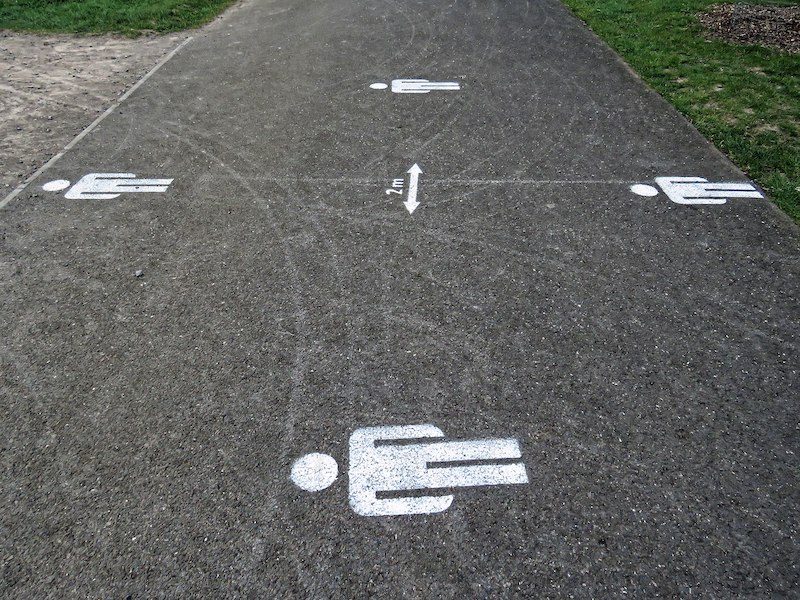
Human figures drawn on ground with an arrow indicating a distance between.
Image 1: Social distancing signs. Photo by ©Acabashi CC-BY-SA 4.0

To understand the massive world-disruption of the COVID-19 pandemic we need a sociology of complicity. Since the different waves hit the planet, we have been hearing repeatedly two crucial phrases: 1) “we are all in this together” (or the opposite: “we are not in this together”), and 2) “we are all becoming complacent to the virus.” Politicians and epidemiologists have shown us how we have “lowered down our collective guards” to community transmission of the virus. Simultaneously, the pandemic has exposed and accelerated social inequalities like never before. Complicity has led us to be complacent, and complacency has only exacerbated our complicity. Complicity with these increasingly genocidal and fascist forms of late capitalism at the macro level and its counterpart of auto-exploitative neoliberal subjectivity at the micro-level (see Chapoutot 2020) took us all to here-now.

The key question Michel Foucault and other critical thinkers (see Peters 2020) have repeatedly asked is: What causes us to love and obey forms of power/subjectivity that are strictly against our interests? I argue that as we move away from complicity/compliance, we should choose complicity/connection. That is, we should aim to create entanglements of solidarity and ethical relatedness to fight the current and future forms of oppression and inequality that will emerge during and after the COVID-19 capitalist and neoliberal world.

Beyond complicity/complacency

Two key ideas from Karl Marx and Émile Durkheim can form our compass. First, the world-remaking thesis: we need to go beyond inferring the world to radically change it. We need to seize our complacencies with an individualistic commodity-driven world shaped by extreme (auto)exploitation and (outer)profit. (2) the connection-as-sociability thesis: we need to look at how solidarity works as a form of social connective tissue, even more when considering the social disconnection and the exacerbation of prior inequities created by the current pandemic. Both Marx and Durkheim dealt with the ‘complacency’ dynamic, the former as a matter of complicity (including cross-class alliances for revolution), the latter as a matter of connection (social solidarity in an anomic world). When we look up the etymology of complicity, we are struck by the realization that it has the same root as compliance (from com– ‘together’ + the root of plicare ‘to fold’). A kind of ‘folding together,’ the latter more like folding in the sense of bending to authority or just giving up: as we have all had to adapt to wearing masks, social distancing, following changing public health orders, etc. Conversely, many have resisted this on the grounds of their freedom being violated.

The world-remaking thesis

Karl Marx was among the first to confront the fact that intellectuals are never detached observers but rather deeply connected with, and implicated in, structures of power, status, wealth, and symbolic captures. In The German Ideology, Marx (1970) goes against the Hegelian intellectuals who were “merely interpreting the world” (as if that was ever possible). For Marx, the key organizing idea has always been to “change the world.” Marx (1990) wrote Kapital while helping to organize the International Workingmen’s Association in the middle of debates with Bakunin and Proudhon on how to mobilize the working class to change the world according to their interests. He was both a public writer and public speaker fueling the masses to decode and transform this unjust (human-made, and, thus, human-changeable) world. Those two things were never a contradiction but his raison d’être. 

Today, we have naturalized and reified the capitalist world. We cannot imagine the end of it. As Frederic Jameson (2003, 76) says “[s]omeone once said that it is easier to imagine the end of the world than to imagine the end of capitalism. We can now revise that and witness the attempt to imagine capitalism by way of imagining the end of the world.” Imagining the end of the world is visualizing our complicities with this capitalist world. We can see how we (social scientists) are wired and networked in ways that both insulate us and implicate us without questioning capitalism itself. But for Marx, everything was about how intellectuals–philosophers, historians, political organizers, and workers–were complicit, compliant, and complacent with the unjust social worlds experienced by the working-classes. That was the key back then, that is the key right now.

Does a post-covid world help us imagine post-capitalism and post-neoliberal subjectivity? Or can we re-envision capitalism by way of imagining the end of the COVID-19 world? Both are intrinsically interconnected. Of course, there are “competing narratives” pushing/pulling us to/from inequality and merit, deservingness and undeservingness (Kalb 2020). The COVID-19 pandemic has both intensified and revealed myriad social, racial, gender, economic, political, migratory, and ecological crossroads that were swept under the rug or systemically denied as glitches in the default system designed for endless economic growth (and endless economic gains by a very few; see Robbins 2020). This pandemic did not begin in December 2019. The colonial violence and world imperial destruction, before even industrialization, made this world. And the West would not be the West without complicity with slavery and colonialism (Davis and Todd 2017).

Many interconnected crises and vast inequalities of late capitalism have surfaced at the forefront of the planetary consciousness because of the pandemic. In some weird way, we need to thank the tiny virus for its contribution to seeing what we cannot unsee. Remarkably, those overlapping crises of late capitalism were not hiding out of sight, quite contrary they were/are essential crises of the larger politico-economic systems of accumulation and dispossession that were forced to shift and pivot in new ways (think about Silicon Valley capital investing in telecommunication apps, refugees always on the move finding even more dangerous paths, and state agencies funnelling public money to big-pharma R&D for COVID vaccines).

The dual meaning of “complicity”

When Karl Marx and Friedrich Engels wrote the Communist Manifesto (1848, 1), their first words were these: “A spectre is haunting Europe – the spectre of communism. All the powers of old Europe have entered into a holy alliance to exorcise this spectre: Pope and Tsar, Metternich and Guizot, French Radicals and German police-spies.” As Derrida (1994) writes, the “spectre of communism” were the anti-status-quo forces; the phantasmagoric and powerful fears of imagination (and the imaginative powers of fear) that worked for social revolution. These phantom-like forces were spreading like a summer forest fire through Europe ready to purge this “holy alliance.” They were threatening to destroy everything that was prefiguring the current present (the separation of production from reproduction, human exceptionalism, the racial/imperial project of white European male supremacy). This is one meaning of complicity. COVID-19 is indeed a threat to the current status-quo because of its potential and spectral capacity to disrupt the COVID-capitalist world.

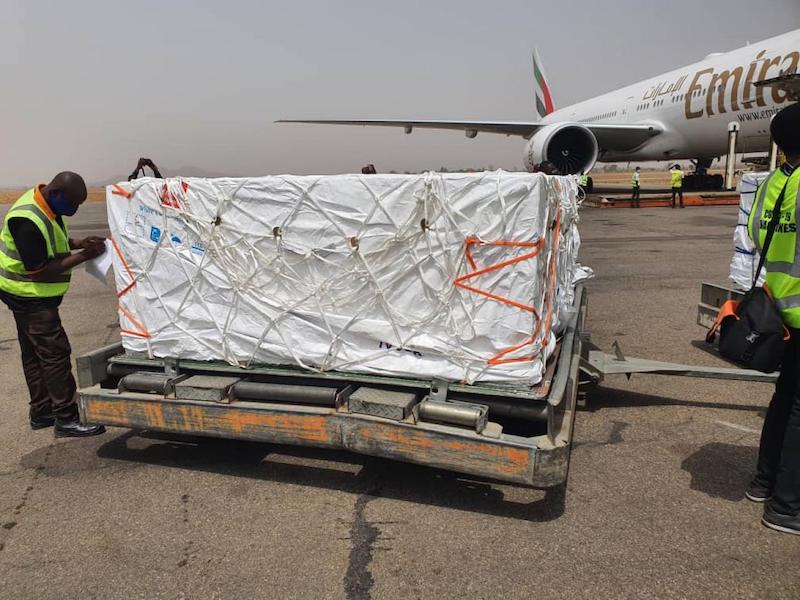
The second meaning of complicity is linked to morality, like in this definition: “the fact or condition of being involved with others in an activity that is unlawful or morally wrong” (Oxford Dictionary). We can see that in the moral justification of outrageous social inequalities (Chancel 2021). For Marx and Engels (1848, 1), “[t]he history of all hitherto existing society is the history of class struggles” and there is no other place to see this right now than in the dramatically unequal and obscene distribution of vaccines between high- and low-income countries. Of course, that is not what Marx and Engels meant about class struggles. Yet, the history of our existing COVID-capitalist society is now the history of vaccine apartheid. There is a vaccine nationalism with an outspoken political and moral agenda. Nigeria, for instance, had to ask the World Bank for a USD400M loan to purchase vaccines. The good wishes of COVAX clashed with national and big-pharma plans.

Image 2: Vaccines shipped by COVAX arrive in Nigeria, 2 March 2021. © UN Nigeria.

Madhukar Pai argued, “… the widening chasm of vaccine inequity has devastating consequences, especially with the Delta variant ripping through populations. Millions of people will die, and trillions of dollars will be lost. Addressing this inequity MUST be a top priority for everyone, regardless of where they live.” In late 2020, India and South Africa proposed to the WTO’s Trade-Related Aspects of Intellectual Property Council a patent waiver proposal that would free vaccine technology to low- and middle-low-income countries to speed up the vaccination rollouts and to contain the further development of more mutations in those countries unable to access to vaccines via market purchases. In their statement, India argues “[o]n the one hand, these [high-income] countries are buying up as much of the limited supply as they can, leaving no vaccines in the pie for developing and least-developed countries. On the other hand, and very strangely, these are the same countries who are arguing against the need for the waiver that can help increase the global manufacturing and supply to achieve not just equitable, but also timely and affordable access to such vaccines for all countries” (Usher 2021, 1791). It is morally reprehensible that high-income countries are complicit with the further expansion of Delta and potential other variants in low and middle-low-income countries (and among their own marginalized communities).

The last words of Marx and Engels’ Manifesto were the working-class mantra: “Proletarians of all lands, Unite!” In this urgent context, there is no time to waste on any form of complicit-complacency regarding collective solutions to this pandemic (vaccines being not the only one but a big one). By September of 2021, according to the WHO, “Only 20% of people in low- and lower-middle-income countries have received a first dose of vaccine compared to 80% in high- and upper-middle income countries.” Few countries are overflowing with vaccines, whereas many parts of the world have few or no vaccines at all. There is a full-fledged vaccine diplomacy war (“vaccine nationalism”) developing between China, Russia, UK, and U.S (Zhou 2021). Calls to liberate patents and transfer know-how to rapidly accelerate the vaccination campaigns throughout the whole world have been scarce or muted. How, then, did we allow big pharma to set the tone of the vaccine campaigns worldwide when we know that no one will be safe until everyone is?

The connection-as-sociability thesis

Émile Durkheim (1912) coined the concept of “collective effervescence” during the vast secularization and individualization processes of the early 20th century in metropolitan and imperial Europe. His concept refers to instances in which a community, social group, or society may come together as a sort of collective-at-sync political-emotional unfolding. We could argue that the COVID-19 pandemic is a fundamentally social phenomenon that (very unevenly) affects humanity in the same way religion was for Durkheim back then. Some events can cause collective effervescence which inspires individuals and can act as a catalytic to unite society (think, for instance, the race to create COVID-19 vaccines or the anti-mask movement). We are all going to get out of it worse or better and it entirely depends on how we manage this “collective effervescence.”

The police killing of George Floyd, Brionna Taylor, Jared Lowndes and many other Black, Indigenous, and People of Color created long-lasting effects, political organizing, communal solidarity, and forms of resistance. The live-filmed death of Joyce Echaquan, a 37-year-old Atikamekw woman who suffered from a rare heart condition and filmed her health care providers in a Quebec hospital mistreating her and letting her die shook Canada. It prompted the province coroner to ask the Quebec government to recognize the systemic racism within the health care system. These are examples of how the pandemic has both exacerbated and made visible structural violence. We could expand the argument in the direction of the fresh COP26’s massive failure and global warming apocalypse, a massive capitalist restructuring from above is very possible, one which is going to replicate the injustices and unevenness of Covid. Yet, what keeps us together despite a brutal pandemic that tends to isolate, alienate, oppress, and vaccine-apartheid us? What is the source of hope despite, and because, of this pandemic? Naomi Klein says that we are living in Coronavirus Capitalism, and “If there is one thing history teaches us is that moments of shocks are profoundly volatile. We either lose a whole lot of ground, get fleeced by elites, and pay the price for decades, or we win progressive victories that seemed impossible just a few weeks earlier. This is no time to lose our nerves. The future will be determined by whoever is willing to fight harder for the ideas they have lying around.”  If we can transition from complicity-complacency to complicity-connection, we could still change this story. We could change this world.


Rafael Wainer is a medical anthropologist and Lecturer in the Departments of Sociology and Anthropology at the University of British Columbia, Canada. His main research interests are children’s experiences of cancer treatment, palliative care, and medical assistance of dying, hope and resilience, and the socio-anthropological understanding of the COVID-19 pandemic.


References

Chancel, Lucas. 2021. Climate Change and the Global Inequality of Carbon Emissions. World Inequality Data Base. url: https://wid.world/news-article/climate-change-the-global-inequality-of-carbon-emissions/

Chapoutot, Johann. 2020. Libres d’obéir. Le management, du nazisme à aujourd’hui. Paris: Gallimard.

Davis, Heather and Todd, Zoe. 2017. On the Importance of a Date, or Decolonizing the Anthropocene. ACME: An International Journal for Critical Geographies, 16(4): 761-780.

Derrida, Jacques. 1994. Specters of Marx: The state of the debt, the work of the mourning, and the new international. New York & London: Routledge. 

Durkheim, Émile. 1912. The Elementary Forms of the religious life. London: George Allen & Unwin Ltd.

Jameson, Frederic. 2003. Future Cities. New Left Review, 21(May-June): 65-79.

Kalb, Don. 2020. COVID, Crisis, and the Coming Contestations. FocaalBlog, 1 June. http://www.focaalblog.com/2020/06/01/don-kalb-covid-crisis-and-the-coming-contestations/

Marx, Karl. 1990. Das Kapital. Vol. 1. London & New York: Penguin Books. 

Marx, Karl and Engels, Friedrich. 1970. The German Ideology. New York: International Publishers.

Peters, Michael A. 2020. ‘The fascism in our heads’: Reich, Fromm, Foucault, Deleuze and Guattari – the social pathology of fascism in the 21st century. Educational Philosophy and Theory. DOI: 10.1080/00131857.2020.1727403

Robbins, Richard. 2020. The Economy After COVID-19. FocaalBlog, 13 July. http://www.focaalblog.com/2020/07/13/richard-h-robbins-the-economy-after-covid-19/

Usher, Ann Danaiya. 2021. South Africa and India push for COVID-19 patents ban. The Lancet, 396(10265): 1790-1791.

Zhou, Yanqiu Rachel. 2021. Vaccine nationalism: contested relationships between COVID-19 and globalization. Globalizations, DOI: 10.1080/14747731.2021.1963202


Cite as: Wainer, Rafael. 2021. “COVID-19: Complicity, complacency, and connections.” FocaalBlog, 22 November. https://www.focaalblog.com/2021/11/22/rafael-wainer-covid-19-complicity-complacency-and-connections

Pauline Destrée: Solar for the Few: Stranded Renewables and Green Enclaves in Ghana

Africa’s Green Energy Revolution

This post is part of a feature on “The Political Power of Energy Futures,” moderated and edited by Katja Müller (MLU Halle-Wittenberg), Charlotte Bruckermann (University of Bergen), and Kirsten W. Endres (MPI Halle).

In the past ten years, calls for a “green revolution” on the African continent have cast optimistic and promising scenarios of “leapfrogging” to mass renewable energy generation in order to meet the continent’s targets for electrification and forecast growth for energy demand. With a population expected to increase by 800 million by 2040 with rising urbanisation, the most pressing challenge for the continent in the next 20 years will be to meet growing energy demand in a context of partially-present and unreliable infrastructure (IEA 2019). Renewables have been positioned as a technological messiah of development, enabling the continent to “leapfrog” traditional models of centralized grid-based electricity distribution and to radically green its economies (IRENA 2015). The IRENA 2030 roadmap for Africa’s renewable energy, for instance, suggests that renewables could in the next 20 years constitute half of Africa’s total energy mix (IRENA 2015) – pending an estimated USD $70 billion investment a year. Yet current solar PV installed capacity on the continent only accounts for 5GW, or one percent of the global total (around 600GW) (IEA 2019). Visions of a renewable “energy renaissance” (Olopade 2015, 15) in Africa remain blighted by the current reliance and increasing dependence of African countries on imported oil and fossil-based energy use, and of the continued (and new) opportunities for oil and gas extraction. In turn, discourses of energy transition and leapfrogging, with their unilinear trajectories and singular vision of a low-carbon future, tend to obscure the local specificities and histories of energy systems like Ghana’s, for whom renewable energy, in the form of hydropower, has long been its main source of energy generation.

Photo of a rural landscape with dam in the distance.
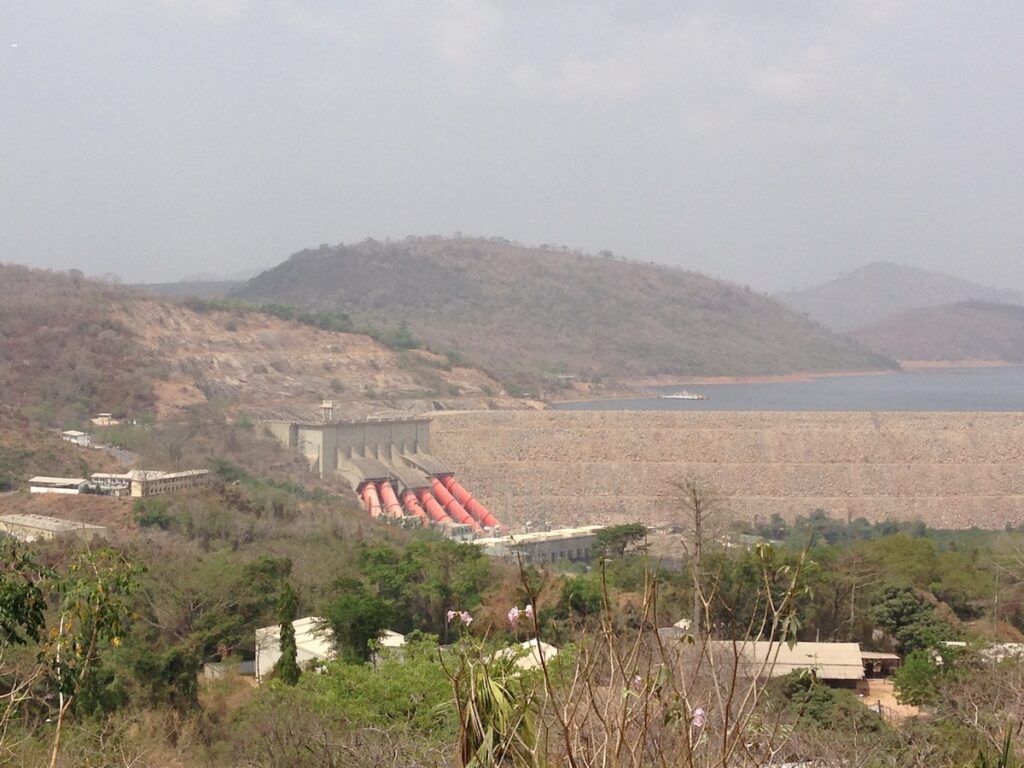
Image 1: Akosombo Dam. Akosombo, Ghana. 2016. Photo by author

In this post, I look at the contested politics of renewable energy in Ghana through a focus on the rise of “corporate solar” during an energy crisis. Ten years ago, shortly after the country discovered oil in large quantities along the coast of the Western Region, it embarked on an ambitious renewable energy path by passing the Renewable Energy Act (2011) (Act 832). The Act aimed to promote and develop the country’s renewable energy resources to ensure the country’s energy security, indigenous capacity and sustainable development. Ghana’s initial target was to increase the renewable electricity generation share, currently at less than one percent, to ten percent by 2020 (Sakah et al. 2017). Ghana thus positioned itself as West Africa’s new “energy frontier”, ushering in a resurgence of fossil extractivism paired with ambitious support for renewable energy technologies (Degani, Chalfin, and Cross 2020). In the midst of oil and gas discoveries, renewables have become a strategic, moving target conveniently reformulated to fit political agenda and rhetoric (Obeng-Darko 2019). For reasons of space, I will not elaborate on the ways in which new oil production came to stymie the growth of renewables. Instead, I provide a snapshot of solar power’s new corporate contours of energy privilege in Accra. I identify the emergence of a “renewable divide” in urban Ghana through the rise of “green enclaves” mostly enjoyed by corporate bodies and wealthy individuals. Building on the recent literature in the anthropology of energy challenging the “fantasy” of solar as a promise of democratic energy access (Szeman and Barney 2021), I consider how energy disparities endure under the transition to cleaner and renewable energy sources.

Moratorium on the Future: Renewables as Stranded Assets

In 2019, at an event on renewable energy opportunities for the private sector, a representative from the Renewable and Alternative Energy department at the Ministry of Energy made an unpopular announcement. Referring to the 2011 Renewable Energy Act, he declared that Ghana was not only on track to meet its target for 10% of total energy generated by renewables, but that it had met its target “long ago”, since the Akosombo Dam, which was built in 1966 by Kwame Nkrumah and accounts for 27% of the country’s total capacity, was technically a source of renewable energy.

Invoking the country’s proud history of electrification through the Akosombo Dam – a key project in Nkrumah’s vision for African industrialization and self-sufficiency (Miescher 2014) – and its negligible contribution to global carbon emissions, he declared the matter closed. Rather than seeking to please international conventions that did not adequately capture Ghana’s place in the global responsibility framework for climate change mitigation measures, he concluded that Ghana, like other African countries, would do well to focus instead on providing enough power for its people and industries.

Renewable energy companies’ representatives, entrepreneurs and analysts were shocked by the Minister’s backtracking commitment. That same year, as a result of overcapacity on the national grid, the government had issued a moratorium on PPAs (power purchase agreements), banning any addition to its grid until 2027. Since then, utility-scale renewable energy projects have come to a stall, leaving many with “stranded assets” and uncertainty about the future viability of large-scale solar PV and wind farms in the country. Of course, the Minister wasn’t technically wrong to claim the Akosombo Dam as a source of substantial renewable energy in the country’s electricity generation mix. To the renewable energy industry, however, it was perceived as a betrayal of the prevailing understanding that the target referred to additional capacity-building, mostly in the form of solar PVs and wind turbines.

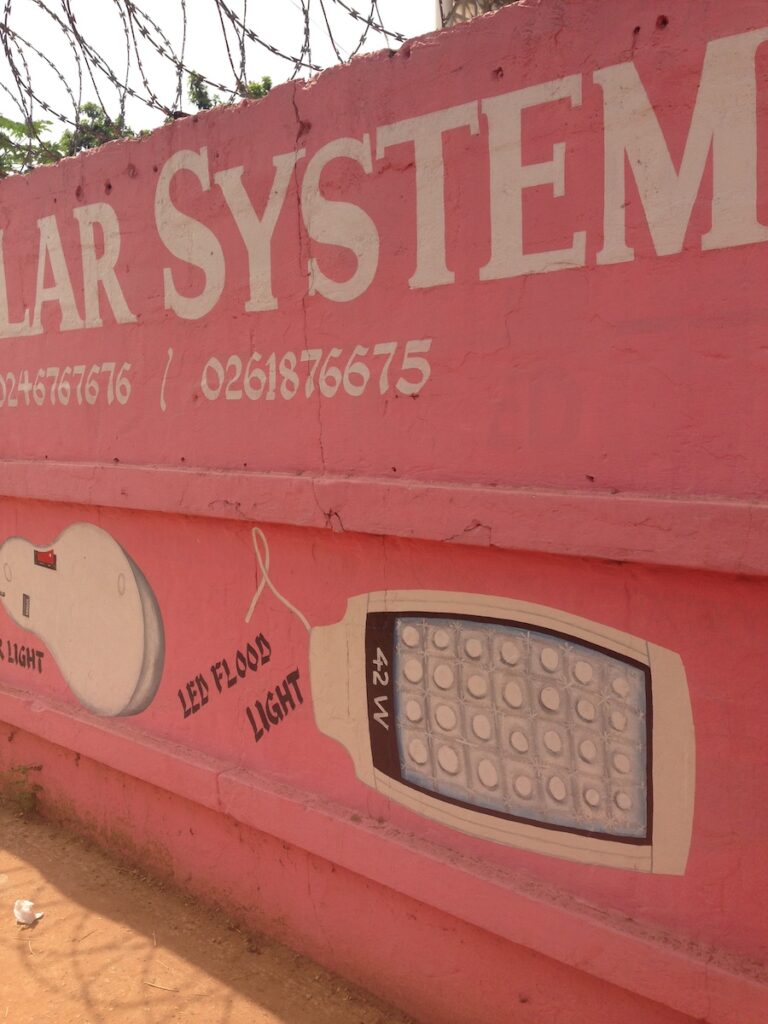
Image 2: Painted advertisement for solar equipment. 2016. Accra, Ghana. Photo by author
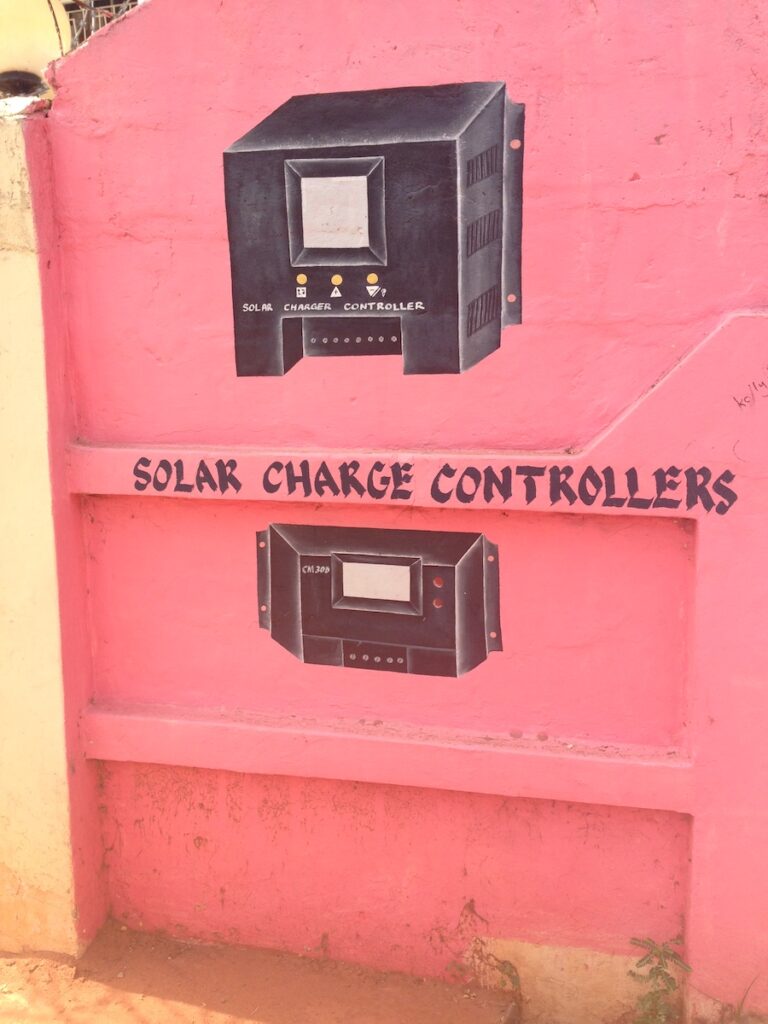
Image 3: Painted advertisement for solar equipment. 2016. Accra, Ghana. Photo by author

Corporate Solar & The Renewable Divide

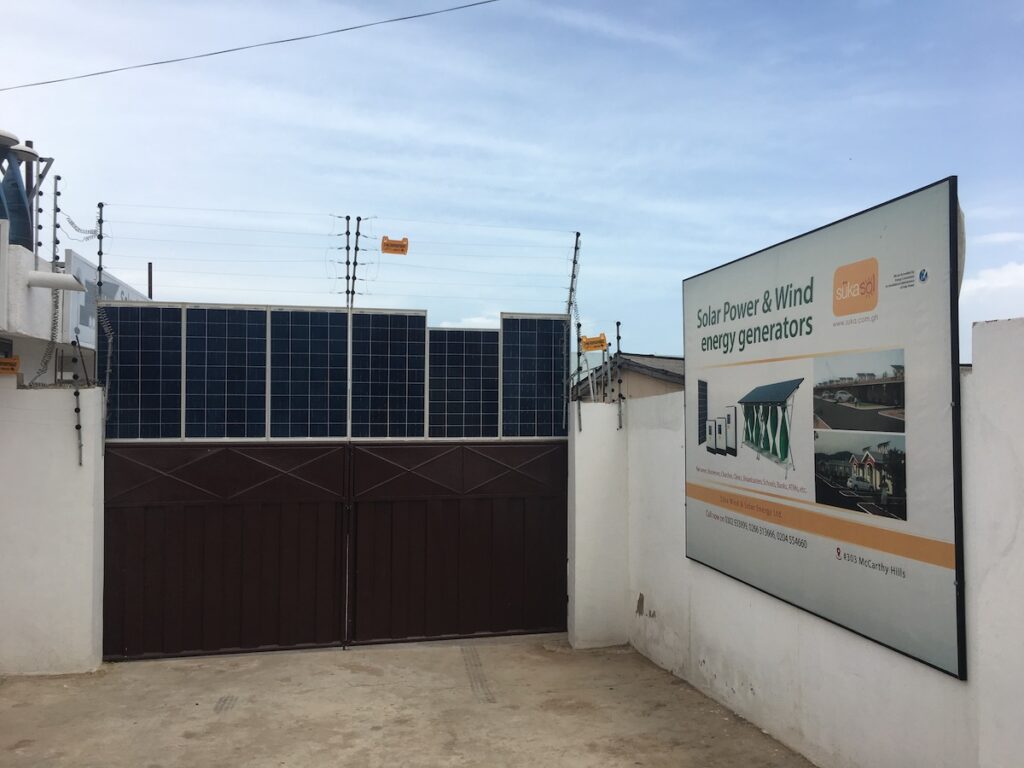
The moratorium on renewable energy PPAs exacerbated the inequalities that solar power has created in Ghana’s energyscape. Today, the largest clients for solar companies in Ghana are banks, hotels and factories – corporate bodies that have the capital for upfront costs. Following the frequent blackouts during the energy crisis that best the country in 2014-2016 (locally known as “Dumsor”), and the steep increase in electricity tariffs, many businesses, particularly factories in the industrial zones, switched to distributed generation, adopting solar as a “commercial strategy” to reduce their costs of manufacturing. “Dumsor” is Twi for “off-on”, a shorthand for the power outages that have become increasingly common in the country; today, the word has come to index a more general situation of disenchantment with infrastructure delivery and political expediency. Solar energy companies were quick to capitalise on the crisis as a business opportunity. In 2016, when I was researching Dumsor for my PhD thesis, I spoke to the representative of an Indian solar company with a large global presence who told me that initial investments in solar energy in Ghana prior to the crisis had been minimal because the power sector was “too good” and “too stable” for profit, compared to countries like Nigeria or Egypt that had more frequent power cuts and thus a bigger potential market.

In the turn to solar as a panacea for crisis, large corporate bodies removed their operations from the national grid, alternating between distributed solar and diesel-powered generator sets. This commercialization of distributed solar has further strained the financial situation of the national utilities, heavily dependent on industrial consumers’ revenues to subsidize residential low consumers. This has resulted in higher electricity tariffs for urban residential consumers, making electricity increasingly unaffordable to many. The capacity to switch to solar during a moment of crisis revealed new forms of energy privilege that take place outside the grid. In turn, the adoption of solar by a select elite (cf. Günel 2021) has further exacerbated the conditions of energy inequalities and precarity that many Accra residents live under. In the low-income neighbourhood of Western Accra where I have been doing fieldwork since 2014, this “renewable divide”, as we may call it, crossed two types of association. My neighbours and interlocutors perceived rooftop solar as a luxury item unaffordable to most, or as a humanitarian good reinforcing unequal trajectories of transition between the global North and the global South.

Here, “corporate solar” coexists with the “developmental” deployment of small-scale solar (in the form of solar lanterns and mini-grids) introduced by NGOs and small social enterprises in rural areas. The parallel trajectories of corporate and non-profit interests may appear surprising, operating as they do in divergent moral economies. Both types of solar projects, however, are driven by the same material, political and economic advantages of solar, as a form of cheap, reliable and distributed generation that offers autonomy from the inefficiencies of state infrastructure (Cross 2019, 54).

In effect, both “developmental” and “corporate” solar contribute to what may be called the creation of “green enclaves” in the energy landscape of Ghana, pockets of autonomous, renewable energy that serve both corporate and humanitarian rationales. I borrow the term “green enclave” from an engineer of the Volta River Authority (VRA) responsible for the hydropower generation plant at the Akosombo Dam that provides a large part of Ghana’s generation capacity. At a convention for renewable energy in Accra in 2019, he described to me plans to install solar panels on the roofs of Parliament, ministries, and the residential facilities at the Akosombo dam as “the greening of our enclaves”, a term that fittingly describes the infrastructural model of renewable energy at large in the country. It is not surprising that the Minister who had conveniently re-adjusted Ghana’s renewable energy target himself had solar panels installed on his house.

In a context of widespread energy precarity, solar in urban Ghana has exacerbated inequalities of access to reliable and affordable electricity, creating “green” geographies of inequality, energy security, and privilege.

Image 4: Solar panel business. 2019. Accra, Ghana. Photo by author

Conclusion: Energy Transitions in perspective

Ghana’s case-study has important implications for understanding energy transitions around the world. In popular discourses of energy transitions, the replacement of fossil fuel dependencies by renewable energy sources seems both inevitable and imperative. Calls for a renewable energy revolution in Africa are appealing, but they too often assume that renewables come to fill a gap, a lack, or an evidential need – in other words, that their benefits are too self-evident to forgo. Renewables, in this case, belong to the future – and fossil fuels to the past. In many ways, Ghana presents an inverse scenario of this dominant model of transition. Having powered most of its electricity needs with hydropower, it is now switching to increased reliance on thermal power plants and an oil economy. Further, this past of renewable energy through hydropower is today invoked to encourage a rush for oil and gas exploitation. In discussions with energy officials, policymakers, and the general public, I am repeatedly reminded that “Ghana is a low emitter”, bearing no responsibility to global greenhouse gas emissions. For a country that relied until recently entirely on hydropower for electricity, yet currently faces issues of reliability and affordability (Eshun and Amoako-Tuffour 2016), “sustainability” appears as a secondary concern to more pressing issues of overcapacity and improving access to reliable and affordable power. In turn, the adoption of renewables may not primarily be motivated by questions of environmental ideology, but also as a convenient (if privileged) solution to crisis. Accounting for the political potential of renewable energy futures around the world will demand that we grapple with the contradictory, divergent and conflicted visions and temporalities of energy transitions, and the relations between crisis and capital, privilege and poverty through which they come into being. 


Pauline Destrée is a Research Fellow in the Department of Anthropology at the University of St Andrews. She is a member of the ERC-funded research project Energy Ethics. Her research explores energy, extraction, climate change, gender and race in Ghana.

Twitter: @PaulineDestree https://twitter.com/PaulineDestree


Bibliography

Cross, Jamie. 2019. “The Solar Good: Energy Ethics in Poor Markets.” Journal of the Royal Anthropological Institute 25 (S1): 47–66.

Degani, Michael, Brenda Chalfin, and Jamie Cross. 2020. “Introduction: Fuelling Capture: Africa’s Energy Frontiers.” The Cambridge Journal of Anthropology 38 (2): 1–18.

Eshun, Maame Esi, and Joe Amoako-Tuffour. 2016. “A Review of the Trends in Ghana’s Power Sector.” Energy, Sustainability and Society 6 (1): 9.

Günel, Gökçe. 2021. “Leapfrogging to Solar.” South Atlantic Quarterly 120 (1): 163–75.

IEA. 2019. “Africa Energy Outlook 2019.” Paris: IEA.

IRENA. 2015. “Africa 2030: Roadmap for a Renewable Energy Future.” Abu Dhabi: IRENA.

Miescher, Stephan. 2014. “‘Nkrumah’s Baby’: The Akosombo Dam and the Dream of Development in Ghana, 1952–1966.” Water History 6 (4): 341–66.

Obeng-Darko, Nana Asare. 2019. “Why Ghana Will Not Achieve Its Renewable Energy Target for Electricity. Policy, Legal and Regulatory Implications.” Energy Policy 128 (May): 75–83.

Olopade, Dayo. 2015. The Bright Continent: Breaking Rules and Making Change in Modern Africa. Reprint edition. Boston: Houghton Mifflin Harcourt USA.

Sakah, Marriette, Felix Amankwah Diawuo, Rolf Katzenbach, and Samuel Gyamfi. 2017. “Towards a Sustainable Electrification in Ghana: A Review of Renewable Energy Deployment Policies.” Renewable and Sustainable Energy Reviews 79 (November): 544–57.

Szeman, Imre, and Darin Barney. 2021. “Introduction: From Solar to Solarity.” South Atlantic Quarterly 120 (1): 1–11.


Cite as: Destrée, Pauline. 2021. “Solar for the Few: Stranded Renewables and Green Enclaves in Ghana.” FocaalBlog, 9 April. https://www.focaalblog.com/2021/04/09/pauline-destree-solar-for-the-few-stranded-renewables-and-green-enclaves-in-ghana/

Giacomo Loperfido: On Excellence, Precarity, and The Uses of Public Money

This post is part of a feature on “Debating the EASA/PreAnthro Precarity Report,” moderated and edited by Stefan Voicu (CEU) and Don Kalb (University of Bergen).

Covid19 is producing a crisis – both sanitary and economic – of global structural proportions, threatening the very existence of society as we know it. All precarious segments of society have become more precarious. But even before now, a growing precariat, eating into larger and larger segments of the middle classes, was emerging. Isolation, alienation, precaritization are not a novelty. Looking at the PrecAnthro/Easa survey (Fotta, Ivancheva, Pernes, 2020), one can see that the transformations of the academic system are an integral part of the process of middle class precaritization that started long before the current crisis.

I am an unemployed anthropologist (and have been so for more than two years). I am also a member of the PrecAnthro collective/union. At the EASA conference of 2018 I had the pleasure to be part of Alice Tilche’s initiative to bring together junior and senior anthropologists (precarious and otherwise) to reflect critically on the implications of the current trend of funding academic research through “big projects” (see Tilche and Loperfido, 2019). Before then, I had been a “privileged” (Matos, 2019) precarious researcher, employed as a postdoc in one of those big projects. For four years, I enjoyed the chance to participate in a solidly funded team under the expert coordination of a senior researcher who was also able to embed our collective research among her high level contacts in global anthropology. Despite fundamentally benefitting from having been part of a “big project”, I would like to use my space here to express a critical stance on what seems to have become one of the hegemonic mechanisms of research funding in the European and global arena.

The “big project” trend relates directly to the occupational transformations within social anthropology highlighted by the survey: precaritization, constant competition over funding, growing separation between research and teaching, vertical polarisation of academic hierarchies, de-professionalization of academic labor through multiple contracts, the imperatives of – often restless – international mobility, to cite but a few.

In the 1990s, the extension of New Public Management policies to the university system enforced the managerialization of administrations, introduced performance requirements, and set up unbridled competition. What emerged was a new trans-nationalized educational arena, in which “excellence” and “competition” became not only fundamental key words and real-world access keys to tenured careers. As an effect, an increasing number of tenured positions were proletarianized as a collective body, “and the number of short term or part time contracts at major institutions increased (with the concomitant participation of a handful of highly paid stars)”, as a worried Bill Readings had already stated 25 years ago (Readings 1996: 1). He noted how the university was beginning to be spoken of in the idiom of “excellence” rather than of “culture”. His explanation was that “the university no longer has to safeguard and propagate national culture, because the nation-state is no longer the major site at which capital reproduces itself” (Readings 1996:13).

About ten years later, the establishment of the European Research Council was saluted as “a European Champions League” (Winnacker 2008: 126), and the new way of funding research through big grants was established as part of the EU’s 7th framework program. Here again, “individual excellence” and “competition as the prerequisite for the formation of excellence” were becoming key principles in overcoming the “startling parochialism fostered in Europe by the reality of Nation States” (Winnacker: 124-25).

In much less enthusiastic terms, PrecAnthro’s action has focused on those very processes of increased internationalisation, escalating competition, and the new global imperative of “excellence”. With the above-mentioned event at the EASA conference 2018, we wanted to problematize the ways in which the international academic arena has been transformed into a market, where “scholars who are able to secure large grants have become football stars openly traded in the academic league” (Tilche, Loperfido, 2019:111).  A “Champions League”, indeed. Yet, on the dark side of that seemingly glamorous moon, a less visible academic precariat silently took shap; and became exposed to all the profound challenges and hardships in academic careers and personal life that the EASA/PrecAnthro report brings to light for the EASA membership community.

From all the above, I can only infer a general decline in the perception of the value of public institutions as something being endowed with more than just ‘competition’, such as social equality and cultural reproduction. Certainly, we all love excellent scholarship. Yet, there is a difference between a public action that promotes academic excellence so that it helps everybody to improve their scholarship, and an excellence that comes as a single-minded competition mechanism where only those that already have the label of excellence will benefit. 

Personally, I did benefit from the opportunities offered by participation in a big international grant. But we should refuse to assess collective problems on the grounds of our personal interests only. If we are to do something about “the current tragedy of anthropology as a discipline” (Kapferer, 2018) – and these are, once again, words from a time before the current pandemic – it is important ask, from a political and economic angle, where the public money that I benefitted from did not go. How many more non-tenured positions, how many more fixed-term research contracts and how many part-time teaching contracts does each €2,5 million grant produce? Who shoulders the costs of those grants? The PrecAnthro survey offers important answers to these questions. Now, what happens if we put together the scary picture portrayed by that survey prior to the current pandemic with the projections we have on the impact of Covid19 on the global economy and precarity in the academy in particular? There is enough evidence now for an honest and serious discussion on social justice; and to question where the current organisation of “big grant” transnational research funding fits into the escalating inequality in academia.


Giacomo Loperfido is an independent researcher, member of PrecAnthro. He is currently working on his first monograph, A Birth of Neo-fascism: Cultural Identities, the State, and the Politics of Marginality in Italy, thanks to the generous help of the Centro Incontri Umani, Ascona, CH.


Bibliography

Fotta, Martin, Ivancheva, Mariya, Pernes, Raluca. 2020. The anthropological career in Europe: A complete report on the EASA membership survey. European Association of Social Anthropologists. https://easaonline.org/publications/precarityrep

Kapferer, Bruce. 2018. “The Hau complicity: An event in the crisis of anthropology.” FocaalBlog, 9 July. www.focaalblog.com/2018/07/09/bruce-kapferer-the-hau-complicity-an-event-in-the-crisis-of-anthropology.

Matos, Patricia, 2019. “Precarious Privilege. Confronting Material and Moral Dispossession”, in Forum: Politics and Precarity in Academia, Social Anthropology 27: 97-117.

Readings, Bill, 1996, The University in Ruins. Cambridge, London: Harvard University Press.

Tilche, Alice, Loperfido, Giacomo, 2019. “The Return of Armchair Anthropology? Debating the Ethics and Politics of Big Projects”, in Forum: Politics and Precarity in Academia, Social Anthropology 27: 97-117

Winnacker, Ernst-Ludwig, 2008. “On Excellence Through Competition”, European Educational Research Journal, 7:2, 124-30.


Cite as: Loperfido, Giacomo. 2021. “On Excellence, Precarity, and The Uses of Public Money.” FocaalBlog, 29 January. http://www.focaalblog.com/2021/01/29/giacomo-loperfido-on-excellence-precarity-and-the-uses-of-public-money/

Natalia Buier: What sample, whose voice, which Europe?

This post is part of a feature on “Debating the EASA/PreAnthro Precarity Report,” moderated and edited by Stefan Voicu (CEU) and Don Kalb (University of Bergen).

The EASA membership survey and the associated ‘precarity’ report (Fotta, Ivancheva and Pernes 2020) are an important and timely contribution. Surely these are findings we must build on and the critical scrutiny of which is indispensable for formulating minimally shared lines of action. The report is likely to stir discussion both through its inclusions as well as through some of its inevitable silences. It is some of the latter that I want to briefly touch upon here.

Continue reading

Stefan Voicu: Introduction: EASA’s ‘Precarity Report’: Reflections, Critiques, Extensions

This post is part of a feature on “Debating the EASA/PreAnthro Precarity Report,” moderated and edited by Stefan Voicu (CEU) and Don Kalb (University of Bergen).

Every day across Europe hundreds of social anthropologists wake up knowing that their precarious employment conditions may one day force them to leave the discipline. Still, they keep the discipline going across the continent by teaching, providing vital research data for high-profile research projects and a substantial share of the annual publication output. They also apply for grants and jobs while balancing the tightrope of overtime work and personal life. All for the glimmer of hope of a permanent position.

Continue reading

Adam James Moore: The human cost of city upgrading in ‘pro-poor’ Medellín

This post is part of a feature on “Urban Struggles,” moderated and edited by Raúl Acosta (LMU Munich), Flávio Eiró (Radboud University Nijmegen), Insa Koch (LSE) and Martijn Koster (Radboud University Nijmegen).

On 1st March 2018, a group of protestors blocked a dual-carriageway in front of Acevedo Metro (and Metro cable line) Station in the North of Medellín, Colombia. Those who have read something about Medellín’s internationally acclaimed urban transformation in recent years will have almost definitely found their gaze drawn to the image of a cable car suspended above a tapestry of terracotta roofs that cascades down Medellín’s Aburra Valley. This image has become emblematic of a wondrous turning-point in Medellín’s contemporary urban trajectory. Once a hotbed of urban violence, state abandonment and spatial disconnection, these underprivileged peripheral neighbourhoods received state investment in bold infrastructural projects, and via the introduction of participatory governance mechanisms, now enjoy an empowering degree of protagonism in shaping Medellín’s urban future. Welcome to the ‘pro-poor’ city of Medellín.

Continue reading

Richard H. Robbins: The Economy After Covid-19

Richard H. Robbins, SUNY Plattsburgh

One feature of both the economic recession of 2007/2008 and the present Covid-19-induced economic collapse is increased central bank bouts of quantitative easing. The U.S. Federal Reserve, after pumping about $500 billion in the economy in 2008 is adding $2.3 trillion as of April 2020, while the European Central Bank (ECB) launched a €750 billion asset purchase program in March. And the IMF estimates that global fiscal support to counter the economic effects of the pandemic is $9 trillion. The question is who gets it and what does it tell us about today’s political economy and what happens next (see also on this blog: Don Kalb 2020a)?

Continue reading

Nicolas Martin: Democracy subverted: Inequality, liberalism, and criminal politics in the Indian Punjab

A number of liberal scholars of India, ranging from Amartya Sen and Jean Drèze to James Manor, all broadly view democracy as the solution to a variety of social evils including poverty, inequality, corruption, crime, and even violent conflict. They all acknowledge that Indian democracy is at times a messy affair, but they share a common faith in its self-correcting potential. As they see it, democracy has fostered a more assertive citizenry that no longer accepts traditional hierarchies and that is less tolerant of abuses of power.
Continue reading

Jane Collins: Reclaiming the Local in Movements against Inequality: A View from the United States

Many European nations have seen protests in 2013 as the state shifts its historic roles and responsibilities and protesters respond to cutbacks in public support as a breach of moral economy. At the same time, individuals and collectives have responded to austerity by creating and deepening forms of self-provisioning outside the realm of state and market.
Continue reading