Tag Archives: India

Beatrice Jauregui: Anxious Anticipations: Border-crossing In/security and the Implosion of the US-led Global Order

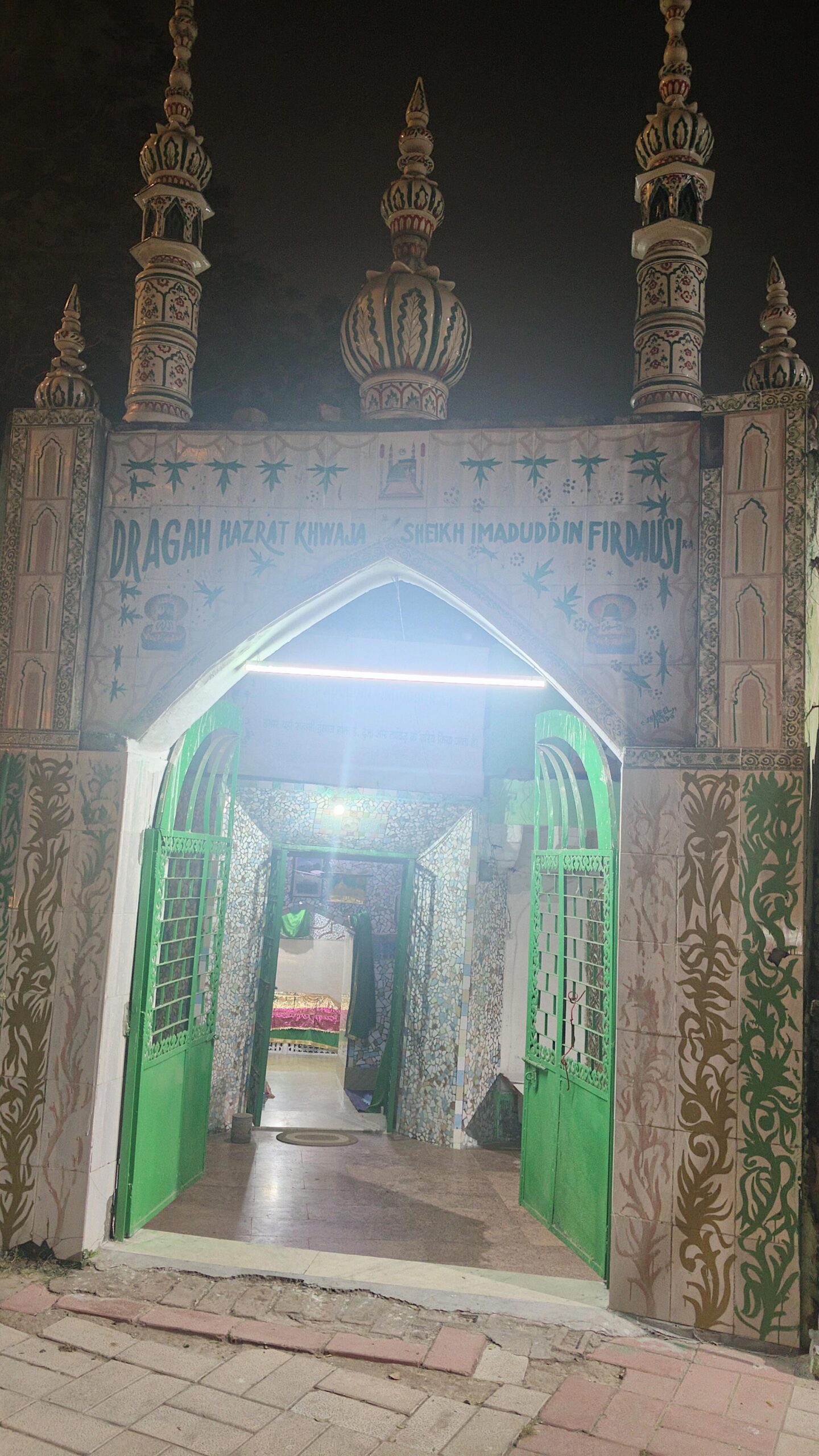
Image 1: Akwesasne territory. Source: Mohawk Council of Akwesasne

Born on US soil to citizen parents, I applied for my first passport at age 12, when my grandma took me with her to visit Italy and Greece for two weeks. My biggest concern then was packing my best clothes and how the passport picture unfortunately highlighted my crooked teeth and frizzy hair. Ten years later, I renewed the passport to make my second trip overseas, this time to go to India to do independent student research on a grant from my university. Imagine my awe and confusion when—thanks to a letter of introduction by an Indian government official whom I met through a professor—I was able to bypass the customs and immigration lines with a police escort at the airport in New Delhi and get my passport stamped without question in a back office before being shuttled into a gleaming white ambassador car to meet with a senior police officer. These early experiences crossing international borders were therefore smooth. They contrast dramatically with experiences shared by people who have long been Othered and constructed as suspect in various ways. Precisely this sensory experience has become more salient for me recently.

On an episode of The Chris Hedges Report podcast, Canadian writer Omar El Akkad talks about growing up with a “cultural survival kit” that (in large part) traces back to his witnessing a soldier interrogating his father at a checkpoint in Egypt. He says he is always anxious to go through airport border security, and points to how so many people more or less like him (i.e., brown skinned and/or naturalized citizens, with names indexing certain national or religious identities, perhaps with different accents to their spoken English) are “regularly dragged into secondary” inspection at US (or other) border crossings. El Akkad shares that this pervasive experience involves things like “pre-emptively preparing” for interactions with government agents “and trying to put them at ease” so as to suggest to them “don’t be scared” of me. He notes how over time he realized that it would behoove him to behave less “yes, sir, no sir” formally with border security officers, and instead act “more casual because that’s how people who are from here are behaving”. He remarks how only some feel “the cumulative effect” of how border securitization intersects with racism and other forms of discrimination. This is just one account of ways that marginalized peoples sense and embody insecurity at official border crossings globally through consciously altered comportment—never mind the millions who annually attempt to migrate unofficially or illegally, often risking or losing their lives.

I moved to Toronto for work over a decade ago and am now a dual citizen of both Canada and the US. Until recently, crossing between these countries felt easy, oiled by trusted traveler programs and historically friendly political economic relations. The only thing that ever “detained” me was a lonely border agent posted at a remote intersection of western Quebec/upstate New York, who was thinking of going back to school and wanted to chit-chat when he asked about my business and I told him about my scholarly research and teaching on police. He got an impromptu 20 minutes “office hours” session, and it was mildly endearing since that afternoon I was not in a rush while returning to Akwesasne from doing some fieldwork with members of their sister community in Kahnawà:ke, which is a Kanien’kehá:ke (Mohawk) territory near Tiohtià:ke (Montreal). The first time I felt significant anxiety about crossing this complex international boundary was a few days later, when I was informed by Canadian border agents that I could be fined thousands of dollars and my car seized because I had inadvertently not followed proper reporting procedures while conducting research in Akwesasne, a territory that straddles both the US-Canada border, and also the provincial border between Ontario and Quebec.

Akwesasne’ronon (the Kanien’ké:ha word for members of this Indigenous community) experience the insecurity, jurisdictional confusion, and exclusionary power of international border enforcement every day, since boundary lines zigzag irregularly through their land (Image 1). People joke about homes where the kitchen is in Canada and the living room is in the US, and relate far less amusing struggles over which problematic governing agreements dictate action on everything from commercial licenses to speeding tickets and the illegal trafficking of drugs, firearms, and human beings through the territory. As members of a sovereign First Nation recognized by both Canadian and US federal governments, Akwesasne’rono have special rights to move around their territory as needed without incident or incrimination. Unlike US or Canadian citizens—and with the exception of several designated crossings where there are special “express” lanes only accessible to Indigenous people with “native status” cards—Akwesasne’rono are not required to “check in” with officials when they traverse the border, not least since it would be impractical, often impossible to do so. But even people with all of their status documents in order have shared countless stories about being routinely questioned, detained, investigated, or otherwise inconvenienced—and reminded of their colonized Other-ness—by government agents on all sides. One community member with a status card even reported that he had to sit for several hours at a checkpoint one weekday after getting a medical X-ray, since agents detected radiation on him and classified it as suspicious and indicative of a potential security threat.

It is hardly news that even some of the most supposedly “friendly” and “porous” borders for some—especially persons privileged to have passports from globally powerful countries or other types of legitimating documentation—have long been places of anxiety, uncertainty, frustration, fear, paranoia, and terror for others, particularly people identified with groups facing prejudice and discrimination on the basis of indigeneity, nationality, race, religion, and other markers of cultural difference. Many in this latter category have become used to embodied experiences of sensing insecurity in a liminal space of exceptional, arbitrary, and mostly unchecked power meted out by state authority figures.

Recently however, and increasingly so, persons in the former (privileged) category, including myself, have begun sensing insecurity in borderlands as well. A stark case followed the re-election of Donald Trump as US President on a platform that included hard-line anti-immigrant and blatantly racist ideologies. Many have watched with horror as these ideologies play out in constant news streams about ICE (Immigration and Customs Enforcement) raids leading to the kidnapping and deportation of thousands of people across the US. Simultaneously, there are many stories circulating more or less publicly about increasingly arbitrary allegations of “anti-Americanism” and “national security threats” suspicions against persons who express dissent against or negative evaluations of some of the regime’s destructive and incoherent policies.

There are now many news accounts of foreign nationals getting caught up in the US immigration-detention dragnet since the beginning of 2025, sometimes allegedly due to procedural errors or miscommunications. Governments, NGOs, universities, business corporations, and others have been issuing travel warnings to their constituents, advising on how to respond to increased surveillance, search and seizure of electronic devices, denial of entry, and possible detention depending on one’s citizenship status. Stories have been circulating about people having their passports marked with a five-year ban from entering the US simply for being critical of the Trump regime. All of this is of course alarming for millions of people who have any sort of relationship with or reason to travel to the US. And it has dramatically shifted my own sense of in/security, even as someone with all of the (supposed) rights of US citizenship, and the privileges associated with being a well-educated descendent of white European settlers with no criminal record. Before traveling to the US, I now always anticipate interrogation. I carefully review the content of all of my devices; rehearse what I might say if questioned; and even give my children instructions on what (not) to say and do when we travel together. I have never been so anxious when passing through Canada-US border checkpoints, sometimes to the point of feeling physically ill, or unable to eat, bordering on panic attacks, even though I know “rationally” that I have done nothing wrong or anything that should warrant increased scrutiny or sanction.

My exponential increase in anxiety around crossing into the US is not simply speculative paranoia based on distant doomster social media stories and second-hand rumors. It emerges out of two specific circumstances related to expressed recognition of state violence. Foremost is a history of speaking out against occupation, apartheid, and genocide in Palestine/Israel (Bangstad 2025), to the extent that I have been profiled alongside thousands of others on the defamatory Canary Mission website with false charges of being antisemitic and pro-Hamas, and of allegedly supporting “terrorism”. I have viewed documented evidence of persons listed on this untrustworthy propaganda website being interrogated about it explicitly in secondary inspections at the US border; and in some cases, if someone was not a US citizen, they were reportedly banned and denied entry to the US. This is part of a larger pattern of the current US government’s weaponization of antisemitism as a smoke screen to try to bring universities and other institutions to heel with threats of rescinding of federal funding, canceling of work and study visas, and banning international student admissions as punishments or “warnings” for not falling in line with regime policies or allowing open protest of war crimes and atrocities. I admit to feeling afraid even now as I write this, and hope this will not cause harm in the future.

The other key factor that has amplified my sense of anticipatory insecurity about border crossings more generally relates back to my decades of research in India on police and security infrastructure. After some critical comments I made in independent media about harmful discriminatory policies and practices of the Hindutva (Hindu nationalist) government that has now been in power there for more than a decade, representatives from the Indian consulate came to my house in Toronto and issued me a “show cause notice”, criminalizing me for alleged “anti-national” activities that violate “the sovereignty and integrity of India”, and accusing me of “clandestine activities” in relation to my research. The charges are as absurd as they are baseless, and a Delhi-based lawyer has done their best to set me up well to fight these allegations in court as needed. But the government’s strategy of harassment and intimidation has compelled me to self-censor. While I still write candidly in scholarly sources about my research, I am more hesitant to respond to inquiries from journalists requesting comments on politically sensitive matters. And while many friends and colleagues already know about this old “news” of my essentially being blacklisted from a place I have considered another home for decades, this is the first time that I’m sharing it publicly in writing, more than three years after state officials first darkened my doorstep. Meanwhile, I have not attempted to return to India, even though I technically still have what is known as OCI (Overseas Citizenship of India) status. I have read and heard about many stories of other persons with this status having their cards revoked, and I fear arriving at that airport—where, recall, I was once able to bypass the long lines of foreign passport holders even though I had never before set foot in the country—only to be deported immediately, like other colleagues who have been unfortunately caught up in the Indian government’s dragnet of nationalistic hyper-securitization.

This is how state harassment and repression of dissent have always worked, of course; through instilling generalized suspicion along ideological divides, engendering amorphous anxiety that accumulates like moss, and shapeshifts into intensified fear and paranoia that spreads like a contagion. Rapidly changing technological capacities aside, most of the routine and exceptional tactics, strategies, and outcomes of potential and actual state violence are not new. But their sensory impact on new populations, and in relation to US power specifically, indicates substantive and seismic shifts. One key feature of these shifts is the increasingly blurry “border” between a palpable fear of mere “inconvenience” (perhaps I’ll miss a flight, or my phone will be seized at the border and I won’t ever get it back) versus the probability of a seriously harmful impact on peoples’ lives (perhaps I’ll be detained indefinitely, or they’ll do a full forensic image of my seized device that will lead to serious legal or financial complications, never mind the violations of privacy). Scaling up and out, it also seems that we are witnessing significant realignments and sea changes in the global order of political economic power, heretofore dominated by the US through what some have called “empire” in the post 1945-era.

Returning to El Akkad’s reflections, he acknowledges that as someone with the privilege of Canadian citizenship, his border-crossing fears have been, if not “silly” (his word), then still mostly about trying to ensure “as few headaches as possible” and to prevent the potential hassle of losing time, money, or equipment. For me as a dual citizen, I would like to continue to feel that the worst I might suffer at the Canada-US border is a short period of detention until I could obtain legal representation. But there is a growing sense that what appears to be intensified and unpredictable border interrogations of anyone and everyone—not just the “usual suspects”, which of course has always been “unjust”—may only get worse, and that the “normal” national and international legal protections may not hold, such that even citizens who don’t protest too much may be subject to extraordinary rendition. It feels like I now know more people than not who express some version of this fear on a regular basis, and especially in the lead up to a trip crossing the US border—or in a decision to avoid going to the US altogether, which also now seems far more common. The boundary between nuisance and violence has become more than a little insecure.

The (again) not new or unique, and yet intensified and arguably more-prevalent-than-ever, sense of insecurity around crossing borders into the US is also indicative of concerns well beyond just mobility and migration. It indexes the decline and fall of political economic forms and cultural ways of life that many people, including some of the wealthiest and heretofore well-protected and well-served by the US-led global order, have long enjoyed and don’t want to let go. Among other touchstones of security, it seems that US-based global and national governing institutions, free speech, legal and regulatory bodies, human and civil rights, social services, educational opportunities, and trust in mediated knowledge production are disintegrating across the board. Many try to go on as before, hoping for a savior in litigation, legislation, or perhaps a new leader, assuming the next US national election occurs on schedule. This mass tendency to “keep calm and carry on” seems to have a deeper sensory structure than mere maintenance of morale in the face of widespread and ongoing degeneration. Perhaps it exhibits something more akin to what Alexei Yurchak (2005) has called “hypernormalization” in the context of the end of Soviet Russia, wherein people expressed a strong sense that things would always continue as they had, even as their world was falling apart around them. I cannot predict with any precision the long-term or even immediate future of the US-led Global Order. But the fluctuations and increasing sense of creeping dread and acute terror that I now feel every time I approach the border of the country of my birth signify the insecurity, if not the complete implosion, of so much that so many of us have always thought to be true and trusted.


Beatrice Jauregui is Associate Professor at the University of Toronto Centre for Criminology and Sociolegal Studies. She is author of Provisional Authority: Police, Order, and Security in India and co-editor of the Sage Handbook of Global Policing and Anthropology and Global Counterinsurgency.  


References

Bangstad, Sindre 2025. “The IHRA Working Definition of Antisemitism and Academic Freedom” Focaalblog 28 March, https://www.focaalblog.com/2025/03/28/sindre-bangstad-the-ihra-working-definition-of-antisemitism-and-academic-freedom/

Yurchak, Alexei. 2005. Everything Was Forever Until It Was No More. The Last Soviet Generation. Princeton University Press.


Cite as: Jauregui, B. 2025. “Anxious Anticipations: Border-crossing In/security and the Implosion of the US-led Global Order” Focaalblog December 22. https://www.focaalblog.com/2025/12/22/beatrice-jauregui-anxious-anticipations-border-crossing-in-security-and-the-implosion-of-the-us-led-global-order/
Anagha Anil: Portrait Populism: On the Communist Iconography of Kerala

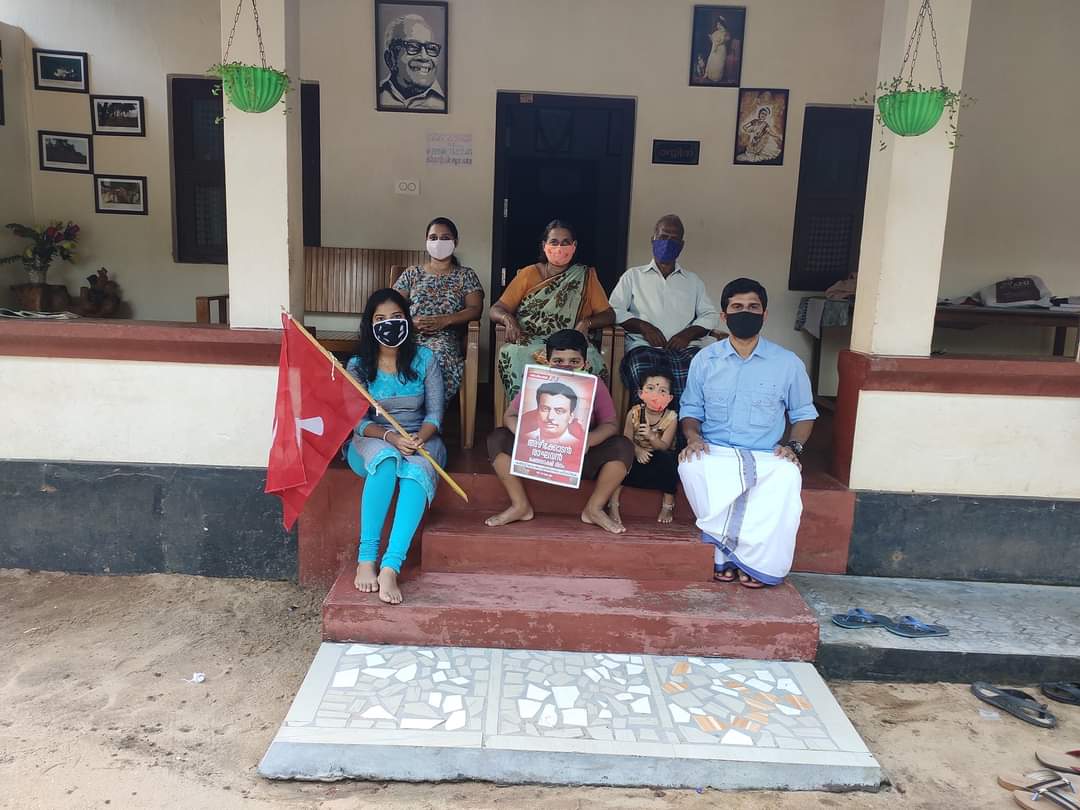
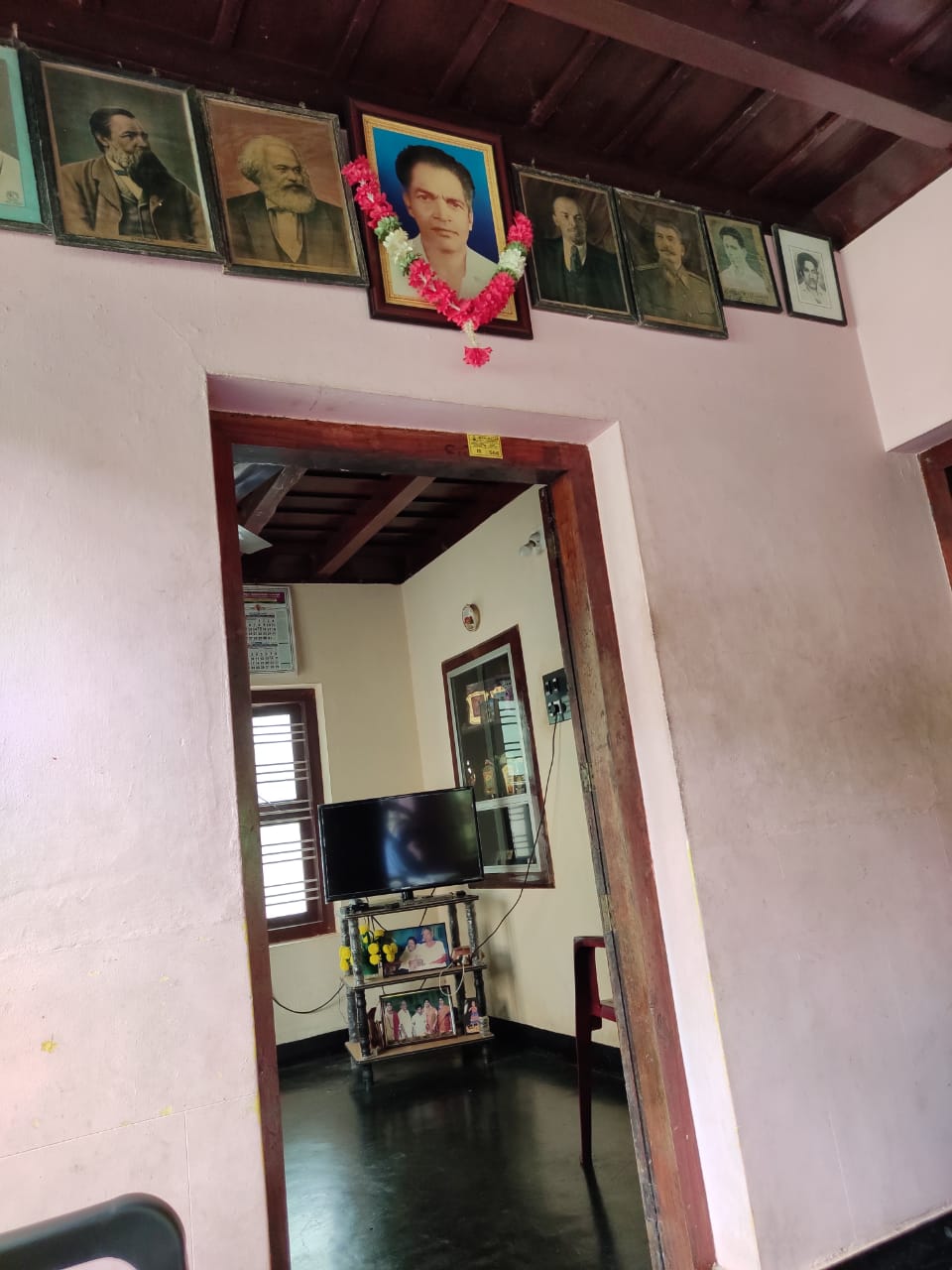
Image 1: A portrait of the first chief minister of Kerala, E.M.S. Namboodiripad displayed at the
kolaya (a Ravi Varma painting could be observed on the adjacent right wall), photo by T.P. Bineesh

Communism continues to thrive both as a ubiquitous presence and a powerful electoral force in the south Indian state of Kerala. Established in 1940, the Communist Party of Kerala formed the first democratically elected government of the state in 1957. By organizing popular movements which demanded the abolition of feudalism, landlordism, and the transfer of land to its tillers, the Communist Party gained a strong foothold amongst the masses and built a solid base in rural areas from where it could not be dislodged (Fic, 1970). Today, the communist movement in Kerala, especially as represented by its dominant party, the Communist Party of India (Marxist) [CPI(M)], can be said to display tendencies of populist movements, including a cult of a leader-hero and the rhetoric of a ‘pure people’ versus the ‘corrupt elite’ (Mudde & Kaltwasser, 2017).

This blog looks at the perpetuation of the leader cult in Kerala through the use of commemorative portraits. Disseminated through domestic and digital spaces, these images reinforce a sense of collective identity among party workers while also invoking filial sentiments. I will be reading such negotiations utilising the idea of corpothetics or corporeal aesthetics which concerns the mobilisation of all senses for the appreciation of a text (Pinney, 2004). The concept is utilized appositely to understand the filial mode of reverence, effected by everyday embodied practices which enhance the affective potential and emotional capital of the Party. Such engagements, which are sensory/sentimental in character, play a key role in embedding the Party as an affective presence (rather than an abstract political programme) within the state of Kerala.

Portraits and Corpothetic Engagement

A discussion of the portraits of communist leaders hung in Kerala houses is necessary to properly situate the cultural context in which digital iconography is circulated and made meaningful. The part of the house which opens to the front yard is usually an open space (called kolaya or sit-out), which in many Kerala houses serves as a display area for objects such as family photographs, trophies, photos of Gods and ancestors, and other decor items, expecting public appreciation (see image 1).

The portraits of former Communist leaders are hung in the houses of party supporters in the kolaya. The kolaya thus functions as a private sphere communicating the family’s socio-cultural inclinations, ideologies, and aspirations. With their fixed frontal stance, these images can initiate an embodied interaction with the beholder, whose eye here functions not only as an organ of vision but also of touch. This notion could be explicated further by discussing how the mutuality of vision and its ensuing tactility was deployed in early mythological films. The devotee in such films would beseech the deity to interfere in moments of pain and distress. The dialogue that transpires between the two of them is cinematically represented through intermittent shots that show the eyes of the devotee and the deity. Sometimes even a ray would pass from the deity’s eye to that of the devotee, thereby liberating her/him from their suffering. Thus, within the Indian context, the eye is more than an organ of vision but also of touch (Pinney, 2004). The emotional resonance evoked by these portraits is to be contextualized in this corporeal visual culture.

Image 2: Portraits of International Communist leaders along with that of a family ancestor in former MLA (Member of Legislative Assembly) C.P Narayanan’s House, photo by author

In his study of family photographs in Kerala, Sujith Kumar Parayil (2014) demonstrates that apart from documenting the family, these photographs function as performances of the interpersonal and intimate relations between family members while also displaying their cultural capital (Parayil, 2014). He also notes how these families have a penchant for displaying the portraits of ancestors or deceased family members along with deities, thus enabling a corpothetic performance of commemoration (see image 2). Such a display is rendered corpothetic when the beholder engages with the photographs through everyday practices such as dusting, garlanding or lighting a lamp in front of the portrait.

In the Malabar region of north Kerala, where Communism emerged and continues to flourish as a formidable force, portraits, found in both Dalit and upper caste households, are often placed along with photos of Gods or ancestors, functioning as surrogates for what they represent. The portraits displayed include regional and international male leaders of the Communist movement such as E.M.S. Namboodiripad (the first chief minister of Kerala), P. Krishna Pillai, Joseph Stalin etc. along with other local leaders and ‘martyrs’ (images 1 and 2).

The reverence and admiration directed towards these portraits by the family members are performative in character, demonstrating their loyalty and affiliation towards the Party. . For instance, in image 1 the family members of the Communist family home are observed sitting in the kolaya to commemorate the ‘martyr’ Azhikodan Raghavan. A portrait of former chief minister E. M. S Namboodiripad could be seen in the background, as displayed in the kolaya. The choice of the family members to pose in the kolaya was not accidental but can be seen as a conscious decision to affirm the family’s affiliation as supporters of the Communist Party. Such transactions empower the images to exert a corrective moral eye while the visible presence of the ancestors coerces the family members to adhere to the norms and morals encoded within the family. Actions like placing the Communist portrait at a crucial spot (veranda, living room, and dining room) along with portraits of family elders (image 2) while ensuring adequate visibility, also guarantee the quotidian yet affective commemoration of the Communist movement.

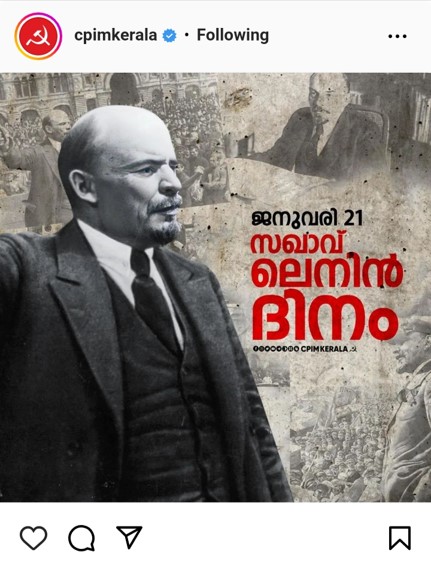
Image 3: Screenshot of an Instagram post commemorating Vladimir Lenin’s death anniversary on January 21st, from the official Instagram page of CPI(M), Kerala

Communist Iconography in Social Media

Social media plays a crucial role in determining the arc of Indian politics. It played a pivotal role in facilitating the Bharatiya Janata Party’s (BJP) victory in the 2014 elections (Kanungo, 2015). A recent example would be Rahul Gandhi’s strategic choice to engage with social media vloggers and YouTubers instead of relying solely on mainstream media during his “Bharat Jodo Yatra” (Unite India March 2023).

The situation is no different with Communist parties in Kerala, with the Communist Party of India (CPI) and especially the Communist Party of India (Marxist) [CPI(M)] that has been active on social media since 2016, following the example set by other political parties. The integration of social media platforms such as Facebook, Twitter, Instagram, and WhatsApp into the official communication stream of government administrative institutions would be an example. However, Party officials also utilize social media to disseminate iconography in an attempt to cultivate a digital populist style. These iconographic artifacts include posters and reels which glorify the leader while foregrounding the participatory politics of the Party. An example is image 3, posted on Instagram, commemorating Vladimir Lenin by superimposing his image over a couple of other photographs where he is seen as addressing the masses or leading them on a strike. Circulated in the form of posts, tweets and stories, such expressions intensify the affective potential of left populism in Kerala while also validating its democratic appeal among the people.

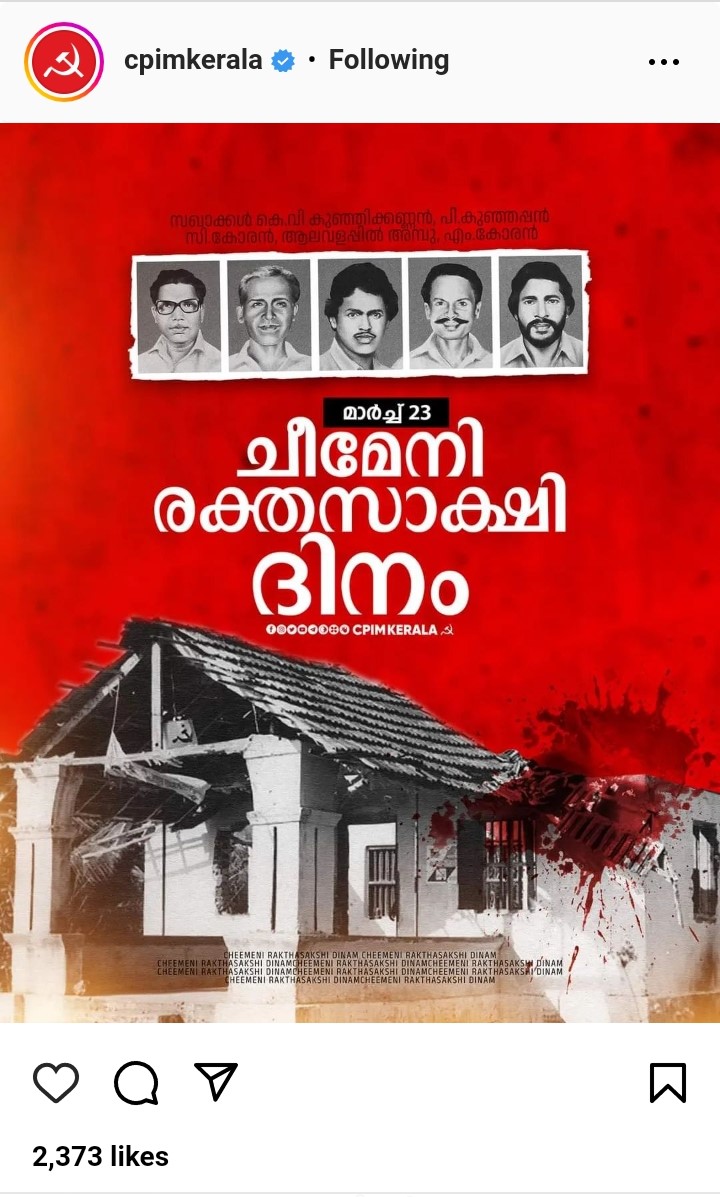
Image 4: Screenshot of an Instagram post commemorating Cheemeni Massacre on 23rd of March; the Party Office of Cheemeni along with the portraits of martyrs could be seen at the top (from left: K. V Kunjikannan, P. Kunjappan, C. Koran, Aalavalathil Ambu, M. Koran), from official Instagram page of CPI(M), Kerala

These digital images also function as counterparts to the portraits discussed in the previous section. Digital posters of the Party are suffused with captions, images of a red sickle and hammer, red festoons, Party flags, etc. Image 4 is a poster commemorating the Cheemeni massacre, where five CPM members were killed by Congress workers on March 23rd1987, at the Cheemeni Party Office of Kasaragod district in Kerala. A notable aspect of this poster is how the Cheemeni Party Office, the site of the massacre, is foregrounded. With portraits of ‘martyrs’ placed on top, the image of the dilapidated Party office superimposed with a blood splash triggers associated memories of the massacre. Such a representation effectively tweaks the images’ affective value and ensuing ‘stickiness’ – that is the way in which emotions and feelings get attached to particular objects, situations, or people, influencing one’s perception and interactions over time (Ahmed 2004).

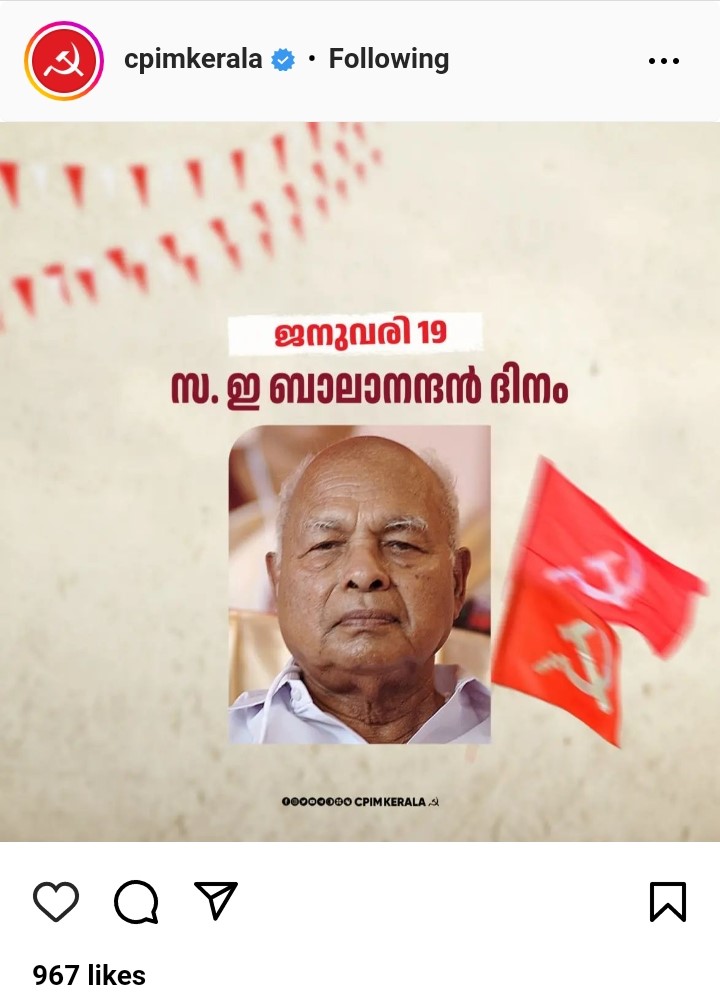
Portraits of leaders are also circulated in similar fashion after including certain extensions. An example would be an Instagram post (image 5) featuring the image of E. Balanandan, former MP, Politburo member, and secretary of the CITU (Centre of India Trade Unions). Commemorating the death anniversary of the veteran Communist leader, the poster bears a portrait of Balanandan with other iconographic artifacts in the background, such as the Communist flag and red festoons. Further, it is accompanied by a caption elaborating on the leader and his contributions to the Party. When added to the portrait, such stylizations become corpothetic as they are implemented through actual tactile engagement with the image which entails a mere swish of the finger.

Image 5: Screenshot of an Instagram post commemorating E. Balanandan’s death anniversary on January 19th, from the official Instagram page of CPI(M), Kerala

Such modifications could be read as digital articulations of corpothetic practices which until then were directed towards actual photographs. Such gestures are further amplified through actions such as commenting, sharing, and liking which has an ability to “strengthen the shared affective and political meaning-making in the community” (Hokka & Nellimarkka, 2020, 3).

The Party in everyday life

These novel forms of Communist iconography with their interactive features, invoke a new form of digital populism that requires to be performed online. Youngmi Kim (2008, 122) defines digital populism as a new type of political behaviour marked by the political use of the internet as a form of political participation as well as an instrument of mobilisation. Actuated through individualized engagements, this virtual replication of proximal empowerment (Pinney, 1997) comes across as a performance of self within the digital world. It is this performance that Schechner calls a form of public dreaming (qtd. In Papachirissi 2003, 98).

The participatory aspect of digital populism facilitates engagement of the people with the communist movement without being restricted by the constraints of formal Party lingo ridden by rigid theoretical diction. Udupa et al. (2019) highlight the significance of colloquialism in such digital interactions. Communist Parties in Kerala employ region specific and colloquial cultural references in social media. Such expressions of digital populism, which incorporate the rhetoric of the popular, facilitate the transcendence of the Party from the realm of the political to that of the affective. Nested in one’s day-to-day life, these artefacts found both in domestic spaces and social media, are crucial towards rendering the Party quotidian.


Anagha Anil is currently a PhD scholar in Cultural Studies at Manipal Academy of Higher Education, Karnataka, India. Her research focuses on the corpothetics of communist iconography in contemporary Kerala. Her research interests include visual studies, popular culture and film studies.


References

Ahmed, S. 2004. “Affective Economies.” Social Text 22, no. 2: 117-139.  

Fic, V. M. 1970. Kerala Yenan of India – Rise of Communist Power 1939-1969. Bombay: Nachiketa Publications.

Hokka, J. and Nelimarkka, M.. 2019 “Affective Economy of National-Populist Images: Investigating National and Transnational Online Networks through Visual Big Data.” New Media & Society, 1-23.

Kanungo, N. T. 2015 “India’s Digital Poll Battle: Political Parties and Social Media in the 16th Lok Sabha Elections.” Studies in Indian Politics 3, no. 2: 212–28,

Kim, Y. 2015 “Digital Populism in South Korea? Internet Culture and the Trouble with Direct Participation” in Digital Activism in Asia Reader, eds. N. Shah, P. Purayil Sneha and S. Chattapadhyay. Milton Keynes: Meson Press. Pp:13-126.

Mudde, C. and Kaltwasser, C. R. 2017 Populism: A Very Short Introduction. Oxford; New York, Ny: Oxford University Press.

Parayil, S. 2014. “Family Photographs: Visual Mediation of the Social.” Critical Quarterly 56, no. 3 :1-20.

Pinney, C. 2004. Photos of the Gods: Printed Image and Political Struggle in India. London: Reaktion Books.

Pinney, C. 1997. Camera Indica: The Social Life of Indian Photographs. Chicago: University of Chicago Press.

Udupa, S., Venkatraman. S., and Khan, A. 2020. “‘Millennial India’: Global Digital Politics in Context.” Television & New Media 21, no. 4: 343-359


Cite as: Anil, Anagha 2024. “Portrait Populism: On the Communist Iconography of Kerala” Focaalblog 26 June. https://www.focaalblog.com/2024/06/26/anagha-anil-portrait-populism-on-the-communist-iconography-of-kerala/

Smytta Yadav: Shifting Landscapes: Urbanization, Religious Transformations, and Cultural Resilience in Delhi

In the midst of India’s extensive urbanization, with more than 34% of the population dwelling in urban areas as of 2021, as per the World Bank, the complex relationship between urban transformation, poverty dynamics, and the impact of capitalism gains prominence. Amidst this swiftly urbanizing landscape, it is relevant to ask about the enduring significance of street shrines and the deities they embody. This blog post unravels the complex interplay between urbanization, poverty dynamics, and capitalism in shaping the evolving narrative of street shrines in Delhi. By examining specific examples, we seek to contribute to the understanding of the socio-political implications of religious transformations, shedding light on the informal mechanisms that influence the cultural and political dimensions of urban India.

As Hindu deities increasingly dominate street shrines, such as those near Jama Masjid, Red Fort, and Chandni Chowk, the very essence of these spaces undergoes an accretionary conversion over time. This transformation is not merely a happenstance but a result of a complex collusion involving diverse social and economic players who shape the city’s evolving political, religious, and cultural landscape. Old Delhi, with its labyrinthine lanes and historical significance, is undergoing a palpable cultural reshaping as Hindu dominance unfolds within its streets.

Street shrines, once reflective of the syncretic blend of Hindu and Islamic traditions, are now marked by a pronounced prevalence of Hindu deities. This is largely due to the ongoing influx of labor migrants from the neighbouring states of Bihar and Uttar Pradesh into the city who are reshaping the sacred spaces in both their structure and function. The diverse backgrounds, cultures, and religious practices of the migrants contribute to a rich tapestry of beliefs that find expression in the street shrines. The choice of the deities is a reflection of their faith. Migrants, seeking a sense of community and continuity with their cultural heritage, often contribute to the embellishment and maintenance of these shrines. The shrines may adapt to serve not only as religious spaces but also as community hubs where migrants find support, share experiences, and build social networks.

Icons like Shirdi Sai Baba and Hanuman, along with other Vedic motifs, have become the visual protagonists, signifying a transformative narrative that overrides the Islamic heritage that was historically ingrained in this part of the city. In the intricate lanes of Old Delhi, the evolving narrative of cultural transformation is discernible through the gradual transition of temporary religious symbols into enduring fixtures. Local spaces, once harmoniously shared, now bear markings that define them for specific purposes, subtly alienating those who traverse them and instilling a sense of unease. This shift, woven into the fabric of the city, holds profound implications for understanding the social and ethnic conflicts that manifest within its boundaries.

The multifaceted nexus signifies that as urban centers burgeon, various economic and social forces come into play, fostering both economic opportunities and disparities. The growing number of street shrines might be interpreted as a reaction to the changing cityscape, complexly influenced by issues of poverty, capitalism, and religious practices. The chosen field sites in New Delhi were intentional selections, serving as gateways into regional politics entwined with land acquisitions, unraveling layers of influence on the transformation of public shrines and art.

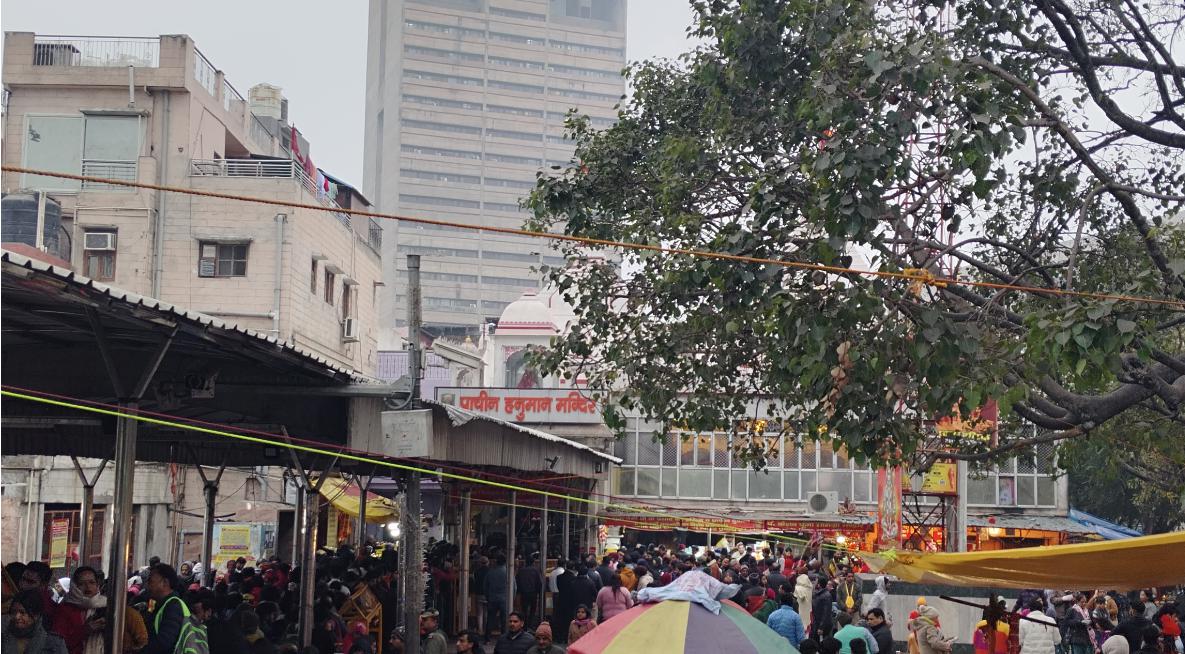
Image 1: A Shrine for Hanuman right behind Connaught place in New Delhi (Photo by Smytta Yadav)

The following provides some examples of street shrines and the changes they have undergone.

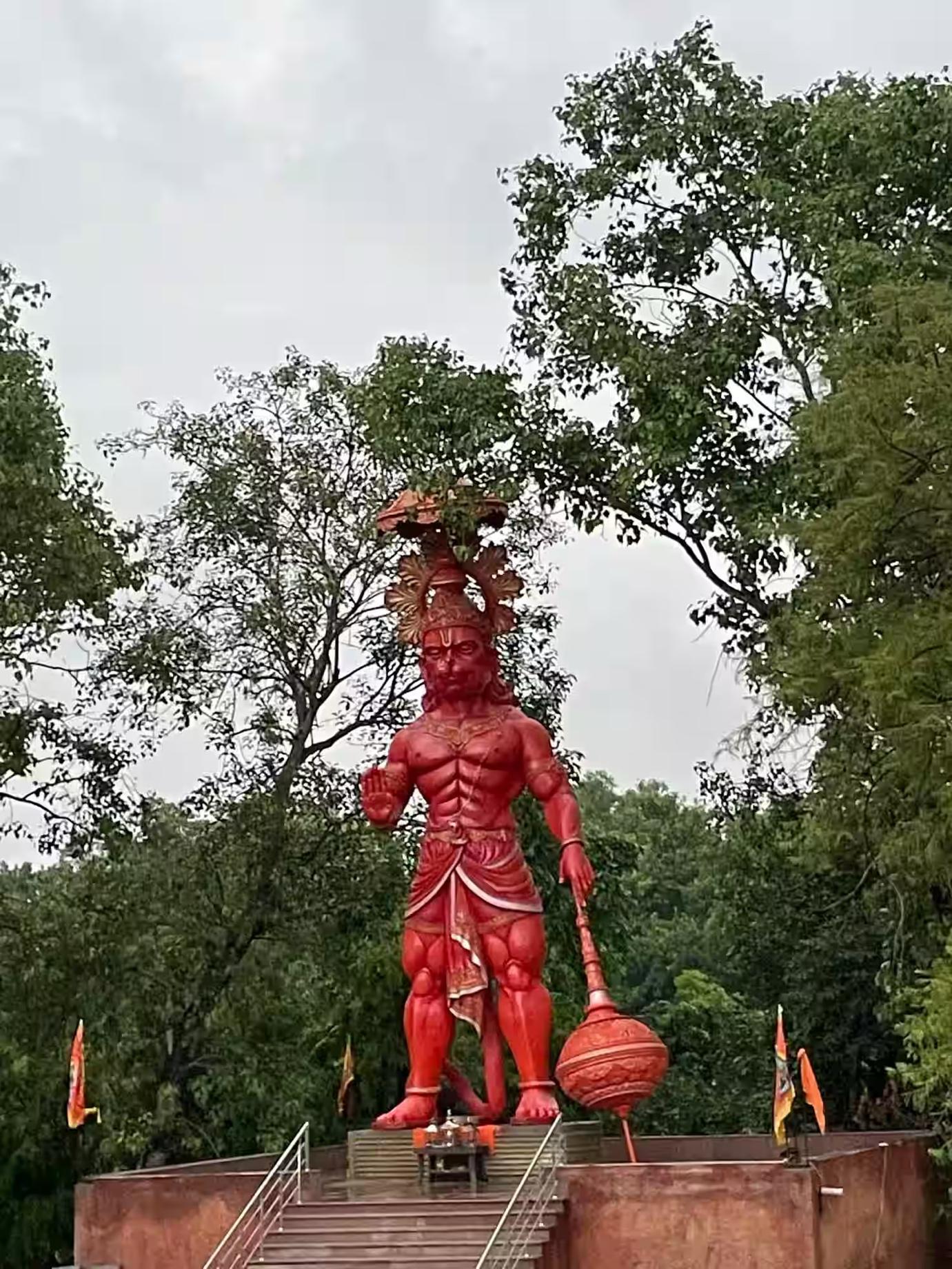
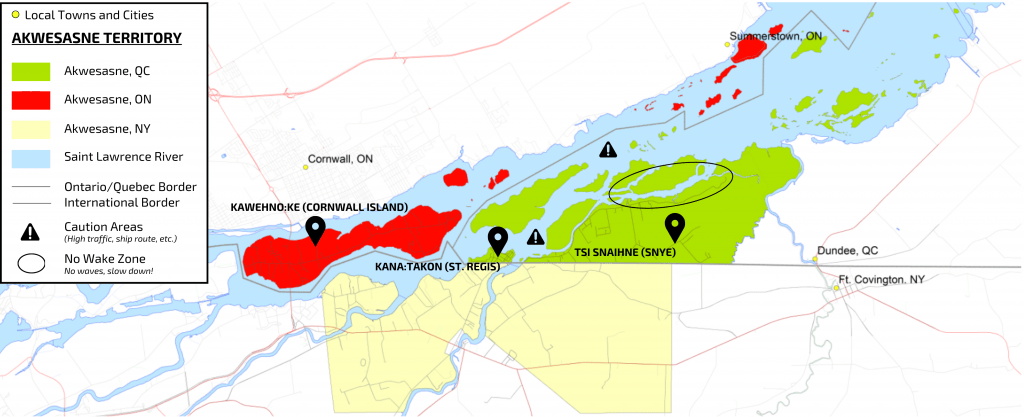
Hanuman’s Ascendance: In the heart of Old Delhi, near the iconic Jama Masjid, street shrines that were once adorned with Islamic calligraphy and symbols now prominently feature the figure of Hanuman. This ascendance of Hanuman in the visual landscape signals a shift in religious and cultural prominence, eclipsing the Islamic heritage that was historically intertwined with this area.

While administrative authorities recognize that these religious shrines can be leveraged for land acquisition, the marginalized inhabitants dwelling in their vicinity perceive them as a safeguard against eviction, highlighting the intrinsic connection between religion, politics, and commerce —exemplifying the strategic integration of religious practices and turning these humble street shrines into vibrant expressions of cultural and spiritual amalgamation while at the same time legitimising the ownership of the marginalised communities residing in the slums of the capital.

Image 2: An Ancient Muslim Shrine; Hasrat Sheikh Imadudin Firdousi at Nizamuddin (photo by Smytta Yadav)

Furthermore, demolition notices have been issued by authorities to mosques located on land that the Delhi Waqf Board asserts as its own. The board has filed a challenge to two of these notices in the High Court because of the  Places of Worship Act 1991 of the Indian constitution, according to which a mosque, temple, church or any place of public worship that was in existence as of 15 August 1947 will retain the same religious character that it had on that day – irrespective of its history – and cannot be changed by the courts or the government.  It is worth noting that these actions targeting Muslim sites transpired simultaneously with other initiatives, such as the purported demolition of dwellings in squalor areas prior to the G-20 summit that was hosted in Delhi on September 9 and 10.

Image 3: Hanuman Statue near the famous Chandni Chowk in a heavily Muslim neighbourhood. (Photo taken by Smytta Yadav).

Some other examples of dominance of Hindu street shrines in predominantly Muslim neighbourhoods are:

Symbolic Transformation near Red Fort: Walking towards the iconic Red Fort, another bastion of Delhi’s historical legacy, one can observe a symbolic transformation in the street shrines that line the route. Hindu deities, particularly Hanuman and Shirdi Sai Baba, now take centre stage, subtly overshadowing the Islamic architectural marvels and their associated religious symbols.

Syncretism Eroded in Chandni Chowk: Chandni Chowk, renowned for its historical syncretism, is experiencing a erosion of this syncretic cultural tapestry. Street shrines in this area, once a testament to the harmonious coexistence of Hindu and Islamic traditions, now showcase a pronounced prevalence of Hindu deities. The visual language is evolving, rewriting the narrative and erasing some of the syncretic elements that defined Chandni Chowk.

Influence in Kinari Bazaar: Kinari Bazaar, a market known for its traditional charm, reflects the broader influence of Hindu dominance in Old Delhi. Street shrines along the narrow lanes prominently feature symbols associated with Hinduism, subtly reshaping the cultural and religious landscape of this historic market.

The evolution of Hindu street shrines in New Delhi is intricate and multi-layered, intertwining individuals and households based on factors such as caste, religion, regional origin, language, or ideology. This complexity is vividly illustrated by the diverse ways in which these communities engage in political strategies, aligning themselves with various political parties. This involvement emerges as a pivotal dimension in the larger quest for social mobility and empowerment in the city.

For instance, certain street shrines may become focal points for followers supporting different political parties, reflecting the dynamic nature of political affiliations within these communities. The cultural movements and societal struggles that unfold within these religious spaces seamlessly transition into political conflicts, with tangible manifestations in territorial disputes over physical space in New Delhi. For instance, recently in Jan 2021, an idol of Shirdi Sai Baba was demolished by a BJP supporter and a realtor because a Jat Hindu Guru had claimed Shirdi Sai Baba was born a Muslim, and the realtor did not want that to be placed in a Hindu neighbourhood.

In essence, the nuanced dynamics of Hindu street shrines not only mirror the cultural diversity within the communities but also serve as arenas where political ideologies and affiliations converge, shaping the broader narrative of social dynamics and empowerment in the dynamic context of New Delhi.

It is essential to have a clear understanding of the fact that political and religious imbrications are connected to rural-urban flows, transitions, and networks, as well as the caste and regional conflicts that are involved in these transitions and connections. Furthermore, it is important to note that these imbrications are not simply the result of government action or inaction on urban and spatial planning: caste and regional conflicts are also involved.

At the same time, publicly addressing the contentious issues that arise from these conflicts and struggles cannot be addressed purely through formal state or urban planning mechanisms, as these play out primarily through informal channels, in spatial patterns that are informal, and in public spaces that through long term practice and local sanction have been earmarked for informal uses. Because politics, religion, and culture are much more closely linked in the Asian context to issues of dominance, inequality, and hierarchy – all of which operate through informal mechanisms – it is not surprising that battles around these take place in informal spaces, and perhaps even achieve a greater degree of success than formal or institutionalised attempts to democratise Indian society.

The ethnographic observations about these shrines offer a glimpse into the ongoing negotiations between tradition and modernity, the sacred and the secular, thus contributing to the broader scholarly debate on the cultural and political dimensions of urban India. The enduring legacy of these shrines, amidst the dynamic changes of urbanization, reflects not only a rich cultural heritage but also a resilient adaptation to the evolving socio-political landscape.

In conclusion, this exploration into the realms of street shrines offers insights into their evolving cultural and political significance. The dynamic mosaic of street shrines in urban India serves as a vivid representation of the intricate interplay among diverse cultural dimensions. Amid conflicting perspectives on land utilization and decision-making authority, the delineation of sacred boundaries becomes increasingly intricate, particularly in a country like India where finite land resources pose challenges. This ethnographic journey seeks to unravel how these sacred spaces engage with the dynamic geography of the city, thereby reshaping the ancient Islamic architecture in Delhi’s urban landscape.


Dr. Smytta Yadav is an Anthropologist and currently a Leverhulme Research Fellow at the University of Sussex. The above article is an output of her AHRC grant number AH/T000864/1 which she held at the Queen’s University of Belfast. The title of the grant was Ancient Vedic Gods in Early Urban and Pre-Mughal India.


References:

Kennerly, R. M. (2005). Roadside Shrine Cultural Performance: Poststructural Postmodern Ethnography. Agricultural and Mechanical College, LSU.

Mayaram, S., Pandian, M. S. S., & Skaria, A. (Eds.). (2005). Muslims, Dalits, and Historical Fabrications (Vol. 12). Oriental Blackswan.


Cite as: Yadav, Smytta 2024 “Shifting Landscapes: Urbanization, Religious Transformations, and Cultural Resilience in Delhi” Focaalblog 16 January. https://www.focaalblog.com/2024/01/16/smytta-yadav-shifting-landscapes-urbanization-religious-transformations-and-cultural-resilience-in-delhi/

Nithya Natarajan: Behind the Indian Boom

“Behind the Indian Boom: Inequality and Resistance at the heart of economic growth” is an exhibition curated by Simon Chambers and Alpa Shah.[i] The exhibition draws on research undertaken across India as part of an ESRC- and ERC-funded Programme of Research on Inequality and Poverty based in the Department of Anthropology at LSE led by Alpa Shah and Jens Lerche.[ii] The exhibition also includes contributions from a number of scholars, journalists, and activists.

Continue reading

Johan Fischer: Veg or non-veg? On fieldwork and food in India

Reporting from an ongoing fieldwork in Hyderabad, India, the central topic of this piece is the ways in which the vegetarian and the nonvegetarian are understood, practiced, and contested in contemporary India. I argue that “vegetarianism,” especially when seen to be inseparable from Hinduism and the caste system, can fruitfully be unpacked when explored empirically vis-à-vis the nonvegetarian. What is more, I show that context matters when exploring the vegetarian and nonvegetarian in the interfaces between state/politics, markets, and consumers in Hyderabad. My preliminary findings suggest that the relationship between the vegetarian and nonvegetarian is being redefined in contemporary India: the long-held idea that the more individuals and social groups follow a vegetarian lifestyle the higher social status they enjoy is breaking down. What is more, vegetarianism and meat-eating are increasingly individual lifestyle choices rather than determined by religious orthodoxy.

Continue reading

Edward Simpson: The future of the rural world?

The conference “The Future of the Rural World? Africa and Asia” was hosted by SOAS, University of London during October 2015. The event marked the end of a major project funded by the United Kingdom’s Economic and Social Research Council (ESRC) on “restudying” village India. It also coincided with the launch of an exhibition and film installations at the Brunei Gallery at SOAS, which emerged from the same project. At the conference, Peter Ho, Katy Gardner, and Henrietta Moore spoke provocatively on rural futures in China, Bangladesh, and East Africa.
Continue reading

Rajalakshmi Nadadur Kannan: Copyright, capitalism, and a postcolonial critique of Karnatic music

Karnatic music, or South Indian classical music, is understood as “religious” music, deemed to be “divinely inspired,” and performers are seen as embodying the divine. Because of its association with “religion,” Karnatic music is generally considered a shared traditional knowledge that has historically been bequeathed from one generation to another through oral teaching. However, at the same time, Karnatic music also has a complex history with capitalism, having been constructed by bourgeois-nationalist elites in the early twentieth century from traditions that formed an inseparable part of the operation of temples and courts. This history has recently become further complicated. Some contemporary Karnatic musicians, while adhering to the beliefs of the “religious” and “divine” nature of the tradition and indeed the creativity of musicians therein, now raise concerns about protecting individual creativity and performances—specifically against unauthorized recordings of performances in concert halls and the availability of such recordings on the Internet (Paitandy 2011).

Continue reading

Jayson Beaster-Jones: Music, labor, and value in Indian music stores

The Indian music industry of the early 2000s was extremely volatile, as the overproduction of new recordings and ready availability of pirated material led to a decline in overall sales and waning profitability for the physical circulation of recorded music. Indian music retailers had to navigate a complex social and business environment in which their customers could shop for music in a bewildering array of successful retail outlets, ranging from street hawkers to family-owned shops to large, organized chain stores, to mobile phone providers.
Continue reading

Nicolas Martin: Democracy subverted: Inequality, liberalism, and criminal politics in the Indian Punjab

A number of liberal scholars of India, ranging from Amartya Sen and Jean Drèze to James Manor, all broadly view democracy as the solution to a variety of social evils including poverty, inequality, corruption, crime, and even violent conflict. They all acknowledge that Indian democracy is at times a messy affair, but they share a common faith in its self-correcting potential. As they see it, democracy has fostered a more assertive citizenry that no longer accepts traditional hierarchies and that is less tolerant of abuses of power.
Continue reading

Marcus Banks: Revisiting Raju

Raju and His Friends was released almost exactly a quarter of a century ago, and revisiting it now at the invitation of the FocaalBlog editor is something of a trip in a time machine for me. As I discuss below, ethnographic film and anthropological theory have moved on considerably since then. The question, therefore, is whether the film still has relevance to students and fellow academics today.

Continue reading