Tag Archives: Hungary

Luca Szücs: Populism in retreat? Lessons from Orbán’s downfall

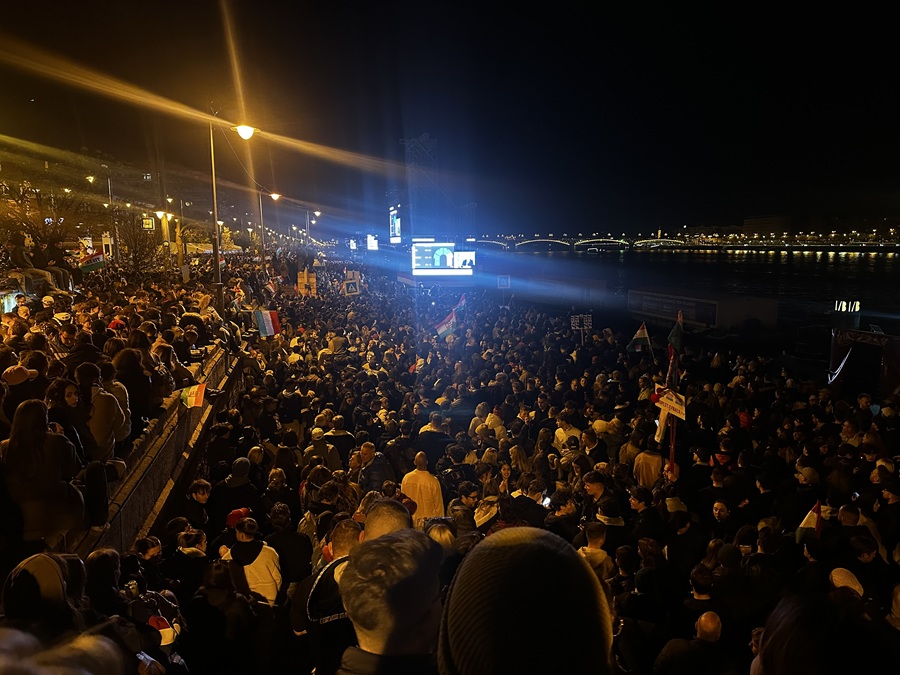
Image 1: Supporters of the Tisza Party follow the election results at the party’s election-night event held at Batthyány Square, Budapest. Photo by Julianna Ugrin

On the night of 12 April, in the wake of the landslide victory of the Tisza Party, Hungary erupted into collective euphoria. Images from election night quickly spread across global media, capturing an outpouring of emotion as people took to the streets not only in Budapest, but across the country. Many who experienced that night, including myself, felt they were witnessing a historic moment. This was not simply a parliamentary election producing a new government, it was a vote for full regime and elite change. Once again, Hungarians expressed a strong sense of belonging to their European allies and the illiberal and autocratic regime of Viktor Orbán, along with its left-liberal “progressive” opposition, was replaced.

This collective catharsis also reflected a deeper sentiment: for the first time in decades, Hungarians could truly claim the outcome as their own. Unlike earlier transformation shaped by global forces – such as the collapse of the Soviet Union – this result was driven by domestic political agency. In that sense, it felt like a belated regime change of 1990, when many Hungarians felt more anxious than relieved – rightly so – and did not perceive themselves as active participants in a transformation largely driven by external forces. It is telling that voter turnout in the first free elections of 1990 was only 65 per cent, while in other parts of the former Soviet bloc it exceeded 90 per cent.

This time, turnout approached 80 per cent. The Tisza Party secured a parliamentary supermajority with 53 per cent of the vote, while Fidesz received only 38 per cent. With this result, Péter Magyar (Prime Minister of Hungary) and his government received unprecedented legitimacy, which, of course, comes with enormous responsibility. There is immense social pressure to begin with a clean slate. It is therefore no surprise that the newly appointed head of the Prime Minister’s Office announced that one of the first measures would be the opening of socialist-era agent files, along with the establishment of an Asset Recovery Office to reclaim stolen assets and public funds misused by the Orbán regime.

What happened to the old opposition?

Since the crushing defeat of the Orbán regime, a number of essays, op-eds, and articles have already appeared, and deeper analyses and academic studies will certainly follow, seeking to draw lessons from the Hungarian case on how to defeat illiberal autocratic regimes (see also Pulay 2026). While the European Union and much of the world shared in Hungarian euphoria with a sense of relief, international and domestic commentators have expressed concern (Scheiring 2026) over the disappearance of left-liberal and progressive forces from the new Hungarian parliament, fearing that these perspectives would not be genuinely represented by Tisza. Many felt, understandably, that only various shades of the Right would now remain in parliament. Others saw Tisza’s victory as final proof of the country’s deeply conservative nature (Szakolczai and Eilenberger 2026).

However, by 2026, the left-liberal opposition’s work had become completely hollowed out. Opposition parties were reduced to a largely reactive identity-political force that, willingly or unwillingly, sustained Orbán’s Fidesz system while having long lost their social base, including the working class. It is revealing that, with the exception of the mass protests triggered by the so-called “slave law” (Overtime Act) (Szombati 2018) at the end of 2018, this opposition never meaningfully engaged with topics such as workers’ rights. Nor did they confront the underlying material and cultural forces of “double devaluation” (Kalb 2023) that had produced the class base of Orbán’s illiberalism in the first place.

At the same time, Orbán had meticulously created a system in which room was allowed for dwarf opposition parties focused on identity politics, thus maintaining at least the appearance of a functioning liberal democracy. The dynamic resembled a predictable political choreography between Fidesz and its opposition. The 2025 ban on Pride by Orbán, followed by the decision to organize the event with the support of left-liberal opposition politicians, was a case in point. Rather than joining the Pride march, Magyar and Tisza party continued to focus on its campaign centered primarily on economic and social issues. Their strategy aimed to address the concerns of a broader segment of society in order to unify the opposition. Magyar also understood that the persistence of these cultural wars at the center of political debate, cultivated for more than a decade by both Orbán and his opponents, had made regime change impossible.

Although the election swept away the left-liberal parties and their political elite alongside Fidesz, voters and politicians committed to leftist values did not disappear. Instead, they joined Tisza and its broader grassroots movement.

The rise of a counterhegemonic force from within

In recent years, Orbán’s illiberal hegemony had already begun to erode. In the wake of the COVID-19 crisis, Russia’s invasion of Ukraine, the drying up of European Union funds for Hungary, and a long series of poor governmental decisions, the economy has been in a bad shape for some time, causing significant material stagnation. Orbánism recorded the highest cumulative inflation in the EU since 2020, with prices rising by 57 per cent. The stark contrast between the material reality of average Hungarians and the unhinged corruption and extreme wealth of Orbán and his cronies became increasingly difficult to conceal. His hegemony was collapsing and the raw domination that had increasingly underpinned it was in plain sight (Éber 2025).

Amid the economic and moral exhaustion of the regime, the counter force emerged from within: Péter Magyar was an insider and for many years a loyal cadre of the Orbán regime. The landslide victory of Magyar’s Tisza Party – and its ability to bring about regime change – was preceded by two years of intensive work centered on a sustained nationwide tour and engagement with local communities. During this period, Magyar established dialogue with the rural majority, moving from village to village and from town to town. This experience distilled the core themes of his campaign.

Out of these encounters, local communities – civil society in its original sense – began organizing themselves into one of the largest grassroots movements of recent decades: the so-called “Tisza szigetek” (Tisza islands), which became the social backbone of the Tisza Party. Crucially, these were not formally part of the party, nor were they created by it. Rather, they were catalyzed by the emergence of Péter Magyar and the Tisza Party, evolving into a parallel social formation alongside it (Borbáth 2026).

Importantly, the main concerns of this social base centered on material issues: the dire poverty of workers, wage conditions, entrenched clientelism, working conditions, systemic corruption, and the erosion of public institutions essential to social reproduction such as health and education. These concerns formed the unifying core of Tisza’s campaign and produced a potentially counter hegemonic focus on everyday material concerns away from Orbán’s increasingly fictitious identity politics.

Nevertheless, these issues were in fact far from new. As a social anthropologist focusing on small business owners and conducting fieldwork in the countryside between 2015 and 2016 – at the height of the so-called migration crisis – I observed that the main concerns of my interlocutors revolved around much the same issues – even as people lived amid Fidesz’s hate propaganda and xenophobic hostility toward migrants, and the country was saturated with government posters conveying anti-Brussels hate messages.

Even during the relatively favourable global conjuncture between 2010 and 2019, when foreign capital and EU funds were flowing in, the structural problems of the economy and the labour market had persisted, particularly the extremely low taxation of capital, reaching as low as 3 per cent (Scheiring 2020) and the relatively high taxation of labour, despite the new flat tax (Scharle and Szikra 2015), which contributed to low incomes, a high level of undeclared employment and impeded formal job creation in small and medium-sized businesses. As a result, my interlocutors, small business owners, were often confronted with labour related issues, while self-employed workers were constantly hustling, working multiple shifts and combining various jobs simply to make ends meet. People managed to get by largely at the cost of self-exploitation. Meanwhile, formal labour became more flexibilized than ever, giving way to informal paternalistic mechanisms of labour control and surveillance (Szücs 2021). Fidesz’s ideology promoted a “work-based society” while curtailing workers’ interests. The so-called progressive side, meanwhile, had long abandoned the working class as well.

Contrary to the claim that the decline of left-liberal parties reflects an inherently conservative Hungarian society, value-mapping surveys indicate that majority of Hungarians lean economically left, with egalitarian and redistribution-supporting values remaining dominant, while only a small minority holds strong market-liberal views (Bíró-Nagy et al. 2022). This was clearly reflected in Tisza’s campaign and became the source of its success. To frame social and economic concerns, Tisza drew on national symbols and shared cultural references – Hungarian flags were everywhere. The reappropriation and rearticulation of the nation against an Orbánism that had turned it de facto against the demos proved a powerful mobilising any unifying tool, though it was often misinterpreted as evidence of an inherently conservative orientation.

The use of national symbols, including the Hungarian flag, may appear banal, but in a country where from the late 1990s the first Orbán government instrumentalised them for division, their reappropriation for democratic purposes carried a deeply liberating meaning for many Hungarians. It signified not ethno-national exclusion or national security vis a vis foreign forces, but rather a sense of popular democratic revival.

The new Tisza government was just inaugurated, so any full assessment of its policies remains premature. However, its general direction is already clear: strengthening ties with the European Union and reintegrating into its institutions; playing a more active role in Central European politics – Poland and Austria were the first to be visited after Brussels; diversifying energy sources in order to reduce dependence on Russia; rebuilding the rule of law and institutional frameworks, including going after misspent public money; restoring checks and balances; revitalizing the economy; strengthening public sectors such as education and healthcare; and reducing social inequalities.

Preliminary lessons learned

Liberal-left parties became embedded within Orbán’s illiberal system and failed, over sixteen years, to establish an effective counterhegemonic force, in fact replicating Orbán’s identity politics from the other side. Their focus on identity politics – largely shaped by Western liberal frameworks – proved politically powerless in the Hungarian context. The rediscovery of the material concerns of the broader population was crucial in Tisza’s victory.

A relentless presence on the ground, combined with the catalysis of a bottom-up grassroots movement, helped to counterbalance the omnipresent, increasingly AI-driven, fear-based propaganda of Fidesz. At the same time, the election was smartly framed as a choice between East and West, to which the Hungarian majority, always already pro-European, responded strongly. The Hungarian case demonstrates that what counts as “progressive” is context-specific, shaped by history, socio-political structure, and culture. Rather than relying on a priori assumptions of what progressive politics is and how progressive forces should respond to far-right and authoritarian challenges, it shows that credible political alternatives must be locally anchored and socially meaningful in order to succeed.


Luca Szücs is an anthropologist with a PhD from the Martin Luther University Halle-Wittenberg and the Max Planck Institute for Social Anthropology. After working at the International Labour Organization (ILO) headquarters in Geneva, she now works as an independent consultant on labour-related topics. Her research and writing explore the changing world of work, as well as the politics, society, and culture of Eastern Europe through historical and ethnographic perspectives.


References:

Éber, Márk Áron. 2025. “Viktor Orbán’s politics of knowledge, intellectuals, and institutions in the light of Gramsci’s ideas.” In Laboratorio dell’ISPF 22. http://www.ispf-lab.cnr.it/system/files/ispf_lab/documenti/2025_BRM.pdf

Bíró-Nagy, András et al. 2022. Magyarország értéktérképe 2022. Friedrich-Ebert-Stiftung – Policy Solutions. https://real.mtak.hu/155579/1/Policy%20Solutions_Magyarorsz%C3%A1g%20%C3%89rt%C3%A9kt%C3%A9rk%C3%A9pe%202022.pdf

Borbáth, Endre. 2026. “Explaining Tisza’s Hungarian breakthrough” The Loop, April 12. https://theloop.ecpr.eu/explaining-tiszas-hungarian-breakthrough/

Kalb, Don. 2023. “Double devaluations: Class, value and the rise of the right in the Global North.” Journal of Agrarian Change, 23(1), 204–219.

Pulay, Gergely. 2026. “Post-feudalism and post-fascism at the end of the Orbán-regime in Hungary” FocaalBlog, May 6. https://www.focaalblog.com/2026/05/06/gergely-pulay-post-feudalism-and-post-fascism-at-the-end-of-the-orban-regime-in-hungary/

Scharle, Ágota and Dorottya Szikra. 2015. “Recent Changes Moving Hungary Away from the European Social Model” in The European Social Model in Crisis: Is Europe Losing Its Soul?, edited by Daniel Vaughan-Whitehead. Cheltenham: Edward Elgar.

Scheiring, Gábor. 2020. The Retreat of Liberal Democracy: Authoritarian Capitalism and The Accumulative State in Hungary. Cham: Palgrave Macmillan.

Scheiring, Gábor. 2026. “Democracy After Orbánism?” Jacobin, May 5. https://jacobin.com/2026/05/hungary-magyar-democracy-orbanism-technocrat

Szakolczay, Árpád and Wolfram Eilenberger: “What does Péter Magyar’s election mean for Hungary and Europe?” University of St. Gallen Newsroom April 16. https://www.unisg.ch/en/newsroom/what-does-peter-magyars-election-mean-for-hungary-and-europe/

Szombati, Kristóf. 2018. “Protesting the “slave law” in Hungary: The erosion of illiberal hegemony?” Focaalblog, December 28. https://www.focaalblog.com/2018/12/28/kristof-szombati-protesting-the-slave-law-in-hungary-the-erosion-of-illiberal-hegemony/

Szücs, Luca. 2021. “Moral Economy and Mutuality at Work: Labour Practices in Tobacco Shops”. Pp. 57 – 75 in Moral Economy at Work, Ethnographic Investigations in Eurasia, edited by Lale Yalçın-Heckmann. Berghahn: New York – Oxford.


Cite as: Szücs, L. 2026. “Populism in retreat? Lessons from Orbán’s downfall” Focaalblog, May 13. https://www.focaalblog.com/2026/05/13/luca-szucs-populism-in-retreat-lessons-from-orbans-downfall/
Gergely Pulay: Post-feudalism and post-fascism at the end of the Orbán-regime in Hungary

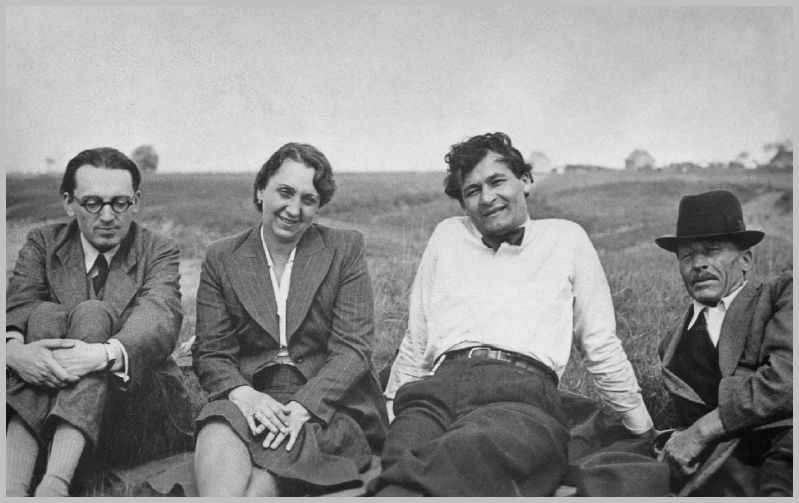
Image 1: István Bibó (on the left) and Ferenc Erdei (second from the right) in the company of sociologist-psychologist Viola Tomori and Erdei’s father in 1940. Photo source: Wikipedia.

With the global rise of illiberalism in the twenty-first century, the reputation of Viktor Orbán’s regime has far exceeded Hungary’s actual geopolitical and economic weight. During late-socialism and around 1989, high profile international discourse on Hungary was shaped by the relationship of Hungarian dissident intellectuals and their Western friends (Harms 2025). Under Orbán, Hungary’s friends became autocratic leaders and far right politicians, and the exchange of ideas took place within transnational networks of knowledge production as a backdrop for an emerging illiberal international in Europe and beyond (Végh 2025). Now that Orbán’s regime is suddenly over as a result of this spring’s electoral revolt, Hungary’s local-global history as political laboratory seems to be entering a new phase, defined by the prospects of overthrowing illiberal regimes. A multitude of commentators are seeking to answer the question of how Orbán was defeated, hoping that the answer may have implications for the struggle against similar leaders in other countries.

The conferral of the political laboratory status often occurs alongside a near-complete disregard for social and intellectual history. Dominated largely by political science and commentary, studies of illiberalism tend toward analytic presentism and theorization in the negative, construing their object of scrutiny as a recent challenge, a style of leadership that does not fully correspond to the normative ideals of liberal democratic conduct. Illiberals reject the universalist criticism directed at them over corruption or the abuse of power, claiming that such critique is just an expression of liberals’ disrespect towards local custom and culture.

In my recent work, I trace a genealogy of two key words, or emic intellectual concepts—post-feudalism and post-fascism—to provide a historically and socially embedded account of the fatal symbiosis we today call illiberalism. These two concepts are rooted in the work of two towering figures of Hungarian social thought, István Bibó and Ferenc Erdei, who developed their main ideas as critics of admiral Horthy’s interwar authoritarian regime and then in the immediate aftermath of World War II (Bibó 2015, Erdei 1988), After the communist takeover, Bibó was marginalized, while Erdei became a high-ranking politician, but in 1956, they both became members of Hungary’s revolutionary government. As I return to it below, at the end of Fidesz’s first term in power in 2002, philosopher Gáspár Miklós Tamás described Orbán’s rule as an autocracy based on personal dependence, in other words a fatal symbiosis of post-feudalism and post-fascism.

Post-feudalism

Hungarian interwar populist progressives criticized the system of large landownership, monopolies and the redistribution of the national wealth by oligarchs who belonged to a political clientele. In their footsteps, generations of social critics engaged with forms of contingent closure, relying simultaneously on the categories of class and estate rather than reducing one to the other (Böröcz 1997). The concept of post-feudalism (utórendiség) was developed by Ferenc Erdei and his intellectual followers.In post-feudalism, the economic sphere has been thoroughly reshaped by capitalism (hence the ‘post’), yet the dominant logic of inequality remains a rank-based hierarchy of privilege and allegiance, entrenched in a political and administrative system in which the supremacy of the nobility—the ruling estate—persists behind the façade of parliamentary arrangements.

The practical side of post-feudalism is clientelist domination, based on the exchange of loyalty and support for guarantees of security and well-being—or simply the right to exist—between partners in unequal positions of power. In the period between the commodification of land in the mid-nineteenth century and the state-socialist collectivisation of agriculture, patron-client relations functioned as an institution that mitigated the consequences of polarization among different strata of the peasantry—such as landed farmers, smallholders, and landless day labourers within the same village community (Fél & Hofer 1973). As a system of domination and dependence, such networks of kinship and friendship regulated the flow of labour, services, and material goods, as well as the distribution of political loyalty. In clientelist transactions, participants placed strong emphasis on the idea of horizontal camaraderie or the ethics of mutual aid, even while remaining acutely aware of the inequalities between their positions. The wealthy benefited at the expense of the poor, who nonetheless took part in maintaining the relation for reasons of prestige (membership) and the expectation of return service. While clients could criticize their patrons in informal settings, open dissent—particularly in elections—was effectively prohibited.

Depending on the concentration of wealth and power, post-feudal arrangements may involve divergent forms of patronage, brokerage or atomized advocacy. Especially in the initial Stalinist version, the state-socialist regime managed to incorporate clientelism by the organization of the party-bureaucracy or nomenklatura, based on the principle of top-down appointment. In exchange for assistance in advancing their careers, clients carried out their patrons’ policies. (Szelényi & Mihályi 2020: 43) From the 1990s, local entrepreneurs in rural Hungary competed for monopolistic privileges to get access to profit flows by retaining some leverage (i.e. power over the distribution of advantages and disadvantages) and safeguards in relation to the state as well as business partners, banks and customers. Hierarchical forms of mutual obligation provided durable ways to bind the labour force to entrepreneurs as much as local constituencies to their political leaders. Amid the relative absence or decline of universal services, everyday problem-solving became increasingly synonymous with the pursuit of preferential treatment, entitlements, or various micro- and macro-privileges. At the same time, in the post-socialist political field, different factions established durable alliances with party-affiliated companies and economic elites that received competitive advantages and orders from governments in exchange for party and campaign financing (Stark & Vedres 2010). Post-socialist policies of austerity gave rise to a multitude of lobbies and strategies of informal and personalized bargaining to gain exemptions, concessions and favours. With Orbán’s rise to power in 2010, post-feudal arrangements took on an ever more centralized and systematic form. Relations of clientelism and brokerage were increasingly facilitated by the central state—as in case of workfare, the governance of poverty by discretionary power delegated to local mayors (Kovai, Pulay & Szombati 2022)—while minor corruption such as in hospitals was increasingly policed. With parliamentary super-majority, funding from the EU and some economic growth after the recovery from the financial crisis of the late-2000s, Orbán’s ruling estate was profiting from semi-peripheral capitalist integration through monopolizing the resources available through the state, without being held accountable for their misdemeanours. Still, these arrangements were not based on total consent. The introduction of new bills (including the one curtailing labour rights, or the amendments of the constitution) drew large crowds to the streets, but protests had virtually no effect on the ruling party’s decisions. By the early 2020s, popular criticism had become a common feature of everyday talk among ordinary Hungarians who were yearning for normal lives and ‘barking at politicians’ (Jansen 2015) mostly in restricted, confidential and friendly settings, without any necessary implication for their formal political participation or electoral behaviour. Post-feudal forms of domination continued to persist through the gift-like exchange of obligations and channels of atomized advocacy, accompanied by parallel publics and rampant forms of doublespeak. In Orbán’s Hungary, such apparent imperfections of hegemony were to be resolved by the more explicit forms of illiberal propaganda.

Post-fascism

If post-feudalism is a form of hierarchical organization, post-fascism is rather a vision or ideology of hierarchy. In a predominantly rural country like Hungary, twentieth-century fascism responded to economic crisis and a widespread sense of cultural decline by promoting the (re-)invention of supposedly archaic traditions, and the idea of collective rebirth after the elimination of the nation’s ‘others’. Conceiving hierarchy as natural, fascism subdued class-based differences to the principle of the racialized community (Kékesi 2023).

Post-fascism became a core concept in the work of Gáspár Miklós Tamás, following his profound disillusionment with post-socialist liberalization (Tamás 2000, 2002). The concept was inspired by the work of István Bibó, particularly his notion of ‘political hysteria’ from the 1940s, which GM Tamás sought to reframe for the conditions of the twenty-first century. Post-fascism describes a movement within global capitalism that reverses the Enlightenment tendency to equate citizenship with the human condition. In continuity with twentieth-century fascisms, it represents hierarchy as natural and seeks to reinforce the division between sub-political humanity and the privileges or elevated status of ‘proper’ citizens. Post-fascism denies the possibility of reconciliation between groups defined by gender, ethnicity, ‘race,’ or religion. Inter-group relations are instead construed as a domain of existential struggle, in which one side’s gain necessarily entails the other’s loss. This denial of reconciliation produces a vision of the social world in which the common good becomes unintelligible beyond the loyalties of the hierarchical in-group.

In Hungary, amid severe economic and social crises following the fall of state-socialism in 1989-1990, the demand for legitimation increased in a weakened state. Citizens harboured illusions about the protective capacities of state dependency in an attempt to find rescue from the terrifying outcomes of capitalism. The politics of refeudalization eroded and bypassed the entire system of impersonal administration, the rule of law, and bureaucracy by dismissing them as non-national institutions. Thus, understanding its manifestations merely as corruption misses the system’s core dynamics. Refeudalized power binds individuals and groups by concessions, exemptions, waivers, posts, titles, ranks, informal access to goods and services granted outside the statutory scheme (see also: Szalai 2017). Politicians of the new right salvaged what they could from crumbling nation-states, acting as operators of wealth and institutions extracted from the state on territory left behind by global capital. Two main pillars of Orbán’s ideology can be identified: the idea of permanent war against internal and external ’aliens,’ and an understanding of politics as structured by the existential fear for the community. Orbán’s anti-liberalism promised protection from the very minorities that liberals sought to protect against the ‘normal’ (hardworking, heterosexual and obedient) majority. Amid growing economic and social insecurity, majoritarian neo-nationalisms appropriate the language and modes of claim-making originally developed for the recognition struggles of minorities or the truly disadvantaged (Gille 2010). The inversion of human rights liberalism is central to the project, as exemplified by the construction of the white Christian majority as a vulnerable category in need of privileged protection against the threat of becoming a minority in its own homeland. This parasitic dependence on liberal discourse reflected the symbolic dimension of the Orbán-regime’s material dependence on EU-funding—at least while such funding remained available.

What comes next?

Orbán’s downfall resulted from a rare convergence of geopolitical, economic and moral crises. Péter Magyar’s Tisza party and movement emerged as a specialized task force aimed at confronting Orbán’s regime through a broad populist coalition that seeks to liberate suppressed creative energies and defend life itself from a parasitic elite (cf. Rajković 2023). Magyar’s credibility was reinforced by his former insider status within the Orbánist ruling estate, providing him with in-depth knowledge of the regime’s inner workings, akin to the role of former mafia members in anti-mafia struggles (cf. Rakopoulos 2017). Magyar relates to Orbán similarly to the way reform-socialists once related to Stalinists whose crimes they have rejected.

The post-Orbán moment is marked by ambivalence: euphoria, relief and hope coexist with a sense of loss and sacrifice. In states of collective effervescence, we tend to experience heightened clarity regarding temporal divisions between the old and new, as well as social divisions between the victims and perpetrators. Later, however, these distinctions appear more complex, as the experience of shared suffering becomes intertwined with recognition of shared complicity. The new Hungarian parliament is comprised of different conservative, right-wing parties and that should give an impetus for new political movements and platforms that we do not yet see. Fidesz has become a mid-sized party representing predominantly rural, less-educated, elderly, and poorer voters, which should serve as a warning sign for anyone concerned about social inequalities and another backlash.

One of the corrosive effects of illiberal hegemony has been the erosion of critical imagination. In this context, I propose to revisit theoretical ideas from the past in order to reclaim their critical potential in the present, to envisage alternatives for the future. Post-feudal or clientelist social arrangements are often criticized in the name of meritocracy or the autonomous, rights-bearing individual. However, they can be even more powerfully criticized for the way in which—behind the façade of mutual aid—they undermine horizontal forms of association, class-based solidarity and shared claim-making in the name of the commons. Together with anti-fascism, and alongside the more familiar de-colonial agenda, the project of de-clientization should go beyond the critique of specific elites in order to challenge the broader patriarchal mode of social reproduction. For the time being, it is worth recognizing that a huge majority of Hungarian voters expressed their readiness to accept change as a forward-looking condition—even as something desirable—rather than associating it with threat and danger, as Orbán’s propaganda has done for sixteen years.


Gergely Pulay is a sociologist and social anthropologist, Research Fellow at the ELTE Centre for Social Sciences in Budapest. His research interests include urban marginality, value and livelihood and intellectual history in Hungary and Romania.


References

Bibó, István. 2015. The Art of Peacemaking: Political Essays by István Bibó. Yale University Press.

Böröcz, József. 1997. ‘Stand Reconstructed: Contingent Closure and Institutional Change.’ Sociological Theory 15(3): 215-248.

Erdei, Ferenc. 1988. Selected writings. Akadémiai.

Fél, Edit and Tamás Hofer. 1973. ‘Tanyakert-s, Patron-Client Relations, and Political Factions in Átány.’ American Anthropologist 75(3): 787-801.

Gille, Zsuzsa. 2010. ‘Is there a Global Postsocialist Condition?’ Global Society 24(1): 9-30.

Harms, Victoria. 2025. The Making of Dissidents: Hungary’s Democratic Opposition and Its Western Friends, 1973-1998. University of Pittsburgh Press.

Jansen, Stef. 2015. Yearnings in the Meantime. ‘Normal Lives’ and the State in a Sarajevo Apartment Complex. Berghahn Books.

Kékesi, Zoltán. 2023. Memory in Hungarian Fascism. A Cultural History. Routledge.

Kovai, Cecília, Gergely Pulay and Kristóf Szombati. 2022. ‘Building the ‘work-based society’: State-enabled grassroots clientelism and the re-establishment of order in present-day Hungary’ Paper presented at EASA2022 Belfast: Transformation, Hope and the Commons.

Rajković, Ivan. 2023. ‘Whose death, whose eco-revival? Filling in while emptying out the depopulated Balkan Mountains’ Focaal 96: 71-87.

Rakopoulos, Theodoros. 2017. From Clans to Co-ops. Confiscated Mafia Land in Sicily. Berghahn Books.

Stark, David and Balázs Vedres 2010. ‘Structural Folds: Generative Disruption in Overlapping Groups’ American Journal of Sociology 115(4): 1150-1190.

Szalai, Erzsébet. 2017. ‘Refeudalization.’ Corvinus Journal of Sociology and Social Policy 8(2): 3-24.

Szelényi, Iván and Péter Mihályi. 2020. Varieties of Post-communist Capitalism. A comparative analysis of Russia, Eastern Europe and China. Brill.

Tamás, Gáspár Miklós 2000. ‘On Post-Fascism’. Boston Review. https://www.bostonreview.net/articles/g-m-tamas-post-fascism/

Tamás, Gáspár Miklós 2002. A helyzet. (‘The situation.’) Irodalom Kft.

Végh, Zsuzsanna 2025. ‘Rewriting the European Project? The balance and implications of Fidesz’s illiberal alliance-building in Europe.’ Wrocław: College of Eastern Europe. https://www.kew.org.pl/en/2025/05/05/rewriting-the-european-project-the-balance-and-implications-of-fideszs-illiberal-alliance-building-in-europe/


Cite as: Pulay, G. 2026. “Post-feudalism and post-fascism at the end of the Orbán-regime in Hungary” Focaalblog, May 6. https://www.focaalblog.com/2026/05/06/gergely-pulay-post-feudalism-and-post-fascism-at-the-end-of-the-orban-regime-in-hungary/

Kristóf Szombati: Protesting the “slave law” in Hungary: The erosion of illiberal hegemony?

In recent weeks, Hungary has again made international headlines. This time, it was a popular movement born out of resistance to the latest rewriting of the labor code—which the ruling Fidesz party had already modified in 2011 to the benefit of employers—that made the news. On 12 December, amid chaotic scenes in the National Assembly (where opposition MPs sought to obstruct the voting procedure), Fidesz passed a law that raises the maximum amount of overtime employees can work from 250 to 400 hours a year, and gives employers the freedom to delay payment for overtime work by up to three years. A similar amendment had already been proposed last year but was quickly withdrawn after the government realized the unpopular measure could dent Fidesz’s popularity in the run-up to this spring’s parliamentary election. Off-the-cuff comments made by Fidesz representatives have revealed that the law was reintroduced to satisfy German carmakers who are facing an increasingly acute labor shortage in a low-wage economy that a sizeable segment of the labor force has left behind to take up better-paid work in Austria, Germany, and other Western European countries.

Continue reading

Chris Hann: Hayek versus Polanyi in Montréal: Global society as markets, all the way across?

The workshop “Geographies of Markets”—hosted over three days in mid-June 2017 by the Karl Polanyi Institute of Political Economy at Concordia University, Montréal—gave scholars from a wide range of countries and disciplines an opportunity to assess the continued relevance of the Polanyian critique of “market society.” Even if this critique lacks the formal rigor of neoclassical economics, even if Polanyi’s concept of market exchange fails to capture the institutional intricacies of contemporary markets, and even if the man himself was very much a European intellectual of his age, his approach still appears to provide the best scientific foundation on which to build global political and normative alternatives to neoliberal hegemony. Today, however, his geographic binary between East and West, like his ideal types of redistribution and market exchange, all need careful reappraisal.

Continue reading

Prem Kumar Rajaram: Beyond crisis: Rethinking the population movements at Europe’s border

This post is part of a series on migration and the refugee crisis moderated and edited by Prem Kumar Rajaram (Central European University).

Crisis
The refugee crisis in Europe is fabricated. Like most “crises,” the recent onset of people from Syria, Iraq, Afghanistan, Bangladesh, and Pakistan trying to cross into the European Union is a representation. Anxiety and specific readings of law and humanitarianism frame this issue. This framing works inward as well as outward. Inward, it establishes a dominant regulating norm—an idea of “the refugee”—that allows for internal comparison and inequalities (people are said to have varying rights to protection). Outward, the framing helps create an understanding of a complex situation—an abstracted understanding—and allows for policy makers and commentators to treat “the refugee crisis” as an exceptional condition. As exception, that crisis appears to be regarded and treated as an “event” distinct from the political “norm,” and it enables a vertical form of politics. The crisis is the state acting as it tends to, as a protection racket in Charles Tilly’s memorable take, defining a danger or threat that strengthens its force and its hold over territory.
Continue reading

Chris Hann: The new Völkerwanderungen: Hungary and Germany, Europe and Eurasia

Hann1

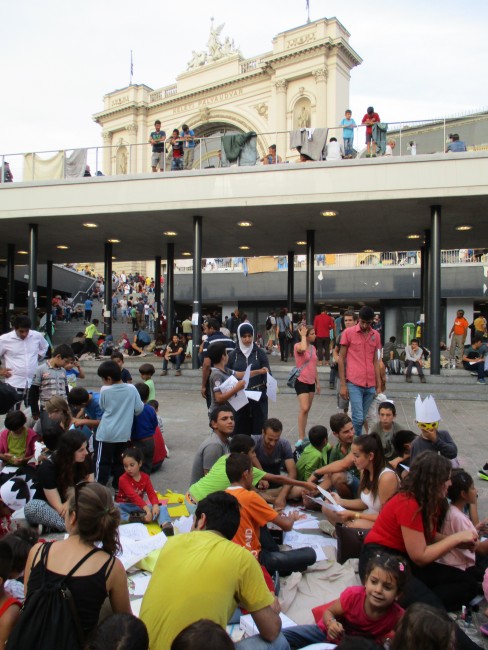
I spent the last weeks of August and the first days of September in Hungary, close to the European Union’s border with Serbia. Never before had a routine field trip catapulted me into an engagement with issues dominating daily headlines, both in Hungary and elsewhere. What light can social anthropology throw on the current “migrant crisis”?
Continue reading