Tag Archives: resistance

Bjørn Enge Bertelsen: Pots that go bang in the night: Noise and rhythm as enacting popular security amidst political protest in Mozambique

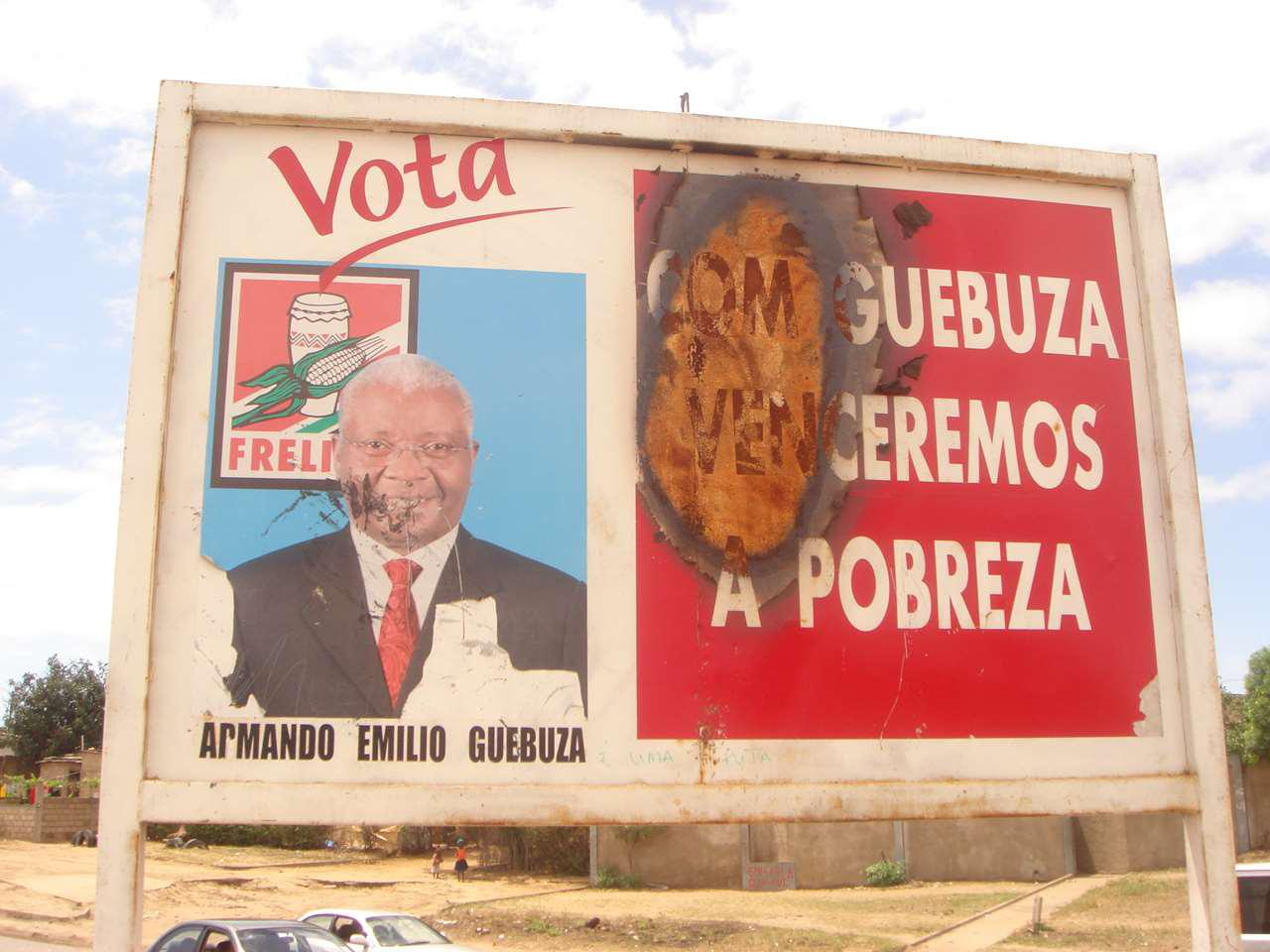
Image 1: Photo of an election poster for former Mozambican president Armando Guebuza. The poster burnt down and destroyed in relation to the uprisings in Maputo 2010. Photo by author

Introduction

The pots and pans that were banged at night in Mozambique in late 2024 and early 2025 are now silent. However, their legacy is neither muted nor forgotten—reflecting similarly the trajectories of other forms of protest the last decades which has shaken Mozambique and, especially, its ruling party (see Bertelsen 2014).

What unfolded was extraordinary: The country’s heavily contested presidential and parliamentary election of 9th October 2024 was followed by loud street-based protests and riots across Mozambican cities which were often met with brutal violence by police and security forces. The clashes between young men and the police left around 400 dead and thousands injured.

Here I would like to draw attention to a form of protest that was somewhat eclipsed by the street-fighting, namely the banging of pots by female protestors in their homes and on the street. These female protestors engaged the collective sensorium of urban citizens and shifted the very sense of security and insecurity in this highly unpredictable political situation. Beating pots—on balconies, in courtyards, in kitchens with open windows and in the streets—mediated the population’s sense of insecurity, amounting to a gendered form of collective rejection of the violence of the state apparatus. For Mozambique, this marked a definite shift in terms of both the participation and the format of political opposition in the country, the noise also, crucially, instilling fear in the erstwhile security apparatus and the police

Maputo 2024 and 2025: Protests, rhythm, collective security

Centuries of Portuguese colonial rule and violence ended with liberation in 1975 at the hands of Frente de Libertação de Moçambique (Frelimo – Front for the Liberation of Mozambique). In the half-century that followed, Mozambique has seen ongoing civil war conditioned respectively by Cold War dynamics (1976/77-1992), experiments in Afrosocialism (1980s), and multiparty elections from 1994 onwards. Given the merging of the Frelimo party with the Mozambican state apparatus in this period (Bertelsen 2016), few were surprised when Frelimo won in October 2024, securing the party elite victory in both the parliamentary and presidential elections.

However, in Mozambique’s last election Frelimo attained a majority so improbable that it defied even the most cynical of expectations among experts and citizens alike. For instance, ghost armies of voters—politically loyal subjects conjured from the realms of both the living and the dead—were called up to attain majorities for Frelimo in districts widely known as opposition party strongholds. Rampant ballot-stuffing bolstered other draconian moves, including manipulation of the country’s complex vote-counting system and widespread voter intimidation.

Formal complaints by the opposition were initially quashed, deepening the unpopularity of Frelimo. Protestors rapidly took to the streets and engaged police and security forces in sustained battles. By 27 January 2025, 313 protestors were registered as killed. While there had been protests against previous elections, the scale, form and distribution surpassed these (Feijó and Chiure 2025a, 2025b).

Central to the protests unfolding over several months was how Venancio Mondlane—popularly called VM7 and the founder of a new opposition party—emerged to contest the result. His firebrand speeches drew heavily on his background as a pastor in the Pentecostal church Igreja Ministério Divina Esperança. VM7’s dramatic contestation included well-orchestrated social media broadcasts from his exile in South Africa and a dramatic heroic re-entry into Maputo on 9 January 2025 where he was greeted like a hero—all cast, recast and morphed on social media.

Revisiting such events in November 2025, these months of unrest and protests also assumed a new and, for Mozambique, unprecedented shape—or, better, shapelessness. Evading the violence of the streets and residing within their apartments, on balconies or in courtyards, every night, female citizens banged their pots and pans for hours, chanting slogans against the Frelimo regime and the stolen election, sometimes accompanied by blowing whistles. In many video clips circulating on social media, one may see that the officers from the police force and the security apparatus are visibly affected by the noise surrounding them, treading more carefully and being visibly nervous.

The format, scale and space of these protests and how they affect also those meant to exert control on the streets, mark a shift in the Mozambican political landscape as the rhythms of protest were also emitted from areas of Maputo inhabited by segments of the population often characterised as wealthy or upper middle class—groups commonly perceived as allied with or integral to the Frelimo-state and not previously having been important parts of protests. Further, it is equally surprising, therefore, that Taela (2025: 6) and others suggest that it was initiated in Eduardo Mondlane University’s student housing—where banging pots was accompanied by throwing books and papers out of the windows onto the streets. Clips of protests have continuously filled the pluriverse of social media and across Maputo residents were informed about what was happening, including both wealthy areas downtown, as well as poorer areas, such as in the bairros Mafalala, Maxaquene, and Chamanculo. Some of the first images and clips surfaced immediately after the election and soon came to visually and graphically dominate several of the popular digital channels Mozambicans follow.

In the weeks and months to follow, the banging of pots rapidly turned into a massively popular mode of protest, mobilising especially women and girls and inserting them into a politics of resistance against the stolen elections. As Taela notes (2025: 6, my translation from Portuguese):

The pots and pans only came out of the cupboards at night, after protesters faced extreme police repression on the streets during the day. Banging pots and pans, known as panelaço, emerged as a strategy for those who wanted to protest but did not want to do so on the streets.

As shown in the many clips on social media, noise started after dark and the rhythms churned out from households were often rapid and intense — rhythms sometimes layered, with sounds ranging from the metallic drum of cheap aluminium pots to the deep humming of cast iron kitchenware. Many clips capture entire neighbourhoods banging in synced rhythm—but, crucially, with few of the protestors being visible.

The repeated banging of pots generated a sense of unification, collectivity, and participation mirroring the mass congregations that usually define street protests but in this case often marked by becoming heard, not seen, as well as being nocturnal, not diurnal. On the street in the same clips, one may see the heavily armed state security forces moving uncertainly through the dimly lit streets, navigating endless cascades of drumming and humming being poured over them. In some clips, the same forces nervously fire teargas grenades against balconies only to be met by a more massive wall of noise.

In many respects, Maputo’s panelaço of 2024 and 2025 constituted an act of resistance that transcended electoral and party-political registers: By amplifying and transmogrifying the soundscape of food-preparation from the individual households and into the public sphere, also collectivizing the sounds, what was repelled by noise was not only ghostly voters but also ossified politics, societal structures, and the gendering of space. This was also an explicit subtext in the many items on social media, namely that women were banging pots to be audibly present as a collective and that women’s politics should be recognized. In many of the acts, including during daytime, women set up kitchens in the streets where they cooked for protestors— extending the private realm of the kitchen onto the violently contested public spaces. Thus, these protests and practices may also be seen as extending care for others in its most inclusive sense. The symbolic importance of the pots should not be underestimated, as noted in a Facebook post by Zito Ossumane that was widely shared in Mozambique (translated from Portuguese):

The pots and pans, in a desperate gesture, decided to speak. They sacrificed themselves, banging against each other in a metallic hymn, invoking the god of kitchens and stoves. It was a collective prayer, a cry for help that spread throughout Mozambique, as if the noise of one neighborhood could travel through the bowels of the entire country. […] The revolution of the pots and pans has already begun. May the revolution of everything else come.

Panelaço: Shifting timespace, generative noise, sonic agency

The nocturnal banging of pots and their rhythm—synchronicity and non-synchronicity, collectivity and not—is not unique to Mozambique nor to postcolonial Africa. Writing on Paris and the 2016 nocturnal Nuit Debout protest—a form of charivari protest well-known from across Europe and North America—Shaw (2017: 117) notes “that the move to the night might be seen as an attempt to find a timespace in which a more open and creative politics is possible, strategically responding to the reduction in the freedom to protest in the more heavily surveyed day.”

Precisely the evasion, the slipping away into the night, the search for other than a securitized and striated space, is central here; in Paris the hypersurveilled urban spaces and in Maputo the security forces and their oftentimes indiscriminate diurnal violence exacted on protestors and civilians. Both index long-standing practices of evading statist domains of control, surveillance and, ultimately, notions of security defined by a central government. Further, in such evasion there is also a blurring of the public and private as protestors would often be confined to homes due to the imposed nightly curfew, left to consume news on TV or social media. Engaging in banging pots and pans may, in some sense, be interpreted as an inclusive, low-stakes form of protest, reflecting other social media activism as a facile way to “vent frustration” by protesting from the comfort of your home. However, here the Paris and Maputo cases diverge somewhat as in the latter those banging the pots were constantly fearing teargas grenades and shots launched at their balconies—as well as the volatility and violence of the situation being underscored by the number of casualties in daytime street protests.

Within contexts that are increasingly conditioned by non-democratic forms of securitization—including places like Mozambique—we, as anthropologists, also need to shift our attention to include the full sensorium: our own and of the fellow humans we engage. This includes exploring also what is entailed by “radical listening”, as Brandon LaBelle has called it. He also notes that “from an insurrectionary urgency, gestures and acts are made that force into being a heterogeneous space of social becoming, whose weakness or invisibility, whose transience or strangeness upset or elide established structures to produce what I think of as unlikely publics” (LaBelle 2018: 14-15).

Arguably, the nocturnal beating did produce what we might, with LaBelle, call “unlikely publics” with noise, rhythmicity, and the rearticulation of the quotidian kitchenware into powerful messages of distrust, assertiveness, collectivity. These forms also carved out yet another terrain for a gendered and classed form of political agency in a violent, state-orchestrated security state environment, instilling fear in the powers-that-be and their agents in the streets

Noise against the nocturnal body of democracy

The political theorist Achille Mbembe connects the nocturnal to various capacities and dimensions of the postcolony in many of his writings (Mbembe 2003). Crucially, he draws our attention to what he calls “the nocturnal body” of democracy. This is a form of organ constituted by the (often hidden) violent parts of democracy and statecraft, exemplified by the plantation and the penal colony.

The image of the nocturnal body aptly captures the shape of the postcolonial state of Mozambique and its long-standing impulse to deploy violence against its citizens—both at day and night (see Machava 2025). However, what is spectacular about the protests in Maputo in 2024 and 2025 and the many incarnations of citizen-led uprisings before that (Bertelsen 2014; de Brito 2017), is that the body of the populace unites through rhythms the source of which is invisible yet tangibly, corporally, and sensorially experienced.

The paradoxical combination of tangible and elusive in the nocturnal acts of panelaço showcase protests that are multivocal, yet highly gendered through transforming quotidian objects into vessels for resounding, collective rhythms of resistance and protests. Crucial here is also the enshrouding in darkness of protestors, effectively obscuring the waxing and waning numbers of those who beat the pans—although the many deformed pots and pans are there for everyone to see during daylight. It also underscores the possibilities inherent in the pliability of the political that is attained via collective (but not organized) efforts, indexing also the forms of articulation available in the restrictive political ontology dominating Mozambique (cf. Sumich and Bertelsen 2021).

This in situ generation of a sensorium of security beyond both the state and the marketized commodity form of metal gates, guards, guns, and alarms is significant and is a form of protest with long historical roots that has become globalised—from Argentina to France, from Canada to the Philippines. In Mozambique, its collective format is poised against the massive nocturnal body of the one-party state and its street-level presences. Finally, if noise should be approached as generative, as suggested by Serres (2007 [1980]), then the nocturnal beating pots, the rhythmic banging and its endless recursivity, as reproduced and shared by digital channels, generates an enduring, common sonic space of collective security against the violence of the state’s nocturnal body.


Bjørn Enge Bertelsen is professor of social anthropology at the University of Bergen. He has published on political violence, postcolonialism, urban transformation, and socio-cultural dynamics, most of which is based on his long-term research in Mozambique since 1998.


References

Bertelsen, Bjørn Enge. 2014. Effervescence and Ephemerality: Popular Urban Uprisings in Mozambique. Ethnos, 81(1): 25–52.

Bertelsen, Bjørn Enge. 2016. Violent Becomings: State Formation, Sociality, and Power in Mozambique. New York: Berghahn Books.

de Brito, Luís, ed. 2017. Agora eles têm medo de nós! – Uma colectânea de textos sobre as revoltas populares em Moçambique (2008-2012). Maputo: Instituto de Estudos Sociais e Económicos (IESE).

Feijó, João, and Rita Chiúre. 2025a. “Afinal ‘foi só Maputo’? A geografia do protesto pós-eleitoral”. Destaque Rural #324. Maputo: Observatório do Meio Rural (OMR).

Feijó, João, and Rita Chiúre. 2025b. “Quem saiu às ruas? Uma análise dos actores em protesto durante as manifestações pós-eleitorais”. Destaque Rural #331. Maputo: Observatório do Meio Rural (OMR).

Machava, Benedito Luís. 2025. The Morality of Revolution: Reeducation Camps and the Politics of Punishment in Socialist Mozambique, 1968–1990. Ohio University Press.

Mbembe, Achille. 2003. “Life, Sovereignty, and Terror in the Fiction of Amos Tutuola.” Research in African Literatures 34(4): 1–26.

Serres, Michel. 2007 [1980]. The parasite. Minneapolis: University of Minnesota Press.

Shaw, Robert. 2017. “Pushed to the margins of the city: The urban night as a timespace of protest at Nuit Debout, Paris.” Political Geography 59:117-125.

Sumich, Jason and Bjørn Enge Bertelsen. 2021. “Just out of reach: Imminence, meaning and political ontology in Mozambique”. Current Anthropology, 62(3): 287-308.

Taela, Kátia. 2025. “A ‘Revolução das Panelas’: Mulheres, Crise de Cidadania e Protestos em Moçambique Contemporâneo”. Destaque Rural #337. Maputo: Observatório do Meio Rural


Cite as: Bertelsen, B. E. 2025. “Pots that go bang in the night: Noise and rhythm as enacting popular security amidst political protest in Mozambique” Focaalblog December 24. https://www.focaalblog.com/2025/12/24/bjorn-enge-bertelsen-pots-that-go-bang-in-the-night-noise-and-rhythm-as-enacting-popular-security-amidst-political-protest-in-mozambique/
Omid Mehrgan: Palestine the Wound: A Report on the Iranian Reception of the Cause

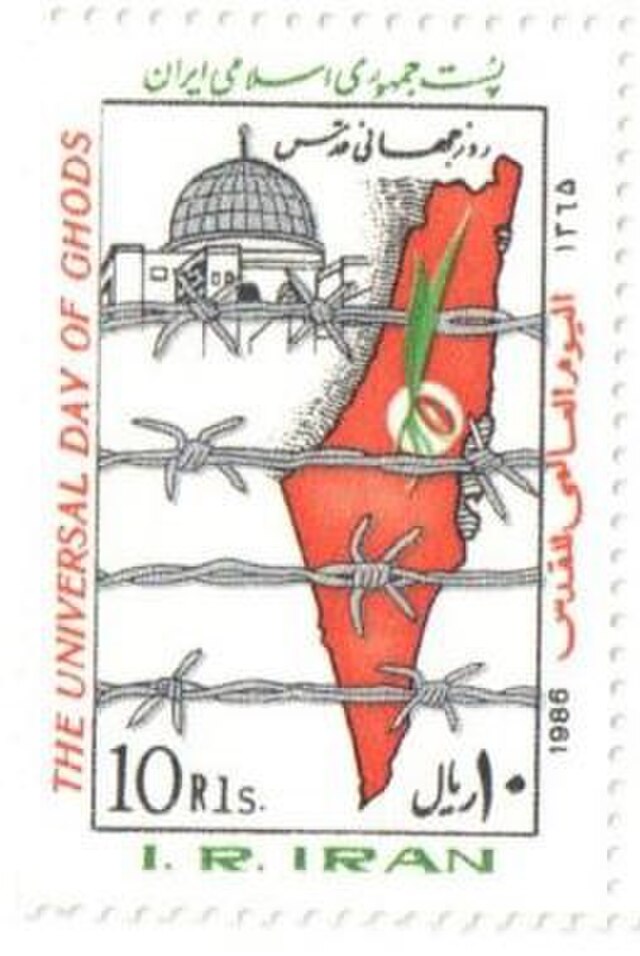
Image 1: Stamp of Iran memorizing the Day of Qods, printed 1986

A Postscript Note: I finished writing this piece prior to the Israeli-US attacks on Iranian cities and nuclear facilities, which killed over a thousand people. There is, therefore, no trace of that consequential war in the piece. Another event also took place between the time of writing this and the onset of that war: the “For Palestine” rally on the 22nd of May in front of the University of Tehran to protest the Gaza Genocide. Though modest in size, this marked “a moment when a diverse group of citizens, without any formal call, unaffiliated with power centers, and beyond prevailing ideological frameworks, raised their voices in defense of the human dignity of the Palestinian people” (Shabani 2025). When I speak of the losses of the Iranian Left in the following paragraphs, I would like to remember such delicate gains, too.

Taking stock of the Iranian response to the Palestinian cause since the Nakba can point out a history of militant solidarity but must also face the melancholic realization that the Iranian Left has lost something big. What mediated the two—and this can be the great irony of Middle Eastern history—was 1979 Revolution in Iran. An epoch–making event that emerged as a resistant block against imperialist forces and a powerful state backer of Palestinians in its secular and religious strains, the Revolution went on to transform the very meaning of relating to Palestinian anticolonial resistance. Whether, and how exactly, the government that was established in its wake helped Palestinians since is a convoluted topic with many chapters, yet to be studied. What is less obscure is the fact that the Iranian Left—a material, discursive, and cultural force in giving birth to modern revolutionary Iran—no longer possesses any seductive and material forces for performing a necessary double task today: building a working class movement strong enough to push back against the increasingly harsh oligarchic capitalism inside Iran, and helping resist the US–Israeli aggression in the region that is piling up ruins after ruins in its trail. Iran’s Islamic Republic has largely alienated the real forces on the ground from which it once appropriated the Palestinian cause. Those forces that it has instead recruited and organized—legions of the unemployed and of undocumented immigrants from Afghanistan and Pakistan to be deployed to Syria during the 2010s (Azizi and Vazirian 2022)— it has not done so based on labor. But nor have the progressive forces inside or outside Iran succeeded to win the marginalized and increasingly impoverished masses who periodically take to the streets only to face brutal repression.

The net result has been the loss of a political identity in Iran that could understand itself in a collective way by identifying its real sources of vitality. An epitome of this phenomenon which can be called apolitical radicalization, the Diaspora Opposition politics of “subversion” (barandaazi) in the past Iranian long decade (from 2009 Green Movement to when Iranian forces left a fallen Syria in 2024) has shifted toward the right to the bewildering extent that siding with Israel has become a form of performing resistance against the Islamic Republic (Shams 2025). The war industry has recruited its own figures from the exiled (Shohadaei 2023). Many, many people embrace them, apparently. But, under the black sun of Gaza that has cut through all statuses, identities, positions, forcing each to reckon with itself anew, Iranian political culture too is bound to find itself re-evaluated for its own actors and observers. And because the word “Palestine” has for decades permeated official discourses of politics in Iran to the point of exhaustion, speaking to it in relation to emancipatory politics is exceptionally difficult.

In such an atmosphere, writing about Iran in English is more aporetic for me today than ever before. By “today” I mean a moment in history marked by two consequential events that have changed much about Iran: The Women, Life, Freedom (WLF) movement (following the death-in-custody of the young Kurdish woman Mahsa Jina Amini in Tehran in September 2022) and the Al-Aqsa Flood Operation. Months after the women and girls’ life-and-death historic fights in the streets with the riot officers over the mandatory hijab (with clear socio-political victories) were widely repressed, October the 7th took place. On around the anniversary of the Palestinian assault on Israeli settlements near Gaza’s borders, a video came out showing the correspondent of the London-based TV Iran International writing the movement’s slogan in Persian on the wall of a destroyed home in Gaza (Middle East Monitor 2024). The obscene contrast between the message and the medium, between the words life, woman, freedom, and that context of suffocating blockade, lethal masculinity, and death, posed the question: How could those words be allowed to travel to the abyss of Gaza with pure affirmation and total blindness to its setting? The smiling ease with which the Israel-based Iranian reporter performed the act in front of the camera demonstrated a secure confidence in the public reception of his horrid message. He probably felt it like an act of resistance rather than pervert violation. Reportedly, the news outlet, funded by Saudi Arabia’s Mohammed bin Salman, is being watched by millions of Iranian households, having widely been preferred over the standard BBC Persian and a host of hopeless national TV channels (Gamaan 2023). Was there no symbolic counterforce defying this messaging? Apparently, not. The vocal figures of the WLF movement did not voice any visible solidarity with Palestinians, nor articulated any radical critique of Israeli aggression to prepare people for protecting themselves against identifying with the aggressors. The Nobel Peace Prize winner and prominent activist who spent years in jail and has been particularly vocal about solitary confinement and death penalty in Iran did not mention the word Gaza in a statement she issued from Evin prison where he called for an end to ”war.” The media coverage of her statement in English added the word “Gaza” (IranWire, November 1, 2023).

All this shift to the right in mainstream Iranian opposition politics, if not in people themselves, shows an astounding departure from the pre-Revolutionary times when Palestine shaped the discourse of both the Marxist left and the radical Shia’ clergy as well as Muslim intellectuals. Recent scholarship has shed light on the indebtedness of Iranian political culture to the Palestinian cause from around the time of the Nakba onward (Alavi 2019, Elling and Haugbolle 2024, Sadeghi-Boroujeni 2025). This was in the aftermath of the US-sponsored 1953 Coup that blocked the path of a popular national independence movement. In attempts to break through the total political blockage of the post-Coup era beyond traditional party politics already crushed by the Shah, Iran’s guerrilla movement (1970-79) learned tactics of armed struggles from Palestinian fighters in the refugee camps of Lebanon and Syria, gaining insights into the deep ties that linked capitalism, imperialism, and colonialism in the region—places destined to define the future trajectory of Iran’s political life for decades to come (Vahabzadeh 2010: 12-15, Montazeri 2024). The Palestinian cause effectively contributed to a revolution in Iran, having ended the Monarchy’s alliance with America and Israel. In this way, it seems, Iran in its turn shaped the trajectory of the Palestinian cause by becoming the first state officially incorporating it into its very identity—and that in the wake of Camp David’s deal with Israel which lost Egypt for Palestinians. Did this victory come with a curse?

The Cause after the Revolution rapidly moved from the streets to the institutions and the law in Iranian politics. Such a shift took place in the context of a bloody fight for power primarily between the Leftist parties and the Islamic Republic Party (IRP) in the first couple years after the 1979 Revolution. The IRP clerics reluctantly had to deal with the more secular, nationalist Palestine Liberation Organization (PLO) leadership. To win over the socialist, guerrilla forces who had legitimate claims to the Revolution, the IRP moved to rid the Palestinian cause of its leftist discursive elements. One telling example was when their official newspaper Jomhuri-ye Eslami published the headline “Arafat pleads to Muslims of the world against Israel’s expansive offensives,” while Arafat’s 26 August 1979 plea addressed diverse universal identities including “public conscious around the world” and “resisting nations of the world.” (Alemzadeh 2024, 12) It was a real case of inclusive exclusion or exclusive inclusion. Yasser Arafat’s unfortunate decisions in key moments, from trying to mediate the releasing of the American hostages held by Iranian revolutionaries during the Hostage Crisis to siding with the invader in the Iraq-Iran war, only facilitated such a move.

“Felesteen” in Persian thus started losing its original socialist ring, becoming more and more Islamic—a tendency that culminated in the Islamic Republic’s consequential rapport with the Islamic Jihad and then Hamas a couple decades later. These were, of course, the contingent tendencies in Palestinian history within various contexts to which the Iranian support adapted. The nature of this support has been reported not to have dictated internal politics of Palestinian movements. Nizar Banat, the Palestinian intellectual killed by Palestinian Authority forces, said: “Whether Fatah, PLFP, Communists, anyone; it [Iran] never intervened in the ideological conceptions of our resistance.” (Banat [2021]) Even so, the name of Palestine did not enjoy such political diversity inside postrevolutionary Iran. With the violent suppression of the Left during the 1980s, Iran’s popular politics inevitably moved towards a liberal-democratic rights-centered activism in civil society in the Reformist Era (1995-2004). The pro-government forces, in turn and in effect, started building up a new security practice and discourse that gave rise to the Axis of Resistance in the aftermath of failed American interventionist projects that generated a vacuum in which floated many fragmented forces sponsored by regional and international powers. Palestine was won for national security and largely lost for justice and freedom (Alemzadeh 2025).

In terms of security—in the post-9/11 world, where the US-led Coalition forces invaded countries to the left and the right of Iran (Gregory 2004)—Palestine appeared in the depth of a fortified field seen from the heights of Iranian plateau. The “offensive defense” strategy brought Iranians extremely close to Israeli fortifications around the Golan Heights—perhaps too dangerously close. Iran’s oldest ally through decades, Syria, made this progression possible. The same troublesome route that Iranian guerrilla fighters during the sixties and the seventies took from Tehran to Beirut to join PLO militants was upgraded in the mid-2010s into a highway trodden by the Islamic Revolutionary Guard Corps (IRGC) overseas forces (Magnier 2021). The story of Iran’s intervention in the Syrian War, its human toll, political economy, and geopolitical import, is yet to be told. But the claim on the part of the Islamic Republic has been that we are defending our borders against imperialist and Zionist assaults at military, cultural, social, media levels. Intellectuals, activists, artists, and the entire middle-class cultural makers were never fully convinced. The presence of American-Israeli footprints in any major national disaster from the eight-year Iran-Iraq War to devastating sanctions and terror attacks throughout the past four decades has been documented, and yet Palestine is absent from the most progressive political discourses in Iran.

A central question for the highly fragmented, disorganized Iranian leftists today is why many Iranians appear to go along with the cruelest forces in the world today. A big bulk of answers given do not pose the question or clarify its premises adequately or in good faith, providing instead conclusions that only beg the question anew. They tend to use the language normally deployed by pro-Israeli platforms. For instance, Ali Afshari, a former organizer of the Iranian student movement turned regime-change activist, asks why there is no sympathy with Palestinians in Iran without discussing in any terms what it is they should sympathize with. This is because the author cannot even name the situation: the genocidal killings of a people daily. It is either “Israel’s war” or a “conflict.” And yet, he reserves the naming for Hamas, summing up his answer by setting the equation thus: “Meanwhile, the atrocities of Oct. 7, 2023, against Israelis by Hamas only reminded the Iranian people of their government’s ideological, turbulent, and costly foreign policy.” (Afshari 2024) In this piece as in several others about the topic of Palestine and Iran, authors tend to draw on one slogan first heard chanted in the 2009 protests: “Neither Lebanon, Nor Gaza, I’ll give my life for Iran.” (Ziaberi 2025) It is presented as a confirmation of the Iranians’ judgment on the fate of the Palestinian cause in Iran. The texts omit the other slogan that I heard in the streets of Tehran that same year also within the Green Movement: “People, why are you sitting down, Iran has become Palestine.” The origin of the slogan goes back to the time of the Iranian Revolution. It signified the understanding that Palestine has a universal import, shedding light on any situation where an indigenous population is being suffocated by forces of the state or states. The generational continuity between 1979 and 2009, evident not least in their shared slogans, was broken in the long decade following when Iran went to Syria. The relation to Palestine both made and broke it. (In a correspondence, Akbar Masoumbaigi, a prominent intellectual and a veteran organizer in the Iranian leftist movement, told me about the origin of the slogan which he had heard in the streets of Tehran at least as early as 1979. Before the date, he said, similar slogans were common.)

Today, while there have been statements from Iranian feminists, artists, scholars, and activists against the Gaza Genocide (A Call to Action 2024, Moezidis 2025), most Iranian identifications with the suffering of Palestinians much more resemble a spirit of appropriation: “We too are undergoing genocide. We too are occupied. We too are under (gender) apartheid. We too are colonized, even if by a regime which we brought to power through a revolution.” Iranian protests proclaim such positions in the BBC Persian service or on Iran International, much of it is also echoed in recent works by scholars on “internal colonialism,” “gender apartheid” used for Iran without naming Israel (Eskandari 2023, Seltzer 2023, Elyasi 2024; for a critique, see Shohadaei and Mehrgan 2024). Or conversely, at its worst, as in Afshari’s piece quoted above, they go for the equation: Hamas represents for Israelis what the Islamic Republic means to Iranians living under its rein. Although the reason for this has much to do with how official apparatuses of power, policy, and media in Iran have failed to incorporate the Palestinian cause they inherited from a revolution into projects of social justice domestically, many individuals and groups in civil society, too, have participated in what can be called a pervert relation to Palestine: absolute negation or absolute cooptation.

Disappearing with the Left is thus the very possibility of the solidarity of singular experiences of oppression and empire. What has been lost is the very possibility of an Iranian political identity. Palestine is not only a moral or humanistic cause—which, given the incredible ethical indifference at the global institutional level to the daily massacres and starvation in Gaza, can only mean coming catastrophes. It is rather also a mode of relating to the politics of material conditions of life that touches all forms of politicization in the globalized ecologies of war and of remnants of life today. The Iranian Left realized with much pain through Palestine: Anti-imperialism without class struggle is empty, and class struggle without anti-imperialism is blind. In the case of Iran today, the double task has pressed the Left, or any real progressive politics (the women’s movement in particular) to the point of collapse as it must deal with this: an oligarchic capitalism backed by state repression inside and genocidal imperialist forces outside against which, well, that very repressive state has posed a resistance—for now.


Omid Mehrgan is a philosopher teaching in the Department of Liberal Studies at New York University. He is the author of The Narrowest Path: Antinomies of Self-Determination in Four Aesthetic Studies (Brill, 2024) and the translator of several key philosophical texts into Persian.


References

‘A Call to Action: Against the Imposed ‘New Order’ in the Middle East’. No-to-Genocide, October 2024, https://www.no-to-genocide.com/english.

Afshari, Ali. 2024. ‘Why are So Many Iranians Seemingly Indifferent to the War in Gaza?’, Stimson, May 13, 2024. https://www.stimson.org/2024/why-are-so-many-iranians-seemingly-indifferent-to-the-war-in-gaza/.

Alavi, Seyed Ali. 2019. Iran and Palestine: Past, Present, Future. New York: Routledge.

Alemzadeh, Maryam. 2024. “The Islamic Republic Party and the Palestinian Cause, 1979-1980: A Discursive Transformation of the Third-Worldist Agenda,” in Rasmus C. Elling and Sune Haugbolle, eds., The Fate of Third Worldism in the Middle East: Iran, Palestine and Beyond (Oneworld Academic, 2024)

Alemzadeh, Maryam. 2025. ‘Iran, Palestine and the Axis of Resistance’,Middle East Report, no. 313, Winter 2024. https://merip.org/2025/01/iran-palestine-axis/

Azizi, Hamidreza, and Amir Hossein Vazirian. 2022. ‘The Role of Armed Non-State Actors in Iran’s Syria Strategy: A Case Study of Fatemiyoun and Zainabiyoun Brigades.Journal of Balkan and Near Eastern Studies 25 no.3: 540–57. https://doi:10.1080/19448953.2022.2143864.

Elling, Rasmus C. and Sune Haugbolle, eds. 2024. The Fate of Third Wordlism in the Middle East: Iran, Palestine and Beyond. London: Oneworld Academic.

Elyasi, Arefe. 2024. ‘Gender Apartheid: Unraveling Systemic Segregation and Its Socio-Legal Implications’. Master’s thesis, Global Campus of Human Rights, 2024. https://repository.gchumanrights.org/handle/20.500.11825/2779

Eskandari, Sarah 2023. ‘Internal Colonialism in Iran: Gender and Resistance against the Islamic Regime’, International Journal of Middle East Studies 55, no. 4 (November 2023): 739–743.

Gamaan. 2023. ‘Iranians’ Attitudes Toward Media 2023’. September 8, 2023. https://gamaan.org/2023/09/08/iranians-attitudes-toward-media-2023/

Gregory, Derek. 2004. The Colonial Present: Afghanistan, Palestine, Iraq. London: Blackwell.

Magnier, Elijah J. 2021. ‘The Axis of Resistance’s road from Tehran to Beirut is open and secure’, The Cradle, August 12, 2021. https://thecradle.co/articles-id/5976.

Moezidis, Ciara. 2025. ‘(Dis)Entangling Iran and Palestine/Israel: The Lesser-Known Narrative of the Pro-Palestine Iranian Diaspora in the U.S.’ Jadaliyya, 28 January 2025. https://www.jadaliyya.com/Details/46477

Montazeri, Omid. 2024. ‘Abandoned Legacy: The Left of Iran and Palestinians’, Verso Blog, June 12, 2024. https://www.versobooks.com/blogs/news/abandoned-legacy-the-left-of-iran-and-palestinians?srsltid=AfmBOooi5BMPMWFD8brHOu9HBoHLQyTfVPIcfiBIyGNhrJWIorw2_AXm.

Nizar Banat. [2021]. ‘Nizar Banat on Iranian support of Palestinian resistance’, The East Is a Podcast YouTube Channel. https://www.youtube.com/watch?v=eHqSH7Gwc7g&t=3s. Accessed September, 21, 2025.

Sadeghi-Boroujeni, Eskandar. 2025. ‘Iran and the “Axis of Resistance”: A Brief History’, Jadaliyya, May 19, 2025. https://www.jadaliyya.com/Details/46685/Iran-and-the-%E2%80%98Axis-of-Resistance%E2%80%99-A-Brief-History.

Seltzer, Lena Yasmine 2023. ‘Gender Apartheid in the Islamic Republic of Iran: The Intersection of Religion and Human Rights’. Master’s thesis. Università degli Studi di Padova, 2023. https://thesis.unipd.it/handle/20.500.12608/50102

Shabani, Azadeh. 2025. ‘From Tehran, “For Palestine”: Disrupting the State’s Discursive Monopoly on Anti-Imperialism and Pro-Palestine Solidarity’, Jadaliyya, June 11, 2025. https://www.jadaliyya.com/Details/46777/

Shams, Alex. 2025. ‘Our Man for Tehran’, Boston Review, August 6, 2025. https://www.bostonreview.net/articles/our-man-for-tehran/

Shohadaei, Setareh, and Omid Mehrgan. 2024. ‘“Apartaidi jensiati”, “jang alayhi zanan”, ya tasahobi dobareyi muqavemati zanan?’ [‘Gender Apartheid’, ‘War on Women’, or the Reappropriation of Women’s Resistance?] Radiozamaneh, May 27, 2024. https://www.radiozamaneh.com/818312/

Shohadaei, Setareh. 2023. ‘Is Masih Alinejad Really the Voice of the Iranian Women’s Movement?’, Public Seminar, September 13, 2023. https://publicseminar.org/2023/09/is-masih-alinejad-really-the-voice-of-the-iranian-womens-movement/

Vahabzadeh, Peyman. 2010. A Guerrilla Odyssey Modernization, Secularism, Democracy, and Fadai Period of National Liberation in Iran, 1971-1979. Syracuse: Syracuse State University.

Ziaberi, Kourosh. 2025. ‘Iranians Have Become Desensitized to the Question of Palestine’, New Line Magazine, November 17, 2025. https://newlinesmag.com/spotlight/iranians-have-become-desensitized-to-the-question-of-palestine/


Cite as: Merghan, Omid 2025. “Palestine the Wound: A Report on the Iranian Reception of the Cause” Focaalblog October 6. https://www.focaalblog.com/2025/10/06/omid-mehrgan-palestine-the-wound-a-report-on-the-iranian-reception-of-the-cause/

József Böröcz: Out of Place

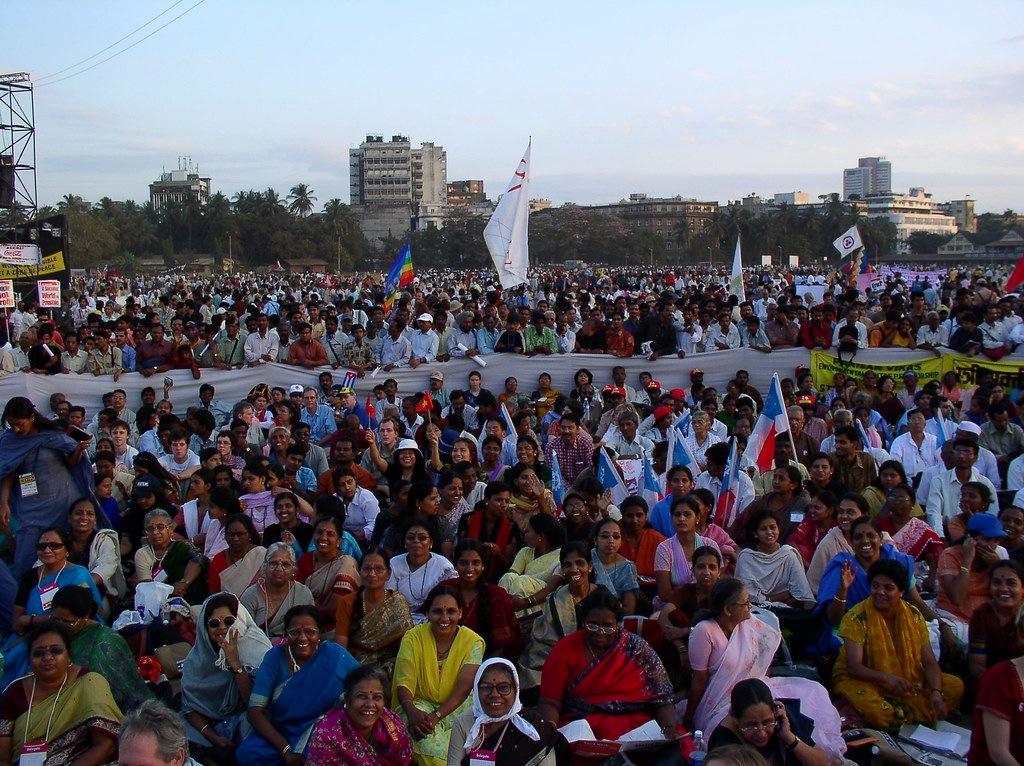
Spectators at the final concert of the World Social Forum, Mumbai 2004 (author: Claudio Riccio, https://www.flickr.com/photos/ilriccio/135304963/in/photostream/)

From Andheri to Goregaon—it’s five kilometers. Half an hour by Ambassador in the north Mumbai traffic. Windows down—through them, the usual fumes: chai, wood smoke, diesel exhaust. Plus, the blinding, crunchy, almost chewable dust of the industrial area, a landscape half abandoned, half under-construction. Taxiwala grows edgy—why, Toma can’t fathom. Dumps passengers on an impulse: “New Standard Engineering Grounds”, he says, “ahead.” Ahead it is, indeed—a twenty-minute walk. Add the heat to the scents and more of the dust.

About twenty paces in the queue for registration at the entrance stood the founder of world-systems analysis. He was invited to the event to address the crowd. Toma missed him somehow, couldn’t say “hi.”

There was no category for Toma at the event. He was hoping for “attendee” or “participant,” but—no, no such thing. He became, thanks to the helpful student worker at the registration desk, a “delegate.” The best she could do. So it said on the vibrantly designed tag, hanging from Toma’s neck. Two names: Toma and country.

Speaking of which, he is from two countries, at least. One of those is a titanic, the other a dinghy. She chose the dinghy for him. Upon exit at the end of a long day, another nice person at the same desk confirmed—there were no other “delegates” from country dinghy.

Toma had given a lot of thought to the very idea of this jamboree. How do you organize a “social forum”—for the world, no less, without an underlying theme—other than, supposedly, a vague call for resistance, so to speak, to global capital? And what does it do to that event of resistance that it is sponsored by major multinational corporations? Mind you, a counter-event, held just across the highway, asserted that exact critique. The two events together seemed to “cover” much of the political left of south Asia.

Indeed, how to be “anti-Davos?” besides, what do they do in Davos in the first place? Toma had no idea. The Mumbai event turned out to be a pageantry of all the worthwhile causes good people could think of. Attendance was expected to be 75 thousand. Conversation on the ground went up to as high as 130.000 “delegates” from 130 countries.

“I didn’t quite realize Mumbai was this far,” a group of people chatted in a cluster that somehow ended up including Toma. “Far . . . from where?”, he interjected an old joke from Budapest. Polite amusement, a smile or two. They had an accent Toma could not quite place within the UK.

There was breathtakingly little water for so many people. Toma saw two taps on the entire grounds. Plus, there were of course the drinking water tanks provided by the municipal authority. Neither to be had without boiling. Everybody ran around, hence, with store bought drinking water in plastic bottles, half a dollar per liter—at an event that deplored, among other things, the depletion of the environment, the commercialization of a basic human necessity like drinking water, and pollution of the planet with single use plastic containers.

The Forum was a gigantic café—without tables. A global / adda. \

Toma chatted with hundreds of other “delegates,” mainly young people from Asia. Gaped at Vietnamese students parading with a two-story flag of their country. Talked with South Indian and Latin American activists fighting the good fight against Coca Cola robbing their regions of drinking water. (Or was it Pepsi? Toma can never tell those two apart.) People who organize artisanal cooperatives. Artists of all kinds. Activists for NGOs of people displaced by hydroelectric dams, airports, shopping malls. A gentleman presented a contraption that looked like an aluminum wash basin but glittering inside: It gathers the rays of the Sun to cook a meal. He demonstrated that on the spot. Toma was distracted by something, he didn’t stick around to taste it.

A man with a broad smile approached Toma. He had a mustache and was wearing gauze-thin white cotton tied around his head, a linen shirt and a dhoti. He was very interested in the status of the agrarian question in “Toma’s country.” How peasants are doing in country dinghy. It was important to him, he said, because he knows the peasantries of their two countries could learn much from each other.

Toma made a quick calculation. As far as he knows, eleven of his sixteen great-great-grandparents were born serfs. Then came the abolition of serfdom, capitalism—of Kakanien, the Habsburg variety—two world wars, fascism, holocaust and socialisms, in the plural. Then back to a neoconservative, deeply confused, angry and desperate kind of capitalism. Now everyone in Toma’s extended family lives in cities. The most sweeping form of social change in country dinghy over the last century is that there are hardly any peasants left—other than in one-step removed, virtual forms as cultural movements aim to “preserve” and “re-cycle” peasant culture, especially music and dance, in urban life. In the country of Bartók—who railed against this kind of appropriation—the culture of the peasantry is now re-used as folklorism, exoticizing the lives of the descendants of the people who created that art in the first place.

They discussed the legacies of serfdom and the “peasant question” in Soviet history. And that more-than-half of the peoples of south Asia that hover precariously between peasant near-self-sufficiency and market-driven farming. How the average Indian peasant walks to polling stations to be able to cast a vote. Two hours, both ways. GMO seed. Child malnutrition. Toma’s new comrade had read Chayanov enthusiastically and mentioned Lenin a couple of times. He gave Toma a card. “Secretary General of the Peasant Trade Union Confederation of India.”

There was visible discomfort—among the Europeans. Not so much because of the heat or the dust. Two other things. One was unspoken but Toma felt it. The weirdness of standing out: Their head loomed above almost everyone else in the great sea of global “delegates.” Comrades in terms of politics, moral values, aesthetics, all the good things, with their pink and sweating heads sticking out. Because of their infrequency at the event, they seemed to feel on display. It’s not just that there was staring—there is much more of that on a tram in Kolkata or in a bus in Delhi. They came here to swim in the sea of comrades from the global south, after all. To be in the company of the like-minded from the rest-of-the-world. That was the whole point. There they are now, this is it.

The truly unpleasant thing was realizing that they had not even thought about the possibility of feeling strange. Their own reaction seemed to be a genuine surprise to them. They may well have traveled outside Europe before. But that’s not like this. They saw crowds in Istanbul or Cairo. But this is not that. The crowds on earlier trips were at a distance. Possibly behind windows of buses, or hotel lobbies. Here, everyone is so exposed to a truly intense mix of languages—bodily and spoken—that it is easy to feel lost. More body-to-body contact on a January afternoon than they have in an average year. And all that is driven by rules they don’t quite understand. They could, of course have read about those rules—but they didn’t quite think of it. It didn’t occur to them.

Losing the ability to sort everything out—who is who and what is what—they could neither wipe the discomfort away nor give it a name. For, that might be considered “rude”. . . Too honest. Not to mention admitting defeat, the thought that this corporeal idea of solidarity is not working for them.

There was, then, the second discomfort— and that one was indeed spoken of very much. A metaphor for all other metaphors.

“Child labor.”

The horror.

Who could be in favor of child labor? The abysmal life. The barefoot, scantily dressed, small bodies toiling in the crowd. “They should be in school.”

Mind you, at the event, begging was not allowed. Panhandlers were chased away by the private jawans, armed with long batons, very eager to use them, stationed visibly at each entrance. Toma wondered to what extent the jawans-with-truncheons “solution” to “the begging problem” was cleared with the organizing committee—whose charge it was to assure the event stayed on course toward its haughty goals of global equality. For sure, the clubs were used in the outside world—the world that these seventy-five thousand to one hundred and thirty thousand people all came to protest.

“Are the beatings OK if they happen outside the gates?” Toma is asking questions like that. “I could never bear being on that Organizing Committee.”

There was, however, plenty of tea and coffee on offer everywhere, brought to everyone—a little more to the “delegates” with lower levels of melanin, a skin color situation the hot beverage workers were very familiar with. Mumbai is a truly tourism-infested city. Those delegates might even give a 100% tip on the 5-rupee price—for the tea poured from large pots to small throwaway plastic cups, a nice counterpoint to the event protesting plastic pollution. All that service was rendered by tiny, unbearably cute children.

It struck Toma, as he stood there, amidst all the chatter about child labor, that the conversation never went past the initial revulsion and moral panic. All those people, supposedly the best the global north has produced, armed with sharp critiques of hydrocarbon colonialism, or global militarism, or product chains, using their privileged access to knowledge for the best possible political purpose, had a hard time discerning what it is that they are looking at when they see five-six-year-old proletarians doing truly labor-intensive service. For them. That the children’s toil might be supporting the ambitious strategies—of rising above the rural survival threshold—of entire families in a village a stone’s throw away. That the 100% tip—the generous transfer of 14 instead of 7 dollar-cents in exchange for a small cup of tea—will teach those children, and their adult relatives, that they should be selling tea for the rest of their lives. To low-melanin strangers.

That is where the global critique came to a complete halt. Right at the line around the European “delegates’” own global selves. The thought of the violence of their own retirement portfolios, amplified by the privileges bestowed upon them by their melanin-deficiency, just didn’t seem to come to them. They had spent the equivalent of ten, twenty times each of those children’s extended families’ total annual income—just flying to Mumbai.

“Was I the only person having those thoughts?”, Toma ponders today. Maybe they also had them—and filed them along with all other instances of discomfort, under a rubric labeled “not-to-be-talked-about.”

The plenary session took place on the maidan—a meadow the size of several football fields. It consisted of a large stage before a giant audience space, the latter covered with industrial tarp sheets tied together, a quilt to seat the righteous of the world. An enormous navy-blue arena of plastic—encircled, once the crowd descended on it, by layers upon layers of sandals, shoes, flip-flops. Footwear of all kinds. As if entering a person’s home, or a temple, the participants took off and left “outside” their foot covering. A show of respect. And keeping the oilcloth perhaps a tiny bit less dusty.

A group of ten-fifteen Italian students arrived, chatting merrily. Guessing from the clothes, on a return leg of a roundtrip flight between Milan and Kathmandu. Locs, woven sacks, the works. Asserting the power of a supposedly righteous kind of appropriation galore. Leaving their shoes on, they entered the field. The crowd opened for them, forming a human alley. They took the offer matter-of-factly, went right to the middle, and sat down. Shoes on, soles facing outward. The crowd absorbed them. Toma lost sight of them.

Speeches: politicians, progressive intellectuals, strongly encouraging the audience that “we should do more.” Toma is not sure who the “we” is, and more of what. Then came Junoon, a politically engaged band from Pakistan. Performing in India. A geopolitical first. Palpable excitement overall and an exuberant audience response, especially among the crowd from the Subcontinent.

On the last day, the shift of the jawans-with-the-truncheons at the gates ended at six pm. The World Forum became even more social, with the arrival of a thousand or so panhandlers through the now un-jawan-ed, truncheons-free gates. Likely not the sociality the organizers had in mind.

Toma flew back to country dinghy from Mumbai two days later. At the airport, he was selected for a “detailed customs check” by a gentleman dressed in an immaculate white uniform. He took Toma to a separate room—his luggage had already been placed on a table. The officer reached into Toma’s now-open suitcase and, with the gesture of a magician, he pulled out Toma’s tag—Toma’s name and country dinghy—and asked, “you like that kind of thing?”

A rhetorical question. The officer turned to his men and quipped, half-Hindi-half-English—Toma could make it out, the officer probably wanted it that way—how Toma came here “to allay his White guilt”. A real joker. Polite giggles from the men to their superior officer, fixed stares at Toma. He liberated Toma from his remaining rupees. A “processing fee,” he winked. He tossed a small tip to the man who “handled” Toma’s suitcase. The rest disappeared into his uniform. Very politely he walked Toma to his gate, doing small talk in a self-ironical tone. He had a truly sharp and witty sense of humor.

By the time Toma arrived at his gate he learned that his seat got re-assigned. On board he realized he was sitting next to a passenger who kept talking to him nervously throughout the entire eight-hour flight.

The World Social Forum has never returned to Mumbai.

Rumor has it—it’s the child labor.

The World Social Forum (WSF) is a global social movement organized as an open environment, a meeting space for activists, NGOs and progressive social movements committed to democracy, equality and preservation of the planet, in opposition to the “World Economic Forum”—the meetings of owners and management of big capital and top brass of the world’s most powerful states held annually in Davos, Switzerland. The first WSF meeting was held in Porto Alegre, Brazil in 2001. The event in Mumbai, India—held twenty years ago—was the first time WSF had its global assembly outside Brazil.


József Böröcz is Professor Emeritus in Sociology at Rutgers, The State University of New Jersey. He is the author of ”’Eurowhite’ Conceit, ’Dirty White’ Ressentiment.” A recent, “reflexive sociology” interview with him about socialisms, history and ‘race’ is ”Society—Instead of Apartheid. Interview with József Böröcz.” Most of his written scholarly work can be found here.


Cite as: Böröcz, József 2024. “Out of Place” Focaalblog 14 October. https://www.focaalblog.com/2024/10/14/jozsef-borocz-out-of-place/

Antonio De Lauri: The idea of a clean and efficient war is a dangerous lie

The war in Ukraine resuscitated a certain dangerous fascination for war. Notions such as patriotism, democratic values, the right side of history, or a new fight for freedom are mobilized as imperatives for everyone to take a side in this war. It is not surprising then that a large number of so-called foreign fighters are willing to go to Ukraine to join one side or the other.

I met a few of them recently at the Poland-Ukraine border, where I was conducting interviews with a Norwegian film crew with soldiers and foreign fighters who were either entering or exiting the war zone. Some of them actually never got to fight or be “recruited” as they lack military experience or proper motivation. It’s a mixed group of people, some of whom have spent years in the military, while others only did military service. Some have family at home waiting for them; others, no home to go back to. Some have strong ideological motivations; others are just willing to shoot at something or someone. There is also a big group of former soldiers who transitioned towards humanitarian work.

As we were crossing the border to get into Ukraine, a former US soldier told me: “The reason why many retired or former soldiers moved to humanitarian work might easily be the need for excitement.” Once you leave the military, the closest activity that can take you to the “fun zone,” as another one said, referring to the war zone in Ukraine, is humanitarian work – or, in fact, a series of other businesses mushrooming in the proximity of war, including contractors and criminal activities.

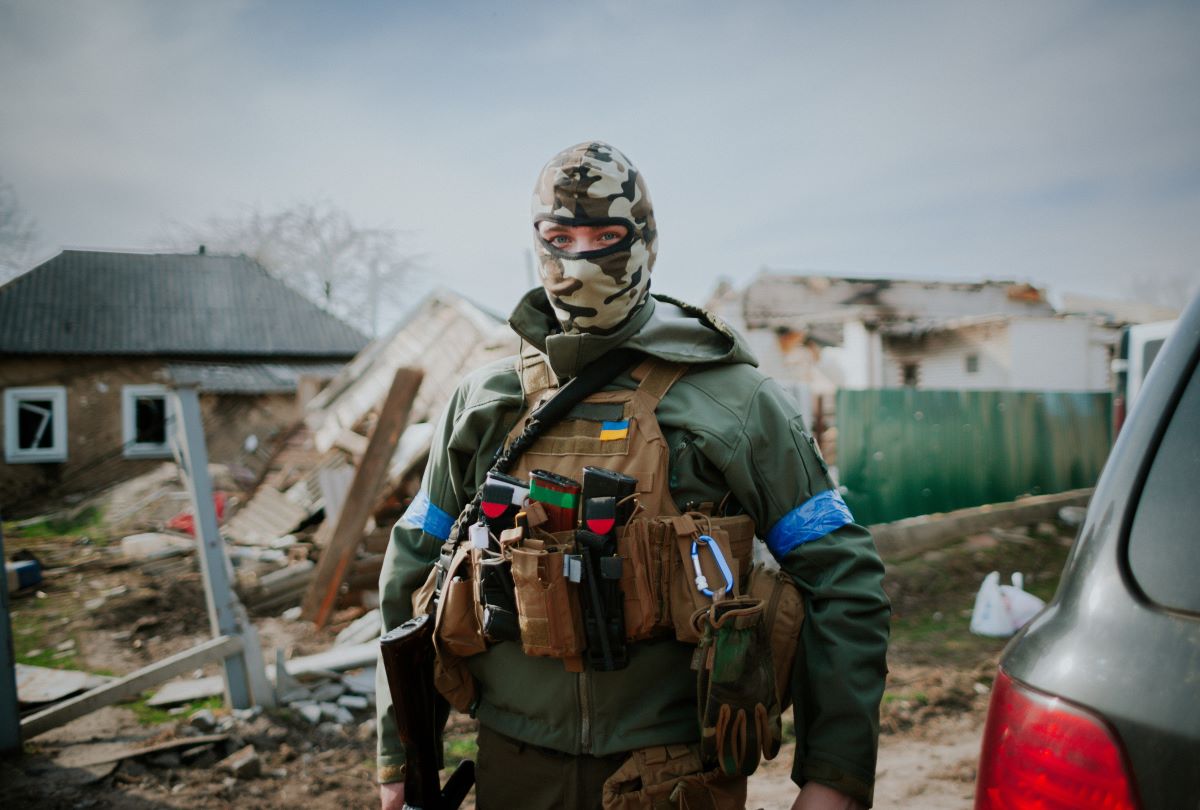
A white person stands in front of a destroyed house, wearing a camo balaclava, green jacket, and ammo and gear vest with a gun strapped across one shoulder. A Ukrainian flag is displayed on the chest of the gear vest.
Image 1: Fighter of the Ukrainian 43rd Territorial Defense Battalion “Patriot”, photo by Алесь Усцінаў

“We are adrenaline junkies,” the former US soldier said, although he now only wants to help civilians, something he sees as “a part of my process of healing.” What many of the foreign fighters have in common is the need to find a purpose in life. But what does this say of our societies if, to search for a meaningful life, thousands are willing to go to war?

There is dominant propaganda that seems to suggest war can be conducted according to a set of acceptable, standardized and abstract rules. It puts forth an idea of a well-behaved war where only military targets are destroyed, force is not used in excess, and right and wrong are clearly defined. This rhetoric is used by governments and mass media propaganda (with the military industry celebrating) to make war more acceptable, even attractive, for the masses.

Whatever deviates from this idea of a proper and noble war is considered an exception. US soldiers torturing prisoners in Abu Ghraib: an exception. German soldiers playing with a human skull in Afghanistan: an exception. The US soldier who went on a house-to-house rampage in an Afghan village, killing 16 civilians including several children with no reason: an exception. War crimes committed by Australian troops in Afghanistan: an exception. Iraqi prisoners tortured by British troops: an exception.

Similar stories are emerging in the current war in Ukraine too, even though mostly still “unconfirmed”. With the information war obfuscating the distinction between reality and fantasy, we don’t know if and when we will be able to verify videos such as one showing a Ukrainian soldier talking on the phone with the mom of a killed Russian soldier and making fun of her, or Ukrainian soldiers shooting prisoners to make them permanently injured, or news about Russian soldiers sexually assaulting women.

All exceptions? No. This is exactly what war is. Governments make big efforts to explain that these kinds of episodes don’t belong in war. They even pretend to be surprised when civilians are killed, even though systematically targeting civilians is a feature of all contemporary wars; for example, over 387,000 civilians were killed in the US post-9/11 wars alone, with more likely to die from those wars’ reverberating impacts.

The idea of a clean and efficient war is a lie. War is a chaotic universe of military strategies intertwined with inhumanity, violations, uncertainty, doubts, and deceit. In all combat zones emotions such as fear, shame, joy, excitement, surprise, anger, cruelty, and compassion co-exist.

We also know that whatever the real reasons for war, identifying the enemy is a crucial element of every call for conflict. In order to be able to kill – systematically – it is not enough to make fighters disregard the enemy, to despise him or her; it is also necessary to make them see in the foe an obstacle to a better future. For this reason, war consistently requires the transformation of a person’s identity from the status of an individual to a member of a defined, and hated enemy group.

If the only objective of war is the mere physical elimination of the enemy, then how do we explain why the torture and destruction of bodies both dead and alive is practiced with such ferocity on so many battlefields? Although in abstract terms such violence appears unimaginable, it becomes possible to visualize when the murdered or tortured are aligned with dehumanizing representations portraying them as usurpers, cowards, filthy, paltry, unfaithful, vile, disobedient – representations that travel fast in mainstream and social media. War violence is a dramatic attempt to transform, redefine and establish social boundaries; to affirm one’s own existence and deny that of the other. Therefore, the violence produced by war is not mere empirical fact, but also a form of social communication.

It follows that war cannot be simply described as the by-product of political decisions from above; it is also determined by participation and initiatives from below. This can take the form of extreme brutal violence or torture, but also as resistance to the logic of war. It is the case of the military personnel who object to being part of a specific war or mission: examples range from conscientious objection during wartime, to explicit positioning such as the case of the Fort Hood Three who refused to go to Vietnam considering that war “illegal, immoral, and unjust,” and the refusal of the Russian National Guard to go to Ukraine.  

“War is so unjust and ugly that all who wage it must try to stifle the voice of conscience within themselves,” wrote Leo Tolstoy. But it’s like holding your breath underwater – you can’t do it for long, even if you are trained.


This text was originally published in Common Dreams.


Antonio De Lauri is a Research Professor at the Chr. Michelsen Institute, the Director of the Norwegian Centre for Humanitarian Studies, and a contributor to the Costs of War Project of the Watson Institute for International and Public Affairs at Brown University. He received an ERC grant for a project on soldiering and warfare.


Cite as: De Lauri, Antonio. 2022. “The idea of a clean and efficient war is a dangerous lie.” FocaalBlog, 18 April. https://www.focaalblog.com/2022/04/18/antonio-de-lauri-the-idea-of-a-clean-and-efficient-war-is-a-dangerous-lie

Felix Lussem: Alienating “facts” and uneven futures of energy transition

This post is part of a feature on “The Political Power of Energy Futures,” moderated and edited by Katja Müller (MLU Halle-Wittenberg), Charlotte Bruckermann (University of Bergen), and Kirsten W. Endres (MPI Halle).

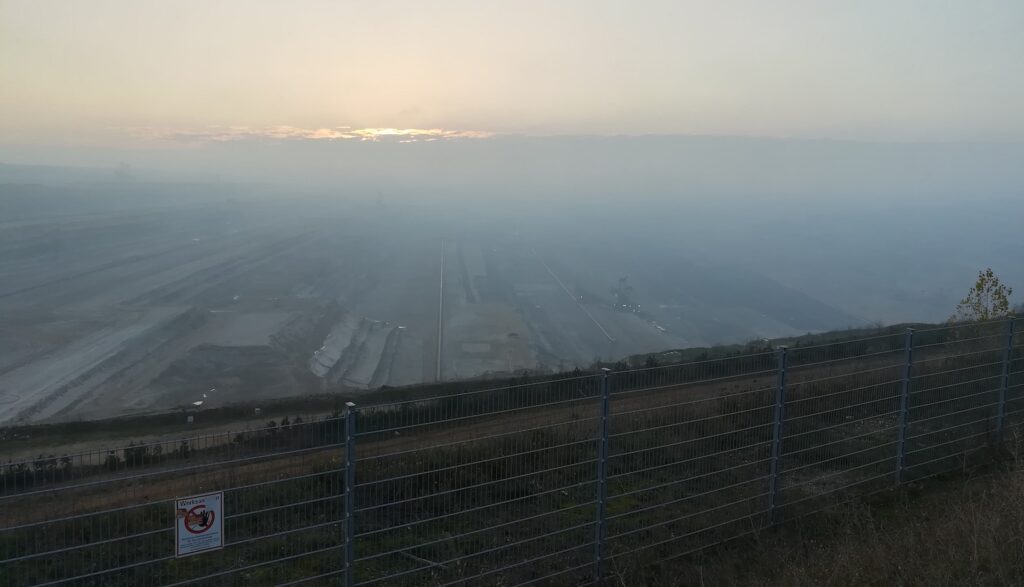
We are in the middle of the Rhineland’s lignite mining region, a semi-urban to rural area in the west of Germany. The landscape is considerably altered by past and present projects of large-scale resource extraction and subsequent “recultivation” measures to convert the land back to agricultural production or natural conservation. Lignite (or brown coal) is exploited in vast open-pit mines here – the Hambach mine not far from the city of Cologne is dubbed “Europe’s biggest hole” – “swallowing” everything from forests to villages in their way.

Coal mining – in contrast to the more authoritarian and centralized organization of oil extraction – has been historically associated with the development of the welfare state and the consolidation of workers’ rights in western democracies. However, as Thomas H. Eriksen notes, “contemporary coal mining has been restructured and reconfigured to resemble oil drilling formally”, becoming “less labour-intensive and more capital-intensive than in the past” (2016: 38). This neoliberal restructuring resulted not only in the transformation of institutions of “Carbon Democracy” (Mitchell 2009), as the conditions for workers to organize and wield influence over the means of production were eroded, but also in declining economic dependency on the coal industry in the Rhineland region.

Despite this decrease of economic significance in the region, RWE, the energy company currently operating the mines, has still been considerably involved in local politics over the past decades – not least because of its mandate to secure the provision of cheap electricity for German industry and consumers. To this day the state-approved “general public interest” serves as the legal basis for the suspension of fundamental rights, making possible the expropriation of land titles, the demolition of protected landmarks, or the circumvention of guidelines for environmental protection for the extraction of fossil fuels in Germany’s lignite mining regions.

Excavators, conveyor belts and terrace landscape in the Hambach open-pit mine
Image 1: A new energy horizon after the end of the world? Excavators, conveyor belts and terrace landscape in the Hambach open-pit mine (Picture taken by the author)

Environmental destruction and relocation of tens of thousands of people due to numerous mine expansions in the Rhineland were thus firmly connected to narratives of national progress and regional prosperity. Mourning over losses of personal possessions and feelings of belonging were relegated to the private realm, and little room was left for critical voices in the public domain.

Recently however, this hegemonic state-industry nexus has been successfully challenged by a coalition of environmentalists, citizen initiatives, radical activists and other civil society actors (despite the continued economic profitability of the coal industry, ensured by “environmental load displacement” (Hornborg 2009) and other indirect subsidies). Their demands to save the remaining forest in front of the Hambach mine effectively stopped the encroaching extractivist operation. They were supported by a government commission installed to negotiate the conditions of Germany’s energy transition, following the decision to phase out the coal industry as a national contribution toward climate change mitigation.

The prospect of a global climate crisis has therefore led to the current reevaluation of lignite mining from guarantor of wealth and stability to driver of multi-scalar uncertainties. This enabled previously marginalized actors to voice their concerns by articulating their demands in terms of these globalized discourses. Yet, the (inter-)nationally reported success of the protests around the Hambach forest was only one instance of ongoing negotiations about the pace and scale of energy transition, from the perspective of the critical civil society actors with whom I conduct research in the Rhineland.

Since this seeming breakthrough for civic participation in shaping the region’s future, numerous setbacks and scandals have occurred. These are testament to the inability of carbon-democratic institutions to deal with a crisis that challenges its basic principles of growth as progress and wage labor as key to well-being. Controversies range from the passing of a coal exit law that many critical voices interpret as a “coal extension law”, to the federal government holding back an official report that questions the energetic necessity of the energy company’s plans for mine expansion.

Before the outbreak of the COVID-19 pandemic, I regularly participated in meetings of a local group of critical civil society actors who played a decisive role in saving the forest and turning it into a national symbol of climate activism. Their political engagement served as an opportunity to take a closer look at the uneven futures of energy transition in the Rhineland. As we sit in a circle in the Protestant church hall of a village close to the Hambach mine, many of the participants share impressions of feeling alienated from their home region by the energy company’s mining activities. Despite being part of the majority that does not depend on the coal industry for income, some of the locals feel their concerns were generally ignored by communal politics, making them rather skeptical of established political institutions’ capability to develop a sustainable and equitable future for the mining region.

Nonetheless, they see the impending process of energy transition as a window of opportunity to reconnect with their home region by actively participating in the development of alternative future visions, beyond institutions of representative democracy. This desire for autonomous participation is directly linked to the affective alienation associated by some of my interlocutors with the large-scale landscape transformation of the mining activities, coupled with the close connection between local politics and the energy company.

This carbon-democratic entanglement of political institutions and energy industry experienced in everyday life in the Rhineland’s lignite mining region probably finds its most drastic manifestation in the practice of “creating facts” (“Fakten schaffen”), of which my interlocutors often accuse the mining company. This expression usually refers to the practice of producing accomplished facts which alter conditions in a way to favor certain outcomes. Often their undeniable materiality forces other actors to acknowledge these facts, in turn leading to the retrospective legitimization of the outcomes of Fakten schaffen. Thus, actors with the power and institutional support to “create facts” narrow down an otherwise ambiguous situation potentially open to negotiation by different actors to a specific path of options in their interest.

In this way the energy company continues the controversial destruction of almost completely relocated villages. Under Germany’s new energy policy, the company is sticking to its operating plan and regular rhythm of extraction and redevelopment, despite radically changing socioecological and energy-political parameters. While numerous critical actors unsuccessfully appeal to democratic institutions to inhibit this pursuit of enforcing prior arrangements through material destruction, the following, more ambiguous example will serve to illustrate this modus operandi of Fakten schaffen and its relation to the feeling of alienation.

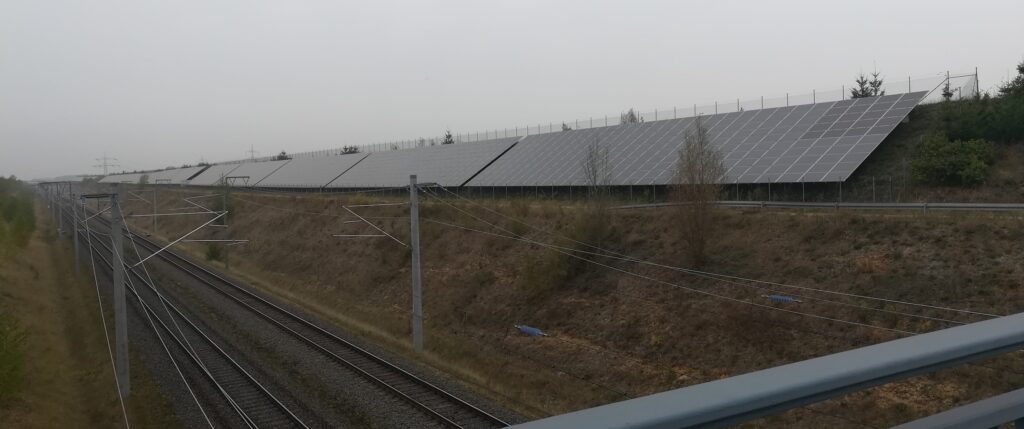
Photo of solar panels aligning fossil fuel transportation infrastructure near the Hambach forest
Image 2: “Path dependency” – literal and figurative: Solar panels aligning fossil fuel transportation infrastructure near the Hambach forest (Picture taken by the author)

Thomas, an outspoken and very knowledgeable member of a local citizen initiative against coal mining, and part of the larger group of civil society actors mentioned above, gives me a ride to the train station after we participated in one of the regular protest-walks through the forest at the Hambach mine. As we pass the bridge over the railway connecting the mines with the nearby power plants, I decide to ask him about the solar panels aligning the tracks beneath us. Their sheer size hardly makes them unnoticeable, but I never paid much attention to them, except for contemplating the irony that the fossil fuel infrastructure gives room to more “sustainable” forms of energy generation here. After all, the solar panels seemed somewhat out of place next to passing trains packed with lignite. The panels simultaneously signal the out-of-time-ness of the coal industry and point to a new energy future on the horizon.  But Thomas’ reaction to my question made me aware of another aspect regarding their significance for the issue of affective alienation in relation to the practice of Fakten schaffen.

Knowing that most of my interlocutors are in favor of direct solar energy generation and having the impressive photovoltaic structure right before our eyes, I am prepared to finally hear a success story about civic participation in local development. Yet, Thomas is not sympathetic to the photovoltaic project at all. He tells me it was a typical outcome of cooperation between energy company and politics in the region.

This sentiment echoes many civil society actors who criticize that, being the biggest landowner there, RWE conducts itself “like the lord of a manor” (“Gutsherrenart”), demonstrating the “feudal” excesses of carbon democracy in the Rhineland, which regularly undermine popular desires of stronger democratic involvement in matters of future-making. Thomas goes on to inform me that a citizen initiative proposed a similar project a few years ago in which the solar panels ought to be lining the highway that was relocated closer to the village because of the encroaching mine. They had imagined the photovoltaic structure as serving multiple other functions, such as protecting villagers from noise and air pollution emitted by the mine and highway. While the project gained some attention in the local press, it was not supported by the communal administration and ultimately had to be relinquished.

Around the same time, the energy company came to an agreement with the administration to make property available for the hitherto largest photovoltaic project in the region, co-financed by a local bank. The uncanny speed with which this project was realized confirmed not only the close ties between politics and coal industry to critical actors like Thomas, but also showed clearly how easily something can be achieved in the region when the energy company is directly involved.

So instead of being perceived as a successful step towards sustainable energy transition in the Rhineland’s lignite mining area, the solar panels symbolize a failure of civic participation. They appear to Thomas as a material (arte-)fact resulting from the dubiously close cooperation between local politics and the energy company. Judged from a distance, this instance of Fakten schaffen produced a material outcome in line with my interlocutors’ desires for sustainable energy generation. However, the concrete infrastructure stands as a monument that exemplifies how flows of innovation are caught up in existing power relations and ultimately contribute to consolidating the local incarnation of the state-industry nexus, even in the face of impending coal exit.

While the lignite industry will disappear in the foreseeable future, the longstanding history of capitalist extractivism – the main reason for the affective alienation of a large group of people in the area – will likely continue, no matter the source of energy. The deliberate promotion of technoscientific development interventions carried out by experts in the context of energy transition policies thus works to forestall the socioecological transformation from below that Thomas and others envision as a necessary step for politics in the Anthropocene.

Nowhere does this become more apparent than in the economic ministry’s newly adopted rhetoric of establishing a special economic zone in the area to speed up planning processes and pursue the double-bind of “green growth” (Eriksen 2016). Meanwhile, they were simultaneously hosting forums for civic participation that seem disconnected from this pursuit, because they operate at a different pace. This contradictory course of action leads many local actors to evaluate the efforts to integrate civil society into official planning processes as a mere façade, intensifying their skepticism towards institutions of carbon democracy in the region.

This brief insight into my fieldwork shows how inhabitants that felt alienated by collusions between energy industry and political institutions, sensed the diverging interest of politics and industry in the context of energy transition as an opportunity to regain some autonomy over the shaping of their region’s future. However, instances of Fakten schaffen enacted by the state-industry nexus function to curtail this grassroots engagement, and to (re-)connect extractive infrastructures of late industrialism (Fortun 2014) to narratives of modernization and progress under the aegis of “green growth”.

A coalition of local actors more attuned to the socioecological uncertainties of the Anthropocene criticizes this carbon-democratic variant of “cruel optimism” (Berlant 2011), and pushes for a joint transformation of resource use and political culture in search of a redefined “good life” for all. Rather than a utopian vision of future prosperity, this practical engagement might be characterized as “patchy hope” (Tsing et al. 2019) which, despite being situated and emplaced, operates between the particular and the universal, the local and the global; aware of its own limitations within ambiguous entanglements of politics and energy in the Rhineland.


Felix Lussem is a research assistant and lecturer in the field of environmental anthropology at the Department of Social and Cultural Anthropology at the University of Cologne, Germany. His doctoral research deals with shifting spatial and temporal orders in negotiations of “global crises” with a regional focus on the Rhineland’s lignite mining area. Contact: flussem2@uni-koeln.de


Bibliography

Berlant, Lauren. 2011. Cruel Optimism. Durham & London: Duke University Press.

Eriksen, Thomas H. 2016. Overheating. An Anthropology of Accelerated Change. London: Pluto Press.

Fortun, Kim. 2014. From Latour to late industrialism. HAU: Journal of Ethnographic Theory 4 (1): 309-329.

Hornborg, Alf. 2009. Zero-Sum World: Challenges in Conceptualizing Environmental Load Displacement and Ecologically Unequal Exchange in the World-System. International Journal of Comparative Sociology 50 (3-4): 237-262.

Mitchell, Timothy. 2009. Carbon democracy. Economy and Society 38 (3): 399-432.

Tsing, Anna Lowenhaupt, Andrew S. Mathews & Nils Bubandt. 2019. Patchy Anthropocene: Landscape Structure, Multispecies History, and the Retooling of Anthropology. Current Anthropology 60 (Supplement 20): S000.


Cite as: Lussem, Felix. 2021. “Alienating ‘facts’ and uneven futures of energy transition.” FocaalBlog, 7 April. https://www.focaalblog.com/2021/04/07/felix-lussem-alienating-facts-and-uneven-futures-of-energy-transition/

Stephen Campbell: What can workers expect in post-coup Myanmar?

International media coverage of the February 1st military coup in Myanmar has been rather consistent. The focus, overwhelmingly, has been on the detention of State Counsellor and Nobel laureate Aung San Suu Kyi, with speculations about the political machinations of Myanmar’s commander-and-chief, Min Aung Hlaing. In this way, the developing story has orbited around the theme of liberal democracy in peril, for which Suu Kyi in detention serves as synecdoche. What such a focus misses, however, is the very real threat the coup poses to millions of ordinary workers and their families across the country.

Already by late January 2021, Min Aung Hlaing had hinted of a possible coup. But still, the events of February 1st came as a shock to many inside the country and abroad. Claiming widespread voter fraud in the November 2020 elections, which delivered Aung San Suu Kyi’s ruling National League for Democracy a resounding victory, the military deployed troops to urban centres, detained Suu Kyi and other senior government officials, and declared a nationwide state of emergency this past Monday.

Online commentary has been rife with speculation. Was the coup motivated by Min Aung Hlaing’s presidential ambitions? Or was is it simply a matter of plain stupidity? The latter assertion claims plausibility on the grounds that the military itself drafted the 2008 constitution, which enshrined its role in government even before the coup by way of apportioned parliamentary seats and reserved ministerial positions. And it was a lucrative arrangement. With sprawling business interests under two expansive holding companies and other nepotistic business arrangements, the generals were collecting vast profits, much of it from mining and other extractive industries in the country’s north and northeast. Whatever the motivations behind the coup, little is certain at present. What is clear, however, is that the state of emergency has raised anxieties among the millions of workers and their families who were already struggling to get by in the industrial zones around Yangon (where I have done research since 2016) and elsewhere in the country.

Image 1: Striking garment factory workers in the Hlaingtharyar industrial zone outside Yangon (Yaung Chi Oo Workers Association, 2019).

Working class struggles

The working-class population in Yangon’s industrial zones comprises mostly former villagers pushed out of rural areas due to unmanageable debt, the infrastructural devastation of 2008’s Cyclone Nargis, and outright theft of their land by military and private business interests. As real estate speculation and elitist urban development over the past ten years drove up the cost of housing, hundreds of thousands of migrants arriving in the city were priced out of formal accommodation and turned instead to cheaper squatter housing on the city’s outskirts. Many of these new urban residents sought employment in food and other processing factories producing for the domestic market, or at garment factories producing for export. By 2018, over a million workers—mostly young women, including many squatters—were employed in garment, textile, footwear, and accessories factories in Myanmar—mostly around Yangon. In this context, workers at factories and workplaces across Yangon’s industrial zones have over the past decade organised collectively, formed unions, and gone on strike in impressive struggles against employer intransigence and outright violence. Such struggles pre-date the country’s so-called democratic transition that began in 2011, which was also the year new labour legalisation granted workers a legal right to form unions. So, while the new labour law cannot be credited with empowering workers, it did grant them greater legal space in which to organise.

Covid-19

Then Covid-19 happened. A shortage of supplies from the People’s Republic of China in February 2020 led to factory closures and an initial loss of 10,000 to 15,000 jobs, and by September, 223 factories had filed for closure, temporary closure, or redundancy following a government-mandated lockdown. Meanwhile, factory employers used the pretext of Covid-19 disruption to fire unionised workers in mass, while police intervened to break up strikes and arrest organisers. With no effective social safety net in the country, dismissed factory workers have been struggling under the pandemic—taking on further debt, reducing food consumption, and in some cases turning to sex work to support their families. And all of this was before the military coup. Indeed, the day before the military seized power, I was editing a funding report for activist friends in Yangon who had formed a sewing cooperative to support factory workers fired during Covid-19 for their union organising activities.

Another state of emergency

Under these already grim conditions, the declared state of emergency portends even more dire circumstances for workers and their families. A Myanmar labour activist group, Alokthema Awlan [The Workers’ Megaphone], shared online the results of impromptu interviews conducted on the day of the coup with factory workers in the Hlaingtharyar industrial zone, outside Yangon. Respondents spoke of fears of food shortages and temporary store closures, which led to panic buying and drove up prices of basic foodstuffs.

It remains unclear what the status of Myanmar labour law will be under the state of emergency, but there is little to suggest that space for worker organising will do anything but contract. Some workers have already expressed concern that existing labour law will be abrogated or simply disregarded. To get their views on the matter (and since I am in Singapore), a Burmese labour activist friend of mine interviewed, a couple days after the coup, several women employed at garment factories in the Hlaingtharyar industrial zone. One woman, who has been active in her local workplace union, stated:

“Now that the military has taken power, I’m worried the situation will go back to the way it was before [under military rule] and that the workers won’t have any rights anymore. Also, we were told that the [legal minimum] wage was going to be increased in the coming months. The young workers were hoping for that. But now we don’t expect that there’ll be an increase. It’ll be as though we’ve lost our rights. And with the military taking power, it’ll be like it was before, and employers will oppress the workers and reduce their wages. That’s what I expect.”

Trade unions in Myanmar’s global factories

As a precedent, over the two decades of direct military rule from 1988 to 2011, trade unions were prohibited, and police violently repressed workers’ attempts to organise and bargain collectively. Even under Myanmar’s so-called democratic transition (from 2011 to the present), police regularly intervened on the side of employers to repress workers’ struggles. Factories producing for the domestic market have routinely paid below the legal minimum wage, forced employees to work overtime, employed child labour, and violated manifold workplace health and safety laws. Even garment factories producing for export have been in widespread violation of legal labour standards, notwithstanding their greater likelihood of paying the minimum wage and avoiding child labour. Under such conditions, many workers who took their grievances to the government’s industrial relations offices encountered reluctance, evasiveness, and outright collusion with employers by government appointed mediators. Said one such factory worker whom I interviewed in 2019:

“The official at the Township Conciliation Body would say just a little on the side of the workers and would say a lot on the side of the employer. I don’t think that he was trying to achieve justice… I think that the employer and the official were working together.”

“Good” liberal government versus an illiberal military?

Such egregious conditions even before the coup—for industrial workers, but also for impoverished rural dwellers and ethnic minority civilians displaced by ongoing armed conflict elsewhere in the country—raise important caveats for emerging lines of analysis that would frame recent developments in Myanmar as a struggle between a “good” liberal government ousted by an illiberal military. Such was the dominant trope in Burma analysis during the 1990s and early 2000s. It allowed NLD politicians, foreign media, and Western governments to narrowly construe popular opposition to military rule in Myanmar as a singular desire for liberal capitalism and bourgeoise democracy. Military sympathisers could then argue (not without some truth) that such elitist politics disregarded the more immediate health and livelihood concerns of ordinary people in the country—urging, instead, an approach that would ostensibly go “beyond politics to societal imperatives.”

Fighting back

To be sure, workers, unions, and labour activist have already expressed their opposition to recent events. Shortly after the coup, trade unions and labour organisations released statements condemning the military’s actions. Activists disseminated proclamations online of a country-wide campaign of civil disobedience against the reassertion of direct military rule. And by Tuesday night, a day after the coup, the banging of pots was echoing throughout urban centres as an expression of popular dissent. (Friends in the border town of Myawaddy sent me photos of their much-battered kitchenware.) More confrontational tactics are apparently in the works, including strikes by hospital workers, trade unions, and students. And crucially, industrial workers around Yangon are eager to take part in such actions. According to another garment factory worker in Hlaingtharyar whom my friend interviewed:

“Since the 1st [of February] the workers here have wanted to go out and protest. They want to go downtown and join protests. It’s like that. We feel like we can’t accept [the situation]. We all want to do that. We already voted, and then the military seized power. So, we feel that we don’t want to accept what happened. Now, everyone is sharing news on their phones and writing comments about what has happened. If our union federation decided to take some action [against the coup], then all of us workers would want to take part.”

Better lines of analysis and action

There is a sense in which these actions, coming after Suu Kyi’s call for supporters to protest the military’s seizure of power, point to a mere restoration of Myanmar’s brief experiment in bourgeois democracy, which even before the coup had been an elitist project that provided cover for the military’s rapacious resource theft, militarisation of ethnic minority areas, and ethnic cleansing of hundreds of thousands of Rohingya. However, given the frustrations that many workers previously expressed about the repressive working conditions they encountered under NLD rule, current working-class dissent also reveals, I suggest, the enduring material concerns of workers and the unemployed who are struggling to get by in Yangon’s industrial zones.

Such working-class opposition cannot be contained in a liberal narrative that would read proletarian dissent as a mere statement of support for bourgeois democracy under the 2008 constitution. Greater attention to the everyday struggles of ordinary people—under the state of emergency, of course, but also under the NLD’s own elitist rule over the preceding years—would do much to avert the sort of simplistic liberal narratives that dominated international reporting on Myanmar prior to the country’s return to quasi-civilian rule a decade ago.


Stephen Campbell is Assistant Professor in the School of Social Sciences at Nanyang Technological University, and Research Fellow in the Department of Social Anthropology at the University of Bergen. He is the author of Border Capitalism, Disrupted: Precarity and Struggle in a Southeast Asian Industrial Zone (2018), as well as numerous articles on labour issues in Myanmar and Thailand.


Cite as: Campbell, Stephen. 2021. “What can workers expect in post-coup Myanmar?” FocaalBlog, 3 February. http://www.focaalblog.com/2021/02/03/stephen-campbell:-what-can-workers-expect-in-post-coup-myanmar?/

Ida Susser: Covid, police brutality and race: are ongoing French mobilizations breaking through the class boundaries?

On May 31, 2020, the US exploded in protest to address the super-exploitation of racism, which has uniquely scarred its history. This was followed by international demonstrations, including massive demonstrations in Paris against police brutality, a common theme of the Gilets Jaunes, a protest starting in November 2018 that I was studying. However, this time the Paris protests included the Gilets Jaunes but focused specifically on the brutality against youth and people of color. In these important new developments, we have seen an international mobilization which may now be breaking down, or breaking through, some of the fragmentations of the working class between so-called but no longer stable working classes, the imagined middle classes also at risk of instability, and the super-exploited subjects divided by racism, sexism, colonialism, citizenship and other forms of historical subordinations.

Here I consider long-term research among street protests in France in relation to the post-Covid outrage against police brutality. Austerity policies should be seen not simply as a consequence of the Great Recession in the wake of the financial crisis but rather as the latest most destructive stage of a neoliberal assault that began worldwide in the 1970s. My ongoing research in France suggests that the  mass demonstrations which began with the French Occupy movement Nuit Debout (see Susser  2016, 2017) in 2016 and continued through a variety of strikes among students, transportation workers and others until the Gilets Jaunes demonstrations of fall 2018, and finally the massive pension demonstrations of 2019/2020, represent an effort to rebalance the pendulum in the struggles against the ever more virulent neoliberal assault. These are, in the end, international processes. I suggest that the kinds of demonstrations which were emerging powerfully in France before Covid-19, are now beginning to take place in the US and elsewhere. The disastrous inequalities that were massively exposed in the unequal fatalities and economic distress caused by the pandemic (see Focaalblog: Kalb 2020, Nonini 2020) have precipitated protests that can be seen as part of an ongoing formative process.

Long-term neoliberal assault, international dimensions

Long-term neoliberal assault has precipitated the widespread destruction of a particular kind of state (Smith 2011) as well as the restructuring of global power and networks  (Nonini and Susser 2020). The industrial state underwrote the corporate world by subsidizing the education, health and stability of a large proportion of workers. Twentieth century workers’ struggles established the particular forms of social reproduction originally reified in the welfare state. The idea, for example, of ‘a fair day’s wage’ encompassed the costs of the patriarchal, heterosexual family for the reproduction of men with their wives and children. However, the stable working class emerged alongside and in interaction with lower and precarious standards of reproduction for minorities, migrants and other historically subordinate groups and women, as well as the uneven development of (post) colonialism. In other words, industrial capitalism included a super-exploited working class, marked by race and gender, citizenship rights and in many cases, indigeneity (Carrier and Kalb 2015; Kasmir and Carbonella 2014; Fraser and Jaeggi 2019, Steur 2015). These groups were the subjects of distinctive historically-defined processes of inequality and they were generally excluded, especially in the United States, from the benefits of the welfare state and the class compromise.

The massive assaults of neoliberalism of the past 50 years destroyed the lives of displaced industrial workers and further devastated minority, immigrant and native communities. Under Covid-19, both in France and more drastically the US, these losses, long manifested in differential mortality rates, among others, have become immediate life and death issues.

Image 1: French Riot Police at Gilets Jaunes protests in Paris (Photo: Ida Susser, May 2019)

A new working poor of displaced industrial workers compounding the super-exploitation of historically subordinated groups has been recognized in the United States and Europe since the 1990s (Susser 1996). In the shifting global power configurations, contemporary nation-states no longer protect the stability of the traditional working class. The emergence of different forms of social movements can be seen as an attempt to redress the assault on customary living conditions, life cycle security and aspirations. I would suggest that this is also an attempt to redefine workers to include the previously neglected minorities as well as new family and identity configurations. New forms of worker protection will have to consider new forms of relationships within families and new kinds of work/leisure routines to address issues that some categorize as identity politics (such as feminism and LBGT rights).  

From Nuit Debout to Gilets Jaunes

After Nuit Debout, 2016-17 in France, which was largely a big city, youth led, leftist Occupy movement, the next major mobilization was that of the Gilets Jaunes (2018-2019).  The Gilets Jaunes were recognized as a new phenomenon as they came from the urban peripheries of Paris and throughout the provinces. Not regarded as cosmopolitan they included many teachers, nurses, social workers as well as truck drivers, chefs, construction workers and service workers in general. Many Gilets Jaunes were middle aged and some were thought to be right wing.

Although perhaps not representative, it should be noted that the woman who sent out the first call to protest the new fuel tax implemented by President Emmanuel Macron was an educator of color from the urban periphery of Paris. In addition, contrary to stereotype and the government portrayal of the demonstrations, Gilets Jaunes insisted that they did not object to environmental concerns. They objected to a measure that targeted for extra tax the fuel that poor people in the urban peripheries were dependent on for their daily commutes. Protests were organized in collaboration with climate activists to demonstrate their common concerns and the support of the Gilets Jaunes for the environment. A frequent chant and sign stated; we care about “the end of the month and the end of the world”.

The first email call to protest the fuel tax was put out in September 2018 but by November, when the Gilets Jaunes began to block the highways and roundabouts and gather in thousands in the streets of Paris, they were objecting to much more than the fuel tax. They were concerned with the degradations of public services, the privatization of health care and their own daily challenges as well as what they saw as the decay of democracy. These protestersfrom the urban periphery frequently described the lack of investment in public transportation outside Paris and the declining support for provincial services as illustrating the “stealing of the state.” (Susser 2020). People regarded public services as a right and saw the services as belonging to the state as paid for by their tax money and therefore belonging to them. When the state privatized a service, it was seen as ‘stealing the public money.’ The destruction of the state is manifest not only in the privatization and dismantlement of public services, but also in the crisis of daily life, the family, education, health care, the aged, the handicapped (highly visible at protests on crutches and in wheelchairs) and the students, who feel they are “losing their futures,” as one protester said to me.

Continued Gilets Jaunes resistance

Until the pension strike, which began in September 2019, the Gilets Jaunes were the most powerful, and most supported of a variety of movements that had emerged in France since the austerity policies imposed in the wake of the financial crisis. They linked many of the uprisings and strikes from different sectors (such as railroads, teachers and health workers) and the smaller uprisings among hospital aides or the sans-papiers as well as the climate change activists and left-wing organizations. Not concentrated in the workplace although participating in many disparate strikes, the Gilets Jaunes invented new methods, such as the occupation of the ronds-points, the building of cabanas and the freeing of toll booths. In these ways, the Gilets Jaunes were attempting to forge a new set of resistances and generating the support of the public from the banlieues to the provinces. The movement was both enraged and resilient: Enraged at the loss of community and public and social services over time, and resilient in the commoning efforts to create a new community (Susser 2020). The Gilets Jaunes, made up of working-class people on the urban periphery, including many pensioners and families who could not make ends meet, were crafting an emerging oppositional bloc.

The pension protests began in September 2019, when strikers closed down the metro and the buses for a day. A few months later, different sectors from health care workers, legal professions, social services, educators and others, organized massive strikes and demonstrations in the streets that continued until they were shut down by the Covid 19 epidemic in March 2020.

Gilets Jaunes among the grassroots union members, in many ways, had forced the unions to take up more militant positions against the pension changes. As health workers, lawyers and transportation workers marched in massive protests through Paris, Gilets Jaunes could be seen populating the street protests of every profession in their distinctive yellow jackets, personal statements written in black marker on their backs. The signature song of all the pension protests was that of the Gilets Jaunes, as were many of the chants and banners. Until Paris was closed down for Covid-19 in March 2020, the Gilets Jaunes and the massive pension marches combined in different, often conflicted, ways across France, in some cities with more cooperation in time and place than others.

Image 2. Gilets Jaunes protests in Paris (Photo: Ida Susser, May 2019)

In France, Nuit Debout, the Gilets Jaunes, the pension strikers and many other movements represent transformative spaces where people in the current era of financialization and globalization are struggling to work out new strategies. Activists envision horizontalist movements as an effort to develop innovative forms of protest to counteract the increasing inequality, authoritarian tendencies and hardened boundaries of the new global regime. Such progressive representation strives for inclusivity and the breakdown and recognition of established hierarchies of gender, race, immigration and class, among others. Each of these groups has to be understood in the context of their own history and social movements. The participants in Nuit Debout were not the same as the Gilets Jaunes. However, in France and elsewhere, multiple subaltern groups may be beginning to recognize themselves as part of a larger political bloc in opposition to the destruction of the welfare state and degradation of democratic representation (Kalb and Mollona 2018). Such movements are contingent and contested, reflective of the same rage against the destruction of living standards and aspirations for a generation but offering hope for more inclusive solutions.

Image 3. Protests against police brutality in Paris (Photo: Ida Susser, May 2019)

Before the Gilets Jaunes, in 2016/7 activists from Nuit Debout had protested the police violence often focused on young men of color in the streets. The Gilets Jaunes protested the violence of the police against their own street demonstrations for over a year. It is a crucial development that in June 2020 the Gilets Jaunes joined ranks with the protests against police brutality and racism that were rocking the world. At this conjuncture, after the shocking Covid-19 shutdown and the disproportionate deaths of people of color in France as elsewhere, the displaced workers of the urban periphery joined directly with the superexploited immigrants, refugees and previously colonized people of color from the banlieues in several unprecedented massive demonstrations.

Image 4. Gilets Jaunes protester with Black Lives Matter support message (Photo: Ida Susser, May 2019)

As Polanyi knew, rage against the disastrous failures of (neo)liberalism could be expressed in brutal and fascist ways (see also Maskovsky and Bjork-James 2020, Kalb and Halmai 2011). However, the protests that we see today are a hopeful sign in their inclusive progressive moments bringing together many groups who are all at risk in different ways and at different levels or aspects of exploitation. They are demanding a rebalancing of the destructive neoliberal assault of the past 50 years. They are constructing an inclusive but uneven critical community which may serve as an antidote against the growing fury which is fueling nationalism and exclusivism (see also Kalb and Mollona 2018).


Ida Susser is Distinguished Professor of Anthropology at Hunter College and the Graduate Center, City University of New York. Her most recent book is The Tumultuous Politics of Scale, co-edited with Don Nonini.


References

Fraser, Nancy and Rahel Jaeggi. 2018. Capitalism: A Conversation in Critical Theory. Medford, MA: Polity

Carrier, James and Don Kalb (eds.) 2015. Anthropologies of Class: Power, Practice and Inequality. Cambridge: Cambridge University Press.

Kalb, Don and G Halmai (eds.) 2011. Headlines of Nation, Subtexts of Class: Working Class Populism and the Return of the Repressed in Neoliberal Europe. Vol. 15. Oxford: Berghahn Books.

Kalb, Don and Massimilliano Mollona (eds.) 2018. Worldwide Mobilizations. New York: Berghahn Books.

Kasmir, Sharryn and August Carbonella (eds.) 2014. Blood and Fire. New York: Berghahn Books

Kalb, Don 2020. Covid, Crisis and the Coming Contestations. http://www.focaalblog.com/2020/06/01/don-kalb-covid-crisis-and-the-coming-contestations/

Maskovsky, Jeff and S. Bjork-James (eds.) 2020. Beyond Populism: Angry Politics and the Twilight of Neoliberalism. Morgantown, WV: West Virginia University Press

Nonini, Don 2020 Black Enslavement and the Coming Agro-Industrial Capital. http://www.focaalblog.com/2020/07/03/don-nonini-black-enslavement-and-agro-industrial-capital/

Nonini, D. and I. Susser (2020). The Tumultuous Politics of Scale. New York: Routledge.

Smith, Gavin (2011). Selective Hegemonies, Identities, 18(1): 2-38.

Steur, Luisa (2015). Class trajectories and indigenism among agricultural workers in Kerala. In: Carrier J and Kalb D (eds) Anthropologies of Class: Power, Practice and Inequality. Cambridge: CUP, pp.118-130.

Poperl, Kevin and Ida Susser (1996). “The Construction of Poverty and Homelessness in US Cities.”Annual Review of Anthropology 25 (1): 411–35.

Susser, Ida (2018) Inventing a Technological Commons: Confronting the Engine of Macron, http://www.focaalblog.com/2018/04/19/kevin-poperl-and-ida-susser-inventing-a-technological-commons-confronting-the-engine-of-macron/

Susser, Ida (2017). Introduction: For or Against the Commons?, Focaal 79:1-5.

Susser, Ida (2017). Commoning in New York City, Barcelona and Paris: Notes and observations from the field. Focaal 79: 6-22.

Susser, Ida (2020, forthcoming). “They are stealing the state”: Commoning and the Gilets Jaunes in France. In: Urban Ethics Moritz Ege and Johannes Moser (eds.). New York: Routledge.


Cite as: Susser, Ida. 2020. “Covid, police brutality and race: are ongoing French mobilizations breaking through the class boundaries?” FocaalBlog, 3 December. http://www.focaalblog.com/2020/12/03/ida-susser:-covid,-police-brutality-and-race:-are-ongoing-french-mobilizations-breaking-through-the-class-boundaries?/

Adam James Moore: The human cost of city upgrading in ‘pro-poor’ Medellín

This post is part of a feature on “Urban Struggles,” moderated and edited by Raúl Acosta (LMU Munich), Flávio Eiró (Radboud University Nijmegen), Insa Koch (LSE) and Martijn Koster (Radboud University Nijmegen).

On 1st March 2018, a group of protestors blocked a dual-carriageway in front of Acevedo Metro (and Metro cable line) Station in the North of Medellín, Colombia. Those who have read something about Medellín’s internationally acclaimed urban transformation in recent years will have almost definitely found their gaze drawn to the image of a cable car suspended above a tapestry of terracotta roofs that cascades down Medellín’s Aburra Valley. This image has become emblematic of a wondrous turning-point in Medellín’s contemporary urban trajectory. Once a hotbed of urban violence, state abandonment and spatial disconnection, these underprivileged peripheral neighbourhoods received state investment in bold infrastructural projects, and via the introduction of participatory governance mechanisms, now enjoy an empowering degree of protagonism in shaping Medellín’s urban future. Welcome to the ‘pro-poor’ city of Medellín.

Continue reading

Sven da Silva: Special Zones, Slums, and High-rise buildings: Community leaders between “occupancy urbanism” of the poor and the powerful in Recife, Brazil

This post is part of a feature on “Urban Struggles,” moderated and edited by Raúl Acosta (LMU Munich), Flávio Eiró (Radboud University Nijmegen), Insa Koch (LSE) and Martijn Koster (Radboud University Nijmegen).

This blog documents the politics of community leaders in an area selected for “urban renewal” in the center of the city of Recife in the northeast of Brazil. More specifically, it looks at how they position themselves regarding legally defined low-income residence areas (officially named as Special Zones of Social Interest, or ZEIS), informal land occupations (favelas or slums), and vertical gated communities (residential high-rise buildings). Community leaders operate as brokers between the interests of the urban poor, politicians, and real estate developers. They provide essential services in slums, while being dependent on the lower level bureaucracy for the provision and maintenance of these services (Koster & de Vries 2012). The role of community leaders as crucial brokers in Recife is heightened by the fact that they are democratically elected as local representatives of their Special Zone within a city-wide participatory program for slum governance.

I deploy the analytical lens of “occupancy urbanism” that narrates struggles for urban space and shelter “beyond policy and projects” (Benjamin 2007: 558). The perspective insists on seeing “the urban” as an open-ended site of encounter and “political possibility” (Benjamin 2014: 319). “Occupancy urbanism” is the term that Solomon Benjamin uses to describe the physical-political spaces that are opened-up when the urban poor occupy land, claim public services, or negotiate with the municipal bureaucracy (2007, 2008, 2014). As I explain further below, despite occupancy urbanism being a political practice of the poor, it has become useful for the powerful, especially for real estate developers and their allies.

As the poor’s “subversive politics on the ground” (Benjamin 2008: 723), “occupancy” urbanism challenges the mainstream developmentalist model of “global” urbanism. The latter abides by capitalist market mechanisms and private property, while assuming that cities in the “Global South” will follow the footsteps—or become satellites—of those in the “Global North”. Occupancy urbanism is not about policymaking and masterplanning to make cities “inclusive”, “smart”, and “World Class”. Occupancy urbanism is neither the arena of elite civil society that preaches “good governance” and forms of direct citizen participation without collective representation by community leaders. Central to occupancy urbanism is the analysis of “land and its historicity in its multiple logics” (2014: 318). The focus on various forms of “occupancy” and tenure arrangements forces us to move beyond homogenized versions of “the favela” (slum). Occupancy urbanism thus highlights internal diversity within “the slum” while “grounding the slum in the circuits of finance and real estate capitalism” (Roy 2011: 228).

Affluent private investors and developers have not only made their own agreements with community leaders and the municipal administration, but they have also benefited from the land occupations initiated by the poor. I follow Anaya Roy in calling this an “occupancy urbanism of the powerful” (2011: 230). Roy points at the existence of “development mafias, local criminal syndicates, often with global connections” (Weinstein in Roy 2011: 230). Their practices are interpenetrated with the occupancy urbanism of the poor in terms of claims to land, basic services, and embeddedness within the lower level municipal bureaucracy. While community leaders in Recife can definitely not be described as “mafias organized in criminal syndicates”, it is possible to observe the proliferation of community leaders with strong ties to real estate developers who negotiate with the municipal administration under the guise of “public consultation”. For these reasons, I consider these practices of community leaders as part of occupancy urbanism of the powerful.

In the following sections I present ethnographic examinations of two areas, Coque and Vila Imperial. My approaches to community leaders and the context in both settings has allowed me to further theorize the squatter approach to urban development that is taking place. I show how, in Recife, occupancy urbanism is “wielded differentially by different social classes in the context of urban inequality” (Roy 2011: 231). I argue that occupancy urbanism helps us to think about land development and urban politics as an interplay between various practices of “occupancy”. In this way we can gain an understanding of the creation of a highly exclusionary city. Before expanding on Coque and Vila Imperial, however, I first expand on Recife’s urban governance and offer a short description of a contestatory movement called Occupy Estelita.

Image 1: Map of the center of Recife that locates land occupations, ZEIS, Rio Mar shopping mall, New Recife project area, and (halted) social housing estates (OpenStreetMap, 2020, adapted by Sven da Silva)

Participatory urban governance

Often referred to as Brazil’s capital of inequality, Recife’s urban governance legacy includes a slum governance program, as well as a participatory planning program in which the municipal administration visits neighborhoods for consultation and deliberation. Both programs were initiated in reaction to massive land occupations by the poor in the 1970s; although these programs have lost much steam over time. Due to this strong popular movement, the military regime (1964-1985) had to shift their strategy from forced evictions for a “slum-free” city towards, what we would now call, “upgrading” for an “inclusive” city.

In 1983 a new local zoning law defined Special Zones of Social Interest (ZEIS), as “spontaneously existing and consolidated housing settlements, where special urban norms are established, in the social interest of promoting their legal regularization and their integration into the urban structure”. ZEIS, in a way, mediate the “formalization” of the “informal” city. Today there are 74 ZEIS in the city and more than half of Recife’s 1.6 million inhabitants lives in such a zone.

Approved in 1987, the PREZEIS (Plan for REgularization of ZEIS) regulates these “special urban norms”. As a complex bureaucratic system of laws and actors, the PREZEIS attempts to regulate land markets. PREZEIS prioritizes shelter over ownership rights, regulates maximum plot sizes, and limits relocation to the minimum required (de Souza, 2001). From their neoliberal perspective that favors unregulated land markets, urban investors and pro-business media see the PREZEIS as an impediment for land development and have always attempted to open up ZEIS areas for land valorization and beautification, especially those near the riverbanks or the oceanfront.

The real estate pressures on ZEIS areas intensifiedwhen Brazil began preparing to host the FIFA World Cup 2014. Presented to the public using the bombastic language of “turning Recife into a new Dubai” the highly controversial New Recife was approved by the municipal government. The project aims to construct more than ten high-rise buildings at the Estelita quay. Through an auction questioned by national prosecutors, in 2008, the New Recife construction consortium—made up of private investors—acquired a huge abandoned terrain owned by the federal government. There was no public consultation, the terrain was auctioned “for a banana price”—as neighboring community leaders commented—and there are allegations that one of the consortium members sponsored the campaigns of politicians in order to get the deal approved.

Such top-down “urban renewal” projects for the middle and upper classes were combined with participatory planning for the poor. This means that the construction of highways and shopping malls went together with contracts for the construction of housing estates for displaced families in ZEIS areas. However many of these estates have not been constructed, because the municipal administration has since 2013 discontinued the participatory planning program, leading to a major increase in the social housing deficit.

Occupy Estelita

In the aftermath of the nation-wide June 2013 protests (Mollona 2014), the social movement Occupy Estelita erupted on the political scene in 2014. Largely composed out of a middle-class group of university students and professors, architects and lawyers, the activists camped on the New Recife terrain to prevent the demolition of historic warehouses located on the construction site. Occupy Estelita has been described as the most important recent Brazilian social movement against the decay of participatory structures and the privatization of public space. Various lawsuits have so far prevented the construction of the New Recife skyscrapers.

Occupy Estelita mobilizations pressured the municipality to re-negotiate the project. Community leaders, both those in favor and against the New Recife project, jumped into the space opened up for re-negotiation. They were able to make claims for public services in land occupations with various shacks bordering the New Recife construction site along the historic train rails. Community leaders in Coque always remained divided however regarding the New Recife project. Nevertheless they are overall satisfied that the project’s redesign includes more space for leisure activities and social housing units as compensation. It still remains unclear, however, who can claim a right to the social housing units and where these will be constructed.

Coque’s leaders and projects

Coque is a ZEIS in the center of Recife where 40 thousand people live. It is located at a walking distance from the New Recife terrain. At the end of 2013, the current mayor spectacularly announced the construction of a canal crossing Coque as a basic sanitation project budgeted at R$18 million. This would go together with the construction of a social housing estate for affected families who lived in shacks on the edge of the canal. However, the social housing estate was never constructed and, instead of a house, the 150 affected families were offered very low compensations ranging from R$ 4,000 to R$ 38,000, amounts that are not sufficient to find housing near Coque.

At the same time the municipality had transferred several pieces of land to “third party” actors for urban development within Coque’s ZEIS borders. A large strip of land along the riverbanks was transferred for the construction of a Juridical hub. Ironically enough, this did not follow PREZEIS regulations.

Louro and Moises, both active in the local board of Coque within the PREZEIS, were very active in the successful resistance against the construction of the juridical hub. They are micro-entrepreneurs, born in the 1970s, and active in community groups involved in the “never-ending struggle” (luta eterna)for better living conditions in Coque. Louro works as an Uber driver and is better known as “Louro of the Pitbulls” for he breeds and takes care of pitbulls. Moises runs a stall (banca) in the city center with his wife where they sell clothes and accessories. He is better known as “Brother Moises” since he is a faithful member of the Pentecostal Assembleia de Deus. With other community leaders and groups in Coque, Louro and Moises stressed the risk of future resettlements that the New Recife project brings for Coque.

The main representative of Coque however stressed the employment opportunities that the New Recife project will generate for Coque’s residents. He formed part of a group of community entities in the vicinity of the New Recife construction site, including Cabanga and Coelhos, to demand participation within the New Recife consortium meetings. They made commercials to promote the project under the slogan “Good for You, Good for the City” and mobilized residents to support the New Recife project during public hearings in 2014. More recently they mobilized unemployed residents when the consortium started to collect résumés.

Image 2: A community leader from Coque records a pro-New Recife commercial. He argues that New Recife will bring employment opportunities for the poor and helps build a safer city, because the abandoned terrain at the Estelita quay attracts drug-traffickers. On the background the medical hub and the construction of a business tower. (Photo by Sven da Silva, 2014)

Land and housing rent prices near the new shopping malls or areas destined for vertical growth increased massively. Several new occupations emerged out of Coque. Moises and Louro initiated a new occupation just on the edge of Coque’s ZEIS parameters at the Imperial Street. Their occupation exposed the unfair compensations received by affected families of the canal in Coque. Using his own measures, yet without much exaggeration, Moises recounts:

“The compensation (indenização) is always ridiculously low. Imagine somebody living on the main street of Coque receiving R$ 40.000 as compensation, while the house is worth R$ 200.000. That is because the municipality does not pay for the land. We don’t have the land titles.”

Since the cheapest house in Coque at the time sold for R$ 50000, several families moved to distant locations outside the city center. The compensations were thus used to buy materials to construct a shack at a new land occupation. Such “occupancy urbanism” of the poor exposed high housing rent prices in Coque, despite the efforts of the PREZEIS to avoid housing rent or keep it low.

Image 3: Street in Vila Imperial in 2014 (Photo by Sven da Silva, 2014)

Vila Imperial

On paper the vacant terrain that affected residents of Coque occupied was on the name of the federal government (the União) as stated in the union heritage register (SPU). In practice, two enterprises built a wall around it to claim the terrain as theirs. On Labor Day 2014, the land occupation started, and it was baptized as Vila Imperial.

I visited Vila Imperial days after its initiation and saw how lots were being allocated with the support of a housing rights movement. Several wooden shacks had already been built and the number of people arriving to occupy lots was growing rapidly. Louro explained the occupation as follows:

“We occupy due to the pressures on housing in Coque, and the lack of assistance from City Hall (Prefeitura). But at any moment some project can arrive for the terrain. You will see how people who have invested in constructing their house lose everything again. It is a vicious circle.”

Stories of land occupations such as Vila Imperial are often contradictory and sensitive. Political rivals of Louro and Moises would speak about invasões “illegal invasions” (of private property). They see it as a form of opportunism or urban speculation of the “better off” poor who already have secured housing in Coque. They argue that the shacks are rented out again, only there to wait for resettlement money, or a speculative strategy to receive an apartment in a social housing estate. Such discourses were used by many of those in favor of the New Recife project, as justification for evictions. Louro explained the conflicting views as follows;

“People from Coque and Vila Imperial gave more body to the Occupy Estelita movement. We occupied the streets and pressured the municipality, and they supported our struggles. They for example helped us stop the eviction of 58 families through legal and design support. That is when other leaders in Coque started to call us terrorists and mentally deficient people who want to obstruct the development of the city. There now exists a big lie about opportunism at Vila Imperial intended to discredit the occupation and its organization. They say that so-and-so (fulano o tal) bought 50 lots at the occupation to rent out shacks. However, the pioneers at Vila Imperial know that nobody received more lots than anyone else.”

Four years later, Vila Imperial had electricity, water supply, and instead of wooden shacks, there were now brick houses, some of them with two floors. The land occupation is now very much considered part of Coque, yet it is not included in the ZEIS parameters. I walked through Vila Imperial with Moises again and discussed the election of Bolsonaro who had called movements that occupy land “terrorists” (Albert 2018, Eiró 2018), as well as the beginning of the sale of the first New Recife apartments, a sign that the construction will soon begin. He suddenly climbed a shaky wall and revealed:

“See those warehouses? Four upscale apartment blocks will be erected there. Nobody called us to say that this will happen, and still, it is all approved by Recife’s Urban Development Council. [NB: The majority of seats are occupied by delegates who represent the real estate sector.] The only thing that we don’t know is when they officially start and end the construction. This will have a major impact on Coque and Vila Imperial. Imagine how many cars that would be! For sure the main street of Coque will need to be widened at some point.”

Yet again an upscale project that pressures Vila Imperial and Coque. Now one that is on a stone-throwing distance. Without ZEIS protection, residents of Vila Imperial remain in constant fear of “the vicious circle”—of losing a house without sufficient compensation and starting all over again. With the decay of participatory structures and the deepening of an urban development model where investments for the poor are only “compensatory” or alleviative (paliativo), the political spaces in which community leaders like Moises and Louro can operate have become increasingly slim.

Image 4: Street in Vila Imperial in 2018 (photo by Sven da Silva, 2018)

Rethinking occupancy urbanism

Occupancy urbanism explains land occupations such as Vila Imperial and how Moises and Louro “run after things” for this “informal settlement” by claiming land and housing. At the same time, occupancy urbanism makes visible how “formal” planning such as the New Recife project similarly operates in a legal area of opaque negotiations between community leaders, political parties, developers and the municipal bureaucracy. Following Roy, I have the called the latter “occupancy urbanism of the powerful” (2011: 230).

Can we then continue to perceive occupancy urbanism as a politics of the poor that challenges neoliberal urban development projects? I have shown how Moises and Louro experience what can be called “occupancy of the powerful” as encroaching on Coque and Vila Imperial. They continuously struggle against evictions and very low resettlement compensation. This lies in stark contrast to the fact that luxury buildings get constructed through covered-up illegal means. Can we then continue to assume that Moises. Louro, and “informal” land occupations have a specific form of political agency—in and of themselves—that is able to counter occupancy urbanism of the powerful and “global” urbanism?

Therefore, I wish to caution against over-reading occupancy urbanism as the political agency of the poor. In Recife, the “occupancy urbanism by the powerful” has gained much political space as witnessed in the increased role of community leaders with close ties to the real estate developers and municipal administration. Rather than a threat or disruption to “global urbanism, land occupations and ZEIS are used as justification for the construction of skyscrapers by promising employment and social housing. And yet, the occupancy urbanism of the poor draws on collective memories of the popular movement in the 1970s in their struggles against dispossession. It must be stressed that this resulted in the PREZEIS, and that these were struggles for belonging to the city, as against resettlement to the periphery or relocation to a social housing estate.


This project has received funding from the European Research Council (ERC) under the European Union’s Horizon 2020 research and innovation programme (grant agreement No. 679614).


Sven da Silva is a PhD Candidate in Anthropology and Development Studies at Radboud University (The Netherlands), and member of the ERC-funded research project “Participatory urban governance between democracy and clientelism: Brokers and (in)formal politics”. 


References

Albert, Victor. 2018. “Brazil’s Homeless Workers’ Movement is an assertive social work organization” FocaalBlog, 30 November. www.focaalblog.com/2018/11/30/victor-albert-brazils-homeless-workers-movement-is-an-assertive-social-work-organization

Benjamin, Solomon. 2007. Occupancy Urbanism: Ten Theses. Sarai Reader 07(Frontiers): 538-563. https://sarai.net/sarai-reader-07-frontiers/

Benjamin, Solomon. 2008. Occupancy urbanism: Radicalizing politics and economy beyond policy and programs. International Journal of Urban and Regional Research 32(3): 719-729. DOI:10.1111/j.1468-2427.2008.00809.x

Benjamin, Solomon. 2014. Occupancy urbanism as political practice. In: The Routledge Handbook on Cities of the Global South, 331-343.

de Souza, Flávio A.M. 2001. Perceived security of land tenure in Recife, Brazil. Habitat International 25(2): 175-190.

Eiró, Flávio. 2018. “On Bolsonaro: Brazilian democracy at risk” FocaalBlog, 8 November. www.focaalblog.com/2018/11/08/flavio-eiro-on-bolsonaro-brazilian-democracy-at-risk

Koster, Martijn, and Pieter A de Vries. 2012. Slum politics: Community leaders, everyday needs, and utopian aspirations in Recife, Brazil. Focaal (62): 83-98. doi:10.3167/fcl.2012.620107

Mollona, Massimiliano. 2014. “The Brazilian ‘June’ revolution: Urban struggles, composite articulations, and new class analysis,” FocaalBlog, October 28, www.focaalblog.com/2014/10/28/massimiliano-mollona-the-brazilian-june-revolution-urban-struggles-composite-articulations-and-new-class-analysis

Roy, Ananya. 2011. Slumdog cities: Rethinking subaltern urbanism. International Journal of Urban and Regional Research 35(2):223-238. DOI:10.1111/j.1468-2427.2011.01051.x


Cite as: da Silva, Sven. 2020. “Special Zones, Slums, and High-rise buildings: Community leaders between “occupancy urbanism” of the poor and the powerful in Recife, Brazil.” FocaalBlog, 31 July. www.focaalblog.com/2020/07/31/sven-da-silva-special-zones,-slums,-and-high-rise-buildings-community-leaders-between-occupancy-urbanism-of-the-poor-and-the-powerful-in-recife-brazil/

Vita Peacock: The slave trader, the artist, and an empty plinth

On 7th June 2020, the bronze statue of Edward Colston in the English city of Bristol was pulled down by Black Lives Matter protesters with a rope, rolled a short distance down the road, and dropped into the harbor with a gurgle. Colston was a merchant who became rich in the late seventeenth-century selling sugar, wine, oil, fruits, and most significantly, slaves from the West African coast (Morgan 1999). Although, rather dubiously, Colston left no written records, he became a member of the Royal African Company in 1680, rising to deputy governor in 1689, at a time when the chartered corporation held a monopoly over the West African slave trade, shipping captives to plantations in North America, the Caribbean, and Brazil (Pettigrew 2013). Colston’s memory has however endured in Bristol because of his local philanthropic works. Colston funded schools, hospitals, almshouses, workhouses, and other charitable causes, and even today his name is attached to a number of other toponyms across the city. The statue itself was erected in 1895 at the height of the British Empire as a tribute to these works—completely neglecting their own inhumane underpinnings.

Since the 1990s, Colston’s pivotal role in the slave trade has become more widely known, and calls had been growing to remove the statue, but without tangible effect. So when a wave of protests swept the world, in anger at the killing of African-American George Floyd by a white police officer, Black Lives Matter activists in the U.S. began upending confederate statues, and Colston fell as part of this iconoclastic surge, subsequently catalyzing it when the event was beamed across social media and made international headlines. At the time of writing, over 360 public objects across the world symbolizing racial hierarchies have now been removed, defaced, painted over, beheaded, and drowned.

Michael Taussig has reflected extensively on what happens when symbols are destroyed (1999). Public statues like the eighteen-foot figure of Colston contain a secret, a public secret—in his case the secret of African slavery that lay behind his reformist programme—that is revealed at the moment of their desecration. The power of this revelation is by its own nature temporary, but nevertheless extremely potent, releasing a ‘strange surplus of negative energy’ into the world (1999, 1), a magical shockwave whose strength is commensurate with the depth of the secret it exposes. When activist Jen Reid stood on top of the empty plinth later that day, spontaneously raising her arm in the Black Power salute, ‘It was like an electrical charge of power running through me’, she remembers. As news of the toppling continued to spread, the plinth stood there, pulsing, while a feverish debate developed over what should replace it.


The empty plinth where Colston stood is embroidered with Black Lives Matter placards (Caitlin Hobbs / 7th June 2020, https://commons.wikimedia.org/wiki/File:Edward_Colston_-_empty_pedestal.jpg)

I have been an admirer of the artist Marc Quinn since I was twelve years old. That year, 1997, I was tugged along to the epoch-defining Sensation exhibition at London’s Royal Academy. Quinn’s contribution was present alongside other so-called Young British Artists, or YBAs, a new generation of creators working under the influence of postmodernism who sought to redefine what we thought of as art. The sight of his head made entirely out of his own blood is still imprinted on my mind, an object which somehow managed to capture both the intense throb of life, at the same time as being a death-mask, a memento mori. Some years later, when I was twenty, I made sure to catch Alison Lapper Pregnant on the Fourth Plinth in Trafalgar Square, the sumptuous marble form of a woman in the bloom of biological reproduction alongside a severe disability.

At 4.30am on the 15th July 2020, in the space of barely fifteen minutes, Quinn, together with Jen Reid, a Guardian journalist, and a team of crane operatives, again placed himself at the forefront of my consciousness when he installed a life-sized resin statue of Reid giving her salute on top of Colston’s empty plinth, alongside a statement on his website. But this artwork raised questions in a way that the others did not.

The statement announces that it was a ‘joint’ undertaking by Quinn and his model Reid, an act of co-creation. Their aims are stated using the collective ‘we’ and Quinn stresses that he and Reid wanted to do the installation ‘together’. In a fuller interview with the Guardian, Quinn even attempts to efface his own role entirely, when he claims that ‘Jen created the sculpture when she stood on the plinth and raised her arm in the air’. But this vision of equality is a smokescreen, and a dangerous one at that. Reid did not create the sculpture when she raised her arm on the plinth, she was experiencing life as a subject, not an object, sensing the energic power of defacement. Quinn created the sculpture with a team of craftsmen. He is a white, 56-year old man, educated at a private boarding school and later at Cambridge University, with a distinguished legacy as an artist behind him. This kind of positionality does not prevent him from being the effective ‘white ally’ that the statement claims to strive for, but true allyship cannot arise when vast differences of institutional privilege are altogether erased. He announces modestly that the sculpture is ‘an embodiment and amplification of Jen’s ideas and experiences’, and yet, after trawling newspaper articles about the installation, I remain unable to answer the most basic question of Reid’s daily occupation.

Still, the most egregious part of the statement comes when Quinn asserts that the motive for the sculpture was ‘keeping the issue of Black people’s lives and experiences in the public eye’. This is at best a delusion and at worst a deception. This issue was at the very center of the public’s dilated pupils as it watched the satisfying swivel of Colston’s tumble on repeat, something which had little to do with Quinn, and everything to do with the physical, social, and legal risks taken by activists on the ground. The terrible genius of Quinn’s move was that he won either way. Either Bristol City Council opted to retain the sculpture, in which case his work would be permanently occupying what is at present the most famous plinth in Britain, or they opted to remove it, by which point the exposure achieved through the guerilla act will have inflated its capital value beyond anything that could have been achieved through more conventional means.

Of course, this was what the YBAs were known for. Tracy Emin’s soiled bed at the same Sensation exhibition in 1997 was as much a confidence trick about whether such an object could command a re-sale value as anything else. And its apotheosis came when Damien Hirst attempted to vend a diamond-encrusted skull for £50 million, a brazen (and by some accounts unsuccessful) experiment in wealth creation. Even if, as Quinn says, the money made when A Surge of Power (Jen Reid) is eventually sold will be given directly to the causes of people in Britain of African descent, the value is not his to give. Just that philanthropic gesture echoes the uncomfortable paradoxes of Colston himself, who made his wealth in an economy of exploitation only to munificently re-gift it.

No formal consent has been sought for the installation’, the statement says calmly. Herein lies the most problematic aspect of the work. At the risk of simplifying a complex and multivalent phenomenon (cf. Patterson 1980), we might think of non-consent as the very epicenter of the slave relation. To be compelled into a condition when the only alternative is violence or death is the antithesis of consent as we would understand it. Enlightenment thinkers invented various moral contortions to get around this brute truth, John Locke famously arguing that as captives in a just war, the slave gave his or her consent in exchange for their life, but these can now be comprehensively dismissed. To engage in such an openly nonconsensual way with a value created by Black people, both now and historically, at a time when a genuine public discussion around slavery in Britain had just opened up, was deplorable. It need not be said that if a Black artist, or someone with less gilded credentials, had engaged in this kind of illegal action, they may not have received the same general fanfare, and may even have been criminally prosecuted.

Within just twenty-four hours the artwork was removed. Bristol has been governed, since 2016, by the first ever person of African descent to be elected to the mayoralty of a major European city, Marvin Rees, whose father is Afro-Jamaican and mother is white British. Rees set the tone within hours of the installation with a public statement, ‘There is an African proverb that says if you want to go fast, go alone, if you want to go far, go together. Our challenge is to take this city far’. Quinn’s unsolicited gift, which may now be worth hundreds of thousands of pounds, was quietly, but firmly, rejected by Bristol City Council. This was no minor financial decision for an entity working under the pressure of a decade of austerity and the devastations of Covid-19. The profound dignity of this gesture was what Audra Simpson might call a ‘refusal’ (2014), a negation of one world for the purpose of affirming another. It was a refusal in this case to play the game of appropriation, the seizure of value. It gave hope for the future.


Vita Peacock is an anthropologist and Humboldt Fellow affiliated with LMU Munich and the Humboldt University. She is currently finalizing a manuscript based on her ethnography of the Anonymous movement, Digital Initiation Rites: The Arc of Anonymous in Britain.


References

Morgan, Kenneth. 1999. Edward Colston and Bristol. Bristol: Bristol Branch of the Historical Association.

Patterson, Orlando. 1982. Slavery and Social Death: A Comparative Study. Cambridge, [Mass.] ; London: Harvard University Press.

Pettigrew, William. A. 2013. Freedom’s Debt: The Royal African Company and the Politics of the Atlantic Slave Trade, 1672-1752. Chapel Hill: The University of North Carolina Press.

Simpson, Audra. 2014. Mohawk Interruptus: Political Life Across the Borders of Settler States. Durham: Duke University Press.

Taussig, Michael T. 1999. Defacement: Public Secrecy and the Labor of the Negative. Stanford, CA: Stanford University Press.


Cite as: Peacock, Vita. 2020. “The slave trader, the artist, and an empty plinth.” FocaalBlog, 29 July. www.focaalblog.com/2020/07/29/vita-peacock-the-slave-trader-the-artist-and-an-empty-plinth/