In the years leading up to the overthrow of Bashar al-Assad and the downfall of the Syrian Ba’athist state, the Syrian state propagated what I referred to in previous publications, as a ‘post-war narrative’ (Crone 2023; 2025). This narrative became particularly evident after the last-remaining area of rebel-held Aleppo was recaptured by the state army on December 22, 2016. The Syrian Arab News Agency (SANA) reported on the reopening of schools, re-asphalting of damaged streets, recovering business life in once war-torn neighborhoods and other stories that fed into a narrative about the return of ‘normal life’ in Syria. While far from reflecting reality on the ground, the media focus on the reconstruction of the country became an important element in the constructed narrative about Syria being in a post-war state.
A particular feature at SANA was the coverage of ongoing reconstruction projects of important cultural heritage. In 2024, in the article “Reconstructing Ba’athist Syria through Cultural Heritage and State Media”, I investigated SANA’s coverage of the reconstruction of The Citadel, The Umayyad Mosque and the old souq in Aleppo (Crone 2025). I argued that the Syrian Ba’athist state was utilizing the narratives of both the destruction and reconstruction of important cultural heritage: on the one hand, to prove the oppositional groups were barbaric terrorists; and on the other hand, to promote the state as the civilized protector of Syrian cultural history and world heritage, thus the natural successor of the ancient nation. Moreover, I argued that the narratives of reconstruction in Aleppo should be understood as an attempt to symbolically retake control over Aleppo by (re)connecting important national cultural heritage to the Ba’athist state.
Not long after I finished the article, Bashar al-Assad and the Ba’athist state became remnants of the past and new rulers had grabbed power in Syria. However, the topic of cultural heritage is as relevant as ever before. My argument still holds that the reconstruction of cultural heritage is part of “a battle over national symbols, narratives and memories, the outcome of which is of crucial importance in determining which Syria is to rise from the ruins” (Crone 2025). The fall of Bashar al-Assad – and with him the collapse of the Ba’athist state which was pivotal for the identity of post-colonial Syria – has created a need to renegotiate national identity. This is currently playing out in armed fighting, in political discussions, in social confrontations and in cultural battles. In this process, the role and meaning of national cultural heritage is (once again) up for contestation. What sites are considered important? What do they symbolize? And what political message should they embody?
In this blog post, I revisit SANA and its reporting on (the reconstruction of) sites of national cultural heritage. I take a look at how this has unfolded in the first year after the toppling of Assad to gain insights into the roles and meanings the new rulers in Syria envision for cultural heritage – from the past to the future. I find that in many ways, they appear to replicate the discourses and narratives of the Ba’athist Syrian state with the small adjustment of Damascus overtaking Aleppo’s key role in the Ba’athist post-war narrative. Although one might have expected that the new rulers wished to promote a different narrative about the past (for instance a more univocal focus on the Islamic parts of history), they appear to be promoting (or at least permitting) a multifaceted focus on the rich cultural heritage of Syria that continues former practices. I suggest that this serves to legitimize the rulers of the country by staging them as caretakers of Syria’s long and proud history, similar to the strategies used by the Baath state.
Below, I first introduce SANA and reflect on the role of cultural heritage in nation-building projects. I then look back at how SANA reported on the reconstruction of Aleppo’s three most important sites of cultural heritage, The Citadel, The Umayyad Mosque, and the old souq, before moving on to examine differences and similarities in SANA’s post-Assad reporting.
SANA as a site of state propaganda
Since its foundation in 1965, SANA, the official, state-owned news agency in Syria, has been a central platform for propagating the ideological discourse of the state. Thus, they direct state media in general on how to report on current events. In the days leading up to December 8, 2024, its website, SANA’s website, suddenly became inaccessible and remained inactive for weeks. While the new rulers in Syria used Telegram, WhatsApp and other social media platforms as their main communication tools, SANA was quickly up and running again after a superficial makeover (mainly replacing the old Syrian national flag with the new). The website continued its previous role as a mouthpiece of the rulers; it reports on Ahmad al-Sharaa’s good deeds now, rather than those of Bashar al-Assad. Yet there seems to also be irony in this continuity. News articles from the Assad-era were still available on the website, and for those browsing the site, this collapse of successive ruling regimes in an online space created the schizophrenic experience of articles praising Bashar al-Assad performing his official duties next to praise of al-Sharaa’s latest accomplishments.
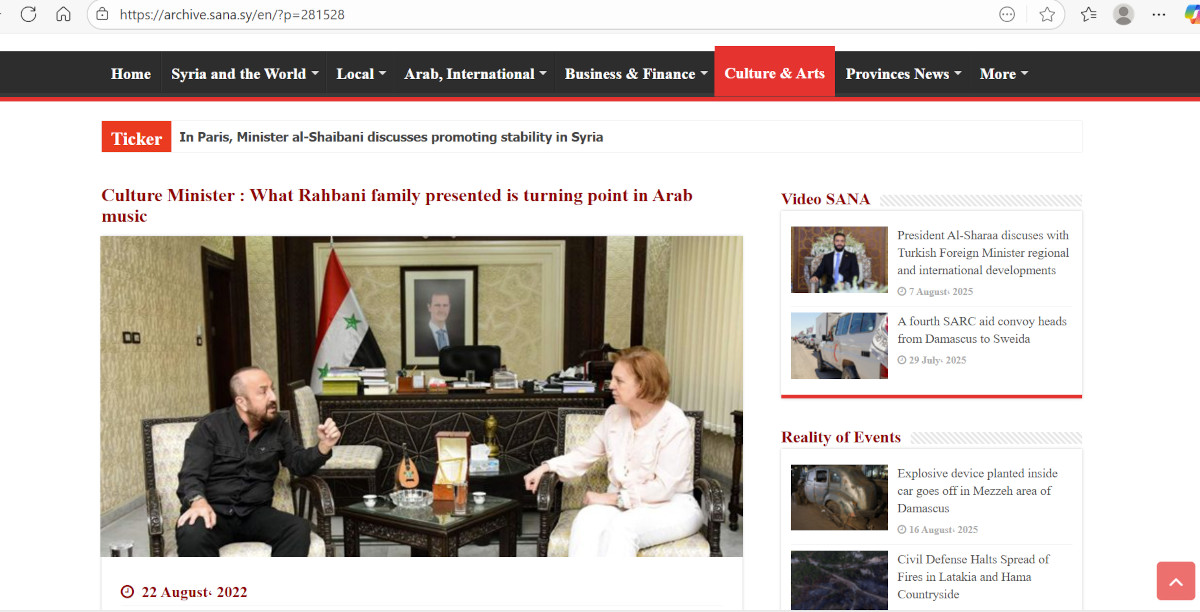
The website was thoroughly remodeled and relaunched on August 22, 2025, promising independent and critical journalism. However, the co-existence of parallel realities at SANA continued as Assad-era articles remained searchable until the end of 2025. The peculiar phenomenon of having news stories from the two political eras available on the same site displayed in an absurd manner the disappointing tendency that SANA has continued its uncritical reporting on national politics and the state leader’s whereabouts. Likewise, it accentuated the continuation of previous rhetorical and visual communication styles – also when covering (reconstruction projects of) national cultural heritage.
Cultural heritage and (Ba’athist) nation building
Most nation states engage in the construction of “useable pasts” (Edgerton 2001) in order to build national identity and legitimize state-building. In post-colonial states in the Middle East and beyond, cultural heritage often plays a central role in this type of political project as it materializes imaginaries of ancient national history, thus naturalizing the postcolonial nation state. This was indeed the case for the Syrian Ba’athist state. Through its 61 years of rule, in different ways, the state has used the historical past of the area that today constitutes Syria to write about national history, thus constructing national narratives. As mentioned earlier, in the last years of the Ba’athist rule, destruction and reconstruction of cultural heritage came to play a central role in the post-war Ba’athist narrative. Whereas monuments destroyed during the war (regardless of who the responsible actor was) served as proof that the opposition consisted of uncivilized terrorists, the following reconstruction initiated by the state (often in collaboration with international actors and organizations) proved Bashar al-Assad as the protector of Syrian cultural history and world heritage. In SANA, reconstruction projects of e.g. The Citadel, The Umayyad Mosque, and the old souq in Aleppo became platforms for staging Bashar al-Assad as the man who could restore national order and re-establish civilization.
In addition to promoting al-Assad and the Ba’athist state as those who re-establish Syrian civilization, SANA’s coverage of the reconstruction projects also served to regain control over the symbolic meaning of national cultural heritage. The Citadel, The Umayyad Mosque and the old souq in Aleppo had all been locations of intense fighting during the battle over Aleppo (2012-2016) while under the control of changing actors. Thus, the media reports of the ongoing reconstruction of these sites served to overwrite the years of war and assign a particular role to these national symbols within the state’s post-war narrative.
This was most spectacularly evident in the visual coverage of Bashar and Asma al-Assad’s visit to Aleppo in July 2022, together with their three children. The trip was staged as a happy reunion between the al-Assad lineage and the ancient city. Images of the family touring Aleppo quickly circulated the news stream, including cheerful images from the crowded and colorful (restored) old souq and more serious images from the presidential couple’s inspection of the ongoing reconstruction work at the Umayyad Great Mosque.
These and other images served to connect the Assad rule with historical monuments and places of symbolic importance in Aleppo – what Assmann calls ‘memorial signs’ (2008) – to regain control over the symbolic meaning of national cultural heritage, and thus over the city, that had been outside state control for four years (Munawar 2022). However, for such signs to be effective, as Halbwachs (1992) reminds us, they must operate within ‘social frames’; they must resonate with or have emotional meaning for people. The Citadel, The Umayyad Mosque and the old souq in Aleppo were – and still are –examples of cultural heritage sites of strong significance for most Syrians, as they are loaded with symbolism not only in Syria but across the world. However, what they represent is less clear and potentially contested. This has been the case with other historical symbols that over time have acquired multilayered meanings while adapting to changing historical and political contexts. Moreover, when cultural heritage is damaged or destroyed during wartime, decisions about whether and how to reconstruct it add new layers of symbolism (Viejo-Rose 2011). Below, I move from SANA’s coverage of cultural heritage during the time of Bashar al-Assad to the time of Ahmad al-Sharaa to sketch out potential difference and similarities in how SANA narrates ‘the new Syria’.
Cultural heritage in ‘the new Syria’
Shortly after the Syrian Army had recaptured the rebel-held parts of Aleppo in December 2016, SANA posted photos of The Citadel decorated with an enormous (then) Syrian national flag and equally huge posters of Bashar al-Assad. Regaining control over this ancient monument of medieval Islamic fortress architecture – Aleppo’s hallmark and a cherished site of national and world cultural heritage – obviously mattered beyond its military value. However, The Citadel itself was damaged from the war, and only reopened in 2018. Already from the summer 2017, the city council arranged a number of concerts in the amphitheater situated behind the walls of The Citadel. SANA enthusiastically celebrated its reinstatement as Aleppo’s cultural center stressing that it symbolized how the city’s long history of civilization and steadfastness had defeated the terrorists while staging Ba’athist Syria as both the protector and perpetuator of Aleppo’s important historical legacy.
Serving as a scene for several official events, The Citadel has obviously maintained its high importance to the new rulers and has appeared frequently in SANA reporting during the year that has passed since the overthrow of Bashar Al-Assad. This was the case, for example, when Ahmad al-Sharaa visited Aleppo on Saturday, 29 November 2025, to participate in marking the one-year anniversary of the city’s liberation. Another example includes the official reopening of The Citadel two months prior, on September 29. At SANA, this was covered with multiple videos of the celebration taking place on the stage of the old amphitheater with speeches by the minister of culture, Mohammad Yassin al-Saleh and other important officials. Al-Saleh declared that the reopening of The Citadel was a “prominent symbol of recovery and revival”. The governor of Aleppo stated, “We reopen the gates of the citadel, for the history, the pride and the hope, and we open a new era made of the blood of martyrs, the patience of mothers and the dreams of children”. Other speakers stressed how the ancient monument symbolizes the steadfastness (sumud) of the Aleppian people. This article, The article, ends by concluding:
The Citadel of Aleppo is an ancient historical jewel that rose on its hill thousands of years ago to be an impregnable fortress and a stage for successive civilizations – from the Arameans and Greeks to the Umayyads, Ayyubids and Mamluks – with its towering walls, majestic gates and stones that embrace history. It has remained a symbol of the city’s steadfastness and pride. Today, the citadel opens again, not as a fortress for war, but as a beacon of culture and the arts, and a mirror that reflects Syria’s bright face to the world.
(author’s translation)
Despite the new political context, which of course is reflected in the statements and speeches quoted at SANA, the overall discourse in the coverage is surprisingly similar to that of the Assad-era. The coverage includes: the same images of an illuminated citadel and an amphitheater with musical performances, official speeches and a cheering audience; the same narratives of the citadel as a symbol of Aleppo’s ancient history, the Aleppians’ steadfastness and Syria’s proud civilization and culture; and, not least, the same ambition of connecting the almost 1000-year-old ancient military monument with the current rulers in power.
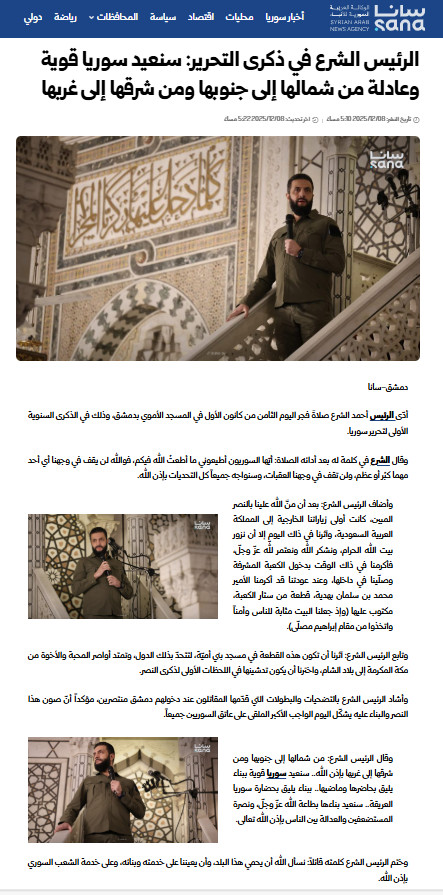
The old souq and the Omayyad Mosque in Aleppo have both received less attention at SANA than was the case in al-Assad’s post-war narrative; however, their Damascene counterparts – and Damascus in general – have appeared as important locations. This may not be surprising, as Syria’s new rulers had a less difficult task of gaining symbolic control over Aleppo than what could potentially be the case with Damascus, since it had remained under Assad’s control until the end of his rule. Thus, just as SANA through its reporting made an effort to reinstate Bashar al-Assad as having symbolic control over Aleppo’s ‘memorial signs’ after the Syrian Army had regained military control over the city in 2016, SANA has been working to place Ahmad al-Sharaa as having a connection with other important ‘signs’. Most importantly, of course, with its reporting on his first anniversary speech in the Omayyad Mosque in Damascus on December 8, 2025, they marked Bashar al-Assads flee to Russia and Ahmad al-Sharaa’s rise to power. The fact that he was able to address the Syrian population from the ultimate national and religious symbol – the Omayyad Mosque – proved his (partial!) success in ruling not just Idleb but all of Syria. SANA, of course, reported on the event by circulating images of the president from the Mosque as he gave a speech and performed the dawn prayer (wearing the same uniform as he did one year previously when he entered Damascus). Similar to the Assad family’s visit to old Aleppo a few years earlier, the images of al-Sharaa in old Damascus positions a contemporary leader within an ancient national history in order to strengthen his own political legitimacy and perform instant nation-building. In the case of al-Sharaa, his staging in the Umayyad Mosque also served to connect him to the Umayyad Empire, and thus, albeit subtly, spoke to the popular narrative of al-Sharaa representing the return of the Umayyads (see Holst’s introduction to this feature, Pierret’s contribution to this feature).
In a Damascus context, the reconstruction of cultural heritage obviously takes up a less prominent role in SANA reporting, since the city was neither bombed nor a site of intense fighting during the years of war. However, this has not discouraged the news agency from highlighting the historical treasures of the ancient capital – quite the contrary. Since the relaunch of SANA in August 2025, it has continued to promote and highlight cultural heritage in Damascus and beyond, depicting how the new rulers of the country are committed to preserve and protect this national heritage. SANA’s interest in the topic neatly corresponds with the official discourse. On the last day of 2025, the Syrian Directorate of Antiquities and Museums launched a new national strategy for the protection of Syria’s cultural heritage. In reporting SANA’s coverage on the strategy, they highlight how this initiative aims at remedying the previous regime’s mismanagement and neglect, They cite the directorate for stressing that
The Syrian cultural heritage, both the material and the non-material, constitutes one of the main pillars of the national identity and the memory of the Syrian society, which carries of civilizational depth that extends for thousands of years.
(author’s translation from Arabic)
The message seems to be clear: post-Assad Syria is a smooth and natural continuation of the country’s long and proud history. Syria remains the cradle of civilization, and the Syrian state is the guardian of important cultural heritage. Thus, the same, familiar narrative from the time of the Ba’athist state continues to serve as an important element for the Syrian state in consolidating national identity and legitimizing political power.
Christine Crone is an assistant professor in the Department of Cross-Cultural and Regional Studies, University of Copenhagen. She is a Middle East scholar working on Arab media. She is the author of Pan-Arab News TV Station al-Mayadeen: The New Regressive Leftist Media (Peter Lang, 2020). She has published on topics such as TV drama, Syrian media and documentaries, and the use of images in Arab media.
References
Assmann, Aleida (2008). “Transformations between History and Memory”. Social Research, 75 (1): 49–72.
Crone, Christine (2025). “Reconstructing Baʾathist Syria through Cultural Heritage and State Media”. Middle East Journal of Culture and Communication 17 (4): 295–315.
Crone, Christine (2023). “Re-narrating the Past, Producing the Present and Unlocking
the Future: Haris al-Quds, a tv-dramatization of ‘post-war’ Syria”. Middle East Critique 32 (3): 305–321. http://doi.org/10.1080/19436149.2023.2229188.
Edgerton, Gary R. (2001) “Television as History: A Different Kind of History Altogether”. In: Edgerton and Rollins (eds), Television History: Shaping Collective Memory in the Media Age. Pp. 1-16. The University Press of Kentucky.
Halbwachs, Maurice (1992). On Collective Memory. Chicago: University of Chicago Press.
Munawar, Nour A. (2022). “Reconstructing Narratives: The Politics of Heritage in Contemporary Syria”. Journal of Social Archaeology 22 (2): 172–190. https://doi.org/10.1177/14696053221073992.
Viejo-Rose, Dacia (2011). “Destruction and Reconstruction of Heritage: Impacts on
Memory and Identity”. In: Anheier, Helmut and Yudhishthir Raj Isar (eds.), Heritage,
Memory & Identity, pp. 53–69. London: Sage. https://doi.org/10.4135/9781446250839.
Cite as: Crone, C. 2026. “Constructing post-Ba’athist Syria through Cultural Heritage: the role of the Syrian Arab News Agency” Focaalblog March 23. https://www.focaalblog.com/2026/03/23/christine-crone-constructing-post-baathist-syria-through-cultural-heritage-the-role-of-the-syrian-arab-news-agency/