One of the most troubling features of Trump-era politics is not simply nationalism, authoritarian style, or contempt for institutions. It is the extent to which large parts of the administration and its surrounding ecosystem have normalised a form of religious absolutism, especially in its Christian Zionist variant, as a legitimate basis for public policy. This is most clearly visible in relation to Israel–Palestine, where biblical claims, apocalyptic imagination, and civilisational rhetoric increasingly bleed into state language, lobbying, and diplomacy.
This is not a story about religion in politics in the broad sense. American politics has always been saturated with religion. Nor is it a story about American Christians as such, many of whom reject Christian Zionism and oppose the sacralisation of war and occupation. It is, rather, a story about a specific ideological formation: the convergence of Trumpism, evangelical power, militarised Christianity, and an unqualified pro-Israel agenda that increasingly treats territorial expansion and permanent domination as morally righteous, even divinely sanctioned.
Consider Pete Hegseth, now serving as U.S. defense secretary. His tattoos include both “Deus Vult” (the medieval crusader slogan meaning “God wills it”) and the Jerusalem Cross, a symbol with a long Christian history that has also been adopted by some far-right groups as an emblem of struggle for “Western civilisation.” Symbolism matters, especially when it aligns with a broader worldview. Hegseth’s public commentary has long deployed crusade-inflected language and cast politics in civilisational terms. In a political environment already inclined to frame conflict as existential and redemptive, such imagery is not merely ornamental. It signals a moral universe in which force can be imagined as a sacred duty.
Then there is Paula White-Cain, Trump’s longtime spiritual adviser, now serving as senior adviser to the White House Faith Office, created in February 2025. White is not a marginal pastor offering private counsel; she is an institutional actor at the centre of the administration’s religious outreach. Her prominence illustrates how charismatic evangelical leadership has been folded directly into executive power. Whatever internal diversity exists within evangelicalism, White’s role provides formal access and symbolic legitimacy to a religious-political bloc that has made unwavering support for Israel central to its moral vocabulary.
That bloc has organisational muscle. Christians United for Israel (CUFI) describes itself as the largest pro-Israel organisation in the United States, with more than 10 million members. It presents its mission in explicitly activist terms: to educate and mobilise Christians “with one voice in defence of Israel and the Jewish people.” CUFI is not merely a constituency group; it is a mass infrastructure for translating prophetic belief into lobbying pressure. When biblical narratives are converted into organised political leverage at this scale, they shape the range of what elected officials can say and do.
The American Israeli Public Affairs Committee (AIPAC) is different, but no less important. It is a major pro-Israel lobbying organisation that plays a key role in shaping the U.S.–Israel relationship. Its worldview is more conventionally strategic than theological. Yet in practice, the agendas of groups like AIPAC often converge with those of Christian Zionist networks, producing an American political field in which the costs of backing Israeli occupation, settlement expansion, or maximalist territorial claims are drastically reduced. Theology and lobbying are not identical, but they are politically complementary.
The administration’s own institutional architecture reinforces this trend. In February 2025, Trump signed an executive order creating the Task Force to Eradicate Anti-Christian Bias, led by Attorney General Pam Bondi. On paper, the initiative is framed as protecting Christians from discrimination. In practice, such moves risk deepening a politics of Christian grievance and exceptionalism, presenting the state as the guardian of a supposedly besieged majority faith at the very moment when Christian nationalist language is becoming more entrenched in public power.
The rhetoric becomes even clearer in the case of Elise Stefanik. During her January 2025 confirmation hearing for the UN post, Stefanik endorsed the claim that Israel has a “biblical right” to the West Bank. The significance lies not only in the remark itself, but in what it reveals: a willingness to displace international law, diplomacy, and Palestinian political rights with a sacred title deed. Although her nomination was later withdrawn, the statement remains politically telling.
Mike Huckabee, now U.S. ambassador to Israel, has long embodied this same logic. He is widely described as a staunch evangelical supporter of Israel and a longstanding defender of Jewish settlements in the occupied West Bank. His politics are not simply “pro-Israel”; they are rooted in a theological reading of land, sovereignty, and history that aligns closely with Christian Zionism. That worldview narrows the space for any policy grounded in equality, international law, or genuine Palestinian self-determination.
This alignment is clearly reinforced by the relationship with Israeli political leadership. While Benjamin Netanyahu has strategically engaged with evangelical audiences and Christian Zionist networks, he is not alone. Extremist figures such as Bezalel Smotrich and Itamar Ben-Gvir have drawn explicitly on religious justifications in articulating territorial claims and in dehumanising Palestinians. This does not imply a simple ideological overlap with American Christian Zionism, but it highlights a growing convergence in which theological narratives and state interests intersect, mutually reinforcing a political environment where extremist ideologies and military policies acquire both strategic and symbolic legitimacy.
Crucially, this ideological framework does not stop at Israel–Palestine. It extends into broader geopolitical imaginaries, including the war in Iran, where segments of the same evangelical ecosystem interpret conflict through apocalyptic and civilisational lenses. In such narratives, geopolitical confrontation is not merely strategic but part of a larger, divinely ordered struggle. The effect is to further erode the space for diplomacy, recasting war as destiny rather than as a contingent and avoidable political choice.
At the centre of this configuration stands Donald Trump himself. Trump is not a conventional religious actor, nor does he consistently articulate a coherent theological worldview. His relationship to religion has been largely instrumental and politically attuned rather than doctrinal. It is precisely this pragmatism that has enabled a particularly effective alignment with Christian Zionist constituencies. Trump’s approach to Israel has combined strategic calculation with symbolic gestures that carry deep theological resonance for evangelical supporters. Decisions such as the relocation of the U.S. embassy to Jerusalem, the recognition of Israeli sovereignty over contested territories, and the consistent avoidance of pressure on settlement expansion have not been framed in explicitly religious terms by Trump himself. However, they have been readily interpreted within a Christian Zionist framework as affirmations of biblical promise and prophetic fulfilment, in line with the “Greater Israel” vision. Trump’s significance lies less in personal belief than in political calculation: he has translated a set of religiously inflected expectations into concrete policy shifts, while maintaining enough ambiguity to keep these commitments legible as both strategic choices and moral imperatives.
Taken together, these figures and institutions reveal a deeper pattern. Christian Zionism is not a decorative feature of Trumpism; it is one of the moral languages through which power justifies itself. It sanctifies hierarchy, recasts occupation as covenant, and turns war into destiny. Its extension beyond Israel–Palestine into wider conflict theatres underscores the risks of allowing theological absolutism to shape statecraft.
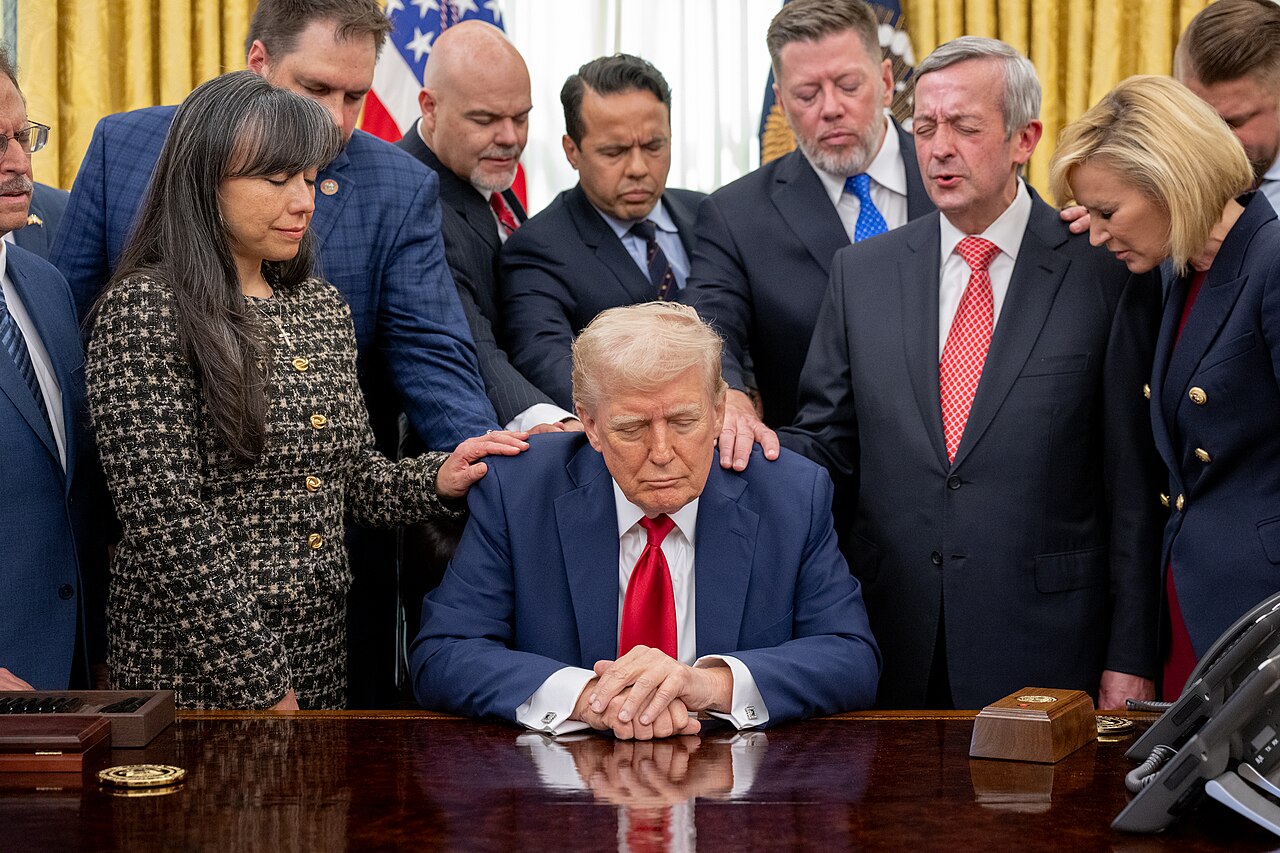
Its danger lies precisely in this fusion of transcendence and politics. Once territorial claims are rendered biblical, and military force is wrapped in sacred symbolism, political argument becomes harder, compromise becomes sinful, and domination begins to masquerade as faith. The ritual of “laying on of hands” in the Oval Office on 5 March 2026—during which prominent evangelical figures gathered around Donald Trump, placing their hands on his shoulders and arms while praying over him—epitomises this convergence. It is not merely a display of personal devotion, but a performative enactment of political theology: a moment in which spiritual authority and executive power collapse into one another, reinforcing the idea that political leadership itself is divinely sanctioned and that state action can be endowed with sacred legitimacy.
Antonio De Lauri is a Research Professor and Research Director at the Christian Michelsen Institute. He is the President of the International Humanitarian Studies Association, and the Editor-in-Chief of Public Anthropologist.
Cite as: De Lauri, A. 2025. “The Trump Administration: Theology into Statecraft” Focaalblog March 27. https://www.focaalblog.com/2026/03/27/antonio-de-lauri-the-trump-administration-theology-into-statecraft/