All posts by Focaal Web Editor

Julija Kekstaite, Soline Ballet, and Ava Zevop: Fabricating political imagination in contemporary art ‘peripheries’. Postcolonial and postsocialist encounters in Slovenia and Lithuania

The Eastern edges of the European Union stand as landscapes of transformation and socioeconomic and cultural flux, situated between shifting empires and layered histories. Their in-betweenness mirrors a duality of political imaginaries: remnants of collapsed past utopias colliding with the alluring yet hollow promises of contemporary global capitalism. These places also inhabit the peripheries of the contemporary art market, providing an infrastructure that feeds into neoliberal logics and fosters opportunities for some while relying on the precarity and exploitation of others (Malik, 2019). Yet, it is precisely this peripheral, liminal position that enables the Eastern edges of the European Union to cultivate specific types of localised knowledge, dialogue, and conversations that would resonate differently if held at the centre of the capitalist world system. Thus, in this blog post, we assess the fleeting potentiality of thinking ‘between the Posts’ (Chari & Verdery, 2009)—that is, examining both colonial and socialist histories–in possibly providing a richer, hybrid framework not only for intersectional critique but also for new political imaginations and coalitions to emerge.

We want to illustrate this with reference to the postcolonial and postsocialist encounters we came across at the Kaunas Biennial, Long-Distance Friendships, and the Ljubljana Biennial From the Void Came Gifts of the Cosmos, which took place in 2023. While in the fast-paced world of art critique with its immediate reporting, looking back at past cultural events a year or so later might seem unorthodox, we see value in slower forms of reflection.

Attending the two events, we were curious to see how the two art biennials realised their ambition to invite postsocialist subjects to reflect on coloniality. What are the benefits when postcolonial conversations are situated in geographical settings that have different histories of capitalism and anti-capitalism than world-leading biennials such as Venice? This text is a reflection of our ambivalent and interwoven positionalities spanning research, art, and activism in ‘Eastern’ and ‘Western’ Europe, and our life and work mobilities between Belgium, Slovenia, and Lithuania.
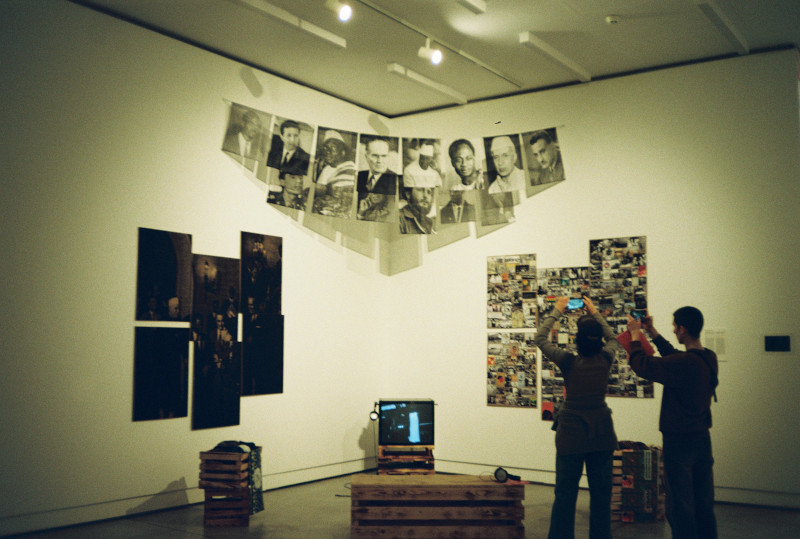
Image 1: The authors of this blog at the Cukrarna Gallery, Ljubljana (Julija Kekstaite, 4 January 2024)

We grappled with the discourses emerging in the frameworks of the biennials as anthropological artefacts, pondering how they travel, morph, germinate, and fade out. What are their political economy, impact, and historical reference points in a world region outside the capitalist bloc during the Cold War, for example? Who are the artists invited to work with and articulate these reference points, and under which conditions? For this project we took research trips to Kaunas and Ljubljana and conducted interviews with institutional representatives, curators, and artists.

From the void // came gifts

With the notion that ‘from the void came gifts of the cosmos,’ the artistic director, Ghanaian artist Ibrahim Mahama, and a group of curators were invited by the MGLC (Mednarodni grafični likovni center;transl: International Centre of Graphic Arts) for the 35th Graphic Biennial of Ljubljana (founded in 1955), to initiate an exchange among the works of 44 artists and 11 historical artworks from the biennial’s archives. The historical ties post-independence Ghana and former Yugoslavia as member-states of the Non-Aligned Movement (NAM, founded in 1961 as a forum of countries not aligned with either of the two major power blocs of the Cold War) were seen as legacies to build on for new solidarities between Slovenia (and Eastern Europe at large) and the Global South.
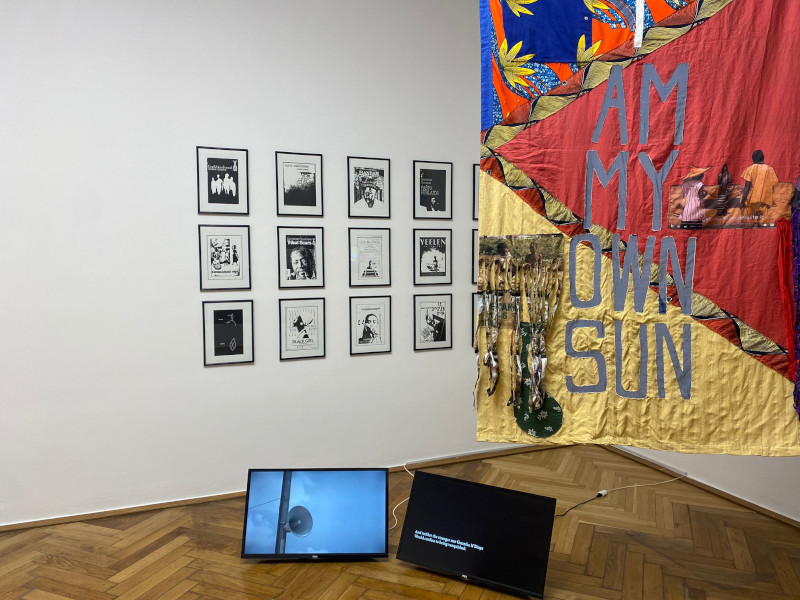
Image 2: I Am My Own Sun, School of Mutants, installation (2023) at the 35th Ljubljana Biennale of Graphic Arts (Soline Ballet, 5 January 2024)

Ibrahim and the curators took the expansive notion of ‘The Void’ as an uncontrolled space with inherent radical potential for equality as the point of departure for their work. Under circumstances where we need more conceptual tools to grasp emerging alliances at the interstices of global powers and common forms of dispossession—such as those related to the environment—the biennial’s departure from ‘The Void’ proved stimulating. Kwasi Ohene-Ayeh, a curator based in Kumasi, Ghana, explained in an interview how the notion of ‘The Void’ can unveil the promises and failures of post-independence politics and transnational friendships, such as the Non-Aligned Movement.

To transcend hegemonic binary logics and think through “universality from the periphery” means, in Kwasi’s words, “to take the poison, and out of it, generate something progressive”. The curators embraced the void as a means of reconciling with and affirming the role of the arts in constructing new imaginaries and alliances between the Global South and Global East beyond the monopoly of Western power (Ohene-Ayeh et al. 2023). With this, they echoed Ghanaian artist-intellectual kąrî’kạchä seid’ou’s vision of transforming art from commodity to gift as a way to challenge art’s capitalist underpinnings and to foster alternative forms of exchange.

An important aspect of the 2023 exhibition was therefore a reflection on the history of the Graphic Biennial as both a generator and a product of the Socialist Federal Republic of Yugoslavia’s cultural diplomacy. While the Ljubljana biennial convincingly linked post-independence, postcolonial, and socialist artworks and global alliances of the Cold War period to the question how political projects can fill ‘The Void’, it also left a void in addressing how artists can liberate themselves from the neoliberal regimes of contemporary art to connect with the material conditions of local struggles against rapid neoliberalisation. An immediate display of this project came from the local grassroots art scene in Ljubljana as the local Krater Collective contributed an artwork that showcased the negotiations over the material terms and conditions of the Graphic Biennial.

A place we call home”

The Ljubljana biennale showed many international artists, particularly from the Global South, but it is the participation of Tjaša Rener which unearths the unorthodox and less mediated mobilities from South-Eastern Europe to the Global South. Rener is a Slovenian-born artist who has been living in Ghana for over a decade. For the exhibition venue at Cukrarna she had prepared an installation called A Place we Call Home, which juxtaposed her own positionality with that of another Slovenian-born woman named Metoda. While both the artist as well as her subject are presented as outliers to the more common routes of the global mobility regime, their personal routes were four decades apart. In those four decades, the political system of their place of origin changed. For socialist Yugoslavia, which had no prior tradition of international education, cooperation with socialist countries in Africa brought an influx of international students to its nascent socialist education system (Dugonjic-Rodwin & Mladenovic, 2023). One of them was Metoda’s now deceased husband, who came to Yugoslavia as a student on the NAM’s programme of bilateral collaborations and with whom Metoda moved to Accra in 1974. A place she has made her home.

Metoda’s house in Accra is the central motif of Rener’s work for the Graphical Biennale. The installation combines archival photographs, historical objects, and a painting to evoke both Metoda’s home in Accra, memories of 1980s Slovenia, and the artist’s own childhood home, her mother’s house. In the corner, an old radio is playing excerpts from interview with Metoda, capturing the gradual, but enduring erasure she faced as socialist Yugoslavia collapsed and she was in Ghana as a citizen of a nation that was no more, while Ghana’s digitalization of national registers made it difficult to access her administrative and legal documents and rights. The artist compares Metoda’s experience with that of the so-called ‘Erased” in Slovenia, residents mainly from states of former Yugoslavia and of ethnic minority status with similar experiences.

Image 3: Yugoslav passport of Rener’s mother was one of the exhibited items in the installation A place we call home (Ava Zevop, 4 January 2024

The artwork compels us to think through complex mobilities and modes of identity construction of postsocialist subjects in a postcolonial space, in which the artist and Metoda interact through a shared language, the debris of historical ties and recent attention to relations between socialist Eastern Europe and postcolonial nations. While it is tempting to read non-alignment –- both in the work of Rener, as well as the larger framework of the biennial – as re-affirming the nation state as a point of reference and belonging, another reading highlights its internationalism and the internationalist outlook it offered to citizens of socialist Yugoslavia and others (Dugonjic-Rodwin & Mladenovic, 2023).

The artist evokes a gendered sensibility to read the historical (diplomatic) ties between former socialist and post-colonial countries, while using her own positionality between Ghana and Slovenia as a lens to explore the multiple articulations of identity and belonging, race and class, and the changing mobility regimes under non-alignment and neoliberal capitalism.

Fabricating resistance between the posts

The Kaunas Biennial centred on personal histories, relationships, and their potential. By bringing together artists from Lithuania, the African continent, and beyond—many of whom created works on the event site—the curators facilitated a space not only for an exhibition but also for collective thought and work. The main exhibition venue, a modernist post office building in Kaunas, served as both a space where artists created works on site and a nod to the historical ties of communication and exchange among countries under former Soviet and colonial rule, as well as present and possible future entanglements.

Often, the contemporary art scene in the Baltic states has adopted a Western postcolonial framework that reproduces the binary coloniser/colonised relationship by portraying itself in a victim role vis-à-vis Russia as a colonial empire. While this perspective was suitable for a certain period—especially when national liberation and independence were the primary frameworks available to resist imperialist domination—such readings have run their course, overlooking these spaces’ present-day relatedness to global capitalist infrastructures of domination and cultural exploitation. Thus, it is refreshing to see a critique that highlights the continuities between postcolonial and post-socialist conditions, where ‘post’ hints not only at a space for correspondence but also at a ‘critical standpoint’ recognising divergent and overlapping experiences and struggles (Chari and Verdery, 2019).

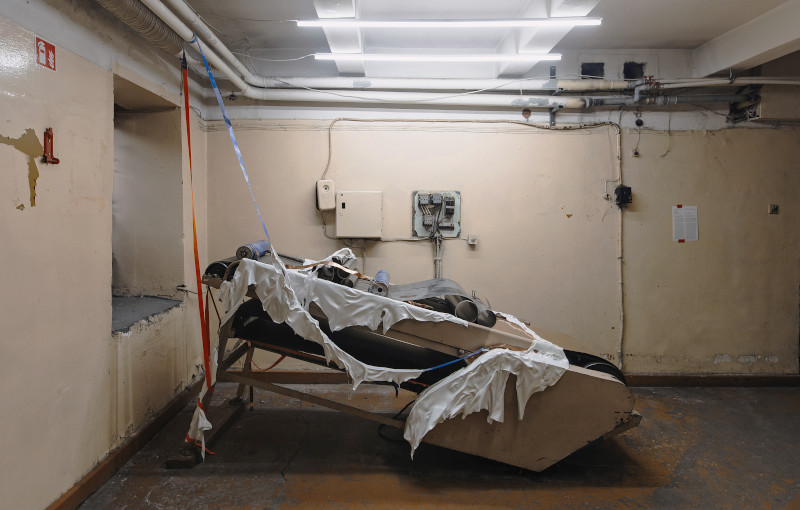
Images 4: Body of an Image, Anastasia Sosunova, 14th Kaunas Biennial (Martynas Plepys, 2023)
Images 5: Body of an Image, Anastasia Sosunova, 14th Kaunas Biennial (Martynas Plepys, 2023)

Anastasia Sosunova’s work epitomises an affirmative critique of the shared global condition without obscuring historical and geopolitical differences. Reflecting on the curation of the bienniale, Sosunova notes, “what I liked about the Kaunas Biennial or Riga’s Survival Kit [authors comment; the third biennial taking place in parallel to Kaunas and Ljubljana] is that their shared theme referred to this weird and complex ‘everywhere at the same time’ kind of context of the globalised world, while acknowledging that every place is like ‘nowhere else’”. Their installation, Body of an Image, conceived on-site during one of the guided tours organised by the curators, drew on both archival material and fictional tools to explore the ambivalence of postcolonial and postsocialist encounters and the productive frictions they can yield. The piece drew inspiration from and referenced Vytautas Andziulis, who dug out his basement to run a secret, oppositional underground publishing house during Soviet times. Adziulis constructed a printing press from discarded Soviet machinery parts to primarily print Christian and anti-Soviet material. He dubbed it Hell’s Machine. Sosunova, in contrast, constructs their own fictional resistance machine from scrap metal pieces devoid of any nationalist and religious sentiment, instead serving as a bridge between two contemporary resistance outlets: the 1990s Lithuanian gay magazine Naglis and Uganda’s contemporary queer magazine Bombastic. Though separated by time and space, the two magazines share the underground resistance of the gay and queer movement(s). In conversation with us, Sosunova reflects on how creating this fictional machine of resistance by linking it to queer oppression allowed them to reshape history as “a friendship concretised through the postcolonial liberation”. So, by interweaving nods to similar and contradictory expressions of resistance and bringing in elements of imagination, Sosunova’s work makes us question whether we can align our distant yet connected struggles while not only acknowledging differences in historical baggage but even drawing inspiration from that to remould it into something (a)new.

Where do we go from here?

As we sipped on overpriced Negronis in the centre of Ljubljana after visiting the biennial, we had a strong sense that the edges of the capitalist world system have moved further East.Yet, the artworks at both biennials also highlight the continued power of peripheral political positions in Eastern Europe; those who navigate intersections of postcolonial and postsocialist transformations to elicit new political ideas and projects. However, two challenges remain. On the one hand, how to make those ideas actionable beyond the microcosm of the contemporary art field? And, on the other hand, how to balance the poignant quest for solidarity with productive (self)critique?
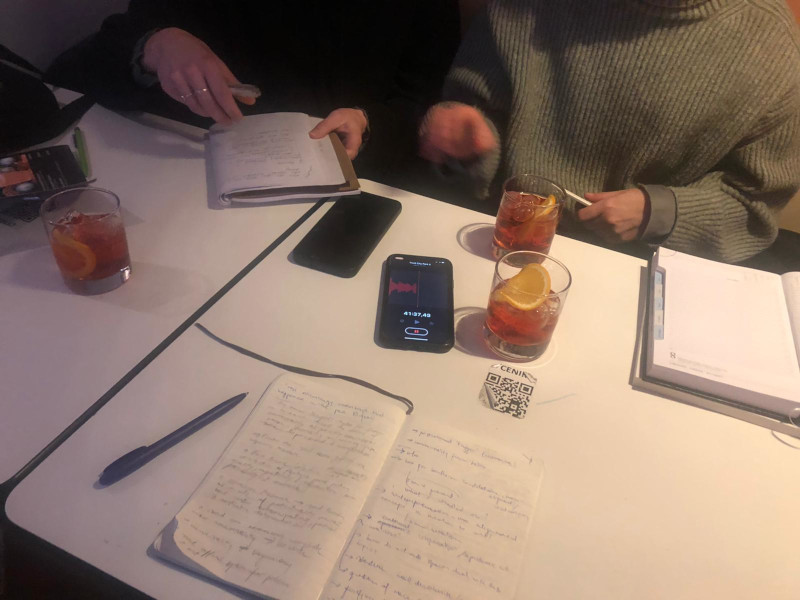
Image 6: The authors discussing their fieldwork in a Ljubljana bar (Julija Kekstaite, 7 January 2024)

In what concerns the first challenge, the tepid response from the Eastern European art establishment, with some notable exceptions, to ongoing genocides in Myanmar, Palestine, Sudan, and elsewhere shows a failure to move from aesthetics and poetics to political praxis. As for the latter challenge, future research on similar manifestations of the relational decolonial gaze in contemporary art must be wary of not painting postcolonial and postsocialist encounters in these contexts too much as ‘events’ (Badiou, 2005), radically new occurrences that can interrupt the status quo but are detached from any historical, socio-political or economic positioning. When yet another artist from Africa or the Middle East, whose works one gets to see in European galleries at the exhibitions on decolonial futures, again fails to obtain their travel visa we should be reminded that people from the Global East and the Global South are still differently situated within the structures of racial capitalism as well unequally subjected to the violence of the global mobility regime (Van Houtum 2010).

Nonetheless, what we tried to argue here through the examples of Kaunas and Ljubljana biennials is that bringing into dialogue postcolonial and postsocialist subjects and histories seem to excavate a space for a relational decolonial gaze that can offer intersectional and multiple critiques. Instead of binary readings of white and black, coloniser and colonised, resistance or existence, such a gaze embraces the ambivalence and messiness of intersecting oppressions and multiple resistances beyond the state within the global postcolonial condition. It can cultivate new threads of solidarity with the Global South, mindful of avoiding alliances that echo the relationships of imperialism and capitalist paternalism during the Cold War.

In times when alternatives seem to have vanished (Piškur, 2024), emphasising the potential of such a relational decolonial gaze for the creation of conditions and coalitions for political imagination is especially tempting, but is ‘at best gestural if not counterproductive’ (Malik 2019) if not coupled with a reflection on art infrastructures themselves.


Julija Kekstaite is a PhD researcher in Sociology at Ghent University, Belgium, and a researcher-activist with the grassroots group Sienos Grupė in Lithuania. Her interests encompass various strands of critical theory, focusing on border violence and resistance in the post-Soviet space.

Ava Zevop was born in Ljubljana, Yugoslavia and currently lives in Brussels, Belgium. She is a visual and media artist, and an independent researcher. In her practice, she concerns herself with technological degrowth from the position of intersectional struggle, and global justice.

Soline Ballet is a PhD researcher in Social Work and Social Pedagogy at Ghent University, Belgium focusing on social work initiatives with illegalised migrants. Their interests include solidarity, migration management and governance, and power/knowledge practices.


References

Badiou, A. (2005). Being and event (O. Feltham, Trans.). Continuum. (Original work published 1988)

Chari, S., & Verdery, K. (2009). Thinking between the posts: Postcolonialism, postsocialism, and ethnography after the Cold War. Comparative studies in society and history, 51(1), 6-34.

Dražil, G. (2023). Mohammad Omar Khalil and Some Highlights from the History of the Ljubljana Biennale of Graphic Arts. In Ohene-Ayeh, K., Haizel, K., Ankrah, P. N. O. & Kudije, S. (Eds.) (2023). From the void came gifts of the cosmos: a reader. The 35th Ljubljana Biennale of Graphic Arts. International Centre of Graphic Arts (MGLC)

Dugonjic-Rodwin, L., & Mladenovic, I. (2023). Transnational Educational Strategies during the Cold War: Students from the Global South in Socialist Yugoslavia, 1961-91. Socialist Yugoslavia and the Non-Aligned Movement, 331-360.

Ohene-Ayeh, K., Haizel, K., Ankrah, P. N. O. & Kudije, S. (Eds.) (2023). From the void came gifts of the cosmos: a reader. The 35th Ljubljana Biennale of Graphic Arts. International Centre of Graphic Arts (MGLC)

Malik, S (2019). Contemporary Art, Neoliberal Enforcer. Youtube https://www.youtube.com/watch?v=ivQjEBaJh5g. Accessed 19, October 2024.

Piškur, B. (2024). Troubles with the East(s). L’internazionale Online.https://archive-2014-2024.internationaleonline.org/opinions/1123_troubles_with_the_easts/

Povinelli, E. A. (2012). After the last man: Images and ethics of becoming otherwise. E-flux journal35.

Van Houtum, H. (2013). Human blacklisting: The global apartheid of the EU’s external border regime. In Geographies of privilege (pp. 161-187). Routledge.


Cite as: Kekstaite, Julija, Ballet, Soline, and Zevop, Ava 2024. “Fabricating political imagination in contemporary art ‘peripheries’. Postcolonial and postsocialist encounters in Slovenia and Lithuania” Focaalblog 3 December. https://www.focaalblog.com/2024/12/03/julija-kekstaite-soline-ballet-and-ava-zevop-fabricating-political-imagination-in-contemporary-art-peripheries-postcolonial-and-postsocialist-encounters-in-slovenia-and-lithuania/

Adia Benton: Humanitarian vernaculars (and the racial vernaculars of humanitarianism)

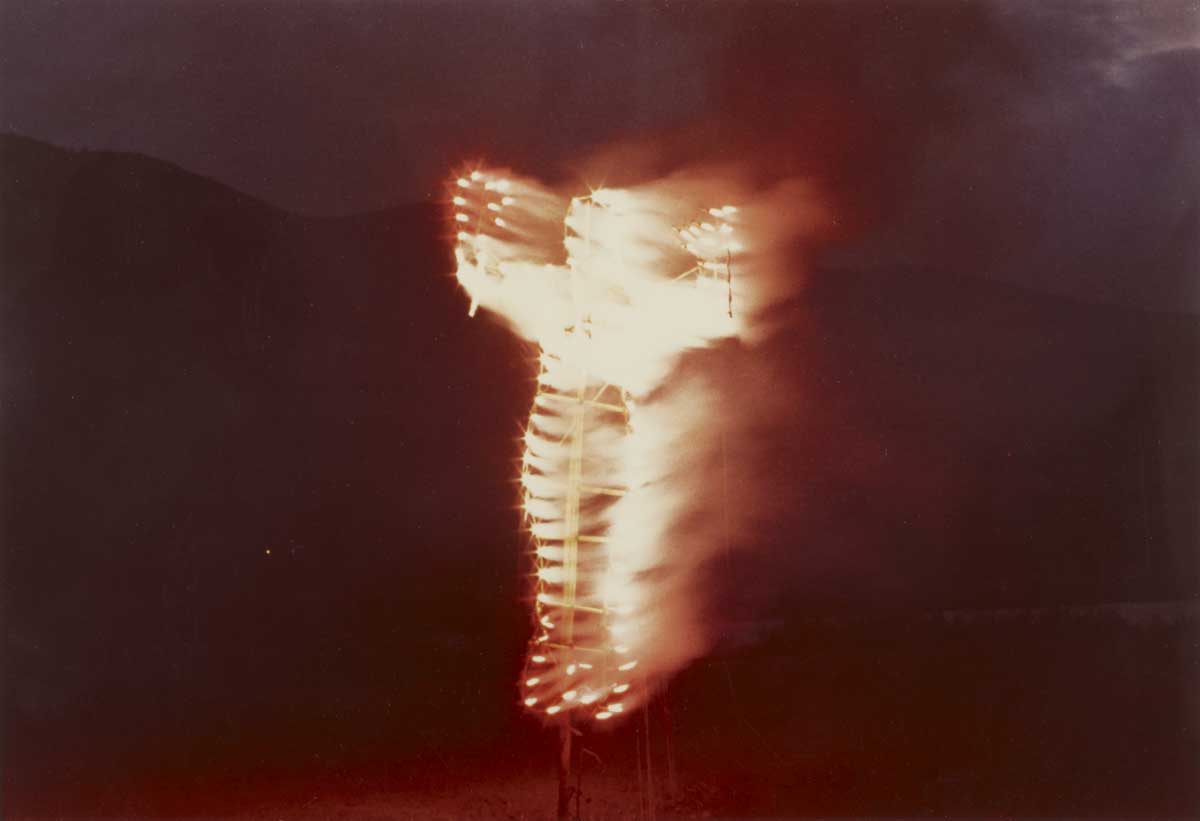
Image 1: Untitled (Ánima, Silueta de Cohetes) 1976, by Ana Medieta

While explaining the origins of Gramsci’s definition of hegemony to an interviewer, the labour historian Michael Denning (2023) suggested taking a Jeopardy! approach to social theory, which is to say: “rather than try to define a term, give a term, and the question to which that term is the answer.” For the purposes of this short essay, I’ll begin with the term “humanitarianism.” If humanitarianism is the answer, the question is: why do you help someone who is not like you, who is also far away from you; what are the logics or the rationale underlying the imperative to organize help for distant others, for attempting to alleviate their suffering? As Malay Firoz and Pedro Silva Rocha Lima note in the introduction to this collection, when the question is posed this way, “the human” that forms the basis for much theorizing about humanitarianism is not a universal category, but a differentiated (and aspirational) one; in this formulation, “empathy for ‘distant others’ is not simply a moral calling but a politically filtered and calibrated gesture.”

What comes into view when we acknowledge that humanitarianism is premised on the idea of treating members of a suffering collective as if human? This is where the critical study of humanitarianism and its taxonomies of difference intervenes. To argue for a critical study of humanitarianism and its taxonomies of difference is not to normalize or ascribe normative status to humanitarianism as an Euro-American or Eurocentric mode of governance, profession, ethos, laws, or industry, but to denaturalize it as the primary category through which we understand the moral and political imperatives to help others along lines of or transversal to allegiance, affinity, solidarity, or difference. It is also to highlight the forms of difference upon which the field rests and operates, through which it is mobilized and that it produces.

Fechter and May, working at the Myanmar-Thailand border, observe local, grassroots efforts to assist internally displaced persons and refugees fleeing protracted conflict. They call for de-centring taxonomies of difference in “classical” humanitarianism—what Dorothea Hilhorst (2018) has defined as the “highly institutionalized form, often led by organizations from the Global North”—and to instead examine the taxonomies of humanitarianisms and the various affinities and inclusions associated with them. I understand them to also be asking: Can examining the lateral, vernacular or everyday forms of assistance during crisis help to (re)construct different genealogies, and therefore, a different critique, of the imperative to help, its social and political organization, its emergent and undergirding sodalities?

Based upon the insights provided in the other posts, I’d like to propose that reframing these locally organized acts of mutual aid and solidarity as ‘vernacular humanitarianism’ simply provincializes these acts as an (humanitarian) object of study. Using a sleight of hand deployed by Fechter and May, I wonder if it is perhaps more politically necessary to excavate and decipher not only vernacular humanitarianisms—if we must call them that – but also the humanitarian vernacular, revealed through our analyses of so-called classical humanitarian ideologies, organizations, practices, and discourses (cf. Pierre 2020, and her discussion of the racial vernacular of development). Doing so helps us to understand how humanitarianism organizes, institutionalizes, and builds upon existing ideas about ethics, labour, race, culture, religion, gender, family, and nation—and vice versa.

In her contribution on Turkish humanitarians working among Muslims in Africa south of the Sahara (a space racially coded as ‘Black Africa’), Güner provides a clear illustration of what attention to taxonomies of difference can offer. She details the discursive construction of Muslim whiteness in humanitarians’ accounts of their encounters with Black Muslims in Africa, highlighting the circulating narratives about their interpellation as ‘White Muslims’ by their African interlocutors (Güner 2023). Her contribution here not only reveals how “the racial logics of humanitarianism operate…in transnational contexts outside of the West,” but also how national racial projects and formations are constituted through humanitarian governmentality.

Within the humanitarian vernacular, taxonomies of difference (and affinity) are laid bare as operational categories within nongovernmental and state organizations, which are reproduced and experienced via everyday encounters with these entities. Ward, drawing on her research in Jordan and sociological theories of on-the-ground race-making, reveals how racialized constructions of the formal and informal classifications of aid workers as ‘international’, ‘expat’, ‘national’ and ‘local’,” organize everyday work of Jordanian freelance consultants. These expert consultants are ‘fast-fixers’ who, working on short timelines, are hired to edit and improve international consultants’ reports to donors. Fast-fixers are often former employees of humanitarian NGOs who have ‘maxed out of the local’ and into freelance work; for a range of reasons, including the limited mobility afforded by their passports, they do not move on/up and work abroad. These ‘local’ consultants insist that they are ‘true humanitarians’ because they have remained in place to help others, rather than hopping from place-to-place—a notable feature of humanitarian labour regimes (Redfield 2012; cf. Benton 2016). Ward ultimately outlines the humanitarian industry’s racial vernacular and how it is “deployed in ways that sustain racial thought, that index particular racial meanings, and that prescribe certain social and political practices” (Pierre 2020: 87).

In the work of Tsoi and Stuewe, respectively, Canada and Germany define their border and migration projects in terms of humanitarianism and human rights. Stuewe argues that Germany’s humanitarian approach to managing Yezidi refugees from Iraq prioritizes assimilation via conventional educative programming like language instruction, but also what historical anthropologist Ann Stoler referred to as the ‘education of desire,’ the curriculum highlighting German norms and values around family, kinship, and romantic love (“free partner choice”). The programming is experienced by Yezidi refugees as a violent erasure of their kin practices and, thus, an existential threat. Tsoi focuses on Canada’s relaxed immigration policy, in which a “democratic logic intersects with a capitalistic logic to control border mobility.” Specifically, the regime of mobility governing this policy is also a racial regime, in which democracy and capitalism are intertwined: Hong Kong diasporans in Canada are racialized as uniquely economically productive citizens. Incoming Hong Kong migrants are, thus, prospectively placed in the category of ‘productive labourers’, while the conferral of Canadian citizenship is the democratic intervention. Together, Tsoi and Steuwe show how border regimes, particularly when they are characterized as humanitarian, or as performing a humanitarian function, interpolate humanitarian assistance into exploitative and often violent, differentiating function of borders.

Each of these contributions helps us to understand the humanitarian vernacular and its ‘grammar’—how humanitarianism organizes, institutionalizes, produces and builds upon local, everyday notions of ethics, labour, race, culture, religion, gender, family, and nation. They also show us specific ways humanitarianism becomes vernacularized, organizing the scale and scope of helping economies; sustaining racial regimes that subtend international humanitarian organizational forms and local labour conditions; prescribing certain kinship practices and enabling border migration regimes that consolidate ideas about membership, belonging and humanity.


Adia Benton is an associate professor of Anthropology and African Studies at Northwestern University, where she is affiliated with the Science in Human Culture Program. She is the author of the award-winning book, HIV Exceptionalism: Development through Disease in Sierra Leone, and is currently writing a book about the 2014 West African Ebola outbreak.


References

Benton, Adia. “African expatriates and race in the anthropology of humanitarianism.” Critical African Studies 2, no. 3 (2016): 266–277. https://doi.org/10.1080/21681392.2016.1244956.

Denning, Michael. Interview by Daniel Denvir. Transcript, January 23, 2023. https://jacobin.com/2023/01/michael-denning-antonio-gramsci-prison-notebooks-theory-hegemony-class-organizing

Güner, Ezgi. “Rejoicing of the Hearts: Turkish Constructions of Muslim Whiteness in Africa South of the Sahara.” Africa 93, no. 2 (2023): 236–55.

Hilhorst, Dorothea. “Classical Humanitarianism and Resilience Humanitarianism: Making Sense of Two Brands of Humanitarian Action.” Journal of International Humanitarian Action 3, no. 1 (September 10, 2018): 15. https://doi.org/10.1186/s41018-018-0043-6.

Pierre, Jemima. “The Racial Vernaculars of Development: A View from West Africa.” American Anthropologist 122, no. 1 (March 2020): 86–98. https://doi.org/10.1111/aman.13352.

Redfield, Peter. “The Unbearable Lightness of Ex-pats: Double Binds of Humanitarian Mobility.” Cultural Anthropology 27, no. 2 (2012): 358–382. https://doi.org/10.1111/j.1548-1360.2012.01147.x.


Cite as: Benton, Adia 2024. “Humanitarian vernaculars (and the racial vernaculars of humanitarianism)” Focaalblog 20 November. https://www.focaalblog.com/2024/11/20/adia-benton-humanitarian-vernaculars-and-the-racial-vernaculars-of-humanitarianism/

Ezgi Güner: Islamic Humanitarianism and Renegotiating the Boundaries of Turkish Whiteness in Africa South of the Sahara

The silence around the salience of race in development and humanitarianism (see White 2002, Kothari 2006) has lately been interrupted by an increased attention to white saviourism, especially in social media and celebrity humanitarianism (Benton 2016, Toomey 2017, Pallister-Wilkins 2021, Budabin and Richey 2021). This body of literature provides crucial insight into the deep entanglements between humanitarian subjectivity and global white supremacy. My research examines similar entanglements by ethnographically tracing the transnational discourses and practices of Turkish Islamic humanitarianism in Africa south of the Sahara. Turkey, under the neoliberal authoritarian rule of the Justice and Development Party (Adalet ve Kalkınma Partisi, hereafter AKP) provides an intriguing case study of the co-optation of Islamic ethics of care by humanitarian governmentality and the re-entrenchment of racial hierarchies embedded in the foundations of humanitarianism in novel ways.

Historically an aid recipient country, Turkey has refashioned its global image as a “humanitarian state” over the last decades (Keyman and Sazak 2014, Çelik and İşeri 2016, Akpinar 2022). Africa south of the Sahara has provided the racial terrain on which Turkey’s position within the “international community” has been renegotiated. In tandem with the Turkish foreign policy reorientation towards Africa south of the Sahara and the rapid growth of the continent’s share in Turkey’s official development assistance since the mid-2000s, faith-based humanitarian NGOs ranging from small local associations to nation-wide foundations have extended their operations to Muslim Africa. Blurring the boundaries between development, humanitarianism, Islamic charity and proselytizing, these organizations have been channelling pious donations collected from middle-class citizens to rural Africa mainly in the form of water wells, medical camps, schools, mosques, solar energy and irrigation systems, community gardens, livestock, sacrificial meat, Qur’an distribution and orphan sponsorship, among others. The transnational flows of state resources and aid from Turkey to Africa south of the Sahara are returned not only by flows of profit, but also racialized discourses and images of Muslim Africa that circulate nationally through the networks and infrastructures created by the Islamic civil society (Güner 2023, forthcoming).

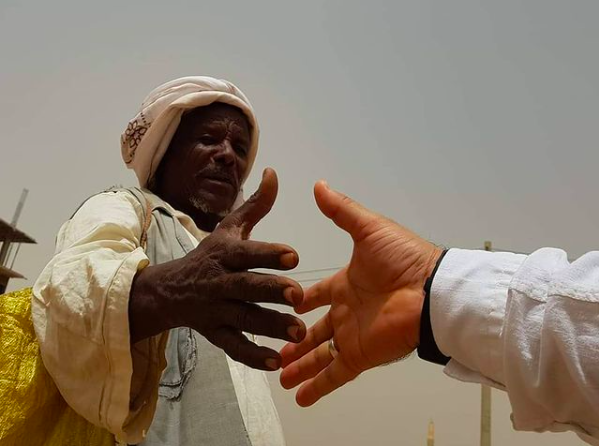
Image 1: The visual trope of touching hands with different skin colour universally signifies racial diversity, equality and solidarity. This global signifier is adopted and widely circulated by Turkish humanitarian organizations, as in this image, to symbolize the racial difference, yet religious sameness of Turkish and African Muslims. The interracial intimacy between aid donors and recipients is more often a gendered construction of Islamic “brotherhood” than “sisterhood”, unlike this image.

The paradox of Islamic humanitarianism resides in its advocacy for racial egalitarianism in reference to the Qur’an and the Prophetic tradition while inevitably inheriting the racial hierarchies historically inherent in humanitarianism. Turkish humanitarianism at the conjunction of state policy and pro-government civil society aims to build a global umma (community of believers) knit together with humanitarian sensibilities and under the politico-religious leadership of AKP’s Turkey. In doing so, it reproduces the global racial hierarchies at the scale of the umma, situating Turkey at the top.It is not a coincidence that this self-ascribed positionality entails a claim to whiteness. If Turkey’s ascendancy to the position of the protector of the Muslim world has been justified based on historical arguments about being the heir of the Ottoman empire as well as the Caliphate’s religious legacy in the past, today, it is also naturalized through racial arguments.

Circulating narratives about their interpellation as White Muslims by their African interlocutors, Turkish humanitarians contribute to the re-entrenchment of white supremacy in Turkey in novel ways (Güner 2021, 2023). This racial project hinges on the bifurcation of whiteness into Western-Christian and Ottoman-Islamic formations in Africa south of the Sahara. Constructed as the moral antithesis of colonial racism, Muslim whiteness claims racial sameness with and civilizational difference from the West based on a particular imagination of the Ottoman-Islamic heritage. In the humanitarian discourses I study, Muslim whiteness is differentiated from Western whiteness by its capacity to create interracial intimacy. In contrast to the segregationist logic of colonial racism in Africa, Muslim whiteness is defined by an immediate emotional and corporeal intimacy with the Black Muslim, therefore justifying the growing Turkish presence on the continent as “brotherly”.

Image 2: Within the humanitarian visual regime, hands also symbolize help. Images of giving and receiving hands not only speak to the racialized asymmetries of humanitarianism in general, but more specifically to the symbolic language of Islamic ethics of charity deployed by the Prophetic tradition. This picture is taken as a Sudanese Muslim is about to shake hands with a Turkish Muslim. By circulating it on social media, the Turkish NGO conveys the message that they are welcome in ‘Africa’. The interracial handshake also foreshadows the humanitarian donations that will pass from one to the other.

To conclude, the racial logics of humanitarianism operate in a similar way in transnational contexts outside of the West. The making of a global umma on the basis of Islamic humanitarianism racializes Muslims as white saviours and positions them above black and brown victims. As the White Muslim comes into being through the touch and the gaze of the Black African, this racial formation also reveals how even the wildest dreams about erecting a politico-moral alternative to the Western civilization in a multipolar world have inherited whiteness as the hallmark of civilization.


Ezgi Güner is a Mellon postdoctoral fellow in global/comparative studies of race and ethnicity at the Hurford Center for the Arts and Humanities and a visiting assistant professor in the Department of Anthropology at Haverford College. Her research focuses on the transnational articulations of race, religion, and empire across the Middle East and Africa south of the Sahara.


References

Akpinar, P. (2022), ‘Turkey’s “Novel” Enterprising and Humanitarian Foreign Policy and Africa’, in J. Jongerden (ed), The Routledge Handbook on Contemporary Turkey (Abingdon: Routledge), pp. 495–507.

Benton, A. (2016) ‘Risky business: race, nonequivalence and the humanitarian politics of life’, Visual Anthropology 29:2, 187–203.

Budabin, A. C. & Richey, L. A. (2021) Batman saves the Congo: How celebrities disrupt the politics of development. Minneapolis: University of Minnesota Press.

Çelik, N. & İşeri, E. (2016), ‘Islamically oriented humanitarian NGOs in Turkey: AKP foreign policy parallelism’, Turkish Studies, 17:3, 429-448.

Güner, E. (2021) ‘Rethinking whiteness in Turkey through the AKP’s foreign policy in Africa south of the Sahara’, Middle East Report 299 (Summer). Available at https://merip.org/2021/08/rethinkingwhiteness- in-turkey-through-the-akps-foreign-policy-in-africa-south-of-the-sahara/

Güner, E. (2023) ‘Rejoicing of the hearts: Turkish constructions of Muslim whiteness in Africa south of the Sahara’, Africa 93:2, 236-255.

Güner, E. (Forthcoming) ‘Revisiting the tesettür question in Muslim West Africa: Racial and affective topography of the veil in Turkish discourses’, Culture and Religion.

Keyman, E. F. & Sazak, O. (2014) ‘Turkey as a “Humanitarian State”’, POMEAS (Project on the Middle East and the Arab Spring) Policy Paper, 2. Available at https://research.sabanciuniv.edu/31364/1/keyman-turkey-as-a-humanitarian-state.pdf

Kothari, U. (2006) ‘An Agenda for Thinking about “Race” in Development’, Progress in Development Studies, 6:1, 9–23.

Pallister-Wilkins, P. (2021) ‘Saving the Souls of White Folk: Humanitarianism as White Supremacy’, Security Dialogue 52, 98–106.

Toomey, N. (2017) ‘Humanitarians of Tinder: constructing whiteness and consuming the other’, Critical Ethnic Studies 3:2, 151-172.

White, S. (2002) ‘Thinking race, thinking development’, Third World Quarterly, 23: 407–19.


Cite as: Güner, Ezgi 2024. “Islamic Humanitarianism and Renegotiating the Boundaries of Turkish Whiteness in Africa South of the Sahara” Focaalblog 15 November. https://www.focaalblog.com/2024/11/15/ezgi-guner-islamic-humanitarianism-and-renegotiating-the-boundaries-of-turkish-whiteness-in-africa-south-of-the-sahara/

Oane Visser and Nina Swen: COP29, Climate Politics and Caspian Fisheries

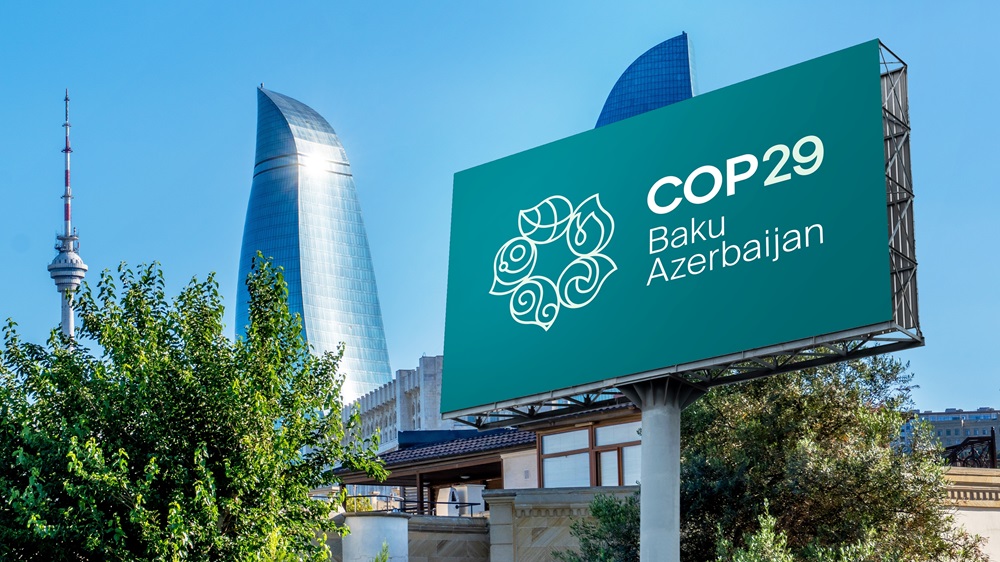
Image 1: COP29 International Climate Change in Baku, Azerbaijan, illustration by Zulfurgar Graphics

By hosting the UN’s global Climate Change conference COP29 in Baku (11-22 November 2024), Azerbaijan presents itself as a climate-responsible oil state and new political ally and donor for Small Island Developing States (SIDS) struggling with the impacts of climate change. Yet the fate of fisheries off the coast of Baku, navigating between the oil rig dotted and shrinking Caspian Sea, markedly contrasts with this posture. Drawing on research amongst Caspian fishers, this blog examines these contradictions, and the potential for local (and international) fishers to use the COP on their coast as a space for advocacy.

Just offshore of Baku, the contradictions behind Azerbaijan’s effort to re-position itself as an oil state supporting precarious coastal communities become visible. From Baku’s coast, a COP delegate can see the rigs of one the World’s first offshore oil industries, dating back to 1873. The Caspian Sea is increasingly devoid of valuable fish due to oil industry pollution and climate change. Concurrently, some 40 kilometers east of Baku, small boats of artisanal fishers can be seen navigating their shrinking sea territories.

What a knowledgeable observer can also discern from Baku’s coast, is how the ‘sea’ has receded over the past decades. In contrast to the global trend of rising sea levels, the Caspian water level is projected to fall by 9–18 meters by the end of this century. This is caused by increasing evaporation engendered by higher global temperatures, and regional anthropogenic factors such as declining influx from rivers due to irrigation and ongoing dam construction. This change, together with increased water temperatures and pollution from oil and gas extraction, leads to the disappearance of habitats for fish and the entrance of invasive species. Its level still drops by 7 centimeters annually. In some areas the horizontal retreat of the Caspian Sea amounts to 12 meters. The pace of this change is so substantial that the shallower, Northern part of the Caspian is set to disappear even under more optimistic climate change scenarios.

Oil-fueled international climate aid

The announcement that the UAE would host COP28 in 2023 raised eyebrows amongst climate activists and scientists. With Azerbaijan, another fossil fuel-dominated country has become host. Azerbaijan’s eagerness to host the global climate summit aligns with the recent attempt to reposition itself as an international donor in climate adaptation and disaster relief. As COP host, the country is now leading efforts to create a Climate Fund by oil-rich countries to help vulnerable developing nations adapt to climate change (Volcovici 2024, Eurasianet 2024). Azerbaijan started funneling some of its oil wealth into international aid at least a decade ago. Azerbaijan became a participant in the OECD’s development assistance committee in 2019, marking its nascent role as international donor, even though it continues to receive international (Western) aid. The country spent just about 50 million dollars on international aid between 2005 and 2018, representing 0.05% of its GDP. This amount is significantly less than the 115 million dollar it received itself in aid in 2017 alone (Volcovici 2024).

Ahead of COP29, Azerbaijan announced the establishment of a Climate Fund with a targeted 1 billion dollars to support developing countries’ climate goals (Volcovici 2024). The Fund, to be hosted in Baku, will be financed by 10 fossil-fuel producing countries as well as oil and gas companies. “Countries rich in natural resources should be at the forefront of those addressing climate change,” said Azerbaijan’s COP29 President-Designate Mukhtar Babayev (Volcovici 2024). Together with the UAE (Cop28) and Brazil (organizer of COP30 in 2025, and another major oil producer), Azerbaijan is driving these efforts.

Domestic climate policies versus biodiversity and artisanal fisheries

At the same time, Azerbaijan’s climate action at home is mostly still in the phase of announced ambitions with a recently established target of 30 percent of its energy renewable by 2030. While plans for a large offshore wind farm park, and dams in the Kura River flowing into the Caspian Sea might contribute to fighting climate change globally, they are likely to harm the Caspian Sea’s biodiversity and fishers’ livelihoods. The negative effect of dam building is especially strong upstream in Russia, as the Volga river accounts for 80% of the inflow in the Caspian, and 18 new Volga dams are in the pipeline in addition to the 40 current dams. This is exemplary of a tension observed in various seascapes across the world, where green maritime developments aimed at global climate targets often harm surrounding ecologies, with negative repercussions for local fishing communities (Abasli et al 2024). With wind farms’ arrival parts of the Caspian likely will be closed off for fishing, in addition to zones already inaccessible due to oil extraction.

Caspian fishers identify dam constructions, large-scale irrigated agriculture and especially marine mismanagement as potential causes of the receding coastline, which, they say, causes fish to move to deeper seas. They consider government’s policies, including quotas and a moratorium on high-value species such as sturgeon, to be inefficient and unjust. These measures hinder fishers to diversify their catch based on their own observations of fish population and migration patterns. They now must focus on a narrower range of species and catch smaller (immature) fish. Imposed quotas -only loosely based on scientific data- seem an instrument for oil companies’ new explorations for offshore gas deposits. Marine policy making, has remained top-down as in the Soviet-era, without participation of fishers.

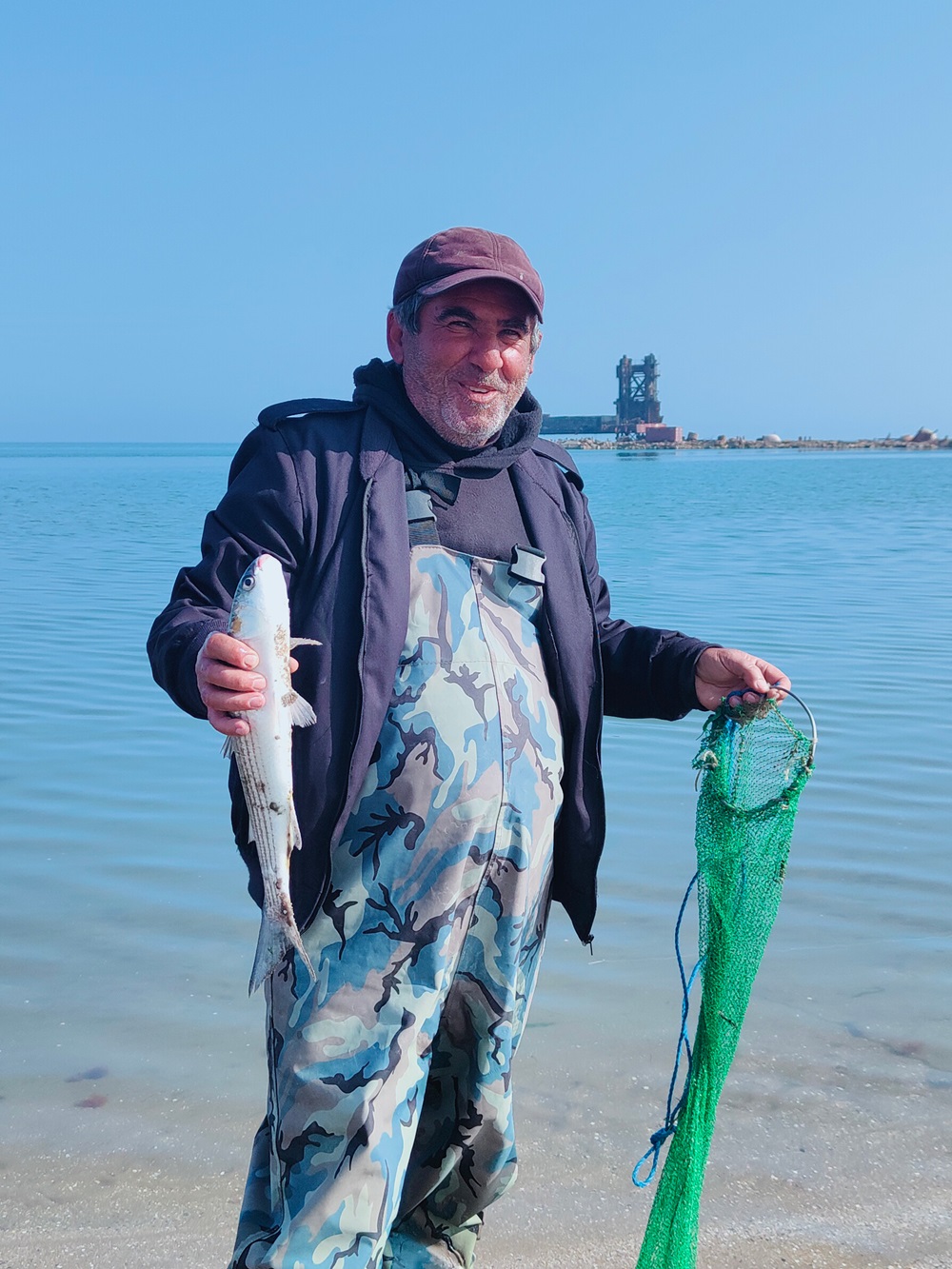
Image 2: Rod fisherman in Baku, photo by authors

COP29 as a space for fishers’ advocacy?

Does the COP29 present a (limited) window of opportunity, for small-scale fishers, local or international, to advocate for their concerns?

International movements of small-scale food producers do have representation at the COPs, although small. The COP with the biggest imprint of societal movements was the COP21, where the influential Paris Agreement was reached. Alongside this 2015 summit, a parallel civil society-led summit took place, with numerous food movements, including 15 representatives from fishers’ movements. The side-summit concluded with a big demonstration with over 30.000 people, including fishers (Mills 2023). Some years earlier, a significant milestone for small-scale food producers’ participation in global forums was the opening of the UN’s World Committee for Food Security (CFS) to non-state actors. It allowed agrarian and fishers’ movements to raise attention for small-scale production centered around ‘food sovereignty’ (Duncan et al. 2022, Edelman et al. 2014).

However, in the past few years, the movements’ presence in global forums is gradually being curtailed. In the CFS, corporations have markedly increased their presence, leading to the ‘priority voice’ of civil society being ‘under threat’ (Duncan et al. 2022). Increasing repression, stringent visa regulations, and the choice for authoritarian countries as hosts have stifled vibrant civil society involvement at the recent COPs. At COP28 in the UAE, the number of civil society organizations was lower than before, while agribusiness’ presence grew markedly, with approximately twice as many corporations compared to the previous year. The NGO GRAIN speaks of the ‘Davos-isation’ of the COPs, increasingly looking like the World Economic Forum with its corporate domination.

Like other societal organisations, fisheries movements’ physical participation in the COP has declined since the COP in Paris. Still, there are several fishers’ movements that manage to formulate shared concerns around climate and blue economy-induced marginalization of artisanal fishers, either through live or online COP presence.

However, within the fishers’ movements, post-socialist Eurasia is strikingly absent. Next to Azerbaijani fishers’ lack of cross-border contacts with neighboring Caspian fishers, impeded by rigid borders and shrinking democratic space, they also miss contacts with transnational movements. With a post-soviet legacy of distrust in collective action, small-scale food producers in post-socialist contexts rarely raise their voice, and mostly limit their sustainability actions to ‘quiet’, depoliticized adaptation (Jehlička et al. 2020, Visser et al. 2015). Similarly, the Azerbaijani “Baku Underwater Hunters and Fishermen’s Club” Public Union focuses on information sharing between fishers and refrains from political action.

In sum, despite Baku’s coastal location and its proximity to artisanal fishing communities, the chances for the COP29 to provide significant advocacy space for international, let alone Caspian, fishers are slim. Although two of the largest fishers’ movements, World Forum of Fisher Peoples WFFP, 75 member organizations from 50 countries, and the World Forum of Fish Harvesters and Fish Workers WFF, participate physically in the COP, Azerbaijani fishers are not involved. While state and corporate COP delegates discuss climate policies, Azerbaijani fishers are sailing past oil rigs in their small boats, further offshore in deeper -and dangerous- waters, in attempts to still catch fish in a depleting Caspian Sea.


Oane Visser is associate professor at the International Institute of Social Studies (ISS) of Erasmus University Rotterdam, and research associate at the Independent Social Research Foundation, London. He studies food and agrarian movements, climate adaptation, and digitalization of agriculture.

Nina Swen, PhD researcher at the International Institute of Social Studies (ISS) of Erasmus University Rotterdam, examines knowledge production and contestation within environmental conflicts, with a focus on fossil fuel extraction sites.


References

Abasli, I., N. Swen, N & O. Visser (2023) ‘Climate change in Caspian Sea, small-fisheries and climate adaptation’. Presentation at the ISS Workshop ‘Artisanal Fisheries, Climate Change and Knowledge for Adaptation Workshop’, 8 December 2023

Duncan, Jessica, Nadia Lambek and Priscilla Claeys 2021. The committee on World Food Security. Advances and challenges 10 years after the reform.Un monde sans faim: Gouverner la sécurité alimentaire. Paris: SciencePo Les Presses.

Edelman, Marc, Tony Weis, Amita Baviskar, Saturnino M. Borras Jr., Eric Holt-Giménez, Deniz Kandiyoti and Wendy Wolford. 2024. Critical perspectives on food sovereignty, Journal of Peasant Studies, 41(6): 911-931.

Jehlička, Petr, Mikelis Grīviņš, Oane Visser and Balint Balázs (2020) Thinking food like an Eastern European: a critical reflection on the framing of food systems, Journal of Rural Studies, 76: 286-295.

Mills, Elyse 2023. The politics of transnational fishers’ movements. Journal of Peasant Studies, 50(2): 665-690.

Visser, Oane, Natalia Mamonova, Max Spoor and Alexander Nikulin 2005. ‘Quiet food sovereignty’ as food sovereignty without a movement? Insights from post-socialist Russia. Globalizations, 12(4): 513-528.

Volcovici, Valerie 2024. Azerbaijan launches Climate Fund, seeks fossil-fuel support. Reuters, 19 July https://www.reuters.com/sustainability/sustainable-finance-reporting/azerbaijan-launches-climate-fund-seeks-fossil-fuel-producer-support-2024-07-19/


Cite as: Visser, Oane and Swen, Nina 2024. “COP29, Climate Politics and Caspian Fisheries” Focaalblog 12 November. https://www.focaalblog.com/2024/11/11/oane-visser-and-nina-swen-cop29-climate-politics-and-caspian-fisheries/

Patricia Ward: Power, Pace, and Place: Local Consultants and Racialized Expertise

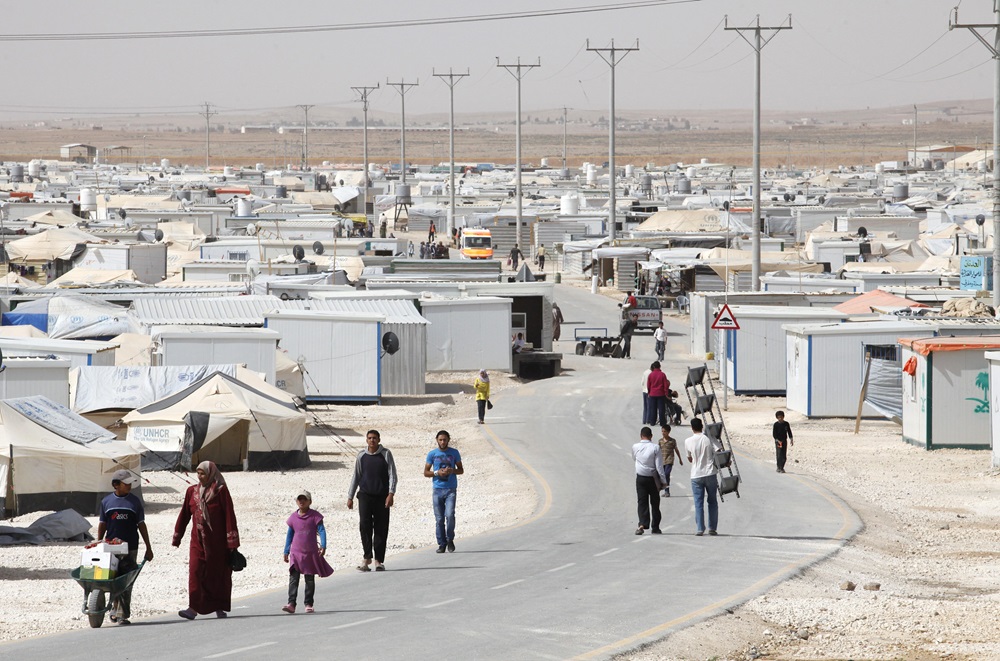
Image: Daily life in Za’atari refugee camp in Jordan (2014), photo by Dominic Chavez/World Bank

Critical scholars recognize humanitarianism as a racializing project rooted in colonial and imperial relations, in which classifications of aid workers as ‘international’, ‘expat’, ‘national’ and ‘local’ reflect the latter (Benton, 2016; Bian, 2022; Pallister-Wilkins, 2021; Warne-Peters, 2020). In this short reflection, I focus on local aid consultants to think about these classifications as ‘on-the-ground race-making’ (Quisumbing and White, 2021): to consider precisely how racialized constructions of these terms organize the actual labour that constitutes contemporary humanitarianism.

The local aid consultant is emerging as an important gig and category of work in the so-called global South where humanitarian operations are present. While not always articulated as a specific job title, major aid employers, including INGOs and UN bodies, recruit individuals residing and working in crisis contexts to do everything from writing reports and evaluations to collecting and analysing data about their aid projects. This recognition and recruitment of locals as consultants contrast with how ‘locals’ in the aid sector are often depicted as brokers of various sorts, eager implementers of global North donors’ agendas on the frontline, or as cultural connectors that help aid organizations and their leaderships from ‘elsewhere’ navigate the national context and reach beneficiaries ‘in need’. Locals are often not associated with roles such as ‘managers’ or ‘experts’ – terms that are more so conflated with so-called aid professionals, or international (often, but not always white) workers. In fact, sometimes locals are not even acknowledged or analysed as workers situated in employer-employee relations. However, speaking with local consultants between 2016 and 2018 in Jordan, a major hub for humanitarian activity, it became immediately evident that the local consultant is just the latest articulation of a construction of difference in terms of racialized skill and expertise on which humanitarianism as an institution, industry, and transnational employer relies.

Local consultants’ roles as what I call ‘fast-fixers’ provide a vivid example of the latter. In this role, aid employers recruit local consultants to ‘fix’ international consultants’ poor-quality reports and evaluations, ‘products’ that are critical for organizations’ project funding. ‘Fast fixers’ improve both the content and technical aspects of the product, and sometimes redo the entire piece all together. In many cases, organizations recruit local consultants for this role ‘last minute before the deadline’ when the report or evaluation is due. This means that fast-fixers not only have to redo the report quickly but deliver better quality in less time as well. Project budgets are overwhelmingly spent near the deadline, so fast-fixers often receive less compensation for their work, too. Given these work arrangements, aid employers’ expressed interests in so-called ‘local knowledge’, that is, local experts’ thoughtful and critical analyses of social relations, cultural norms and living conditions in the local context, appear tenuous and insincere. Instead, the value and expertise of local consultants relate to their pace and price: their ability to deliver quick results for a bargain amount. Like 500-900 percent salary gaps between international and national staff hires in many aid organizations (Carr et al., 2010), fast-fixers’ labour is devalued by its price (their compensation) and distinguished by its content and pace (they must hustle and do particular things to get the job done on time) from international consultants, who usually negotiate what product(s) they will provide (e.g. stakeholder mapping, final report) and their fixed rates for these services well ahead of the project deadline (or maybe even before a project begins).

Undoubtedly, the local consultant is partially an outcome of an aid labour hierarchy that stifles national staff’s upward mobility and professional development (Farah, 2020; Pascucci, 2019). One consultant described to me how he quit his position with a UN organization because he ‘maxed out of the local’: traditional roles designated for local hires ‘stopped’ developing in terms of promotions, salary, and responsibilities. To advance would entail physically working abroad: ‘becoming’ an international, expat staff. However, aid employers must invest significant time and financial resources to process and cover work visas and residencies for this to happen, items that are often ‘easier’ and less costly to obtain for recruits who hold global North citizenships associated with greater geographical mobility.

Becoming a local consultant therefore presents itself as another viable – and perhaps even more desirable – alternative for workers who ‘max out of the local’. After all, consultancies serve at least two purposes: first, they are a way for aid workers to ‘deal’ with the limitations associated with their professional development in traditional aid jobs. Second, they shift the configuration of the labour relation with aid organizations – and the power within it – from employer to client. As consultants, individuals work on a timeline and at a daily rate determined and negotiated with (rather than by) their former employers. In fact, consultants often emphasized with pride their decision to ‘stay local’ as ‘true humanitarianism’ versus what they described as ‘Western’ and ‘expat workers …. who come and go’. They delineated themselves to challenge the conflated relationship between mobility and the humanitarian profession. Yet, their claims seem to also challenge racialized structures and narratives of morality that conflate certain skills, ‘expertise’, and job trajectories with constructions of ‘the humanitarian’, and, ultimately, what it means to be and act human through work too. Such dynamics complicate popular depictions of the ‘local worker’ as simply operating in the interests of ‘white, Western publics’, and suggest that further analyses of humanitarianism from the starting point of ‘the local’ may provide important insights regarding the multiple relations and dynamics that shape how and why aid as work reifies, but also potentially challenges the racialized power hierarchies embedded in the global division of labour.


Patricia Ward is a postdoctoral research associate at Bielefeld University (Germany) in the Faculty of Sociology. Her research interests are in the areas of transnational labour, mobility, humanitarian aid and development. Her recent projects examine the configuration of humanitarian supply chains and labour relations in Jordan’s aid sector.


References

Benton, A. (2016) ‘African Expatriates and Race in the Anthropology of Humanitarianism’, Critical African Studies 8(3):266–77.

Bian, J. (2022) ‘The Racialization of Expertise and Professional Non-Equivalence in the Humanitarian Workplace’, Journal of International Humanitarian Action 7(1):3.

Carr S.C., McWha I., MacLachland, M. and A. Furnham (2010) ‘International-Local Remuneration Differences Across Six Countries: Do They Undermine Poverty Reduction Work?’, International Journal of Psychology 45(5):321–340.

Farah, R. (2020) ‘Expat, Local, and Refugee: “Studying Up” the Global Division of Labor and Mobility in the Humanitarian Industry in Jordan’, Migration and Society 3(1):130–44.

Pallister-Wilkins, P. (2021) ‘Saving the Souls of White Folk: Humanitarianism as White Supremacy’, Security Dialogue 52(1_suppl):98–106.

Pascucci, E. (2019) ‘The Local Labour Building the International Community: Precarious Work within Humanitarian Spaces’, Environment and Planning A: Economy and Space 51(3):743–60.

Quisumbing King K. and A. I. R. White (2021) ‘Introduction: Toward a Global Historical Sociology of Race and Racism’, in White, A. I.R. and Quisumbing King, K. (eds) Global Historical Sociology of Race and Racism. Vol. 38, Political Power and Social Theory, Emerald Publishing Limited. 1–21.

Warne-Peters, R. (2020) Implementing Inequality: The Invisible Labor of International Development. New Brunswick: Rutgers University Press.


Cite as: Ward, Patricia 2024. “Power, Pace, and Place: Local Consultants and Racialized Expertise” Focaalblog 11 November. https://www.focaalblog.com/2024/11/11/patricia-ward-power-pace-and-place-local-consultants-and-racialized-expertise/

Allison Stuewe: Humanitarian Erasure: Marriage Practices of Iraqi Yezidi Refugees and Germany’s Integration Courses

Image: Refugee welcome centre in Hamburg, Germany, photo by Rasande Tyskar

The German governing coalition explicitly considers refugee integration to be a humanitarian project based on an obligation to care for others because of their shared humanity. Notably, however, the country’s strategies for integrating refugees are based on the notion that refugees coming to Germany lack not only the practical skills (like linguistic skills) to help them succeed in Germany but also the “right” values. The idea that refugees and their cultural differences, not German society, are the barrier to refugee success in Germany guides German integration programming. Survey data suggests, however, that refugees identify with most “German values” to an equal or stronger extent than the rest of the German population (Fuchs, Fan, and von Scheve 2021).

To compensate for this perceived (if false) deficiency, Germany’s humanitarian approach to refugee management relies on policies and programming, including federally designed integration courses, that prioritize refugee personal development to transform refugees into desirable German subjects who value the rule of law, freedom, tolerance, and equal rights. Germany’s integration strategies provide one example of how colonial taxonomies of social difference—in this case, orientalist notions of the inferior values of people from the Middle East—can produce humanitarian practice itself. While German integration courses are imagined by the state to facilitate refugee life through cultural integration, the courses do nothing to address refugee racialization or institutionalized racism in Germany. I raise the question then, based on the experiences of my Iraqi Yezidi refugee interviewees, about the degree to which integration courses re-package orientalist hierarchies into other forms of taken-for-granted, institutionalized social difference. To what extent do integration courses imply a suppression of meaningful cultural practices, like marriage practices, while leaving German racial hierarchies untouched?

The very idea of the individual refugee subject who can be taught the right values through integration policy is deeply inflected by ideas about love, sex, and marriage. Elizabeth Povinelli (2006) has called this self-making subject the “autological subject” and has argued that it, along with its false binary pair, “genealogical society,” or social constraint, are Enlightenment products tied to ideas about intimacy. Scholars have argued in multiple contexts that through the marriage of a heterosexual couple—and the state’s efforts to regulate it—political and economic subjects are made and the state is reproduced (D’Aoust 2014; de Hart 2015; Federici 2004; Foucault 1978; Stoler 2001). Notably, in my research with Iraqi Yezidis—Kurdish-speaking practitioners of an ancient monotheistic religion who are strictly endogamous—marriage is similarly critical for the reproduction of the community.

The content of the integration courses, which are administered through course providers approved by the Federal Office of Migration and Refugees, offers a concrete example of how ideas about marriage and love are bound up in the individual political subject that Germany’s refugee integration strategies aim to create. These courses, which are often a requirement for receiving social benefits or obtaining more secure legal status, are intended to improve language skills and provide information about German law and society. As outlined by the national standard curriculum for official integration courses (Bundesamt für Migration und Flüchtlinge 2017), Module III teaches values like freedom and tolerance through content about family and gender roles among other topics. The curriculum names different family forms, “free choice of partner,” and the possible clash of family expectations about romantic choices as topics that should be covered.

For Yezidi refugees who have through history struggled against campaigns of forced assimilation and displacement at the hands of the Ottoman Empire, British colonizers, the Iraqi and Kurdish governments, and terrorist organizations, these integration courses are not neutral. This is particularly so as some of the dynamics of refugee management in Germany, including constraints on where refugees can live, the pressure to learn German, and acts of violence and discrimination against refugees perceived to be inadequately assimilated, seem to echo campaigns against Yezidis in Iraq. Many of my interviewees find the messages in these integration courses (that free choice of partner is valuable, for example) challenging because they seem to critique what most of my interviewees see as essential for the future of the Yezidi minority: the obligation to marry another Yezidi. The stakes for Yezidis are high; many of my informants have said to me that if too many Yezidis choose to marry outside the community, Yezidism will no longer exist in 50 or 100 years.

Marriage has emerged as an institution through which making choices informed by the appropriate values is critical for the reproduction of both Yezidism and Germany itself. The marriage choices young Yezidis make are not just acts of diplomacy balancing between the competing expectations of their families and the German state but small “intimate events” (Povinelli 2006) in the struggle for a Yezidi future. German integration programming impinges upon Yezidi practices like strict prohibitions against out-marriage that might create ‘parallel societies’, but many of my interviewees see the state’s attention to integration and indifference to threats to Yezidi cultural integrity as harbingers of possible Yezidi ethnocide by assimilation. Beyond the focus of Germany’s integration programming on values, the promise of integration raises questions for some of my interviewees. Even if integration courses do result in changes in Yezidi marriage choices or other culturally salient practices, will Yezidis be able to easily, as one of my interviewees put it, “live like Germans?” For some of my interviewees, there is the sense that even if they might be able to do so, they would not be accepted as such; perhaps the Yezidi would be gone, but the racialized refugee would remain.


Allison Stuewe is a PhD candidate in the School of Anthropology at the University of Arizona. Her research interests include migration policy, intimate relationships and kinship, and historical political economy. Her current research project explores the marriage decisions of Iraqi Yezidi refugees living in Germany.


References

Bundesamt für Migration und Flüchtlinge (2017), ‘Curriculum Für Einen Bundesweiten Orientierungskurs: Überarbeitete Neuauflage Für 100 UE – April 2017’, Nürnberg.

D’Aoust, A. (2014), ‘Love as Project of (Im)Mobility: Love, Sovereignty and Governmentality in Marriage Migration Management Practices’, Global Society, 28:3, 317–35.

de Hart, B. (2015), ‘Regulating Mixed Marriages through Acquisition and Loss of Citizenship’, Annals of the American Academy of Political and Social Science, 662:1, 170–87.

Federici, S. (2004), Caliban and the Witch (Brooklyn: Autonomedia).

Foucault, M. (1978), The History of Sexuality, Volume 1: An Introduction (New York: Random House).

Fuchs, L. M., Y. Fan, and C. von Scheve (2021), ‘Value Differences between Refugees and German Citizens: Insights from a Representative Survey’, International Migration, 59:5, 59–81.

Povinelli, E. A. (2006), The Empire of Love: Toward a Theory of Intimacy, Genealogy, and Carnality (Durham: Duke University Press).

Stoler, A. L. (2001), ‘Tense and Tender Ties: The Politics of Comparison in North American History and (Post) Colonial Studies’, Journal of American History, 88:3, 829–65.


Cite as: Stuewe, Allison 2024. “Humanitarian Erasure: Marriage Practices of Iraqi Yezidi Refugees and Germany’s Integration Courses” Focaalblog 8 November. https://www.focaalblog.com/2024/11/08/allison-stuewe-humanitarian-erasure-marriage-practices-of-iraqi-yezidi-refugees-and-germanys-integration-courses/

David Kwok Kwan Tsoi: ‘Lifeboat’ Campaign for Hong Kongers: Why is Capitalistic Agenda a Mandate for Democratic Intervention?

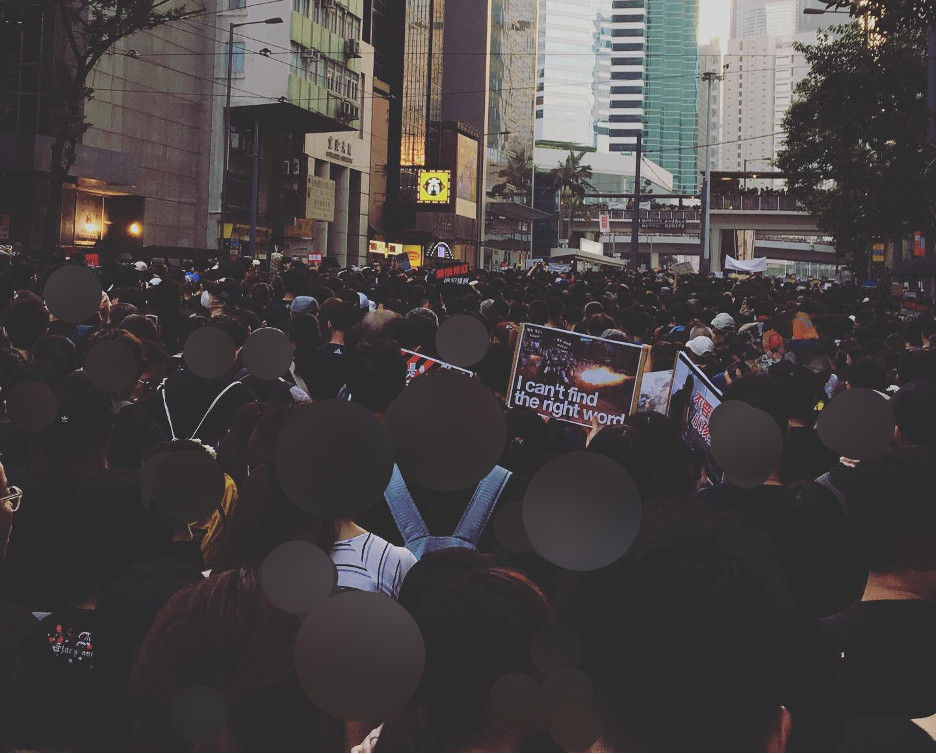
Image 1: Photo taken by author in 2019 at one of the Anti-Extradition Law Bill demonstrations

Since 2021, along with the British and Australian governments, the Canadian government has relaxed immigration policy for Hong Kong immigrants. This policy offers an unconventional path with lowered barriers for Hong Kongers to apply for permanent residency in Canada. Popularly framed as ‘lifeboat’ campaigns, these immigration policies directly respond to the post-2019 political situation in Hong Kong. This political contingency was instigated by the tumultuous 2019-2020 Anti-Extradition Law Bill Movement, and the subsequent implementation of National Security Law in June 2020. Against this background, the Canadian government has combined an economic narrative, i.e., Hong Kongers being economically productive, with a political narrative, i.e., human rights concern, to legitimise this ‘lifeboat’ scheme.

The Canadian ‘lifeboat’ scheme includes two pathways: Stream A and Stream B. Stream B requires candidates to have post-secondary education qualifications and one year of work experience within Canada before they apply for permanent resident status. Interestingly, the government cancelled the requirement on education qualifications on 15 August 2023, further lowering the barrier. Following Canadian activist Harsha Walia’s writing about borders (2021), I illuminate the way a democratic logic intersects with a capitalistic logic to control border mobility under the state’s purview. I seek to problematise this naturalised connection. Under the benevolent notion of democratic intervention, how does the state deploy the notions of human rights and humanitarian care to serve an economic purpose? Why do these migrants have to be first taxonomised as productive labouring subjects in order to be considered “worthy” of democratic intervention? Further, what does democracy mean within this existing liberal democratic regime?

Under the “lifeboat” policy, it is stated that “Canada shares longstanding ties with the people of Hong Kong and is concerned with the deteriorating human rights situation there. […] Canada has put in place a number of facilitative measures to help Hong Kong residents come to Canada” (Government of Canada 2021b). Clearly, human rights concern is identified as a key component to this policy. Paradoxically, it considers economic contribution rather than political risks at home as a legitimizing clause for permanent residency. In the policy, under the section “Public policy considerations”, it is stated that: “[The policy] recognises the contributions made by Hong Kong residents to Canada’s economy and social-cultural landscape through human capital, while also promoting democratic values” (Government of Canada 2021b). In another government press release issued on 4 February 2021, similar language was adopted: “The first Hong Kong residents arrived here over 150 years ago, contributing immensely to Canada’s economic, social and political life” (Government of Canada 2021a).

Border regimes serve to create differentiated entry of migrants in order to protect public interests within the border, such as job availability and welfare system. As Walia (2021, 19) suggests, borders ‘buffer against the retrenchment of universal social programs.’ In a liberal democratic regime with strict border control, citizenship is granted based on one’s expected contribution to the national economy. It is therefore not surprising that a neoliberal state rationalises immigration policies under the premise of economic calculations (Xiang 2007). Still, in this case, the economic logic is weaved into a democratic intervention in a language that renders this intersection rational, natural, and reasonable. In other words, democratic intervention is about human rights concerns—so long as it is also generative of economic benefits. To do so, the Canadian government racialises a history of Hong Kong diaspora; this taxonomises incoming Hong Kong migrants as productive labour, which becomes a strange but also naturalised prerequisite for democratic intervention.

Scholars have examined the way the global north extracts labour from the global south while imposing militarised border regimes to deter immigrants (Besteman 2019), resulting in ‘coloniality of migration’ (Gutiérrez Rodríguez 2018). Nevertheless, the emigration of East Asia migrants, particularly the middle-class and the upper-middle-class, has complicated the way coloniality of migration is configured. In the case of Canadian ‘lifeboat’ campaign, I suggest that the Canadian government uses a democratic narrative to add moral fervour as they extract both skilled and unskilled labour from Hong Kong. There are two sets of repercussions. First, the democratic intervention is only enjoyed by those who are considered economically productive. Borders continue to facilitate accumulation of capital within a sovereign state. At the same time, borders preclude universal access to political refuge. Second, the democratic intervention becomes a rationalised labour extraction from East Asia to the global North.

In sum, political discourses about human rights and democracy are instrumentalised and repackaged by the West (by which I refer to as anglophone-speaking countries) to solidify their image as the global protector of human rights, while benefiting materially from westward movement of labour and capital from the global East, which sustain their roles as the civilised Man and a civilizing force in the unfinished project of modernity (Wynter 2003).


David Kwok Kwan Tsoi is a DPhil student at the School of Geography and the Environment, University of Oxford. His research examines the relationship between housing, class, and migration amid political changes in Hong Kong. He also writes about informal economy and queer politics in Hong Kong.


References

Besteman, Catherine. 2019. “Militarised Global Apartheid.” Current Anthropology 60 (19): 26–38. https://doi.org/10.1086/699280.

Government of Canada. 2021a. “Canada Launches Hong Kong Pathway that will Attract Recent Graduates and Skilled Workers with Faster Permanent Residency.” Immigration, Refugees and Citizenship Canada. 4 February 2021. https://www.canada.ca/en/immigration-refugees-citizenship/news/2021/02/canada-launches-hong-kong-pathway-that-will-attract-recent-graduates-and-skilled-workers-with-faster-permanent-residency.html

Government of Canada. 2021b. “Temporary public policy creating two pathways to permanent residence to facilitate the immigration of certain Hong Kong residents.” Public Policies. 8 June 2021. https://www.canada.ca/en/immigration-refugees-citizenship/corporate/mandate/policies-operational-instructions-agreements/public-policies/hong-kong-residents-permanent-residence.html

Gutiérrez Rodríguez, Encarnación. 2018. “The Coloniality of Migration and the “Refugee Crisis”: On the Asylum-Migration Nexus, the Transatlantic White European Settler Colonialism-Migration and Racial Capitalism.” Canada’s Journal on Refugees 34 (1): 16–28. https://doi.org/10.7202/1050851ar.

Walia, Harsha. 2021. Border and Rule: Global Migration, Capitalism, and the Rise of Racist Nationalism. Chicago, IL: Haymarket Books.

Wynter, Sylvia. 2003. “Unsettling the Coloniality of Being/Power/Truth/Freedom: Towards the Human, After Man, Its Overrepresentation–An Argument.” CR: The New Centennial Review 3 (3): 257–337. https://doi.org/10.1353/ncr.2004.0015.

Xiang, Biao. 2007. Global “Body Shopping”: An Indian Labor System in the Information Technology Industry. Princeton and Oxford: Princeton University Press.


Cite as: Tsoi, David Kwok Kwan 2024. “‘Lifeboat’ Campaign for Hong Kongers: Why is Capitalistic Agenda a Mandate for Democratic Intervention?” Focaalblog 6 November. https://www.focaalblog.com/2024/11/06/david-kwok-kwan-tsoi-lifeboat-campaign-for-hong-kongers-why-is-capitalistic-agenda-a-mandate-for-democratic-intervention/

Walden Bello: The October Surprise

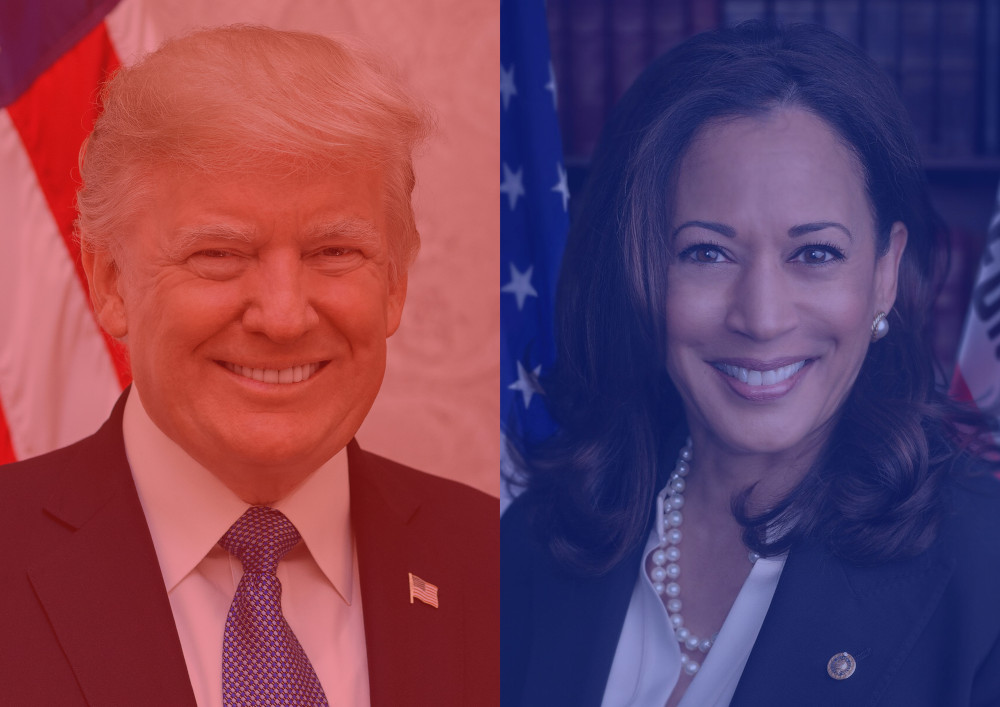
Foreign policy played a minor role in the presidential debate between Kamala Harris and Donald Trump in September. The vice presidential exchange between J.D. Vance and Tim Walz on October 2 barely touched on it. Yet less than a month before the US elections on November 5, it is foreign policy that may upend the Democrats’ chances of winning.

It used to be a matter of great concern that in the run-up to the November elections, the party in power would spring a “October Surprise” or a foreign policy “crisis” that would swing the elections in its favor. The creator of the October Surprise this time around is not the party in power but an external actor and the event may end up derailing the fortunes of that party.

More and more people in the US worry about the outbreak of a regional war in the Middle East that can suck in Washington. Televised images of US naval deployments have raised fears about another war that most Americans would want to avoid. Israel’s reckless move of opening a new front in Lebanon has been the cause of the increased regional tensions. Indeed, Tel Aviv actually seeks a fight not only with Hezbollah but also with Iran because it wants to draw the US into active combat on its behalf. It’s the Israeli tail wagging the American dog with impunity.

The Biden-Harris administration brought this impending disaster on itself. Over the last year, its policy has been to pretend it is seeking peace in Gaza while shipping massive amounts of weapons enabling Israel to commit genocide. It’s a foreign policy debacle on all fronts, with Washington promising to fight to the last Ukrainian in Ukraine and to fight to the last Filipino in the South China Sea.

Not surprisingly Trump, despite his own not very pretty foreign policy record while he was president, has opportunistically painted himself as a peacenik and Harris as a warmonger. For many voters, his most memorable campaign line on foreign policy was his promise at the Republican National Convention in July that “I could stop wars with a telephone call.” It’s typical Trump bombast, but it may be effective in swinging the still uncommitted.

Parties of empire

As the Democrats’ prospects for victory become more uncertain, many in the Global South are asking themselves: Will it make a difference who wins when it comes to foreign policy? My answer to this is yes. There is no question that both Harris and Trump will aggressively promote US interests. Where they differ is in their conceptions of what the interests of the United States are and what their means of promoting these interests will be. These questions are related in turn to different visions of America’s status and role in the world.

Both the Democratic Party and the pre-Trump Republican Party have favored an expansive imperialism that has extended US corporate hegemony by force of arms. Both have mobilized the ideology of missionary democracy, or spreading the gospel of western democracy in what they consider the benighted non-western world, to legitimize imperial expansion. And at certain historical moments, like during the debate to invade Afghanistan in 2001, both have manipulated democratic hysteria to advance the ends of the empire.

The record speaks for itself. To take just the most recent examples, only one Democratic member of Congress, Barbara Lee, voted against the resolution authorizing the invasion of Afghanistan. Despite the absence of evidence that Saddam Hussein possessed nuclear weapons, the majority of Democratic Senators voted to commit US troops to the invasion of Iraq in 2002. And it was a Democratic president, Barack Obama, that led the campaign that, in brazen violation of the principle of national sovereignty, overthrew the Qaddafi government in Libya in 2011, leading eventually to the state of anarchy that has prevailed since then in that country.

Of course, there have been some variations in the ways Democrats and traditional Republicans have conducted their empire-building or empire-maintaining activities. Democrats have tended to be more “multilateral” in their approach. They have, in other words, invested more effort in marshaling the United Nations and NATO behind Washington’s imperial adventures than Republicans. They have also pushed the International Monetary Fund and the World Bank to take the lead in economically disciplining countries of the global South. But the aim is simply to provide the US’s moves with more legitimacy than would a unilateral exercise of US power, that is, clothe the iron fist with a velvet glove. These are differences of style that are minor and marginal in terms of their consequences.

Critics from the Global South have rightly pointed out that Obama’s elimination of Quaddafi with the approval of the United Nations Security Council may have had more “legitimacy” than Bush’s overthrowing of Saddam Hussein via his much denigrated Coalition of the Willing, but the results have been the same: the overthrow via an exercise, largely of US power, of a legitimate government and the consequent disintegration of a society.

The great Republican exodus

Over the last few months, however, there has been an interesting phenomenon. More and more people who played key foreign policy roles in previous Republican administrations have declared their support for the Democratic candidate, first Joe Biden, now Kamala Harris. The most notable recent addition to the Democratic bandwagon is former Vice President Dick Cheney, who was one of the key architects of Bush Jr’s interventionist wars in the Middle East, who recently signed up along with daughter Liz.

There are two reasons why former foreign policy hardliners have been leaving the Republican fold. The first is that they can no longer trust Trump, who now has total control of the Republican base. In their view, Trump during his first term weakened the western alliance that Washington created over the last seventy eight years by speaking badly of allies and demanding they pay for US protection, declaring the Republican-sponsored invasion of Iraq a mistake, and crossing red lines that the US Cold War elite put in place, the most famous being his stepping across the Demilitarized Zone (DMZ) in Korea to talk to Kim Jong Un. More recently, he has repeatedly communicated implicit disapproval of US and NATO support for Ukraine in its war with Russia, while his running mate Vance, wants to eliminate aid to Kyiv altogether.

Trump, these Republican deserters feel, is not interested in sticking to the cornerstone of the bipartisan consensus that the US elite, despite their sometimes rancorous quarrels, have adhered to: expanding and maintaining a “liberal” empire via free trade and the free flow of capital–an order promoted by political canopy of multilateralism, legitimized via an economic ideology of globalization and a political ideology of liberal democracy, and defended by a western military alliance at the center of which is American power. They worry that Trump is playing to the not insignificant part of his base, personified by Vance, that is tired of bearing the costs of empire and see this as one of the key causes of America’s economic decline. They know that what makes “Make America Great Again” (MAGA) attractive to many people is its promise to build a Fortress America that is much, much less engaged with the world and focused on rebuilding the imperial heartland. They are apprehensive that under Trump, the multilateral institutions through which the US has exercised its power, NATO and the Bretton Woods institutions, would be allowed to wither away. They fear that selective, pragmatic deal-making, like the one Trump tried with Kim Jong-Un, Xi Jin Ping, and Vladimir Putin, would, instead, become the norm in US diplomacy and unilateral military action rather than allied initiatives via NATO would be the principal means to coerce and discipline the Global South.

The other reason hardline Republicans are engaging in the once despised practice of crossing party lines is that the Biden administration is now carrying out the kind of aggressive militarized foreign policy once associated with the Bush Jr administration in the Middle East in the 2000’s. Biden has given full-throated support to Israel, which the hard-line Republicans have sanctified as the only reliable ally in the Middle East, followed Bush Jr’s policy of isolating Russia by supporting Ukraine, reinvigorated NATO after Trump’s morale-sapping bad-mouthing of US allies and expanded the alliance’s reach to the Pacific, and mounted the full-blown containment of China that Bush Jr and Cheney wanted to carry out but had to shelve owing to their need to win’s Beijing’s participation in their administration’s “war on terror.”

Biden has, in fact, taken the containment of Beijing beyond Trump’s approach of curtailing trade and technology transfers by carrying out the aggressive military encirclement of China. He has done what no other American president had done since the historic 1979 Joint Communique articulating Washington’s “One China Policy,” which is to explicitly commit Washington to a military defense of Taiwan. He has ordered the US Navy to send ships through the 110-mile-wide Taiwan Strait to bait Beijing and deployed five of the US’s 11 carrier task forces to the Western Pacific. Not surprisingly, his gestures have given the green light to worrisome bellicose rhetoric from the top military brass, like the statement of Gen Mike Minihan, chief of the US Air Mobility Command, that, “My gut tells me we will fight in 2025.”

That the Democratic party elite now has a monopoly of promoting expansive imperialism was in full display during Kamala Harris’s acceptance speech during the Democratic National Convention on August 23, when she accused Trump of abdicating American global leadership, seeking to abandon NATO, and encouraging “Putin to invade our allies” and “do whatever the hell they want.” Republican defectors like Cheney and daughter Liz could only cheer when Harris promised to make sure the US armed forces would be “the most lethal fighting force in the world” and committed herself to making sure “that America, not China, wins the competition for the 21st century.”

Two paradigms of empire…

In sum, what we have in contention on Nov 5 are two paradigms of empire. One is the old Democratic/Republican expansionist vision of empire that seeks to make the world safe for American capital and American hegemony. The opposing view, that of Trump and Vance, considers the empire overextended and proposes an “aggressive defensive” posture appropriate to a superpower in decline. The MAGA approach would disengage from what Trump has called “shithole countries”—meaning most of us in the Global South–and focus more on walling off the core of the empire, North America, from the outside world by radically restricting migration and trade, bringing prodigal American capital back, dispensing with what Trump considers the hypocritical exercise of extending foreign aid and exporting democracy, and abandoning with a vengeance all efforts to address the accelerating global climate crisis (preoccupation with which he considers a fetish of effete liberalism).

As far as the exercise of force is concerned, the MAGA approach would most likely be in the Israeli style of periodic unilateral strikes against selected enemies outside the wall to keep them off balance, without consulting any allies or giving a damn for whatever havoc they cause.

Too late

As far as we in the Global South are concerned, these two visions of empire are unappetizing. But one of them will prevail on November 5, and it is increasingly likely that that paradigm is Trump’s.

Throughout the 2024 presidential campaign, the Democratic Party’s weak point was inflation. Now the ravages of mega-hurricane Helene and Israel’s risky provocations in the Middle East have fused with inflation to create the perfect storm for them and an increasingly likely victory of Donald Trump on November 5. Coming into the last phase of the campaign, the Democrats could no longer do anything about inflation, and Helene was an ”act of God.” But they could have leashed Israel, as most of the world demanded. Now it’s too late.

Will Trump be able to stamp out the wars of the Biden era with just one telephone call? That is very unlikely, and even two won’t do it. But what the world will be treated to will likely be what was the signature of his foreign policy during his first term: unpredictability.


This text first appeared on Meer and it is reproduced here with the author’s permission.


Walden Bello is currently the honorary senior research fellow at the Sociology Department of the State University of New York at Binghamton and Chair of the Board of the Bangkok-based research and advocacy institute Focus on the Global South.


Cite as: Bello, Walden 2024. “The October Surprise” Focaalblog 1 November. https://www.focaalblog.com/2024/11/01/walden-bello-the-october-surprise/

Marc Edelman: Make America Think Again

Image: White Sulphur Springs, NY, photo by author

MAKE AMERICA THINK AGAIN. That’s the bumper sticker on my friend’s pickup and that’s what I hope for. I like evidence and data, and I detest TV talking heads, “alternative facts,” and political zealots of all stripes. I want people to think about policies and how these will affect them.

Many of my rural upstate New York neighbors plan to vote Republican in November. Their reasons vary. Most express dismay at high food and gas prices. Many say they pay too much in taxes. Some have a chip on their shoulder about “elites,” “city people,” and educated snobs who look down on them and lack “real” skills but somehow seem to make money anyway. A handful subscribes to outlandish conspiracy theories.

Few, if any, have perused or even heard of Project 2025, the policy recommendations for a second Trump Administration that the Heritage Foundation and some 100 conservative lobbies and think tanks designed and that critics view as a blueprint for a far-right authoritarian regime and unbridled corporate rule. Project 2025 aims to deepen the swamp by replacing civil servants and expert technocrats in every government agency with MAGA loyalists — a corrupt spoils system, in other words. Trump, of course, says that he has “no idea” who is behind Project 2025 and that he knows “nothing” about it. He also remarked that he “disagreed” with some of the things in it, which he slammed as “absolutely ridiculous and abysmal.”

Let’s MAKE AMERICA THINK AGAIN. If Trump knows “nothing” about Project 2025, which several of his leading advisors and more than 100 former staffers authored, how can he “disagree” with some of the “ridiculous and abysmal” things in it?

Let’s MAKE AMERICA THINK AGAIN about how Project 2025’s prescriptions will impact my neighbors’ concerns. I shop for my family, so I know food price inflation is significant, even if it is slowing and even if prominent affluent pundits pooh-pooh it. Much of the problem relates to extreme concentration in the food and grocery industries and to corporations locking in pandemic-era price surges and staging stock buybacks to jack up share prices for their directors (Project 2025 on p. 696, in a typical pro-corporate segment, recommends repealing the stock buyback excise tax). Food system (and other) monopolies deny consumers the lower prices of a genuine, competitive market system. Maybe we should think about antitrust prosecution for giant grocery chains or in meat and poultry packing. Regulation, after all, is just law enforcement for corporations, which is why Project 2025 wants to do away with it.

Ask yourself who works in meat and poultry packinghouses and doing stoop labor in the fields. Do you think that deporting 20 million undocumented people — the actual number is almost certainly much less — will make food prices go up or down? Do you think that eliminating most agricultural subsidies, including those for crop insurance, as Project 2025 recommends (pp. 295-97), will make food prices go up or down? Do you think slapping baseline tariffs on all imports, as the GOP Platform promises, will make your cost of living go up or down? While we’re at it, let’s think about who does much of the grunt work in construction. Thirty percent of the construction workforce are foreign-born, many probably undocumented. Will mass deportations make housing prices go up or down? Will we Americans, with our historically low 4 percent unemployment rate, immediately step in and fill all those jobs cutting up chickens, harvesting lettuce, and installing flooring?

And gas? Let’s MAKE AMERICA THINK AGAIN. Gas prices peaked in July 2022 following Russia’s invasion of Ukraine. They were very low in 2020 during the worst of the Covid-19 pandemic because nobody was driving anywhere. Very few market actors, apart from the largest oil companies and the Saudi royal family, have enough heft to influence prices. And the US is now producing more petroleum than any other country in history and is largely self-sufficient. Whether or not that’s good for the climate is another question. But let’s THINK before eating up whatever the talking heads feed us.

Let’s MAKE AMERICA THINK AGAIN about high taxes. Trump’s sole legislative accomplishment during his first term was a package of tax cuts that mainly benefited the mega-rich and that added $2.5 trillion to the national debt. When the rich and corporations don’t pay their fair share, you and I must pay more. When tax bases dwindle, communities spiral downward and provide fewer and worse services. Is that what you want? Maybe those tax giveaways to the rich weren’t such a brilliant idea.

Few of my neighbors who are allergic to taxes are aware that flows of federal funds to rural areas greatly exceed the taxes that those areas pay. This obliviousness to the invisible subsidies that we receive reinforces the fantasies of self-sufficiency and individualism that so many of my neighbors embrace and to which Trump deftly panders. Like it or not, we are partly living off the teat of high-income urban taxpayers.

Let’s MAKE AMERICA THINK AGAIN about those pesky “city people.” Yes, many look down their noses at smalltown and rural America. If you don’t believe me, read White Rural Rage, a much-discussed holier-than-thou bestseller that purports to explain benighted white country people to self-important urban elites. Like Republican vice-presidential nominee J.D. Vance’s Hillbilly Elegy, it is mostly a blaming the victim book. The victims of rural deindustrialization, corporate looting, financial restructuring, and the demise of Main Street businesses, that is, though it doesn’t analyze these forces much.

Let’s MAKE AMERICA THINK AGAIN about Project 2025. Do you really think it’s a good idea to eliminate the Department of Education (p. 319) when so many of our young people must acquire knowledge and skills for navigating the complicated twenty-first century and when so much of our population lacks media literacy and is easily taken in by crackpot conspiracy hucksters? How about dismantling the Department of Homeland Security and the Transportation Security Administration? LET’S MAKE AMERICA THINK about whether that Project 2025 recommendation (pp. 133-34) will make us safer in today’s conflictual world. With an aging population, do you think it’s a great idea to cut Medicare funding, as Project 2025 also recommends? If you hope to have a dignified retirement, do you think privatizing Social Security (p. 605) will raise or lower your benefits?

There’s so much more in Project 2025 that AMERICA OUGHT TO THINK ABOUT AGAIN, as well as in the Republican Party’s 2024 Platform, a document whose 20 key points are so disconnected from evidence and data and so calculated to produce fear and anger that they inspire astonishment in anyone who hopes to MAKE AMERICA THINK AGAIN. Project 2025 and the GOP Platform are a masterplan for undermining reproductive rights, women’s rights, labor rights, voting rights, civil rights, immigrants’ rights, and LGBTQ+ rights, and freedom of speech, assembly and thought. In plain view, they aim to entrench corporate domination, despoil our environment, decimate our schools, and ruin our health. That’s not MAKING AMERICA GREAT AGAIN, is it?

I’m optimistic, though. A lot of people around here like to say, “Do your own research.” Mostly they just mean googling stuff and reading the first few links their personal algorithm serves up. But if they begin to THINK just a little bit more and dig a little bit deeper, I’m confident they’ll see through the smoke and mirrors, the snake oil salesmen, and the bread and circuses. If they don’t — and if we don’t MAKE AMERICA THINK AGAIN — we’ll be in for a hard ride.


This article first appeared in The River Reporter and it is republished here with the author’s permission.


Marc Edelman is professor of anthropology at Hunter College and the Graduate Center of the City University of New York. 


Cite as: Edelman, Marc 2024. “Make America Think Again” Focaalblog 1 November. https://www.focaalblog.com/2024/11/01/marc-edelman-make-america-think-again/

Anne-Meike Fechter and Eileen May: Taxonomies of Difference and Inclusion: Notes From ‘Other’ Humanitarianisms

Items donated to people fleeing from fights on the border of Thailand, Kayin State, photo by Jacqueline Hpway

The call for looking at taxonomies of difference in global humanitarianism is a powerful reminder to consider how differences—as well as, we argue, affinities—shape humanitarian practices. Prompted by research with people displaced by violent conflict in the Myanmar borderlands near Thailand, we propose alternative perspectives. First, we suggest that the lens of ‘taxonomies of difference’ can be applied productively to humanitarianism itself. Beyond invoking a singular global humanitarianism, we are calling attention to what is often presented as an un-questioned standard. This is humanitarianism in its highly institutionalised form, often led by organisations from the Global North. This version of humanitarianism offers insights on how taxonomies such as of race, whiteness and more specifically antiblackness, materialise. While such inquiries are overdue, here we suggest that taxonomies of humanitarianisms which forefront such singular form, deserve questioning themselves.

Based on the findings from a larger research project specifically engaging with displacement-affected communities in Myanmar, it emerged that in geographical areas that were harder to reach for international organisations, for practical and political reasons, or where these had recently vacated a humanitarian space, a range of other humanitarian practices became visible. These include locally based civil society groups who step in to support internally displaced people (IDPs) through fundraising, donations, and providing emergency supplies. More broadly, it became clear that due to decades-long conflict, in several locations there were groups of people who had been displaced in earlier periods who were now, to some extent, providing short-term as well as longer-term resources to others including land, or setting up education centres for children and young people. There was thus not necessarily a clear division between those who were considered settled and those who were displaced. At the same time, there was not a hard line between beneficiaries or recipients on the one hand, and those supplying short-term aid on the other. While not all those who experienced displacement in the past support others, there is a fluidity between having been in need oneself, and, once in a more stable position, donating resources to new arrivals. One might understand such practices as vernacular, local, or everyday humanitarianism (Fechter, 2023). Irrespective of nomenclature, they unsettle a taxonomy of humanitarianism which centres the global North-dominated as a default form.

Such vernacular or everyday forms, beyond their ethnographic or empirical significance, hold the possibility of revisiting which taxonomies of difference matter in other humanitarianisms. As outlined in the other contributions, taxonomies centred on anti-Blackness, for example, define categories of exclusion, in stark contrast to what is sometimes presented as the impartiality and all-encompassing ‘humanity’ of global humanitarianism. Among displaced communities, we found that taxonomies of difference certainly matter. This can be in terms of ethnic as well as faith groups. The latter can constitute axes of exclusion, as in the case of one resettlement site which strongly favoured Buddhist faith groups, as opposed to Muslim ones. At the same time, some of these also create of grounds for inclusion. Indeed, a strong driver for humanitarian activity and resource-sharing evolved around taxonomies of affinity, perceived or constructed similarity, and shared biographies. For example, among ethnic Karen groups, Christian church networks, within Myanmar, across the border with Thailand, and further afield, became a significant source of donations. This was especially prominent during festive periods such as Christmas, or Karen New Year. Further, sharing food and resources among displaced people of common geographical origin mattered, as well as on grounds of shared ethnicity. The latter was formalised through ethnic armed organisations, their social welfare units and humanitarian efforts—aimed at, but not exclusively so, fellow ethnic community members. Similarly, substantial humanitarian support is being raised and facilitated through well-documented diaspora networks.

In sum, thinking through taxonomies of difference offers a much-needed opportunity to consider what shapes humanitarian practices, acknowledging that such re-assessment includes taxonomies of humanitarianism itself, as well as how people select, ignore, include or support others according to matrices of difference as well as affinity.


Anne-Meike Fechter is Professor of Anthropology and International Development in the School of Global Studies, University of Sussex, UK. She currently works on informal aid among displaced people in Myanmar. Her most recent book is Everyday Humanitarianism in Cambodia (Manchester University Press, 2023).

Eileen May is a research fellow at the Covenant Development Institute in Myanmar and is a PhD student in Human Rights and Peace Studies at Mahidol University in Thailand.


References

Fechter, A.-M. 2023. Everyday Humanitarianism in Cambodia: Challenging Scales and Making Relations. Manchester: Manchester University Press.


Cite as: Fechter, Anne-Meike & May, Eileen 2024. “Taxonomies of Difference and Inclusion: Notes From ‘Other’ Humanitarianisms” Focaalblog 28 October. https://www.focaalblog.com/2024/10/28/anne-meike-fechter-and-eileen-may-taxonomies-of-difference-and-inclusion-notes-from-other-humanitarianisms/