In reading The Yellow Vests and the Battle for Democracy by Ida Susser (2026) I was impressed by four qualities of the book that I want to acknowledge and applaud.
1. Its compelling political optimism. Susser draws heavily and often on the insights of Karl Polanyi, so it is not surprising that his idea of the double movement inspired some optimism. But the optimism here is not just conceptual or hopeful. Instead, the analysis makes a convincing case for the potential of “commoning” (the grassroots practices through which people built non-commodified spaces of sociality, mutual aid and protest) and “thresholding” (cooperating across common divisions such as ethnicity, class and party affiliations) to shift or counter the dynamics of right-wing or exclusionary politics. The engaging analysis actually convinces the reader to share her optimism! As someone steeped in postsocialist disappointments (Creed 2024), political optimism is not my default, but I was persuaded. Even if you remain skeptical about the extent or scope of this promise, I think you will be buoyed by it, and this is a treatment, if not an antidote, for paralyzing apathy and cynicism.
2. Its seamless integration of theory and ethnography. The voices of Bourdieu, Braudel, Benjamin, Harvey, Thompson, Tilly, Lefevre, Castells and especially Gramsci and Polanyi are heard repeatedly throughout the book, not just for theoretical framing but integrated with the ethnographic elements they enlighten and help us interpret. This not only reveals Susser’s expansive knowledge of urban social theory, it makes the connection between theory and ethnography explicit. More impressive, in doing this she puts the voices of her interlocutors in the same frame and on the same level as these renowned theorists. It provides a model of how theory and ethnography can interface productively.
3. Its judicious deployment of history. The French are not a people without history and Susser doesn’t shy from jumping into the surfeit. More than just “background”, however, history is woven regularly into the analysis to inform the interpretation, meaning and significance of the events she documents and describes. From the historical symbolism of iconic places such as the Place de la Republic to parallels with 14th century peasant revolts (which the Yellow Vests themselves invoked) we are repeatedly reminded that the past is still with us as inspiration, resource and interpretive lens. Susser manages this without letting history overwhelm or displace the ethnography it is invoked to contextualize.
4. Its attention to the role of individual biographies. Susser places the Yellow Vest movement in a Braudelian longue durée, but she also makes it clear that an individual’s current political subjectivity and position has a history, a biography if you will, that cannot be reduced to the socio-economic parameters analysts commonly reference. A person’s political stance, or even the fact that they have or express one, is the product of interacting factors that influence how they respond to a provocation. This helps us understand why people sometimes seem to vote against their supposed interest as analyzed by others. Where someone is from (e.g. the experience of growing up or living in a “Red belt”), the experience with politics from one’s parents, one’s past engagements with electoral politics or activism, all comingle. The interaction shapes how one might respond to the privations and abuses that ignited the Yellow Vest movement. Susser gives primacy to the economic forces driving protesters to the streets, but she also recognizes the personal histories and biographies that influenced this response. Taking the same perspective forward, she shows how their experiences in the movement shaped future actions. People’s political stance and action changed: people left the movement and people who joined with exclusionary nationalist sympathies changed their perspective as a result of their involvement.
Given all the above, my next comment shouldn’t be a surprise: the title of the book, as long as it is, does not really capture the breadth of the analysis. This is not a criticism, as I think it works on other fronts I discuss below, rather I offer it as a flag for potential readers that the book is about far more than the Yellow Vest movement. It is about a history and diversity of activism and action, including the Occupy parallel Nuit debout and the bike delivery workers’ network formed around the CoopCycle app, among others. The Yellow Vests have pride of place here, but it’s the assembly of efforts that gives her claim for the value of commoning and thresholding the credibility I described in my first point.
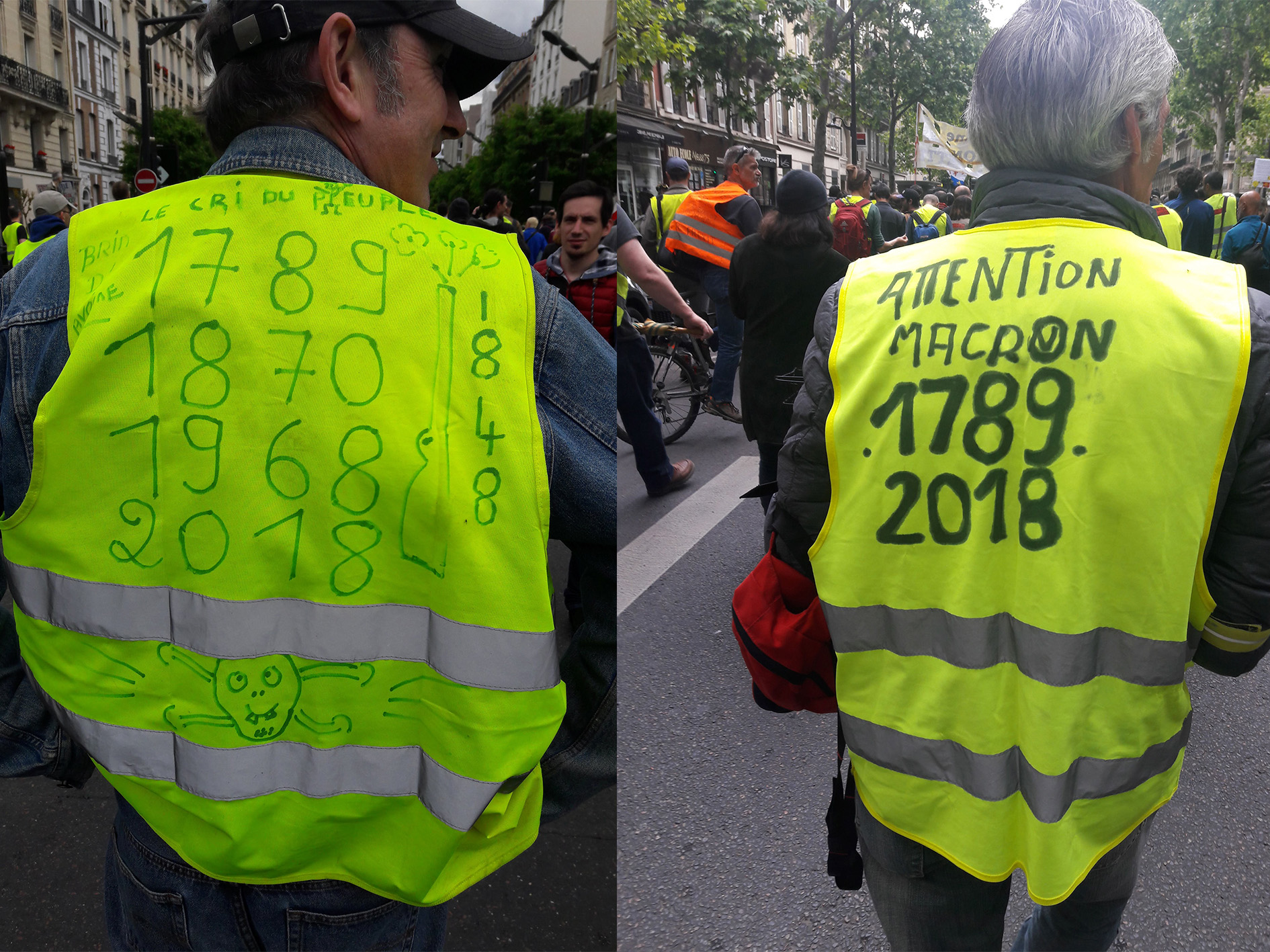
Nevertheless, I recognize the value of highlighting the Yellow Vests in the title, which is due to a factor I think could use more attention—the aesthetics and symbolism of the vests themselves. Besides the bright yellow color, there are other elements that make this symbol compelling. The state requires all cars to carry these vests so a stranded driver can be seen easily in case of accident or mechanical failure. To be seen is just what these activists are demanding. Moreover, the vest is intended to be worn during a mechanical breakdown, and it is just such a breakdown of the state’s responsibilities that the protesters are marking. Turning something the state requires you to own/have into a symbol against state policies is a powerful reversal. The fact that you can write on the vest completes its excellence. Writing not only recasts the vest as a symbol of resistance but allows individual activists to capture and convey some of the different motivations or inspirations for their participation as emphasized above in point 4. Wearing these sentiments on the very body that is bearing the brunt of the economic retrenchments they are protesting makes the messages visceral. Moreover, wearing them in different kinds of places, from iconic national landmarks to traffic roundabouts, brings the two together, reminding observers and the state that it is workaday locations and actions that constitute the nation state.
The title also has another misdirection worth interrogating. While democracy is obviously at stake, it seems to be more of a condensing or master symbol for the variety of issues activists are protesting. As Susser makes clear these are primarily socio-economic grievances associated with the neo-liberal evisceration of the welfare state. The participants themselves summarize this plethora of complaints as “stealing the state”, but it is not stolen elections or voting rights that they reference with this phrase, rather it is the removal/theft of the resources that have been collective and common. Democracy is implicated here for sure, and it is a useful shorthand to reference the different and often opposing social, economic and environmental agendas being pursued, but I worry about what is lost (and I’m not limiting this question to France) by deploying the idea of democracy as a synthetic symbol for diverse economic problems. In places as different as the US and Bulgaria, politics has a despicable reputation. What do we gain by finding a common (hopefully unifying) denominator for varied discontents if that common denominator is suspect or even off-putting to so many?
A final thought concerns Susser’s commitment to Gramsci’s idea of an historical bloc. Susser suggests that commoning brought together people with diverse backgrounds and political leanings, under trying circumstances, which allowed them to cross thresholds of trust and build bridges. Such experiences encourage people to see themselves in broader focus and foster a collective counter-hegemonic vision that could create the conditions for a new historical bloc. She compares the alchemy of these events with the experience of rites of passage described by classical anthropologists. I thought this was a provocative analogy, but it led me in a different direction. It made me think about how earlier anthropologists found utility for these bonds in the very different context of segmentary politics. For them the cross-village bonds forged in common initiation rites created possible allies in times of conflict, but it did not create new political groupings. Perhaps the value of commoning and thresholding is in this potential—creating bases for people to come together when their interests and commitments align that can morph into different configurations as the issues or their interests change. In other words, in the current political terrain might flexibility be more effective than the stability implied by an historical bloc? Originally documented in nonstate contexts, such segmentary operations also seem more compatible with the non-hierarchical nature and commitment of these movements.
Gerald Creed is Professor of Anthropology at Hunter College and CUNY Graduate Center. He is a cultural anthropologist specializing in political economy, ritual, and identity in Eastern Europe.
References
Creed, Gerald. 2024. “The vanishing villager. Three decades of political, economic and ethnic change in Bulgaria.” HAU: Journal of Ethnographic Theory 14(2): 497-499.
Susser, Ida. 2026. The Yellow Vests and the Battle for Democracy. Taking to the Streets of Paris in the 21st Century. New York: Routledge.
Cite as: Creed, G. 2026. “Optimism and Other Lessons from Ida Susser’s Yellow Vests” Focaalblog November 23. https://www.focaalblog.com/2026/11/23/gerald-creed-optimism-and-other-lessons-from-ida-sussers-yellow-vests/
Discover more from FocaalBlog
Subscribe to get the latest posts sent to your email.