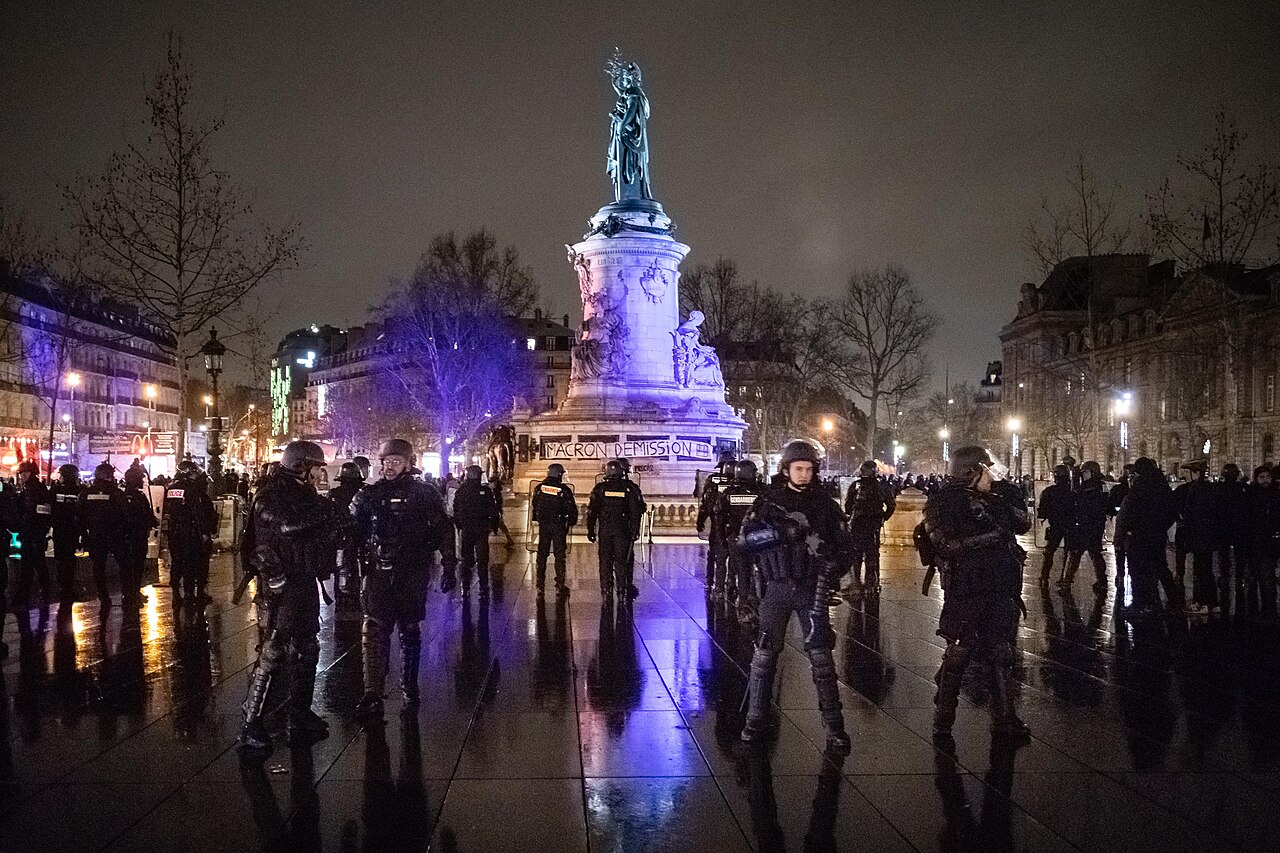

Ida Susser’s The Yellow Vests and the Battle for Democracy. Taking to the Streets of Paris in the 21st Century (2026) is very good to think with. When I read of the recent wave of student protests in France—which spurred the mayor of the immigrant, working-class northern Parisian suburb of Saint-Denis to dance in the street with youthful participants, and, some weeks later, led the Gilets Jaunes (Yellow Vests) to join the mobilizations—it was that book that attuned me to the anomalous, populist mix that fueled that uprising. This is so, in part, because Ida doesn’t prejudge the political tenor of her subjects. Over fourteen chapters, she keeps open questions about whether the Yellow Vests are moving right or left, or if that blurring of political lines will ultimately accrue power to the right. I take that indeterminacy as a gift, and I offer the following comments and questions in that spirit.
Ida asks how politically diverse and spatially dispersed people in Paris and beyond—formed through different but interconnected histories of industrialism, colonialism, migration, racialization, and capital abandonment—might become capable of resisting what they call “the theft of the state.” I read the book’s central political argument as making a case for an ideologically and organizationally heterogeneous left, including autonomists, anarchists, populists, socialists, and communists.
Ida introduces an opposition between Rancière’s affection for spontaneous commoning and Badiou’s commitment to organization and institutions, and she suggests a third possibility, that of an historic bloc of commoning practices, unions, parties, and neighborhood institutions, all operating at distinct moments in the capital circuit. Each does different work: Commoning invites encounter and experimentation; labor unions exercise power at the workplace; political parties formulate programs and directly contest state power; municipal communism has produced material legacies, including social housing, parks, and cultural institutions. Ida explores how these various forms reinforce one another, and she asks about the possibilities they may enable.
The Yellow Vests accuse France’s centrist President Emmanuel Macron of “stealing the state,” that is, of privatizing collective resources and pushing through austerity measures that diminish social protections, such as pensions and labor rights, and threaten the conditions of social reproduction. They insist, instead, that the state belongs to the people who finance it and depend upon its provisions. But precisely who “the people” are understood to be is at the very heart of the matter. For Ida, the question of whether the Yellow Vests are best understood as tending to the left or to the right depends on whether or not the group’s demands for the state include migrants and whether or not it envisions “the people” as a racially inclusive subject.
Ida doesn’t judge the Yellow Vests by first appearance. A 2018 diesel-tax revolt originating in the provinces and urban peripheries may bear likeness to the right-wing, populist Poujadism of petit-bourgeois fractions and rural workers in the 1950s, yet its yellow-vest-clad participants are not destined for the right. Nor do their commoning efforts necessarily incline them toward the left. The participation of left activists among the Yellow Vests may have the effect of marginalizing the extreme right; on the other hand, the acceptance of the National Rally within the movement may normalize it. Throughout the book, Ida considers both possibilities.
To be sure, the blurring of right and left that Ida observes is not politically neutral. The right has produced parties, media, narratives, and affective repertoires ready to organize grievance. The left has been less able to do so over the last decade. As I read it, Ida’s project is to help imagine a left that could.
To that end, she suspends any definitive branding of the Yellow Vests and follows them instead through close participant observation. For example, Chapter 9, on working-class memoirs, traces the embodied injuries and affective legacies of class decomposition: a father’s back is permanently injured, a cashier’s hands chronically ache, many people feel politically invisible, and some turn to the right. Ida cites Sherry Linkon’s “half-life of deindustrialization” to describe this emotional landscape. Linkon coined that evocative phrase to capture the far-reaching impact of capital flight, “for decades after plants closed and across generations, affecting the worldviews of younger people who never worked in steel mills or auto plants. Like radioactive waste, deindustrialization has a half-life” (Linkon 2016; also 2018). The term conveys enduring social, emotional, and bodily harm following deindustrialization: the original event, reduced by half, and half again. However, Ida’s ethnographic material suggests more than a long and diminishing attenuation, as Ida herself suspects.
I’ve been thinking instead of “the afterlife of deindustrialization,” to convey a different process and politics. Those who arrived after factory closures and layoffs do not share a memory of Fordist industrial employment. They encounter the remains of industrialism—endangered social housing, highways that cut through working-class neighborhoods, brownfields, public and cultural institutions barely holding on, fiscal inequalities—and they draw on their own experiences of colonialism, migration, racialization, other histories of struggles and protest. “Afterlife” captures the mutual constitution (Kasmir and Gill 2020) of the new political field including migrants and older residents, the combination of their experiences, not the halving of deindustrialization but the production of something new. Ida nearly uses this language when she writes that Saint-Denis’s surviving left-wing infrastructure combined with new collective protest and political expressions to hold in check any eruption of racist and anti-migrant impulses. The notion of combination is key here, as it speaks to the making of a novel political formation, of which the disorganization of “Old France’s” working class is just one facet.
Ida follows the making of a political alignment across space. In her analysis, Paris is not a bounded unit. Yellow Vests travel from villages and urban peripheries to Paris protests; urban activists travel outward to demonstrations; farmers, environmental activists, banlieue residents, and trade unionists come together in roundabouts and marches. Ida plainly rejects static urban boundaries and treats province and city relationally, putting us in mind of Raymond Williams’ groundbreaking conception of space in The Country and the City. Industrialization, colonialism, migration, deindustrialization, and the construction of banlieues are interconnected histories of accumulation and state formation across space. Their hidden relations can become visible in struggle, as can the possibility of recomposing them politically.
May Day provides an example. Ida puts the concept of “thresholding” to work here. She writes that labor, environmentalists, Black Lives Matter activists, Nuit Debout, and Yellow Vests enter a shared political space and cross a metaphorical threshold to be together. For Ida, this is an important political occurrence, in and of itself, but I think that thresholding can become too permissive a concept.
May Day evidences the fragmentation of contemporary labor, and it manifests the political work required to bridge those divides. Thresholding points to moments: shared exposure to police violence changes how some White Yellow Vests understand Black and Arab youth; food sharing, mutual aid, campaigns against police violence, and demonstrations after Nahel Merzouk’s killing move people across racialized boundaries. It highlights openings, yet I suspect it cannot bear the explanatory weight needed for analyzing the making of political formations. What would count, ethnographically and politically, as evidence that thresholding has produced durable solidarity more than temporary encounter? How do we get from threshold to historic bloc? What concepts—like combination or class (Kasmir and Gill 2018; Smith 2020) —might we need to do that theoretical work?
Ida broaches these problems in the Conclusion, where she recalls E. P. Thompson’s making of the English working class and urges us to follow the different histories of subaltern groups to identify moments when they begin to recognize themselves as a larger bloc. But what commoning and organizing are needed to build solidarity between “old and new France”? What actions and institutions are needed to build power?
The ethnography of the municipality of Saint-Denis in Chapter 11 suggests what steps might lead from thresholding to an historic bloc. It shows the accumulation of political capacities over time. Municipal communism did more than invite people across thresholds. The French Communist Party (PCF) built housing, clinics, schools, sports facilities, theaters, and social centers; it trained cadres, placed working-class leaders in municipal office, and embedded political belonging in everyday life. Its institutions participated in making a working class. Ida’s ethnography invites us to ask how this milieu encouraged class solidarity and inhibited racism from becoming a dominant political register. How did communist identification prevail over racist exclusion? What kinds of political education were on offer? What party rituals, social sanctions, or material assistance helped shape that outcome, and when did they fall short of doing so? These questions matter because development for the Olympic Games, privatization, gentrification, and the loss of subsidized social spaces now threaten the settings in which a left political culture was reproduced in Saint-Denis.
Ida writes that there is “no magic in commoning” (Susser 2026, 269). She maintains that neighborhood work, street uprisings, unions, and left parties together helped push the Yellow Vests toward inclusivity. That is, commoning, unions, and parties complement each other. One of Ida’s valuable contributions is to attempt to move beyond the 150-year-old opposition (rather stale and stalled) between utopian and scientific socialism, anarchism and communism, and to see them as mutually reinforcing political forms. What I take from this is an argument that a left capable of state contestation, and of defeating the right, needs both the experimentation of commoning and the mobilizing might of unions and strategic capacity of party institutions. Ida shows political subjects in motion, as they draw upon these diverse forms. She makes plain the reversals, partial alliances, dangers, and possibilities of the Yellow Vest movement, without presuming to already know the political outcome.
Sharryn Kasmir is Professor of Anthropology at Hofstra University. She has done fieldwork in the Basque region of Spain and in the southern United States. Her research and writing focuses on capitalism and working class lives and politics.
References
Kalb, Don. 2018. “Trotsky over Mauss: Anthropological Theory and the October 1917 Commemoration.” Dialectical Anthropology, 42(3): 327-343.
Kasmir, Sharryn, and Lesley Gill. 2018. “No smooth surfaces: An anthropology of unevenness and combination.” Current Anthropology, 59 (4): 355–377.
Linkon, Sherry. 2016. The Half-Life of Deindustrialization: Why Donald Trump is Just a Symptom. Salon. https://www.salon.com/2016/08/19/the-half-life-of-deind_partner/, Accessed Jan 31, 2026.
Linkon, Sherry Lee. 2018. The Half-Life of Deindustrialization: Working-Class Writing about Economic Restructuring. Ann Arbor: University of Michigan Press.
Smith Gavin 2020: “Interrogating The Agrarian Question then and now in terms of Uneven and combined Development” In Don Nonini and Ida Susser (eds): Unsettled states, movements in flux, migrants out of place: the tumultuous politics of scale. Taylor and Frances, p.153-75.
Susser, Ida. 2026. The Yellow Vests and the Battle for Democracy. Taking to the Streets of Paris in the 21st Century. New York: Routledge.
Cite as: Kasmir, S 2026. “To the Political Left or Right? Ida Susser’s Exploration of the Yellow Vest Movement in France” Focaalblog November 23. https://www.focaalblog.com/2026/11/23/sharryn-kasmir-to-the-political-left-or-right-ida-sussers-exploration-of-the-yellow-vest-movement-in-france/