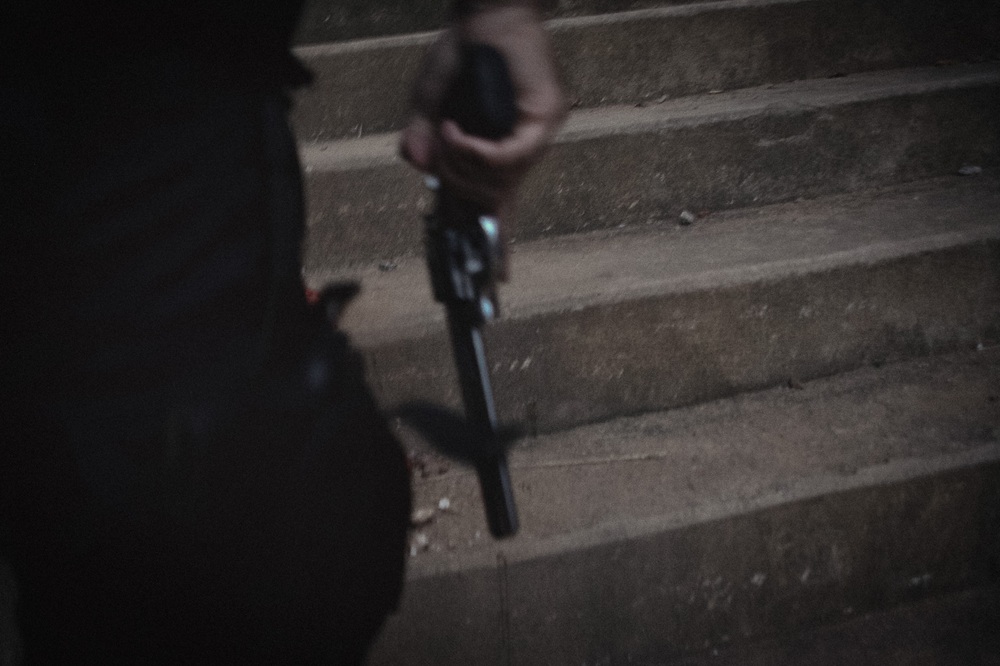
Palm Springs, mid-September 2025. The American flag flies at half-staff across the city in honour of Charlie Krik, right-wing political activist and Trump supporter who was shot and killed in Utah at the beginning of the month.
While gun violence is not foreign to Americans, the assassination of Kirk is met with shock, anger, and disbelief by many, but also with glee and a sense of divine justice by others, as Kirk ardently opposed gun control policies across his social media platforms, including his wildly popular podcast show.
In Palm Springs’ affluent middle-class neighbourhoods, a young couple working in the local art industry is quick to note the irony. They are not Trump supporters and politically far from the far-right, but like many Americans, they own guns which they use both for protection and play.
When a stranger passes out on the sidewalk in front of their home, smelling alcohol and old sweat, the guns offer a sense of security, and are carried as a precautionary measure. While the couple have sympathy for the man and his obvious suffering, they emphasise that this is a family neighbourhood. The kids that live here should not be exposed to these scenes.
As the young couple debates how to address the situation, a neighbour pulls up in a big, white pick-up truck. He wears a spotless, white polo shirt with SECURITY embroidered on the chest and carries a gun on his hip. Taking charge of the situation, he calls the police, who soon arrive to detain the man sleeping on the street corner.
The neighbours chat while they wait for the officers to arrive, and the security man explains that he lives a few houses down the road, that he is a former marine and police officer, and that he likes to keep his neighbourhood safe. The man is friendly and polite, and offers his number to the young couple, should they ever need assistance.
And indeed, they soon do: their roommate is a former substance addict and apparently, as the couple eventually speculate, also a practitioner of some sort of black magic. When he is asked not to treat himself to the soda cans that are in the fridge, he spirals into an escalating episode of rage.
He yells at them to fuck off at the top of his lungs, his anger reverberating through the home. “I have never felt so disrespected in my life,” Rob, the male half of the couple asserts. Over the next days and weeks, tension between the couple and the roommate builds as they try to evict him. “Oh yes, we all own guns,” Rob dryly notes when asked if the evicted roommate is armed.
Eventually, after weeks of emotional distress, they call on their security neighbour to negotiate the conditions of the roommates’ eviction. They commended his professional and calm demeanour. Their impression of the vigilante has changed from scepticism to trust. They feel safer that he is around, and prefer his assistance to that of the police—at least on this occasion.
As they clean out their old roommate’s room, they find bone fragments, human teeth, and a doll that they describe as having an unsettling energy. They burn the teeth in their yard and cleanse the room with sage and incense.
The scenes from contemporary US, observed by Tomas Salem, show how sensations of (in)security are perceived, constructed, and negotiated through a set of materialities that include guns, social media, unsettling bodies, national symbols, mind-altering substances, and ontologically ambiguous objects, as well as perceived energies, political pundits, and the institutions and agencies usually associated with the provision of security.
Some of these elements, such as guns, are commonly linked to the field of security and evoke strong emotions, reactions, and opinions.
Firearms are habitually subjected to processes of political polarisation and simultaneously perceived as elements of risk or guarantors of safety. Similarly, unsettling bodies—the drunk, the migrant, the racialised, or the emotionally volatile—also shape feelings of (un)safety and fear. Additionally, ontological assumptions about the life of objects can produce feelings of anxiety, restlessness, or insecurity, or they can calm such feelings.
Over the past decade, scholars and artists alike have begun to rethink security not just as a set of institutions or policies, but as something deeply felt, material, and sensory. From drone surveillance to facial recognition, from border fences to biometric databases, security today is not only managed through laws and strategies; it is experienced through bodies, affects, and technologies. The hum of a CCTV camera, the buzz of a phone alert, or the tension in a checkpoint queue all contribute to how security takes shape in everyday life.
In this series, we place the sensorial at the forefront of anthropological inquiry into everyday practices and understandings of (in)security.
What does it mean to sense security? Anthropologists working with ideas from new materialism and posthumanist thought have helped push this conversation forward. Rather than seeing humans as the only actors in our analysis of security, these perspectives draw attention to the agency of things and examine how technologies, infrastructures, and environments participate in producing (in)security.
The concept of sensing here works in multiple directions: humans sense danger or safety, but sensors, algorithms, and data infrastructures also “sense” the world, classifying and responding in ways that shape our collective experience. Security becomes not just something we enforce or feel, but something co-produced by human and nonhuman actors alike.
New materialist approaches remind us that sensing is never neutral. The technologies that claim to detect threat or measure risk often reproduce the same racialized and colonial hierarchies that have long structured the security field.
In this sense, studying sensing and materiality is also about uncovering how inequalities are embedded in the very textures of security, in codes, in infrastructures, and in atmospheres.
In this feature, we are interested in better understanding how embodied emotional registers are manipulated in political projects, especially those responding to widespread anxieties about the future. To sense (in)security is to inhabit a world where matter, technology, and emotion converge.
Which lives and movements are rendered visible, and which remain unseen? How do certain bodies become “suspicious” in the eyes of a security guard, vigilante neighbour, or algorithm?
By focusing on the sensorial as the locus of interplay between materiality and experience, and thus, of our ontology or perception of reality, the contributions reveal the nuanced dialectics of security and insecurity in contemporary life.
Key to this exploration are the ways in which bodies, objects, and technologies, from algorithms to uniforms and weapons, shape sensations of (in)security. We are interested in analysing how a sensorial approach that foregrounds sensorial understandings and interpretations provides in-depth analysis of how feelings of (in)security are experienced and translated.
This feature also underlines how anthropology offers a distinctive way to engage with these questions.
Ethnography brings us close to the affective atmospheres and sensory details of security worlds, including the fear, boredom, adrenaline, anticipation, or unease that circulate between people, technologies, and spaces. Thinking of security through sensing thus invites us to move beyond abstract notions of protection or control, and instead to ask how security feels, where it resides, and how it takes shape through the material world around us.
By zooming in on the often-invisible ways in which the sensorial is securitized, the diverse case studies that constitute this collection reveal how political orders and normative frameworks mobilize the senses to maintain control.
Like the scenes we observed in the United States, the essays in this feature trace how the sensory is mobilized to maintain, and sometimes subvert, orders of control across settings as diverse as the US border, Rio de Janeiro’s favelas, Rome’s Roma camps, Mozambique’s political protests, and Denmark’s urban margins.
Through its diverse cases, this feature emphasizes that security is not only a set of practices but a mode of perception. To sense (in)security means to rethink how we study security, and how we feel it as citizens and anthropologists.
Tessa Diphoorn is an Associate Professor at the Department of Cultural Anthropology at Utrecht University, and her research and teaching focus on policing, security, violence, and authority in Kenya and South Africa. She is the author of Twilight Policing. Private Security and Violence in Urban South Africa (University of California Press, 2016), the co-editor of the edited volume, Security Blurs: The Politics of Plural Security Provision (Routledge, 2019), and the co-curator of Nairobi Becoming: Security, Certainty, and Contingency (Punctum Books, 2024).
Tomas Salem is a social anthropologist who completed his PhD research on happiness, environmental ethics, and tourism at the University of Bergen. He is also the author of Policing the Favelas of Rio de Janeiro: Cosmologies of War and The Far-Right (Palgrave 2024).
Cite as: Diphoorn, T. & Salem, T. 2025. “Sensing (In)Security. New materialism and The Politics of Security” Focaalblog December 22. https://www.focaalblog.com/2025/12/22/tessa-diphoorn-and-tomas-salem-introduction-sensing-insecurity-new-materialism-and-the-politics-of-security/
Discover more from FocaalBlog
Subscribe to get the latest posts sent to your email.