This interview with Susan Buck-Morss took place at the City University of New York (CUNY) Graduate Center on May 12 2015. Buck-Morss is Distinguished Professor of Political Philosophy at the Graduate Center and has been a towering figure in continental theory since her publication of The Origin of Negative Dialectics in 1977. Her books include Hegel, Haiti, and Universal History (2009), Thinking Past Terror: Islamism and Critical Theory on the Left (2003), Dreamworld and Catastrophe: The Passing of Mass Utopia in East and West (2000), and The Dialectics of Seeing: Walter Benjamin and the Arcades Project (1991). In this interview with Zoltán Glück for FocaalBlog, Professor Buck-Morss talks about her formative years of political radicalization, the difficulties of teaching the radical tradition, and the political significance of crowds.
Continue reading
Yearly Archives: 2015
Chris Hann: The new Völkerwanderungen: Hungary and Germany, Europe and Eurasia
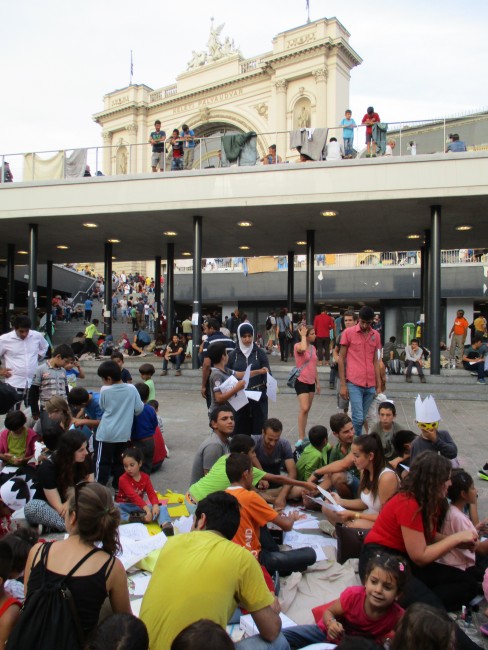
I spent the last weeks of August and the first days of September in Hungary, close to the European Union’s border with Serbia. Never before had a routine field trip catapulted me into an engagement with issues dominating daily headlines, both in Hungary and elsewhere. What light can social anthropology throw on the current “migrant crisis”?
Continue reading
FocaalBlog Event: CUNY Panel Discussion on Puerto Rico’s Debt Crisis
On Tuesday, September 8, the City University of New York (CUNY) Center for Latin American, Caribbean, and Latino Studies is hosting a free panel discussion and presentation based on the recent FocaalBlog post “Puerto Rico Is NOT Greece: Notes on the Role of Debt in US Colonialism.”
Where: The Graduate Center
365 Fifth Avenue
Room 9100: Skylight Room
When: September 8, 6:30–8:30 p.m.
Contact Info: 212-817-8434
The blog authors Ismael García-Colón, Associate Professor of Anthropology at the College of Staten Island and the CUNY Graduate Center, and Harry Franqui-Rivera, Research Associate at Hunter College’s Center for Puerto Rican Studies, will participate in the discussion.
For more details, please visit the event page here.
Joe Trapido: Elections, politics, and power in central and southern Africa
The conference “Elections in central and southern Africa, dynamics of exclusion and participation,” at SOAS on 26 June 2015, prompts me to some personal reflections. Elections in central and southern Africa are marked by a paradoxical dynamic of participation and exclusion. Ostensible rituals of mass participation and of legitimation by civil power, electoral processes in the countries of the region have often made recourse to forms of exclusionary violence during campaigns. This is not, of course, unique—elections in Africa should not be seen as sui generis events. This exclusionary dynamic is well understood as a regional variant on a wider theme.
Continue reading
Ismael García Colón & Harry Franqui-Rivera: Puerto Rico Is NOT Greece
Notes on the Role of Debt in US Colonialism
UPDATE: On Tuesday, September 8, the City University of New York (CUNY) Center for Latin American, Caribbean, and Latino Studies is hosting a free panel discussion and presentation based on this blog post. For more details, visit the FocaalBlog event page here.
Early July 2015, at an event discussing the Greek debt crisis hosted by the German Federal Bank in Frankfurt, German Finance Minister Wolfgang Schaeuble talked about a sarcastic conversation he’d had with United States Treasury Secretary Jack Lew. Responding to pressure from the US government for a resolution on the pending Greek debt talks, Schaeuble told Lew that the European Union could take Puerto Rico into the euro zone if the US was willing to accept Greece into a dollar union. In the video of the event, one can appreciate people laughing at Schaeuble’s remarks, made in front of a large projection of the event’s theme “Turning points in history: How crises have changed the tasks and practice of central banks.” Interesting enough, his comments say more about Germany’s intentions and its role in the Greek debt default than about Puerto Rico.
Continue reading
Alan Bradshaw: European austerity and collective blame
According to Richard Seymour (2015), current European austerity politics ought to be regarded not as a temporary period of economic rationalization during crisis but rather as a shift toward a new political economic paradigm. This new paradigm is to be driven by a rhetorical commitment to “worker flexibility” and “labour market competitiveness”—both euphemisms for a long-term decline in the value of European salaries and an overall context of bottom-to-top economic redistribution. A further defining aspect of austerity in Europe is the condition of financialization, meaning that mantras of “living within our means” typically define the parameters of sensible governance yet often take the form of shifting public debt onto private households, as capital accumulation becomes increasingly driven by banks leveraging household debt to fund trading on financial markets (see Lapavistas and Flassbeck 2015).
Continue reading
John Levack Drever: Sublime-sound-of-the-one-hand [Ryōan-ji]
My soundscape composition Sublime-sound-of-the-one-hand [Ryōan-ji] sounds out the acoustic ecology of the “quintessential … karesansui dry landscape garden” (UNESCO 1993: 41) Or, put another way, to limit “idiosyncratic and ambiguous” (BSI 2014: v) concepts spilling across interrelated disciplines, by implementing the new British International Standard’s definition of “soundscape,” the question is: how is “the acoustic environment perceived or experienced and/or understood by a person or people,” in the “context” of the karesansui dry landscape garden (BSI 2014:1)?
Continue reading
Chiara Ambrosio & Caterina Pasqualino: Tending to the Garden
Caterina Pasqualino is an anthropologist whose research within the realm of Gypsy flamenco for the past twenty years has culminated in her seminal book Flamenco Gitan. Her interest in performance and ritual and their relationships with experimental film—explored in the book she co-edited with Arnd Schneider, Experimental Film and Anthropology—has led her to begin exploring her practice through the language of experimental film.
Following a meeting with Chiara Ambrosio—a filmmaker, visual artist, and flamenco dancer—the two have decided to develop a film together to explore the role of the “outsider” and of suffering within art and, more specifically, within the space of flamenco.
Continue reading
Dave Lewis: “Field Work”
My engagement with the ideas and practices of fieldwork stems from my interest in anthropology and the classification of human “types” through the “science” of anthropometry in the mid-nineteenth century, which began when I was a photography undergraduate student. “Field Work” (2010) was my attempt to address visual ethnographic practice from the position of a contemporary photographic practitioner. As a photographer I have always been concerned with issues around race, identity, and representation, and the award of the AOA1 commission provided the opportunity to question specific perceptions of boundaries and region in the United Kingdom, and how these relate to identification with a particular community. The commissioners wanted “an image-maker who can have agency as a British citizen, meditate and reflect on being a ‘stranger,’ but also move to a place that can be seen as his home domain and look out towards ‘his’ England.”
Continue reading
Ida Susser: From the underground resistance under Franco to Podemos, with Vicente Navarro
Vicente Navarro is a leading analyst of the history and origins of the financial crisis in Spain (and Europe in general) and an economic adviser to Podemos. His book There Are Alternatives (Hay Alternativas: Propuestas para Crear Empleo y Bienestar Social en España), written with economists Juan Torres and Alberto Garzón, became an inspiration to the Indignados movement. Asked by Podemos, Navarro and Torres developed a new economic policy outlining the challenges of the current era and economic strategies that serve the people rather than the corporations. Podemos distributed this publication under the title An Economic Project for the People (Un Proyecto Económico para la Gente). Presented by Pablo Iglesias and the authors, the project became a major media event, denounced by banks and corporate representatives all over Europe and acclaimed by many throughout Spain.
Continue reading