Tag Archives: solidarity

Olivia C. Harrison: Who’s Afraid of Palestine Solidarity?


Image 1: The logo of Mouvement des travailleurs arabes, from the Saïd Bouziri collection at Archives de La Contemporaine.

One question has been haunting me since the current wave of repression of pro-Palestinian speech began in the wake of the October 7 attacks and the genocidal campaign-disguised-as-reprisal that followed: who’s afraid of Palestine solidarity? This is an urgent question on US, French, and German campuses today, but its purview is not limited to the Global North. In fact, this question puts pressure on the distinction between Global North and South, as if the newly minted leaders of formerly colonized nations had created the “new man” that Frantz Fanon so passionately called for (Fanon 1963: 316). As dissidents, intellectuals, and artists from former European colonies have taught us, the simple transfer of power cannot be mistaken for what Fanon called decolonization, a process that begins with sovereignty but does not end there. The mass transfer of populations set in motion by colonial settlement and postcolonial migration is one of the vectors that disrupts the neat temporal and epistemic divisions between the imperial era and the purportedly postcolonial era. So too is Palestine, the object of a century-long process of settler colonization that flares up every few years in a new war of elimination. The migrant question and the Palestinian question are not separate questions. The ways in which they overlap go a long way to explaining the threat Palestine and Palestine solidarity represent across our still decolonizing world.

At first sight, Palestine appears to be an outlier on the sanitized map that has made permanent the borders drawn by European colonial powers – as if Palestine were a belated hangover from the era of full-throttle imperialism and settler colonialism. But the impermanence of Palestine’s ever-dwindling borders gives the lie to the fantasy of decolonization as a fait accompli. Palestine is a thorn in the side of postcolonial regimes too quick to forget the revolutions that carried them to power – perhaps especially those regimes that pay lip service to the Palestinian cause while quashing dissent, including Algeria, a self-declared ally of the Palestinian resistance that has long suppressed any speech deemed critical of the state. As dissidents in Morocco, Algeria, and Tunisia have repeatedly warned, Palestine has long served as an alibi for repressive Arab regimes.

And yet Palestine solidarity is alive and well, as the mass protests of the past two years have shown us, even though the conditions on the ground have deteriorated to the point that the goals of Palestine solidarity in the era of Third Worldism – total decolonization in the form of a single, democratic state for all inhabitants of historic Palestine – seem completely unattainable today. The facts on the ground have all but foreclosed the possibility of Palestinian sovereignty. So why does Palestine continue to pose a threat, not only to the settler colonial regime that has been steadily replacing the Palestinians for over a century, but for nation-states that have apparently no stake in the outcome of settler replacement or indigenous resistance? This is not a rhetorical question, although the answer may seem obvious in the nation-state in which I write, the US, a settler colonial regime likewise premised on the replacement of its indigenous populations. Settler colonial solidarity goes a long way to explain the threat that Palestine and Palestine solidarity represent to Israel and the US. This is also true of other settler and post-settler regimes like Australia and France (more on the latter below). But this does not explain the threat that Palestine solidarity poses to the postcolonial regimes of former European colonies – including former settler colonies like Algeria. This is the flip side of Arpan Roy’s caution against taking Palestine solidarity as a given. If we need to rethink what it means to commit to Palestine, anti-Palestinian backlash, too, should be denaturalized. In what follows I discuss several case studies that shed light on dangers that commitment to Palestine represents in France, Algeria, and the US, focusing on the links that tie the migrant question to the Palestinian question.

*

I begin with a document that stages our relationship to decolonization as an unfinished process, one in which Palestine figures among other more or less successful anticolonial revolutions. French-Moroccan artist Bouchra Khalili’s twenty-two minute digital video Foreign Office is part of an installation which includes fifteen photographs of the now-deserted embassies of Third World revolutionary movements in Algiers and a silkscreen print that assembles these sites in an “Archipelago” of now disconnected points. The video begins with a medium shot of Ines and Fadi, two young Algerians, sitting side by side at a black desk that turns into an editing table as they handle the maps, photographs, audio and video recordings that together compose the archive of Algiers as a “Mecca for revolutionaries,” in Amílcar Cabral’s poetic phrase: the soundtrack of the 1969 Pan-African Festival; black and white photographs of Eldridge and Kathleen Cleaver at the Black Panthers’ international headquarters in Algiers; and portraits of Nelson Mandela, Malcolm X, Agostinho Neto, Mário Pinto de Andrade, and other Third World revolutionaries who gathered in Algiers to discuss their plans for decolonization (Khalili 2015). In the wake of the Algerian revolution, anticolonial and antiracist movements from around the world found refuge in Algiers, sometimes headquartered in the same colonial-era building, vacated to make room for transcolonial solidarity. But this legendary past is long gone. “We have inherited only disenchantment and history in pieces,” Ines observes. What has happened to Algeria, she wonders, to make everyday Algerians yearn to leave for France? Ines speaks in Darija (Algerian Arabic), Fadi speaks in Taqbaylit, an indigenous language that predates the Muslim conquest of North Africa in the seventh century, and they understand each other perfectly. Together, they edit the archives of an era they never knew to understand the present they share, summoning the voice of Algerian writer Kateb Yacine, who left behind the French language – his “butin de guerre” (war booty) – to forge new cultural forms and idioms in a newly sovereign nation that was already betraying its revolutionary ideals.

Shot in Algiers a few years before the pro-democracy movement (al-hirak) took to the streets in February 2019 to protest Abdelaziz Bouteflika’s attempt to secure a fifth term as president, Foreign Office sketches the coordinates of transcolonial solidarity and its undoing in the aftermath of decolonization. What lessons can we draw from Ines and Fadi’s “revolutionary heartbreak” (to cite a term coined by my colleague Neetu Khanna) as we witness the destruction of Gaza in the twenty-first century? And what can Palestine teach us about our relation to the anticolonial past and neocolonial present? The lines that Foreign Office draws between past and present, here and elsewhere are an invitation to rethink what commitment to Palestine means at a time when the intensity of Palestine solidarity stands in inverse proportion to the possibility of Palestinian futurity.

To begin answering the question “who’s afraid of Palestine solidarity,” I take Ines and Fadi’s invitation to return to the work of Kateb Yacine, an outspoken advocate for Palestinian rights who deployed Palestine in a twinned critique of the roles Algeria and France played in transforming the figure of the indigène (the colonized) into the figure of the immigrant, divorced from the settler colonial histories that produced it. In response to Ines’s question as to why Algerians continue to leave the “Mecca of revolutionaries,” Kateb’s play proposes that they do not have a choice. Settler colonialism set in motion the mass transfer of populations from the metropole to the colony, from the colony to the metropole, and, if the anti-immigrant right has its way, from the post-settler colony back to the former colony. It’s not coincidental that settler colonialism set this train in motion, or that Palestine, the object of another project of settler replacement, elucidates this dynamic in Kateb’s writings and in the forms of migrant activism that followed. As I will show in my concluding discussion of Palestine solidarity in 1970s France and the US today, Palestine has become a litmus test for national belonging in the settler postcolony.

*

In 1970, the beloved anticolonial writer Kateb Yacine returned to Algeria with the aim of working in the languages of the people, Darija and Taqbaylit, better suited, according to him, to achieving cultural decolonization than the colonial tongue he mastered so brilliantly. On his friend Ali Zamoum’s recommendation, he joined Masrah al-bahr (Theater of the sea), a popular theater troupe that had already performed several plays, including one on Vietnam, a topic dear to Kateb’s heart. Based on collaboration, improvisation, and audience participation, the troupe began adapting parts of Kateb’s thousand-page French-language manuscript play, Boucherie de l’espérance (Butchery of hope, 1968-69) in their headquarters in the working-class neighborhood of Kouba, in Algiers. Their first play, Mohamed arfad valiztek (Mohamed pack your bags), premiered on October 17, 1971, marking the tenth anniversary of the murder of hundreds of Algerians peacefully protesting against a racist curfew targeting Français musulmans d’Algérie (colonized Muslim French nationals of Algeria) by Paris police forces five months before the signing of the Evian Accords that would put an end to the Algerian war of independence from France. The irony of the title, Mohamed pack your bags, was initially lost on the Algerian immigrants who saw the poster for the play during the troupe’s French tour in 1972 – they reportedly panicked, assuming it was a call for the expulsion of immigrants. (The far-right National Front party was founded on this very campaign promise in October 1972. It remains the number one agenda of its de-demonized successor, the National Rally, and the plethora of anti-immigrant parties and organizations that have cropped up since.) While one of the self-declared aims of the play was, in fact, to convince Algerians to return to their homeland to continue the work of decolonization, the play is also a fiercely funny denunciation of the collaboration of postcolonial Algerian authorities and French government and industrial forces in recruiting, deporting, and exploiting Algerian workers in France. Mohamed arfad valiztek remained the troupe’s most popular play, reaching an estimated 75,000 spectators during the French tour, from February to June 1972, and another 350,000 in Algeria in the next four years, where the troupe (renamed Al-nishat al-thaqafa lil-‘umal/Action culturelle des travailleurs or Worker’s cultural action, hereafter ACT) continued to perform Mohamed arfad valiztek alongside plays on Palestine (Filastin al-maghdura, Palestine betrayed, 1974) and the neglected role of Imazighen (“Berbers”) and women in Algeria’s millennial history (Malik al-gharb, The king of the west, 1977). Initially funded by the Ministry of Work and based in the popular Bab El Oued neighborhood of Algiers, the troupe’s irreverent and openly critical performances soon caught the attention of government censors. In 1977 the troupe was forced to relocate to the Western province of Sidi Bel Abbès, where they continued to perform until Kateb’s premature death in 1989.

An often bitingly funny satire of the backroom deals between the Algerian and French governments that resulted in the emigration of an estimated 750,000 Algerians by the time the first decade of independence was over, Mohamed arfad valiztek depicts the trials and tribulations of the titular character, a down-on-his luck migrant who faces a series of setbacks that ultimately lead to his triumphant return to Algeria where he resumes possession of his expropriated home thanks to the proverbial nail in the wall (this scene is based on a popular “Juha” tale known throughout North Africa) and vows to join the struggle against injustice “until the end of colonialism!” (Kateb 1999: 336). Although no opponents are named – Mohamed battles in turn the slavedriver, the police officer, the qadi (judge), the mufti (religious leader), and Boudinar (“father of money”) – the satire of the national elites and their French counterparts is impossible to miss. More subtle is the play’s critique of the transformation of indigènes (natives), as the Algerians were dubbed in French colonial law, into immigrants, construed as a disposable labor force that greases the wheels of the French and Algerian economy alike. The satirical name Pompez-tout (“Pump-it-all”), a near homonym of Pompidou, the French president’s name, neatly captures the labor-for-oil deals of the postcolonial migrant economy. But a less expected figure joins the chorus of characters on stage to expose the colonial genealogies of the migrant economy in France: a Palestinian laborer. What does Palestine have to do with Algerian immigration to France?

Mohamed arfad valiztek begins with a scene split between French Algeria and Mandate Palestine. On one side of al-halqa (a circle drawn by the spectators) stand Mohamed I, an indigenous laborer, and Ernest, a French settler; on the other, Mohamed II and Moses, a Zionist settler. The two Mohameds till the land under the supervision of the settlers, until the pairs depart, seemingly taking the same path home. After a good night’s rest, the two Mohameds and settlers wake up and begin chasing a single rooster with the generous aim of offering it to their “guest” for breakfast. The hilarious battle for hospitality that ensues satirizes the contest for indigeneity in a now chiasmic settler colony (“If only this rooster could speak… – He’d say France! . . . – Israel! – Algeria! – Palestine!) but also, as the rest of the play implies, in the settler postcolony, where yesterday’s indigène has been transformed into an immigrant, and the settler of old has become a native (Kateb 1999: 214). Rooting French anti-immigrant discourse in the longue durée history of French Algeria, Mohamed arfad valiztek exposes the settler colonial genealogies of the forms of nativism that were taking hold in France at the time. That it delivers this critique through a comparison with Palestine should not surprise us. If settler colonialism is based on land expropriation rather than labor exploitation, it remains the case that both French Algeria and Israel relied on native labor – notwithstanding the Zionist myth of Jewish labor – and that the indigènes (natives) have been transformed into foreigners in both France and Israel. But the play goes further than this. If the migrant economy is a product of settler colonialism, settler replacement also provides the rhetorical framework for calls for “remigration” satirized in the title Mohamed pack your bags. The fantasy of the “great replacement” – the purported replacement of Français de souche, white French people, by immigrants – was born at the colonial frontier.

When the ACT toured Mohamed arfad valiztek in France, North African migrant workers were already organizing around Palestine. In the wake of Black September, the 1970 massacre of thousands of Palestinian fedayeen by King Hussein’s troops in and around Amman, a group of Moroccan, Algerian, Tunisian, Syrian, Lebanese, and Palestinian activists got together at the Maison du Maroc (Morocco House) of the Cité Universitaire in Paris to form the Comités de soutien à la révolution palestinienne (Committees in support of the Palestinian revolution, hereafter CSRP). The first autonomous organization dedicated to the rights of migrant workers and students in France, the CSRP allied support for Palestine to advocacy for migrants, raising money and donating blood for the fedayeen even as they organized mass protests to denounce racist crimes and anti-immigrant legislation. The French authorities, aided by their counterparts in North Africa who were busy tracking their nationals’ political activities abroad (including activism against the authoritarian regimes of Morocco and Tunisia), arrested scores of pro-Palestinian activists and deported several to their home countries, where they were duly collected by domestic police forces. These punitive measures did not deter CSRP activists, who went on to found the Mouvement des travailleurs arabes (Arab workers’ movement) and a theater troupe, Al Assifa (The Tempest), named after the armed wing of Fatah (the Palestinian National Liberation Movement). Popular theater was, for Al Assifa as it was for the ACT, a weapon in the struggle for migrant rights in France. Whether or not the members of Al Assifa attended any of the ACT’s performances in France – there is no evidence of this in the archives – the North African genealogy of Palestine solidarity in France is clear. North African migrant workers and students identified with the Palestinians on the grounds of a shared experience of colonization and settler replacement. But they also looked to Palestine for inspiration, explicitly positioning themselves as successors to the Algerian revolutionaries and allies of the fedayeen. Migrant rights were, for these activists, part of a process of decolonization that did not stop with formal independence or at the borders of France-Algeria. The French government was right to suspect that Palestine solidarity meant activism on many fronts, including in defense of migrant rights, just as its North African counterparts were right to see Palestine solidarity as a first step in the struggle for decolonization in the purportedly postcolonial era. For the past half century, Palestine has been a “rallying cry” for decolonization in former colonies and metropoles alike (Said 1979: 125).

*

The repression of pro-Palestinian speech in 1970s Algeria and France prefigures the repression of pro-Palestinian speech today, even though there are important differences between these two moments, not least the impossibility of calling for cohabitation in a single democratic state – let alone the right to resist colonialism, once enshrined in international law – without being branded a terrorist. Today the suppression of pro-Palestinian speech remains intimately tied to the suppression of migrant rights, as illustrated most recently by the Abu Daqqa case in France and the Mahmoud Khalil case in the US. In conclusion, I briefly turn to these two cases, which are exemplary of the intimate links between Palestinian and migrant rights, and the continued instrumentalization of pro-Palestinian speech by anti-immigrant policy.

On October 16, 2023, undercover French police arrested Palestinian feminist activist Mariam Abu Daqqa in Marseille, following an Interior Ministry expulsion order that claimed that her presence on French territory after the Hamas attacks of October 7 was a threat to “public order” (Abu Daqqa is a member of the Popular Front for the Liberation of Palestine, which is blacklisted as “terrorist organization” in France and the US). A pioneer of the Palestinian feminist movement, Abu Daqqa was invited by French feminist organizations in September 2023 to speak about the rights of Palestinian women and the plight of female political prisoners in Israeli jails. The timing of her presence on French territory proved ideal for the nativist right. Her arrest came one week after the October 7 attacks and one day after an Islamist Russian national murdered a French schoolteacher, Dominique Bernard, in Arras. Despite legal attempts to stay the deportation order, she was deported to Cairo on November 10 (the state did not deport her to her native Gaza, on humanitarian grounds). In the following weeks, the Abu Daqqa and Bernard cases were instrumentalized to support a proposed law that would make it possible to deport immigrants displaying “behavior not compatible with French values.” Abu Daqqa is a feminist activist, and an unveiled one at that – in this sense, her behavior is presumably compatible with the values of the French Republic. But this does not make her less threatening in the context of France’s ongoing war on terror. To be Palestinian or pro-Palestinian is to be a potential terrorist.

The long history of the French state’s suppression of pro-Palestinian speech offers lessons for activists and scholars who continue to commit to Palestine in a range of diverse contexts, even though we must attend to the specific forms these commitments take, and the particular contours of the backlash against them. Writing as a French-American teacher and scholar based in the US, I am struck by the parallels between the foreignization of Palestine solidarity in France over the past fifty years and the decades-long reduction of Palestine solidarity to terrorism in the US. Remember that one of Donald Trump’s first reelection campaign promises was to deport foreign pro-Palestinian protestors. True to his word, he has spent the first few months of his second term targeting pro-Palestinian activists, starting with students carrying visas and green cards. Although I’m not aware of any inkling within his team that France has a proven record of doing the same, it’s clear that the deportation of pro-Palestinian migrant workers in 1970s France and, more recently, the deportation of Mariam Abu Daqqa offer a playbook for the foreignization of Palestine solidarity in the US, one that fits perfectly in the narrative of the war on terror that governs both French and American domestic and foreign policy. The current arrest of pro-Palestinian protestors by the US Immigration and Customs Enforcement (ICE) is the most recent example of anti-Palestinian policing in the settler postcolony, where migrant rights are the first (but not the last) to be sacrificed in the name of security. That the government is threatening to deport a permanent resident, Mahmoud Khalil, apparently marks a departure from the French state’s practice of deporting immigrants, whether on French territory legally or not. And yet twenty-first century debates about denaturalization in France, and more recently in the US, make it clear that Palestine has become a litmus test for national belonging: if you’re pro-Palestinian, you’re not really French, or American.

That the criminalization of pro-Palestinian speech has been reenergized in the wake of October 7 and the unfolding genocide in Gaza should not delude us. If the killing subsides, as one must hope it will, Palestine solidarity will not die down, nor will attempts to suppress it. Commitment to Palestine has only become more urgent as a result, particularly for those of us who have the privilege of carrying a French or US passport – at least the kind that cannot be revoked. We know who’s afraid of Palestine solidarity, and we’re not afraid of them.


Olivia Harrison is Professor of French, Comparative Literature, and Middle East Studies at the University of Southern California, and author of Natives against Nativism: Antiracism and Indigenous Critique in Postcolonial France (2023) and Transcolonial Maghreb: Imagining Palestine in the Era of Decolonization (2016).


References

Fanon, Frantz (1963). The Wretched of the Earth, translated by Constance Farrington. New York: Grove Press.

Kateb, Yacine (1999). Boucherie de l’espérance: œuvre théâtrale. Paris: Seuil.

Khalili, Bouchra (2015). Foreign Office. Digital video.

Said, Edward W. (1979). The Question of Palestine. New York: Vintage Press.


Cite as: Harrison, Olivia C. 2025. “Who’s Afraid of Palestine Solidarity?” Focaalblog September 26. https://www.focaalblog.com/2025/09/26/olivia-harrison-whos-afraid-of-palestine-solidarity/

Arpan Roy: Introduction: Staying-With Palestine. Making and Remaking Postcolonial Worlds

Image 1: Palestine is not alone (2020), by Vishal V. Shenoy

Extrajudicial arrest, termination from employment, suspension of university enrollment, being declared persona non-grata (Karl 2025), police violence at demonstrations, harassment at airports, online doxxing, and, in the case of six-year old Wadea al-Fayoume, a martyrdom in a strange land—these are some of the ways in which solidarity with Palestine has, since October 2023, been rebuked in the Global North in unprecedented ways. We do not yet know the longue durée of how the annihilation of Gaza and the genocide of its people will recalibrate the way in which the world relates to Palestine. In the darker continents, and especially in the lands immediately surrounding Palestine—lands with which Palestine has historically been organically linked and nurtured—punishment for resisting injustice has been more damning. Al-Hudaydah Port in Yemen has been repeatedly targeted by American and Israeli weapons of mass destruction in retribution for the country’s military operations against Israel, and entire towns and villages in Lebanon have been wiped off the map, and thousands of its people martyred. Regardless of how one evaluates the political efficacy of Hezbollah’s involvement in the Al-Aqsa Flood Operation, it is difficult to argue that any people on earth have paid a higher price for standing with Palestine than the Lebanese. Elsewhere, for much of the last half-century, Palestine solidarity at the level of state policy has been neutralized by economic sanctions and has sometimes been engineered toward permanent instability through regime change wars, bringing poverty and civil conflict upon millions of people, particularly the Arab and Iranian people. Indeed, in the weeks during which I began writing these words, Iran fought for its survival, perhaps its survival at the level of civilization, in the face of an unprecedented Israeli aggression coordinated with much of the Global North.

This forum is an inquiry into what it means to stand with Palestine. It is an exploration of how Palestine has stayed-with “local” political contexts, and how it has survived setbacks and tribulations, and ultimately inspired a commitment. The five essays in this forum explore disparate contexts, each with its own geopolitical history and postcolonial trajectory, that has negotiated its commitment to Palestine in spite of this principled position having invited hardships and at times catastrophic consequences. Moreover, the essays are penned by scholars—a literary scholar, a historian, an anthropologist, and a philosopher—whose respective research is outside the geographic boundaries of Palestine, but which intersects in irretractable ways with Palestine. What to make of this irretractibility?

Inspired by the anthropologist Nazan Üstündağ’s (2023) remarkable recent ethnography of the Kurdish Movement, I term the affective and political committing to Palestine as a mode of “camaraderie.” Üstündağ translates the Kurdish hevalti, the semantic equivalent of the Arabic rifqa, as “friendship,” but, for reasons I will elaborate on shortly, it may be more accurate to expand its semantic range also to “companionship;” a richness of meaning most succinctly captured by “camaraderie.” Indeed, in leftist movements in Kurdish, Arab, and Anglophone worlds, a partner in revolution is, respectively, heval, rafiq, or comrade.

Üstündağ sees hevalti as designating a “position in a particular revolutionary grammar,” and the revolutionary movement as an “organization of relationships.” Camaraderie emerges from an “accumulated perspective and knowledge of the ways in which these relationships will be molded.” (Üstündağ 2023:142) I find this semantic sketch of camaraderie as a useful reference for how to think through committing to Palestine, particularly in the world’s leftist movements—historically the natural home of camaraderie with Palestine—in the sense that a commitment to the Palestinian cause organizes one’s more immediate political life in all kinds of practical ways. As Omid Mehgran writes in this forum, Palestine is a “mode of relating to the politics of material conditions of life that touches all forms of politicization in the globalized ecologies of war and of remnants of life today.”

The essays in this forum may very well evoke a certain melancholy. A hundred years of the Palestinian cause, and the support that it has received from various actors from various stages, has not resulted in the liberation of Palestine. Yet, Palestine has accompanied these actors and stages, as a comrade that becomes a part of one’s own life and politics, but without resolution. It is in part because of this (among other reasons) that I find the paradigm of “solidarity” to be useful but incomplete in theorizing state-level affects with Palestine as a world-leftist issue. This paradigm has been closely examined in scholarship in recent years, often focusing on the 1968-1982 period as the zeitgeist of a globalizing Palestine solidarity (Thompson & Olsen 2023, Randall 2023, Harrison 2016, Haugbolle & Olsen 2023), and also appears in the essays in this forum, particularly that by Olivia Harrison. At the same time, solidarity as a symbol of a mythologized world-leftist revolutionary moment—now gone—now appears often in a romantic lens conditioned by temporal distancing (see Abu Hatoum, & Assali 2024). While not negating the importance nor the veracity of the solidarity framework, the essays in this forum search for deeper epistemologies, placing emphasis on Palestine as a tragedy that inflicts its pain also onto other stages and contexts. It is also a creative and generative force; a point of inspiration for political mobilization (leftist, Arab nationalist, Islamist) for over half a century, lending its companionship to debates, impasses, countermovements, and a negotiating of local paradigms. It is in this sense a camaraderie, a companionship or a staying-with.

This forum mostly concentrates on “other” worlds—known by various names: postcolonial, Third World, Global South—because those are the ones whose entanglements with Palestine have been more direct and, in some cases, devastating. However, as the essays by Olivia Harrison and Nico Putz show, these worlds are not bounded, and interact in dynamic and complex ways with European and North American metropoles. Harrison traces discourses around decolonization in Algeria (the “Mecca of revolutionaries”) to anti-immigrant fervor in contemporary France, where “yesterday’s indigène has been transformed into an immigrant, and the settler of old has become a native.” In these discursive transformations from indigenous-immigrant and settler-native, it is Palestine that links the two ends of this transformation, saturating the time in between through its camaraderie with revolutionary cultural production by North African intellectuals. Putz, in his essay, shows how contemporary German leftist politics has been informed by a trajectory in which its ethical self-making has been in close dialectic with events in the postcolonial/Third world—Iraq, Yugoslavia, and above all Palestine—particularly in the reactionary Anti-Deutsche movement. Beginning as a communist-tinged leftist movement but the self-proclaimed vanguard of the politics of antisemitism, the Anti-Deutsche is a compelling case of how the Palestine question continues to interrupt and disorient European political life. Although ostensibly exiled from mainstream German politics, Putz shows how the exaggerated police repression of Palestine demonstrations in Germany since October 2023 is an embodiment of a decades-long German political trajectory in which Anti-Deutsche has found an unconscious place.

Discussing the multi-layered interplay between class, sectarianism, and the Palestinian Revolution during the Lebanese Civil War (1975-1990), Aaron Eldridge reviews a major work by the iconic Lebanese leftist intellectual Mahdi Amil, who theorized the infestation of sectarianism in Lebanon, and all the mythic violence that it entailed, to be a metonymic expansion of class ideology. For Amil, the Civil War, if the reader allows my simplification of Eldridge’s complex and close reading of Amil, was a confrontation between the “dominant class,” composed of the Lebanese bourgeoisie dominated by those with material interests to protect, and the “revolutionary class,” the wretched of the Earth composed of the Palestinian revolutionaries and their allies. Materialist analysis of this kind, a long-held position by Lebanese (and generally Arab) leftists, locates the Palestinian cause embedded into the broader class politics of Lebanon and the region. Here, Palestine is not a site of “solidarity” between two struggles, but, rather, an index that organizes the politics of a given place, accompanying it at every step. Around 150,000 Lebanese were killed during the Civil War, and another 6,000 in the Israeli war campaigns since 2006. If one is to take Amil’s analysis seriously, to abandon the Palestinian cause in the Lebanese context would mean to abandon the materialist basis of society itself—an impossibility that Israel and the wider West is unwilling or unable to understand.

The fourth essay in this forum, by Omid Mehrgan, overviews the Palestinian cause as a central tenet of the 1979 Iranian Revolution, and Palestine’s staying-with in Iranian politics as a principled commitment often to the detriment of the Revolution’s standing even to its own public. Mehrgan does not give cover to the many repressive policies of the Revolutionary government (nor do I), but he makes a lucid case linking a detachment from the Palestinian cause on the part of many anti-government activists in Iran since at least 2009 to a certain “apolitical radicalization;” a certain worldlessness that I think is perhaps best shorthanded by Alain Badiou’s (2009) critique of politics sometimes becoming mere “bodies and languages” without a militant commitment to a revolutionary Idea.

The final essay is a commentary on the forum by Laura Adwan. Commenting on the points discussed in the essays (as well as on this introduction), by exploring the case of Iraq since 2003 Adwan argues that Palestine does not only stay-with local contexts but also but also stands-in-for them, showing how echoes of Palestine ring out from Iraq since the American invasion. But these echoes do not only reverberate between bodies. As Adwan claims, the pain of Iraq is the pain of Palestine severed from what was once a possible singular political community. As such, the fragments of Palestine explored in the previous four essays are also fragments of a dismembered region, of which Iraq and Palestine are victims of a closely related human geography.

This forum was conceived in exceptional times. On the one hand, these essays are a response to the longevity and inextricability of the Palestinian question in a time in which Palestine is, in a very literal sense, undergoing destruction on an unprecedented scale. Of course, they do not come close to comprehensively surveying the entirety of the world scene, but they do illuminate the entanglements of the Palestinian question into other world-political questions. As Edward Said (1979) noted, a “question,” as a strictly political term, is something that is long-standing, intractable, and insistent, and, as such, it is something that stays-with us. This forum is also a friendly rejoinder to our comrades in the Global North, newly under duress in the bosom of Empire, to take stock of the global scene: a dismemberment of the political and social bodies nearest to Palestine—Lebanon and Syria—an unforgivable Gulf betrayal, and a late-stage Zionist colonialism making a desperate grasp for hegemony between the Nile and the Euphrates. Decolonization, to borrow again from Üstündağ (2025: 143), means “transforming life and death into offerings, thereby initiating new communications.” The task of committing to the emergency of the Palestinian cause, it seems to me, is to withstand the present ruptures. The five essays in this forum are invitations, albeit difficult, to old and new possibilities.

Acknowledgements: Thanks to Ahmad Moradi and Aaron Eldridge, conversations with whom inspired this forum.


Arpan Roy is a Marie Skłodowska-Curie Postdoctoral Fellow at Leibniz-Zentrum Moderner Orient in Berlin. He is the author of Relative Strangers: Romani Kinship and Palestinian Difference (University of Toronto Press, 2024) and the co-editor of Naseej: Life-Weavings of Palestine (Pluto Press, 2025).


References

Abu Hatoum, Nayrouz. & Assali, Hadeel (2024). Becoming Al-Mulatham/a: Fedayee Art, Abu Oubaida, and Palestinian TikTok. In D. Matar & H. Tawil-Souri (Eds.), Producing Palestine: The Creative Production of Palestine Through Contemporary Media (pp.51-62). Bloomsbury.

Badiou, Alain (2009). Logic of Worlds: Being and Event 2. Continuum.

Harrison, Olivia (2016). Transcolonial Cartographies: Kateb Yacine and Mohamed Rouabhi Stage Palestine in France-Algeria. In Singh, J. & Kim, D. (Eds.), The Postcolonial World (pp. 243-259). Routledge.

Haugbolle, Sune. & Olsen, Pelle (2023). Emergence of Palestine as a Global Cause. Middle East Critique *32* (1), 129-148.

Karl, Rebecca E. (2025). What Does It Mean to Be Declared Persona Non Grata by My University? Journal of Palestine Studies 54 (1), 77-81.

Randall, Jeremy (2023). Global Revolution Starts with Palestine: The Japanese Red Army’s Alliance with the Popular Front for the Liberation of Palestine. Comparative Studies of South Asia, Africa and the Middle East *43* (3), 358-369.

Said, Edward (1979). The Question of Palestine. Vintage.

Thomson, Sorcha & Olsen, Pelle (Eds.). (2023). Palestine in the World: International Solidarity with the Palestinian Liberation Movement. Bloomsbury.

Üstündağ, Nazan (2023). The Mother, the Politician, and the Guerrilla: Womens Political imagination in the Kurdish Movement. Fordham University Press.


Cite as: Roy, Arpan 2025. “Introduction: Staying-With Palestine. Making and Remaking Postcolonial Worlds” Focaalblog September 26. https://www.focaalblog.com/2025/09/26/arpan-roy-introduction-staying-with-palestine-making-and-remaking-postcolonial-worlds/

Elena Maria Reichl: End of Hell? Brazil’s Election and a Community Kitchen of the MTST

On 30/10/2022, Luiz Inácio Lula da Silva (Lula) of the Workers’ Party won an exceptionally close runoff election against the current far-right president of Brazil, Jair Messias Bolsonaro. For volunteers of a community kitchen (Cozinha Solidária) of the leftist Homeless Workers Movement (MTST), Lula’s victory represents an enormous relief and a hope after the long period of anxiety during the election campaign. Nevertheless, his victory does not mean “the end of hell or the entrance into paradise”, as Maria (all names are pseudonyms), one of the volunteers cooking in a Cozinha Solidária noted.

The hell she speaks of means the years of the Bolsonaro government, in which almost 700,000 people in Brazil died of Covid-19, while the president made jokes about patients with respiratory distress. Hell, moreover, means the hunger that the women themselves experience and fight in their volunteer work. In recent years, Brazil has returned to the world hunger map of the United Nations. According to the Brazilian Research Network on Food and Nutritional Sovereignty and Security, circa 30% of Brazilian households are currently food insecure. In addition to the Covid-19 pandemic, suspension of state welfare programs, inflation and price increases have led to this development. The aftermath of this period will not be over when Lula takes office early next year.

Hell and paradise are metaphors that reflect the volunteer’s worldview, which is strongly influenced by the Christian system of belief. The all-female chefs of the Cozinha Solidária where I conduct ethnographic fieldwork since March 2022 regularly frequent Catholic or Evangelical churches. Besides that, the women are also part of the political struggle for housing in demonstrations and occupations of urban land. In their everyday lives, they balance left-wing political militancy and religiosity. They are politicized through the social movement and entrenched in their peripheral community. All the kitchen’s volunteers working there currently are also mothers and most of them work or worked in paid cleaning jobs in addition to their volunteer work.  

In this article, I portray the period between the first round of voting on 2/10/2022 and the runoff. How did the cooks negotiate the fear of a second electoral victory by Jair Bolsonaro? A look at the Cozinhas Solidárias sheds light on the positioning of hunger and domestic labor within the election campaign. The perspective of the cooks’ stresses the importance of religiosity to people’s lives and political decisions. After localizing the Cozinhas Solidárias within the Homeless Workers Movement and explaining their emergence and functioning, I consider reflections and concerns about the election, starting from the perspective of the cooks, to arrive at an assessment of the consequences of the election results.

Cozinhas Solidárias of the Homeless Worker’s Movement

The Homeless Workers Movement (MTST) was officially founded in 1997 as the urban counterpart of the rural reform movements of the Landless Workers Movement (MST). The first occupation took place in Campinas, a city close to São Paulo. Nowadays, the MTST is present in 13 Brazilian states, but most occupations are still concentrated in and around the city of São Paulo. The strategy of the movement is to occupy unused land in the periphery of large cities and to obtain expropriation with reference to the legally established duty of fulfilling a social function of the inner-city areas.

Victor Albert traces the history of the movement: In the first decade after its founding, it had little success with the strategies of the Landless Workers Movement. This changed, on the one hand, because of social mobilizations during the housing market crisis and the 2013/2014 World Cup, and on the other hand, primarily through cooperation with the Lula government’s state housing program Minha Casa Minha Vida. The movement was often able to obtain home ownership for the squatters through the State Program and thus acted as an agenda for identifying new building land for the state program.

During Jair Bolsonaro’s administration, which replaced the Minha Casa Minha Vida program with the Casa Verde e Amarelo loan program and classified the MTST as terrorism, their construction projects from the Minha Casa Minha Vida era continued to be completed, such as 216 apartments in São Paulo’s West Zone in March 2021.

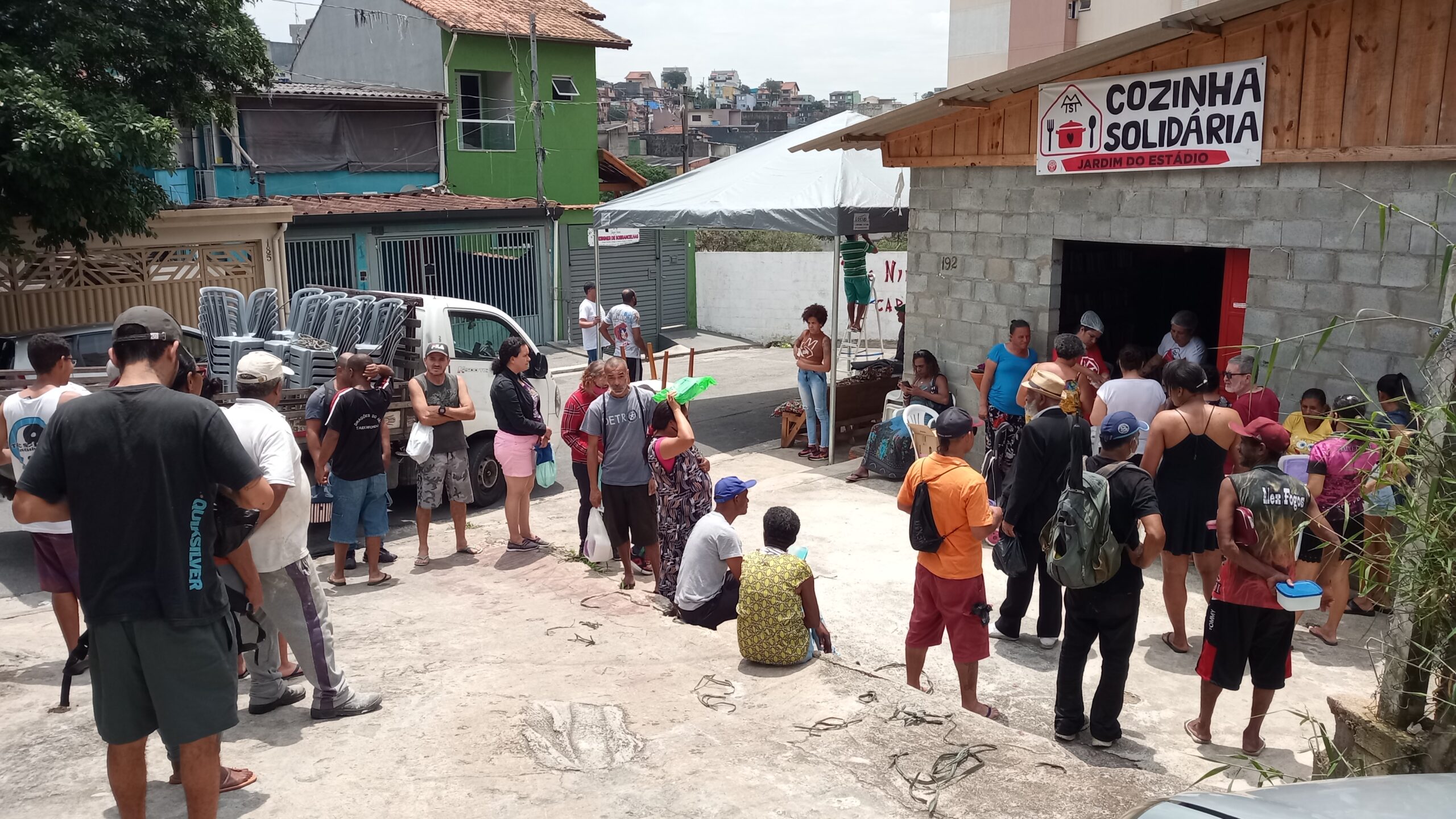
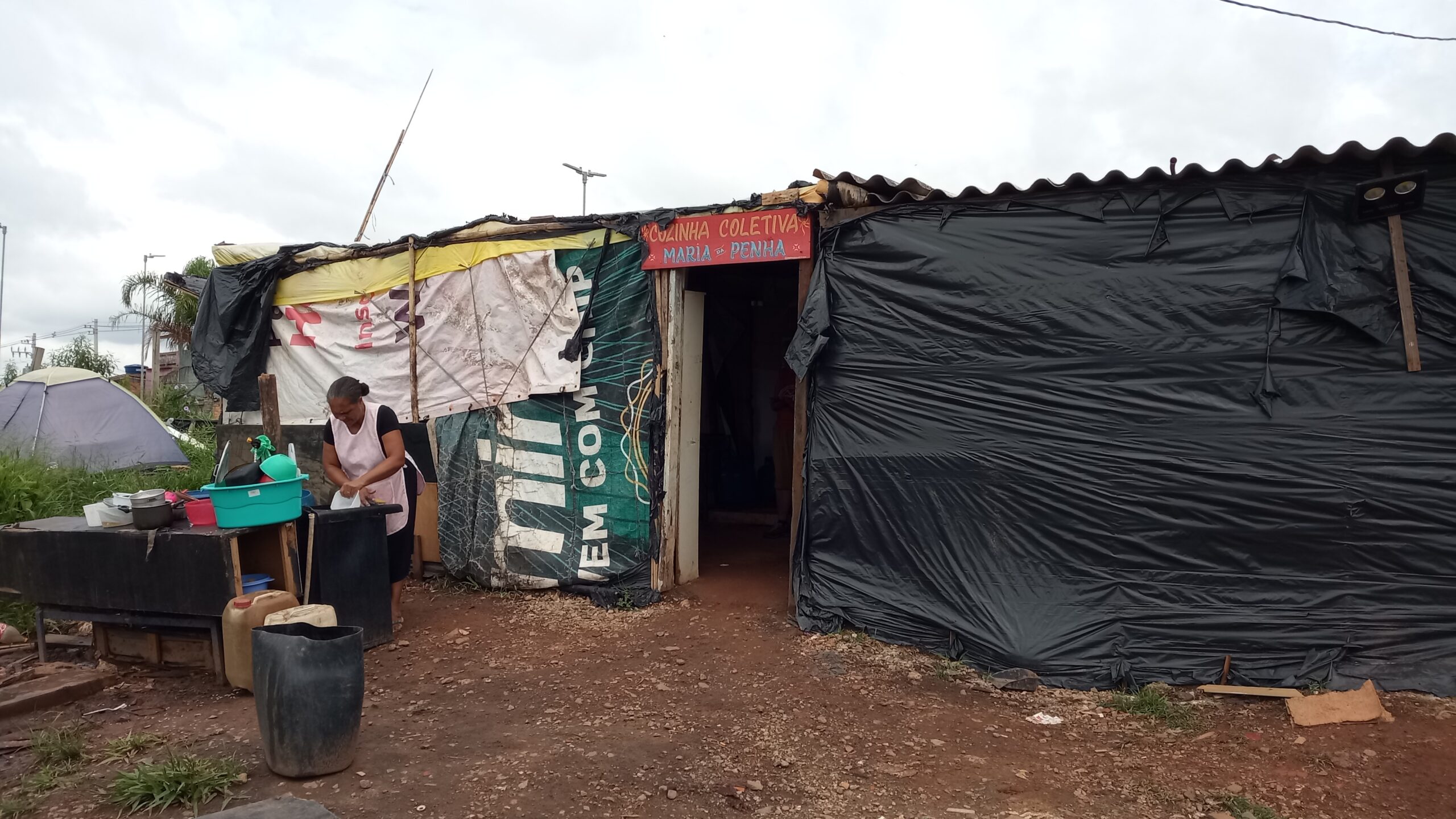
Figure 1 Kitchen as part of occupation
Figure 1 Kitchen as part of occupation, Photo: Elena Reichl March 2022
Figure 2 Cozinha Solidária at lunch time
Figure 2 Cozinha Solidária at lunch time, Photo: Elena Reichl October 2022

The idea of Cozinhas Solidárias was already inherent in the community kitchens that are part of every land occupation of the movement.  The occupations of new land areas begin with the construction of tents made of tarpaulins and bamboo. In newly emerged occupations, community kitchens are the first shanties to be set up to nurture the squatters and provide a place of political organization and community economy. Each occupation has numerous of these kitchens, which are the heart of the groupings, the small neighborhoods within the barrack settlements. The kitchens inside the squats are primarily for the squatters who run and finance them.

What is new about the Cozinhas Solidárias is that they now address the peripheral neighborhoods outside the occupations. Diverse people from the nearby neighborhoods frequent the cozinhas solidárias, for example schoolchildren, old people, or workers at their lunchbreak. They pick up hot lunches for free that were prepared and distributed by volunteers like the women mentioned in the beginning of this article. The Cozinhas Solidárias acquire their donations in the form of money from large-scale campaigns and as crops by collaborations with, for example, supermarkets and the MST. Cozinha Solidarias’ dependence on food has brought the MST into close contact with its urban counterpart.

The Homeless Workers Movement founded the first Cozinha Solidária in São Paulo in March 2021, during the peak of the Covid-19 Pandemic, under the motto highlighted by MTST coordinator Guilherme Boulos, “we do what the government does not“. The movement now operates 31 of these kitchens throughout Brazil. By expanding to peripheral neighborhoods in general, the movement claimed a direct confrontation of the cutbacks in state welfare programs under the Bolsonaro government.

Hunger was particularly central to Lula’s election campaign, highlighting how his earlier government had helped to remove Brazil from the United Nations world hunger map, on which the country turned back after the election of Bolsonaro in 2018. In fact, it was through Bolsa Família, as Massimiliano Mollona elaborates,that this government from 2003 to 2008 reduced the population rate below the poverty line from 36 percent to 23 percent. Bolsa Família incorporated the preceding Zero Hunger “Fome Zero” program in 2003 and, as Anthony W. Pereira argues, promoted the democratization of citizenship claims through effective, relatively unbureaucratic redistribution. On the other side, Bolsonaro has introduced the social program Auxilio Brasil at the end of 2021, which is modeled on Lula’s Bolsa Familia but without any long-term strategy or monitoring and therefore has beencriticized as an election campaign method.

Before the Runoff Election

A morning a few days after the first round of voting in one of the cozinhas solidárias in the periphery of São Paulo: In addition to preparing rice, beans, chicken, and fried cassava, we talked about Bolsonaro’s visit to the Freemasons. The video is from Bolsonaro’s 2017 election campaign but gained popularity only in October 2022 via its rapid spread on social media. The context mattered little. Bolsonaro had been campaigning for votes among Freemasons and rumors were spread that he might be a member.  We chatted about the experiences some of the women had as cleaners for members of the Freemasons whom they accused of performing diabolical rituals. On the subject of religion, we also came to a remark that one of them had overheard during services in their parishes: Their pastor had announced that whoever voted for Lula would go to hell.

Ludmilla was indignant: “The place for priests is in the church. What is this about politics?” “They won’t vote for him [Jair Bolsonaro] because of the Freemasons” Retorted Maria.  Ludmilla: “I am afraid that they might do it after all.”

Jair Bolsonaro has many evangelical supporters who, as some of the cooks, consider the Freemasons a diabolical sect and hence expressed their disappointment. On a more general level, religiousness played a key role in the election campaign. Padre Kelmon, who was denied the recognition as a priest by the Catholic Church, ran for president as one of the eleven candidates of the first electoral round. He just received 0.07 % of the valid votes and was called a “folkloric candidate”. For Bolsonaro’s election campaign, his candidacy nevertheless had an important function. He supported Bolsonaro during the first TV Globo debate, to which all candidates were invited. Instead of asking critical questions, he accused Lula of wanting to establish an anti-religious dictatorship in Brazil. Lula, meanwhile, tried to win over conservative church followers through critical statements on abortion and Christian affirmations, as he recently did in a letter to evangelicals.

In the community kitchen, I hear different Christian songs sung by the women every day. “God bless you” is a common phrase used by those receiving the hot lunches, to which the cooks respond with “Amen”. Unlike the students and coordinators of the movement, for whom religion takes a back seat to communist utopias, the cooks and squatters balance left-wing political commitment and the struggle for housing with religious affiliations in their work.

A domestic worker comments on the election

For Lula’s election campaign, starvation, but also ‘gusto’, was a central theme. During this election, Lula’s repeated statement that the people must be able to eat picanha and drink beer again became famous. Ludmilla, a cook at the community kitchen before the runoff election, said she talks to Lula when she sees him on TV. “Lula, stop talking about picanha. When did I eat picanha? Lula, I cleaned the toilet of my patron [where she worked as a maid] during your government.”

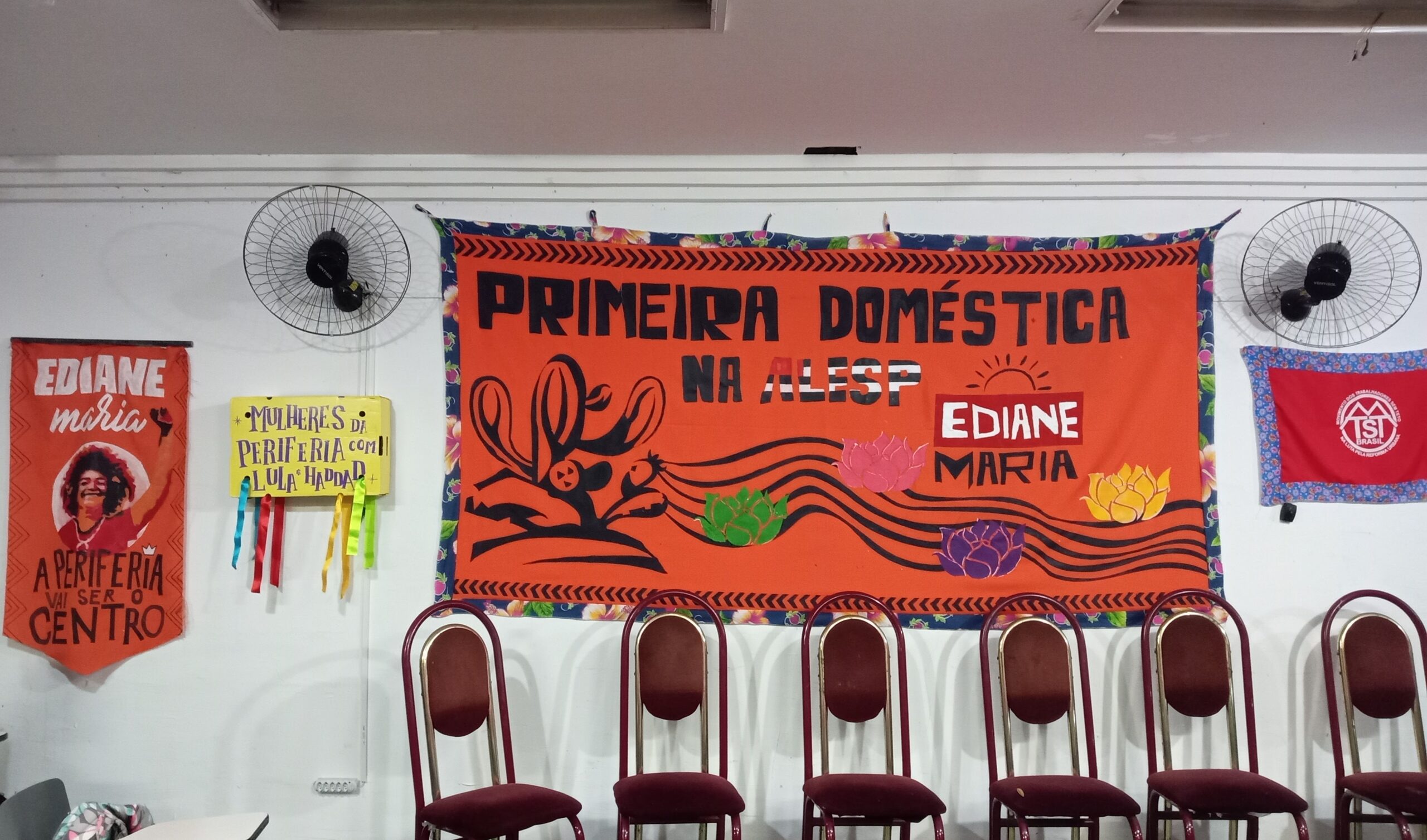
Figure 3 Banner that says “First domestic worker in the Legislative Assembly of São Paulo” at the event “Women from the periphery with Lula and Haddad”, in which some cooks of Cozinha Solidária participated, Photo: Elena Maria Reichl, October 2022

Although she supports Lula, she feels unrepresented by his promises of the return of expensive barbecue after the huge price increase during the Bolsonaro regime. Actually, picanha has never been part of her lifeworld. Domestic workers, who are for the first time politically represented in Brazil, gain more political and class-consciousness. In the first round of voting, PSOL candidate, former domestic worker, and occupant of the MTST Ediane Maria, won the post of State Representative in the Legislative Assembly of the State of São Paulo as the first domestic worker to occupy this political position. Like Ludmilla, Ediane Maria had migrated to São Paulo from Brazil’s northeast to work as a domestic worker. Ediane Maria will now represent Ludmilla’s perspective in São Paulo. No easy task in a parliament where the PL, Bolsonaro’s party, won by far the most votes.

Anti PT and “anti-establishment” propaganda

The outcome was close, with Lula winning 50.9% and Bolsonaro 49.1% of the vote. Bolsonaro’s party’s most effective campaign method still seemed to be the “anti-corruption agenda” Flávio Eiró already analyzed after the 2018 election.

Although the court case that led to Lula’s conviction was annulled as illegal in 2021, opposition to Lula’s PT party because of corruption scandals remains widespread. This is despite the fact that Bolsonaro has also been accused of institutionalized corruption, namely the use of public funds in the form of secret budgets to buy approval in Congress.

Bolsonaro still manages to position himself as ‘anti-establishment’ in front of large segments of the population, who spread the slogan “PT never again” and in the aftermath of the election “crimes pay off in Brazil” on the internet. Widespread among his electorate is also a rejection of conventional media and academia. Election forecasts predicting a higher approval rating for Lula than he actually received in the first round of voting confirmed this skepticism. The Tribunal Superior Eleitoral’s decision to cut Bolsonaro’s TV time due to fake news also fuels the debate about media bias. Bolsonaro supporters were already acting violently in some cases, such as federal deputy Carla Zambelli, who a few days before the election chased a black journalist with a firearm under the pretext that he had pushed her.

The End of Hell?

During this interim period between the two votes one clearly sensed the fear that Bolsonaro might not recognize the election results, as he had already spread rumors that the ballot boxes were rigged.  On day one after the elections, while Bolsonaro remained without statement about his loss, his supporters blocked roads within the country to protest alleged electoral fraud. Attempts at electoral fraud did indeed occur, but not on the part of PT supporters: The electoral court investigates against the federal police, who blocked roads for hours in the northeast and near indigenous communities, from where most votes for Lula were expected, under the pretext of carrying out road controls.

Even without a coup, Lula’s victory will mean hard work against right-wing fronts in state and federal parliaments, but above all against what is called ‘bolsonarismo’ in society. The cooks of Cozinha Solidária are well aware of this. Nevertheless, there will be relief for their movement when Lula takes office next year. He has already announced his intention to rehabilitate the program Minha Casa, Minha Vida. Fighting hunger was moved again to the center of the political agenda. Currently, discussions are underway within the MTST to make Conzinhas Solidarias a public policy and to hire the cooks on a regular basis until the acute hunger crisis is resolved. This would mean the end of dependence on donations and volunteerism. Lula, who had already visited a Cozinha Solidária this year, nurtured hope for this possibility.


Elena Maria Reichl is a PhD candidate in Social Anthropology of the Johannes Gutenberg-University in Mainz, Germany, and member of the Project „Sorting with Care. Human Categorization in Post-Humanitarian Contact Zones“ that is part of the Collaborative Research Centre 1482 “Studies in Human Categorisation” funded by the German Research Foundation.


References:

Albert, Victor. 2018. “Brazil’s Homeless Workers’ Movement is an assertive social work organization.” FocaalBlog, 30 November. www.focaalblog.com/2018/11/30/victor-albert-brazils-homeless-workers-movement-is-an-assertive-social-work-organization

Balloussier, Anna Virginia; Seabra, Catia and Victoria Azevedo. 2022. Lula Releases Letter to Evangelicals and Rejects Abortion and Lying Pastors. Folha de São Paulo, 20 October. https://www1.folha.uol.com.br/internacional/en/brazil/2022/10/lula-releases-letter-to-evangelicals-and-rejects-abortion-and-lying-pastors.shtml

Boulos, Guilherme. 2021. “Cozinhas Solidárias: fazendo o que o governo não faz” Instituto para Reforma das Relações entre Estado e Empresa (IREE), 22 March. https://iree.org.br/cozinhas-solidarias-fazendo-o-que-o-governo-nao-faz/

Campos Lima, Eduardo. 2022 “Brazil presidential contenders slug it out over who’s the real ‘enemy’ of the church” Crux, 1 October. https://cruxnow.com/church-in-the-americas/2022/10/brazil-presidential-contenders-slug-it-out-over-whos-the-real-enemy-of-the-church

Eiró, Flávio. 2018. “On Bolsonaro: Brazilian democracy at risk.” FocaalBlog, 8 November. www.focaalblog.com/2018/11/08/flavio-eiro-on-bolsonaro-brazilian-democracy-at-risk.

Extra. 2022. Padre Kelmon recebe mais de 81 mil votos pelo Brasil; relembre outros ‘candidatos folclóricos’ que marcaram eleições. Globo Extra 3 October https://extra.globo.com/noticias/politica/padre-kelmon-recebe-mais-de-81-mil-votos-pelo-brasil-relembre-outros-candidatos-folcloricos-que-marcaram-eleicoes-25582731.html

Folha de São Paulo. 2022. O que a Folha pensa: Recauchutagem ruim. Folha de São Paulo, 28 October. https://www1.folha.uol.com.br/opiniao/2022/01/recauchutagem-ruim.shtml

Globo. 2022. Grupo denuncia Carla Zambelli por racismo em caso que ela apontou arma para homem em SP; ‘Eles usaram um negro pra vir em cima de mim’, diz a deputada. Globo, 29 October. https://g1.globo.com/sp/sao-paulo/noticia/2022/10/29/grupo-denuncia-carla-zambelli-por-racismo-em-caso-que-ela-apontou-arma-para-homem-em-sp-eles-usaram-um-negro-pra-vir-em-cima-de-mim-diz-a-deputada.ghtml

John, Tara. 2022. Brazil’s election explained: Lula and Bolsonaro face off for a second round in high stakes vote. CNN, 27 October.

Mollona, Massimiliano. 2018. “Authoritarian Brazil redux?” FocaalBlog, October 6. www.focaalblog.com/2018/10/06/massimiliano-mollona-authoritarian-brazil-redux.

Netto, Paulo Roberto. 2022. TSE cobra explicações da PRF sobre operações durante eleições após decisão. UOL, 30 October. https://noticias.uol.com.br/eleicoes/2022/10/30/tse-explicacoes-prf.htm

Pereira, Anthony W. 2015. Bolsa Família and democracy in Brazil. Third World Quarterly 36 (9): 1682-1699, doi: 10.1080/01436597.2015.1059730

Phillips, Tom. 2022. Fears Bolsonaro may not accept defeat as son cries fraud before Brazil election. The Guardian. 27 October. https://www.theguardian.com/world/2022/oct/27/jair-bolsonaro-brazil-election-fraud-claim

Romani, André. 2022. Com Bolsonaro ainda em silêncio, bloqueios de caminhoneiros ganham força e se espalham pelo país. UOL Economia. 31 October https://economia.uol.com.br/noticias/reuters/2022/10/31/protestos-interditam-br-163-e-trecho-da-dutra-apos-eleicoes.htm

Rizek, Cibele and André Dal’Bó. 2015. The Growth of Brazil’s Homeless Workers’ Movement. Global Dialogue. 22 February https://globaldialogue.isa-sociology.org/articles/the-growth-of-brazils-homeless-workers-movement Soprana, Paulo. 2022. Bolsonarists Freak Out over Video of President in Freemasonry. Folha de São Paulo. 4 October. https://www1.folha.uol.com.br/internacional/en/brazil/2022/10/bolsonarists-freak-out-over-video-of-president-in-freemasonry.shtml


Cite as: Reichl, Elena Maria 2022. “End of Hell? Brazil’s Election and a Community Kitchen of the MTST.” Focaalblog 2 November. https://www.focaalblog.com/2022/11/02/elena-maria-reichl-end-of-hell-brazils-election-and-a-community-kitchen-of-the-mtst/

Lieke van der Veer: Group-making and distrust within the infrastructure of refugee support

This post is part of a feature on “Urban Struggles,” moderated and edited by Raúl Acosta (LMU Munich), Flávio Eiró (Radboud University Nijmegen), Insa Koch (LSE) and Martijn Koster (Radboud University Nijmegen).

In the Netherlands from 2015 onwards, the ‘spectacle’ (Casas-Cortes et al. 2015) of people arriving into Europe seeking refuge was channeled by vast media attention and political debate. These events triggered a vast response of bottom-up initiatives in the Netherlands wanting to support refugee status holders. In this contribution, I focus on such newly emerged initiatives that seek to support refugee status holders in Rotterdam, the second-largest city in the Netherlands. It discusses the struggles that the initiators of these initiatives face, who more often than not have a refugee background themselves. It shows how these struggles originate from the ambiguous categorizations of group-making that experimental policies presuppose in the field of refugee reception and support in urban spaces today.

I focus on initiatives that are not established yet, but are still in the process of becoming. By studying initiatives that are still fine-tuning their focus, grappling for funds, searching for volunteers, seeking collaborations with others et cetera, I had an insight in the constitutive and generative elements of the infrastructure of refugee reception and support.

During a 12-month ethnographic fieldwork period in Rotterdam in which I studied such initiatives, I followed several aspiring initiatives in their efforts to establish partnerships with other organizations. When the community organizers of these initiatives would meet with people who know about funding circuits, discuss their project proposals with the municipality, pitch their plan in network sessions, organize events to acquire volunteers and so on, I joined them. In doing so, moments of breakdown (Larkin 2013) were particularly insightful; when my research participants hoped for or anticipated something that did not arrive, I learned about who may do what, where and how.

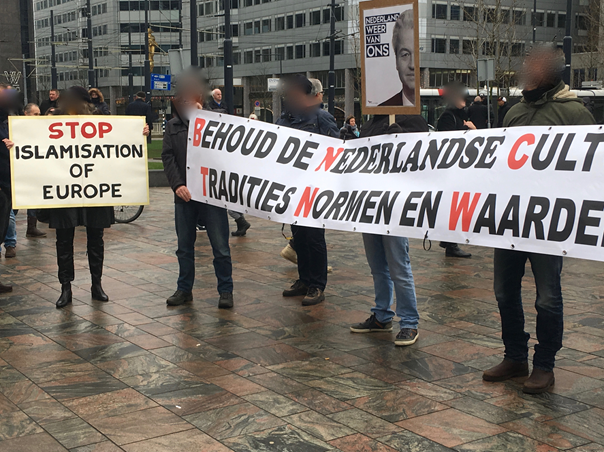
Rotterdam is an illuminating case to study grassroots initiatives in the field of refugee reception and support. It is considered ‘policy laboratory’ (cf. Van Houdt and Schinkel 2019) and is celebrated for its allegedly innovative urban and social policies, including in relation to migrant integration. Rotterdam cherishes its alleged hands-on mentality – a mentality captured by the popular slogan ‘actions speak louder than words’. Contrasting with Rotterdam’s self-image as experimental and bold, the city has the highest number of low-income households in the Netherlands. Another central force in the city is Livable Rotterdam [‘Leefbaar Rotterdam’], a rightwing party with populist traits and the highest share of votes in local elections. Their policies focus on so-called immigrant assimilation and are explicitly anti-immigration – which translates into policy frameworks that the resident initiatives I study here are affected by and provides context to the fierce anti-immigrant protests in the city in 2015.

Intersecting struggles

Between 2016 and 2020, the so-called Rotterdam Approach for Status Holders explicitly reached beyond the integration objectives articulated by the national government. For example, in Rotterdam, the City Council expects refugee status holders to pass the civic integration exams one year earlier than usually required. In addition, through the ‘Time Obligation’ measure [dagdeleneis], the City Council expects refugee status holders to be ‘active in society for at least four days a week or more with education, work, or voluntary work’. This measure is part of the so-called ‘Participation Act’, which applies to everybody in receipt of benefits. Although a policy evaluation pointed out that only 47 per cent of the status holders in Rotterdam was indeed ‘active’, the most recent (2019-2022) Rotterdam Approach to Status Holders largely continues the existing approach. As a consequence, the refugee status holders that I worked with struggle to live up to the demand to integrate fast, struggle to find their way in the incomprehensive field of initiatives, and fear to be unsuccessful in managing their new lives.

Resident initiatives that seek to support status holders struggle too – although on first sight, Rotterdam seems the place to be for resident initiatives. The Rotterdam Approach for Status Holders states that, in ‘coordinating additional activities’ for accepted asylum seekers, it ‘smartly uses […] private initiatives for refugees and volunteer work,’ thus explicitly opening up the floor for participatory initiatives to play a role. The document claims to ‘believe in the added value of civil society,’ to recognize ‘that creative and innovative initiatives from volunteer organizations give new energy and help integration,’ and that it ‘encourages such initiatives wholeheartedly.’ It thereby responds to recommendations from The Netherlands Scientific Council for Government Policy (WRR) to mobilize to ‘society’ and ‘volunteer projects’ in ‘speeding up integration’, as well as to the general appeal to ‘active citizenship’.

In practice, however, funds are drying up. In 2014, the city administration agreed to ‘stop irrelevant subsidies in the field of diversity and emancipation,’ for ‘tax payers’ money gets lost’ and ‘subsidizing activities is not a goal in itself’. This shift away from subsidized activities is explicitly mentioned in a recent policy document regarding support to refugee status holders: ‘only a small part of the budget remains available for subsidies for small-scale, innovative initiatives from society,’ the document points out. As such, the initiatives I worked with find themselves faced with competitive funding schemes; they fear being excluded from subsidies and collaborations, while trying their best to build an image of professional legitimacy.

Opaque group-making

The different forms of struggle identified thus far can also come to intersect, as illustrated in the case of Aida. Aida received a refugee status several years ago, is in receipt of social benefits, and is in the process of setting up an initiative to help Eritrean status holders with their paper work. However, she is afraid she will not be able to get support from the City Council. This is so because the abolishment of the so-called ‘target group policy’ in Rotterdam prescribes that policies should target the population of Rotterdam in general, and not have specific interventions that assume ethno-racial differences (such as people with an Eritrean nationality). Although the Netherlands has a strong tradition of implementing targeted policies, the shift from group-specific policies to generic policies has been a political priority since at least the 2000s (Scholten and Van Breugel 2018). As a result, there is evidence of a declining consciousness of migrant integration concerns, because generic policies often fail to incorporate immigrant integration priorities in the ‘mainstream’ (idem).

For Rotterdam, Dekker and Van Breugel have deconstructed the move from target group policies towards generic policies. They identify a ‘continuous act of balancing between generic and specific policies’ (Dekker and Van Breugel 2019, 128) that at one time implements targeted policies for migrants and at another time subsumes migrant interest under generic policies. These interchanging approaches to group-making in Rotterdam now seem to have reached an equilibrium in which generic policies are the norm. Regarding the support of civil society organizations that seek to assist refugee status holders, the municipality decided to no longer support ‘mono-ethnic and/or mono-religious activities’ to the extent that initiatives ‘will not be financed, unless there are substantive reasons to do otherwise’ because activities should be ‘focused on participation and integration.’ In another policy document, the city’s discouragement of such activities is explicitly linked with Rotterdam’s earlier-mentioned self-image as ‘innovative city’: in ‘giving room to new innovative organizations and ideas,’ the City Council explicitly breaks with ‘whatever is done in the past’.

Yet despite the fact that Rotterdam seem to have reached an equilibrium in which generic policies are the norm, the city publishes annual reports on the achievements of ‘people with a migration background’ that fly in the face of any ‘generic’ policy assumption. Moreover, to my research participants, the ‘group policies’ are elusive and subject to change. For example, Rotterdam’s ‘Somali-resolution’ in 2015 has resulted in the formal recognition of people of Somali descent as ‘group’ and led to the subsequent availability of subsidies to community organizers that sought to assist this ‘group’. And considering recent publications about ‘the Eritrean group’ – such as this and this and this one – my research participants now expect the same thing to happen to people from Eritrean descent as ‘group’.

Exactly because of this instability and opacity with regards to group-making, community organizers such as Aida are striking out blindly with regards to what ‘groups’ can be identified without risking eligibility to municipal funding.

What adds to Aida’s confusion, is that different municipal departments work through different logics. The department that is responsible for procurements in the field of refugee receptionand support (Work and Income) has different expectations from initiatives than the department that is responsible for subsidies (Social Support). The former department is now experimenting with so-called ‘customer profiles’. As an example of such profiles the policy advisor mentions ‘the single mother with three kids’ and adds that ‘customer profiles are a good way to offer tailor-made solutions without working with target groups.’ Customer profiles thus are meant to ‘objectively’ describe ‘groups’ of city dwellers without assuming ethno-racial differences, they make use of stereotypes such as ‘the single mother with three kids’ – a figure that appears as ‘the inversion of morality and family values par excellence’ (Koch 2015). To Aida, it is unclear to what extent these customer profiles are something that concern her and her endeavors; although she now applies for subsidies, she hopes for her activities to be included in the procurement structure some time. Again, she gropes along in the dark.

Eclectic initiatives

As a result of her insecurity about what constellations of people are accepted as a target group, Aida has started to organize dinner parties for long-term Rotterdammers with little money, alongside offering administrative support to Eritrean refugee status holders. She does so because she is scared that if the municipality found out that she only offers support to Eritreans – which she in fact does, with a few exceptions – she would be accused of catering only for one ‘target group’ and as such miss out on funding and collaborations.

These dinner parties however create awkward moments, because the long-term Rotterdammers – who are all white – usually sit on separate tables to black Eritrean people. It is not that Aida has intentionally designed the dinner-setting as such; it is rather that she does not know how to deal with the situation. Recently, the initiative of Aida was declined funding again. In the refusal letter said that ‘there are good reasons to assume that the subsidy would not (or not sufficiently) be spent on (or contribute to) the (policy) objective for which the subsidy is meant.’ In a subsequent meeting with a policy advisor at the town hall, it was specified that Aida’s initiative was considered ‘too broad’. Never mind that very reason the constellation of beneficiaries is indeed quite diverse is that Aida is scared to be accused of focusing on one group in the first place.

Image 1: Right-wing protest in Rotterdam (Banner on the right says: ‘Preserve Dutch Culture Traditions Norms and Values’; Photographer: Lieke van der Veer, 2018)

Reception brokers

Because it is so difficult for Aida and other initiatives to navigate the municipal frameworks, she has asked the help of Jozefien. Jozefien is a woman who has co-founded the platform called You Are Welcome. She once introduced herself as ‘from a little village in the Netherlands’ yet added that ‘I feel more like a Middle-Eastern person, I think.’ You Are Welcome was established to strengthen bottom-up initiatives that engage with refugee status holders, and to spread a positive message on integration. The platform was launched in 2015, explicitly in response to violent protests that broke out during an information meeting about the construction of the reception center.

What is problematic, however, is that some of the initiatives that Jozefien helps, dislike one another. In particular, Aida really dislikes Luciano, the founder of another aspiring initiative for Eritreans, who is born in Rotterdam in a family of refugee parents. Aida is upset because she fears that Luciano is trying to take clients from her. Aida is hurt, she says, because she feels that Luciano is a smooth-talker, that he smiles arrogantly at her on the street, and that, given that Luciano has more contact with city administrators, he forces Aida into the shadows.

For Jozefien, although she tries to equally promote both initiatives, it is difficult to deal with the tension between the two. It also has ramifications for her own relationships with Aida and Luciano. Especially for Aida, the competition she experiences with Luciano makes her deeply distrust Jozefien. One afternoon, Aida complained to me that ‘so often she [Jozefien] is at Luciano’s. But she doesn’t come to us! And she has taken him to the councilor [‘wethouder’]! She has arranged an appointment for Luciano with the councilor! I asked Luciano if I could join. But Luciano said: “no”.’ […]  And she [Jozefien] has never even come to our Friday dinners! She only came once, to take a picture, and then she left again. From the very beginning, I didn’t feel welcome at You Are Welcome.’

Discussion: solidarity, humanitarianism and neoliberalisation

Recent ethnographic work contrasts solidarity with humanitarianism and juxtaposes emic accounts that frame solidarity as horizontal, anti-hierarchical, and as an emphasis on similarities between people with the viewpoints of professional humanitarian NGOs (see e.g. Cabot 2014). In Rotterdam, because grassroots initiatives generally turn to the municipality for funding and collaboration and feel pressured to professionalize, the distinction between solidarity and humanitarianism is remarkably fuzzy. The community organizers of refugee support initiatives ‘yearn for’ the state (Jansen 2015) to formally recognize their initiative through a tendering contract and compete to perform professionalism. They seek to use licensed software to prove impact, assimilate to municipal buzzwords, match funding calendars, formalize their organizational form, and forge lucrative partnerships.

These emerging forms of humanitarian volunteering (Youkhana and Sutter 2017; cf. Rozakou 2017) summon a complex assemblage of forms of humanitarian reason, forms of authority and technologies of government (Fassin 2007). Because grassroots initiatives seek to incorporate policy objectives (cf. Van Dam et al. 2014), are subject to mechanisms of raising funds that are part of the technologies of government (Fassin 2007, 151), and thereby gamble on which ‘target groups’ the municipality will acknowledge, they are shaped by these forms of authority and technologies of government. The case of Aida is an example of how refugee support has become intertwined with control mechanisms that are part of experimental municipal policies.  

To Aida as well as to the brokers she turns to for advice, is unclear which ‘groups’ may be identified and which not. A lot of ‘information’ in this regard is distorted and comes from hear-say. Although the interchanging approaches to group-making in Rotterdam now seem to have reached an equilibrium in which generic policies are the norm, this equilibrium is unstable, as reports about specific ethnic groups have proven to result in the recognition of these groups and the subsequent availability of subsidies. Moreover, different municipal departments – that deal with subsidies and competitive tendering contracts respectively – work in accordance with different logics, yet is it unclear where one logic begins and the other one ends.

This opacity of group-making policies and related funding schemes gives rise to fierce competition and distrust between initiatives, which has fueled divisions within the refugee solidarity movement. In the grappling race for funds between (aspiring) initiatives which give in to the criteria for competitive success, neoliberal market logics and humanitarianization become further entwined. Community organizers seek to act as successful entrepreneurs – by reaching targets, increasing numbers, seizing volunteers, and laying hold of the target group. In doing so, they may present their core issues as side affairs and vice versa.

This contribution shows that not only beneficiaries suffer from the contemporary mechanisms that mix care and control; some of the aspiring community organizers with a refugee background find themselves in a precarious position as well. Underneath the seemingly universalizing pretense of generic policies, ambivalent practices of institutional selectiveness exclude vulnerable community organizers and the initiatives they are trying to launch. The inequalities that these exclusions are premised on are produced as well as obscured by the mantra of generic policies.  


This project has received funding from the European Research Council (ERC) under the European Union’s Horizon 2020 research and innovation programme (grant agreement No. 679614).


Lieke van der Veer (Department of Anthropology and Development Studies, Radboud University, Nijmegen, The Netherlands) is a PhD Candidate in Anthropology in an ERC-funded research project on participatory urban governance. She has a background in Philosophy. Based on 12 months of ethnographic research in Rotterdam in 2018, she studies aspiring grassroots initiatives that provide support to people with a refugee background.


References

Casas-Cortes, Maribel, Sebastian Cobarrubias, Nicholas De Genova, Giorgio Grappi, Charles Heller, Sabine Hess, Bernd Kasparek, et al. 2015. “New Keywords : Migration and Borders.” Cultural Studies 29 (1). Taylor & Francis: 55–87. doi:10.1080/09502386.2014.891630

Dekker, Rianne, and Ilona van Breugel. 2019. “‘Walking the Walk’ Rather than ‘Talking the Talk’ of Superdiversity: Continuity and Change in the Development of Rotterdam’s Immigrant Integration Policies.” In Coming to Terms with Superdiversity: The Case of Rotterdam, 107–32. IMISCOE Research Series.

Fassin, Didier. 2007. “Humanitarianism: A Nongovernmental Government.” In Nongovernmental Politics, edited by Michel Feher, 149–60. New York: Zone Books.

Houdt, Friso Van, and Willem Schinkel. 2019. “Laboratory Rotterdam. Logics of Exceptionalism in the Governing of Urban Populations.” In Coming to Terms with Superdiversity: The Case of Rotterdam, edited by Peter Scholten, Maurice Krul, and Paul van de Laar, 133–51. IMISCOE Research Series.

Jansen, Stef. 2015. Yearnings in the Meantime: “Normal Lives” and the State in Sarajevo Apartment Complex. New York and Oxford: Berghahn Books.

Koch, Insa. 2015. “‘The State Has Replaced the Man’: Women, Family Homes, and the Benefit System on a Council Estate in England.” Focaal–Journal of Global and Historical Anthropology 73: 84–96. doi:10.3167/fcl.2015.730107.

Larkin, Brian. 2013. “The Politics and Poetics of Infrastructure.” Annual Review of Anthropology 42: 327–43. doi:10.1146/annurev-anthro-092412-155522.

Rozakou, Katarina. 2017. “Solidarity #Humanitarianism: The Blurred Boundaries of Humanitarianism in Greece.” Etnofoor 29(2), 99-144.

Scholten, Peter and Ilona van Breugel, eds. 2018. Mainstreaming Integration Governance: New Trends in Migrant Integration Policies in Europe. Palgrave Macmillan.

Youkhana, Eva, and Ove Sutter. 2017. “Perspectives on the European Border Regime: Mobilization, Contestation and the Role of Civil Society.” Social Inclusion 5 (3): 1–6.


Cite as: van der Veer, Lieke. 2020. “Group-making and distrust within the infrastructure of refugee support.” FocaalBlog, 3 August. http://www.focaalblog.com/2020/08/03/lieke-van-der-veer-group-making-and-distrust-within-the-infrastructure-of-refugee-support/

Céline Cantat: Migration struggles and the crisis of the European project

This post is part of a series on migration and the refugee crisis moderated and edited by Prem Kumar Rajaram (Central European University).

In April 2015, when four boats carrying almost two thousand people consecutively sank in the Mediterranean Sea, with a combined death toll estimated at more than 1,200, the idea that Europe was experiencing a “migrant crisis” came into currency. Over the next few months, a series of border disasters captured the attention of the European public, sometimes successfully if temporarily reversing the increasingly dehumanizing rhetoric of a “migrant crisis” by giving way to the notion of a “refugee crisis.”

Continue reading