Tag Archives: social movements

Bjørn Enge Bertelsen: Pots that go bang in the night: Noise and rhythm as enacting popular security amidst political protest in Mozambique

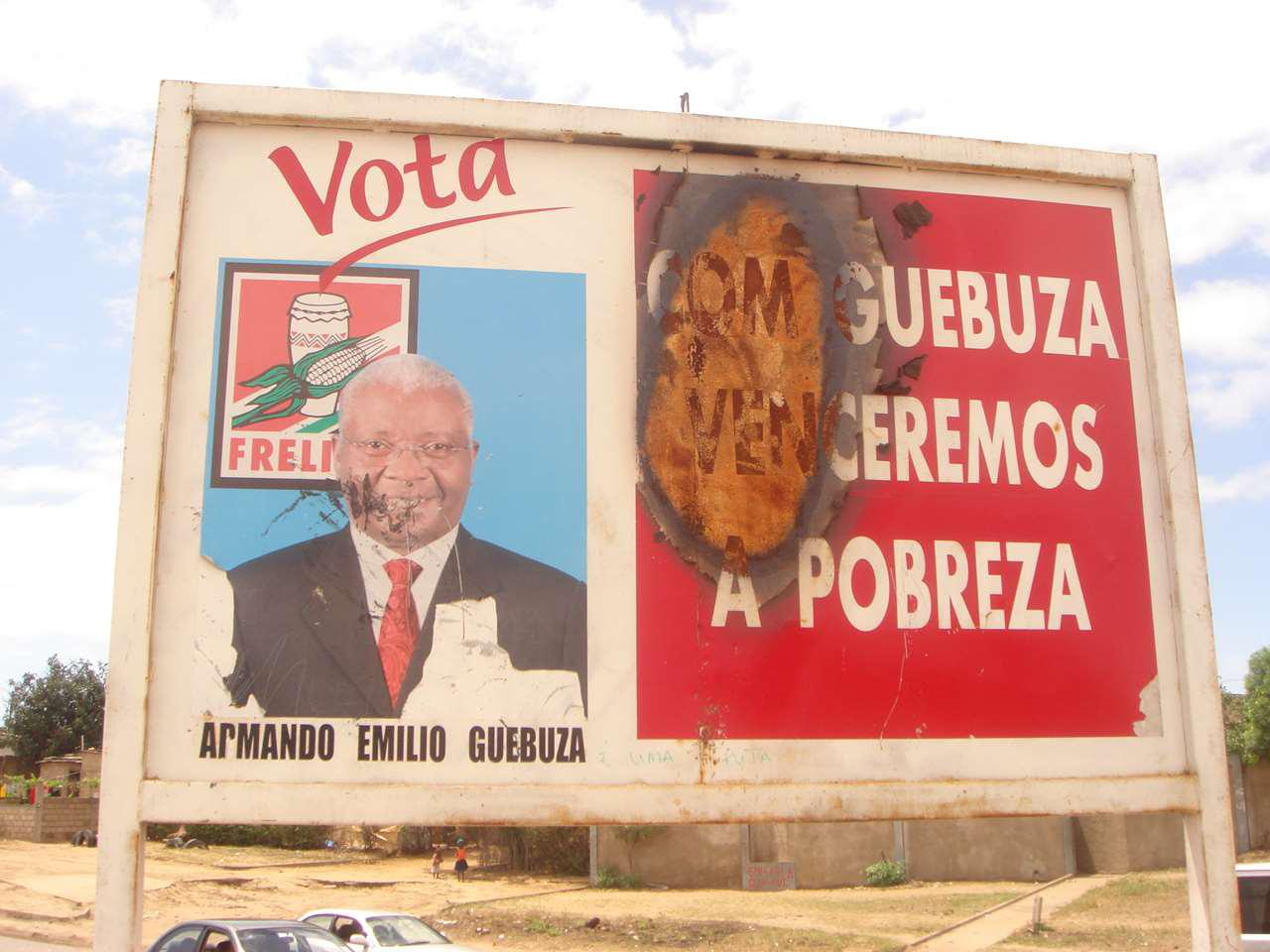
Image 1: Photo of an election poster for former Mozambican president Armando Guebuza. The poster burnt down and destroyed in relation to the uprisings in Maputo 2010. Photo by author

Introduction

The pots and pans that were banged at night in Mozambique in late 2024 and early 2025 are now silent. However, their legacy is neither muted nor forgotten—reflecting similarly the trajectories of other forms of protest the last decades which has shaken Mozambique and, especially, its ruling party (see Bertelsen 2014).

What unfolded was extraordinary: The country’s heavily contested presidential and parliamentary election of 9th October 2024 was followed by loud street-based protests and riots across Mozambican cities which were often met with brutal violence by police and security forces. The clashes between young men and the police left around 400 dead and thousands injured.

Here I would like to draw attention to a form of protest that was somewhat eclipsed by the street-fighting, namely the banging of pots by female protestors in their homes and on the street. These female protestors engaged the collective sensorium of urban citizens and shifted the very sense of security and insecurity in this highly unpredictable political situation. Beating pots—on balconies, in courtyards, in kitchens with open windows and in the streets—mediated the population’s sense of insecurity, amounting to a gendered form of collective rejection of the violence of the state apparatus. For Mozambique, this marked a definite shift in terms of both the participation and the format of political opposition in the country, the noise also, crucially, instilling fear in the erstwhile security apparatus and the police

Maputo 2024 and 2025: Protests, rhythm, collective security

Centuries of Portuguese colonial rule and violence ended with liberation in 1975 at the hands of Frente de Libertação de Moçambique (Frelimo – Front for the Liberation of Mozambique). In the half-century that followed, Mozambique has seen ongoing civil war conditioned respectively by Cold War dynamics (1976/77-1992), experiments in Afrosocialism (1980s), and multiparty elections from 1994 onwards. Given the merging of the Frelimo party with the Mozambican state apparatus in this period (Bertelsen 2016), few were surprised when Frelimo won in October 2024, securing the party elite victory in both the parliamentary and presidential elections.

However, in Mozambique’s last election Frelimo attained a majority so improbable that it defied even the most cynical of expectations among experts and citizens alike. For instance, ghost armies of voters—politically loyal subjects conjured from the realms of both the living and the dead—were called up to attain majorities for Frelimo in districts widely known as opposition party strongholds. Rampant ballot-stuffing bolstered other draconian moves, including manipulation of the country’s complex vote-counting system and widespread voter intimidation.

Formal complaints by the opposition were initially quashed, deepening the unpopularity of Frelimo. Protestors rapidly took to the streets and engaged police and security forces in sustained battles. By 27 January 2025, 313 protestors were registered as killed. While there had been protests against previous elections, the scale, form and distribution surpassed these (Feijó and Chiure 2025a, 2025b).

Central to the protests unfolding over several months was how Venancio Mondlane—popularly called VM7 and the founder of a new opposition party—emerged to contest the result. His firebrand speeches drew heavily on his background as a pastor in the Pentecostal church Igreja Ministério Divina Esperança. VM7’s dramatic contestation included well-orchestrated social media broadcasts from his exile in South Africa and a dramatic heroic re-entry into Maputo on 9 January 2025 where he was greeted like a hero—all cast, recast and morphed on social media.

Revisiting such events in November 2025, these months of unrest and protests also assumed a new and, for Mozambique, unprecedented shape—or, better, shapelessness. Evading the violence of the streets and residing within their apartments, on balconies or in courtyards, every night, female citizens banged their pots and pans for hours, chanting slogans against the Frelimo regime and the stolen election, sometimes accompanied by blowing whistles. In many video clips circulating on social media, one may see that the officers from the police force and the security apparatus are visibly affected by the noise surrounding them, treading more carefully and being visibly nervous.

The format, scale and space of these protests and how they affect also those meant to exert control on the streets, mark a shift in the Mozambican political landscape as the rhythms of protest were also emitted from areas of Maputo inhabited by segments of the population often characterised as wealthy or upper middle class—groups commonly perceived as allied with or integral to the Frelimo-state and not previously having been important parts of protests. Further, it is equally surprising, therefore, that Taela (2025: 6) and others suggest that it was initiated in Eduardo Mondlane University’s student housing—where banging pots was accompanied by throwing books and papers out of the windows onto the streets. Clips of protests have continuously filled the pluriverse of social media and across Maputo residents were informed about what was happening, including both wealthy areas downtown, as well as poorer areas, such as in the bairros Mafalala, Maxaquene, and Chamanculo. Some of the first images and clips surfaced immediately after the election and soon came to visually and graphically dominate several of the popular digital channels Mozambicans follow.

In the weeks and months to follow, the banging of pots rapidly turned into a massively popular mode of protest, mobilising especially women and girls and inserting them into a politics of resistance against the stolen elections. As Taela notes (2025: 6, my translation from Portuguese):

The pots and pans only came out of the cupboards at night, after protesters faced extreme police repression on the streets during the day. Banging pots and pans, known as panelaço, emerged as a strategy for those who wanted to protest but did not want to do so on the streets.

As shown in the many clips on social media, noise started after dark and the rhythms churned out from households were often rapid and intense — rhythms sometimes layered, with sounds ranging from the metallic drum of cheap aluminium pots to the deep humming of cast iron kitchenware. Many clips capture entire neighbourhoods banging in synced rhythm—but, crucially, with few of the protestors being visible.

The repeated banging of pots generated a sense of unification, collectivity, and participation mirroring the mass congregations that usually define street protests but in this case often marked by becoming heard, not seen, as well as being nocturnal, not diurnal. On the street in the same clips, one may see the heavily armed state security forces moving uncertainly through the dimly lit streets, navigating endless cascades of drumming and humming being poured over them. In some clips, the same forces nervously fire teargas grenades against balconies only to be met by a more massive wall of noise.

In many respects, Maputo’s panelaço of 2024 and 2025 constituted an act of resistance that transcended electoral and party-political registers: By amplifying and transmogrifying the soundscape of food-preparation from the individual households and into the public sphere, also collectivizing the sounds, what was repelled by noise was not only ghostly voters but also ossified politics, societal structures, and the gendering of space. This was also an explicit subtext in the many items on social media, namely that women were banging pots to be audibly present as a collective and that women’s politics should be recognized. In many of the acts, including during daytime, women set up kitchens in the streets where they cooked for protestors— extending the private realm of the kitchen onto the violently contested public spaces. Thus, these protests and practices may also be seen as extending care for others in its most inclusive sense. The symbolic importance of the pots should not be underestimated, as noted in a Facebook post by Zito Ossumane that was widely shared in Mozambique (translated from Portuguese):

The pots and pans, in a desperate gesture, decided to speak. They sacrificed themselves, banging against each other in a metallic hymn, invoking the god of kitchens and stoves. It was a collective prayer, a cry for help that spread throughout Mozambique, as if the noise of one neighborhood could travel through the bowels of the entire country. […] The revolution of the pots and pans has already begun. May the revolution of everything else come.

Panelaço: Shifting timespace, generative noise, sonic agency

The nocturnal banging of pots and their rhythm—synchronicity and non-synchronicity, collectivity and not—is not unique to Mozambique nor to postcolonial Africa. Writing on Paris and the 2016 nocturnal Nuit Debout protest—a form of charivari protest well-known from across Europe and North America—Shaw (2017: 117) notes “that the move to the night might be seen as an attempt to find a timespace in which a more open and creative politics is possible, strategically responding to the reduction in the freedom to protest in the more heavily surveyed day.”

Precisely the evasion, the slipping away into the night, the search for other than a securitized and striated space, is central here; in Paris the hypersurveilled urban spaces and in Maputo the security forces and their oftentimes indiscriminate diurnal violence exacted on protestors and civilians. Both index long-standing practices of evading statist domains of control, surveillance and, ultimately, notions of security defined by a central government. Further, in such evasion there is also a blurring of the public and private as protestors would often be confined to homes due to the imposed nightly curfew, left to consume news on TV or social media. Engaging in banging pots and pans may, in some sense, be interpreted as an inclusive, low-stakes form of protest, reflecting other social media activism as a facile way to “vent frustration” by protesting from the comfort of your home. However, here the Paris and Maputo cases diverge somewhat as in the latter those banging the pots were constantly fearing teargas grenades and shots launched at their balconies—as well as the volatility and violence of the situation being underscored by the number of casualties in daytime street protests.

Within contexts that are increasingly conditioned by non-democratic forms of securitization—including places like Mozambique—we, as anthropologists, also need to shift our attention to include the full sensorium: our own and of the fellow humans we engage. This includes exploring also what is entailed by “radical listening”, as Brandon LaBelle has called it. He also notes that “from an insurrectionary urgency, gestures and acts are made that force into being a heterogeneous space of social becoming, whose weakness or invisibility, whose transience or strangeness upset or elide established structures to produce what I think of as unlikely publics” (LaBelle 2018: 14-15).

Arguably, the nocturnal beating did produce what we might, with LaBelle, call “unlikely publics” with noise, rhythmicity, and the rearticulation of the quotidian kitchenware into powerful messages of distrust, assertiveness, collectivity. These forms also carved out yet another terrain for a gendered and classed form of political agency in a violent, state-orchestrated security state environment, instilling fear in the powers-that-be and their agents in the streets

Noise against the nocturnal body of democracy

The political theorist Achille Mbembe connects the nocturnal to various capacities and dimensions of the postcolony in many of his writings (Mbembe 2003). Crucially, he draws our attention to what he calls “the nocturnal body” of democracy. This is a form of organ constituted by the (often hidden) violent parts of democracy and statecraft, exemplified by the plantation and the penal colony.

The image of the nocturnal body aptly captures the shape of the postcolonial state of Mozambique and its long-standing impulse to deploy violence against its citizens—both at day and night (see Machava 2025). However, what is spectacular about the protests in Maputo in 2024 and 2025 and the many incarnations of citizen-led uprisings before that (Bertelsen 2014; de Brito 2017), is that the body of the populace unites through rhythms the source of which is invisible yet tangibly, corporally, and sensorially experienced.

The paradoxical combination of tangible and elusive in the nocturnal acts of panelaço showcase protests that are multivocal, yet highly gendered through transforming quotidian objects into vessels for resounding, collective rhythms of resistance and protests. Crucial here is also the enshrouding in darkness of protestors, effectively obscuring the waxing and waning numbers of those who beat the pans—although the many deformed pots and pans are there for everyone to see during daylight. It also underscores the possibilities inherent in the pliability of the political that is attained via collective (but not organized) efforts, indexing also the forms of articulation available in the restrictive political ontology dominating Mozambique (cf. Sumich and Bertelsen 2021).

This in situ generation of a sensorium of security beyond both the state and the marketized commodity form of metal gates, guards, guns, and alarms is significant and is a form of protest with long historical roots that has become globalised—from Argentina to France, from Canada to the Philippines. In Mozambique, its collective format is poised against the massive nocturnal body of the one-party state and its street-level presences. Finally, if noise should be approached as generative, as suggested by Serres (2007 [1980]), then the nocturnal beating pots, the rhythmic banging and its endless recursivity, as reproduced and shared by digital channels, generates an enduring, common sonic space of collective security against the violence of the state’s nocturnal body.


Bjørn Enge Bertelsen is professor of social anthropology at the University of Bergen. He has published on political violence, postcolonialism, urban transformation, and socio-cultural dynamics, most of which is based on his long-term research in Mozambique since 1998.


References

Bertelsen, Bjørn Enge. 2014. Effervescence and Ephemerality: Popular Urban Uprisings in Mozambique. Ethnos, 81(1): 25–52.

Bertelsen, Bjørn Enge. 2016. Violent Becomings: State Formation, Sociality, and Power in Mozambique. New York: Berghahn Books.

de Brito, Luís, ed. 2017. Agora eles têm medo de nós! – Uma colectânea de textos sobre as revoltas populares em Moçambique (2008-2012). Maputo: Instituto de Estudos Sociais e Económicos (IESE).

Feijó, João, and Rita Chiúre. 2025a. “Afinal ‘foi só Maputo’? A geografia do protesto pós-eleitoral”. Destaque Rural #324. Maputo: Observatório do Meio Rural (OMR).

Feijó, João, and Rita Chiúre. 2025b. “Quem saiu às ruas? Uma análise dos actores em protesto durante as manifestações pós-eleitorais”. Destaque Rural #331. Maputo: Observatório do Meio Rural (OMR).

Machava, Benedito Luís. 2025. The Morality of Revolution: Reeducation Camps and the Politics of Punishment in Socialist Mozambique, 1968–1990. Ohio University Press.

Mbembe, Achille. 2003. “Life, Sovereignty, and Terror in the Fiction of Amos Tutuola.” Research in African Literatures 34(4): 1–26.

Serres, Michel. 2007 [1980]. The parasite. Minneapolis: University of Minnesota Press.

Shaw, Robert. 2017. “Pushed to the margins of the city: The urban night as a timespace of protest at Nuit Debout, Paris.” Political Geography 59:117-125.

Sumich, Jason and Bjørn Enge Bertelsen. 2021. “Just out of reach: Imminence, meaning and political ontology in Mozambique”. Current Anthropology, 62(3): 287-308.

Taela, Kátia. 2025. “A ‘Revolução das Panelas’: Mulheres, Crise de Cidadania e Protestos em Moçambique Contemporâneo”. Destaque Rural #337. Maputo: Observatório do Meio Rural


Cite as: Bertelsen, B. E. 2025. “Pots that go bang in the night: Noise and rhythm as enacting popular security amidst political protest in Mozambique” Focaalblog December 24. https://www.focaalblog.com/2025/12/24/bjorn-enge-bertelsen-pots-that-go-bang-in-the-night-noise-and-rhythm-as-enacting-popular-security-amidst-political-protest-in-mozambique/

Oane Visser: COP30 and the shifting spaces for food movements at global summits

Image 1: The president of Brazil, Luiz Inácio Lula da Silva, with COP30 mascot, Curupira. Photo by Ricardo Stuckert

This year, COP30 took place in Brazil. Unlike last year’s COP29 in Azerbaijan, this one aimed to be an inclusive climate summit. The Brazilian COP organizers explicitly welcomed activists, while a large people’s summit was also unfolding simultaneously. Yet, the predominant trend of climate summits of the past years has been one of diminishing space for fishers’ and agrarian movements. This blog post looks back at the shrinkage of space for food movements (used here as a shorthand term to refer to both agrarian and often neglected fishers’ movements) over the past years that culminated in an extremely weak presence of fishers’ and agrarian movements at last year’s COP29 held in Baku (Visser and Swen 2024, Visser and Swen 2025). This, despite its venue at the shore of the Caspian Sea, in front of artisanal fishers. The case of food movements, which often represent small-scale food producers on the front line of climate change effects, reflects broader tendencies that social movements and NGOs face at climate summits. I examine whether the significantly more open COP30 summit suggests a change of course or merely a temporary aberration from a downward trend in food movements at COPs and other summits.

COP30 Brazil: inclusivity

“COP30 is where lived experience must translate into urgent climate action”, stated Ambassador Corrêa do Lago, COP30 President-Designate, in the run-up to the meetings. “We want people from every walk of life”, including “activists and artists” (..) “to join us in Belém to take collective action”, was the welcoming invitation of COP30’s CEO, Ana Toni, explicitly extended to civil society actors. This annual meeting, organized by the UN Climate Change (UNFCCC) secretariat since 1995, was accompanied by a People’s Summit attended by 1,300 civil society organizations, including numerous food movements, and some 30,000 participants.

Social movements in the sphere of food and agriculture responded positively to Brazil’s hosting of the COP. La Via Campesina, the world’s largest movement of small-scale food producers, stated that “COP30 takes place in a context favourable to popular organization, in Brazil, a land of great social movements that do not give up and that welcome us with open arms and hearts in struggle.”  More than in the past year, social movements actively organized in the run-up to COP30. Fishers’ movements and NGOs (WFFP, COAST foundation, FIAN International) organized a pre-COP in Dhaka, shortly before the COP commenced in Brazil.

Voices from civil society critiqued the COP30, however, for not living up to the promise of inclusivity. Critiques focused on the representation of indigenous people from the Amazon, especially since the COP took place in the Brazilian Amazon city of Belém. During the first week of the proceedings, indigenous people forced their way into the COP venue to demand more voice in negotiations, notably about the management of the Amazon forests. They urged a meeting with the Brazilian President, an action which led to clashes with security guards.

Overall, however, statements regarding this COP’s inclusivity have mostly been moderately positive. “This effort we [social movements] have made to be at the Summit is going well – with great difficulty, but still going well,” said People’s Summit organizer and trade union representative Ivan González. Following up several smaller protests–including by indigenous people–in the preceding days, tens of thousands of activists hit the streets on Saturday, 15 November, in the ‘Great People’s March’. A participant stated that “After two years without public demonstrations during COPs, this is a new era, it is very motivating and engaging to have civil society on the streets again.” Given that the planet has already overcome a heating of 1.5 degrees Celsius, it’s more urgent than ever that civil society is mobilized. In fact, it’s already been four years since the last big demonstration was held at a COP (in Glasgow), with the COPs in states with little tolerance for dissent, such as Egypt, the UAE, and Azerbaijan in between.

Image 2: Protests in Belém near COP30 venue, 15 November 2025. Photo by Xuthoria

COP29: restricted societal space

In the run-up to the COP29 the previous year in Baku, an official video promoted it as “a truly inclusive COP where all voices are heard” (COP29 Azerbaijan 2024). Yet, foreign media and civil society organizations widely criticized the restrictive approach to civil society by the COP29 organization. They spoke of a ‘charade of openness’, with international civil movements’ presence being severely limited and Azerbaijani movements being denied access, with no single local or regional fishers’ movement present.

Just offshore of Azerbaijan’s capital, Baku, COP delegates could witness the major challenges Caspian artisanal fishers face. COP attendees could see the nearby oil rigs, which hamper the fishers in their movements. A knowledgeable visitor could observe how the Caspian coastline has receded due to climate change (because of increased evaporation) and a range of other factors. The latter includes large dam construction in the rivers that flow into the Sea, as well as widespread irrigation based on water from these rivers.

The result is a falling water level, in contrast to the rising sea level in most parts of the world (the Caspian Sea is strictly speaking not a sea as it is not linked to an ocean, and its water is less salty than normal seas). The Caspian water level falls some 7 cm per year. In some places, the coastline has moved back horizontally by 12 meters already. With the receding coastline and the warming of the sea water, many fish species have moved to deeper waters. These deeper parts of the sea are further offshore and risky to reach for artisanal fishers in their small boats.

Despite the major changes that Caspian fishers face, as in most places, the voice of artisanal fishers has been marginal, in this Caspian case, even absent, in marine policy-making (Visser and Swen 2025). The establishment of marine zones where fishing is prohibited, such as conservation zones and oil extraction (and planned offshore wind turbines) areas, is conducted without consultation with artisanal fishers. Caspian fishers consider the government’s marine policies, such as the process of the establishment of zones, quotas, and moratoria (for instance, for sturgeon and beluga), to be flawed and unjust.

In sum, artisanal fishers in the Caspian are already starkly affected by the negative consequences of climate change. As such, the issues discussed at the COP29 climate summit near their fishing grounds, but inaccessible to the local fishers, were of great importance to them.

COPs, climate & ocean summits: declining space for movements?

International movements of small-scale food producers and low-capital processers (fishers, fish workers, peasants, farm workers, pastoralists) do have representation at the COPs. The COP summit with the largest imprint of civil organisations was the COP21, at which the Paris Agreement to keep the temperature rise at 1.5 degrees Celsius was reached. A simultaneous society-led summit took place. Numerous food movements, including 15 representatives from fishers’ movements (Mills 2021), participated in it. The side-summit closed with a large demonstration with over 30.000 participants.

A few years before that, another remarkable milestone regarding the inclusion of small-scale food producers in global fora was reached with the opening of the World Committee for Food Security (CFS) of the UN to societal organisations and other non-state actors. Activists from agrarian and fishers’ movements managed to raise attention for the needs of small-scale producers, such as the demand for ‘food sovereignty’.

However, since Paris, the representation of food movements (and of social movements generally) at global summits has been eroding. In the CFS, multinationals have expanded their presence, putting the voice of movements “under threat” (Duncan et al. 2022). Regarding the COPs, a trend towards stringent visa regulations and increased repression of civil society by host countries of ‘less than democratic’ nature, such as Egypt (COP27), UAE (COP28), and Azerbaijan (COP29), has constrained civil society’s role. Regarding agrarian movements specifically, even their presence at COP30 pales compared with delegates from the fossil fuel industry (every 1 in 25 delegates, amounting to some 7000 delegates, come from this sector alone). The same is true for the large agribusinesses, like Bayer and Yara, which are deeply invested in continuing conventional agriculture based on chemicals and fertilizer, as well as for large processing firms like Nestlé and PepsiCo. One of the discussions in the COP booths and lounges of these BigAg firms will be on (foreign) investment for the plan to convert millions of hectares of Brazilian pastureland in the Cerrado into large-scale, intensively worked soy fields. This plan has been widely criticized by local and transnational agrarian movements.

In terms of fisheries movements specifically, the UN Oceans Conference (UNOC) summits show a downward trend. At the ICSF side event of the UNOC 2025 summit in Nice, it was noted that “fishers have faced serious barriers to participation, including being turned away from ocean action panels due to insufficient space for civil society and lack of interpretation in side events.”

Looking ahead

The inclusive approach of the COP30 hosted by Brazil is in stark contrast with the overall trend. With the upcoming COPs to take place in Turkey (COP31) and India (COP32), the global climate summit will be hosted by countries that, while not having such a vibrant civil society as Brazil, are more open to civil society deliberation than the UAE and Azerbaijan. Yet freedom of speech is declining in both India and Turkey. The democratic profile of the host countries suggests that the inclusivity of the forthcoming COPs will be somewhere in between the low point of COP28 and COP29 and the high openness of COP30 in Brazil. But it is not only the nature of the host country and the COP that determines the space at global summits for fishers and wider food movements. At the CFS, social movements are also encountering headwind, and at the latest UNOC, held in France, the country of the vibrant 2015 COP with the Paris Agreement, fishers’ movements faced multiple obstacles to their participation. In sum, while the inclusivity of COP30 is a much-needed breath of fresh air for social movements, the overall openness of UN summits for fishers’ organizations and other social movements is likely to remain under threat.


Oane Visser is associate professor in agrarian, food & environmental studies at the International Institute of Social Studies (ISS) of Erasmus University Rotterdam, and research associate at the Independent Social Research Foundation, London.


References

Duncan, Jessica, Nadia Lambek and Priscilla Claeys 2021. The committee on World Food Security. Advances and challenges 10 years after the reform. Un monde sans faim: Gouverner la sécurité alimentaire. Paris: SciencePo Les Presses.

Mills, Elyse (2021) The politics of transnational fishers’ movements, Journal of Peasant Studies, 50 (2): 665-690.

Visser, Oane and Nina Swen (2024) COP29, climate politics and Caspian fisheries, Focaalblog, November 12.

Visser, Oane and Nina Swen (2025) Artisanal fishers and COP29. Climate summit politics in Azerbaijan’s Caspian sea, Anthropology Today, 41 (5): 15-18. https://rai.onlinelibrary.wiley.com/doi/10/1111/1467-8322.70019


Cite as: Visser, Oane 2025. “COP30 and the shifting spaces for food movements at global summits” Focaalblog November 27. https://www.focaalblog.com/2025/11/27/oane-visser-cop30-and-the-shifting-spaces-for-food-movements-at-global-summits/

József Böröcz: Out of Place

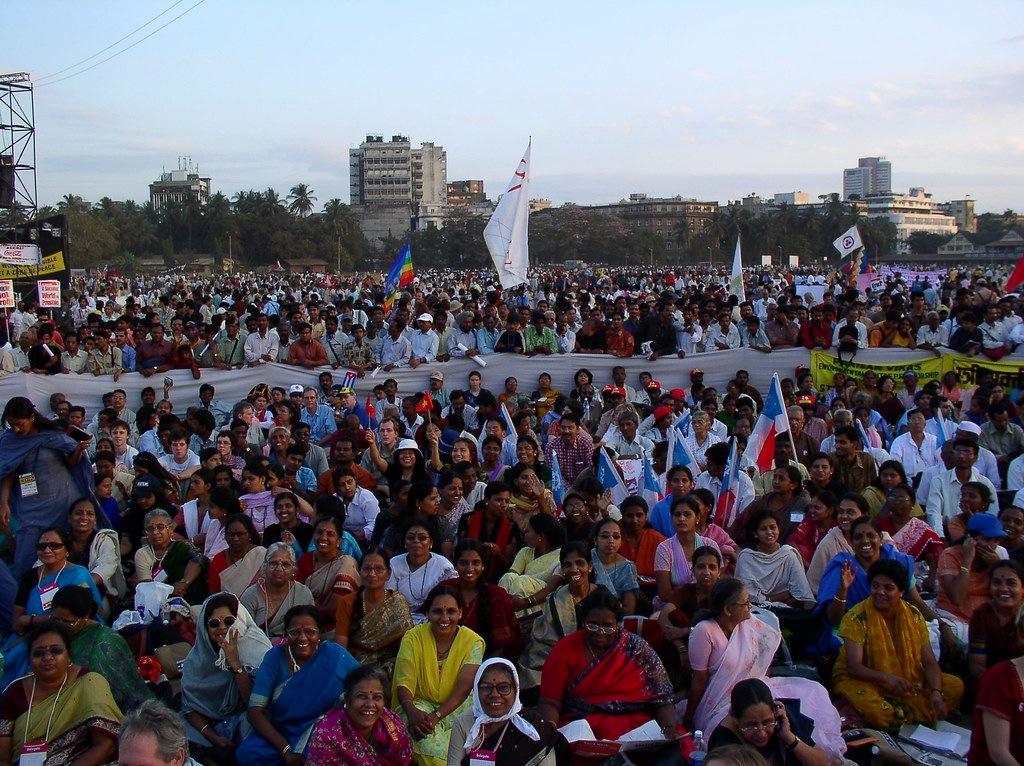
Spectators at the final concert of the World Social Forum, Mumbai 2004 (author: Claudio Riccio, https://www.flickr.com/photos/ilriccio/135304963/in/photostream/)

From Andheri to Goregaon—it’s five kilometers. Half an hour by Ambassador in the north Mumbai traffic. Windows down—through them, the usual fumes: chai, wood smoke, diesel exhaust. Plus, the blinding, crunchy, almost chewable dust of the industrial area, a landscape half abandoned, half under-construction. Taxiwala grows edgy—why, Toma can’t fathom. Dumps passengers on an impulse: “New Standard Engineering Grounds”, he says, “ahead.” Ahead it is, indeed—a twenty-minute walk. Add the heat to the scents and more of the dust.

About twenty paces in the queue for registration at the entrance stood the founder of world-systems analysis. He was invited to the event to address the crowd. Toma missed him somehow, couldn’t say “hi.”

There was no category for Toma at the event. He was hoping for “attendee” or “participant,” but—no, no such thing. He became, thanks to the helpful student worker at the registration desk, a “delegate.” The best she could do. So it said on the vibrantly designed tag, hanging from Toma’s neck. Two names: Toma and country.

Speaking of which, he is from two countries, at least. One of those is a titanic, the other a dinghy. She chose the dinghy for him. Upon exit at the end of a long day, another nice person at the same desk confirmed—there were no other “delegates” from country dinghy.

Toma had given a lot of thought to the very idea of this jamboree. How do you organize a “social forum”—for the world, no less, without an underlying theme—other than, supposedly, a vague call for resistance, so to speak, to global capital? And what does it do to that event of resistance that it is sponsored by major multinational corporations? Mind you, a counter-event, held just across the highway, asserted that exact critique. The two events together seemed to “cover” much of the political left of south Asia.

Indeed, how to be “anti-Davos?” besides, what do they do in Davos in the first place? Toma had no idea. The Mumbai event turned out to be a pageantry of all the worthwhile causes good people could think of. Attendance was expected to be 75 thousand. Conversation on the ground went up to as high as 130.000 “delegates” from 130 countries.

“I didn’t quite realize Mumbai was this far,” a group of people chatted in a cluster that somehow ended up including Toma. “Far . . . from where?”, he interjected an old joke from Budapest. Polite amusement, a smile or two. They had an accent Toma could not quite place within the UK.

There was breathtakingly little water for so many people. Toma saw two taps on the entire grounds. Plus, there were of course the drinking water tanks provided by the municipal authority. Neither to be had without boiling. Everybody ran around, hence, with store bought drinking water in plastic bottles, half a dollar per liter—at an event that deplored, among other things, the depletion of the environment, the commercialization of a basic human necessity like drinking water, and pollution of the planet with single use plastic containers.

The Forum was a gigantic café—without tables. A global / adda. \

Toma chatted with hundreds of other “delegates,” mainly young people from Asia. Gaped at Vietnamese students parading with a two-story flag of their country. Talked with South Indian and Latin American activists fighting the good fight against Coca Cola robbing their regions of drinking water. (Or was it Pepsi? Toma can never tell those two apart.) People who organize artisanal cooperatives. Artists of all kinds. Activists for NGOs of people displaced by hydroelectric dams, airports, shopping malls. A gentleman presented a contraption that looked like an aluminum wash basin but glittering inside: It gathers the rays of the Sun to cook a meal. He demonstrated that on the spot. Toma was distracted by something, he didn’t stick around to taste it.

A man with a broad smile approached Toma. He had a mustache and was wearing gauze-thin white cotton tied around his head, a linen shirt and a dhoti. He was very interested in the status of the agrarian question in “Toma’s country.” How peasants are doing in country dinghy. It was important to him, he said, because he knows the peasantries of their two countries could learn much from each other.

Toma made a quick calculation. As far as he knows, eleven of his sixteen great-great-grandparents were born serfs. Then came the abolition of serfdom, capitalism—of Kakanien, the Habsburg variety—two world wars, fascism, holocaust and socialisms, in the plural. Then back to a neoconservative, deeply confused, angry and desperate kind of capitalism. Now everyone in Toma’s extended family lives in cities. The most sweeping form of social change in country dinghy over the last century is that there are hardly any peasants left—other than in one-step removed, virtual forms as cultural movements aim to “preserve” and “re-cycle” peasant culture, especially music and dance, in urban life. In the country of Bartók—who railed against this kind of appropriation—the culture of the peasantry is now re-used as folklorism, exoticizing the lives of the descendants of the people who created that art in the first place.

They discussed the legacies of serfdom and the “peasant question” in Soviet history. And that more-than-half of the peoples of south Asia that hover precariously between peasant near-self-sufficiency and market-driven farming. How the average Indian peasant walks to polling stations to be able to cast a vote. Two hours, both ways. GMO seed. Child malnutrition. Toma’s new comrade had read Chayanov enthusiastically and mentioned Lenin a couple of times. He gave Toma a card. “Secretary General of the Peasant Trade Union Confederation of India.”

There was visible discomfort—among the Europeans. Not so much because of the heat or the dust. Two other things. One was unspoken but Toma felt it. The weirdness of standing out: Their head loomed above almost everyone else in the great sea of global “delegates.” Comrades in terms of politics, moral values, aesthetics, all the good things, with their pink and sweating heads sticking out. Because of their infrequency at the event, they seemed to feel on display. It’s not just that there was staring—there is much more of that on a tram in Kolkata or in a bus in Delhi. They came here to swim in the sea of comrades from the global south, after all. To be in the company of the like-minded from the rest-of-the-world. That was the whole point. There they are now, this is it.

The truly unpleasant thing was realizing that they had not even thought about the possibility of feeling strange. Their own reaction seemed to be a genuine surprise to them. They may well have traveled outside Europe before. But that’s not like this. They saw crowds in Istanbul or Cairo. But this is not that. The crowds on earlier trips were at a distance. Possibly behind windows of buses, or hotel lobbies. Here, everyone is so exposed to a truly intense mix of languages—bodily and spoken—that it is easy to feel lost. More body-to-body contact on a January afternoon than they have in an average year. And all that is driven by rules they don’t quite understand. They could, of course have read about those rules—but they didn’t quite think of it. It didn’t occur to them.

Losing the ability to sort everything out—who is who and what is what—they could neither wipe the discomfort away nor give it a name. For, that might be considered “rude”. . . Too honest. Not to mention admitting defeat, the thought that this corporeal idea of solidarity is not working for them.

There was, then, the second discomfort— and that one was indeed spoken of very much. A metaphor for all other metaphors.

“Child labor.”

The horror.

Who could be in favor of child labor? The abysmal life. The barefoot, scantily dressed, small bodies toiling in the crowd. “They should be in school.”

Mind you, at the event, begging was not allowed. Panhandlers were chased away by the private jawans, armed with long batons, very eager to use them, stationed visibly at each entrance. Toma wondered to what extent the jawans-with-truncheons “solution” to “the begging problem” was cleared with the organizing committee—whose charge it was to assure the event stayed on course toward its haughty goals of global equality. For sure, the clubs were used in the outside world—the world that these seventy-five thousand to one hundred and thirty thousand people all came to protest.

“Are the beatings OK if they happen outside the gates?” Toma is asking questions like that. “I could never bear being on that Organizing Committee.”

There was, however, plenty of tea and coffee on offer everywhere, brought to everyone—a little more to the “delegates” with lower levels of melanin, a skin color situation the hot beverage workers were very familiar with. Mumbai is a truly tourism-infested city. Those delegates might even give a 100% tip on the 5-rupee price—for the tea poured from large pots to small throwaway plastic cups, a nice counterpoint to the event protesting plastic pollution. All that service was rendered by tiny, unbearably cute children.

It struck Toma, as he stood there, amidst all the chatter about child labor, that the conversation never went past the initial revulsion and moral panic. All those people, supposedly the best the global north has produced, armed with sharp critiques of hydrocarbon colonialism, or global militarism, or product chains, using their privileged access to knowledge for the best possible political purpose, had a hard time discerning what it is that they are looking at when they see five-six-year-old proletarians doing truly labor-intensive service. For them. That the children’s toil might be supporting the ambitious strategies—of rising above the rural survival threshold—of entire families in a village a stone’s throw away. That the 100% tip—the generous transfer of 14 instead of 7 dollar-cents in exchange for a small cup of tea—will teach those children, and their adult relatives, that they should be selling tea for the rest of their lives. To low-melanin strangers.

That is where the global critique came to a complete halt. Right at the line around the European “delegates’” own global selves. The thought of the violence of their own retirement portfolios, amplified by the privileges bestowed upon them by their melanin-deficiency, just didn’t seem to come to them. They had spent the equivalent of ten, twenty times each of those children’s extended families’ total annual income—just flying to Mumbai.

“Was I the only person having those thoughts?”, Toma ponders today. Maybe they also had them—and filed them along with all other instances of discomfort, under a rubric labeled “not-to-be-talked-about.”

The plenary session took place on the maidan—a meadow the size of several football fields. It consisted of a large stage before a giant audience space, the latter covered with industrial tarp sheets tied together, a quilt to seat the righteous of the world. An enormous navy-blue arena of plastic—encircled, once the crowd descended on it, by layers upon layers of sandals, shoes, flip-flops. Footwear of all kinds. As if entering a person’s home, or a temple, the participants took off and left “outside” their foot covering. A show of respect. And keeping the oilcloth perhaps a tiny bit less dusty.

A group of ten-fifteen Italian students arrived, chatting merrily. Guessing from the clothes, on a return leg of a roundtrip flight between Milan and Kathmandu. Locs, woven sacks, the works. Asserting the power of a supposedly righteous kind of appropriation galore. Leaving their shoes on, they entered the field. The crowd opened for them, forming a human alley. They took the offer matter-of-factly, went right to the middle, and sat down. Shoes on, soles facing outward. The crowd absorbed them. Toma lost sight of them.

Speeches: politicians, progressive intellectuals, strongly encouraging the audience that “we should do more.” Toma is not sure who the “we” is, and more of what. Then came Junoon, a politically engaged band from Pakistan. Performing in India. A geopolitical first. Palpable excitement overall and an exuberant audience response, especially among the crowd from the Subcontinent.

On the last day, the shift of the jawans-with-the-truncheons at the gates ended at six pm. The World Forum became even more social, with the arrival of a thousand or so panhandlers through the now un-jawan-ed, truncheons-free gates. Likely not the sociality the organizers had in mind.

Toma flew back to country dinghy from Mumbai two days later. At the airport, he was selected for a “detailed customs check” by a gentleman dressed in an immaculate white uniform. He took Toma to a separate room—his luggage had already been placed on a table. The officer reached into Toma’s now-open suitcase and, with the gesture of a magician, he pulled out Toma’s tag—Toma’s name and country dinghy—and asked, “you like that kind of thing?”

A rhetorical question. The officer turned to his men and quipped, half-Hindi-half-English—Toma could make it out, the officer probably wanted it that way—how Toma came here “to allay his White guilt”. A real joker. Polite giggles from the men to their superior officer, fixed stares at Toma. He liberated Toma from his remaining rupees. A “processing fee,” he winked. He tossed a small tip to the man who “handled” Toma’s suitcase. The rest disappeared into his uniform. Very politely he walked Toma to his gate, doing small talk in a self-ironical tone. He had a truly sharp and witty sense of humor.

By the time Toma arrived at his gate he learned that his seat got re-assigned. On board he realized he was sitting next to a passenger who kept talking to him nervously throughout the entire eight-hour flight.

The World Social Forum has never returned to Mumbai.

Rumor has it—it’s the child labor.

The World Social Forum (WSF) is a global social movement organized as an open environment, a meeting space for activists, NGOs and progressive social movements committed to democracy, equality and preservation of the planet, in opposition to the “World Economic Forum”—the meetings of owners and management of big capital and top brass of the world’s most powerful states held annually in Davos, Switzerland. The first WSF meeting was held in Porto Alegre, Brazil in 2001. The event in Mumbai, India—held twenty years ago—was the first time WSF had its global assembly outside Brazil.


József Böröcz is Professor Emeritus in Sociology at Rutgers, The State University of New Jersey. He is the author of ”’Eurowhite’ Conceit, ’Dirty White’ Ressentiment.” A recent, “reflexive sociology” interview with him about socialisms, history and ‘race’ is ”Society—Instead of Apartheid. Interview with József Böröcz.” Most of his written scholarly work can be found here.


Cite as: Böröcz, József 2024. “Out of Place” Focaalblog 14 October. https://www.focaalblog.com/2024/10/14/jozsef-borocz-out-of-place/

Ida Susser: Melenchon: the creation of a left political bloc

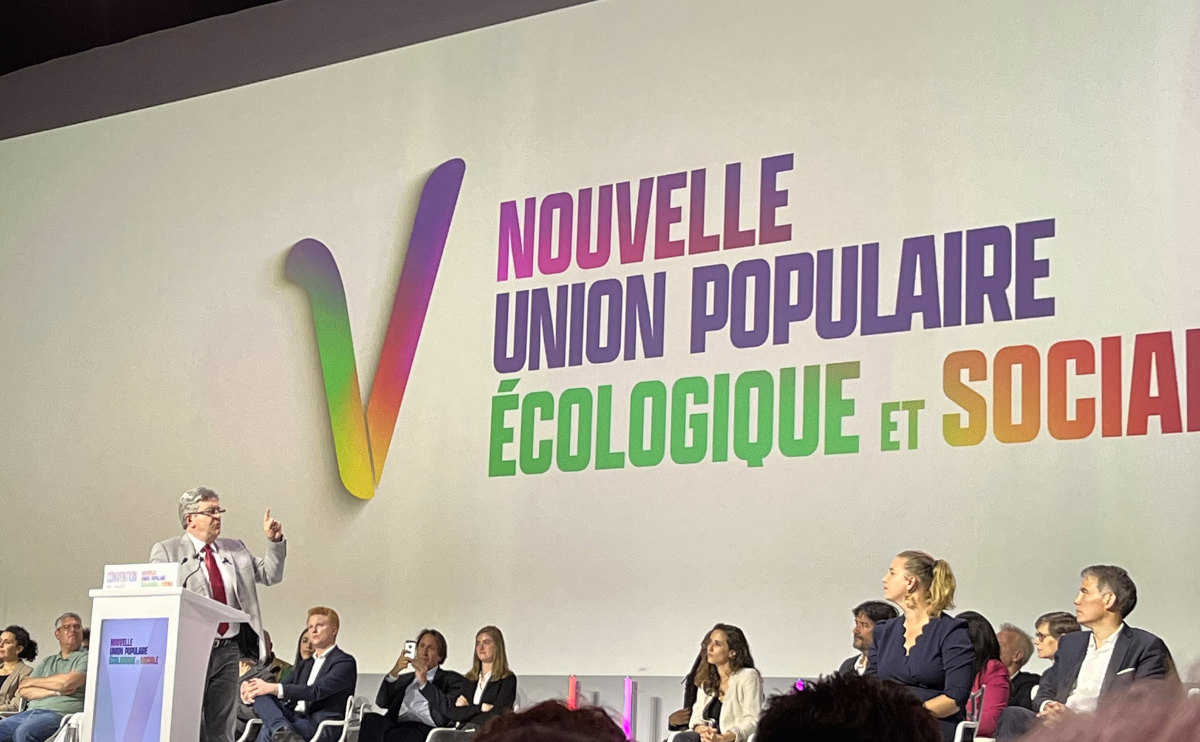
On June 19, 2022, the united left party, NUPES (New Ecological and Social Popular Union), cobbled together by Jean-Luc Melenchon in less than two months, won enough seats to become the official opposition in the French National Assembly. How should we understand the growth of this left alliance in France which seems to have taken political pundits by surprise?

Since 2015, I have been conducting ethnographic research on progressive social transformation in Paris and, in fact, documenting the emergence of the counter-hegemonic bloc represented in this alliance. I have focused on what has been called “commoning” (Nonini 2007; Stavrides 2015; Susser 2016, 2017, 2018; Dardot and Laval 2019), the process of creating commons, to consider the ways in which this form of popular contestation is transforming political subjects, generating collective ethics, and reconfiguring democracy.

Image 1: Jean-Luc Melenchon delivering a speech at the NUPES convention on 7 May 2022, photo by Hugo Rota

Two aspects of commoning help to illuminate the current elections. The first is the creation of a new political subject and a political vision through a process of sharing and community activities. The second is the process of thresholding or crossing of transitional space that led to alliances among groups who had not previously recognized common interests. I argue that both aspects contributed to the creation of a public oriented in the direction of social justice, inclusivity and a collaborative left leaning political bloc.

To illustrate these processes, I focus on the Gilets Jaunes, a movement which emerged in November 2018.  From the start there was much debate in France and internationally about whether to characterize the Gilets Jaunes as right or left in the context of Brexit, Trump, and most significantly, Marine Le Pen, head of the extreme right party in France (Rogozinski 2019, Balibar 2019 and many others). It is this dilemma that made these protests particularly important from an analytic and practical political perspective.

Historical Conjuncture and Crisis

In 2016, the Socialist government of Francois Hollande, with Emmanuel Macron as economy minister, initiated legislation to change the labor laws. Although policies to reduce public spending and increase the flexibility of employment had been gradually implemented for some time, this major effort by a Socialist government to change the labor laws set off a political crisis.

Because of this crisis, a new era of street protest emerged in Paris. The first of the protests was Nuit Debout, which began on March 31, 2016. This movement echoed the historic squares occupations of Southern Europe in 2011, although it took place five years later.  As previously, in Spain, the call to action was initially to join the unions in support of the traditional labor laws that a socialist government proposed to relax.

The attempt to change the labor laws, and the protests in response, dramatically undermined the legitimacy of the Socialist Party. The political conjuncture of this event with allegations of fraud on the traditional right opened the way for a new political configuration in France. In this vacuum, the newly created party led by Macron, the left party created by Jean-Luc Melenchon in 2012, and the marginal far right, reincarnated by Marine Le Pen, re-oriented the national arena.

Taking advantage of the wide-open field, in May 2017, Macron, without a traditional party but strongly supported by corporate funding, was elected President for the first time. He rapidly began to implement far-reaching changes. In the interests of workforce flexibility, he weakened employment security and later tried to alter the calculation of union pensions as well as increase the age for pension entitlements. Student admissions to public universities were re-organized and health workers and teachers faced layoffs. The threat of worker disciplining in the interests of capital became widely feared. Each change was accompanied by massive social movements and street uprisings.

Over the years of the first Macron presidency, many different groups under different kinds of pressures opposed the new changes. Resistance took the form of both organized strikes and wildcat worker strikes, the occupation of squares, student sit ins and street rebellions. In November 2018, the Gilets Jaunes uprising began. Finally in 2019, a mass movement was organized by unions to oppose the dismantling of the national pension plans. I analyze the Gilets Jaunes within this broader historical arena as well as in contrast or comparison with the protest movements I have been observing in the United States.

The Gilets Jaunes and Commoning

The Gilets Jaunes began as a one issue protest, against the gas tax. The message was spread through Facebook, and other platforms. Still organizing around one issue, the protesters began to meet in real time, at roundabouts, crossroads and along highways in many parts of France. Next, Gilets Jaunes took to the streets of Paris in enormous and unprecedented marches on successive Saturdays for over eighteen months.

As people who lived near one another but had not necessarily met before began to meet regularly, they began to build a shared sense of community. Starting out as a mixture of pensioners, and many poor and disabled people from the provinces, including disengaged socialists and Le Pen supporters, the Gilets Jaunes can be seen as negotiating positions over time. Negotiations took place within the space of the commoning experience during the occupations, the general assemblies, the assemblies of assemblies and the massive Saturday demonstrations.

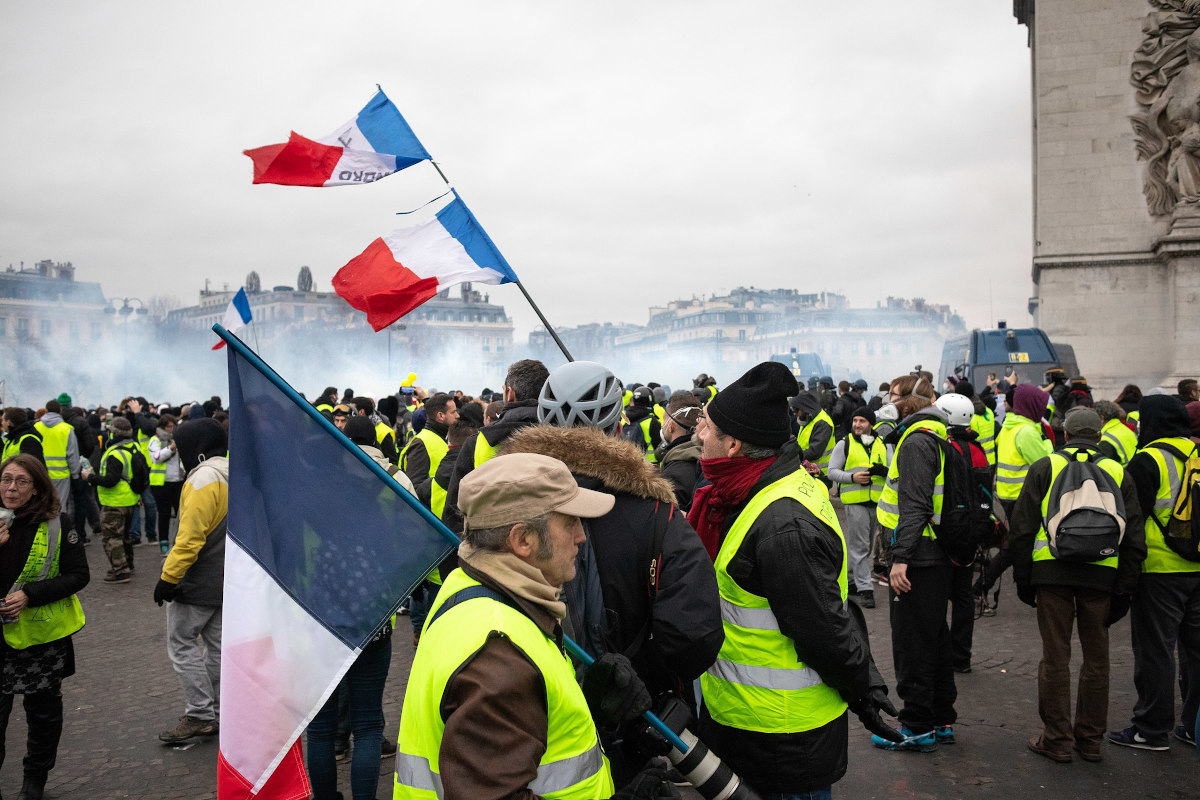
Image 2: Gilets Jaunes – Acte IX at Place de l’Etoile in Paris on 12 January 2019, photo by Olivier Ortelpa

The community was built in multiple ways: by barbecues and picnics, by bringing children to play in the environment, by building cabins, sometimes making them comfortable for wintry stays. Saturday afternoons were spent grouping close together in the cold to keep warm in wind, rain and snow, and some Saturday evenings around fires and in cabins. Gilets Jaunes wrote personal statements and commentaries on the backs of their vests. They spray painted slogans and arrayed tags, posters, and banners as well as other forms of graffiti (Le Comité de soutien 31 2019) along the routes of the demonstrations. The yellow vests and the songs such as the ever-present “On est la” generated a sense of belonging and became a signal that Gilets Jaunes were present in whatever guise they happened to be. Over time, singing the song simply indicated that people emulated and echoed the Gilets Jaunes in other demonstrations.  Experiences such as this can be seen as the commoning process of the Gilet Jaunes.

Through meeting several times, a week, sharing narratives, singing Gilets Jaunes songs and, dressing in the familiar yellow vests, group members built a, possibly fragile, sense of solidarity in ways that crisscrossed over divisions of family, income, color, and age, and maintained a strong belief that the disabled were part of the community. Negotiations involved a recognition that poverty and distress need not be shameful but were a product of changing circumstances and uncaring or destructive government policies. As a result, in difficult, often physically uncomfortable, conditions, principles of cooperation were established along with a belief in horizontalism and an aversion to political leaders.

Où sont les neiges d’antan? (Where are the snows of yesteryear?)

Analysts have discussed the solidarity of factory floors or assembly lines and even nostalgia with respect to that solidarity (Muehlenbach 2017). Following Lefebvre there has also been a recognition of the solidarity of the streets and public spaces (Lefebvre 1971, Harvey 2012, Susser and Tonnelat 2013). The experience of the Gilets Jaunes points to the creation of a critical public at the roundabouts which generated or echoed the affect of the lost village community.

Such nostalgia has historically generated conservatism as well as revolutionary ideas (Susser 2008, Williams 1983). The question became, in what ways would this community be invested with emotions? It could generate an exclusive nationalism (as today in Hungary, Romania, or Poland) or a wider sharing sense of the needs of the poor and disabled.

In an ever-evolving process, people came to the roundabouts and talked among one another of their economic challenges and domestic hardship. They managed to escape the individual humiliations of poverty and household desperation, of their unrelenting work for not enough pay, their exhaustion and lack of belief in their own or their children’s future. Instead, they talked collectively about the degradation of everyday life – the loss of a village center, a post office, a bakery, and a public square; the loss of local schools; the need to drive long distances for employment and childcare; and the endless drudgery of work which did not allow sufficient time or provide the means to help their children, their elderly or disabled neighbors and relatives or meet their friends (Susser 2020). Their nostalgia recalled the loss of a social existence centered around local services and a secure welfare state and became the basis of their rage against Macron’s neoliberal policies.

Thresholding

The second aspect of commoning which contributed to a progressive or left positioning on the spectrum was what has been called thresholding (Stavrides 2015). Analysts (Stavrides 2015) have talked of “thresholds” to distinguish commoning from more right wing or nationalist movements claiming territory. The idea was that open doors or thresholds connected different groups which allowed for inclusivity while at the same time recognizing ethnic and other identities upon which the different groups were based. If commoning creates groups which are built on experiences of sharing in new ways, thresholds are a basis for sharing across groups. Thresholding be understood in much the same way as rites of passage which Arnold Van Gennep (1960) saw as taking place in three stages, separation, transition, and incorporation (see also Turner 1958).

We might consider moments of liminality, such as occupations, freezing afternoons at roundabouts or possibly the common experience of violence in the streets as the moments of separation and transition. These represent challenging and bonding processes taking place in liminal or temporarily undefined space. In sharing such trying circumstances, people cross thresholds of trust and build bridges across unusual groups, in processes of incorporation.  Thus, what might be understood as prefigurative politics which emerged in the practice of street protests included both commoning and the recognition of many autonomous groups working together: In other words, inclusivity, and thresholds to new populations.

Environment, convergence, and thresholding

Thresholding among the Gilets Jaunes occurred with respect to the environmental movement. Emmanuel Macron had announced the gas tax as an effort to curb the use of this gas for environmental reasons. Consequently, the Gilets Jaunes protest against the gas tax was interpreted by the government and the media as a protest against ecology. Over the next two years, much time and effort were put into convergence. Environmentalists who were also Gilets Jaunes and others who organized joint marches, teach ins and conferences worked to counteract stereotypes and to build thresholds between the two movements.

In February 2019, the environmental movement staged a demonstration on a Saturday afternoon in Paris which the Gilets Jaunes joined. They started together. However, after the first few blocks the Gilets Jaunes parted ways from the permitted route of the ecological demonstration and made their way on a “wild” protest (undeclared) towards the Champs Élysées. Later all the groups met again listening to passionate speeches at La Place de la République. Some youthful Gilets Jaunes were sitting in the square wearing flowers in their hair reminiscent of green protests over many decades. After about 6pm, as dusk settled, violence suddenly erupted, traffic was stopped, and the square was closed off by police. From the point of view of the Gilets Jaunes, the violence was in response to police arrests in the square.

In spite, or possibly because, of the evening clashes, this demonstration clearly opened portals between the Gilets Jaunes and the environmentalists. From early 2019, “The end of the month and the end of the world” became a characteristic slogan of the Gilets Jaunes. Climate activists continued their efforts towards convergence. The Gilets Jaunes never became a climate movement, but the polarization claimed by the government was not supported by later events. Rites of passage in shared marches and other experiences had opened thresholds for collaboration.

Police brutality and thresholds of race

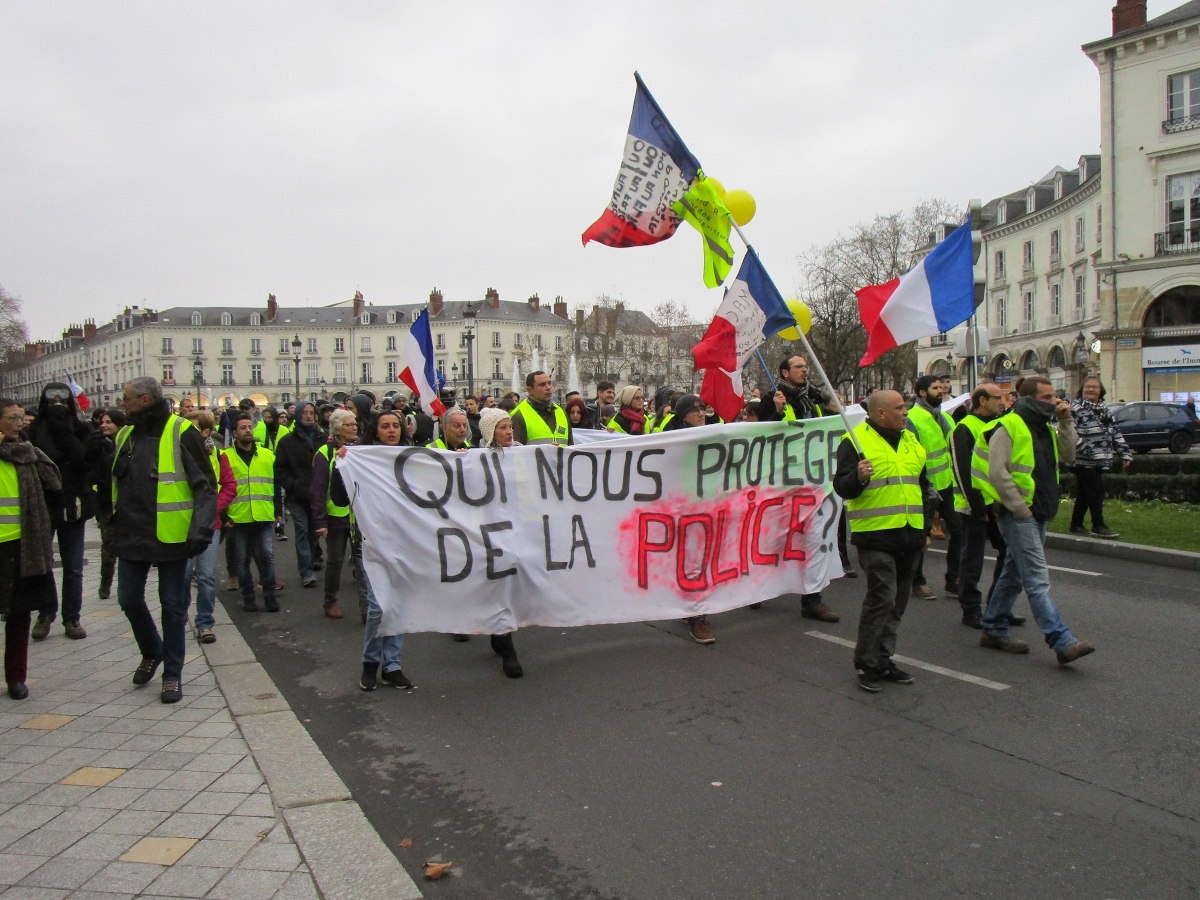
As I described in a previous post in FocaalBlog (Susser 2020), the #BlackLivesMatter protests in the US were followed by massive demonstrations against police brutality in France. Although police brutality was a long-time theme of the Gilets Jaunes, this time the Paris protests, while including the Gilets Jaunes, focused specifically on the brutality against youth and people of color. This recognition of common problems represented newly possible thresholding between the Gilets Jaunes and people of color from the banlieues.

Here, thresholds were opened between so-called but no longer stable working classes, the imagined middle classes also at risk of instability, and the super-exploited subjects divided by racism, sexism, colonialism, citizenship, and other forms of historical subordinations.

Joint marches between Gilets Jaunes and people of color most subject to police brutality were not an ongoing phenomenon but again this demonstrated the opening of a portal for common understandings.

Image 3: “Who protects us from the police?” Gilets Jaunes protest in Tours on 12 January 2019, photo by Guillame70

Unions and strikes: thresholding on the left

Many Gilets Jaunes were suspicious of unions and many unions refused to officially march with Gilets Jaunes. However, despite this contentious relationship, there were collaborative efforts on May Day marches and elsewhere. Gilets Jaunes picketed many early mornings with bus drivers when they were out on strike. After the strike, the bus drivers organized a barbecue in front of a bus headquarters for Gilets Jaunes who had come out on those cold winter mornings: one of many thresholding events among strikers and Gilets Jaunes.

The silence of others: a more controversial example of thresholding

While there was openness among the Gilets Jaunes about not having enough to live on and many domestic challenges, Gilets Jaunes avoided talking about the politics of left and right. Their reticence over political persuasions was not surprising in the polarized political situation of France. In 2017, Macron had successfully used the fear of fascism and the history of the Vichy government to mobilize voters in opposition to Marine Le Pen in the second-round elections.

In 2018, as hundreds of thousands of Gilets Jaunes poured into Paris from the provinces, both Le Pen, on the extreme right, and Jean-Luc Melenchon, on the left, pledged support. Reporters and participants claimed that in ACTE 3, Le Pen nationalists led the assault on the Arc de Triomphe. The international leftist Black Bloc may have led the attack on the elite restaurant Le Fouquet a few months later. The participation of many on the left in the protests, and the roundabouts over time led to a movement that called for a diverse democratic voice and the extreme right became marginalized.

While the Gilets Jaunes expressed their rage in breaking windows and other property and participated in attacks on the Arc de Triomphe and Le Fouquet, they did not accept political leadership from either the far right or the left. Silence with respect to political affiliation and the rejection of an official leadership remained a determined response.

Although disagreeing in fundamental ways, Gilets Jaunes were more or less uniform in their hatred of Macron. They believed that he was “stealing the state” with his privatization policies and cutbacks in funding for services and public employment.  They blamed the government for the destruction of a middle-class lifestyle either for themselves or for their children.

Collaboration for a political bloc was not based on a romantic image of common identity. Rather it was built on a restrained acceptance of political difference in a common rage about the loss of accustomed living conditions. This contrasts sharply with the US where polarization between left and right has become more extreme.

Trump, class, and thresholds in the United States

Although the presidential campaign of Bernie Sanders certainly raised the possibility (Susser 2018), no political bloc has yet emerged to work across the vicious polarization in the United States. Trump demonstrators also come from the shrinking middle class and displaced affluent working class partially represented in the Gilets Jaunes. However, they have moved to the right and responded to the Trumpian rhetoric of anti-immigrants, whispered racism, antisemitism and now even the adoption of theories of the Great Replacement. What can explain these different reactions to some similar circumstances?

Analysts have been concerned that Gilets Jaunes, like Trump supporters, were opening an avenue for the antisemitism, racism, and anti-immigrant rhetoric expressed by the growing far right. Indeed, in recognition of the popularity of Le Pen, Macron adopted some rightwing exclusive rhetoric. A popular surge to the right was a frightening possibility. However, the Gilets Jaunes did not evolve into a movement fundamentally based on hatred of the other. Instead, as a movement they focused their desperation and rage against Macron’s shredding of the welfare state and reduction in investment in areas outside gentrified Paris (Hazard 2020). They demanded a more receptive democracy and not an authoritarian state.

Conclusions

As political pundits have finally noticed, a new political bloc or a working class with consciousness or agency is emerging. Commoning and the generation of shared values as well as thresholding across autonomous groups were particularly significant in the long-term building of this oppositional left bloc. An important part of this thresholding was the ability to by-pass the polarization of the extreme right and the extreme left. This unusual collaboration, rarely the product of any explicit negotiations, allowed the extraordinary and inspirational mass movement of the Gilets Jaunes to avoid the exclusive and racist nationalism evident in the US.

In the presidential elections of 2022, Le Pen, as in 2017, made it through to the second round. However, Melenchon came in a close third. Macron, lacking the broad support evident in 2017, relied on the anti-fascism of the left to pull him through the second round. The power of the left to support Macron against Le Pen was finally negotiated into NUPES, a united left front for the deputy elections for the National Assembly in June 2022. 

In the June elections, NUPES won enough seats to become an official opposition and deny Macron his majority in the National Assembly. Some of Macron’s nominated ministers did not even make it into the Assembly. Macron was no longer able to pass the much-hated changes in pensions or his other policies. Marine Le Pen also won more seats than previously.   Nevertheless, the success of NUPES clearly represents an unheard-of situation in the fifth French Republic where the President is generally rubber stamped by a weak National Assembly. This new powerful counter-hegemonic political bloc should come as no surprise. It has been formed over five years of extraordinary protest including the collaborative politics of commoning, thresholding and silence in the Gilets Jaunes collective efforts. The forthcoming regime will have to take these progressive voices into account.

Ida Susser is Distinguished Professor of Anthropology at Hunter College and the Graduate Center, City University of New York. Her most recent book is The Tumultuous Politics of Scale, co-edited with Don Nonini.

References

Balibar, Etienne. 2019. Le sens du face-à-face. In Joseph Confavreux (ed.). Le Fond de l’Air Est Jaune. Editions Seuil

Dardot, Pierre and Christian Laval. 2019. Common: On Revolution in the 21st Century. Bloomsbury Publishing.

Hazard, Benoit. 2020. Lorsque les ‘sans-parts’ se rallient au ‘pouvoir vivre’. Ethnographie des associations des gilets jaunes sur les ronds-points de l’Oise. Condition Humaine/ Condition Politique 1 https://revues.mshparisnord.fr/chcp/index.php?id=237#text

Lefebvre, Henri 2003. The Urban Revolution. University of Minnesota Press.

Muehlebach, Andrea. 2017. The Body of Solidarity. Heritage, Memory, and Materiality in Post-Industrial Italy. Comparative Studies of Society and History 59(1), 96-126.

Comité de soutien 31. 2019. La rue etait noire de jaunes – 500 slogans, tags, affiches, pancartes, dessins, photos, banderoles….  Éditions du croquant.

Nonini, Donald M. (ed.) 2007. The Global Idea of ‘The Commons’. Berghahn

Books.

Rogozinski, Jacob. 2019. Démocratie Sauvage. Lignes 59, 23-36.

Stavrides, Stavros. 2015. Common Space as Threshold Space: Urban Commoning in Struggles to Re-Appropriate Public Space. Footprint 9(1), 9–19.

Susser, Ida. 2016. Considering the urban commons: Anthropological approaches to social movements. Dialectical Anthropology 40(3), 183–198.

Susser, Ida. 2017. Commoning in New York City, Barcelona, and Paris: Notes and Observations from the Field. Focaal 79, 6-22.

Susser, Ida. 2018 Re-envisioning Social Movements in the Global City: from Fordism to the neoliberal era. In Don Kalb and Mao Mollona (eds.). Worldwide Urban Mobilizations. Class struggles and Urban Commoning. Berghahn Books.

Susser, Ida. 2020. Covid, police brutality and race: are ongoing French mobilizations breaking through the class boundaries? FocaalBlog, December 3, https://www.focaalblog.com/2020/12/03/ida-susser-covid-police-brutality-and-race-are-ongoing-french-mobilizations-breaking-through-the-class-boundaries/

Susser, Ida. 2021. “They are Stealing the State”. Commoning and the Gilets Jaunes in France. In Moritz Ege and Johannes Moser (eds.). Urban Ethics. Conflicts Over the Good and Proper Life in Cities. Routledge.

Susser Ida, and Stéphane Tonnelat. 2013. Transformative cities: The three urbans

commons. Focaal 66,105-121.

Turner, Victor. 1958. Schism and Continuity. Manchester University Press.

Van Gennep, Arnold. 1960. The Rites of Passage.University of Chicago Press.

Williams, Raymond. 1983. Culture and Society, 1780–1950. Columbia University

Press.


Cite as: Susser, Ida. 2022. “Melenchon: the creation of a left political bloc.” Focaalblog, 21 June. https://www.focaalblog.com/2022/06/21/ida-susser-melenchon-the-creation-of-a-left-political-bloc/

Maka Suarez: Thinking about debt with David Graeber and La PAH

Let me begin by saying “this is a thought experiment”; a phrase David often used, and I find useful.

In this talk I’d like to propose an approach to Debt: The First 5,000 Years (Graeber 2011) that connects the book to David’s earlier work on Fragments of an Anarchist Anthropology (Graeber 2004) and his latest work—with David Wengrow—on The Dawn of Everything (Graeber & Wengrow 2021). I think there are many different readings of the book on debt. My own reading of David’s work is in light of ten years of ethnographic research with Latin-American migrants in Spain, who became involved in the country’s largest movement for the right to housing—the Platform for People Affected by Mortgages—or La PAH for its short Spanish acronym (Suarez 2017, 2020). My research focuses on the relationship between political mobilization, mortgage debt, and transnational migration.

My interlocutors were being foreclosed and evicted from their homes, which were bought during the housing bubble. On average they owed over 250,000 euros. They joined La PAH in despair and out of guilt for not paying their debts. The movement helped them transform their guilt into outrage by shifting the grand narrative from individual failure into a counter-narrative on massive financial fraud.  

In what follows I engage with David’s concepts of debt and freedom, as I try to illuminate some of the challenges I ran into while theorizing what debt meant to my interlocutors and fellow activists. 

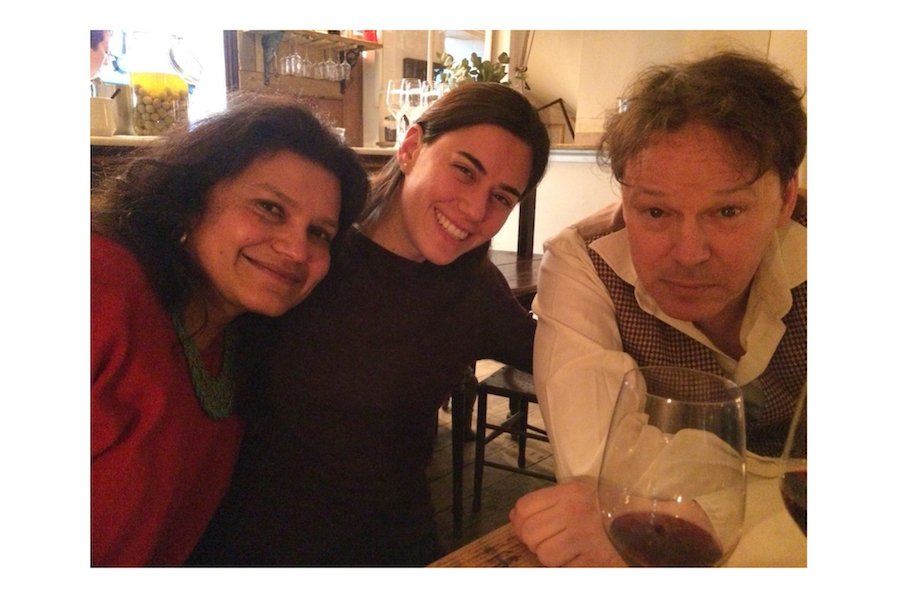
It was January 11th, 2012. I had just returned to London from a preliminary field visit to Barcelona. David was on leave that year and in New York but was on a short visit to London. His mind, however, was still in New York, where he had inspired and was collaborating with the Occupy movement. As we ate delicious Thai food, one of his favorite activities, David detailed his time with Occupy. Meanwhile, I was trying to get a word in to figure out my own research.

In between dishes of prawn panang, charcoal duck, lots of white rice, and Thai iced tea, David turned around and said: “What’s interesting here is not only why has debt become the focus of this movement, but why it has been so effective. It’s notorious that debt is very hard to organize around. We keep talking about debt strikes, debt this, debtors that… and everybody keeps trying to come up with a formula but it’s incredibly difficult. Part of the reason why is because this sort of old morality is very hard to, like, convince people it’s not their fault … What’s interesting here is you have a really effective broad grassroots movement focusing on [debt]. You could ask: why debt becomes a focus and why it’s worked in a certain way?” (In discussion with the author, January 2012). The question is: in what way?

So, let me begin with Fragments and its relation to Debt. In Fragments, David describes several “invisible spaces” where direct forms of democracy are already taking place. To him, it is in these spaces that “the potential for insurrection, and the extraordinary social creativity that seems to emerge out of nowhere in revolutionary moments actually comes” (Graeber 2004, 34). In Debt, on the other hand, David defines the principle of communism as “the foundation of all human sociability” (2011, 96). Communism implies spaces free of debt in which all people can contribute to a common project given the abilities they already have. Unlike hierarchy, communism is not based on relationships of precedent or status, but of cooperation. And, unlike exchange, communism does not intend to end relationships by paying back what is owed, but rather builds a sociality in which one aspires to live in. Communism would then be the moral principle of economic life operating at the heart of the “invisible spaces” suggested by David in his anarchist anthropology.

Now I want to give you an ethnographic vignette to analyze how this moral principle organized the everyday realities lived by Latin American migrants to complicate David’s theorizing. 

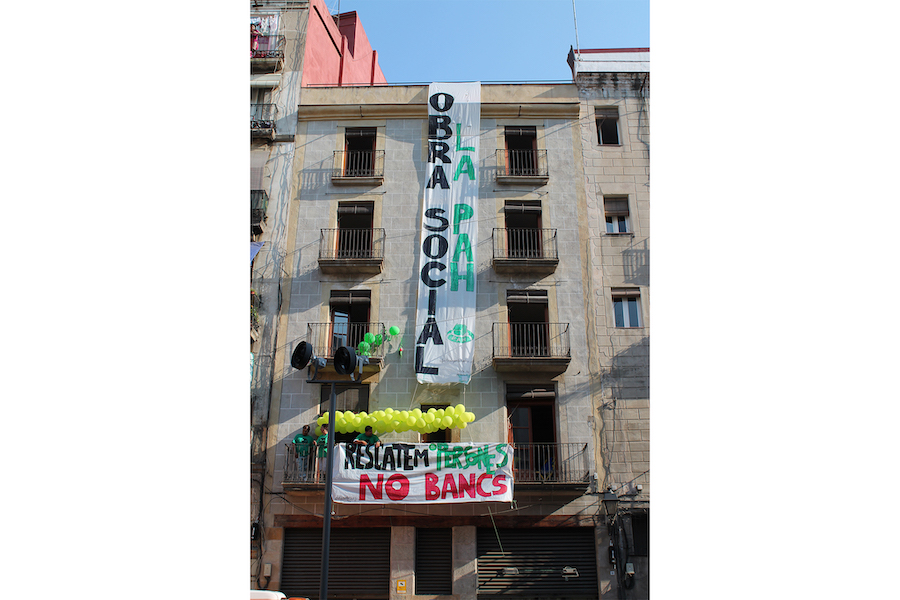
Hector was forty-eight at the time of our interview and his family was able to get what many families desired at La PAH: cancelling their mortgage debt after being foreclosed. In Spain, mortgage law dictates that a mortgaged home is not the sole collateral to a debt. A bank can collect on any remaining debt after the house is auctioned. The predatory nature of this law translated into debts in the hundreds of thousands for my interlocutors after having lost the property. So, full cancelation of a mortgage debt felt, indeed, like a “victory”—as Hector put it. Oddly then, most Latin-American migrants end up celebrating losing their house to the bank in exchange for a full debt cancellation. However, Hector came to another realization right at the same time: he and his family had no place to live. His wife’s monthly income of 600 euros could not pay for a place to rent, not if they wanted to pay the bills and have enough to live. They were left with one option: La PAH’s Obra Social, a project based on the re-occupation of buildings belonging to banks rescued with public funds and which sat empty for years. The idea was to relocate families like Hector’s. The name of La PAH’s project is a play on words. Every large bank in Spain has an ‘Obra Social’, a philanthropic entity supporting cultural events or alleviating social problems. In Catalonia for instance, they often funded Catalan language promotion or similar social events. La PAH thought it would establish its own strategy for solving real social problems by occupying empty buildings and using them for what they saw as its intended purpose: to house people.

Image 1: La PAH’s Obra Social, © Maka Suarez

La PAH’s Housing Reoccupation project for evicted families was criticized by both the left and the right. For leftist and long-term squatters, it was not radical enough because the strategy was not a permanent reappropriation. For conservatives, occupation was a crime and a threat to private property. For my interlocutors, it was a respite but not an optimal solution. Hector’s family is just one example. There were a significant number of single-mothers and their children, unemployed or in low-paid jobs, which constituted the greater portion of subprime mortgages in Spain (and other places like the US). When I interviewed Hector and his family, they had been living in the occupied building for four months. The experience had been very difficult for them, and they hoped to buy an apartment again in the future. Hector was just one case among many people for whom homeownership was still the preferred housing option and a marker of success.  

Why did my interlocutors want to own a house or an apartment rather than occupying one or even renting it? To answer this question, I’d like to connect Debt with The Dawn of Everything. One of David’s most important invitations in Debt is to move away from an omnipresent language of debt. Thinking with David means questioning why people narrate their lives in the idiom of debt and examining whether and how an alternative approach is even possible. David goes to extraordinary lengths to illuminate the very mechanisms that prevent us from living without debt. The biggest endeavor of this book—to my mind—is showing us a path to freedom, real freedom we can already access if we choose to recognize that many “big theories” are in fact forms of reproducing a ruling class or the legitimacy of the state. David knew wholeheartedly that anthropology is uniquely well placed to document these sites of moral and monetary indebtedness.

In The Dawn of Everything, David along with David Wengrow, characterize freedom as the potential for doing things otherwise (something they see taking three primary forms). First, freedom to move or relocate, the idea of being free to leave a place in the face of danger or otherwise. Then, freedom to refuse orders or how not to be bound by hierarchy. Finally, freedom to shape new social realities by choosing what is at the center of our existence. I’m interested in following here the first freedom, freedom of movement, as it is key in understanding why Latin-American migrants became indebted in the first place and why they would consider doing it again today. There are two key moments in Latin Americans’ migratory journey in which debt is essential for moving. First, when they decide to travel (irregularly) to Spain. The trip required anything between 4,000 and 5,000 US dollars which were almost invariably a debt acquired in their countries of origin to move to Spain. The second moment is buying a mortgaged property. To bring their families from Latin America to Spain, migrants needed to show adequate proof of housing, buying a home was the fastest route to reunifying with their loved ones, mainly moving children from Latin America to Spain. Let me illustrate this with another ethnographic vignette.

“The thing is I didn’t even want to buy a flat, I was trying to rent one,” said Juan. He had been trying to rent a flat in order to bring his wife, Paulina, and their three children from Ecuador to Spain under a family reunification scheme. They had been apart for nearly two years. It was his reunification application that pushed him to look for a new place to live since he needed to demonstrate to immigration services proof of suitable accommodations for his family in Spain. Like many other migrants, Juan was aware that it was not possible to accommodate family life in small bedrooms that were often no more than lined, adjacent mattresses on the floor, or a few bunked beds in a room. Migrants’ usual shared rentals were legally (and physically) inadequate for bringing families to Spain.

Juan wanted to rent a flat because he thought he would not qualify for a mortgage loan. To him, private property was a superior form of housing. But in addition, he was aware of the ease private property meant when faced with Spanish immigration services. Each autonomous community has its own process of showing proof of adequate housing. In Catalonia, the regional government, through its Department of Family and Social Wellbeing, was responsible for providing a report asserting the quality of housing. According to Juan, if one had a rental agreement, the Department sent someone to check your home to know that it was indeed as you described, that no other people lived with you, and that you were able to house others—particularly children. However, as Juan explained, if one had proof of property, they never sent anybody to check anything at all.

Reading David’s three books together allows me to reflect upon this double-bind of debt as the absence of freedom and its condition of possibility. I want to circle back to David’s initial question: why was this movement so effective in organizing around debt? As an activist of La PAH but also as an anthropologist, I believe the movement was effective because it stuck with the problem of debt. It never tried to solve it but showed when it became excessive and violent. The basic requirements that the movement has long advocated for include stopping home evictions without proper rehousing, making mortgaged properties the sole collateral to a loan, implementing rental caps, and increasing social housing availability.

Although the Spanish movement for the right to housing does not seek a debt jubilee, which David advocated for in his book, it offers us a space to politicize debt relations. David never dismissed the PAH as a bunch of reformists, which several leftist activists and scholars did and continue to do. David was more interested in how people organized around debt collectively than what people did with debt individually. It’s important to highlight that in over a decade, La PAH has gone from a small group of activists meeting weekly in 2009 to becoming the largest movement for the right to housing with over 220 nodes around Spain, and weekly assemblies that gather—to this day—thousands of individuals to discuss mortgage debt and political mobilization. La PAH is an effective intervention into a growing reality of financial predation, a movement that has learned to respond to injustice collectively, and a socially diverse space where ideological conceptualizations (of debt or occupation and others) can change.

La PAH is not an example of how David thought we should deal with debt, and yet David was always ready to learn from other people’s experiences and strategies. This was very much David. A self-absorbed but incredibly generous activist, mentor, scholar, and friend. While at Goldsmiths and the LSE, I often thought I had gone in for a supervision but came out knowing about Occupy, Rojava, or his friendship with Anton Newcombe—the lead singer from the Brian Jonestown Massacre. Yet, upon listening back to each one of our conversations – I recorded many – I found detailed guides for thinking differently about what I was working on. They didn’t seem terribly evident at the time because he was never telling me how to think. Rather, David was thinking with me based on his own ethnographic examples and political aspirations. This, I believe, is a perfect reflection of how he thought and wrote. He was never trying to tell people how to think but was inviting us into his own way of connecting seemingly disconnected phenomena, often going back several thousand years to do that.

Image 2: Alpa Shah, Maka Suarez and David Graeber, © Maka Suarez

I’d like to thank Jorge Núñez for thinking with me about many of the ideas advanced here, and Alpa Shah for the opportunity to engage with David’s legacy at a time when his ideas are greatly needed, and he is so dearly missed. To everyone here today thank you for choosing to do exactly what David said occurs in mourning and other acts of memorialization, these are an essential part of the labor of people-making. Let’s continue making our relationships to each other matter in ways that shape the futures we want to build. Thank you!


Maka Suarez is Assistant Professor in the Department of Anthropology at the University of Oslo, a fellow at the Institute for Advanced Study, Princeton, and a co-director of Kaleidos, Center for Interdisciplinary Ethnography at the University of Cuenca.


This text was presented at David Graeber LSE Tribute Seminar on ‘Debt’.


References

Graeber, David. 2004. Fragments of an Anarchist Anthropology. Chicago: Prickly Paradigm Press: Distributed by University of Chicago Press.

Graeber, David. 2011. Debt: The First 5,000 Years. New York: Melville House.

Graeber, David, and David Wengrow. 2021. The Dawn of Everything: A New History of Humanity. London, UK: Allen Lane an imprint of Penguin Books.

Suarez, Maka. 2017. “Debt Revolts: Ecuadorian Foreclosed Families at the PAH in Barcelona.” Dialectical Anthropology 41 (3): 263–77. https://doi.org/10.1007/s10624-017-9455-8.

Suarez, Maka. 2020. “‘The Best Investment of Your Life’: Mortgage Lending and Transnational Care among Ecuadorian Migrant Women in Barcelona.” Ethnos, February 1–19. https://doi.org/10.1080/00141844.2019.1687539


Cite as: Suarez, Maka. “Thinking about debt with David Graeber and La PAH.” FocaalBlog, 21 December. https://www.focaalblog.com/2021/12/21/maka-suarez-thinking-about-debt-with-david-graeber-and-la-pah/

Sophia Hornbacher-Schönleber: “A Matter of Priority”: The Covid-19 Crisis in Indonesia

Sophia Hornbacher-Schönleber, University of Cambridge

COVID-19 is wreaking havoc in Indonesia. The government ignored the crisis for too long, relying on a dubious religious discourse of divine protection. When it finally reacted, its response was unsystematic and favored economic stability over health and welfare measures. Although the government has neither imposed a strict lockdown nor the state of emergency, it is clamping down on critics during the crisis.

Continue reading

Sandro Mezzadra: Politics of struggles in the time of pandemic

A prolonged wait at the pharmacy, a long queue before entering a supermarket. Experiences like this, today increasingly common, can help us to see how the spreading of Coronavirus is transforming our society. Yet, more precisely, the global pandemic, and the measures put in place by the Italian government to attempt to counteract it, are in fact merely exacerbating tendencies that have already existed for a while. Recent decades, dominated by the politics of fear, have left their mark. This can be seen in the current fear of physical contact, or in the suspicious looks that guard over the “security distance” between people. Undoubtedly, such an anxiety of control strengthens the powers dominating our lives, and it is worth remembering that once governmental measures such as these are taken they become part of the arsenal of political possibility. Yet, other images have emerged as well, ones with profoundly different connotations. People on the street smile at each other, music is played from balconies, and a sense of solidarity surrounds not only doctors and nurses, but also factory workers on strike to defend the health security offered via their working conditions.

Continue reading

David Hamou and Ida Susser: Where to Catalonia?: Is this commoning? What for independence?

As we sit here in Barcelona, a historic center of anarchism and left resistance, the questions debated in the most recent Focaal special section “Exploring the urban commons” confront us. As demonstrators take to the streets following the unauthorized referendum for Catalonian independence, many of the people involved are fighting for a new independent state, others are demanding a people’s right to choose, and still others are protesting police brutality and the legacy of Franco represented by the current ruling party. Is this an instance of commoning, or is it an instance of nationalist exclusivity? The dilemma of the relation of nationalism to progressive liberation is an old one, but always historically contingent, and appearing in a new form in this exploration of the commons.

Continue reading

Jonathan DeVore: Reflections on crisis, land, and resilience in Brazil’s politics of distribution

Brazil is at a critical juncture. Improvements in social welfare that have been achieved over the past two decades threaten to recede as the Workers’ Party (Partido dos Trabalhadores, PT) is removed from power. Yet the goods that have been objects of Brazil’s various social programs recede and persist in different ways. Once given, some things are harder to take away.

Continue reading

Massimiliano Mollona: The end of the Latin American pink tide? An introduction

This post is the introduction to a series on the Latin American pink tide, moderated and edited by Massimiliano Mollona (Goldsmiths, University of London).

The twenty-first century opened with a wave of radical political mobilizations sweeping through Latin America and brought left-wing parties in power in Brazil (2002), Argentina (2003), Uruguay (2004), Bolivia (2006), Chile (2006), Ecuador (2006), Paraguay (2008), and Peru (2011). The so-called “pink tide” was the result of the massive societal mobilization against the dislocation brought by dictatorships in the 1980s and the radical privatizations and austerity measures pushed through by neoliberal social democracies in the 1990s. The core impulse of this new political phenomenon were the cross-sectional and horizontal alliances between anti-imperialist, white middle classes; the traditional labor movement; and indigenous, women, and urban organizations. The antiglobalization movement that emerged from the World Social Forum (WSF) was another central engine of the pink tide, in creating a liaison between parties and social movements, and renewing the labor movement by bringing together the traditional industrial trade unions and diverse sections of civil society. In power, left-wing governments across Latin America renationalized companies, set in motion massive programs of poverty reduction and urban participation, which empowered women, indigenous, and black minorities.

Continue reading