Tag Archives: religion

Jolien van Veen: Atmospheric Security in Rio de Janeiro

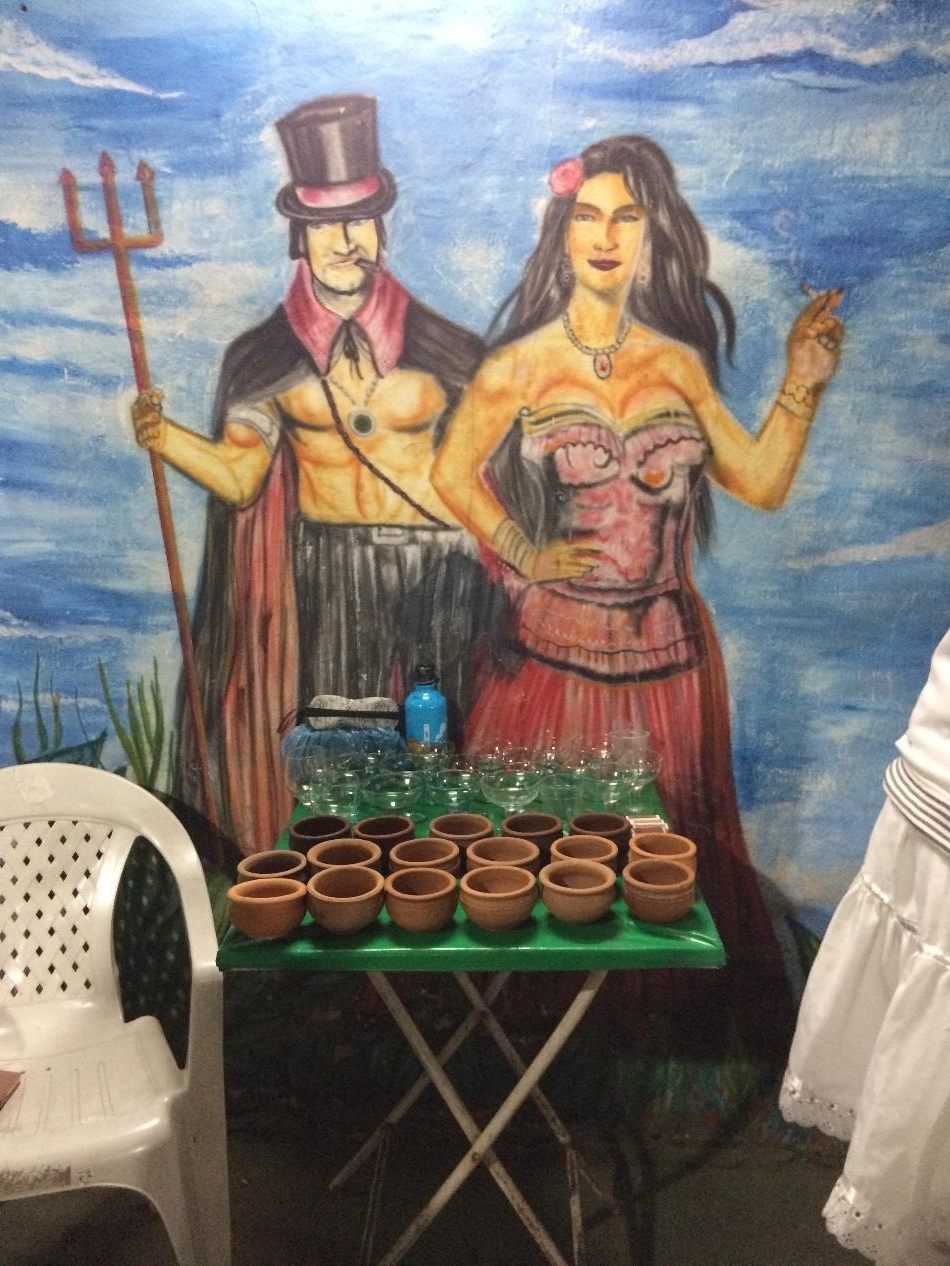
Image 1: Exú Tranca Rua (left) and Maria Padilha das 7 Encruzilhadas (right) depicted on the walls of the center. Photo by author.

When I started fieldwork in neighborhoods in Rio de Janeiro’s North zone in December 2021, the first thing my Brazilian friends told me was to be very careful. The area where I was based was notorious for its high number of armed robberies and for its proximity to a cluster of favelas. Shortly before my arrival in Brazil, the drug trafficking group that effectively controlled the favelas had expanded its territory by blocking roads and installing armed checkpoints at various street corners across the neighborhoods. The local leader (dono) of the group, who identified as a Pentecostal Christian, was accused of orchestrating disappearances, homicides, and extortions, and of destroying temples dedicated to Afro-Brazilian religious practices.

It was against this backdrop of violent events that I conducted an interview with Catarina, a frequent visitor of a local Umbanda center. Umbanda is an Afro-Brazilian religion that contains influences from Roman Catholicism, West-African religious traditions, indigenous beliefs, and Kardecist spiritism. In Umbanda, spiritual guides provide guidance and support on matters of health, money, love, and wellbeing. Catarina lived with her teenage daughter in a commercial district some 15 minutes away from the center, outside the zone of influence of the drug trafficking gang. As we sat in the patio of the center, shaded by the trees that surrounded the open space in front of the terreiro (indoor place of worship), I asked Catarina whether she hadn’t considered visiting a center located closer to her home in an area that was considered less dangerous. She responded the following:

There is a center close to me, which I visit sometimes, but I am not from that center. And I feel very much at peace here. Inside here, it doesn’t feel like I am in this particular neighborhood. It is as if a microclimate (microclima) was created inside here, with the trees and all that. Even if it takes forever for the sessions to start. If you arrive all worked up, inside here you are able to relax, think about life. And thank God, nothing has ever happened to us here. I think that is our protection (é proteção mesmo). Protection that the center gives, which the spirits (entidades) from here give until we arrive at our house. Because nothing ever happened when we left here. While everything is deserted, everything is black.

I was intrigued by Catarina’s attention to the atmospheric qualities of protection. Like other Umbanda practitioners whom I spoke to, Catarina spoke about the protection offered by the center as a material and embodied reality where the dangers of the street were temporarily kept at bay. This is a material and embodied reality that emerges through a series of ritual practices that involve an interplay between objects, bodies, and spirit entities, amongst other things. I offer two examples to illustrate the interplay between these different materialities inside the center.

Champagne and cigarettes

The largest altar in the Umbanda center was dedicated to a group of spirits known collectively as the spirits of the streets (povo da rua). It was located inside a separate building in the courtyard, closed off with an opaque door. The outside wall depicted a large mural painting of the Exú Tranca Rua, protector of the terreiros, and the pomba-gira Maria Padilha das 7 Encruzilhadas, guardian of love, protection, and courage (Image 1). Both figures play an important role in the center as they are called upon to cleanse the center from negative energies (limpar), to open new ways of thinking and being (abrir caminhos) and to shield practitioners from harm (proteger). Because of their ability to protect, the povo da rua are also referred to as guardian spirits (guardiões).

Different from other kinds of spirits, who emphasize benevolence and humility, the povo da rua embody sensuality as well as force. When they incorporate the bodies of the spirit mediums, they dance, smoke, drink, and flirt. To outsiders, the spirits’ human appetites are sometimes mistaken for sinful behavior and for provoking “bad things” (fazer mal). But for my interlocutors, “exú only does good things” (faz bem).

Inside the altar of the povo, a faint red light revealed a row of thirteen statues, representing particular spirits worshipped in the center. Twice a year, the povo receive an extensive offering (oferenda) from the spirit mediums to request guidance and protection for themselves or on behalf of a friend or a family member.

The offerings that I witnessed followed a specific order and were carried out individually. First, a big plate filled with tropical fruits was brought to the altar. The medium then took a pull of a cigarette to appease thefemale spirits. The remaining packet of cigarettes was placed alongside the plate of fruits on the altar. Next, the medium filled a glass of champagne. After taking a sip of the glass, the glass was also placed in front of the statues. To appease the male spirits, the medium took a pull of a cigar and exhaled in the shape of a circle. He or she then filled a glass of cachaça (white rum), took a sip, and placed it on the altar. In the final step, the spirit medium placed a handful of coins in a clay bowl. One of the coins was used to slowly move it over the body, starting with arms crossed, and then directing the coin over the head, knees, legs, and under one of the feet.

The individual offerings were complemented by the traditional food offering for exús, prepared in the small on-site kitchen: a big bowl of toasted manioc flour prepared in Dendê oil, filled with red chili peppers. Softly burning candles and vases filled with red roses and small white flowers were tucked in between the offerings (Image 2). According to the mediums, each of the items placed on the altar to feed the spirits absorbs the spirits’ capacity to cleanse and protect and contributes to the circulation of positive energy and spiritual force inside the center.

The process of preparing the offerings and placing them inside the altar took several hours. After about two weeks, once the offerings were received and “eaten” by the spirits, they were removed from the altar. The rotten fruits were discarded, and the ones that were still edible were taken back home. The flowers, cigarettes, candles, and manioc flower were dispatched near one of the city’s highway intersections, to serve those who wander through the city.

According to Zezé, one of the mediums who works at the center, the offerings to the spirits were not made in vain. When I spoke to him in an interview, he said the following:

The guardian spirits protect those who have faith. Up until today, inside here nothing bad has ever happened, while in the meantime a lot of bad things have happened outside. We’ve had cases where violence happened outside of the gate, shots were being fired, but not even the bullet shells made it in here. That, to me, is proof that this is a protected place.

Zezé’s words echoed those of Catarina. Despite the dangers that surrounded the center, in the comforting presence of the povo da rua, no bullets would pierce the center’s walls.
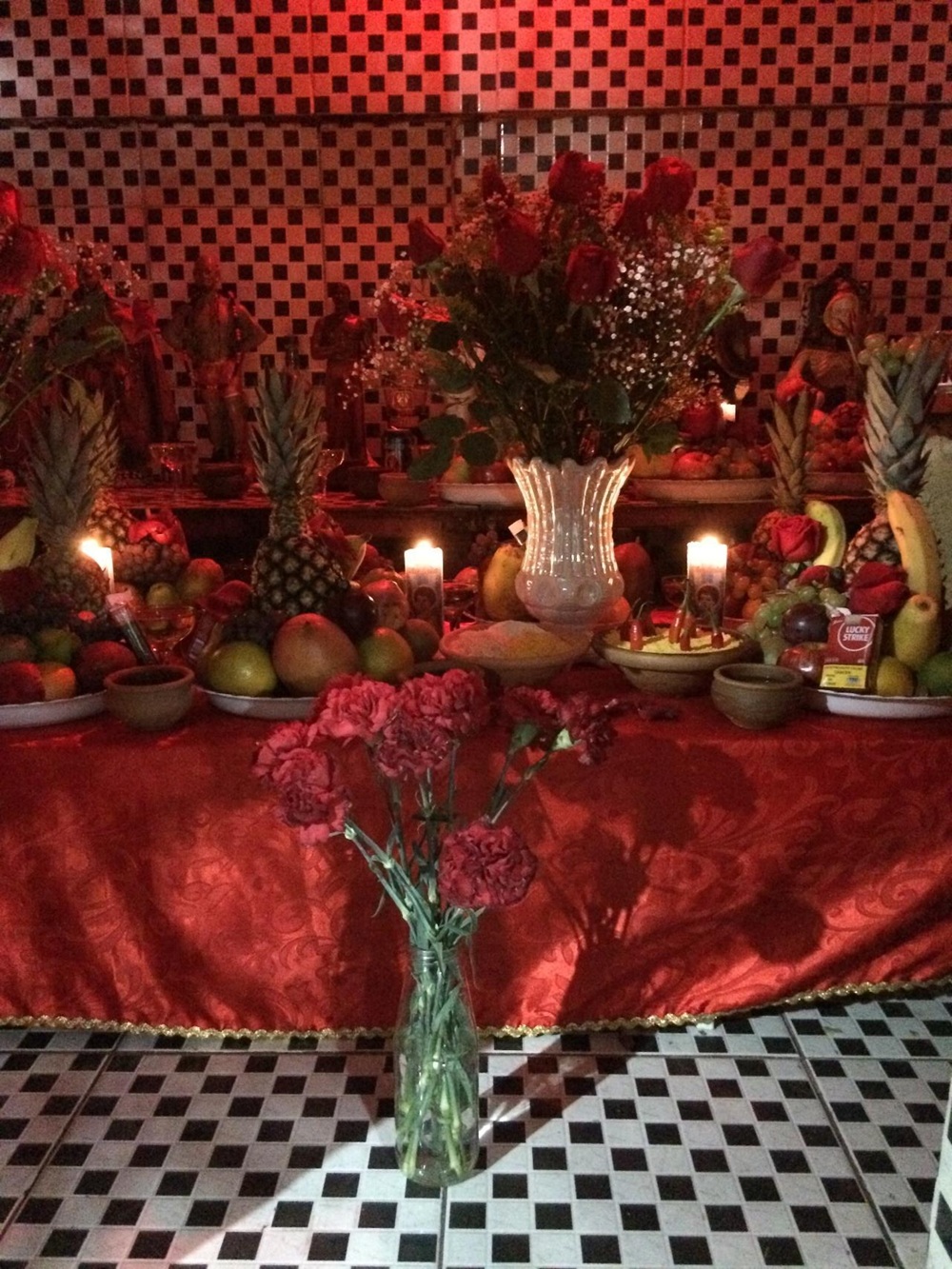
Image 2: Offerings for the povo da rua. Photo by author.

The swords of Ogum

Besides offerings to the spirits, mediums also channeled spiritual energy through incorporation sessions (giras). One of the sessions I attended at the center was dedicated to Ogum, an orixá associated with strength, courage, and battle. Inspired by African deities, orixás are at the top of the spiritual hierarchy in Umbanda. The session for Ogum was held in the indoor space adjacent to the courtyard where all the spirit incorporations took place. The entire room was painted light blue. Walls were covered with paintings, photos of mediums and visitors, and small spirit altars. A small sign right behind the door read “negative energies prohibited.”

Just like the other sessions, the session for Ogum started with a short prayer followed by drumming. The repetitive drum rhythm worked to induce a trance-like state amongst the mediums and the visitors. One by one, the spirits announced themselves through the bodies of the mediums, which were slowly moving towards the center of the room, with one leg lagging the other and their index fingers pointed out. Their reception was welcomed by the audience, whose clapping and singing grew louder as more spirits descended onto the room:

Eu tenho sete espadas pra me defenderI have seven swords to defend myself
Eu tenho Ogum em minha companhiaI have Ogum in my company
Eu tenho sete espadas pra me defenderI have seven swords to defend myself
Eu tenho Ogum em minha companhiaI have Ogum in my company
Ogum é meu paiOgum is my father
Ogum é meu guiaOgum is my guide
Ogum é meu paiOgum is my father
Na fé de ZambiIn the name of Zambi (the Creator)
E da Virgem MariaAnd the Virgin Mary

By the time Ogum finally announced his presence through the body of a medium it was already close to midnight. A spiritual caretaker guided Ogum to a room in the back of the building to prepare his costume. In the meantime, the other spirit mediums took a single leaf each from the sansevieria plant in the front of the room. A few moments later, Ogum re-entered the room with the air of a dignified man, wearing a red cape, a sword, and a knight’s helmet adorned with a red feather. The other mediums held up their leaves in the air and formed an arch (image 3). Carefully, Ogum was led under the arch and made his way to the front of the altar, where he greeted the mediums and the visitors with an embrace.

Towards the end of the session, the mediums handed each of the visitors one of the leaves to take back home and place it in front of their house. The “swords”, I was told, were considered as an extension of the protective power of Ogum cultivated during the session and served to protect the house from negative energies and to attract prosperity (prosperidade).
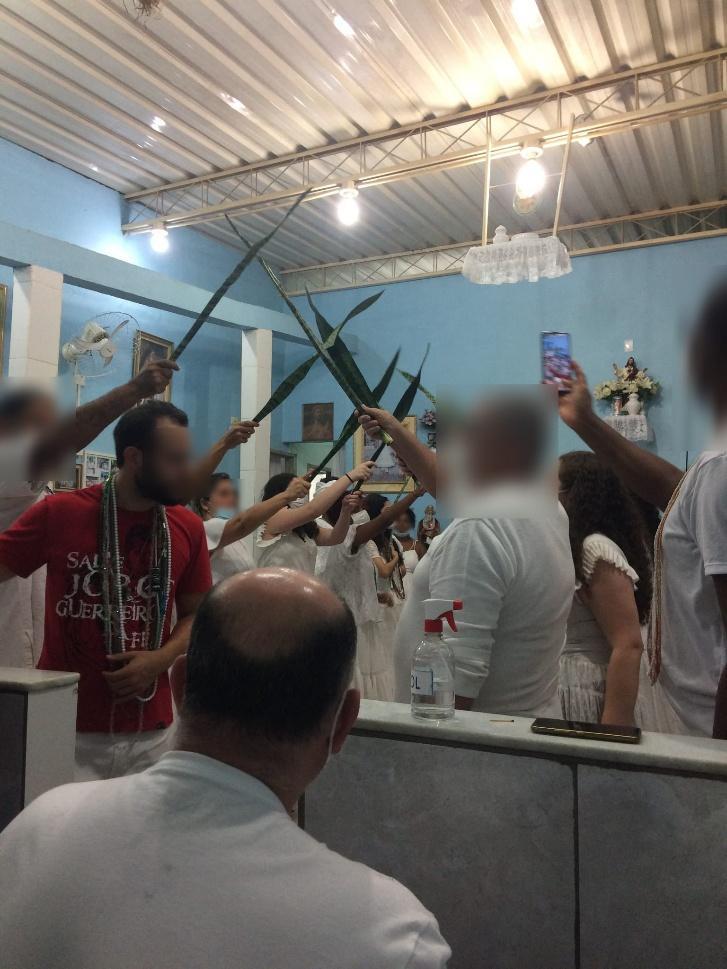
Image 3: The swords of Ogum. Photo by author.

Reflections

There is no shortage of people seeking protection and guidance in Brazilian cities, which statistics show are among the most violent on earth. Trapped between militias, drug trafficking groups, and the state, urban residents cultivate spaces where they feel safe, comfortable, and cared for. These spaces of security and comfort are rarely secular. They are inhabited by a range of otherworldly entities who are called upon to protect and to heal (see also Amoruso 2025. Willis 2024), including Afro-Brazilian spirits.

I have illustrated how Afro-Brazilian spirits and the mediums who incorporate them engage in affective relationships that contribute to a sacred, intimate space shielded from the dangers of the street. Each of the objects placed within the center takes part in this affective relationship in different ways: not merely in a symbolic manner, but by absorbing and circulating the spirit’s powers to cleanse, heal, and protect. The champagne and cigarettes on the altar dedicated to the guardian spirits become charged with spiritual powers, while the swords of Ogum, represented by the sansevieria leaves, become an extension of the protective power of the orixá.

My analysis moves from an understanding of security as something that is produced on the level of the state towards an understanding of security as something that is lived and felt in everyday interactions (see also Ghertner, McFann & Goldstein 2020: 3). Moreover, like Anderson (2009), I draw attention to the atmospheric quality of security as an affect that emerges between objects, bodies, and spaces. For ethnographers, it is essential to do justice to the ways in which the senses shape our everyday experiences and ontological realities.


Jolien van Veen is a PhD researcher at the department of Cultural Anthropology at Utrecht University. Her PhD is part of the ERC-funded project “Sacralizing Security: Religion, Violence and Authority in Mega-Cities of the Global South”. She has published in City & Society and the European Review of Latin American and Caribbean Studies.


References

Amoruso, Michael. 2025. Moved by the Dead: Haunting and Devotion in São Paulo, Brazil. University of North Carolina Press.

Anderson, Ben. 2009. “Affective Atmospheres”. Emotion, Space and Society 2: 77-81. DOI:10.1016/j.emospa.2009.08.005

Ghertner, D. Asher, Hudson McFann, and Daniel M. Goldstein, 2020. Futureproof: Security Aesthetics and the Management of Life. Duke University Press.

Willis, Laurie Denyer. 2023. Go With God: Political Exhaustion and Evangelical Possibility in Suburban Brazil. University of California Press.


Cite as: Veen, Jolien van 2025. “Atmospheric Security in Rio de Janeiro” Focaalblog December 22. https://www.focaalblog.com/2025/12/22/jolien-van-veen-atmospheric-security-in-rio-de-janeiro/
Elena Maria Reichl: End of Hell? Brazil’s Election and a Community Kitchen of the MTST

On 30/10/2022, Luiz Inácio Lula da Silva (Lula) of the Workers’ Party won an exceptionally close runoff election against the current far-right president of Brazil, Jair Messias Bolsonaro. For volunteers of a community kitchen (Cozinha Solidária) of the leftist Homeless Workers Movement (MTST), Lula’s victory represents an enormous relief and a hope after the long period of anxiety during the election campaign. Nevertheless, his victory does not mean “the end of hell or the entrance into paradise”, as Maria (all names are pseudonyms), one of the volunteers cooking in a Cozinha Solidária noted.

The hell she speaks of means the years of the Bolsonaro government, in which almost 700,000 people in Brazil died of Covid-19, while the president made jokes about patients with respiratory distress. Hell, moreover, means the hunger that the women themselves experience and fight in their volunteer work. In recent years, Brazil has returned to the world hunger map of the United Nations. According to the Brazilian Research Network on Food and Nutritional Sovereignty and Security, circa 30% of Brazilian households are currently food insecure. In addition to the Covid-19 pandemic, suspension of state welfare programs, inflation and price increases have led to this development. The aftermath of this period will not be over when Lula takes office early next year.

Hell and paradise are metaphors that reflect the volunteer’s worldview, which is strongly influenced by the Christian system of belief. The all-female chefs of the Cozinha Solidária where I conduct ethnographic fieldwork since March 2022 regularly frequent Catholic or Evangelical churches. Besides that, the women are also part of the political struggle for housing in demonstrations and occupations of urban land. In their everyday lives, they balance left-wing political militancy and religiosity. They are politicized through the social movement and entrenched in their peripheral community. All the kitchen’s volunteers working there currently are also mothers and most of them work or worked in paid cleaning jobs in addition to their volunteer work.  

In this article, I portray the period between the first round of voting on 2/10/2022 and the runoff. How did the cooks negotiate the fear of a second electoral victory by Jair Bolsonaro? A look at the Cozinhas Solidárias sheds light on the positioning of hunger and domestic labor within the election campaign. The perspective of the cooks’ stresses the importance of religiosity to people’s lives and political decisions. After localizing the Cozinhas Solidárias within the Homeless Workers Movement and explaining their emergence and functioning, I consider reflections and concerns about the election, starting from the perspective of the cooks, to arrive at an assessment of the consequences of the election results.

Cozinhas Solidárias of the Homeless Worker’s Movement

The Homeless Workers Movement (MTST) was officially founded in 1997 as the urban counterpart of the rural reform movements of the Landless Workers Movement (MST). The first occupation took place in Campinas, a city close to São Paulo. Nowadays, the MTST is present in 13 Brazilian states, but most occupations are still concentrated in and around the city of São Paulo. The strategy of the movement is to occupy unused land in the periphery of large cities and to obtain expropriation with reference to the legally established duty of fulfilling a social function of the inner-city areas.

Victor Albert traces the history of the movement: In the first decade after its founding, it had little success with the strategies of the Landless Workers Movement. This changed, on the one hand, because of social mobilizations during the housing market crisis and the 2013/2014 World Cup, and on the other hand, primarily through cooperation with the Lula government’s state housing program Minha Casa Minha Vida. The movement was often able to obtain home ownership for the squatters through the State Program and thus acted as an agenda for identifying new building land for the state program.

During Jair Bolsonaro’s administration, which replaced the Minha Casa Minha Vida program with the Casa Verde e Amarelo loan program and classified the MTST as terrorism, their construction projects from the Minha Casa Minha Vida era continued to be completed, such as 216 apartments in São Paulo’s West Zone in March 2021.

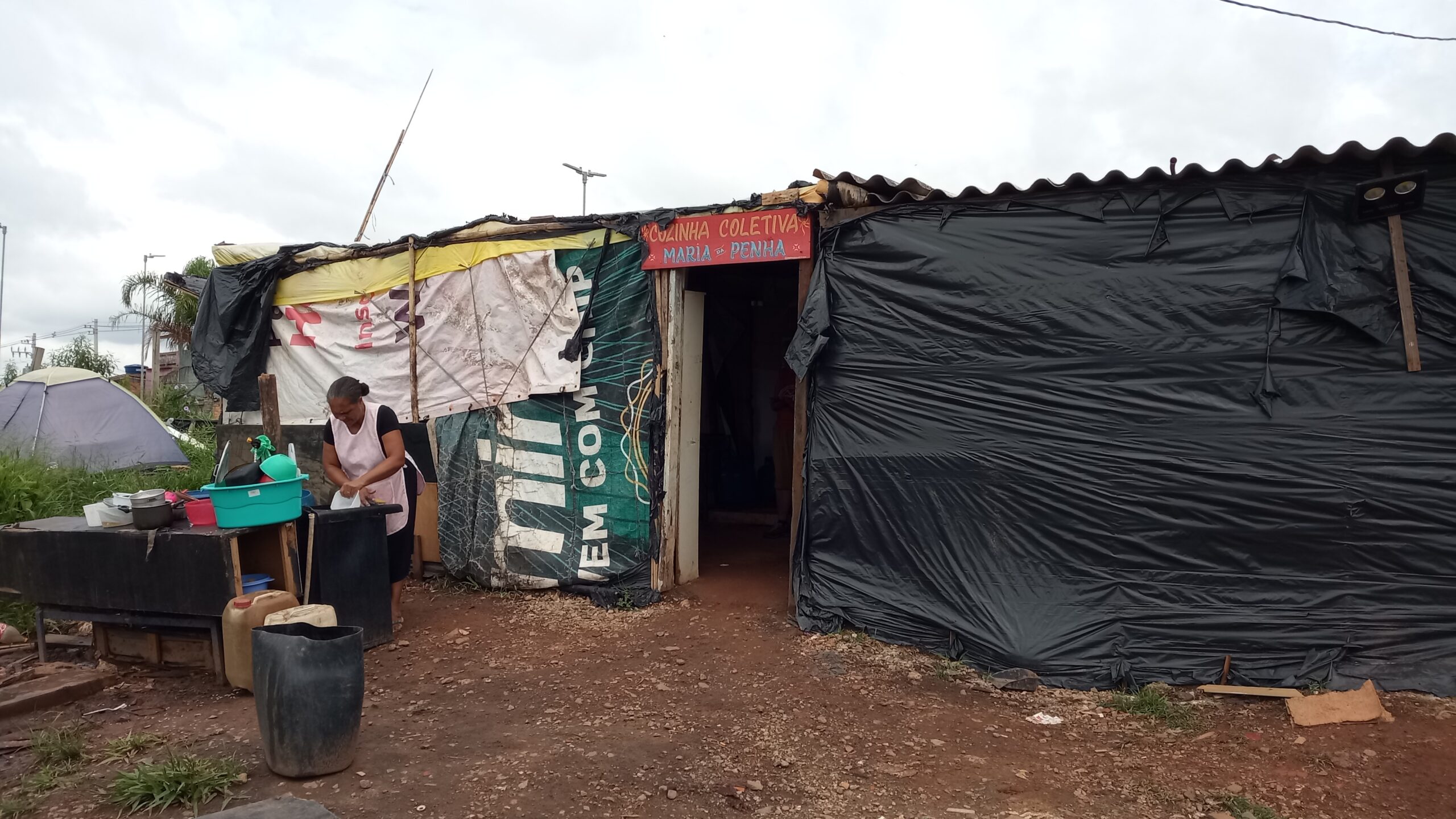
Figure 1 Kitchen as part of occupation
Figure 1 Kitchen as part of occupation, Photo: Elena Reichl March 2022
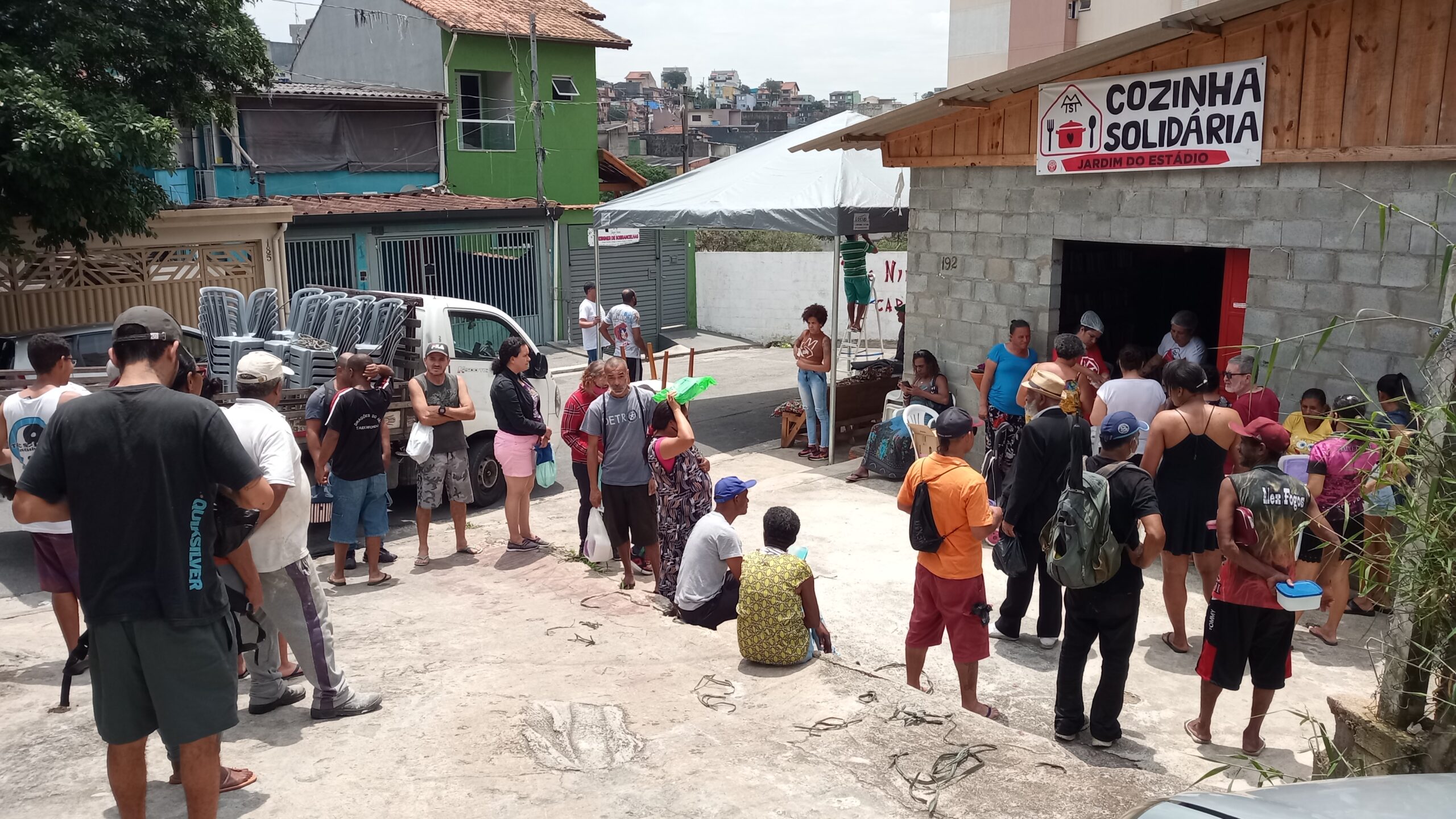
Figure 2 Cozinha Solidária at lunch time
Figure 2 Cozinha Solidária at lunch time, Photo: Elena Reichl October 2022

The idea of Cozinhas Solidárias was already inherent in the community kitchens that are part of every land occupation of the movement.  The occupations of new land areas begin with the construction of tents made of tarpaulins and bamboo. In newly emerged occupations, community kitchens are the first shanties to be set up to nurture the squatters and provide a place of political organization and community economy. Each occupation has numerous of these kitchens, which are the heart of the groupings, the small neighborhoods within the barrack settlements. The kitchens inside the squats are primarily for the squatters who run and finance them.

What is new about the Cozinhas Solidárias is that they now address the peripheral neighborhoods outside the occupations. Diverse people from the nearby neighborhoods frequent the cozinhas solidárias, for example schoolchildren, old people, or workers at their lunchbreak. They pick up hot lunches for free that were prepared and distributed by volunteers like the women mentioned in the beginning of this article. The Cozinhas Solidárias acquire their donations in the form of money from large-scale campaigns and as crops by collaborations with, for example, supermarkets and the MST. Cozinha Solidarias’ dependence on food has brought the MST into close contact with its urban counterpart.

The Homeless Workers Movement founded the first Cozinha Solidária in São Paulo in March 2021, during the peak of the Covid-19 Pandemic, under the motto highlighted by MTST coordinator Guilherme Boulos, “we do what the government does not“. The movement now operates 31 of these kitchens throughout Brazil. By expanding to peripheral neighborhoods in general, the movement claimed a direct confrontation of the cutbacks in state welfare programs under the Bolsonaro government.

Hunger was particularly central to Lula’s election campaign, highlighting how his earlier government had helped to remove Brazil from the United Nations world hunger map, on which the country turned back after the election of Bolsonaro in 2018. In fact, it was through Bolsa Família, as Massimiliano Mollona elaborates,that this government from 2003 to 2008 reduced the population rate below the poverty line from 36 percent to 23 percent. Bolsa Família incorporated the preceding Zero Hunger “Fome Zero” program in 2003 and, as Anthony W. Pereira argues, promoted the democratization of citizenship claims through effective, relatively unbureaucratic redistribution. On the other side, Bolsonaro has introduced the social program Auxilio Brasil at the end of 2021, which is modeled on Lula’s Bolsa Familia but without any long-term strategy or monitoring and therefore has beencriticized as an election campaign method.

Before the Runoff Election

A morning a few days after the first round of voting in one of the cozinhas solidárias in the periphery of São Paulo: In addition to preparing rice, beans, chicken, and fried cassava, we talked about Bolsonaro’s visit to the Freemasons. The video is from Bolsonaro’s 2017 election campaign but gained popularity only in October 2022 via its rapid spread on social media. The context mattered little. Bolsonaro had been campaigning for votes among Freemasons and rumors were spread that he might be a member.  We chatted about the experiences some of the women had as cleaners for members of the Freemasons whom they accused of performing diabolical rituals. On the subject of religion, we also came to a remark that one of them had overheard during services in their parishes: Their pastor had announced that whoever voted for Lula would go to hell.

Ludmilla was indignant: “The place for priests is in the church. What is this about politics?” “They won’t vote for him [Jair Bolsonaro] because of the Freemasons” Retorted Maria.  Ludmilla: “I am afraid that they might do it after all.”

Jair Bolsonaro has many evangelical supporters who, as some of the cooks, consider the Freemasons a diabolical sect and hence expressed their disappointment. On a more general level, religiousness played a key role in the election campaign. Padre Kelmon, who was denied the recognition as a priest by the Catholic Church, ran for president as one of the eleven candidates of the first electoral round. He just received 0.07 % of the valid votes and was called a “folkloric candidate”. For Bolsonaro’s election campaign, his candidacy nevertheless had an important function. He supported Bolsonaro during the first TV Globo debate, to which all candidates were invited. Instead of asking critical questions, he accused Lula of wanting to establish an anti-religious dictatorship in Brazil. Lula, meanwhile, tried to win over conservative church followers through critical statements on abortion and Christian affirmations, as he recently did in a letter to evangelicals.

In the community kitchen, I hear different Christian songs sung by the women every day. “God bless you” is a common phrase used by those receiving the hot lunches, to which the cooks respond with “Amen”. Unlike the students and coordinators of the movement, for whom religion takes a back seat to communist utopias, the cooks and squatters balance left-wing political commitment and the struggle for housing with religious affiliations in their work.

A domestic worker comments on the election

For Lula’s election campaign, starvation, but also ‘gusto’, was a central theme. During this election, Lula’s repeated statement that the people must be able to eat picanha and drink beer again became famous. Ludmilla, a cook at the community kitchen before the runoff election, said she talks to Lula when she sees him on TV. “Lula, stop talking about picanha. When did I eat picanha? Lula, I cleaned the toilet of my patron [where she worked as a maid] during your government.”

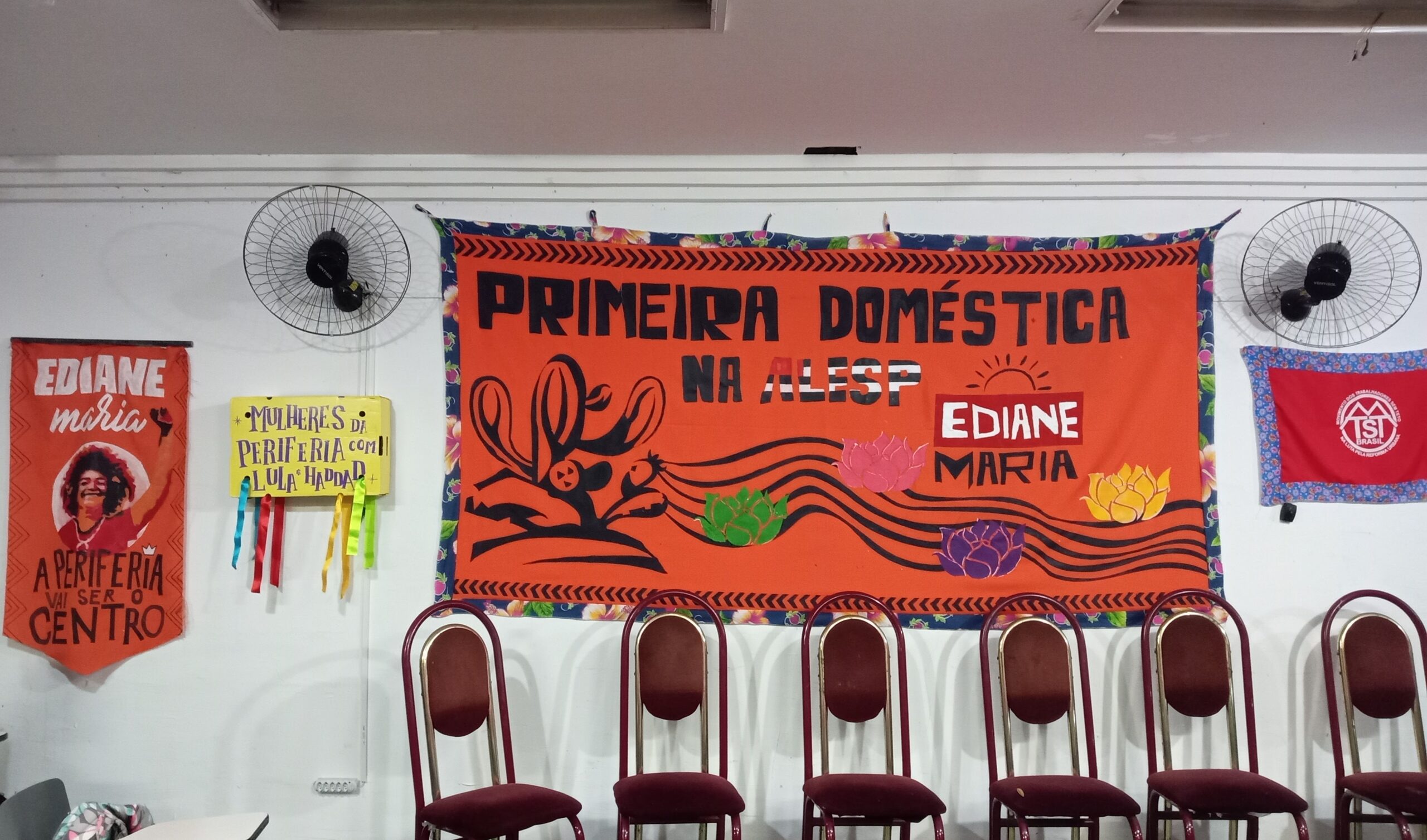
Figure 3 Banner that says “First domestic worker in the Legislative Assembly of São Paulo” at the event “Women from the periphery with Lula and Haddad”, in which some cooks of Cozinha Solidária participated, Photo: Elena Maria Reichl, October 2022

Although she supports Lula, she feels unrepresented by his promises of the return of expensive barbecue after the huge price increase during the Bolsonaro regime. Actually, picanha has never been part of her lifeworld. Domestic workers, who are for the first time politically represented in Brazil, gain more political and class-consciousness. In the first round of voting, PSOL candidate, former domestic worker, and occupant of the MTST Ediane Maria, won the post of State Representative in the Legislative Assembly of the State of São Paulo as the first domestic worker to occupy this political position. Like Ludmilla, Ediane Maria had migrated to São Paulo from Brazil’s northeast to work as a domestic worker. Ediane Maria will now represent Ludmilla’s perspective in São Paulo. No easy task in a parliament where the PL, Bolsonaro’s party, won by far the most votes.

Anti PT and “anti-establishment” propaganda

The outcome was close, with Lula winning 50.9% and Bolsonaro 49.1% of the vote. Bolsonaro’s party’s most effective campaign method still seemed to be the “anti-corruption agenda” Flávio Eiró already analyzed after the 2018 election.

Although the court case that led to Lula’s conviction was annulled as illegal in 2021, opposition to Lula’s PT party because of corruption scandals remains widespread. This is despite the fact that Bolsonaro has also been accused of institutionalized corruption, namely the use of public funds in the form of secret budgets to buy approval in Congress.

Bolsonaro still manages to position himself as ‘anti-establishment’ in front of large segments of the population, who spread the slogan “PT never again” and in the aftermath of the election “crimes pay off in Brazil” on the internet. Widespread among his electorate is also a rejection of conventional media and academia. Election forecasts predicting a higher approval rating for Lula than he actually received in the first round of voting confirmed this skepticism. The Tribunal Superior Eleitoral’s decision to cut Bolsonaro’s TV time due to fake news also fuels the debate about media bias. Bolsonaro supporters were already acting violently in some cases, such as federal deputy Carla Zambelli, who a few days before the election chased a black journalist with a firearm under the pretext that he had pushed her.

The End of Hell?

During this interim period between the two votes one clearly sensed the fear that Bolsonaro might not recognize the election results, as he had already spread rumors that the ballot boxes were rigged.  On day one after the elections, while Bolsonaro remained without statement about his loss, his supporters blocked roads within the country to protest alleged electoral fraud. Attempts at electoral fraud did indeed occur, but not on the part of PT supporters: The electoral court investigates against the federal police, who blocked roads for hours in the northeast and near indigenous communities, from where most votes for Lula were expected, under the pretext of carrying out road controls.

Even without a coup, Lula’s victory will mean hard work against right-wing fronts in state and federal parliaments, but above all against what is called ‘bolsonarismo’ in society. The cooks of Cozinha Solidária are well aware of this. Nevertheless, there will be relief for their movement when Lula takes office next year. He has already announced his intention to rehabilitate the program Minha Casa, Minha Vida. Fighting hunger was moved again to the center of the political agenda. Currently, discussions are underway within the MTST to make Conzinhas Solidarias a public policy and to hire the cooks on a regular basis until the acute hunger crisis is resolved. This would mean the end of dependence on donations and volunteerism. Lula, who had already visited a Cozinha Solidária this year, nurtured hope for this possibility.


Elena Maria Reichl is a PhD candidate in Social Anthropology of the Johannes Gutenberg-University in Mainz, Germany, and member of the Project „Sorting with Care. Human Categorization in Post-Humanitarian Contact Zones“ that is part of the Collaborative Research Centre 1482 “Studies in Human Categorisation” funded by the German Research Foundation.


References:

Albert, Victor. 2018. “Brazil’s Homeless Workers’ Movement is an assertive social work organization.” FocaalBlog, 30 November. www.focaalblog.com/2018/11/30/victor-albert-brazils-homeless-workers-movement-is-an-assertive-social-work-organization

Balloussier, Anna Virginia; Seabra, Catia and Victoria Azevedo. 2022. Lula Releases Letter to Evangelicals and Rejects Abortion and Lying Pastors. Folha de São Paulo, 20 October. https://www1.folha.uol.com.br/internacional/en/brazil/2022/10/lula-releases-letter-to-evangelicals-and-rejects-abortion-and-lying-pastors.shtml

Boulos, Guilherme. 2021. “Cozinhas Solidárias: fazendo o que o governo não faz” Instituto para Reforma das Relações entre Estado e Empresa (IREE), 22 March. https://iree.org.br/cozinhas-solidarias-fazendo-o-que-o-governo-nao-faz/

Campos Lima, Eduardo. 2022 “Brazil presidential contenders slug it out over who’s the real ‘enemy’ of the church” Crux, 1 October. https://cruxnow.com/church-in-the-americas/2022/10/brazil-presidential-contenders-slug-it-out-over-whos-the-real-enemy-of-the-church

Eiró, Flávio. 2018. “On Bolsonaro: Brazilian democracy at risk.” FocaalBlog, 8 November. www.focaalblog.com/2018/11/08/flavio-eiro-on-bolsonaro-brazilian-democracy-at-risk.

Extra. 2022. Padre Kelmon recebe mais de 81 mil votos pelo Brasil; relembre outros ‘candidatos folclóricos’ que marcaram eleições. Globo Extra 3 October https://extra.globo.com/noticias/politica/padre-kelmon-recebe-mais-de-81-mil-votos-pelo-brasil-relembre-outros-candidatos-folcloricos-que-marcaram-eleicoes-25582731.html

Folha de São Paulo. 2022. O que a Folha pensa: Recauchutagem ruim. Folha de São Paulo, 28 October. https://www1.folha.uol.com.br/opiniao/2022/01/recauchutagem-ruim.shtml

Globo. 2022. Grupo denuncia Carla Zambelli por racismo em caso que ela apontou arma para homem em SP; ‘Eles usaram um negro pra vir em cima de mim’, diz a deputada. Globo, 29 October. https://g1.globo.com/sp/sao-paulo/noticia/2022/10/29/grupo-denuncia-carla-zambelli-por-racismo-em-caso-que-ela-apontou-arma-para-homem-em-sp-eles-usaram-um-negro-pra-vir-em-cima-de-mim-diz-a-deputada.ghtml

John, Tara. 2022. Brazil’s election explained: Lula and Bolsonaro face off for a second round in high stakes vote. CNN, 27 October.

Mollona, Massimiliano. 2018. “Authoritarian Brazil redux?” FocaalBlog, October 6. www.focaalblog.com/2018/10/06/massimiliano-mollona-authoritarian-brazil-redux.

Netto, Paulo Roberto. 2022. TSE cobra explicações da PRF sobre operações durante eleições após decisão. UOL, 30 October. https://noticias.uol.com.br/eleicoes/2022/10/30/tse-explicacoes-prf.htm

Pereira, Anthony W. 2015. Bolsa Família and democracy in Brazil. Third World Quarterly 36 (9): 1682-1699, doi: 10.1080/01436597.2015.1059730

Phillips, Tom. 2022. Fears Bolsonaro may not accept defeat as son cries fraud before Brazil election. The Guardian. 27 October. https://www.theguardian.com/world/2022/oct/27/jair-bolsonaro-brazil-election-fraud-claim

Romani, André. 2022. Com Bolsonaro ainda em silêncio, bloqueios de caminhoneiros ganham força e se espalham pelo país. UOL Economia. 31 October https://economia.uol.com.br/noticias/reuters/2022/10/31/protestos-interditam-br-163-e-trecho-da-dutra-apos-eleicoes.htm

Rizek, Cibele and André Dal’Bó. 2015. The Growth of Brazil’s Homeless Workers’ Movement. Global Dialogue. 22 February https://globaldialogue.isa-sociology.org/articles/the-growth-of-brazils-homeless-workers-movement Soprana, Paulo. 2022. Bolsonarists Freak Out over Video of President in Freemasonry. Folha de São Paulo. 4 October. https://www1.folha.uol.com.br/internacional/en/brazil/2022/10/bolsonarists-freak-out-over-video-of-president-in-freemasonry.shtml


Cite as: Reichl, Elena Maria 2022. “End of Hell? Brazil’s Election and a Community Kitchen of the MTST.” Focaalblog 2 November. https://www.focaalblog.com/2022/11/02/elena-maria-reichl-end-of-hell-brazils-election-and-a-community-kitchen-of-the-mtst/

Valentina Napolitano & Kristin Norget: Pope Francis, Reconciliation, and the State

At the end of July, a remarkable event unfolded in three distinct but significant sites in Canada. Pope Francis, the Argentinian current supreme pontiff of the Roman Catholic Church, travelled to Maskwacis, Ste. Anne de Beaupré and Iqaluit on his “penitential pilgrimage” in Turtle Island (the Indigenous name for North America), an historic visit intended to allow for “forgiveness” for the heinous acts at Catholic Residential Schools which for over almost a century (1885-1996) separated thousands of Indigenous children from their families and communities and subjected them to awful physical, emotional, and sexual abuse.

The event earned some attention in the media internationally and in Canada, where it monopolized national and local airwaves and the Internet. The media drummed up popular fascination, in “will he, or won’t he?” fashion, with the potential Apology from the Pope – a possibility planted earlier this year in March when a delegation of members of 32 First Nations, Métis and Inuit communities visited the Vatican and met with the Pope to share their experience in residential schools and express the importance of a formal papal declaration of apology in their homeland. Part of the delegation’s aim was a call for the rescinding of the 1492 Treaty of Tordesillas and its accompanying “Doctrine of Discovery”, which originally endowed early Christian explorers the legal authorization to occupy and extract from a supposed ‘terra nullius’.

We draw attention to the need for anthropologists and other scholars to recognize the importance of what is at stake in this papal event as a culmination of colonial histories and processes that are not merely “religious”. While many may read the papal visit as simply an enactment by an archaic religious institution breathing its last breaths on the global stage, there is much more at work here that touches on the most pressing issues of our day concerning (self-)sovereignty, governance and decolonization, and the powerful hidden theopolitical economy of bodies, blood and soil, and the commons that underlies them. As such, this papal visit and other prominent public Church performances also invoke, implicitly though distinctly, themes familiar to many anthropologists in our thinking and research: debt and guilt, capitalism and care, denizen-ship and vulnerability.

A Pope is never a single story, nor a truly singular individual. Technically, the Pope is the Bishop of Rome, in straight lineal descent from Saint Peter, making him a unique combination of the historical person, the geopolitical configuration of the Church (as sovereign of the Vatican City State), and the liturgical, “God-manifested” investiture of the Pontificate. While many regarded the Second Vatican Council (1962-1965) as marking a pivotal rejuvenation of the Church and a welcome modernizing shift toward reform and social engagement, the two pontificates that followed Vatican II dampened any such hopes. Both Pope (and now Saint) John Paul II (1978-2005) and Pope Benedict XVI (2005-2013) manifested ambiguous stances toward Indigenous people and the deep histories of violence, neglect, and exploitationin the Americas.

John Paul II, personally invested in a post-cold war politics of anti-communism, was a staunch defender of ‘human life’ as a universal value rather than something to be understood as mediated by social and cultural specificities. He travelled to some 120 countries and oversaw an unprecedented surge in the canonization of new saints, including in the Americas. Yet in this continent he also undid years of efforts by more ‘progressive’ Church factions in promoting participatory democracy, land rights advocacy, human and Indigenous rights, and in the fight against poverty and neoliberal policies of international structural adjustment – the broad canvas of programs that theologically and pastorally became known as part of the movement of Liberation Theology. John Paul II’s geopolitical orientation toward Turtle Island could be summed up by his words during a brief visit in 1984 where, in Ste. Anne de Beaupré, he stated, rather elliptically, “We know that Jesus Christ makes possible reconciliation between peoples, with all its requirements of conversion, justice and social love. If we truly believe that God created us in his image, we shall be able to accept one another with our differences and despite our limitations and our sins.” Reconciliation for this pope was thus fundamentally a repairing enabled by the sweeping of vexing “differences” and past evils under the supposedly apolitical carpet of a transcendent universal (European) catholicity.

In contrast to his predecessor, Benedict XVI appeared more interested in the “Arab world” rather than the Americas, which he visited only briefly twice (Brazil in 2007, and Mexico in 2012, en route to Cuba). In travels to Lebanon, Syria, and Germany he worked to encourage, not always successfully, Christian-Muslimdialogue, visibly more at ease as a theologian rather than a pastor surrounded by a crowd. More generally, he had an infamous role in partly covering priestly sexual abuse before becoming Pope, but also, perhaps unknown to many, while Pope, tried to address the abuses committed within and by members of new 19th and 20th century religious Orders (such as the Congregation of the Legionaries of Christ and their founder Marcial Maciel) that had been much in the grace of John Paul II.  The “traditionalism”–in both theological orthodoxy and disposition – of this German Pope also served to bolster the “old”, pre-Reformation Orders within the church and affirmed the Christian roots of Europe and its ‘civilization’. Yet when Benedict XVI met a First Nations delegation visiting the Vatican in 2009 (headed by then National Chief of the Assembly of First Nations, Phil Lafontaine), the pontiff expressed a heartfelt shame and sorrow for the suffering of those living with the tragic legacy of Catholic residential schools, and blessed sacred medicine brought by delegation members. However, the Pope’s utterance of remorse took place on Vatican soil, as part of a private visit, not an act of attempted reconciliation on Turtle Island.

When Francis became Pope, however, the world expected something different. As the first Latin American Pope, with a theological and pastoral proximity to the poor and the “peripheries” (though with an unclear association with Argentina’s military regime while Provincial of the Jesuits in Buenos Aires), it was thought he could open the magisterium of the Church to an embracing of the divorced, homosexuality, the ordination of women priests, and the tackling of priestly sexual abuses, while setting in motion a concrete system of reparation. Now, amid the ninth year of his pontificate, an opening on these matters has been only partial.

Nevertheless, Pope Francis has called attention to capitalism’s “culture of waste” and our universal denizen-ship on the earth as “our common home”; in 2015 he met for over three weeks with Indigenous communities in the Amazon toward mobilizing clergy and others for an “Integral Ecology” of “pastoral, cultural, and ecological conversion” in the interests of Indigenous survival. In addition, he has pointed to the aging, “grandfather”–like nature of European societies which he urges must rejuvenate their ancient cultural values by means of new immigrant blood.

These overtures have been appreciated especially by non-Catholics, attracted by their ethically driven politics of inclusion and active collective responsibility in a time of increasing individualist populist politics world-wide. Conservative Catholics, however, have portrayed Francis as a mere pastoral figure rather than one with true theological gravitas, a breaker of traditions rather than an architect of authentic intra-church alliances. Moreover, the ambiguity of this Pope from the Americas is precisely regarding its Indigenous peoples:  they are beloved as ‘primordial’ caretakers of the earth and holders of ancestors’ wisdom yet remain trapped in the romanticizing gaze of Francis in his own embodiment of an immigrant European in the New World.

The most striking image in the just-completed Turtle Island papal pilgrimage is the frail, wheel-chaired body of Francis as the agent of avowed penitence. The popular enthrallment with the highly mediatized story of the papal visit, not just in Canada but worldwide, points to a collective desire for a punctual, perlocutionary healing, as if the spoken apology “for deplorable evil” could perform the erasure of the stubborn stain of guilt not just for the Church. In this context, the Pope as the Church’s metonymic leader becomes the proxy for non-indigenous Canadian society at large (the latter, after all, tacitly accepted the colonial assimilationist system that allowed the unspeakable abuses of Indigenous children to take place).

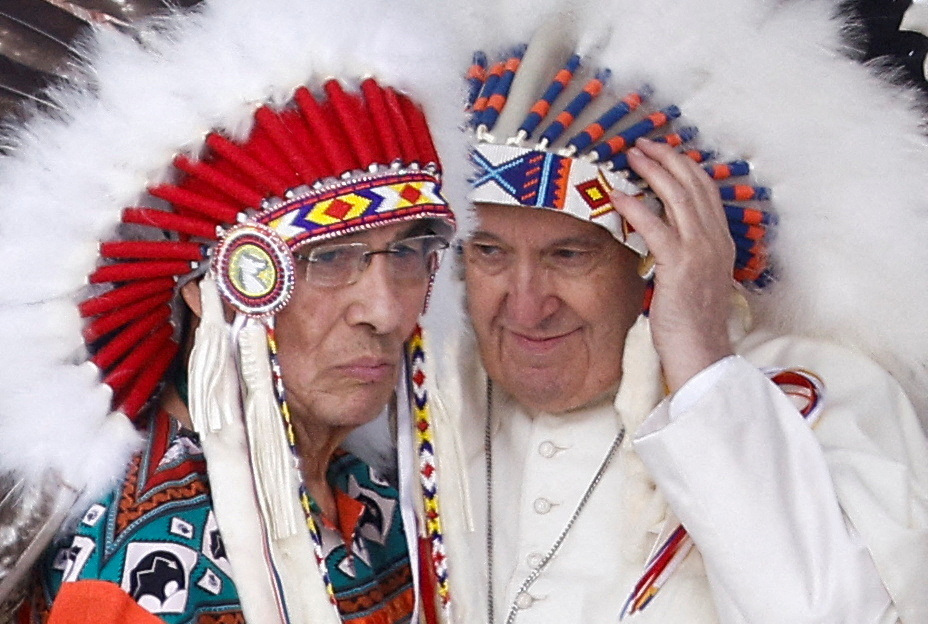
Indeed, at the very start of his visit this unique (as both the first Jesuit and non-European) Pope could be seen solemnly and pensively cradling his chin and mouth in his hand as if hesitant about the words he would soon be expected to utter. Later, in Maskwacis, he was enveloped in a soundscape of sacred chanting and drumming, grinning as he donned an Indigenous ceremonial headdress. The moment displayed a willful audaciousness typical of the Church, justified by the familiar theological principle of Humanitas – a vitalization of ‘cultures’ under a universal umbrella that sees all members of those Cultures as children of God. Yet, the apparent seamlessness of this harmonious scene later became undone by the raw, devastating, impromptu spectacle of a lone woman, Si Pih Ko, powerfully singing, in Cree, her fist raised to the sky, an alternative version of Canada’s national anthem known as “Our Village”, rebuking the papal presence while protesting the death of her brother in prison.  

Image 1: Chief Wilton Littlechild and Pope Francis, Maskwacis, Alberta, July 26, 2022 (photo by Guglielmo Mangiapane, Reuters; the authors are grateful for the right to publish the image here)

If, as Carl Schmitt says, all political concepts are secularized theological ones, Pope Francis’s  recurring gestures of apology for “cultural destruction” came crashing to a ground of (missed) interpellations and apologies, while he continued to offer his fragile body for a performative Church and State healing of indigenous lives ravaged by the violence of genocide – a word the pontiff spoke only when he was safely on the plane back to Rome.

Thus, the concept of reconciliation by Pope Francis was affectively mobilized through the soil, commons, soundscapes, and bodies as these hinged on the ultimate sacrifice of Christ’s crucifixion and a human/divine suffering that were, in this highly mediatized visit, notably devoid of Marian iconicity. In this framework, the singular yet communal suffering of First Nations, Métis and Inuit peoples becomes part of the ‘universal’ redemptive incarnation and blood of Christ, and, by extension, the healing sovereignty of the Canadian state.

The much-anticipated apology for the methodical cruelty of educational Catholic missions, and the Catholic Church’s role in past and ongoing colonialism, cannot be understood simply through an anthropological lens of battles for and refusal of modern state (self-)sovereignty. This 2022 papal journey through Turtle Island made glaringly evident that a colonial Church infrastructure is deeply engrained in a Christianity of the modern Canadian state, as the Canadian Conference of Catholic Bishops made clear by orchestrating, albeit not in line with Pope Francis’s will, an estranging Eucharistic Mass performed in Latin (an archaic norm abandoned post-Vatican II) in Edmonton’s Commonwealth stadium on July 26. Throughout this visit we beheld an aging papal body answering Indigenous calls for the dis-entangling of Catholic colonial violence through his encounter with the sacred soundscape, walking the soil (even if in a wheelchair), and in his public acts of listening.

‘True’ reconciliation remains a matter of the return of stolen gifts and livelihoods, requiring a new articulation between economies of suffering and indebtedness. From the perspective of Catholic theology, indebtedness is intrinsic to the tension between guilt and debt, where guilt is the unavoidable condition of being born as human (fallen from Eden), and debt is enjoined by God’s gift of life that cannot ever be fully repaid. The tension of guilt and debt in their eternal production of indebtedness is a “vital” theological hinge and a primary force of a capitalist market that functions as a never-ending fulfillment of drives and desires. Reconciliation then is also a much-needed breaking of precisely this theological hinge

Yet, in a way that was perhaps unperceived by many, this papal visit with and beyond the Indigenous peoples of Turtle Island affords the possibility that “reconciliation” is not only a matter of voicing and representation, sovereignty and its ongoing unravelling, or retribution and (unmade) apologies. It also a political, theological, and cosmological matter of a mystery of incarnation, in its particular bodily forms of fragility—a fragility now more than ever common to all living beings. As potent as this mystery of incarnation may be for healing, it may not be enough.


Valentina Napolitano is Professor of Anthropology and Connaught Scholar at the University of Toronto. Valentina Napolitano’s work weaves together anthropology, political theology, and Critical Catholic Studies.  She is currently focusing on a book on mysticism and politics in the 21st century.

Kristin Norget is Associate Professor of Anthropology at McGill University. Her current research interests are concerned with mediatization and contemporary strategies of evangelization of the Roman Catholic Church focused on Mexico and Peru. She has also published on issues of indigeneity and Catholic liberation theology in Mexico.


Cite as: Valentina Napolitano and Kristin Norget. 2022. “Pope Francis, Reconciliation, and the State.” Focaalblog, 12 August. https://www.focaalblog.com/2022/08/12/valentina-napolitano-kristin-norget-pope-francis-reconciliation-and-the-state/

Fiona Murphy: Irish State to seal records of Mother and Baby Homes for 30 years: Urgent call for action

Tiny bodies, the remains of little children entombed without name or mercy, are uncovered in Tuam, a small Irish town in Co. Galway in the west of Ireland, at the site of a former Bon Secours Mother and Baby Home in 2017. The excavation, part of a Mother’s and Baby’s Home commission of inquiry (set up in 2015), precipitated by the tireless research of a local historian Catherine Corless, uncovered an eerie underground structure demarcated into 20 chambers (possibly a sewage tank) containing the children’s remains. The commission stated that ‘multiple remains’ were found, but some estimates run as high as in the region of 800. The home was run by the Catholic Bon Secours order of nuns from 1925 to 1961, one of many on the island of Ireland at that time. Now in Oct 2020, even before the Commission of inquiry publishes their long-delayed report (original deadline Feb 2018 due now Oct 30th, 2020), the Irish State has stated it intends on sealing the Mother and Baby records for 30 years.  

Continue reading

Michaela Schäuble: Ecstasy: A review of two recent exhibitions on consciousness-expanding experience

In his classic Ecstatic Religion: A Study of Shamanism and Spirit Possession, I. M. Lewis (1971) contends that ritual, belief, and spiritual experience are the three cornerstones of religion, with the third certainly being the most important. Although disputed, this thesis strongly resonates with trends and themes currently taken up by gallerists and exhibition curators. Last year saw the launch of two major exhibitions on the topic of ecstasy: one at the Musée d’ethnographie de Genève (MEG) in Switzerland entitled Afrique: Les religions de l’extase (Africa: The ecstatic religions) and the other one simply called EKSTASE (Ecstasy) at the Kunstmuseum Stuttgart in Germany.

Continue reading