Tag Archives: Palestine

Erella Grassiani and Nir Gazit: The Smell of Fear, The Sound of Relief: Sensing War in Israel/Palestine

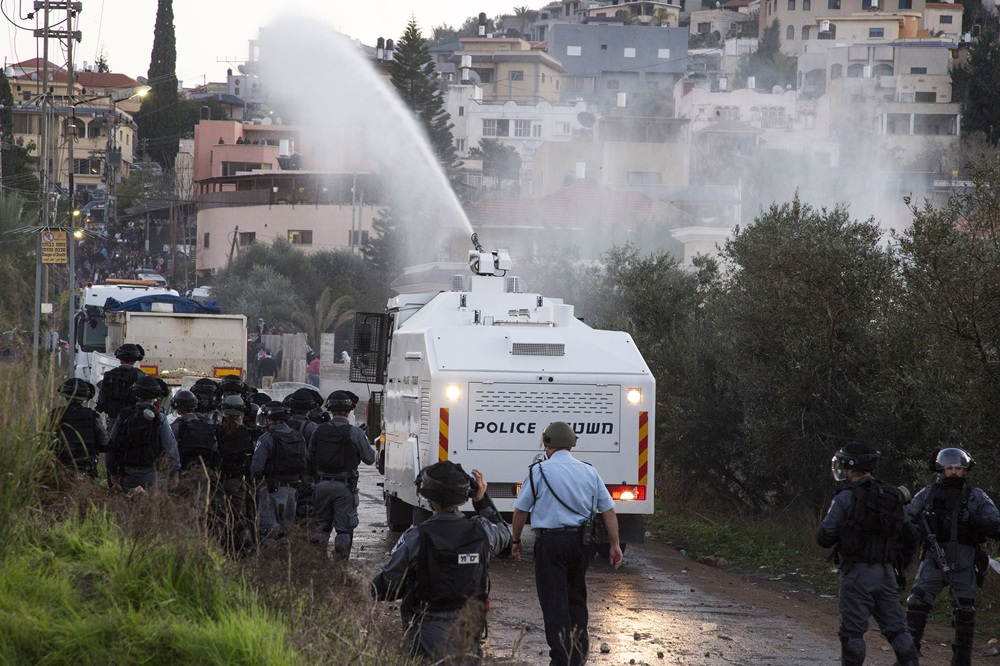
Image 1: A police truck fires “skunk” water at protesters during a demonstration against recent home demolitions in Palestinian communities, Ar’ara, northern Israel, January 21, 2017. Photo by Keren Manor

As we write this, in January 2026, there is, theoretically speaking, a ceasefire in place in Gaza. Unfortunately, this does not mean that the war, the genocide, the violence, and horrors have come to a stop as Israel is breaching the ceasefire on a daily basis. Violence and death are still omnipresent in Gaza and the largely overlooked Occupied Westbank. And so are the sights, smells, and sounds that we associate with death: they are everywhere, albeit experienced differently depending on one’s identity, locality, and positionality. These sounds, smells and sights remind us of the multitude of ways in which war and destruction enter daily lives. War habitually comes in the form of deadly violence, destruction, and famine, and makes itself present through ‘daily’ experiences, such as the sounds of the air raid sirens, the smell of death, and the sight of weaponry in the public sphere.

The senses, of course, cannot be separated from broader issues of embodiment. As several scholars working on the senses and embodiment have demonstrated, senses mediate lived reality and help us to understand it, through our bodies, in a political sense (e.g. Howes 1991; Pink 2015). As such, senses are a means of inquiry that help us understand the realities around us and how we feel this bodily. A focus on the senses can tell us something about what smells, sounds or sights make us feel comfortable and secure, which ones alarm us, frighten us, and how such experiences fluctuate over time and/or in different contexts for divergent groups of people. As such, sensory experiences serve as important mediators in violent conflicts.

In this piece we are interested in the ways war and its violence travel from battlefield spaces to civilian spaces. While it is more common to analyse the ways in which the two are blurred, meaning how the war itself invades civil spaces, we will focus on the ways that war, both purposefully and incidentally, enters Palestinian and Israeli spaces through the senses and what political message the senses convey to different actors in divergent contexts. We include several wars, such as the genocidal war in Gaza, but also the other wars Israel has waged and is still waging with other neighbours, such as Lebanon and Iran, and the ongoing violent occupation and increasing annexation of the Westbank. While we will not be able to delve into the relations between these separate fronts, or their own specificities, we will discuss war and violence are mediated through the senses and how sensorial experiences are individually and collectively interpreted.

We focus on two distinct ways in which the senses are attacked and/or affected in war in Israel/Palestine. First, we recognize the intentional use of sensorial attacks where the senses are purposefully weaponized by Israel and its military through the development and use of technologies that attack sight, sound, taste, and smell. Secondly, we will discuss the sensorial ‘byproducts’ of war’s violence and a society’s militarized characteristics. Although often done unintentionally, this also serves to normalize the war and its violence by bringing it into ‘civilian’ spaces. Here smell and sounds also become sources of conflict and security and they start to play a role in the making of the (enemy) other.

During times of emergency, the way we perceive and digest sensorial input is intensified and feelings of (in)security and fear are (re)constructed by, for example, the sounds of sirens warnings that rockets are on their way, but also through the sight of the huge number of weapons that have been flooded into the Israeli civil space in the last two years. For some, feelings of security increase with this sight of weapons, while for many others it is the opposite.

Intentional sensorial warfare

The direct attack on the senses during war is a practice that goes back many years. Think about the use of tear gas by Britain in WWI to help disperse crowds (Feigenbaum 2017), or the use of sound bombs in Brazil’s favela’s, employed by the military police in their ‘pacification’ efforts (Vieira de Oliviera 2019).

Over the last few decades, Israel has put itself on the map as a major player in the sale of defensive security products and knowledge, and as a specialist in technologies of ‘crowd control’, also known as ‘anti-riot’ weaponry, non-lethal, or even less-than-lethal weapons. The Israeli government, as well as several private companies developing such products sell these globally to clients interested in pacifying both external and internal ‘enemies’, such as protesting citizens (Grassiani 2022). Many of such technologies purposely attack the senses; the eyes, the nose, the ears and have been originally developed to disperse crowds in the Occupied Palestinian Territories, such as protests against the occupation and its violent repression. One notorious example of such an Israeli invention is a substance called Skunk, which has a terrible smell that sticks to anything that it encounters. Not only is it sprayed on people themselves, but it is also used as a form of communal punishment as it is sprayed on houses, leaving the stink lingering for a very long time (Joronen and Ghantous 2024). Another example is how Israeli soldiers release diesel fumes from their tanks—originally intended for battlefield camouflage—onto Palestinian civilians.

An additional technology designed by the Israeli military to disperse people is the ‘Scream’, an acoustic weapon also known as the ‘Shofar’, after the religious horn used during Jewish Holidays. It produces a very high-pitched sound that causes dizziness and feelings of nausea and was used by the Israeli military against Palestinian protestors for the first time in 2011.

More recently, during the genocide in Gaza, human rights organizations also reported the use of supersonic boom by Israeli Air Force fighter jets as a mean of deterrence and terrorizing, as well as the use of quadcopters by the Israeli Defence Forces (IDF). These drones fly very close to windows of houses and tents and broadcast horrific sounds of crying babies, attacking dogs, and constant ambulance sirens. These sounds were purposefully broadcasted as a form of psychological warfare, to terrorize people, and to draw them out of their dwellings (Euromed 2025). In an article in the Guardian, two Gazans relate about the ‘sonic hell’ that is the night in Gaza with the ‘high-pitched whirring that Palestinians call “Zanzana”’ of the drones and the loud explosions (Ahmed and Gonzalez Paz 2024). During the day people receive calls from the Israeli military where a computer voice tells them to evacuate. “You’ve got no option to actually talk to a human being, to ask questions, to negotiate’” says Zaharna in the article (Ahmed and Gonzalez Paz 2024).

Importantly, these technologies have all been designed and intended as an attack on the senses; they are intentional weapons developed and used by the Israeli state and its proxy violent actors.

Sensorial byproducts of war and militarization

In addition to intentional attacks, there are also many more mundane, yet very violent ways senses are targeted in civilian spaces. Those most affected in the case of Israel/Palestine are the Palestinians in both Gaza and the Westbank. Regarding Gaza, it is very difficult to speak about any ‘normal’ civilian space, as almost all infrastructures have been destroyed or damaged. There, Gazan civilians narrate extensively about the smell of death around them, as many bodies of the dead have yet to be found under the rubble. As mentioned above, attacks by sound have been deliberately used as a weapon, but the continuous sounds of the artillery attacks and drones around them similarly have a devastating effect on the civilian population. As Nadera Shalhoub-Kevorkian (2017) has demonstrated, the Israeli occupation of Palestine is also an ‘occupation of the senses’. She refers to the different mechanisms in which the senses are controlled by the Israeli occupation, such as through camera’s, checkpoints and other forms of surveillance and how these ‘sensory technologies …manage bodies, language, time and space’ (2017: 1279).

It is important to note that Israeli citizens are also affected by the ongoing war, although we do want to stress that this cannot at all be compared to what is experienced by residents in West bank and Gaza. Israeli civilians are affected by the ongoing war, which permeates both public spaces and private homes, not in the least through the government’s propaganda machine and society’s militarized character. Daily siren warnings signal incoming rockets, and the IDF issues additional alerts directly to citizens’ mobile phones through the Tzeva Adom (Red Colour) system. The sounds and sights of war—especially within Israel—dominate the national atmosphere, with television networks transformed into 24/7 news channels focused solely on war coverage.
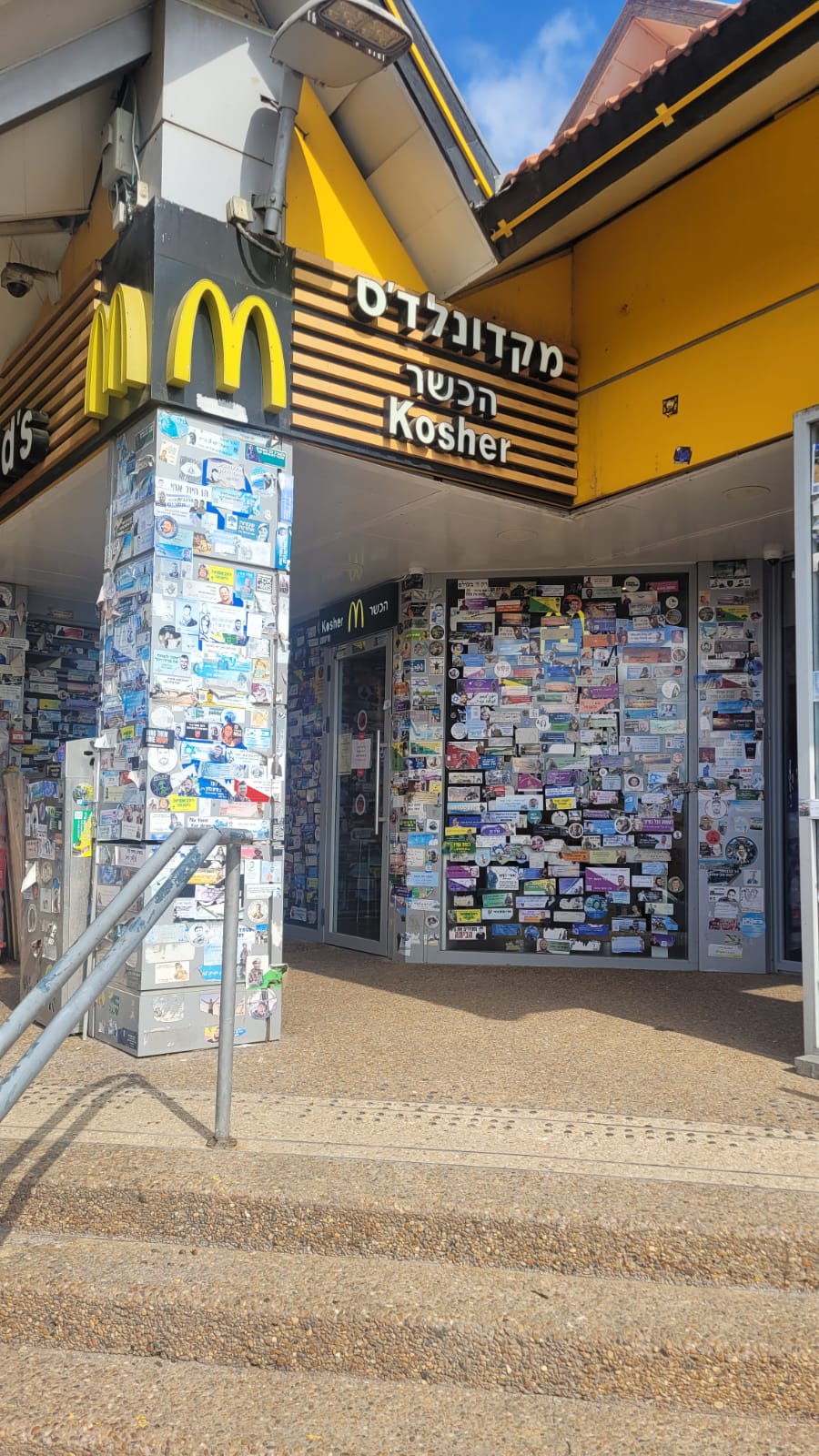
Image 2: Stickers commemorating fallen soldiers on walls of McDonalds at gas station in South of Israel. Photo by Erella Grassiani

In the streets of Tel Aviv, the presence of conflict is inescapable: stickers commemorating fallen soldiers cover walls and signs, posters of Israeli hostages held in Gaza hang on public buildings, shops, and balconies, and yellow flags symbolizing the campaign to free the hostages flutter from nearly every other passing car. The status of war is also evident through the different sounds of ambulances after the Israeli emergency service changed these after the October 7 attack. This change has been made to prevent public confusion and panic, as the traditional ambulance siren was sometimes mistaken for rocket or air-raid alerts, which led people to believe there was an immediate security threat. To address this, emergency services began using alternative siren tones that are more similar to European or international ambulance sounds and clearly distinguishable from military warning alarms. At the same time, however, these exceptional urban sounds have also intensified the sense of emergency among residents.

It is important to realize that there is a high proximity of Palestinian/Israeli spaces that oftentimes completely overlap, and as such, it is difficult to distinguish between them. For example, Palestinian villages and towns that are located within Israel will have similar sensorial experiences as their Jewish neighbours (for example hearing warning sirens or war helicopters flying by), while at the same time they can have a completely different interpretation of these sounds and sights. For one community such sounds might be reassuring, for others they are threatening. Simultaneously, within Israel’s internationally acknowledged borders, some communities are also excluded from the warning sounds from the state that they are part of. This became painfully clear in April 2024, when the only person hurt by the Iranian attacks on Israel was a Bedouin girl, living in an unrecognized village without an alarm system or a proper shelter. In this case, the sound of silence during war time may be interpreted as very alarming and even terrifying.

With such instances, we are not speaking of the deliberate weaponization of the senses, as we do in Palestinian spaces, but rather of the effect on the senses as a byproduct of the militarization of Israeli public space and the normalization of war—its transformation into an ordinary aspect of daily life. This produces a highly selective perception of war, one centred almost entirely on the Israeli (Jewish) experience. In this experience, Gaza appears distant, portrayed as another world rather than a place merely seventy kilometres away, and for some even less. Israeli news coverage rarely addresses the personal suffering or death of individuals in Gaza, and Gazans are shown up close only in sanitized contexts—on the beach, for instance—when the image can be deemed free of visible violence. Although Israeli soldiers sometimes share photos from the fighting in Gaza on social media, and testimonies are increasingly surfacing that expose extreme violence, such images and stories seldom reach the broader public. Moreover, when Israeli activists attempt to circulate pictures of Palestinian child victims, such as on university campuses, they are frequently censured or punished.

Interestingly, the very sounds that evoke fear and terror among Palestinians often carry reassuring or even uplifting meanings for Israelis. The noises of Israeli aircraft and the Iron Dome anti-missile system are perceived as sounds of protection, embodying both national defence and technological superiority. Even the artillery fire directed toward Gaza—audible to Israelis living near the border and at times even in Tel Aviv—is frequently interpreted as a sign of justified retaliation and military strength. Many Israelis describe having developed an ability to discern between sounds that signal real danger and those that do not.

Concluding remarks

Conflict and war cannot be fully understood through geopolitical or military strategy alone; they must also be grasped as a deeply embodied and sensory reality. By centering the senses, we illustrate how war and violence migrate from the battlefield into the most intimate of civilian spaces, mediating how individuals and communities interpret their lived reality. We draw from the concept of the ‘occupation of the senses,’ by demonstrating that state power is exercised not merely through the management of land and borders, but also through the governance of bodies and sensory perception. Following Judith Butler (2009: 51), we conclude that the sensory regime in Israel/Palestine functions to differentiate ‘the cries we can hear from those we cannot,’ effectively pre-determining whose lives are deemed worthy of grief and defence. The sensory experiences discussed—from the ‘sonic hell’ in Gaza to the ‘uplifting’ sounds of artillery in Israel—serve as somatic evidence of this political chasm. Ultimately, by attending to the smell of fear and the sound of relief, we gain a more nuanced understanding of how war inhabits the body, ensuring that the violence of the conflict is felt—and remembered—long after the sirens fall silent.

Moving forward, we encourage further analysis of the long-term somatic effects of these sensory assaults on both populations. Future research might explore how the ‘olfactory duration’ of substances like Skunk water or the sounds of drones shapes the psychological landscape of survivors long after the physical violence ceases. By the same token, it is essential to analyse how those living under a sensory regime develop modes of ‘sensory resistance’ or alternative environmental interpretations to maintain agency and community. As militaries continue to deploy ‘less-than-lethal’ technologies, there is a pressing need to study how these sensory weapons are being adapted for use against protesters and marginalized groups globally, transforming the human body into an additional domain of war.


Erella Grassiani is Associate Professor at the Department of Anthropology, University of Amsterdam. Her work focuses on the Israeli military, the Israeli security industry and non-state violent groups. She is currently working on a new project on aroboreal nationalism.

Nir Gazit is a senior lecturer at the Department of Behavioral Sciences at the Ruppin Academic Center. His research interests include civil–military relations, political violence, and vigilantism.


References

Ahmed, Kaamil and Ana Lucia Gonzales Paz. 2024. ‘I hate the night’: Life in Gaza amid the incessant sounds of war. https://www.theguardian.com/world/ng-interactive/2024/oct/17/i-hate-the-night-life-in-gaza-amid-the-incessant-sounds-of-war

Butler, J. 2009. Frames of war. When is life grievable? London: Verso Books.

Euromed. 2025. ‘Israel intensifies use of quadcopters to terrorise and target civilians in Gaza, with terrifying sounds and home invasions’. https://euromedmonitor.org/en/article/6747/Israel-intensifies-use-of-quadcopters-to-terrorise-and-target-civilians-in-Gaza,-with-terrifying-sounds-and-home-invasions

Feigenbaum, Anna. 2017. Tear Gas: From the Battlefields of World War I to the Streets of Today. London: Verso Books.

Grassiani, Erella. 2022. “The Shifting Face of the Enemy: ‘Less than Lethal’ Weaponry and the Criminalised Protestor”. Journal of Illicit Economies and Development, 4 (3): 323–36.

Howes, David. 1991. “Sensorial anthropology.” In: Howes, David (ed.) The varieties of sensory experience: A sourcebook in the anthropology of the senses ( 167-191). Toronto: University of Toronto Press.

Joronen, M., & Ghantous, W. (2024). “Weathering violence: Atmospheric materialities and olfactory durations of ‘skunk water’ in Palestine”. Environment and Planning E: Nature and Space, 7(3): 1122-1141.

Pink, Sarah. 2015 Doing sensory ethnography. Sage Publications.

Shalhoub-Kevorkian, N. 2017. “The Occupation of the senses: the prosthetic and aesthetic of state terror”. British Journal of Criminology 57: 1279-1300.

Vieira de Oliveira, Pedro J. S. 2019. “Weaponizing Quietness: Sound Bombs and the Racialization of Noise.” Design and Culture 11 (2): 193–211.


Cite as: Grassiani, E and Gazit, N. 2026. “The Smell of Fear, The Sound of Relief: Sensing War in Israel/Palestine” Focaalblog February 17. https://www.focaalblog.com/2026/02/18/erella-grassiani-and-nir-gazit-the-smell-of-fear-the-sound-of-relief-sensing-war-in-israel-palestine/

Laura Adwan: Commentary: On fragmentation and decolonization. The demise of a collective liberation dream

Image 1: Street in Gaza in February 2025, by Jaber Jehad Badwan

Before, times like these have come before

Times when we witnessed hurricanes that never stopped uprooting trees

We thought that we had learned how to travel the road to the gods’ gate

How to carry the burden and rise up again after the flood

How to go, again

If days come when we see hurricanes that never stop uprooting trees

Sargon Boulus

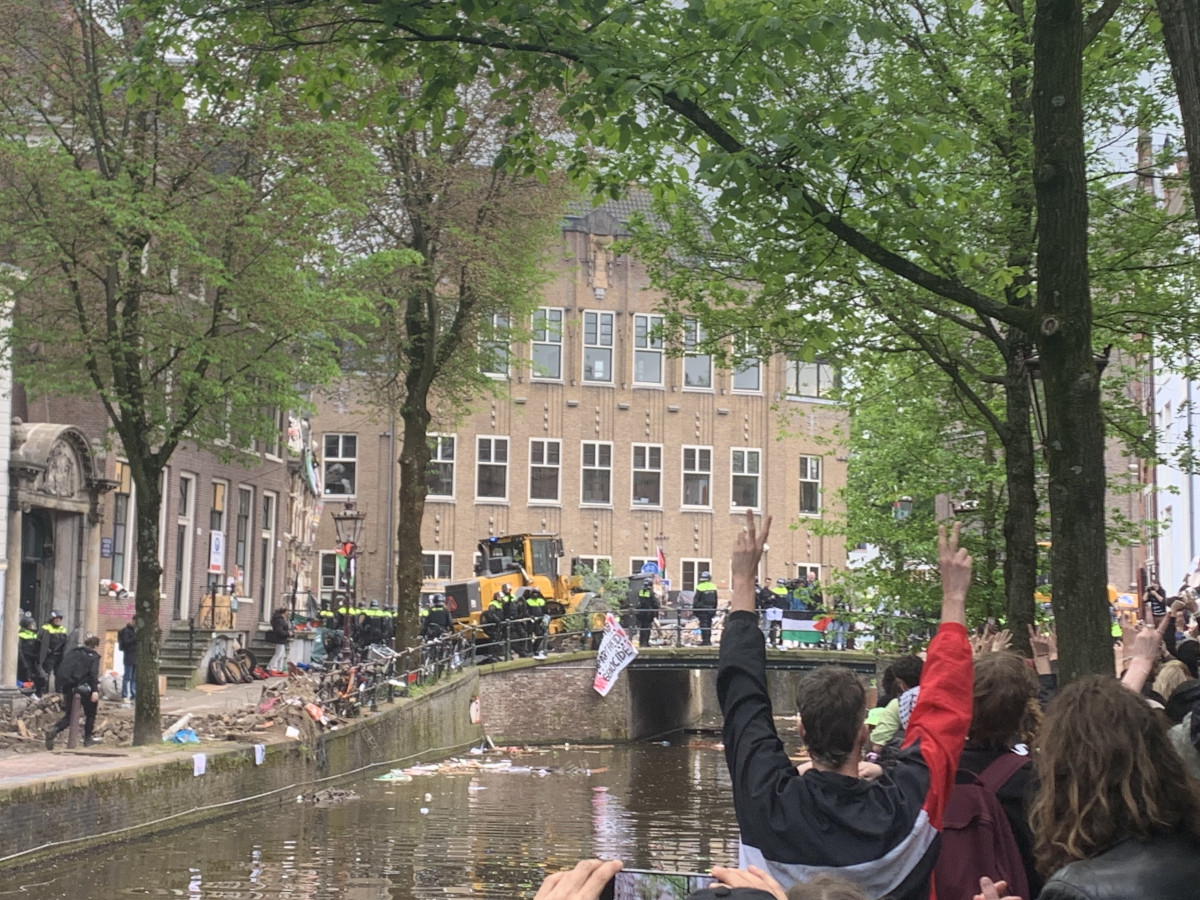
When Arpan Roy invited me to write a commentary for the “Staying-With Palestine” feature, I did not know where to begin. Should I start from where I am “staying” today, in al-Khalil (Hebron), helplessly witnessing the ongoing genocide in Gaza, only 50 kilometers away, while anticipating the elimination of what remains of a dismembered Palestine? The ongoing fragmentation of the West Bank, once depicted as an archipelago of fragmented islands by the French artist Julien Bousac in 2009, turned Palestinian towns and villages into isolated military zones scattered by around 1000 checkpoints (including earth mounds and roadblocks) and iron gates blocking the main entrances. We hear the bombs falling on Gaza, watch the horrific live-streamed death and destruction of all forms of life, and do nothing to stop the genocide in Gaza or “the earthquake” in the West Bank (Nabulsi 2024). In their ongoing attempts to expand their colonial settlements in what remains of Palestine, the Israeli state army and settler gangs, almost daily raid Palestinian localities with their armored vehicles.

Seemingly endless Israeli attacks and military invasion are expanding beyond Palestine, in Lebanon and Syria, with impunity, while acts of support or solidarity are suppressed in neighboring Arab states. The exception to this is Yemen’s Ansar Allah, Lebanon’s Hezbollah, and a few Iraqi resistance factions. The Arab support for Gaza today has been reduced to small popular stands in solidarity, which are hardly visible when compared to the larger solidarity protests and encampments by demonstrators outside the Arab world. Worst of all the leaders of several Arab states make deals and trade worth tens of billions of dollars with the Israeli colonial state, even when the free people of the world are demonstrating to push their governments and companies to boycott Israel politically and economically.

The contributors to this forum explored various dilemmas that partially address one of the questions raised in the introduction: “A hundred years of the Palestinian cause, and the support that it has received from various actors from various stages, has not resulted in the liberation of Palestine.” During these times of despair, it is important to remember the times when Palestinians had a larger space to dream of liberation and justice in Palestine and neighboring postcolonial states. I argue that fragmentation as a colonial tool to rule and divide the colonized communities in the Palestinian and Arab cases reduced several possibilities of local solidarities and support that have been essential in creating the conditions for sustaining the Palestinian collective dream of liberation. The ability to dream of liberation and decolonization require “the creation of new men,” as described by Franz Fanon (2001: 28). A process that demands solidarity to create the conditions necessary for defying colonial plans of fragmentation and generating collective political consciousness among the colonized. The “new men” involved in the decolonization process, as Fanon told us, must not reproduce the colonizer’s world. They should build the conditions which will create new possibilities that require an act of collective dreaming and “revolutionary action” (Fanon 2001: 140).

To explain the decline of the Arab nationalist support to the collective dream of liberating Palestine (Muslih 1987), I will refer to the Iraqi example of fragmentation. The importance of the Iraqi case stems from its experience with fragmentation following a long period of violent wars and economic embargo, that seems to be replicated today in the Syrian and Palestinian cases. During the first three decades after the Nakba, the question of Palestine was articulated as an Arab question, especially among the Arab nationalist movement and the Baath party (Sayigh 1997, Charif 2021). The Baathist Iraq (1960s-1980s), like Assad’s Syria, and unlike Sadat’s Egypt, provided various levels of support to the Palestinian collective liberation dream, at least when it came to their Arab nationalist politics against normalization with Israel, in addition to hosting displaced Palestinians who maintained their refugee status, while enjoying substantial rights, and various Palestinian political factions whose leftist (and later Islamic) rhetoric emphasized resistance, liberation, and return. This was more evident in Syria, where Palestinian factions were more active than in Iraq, with fluctuating relationships with the various ruling regimes (Gabiam 2016, Al-Hardan 2016). For example, al-Yarmouk refugee camp was often called by the Palestinians the “political capital” of the refugees’ struggle for self-determination and the right of return, where leftist factions were active with their numerous grassroots social and political organizations. Following the collapse of the USSR and the Socialist bloc, the Islamic factions became more visible, especially after the Oslo Accords of 1993 allowed for a limited form of self-governance in the West Bank and Gaza in exchange for abandoning full liberation and the right of return.

Rather than contributing to the establishment of the conditions that will help create “the new men” who should lead the decolonization process in postcolonial Arab states, the colonial interventions, of which Oslo Accords were a major strategic component, promoted the birth of a so-called “New Middle East” by creating “new” fragmented political periphery states in an ancient world such as the new Iraq, or new Syria to be dominated by the then recently established Israeli state as part of the Zionist expansive settler-colonial project. In 2003, George W. Bush introduced his vision of the “new Iraq”—an Iraq liberated from Saddam Hussein’s despotic regime. The plan started earlier, after the US-led bombing of the state infrastructure in 1991 and during the thirteen years of economic embargo and sanctions to force Iraq to disarm, paving the road for invading and occupying a formerly sovereign state by the US and its allies (Gordon 2010, Khoury 2013, Dewachi 2017). The new Iraq in the official statements of Bush and the Coalition Provisional Authority (CPA) was presented as an oasis of democracy and free market economy. As in the case of Palestine, fragmentation was one of the main tools used in the new Iraq; it was introduced by privatizing the post invasion Iraqi economy and selling off its industries, which eventually led to the expulsion of several Iraqi bureaucrats and professionals from their jobs in the public sector. Many of the private contractors’ projects were funded by the USAID and once the money was disbursed, it ended up in the hands of private companies, most of which were American. The ultimate aim was to create a newIraq based on a neoliberal model.

In his reading of the disorder that erupted in Iraq, anthropologist Marshal Sahlins criticized the American invasion of Iraq in 2003, and the essentialism informing the invaders’ conquer-and divide policies—which ignored a long history of coexistence: “It takes a lot of culture to make a state of nature” (Sahlins 2011). Within two years of invasion, the United States had created a novel sectarian system, what is described in the media as the “Lebanonization of Iraq”: the parliament was eventually established in 2005 and ministries were allocated according to the relative weight of such parties and of parliamentary blocs, and the reconstructed armed forces followed this pattern. Previously, of little significance, sectarian parties and networks started to exert a much stronger influence in the absence of a strong central state (Marfleet 2007).

The walling of Baghdad was another step in dividing the city into small manageable pieces with walls and military checkpoints, which further intensified militia attacks on sectarian pretext and forced many inhabitants to relocate. Like Palestine, walling also increased the daily suffering of Iraqis who had to waste long hours to reach their places of work or study or medical treatment. The sectarian wall, as it was often called, was a physical embodiment of the destruction of the social Baghdadi inter-communal life. It split neighbors and families and further reduced the already limited possibilities of living for the majority, who did not feel safe leaving their homes and could no longer reach their work and schools. It created the

conditions for anomie, the Durkheimian concept that refers to a situation in which former norms of solidarity break down due to a rapid change in society. Iraqis were forced to search for new ways to bring a sense of connectedness and solidarity in their lives.

However, it would be naïve to blame the fragmentation and rise of religious and sectarian divisions in the Iraqi society solely on the US-led invasion and occupation of Iraq. The politicization of ethnic, tribal, and religious differences was practiced by the Iraqi state at various levels during times of wars and sanctions (Zubaida 2011). Other factors were involved in the rise of sectarian views or intolerance in previous Iraqi historical periods at various levels during the British colonial rule through sectarian division (Batatu 1978, Tripp 2007). After 2003, being Iraqi was not enough to continue living in Iraq, one had to be sectarian (See Eldridge’s contribution to this feature). In the current Iraq, solidarity is reduced to family origin, which became more important to gain access to political and administration positions than qualifications and skills (al-Mohammad 2012, 2015). The Iraqi and other experiences (Friedman 2008) show that when a social system produced its strong socio-economic productive basis, these religion/sectarian differences move to the background and lose their political roles. However, whenever the collective social system was attacked, whether by former state oppressive policies or foreign military interventions, these differences were politicized and were assumed as a social system for their followers (Adwan 2020).

Two decades later, in late-2024, the international community celebrated the creation of a “new Syria” after the fall of the Assad’s despotic rule. Yet, in Syria today (as in Iraq), one’s presence or absence is determined by one’s sect, ethnicity, and their former relationship to the fallen regime. This new situation in the region at large, imposed new representations on the inhabitants of those states, including the former Palestinian refugee communities who became almost invisible in those places where they used to live on equal terms with local Iraqi and Syrian citizens for seven decades. In the process of “liberation” from their former regimes, both Iraq and Syria have dismantled their armies and handed their weapons, a condition that obviously serves the Zionist expansionist dream of “Greater Israel” between the Euphrates and the Nile.

One major effect of the regional and Palestinian fragmentation is related to the Palestinian refugees who no longer represent a collective presence in Iraq and Syria, while we witness the ongoing annihilation of refugee communities in an increasingly fragmented Palestinian reality (Nabulsi 2024). Since January 2025, tens of thousands of Palestinian refugees have been forcibly displaced from their homes in several West Bank refugee camps—Jenin, Nur Shams and Tulkarem—where they lived for 77 years after the Nakba. Decades of international aid failed to address the Palestinian refugee suffering and ongoing Nakba that has often been reduced to a “humanitarian problem” (Feldman 2009), which culminated in the killings of the starved refugees in Gaza in a particularly cynical version of aid orchestrated by the so-called “Gaza Humanitarian Foundation” (Jadaliyya, 2025).

In the last paragraph of his conclusion chapter of The Wretched of the Earth, Fanon explicitly turns to the importance of imagining new possibilities: “For ourselves and for humanity, comrades, we must turn over a new leaf, we must work out new concepts, and try to set afoot a new man” (2001, 255). Fanon’s call is a demand that the colonized peoples should imagine new ways to achieve freedom and justice. For decades, Palestinians have sought to amplify their call for freedom and justice through solidarity from the global Left and the global South, a legacy critically examined by contributors to this forum in response to Roy’s question: “What does it mean to stand with Palestine?” A central issue that follows is: to what extent has such solidarity been oriented not only toward Palestine as a humanitarian issue but also toward seriously confronting the Zionist settler-colonial project, and why has this solidarity failed to produce the conditions necessary for liberation? The critical dimension, in my view, lies in the decline of Arab state support. Neighboring Egypt, for instance, has consistently sought to restrict material and political assistance to Gaza. Iraq and Syria positioned themselves, historically, as champions of the Palestinian cause, granting Palestinians rights and protection that exceeded those available in most Arab host countries from 1948 to the 2000s. Yet today, Palestinian communities in Iraq and Syria have nearly disappeared.

In this commentary, I have tried to show the effects of fragmentation on the Iraqi society in an attempt to explain my main argument that fragmentation played a decisive role in weakening the Iraqi and Syrian standing-with Palestine. To stand with Palestine today means resisting not only the further fragmentation of Palestine itself but also of the region at large. Defragmentation must be seen as a vital step toward decolonization. Standing with (as much as staying-with) Palestine also means learning from past solidarities: from the martyrs who returned to their families thanks to resistance, and from the legacy of anti-colonial fighters both near and far.

I will end here with a note “on hope” recalled from a longer interview with a Palestinian refugee I met in al-Yarmouk camp in Syria in summer 2008 about the martyr-refugees; a new concept she used to describe the 199 Arab and Palestinian freedom fighters who returned to their families as part of al-Radwan prisoner exchange operation between Hezbollah and Israel:

Palestine has always been our dream. When the revolution began, we had a clear goal. Our goal was the liberation of Palestine, and if we remained steadfast as Arabs and Palestinians, we could have achieved it […]. Thanks to the resistance, hope returned to us, when the martyrs returned. After all those long years and decades, the martyrs returned to their people and families. This proves that everything we fight for will return to us.”


Laura Adwan is an Assistant Professor at Al-Quds Bard College for Arts and Science. Her work focuses on forced displacement and transformations among refugees, rural and Bedouin communities in occupied Palestine and the region, by exploring the ways communities view their lived experiences, situated in a historical political economy.


References

Adwan, Laura. (2020). ‘Iraqis on the Move: Displaced Professionals, Protection/ ‘Aman Space in Jordan and Memories of a Destroyed State.’ PhD Dissertation. University of Bergen.

Batatu, Hanna. (1978). The Old Social Classes and the Revolutionary Movements of Iraq: A study of Iraq’s old landed and commercial classes and its communists, Ba’thists, and Free Officers. New Jersey: Princeton University Press.

Boulus, Sargon. (2008). ‘Times: The song of a Sumerian who lived for a thousand year.’ (S. Anton, Trans.) In Azma Ukhra li-Kalb al-Qabila (Another Bone for the Tribe’s Dog). Beirut/Baghdad: Dar al-Jamal.

Bousac, Julien. (2009). ‘L’archipel de Palestine Orientale,’ drawn for Le Monde Diplomatique, based on documents provided by the United Nations Office for the Coordination of Humanitarian Affairs and B’Tselem. https://www.monde-diplomatique.fr/cartes/l_atlas_un_monde_a_l_envers/a60660

Charif, Maher. (2021). The Palestinian National Project: Development, Dilemma and Destiny. Beirut: Institute for Palestine Studies. (In Arabic).

Dewachi, Omar. (2017). Ungovernable Life: Mandatory Medicine and Statecraft in Iraq. Stanford: Stanford University Press.

Fanon, Franz. (2001). The Wretched of the Earth. (C. Farrington, Trans.). London: Penguin Classics.

Feldman, Ilana. (2009). ‘Gaza’s humanitarianism problem.’ Journal of Palestine Studies. 38 (3): 22-37.

Friedman, Jonathan. (2008). ‘Transnationalization, Sociopolitical Disorder, and Ethnification as Expressions of Declining Global Hegemony.’ In Historical Transformations: The Anthropology of Global Systems, edited by Kajsa Ekholm Friedman and Jonathan Friedman,

203-226. Lanham, MD: AltaMira Press.

Gabiam, Nell. (2016). The Politics of Suffering: Syria’s Palestinian Refugee Camps. Bloomington and Indianapolis: Indiana University Press.

Gordon, Joy. (2010). Invisible War: The United States and the Iraq Sanctions. Massachusetts: Harvard University Press.

Al-Hardan, Anaheed. (2016). Palestinians in Syria: Nakba memories of Shattered Communities. New York: Columbia University Press.

Jadaliyya (2025, August 12). ‘Anthony Aguilar: GHF Whistleblower – Connections Podcast #107. Guest: Anthony Aguilar Host: Mouin Rabbani.’ YouTube. https://www.youtube.com/watch?v=ijT86BHnGY8&t=1809s

Khoury, Dina (2013). Iraq in Wartime: Soldiering, Martyrdom, and Remembrance. Cambridge: Cambridge University Press.

Marfleet, Philip. (2007). ‘Iraq’s Refugees: ‘exit’ from the state.’ International Journal of Contemporary Iraqi Studies. 1 (3): 397-419.

Al-Mohammad, Hayder. (2012). ‘A Kidnapping in Basra: The Struggles and Precariousness

of Life in Postinvasion Iraq.’ Cultural Anthropology 27 (4): 597-614.

Al-Mohammad, Hayder. (2015). ‘Poverty beyond Disaster in Postinvasion Iraq: Ethics and the “Rough Ground” of the Everyday.’ Current Anthropology 56 (S11): S108-S115.

Muslih, Muhammad. (1987). ‘Arab Politics and the Rise of Palestinian Nationalism.’ Journal of Palestine Studies 16 (4): 77-94.

Nabulsi, Jamal. (2024). ‘“to stop the earthquake”: Palestine and the Settler Colonial Logic of Fragmentation’. Antipode 56 (1), 187-205.

Tripp, Charles. (2007). A History of Iraq. Cambridge: Cambridge University Press.

Sahlins, Marshall. (2011). ‘Iraq: The State-of-Nature Effect.’ Anthropology Today 27 (3): 26-31.

Sayigh, Yazid. (1997). ‘Armed Struggle and State Formation.’ Journal of Palestine Studies, 26(4): 17–32.

Zubaida, Sami. (2011). Beyond Islam: A New Understanding of the Middle East. London: I.B. Tauris.


Cite as: Adwan, Laura 2025. “Commentary: On fragmentation and decolonization. The demise of a collective liberation dream” Focaalblog October 6. https://www.focaalblog.com/2025/10/06/laura-adwan-commentary-on-fragmentation-and-decolonization-the-demise-of-a-collective-liberation-dream/

Omid Mehrgan: Palestine the Wound: A Report on the Iranian Reception of the Cause

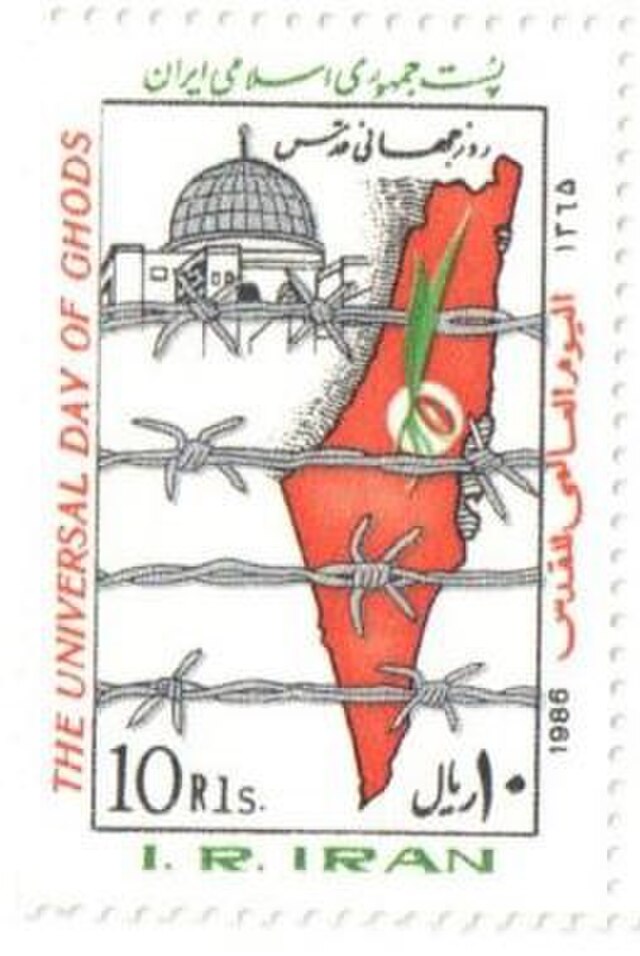
Image 1: Stamp of Iran memorizing the Day of Qods, printed 1986

A Postscript Note: I finished writing this piece prior to the Israeli-US attacks on Iranian cities and nuclear facilities, which killed over a thousand people. There is, therefore, no trace of that consequential war in the piece. Another event also took place between the time of writing this and the onset of that war: the “For Palestine” rally on the 22nd of May in front of the University of Tehran to protest the Gaza Genocide. Though modest in size, this marked “a moment when a diverse group of citizens, without any formal call, unaffiliated with power centers, and beyond prevailing ideological frameworks, raised their voices in defense of the human dignity of the Palestinian people” (Shabani 2025). When I speak of the losses of the Iranian Left in the following paragraphs, I would like to remember such delicate gains, too.

Taking stock of the Iranian response to the Palestinian cause since the Nakba can point out a history of militant solidarity but must also face the melancholic realization that the Iranian Left has lost something big. What mediated the two—and this can be the great irony of Middle Eastern history—was 1979 Revolution in Iran. An epoch–making event that emerged as a resistant block against imperialist forces and a powerful state backer of Palestinians in its secular and religious strains, the Revolution went on to transform the very meaning of relating to Palestinian anticolonial resistance. Whether, and how exactly, the government that was established in its wake helped Palestinians since is a convoluted topic with many chapters, yet to be studied. What is less obscure is the fact that the Iranian Left—a material, discursive, and cultural force in giving birth to modern revolutionary Iran—no longer possesses any seductive and material forces for performing a necessary double task today: building a working class movement strong enough to push back against the increasingly harsh oligarchic capitalism inside Iran, and helping resist the US–Israeli aggression in the region that is piling up ruins after ruins in its trail. Iran’s Islamic Republic has largely alienated the real forces on the ground from which it once appropriated the Palestinian cause. Those forces that it has instead recruited and organized—legions of the unemployed and of undocumented immigrants from Afghanistan and Pakistan to be deployed to Syria during the 2010s (Azizi and Vazirian 2022)— it has not done so based on labor. But nor have the progressive forces inside or outside Iran succeeded to win the marginalized and increasingly impoverished masses who periodically take to the streets only to face brutal repression.

The net result has been the loss of a political identity in Iran that could understand itself in a collective way by identifying its real sources of vitality. An epitome of this phenomenon which can be called apolitical radicalization, the Diaspora Opposition politics of “subversion” (barandaazi) in the past Iranian long decade (from 2009 Green Movement to when Iranian forces left a fallen Syria in 2024) has shifted toward the right to the bewildering extent that siding with Israel has become a form of performing resistance against the Islamic Republic (Shams 2025). The war industry has recruited its own figures from the exiled (Shohadaei 2023). Many, many people embrace them, apparently. But, under the black sun of Gaza that has cut through all statuses, identities, positions, forcing each to reckon with itself anew, Iranian political culture too is bound to find itself re-evaluated for its own actors and observers. And because the word “Palestine” has for decades permeated official discourses of politics in Iran to the point of exhaustion, speaking to it in relation to emancipatory politics is exceptionally difficult.

In such an atmosphere, writing about Iran in English is more aporetic for me today than ever before. By “today” I mean a moment in history marked by two consequential events that have changed much about Iran: The Women, Life, Freedom (WLF) movement (following the death-in-custody of the young Kurdish woman Mahsa Jina Amini in Tehran in September 2022) and the Al-Aqsa Flood Operation. Months after the women and girls’ life-and-death historic fights in the streets with the riot officers over the mandatory hijab (with clear socio-political victories) were widely repressed, October the 7th took place. On around the anniversary of the Palestinian assault on Israeli settlements near Gaza’s borders, a video came out showing the correspondent of the London-based TV Iran International writing the movement’s slogan in Persian on the wall of a destroyed home in Gaza (Middle East Monitor 2024). The obscene contrast between the message and the medium, between the words life, woman, freedom, and that context of suffocating blockade, lethal masculinity, and death, posed the question: How could those words be allowed to travel to the abyss of Gaza with pure affirmation and total blindness to its setting? The smiling ease with which the Israel-based Iranian reporter performed the act in front of the camera demonstrated a secure confidence in the public reception of his horrid message. He probably felt it like an act of resistance rather than pervert violation. Reportedly, the news outlet, funded by Saudi Arabia’s Mohammed bin Salman, is being watched by millions of Iranian households, having widely been preferred over the standard BBC Persian and a host of hopeless national TV channels (Gamaan 2023). Was there no symbolic counterforce defying this messaging? Apparently, not. The vocal figures of the WLF movement did not voice any visible solidarity with Palestinians, nor articulated any radical critique of Israeli aggression to prepare people for protecting themselves against identifying with the aggressors. The Nobel Peace Prize winner and prominent activist who spent years in jail and has been particularly vocal about solitary confinement and death penalty in Iran did not mention the word Gaza in a statement she issued from Evin prison where he called for an end to ”war.” The media coverage of her statement in English added the word “Gaza” (IranWire, November 1, 2023).

All this shift to the right in mainstream Iranian opposition politics, if not in people themselves, shows an astounding departure from the pre-Revolutionary times when Palestine shaped the discourse of both the Marxist left and the radical Shia’ clergy as well as Muslim intellectuals. Recent scholarship has shed light on the indebtedness of Iranian political culture to the Palestinian cause from around the time of the Nakba onward (Alavi 2019, Elling and Haugbolle 2024, Sadeghi-Boroujeni 2025). This was in the aftermath of the US-sponsored 1953 Coup that blocked the path of a popular national independence movement. In attempts to break through the total political blockage of the post-Coup era beyond traditional party politics already crushed by the Shah, Iran’s guerrilla movement (1970-79) learned tactics of armed struggles from Palestinian fighters in the refugee camps of Lebanon and Syria, gaining insights into the deep ties that linked capitalism, imperialism, and colonialism in the region—places destined to define the future trajectory of Iran’s political life for decades to come (Vahabzadeh 2010: 12-15, Montazeri 2024). The Palestinian cause effectively contributed to a revolution in Iran, having ended the Monarchy’s alliance with America and Israel. In this way, it seems, Iran in its turn shaped the trajectory of the Palestinian cause by becoming the first state officially incorporating it into its very identity—and that in the wake of Camp David’s deal with Israel which lost Egypt for Palestinians. Did this victory come with a curse?

The Cause after the Revolution rapidly moved from the streets to the institutions and the law in Iranian politics. Such a shift took place in the context of a bloody fight for power primarily between the Leftist parties and the Islamic Republic Party (IRP) in the first couple years after the 1979 Revolution. The IRP clerics reluctantly had to deal with the more secular, nationalist Palestine Liberation Organization (PLO) leadership. To win over the socialist, guerrilla forces who had legitimate claims to the Revolution, the IRP moved to rid the Palestinian cause of its leftist discursive elements. One telling example was when their official newspaper Jomhuri-ye Eslami published the headline “Arafat pleads to Muslims of the world against Israel’s expansive offensives,” while Arafat’s 26 August 1979 plea addressed diverse universal identities including “public conscious around the world” and “resisting nations of the world.” (Alemzadeh 2024, 12) It was a real case of inclusive exclusion or exclusive inclusion. Yasser Arafat’s unfortunate decisions in key moments, from trying to mediate the releasing of the American hostages held by Iranian revolutionaries during the Hostage Crisis to siding with the invader in the Iraq-Iran war, only facilitated such a move.

“Felesteen” in Persian thus started losing its original socialist ring, becoming more and more Islamic—a tendency that culminated in the Islamic Republic’s consequential rapport with the Islamic Jihad and then Hamas a couple decades later. These were, of course, the contingent tendencies in Palestinian history within various contexts to which the Iranian support adapted. The nature of this support has been reported not to have dictated internal politics of Palestinian movements. Nizar Banat, the Palestinian intellectual killed by Palestinian Authority forces, said: “Whether Fatah, PLFP, Communists, anyone; it [Iran] never intervened in the ideological conceptions of our resistance.” (Banat [2021]) Even so, the name of Palestine did not enjoy such political diversity inside postrevolutionary Iran. With the violent suppression of the Left during the 1980s, Iran’s popular politics inevitably moved towards a liberal-democratic rights-centered activism in civil society in the Reformist Era (1995-2004). The pro-government forces, in turn and in effect, started building up a new security practice and discourse that gave rise to the Axis of Resistance in the aftermath of failed American interventionist projects that generated a vacuum in which floated many fragmented forces sponsored by regional and international powers. Palestine was won for national security and largely lost for justice and freedom (Alemzadeh 2025).

In terms of security—in the post-9/11 world, where the US-led Coalition forces invaded countries to the left and the right of Iran (Gregory 2004)—Palestine appeared in the depth of a fortified field seen from the heights of Iranian plateau. The “offensive defense” strategy brought Iranians extremely close to Israeli fortifications around the Golan Heights—perhaps too dangerously close. Iran’s oldest ally through decades, Syria, made this progression possible. The same troublesome route that Iranian guerrilla fighters during the sixties and the seventies took from Tehran to Beirut to join PLO militants was upgraded in the mid-2010s into a highway trodden by the Islamic Revolutionary Guard Corps (IRGC) overseas forces (Magnier 2021). The story of Iran’s intervention in the Syrian War, its human toll, political economy, and geopolitical import, is yet to be told. But the claim on the part of the Islamic Republic has been that we are defending our borders against imperialist and Zionist assaults at military, cultural, social, media levels. Intellectuals, activists, artists, and the entire middle-class cultural makers were never fully convinced. The presence of American-Israeli footprints in any major national disaster from the eight-year Iran-Iraq War to devastating sanctions and terror attacks throughout the past four decades has been documented, and yet Palestine is absent from the most progressive political discourses in Iran.

A central question for the highly fragmented, disorganized Iranian leftists today is why many Iranians appear to go along with the cruelest forces in the world today. A big bulk of answers given do not pose the question or clarify its premises adequately or in good faith, providing instead conclusions that only beg the question anew. They tend to use the language normally deployed by pro-Israeli platforms. For instance, Ali Afshari, a former organizer of the Iranian student movement turned regime-change activist, asks why there is no sympathy with Palestinians in Iran without discussing in any terms what it is they should sympathize with. This is because the author cannot even name the situation: the genocidal killings of a people daily. It is either “Israel’s war” or a “conflict.” And yet, he reserves the naming for Hamas, summing up his answer by setting the equation thus: “Meanwhile, the atrocities of Oct. 7, 2023, against Israelis by Hamas only reminded the Iranian people of their government’s ideological, turbulent, and costly foreign policy.” (Afshari 2024) In this piece as in several others about the topic of Palestine and Iran, authors tend to draw on one slogan first heard chanted in the 2009 protests: “Neither Lebanon, Nor Gaza, I’ll give my life for Iran.” (Ziaberi 2025) It is presented as a confirmation of the Iranians’ judgment on the fate of the Palestinian cause in Iran. The texts omit the other slogan that I heard in the streets of Tehran that same year also within the Green Movement: “People, why are you sitting down, Iran has become Palestine.” The origin of the slogan goes back to the time of the Iranian Revolution. It signified the understanding that Palestine has a universal import, shedding light on any situation where an indigenous population is being suffocated by forces of the state or states. The generational continuity between 1979 and 2009, evident not least in their shared slogans, was broken in the long decade following when Iran went to Syria. The relation to Palestine both made and broke it. (In a correspondence, Akbar Masoumbaigi, a prominent intellectual and a veteran organizer in the Iranian leftist movement, told me about the origin of the slogan which he had heard in the streets of Tehran at least as early as 1979. Before the date, he said, similar slogans were common.)

Today, while there have been statements from Iranian feminists, artists, scholars, and activists against the Gaza Genocide (A Call to Action 2024, Moezidis 2025), most Iranian identifications with the suffering of Palestinians much more resemble a spirit of appropriation: “We too are undergoing genocide. We too are occupied. We too are under (gender) apartheid. We too are colonized, even if by a regime which we brought to power through a revolution.” Iranian protests proclaim such positions in the BBC Persian service or on Iran International, much of it is also echoed in recent works by scholars on “internal colonialism,” “gender apartheid” used for Iran without naming Israel (Eskandari 2023, Seltzer 2023, Elyasi 2024; for a critique, see Shohadaei and Mehrgan 2024). Or conversely, at its worst, as in Afshari’s piece quoted above, they go for the equation: Hamas represents for Israelis what the Islamic Republic means to Iranians living under its rein. Although the reason for this has much to do with how official apparatuses of power, policy, and media in Iran have failed to incorporate the Palestinian cause they inherited from a revolution into projects of social justice domestically, many individuals and groups in civil society, too, have participated in what can be called a pervert relation to Palestine: absolute negation or absolute cooptation.

Disappearing with the Left is thus the very possibility of the solidarity of singular experiences of oppression and empire. What has been lost is the very possibility of an Iranian political identity. Palestine is not only a moral or humanistic cause—which, given the incredible ethical indifference at the global institutional level to the daily massacres and starvation in Gaza, can only mean coming catastrophes. It is rather also a mode of relating to the politics of material conditions of life that touches all forms of politicization in the globalized ecologies of war and of remnants of life today. The Iranian Left realized with much pain through Palestine: Anti-imperialism without class struggle is empty, and class struggle without anti-imperialism is blind. In the case of Iran today, the double task has pressed the Left, or any real progressive politics (the women’s movement in particular) to the point of collapse as it must deal with this: an oligarchic capitalism backed by state repression inside and genocidal imperialist forces outside against which, well, that very repressive state has posed a resistance—for now.


Omid Mehrgan is a philosopher teaching in the Department of Liberal Studies at New York University. He is the author of The Narrowest Path: Antinomies of Self-Determination in Four Aesthetic Studies (Brill, 2024) and the translator of several key philosophical texts into Persian.


References

‘A Call to Action: Against the Imposed ‘New Order’ in the Middle East’. No-to-Genocide, October 2024, https://www.no-to-genocide.com/english.

Afshari, Ali. 2024. ‘Why are So Many Iranians Seemingly Indifferent to the War in Gaza?’, Stimson, May 13, 2024. https://www.stimson.org/2024/why-are-so-many-iranians-seemingly-indifferent-to-the-war-in-gaza/.

Alavi, Seyed Ali. 2019. Iran and Palestine: Past, Present, Future. New York: Routledge.

Alemzadeh, Maryam. 2024. “The Islamic Republic Party and the Palestinian Cause, 1979-1980: A Discursive Transformation of the Third-Worldist Agenda,” in Rasmus C. Elling and Sune Haugbolle, eds., The Fate of Third Worldism in the Middle East: Iran, Palestine and Beyond (Oneworld Academic, 2024)

Alemzadeh, Maryam. 2025. ‘Iran, Palestine and the Axis of Resistance’,Middle East Report, no. 313, Winter 2024. https://merip.org/2025/01/iran-palestine-axis/

Azizi, Hamidreza, and Amir Hossein Vazirian. 2022. ‘The Role of Armed Non-State Actors in Iran’s Syria Strategy: A Case Study of Fatemiyoun and Zainabiyoun Brigades.Journal of Balkan and Near Eastern Studies 25 no.3: 540–57. https://doi:10.1080/19448953.2022.2143864.

Elling, Rasmus C. and Sune Haugbolle, eds. 2024. The Fate of Third Wordlism in the Middle East: Iran, Palestine and Beyond. London: Oneworld Academic.

Elyasi, Arefe. 2024. ‘Gender Apartheid: Unraveling Systemic Segregation and Its Socio-Legal Implications’. Master’s thesis, Global Campus of Human Rights, 2024. https://repository.gchumanrights.org/handle/20.500.11825/2779

Eskandari, Sarah 2023. ‘Internal Colonialism in Iran: Gender and Resistance against the Islamic Regime’, International Journal of Middle East Studies 55, no. 4 (November 2023): 739–743.

Gamaan. 2023. ‘Iranians’ Attitudes Toward Media 2023’. September 8, 2023. https://gamaan.org/2023/09/08/iranians-attitudes-toward-media-2023/

Gregory, Derek. 2004. The Colonial Present: Afghanistan, Palestine, Iraq. London: Blackwell.

Magnier, Elijah J. 2021. ‘The Axis of Resistance’s road from Tehran to Beirut is open and secure’, The Cradle, August 12, 2021. https://thecradle.co/articles-id/5976.

Moezidis, Ciara. 2025. ‘(Dis)Entangling Iran and Palestine/Israel: The Lesser-Known Narrative of the Pro-Palestine Iranian Diaspora in the U.S.’ Jadaliyya, 28 January 2025. https://www.jadaliyya.com/Details/46477

Montazeri, Omid. 2024. ‘Abandoned Legacy: The Left of Iran and Palestinians’, Verso Blog, June 12, 2024. https://www.versobooks.com/blogs/news/abandoned-legacy-the-left-of-iran-and-palestinians?srsltid=AfmBOooi5BMPMWFD8brHOu9HBoHLQyTfVPIcfiBIyGNhrJWIorw2_AXm.

Nizar Banat. [2021]. ‘Nizar Banat on Iranian support of Palestinian resistance’, The East Is a Podcast YouTube Channel. https://www.youtube.com/watch?v=eHqSH7Gwc7g&t=3s. Accessed September, 21, 2025.

Sadeghi-Boroujeni, Eskandar. 2025. ‘Iran and the “Axis of Resistance”: A Brief History’, Jadaliyya, May 19, 2025. https://www.jadaliyya.com/Details/46685/Iran-and-the-%E2%80%98Axis-of-Resistance%E2%80%99-A-Brief-History.

Seltzer, Lena Yasmine 2023. ‘Gender Apartheid in the Islamic Republic of Iran: The Intersection of Religion and Human Rights’. Master’s thesis. Università degli Studi di Padova, 2023. https://thesis.unipd.it/handle/20.500.12608/50102

Shabani, Azadeh. 2025. ‘From Tehran, “For Palestine”: Disrupting the State’s Discursive Monopoly on Anti-Imperialism and Pro-Palestine Solidarity’, Jadaliyya, June 11, 2025. https://www.jadaliyya.com/Details/46777/

Shams, Alex. 2025. ‘Our Man for Tehran’, Boston Review, August 6, 2025. https://www.bostonreview.net/articles/our-man-for-tehran/

Shohadaei, Setareh, and Omid Mehrgan. 2024. ‘“Apartaidi jensiati”, “jang alayhi zanan”, ya tasahobi dobareyi muqavemati zanan?’ [‘Gender Apartheid’, ‘War on Women’, or the Reappropriation of Women’s Resistance?] Radiozamaneh, May 27, 2024. https://www.radiozamaneh.com/818312/

Shohadaei, Setareh. 2023. ‘Is Masih Alinejad Really the Voice of the Iranian Women’s Movement?’, Public Seminar, September 13, 2023. https://publicseminar.org/2023/09/is-masih-alinejad-really-the-voice-of-the-iranian-womens-movement/

Vahabzadeh, Peyman. 2010. A Guerrilla Odyssey Modernization, Secularism, Democracy, and Fadai Period of National Liberation in Iran, 1971-1979. Syracuse: Syracuse State University.

Ziaberi, Kourosh. 2025. ‘Iranians Have Become Desensitized to the Question of Palestine’, New Line Magazine, November 17, 2025. https://newlinesmag.com/spotlight/iranians-have-become-desensitized-to-the-question-of-palestine/


Cite as: Merghan, Omid 2025. “Palestine the Wound: A Report on the Iranian Reception of the Cause” Focaalblog October 6. https://www.focaalblog.com/2025/10/06/omid-mehrgan-palestine-the-wound-a-report-on-the-iranian-reception-of-the-cause/

Aaron F. Eldridge: The Palestinian Cause Contra Sectarian Thinking

Image 1: “The Palestinian Cause” from the subtitle of Mahdi Amil’s 1980 book, An Entryway into Overturning Sectarian Thinking. Photo by Aaron F. Eldridge

“History is what hurts,” stated Frederic Jameson; “it is what refuses desire and sets inexorable limits to individual as well as collective praxis” (1982, 102). And the situation today in Lebanon is a painful one, indeed. For many, the settler-colonial Zionist efforts to bring about the total obliteration of Palestine and the invasion and bombing of Lebanon can scarcely be spoken of without already appropriating the situation through what the communist thinker Mahdi Amil (1936-1987) critiqued as al-fikr al-ṭā’ifī —“sectarian thinking.” This dominant mode of thinking lays out an (idealist) eternalization of the essence of “sects” and their statist “balance”; that is, their becoming “nature.” In this thinking, what becomes seemingly self-evident is that nothing can change—and from this, the moral injunction emerges: nothing should change. At the same time, Amil averred that it is precisely al-qadiyya al-filastiniyya—“the Palestinian cause” which overturns this thinking.

Committing to Palestine was, for Amil, a question of orienting life in struggle. The bearing of this struggle in Lebanon was occasioned by the Palestinian cause insofar as the latter transgressed, as it still does today, the “natural” order of the Lebanese polity, which subsists in what Amil termed the “colonial relation”—the constellation of forces in the Mashriq that he names as imperialism, reactionism, and Zionism. This conjuncture is evident today where one sees the strong desire to relegate and contain “the Palestinian cause” to an extraneous element, naturally outside of Lebanon’s national situation. The Palestinian cause subsequently appears “within” Lebanon only as the religious fetish of a specific “sect.” This relegation—common today, for example, in the discourse of the anti-communist Kataeb Party and in American-led efforts to enforce UN Resolution 1701—is also practiced in the specific actions of the war by the IDF: the bombing of Beirut and other parts of Lebanon as well as its invasion in the south are seen as merely military actions directed toward “Shi’i” areas—“the South,” the Beqaa, or Dahieh—that are described as Hezbollah “strongholds.” The result is that the war, rather than pivot on the cause of Palestinian liberation, becomes understood as a “sectarian” battle, a metonym of the intractable conflict between East and West, civilization and barbarism, Islam and Christianity, or religion and modernity, for which Zionism is a late vehicle.

Amil was the Lebanese Communist Party’s most prolific writer during the years of Lebanon’s wars (1975-1990), which were in a large part determined by the contours of Palestinian struggle after the defeat of 1967 and the expulsion of 1970. What that “determination” means was (as it remains) a crucial problematic into which Amil consistently intervened. Indeed, Hicham Safieddine (2020: 10) notes that it was one of Amil’s earliest teachers, Shafiq al-Hout—one of the founders of the PLFP and later a prominent member of the PLO—who introduced him to Marx’s writings.

This enjambment of anti-colonial struggle and the class struggle would persist as a problematic in Amil’s theoretical practice. While studying in France and teaching in revolutionary Algeria he developed the concept of the “colonial mode of production” for this overdetermined structure, one characterized by a relation of “dependency” for capitalist domination “in” the colony on imperial capital. The ideological articulation of this structure he termed the “colonial relation,” and it is there, on the question of the matter of that relation, that “sectarianism” and “the Palestinian Cause” collide.

Amil’s return to Lebanon from Algeria was compelled by the defeat of 1967. During the ensuing years the LCP was rearticulating its relationship to anti-colonial struggle and the Soviet Union (a major issue being the latter’s acceptance of the 1948 partition of Palestine). And when in 1975 the fighting began in Lebanon—instigated, we must recall, by the conflict between fishermen in Saida and state organized capitalist expropriation (Traboulsi 2008, 323)—Amil looked to articulate the relationship between “sectarian thinking,” Arab state reactionaries, and Zionism as a question of the class struggle, anticipating the constellation of forces that would eventuate in the Syrian (nominally, the Arab Deterrent Force’s) occupation of Lebanon from 1976 and the Israeli invasion of 1982.

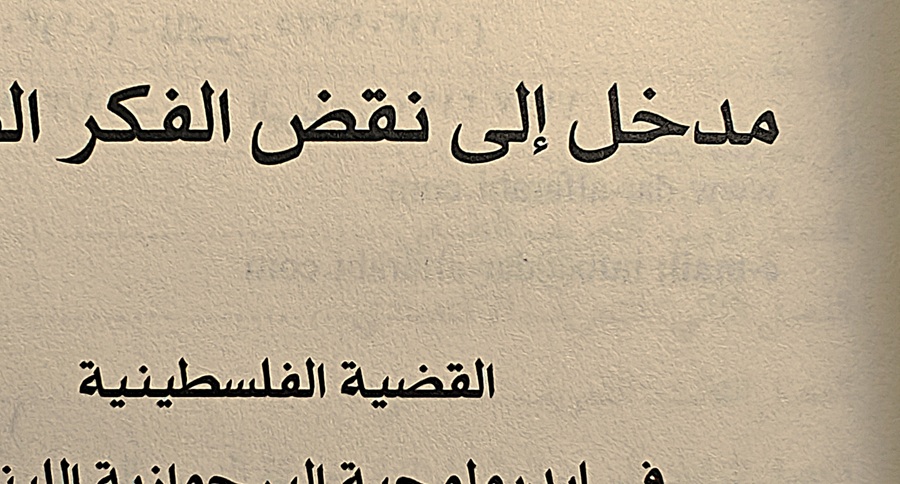
Between these two pivotal military interventions Amil composed and published his 1980 Madkhal ilā naqḍ al-fikr al-ṭā’ifī: al-qaḍiyya al-filastīniyya fī aydiyūlūjiyāt al-burjuwaziyya al-lubnāniyya (An Entryway into Overturning Sectarian Thinking: The Palestinian Cause in the Ideology of the Lebanese Bourgeoisie) in which “the Palestinian cause” occasions the falling away of the spontaneous ideology of the ruling class (sectarianism). It does this not through a ‘critique’ of how one ‘views’ the Palestinian cause, but by allowing sectarian thinking’s own mistaking of the Palestinian cause as a ‘sectarian’ problem to prevail. It is for that reason that the Madkhal is largely made up of a symptomatic reading of the texts of the Lebanese bourgeoisie, from the writings of Michel Chiha (1891–1954), the Mandate-era banker and phalangist politician, to Amil’s contemporary Pierre Gemayel (1905-1984) and other writings of the latter’s Kataeb Party.

The formation of the Lebanese National Movement (LNM), a coalition of reformists and revolutionaries that constituted the chief antagonist of the reactionary Lebanese Front (LF), was largely premised on the constitutional reform of the country’s politics. It was oriented, according to Karim Mroué, a Political Bureau Member of the LCP, toward “eliminating the domination of a kind of religious autocracy” (quoted in Ismael and Ismael 1998, 102n8). However, the Madkhal shows such bourgeois “sectarian thinking” to be undone in its own grasping of “the Palestinian cause.” Hence, while Amil was at pains to show that militant support for the PLO and the Rejectionist Front, with whom the LNM was allied, was the miḥwar, the“axis,” of the national and anticolonial class struggle in Lebanon and not an external element, the Madkhal was to effect a change in thinking—to show that the Palestinian cause as it is articulated in the ideology of the dominant class leads to the latter’s ideological armor, sectarian thinking, to fall away, as Marx says, “like rotten touchwood [wie mürber Zunder].” (1976 [1867], 932). Indeed, while naqḍ in modern Arabic gives the strong sense of a juridical interdiction, earlier meaning of the word directly invoked the unravelling of a cord. This work of unravelling, of the falling away of sectarian thinking, Amil showed, is affected in the Palestine cause. Why this is the case can only be briefly adumbrated here, by setting out the axioms that programmatically orient Amil’s theoretical work in answering the inaugural query of the Madkhal: “How do the Lebanese bourgeoisie, from the vantage of their class ideology, view the Palestinian cause?” (Amel 1980: 11). [1]

The Madkhal takes as its first axiom the orientation of class struggle, which bifurcates (rather than pluralizes) into the position of “dominant class” and the “revolutionary class.” The “ideological position of the labouring class” is what enables “seeing” the ideological practice of the Lebanese bourgeoisie as the political necessity of domination—it follows that the question of which“sect” is dominant (“the Maronites,” “the Sunni,” etc.) not only cannot see the class struggle but participates in the very sectarian thinking that obfuscates it. Moreover, the result of the breakdown of this domination in maintaining the colonial relation was the then-ongoing military action: “the bourgeoisie did not find another way to treat this political crisis of theirs but to ignite civil war; it is the logic of the dying bourgeoisie, ever urging them to descend into the abyss of their intractable crisis” (Amil 1980: 23). It is incumbent upon us to note how successful the ‘civil war’ and threat of its return has been in maintaining this domination in Lebanon over the past half-century.

The second axiom of the Madkhal is that this class-ideological position is the adequation of thinking to a real force of negation. Against the theoretical humanism of a mirrored subject/object—wherein “the Palestinian cause” is an object that can be composited properly by collating these different ‘perspectives’ (whether “one-“ or “two-state” solutions, for example)—the “soil” of this “actual field” is the class struggle that is “in the mode of overturning [naq

].” Breaking with this thinking, then, “consists specifically in bringing to presence this, the political that the ideological absents.” In other words, “seeing” the “Lebanese bourgeois ideological-conceptual structure…in its relation with this political necessity,” bears the activity of overturning it.

It is from these axioms that Amil sets up the relationship between the activity of “overturning” the class ideology of the Lebanese bourgeoisie and “the Palestinian cause”:

Viewing the Palestinian cause is not possible—no matter the position from which we view it—apart from the national liberation movement of the Arab peoples. The Palestinian national movement is an inseparable part of this movement; the internal mechanism that governs the common Arab national movement is itself what governs the Palestinian national movement, the mechanism being the liberation from imperialism, Zionism, and Arab reactionism. (Amil 1980, 12)

In this sense the Palestinian cause condenses the “colonial relation,” the specific conjuncture of forces (imperialism, the Arab capitalist class, and Zionism) that ideologically articulates the colonial mode of production in Lebanon. Hence Amil’s thinking is already disabused of the (idealist) tendency to systematize and absolutize the distinction between “post-colonial” and “Marxist” thought in the so-called Global South. The overdetermined structure of the “colonial mode of production” exists in the collision of these forces.

But this is precisely why it is the question of the overdetermined colonial structure itself that the Palestinian cause occasions for thinking:

Therefore, determining the Lebanese bourgeoisie’s class position on this axial cause (the Palestinian cause) in the struggle of the Arab peoples, required by necessity determining its class position on the Arab liberation movement. For in the light of this position the other position is determined, especially since the Palestinian resistance movement did not manifest, in an actual way, in the Lebanese arena (that is, in the field of the specific class conflict in the Lebanese social structure), and would not become a foundational element therein, until after the defeat of June 1967. (Amil 1980: 12)

The existence of the Palestinian cause as anterior to the anti-colonial class struggle in Lebanon does not mean that it is a genetic outgrowth of the situation, even if it is “determined” by it. Here, Amil is notinterested in instructing a historicism. Rather, he shows how the Palestinian cause’s status as, at once, contingent and axial in Lebanon’s national situation proves to be a decisive obstacle for ‘sectarian’ thinking:

It is an error, then, on the methodological level, not to show the necessary correlative relationship in the Lebanese bourgeois ideology between the position on the Arab liberation movement and the position on the Palestinian cause; as, in truth, this position is a natural, logical consequence of that position that finds, for its part, its explanation in the structure of the existing colonial relations of production in the Lebanese social structure, and in the class relation of dependence that ties the dominant bourgeoisie within it to imperialism. But if we establish a partition between the two positions, not attributing the second to the first, and we do not bring to light that the practice of the outright hostility of the Lebanese bourgeoisie toward the Palestinian resistance and the Palestinian cause is a result of the hostile relationship and class warfare that stamps its relationship to the Arab liberation movement, we would at that time fall into the trap of its class ideology, instead of being capable of overturning it. (Amil 1980: 13)

The position of these liberation movements thus turns on the Palestinian cause which articulates with them to become the symptomatic point specific to the national situation of Lebanon. It becomes the axis of a set of contradictions and of political struggle; it carries the force of the real movement of negation. But it is for precisely this reason that it cannot be thought outside the class struggle internal to Lebanon’s national situation. “We will not,” Amil writes succinctly, “overturn ‘sectarian thinking’ through sectarian thinking” (Amil 1980: 17).

In other words, the Palestinian cause, its pain and therefore its history, is one site that makes the overdetermination of the capitalist mode of production in the present, that is, modern colonisation, thinkable as what can be overturned. “The class struggle is the motive power of history; history is not moved in accordance with the dominant class’s system of class control but in the struggle against it” (Amil 1980: 22). Witnessing the current attempts to obliterate Palestine and its present existence-as-cause as well as its covering-over by the ideological practice of sectarian thinking in Lebanon today, the need to articulate the falling away of sectarian thinking is no less pressing.


Aaron F. Eldridge is a Postdoctoral Fellow in the Department of Anthropology at the University of Toronto. He studies collective responses to cultural destruction and social precarity in the Middle Eastern and Muslim/Eastern Christian world.


Notes

[1] We should note here the polysemy of al-qaḍiyya al-filasṭīniyya in Arabic. It is not only “the Palestinian cause” but also “the Palestinian issue” and “the Palestinian question,” terms which, in English, ramify into terrains of political transformation or armed struggle, social antagonism, and juridical dispute respectively. This question of translation is relevant because what is at stake for Amil, following his contemporary Palestinian comrades in their articulation of resistance, is precisely the transformation of a juridical “question” (to be resolved in the future by statist, international law) into a material “cause” that articulates present time, situated in what Omid Mehrgan aptly describes in this feature as “the remnants of life today.”


References

Amil, Mahdi. 2020. Madkhal ilā naqḍ al-fikr al-ṭā’ifī: al-qaḍiyya al-filastīniyya fī aydiyūlūjiyāt al-burjuwaziyya al-lubnāniyya (An Entryway into Overturning Sectarian Thinking: The Palestinian Cause in the Ideology of the Lebanese Bourgeoisie). Beirut: Dar-al Farabi

Ismael, Tareq Y. and Jacqueline S. Ismael. 1998. The Communist Movement in Lebanon and Syria. University Press of Florida.

Jameson, Fredric. 1982. The Political Unconscious: Narrative as a Symbolically Social Act. Ithaca, NY: Cornell University Press.

Marx, Karl. 1976 [1867]. Capital: A Critique of Political Economy. Translated by Benjamin Fowkes. New York: Vintage.

Safieddine, Hicham. 2020. “Introduction: The Anti-Colonial Intellectual.” In Arab Marxism and National Liberation: Selected Writings of Mahdi Amel, edited by Hicham Safieddine and translated by Angela Giordani, 3–9. Leiden: Brill.

Traboulsi, Fawwaz. 2008. Tarikh lubnān al-ḥadīth [A History of Modern Lebanon]. Beirut: Dar Riad El-Rayyes.


Cite as: Eldridge, Aaron F. 2025. “The Palestinian Cause Contra Sectarian Thinking” Focaalblog October 6. https://www.focaalblog.com/2025/10/06/aaron-f-eldridge-the-palestinian-cause-contra-sectarian-thinking/

Nico Putz: On Anti-Deutsche and Neo-Imperial War

Image 1: Pro-Palestine demonstration in Berlin, October 2023. Photo by Montecruz Foto

This forum has shed light on vastly different but interrelated contexts of Palestine solidarity. The essays draw attention to the interplay of shifting solidarities with Palestine and the amorphous formation of “the (political) left” across geographical and temporal contexts. Germany, although not belonging to the postcolonial and neocolonial contexts as in the other essays, is one among many puzzle pieces interlocking with political realities elsewhere, and across worlds. Like other “post”- imperial regions, Palestine continues to be an uncomfortable question mark in the German national narrative of post-Nazi redemption. It is a question mark which has split the German radical left into two seemingly irreconcilable sects: a staunchly pro-Zionist, pro-American, and markedly bellicose faction—the Anti-Deutsche—and their equally convicted counterpart, the pro-Palestinian, anti-colonial, and supposedly antisemitic Anti-Imperialists. The German and international media cyclically regurgitates this dichotomy, with every escalation of violence in Palestine sparking German leftist networks to organize protests both in support and in opposition to Israel, at times clashing violently with one another. While inter-factional violence amongst leftists is certainly not unique to this context, the locking of arms between members of the Christian Conservative Party (CDU) with antifascist groups at pro-Israeli protests just might be.

German leftists who continue to stand with Palestine were not surprised by the intensification of governmental restriction and police violence targeting pro-Palestinian support. After all, the post-war political discourse in West Germany branded anti-Zionist and otherwise pro-Palestinian leftist voices and positions as antisemitic at least since the 1960s. By the 1990s this radical pro-Zionist stance manifested increasingly in many radical leftist circles across reunified Germany. Triggered by the geopolitical fall-out resulting from the presumed end of the Cold War, like the Yugoslavian wars and the invasions of Iraq, the Anti-Deutsche left emerged as a distinct political current in the country. In this essay, I aim to deliver a longue durée of the German debate around Palestine and Israel through the idiom of this idiosyncratic political formation, pointing at entanglements that continue to link the imperial-colonial to the present. Perhaps, this helps to explain why broad sections of the German left find it easy to look the other way at the face of the destruction of Gaza or the targeting of political dissent at their own doorstep.

In the wake of the Berlin Wall and informed by Nazi atrocities as well as their acceptance of a paradigm of collective guilt, a diverse group of authors and organizers saw the potential rise of a Fourth Reich on the horizon of a reunified Germany. The rise of right-wing extremist attacks in both Germanies seemed to confirm their prophecy of a resurgence of nationalism and authoritarianism reminiscent of the Nazi era and German imperialism. This fear motivated the formation of groups that explicitly identified as antinational and later Anti-Deutsch, emphasizing a critical stance toward German history and identity, opposing German national sentiments, symbols, and slogans. (Hagen 2004, Errlanger 2009)

While a sizable, heterogenous section of the Anti-Deutsche movement eventually continued down a theoretical path, which led them to disavow themselves from “communism” and even “leftism” altogether, in the beginning they very much saw themselves as communists. But from the start, they sharply diverged from the broader radical left by challenging the prevailing anti-imperialist and anti-Zionist consensus. The West German New Left had often aligned itself with anti-colonial national liberation movements and socialist governments in the Global South, while being critical of Israel, in particular since the 1967 War. The West German radical left stood in solidarity with the Palestine Liberation Organization (PLO) and Palestinians. Similarly, in socialist East Germany, solidarity with the PLO and a critical stance towards Israel had been an element of the raison d’état (Staatsräson). Breaking with this leftist tradition, Anti-Deutsche took a militant stance of unconditional solidarity with Israel. This position was not only a political choice but framed as moral imperative grounded in their recognition of Israel as the refuge and homeland of Holocaust survivors.

Anti-Deutsche criticized the left for a tendency to relativize or downplay the Holocaust, and accused it of harboring latent antisemitism, lurking in its admittedly at times quite militant anti-Zionism. In consequence, the attitude toward the Palestinian question became a defining and divisive issue in activist circles. A further point of departure was the Anti-Deutsche’s stance on war and military interventions beyond Palestine, where they further broke with traditional leftist pacifism and anti-imperialism. This shift became particularly pronounced starting with the Gulf War in 1991, with a decisive split in the movement during the wars in Yugoslavia and continuing through the post-9/11 era. As I will show, the Anti-Deutsche ideology took shape not just in response to the German responsibility for the Holocaust, but also in reaction to violent conflicts which ensued with the global transition out of the Cold War’s stalemate, rather than out of a German exceptionalism. In fact, it is the Anti-Deutsche’s discursive linkage between these post-Cold War conflicts and the Holocaust, that have been a decisive factor in building the movement’s political identity and its relations with other formations on the left and beyond.

To fully understand this development, let’s retract again to the global sixties and the New Left. Like many other locales, the post-war generation of the left in West Germany emerged from universities and had—also in response to the Stalinist interventions in a range of popular uprisings—began to align itself with China rather than the Soviet Union. Further exacerbated by the atrocities committed in Vietnam, this anti-imperialism, which some have called Third-Worldism, became staunchly anti-American, with American foreign policy often branded as fascist. The German New Left had begun the decade trying to break their parents’ deafening silence. They acknowledged the bloodsheds of the World Wars and the genocidal Nazi apparatus, while pointing at influential members of society with previous allegiance to the Nazi Party—judges, politicians, generals, professors, etc. Reframed onto Palestine, this translated to an understanding of Israel as colonial enterprise backed by the American empire and its Western allies, with the 1967 War crystalizing this position further, thereby shaping the German New Left as “the natural home of camaraderie with Palestine,” as Roy puts it in the forum’s introduction. The unfolding dialectical radicalization of the West German state and the New Left had eventually even produced a brief active alignment between some militant elements of the German left and some militant elements within the PLO, namely the Popular Front for the Liberation of Palestine (PFLP).

Jean Améry (1912–1978), author and Holocaust survivor, was among the earliest to denounce leftist anti-Zionism as disguised antisemitism. Published from the mid-1960s onwards, his essays stressed Germany’s obligation to support Israel as a refuge for Holocaust survivors. He condemned the New Left’s equation of West German state repression with Nazi crimes as a gross relativization. In 1974, Hermann L. Gremliza became editor-in-chief of the West German leftist monthly Konkret (published since 1957 – except for a short break in the 1970s). While Konkret at the time still published opinions of the pro-Palestinian Red Army Faction, Gremliza would incorporate Améry’s critique and become a key figure among the early Anti-Deutsche. Despite this, he was still able to sufficiently locate a sympathy for the Palestinian cause to make statements unthinkable from German intellectuals today. For instance, he said in 1985: “Why, instead of the poor Arabs, shouldn’t the legal successors of the perpetrators [of the Holocaust] provide the Jews with a state territory, for example, Bavaria […].” Around this time, other authors like Eike Geisel and Wolfgang Pohrt appeared in Konkret, highlighting again the persistence of antisemitism and criticizing the left’s loose commitment to the PLO. Moishe Postone, a key figure for Wertkritik, reinterpreted Marx to show antisemitism as a distorted critique of capitalism. His ideas influenced later Anti-Deutsche groups and publications like Krisis, EXIT!, and Austria’s SINet. By incorporating psychoanalytic insights to critique ideology and nationalism, Ideologiekritik (critique of ideology) became central to certain strands of Anti-Deutsche theory. (Erlanger 2009: 100) While the (re-)discovery of and/or engagement with critical theory, particularly the Frankfurt School, had a long tradition within the German New Left, it gained a centrality in Anti-Deutsche theory, which eventually led to some eliminating Marxism and communism from their ideology.

A key catalyst in the emergence of the Anti-Deutsche, came in response to the fall of the Berlin Wall in 1989. Many West German leftist, from anarchists to formerly Maoist members of the Green Party, opposed reunification, fearing a “Fourth Reich” would emerge out of a newly reunified Germany. The Gulf War of 1991 was another pivotal moment in the definition of Anti-Deutsche. While attacks on the German peace movement for its alleged anti-Israeli and anti-American positions had been present before unification, this first invasion of Iraq radicalized some of the antinational left further, which immediately split the movement. Gremliza and others supported the war—a position that was unprecedented for the general anti-war ethos of the radical left. Their argument framed the war as a necessary defense of Israel from Iraqi chemical weapons and, by extension, a stand against a new form of fascism and antisemitism. Although this pro-war position did not gain majority support within the antinational movement at the time, it nonetheless established an analytical framework for the Anti-Deutsche, which involved drawing analogies between contemporary conflicts in the postcolonies, framing the United States and its allies as antifascist forces opposing new forms of fascism and antisemitism beyond the Global North.

The Kosovo War (March 24 to June 9, 1999) served as another point of departure, profoundly impacting the Anti-Deutsche’s ideological development and their relationship with the broader German left. This conflict, which saw NATO intervention to decisively shift the tide in favor of Kosovo Albanians, culminating in the withdrawal of the Serbian army and the establishment of an international protectorate over Kosovo, marked Germany’s first active military involvement since 1945. In his speech at the Green Party’s special conference on May 13 of that year, the German Foreign Minister Joschka Fischer notoriously defended the NATO assault on Yugoslavia by stating: “Auschwitz is incomparable. But I stand on two principles: never again war, never again Auschwitz, never again genocide, never again fascism. Both belong together for me.”

This implicit Auschwitz comparison and the humanitarian justification for military action ignited an intense debate within both the Green Party and the left in Germany and Austria. In a highly idiosyncratic and anachronistic interpretation, some Anti-Deutsche viewed the Kosovo conflict primarily as a German war against Serbian nationalism, asserting that Germany was leading the intervention with the Americans in a subordinate role. Conversely, the Anti-Deutsche themselves supported Serbia and vehemently opposed NATO intervention, seeing it as a direct continuation of German nationalism and imperialism, replicating the alliance between the Croatian fascists of the Ustaše regime and the Nazis. The remainder of the antinational left on the other hand, tended towards an abstract rejection of both Serbian nationalism and the NATO intervention, condemning all parties involved.

The next external impetus for controversial Anti-Deutsche stances followed soon thereafter in shape of the attacks on New York City and Washington D.C. on September 11, 2001. This confirmed their monochrome assessment of (militant) resistance to Western modernity as inherently antisemitic, in turn radicalizing their position on Palestine and beyond. The Anti-Deutsche then endorsed military interventions in Afghanistan and Iraq as essential for the defense of Israel and Western civilization. We can see here, as with the cases of the Gulf War and the Kosovo War, how the German image of the postcolonial (particularly Muslim) world has been closely intertwined with the responsibilities resulting from the Holocaust and a narrative of a benevolently superior West. This militant pro-war and pro-Israel stance considerably deepened divisions within the German left and, notably, even within the Anti-Deutsche’s own ranks. While a minority retained some critical perspectives on US foreign policy, a significant faction fully embraced a pro-American, pro-Israel position and the broader Global War on Terror. In their evolving analysis, political and even cultural Islam was increasingly viewed as a new fascism, analogous to fascism in the German tradition. Their uncompromising rhetoric led to their exclusion from various left-wing anti-fascist demonstrations and a general alienation from anti-fascist circles, but, at the same time, they won support from the conservative Christian Democratic Union (CDU) party, even attracting some party-members to participate in protests they had organized.

The Anti-Deutsche strongly oppose the traditional left-wing sympathy for Palestine. The Second Intifada and subsequent uprisings were almost exclusively framed as inherently antisemitic attacks on Israel, and Anti-Deutsche discourse consistently emphasizes Israel’s role as a crucial bulwark against global antisemitism and Islamist extremism. Anti-Deutsche critique categorically rejects any concessions to Palestinian movements, indiscriminately devaluating perspectives as diverse as the Boycott, Divestment, Sanctions (BDS) movement, leftist intellectuals like Noam Chomsky, and the Palestinian Islamic Jihad, often drawing parallels to Nazi antisemitism.

Over time, the Anti-Deutsche movement became increasingly isolated from other leftist groups. Some members began publishing in conservative media outlets, further blurring the boundaries between left and right, and provoking criticism from both sides. Despite this, the Anti-Deutsche remain a unique phenomenon in German political culture.

Assessing the Anti-Deutsche’s s impact on German society, particularly the left, is challenging, primarily because it was never bound to a monolithic rhetoric. Beyond unwavering support for Israel and a tendency to back US – led invasions, their positions were at times unpredictable and spontaneous responses to current events. Recurring popular declarations of the Anti-Deutsche left’s demise and irrelevance, or its public stripping of “leftist” status, further complicate impact assessment. As early as 2006, the Rosa Luxemburg Foundation (a major German think tank affiliated with the leftist party Die Linke) published an article implying that the Anti-Deutsche did not fit traditional leftist ideals of optimism, anti-capitalism, and nuanced critique (Erdem 2006). Yet, the Anti-Deutsche’s voice persists in the German public arena, the academy, the media, and in the parliament. Partially, this is explicable by the careers of some Anti-Deutsche, particularly later generations, who might not identify as such anymore but could be bringing their Anti-Palestinian stance along the way up the career ladder.

The Anti-Deutsche were and are an amorphous group, producing sometimes valid and necessary critique of ideological narratives, sometimes cultural agitprop like danceable tunes, and occasional high-meta theory of society under capitalism. To the reunifying German left, they were also the source of countless headaches, accusations, rifts, and breakups, some culminating in symbolic and even physical violence between potential comrades. Alienating their contemporaries, the early Anti-Deutsche have made a lasting impact on future generations, who often diluted the former’s hardcore positions, but simultaneously spread their ideology in academia, the press, and leftist institutions. In Germany, the secret service in charge of surveilling and defining political extremism, has recently re-discovered the Anti-Deutsche left, after deeming its divisive potential exhausted back in 2007. The reports of the Bundesamt für Verfassungsschutz have in response to the developments on and following October 7 included a new section, titled Auswirkungen des Nahostkonflikts und Antisemitismus (Consequences of the Conflict in the Middle East and Antisemitism), in which they acknowledge the continued existence of radical leftist groups with a militant pro-Zionist stance. Yet, the German state’s tradition of ontologically separating Palestinian secular anti-imperialists in Germany from their “native” German counterparts on the other hand, continues in an unbroken chain reaching across several decades of annual reports. Consequently, the Palestinian organization Samidoun, which the German state considers a frontal organization of the PFLP, is lumped in with militant Islamists, Kurdish and Punjabi separatists, and Turkish right-wing extremists, in a separate chapter titled Auslandsbezogener Extremismus (Foreign-related Extremism). This revealing manifestation of Staatsräson might also explain the mainstream acceptance of the criminalization of this organization in 2023.

Taking stock of the larger German scene, Chancellor Friedrich Merz earlier this year welcomed the US-Israeli attack on Iran as a justified strike against an immoral “terror regime” at war with the West’s liberal values. Merz and his government’s views are driven by two core beliefs, both entangled with the legacy of Germany’s post-war leftist schisms: (1) that the post-Cold War transatlantic order, driven by liberal markets and values, is the best path to a democratic and equitable society, and (2) that Islam and Palestinian nationalism are incompatible with this order. These beliefs are increasingly prevalent across the German political spectrum, often as a frantic catching-up to the alt-right’s political gains. Paradoxically, these views often overlap substantially with positions developed from an extreme left that feared the remilitarization of Germany overseen by Merz and his predecessor. As Omid Mehrgan puts it in this forum, Palestine here is a “mode of relating to the politics of material conditions of life that touches all forms of politicization in the globalized ecologies of war and of remnants of life today.” It is also a mode of explication, for those among the readers who may have been stupefied as to why Germany’s repression of pro-Palestine demonstrations on the streets of Berlin and elsewhere have been so over-the-top violent. These demonstrations, in spite of everything, challenge the very trajectory of politics in Germany, especially leftist politics, since the Nazi event.


Nico Putz researches Afro-Asian entanglements during the Cold War at Leibniz-Zentrum für Zeithistorische Forschung in Potsdam, and is on the editorial board of MIDA Archival Reflexicon. 


References

Erdem, Isabel. (2006). Anti-deutsche Linke oder anti-linke Deutsche? UTOPIE kreativ (192), 926–39.

Erlanger, Simon. (2009). “The Anti-Germans – The Pro-Israel German Left. Jewish Political Studies Review 21, (1–2), 95-99.

Hagen, Patrick. (2004). Die Antideutschen und die Debatte der Linken über Israel. MA thesis, University of Cologne, 2004, 2-7, 58.


Cite as: Putz, Nico 2025. “On Anti-Deutsche and Neo-Imperial War” Focaalblog September 27. https://www.focaalblog.com/2025/09/27/nico-putz-on-anti-deutsche-and-neo-imperial-war/

Olivia C. Harrison: Who’s Afraid of Palestine Solidarity?


Image 1: The logo of Mouvement des travailleurs arabes, from the Saïd Bouziri collection at Archives de La Contemporaine.

One question has been haunting me since the current wave of repression of pro-Palestinian speech began in the wake of the October 7 attacks and the genocidal campaign-disguised-as-reprisal that followed: who’s afraid of Palestine solidarity? This is an urgent question on US, French, and German campuses today, but its purview is not limited to the Global North. In fact, this question puts pressure on the distinction between Global North and South, as if the newly minted leaders of formerly colonized nations had created the “new man” that Frantz Fanon so passionately called for (Fanon 1963: 316). As dissidents, intellectuals, and artists from former European colonies have taught us, the simple transfer of power cannot be mistaken for what Fanon called decolonization, a process that begins with sovereignty but does not end there. The mass transfer of populations set in motion by colonial settlement and postcolonial migration is one of the vectors that disrupts the neat temporal and epistemic divisions between the imperial era and the purportedly postcolonial era. So too is Palestine, the object of a century-long process of settler colonization that flares up every few years in a new war of elimination. The migrant question and the Palestinian question are not separate questions. The ways in which they overlap go a long way to explaining the threat Palestine and Palestine solidarity represent across our still decolonizing world.

At first sight, Palestine appears to be an outlier on the sanitized map that has made permanent the borders drawn by European colonial powers – as if Palestine were a belated hangover from the era of full-throttle imperialism and settler colonialism. But the impermanence of Palestine’s ever-dwindling borders gives the lie to the fantasy of decolonization as a fait accompli. Palestine is a thorn in the side of postcolonial regimes too quick to forget the revolutions that carried them to power – perhaps especially those regimes that pay lip service to the Palestinian cause while quashing dissent, including Algeria, a self-declared ally of the Palestinian resistance that has long suppressed any speech deemed critical of the state. As dissidents in Morocco, Algeria, and Tunisia have repeatedly warned, Palestine has long served as an alibi for repressive Arab regimes.

And yet Palestine solidarity is alive and well, as the mass protests of the past two years have shown us, even though the conditions on the ground have deteriorated to the point that the goals of Palestine solidarity in the era of Third Worldism – total decolonization in the form of a single, democratic state for all inhabitants of historic Palestine – seem completely unattainable today. The facts on the ground have all but foreclosed the possibility of Palestinian sovereignty. So why does Palestine continue to pose a threat, not only to the settler colonial regime that has been steadily replacing the Palestinians for over a century, but for nation-states that have apparently no stake in the outcome of settler replacement or indigenous resistance? This is not a rhetorical question, although the answer may seem obvious in the nation-state in which I write, the US, a settler colonial regime likewise premised on the replacement of its indigenous populations. Settler colonial solidarity goes a long way to explain the threat that Palestine and Palestine solidarity represent to Israel and the US. This is also true of other settler and post-settler regimes like Australia and France (more on the latter below). But this does not explain the threat that Palestine solidarity poses to the postcolonial regimes of former European colonies – including former settler colonies like Algeria. This is the flip side of Arpan Roy’s caution against taking Palestine solidarity as a given. If we need to rethink what it means to commit to Palestine, anti-Palestinian backlash, too, should be denaturalized. In what follows I discuss several case studies that shed light on dangers that commitment to Palestine represents in France, Algeria, and the US, focusing on the links that tie the migrant question to the Palestinian question.

*

I begin with a document that stages our relationship to decolonization as an unfinished process, one in which Palestine figures among other more or less successful anticolonial revolutions. French-Moroccan artist Bouchra Khalili’s twenty-two minute digital video Foreign Office is part of an installation which includes fifteen photographs of the now-deserted embassies of Third World revolutionary movements in Algiers and a silkscreen print that assembles these sites in an “Archipelago” of now disconnected points. The video begins with a medium shot of Ines and Fadi, two young Algerians, sitting side by side at a black desk that turns into an editing table as they handle the maps, photographs, audio and video recordings that together compose the archive of Algiers as a “Mecca for revolutionaries,” in Amílcar Cabral’s poetic phrase: the soundtrack of the 1969 Pan-African Festival; black and white photographs of Eldridge and Kathleen Cleaver at the Black Panthers’ international headquarters in Algiers; and portraits of Nelson Mandela, Malcolm X, Agostinho Neto, Mário Pinto de Andrade, and other Third World revolutionaries who gathered in Algiers to discuss their plans for decolonization (Khalili 2015). In the wake of the Algerian revolution, anticolonial and antiracist movements from around the world found refuge in Algiers, sometimes headquartered in the same colonial-era building, vacated to make room for transcolonial solidarity. But this legendary past is long gone. “We have inherited only disenchantment and history in pieces,” Ines observes. What has happened to Algeria, she wonders, to make everyday Algerians yearn to leave for France? Ines speaks in Darija (Algerian Arabic), Fadi speaks in Taqbaylit, an indigenous language that predates the Muslim conquest of North Africa in the seventh century, and they understand each other perfectly. Together, they edit the archives of an era they never knew to understand the present they share, summoning the voice of Algerian writer Kateb Yacine, who left behind the French language – his “butin de guerre” (war booty) – to forge new cultural forms and idioms in a newly sovereign nation that was already betraying its revolutionary ideals.

Shot in Algiers a few years before the pro-democracy movement (al-hirak) took to the streets in February 2019 to protest Abdelaziz Bouteflika’s attempt to secure a fifth term as president, Foreign Office sketches the coordinates of transcolonial solidarity and its undoing in the aftermath of decolonization. What lessons can we draw from Ines and Fadi’s “revolutionary heartbreak” (to cite a term coined by my colleague Neetu Khanna) as we witness the destruction of Gaza in the twenty-first century? And what can Palestine teach us about our relation to the anticolonial past and neocolonial present? The lines that Foreign Office draws between past and present, here and elsewhere are an invitation to rethink what commitment to Palestine means at a time when the intensity of Palestine solidarity stands in inverse proportion to the possibility of Palestinian futurity.

To begin answering the question “who’s afraid of Palestine solidarity,” I take Ines and Fadi’s invitation to return to the work of Kateb Yacine, an outspoken advocate for Palestinian rights who deployed Palestine in a twinned critique of the roles Algeria and France played in transforming the figure of the indigène (the colonized) into the figure of the immigrant, divorced from the settler colonial histories that produced it. In response to Ines’s question as to why Algerians continue to leave the “Mecca of revolutionaries,” Kateb’s play proposes that they do not have a choice. Settler colonialism set in motion the mass transfer of populations from the metropole to the colony, from the colony to the metropole, and, if the anti-immigrant right has its way, from the post-settler colony back to the former colony. It’s not coincidental that settler colonialism set this train in motion, or that Palestine, the object of another project of settler replacement, elucidates this dynamic in Kateb’s writings and in the forms of migrant activism that followed. As I will show in my concluding discussion of Palestine solidarity in 1970s France and the US today, Palestine has become a litmus test for national belonging in the settler postcolony.

*

In 1970, the beloved anticolonial writer Kateb Yacine returned to Algeria with the aim of working in the languages of the people, Darija and Taqbaylit, better suited, according to him, to achieving cultural decolonization than the colonial tongue he mastered so brilliantly. On his friend Ali Zamoum’s recommendation, he joined Masrah al-bahr (Theater of the sea), a popular theater troupe that had already performed several plays, including one on Vietnam, a topic dear to Kateb’s heart. Based on collaboration, improvisation, and audience participation, the troupe began adapting parts of Kateb’s thousand-page French-language manuscript play, Boucherie de l’espérance (Butchery of hope, 1968-69) in their headquarters in the working-class neighborhood of Kouba, in Algiers. Their first play, Mohamed arfad valiztek (Mohamed pack your bags), premiered on October 17, 1971, marking the tenth anniversary of the murder of hundreds of Algerians peacefully protesting against a racist curfew targeting Français musulmans d’Algérie (colonized Muslim French nationals of Algeria) by Paris police forces five months before the signing of the Evian Accords that would put an end to the Algerian war of independence from France. The irony of the title, Mohamed pack your bags, was initially lost on the Algerian immigrants who saw the poster for the play during the troupe’s French tour in 1972 – they reportedly panicked, assuming it was a call for the expulsion of immigrants. (The far-right National Front party was founded on this very campaign promise in October 1972. It remains the number one agenda of its de-demonized successor, the National Rally, and the plethora of anti-immigrant parties and organizations that have cropped up since.) While one of the self-declared aims of the play was, in fact, to convince Algerians to return to their homeland to continue the work of decolonization, the play is also a fiercely funny denunciation of the collaboration of postcolonial Algerian authorities and French government and industrial forces in recruiting, deporting, and exploiting Algerian workers in France. Mohamed arfad valiztek remained the troupe’s most popular play, reaching an estimated 75,000 spectators during the French tour, from February to June 1972, and another 350,000 in Algeria in the next four years, where the troupe (renamed Al-nishat al-thaqafa lil-‘umal/Action culturelle des travailleurs or Worker’s cultural action, hereafter ACT) continued to perform Mohamed arfad valiztek alongside plays on Palestine (Filastin al-maghdura, Palestine betrayed, 1974) and the neglected role of Imazighen (“Berbers”) and women in Algeria’s millennial history (Malik al-gharb, The king of the west, 1977). Initially funded by the Ministry of Work and based in the popular Bab El Oued neighborhood of Algiers, the troupe’s irreverent and openly critical performances soon caught the attention of government censors. In 1977 the troupe was forced to relocate to the Western province of Sidi Bel Abbès, where they continued to perform until Kateb’s premature death in 1989.

An often bitingly funny satire of the backroom deals between the Algerian and French governments that resulted in the emigration of an estimated 750,000 Algerians by the time the first decade of independence was over, Mohamed arfad valiztek depicts the trials and tribulations of the titular character, a down-on-his luck migrant who faces a series of setbacks that ultimately lead to his triumphant return to Algeria where he resumes possession of his expropriated home thanks to the proverbial nail in the wall (this scene is based on a popular “Juha” tale known throughout North Africa) and vows to join the struggle against injustice “until the end of colonialism!” (Kateb 1999: 336). Although no opponents are named – Mohamed battles in turn the slavedriver, the police officer, the qadi (judge), the mufti (religious leader), and Boudinar (“father of money”) – the satire of the national elites and their French counterparts is impossible to miss. More subtle is the play’s critique of the transformation of indigènes (natives), as the Algerians were dubbed in French colonial law, into immigrants, construed as a disposable labor force that greases the wheels of the French and Algerian economy alike. The satirical name Pompez-tout (“Pump-it-all”), a near homonym of Pompidou, the French president’s name, neatly captures the labor-for-oil deals of the postcolonial migrant economy. But a less expected figure joins the chorus of characters on stage to expose the colonial genealogies of the migrant economy in France: a Palestinian laborer. What does Palestine have to do with Algerian immigration to France?

Mohamed arfad valiztek begins with a scene split between French Algeria and Mandate Palestine. On one side of al-halqa (a circle drawn by the spectators) stand Mohamed I, an indigenous laborer, and Ernest, a French settler; on the other, Mohamed II and Moses, a Zionist settler. The two Mohameds till the land under the supervision of the settlers, until the pairs depart, seemingly taking the same path home. After a good night’s rest, the two Mohameds and settlers wake up and begin chasing a single rooster with the generous aim of offering it to their “guest” for breakfast. The hilarious battle for hospitality that ensues satirizes the contest for indigeneity in a now chiasmic settler colony (“If only this rooster could speak… – He’d say France! . . . – Israel! – Algeria! – Palestine!) but also, as the rest of the play implies, in the settler postcolony, where yesterday’s indigène has been transformed into an immigrant, and the settler of old has become a native (Kateb 1999: 214). Rooting French anti-immigrant discourse in the longue durée history of French Algeria, Mohamed arfad valiztek exposes the settler colonial genealogies of the forms of nativism that were taking hold in France at the time. That it delivers this critique through a comparison with Palestine should not surprise us. If settler colonialism is based on land expropriation rather than labor exploitation, it remains the case that both French Algeria and Israel relied on native labor – notwithstanding the Zionist myth of Jewish labor – and that the indigènes (natives) have been transformed into foreigners in both France and Israel. But the play goes further than this. If the migrant economy is a product of settler colonialism, settler replacement also provides the rhetorical framework for calls for “remigration” satirized in the title Mohamed pack your bags. The fantasy of the “great replacement” – the purported replacement of Français de souche, white French people, by immigrants – was born at the colonial frontier.

When the ACT toured Mohamed arfad valiztek in France, North African migrant workers were already organizing around Palestine. In the wake of Black September, the 1970 massacre of thousands of Palestinian fedayeen by King Hussein’s troops in and around Amman, a group of Moroccan, Algerian, Tunisian, Syrian, Lebanese, and Palestinian activists got together at the Maison du Maroc (Morocco House) of the Cité Universitaire in Paris to form the Comités de soutien à la révolution palestinienne (Committees in support of the Palestinian revolution, hereafter CSRP). The first autonomous organization dedicated to the rights of migrant workers and students in France, the CSRP allied support for Palestine to advocacy for migrants, raising money and donating blood for the fedayeen even as they organized mass protests to denounce racist crimes and anti-immigrant legislation. The French authorities, aided by their counterparts in North Africa who were busy tracking their nationals’ political activities abroad (including activism against the authoritarian regimes of Morocco and Tunisia), arrested scores of pro-Palestinian activists and deported several to their home countries, where they were duly collected by domestic police forces. These punitive measures did not deter CSRP activists, who went on to found the Mouvement des travailleurs arabes (Arab workers’ movement) and a theater troupe, Al Assifa (The Tempest), named after the armed wing of Fatah (the Palestinian National Liberation Movement). Popular theater was, for Al Assifa as it was for the ACT, a weapon in the struggle for migrant rights in France. Whether or not the members of Al Assifa attended any of the ACT’s performances in France – there is no evidence of this in the archives – the North African genealogy of Palestine solidarity in France is clear. North African migrant workers and students identified with the Palestinians on the grounds of a shared experience of colonization and settler replacement. But they also looked to Palestine for inspiration, explicitly positioning themselves as successors to the Algerian revolutionaries and allies of the fedayeen. Migrant rights were, for these activists, part of a process of decolonization that did not stop with formal independence or at the borders of France-Algeria. The French government was right to suspect that Palestine solidarity meant activism on many fronts, including in defense of migrant rights, just as its North African counterparts were right to see Palestine solidarity as a first step in the struggle for decolonization in the purportedly postcolonial era. For the past half century, Palestine has been a “rallying cry” for decolonization in former colonies and metropoles alike (Said 1979: 125).

*

The repression of pro-Palestinian speech in 1970s Algeria and France prefigures the repression of pro-Palestinian speech today, even though there are important differences between these two moments, not least the impossibility of calling for cohabitation in a single democratic state – let alone the right to resist colonialism, once enshrined in international law – without being branded a terrorist. Today the suppression of pro-Palestinian speech remains intimately tied to the suppression of migrant rights, as illustrated most recently by the Abu Daqqa case in France and the Mahmoud Khalil case in the US. In conclusion, I briefly turn to these two cases, which are exemplary of the intimate links between Palestinian and migrant rights, and the continued instrumentalization of pro-Palestinian speech by anti-immigrant policy.

On October 16, 2023, undercover French police arrested Palestinian feminist activist Mariam Abu Daqqa in Marseille, following an Interior Ministry expulsion order that claimed that her presence on French territory after the Hamas attacks of October 7 was a threat to “public order” (Abu Daqqa is a member of the Popular Front for the Liberation of Palestine, which is blacklisted as “terrorist organization” in France and the US). A pioneer of the Palestinian feminist movement, Abu Daqqa was invited by French feminist organizations in September 2023 to speak about the rights of Palestinian women and the plight of female political prisoners in Israeli jails. The timing of her presence on French territory proved ideal for the nativist right. Her arrest came one week after the October 7 attacks and one day after an Islamist Russian national murdered a French schoolteacher, Dominique Bernard, in Arras. Despite legal attempts to stay the deportation order, she was deported to Cairo on November 10 (the state did not deport her to her native Gaza, on humanitarian grounds). In the following weeks, the Abu Daqqa and Bernard cases were instrumentalized to support a proposed law that would make it possible to deport immigrants displaying “behavior not compatible with French values.” Abu Daqqa is a feminist activist, and an unveiled one at that – in this sense, her behavior is presumably compatible with the values of the French Republic. But this does not make her less threatening in the context of France’s ongoing war on terror. To be Palestinian or pro-Palestinian is to be a potential terrorist.

The long history of the French state’s suppression of pro-Palestinian speech offers lessons for activists and scholars who continue to commit to Palestine in a range of diverse contexts, even though we must attend to the specific forms these commitments take, and the particular contours of the backlash against them. Writing as a French-American teacher and scholar based in the US, I am struck by the parallels between the foreignization of Palestine solidarity in France over the past fifty years and the decades-long reduction of Palestine solidarity to terrorism in the US. Remember that one of Donald Trump’s first reelection campaign promises was to deport foreign pro-Palestinian protestors. True to his word, he has spent the first few months of his second term targeting pro-Palestinian activists, starting with students carrying visas and green cards. Although I’m not aware of any inkling within his team that France has a proven record of doing the same, it’s clear that the deportation of pro-Palestinian migrant workers in 1970s France and, more recently, the deportation of Mariam Abu Daqqa offer a playbook for the foreignization of Palestine solidarity in the US, one that fits perfectly in the narrative of the war on terror that governs both French and American domestic and foreign policy. The current arrest of pro-Palestinian protestors by the US Immigration and Customs Enforcement (ICE) is the most recent example of anti-Palestinian policing in the settler postcolony, where migrant rights are the first (but not the last) to be sacrificed in the name of security. That the government is threatening to deport a permanent resident, Mahmoud Khalil, apparently marks a departure from the French state’s practice of deporting immigrants, whether on French territory legally or not. And yet twenty-first century debates about denaturalization in France, and more recently in the US, make it clear that Palestine has become a litmus test for national belonging: if you’re pro-Palestinian, you’re not really French, or American.

That the criminalization of pro-Palestinian speech has been reenergized in the wake of October 7 and the unfolding genocide in Gaza should not delude us. If the killing subsides, as one must hope it will, Palestine solidarity will not die down, nor will attempts to suppress it. Commitment to Palestine has only become more urgent as a result, particularly for those of us who have the privilege of carrying a French or US passport – at least the kind that cannot be revoked. We know who’s afraid of Palestine solidarity, and we’re not afraid of them.


Olivia Harrison is Professor of French, Comparative Literature, and Middle East Studies at the University of Southern California, and author of Natives against Nativism: Antiracism and Indigenous Critique in Postcolonial France (2023) and Transcolonial Maghreb: Imagining Palestine in the Era of Decolonization (2016).


References

Fanon, Frantz (1963). The Wretched of the Earth, translated by Constance Farrington. New York: Grove Press.

Kateb, Yacine (1999). Boucherie de l’espérance: œuvre théâtrale. Paris: Seuil.

Khalili, Bouchra (2015). Foreign Office. Digital video.

Said, Edward W. (1979). The Question of Palestine. New York: Vintage Press.


Cite as: Harrison, Olivia C. 2025. “Who’s Afraid of Palestine Solidarity?” Focaalblog September 26. https://www.focaalblog.com/2025/09/26/olivia-harrison-whos-afraid-of-palestine-solidarity/

Arpan Roy: Introduction: Staying-With Palestine. Making and Remaking Postcolonial Worlds

Image 1: Palestine is not alone (2020), by Vishal V. Shenoy

Extrajudicial arrest, termination from employment, suspension of university enrollment, being declared persona non-grata (Karl 2025), police violence at demonstrations, harassment at airports, online doxxing, and, in the case of six-year old Wadea al-Fayoume, a martyrdom in a strange land—these are some of the ways in which solidarity with Palestine has, since October 2023, been rebuked in the Global North in unprecedented ways. We do not yet know the longue durée of how the annihilation of Gaza and the genocide of its people will recalibrate the way in which the world relates to Palestine. In the darker continents, and especially in the lands immediately surrounding Palestine—lands with which Palestine has historically been organically linked and nurtured—punishment for resisting injustice has been more damning. Al-Hudaydah Port in Yemen has been repeatedly targeted by American and Israeli weapons of mass destruction in retribution for the country’s military operations against Israel, and entire towns and villages in Lebanon have been wiped off the map, and thousands of its people martyred. Regardless of how one evaluates the political efficacy of Hezbollah’s involvement in the Al-Aqsa Flood Operation, it is difficult to argue that any people on earth have paid a higher price for standing with Palestine than the Lebanese. Elsewhere, for much of the last half-century, Palestine solidarity at the level of state policy has been neutralized by economic sanctions and has sometimes been engineered toward permanent instability through regime change wars, bringing poverty and civil conflict upon millions of people, particularly the Arab and Iranian people. Indeed, in the weeks during which I began writing these words, Iran fought for its survival, perhaps its survival at the level of civilization, in the face of an unprecedented Israeli aggression coordinated with much of the Global North.

This forum is an inquiry into what it means to stand with Palestine. It is an exploration of how Palestine has stayed-with “local” political contexts, and how it has survived setbacks and tribulations, and ultimately inspired a commitment. The five essays in this forum explore disparate contexts, each with its own geopolitical history and postcolonial trajectory, that has negotiated its commitment to Palestine in spite of this principled position having invited hardships and at times catastrophic consequences. Moreover, the essays are penned by scholars—a literary scholar, a historian, an anthropologist, and a philosopher—whose respective research is outside the geographic boundaries of Palestine, but which intersects in irretractable ways with Palestine. What to make of this irretractibility?

Inspired by the anthropologist Nazan Üstündağ’s (2023) remarkable recent ethnography of the Kurdish Movement, I term the affective and political committing to Palestine as a mode of “camaraderie.” Üstündağ translates the Kurdish hevalti, the semantic equivalent of the Arabic rifqa, as “friendship,” but, for reasons I will elaborate on shortly, it may be more accurate to expand its semantic range also to “companionship;” a richness of meaning most succinctly captured by “camaraderie.” Indeed, in leftist movements in Kurdish, Arab, and Anglophone worlds, a partner in revolution is, respectively, heval, rafiq, or comrade.

Üstündağ sees hevalti as designating a “position in a particular revolutionary grammar,” and the revolutionary movement as an “organization of relationships.” Camaraderie emerges from an “accumulated perspective and knowledge of the ways in which these relationships will be molded.” (Üstündağ 2023:142) I find this semantic sketch of camaraderie as a useful reference for how to think through committing to Palestine, particularly in the world’s leftist movements—historically the natural home of camaraderie with Palestine—in the sense that a commitment to the Palestinian cause organizes one’s more immediate political life in all kinds of practical ways. As Omid Mehgran writes in this forum, Palestine is a “mode of relating to the politics of material conditions of life that touches all forms of politicization in the globalized ecologies of war and of remnants of life today.”

The essays in this forum may very well evoke a certain melancholy. A hundred years of the Palestinian cause, and the support that it has received from various actors from various stages, has not resulted in the liberation of Palestine. Yet, Palestine has accompanied these actors and stages, as a comrade that becomes a part of one’s own life and politics, but without resolution. It is in part because of this (among other reasons) that I find the paradigm of “solidarity” to be useful but incomplete in theorizing state-level affects with Palestine as a world-leftist issue. This paradigm has been closely examined in scholarship in recent years, often focusing on the 1968-1982 period as the zeitgeist of a globalizing Palestine solidarity (Thompson & Olsen 2023, Randall 2023, Harrison 2016, Haugbolle & Olsen 2023), and also appears in the essays in this forum, particularly that by Olivia Harrison. At the same time, solidarity as a symbol of a mythologized world-leftist revolutionary moment—now gone—now appears often in a romantic lens conditioned by temporal distancing (see Abu Hatoum, & Assali 2024). While not negating the importance nor the veracity of the solidarity framework, the essays in this forum search for deeper epistemologies, placing emphasis on Palestine as a tragedy that inflicts its pain also onto other stages and contexts. It is also a creative and generative force; a point of inspiration for political mobilization (leftist, Arab nationalist, Islamist) for over half a century, lending its companionship to debates, impasses, countermovements, and a negotiating of local paradigms. It is in this sense a camaraderie, a companionship or a staying-with.

This forum mostly concentrates on “other” worlds—known by various names: postcolonial, Third World, Global South—because those are the ones whose entanglements with Palestine have been more direct and, in some cases, devastating. However, as the essays by Olivia Harrison and Nico Putz show, these worlds are not bounded, and interact in dynamic and complex ways with European and North American metropoles. Harrison traces discourses around decolonization in Algeria (the “Mecca of revolutionaries”) to anti-immigrant fervor in contemporary France, where “yesterday’s indigène has been transformed into an immigrant, and the settler of old has become a native.” In these discursive transformations from indigenous-immigrant and settler-native, it is Palestine that links the two ends of this transformation, saturating the time in between through its camaraderie with revolutionary cultural production by North African intellectuals. Putz, in his essay, shows how contemporary German leftist politics has been informed by a trajectory in which its ethical self-making has been in close dialectic with events in the postcolonial/Third world—Iraq, Yugoslavia, and above all Palestine—particularly in the reactionary Anti-Deutsche movement. Beginning as a communist-tinged leftist movement but the self-proclaimed vanguard of the politics of antisemitism, the Anti-Deutsche is a compelling case of how the Palestine question continues to interrupt and disorient European political life. Although ostensibly exiled from mainstream German politics, Putz shows how the exaggerated police repression of Palestine demonstrations in Germany since October 2023 is an embodiment of a decades-long German political trajectory in which Anti-Deutsche has found an unconscious place.

Discussing the multi-layered interplay between class, sectarianism, and the Palestinian Revolution during the Lebanese Civil War (1975-1990), Aaron Eldridge reviews a major work by the iconic Lebanese leftist intellectual Mahdi Amil, who theorized the infestation of sectarianism in Lebanon, and all the mythic violence that it entailed, to be a metonymic expansion of class ideology. For Amil, the Civil War, if the reader allows my simplification of Eldridge’s complex and close reading of Amil, was a confrontation between the “dominant class,” composed of the Lebanese bourgeoisie dominated by those with material interests to protect, and the “revolutionary class,” the wretched of the Earth composed of the Palestinian revolutionaries and their allies. Materialist analysis of this kind, a long-held position by Lebanese (and generally Arab) leftists, locates the Palestinian cause embedded into the broader class politics of Lebanon and the region. Here, Palestine is not a site of “solidarity” between two struggles, but, rather, an index that organizes the politics of a given place, accompanying it at every step. Around 150,000 Lebanese were killed during the Civil War, and another 6,000 in the Israeli war campaigns since 2006. If one is to take Amil’s analysis seriously, to abandon the Palestinian cause in the Lebanese context would mean to abandon the materialist basis of society itself—an impossibility that Israel and the wider West is unwilling or unable to understand.

The fourth essay in this forum, by Omid Mehrgan, overviews the Palestinian cause as a central tenet of the 1979 Iranian Revolution, and Palestine’s staying-with in Iranian politics as a principled commitment often to the detriment of the Revolution’s standing even to its own public. Mehrgan does not give cover to the many repressive policies of the Revolutionary government (nor do I), but he makes a lucid case linking a detachment from the Palestinian cause on the part of many anti-government activists in Iran since at least 2009 to a certain “apolitical radicalization;” a certain worldlessness that I think is perhaps best shorthanded by Alain Badiou’s (2009) critique of politics sometimes becoming mere “bodies and languages” without a militant commitment to a revolutionary Idea.

The final essay is a commentary on the forum by Laura Adwan. Commenting on the points discussed in the essays (as well as on this introduction), by exploring the case of Iraq since 2003 Adwan argues that Palestine does not only stay-with local contexts but also but also stands-in-for them, showing how echoes of Palestine ring out from Iraq since the American invasion. But these echoes do not only reverberate between bodies. As Adwan claims, the pain of Iraq is the pain of Palestine severed from what was once a possible singular political community. As such, the fragments of Palestine explored in the previous four essays are also fragments of a dismembered region, of which Iraq and Palestine are victims of a closely related human geography.

This forum was conceived in exceptional times. On the one hand, these essays are a response to the longevity and inextricability of the Palestinian question in a time in which Palestine is, in a very literal sense, undergoing destruction on an unprecedented scale. Of course, they do not come close to comprehensively surveying the entirety of the world scene, but they do illuminate the entanglements of the Palestinian question into other world-political questions. As Edward Said (1979) noted, a “question,” as a strictly political term, is something that is long-standing, intractable, and insistent, and, as such, it is something that stays-with us. This forum is also a friendly rejoinder to our comrades in the Global North, newly under duress in the bosom of Empire, to take stock of the global scene: a dismemberment of the political and social bodies nearest to Palestine—Lebanon and Syria—an unforgivable Gulf betrayal, and a late-stage Zionist colonialism making a desperate grasp for hegemony between the Nile and the Euphrates. Decolonization, to borrow again from Üstündağ (2025: 143), means “transforming life and death into offerings, thereby initiating new communications.” The task of committing to the emergency of the Palestinian cause, it seems to me, is to withstand the present ruptures. The five essays in this forum are invitations, albeit difficult, to old and new possibilities.

Acknowledgements: Thanks to Ahmad Moradi and Aaron Eldridge, conversations with whom inspired this forum.


Arpan Roy is a Marie Skłodowska-Curie Postdoctoral Fellow at Leibniz-Zentrum Moderner Orient in Berlin. He is the author of Relative Strangers: Romani Kinship and Palestinian Difference (University of Toronto Press, 2024) and the co-editor of Naseej: Life-Weavings of Palestine (Pluto Press, 2025).


References

Abu Hatoum, Nayrouz. & Assali, Hadeel (2024). Becoming Al-Mulatham/a: Fedayee Art, Abu Oubaida, and Palestinian TikTok. In D. Matar & H. Tawil-Souri (Eds.), Producing Palestine: The Creative Production of Palestine Through Contemporary Media (pp.51-62). Bloomsbury.

Badiou, Alain (2009). Logic of Worlds: Being and Event 2. Continuum.

Harrison, Olivia (2016). Transcolonial Cartographies: Kateb Yacine and Mohamed Rouabhi Stage Palestine in France-Algeria. In Singh, J. & Kim, D. (Eds.), The Postcolonial World (pp. 243-259). Routledge.

Haugbolle, Sune. & Olsen, Pelle (2023). Emergence of Palestine as a Global Cause. Middle East Critique *32* (1), 129-148.

Karl, Rebecca E. (2025). What Does It Mean to Be Declared Persona Non Grata by My University? Journal of Palestine Studies 54 (1), 77-81.

Randall, Jeremy (2023). Global Revolution Starts with Palestine: The Japanese Red Army’s Alliance with the Popular Front for the Liberation of Palestine. Comparative Studies of South Asia, Africa and the Middle East *43* (3), 358-369.

Said, Edward (1979). The Question of Palestine. Vintage.

Thomson, Sorcha & Olsen, Pelle (Eds.). (2023). Palestine in the World: International Solidarity with the Palestinian Liberation Movement. Bloomsbury.

Üstündağ, Nazan (2023). The Mother, the Politician, and the Guerrilla: Womens Political imagination in the Kurdish Movement. Fordham University Press.


Cite as: Roy, Arpan 2025. “Introduction: Staying-With Palestine. Making and Remaking Postcolonial Worlds” Focaalblog September 26. https://www.focaalblog.com/2025/09/26/arpan-roy-introduction-staying-with-palestine-making-and-remaking-postcolonial-worlds/

Jacob Engelberg: The Palestine solidarity encampments in Amsterdam: “We must refuse this cynical ploy” (introduced by Luisa Steur)

Image 1: Encampment at the University of Amsterdam on the 6th of May, photo by Luisa Steur

In the morning of the 6th of May, inspired by the swelling global wave of student solidarity encampments for Palestine, a group of students set up tents on a field of the University of Amsterdam Faculty of Social and Behavioral Sciences. The aim was to push university management to meet the students’ long-standing demands to disclose, divest and cut ties to Israeli institutions and thereby end the university’s complicity in genocide. At 6 pm that evening, staff was called upon to stand in solidarity and I went together with many colleagues. The atmosphere was euphoric as we had eagerly awaited a moment of collective political action to confront the ongoing bombing and starving of Gaza. Together, university management, police and the mayor of Amsterdam however decided to set the inglorious global record of being the quickest to shut down the encampment: at 3 am that night a bulldozer cleared the barricades and police violently evicted the camp.

Shocked at the police violence, a gathering was called the next day at 4 pm, in which many more students and staff showed up, in solidarity with Palestine and with our students who had suffered police violence. The gathering was full of energy and at the end of the planned speeches it turned into a demonstration of thousands marching to the inner-city campus of the university where a group of students occupied its famous “Oudemanhuispoort”. This time, the university management decided to let the encampment be for the night and set up a series of negotiations on the students’ demands.

Image 2: Clearing of the occupation of Oudemanhuispoort, photo by Luisa Steur

And yet, the next day, when these negotiations had only just started, a massive police force was again unleashed on the student protestors, this time with two bulldozers clearing the occupation. From a short distance, behind the police cordon, students and staff who had rushed to the spot chanted “you are not alone” to show their solidarity and others tried to block the police vans carrying off student activists. That Saturday, the demonstration to commemorate the 76th anniversary of the Nakba in Amsterdam attracted as many as 10.000 protestors from all walks of life.

The Monday after – the 13th of May – a walk-out was called at the campus where it all started, and many students and staff again showed up. Standing on the bridge in front of the main entrance and surrounded by students holding up poster-size images of the covers of academic books on Palestine, an impressive line-up of speakers addressed the crowd. But none received as much applause – and elicited so many tears – as Jacob Engelberg. We are honored to reproduce his speech, as he gave it, here on Focaalblog:

Toespraak van dr. Jacob Engelberg bij de walkout van het UvA-medewerkers from Jacob on Vimeo.

“Hello friends. I join you today as a Jewish anti-Zionist member of staff here at the UvA [University of Amsterdam]; I name myself as both Jewish and anti-Zionist, as dominant discourses circulating—from the Israeli state to the Dutch media to our own CvB [Executive Board]—tend to imply that we do not exist. I assure you, we are many.

I have been working with colleagues in negotiations with our CvB to demand moral action from our university in the face of Israel’s genocide of the Palestinian people in Gaza. I have been deeply inspired by the passion and the moral clarity shown by our students in their call for the university to disclose, boycott, and divest. These urgent calls have been met, however, with repression, intimidation, defamation, and violence, as the CvB refuses to negotiate in good faith, spreads lies about its own students, and then recruits the police to violently repress dissent. We will not stand for the erosion of democratic freedoms at the institution in which we teach and learn. Indeed, teaching and learning cannot take place without the democratic freedoms we hold dear.

I stand here today not only as an academic, but as a Jewish member of our university community. Much has been said about how Jewish people are feeling on campus, but always in a way that erases the presence of Jewish students and staff, including Israeli students and staff, within our Palestine solidarity work. Instead, our community is presented as monolithically Zionist, and critique of the state of Israel is rewritten as antisemitism. In Dutch media and politics, we have heard the lie that the student movement at the UvA is antisemitic. This is a characterisation unrecognisable to those, like myself, who visited the encampment and joined students in their various forms of protest. These lies efface the Jewish students and staff whose efforts in these actions have been steadfast, and who were among those brutalised by the police. The notion that these forms of violence are necessary to secure our safety is a risible distortion of the notion of safety.

I am, of course, well aware that there are many within my community aligned with Zionism, who consider it intrinsic to their Jewish identities, and who see denouncements of Israel’s actions as a threat to their very being. To the Jewish students and staff who feel afraid at the sight of Palestine solidarity protest: I believe your fear. I implore you, however, to reflect on the roots of that fear. My wager is that, like me, you were taught by figures in our communal institutions to equate anti-Zionism with antisemitism. I expect you might have a visceral response to seeing the Palestinian flag, to hearing the phrase “From the River to the Sea,” or even at the very mention of the word Palestine. I want you to know that these responses are the cumulative effects of years of distorted narratives about Palestine solidarity, the history of the Zionist project, and the meaning of a free Palestine. I call on you to think critically about the presuppositions we have been taught to make, to listen to the voices we have been told to ignore. The university, at its best, should be a place where you can do this work of critical reflection.

The state of Israel’s impunity depends upon the support of a terrified diaspora, whose approval is garnered through distortions of real fears of Jewish unsafety, against which Israel then positions itself as the antidote. It uses the trauma of intergenerational experiences of antisemitism, and particularly the trauma of the Shoah, to justify its actions. Let us be clear that a Jewish ethnostate that subjugates, displaces, and murders Palestinians in our name does not make anyone safe. Crucially, Israel’s cynical deployment of Jewish fear turns our attention away from where antisemitism is burgeoning in our societies: in the far-right nationalist parties gaining momentum globally; in the transnational conspiracy theories circulating centuries-old lies about our people; in the rise of neofascism that has already taken the lives of our community members as they pray in shul. Zionism turns our eyes away from where antisemitism needs to be most forcefully resisted, encouraging us, instead, to turn on our Palestinian, Arab, or Muslim siblings. We must refuse this cynical ploy.

It was in my years as an undergraduate that I first began to question the Zionist doctrines with which I had been raised. I felt many fears, among them the fear that were I to critique Zionism, I would find myself bereft of community, bereft of ethnicity, bereft of identity, bereft of culture. What I discovered, however, was a rich tradition of Jewish anti-Zionism with a legacy that stretches from the Bundist movement in Imperial Russia to the very student protests we see globally today. Jewish anti-Zionists have built and will continue to nourish Jewish communities that stand, without reservation, in solidarity with the Palestinian struggle.

I am grateful for the invitation to speak today and I stand beside you in the struggle for a liberated Palestine in which all can live freely under conditions of radical equality from the river to the sea. Thank you.”


Jacob Engelberg is Assistant Professor of Film, Media, and Culture at the University of Amsterdam Department of Media Studies and the Amsterdam School for Cultural Analysis. His research considers the relations between sexuality and the cinema. He has completed research into pornographic film, articulations of Jewishness in transnational cinemas, and the cinema of Ingmar Bergman.

Luisa Steur is Assistant Professor at the Department of Anthropology, Universty of Amsterdam, and Managing and Lead Editor of Focaal—Journal of Global and Historical Anthropology. Her research interests lie in the field of political anthropology and the anthropology of labor with a regional focus on Kerala (India) and Cuba.


Cite as: Engelberg, Jacob 2024. “The Palestine solidarity encampments in Amsterdam: “We must refuse this cynical ploy”” Focaalblog 17 May. https://www.focaalblog.com/2024/05/17/jacob-engelberg-the-palestine-solidarity-encampments-in-amsterdam-we-must-refuse-this-cynical-ploy-introduced-by-luisa-steur/

Letter of support for Prof. Ghassan Hage from Israeli scholars

12.02.2024

Prof. Dr. Patrick Cramer,

President of the Max Planck Society

Old Town, 80539

Munich, Germany

CC: Dr. Ursula Rao, Dr. Biao Xiang, Dr. Marie-Claire Foblets

MPI for Social Anthropology, Halle

Dear colleagues,

We write as Israeli Jewish scholars, working in Israel and worldwide, in support of Prof. Ghassan Hage and in protest of the accusations against him. Prof. Hage is an outstanding contributor to the field of anthropology, who has made a professional impact on us all. His critical analysis of ethno-nationalism – be it Australian, Israeli, or Palestinian – and his vision of an alter-politics for Israel/Palestine both invoke an alternative to nationalist political structures and the possibility of egalitarian co-living between Jews, Christians, Muslims and others.

The significance of this moral and intellectual vision to anthropologists in Israel was reflected in Prof. Hage’s invitation to deliver a keynote address to the Israeli Anthropological Association (IAA) in 2016. Though he refused the invitation, the published correspondence between Prof. Hage and Prof. Nir Avieli, then President of the IAA, demonstrates his sensitivity to the complexity of the political situation in our country. His stance is political and critical, but it is not antisemitic. Accusing Prof. Hage of antisemitism is malicious and betrays a lack of good faith.

As Jews, some of us descendants of victims of the Nazi Holocaust, and some who research the Holocaust and racist violence more generally, we take this opportunity to voice our concern over the conflation between criticism of Israel and antisemitism, which is putting Jewish life in the diaspora, and Germany in particular, at risk.

It is well-known that Prof. Hage is a proponent of the boycott of Israeli academic institutions as part of the BDS movement. While many of us disagree with the methods of this movement, we acknowledge that its guidelines do not mandate discrimination against individual Jews or Israelis, and can affirm that Prof. Hage does not practice such discrimination. Several Israeli Jewish scholars have had the privilege of consulting and debating with him, and have always been welcomed with respect, kindness, and a professional response.

In the harsh time our world is going through, a time of polarization, deep mistrust, nationalist radicalization, and the persecution of dissenting voices, we urge you not to succumb to the brutal silencing of critical voices, and to uphold the academic value of unbiased evaluation and fair dealing.

Best regards,

Alma Itzhaky, Leibniz Zentrum für Literatur und Kulturforschung

Alma Miriam Katz, University of Oxford

Amalia Sa’ar, University of Haifa

Amnon Raz-Krakotzkin Ben-Gurion, University of the Negev

Amos Goldberg, Hebrew University of Jerusalem

Anat Matar, Tel Aviv University

Anat Rimon Or, Beit Berl College

Avital Barak, Nova University

Barak Kalir, University of Amsterdam

Dafna Hirsch, Open University of Israel

Daphna Westerman, Goldsmiths University of London

Eilat Maoz, Hebrew University of Jerusalem

Eli Osheroff, Hebrew University of Jerusalem

Erella Grassiani, University of Amsterdam

Gadi Algazi, Tel Aviv University

Gaia Dan, Anti-occupation Bloc, Haifa Guy Shalev University of Haifa

Hadas Weiss, Humboldt University of Berlin

Hedva Eyal

Hilla Dayan, NYU Remarque Center Visiting Fellow

Inna Leykin, Open University of Israel

Itamar Haritan, Cornell University

Itamar Shachar, Hasselt University

Keren Assaf, University of New Mexico

Livnat Konopny Decleve, Hebrew University of Jerusalem

Matan Kaminer, Queen Mary University of London

Micah Leshem, University of Haifa

Mieka Polanco, Jefferson Consulting

Naor Ben-Yehoyada, Columbia University

Neve Gordon, Queen Mary University of London

Nira Yuval-Davis, University of East London

Nitzan Lebovic, Lehigh University

Nitzan Shoshan, El Colegio de Mexico

Niza Yanay, Ben-Gurion University of the Negev

Nomi Erteschik-Shir, Ben-Gurion University of the Negev

Ophira Gamliel, University of Glasgow

Pnina Motzafi Haller, Ben-Gurion University of the Negev

Professor Amalia Sa’ar, University of Haifa

Professor Avner Ben-Amos, Tel Aviv University

Rafi Grosglik, Ben-Gurion University of the Negev

Regev Nathansohn, Sapir College

Ronnen Ben-Arie, Technion, Open University of Israel

Shifra Kisch, Utrecht University

Sigel Ronen

Smadar Sharon, Tel Aviv University

Tal Dor, Nantes Université

Tamar Barkay, Tel Hai College

Tamar Schneider, Open University of Israel

Udi Raz, Berlin Graduate School Muslim Cultures and Societies

Uri Gordon, CES

Uri Hadar, Tel Aviv University

Yael Assor, Hebrew University of Jerusalem

Yael Berda, Hebrew University of Jerusalem

Yali Hashash, Isha L’isha Feminist Research Center

Yehouda Shenhav, Tel Aviv University

Yinon Cohen, Columbia University

Yuval Yonay, University of Haifa

Arpan Roy: “Is this Narrow Coastal Strip Worth All this Blood?” Bassel Al-Araj on Armed Struggle in Palestine

By taking control of 22 Israeli military bases and localities, sequestering over 200 hostages, and killing more than 1,000 civilians and soldiers (although many details remain ambiguous), Hamas accomplished militarily on October 7, 2023 what no other Palestinian faction has ever accomplished. Early on during the operation, Hamas declared that its goal was to liberate the 5,200 Palestinian prisoners in Israeli prisons by means of a hostage exchange;[1] meaning that the uprising was a spectacular show of force by which to negotiate on better terms with the enemy. In this crux between military success and negotiated exchange, Hamas burst open old-new debates regarding the role of armed struggle in Palestinian movements. The predictable Israeli response is the currently unfolding psychotic war of revenge and accompanying propaganda campaign. As of the time of writing, there are some 20,000 dead Palestinians, tens of thousands more injured, over a million displaced, critical infrastructure irreversibly damaged, one of the oldest cities in the world all but razed to the ground, and 3,000 newly arrested prisoners. More horror likely awaits in the very near future. Was the uprising worth all the death and destruction? Will any good come out of this? Away from the media frenzy of political talking heads and party pundits, these are the kinds of questions that have emerged on the streets of Ramallah, Jerusalem, Amman, and elsewhere, where misery and despair fuse headily with pride and possibility. Misery and despair, that is, because a genocide of Palestinians not only in Gaza but also Jerusalem and the West Bank seems frighteningly plausible; and pride and possibility because for some it has become conceivable for the first time—unlikely perhaps, but somehow still conceivable—that Israel can be defeated militarily.

The nature of Palestinian resistance has had historical ebbs and flows (see Qumsiyeh 2011). Tracing Palestinian uprisings from their first instances in the 1920s (four decades after the establishment of the first Zionist settlements) to October 7, one can observe clearly identifiable Zeitgeists, from periods of political petitioning, times of boycotts and other grassroots satyagraha, other times kamikaze attacks, and seasons of war. In recent decades, the pax americana that was supposed to have been the Oslo Accords ushered in an era of liberal politics in the 1990s (see Haddad 2018, Rabie 2021), which then exploded into the Second Intifada in the early 2000s. After this, the nature of Palestinian movements changed; fragmented, the Palestine Liberation Organization[2] placated by an end-of-history worldlessness,and a Palestinian public was left disenchanted with the failure of liberal politics but without knowing where else to turn. Hamas, during this period, became the unlikely vanguard of Palestinian resistance; a national liberation movement without the nation mentioned anywhere in its name.[3]

In contextualizing the place of armed resistance in the current chapter of the Palestinian story, I present below translations of three short texts by Bassel al-Araj (1984-2017), a Palestinian pharmacist by day and blogger by night who was assassinated in his apartment by Israeli forces in 2017. Al-Araj left behind a body of writing, often blog posts, that has greatly inspired the current generation of leftist Palestinian activists. Al-Araj advocated that the intellectual in Palestine not be a passive commentator but actively “engaged” in resistance, and he coined the term al-muthaqaf al-mushtabak “engaged intellectual;” a nod to the New Man of Guevara-esque romance, in a play of words that is more poetic in Arabic than in English. Some erroneously confuse the epithet with the even more irresistible al-muthaqaf al-musalah “armed intellectual,” a slip that Al-Araj would not have protested. His agitating against the security coordination between the Palestinian Authority and Israel landed him in a Palestinian prison in 2016. He was released following a hunger strike. Six months later, he was killed by Israel. He was thirty-three years old.

The following pieces are translations from Arabic taken from a collection of Al-Araj’s writings, letters, and Facebook posts, published by the Beirut-based leftist publisher Bisan in 2018. In the first piece, written after the 2014 Israeli campaign in Gaza, Al-Araj offers a very original analysis in the aftermath of this event, observing that Hamas’s strategy of armed struggle does not break from the overall arc of armed struggle in Palestinian history. Al-Araj insists that Hamas’s strategy in the conflict was not to defeat Israel militarily, but to arrive at better conditions for negotiations. In the second piece, Al-Araj examines the gains and losses of the Second Intifada, challenging the position that the lesson from Israel’s brutal quelling of the uprising is that such uprisings are not to be repeated. Rather, Al-Araj speculates on what lessons can be learned from the intifada’s defeat so as to be able to succeed in a future iteration. In the third piece, more literary in flavor, he asks whether Palestine, as a national-territorial concept, is worth all the blood that is shed in its name. In this brief communique, he employs a revolutionary-poetic minimalism reminiscent of leftist writers of the twentieth century like, for instance, Eduardo Galeano.

Reading Al-Araj in the context of the current bloodshed, hopelessness, and despair, we might ask again: Was the uprising worth all the death and destruction? Whatever the answer may be, Al-Araj invites us to recognize the complexity of this question, and to remain faithful to rational analysis even in times of an unbearable irrationality of being.

Image 1: Soldier (1970), by Inji Aflatoun

1.

Yezid Sayigh says in his book on the Palestine Liberation Organization that the Fatah movement never took the military conflict seriously, and never viewed the armed struggle as an end in itself or the only path to liberation. Rather, the armed struggle was a means by which to negotiate a diplomatic solution.

I believe that Hamas’s experience in Gaza follows the same approach. Their political leadership views armed struggle exactly as Arafat [4] viewed it.

This is an essential difference between Hezbollah’s experience, for example, and our experience. It is also the difference between the Algerian, Chechen, Vietnamese, and Cuban experiences, and our experience.

In these other experiences, they believed that they could defeat the great powers that were their enemies. We came to the conviction that it was impossible to defeat Israel, and we never believed that returning to Palestine would involve changing the reality on the ground, but rather by appeasing the capitals of influence in the world.

2.

On the allegation: “The Intifada ruined us” [5]

2013/26/09

At the end of the 1920s and the beginning of the 1930s, the Black Hand uprising began in Palestine. It was completely crushed and its participants were eliminated within 4 months. They were either martyred, imprisoned, or exiled. During the same period, the Communist Party attempted to launch an uprising in Vietnam, which was also suppressed and the Communist Party was almost extinguished.

The important thing is that these two uprisings were two of the most excellent uprisings that humanity has ever seen: The Black Hand uprising, which was one of the most important factors leading to the 1936 Revolt [6], and the Communist Party uprising, which was one of the most important factor leading to the Vietnamese rebellion against France. The leaders learned from their mistakes, dealt with them, and corrected them.

People at that time did not renounce the option of armed struggle, nor did they brood over the colonial discourse regarding the usefulness or uselessness of armed struggle. Rather, they reviewed their experience, analyzed it, and launched subsequent uprisings that avoided the same mistakes. In contrast, Palestinians brood over the destruction the Second Intifada brought, and are reluctant to engage in any future uprising for fear of the same results.

I do not know whether Palestinians have sat down to evaluate the results of the Second Intifada in a scientific manner, especially the results of the Intifada’s military experience. Usually, when you hear a person talk about the destruction, the tragedies, the losses, and the setbacks, he is reproducing Zionist propaganda, but in his own language. This propaganda is constituted by multiple mechanisms and begins altering the Palestinian discursive space in a way that does not end only with the official line of the Palestinian Authority (the line of Mahmoud Abbas). The war against us has still not ceased, nor has the symbolic violence and hidden oppression that are the real masters of the situation. Usually when any experiment fails, the criticism focuses on the execution of the experiment, and not on the theory or ideology behind it. The results were not what we could have imagined. Was Gaza not completely emptied of settlers? And is Gaza not reaching a stage of fortification and hybrid warfare as a result of the Second Intifada? Were Tel Aviv and Jerusalem not hit hard by the early iterations of rockets that resembled cans of bug spray? Were settlements in the West Bank (in Jenin and Nablus) not dismantled because the occupation was no longer able to protect them and could no longer afford the cost of their continued existence? Did the Intifada not cost the enemy billions of shekels? And do we not realize what the Intifada did to delay the tragedy awaiting our people? Personally, I believe that the Intifada temporarily delayed a new expulsion process that was being prepared.

Evaluating the military experience of the Intifada, it appears that the armed experience of the Intifada was not actually the reason for its setbacks. Rather, there are other factors that led to this. The leadership was not able to deal with the responsibility of organizing society and preparing it for a sustained popular war. Some also had a naive understanding of armed struggle, and they flattened its essence to the extent that it did not affect the surface tensions. Recall the expression: “Carry a rifle and shoot, who will stop you?”

In addition to a lack of consciousness, as well as a lack of psychological and social readiness, there was no proper organization of the fighting forces. This led to incompetent leadership after the elimination of the first rank. As this social base was completely absent, there emerged a rift between the masses and those carrying out military action.

In addition to this, there was the counterrevolution against Yasser Arafat, and secret contacts and treasonous agreements were made under the table with the enemy. There was also an absence of preparations, equipment, strategy and combat tactics. The objective was the Oslo Accords (the homeland reduced to Gaza and the West Bank). And let us not forget here the Palestinian Authority’s dependence on the occupation for its financial, employment, and administrative system. Finally, there was a lack of conviction by some that armed struggle can change the reality on the ground. Rather, they were convinced of its use in improving the terms of negotiation, and nothing more.

In conclusion, the first thing that colonialism does is establish what is possible and impossible for oppressed peoples. Some elements of the oppressed people usually assist in this. This is done through direct and indirect brainwashing techniques, so do not trust this discourse that is transmitted and planted into our minds. Judge instead the testimonies of our people based on trusting logic and the power of liberation.

3.

Is Palestine beautiful?

I am frequently asked this question. As easy as the question seems, it is one of the most difficult questions. It is more difficult than the question “How are you?” It is difficult to answer once you realize that the real meaning of the question is: “Is this narrow coastal strip worth all this blood?” We all know that beauty is relative and that one’s environment shapes one’s aesthetic sensibilities, and that this differs from person to person. Here you have to resort to comparison to arrive at an easy answer.

But Palestine, in my opinion, is actually the most beautiful place; not because of her greenness, blueness, yellowness, redness, crops, bounty, or nature. Her beauty is that she is the one who answered my search for meaning, and she is the one who answered my existential questions, and who justifies my existence and cures my chronic anxieties.


Endnotes

[1] This number has risen to approximately 8,000 after mass arrests made by Israel since October 7.

[2] The Palestine Liberation Organization (PLO), founded in 1964, was for much of its history a revolutionary guerrilla movement that eventually became Israel’s political partners with the Oslo Accords of 1993.

[3] Hamas, in Arabic, is a kind of acronym for harakat al-muqawama al-islamiyya “Movement of Islamic Resistance,” but hamas also means “excitement.”

[4] Yasser Arafat (1929-2004) was the co-founder of the Palestine Liberation Organization, and was a guerrilla-turned-politician. He signed the Oslo Accords with Israel in 1993 and became President of the Palestinian Authority.

[5] Al-Araj is referring here to the Second Intifada, the Palestinian uprising against Israel that lasted roughly between 2000-2005. Its outcome, on the one hand, was the evacuation of Israeli settlements from Gaza, but also the loss of thousands of lives and the expansion of the Israeli security infrastructure.

[6] The Great Arab Revolt in 1936 was the first large-scale Palestinian mobilization against British rule and the Zionist settlement project in Palestine.


The author would like to thank Abeer Juan for assistance in the translations.

Arpan Roy is an anthropologist researching in Palestine and currently based in Berlin. His book Relative Strangers: Romani Kinship and Palestinian Difference will be published by University of Toronto Press in 2024.


References

Al-Araj, Bassel. 2018. Wajadt Ajwabti. Beirut: Bisan.

Haddad, Toufic. 2018. Palestine Ltd.: Neoliberalism and Nationalism in the Occupied Territory. London: Bloomsbury.

Qumsiyeh, Mazin. 2011. Popular Resistance in Palestine: A History of Hope and Empowerment. London: Pluto Press.

Rabie, Kareem. 2021. Palestine Is Throwing a Party and the Whole World Is Invited: Capital and State Building in the West Bank. Durham. Duke University Press.


Cite as: Roy, Arpan 2023 “Is this Narrow Coastal Strip Worth All this Blood? Bassel Al-Araj on Armed Struggle in Palestine” Focaalblog 12 December. https://www.focaalblog.com/2023/12/12/arpan-roy-is-this-narrow-coastal-strip-worth-all-this-blood-bassel-al-araj-on-armed-struggle-in-palestine/