In the early 1970s, the socialist state of Bulgaria was starting to develop a series of interconnected systems for the automated governance of different areas of social and economic life. The party established a network of territorial computational centres, institutions that housed mainframe computers for shared use by factories and state employees. This network formed the backbone of a new approach to information in the socialist state, one that evoked hopes and imaginaries that we can easily recognise in our data-driven present: automating production, detecting and eliminating human errors, predictive modelling and economic and social governance based on insights from large quantities of data about the processes on local and global level, increased flexibility in the organisation of production and supply chains. In many ways our present is the future past tense of a story that was being written in the post-WW2 decades of the 20th century on both sides of the Iron Curtain and looking back at these beginnings can help us understand how the current constellation of a data-driven economy consolidated and what possible futures it replaced.
Some level of automated information gathering had already been introduced in factories and institutions at that time. Automated systems of governance (ASU), a concept and practice borrowed from the Soviet experience, were mostly reliant on punch card and punch tape machines, with uneven level of technological sophistication and availability of computing machines. Under the umbrella of the project for Unified System of Social Information (USSI), the communist party envisioned the development of interconnected territorial databases that would collect structured data from industry, agriculture, construction, transportation, state administration, demographic statistical information, and the document flows of state institutions. Party leaders and engineers were imagining this machine-processable data as the key to unlocking a multiplicity of futurities that would solve key problems of the socialist society and radically transform its economic position on the global scene. USSI was conceived as a project to centralise the collection of machine-readable information. But for what purposes and what does this project tell us about the relationship of the socialist state to information? The small town of Gabrovo can give us an insight into this question.
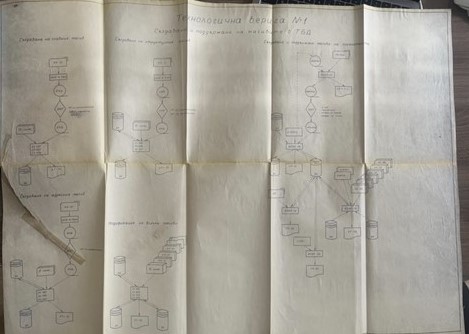
Between 1972 and 1976, a team of engineers and designers assembled in Gabrovo as a local subsidiary of the Scientific Centre of the office for USSI. The team, led by engineer Nikola Vrazhilov, was tasked to develop a pilot module for USSI for the collection and analysis of data from industrial production. The team evaluated the available data collection and data transfer infrastructure at factories and municipal institutions in the region and developed a detailed project for their use in assembling the territorial database for Module Industry. Their archive shows a clever patchwork solution that took into account the different levels of digitalisation of this infrastructure and relied on technological and procedural translation across paper forms, punch card machines, magnetic tape, computers, telephone and telegraph networks. In the process of selecting key indicators to be gathered and writing the code for the BOMP-based programmes that enabled queries and analysis of the data, the question of the relationship between these new technologies for information processing and the traditional information practices of the state became pertinent.
At that point in time, in 1970s Socialist Bulgaria, the network of computational centres was emerging alongside and in an uneasy relationship to the established structures of statistical offices that had so far defined how practices of governance were grounded in information gathering and analysis. And the team in Gabrovo, led by Vrazhilov, was positioned between the two. The team was provided with an office in the building of the municipal computational centre and it had to closely collaborate with the local statistical office. Both of them met Vrazhilov with suspicion, as we can see from an archival trail of complaints and pleas for assistance. But his team played a crucial role as translators between the two models of use of information for governance purposes – the statistical and the computational. While they worked on a pilot project, their ambition was to develop a replicable methodology and code that could be scaled up and used across the country and that would eventually replace the existing incongruent methods of data gathering through statistical paper forms and ASU data. They aimed to establish a standard for digital data storage and use, one based on the principles of deduplication and a single source of truth, which, to this day, define e-government projects around the world.

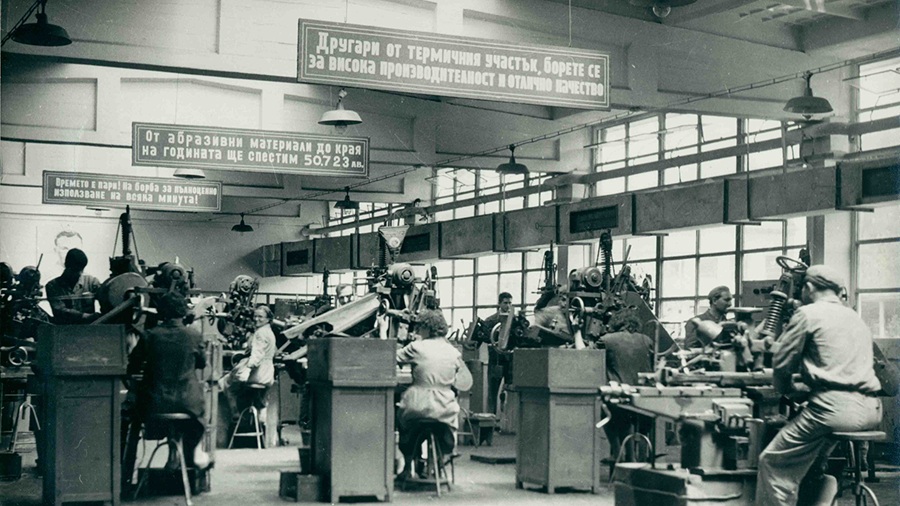
A key part of the work of Vrazhilov’s team was translating the indicators from statistical forms submitted to the Central Planning Committee into code that generated structured data and reports. One can argue that the socialist planned economy in itself was an information management project. The 5-year plan was not just a set of performance metrics to be achieved but acted, in itself, as a discursive performance of commitment to building a communist future. This performative aspect of the plan was reinforced even further with reforms in the early 1960s that aimed as decentralising control and giving back power to the workers. As part of this goal, a new form of the plan was introduced – the counter plan. It was proposed by the industrial workers themselves, at each factory, and was conceived as a way to make the planning expectations more realistic and grounded in the knowledge and abilities of the workers’ collectives, the brigades. In reality, though, the counter plan exacerbated the performativity of the plan, proposing even more ambitious achievements for the planning period. On the ground, as we can see from the archives of another state enterprise in Gabrovo, the Experimental Base, this competitive performativity led to perpetual struggle and failure to meet the goals. When faced with failures, however, the management of the factory was forced to prioritise the “material interest” of the workers and compensate them for their time, regardless of the results. As a way to deal with this cycle of ever more ambitious plans and inevitable failures, some factories had started to falsify the data and this was one of the key problems the state wanted to solve with its new computational network and machine-gathered data. By automating the data gathering and analysis, the state hoped to eliminate human errors – a hope that seems to persist in every historical context, regardless of the structure of the economic system.
Vrazhilov was hoping to achieve more. He wanted to use the data gathered daily, weekly, monthly and quarterly from factories in ways that went beyond mere verification. He wanted the data to show more, to reveal patterns that remained obscured in statistics. He coined the term “operative information” (оперативна информация) to refer to this idea. Operative information was a term that had both functional and temporal dimensions. It captured a period shorter than the regular reporting periods for the purposes of the plan. It was meant to capture the flow of production in action. The operative information consisted of data reported daily and within 10-day periods. These shorter periods of reporting were seen as an opportunity to reveal the rhythm of production rather than just expose whether factories fell short of fulfilling the plan. The operative nature of this approach was grounded in the window for intervention that Vrazhilov foresaw. Code would reveal uneven rhythms and then be used to diagnose and remediate the problem in ways reminiscent of what decades later has been termed algorhythmic governance – the regulation of the various temporal cycles of social life through algorithms.
Aside from the temporal dimension of production, the notion of operative data is interesting in other ways. The operation carried a multitude of loaded meanings during the Cold War. This term, coming from army jargon, captured the militarised spirit of mobilizing the workers for the competition between the Communist East and the Capitalist West. It also unfolded in a consistent relationship to information and the performativity of language and narrative. In the context of foreign intelligence and espionage, for example in a 1962 classified agreement between the Bulgarian secret police and the Soviet KGB, “operative information” was a term used to refer to data gathered through the structures of operative workers (оперативни работници), the fleet of trained informants of the secret police in communist states. These operative workers also played a key role in the moral and often oppressive economies of information in the country. They, together with untrained and spontaneous informants, gathered social data that could not be captured through the mechanisms of statistical forms and everyone, especially those in position of relative power, lived with the awareness that their actions and motives could be subject to a sort of fidelity test for compliance with the ethos of communism, that their social information and its interpretation were a contested terrain of ideological sense-making. This economy of information, where secrets and revelations acted as tools for control and redistribution of power, closely linked the organisation of industrial production with the circulation of narratives and interpretations. The institutions of the secret police and foreign espionage organs themselves were also incorporated into the initiatives for automated information systems for governance, developing databases and networks with dual use – for civilian and wartime purposes.
We can stipulate that this complex informational aspect of the operation was shaped by the intellectual legacy of early Soviet figures like the poet Sergey Tretyakov in the early 1930s and anarchist thinkers and experimentators like Aleksey Gastev from the Central Institute for Labour (TsIT) in the 1920s, for both of whom the operation and the operational played a key role in the conceptualisation and enabling of the transformation to a communist social and economic system. Gastev’s “culture of the operation” aimed to provide a critical counterpoint to capitalist Taylorism, a scientific approach to the rhythm of production that had to be harmonised and steady but, above all, to be organised in a way that counters the alienating effects of the mechanisation and automation of capitalist production. Although the scientific organisation of work in texts by Gastev and TsIT drew inspiration from capitalist thinkers like Frederick Taylor (1910s), Frank Gilbreth (1910s) and Henry Ford (with whom TsIT exchanged letters in the 1920s), they insisted on the possibility of using the same methods to different ends, putting the embodied creativity of the worker and the workers’ collective at the centre of the operation. The ideological articulation of communist production was performative in the sense that the poet Sergey Tretyakov had developed in his work – the language of proletarian industrial production and organisation was not merely descriptive of an existing reality but aspired to bring a new communist reality into being. It was interventionist. And we can see this legacy in the aspirations of Vrazhilov for operative information that can not only capture the state of industrial factory production but can intervene into it and steady the rhythm of its flow.
Vrazhilov’s work was largely met with enthusiasm, and the pilot project was planned to scale up. The traces of his team, however, disappeared in 1977 and his biography shows he was moved to a new position – as a director of the Base for Technological Development of Textile Machine Production in Gabrovo. Yet, the work of Vrazhilov’s team demonstrates how a seemingly technocratic project was deeply embedded in the legacy and aspirations of communism. It was not a project that used uniquely communist machines or approaches to coding or information networks. Rather, the emphasis on what made it socialist was consistently articulated through the language of communist ideology and through the economic base that defined the ownership of the means of production. Perhaps, this leaves us with a question for our present. What if, rather than focusing on the types of data-driven technologies in our lives and looking for technological fixes, we contemplate how to articulate and perform a different future and how to seize the material stratum that underpins it? The performative aspect of the operative information economy in state socialism was precarious and fragile. We have to acknowledge the archives of failures, the moral economy of control and punishment that aimed to contain subjectivities that adopted the performativity of language as means to reconcile the failures of production. And, yet, economic systems are inherently performative and imperfect. Our present AI-driven economy is built on promises and speculations. One crucial difference, however, is that it gradually but consistently limits the possibilities of workers resistance and control and its gains and losses are accounted for in ways that rarely if ever take the “material interest” of the workers as a primary concern.
Tsvetelina Hristova is an anthropologist, critical media studies scholar, and amateur boxer whose interest in social research developed from her involvement in left-wing activism in Bulgaria. Her work explores emerging and alternative forms of governance and control of labor and populations through analysis of the intersections of regimes of technological and political organizing.
We thank the Käte Hamburger Kolleg: Cultures of Research (c:o/re) for permission to reblog their original post, published August 10, 2026: https://khk.rwth-aachen.de/operative-and-performative-economies-of-information-in-communist-bulgaria/
Cite as: Hrsitova, T. 2026. “Operative and Performative Economies of Information in Communist Bulgaria” Käte Hamburger Kolleg: Cultures of Research (c:o/re) August 8. https://khk.rwth-aachen.de/operative-and-performative-economies-of-information-in-communist-bulgaria/