Elections with a Loser but No Winner
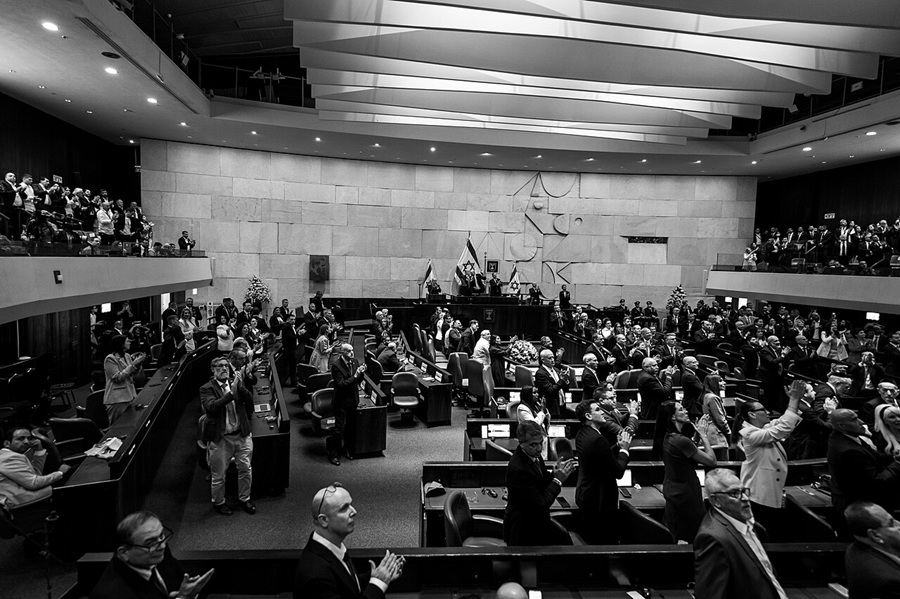
The Israeli election of October 2026 seems to have produced a clear outcome. Prime Minister Benjamin Netanyahu’s coalition, which had support from 68 members in the outgoing Knesset (Israel’s parliament), now has only 53 and is unlikely to secure a majority amongst the 120 members. He could hold on to power if he persuades eight of the 67 members across the aisle to cross the line and join him. A creative, seasoned political manipulator, he crushed a number of opposition parties and alliances in his time. In fact soon after the results came out he assembled a team to research Knesset members in opposing parties, identify their weaknesses and tailor honey traps to lure them. Granted, the cards he holds this time are stacked against him. Still, anyone declaring Netanyahu’s political demise does this at his own peril.
Curiously, Netanyahu’s defeat does not necessarily imply there is a winner. The six parties that oppose him hold 67 Knesset seats between them, but pull in different, often diametrically opposed directions. Largest among them is Yashar (21 seats), founded recently by former IDF Chief Gadi Eisenkot. Too new to be predictable, it seems to be moderate centre-right. Another party alongside Eisenkot is The Democrats, the current iteration of Israel’s historic Labour party – left wing, mildly socialist, supports a Palestinian state alongside Israel.
Two more parties opposing Netanyahu are hardline centre-right. Both vehemently oppose a Palestinian state, often advocating annexation of rural segments of the West Bank to Israel. Two more parties in this group of six are labelled ‘Arab’, as their electorate comes almost exclusively from the 1.5 million strong community of Palestinian Arabs who are citizens of Israel. One has roots in the Communist Party; the other attracts moderate Islamists.
Dynamics among these six parties are awkward at best. A story comes to mind about the Jew who survived a ship wreck and was stranded on a desert island. Years later a passing ship spots him and sends a dinghy to his rescue. Overjoyed he gathers his meagre belongings, then just before he boards the boat invites his rescuers to tour his tiny island. ‘This tent’, he tells them, ‘is where I slept. That palm tree over there is where I ate my meals. This is the hill I used to climb to scan the ocean for a ship that might rescue me. And these are my two synagogues.’
‘Why two?’ asked a sailor.
‘This one’ the man replies, ‘is where I prayed day in day out. The other, and I swear to you, is where I’d never set foot in my life!’
All six parties ran creative, tight campaigns. To distinguish themselves however, some explicitly declared which parties they would never tolerate in a future coalition. The outcome: a complicated maze of boycotts, counter-boycotts and no-goes reminiscent of the logic puzzle where a farmer tries to get a wolf, a goat and a cabbage across a river without any of them eating anyone else as they await their turn to cross.
Avigdor (Yvette) Lieberman, whose centre-right party won seven Knesset seats, has been most vocal and consistent: his refusal to join a coalition that includes an Arab party or is passively supported by one was adamant. Arab parties, he repeatedly declared, support terrorism and seek to terminate Israel as a Jewish state. Lieberman likewise refuses to join forces with ultra-Orthodox parties (13 Knesset seats between them), whom he labels corrupt, draft-dodging parasites. He is graciously amenable to join a government with Likud (27 Knesset seats), provided Netanyahu, its undisputed leader since 1996, resigns…
Naftali Bennett, leader of another centre-right party who wants to oust Netanyahu, is reluctant to join a coalition with an Arab party as well, but is less outspoken. In 2021 in fact he became Prime Minister as leader of a coalition that was passively supported by an Arab party. Bennett might therefore budge, but he is not a one man show. His party includes several members with ideological roots in the religious, nationalistic Israeli right who will have great difficulty cooperating with an Arab party.
Henry Kissinger once said that there is no such thing as foreign policy: everything is ultimately a domestic issue. Israeli politics is a case in point: the country’s trajectory in coming years, which will undoubtedly affect geostrategic developments across the Middle East and possibly beyond, currently hinges on opinionated secondary players in Jerusalem finding common ground.
The Arab Vote
The refusal of most Israeli political parties, including ones with liberal leanings, to cooperate with Arab parties is a glaring example of what many identify as Israel’s version of Apartheid. This has a history.
Like the Jewish ultra-Orthodox parties, the Arab parties reflect rigid identity politics. My research as a cultural anthropologist led me to describe the Palestinian citizens of Israel, who account for approximately one-fifth of the country’s population, as a “trapped minority”: an indigenous group which saw a constant trickle of immigrants gaining dominance in its homeland, eventually establishing a state that now excludes and marginalizes the original inhabitants.
Jewish immigrants – settlers, refugees, socialist visionaries, others with diverse sensibilities and motivations – have been coming to Palestine/Israel for 150 years. Many framed the move as a return to a biblical homeland. The trickle became a flood following the Second World War and the Holocaust, intensifying further in the 1950s when a million Jews departed Arab countries. Meanwhile, the 1948 war, which led to the establishment of Israel as the Jewish nation-state, forced some 750,000 Palestinians to leave their homes and homeland, ending up as refugees in neighbouring Arab states. By 1949 the residual Palestinian community within Israel, a faint shadow of what it had been prior to the war, accounted for only 16 per cent of the new state’s population. This ratio has remained more or less the same since.
One of the first decisions taken by Israel was to grant its Palestinian residents (most Israelis refer to them as “Israeli Arabs”) full formal citizenship. This enabled them gradual integration into the Israeli economy, a process which intensified and deepened in recent decades. Despite being discriminated against, education levels amongst them rose rapidly and is now evident in their weight amongst doctors and paramedics, engineers, lawyers and high-tech professionals. Their formal citizenship and integration into Israel’s economy distinguishes them from the 5.5 million Palestinians in the occupied West Bank and Gaza strip who, having been incorporated into the Israeli system of control after the 1967 war, were never offered citizenship. Bereft of sovereign status, Palestinians in the West Bank and in Gaza have their human, civil and political rights habitually trashed, and their capacity to shape their destiny is limited.
The Palestinian citizens of Israel, in contrast, took part in Israel’s political arena from the get-go. They formed political parties, won seats in the Knesset and became, nominally at least, a feature of the political scene. This integration however came with an asterisk: no Arab party has ever been invited to join a ruling coalition, appoint ministers or run a ministry. Yitzhak Rabin did rely on the support of Arab parties when he formed a ruling coalition in 1992, but did so without including them in his government. Naftali Bennett and Yair Lapid followed suit in 2021. Like Rabin they too rewarded the support they got with infrastructural upgrades, better educational facilities and enhanced welfare services.
Willingness on the part of mainstream Israeli parties to reluctantly include the Palestinian citizens was anathema to Israel’s right-wing. Incitement against Palestinians, their leaders and against Israeli institutions willing to cooperate with them intensified after October 7 and the war in Gaza. With many Israelis feeling humiliated and betrayed by the massacre, attitudes towards Palestinians hardened, often becoming indiscriminate. Palestinian leaders inside Israel who expressed solidarity with those suffering in Gaza were denounced by Netanyahu and his ultra-nationalist collaborators as fifth columnists and Hamas apologists.
Discriminated and excluded, many Palestinian citizens of Israel lost faith in the political process as an avenue to change. Turnouts in elections dwindled, settling at a level significantly lower than turnouts amongst Jewish Israeli voters.
This changed dramatically in 2026 when, for the first time in many decades Palestinian citizens of Israel came to vote in hordes. Turn out bumped from ca. 50 per cent in 2022 to nearly 80, and dividends were swift: for the first time ever, representation of the Arab sector in the Knesset reflects its share in the country’s population.
This surge in turnout and representation, which had an important impact on the overall result and put a major dent on Netanyahu’s chances to remain in power, came as a direct response to his own policies towards Palestinians. One element was his capitulation to the ultra-nationalist, messianic partners in his coalition and their views about the war on Gaza. Treating this disastrous war as a living miracle, they consistently depicted it as the long awaited apocalypse, designed in heaven to yield a total victory and assert Jewish dominance throughout the region. Netanyahu’s callous willingness to accommodate these twisted visions at the expense of countless Palestinian lives and keep his coalition intact cemented the resolve amongst Palestinian citizens of Israel to vote him out.
A second factor pulling in the same direction was Netanyahu’s policies vis-a-vis the Arab sector itself. Like the messianic hard line view in Gaza, policies designed to hurt the Palestinian citizens of Israel were inspired and often executed by Itamar Ben-Gvir, the violent, racist, convicted felon whom Netanyahu appointed in 2022 as Minister of National Security, an office which includes ministerial supervision of Israel’s police forces. Ben-Gvir, who as minister repeatedly (and illegally) tried to interfere with police operations, was generally ineffective and incompetent. One objective he set for the police however was achieved with ease: a dramatic decline in police resources and presence in Arab towns and villages, resulting in rapid deterioration of law and order. The vacuum invited organized crime on an unprecedented scale, quickly eroding people’s sense of basic personal security. Extortion rackets targeting shops and businesses became the norm. Municipal officials are regularly threatened into submission, forced to hand appointments, civil engineering tenders and other contracts to their intimidators. Illegal firearms, including automatic weapons, proliferate. Murder rates in 2026 doubled in comparison to 2022, with only a fraction of homicides investigated and solved.
The lack of personal security and absence of effective governance eventually outweighed the community’s inherent mistrust of public policy and the political process. Desperate, many in the Arab sector began looking to the central government for deliverance. Many hoped that better representation might inject urgency, change priorities and make a change. The long lines outside polling stations on election day in October 2026 suggested that despair does breed renewed trust in politics.
What Happens Now? Who has time on their side? Could Trump-Style Claims of Corruption and Electoral Fraud Keep Netanyahu in Power?
In the wake of every election, Israel’s political system is entrusted with a dual task: launching the newly elected parliament as a functioning legislative power, and ensuring the continuity of the executive branch by confirming a new government .
A Central Elections Committee, headed by a senior Supreme Court judge, is responsible for publishing the official results a week after election day. The new members of Knesset can then convene, take their oaths, elect a Speaker and begin the legislative work. The Knesset’s second duty is confirming a new government; this will come later.
Gadi Eisenkot, leader of the largest party in Netanyahu’s 67 strong opposition in the new Knesset, has already announced that once the Knesset has been sworn in he intends to have a Speaker elected, then swiftly move to legislating. First will be a law establishing a State Commission of Inquiry into events and processes surrounding October 7. Next will be legislation to nullify Netanyahu’s attempts since 2023 to effect a judicial ‘reform’, castrate the judicial system, stifle its democratic institutions, turn Israel to a thinly disguised dictatorship and secure Netanyahu’s Orban-like autocratic reign for many years to come.
A rapid assertion of parliamentary control on Eisenkot’s part even before a new government has been confirmed will be the beginning of the end of Netanyahu’s reign. A state commission of inquiry into October 7th that will inevitably examine Netanyahu’s role is ominous for the aging leader. Not surprisingly, his first priority following the elections was to cast doubt on their integrity.
On election day itself Netanyahu released a video claiming the election had been stolen. Uttering half-baked conspiratorial allegations against a political activist in an Arab town who somehow bribed the masses to come out and vote, the video was a poor man’s version of Donald Trump’s distorted 2020 playbook: flimsy shreds of incoherent evidence that allegedly pertain to isolated and implausible incidents. The Chairman of the Central Elections Committee responded three days later, strongly denouncing the clumsy attempt. Even if all suspicions were confirmed, he explained, the scale of the alleged infringements is too small to impact the results. Like Trump in 2020, Netanyahu is not likely to concede and immediately issued a statement that he does not recognize the results. Peddling the notion that the affair has compromised the Arab parties, his immediate goal is to prevent the Central Election Committee from officially publishing the results, delay the inaugural session of the newly elected Knesset and prevent even the first step towards an orderly transfer of power.
Assuming his allegations fail to stick, the process of transferring power to a new government will go on. The first week of November will see the new Knesset sworn in, setting the stage for the next phase: formal negotiations that will eventually determine who is Prime Minister and what his cabinet and coalition will look like.
Israeli law allocates several months for this task, with the President, a ceremonial figure most of the time, taking center stage. He must first invite the leaders of all parties individually and ask them who they think should be entrusted first with the task of forming a government. Having heard them all he then decides who is most likely to form a viable coalition, and formally assigns him with the task. The incumbent has 28 days, with a possible extension of 14 more. If he fails, the task can be assigned for 28 additional days to a leader of another party. If they fail too, a month-long period is declared in which any member of the Knesset may propose a coalition and present it to the Knesset for a confidence vote. If that month passes with no result the Knesset is automatically dissolved and a new election date is set within 90 days.
Throughout this transitional period, which may last months, the new Knesset functions as the legislative branch. The new government, by contrast, has not been formed as yet, and to ensure executive continuity it is the outgoing government, now labelled ‘caretaker government’, that remains in place, with marginally weaker powers. Significantly, Netanyahu will welcome a protracted process along these lines, while he remains Prime Minister. Should the outcome be a new election cycle, he will campaign as the incumbent.
The first leader the president is likely to approach to form a government will most likely be Gadi Eisenkot who will have a number of options, none of them particularly simple.
One is to persuade his reluctant centre-right partners Lieberman and Bennett to form a coalition with the Arab parties or at the very least lean on their parliamentary support. Eager to remove Netanyahu, one of the Arab parties has already hinted at a willingness to do what they have done before: support the coalition ‘from the outside’, i.e vote for it in the confirmation vote without joining it as ministers.
Eisenkot’s next option is to persuade one of the ultra-Orthodox parties to break away from Netanyahu’s corner and join his. The spiritual leaders of one of the two parties hold a grudge against Netanyahu for promises he made to them that were never fulfilled, and have already declared all options to be on the table. Eisenkot will naturally demand that ultra orthodox youngsters enlist to military or civilian service like everybody else. Preventing this, alongside securing funding for yeshivas, are the absolute priority for the religious leaders. If, against all odds, Eisenkot eventually succeeds in mobilizing them, he will need to sell the deal to his immediate partners. Lieberman, in particular, will have to swallow a bitter pill: collaborating with an ultra orthodox party would be a blatant breach of a commitment he had made.
If Eisenkot fails to broker an agreement with either the Arab or the ultra-orthodox parties that is amenable to all members of his own camp, his options will narrow down to two.
One would be to present the Knesset with a small provisional cabinet – only four or five essential ministries, manned by his most trusted lieutenants. The remaining 20 ministries he will keep vacant, available for parties that might join his coalition later. Since a Knesset vote of confidence in favour or against a government is a public, roll-call affair, this move by Eisenkot will put all Knesset members who pledged to oust Netanyahu in a difficult position. Fail to support Eisenkot’s seed cabinet and you give Netanyahu, who will remain in office, a new lease of political life. On the other hand, a vote in favour of Eisenkot at this point will not compel any of his allies to join forces with their nemesis. Confirming Eisenkot’s cabinet in its abbreviated form will put an end to 30 years of Netanyahu’s reign without the need to break a single campaign promise.
Finally, Eisenkot can form a wall to wall national unity government with his natural allies AND Netanyahu, adding 27 Knesset votes to his tally. Each of the two leaders currently insists that this could happen only if he is at the helm, so good luck to us all in getting one of them to budge. Welcome to coalition politics! A universe where flexibility abounds and five months is an eternity – enough time to switch synagogues, perhaps even to ferry a big bad wolf, a naive goat and a reluctant cabbage across a river.
Dan Rabinowitz teaches Anthropology and Environmental Studies at Tel Aviv University. His research areas include ethnicity, political minorities and, more recently, Policy and Social aspects of climate change. He is a long standing contributor to Haaretz’s Op-Ed section, and held leadership positions in environmental NGOs in Israel and abroad.
Cite as: Rabinowitz, D. 2026 “The Fateful Elections Everybody Lost” Focaalblog November 4. https://www.focaalblog.com/2026/11/04/dan-rabinowitz-the-fateful-elections-everybody-lost/