Tag Archives: Italy

Ana Ivasiuc: ‘I can’t explain, you need to see for yourself’: Matters and senses of insecurity in the campi nomadi of Rome

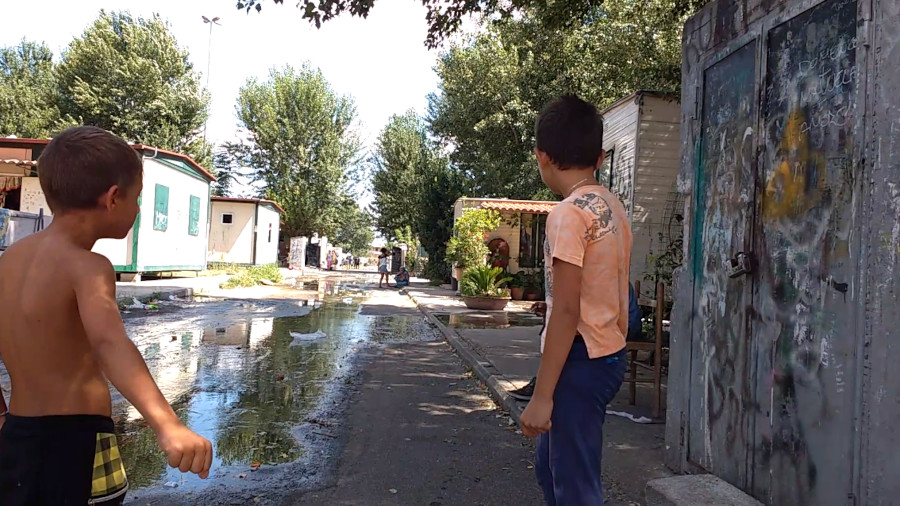
Image 1: Salone camp 2017. Photo by author

‘What is it like to work with Roma?’ I asked the police officer. He gestured widely, shaking his head and raising his arms and shoulders, suggesting that words could not describe what he was trying to convey. ‘You would have to seefor yourself. Once you see how they live, how they smell, what the camp looks like, you will understand everything about the Gypsies. I can’t tell you more. You just have to see yourself, that’s it’. Other officers at the police precinct nodded in agreement. They were all part of a special police unit set up in 2010 by far-right mayor Gianni Alemanno to police Roma encampments in Rome.

The officer’s suggestion that I have to see – and smell – for myself what it was like to work as a police officer in Roma camps dovetails with insights informed by a Latourian approach to materiality and literature subsumed under the umbrella of new materialisms. The securitization of the Roma across Europe is rarely only a mental construct. Rather, material infrastructures and sensorial experiences effectively co-produce (in)security beyond mere representations of danger. Matter and its sensorial perceptions quietly fabricate (in)security, rendering the Roma as dangerous subjects to be perpetually governed through exceptional and ever-multiplying security measures, among which the racial policing that I witnessed in my ethnographic work.

Nomad emergency

In April 2008, the newly elected Berlusconi government triggered the state of emergency in an episode that would be known as the emergenza nomadi (nomad emergency), motivating its decision by the ‘social alarm’ produced by the presence of informal camps of migrant Roma settled in the peripheries of Italy’s largest conurbations. Following the declaration of the state of exception, local authorities received power and resources to set up urban security measures as they saw fit. In Rome, this amounted, among other measures, to the establishment of the special police unit within which I carried out part of my research on the securitization of the Roma in Italy.

In its beginnings, the unit was tasked with policing Roma camps – the authorized encampments set up by the state, but also new informal camps and old, ‘tolerated’ settlements that the authorities let be in the interstices of Rome. Initially, the title of the unit contained the word ‘nomadi’ – the term generally, though erroneously used to refer to Roma in Italy, despite activists’ efforts to debunk the myth that Roma continue to be a nomadic people. The initial title suggests that the unit was set up as a racial police; however, in 2011 its title was changed to ‘Public Security and Emergency-related unit’, and new tasks were added to its mandate. Notably, its portfolio included policing related to unaccompanied minor migrants, as well as the task of carrying out squat evictions.

The unit is composed of about 60 police officers, some of whom have longstanding experience in policing Roma. Consider, for instance, the commander of the unit at the time of my research, Antonio Di Maggio. In an interview he granted me in 2015, he mentioned his 25-year long experience of dealing with Roma encampments. As several officers explained, the setup of the unit in 2010 allowed the commander to gather ‘his men’ up: police from other units with whom he had previously worked, some of whom had also been involved in specific actions of policing the Roma. The officers of the unit are known among Roma in camps; they refer to them as ‘Di Maggio’s men’.

Salone

The camp of Salone sits in isolation beyond the city’s ring road. The nearby train station of Salone is almost always deserted, and only two trains stop – one in the morning, on the way to Rome, one in the evening, returning from the capital. In one of the trains that did not stop in Salone, I overheard someone explain to their friend that the train does not make a halt ‘because of the Gypsies’ (zingari): it isn’t safe. The materiality of a desolate train station where trains do not stop conveys to thousands of commuters daily that Salone is a dangerous place.

Originally designed to host 600 people temporarily, the camp saw its numbers swell to nearly 900 following the aggressive eviction policies around the mid-aughts that gentrified Rome and sanitised the capital’s space of the presence of undesirables. The camp housed diverse and often rival Roma groups, from Serbian and Bosnian families arrived as early as the 1970s, to those from Kosovo and Montenegro who fled the violence that marked the dissolution of Yugoslavia, and more recent arrivals from Romania following its accession to the EU. Metal and PVC boxes arranged in equally spaced rows, resembling shipping containers, serve as housing units. In fact, that is the name of the ‘houses’: container. Most of them display graffiti, and some bear marks of violence: overcrowding and conflicts over the use of space sometimes result in feuds that leave material traces. Streams from broken water pipes traverse the main alleyway, forcing people to zigzag over puddles and mud. At the entrance of the camp, on the right side, overfilled rubbish dumpsters greet the rare visitors.

Sensorial Securitization

The accumulation of waste surrounding camps – broken objects, car carcasses, construction debris – is a complex phenomenon resulting from neglect, refuse dumping practices, and cost-reducing strategies by non-Roma firms and individuals. Yet, this waste is frequently conceptualized as a cultural marker for Roma, reifying them as abject and connecting them to epithets like ‘peoples of landfills’ (Piasere 1991). The subsequent combustion of this waste, often generating toxic smoke (roghi tossici), becomes the centerpiece of a securitarian discourse in Rome that overtakes concerns of petty criminality. Smoke is infused with meaning through the powerful mediator of dioxin, ingrained in collective memory through the 1976 Seveso industrial accident. Dioxin is a dangerous substance that can be inhaled to one’s unbeknownst. Vigilantes and neighbourhood committees from areas in the proximity of campi nomadi post on social media visualizations of rising smoke – often describing their neighborhood as ‘under siege’ or a ‘zone of war’ where ‘chemical weapons’ are being deployed. Such photos and the accompanying comments generate intense social alarm and fears. They provide fuel for incitement to violence, including exhortations to ‘burn down the camps with everyone inside’, as a comment on Facebook suggested. The powerful connection of fear to sensorial regimes of securitization led authorities to institute fixed surveillance services and police patrols specifically to control the fires.

This racialized landscape is always paired with a smell. The olfactory connects the Roma body, space, and materiality to an inferiority that ‘does not belong in and to Europe’ (Racleș and Ivasiuc 2019). Non-Roma interlocutors routinely distinguish Roma by a specific ‘gypsy’ smell (Racleș 2021) as an olfactory distinction that they cannot explain nor describe, but that allegedly ‘everyone knows’.

During police patrols around campi nomadi, officers engage in a ritual of repulsion involving grimaces, covering their noses, and making comments regarding the “puzza” (stench) that they discern upon approaching the camp. This olfactory disgust finds anchors in the materiality of the camp: heaps of waste, overflowing rubbish dumpsters, rats. The officers interpret this squalor as proof that inhabitants are uncivilized and that ‘living like this’ must be a cultural trait. The fear of contamination is visceral: after incursions in camps, police officers half-jokingly invoke the need for ‘epidemiologic checkups’ and the need for disinfection.

In an incident that I recount in more detail elsewhere (Racleș and Ivasiuc 2019), a policewoman, hastening to use disinfectant gel after strip-searching a Roma woman, suggested that the smell ‘stays with you regardless of how much you wash your hands’. The sensorial-material nexus ensures that the spatial segregation and policing of the Roma are repeatedly justified and reified as necessary measures against an inherently abject and dangerous threat at the most intimate, molecular level.

The inhabitants of the camp deplore its material conditions too. They complain about the waste and the irregularity of public services in removing it from the camp and repairing faulty pipelines and sewage. The rats, the foul smells rising up in the hot Roman summers from waste heaps and broken sewage, all of these material conditions are not of their own making and they develop strategies to combat them. One of the women in the camp explained that to combat foul smells and discourage rats from approaching her container, she uses large quantities of bleach on a daily basis: ‘I use a bottle of chlorine a day to clean, it’s so clean you can eat off the floor’. Yet camp inhabitants are painfully aware that their living conditions are leveraged against them to solidify racial stereotypes of uncleanliness and ‘uncivilisedness’.

Conclusion

Processes of securitization are deeply entangled with the sensorial realm. More specifically, sight and olfaction, as expressed by the police officer quoted in the opening vignette, serve as mediators reassembling the Roma in specifically racialized ways. Leonardo Piasere (1991) invokes sensorial perceptions of Roma as ‘antigypsy senses’ (sensi antizingari): racialization patterns where senses are involved in the production of racist tropes of nuisance that must be contained. In Rome, sight and smell quietly fabricate insecurity by linking the Roma body and inhabited space to fears of contamination and pollution. While such fears have been examined in relation to the racialization of the Roma on the symbolic realm, elsewhere I show how contamination and pollution constitute fears that cannot be disentangled from the material realm (Ivasiuc 2019).

As this piece has shown, the materiality of the camp and the sensorial registers used to apprehend it act to embody the Roma as ontologically dangerous. Human and non-human actors (waste, dioxin, vigilantes, police, social media platforms. etc.) are continuously drawn into chains of association, re-assembling the Roma as inherently dangerous, uncontainable, and ungovernable, and producing insecurity in a processual and self-perpetuating way. This quiet fabrication ensures that the politics of policing and exceptionality multiply, requiring constant security measures against a threat that is simultaneously material, sensorial, and ontological.


Ana Ivasiuc is a Teaching Fellow at University College Dublin and a Researcher at the University of Ostrava. She carried out an ethnography of formal and informal policing of Roma migrants in the peripheries of Rome.


References

Ivasiuc, Ana. 2019. “Reassembling (In)security: The Power of Materiality.” In Regina Kreide and Andreas Langenohl (eds.). Conceptualizing Power in Dynamics of Securitization: Beyond State and International System. Baden Baden: Nomos, pp. 367–94.

Piasere, Leonardo. 1991. Popoli delle discariche: Saggi di Antropologia zingara [Peoples of the Landfills: Essays of Gypsy Anthropology]. Rome: CISU.

Racleș, Andreea, and Ana Ivasiuc. 2019. Emplacing Smells: Spatialities and Materialities of ‘Gypsiness’. Anthropological Journal of European Cultures 28 (1): 19–38. https://doi.org/10.3167/ajec.2019.280105.


Cite as: Ivasiuc, A. 2026. “‘I can’t explain, you need to see for yourself’: Matters and senses of insecurity in the campi nomadi of Rome” Focaalblog March 3. https://www.focaalblog.com/2026/03/03/ana-ivasiuc-i-cant-explain-you-need-to-see-for-yourself-matters-and-senses-of-insecurity-in-the-campi-nomadi-of-rome/
Maddalena Gretel Cammelli: Reflections on contemporary fascism

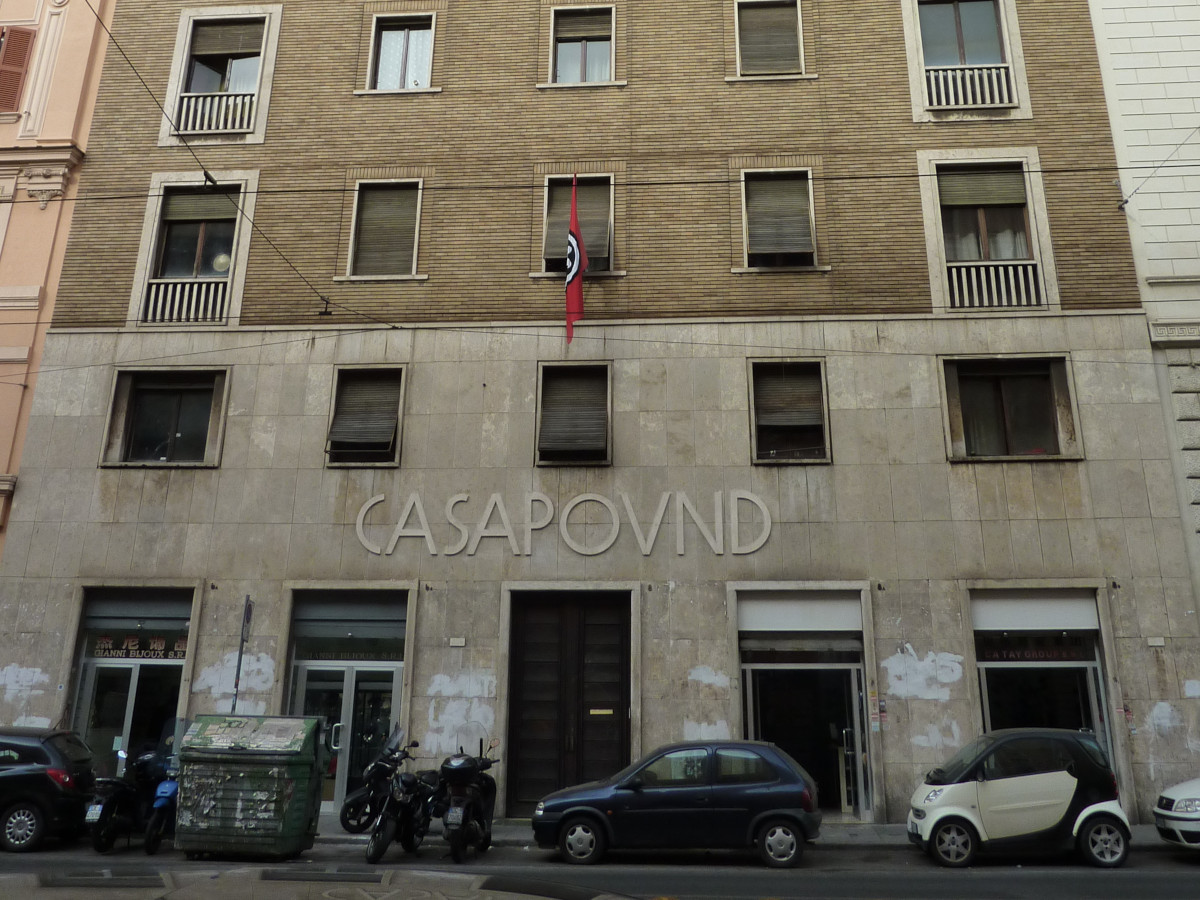
Image 1: Building in Rome occupied by the CasaPound movement in 2003, photo by Barbicone

It was 2009 when, while living in a squatted house in the Montreuil, a leftist banlieue on the East side of Paris, I was asked how it was possible that there were people occupying buildings in Rome, Italy who self-defined as fascists. The activities of the CasaPound movement were coming to be known on the other side of the Alps as well, and French Leftists were asking me for explanations. Indeed, CasaPound activists used to call themselves third millennium fascists: they have de facto been the first movement to self-claim this label and assert a direct legacy with Fascism since 1945. It is important to remember that Italian law and the country’s constitution prohibit the re-formation of the Fascist party, so a claim of this kind has a certain weight.

Since that moment, I began to focus my research on this subject, first with my PhD dissertation on CasaPound (Cammelli 2015, 2017), and later by continuing to reflect on the place and significance the concept of fascism has been gaining in contemporary European landscapes (within the ERC project F-WORD).

In some ways, the fact that the activists I first engaged were using the label “fascist” to self-identify made things easier for me: my own reproduction of this category in the research was not a choice of political labelling, but simply an act of respecting the emic perspective claimed by the activists themselves. Nonetheless, the specific nature of such a categorization required unpacking.

It is important to recall that, at that time almost 15 years ago, very few people were taking this group seriously as a danger. CasaPound activists were not generally considered new exponents of a fascist-like identity. At an analytical level, it was suggested that I use the “integralist” category proposed by Douglas Holmes (2000) so as to indicate continuity with more traditional political forms, but without the demonizing consequences the label of fascism might trigger. Alternatively, they could be referred to as neo-nationalist, as suggested by Gingrich and Banks (2006) and Kalb and Halmai (Kalb and Halmai 2011) or populist as used by Kalb in his work on Poland (2009). I engaged with this literature to analyze the way this presence was affecting Italian political life, and indeed how cultural identities and political identities seemed to be playing a primary role in absorbing the disappointment experienced by people suffering the double devaluation (Kalb 2022) produced by the social crisis of European modernity – a crisis which, far from being exclusively economic, still continues today.

Almost fifteen years later, we may be in the position to add a few new pieces to the CasaPound puzzle, as the evolution of the political situation in Italy and Europe allows us to make some more specific arguments.

It is evident, as tellingly signalled by the 2022 election of the Meloni government, that the state of affairs once known as the cultural hegemony of the (so-called) left wing in Italy has lost its “momentum”. If there is anything like a cultural hegemony today in the sense outlined by Gramsci, it aligns with the consensus established around the Meloni government and reflects many of CasaPound’s own values. These activists are no longer at the margins; they now find themselves at the centre of the political imaginary of contemporary Italian society (as in other European countries). As confirmed by Douglas Holmes (2019), this not only means that the fascists of today are no longer the violent, skinhead-like people we would have imagined in the past; they have assumed a much more common and widespread profile. It also means that the people who twenty or even ten years ago appeared to be marginal groups of stigmatized militants now play a completely different role in the political arena, having become mainstream and widely accepted. This development may trigger important changes in the way new research on the topic is delineated, and we need to contextualise the rise of right-wing claims and populist nationalist drives more generally within the development of neoliberalism and its irrepressible hegemonic consensus in Europe and the Americas.

To return to the question of how the concept and word “fascism” are being used, therefore, we may look at the enormous body of literature produced by sociologists and political scientists about political parties and formations positioned on the “right” of the political spectrum. These formations are variously characterised as far-right, extreme-right, radical right or, more recently, populist radical right (Caiani Padoan 2020, Brubaker 2020, Froio et al. 2020, Mudde 2007, 2019). Italian historian Claudio Vercelli recently wrote that, while clearly the past never repeats itself, it is valid to say that the underlying motivations and behaviours evoking an ideological and subcultural substratum with specifically fascist roots does re-emerge (Vercelli 2021: 27). Shortly before (2019), historian Emilio Gentile pointed out the perils of what he calls writing “a-historiography”, that is, the practice of comparing different historical epochs to identify similarities and continuity with the Fascist past; such scholarship, he warns, risks rendering fascism banal and empty. Nonetheless, in view of current political developments in Europe, the USA and beyond, recent literature on EU and US contexts has focused on fascism and faced the f-word head on (Stanley 2018, Traverso 2017, Zetkin Collective 2020). This is not a matter of comparing different historical epochs or making ‘a-historiography’ (Gentile 2019). On the contrary, it is high time for anthropological research to bring its insights to bear on this topic, improving our understanding of the meanings behind the concept of fascism today, its use in social cultural life, and its multiple forms of reception and incorporation.

My argument is that, by silencing the word fascism (using populism, far-right, extreme-right, etc. instead), we risk overlooking the central place historical Fascism plays today as a “mythological machine” (Jesi 2011) and meaning-producer. Silencing this word runs the risk of mis-viewing the central place that the construction of mythological spectacle played historically in the formation of Fascism itself. As Simonetta Falasca Zamponi argues, such spectacle was pursued by using symbols and myths as tools for Fascism to define itself, thus contributing to forging Fascist identity (Falasca Zamponi [1997] 2003: 181). In other words, civic rituals, monuments, and public holidays offered myths and symbols that were instrumental for the self-representation of the nation (Mosse 1975: 145). Mythologies acted to normalise and naturalise meanings, containing them in an apparently permanent space. Historical Fascism used myths and rituals to form/perform a superior spiritual community capable of delineating a cosmology based on (what was asserted as) the natural order of things. Legitimizing the superiority of the virile Fascist man over any other subject, human or non, and with the tools of violence to impose the myth on history, Fascism manifested in history in a deeply pervasive and destructive way. With its future-oriented aspects developed in opposition to the sense of decay characterising the beginning of the last century, it went beyond a simple conservative movement born in reaction to the Bolshevik revolution. Overall, we need to address how memories, rhetoric, and symbols derived from historical Fascism help to constitute new political subjects today, regardless of whether they are ultimately best described as fascists or not (Levi Rothberg 2018: 357). This process is effectively illustrated and concretised by my ethnographic encounter with CasaPound activists (Cammelli 2015, 2017): I found that music and concerts served as gathering sites forging a community of destiny united by faith in the leader and obedience to his will. The community gathered behind this leader become a homogenized collective self, finding significance and reasons for their activism in symbols and images of Mussolini and the Fascist past.

An objective of anthropological investigation should thus be to explore the mythological machine (Jesi 2011) fascism produces of itself, the manifestations that make of this machine that contradictory yet mutable, violent yet meaningful contemporary presence that calls out to be explored in its multiple and differently situated manifestations. Anthropologists should try to find meaning instead of arguing over definitions, to search out lower-case fascism as a heuristic device (Holmes 2019) and violent human reaction to present-day social crises. Nonetheless, fascism is not monstrous, inhuman, or alien in any way. It is a phenomenon wholly entangled with modernity (Bauman 1989) and the way we use reason to justify multiple forms of supremacy.

To conclude, we should consider fascism as it has variously manifested across 1945 and the turn of the millennium, and in its connection with liberalism and the neoliberal turn. And we may need to look more widely around us as well as inside ourselves, not limiting our gaze to some stigmatised militant but instead paying attention to the more general culture of domination and violence that is feeding our contemporary world.


Maddalena Gretel Cammelli is Associate professor in cultural anthropology at the Department Cultures, Politics and Society of the University of Turin, and Principal Investigator of the ERC Starting Grant project The world behind a word. An anthropological exploration of fascist practices and meanings among European youth (F-WORD) (https://fword.unito.it/).


References

Bauman, Zygmunt. [1989] 2010. Modernità e Olocausto. Bologna: Il Mulino.

Brubaker, Rogers. 2020. “Populism and nationalism” in Nation and Nationalism, 26 (1), 2020, pp. 44–66.

Caiani Manuela, Enrico Padoan. 2020. “Setting the scene: filling the gap in Populism studies” In PACO Partecipazione e conflitto 13(1) pp. 1-28.

Cammelli, Maddalena Gretel. 2014. Millenial Fascism. Contribution à une Anthropologie du Fascisme du Troisième Millénaire. PhD diss. Paris: Ecole des Hautes Etudes en Sciences Sociales.

Cammelli, Maddalena Gretel. 2015. Fascisti del Terzo Millennio. Per un’Antropologia di CasaPound. Verona: OmbreCorte.

Cammelli, Maddalena Gretel. 2017. Fascistes du Troisième Millénaire. Un Phénomène Italien? Milan: Editions Mimésis.

Falasca Zamponi, Simonetta. [1997] 2003. Lo spettacolo del fascismo. Soveria Mannelli: Rubettino.

Froio Caterina, Pietro Castelli Gattinara, Giorgia Bulli, Matteo Albanese. 2020. CasaPound Italia. Contemporary Extreme-right Politics. London, New York: Routledge.

Gentile, Emilio. 2019. Chi è Fascista. Bari-Roma: Laterza.

Gingrich, André, Marcus Banks. 2006. Neo-Nationalism in Europe and Beyond. Perspectives from Social Anthropology. New York and Oxford: Berghahn.

Holmes, Douglas R. 2000. Integral Europe. Fast-Capitalism, Multiculturalism, Neofascism. Oxford, Princeton: Princeton University Press.

Holmes, Douglas R. 2019, “Fascism at eye level. The anthropological conundrum”, in Focaal—Journal of Global and Historical Anthropology. 84 pp. 62–90.

Jesi, Furio. 2011. Cultura di destra. Roma: Nottetempo.

Kalb Don, Halmai Gabor (eds). 2011. Headlines of nation, subtexts of class. Working-class populism and the return of the repressed in neoliberal Europe. New York, Oxford: Berghahn.

Kalb, Don. 2009. “Conversations with a Polish Populist: Tracing hidden histories of globalization, class, and dispossession in post-socialism (and beyond)”. American Ethnologist 36(2): 207-223.

Kalb Don. 2022. “Double devaluations: Class, value and the rise of the right in the Global North.” In Journal of Agrarian Change. 23, 1: 204-219.

Levi, Neil, Michael Rothberg. 2018. “Memory studies in a moment of danger: Fascism, post fascism, and the contemporary political imaginary”, in Memory Studies Vol. 11(3) pp. 355–367.

Mosse, George L. 1975. La nazionalizzazione delle masse. Simbolismo politico e movimenti di massa in Germania dalle guerre napoleoniche al Terzo Reich. Bologna: Il Mulino.

Mudde, Cas. 2007. Populist Radical Right in Europe. Cambridge: Cambridge University Press.

Mudde, Cas. 2019. The Far-Right today. Cambridge: Polity Press.

Stanley, Jason. 2018. How fascism works. the politics of us and them. New York: Random House.

Traverso, Enzo. 2017. I nuovi volti del fascismo. Verona: OmbreCorte.

Vercelli Claudio. 2021. Neofascismo in grigio. La destra radicale tra l’Italia e l’Europa. Torino: Einaudi.

Zetkin Collective. 2020. Fascisme Fossile. Paris : La Fabrique éditions.


Cite as: Cammelli, Maddalena Gretel. 2024. “Reflections on contemporary fascism” Focaalblog 9 February. https://www.focaalblog.com/2024/02/09/maddalena-gretel-cammelli-reflections-on-contemporary-fascism/

Giacomo Loperfido: Austerity, Charisma, and the Attacks on Reason

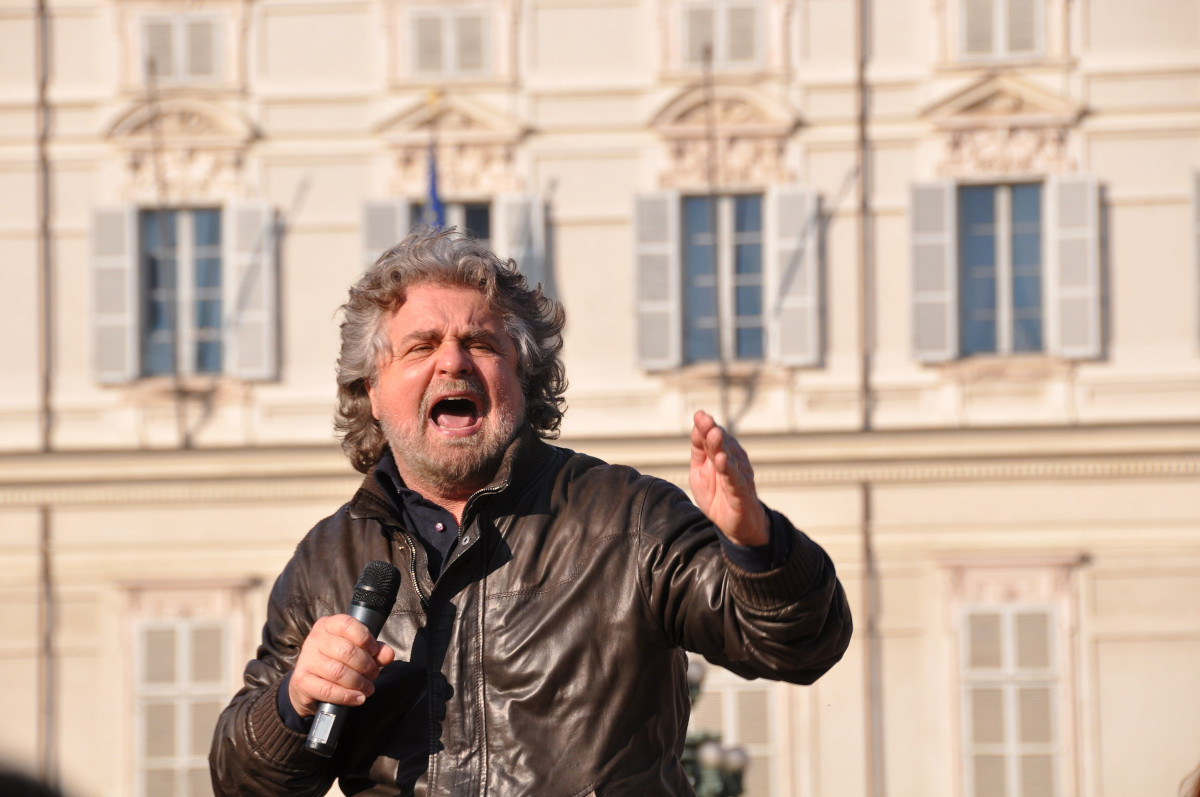
Image 1: Beppe Grillo in Piazza Castello in Turin for the campaign of the 5 Stars Movement Piemonte on 14 March 2010, photo by Giorgio Brida

I do not want to focus too much on the definitions of social phenomena because I find it more interesting to look at the structures (synchronic and diachronic) and contexts (at various scales) underpinning them. It is – I believe – analytically more productive to compare those, instead of sticking to what a categorical label (which is always, to an extent, arbitrarily attributed) does or does not include. Moreover, the word “fascism”, having become so morally laden in its century old history, is almost impossible to use it without falling into excessive generalizations (both moral and historical). With this in mind, my tendency towards what might or might not be classified as “fascism”, hinges on one simple principle: I use it either when referring to the movement founded by Benito Mussolini in 1919, or when the category is used “emically” by my research participants to describe themselves.

Consistently with the above, I’d like to focus on some systemic aspects I have been concentrating on in my recent work on populism and conspiracy theory within the Italian 5 Stars Movement (5SM), and put that into relation with insights from previous research. I do not at all intend to suggest that 5SM is a phenomenon of the fascist type, albeit one might notice, historically, a few overlapping tendencies. Rather, I look at the 5SM as a political grouping that was, at its origin, populist. Fascism, too, is an historically specific form of populism. But not every populism is fascist.

My main areas of interest in political anthropology have been concerned with: 1) The ideological innovations of Spontaneismo Armato: a radical and partly clandestine neo-fascist galaxy of small armed groups, active in Italy in the late 1970’s, and deeply engaged in the political violence of those years, (Loperfido 2018, 2022). 2) The constitutive processes, and subsequent collapse, of a specific socio-economic ideology of autarchy/self-reliance in Veneto, Italy. The latter was organized around an organicist understanding of the social relations of production which had also framed the sub-nationalist discourses of Lega Nord, another populist protest party, that had seen the light in Veneto and Lombardia in the late 1960s and early 1970s (Loperfido and Pusceddu, 2019, Loperfido 2020). 3) The above mentioned 5SM, with particular reference to the articulation of its early populistic functioning, and the fantasies of conspiracy against the people, very widespread in the early stages of the party formation (2005-2016). With Victor Turner, I analyze this articulation in terms of the anti-structural logics of charisma/enthusiasm, that informed the party’s constitutive process within the complex political economy of the long crisis unleashed by the financial breakdown of 2009.

All three of these political phenomena have been associated with fascism by variously distributed detractors in the media and at times in scientific discourses. Personally, I only dealt with Spontaneismo in terms of “Neo-fascism”, for the reasons listed above. However, one can notice that the three political formations shared a few ideological features with historical fascism.

Some of these features are:

1) All three – at least in their constitutional phase – claimed to represent various expressions of a third way between left and right, socialism and liberalism.

2) They all, likewise, claim(ed) to represent some form of revolt against the bourgeois world, while leaving unchallenged the system of property, market relations, and capital accumulation more generally.

3) They all were charismatic in nature, vitalistic and transgressive. One could say enthusiastic in the Durkheimian sense, or – more appropriately – anti-structural in a Turnerian perspective.

4) They all opposed action to theory and reason, giving to the former the moral edge over the latter. This created, in all four cases, a strongly anti-intellectual orientation, with attacks on rationalism, and to bourgeois idealist notions of foundational identity.

5) They all produced forms of organicist ideologies which were, more or less explicitly, obscuring class differences, and thus attempting to deny and repress class conflict.

Reflecting on similar ideological configurations, Susana Narotzky makes an important statement when saying that:

most ‘third-way’ attempts at producing alternative social models have been of the ‘organic’ type, from the social doctrine of the church at the turn of the twentieth century through republican solidarism and fascism, to present-day third-way and social-capital proponents. They are similar in that they all aim at maintaining capitalist market-led relations of production while solving the ‘social question’, that is, the social unrest created by the necessary differentiation those very relations produce. They differ in the means employed to reach these common objectives and therefore in the procedural structures of governance developed. However, they all stress the importance of personalized relationships between agents and the specificity of community contexts” (Narotzky 2007:406, my emphasis).

Following in her footsteps, I would like to explore how third way postulations, and the processes of personalization/naturalization of socio-economic relations that are integral to it, could be related to the macro-context of austerity measures. Can this dynamic of personalization/naturalization be interpreted as the nexus determining a mutually constitutive relationship between austerity and charisma? The above might not give us certainties on what fascism is or is not, but could perhaps illuminate social processes, structures and constraints that elicited the emergence of fascism in its historical form, and that have – at other times – produced ideological tendencies that are – to an extent – comparable with it.

If we look at the historical context, our first realization is that all of these formations were constituted at moments of deep crisis of capital accumulation (historical fascism in the late 1910s, the Liga Veneta – then Lega Nord, then Lega – in the early 1970s, Spontaneismo in the mid 1970s, 5SM in 2009). This is not to say these political formations were reacting to economic crisis per se, rather, they all seemed to embody a reaction to what Stuart Hall has termed – with Gramsci – “a passive revolution”, a sort of reaction to a non-reaction: “when none of the social forces were able to enforce their political will and things go stumbling along in an unresolved way” (Hall and Massey 2010).

Another recurrent aspect in all of these situations is the emergency of austerity as a culturally hegemonic discourse. In a recent book Clara Mattei (2022) explores the relationship between austerity and fascism in Italy, as a process of reciprocal constitution. She sheds new light on austerity presenting it as a project elaborated by British and Italian think tanks at the dawn of the last century with the goal of liberating the forces of capital from the yoke of political control. She reminds us of how in his very first discourse as Prime Minister, Mussolini spoke the idioms of austerity, and promised to de-politicize the economy and remove all meddling of the state within it (Mattei 2022:205). Obviously, the other conjunctures in which the “idioms of austerity” were enforced as culturally hegemonic, were precisely the moments, named above, where the forces of capital appeared to be under severe threat (the 1970s and the 2010s).

Now, there are of course enormous differences, and neither Lega, Spontaneismo, or 5SM, embraced austerity the way Mussolini’s regime did. But I am not interested here in the direct relationship between these movements and austerity. Rather, I’m trying to suggest that austerity became a paradigm, powerful enough to establish a new representation of the relation between the economy and the state, where the possibility and the duty of the former to intervene in the latter and regulate the markets, disappears. This implies a set of consequences that, I shall argue, can be seen as co-responsible for the emergence and social establishment of the ideological configurations listed above.

Yesterday, like today, austerity seems to have the power to de-politicize issues, where these are “removed from the level of public accountability, and designated as ‘non-political’” (Hadjimichalis 2018: 108). Integral to austerity is what Don Kalb has termed “the unstoppable rule of experts” (2011: 3), whereby economic forces are not any longer the object matter of politicians (who govern things), but of technicians, scientists and technocrats (who study and manage things). This seems to inaugurate a process whereby the necessity to govern socio-economic forces is obscured. More than that: these are divorced from their social situatedness, their rootedness in the social process, and their being integral to the unequal relationalities between power holders and the subaltern classes. We could say that – with austerity – economic processes, social facts, power relations, develop a tendency to exit the social, and enter the domain of nature. Costis Hadjimichalis (2018) has shown how the discourse of austerity seems to be endowed with the magic power of making bloody attacks on social welfare, budgetary cuts for health and education, disappear beneath the idioms of flexibility, efficiency, and modernization. The result is “a culture of fear, alongside feelings of injustice and anger” (Hadjimichalis 2018: 108).

I was grappling with similar issues when faced with the problem of populism and conspiracy theories within the 5SM in the immediate aftermath of the 2009 economic breakdown, where not only the relation between the masses and the leader had become personalized, individualized, and as it were unmediated (Calise 2016, Comby 2014), but social and political forces were seen as personified and animated. The state had become a Vampire, the politicians were Zombies, while conspiracy theories about vaccines or organ removal during Covid-19 had come to represent the penetration of the extractive logic of capital down to the intimate sphere of the body itself.

We have known at least since Weber that “the social relationships directly involved in charisma are strictly personal, based on the validity and practice based on charismatic personal qualities” (1964 [1947]: 363-364). Yet, we can perhaps enrich this idea further by exposing a relationship that might connect personalized logics of charisma, 3rd way attempts, attacks on rationalism, with the larger systemic shift to hegemonic austerity. As we have seen, austerity deliberately dis-empowers the state as an abstract mechanism of social-economic regulation: a normative centre immanent over social relations, overseeing, governing, and intermediating social, economic and political interactions between actual persons, groupings, and different orders of institutions. The power of abstraction with which we endow the state, is key to that socially regulating function, tasked with emancipating social relations from their situated imbalances of power and their hierarchical relationalities. It is via these abstracting properties that the socially equalizing function of the state can be implemented via the establishment of a normative order. Obviously, when that function is removed not only is the field open again to the re-embedment of power relations into the given social hierarchy, but also to the general essentialization of social characters and social forces. It seems to me that this is the kind of context Gramsci alluded to, precisely when talking about fascism in austerity ridden Italy, when he saw, between the old that is dying and the new that cannot be born, an interregnum where “a great variety of morbid symptoms appear”.


Giacomo Loperfido is an ERC researcher in social and political anthropology for the PACT (Populism and Conspiracy Theory) Project, at the University of Tübingen. His research deals with questions of political violence, political radicalism, cultural enclavization, social and economic disintegration, in the wider context of global systemic crisis. He edited the volume “Extremism, Society and the State” (Berghahn Books, 2022).


References

Calise, Mauro. 2016. La Democrazia del Leader. Roma, Bari: Laterza.

Comby, Jean-Baptiste. 2014. “L’individualisation des Problèmes Collectifs: une Dépolitisation Politiquement Située.” Savoir/Agir:2: 45-50.

Hadjimichalis, Costis. 2018. Crisis Spaces. Structures, Struggles, and Solidarity in Southern Europe. London, New York: Routledge.

Hall, Stuart, and Doreen Massey. 2010. “Interpreting the crisis.” Soundings 44.44: 57-71.

Kalb, Don. 2011. “Headlines of Nation, Subtexts of Class. Working-class Populism and The Return of the Repressed in Neo-liberal Europe, Introduction”, inKalb Don and Gabor Halmai, Headlines of Nation, Subtexts of Class. Working-class Populism and The Return of the Repressed in Neo-liberal Europe. New York, Oxford : Berghan Books.

Loperfido, Giacomo. 2018. “Neither Left nor RIght. Crisis, Wane of Politics, and the Struggles for Sovereignty”, in Kalb, Don and Mollona, Mao, Worldwide Mobilizations: Class Struggles and Urban Commoning, New York, Oxford: Berghahn Books, 118-141.

–. 2020. “The entrepreneur’s other: Small entrepreneurial identity and the collapse of life structures in the ‘Third Italy’”, in Narotzky, Susana, Grassroots Economies, Living With Austerity in Southern Europe. Pluto Press, 173-191.

–. 2022. “The Empire and the Barbarians: Cosmological Laceration and the Social Establishment of Extremism”, in Loperfido, Giacomo, Extremism, Society, and the State, New York, Oxford: Berghahn Books, 87-108.

Loperfido, Giacomo, and Antonio Maria Pusceddu. 2019. “Unevenness and Deservingness: Regional Differentiation in Contemporary Italy.” Dialectical Anthropology 43:4, 417-436.

Mattei, Clara. The Capital Order: How Economists Invented Austerity and Paved the Way to Fascism. University of Chicago Press, 2022.

Narotzky, Susana. 2007. “The Project in the Model. Reciprocity, Social Capital, and the Politics of Ethnographic Realism.” Cultural Anthropology, 48:3, 403-424.

Weber, Max. 1964 [1947]. The Theory of Social and Economic Organization. New York: The Free Press


Cite as: Loperfido, Giacomo. 2024. “Austerity, Charisma, and the Attacks on Reason” Focaalblog, 1 February. https://www.focaalblog.com/2024/02/01/giacomo-loperfido-austerity-charisma-and-the-attacks-on-reason/

Andrea Tollardo: No return to old normalities: Reflections on a time of passage in locked down Italy

At the end of February, the center of Italian capital encountered an unexpected problem. Not an unforeseeable one, but one that was not previously thought possible in the highly integrated European tertiary hub of Lombardy. Some weeks of contradictory official announcements passed by. Local and central governments, experts, and politicians first closed the few institutions that remained under public control after several years of privatization of public services, such as schools and libraries, and then came up with city marketing campaigns such as #MilanoNonSiFerma or #BergamoNonSiFerma (Milan/Bergamo doesn’t stop) intended to push everyone to keep the service sector and the productive economy up and running. Finally, at the end of the first week of March, the government frantically urged everyone in Italy to enact so-called social distancing and isolation at home.

Continue reading

Sandro Mezzadra: Politics of struggles in the time of pandemic

A prolonged wait at the pharmacy, a long queue before entering a supermarket. Experiences like this, today increasingly common, can help us to see how the spreading of Coronavirus is transforming our society. Yet, more precisely, the global pandemic, and the measures put in place by the Italian government to attempt to counteract it, are in fact merely exacerbating tendencies that have already existed for a while. Recent decades, dominated by the politics of fear, have left their mark. This can be seen in the current fear of physical contact, or in the suspicious looks that guard over the “security distance” between people. Undoubtedly, such an anxiety of control strengthens the powers dominating our lives, and it is worth remembering that once governmental measures such as these are taken they become part of the arsenal of political possibility. Yet, other images have emerged as well, ones with profoundly different connotations. People on the street smile at each other, music is played from balconies, and a sense of solidarity surrounds not only doctors and nurses, but also factory workers on strike to defend the health security offered via their working conditions.

Continue reading