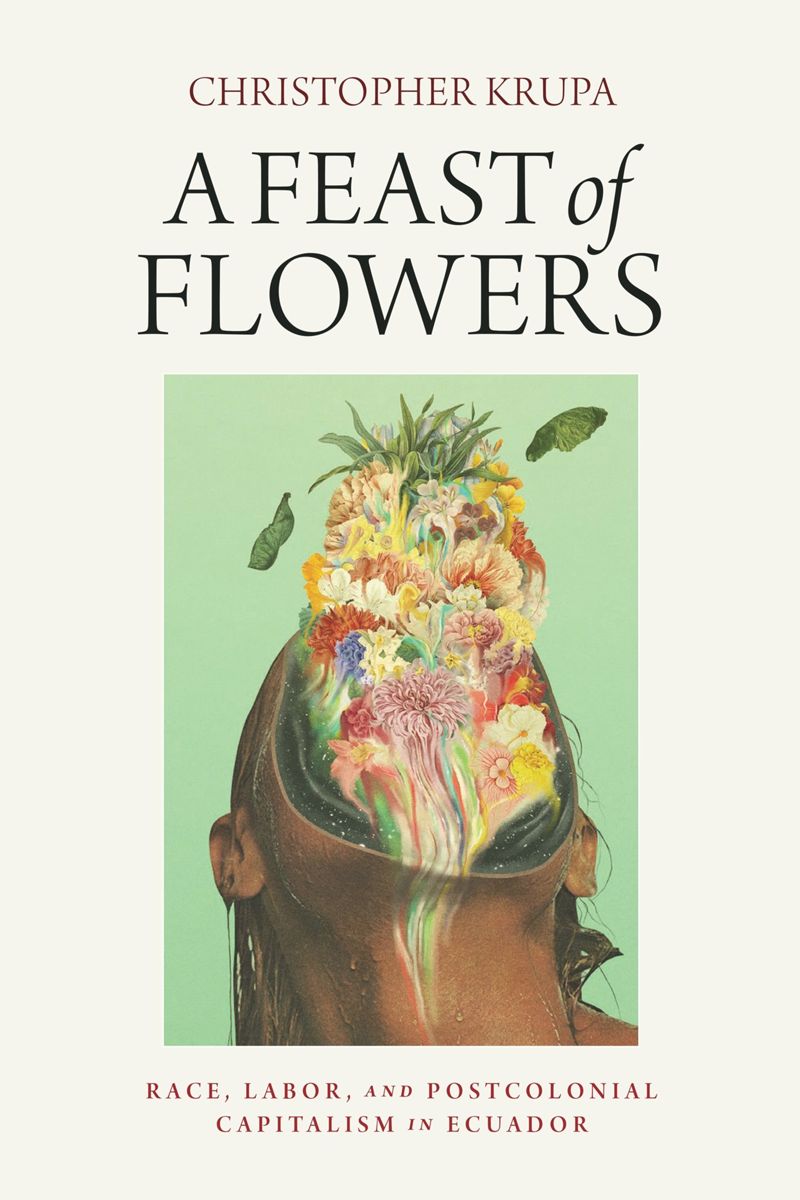
In April 2022, University of Pennsylvania Press published A Feast of Flowers: Race, Labor, and Postcolonial Capitalism in Ecuador, by University of Toronto anthropologist Christopher Krupa. Tracing the expansion of capitalism in the largely rural, agrarian canton of Cayambe, Krupa’s book is an historically informed ethnography of Ecuador’s cut flower industry. In the interview below, Focaalblog co-editor Stephen Campbell talks with the author about this important new monograph.
Stephen Campbell: First, thank you for agreeing to talk with me about your new book. A Feast of Flowers is brilliant on many levels—most broadly as a theoretically sophisticated contribution to anthropological political economy. To start, I’d like to ask about the book’s background. Could you say a bit on how you came to this project? What were the initial research interests that led you to studying Cayambe’s cut flower industry?
Chris Krupa: Thanks for your kind words about the book, Stephen. I know this is an ethnographic cliché, but I actually didn’t begin this project with the intention of studying the cut flower industry, at least not directly. Since the mid-90s, I’d been spending time living in indigenous communities around Cayambe and had become fascinated with both the political work of territorialized communities and the technical details of indigenous agrarian practice. I was invested in the debates occurring in Marxist anthropology at the time about rural societies, things like the articulation of modes of production and simple commodity production literatures, and was always keeping an eye on the massive export plantation sector then starting to engulf the whole region.
I started trying to map out the complex ways in which any one thing I was interested in—a community, let’s say, or a small plot of commercial onions—was becoming intelligible only as one part of a complex and dynamic social formation that included things like flower plantations and foreign currency markets in them. I found that no matter how I composed this map, capital always seemed to enter my analysis as a kind of disruptive externality, turning the anthropological project into a rather obvious moral tabulation of the violence effected by capitalist expansion, something one could do well enough without much ethnographic or historical research at all.
At the time, we were getting a lot of really competent studies of indigenous political practice in Ecuador by scholars who quite explicitly positioned their scholarship as a contribution to a kind of radical democracy project of expanding the presence of indigenous activism, something that joined with similar projects in other parts of the world. The more time I spent with these movements, the more curious I became about our opponents, which also resonated with the questions the activist-intellectuals I was living and working with were posing to me.
What we didn’t have, and don’t often get, I think, when the terms of contestation are so neatly drawn, are in-depth studies of how power actually works in a historically-specific social formation. This is particularly true, I think, of capital, especially when the dynamics of local capitalist practice seem to express broader patterns going on worldwide, such as, in this case, the expansion of labor-extensive production systems in the Global South dedicated to making specialized goods for Northern consumers.
Through a series of accidents, I managed to get invited to do research inside a flower plantation, which led to further invitations (after many, many refusals), and which kind of opened up this completely bewildering insider’s view of how wealth is made in a place like rural Ecuador today. This was something that the indigenous federations and communities I was aligned with and living in were far more interested in than anything I might have to say about what they were doing. Figuring this out became a major part of my research and took me well over a decade to really piece together, as Part I of the book tracks. It also, I think, tells a different kind of story about how rapid capitalist expansion happened in places like the indigenous highlands of Ecuador in the late 20th century.
SC: The book covers a lot of ground—from a global history of financialisation since the 20th century, to a survey of Ecuadorian race thinking, to industrial psychology, to workplace labour processes. The unifying thread running through the book, however, in my reading, is the dialectics of capitalist expansion. Would that be a fair gloss of the book’s overall conceptual contribution? Or how would you most succinctly state the book’s primary theoretical concerns?
CK: That works. One thing I really wanted to do with the book was provide a deep ethnographic account of primitive accumulation, one that could at least aspire to treating primitive accumulation with all the nuance evident in Marx’s retheorization of it. The crucial thing for me was to address with equal complexity the two inseparable processes Marx identifies as making up primitive accumulation. On the one hand, there are the brute material processes under-girding the consolidation of capitalist class relations and the increasingly narrow organization of these relations and their reproductive capacities around emergent forms of commodity production and capital accumulation. On the other hand, there is the assemblage of a new register of history that reconfigures historical positionings like past, present, and future or then/now distinctions or senses of historical arc and momentum, as well as frames of historical action and intervention, around these material transformations such that broader issues of being and becoming and so on can’t but be inflected with one’s positioning in a new capitalist historicity. There’s been a tendency to emphasize the first of these processes over the second and to reduce everything in that to somewhat shorthanded notions of dispossession, with land theft or things matching the metaphysics of property seizure becoming the iconic, foundational, scene of capitalist arising.
In northern Ecuador, the juridical weight of its rural community system has rendered indigenous land unavailable for capitalist expropriation, and the whole history of land ownership is an important part of the story. But more than that, the constellation of actors and forces and interests that came together in rapidly developing this plantation system in and around indigenous territories in northern Ecuador (which turned the country from a non-producer of commercial flowers to the third largest global exporter of them in only a few years) was infinitely greater than what can be explained by a single violently explosive event like a land grab. It involved all the forces you mention, Stephen, and I wanted to be able to trace out the interactions between these in detail to really outline what this part of primitive accumulation, the first set of processes I mention above, really looked like in this one case, as a model for how such things might be coming together in other parts of the world.
Because so much of this information is secret or not publicly available or just hard to get is probably why we tend to get rather truncated stories of capitalist process—and why it also took me over ten years to write this part of the book. But attending to the other part of this, capital’s interventions into historical production, is equally important because it allows us to see how the people directing these processes situate them in a local reality—what they imagine that to be, why they think it is that way, and how the work they are doing will intervene into that. It is where the foundational logics of capitalist accumulation get de-abstracted, rendered socially specific and concrete, and shape the way that very human component of primitive accumulation—turning people who aren’t wage workers into them—gets actualized and justified in one way or another. And it is where questions arising in our attention to the first set of processes—like, in my case, why the science of industrial psychology figures so prominently in shaping plantation labor systems and securitizing the borders between capital’s inside and outside—get answered. So, all of this, this expanded definition of primitive accumulation and its attendant ethnographic critique of capitalist historicity, is perhaps what I’d say shapes any conceptual or theoretical contributions the book may offer.
SC: You’ve framed your book as a contribution to understanding post-colonial capitalism in general. But you also delve, in much detail, into the specificity of Cayambe’s cut flower industry and its situatedness in Ecuadorian history and in Ecuadorian race thinking. Is there something particular about this case that renders it especially helpful in illuminating the workings of post-colonial capitalism more broadly?
CK: Yes, I think there is but I should probably clarify what I mean by “postcolonial capitalism”. This is a term of specification not generalization. On the one hand, it is meant to push for a specification of the components of a given capitalist system that draw their force from their invocation of frameworks devised to advance or stabilize a prior colonial system. This involves a pluralization of both capitalism and colonialism and the tracing out of historical continuities between these in their unique historical assemblages.
For instance, it matters a good deal that the Spanish conquest of the northern Andes did not advance through a singularly genocidal agenda and that it wasn’t just the land, as a potentially vacant resource, that was valued. Indigenous people were needed, as both tribute-paying subjects and as workers in the Crown’s labor drafts, in mining operations throughout the colonial Andes, on the agrarian and domestic operations of settlers, and in all kinds of jobs that settlers wanted done for them. The violence of conquest regularly returned to the question of how to fold indigenous subjects most productively into dominant economic and political agendas and reap value from that way.
This orientation comes to define the ways hacienda complexes operated when they took over the entire rural Andes and absorbed indigenous populations into them as resident peons after Independence. And this sets up a particular approach to capitalist development in the 20th century, which itself builds on over 100 years of dominant political thinking in Ecuador that united questions of economy and race, of capitalist expansion and indigeneity, into a single question that then shapes the capitalist-expansion-as-indigenous-salvation script organizing plantation hiring practices, labor processes, and so on, as I discuss throughout the book. So that’s one part of what I mean, which is a kind of broad methodological orientation.
The other part is more specific, in that I use the term “postcolonial capitalism” to characterize a form of capitalism that folds a certain claim to historical intervention into its operational rationality, specifically presenting itself and its expansion as curative of the lingering colonial residues haunting the present. In other words, I don’t use the term “postcolonial” here as an objective descriptor—obviously, if I were to try to locate the mis-en-scene of capitalist arising in highland Ecuador, it could certainly be debated whether “postcolonial” is most effective for capturing its complex temporal register. Similarly, if I were trying to offer a political perspective on that same process, it is open to debate if postcoloniality would best capture that.
Instead, I use the term here to identify what might be called an ideological framework appropriated by capital itself to position itself historically and to overlay the violence of expansion with a claim, drawing on ideas about progressive futurity and temporal momentum, to beneficent social good. Here, the colonial legacy up for grabs is indigenous abjection, the equation of indigeneity with misery and exclusion, and even the relevance of racializing terms like indigeneity at all. Capital’s claim is to finally get over all this—this is what its expansion promises. “Postcolonial capitalism” points to the interactive co-existence of these contradictory processes—the appropriation of colonial residues into the core operational procedures of an expanding capitalist system and the claim that this system is uniquely qualified to eradicate colonial residues from the places it expands into.
SC: The term “racial capitalism” appears in the book’s introduction, though it’s not a concept to which you explicitly return. Yet, the dialectics of race and capitalism is definitely one of the book’s central concerns. How would you situate your book in relation to the growing literature on racial capitalism? What do you see as your book’s primary contribution to this literature?
CK: Right, well as I’ve said above, one of the core historical threads running through the book is the deep connections between the economic and racial sciences and agendas in Ecuador, and of political projects fusing the two together as a pretext for various sorts of interventions into indigenous territories. By the early 20th century, the idea of “capitalism” in Ecuador becomes hard to think outside of its figuration as a liberating force for highland indigenous people bound in different ways to hacienda enclosures. Capitalism emerges as the solution to what was referred to as the “Indian Problem,” and today’s flower plantations are heirs to this mission. The ethnographic work inside flower plantations in the latter chapters of the book show how this agenda is set in motion in plantation labour systems.
But at another level, I’ve been admittedly quite influenced by the ways early American contributors to the literature on racial capitalism based their use of the concept on a searing critique of the millennialism under-girding conventional capitalist history. Their re-tracing of the rise of capitalist class relations out of post-abolition efforts to continue the economic structure of slavery opens up a pretty important discussion of the inherently racializing character of the location “labour” itself. It also points to our need to continually ferret out the historically specific ways that capitalism disguises the violence inherent to its routine operations. As I show in the book, the social work of primitive accumulation rests entirely on both of these processes in its historical reconstruction of the pre-labouring poor as marked by forms of consequential and often essentialized difference that are progressively overcome by their proletarianization. This is a central narrative trope inherent to primitive accumulation as a genre of elite historicity.
SC: Race is central to your theorisation of post-colonial capitalism. Yet, it struck me that the large white and mestizo populations of Latin America distinguish this region from most post-colonial countries in Asian and Africa. Is that a relevant distinction to make? Would you nonetheless say that the dialectics of race and capitalism that you trace in the book play out similarly in post-colonial contexts elsewhere in the global South?
CK: I can’t answer that question, but I think that’s the sort of fine-grained ethnographic and historical question that I hoped to offer one more source of inspiration for with this book.
SC: One thing that stood out for me was how deeply Hegelian the book is. You write, for example, of “the plantation as an object constituted by relations with forces outside it,” of “the flower as negation,” of narrative frames “located neither entirely inside nor outside” the domain of capital, of “mediation between inner and outer worlds,” of a site of knowledge creation “dialectically related to its opposite,” and of a form of capital accumulation “whose ‘outside is essential,’ of its essence.” This Hegelian dimension is not explicitly named as such in the book. Could you elaborate on how an understanding of Hegelian logic informed your research analysis and writing? Was this an approach you had in mind before you started the project, or was it something that developed over the course of research and writing?
CK: Good catch, Stephen. Guilty. I think one of the most consequential things I did during my graduate training was participate in a slow, page-by-page, group reading, led by Neil Larsen, of Hegel’s Phenomenology, followed immediately by doing the same with Capital V.1. I also, having received zero training in field methods during my graduate education, brought Bertell Ollman’s Alienation with me to the field and used that as my field methods training instead. It’s all there, I suppose, in Ollman’s Hegelian reading of Marx’s method, and it’s striking how well that book works as a primer in ethnographic methodology if you’re interested in the sort of things you and I might be interested in.
Ollman’s reading of Marx centers on his dialectical phenomenology, his radical critique of the object, his explosion of metaphysical notions of presence, and of suchness being an effect of overlapping webs of relations, which logically exist prior to and become determinate of things themselves. How to set all this in dynamic motion as an ethnographer? was a question I asked myself throughout fieldwork and there were a lot of missteps in it along the way. Writing the book, I think I was best able to work through this in the chapters on interiority, especially in the overlaps between notions of psychological interiority that can only be grasped through processes of exteriorization like projection, capital’s outwardly expansive dynamics that only work through processes of interiorizing its externalities, the shifting spatial dynamics codifying capitalist/non-capitalist locations, and the scientific efforts to construct a profile of the inner life of indigenous people as preludes to various forms of external intervention upon them.
SC: One of the recurring themes in your discussion of post-colonial capitalism is the notion of difference. Difference has also been a key theme in the anthropology of capitalism that is influenced by J.K. Gibson Graham. Yet, whereas Gibson-Graham, and the anthropologists whom they’ve influenced, employ a Deleuzian notion of autonomous difference, your book advances an explicitly relational understanding of difference—specifically, of differences that are “internally related.” Would you say that this is a relevant distinction to make? Could you elaborate on your understanding of difference, especially as it pertains to the theorisation of capitalist expansion?
CK: Let me answer this in a slightly different way than I think you might intend. The book is an anthropological critique of political economy and its topic is capitalism. I am not interested in attempting a general theory of something like difference, though I do draw from some of my teachers who were. Difference enters the analytic because it was there from the start. There from the start because the lineage I trace of capitalist thought in Ecuador, right up to the present, begins with, and never ceases to ponder, the question of what the imposition of things like free labour contracts or monetary remuneration of hourly wages or disciplined, routinized labour routines, or regularized working hours might mean for effecting a (spiritual, moral, political) transformation of indigenous society.
The reverse was also true—at a certain point in the late 1800s, questions about what indigenous people are, why they are that way, how they might become different, and so on, get completely entwined with questions about the ways these markers of indigenous difference are determined by the hacienda enclosures to which they are imagined to be universally bound, stimulating the question of what, then, would become of indigenous people, and indigeneity itself as a category of difference, were the haciendas to be replaced by capitalist forms of production. There from the start also because primitive accumulation, as a genre, locates the foundational act of capitalist emergence in an encounter with difference, that is, with a description of a population retroactively constituted as pre-labour and defined by certain features that are magically transformed through their absorption into the project of capitalist expansion. Those originary features are bad or pathological, their transformed conditions are good or curative. This is a pretty standard trope in primitive accumulation’s narrative form, as I said earlier.
To follow your distinction, an “autonomous” notion of difference is as central to capitalist method as a “relational” one is to its critique. The urban and rural poor are so because they are given to sloth and the wasteful expenditure of time, says the former. Time thrift only marks the pre-labouring subject with difference because their potential labour-power is being valued in measured temporal units for your profit, says the latter, who addresses the former as a predator. Difference is there from the start. So is its critique.
SC: To close, could you say a bit about what are you working on now? What is your next project?
CK: I’m currently writing an anthropological history of the late Cold War years in Ecuador, focusing on the way a small guerrilla movement was used by the proto-neoliberal state to justify an expansive campaign of terror. It’s also about the Cold War prison and the intimate solidarities of revolutionary practice, and attempts to do all this through an analytic method that I associate with older Marxist literary criticism.
SC: Thank you so much for taking the time to do this interview. I encourage interested readers of this interview to check out the full book, which is available at the University of Pennsylvania Press website, and elsewhere.
Christopher Krupa is Associate Professor in the Department of Anthropology at the University of Toronto (Scarborough). He has researched and written on Andean Ecuador for over 15 years. He is co-editor (with David Nugent) of State Theory and Andean Politics: New Approaches to the Study of Rule (2015), and author of A Feast of Flowers: Race, Labor, and Postcolonial Capitalism in Ecuador (2022).
Cite as: Campbell, Stephen. 2022. “On the dialectics of capitalist expansion: An interview with Christopher Krupa.” Focaalblog 6 October. https://www.focaalblog.com/2022/10/06/stephen-campbell-on-the-dialectics-of-capitalist-expansion-an-interview-with-christopher-krupa/