Tag Archives: workers’ rights

Ståle Knudsen: The Invisible Hard Toilers of The Green Transition in The Maritime Sector: Shipyard Workers in Turkey

Image 1: Narrow spaces for shipyards in the bay of Tuzla. Photo by author

How do companies handle responsibilities to people and the environment when they operate abroad? What tools do they use, and what are the effects? These have been throughgoing concerns in my work during the last 10-15 years of research in Turkey. I have investigated how the ‘corporate social responsibility’ work of Austrian energy company OMV helped them gain social license to operate in a community in Turkey, and how the Norwegian energy company Statkraft sought to address ‘project affected people’ in a hydropower project through ‘IFC performance standards’. This research agenda culminated in the comparative project Energethics and the book Corporate Social Responsibility and the Paradoxes of State Capitalism (Knudsen 2023). When I realized a few years back that the construction of Norwegian boats in Turkey had become big business, I became curious about how Norwegian boat owners and state institutions handled the ethical dilemma involved in the praiseworthy effort of constructing ‘green ships’ under less praiseworthy labour conditions in Turkey. How is responsibility handled in such a context?

Dependent on Turkish shipyards

The green shift in the Norwegian maritime sector is largely considered a success. The electrification of car ferry connections is particularly highlighted: there are now over 80 battery ferries in operation in Norway. The authorities have provided significant support for this shift in order to achieve goals for reducing CO2 emissions, but also to position the Norwegian maritime industry for export within a new fossil-free maritime future. Through direct support via state institutions such as ENOVA (tasked to facilitate the energy transition in Norway) and Innovation Norway (promoting Norwegian export), ‘battery surcharges’ on ferry concessions from the Norwegian Public Roads Administration, and loan guarantee support from Eksfin (Eksport Finance Norway), the Norwegian authorities have made this green transition possible. However, Norwegian shipyards have not had the capacity to build all these new green boats and have been dependent on foreign shipyards, especially in Turkey. In addition, Norwegian shipowners save 10-30% when building at Turkish shipyards. In 2021, Turkish shipyards surpassed Norwegian shipyards in terms of volume of Norwegian newbuilds.

One may reasonably claim that the green shift in the maritime sector in Norway is partly being carried by underpaid and accident-prone Turkish workers. With 100,000 workers in the Turkish shipyard industry and an unclear social and political landscape, it is very difficult for shipping companies to clarify whether the conditions for the workers are satisfactory. With a background as a social anthropologist with good knowledge of Turkey, I have written a comprehensive report that attempts to deepen and nuance knowledge about the conditions at shipyards in Turkey. This blog post is based on that report.

Subcontractors

The most important thing to know about the shipyard industry in Turkey is that 80-90% of the workforce works for subcontractors. These workers are often migrant workers from other parts of Turkey, they work on short contracts, change shipyards frequently, live in overcrowded ‘bachelor dormitories’, and feel most connected to other workers from the same hometown and linguistic-ethnic group (many workers are Turkish Kurds and Arabs). These workers are paid daily wages, and as seasonal workers they prefer to work as much as possible. Some manage to establish small businesses themselves that have contracts with the shipyards, but most struggle with poor and unstable wages and are exposed to dangerous working conditions in many shipyards.
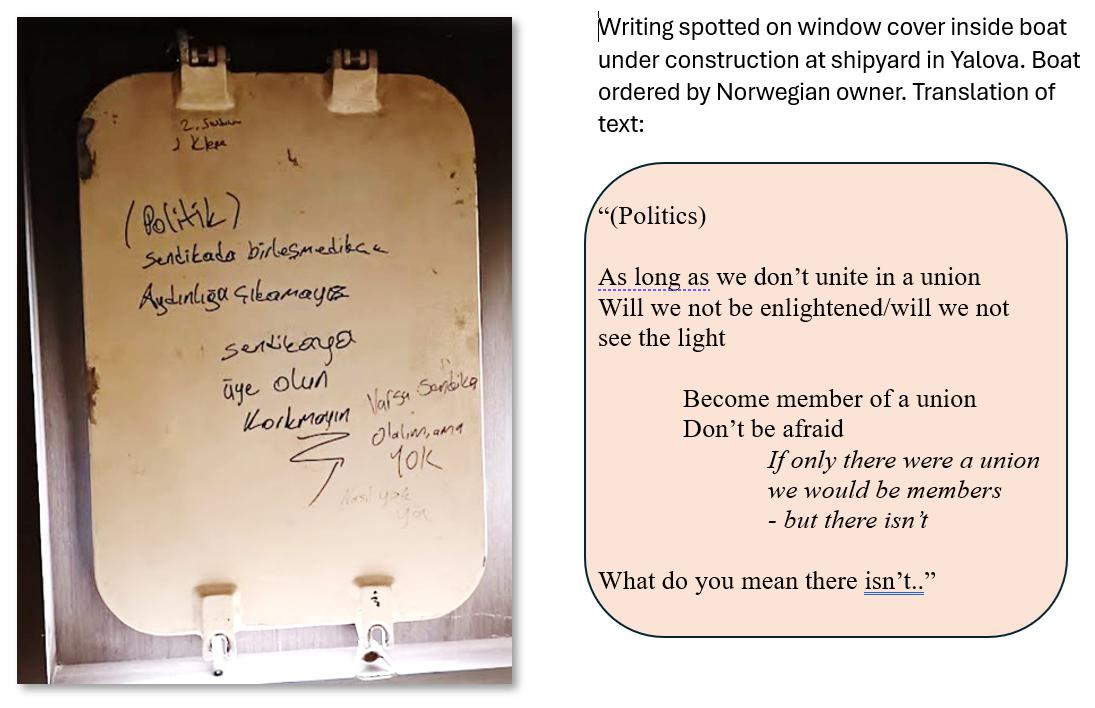
Image 2: The struggle of unions. Photo by author

Under such conditions, it is difficult for workers to cooperate and organize. It also does not help that laws and regulations in Turkey make effective union organizing in this sector difficult. There are two active unions at the shipyards in Turkey. The largest, DOK Gemi-İş, is politically and religiously conservative and relatively close to the authorities. They organize workers ‘on the floor’ who are directly employed by the shipyards, and have collective agreements with many shipyards. The other union, Limter-İş, has very few members, is politically positioned far out on the left, and mainly organizes workers employed by subcontractors. They often take an active role in coordinating and leading the many spontaneous protests that arise in response to lack of pay or in reaction to fatal accidents. Some shipyards actively oppose unions, and one of the largest shipyards, which also builds a lot for Norwegian shipowners, has even forced the conservative union out of their shipyard.

While the workers are very poorly organized, the employer side is represented by three organizations with significant resources and great influence with the political environment and authorities. In contrast to the union representatives, employees in the employer organizations are highly educated, have good command of English, and often represent the shipyards in international contexts. Recently, however, the Turkish Competition Authority opened an investigation into two of these organizations as well as 33 shipyards for alleged collusion to hold down the wages of shipyard workers.

Occupational accidents

Turkish shipyards have been notorious for many accidents and deaths. There are various explanations for this. While shipyard owners and their organizations, the conservative trade union, authorities and some academics point to a lack of education and ‘culture’, the radical trade union and other academics focus on structural reasons, particularly related to government policies and the large subcontracting sector. In the report, I argue that both of these explanations are valid. Since 2010, a number of measures have also been implemented that have improved conditions to some extent. It is likely that pressure from Norwegian shipowners has contributed to this. Nevertheless, the death toll has been on the rise again. According to the NGO Health and Safety Labour Watch/Turkey (İSİG), there were 19 and 17 deaths in fatal accidents at shipyards in 2022 and 2023 respectively (no official registration). By 2025, the number had fallen to ten deaths. However, these numbers exclude accidents in the large and often informal side industries. In December 2025, at one O’clock at night, a 16-year-old youth died in a fire in a workshop located in the ship industry site in Tuzla in the outskirts of Istanbul. They were producing pumps for ships.

What are Norwegian shipowners and authorities doing?

Many Norwegian shipowners have received loans from Eksfin for their construction projects in Turkey. In such cases, the shipowners must comply with a detailed guide for assessing employee rights at shipyards. This involves extensive ‘due diligence’ and follow-up inspections, which gives Eksfin and the shipowners ample opportunity to guide and, if necessary, put pressure on the shipyards.

Although there are probably significant differences between the shipyards, it is also difficult to know which shipyards are preferable. It also does not help that Norwegian shipowners who have boats built in Turkey rarely mention this in their reports in accordance with the Norwegian Transparency Act. Some shipowners with large construction contracts at Turkish shipyards do not mention at all that they build a lot in Turkey. At the same time, it is also the case that neither the Norwegian Public Roads Administration, ENOVA nor Innovation Norway set any special requirements for due diligence assessments. It is time for Norwegian shipowners and other relevant institutions to take a closer look at how they can together contribute to ensuring that the conditions at the shipyards they use in Turkey are satisfactory.

The limits of soft governance

Standards, certification and audits as operationalized by for example Eksfin may have some impact on labour conditions and safety, but these tools only enable insight into and influence over certain ‘immediate’ concerns, some of which are results of deeper dynamics which are beyond the reach of these tools. The subcontracting system, for instance, is one major driver for many of the challenges in the sector. However, the way shipbuilding is socially organized is beyond the reach of standards, certification and audits. Thus, the structural frames that ensure that the subcontracting system is reproduced, including the politics upholding those frames, and the capitalist system itself, are not addressed. Rather, the particular way of organizing capitalism in Turkey may indirectly be legitimized through these exercises.


Ståle Knudsen is professor at Department of Social Anthropology, University of Bergen where he pursues work in political ecology based on ethnographic work in Turkey and Norway. Recent thematic interests include energy, aquaculture, shipbuilding and corporate responsibility.


References

Knudsen, Ståle. (ed.)(2023). Corporate Social Responsibility and the Paradoxes of State Capitalism. Berghahn Books.


Cite as: Knudsen, S. 2026. “The Invisible Hard Toilers of The Green Transition in The Maritime Sector: Shipyard Workers in Turkey” Focaalblog January 28. https://www.focaalblog.com/2026/01/28/stale-knudsen-the-invisible-hard-toilers-of-the-green-transition-in-the-maritime-sector-shipyard-workers-in-turkey/
Mahmudul H. Sumon: What do we learn from hybrid governance in Bangladesh’s garments sector?

Global production networks, as we know today, have repeatedly failed to ensure the rights of workers and their health and safety. These failings have been exposed time and again whenever there has been a disaster. To address these failings, transnational activists have long been arguing for various types of multi-sectoral initiatives (MSIs) in global supply chains that involve private companies, trade union networks from both the global south and north, and national governments. Against this general backdrop and the emergence of some types of MSIs, questions for labor rights activists and critical researchers have become pertinent. What should be our position on transnational regulatory mechanisms or hybrid mechanisms in the “upstream” of the supply chains? What kind of organizational and legal relations should such regimes have; especially so vis-à-vis the state in which they operate? Could such agreements improve workplace health and safety? What role could they have in ensuring workers’ rights?

In this brief essay, I particularly focus on Bangladesh’s ready-made garment industry (RMG) and discuss the plight of one such MSI; the Bangladesh Accord that came into effect after two cataclysmic industrial disasters, namely the Tazreen fire and Rana Plaza building collapse. While thinking through some of the questions, I show that this much-coveted initiative, developed and imagined in the transnational spheres of activism, has faced resistance from key stakeholders of the RMG sector in Bangladesh (i.e., the BGMEA, the representatives of garments employer’s association). I argue that the country’s business elite associated with the RMG sector has been instrumental in facilitating the transformation of the Accord into a national corporate venture, making sure that their interests are protected. In the absence of any political will from the state (in the neoliberal order political will perhaps is an outdated idea), I contend that hybrid governance initiatives are somewhat destined to fail given the government’s strong dependence on the business class for its export earnings (i.e., the state business nexus). The story of Bangladesh Accord’s rise and fall or its continued existence under a new name precisely points to the strong leverage that the country’s business class enjoy over the state.

The emergence of the Bangladesh Accord

The Bangladesh Accord is a legally binding agreement between global brands and retailers on the one hand  and IndustriALL Global Union, UNI Global Union, and their Bangladesh-based affiliate unions on the other hand. The signatories aim to work towards a safe and healthy garment and textile industry in Bangladesh. It came into effect after two cataclysmic events, namely the Tazreen Factory fire (2012) and the Rana Plaza building collapse (2013), which killed 119 and 1134 workers respectively and injured many more. Over 220 companies signed the five-year Accord, and by May 2018 the work of the Bangladesh Accord had achieved significant progress for safer workplaces that covered millions of Bangladeshi garment workers. To maintain and expand the progress achieved under the 2013 Accord, over 190 brands and retailers signed the 2018 Transition Accord with the global unions, a renewed agreement that entered into effect on 1 June 2018.

Some international rights organizations and campaign groups have been instrumental in materializing the Accord in Bangladesh. Many believed it would provide a unique opportunity for a collaboration between national and international rights groups and labor rights organizations on the one hand and international retailers and brands on the other hand to begin a ‘fire and building’ inspection regime in Bangladesh. For labor-rights activists working in the global north, a legally binding agreement between brands and trade unions had been a long-standing demand to transition from the previous voluntary standard for garment production to a “binding” standard.

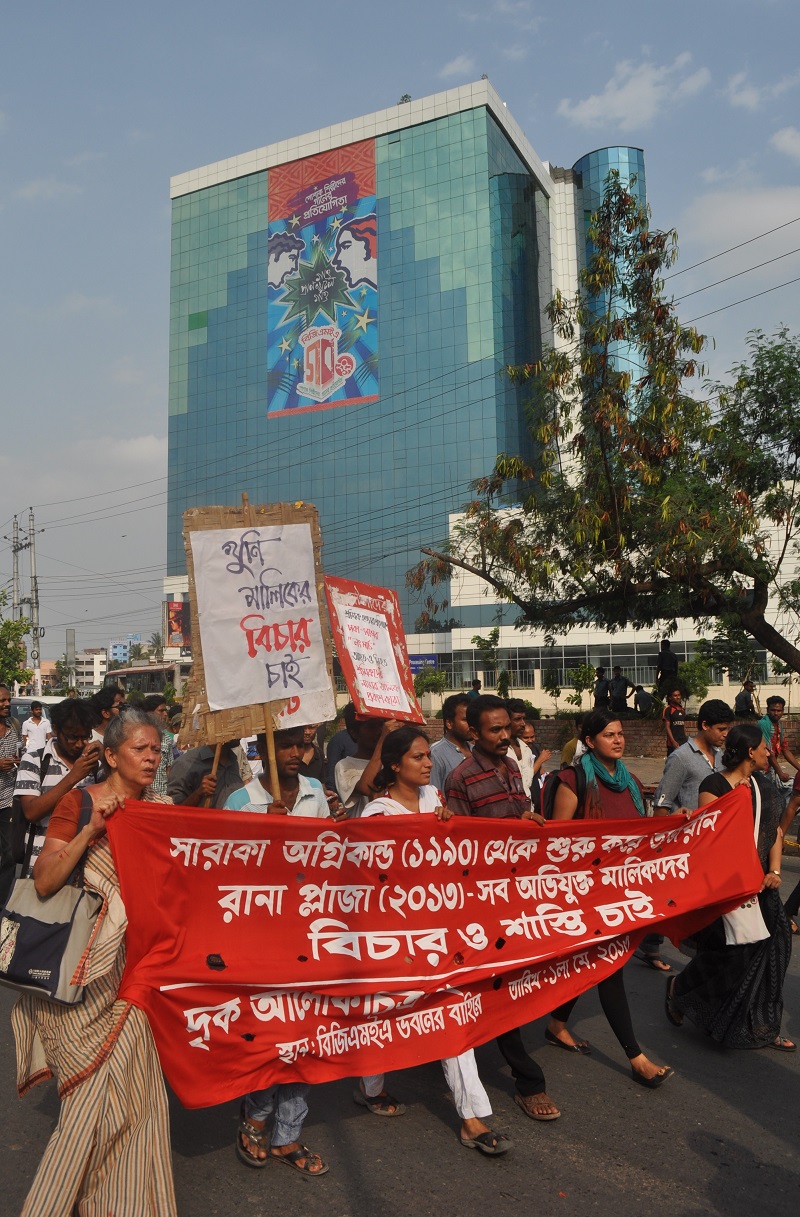
Activists chanting slogans for punishment of all the accused owners of garment factories starting from the Saraka fire (1990s) to Tazreen fire and Rana Plaza collapse (2013) in Dhaka on May-Day 2013 (photo by Mahmudul H. Sumon)

In design, the Accord is best understood as multi-stakeholder-oriented, with scopes for the participation of activists and civil society, both national and transnational.

Although private governance has been a timeworn mechanism in the garment export sector and has been in use for many years in different forms to assess supplier conduct, scholars have noted some differences between private governance and the newly installed Bangladesh Accord. The Accord has been an experiment in “co-governed private regulation” that included global union federations in addition to foreign brands and had the potential to challenge the relations of power between labor and employers.

The stated objective of the Bangladesh Accord has been to introduce an inspection regime aiming for “a safe and sustainable Bangladeshi Ready-Made Garments (“RMG”) industry in which no worker needs to fear fires, building collapses, or other accidents that could be prevented with reasonable health and safety measures” (quoted from the Accord on Fire and Building Safety in Bangladesh text dated May 13, 2013). However, the said inspections have been limited to factories from where the signatory brands of the Accord sourced their products. The Accord had built-in training programs for what it called the workers’ “empowerment” and “awareness” and had plans for the sustainability of the project.

A look back at the period immediately after the Rana Plaza disaster reveals that when it comes to labor reforms, the Bangladeshi government (i.e., the Ministry of Commerce and the Ministry of Labour and Employment) mostly reacted to the situation, responding foremost to the demands put forward by the European Union and the USA. Curiously, the US embassy in Dhaka made a lot of the noises to bring in changes in the labor law for issues such as freedom of association of the workers and easing rules for the EPZs so that worker’s rights were protected. On the face of it, the government complied with these demands, as reflected in amendments to the Bangladesh Labour Law in 2013 (which first came into effect in 2006). In government documents, the main concern for these amendments was slated as “workers’ safety, welfare, and rights and promoting trade unionism and collective bargaining”. The National Occupational Health and Safety Policy was also adopted by the government in 2013. In total, the government reported 76 amended sections and 8 new sections incorporated in the Bangladesh Labour Act. The government also changed the EPZ legislation and introduced rights to unionization which were previously withheld.

The BGMEA smear campaign against the Bangladesh Accord

In the first five years of its mandate, the Bangladesh Accord secured a remediation process for a good number of factories and was deemed “successful” by transnational observers. But as time elapsed and the disaster faded from international public memory it became apparent that the remediation requirements enforced by the Accord administration were not welcomed by factory owners and particularly not by the Bangladesh Garment Manufacturers and Exporters Association (BGMEA). More and more “voices” that criticized the Accord appeared in public discussions, pamphlets, and workshops organized by the factory owning elite and their representatives in Dhaka.

The BGMEA is the trade body that looks after the interests of local capitalists in the sector. It enjoys leverage over the government because of the export earnings from garment manufacturing. Their semi-clandestine campaign against the Accord indicates new safety procedures were not easy to flout and turned out to be a “costly” endeavor for local factory owners. Industry leaders showed detest for the new mechanisms publicly in newspaper op-eds. During a workshop organized by an international non-governmental organization working in Dhaka, one owner of a group of factories with an important position in the BGMEA demanded that factory owners should have the option for “self-governance” (statement from the managing director of a renowned group of industries in a day-long policy event space organized by Friedrich-Ebert-Stiftung (FES), Dhaka (n.d.), personal observation). 

There is clear evidence to suggest that throughout the implementation period of the Accord, the relationship between the BGMEA and the Accord enforcement teams deteriorated. Important representatives of the government evaluated the Accord’s new governance regime as “interfering” with the state’s affairs. At one roundtable discussion held in Dhaka in July 2018, an official from the Ministry of Labour and Employment stated that they were willing to cancel the Accord’s provisions for good. It is worthwhile to note that during the implementation period of the Accord, the opinions expressed by the Minister of Commerce closely matched those of the BGMEA and the business elite of the country. Enforcement of the Accord has been dubbed as “excesses” by a government key spokesperson, indicating how the government simply dovetailed BGMEA on matters of workplace safety. While the BGMEA’s detest for the Accord perfectly fits with the logic of capitalism in the garment sector, what should we make of the government’s detest for the Accord?

The links between government and BGMEA

As the Accord’s tenure drew to a close and an extension was on the table, the friction came out in the open. After news reports that the BGMEA was committed to bringing all the “different regimes” of governance under one roof, the association developed a proposal to this effect for government approval. As recent as August 2019 the BGMEA is on record to have brought allegations against the Accord for its “going alone” policy even though the association committed to a cooperation between the Accord team and the BGMEA’s “local entrepreneurs and experts”. Indeed, the signatories to the Accord’s extension on 21 June 2017 agreed to continue a fire and building safety program in Bangladesh until midnight of May 31, 2021, after which the task would be handed over to a national regulatory body supported by the International Labor Organization.

In January 2020, a deal was struck between the Accord associations and the BGMEA to establish a Ready-Made Garment Sustainability Council (RSC) which would replace the Accord and operate within the regulatory framework of the laws of Bangladesh. Some international labour rights groups and networks made allegations in a witness signatories’ brief that the RSC’s takeover of the Accord’s Bangladesh operations was an upshot of a “protracted campaign” by the Government of Bangladesh and factory owners against the Accord. Among other things, that employers’ campaign included a court case against the Accord, sued by one disgruntled garment factory owner in Dhaka.

At the inauguration of the RSC, the new initiative was praised as an unprecedented “national” supply chain initiative, adding a flair of nationalism in business. The Accord press statement on the transition said, “RSC is a newly established not-for-profit company in Bangladesh created and governed by global apparel companies, trade unions, and manufacturers.” It was officially registered on May 20, 2020, to be “a permanent safety monitoring and compliance body in the RMG sector in Bangladesh.” All the signatory companies and unions of the Accord and the BGMEA agreed to establish the RSC through a Memorandum of Understanding (MoU) signed on May 8, 2019. It was also stipulated that the “RSC will continue with factory inspections, remediation monitoring, safety training, and a safety & health complaints mechanism at the RMG factories supplying to Accord signatory companies” and that the programs “will be implemented following the protocols and procedures developed by the Accord, which have also been inherited by the RSC.” The statement further noted

With the transition of the Accord’s Bangladesh office and operations to the RSC, the RSC becomes the organization implementing the in-country safety inspections and programs of the legally binding 2018 Transition Accord agreement between global companies and unions. To ensure the provisions of the 2018 Transition Accord on remediation, inspections, training, and complaints programs are fully and adequately implemented, the Accord International Secretariat based in Amsterdam will cooperate with and support the RSC.

RSC released the following press release now found on its newly established website.

Today the functions of the Bangladesh offices of the Accord on Fire and Building Safety in Bangladesh have transitioned to the RMG Sustainability Council (RSC), a permanent national [organisation] with equal representation from RMG manufacturers, global apparel companies, and trade unions representing garment workers.

The press release quoted three people representing three parties of the RSC Board of Directors. Dr. Rubana Huq, the then President of the BGMEA and industry representative on the RSC Board of Directors, said “The RSC is an unprecedented national initiative and through our collective efforts with the brands and trade unions, we will make sure that Bangladesh remains one of the safest countries to source RMG products from.” China Rahman, General Secretary of the IndustriALL Bangladesh Council and trade unions representative on the RSC Board of Directors, said, “Together with our Bangladeshi trade union affiliates, we will help ensure workers in RMG factories have safe workplaces and have access to remedy to address safety concerns and exercise the right to safe workplaces. We will work to ensure that workers […] have trust in the newly established RSC”. Roger Hubert, Regional Head for Bangladesh, Pakistan and Ethiopia for the multinational high-street retailer H&M and brand representative on the RSC Board of Directors, said: “With the establishment of the RSC, brands can continue to honour their supply chain responsibilities that they have committed to through the Accord signed with the trade unions. The RSC will provide the assurance that workplace safety will continue to be addressed throughout out Bangladeshi RMG supply chain.” Dr. Huq was categorical in stating that the RSC received its license for operation from the commerce ministry and had taken over ACCORD’s current office and offered all existing staff members to join the RSC.

Uncertain futures under corporate control

After Bangladesh Accord’s transition to a new name there has not been much in the news about ongoing activities. The Accord’s continued operation with new arrangements under the Ministry of Commerce indicates the business elite’s close ties with the ruling political party in Bangladesh. It points to the local power nexus that are at play and business interests prevailing over all other considerations, something commonly seen in literature on global production networks. For all the symbolism involved with the RSC and its “new beginnings”, it is apparent that a truce has been found for the time being. Paradoxically, the “new” developments may resemble a move towards a structural power approach to the problem at hand, where the state’s role is seen as paramount. But in the absence of any political will from the state’s ruling political block, one cannot be too hopeful.


Mahmudul H Sumon is a Professor at the Department of Anthropology, Jahangirnagar University, Bangladesh. He can be contacted at: sumonmahmud@juniv.edu.


Cite as: Sumon, Mahmudul H. 2022. “What do we learn from hybrid governance in Bangladesh’s garments sector?” Focaalblog, 13 September. https://www.focaalblog.com/2022/09/14/mahmudul-h-sumon-what-do-we-learn-from-hybrid-governance-in-bangladeshs-garments-sector/