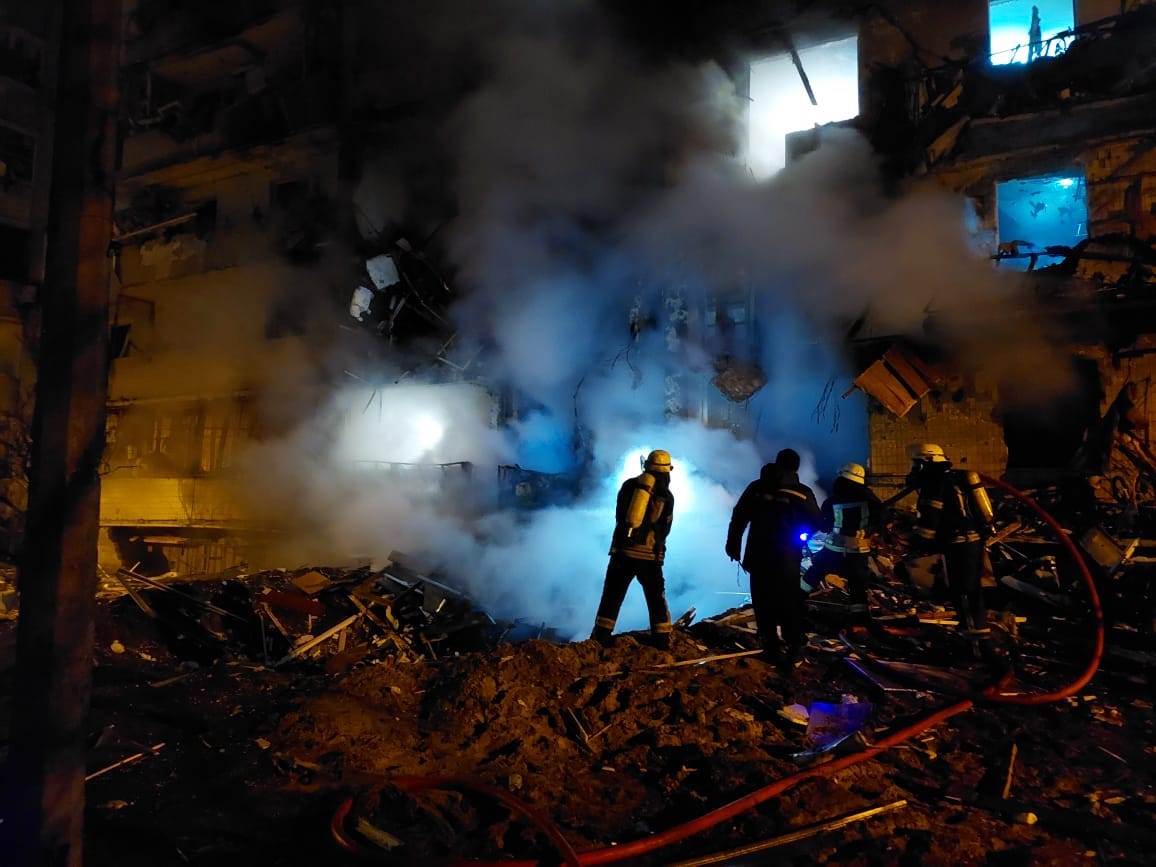
It is now becoming overly clear that this cruel and unjustifiable war in and on Ukraine is not going to last ten days – as the strategists in Moscow, Brussels, and Washington D.C originally expected – or ten weeks, as the pessimists thought. It may well extend to ten months and possibly morph into another ‘forever war’ (both hot and cold).
We are therefore turning our original FocaalBlog discussion, launched in the very first days of the war, into a rolling Feature that is open for any genre of submission: ethnographical, historical, theoretical, global.
So, this is an open call: we invite further contributions.
However, given the sprawling passions around this topic and the massive ideology production and propaganda on all sides, we emphasize that at FocaalBlog we continue to honor the elementary distinctions between description, explanation, historical contextualization, and moral justification. We are not in the business of the latter, and none of our authors engages in it.
We remain deeply and intimately interested not only in what is going on in Ukraine and Russia, and with Ukrainian and Russian citizens of all sorts – including the young and better educated current refugees into the EU as well as the older vulnerable people who remain behind in the war torn villages and suburbs without food or water – but also in the critique of war, militarism, imperialism, violence, primitive accumulation, ideology, nationalism, fascism, racism, and the shifting power fields of the ever less liberal global order in which this war is embedded, into which it feeds, and which it may accelerate.
This involves any type of critique of all the main actors in this cruel and utterly dangerous drama started by Putin. There is no doubt, this is Putin’s war. While this is so in a juridical sense, we should carefully consider that the very possibility of this war, with the exact same stated reasons and objectives from the side of Russia (minus the ethno-essentialism), was already discussed between US Secretary of State James Baker and (former) President Gorbachev in 1992, long before Putin came on stage (Sarotte 2021). Thus, the critique also continues to include prominently the US, the EU, and NATO.
There are loud and self-advertised NATO anthropologists around these days who imagine that NATO can save us from the abys and must have been the solution all along. They should never forget this: while NATO was steadily expanding in Eastward direction towards Russian borders (CEE, Georgia, Ukraine), it was simultaneously waging war for one and a half decade in the Middle East, invading, occupying, and destroying countries such as Iraq and Afghanistan, at the cost of close to a million official deaths (on Yemen, a proxy war, we keep counting). The US and the UK had acted on transparent lies and treacherous accusations, had blatantly ignored the United Nations, and pushed aside the principled objections against their aggression within NATO/the West. The unprecedented and globe spanning anti-war demonstrations of early 2003 made no impression whatsoever. Russia, not averse to superpower aspirations of its own, duly took note (as did China): this is apparently allowed. We as anthropologists and citizens (mostly) of the Western world do not have the moral luxury to forget this. This is ‘hard’ knowledge, and it is an anthropological sine qua non for understanding the contemporary world order.
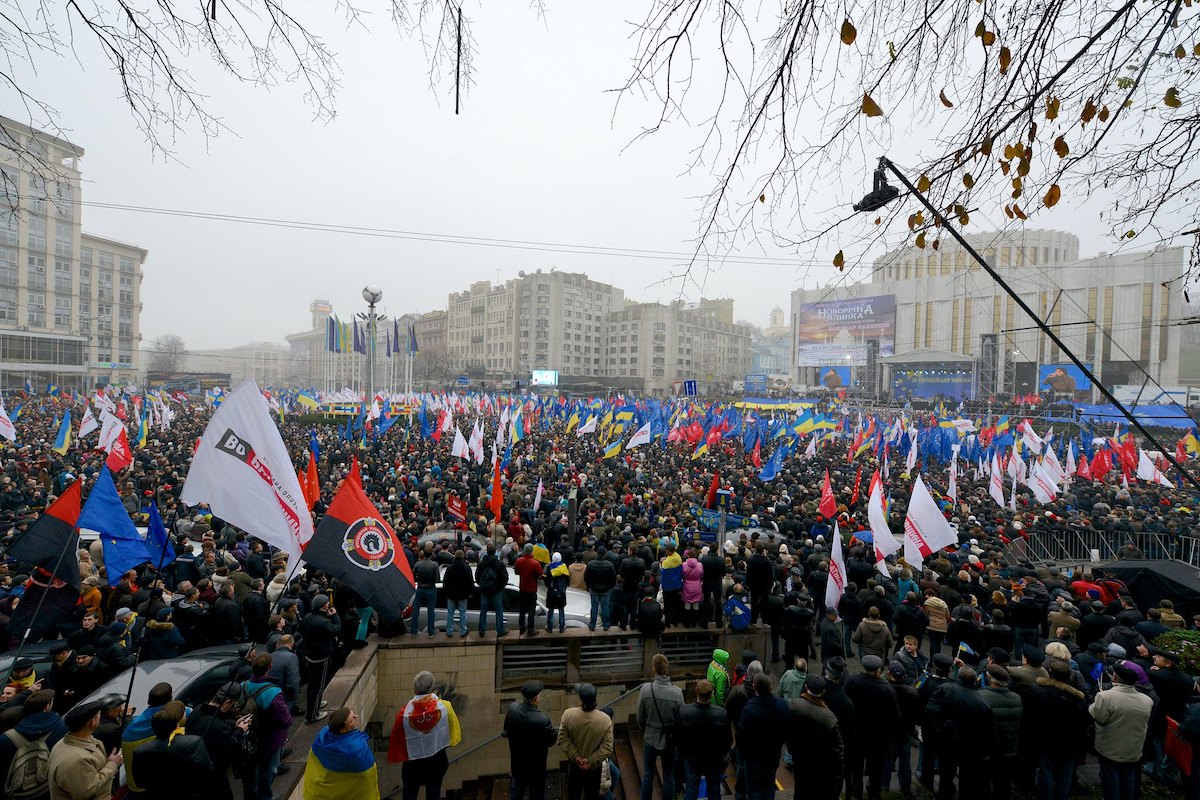
We are writing almost two months into the violence (19 April 2022). The UN has openly acknowledged that a majority of the more than 5 million Ukrainian refugees will probably never actually ‘go home’ again. In the centers of war planning, it is also now gradually accepted that the expected but failed Russian blitz into Ukraine, which in Russia itself was not allowed to be called a war, is sliding unstoppably into a ‘proxy war’ between Russia and NATO, with heavy and advanced weapons deployed on both sides and both military colossuses determined not to lose. Ukrainians continue to heroically play their part and to actively imagine, and being made to imagine, that it is a war for their ‘sovereignty and freedom’. At some point, the distance between these abstract and lofty desires and the raw reality of death, destruction, and mass out-migration will for some begin to feel alienating. After the sinking of the Moskva missile cruiser on 16 April even TV commentators in Moscow, in emotional outbursts, are now allowed to call this a war. Patriarch Kiril of the Russian Orthodox church continues to defend the holy war of Mother Russia against the sinful West of the LGBT’s and the gay parades. Meanwhile, in a militarily surrounded and levelled Mariupol, the hard Right Azov Brigade, or what is left of it, refuses to give up its arms and has retreated into the underground tunnel complexes of the giant Azov Steel complex. They are betting that the massive soviet heritage of industrial labor they had so ardently wished to erase ideologically during the ‘de-communization’ campaigns and memory wars after the 2014 Maidan revolution, might in the end offer them some paradoxical protection. President Zelensky, chosen in 2019 on a platform that resolutely rejected the polarizing identarian logic of the nationalist-civilizational cleavages of Ukraine’s antagonistic governmental elites (‘European Ukraine’ versus ‘Russian’), saw his program quickly collapse in the face of determined right wing nationalist opposition, such as from the members and supporters of the Azov Brigade. The Minsk 2 peace process then all but stalled. Zelensky has now announced that if these circa 2000 national heroes of Ukraine get killed in the Azov Steel tunnels, there cannot be any peace negotiations and Ukraine must fight for final victory. All the actors are overwhelmed by the logic of war.
Outside of the immediate theatre, much of the Global South and all the BRICS have refused to support the Western condemnation and isolation of Russia, which they find sanctimonious. The spiking inflation in the prices of energy and food probably mean that, after the massive build-up of pandemic related debt, many of these postcolonial nations are going to face simultaneous famine and debt-defaults by the end of the year, with likely resounding political consequences. The West, meanwhile, bootstrapping itself out of the embarrassing Afghanistan debacle of just half a year ago, and finding itself viscerally surprised about its own sudden unity, has accepted President Zelensky as the brave contemporary embodiment of its own historical ideals of liberty and freedom, so under siege lately by domestic ‘populism’. It has launched unprecedented financial punishment on Russia – deploying its continued exclusive control over financial circuits and values – and is seeking to isolate and cut down Russia for the long term by banning its oil and gas while claiming to speed up its own green transition. China, clearly, is far from ready to impose a Bismarckian moment (the Berlin conference of 1885 that carved up the world for colonialism) and seems willing to remain modestly supportive of the Russian side – indeed, Putin started his war directly after meeting privately with Xi. There is no doubt that the US is waging its proxy war also with an eye on teaching China what can happen if it does not abide by Western rules. Western Central Banks, meanwhile, faced with the highest inflation in four decades, revert to an earlier monetary normal, and are beginning to push up the interest rates, loosely talking about ‘a repeat of stagflation’ (a misplaced comparison with the 1970s), a possible ‘Volcker moment’, and a ‘necessary economic recession’. Global South and other big debtors are forewarned. Donald Trump is waiting rather quietly in the wings, as is Marine Le Pen, both (former?) admirers and clients of Vladimir Putin.
The palimpsest is utterly scary, full of actual and potential future violence, extremely volatile and dynamic, and full of powerful contradictions. We need to think, discover, describe, and analyze. On the ground and off the ground. New Times.
Don Kalb is Professor of Social Anthropology at the University of Bergen, Editor at Large of Focaal Journal and FocaalBlog.
References
Sarotte, M.E. 2021. Not One Inch: America, Russia, and the Making of Post-Cold War Stalemate. New Haven: Yale U.P
The war in Ukraine resuscitated a certain dangerous fascination for war. Notions such as patriotism, democratic values, the right side of history, or a new fight for freedom are mobilized as imperatives for everyone to take a side in this war. It is not surprising then that a large number of so-called foreign fighters are willing to go to Ukraine to join one side or the other.
I met a few of them recently at the Poland-Ukraine border, where I was conducting interviews with a Norwegian film crew with soldiers and foreign fighters who were either entering or exiting the war zone. Some of them actually never got to fight or be “recruited” as they lack military experience or proper motivation. It’s a mixed group of people, some of whom have spent years in the military, while others only did military service. Some have family at home waiting for them; others, no home to go back to. Some have strong ideological motivations; others are just willing to shoot at something or someone. There is also a big group of former soldiers who transitioned towards humanitarian work.
As we were crossing the border to get into Ukraine, a former US soldier told me: “The reason why many retired or former soldiers moved to humanitarian work might easily be the need for excitement.” Once you leave the military, the closest activity that can take you to the “fun zone,” as another one said, referring to the war zone in Ukraine, is humanitarian work – or, in fact, a series of other businesses mushrooming in the proximity of war, including contractors and criminal activities.
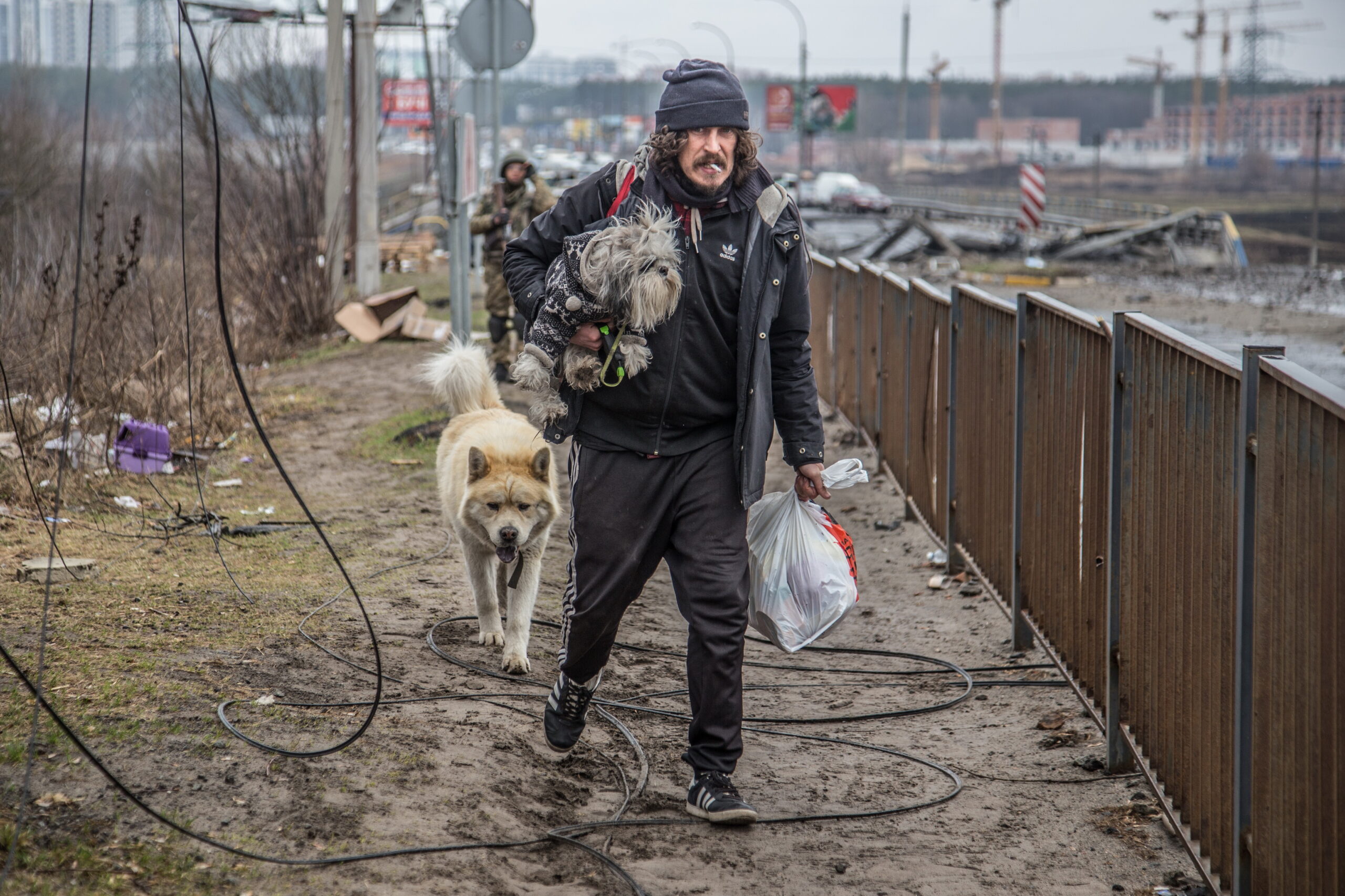
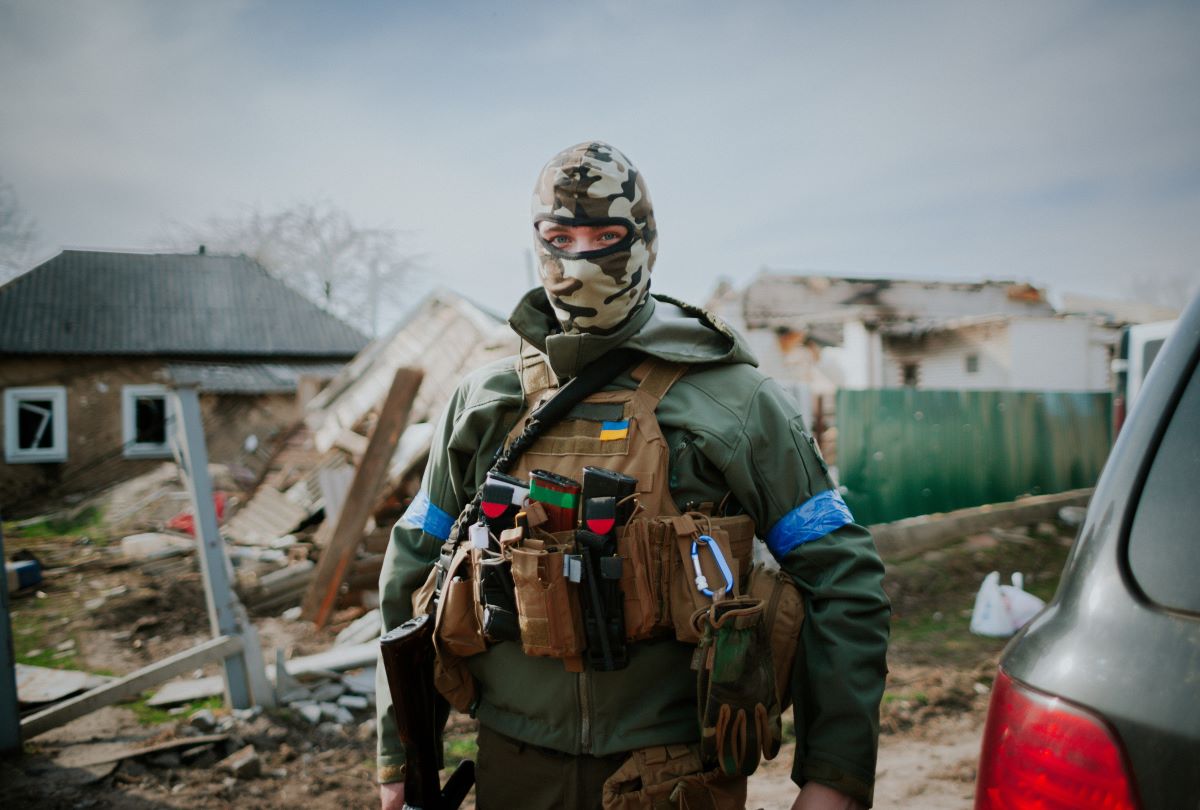
Image 1: Fighter of the Ukrainian 43rd Territorial Defense Battalion “Patriot”, photo by Алесь Усцінаў
“We are adrenaline junkies,” the former US soldier said, although he now only wants to help civilians, something he sees as “a part of my process of healing.” What many of the foreign fighters have in common is the need to find a purpose in life. But what does this say of our societies if, to search for a meaningful life, thousands are willing to go to war?
There is dominant propaganda that seems to suggest war can be conducted according to a set of acceptable, standardized and abstract rules. It puts forth an idea of a well-behaved war where only military targets are destroyed, force is not used in excess, and right and wrong are clearly defined. This rhetoric is used by governments and mass media propaganda (with the military industry celebrating) to make war more acceptable, even attractive, for the masses.
Whatever deviates from this idea of a proper and noble war is considered an exception. US soldiers torturing prisoners in Abu Ghraib: an exception. German soldiers playing with a human skull in Afghanistan: an exception. The US soldier who went on a house-to-house rampage in an Afghan village, killing 16 civilians including several children with no reason: an exception. War crimes committed by Australian troops in Afghanistan: an exception. Iraqi prisoners tortured by British troops: an exception.
Similar stories are emerging in the current war in Ukraine too, even though mostly still “unconfirmed”. With the information war obfuscating the distinction between reality and fantasy, we don’t know if and when we will be able to verify videos such as one showing a Ukrainian soldier talking on the phone with the mom of a killed Russian soldier and making fun of her, or Ukrainian soldiers shooting prisoners to make them permanently injured, or news about Russian soldiers sexually assaulting women.
All exceptions? No. This is exactly what war is. Governments make big efforts to explain that these kinds of episodes don’t belong in war. They even pretend to be surprised when civilians are killed, even though systematically targeting civilians is a feature of all contemporary wars; for example, over 387,000 civilians were killed in the US post-9/11 wars alone, with more likely to die from those wars’ reverberating impacts.
The idea of a clean and efficient war is a lie. War is a chaotic universe of military strategies intertwined with inhumanity, violations, uncertainty, doubts, and deceit. In all combat zones emotions such as fear, shame, joy, excitement, surprise, anger, cruelty, and compassion co-exist.
We also know that whatever the real reasons for war, identifying the enemy is a crucial element of every call for conflict. In order to be able to kill – systematically – it is not enough to make fighters disregard the enemy, to despise him or her; it is also necessary to make them see in the foe an obstacle to a better future. For this reason, war consistently requires the transformation of a person’s identity from the status of an individual to a member of a defined, and hated enemy group.
If the only objective of war is the mere physical elimination of the enemy, then how do we explain why the torture and destruction of bodies both dead and alive is practiced with such ferocity on so many battlefields? Although in abstract terms such violence appears unimaginable, it becomes possible to visualize when the murdered or tortured are aligned with dehumanizing representations portraying them as usurpers, cowards, filthy, paltry, unfaithful, vile, disobedient – representations that travel fast in mainstream and social media. War violence is a dramatic attempt to transform, redefine and establish social boundaries; to affirm one’s own existence and deny that of the other. Therefore, the violence produced by war is not mere empirical fact, but also a form of social communication.
It follows that war cannot be simply described as the by-product of political decisions from above; it is also determined by participation and initiatives from below. This can take the form of extreme brutal violence or torture, but also as resistance to the logic of war. It is the case of the military personnel who object to being part of a specific war or mission: examples range from conscientious objection during wartime, to explicit positioning such as the case of the Fort Hood Three who refused to go to Vietnam considering that war “illegal, immoral, and unjust,” and the refusal of the Russian National Guard to go to Ukraine.
“War is so unjust and ugly that all who wage it must try to stifle the voice of conscience within themselves,” wrote Leo Tolstoy. But it’s like holding your breath underwater – you can’t do it for long, even if you are trained.
This text was originally published in Common Dreams.
Antonio De Lauri is a Research Professor at the Chr. Michelsen Institute, the Director of the Norwegian Centre for Humanitarian Studies, and a contributor to the Costs of War Project of the Watson Institute for International and Public Affairs at Brown University. He received an ERC grant for a project on soldiering and warfare.
Cite as: De Lauri, Antonio. 2022. “The idea of a clean and efficient war is a dangerous lie.” FocaalBlog, 18 April. https://www.focaalblog.com/2022/04/18/antonio-de-lauri-the-idea-of-a-clean-and-efficient-war-is-a-dangerous-lie
One of the casualties of Putin’s war on Ukraine will be European critical social science. While the war has instigated important discussions about ‘US-plaining’, ‘Westplaining’ and about Russian imperialism, we also see—so far in a clash of keyboards—a growing weaponization of scholarship. There are signs of growing censorship of those ideas that would not align neatly into friend-enemy dyads. In the fight against ‘misinformation’, diverging opinions are framed, often preventively, as problematic and even pejoratively as “pro-Kremlin.”
It is with this in mind that I revisit herein the campaign to amend the “EASA Statement on the Russian war against Ukraine”, published initially on 26 February 2022 and amended on 15 March 2022. The case reveals how not only mainstream media and big tech are changing what is permissible, but how militarism, securitisation, and warmongering is creeping into anthropologists’ language and analyses, at times insidiously as they usurp anti-hegemonic and decolonial positions to enhance their credibility. Where it will take us is hard to predict, but it might be worth looking into the amendments of the EASA statement to cast light on possible futures in social anthropology’s debates and in order to make a case for anthropology as an anti-colonial, anti-imperialist, cosmopolitan and anti-war discipline.
EASA’s statement on the Russian war and the protest campaign to rewrite it
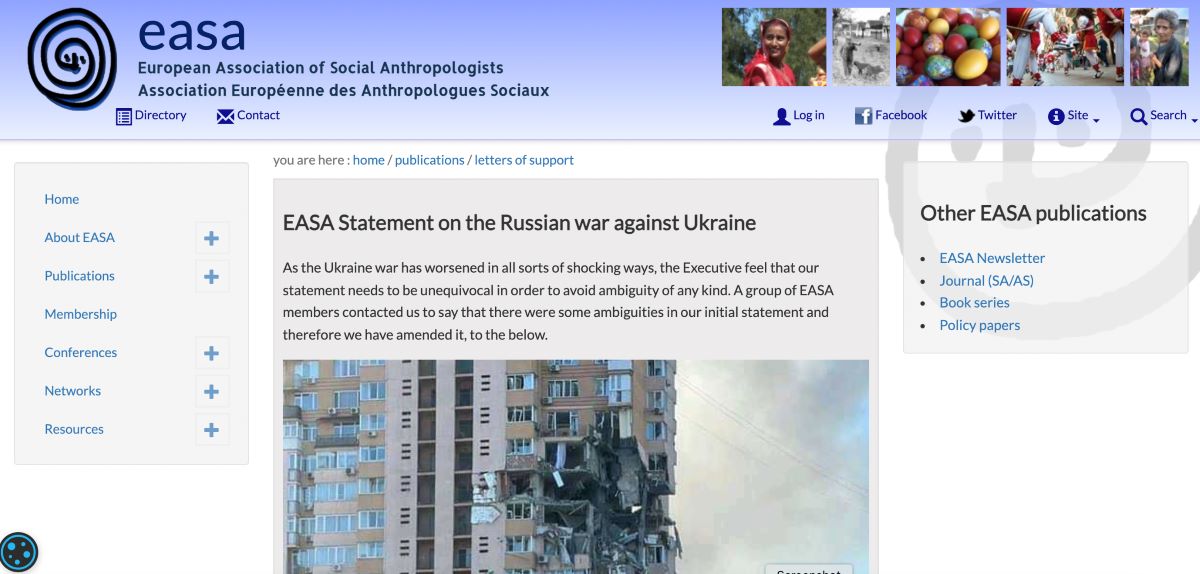
On the 26th of February 2022, two days after Russia’s invasion of Ukraine, the EASA executive committee (EASA EC) published a statement ‘EASA Statement on the Russian war against Ukraine’. While in the context of atrocities its value is symbolic rather than practical, the EASA EC must be commended on the swiftness of their response and the clarity of their stance against the war and imperialism. The first two paragraphs of the statement are particularly strong:
The Executive Committee of the European Association of Social Anthropologists (EASA) condemns the Russian government’s illegal and unprovokedmilitary invasion of Ukraine: an imperialist war that is leading to immeasurable suffering and losses for the Ukrainian people, whose dignity, well-being, and independence we wholeheartedly support.
As the Ukraine war has worsened in all sorts of shocking ways, the Executive feels that our statement needs to be unequivocal in order to avoid ambiguity of any kind. A group of EASA members contacted us to say that there were some ambiguities in our initial statement and therefore we have amended it.
How did this change come about? On Friday, 11 March, almost two weeks after the statement had been published, a group of anthropologists from East Central Europe wrote an email to EASA EC demanding that what they saw as ‘controversial ideas’ in the statement be revoked. In the meantime, they also uploaded a petition to GoogleDocs and started gathering signatures. They explained in earlier versions of the petition that if EASA did not retract the wording by noon on Monday, 14th March, they would feel ‘morally obliged’ to go public with the petition. As EASA EC changed the wording, the petition was never widely circulated.
The style of the protest itself is quite stunning as it features moralistic-conservative language (‘controversial ideas’), forces the executive committee to decide over a weekend, and in many ways resembles wartime Realpolitik (the initiators speak of ‘kind appeals’ but set conditionalities and prepare to escalate further, justifying such their steps with reference to morality). But it is the content of the protest that interests me here. As the authors of the petition explain:
While we fully agree that the war against Ukraine has roots in Russian imperial ambitions, we reject the suggestion that Russia’s armed aggression is caused by NATO expansion into the Eastern European territory. Such a statement would imply that sovereign countries of Eastern Europe do not have the right to join international alliances unless Russia approves, justifying Russia’s colonialist and imperialist claims over countries in Eastern Europe. As anthropologists, we understand Ukraine’s defensive actions as resistance against the reactionary empire and recognize the right of people of sovereign states to decide on membership in international alliances. The sentence [this refers to the final sentence in the EASA EC statement quoted above; M.F.] also contains a deeply troubling ambiguity—referring to Putin as “main aggressor” implies that there are more aggressors in this war than Putin and Russia, assigning the blame for the war against Ukraine (even asymmetrically) to another party.
Don’t mention the North-Atlantic Treaty Organisation
The “ambiguity” raised by the last point can be debated. On the other hand, most EASA members are not native speakers of English and thus there may always be ambiguity in written English statements from the organization. But I believe, it is clear from the statement condemning “Russian government’s illegal and unprovoked military invasion” in the opening sentence who is the aggressor.
It is, however, the arguments made in the first three sentences which are particularly striking. I ask the readers to take a look at the first two paragraphs of the original EASA statement quoted above again. How could a mention NATO’s role in the longer history preceding the invasion imply that sovereign countries do not have the right to join international alliances unless Russia approves? What logical somersault was performed here? Does the protesters’ problem with EASA EC’s statement lie in the word “roots”? Do the protesters read this as equivalent to “the cause”?
It is certainly not a marginal position to argue that Putin’s actions are framed in geopolitical terms (where the key agents are the US and China) and that the West has not really tried to “inscribe Russia in a more comprehensive security agreement and all of the bilateral and multilateral agreements”. It is also not a marginal position to point out that NATO policies have made Russia’s invasion more likely. Moreover, pronouncements about Ukrainian membership in NATO (or in the European Union) had been merely symbolic. Even countries of Central and Eastern Europe (CEE) had never truly supported Ukraine’s membership until now (geopolitics, in other words), leaving it in a particularly vulnerable position. In no way, however, does acknowledging “the geopolitical confrontation between the US-led liberal “empire”, and the Russian imperialist project in East Europe” mean that Ukrainians are mere puppets without desires, hopes and agency, who should not freely express their will on which international alliances their country should enter, without a fear of becoming targets of military invasion.
Of course, most Ukrainians have no time and patience for such debates now—their country has been brutally attacked and the fight against the Russian invaders is all that matters to them. In this sense, it is good that the EASA EC removed the final sentence of the statement to avoid a social media storm that would have followed with the publication of the petition and which would have detracted from the statement’s overall message.
But let’s be clear here: there was no ambiguity in the original statement. The ambiguity was created by the initiators of the protest. Unless, of course, for anthropologists it is inconceivable that one can support the independence and sovereignty of Ukrainian people while seeing Russian tsarism and NATO enlargement as shaping the context of the invasion. But there is a danger that knee-jerk ascriptions of culpability and contests over the moral high ground will weaken our capability to take a critical view of ourselves, and to understand how our activities contribute to fascism and militarism.
NATO in CEE
The choice presented by the protest initiators is straightforward: if the EASA EC statement mentioned NATO as an actor shaping geopolitical contexts, it would go against Ukraine’s right of self-determination. This, to me, is a whitewashing of NATO. It is striking that it comes from anthropologists who must know that the pro-NATO position was never unequivocally embraced by Ukrainians. This is why, Volodymyr Arthiuk explains, “a silent majority” elected Zelensky who “promised to end the war, to not press issues of identity and language.” And while for reasons of bare survival under occupation, support for NATO membership, or at least for a closer cooperation, increased among Ukrainians in comparison with the pre-war period, these views will continue to be in flux and are regionally specific. As regards Ukrainians’ political opinions, one must also wonder what it will be in the future, given how NATO has failed to come to their defence.
Equating NATO membership unproblematically with popular sovereignty, with “the right of people of sovereign states to decide on membership in international alliances”, is even more disingenuous coming from CEE scholars, as in most CEE countries there were no referendums about NATO membership—there was no popular decision. And while in Poland or the Baltic countries, the majorities would have probably been in favour, even Václav Havel was against the referendum in Czechia, since the opinion polls were far from conclusive. In Slovakia, another country that I know well, barely 50% supported membership in 2003 when the country joined the alliance. Continued ambivalence of these two countries to NATO can be seen, for instance, in demonstrations against the installation of tracking radar and kinetic missiles in Czechia. Although politicians argued these would protect from attacks by rogue states, such as Iran, the public overwhelmingly (68%) rejected them. In Slovakia, just prior to the invasion, more people blamed NATO than Russia for the escalation of the tensions along Ukraine’s borders.
The petition was initiated by eight anthropologists – seven Polish and one Slovak (see ‘Protest initiators’). The petition now claims to speak for an “international anthropological community”, whereas the EASA website speaks of an initiative by “EASA members” that stimulated the change. Since the petition with signatures was never publicised, I must suppose that the executive committee decided to change the wording of the statement following the email from the protest initiators. A predominantly CEE character of the initiative is further reflected in the online social life of the petition: most of the signatures come from Poland, Slovakia and Czechia. And while a public campaign was stopped short by the EASA EC changing its statement, any momentum for obtaining a critical mass for the protest would have emerged from within this region.
In this way, the narrative of the protest echoes important discussions about the position of Central and East European anthropologists within the discipline, in which many signatories of the protest letter have been taking part actively. However, consider the irony it leads to: a group of CEE anthropologists led by former members of EASA EC end up defending NATO against EASA, which they imply is a Western hegemonic institution misunderstanding the region (even if it is currently presided over by a Bulgarian). Such positioning undoubtedly added to the pressure on the EASA EC, since it suggested that EASA’s statement was denying sovereignty to Ukrainians and to peoples of other “sovereign countries of Eastern Europe”, legitimising Russia’s imperialist claims.
We must be wary of such east-Europeanising re-alignments in the context of the prevalent view of Ukraine in many CEE countries as a failed state between Central Europe and Russia; the racialisation of Ukrainians as cheap and thus exploitable, also sexual, labour, but ‘white’ (good migrants and even refugees!). Likewise, it is important to critically reflect on the grading of Europeanness in the CEE public sphere, where NATO and EU membership have been constructed as its unambivalent symbols.
It would also be misleading to say that all CEE anthropologists found EASA’s original statement to be “the dangerous distortion” that the protesters saw it to be. Many disagreed, or would have disagreed, if they had been aware of the protest, and if not with the content of the protest, then with its tone. Indeed, there was a lively discussion on the mailing list of the Czech Association for Social Anthropology (CASA), with voices pro and contra. In the end, only a few members signed the petition. Of course, some were probably waiting for EASA EC’s response, while others might have thought this whole thing ridiculous, since, as one member put it, and I paraphrase, “Ukrainians need guns, not statements.” In any case, it shows that the options presented by the protest initiators as clearcut were not wholeheartedly embraced by all.
The need for anti-militarism
Let’s be honest here. Rather than an argument about popular sovereignty, the initiators’ position is a pro-NATO one. It presents a false dichotomy: if one is against Putin, one cannot be against NATO. To be sure, I understand where this position comes from. The feeling among many people in CEE, including my parents, confirmed by the invasion, can be summarised in the following way: only NATO membership protects our countries from becoming prey to Russia’s tsarist ambitions; it is therefore only NATO that enables people in member states to be safe and, by extension, CEE anthropologists to pursue our careers.
Certainly, such an argument is counterfactual, as the world where CEE countries would not be NATO members would be a different world. Precisely because any line of argument about the absence of NATO membership must remain counterfactual it invokes both fears and desires, and in its operation must reproduce legitimising narratives. These are things anthropologists should be mindful of. The argument is also problematic as it separates NATO’s past interventions and invasions from its role as a defensive alliance through which smaller states can protect themselves against an imperialist next door. Violence elsewhere (e.g., Yugoslavia, Afghanistan, Libya, and with Turkey as a NATO members conducting a war against the Kurdish population within its borders and in Syria) and often against a threat of “tribal” or racialised “savagery” (Pierre 2013: 548) are treated in isolation from peace and European values at home. This compartmentalization is understandable in the context of Russian imperialist warfare, but it leads to simplistic listing of pros (NATO as a national-level ally against Russian colonialism) and cons (continued militarisation internationally; ‘humanitarian interventions’), which is a sophisticated approach to neither the history of imperialism nor to a critical anthropology of military alliances. As anthropologists, we must resist such a compartmentalization. Our discipline must be anti-colonial, anti-imperialist, cosmopolitan and anti-war, even though it is always practised from a specific locale, such as CEE. We must reject simplistic Manichaeism, labour against provincialism, and reject seeing anthropologists as Putin’s apologists, just because they are critical of NATO and of their own countries’ role in it.
Furthermore, the above line of argument promises only war; it extends Russia as a threat into the past with only war and crisis on the horizon. One must wonder how such “truths” (constructed through the piling up of historical analogies, which are now in vogue) skew anthropological sensibility, especially in and about Central and Eastern Europe. Gregory Bateson (2000: 265), among others, showed how our truths, premises and habits of thought recursively reinforce our understanding of the world and of ourselves, which leads further to the petrification of these truths.Against the real threat of securitisation in European anthropology, I suggest we promote an anti-war anthropology, a part of a broader anti-war movement. To break the militarist habit of thought we should become apprehensive of how militarism and militarisation shape research topics and field sites (Gusterson 2007).
We should also proceed as if we knew that the forever war (as a problematic, not static ontology) was the ground on which we stand and from which we speak as anthropologists. This task is more urgent now when countries are increasing their military spending or when some argue for the need to destroy Russia in a long-term war, with the suffering borne by Ukrainians. We might find inspiration in abolitionist anthropology and rethink European anthropology as a speculative analysis that not only critiques the existing order, but in a move of counter-war imagination, reimagines and—through collective practical effort—reinvents the possible, “past the ruins of the world (and the discipline) as we know it” (Shange 2019: 10).
Two final comments
The fact that Putin clearly broke international law and the Russian army has been committing war crimes should not make us blind to the fact that the war has been going on in Ukraine for eight years preceding the invasion. As anthropologists we must recognise the complexity of that situation. This does not make us Putin’s apologists. In fact, the real problem from the point of view of the discipline is the way European anthropology chooses which ‘events’ it notices: while we have had discussions on Brexit and COVID (e.g., dossiers in Social Anthropology and two series of articles on FocaalBlog), the war in eastern Ukraine—with 14,000 casualties between 2014 and 2021—was never the focus of critical discussion (e.g., no dossier or EASA-sponsored roundtable, not even by the protest initiators).
Turning to the internal politics of EASA, it is important to note that many members would want the association to function as a learned society that abstains from activism and politics. For them, EASA’s past activities related to HAU, precarity, and possibly also the open letters published by the current EASA EC signify an unwelcome ideological move to the left. It is ultimately EASA members who will decide on this in the future elections. I, personally, am proud to be a part of an association that published such a strong anti-war statement on the Russian invasion of Ukraine. Organising biannual conferences, publishing a journal or facilitating various topical networks is not enough.
Martin Fotta is a researcher at the Institute of Ethnology, Czech Academy of Sciences. His current research focuses on the Romani diaspora across the Lusophone South Atlantic region.
References
Bateson, Gregory. 2000. Steps to an ecology of mind: Collected essays in anthropology, psychiatry, evolution, and epistemology. University of Chicago Press.
“What’s going on inside Putin’s head?” “He’s insane.” Questions and declarations like these pepper discussions of Russia’s invasion of Ukraine. While insanity appears an obvious — albeit broad — diagnosis, particularly to those in the West, even the most delusional psychosis has its internal logics and deep structures. And while we can never really get into someone else’s head, anthropological or psychoanalytic conceits about others’ subjectivity notwithstanding, it may be possible and useful to grasp another’s craziness, if we understand the roots of their version of reality.
Encirclement always loomed large in pre-1917 Russian, Soviet, and then post-1991 Russian imaginaries. Russia experienced four invasions that came through Ukraine — in 1812, 1914, 1919, and 1941. Many analyses point to NATO’s eastward expansion as a proximate cause of today’s crisis, with some viewing it as a tragic historic mistake and others pointing to the invasion itself as a post-hoc justification. What these and other studies almost always miss, however, is that NATO’s expansion is significant because it triggered archaic anxieties dating back to Tsarism. That Ukraine’s constitution enshrines an aspiration to join NATO and the EU did little to allay these historical, though clearly overblown, fears.
Vladimir Putin and I were both born in 1952. Our fathers and uncles fought Nazism on different fronts, his in the Soviet Red Army and mine in the U.S. Army and Navy. The Great Patriotic War certainly overshadowed his childhood, as World War II did mine. Fascism and Nazism, even if defeated before our births, remained a frightening specter. Putin’s family, like most Soviet families and virtually all Leningraders, suffered terribly in the War (Gessen 2013). In my family, one great uncle went missing in the Battle of the Bulge when his assault boat capsized in the Roer River after a reconnaissance mission behind enemy lines (the Army confirmed his death five years later, but never recovered his remains). My father and other uncles returned with horrifying stories, relatively minor injuries, and what we might today describe as PTSD.
Unlike almost all Americans but like quite a few New Yorkers of my generation, as a child I knew many more Communists and ex-Communists than I did Republicans. Later, in 1986, as an exchange scholar in the Soviet Union, I had many conversations with young university students who were suffering through the soporific required course on “Nauchnyi Kommunizm” (“Scientific Communism”) and with a more ideologically zealous or simply opportunistic subset of these who were majoring in Istoriia KPSS (History of the Communist Party of the Soviet Union — yes, that was an important, if soon to be useless, undergraduate major). So, between growing up among red and pink diaper babies in 1960s New York (Freeman 2001) and my brief but intense sojourn in the USSR (Edelman 1996), I have some sense of the emotional valence that attaches to encirclement in the minds of those socialized in orthodox Communist worldviews.
The Russian inferiority complex vis-à-vis the West is a longstanding, hackneyed trope in writing on geopolitics. What is frequently forgotten is that Russia — or its upper classes at least — also had an inferiority complex in relation to the East. Japan, a rising power in Asia, trounced the Russian Empire in their 1905 war. This was a huge blow to the narcissism of the Russian nobility and elites, who not long before had conquered most of Central Asia and imagined themselves as part of European civilization, ipso facto superior to those “lesser” peoples of the East.
Russia’s performance in World War I was little better than it had been against the Japanese and the near collapse of its military was part of the maelstrom that led to the 1917 Bolshevik Revolution and Soviet Russia’s withdrawal from the War. In the immediate aftermath of the Bolsheviks’ seizing power, more than a dozen foreign armies invaded Russia (Ullman 2019) and fought with the Whites against the Reds in a bloody Civil War that only ended in 1920. These mostly small interventions didn’t make much difference militarily, but the memory seared into Soviet and later Russian collective consciousness, fueling a siege mentality. Soviet (and western) Communists would self-righteously point to this long after as a key reason why the USSR had to be vigilant and maintain strong defenses.
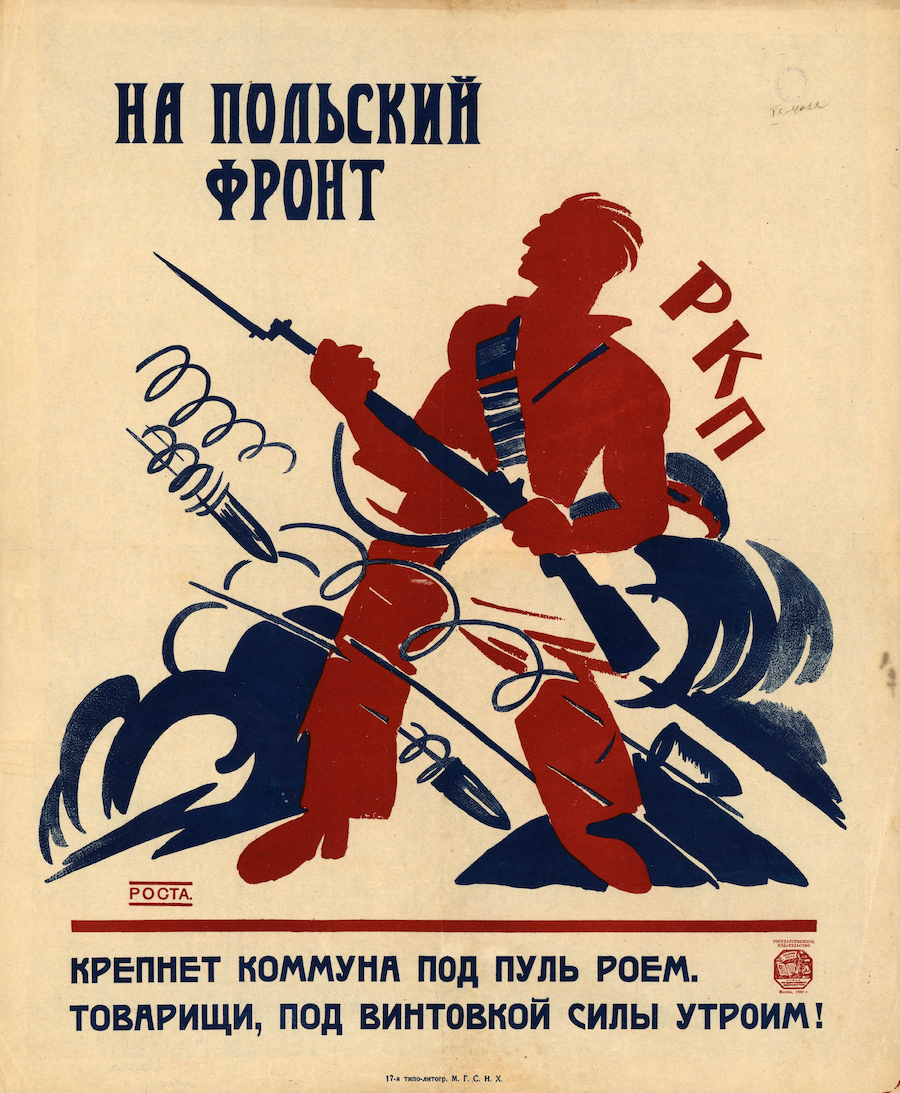
Towards the end of the Civil War, in 1919-20, the Red Army launched a separate campaign out of Russia’s northwest that tried to spread Bolshevism to Belarus, Lithuania, and newly independent Poland. While this complicated conflict aimed in part at opening a Red corridor to Germany, where the military crushed a Communist uprising in 1919, Polish resistance at Warsaw turned back the Bolshevik advance. Isaac Babel’s (2006) memoir Red Cavalry , reports that in one of the last battles, “The enemy machine-guns were firing from twenty paces away, and men fell wounded in our ranks. We trampled them and attacked the enemy, but his square did not falter; then we ran for it.”
Image 1: 1920 poster by Vladimir Mayakovsky hailing the Soviet invasion of Poland. “To the Polish front! The commune is getting stronger under a swarm of bullets. Comrades, we’ll triple our strength in riflemen!”
The 1939-40 ”Winter War” with Finland barely went better. Ignited with a Soviet invasion that aimed at grabbing a wider buffer zone between Leningrad and the border, the conflict ended with some minor Finnish territorial concessions and a humiliating Soviet defeat inflicted by agile ski troops in white camouflage uniforms. Hitler was watching, and many historians attribute his fatal 1941 decision to invade the USSR to a belief that if the Finns could thrash the Soviets, the Germans certainly could too.
The Red Army, of course, was key to defeating the Nazis, but it did so at tremendous cost. Soviet casualties in most battles were many multiples of German ones and the country lost as many as 27 million citizens, between military and civilian fatalities. The sacralized state-managed memory (Markwick 2012) of the Great Patriotic War and the victory over Nazism became the pivotal legitimating narrative in the post-Stalin USSR. This was even more the case for post-Soviet Russia, when the state pushed War-related patriotism to plug what Putin called the “ideological vacuum” left by the collapse of communism.
Many Ukrainians understand this narrative in different terms. Stalin’s collectivization of agriculture in the 1930s hit Ukraine especially hard, with a planned famine in which at least 3.5 million peasants died of starvation. Not surprisingly, many Ukrainians came to despise and distrust Russia.
After Hitler’s 1941 invasion of the USSR some 250,000 Ukrainians joined the Wehrmacht and Waffen SS or served as concentration camp guards (millions, of course, fought in the Red Army) (Khromeychuk 2016). Some Ukrainian nationalists today glorify Stepan Bandera and other pro-Nazi fighters. Statues of these loathsome figures dot today’s Ukraine (as they do upstate New York, not far from where I live). The Azov battalion, a far-right militia that attracted foreign white supremacists and whose members became part of Ukraine’s military in 2014, figures significantly in Russia’s anti-Ukraine propaganda and in that of the “campist” left in the West, even though its support base is rather paltry (Gomza and Zajaczkowski 2019).
Putin sees today’s Ukrainian nationalists as progeny of the enemy in the Great Patriotic War, an earthshaking event imbued with deep emotion for Soviet and now Russian patriotism. It’s not that fascists and antisemites aren’t worrisome, whatever country they are from. But as VICE reporter Tim Hume pointedly notes, “Ironically, given the Kremlin’s attempts to use Azov’s extremist ideology to smear the Ukrainian forces as a whole, white supremacist foreign fighters also received training and fought for the pro-Russian separatists through groups like the Russian Imperial Movement (RIM), an ultranationalist organisation which claims to be fighting for the ‘predominance of the white race.’”
Ukraine’s despicable far-right and neo-Nazi elements, while theatrically visible at times, are hardly significant in the country’s politics. National Corpus, the Azov-aligned political party, failed to elect a single candidate in the most recent parliamentary elections. The same is true for Right Sector, another pro-fascist party. The extreme nationalist Svoboda (Freedom) Party has one representative. Vox in Spain, Rassemblement National in France, Alternative für Deutschland in Germany, or the Republicans in the United States have vastly more support. After a Russian attack damaged the Holocaust memorial at Babyn Yar, where the Nazis massacred 33,771 Jews in two days in 1941 and some 70,000 more Jews and others during the rest of their occupation, Ukrainian President Volodymyr Zelensky — from a secular Jewish family — seethed with anger as he accused Russia of “killing Holocaust victims for the second time.” These are not the words of the head of a “neo-Nazi” state.
Putin’s assertion that Ukraine is suppressing Russian language is equally risible, especially given how the USSR actively Russified its non-Russian republics. In practice, most Ukrainians are bilingual and in rural zones many speak a mix of Ukrainian and Russian known as Surzhyk. The country did pass a law making the use of Ukrainian mandatory for public sector workers, but Zelensky, then a presidential candidate, opposed it, has failed to enforce it, and frequently uses Russian when he addresses domestic and international audiences.
Masha Gessen’s (2013) biography of Putin depicts a prickly, thin-skinned, and pugnacious boy and young man who then and later cultivated a reputation as a brawler and thug. Recent accounts highlight his isolation during the COVID-19 pandemic and the way he has surrounded himself with sycophants and “yes-men.” Like Stalin, he rises late and often works into the wee hours of the morning.
Since the USSR’s collapse, Russia has consolidated control inside, with two wars in Chechnya, and relentlessly expanded outside, annexing Crimea (2014) and carving out bogus “republics” that it controls in Transdniestria (Moldova, 1992), Abkhazia and South Ossetia (Georgia, 2008), and Donetsk and Luhansk (Ukraine, 2014). In Putin’s embittered and aggrieved mind these military conquests, which — like its backing for Assad in Syria and today’s invasion of Ukraine — exhibited a total indifference to human life and international norms, were necessary steps to buffer Russia’s heartland against foreign attack.
The first Cold War was never really “cold” and this one isn’t either. Russia’s invasion of Ukraine is unfolding in a context where the binding treaties and security architecture that regulated East-West competition have mostly unraveled. When the United States withdrew from the Intermediate Nuclear Forces Treaty in 2019, a few isolated voices warned that this was hugely destabilizing. Now both sides have deployed these previously banned weapons, including U.S. missile interceptor launchers in Poland. In 2020-21 the United States and then Russia withdrew from the Open Skies Treaty. The Conventional Forces in Europe Treaty died a slow death, marked by eight years of reduced Russian compliance and finally withdrawal in 2015. The 2010 New Strategic Arms Reduction Treaty is the only remaining treaty limiting U.S. and Russian nuclear arsenals and it expires in four years, which is not enough time for negotiating a new agreement, especially when a “hot” war is ongoing.
The late Viktor Kremenyuk — Russian, though born in Odessa and with a Ukrainian surname — was for many years one of the Soviet Union’s and Russia’s leading academic experts on the United States. A decade ago, in a paper on international negotiations, he remarked that, “In the long run much will depend on the psychological framing of the activities of negotiators and their ability to prove to national decision-makers that negotiable solutions are ‘not worse’ than unilateral ones and may be even better” (Kremenyuk 2011)
Kremenyuk also observed, with eerie prescience given the current situation and Putin’s nuclear saber-rattling, “In a democracy the processes that shape the negotiation behavior and changes in position are totally different from those in a totalitarian system where very often one person decides the final shape of the position of the nation. It also depends on the tradition and previous experience of the nation.”
This does not augur well for efforts to restore peace and stability in Europe or to rein in the squandering of vast resources on military budgets. The renewed love affair on both sides with fossil fuels further delays urgent transformations of the energy matrix needed to avert climate catastrophe.
Americans are famously amnesiac about the past, but in Ukraine and Russia historical memories have a long arc and terrible contemporary resonance. They are the background conditions for an unfolding confrontation that can only bring more tragedy to a region that suffered massively in the twentieth century and, in the worst case, to the entire world.
Marc Edelman is professor of anthropology at Hunter College and the Graduate Center, City University of New York. Many years ago, he held an IREX fellowship at Columbia University’s W.A. Harriman Institute for Advanced Study of the Soviet Union and did research in Tashkent and Moscow on Soviet-Latin American relations.
References
Babel, Isaac. 2006. Red Cavalry and Other Stories. Penguin Classics.
Edelman, Marc. 1996. “Devil, Not-Quite-White, Rootless Cosmopolitan: Tsuris in Latin America, the Bronx, and the USSR.” In Composing Ethnography: Alternative Forms of Qualitative Writing. AltaMira Press.
Freeman, Joshua B. 2001. Working-Class New York. Life and Labor Since World War II. The New Press.
Gessen, Masha. 2013. The Man Without a Face. The Unlikely Rise of Vladimir Putin. Riverhead Books.
Gomza, Ivan and Johann Zajaczkowski. 2019. “Black Sun Rising: Political Opportunity Structure Perceptions and Institutionalization of the Azov Movement in Post-Euromaidan Ukraine.” Nationalities Papers 47 (5), 774-800
Khromeychuk, Olesya. 2016. Ukrainians in the German Armed Forces During the Second World War. History. The Journal of the Historical Association 100 (343), 704-724
Kremenyuk, Victor. 2011. “Ideal Negotiator: A Personal Formula for the New International System.” In Psychological and Political Strategies for Peace Negotiation. Springer.
Markwick, Roger D. 2012. “The Great Patriotic War in Soviet and Post-Soviet Collective Memory.” In The Oxford Handbook of Postwar European History. Oxford University Press.
Ullman, Richard H. [1961] 2019. Anglo-Soviet Relations, 1917-1921, Volume I. Intervention and the War. Princeton University Press.
After nearly two weeks of violent conflict in Ukraine, it is increasingly difficult to stand back and see the bigger picture. The West has lined up behind the charismatic President Zelensky, who has addressed parliaments in Brussels and Westminster to rapturous applause. In Britain, football stadia and Oxbridge colleges (including my own) have draped themselves in the Ukrainian national colours. There is little or no attempt to representation of the Russian perspective. It is light versus darkness, innocent victims versus post-communist megalomaniacs, Europe versus Oriental Despotism. In her recent contribution to this blog, Elizabeth Cullen Dunn presents the binary in terms of the right of smaller peoples to choose freedom in the face of Russian neo-imperialism.
The evidence seems so clear cut that only a Putin stooge or an idiot could argue differently. But anthropologists have a habit of complicating matters and they are not alone in doing so. You don’t have to be a Marxist to highlight the humiliation heaped upon Russia by Western leaders unable to discard their Cold War blinkers; but David Harveyaddresses this emotional dimension particularly well. The West bears a lot of responsibility for creating the monster called Putin: it rebuffed Russian efforts to integrate into western institutions, instead targeting their closest relations for admission to the world’s most militarily powerful and economically prosperous alliances (Kalb 2022). Elsewhere, Michael Hudson has pinpointed the American interests that lie behind spectacular demonstrations of renewed Western unity; the catastrophe in distant Ukraine is already a defeat for Europe, and especially Germany, by the military-industrial complex of the capitalist hegemon, in combination with the key sectors of resource extraction and finance.
Image 1: The CIA was actively involved in the maidan demonstrations of 2014; it did not trust Ukrainian “civil society” to secure an optimal outcome for Washington, photo by Ivan Bandura
Few of the analyses I have read so far engage with the history and geography of the places where the violence is unfolding. I suspect most Western Europeans and North Americans perceive Ukraine naively as the historic homeland of the Ukrainian people, regrettably complicated by a subversive Russian minority. In fact, the territory of contemporary Ukraine has been occupied by many diverse populations since prehistoric times (Magocsi 2010 provides a dispassionate and comprehensive history). The dominant elements in the last millennium have been Slavic. Kyiv was the centre of the first Rus’ polity. The city was conquered by the Mongols in 1240 and was not reintegrated into a Slavic state until centuries later. A Ukrainian national consciousness emerged only in the late Tsarist era. When the great empires of the region collapsed at the end of the First World War, the majority of former subjects hardly knew what their identity was (or should become) as citizens of a nation-state. In the case of Ukraine, this learning process has dragged out over a century. It is being completed before our eyes in the most tragic way imaginable.
This particular history needs to be born in mind constantly when commentators write about “the Ukrainian people” as an entity of great antiquity. It goes without saying that the writers of history books in today’s post-Soviet Ukraine can evoke national heroes who repelled invaders in the distant past. This is in fact easier terrain than the twentieth century. Elizabeth Dunn is right to note that the Ukrainian Soviet Socialist Republic was a product of forcible incorporation into a new empire, that of the USSR. She does not describe the chaotic and violent circumstances in which very different Ukrainian polities were constructed on the ground in 1918-9, when the national flag was already the flag in use today. She does not mention the large-scale pogroms that characterized the larger of these embryonic Ukrainian states. The dark history of repressed Ukrainian nationalism continued during and after the Second World War (see also Kalb 2022), when most of its leaders collaborated with Nazi occupying forces and instigated new campaigns of terror against Poles as well as Jews. Dunn cites the result of the referendum of 1991 as evidence that the overwhelming majority of Ukrainian citizens wished to regain their sovereignty. She does not detail the circumstances in which this referendum was held, following an attempted coup in Moscow, when the socialist empire had already imploded. Earlier in that same year (despite a national revival in the years of perestroika), a large majority of Ukrainian citizens voted not for independence but for a continuation of the Soviet Union in some form.
It is easy to get lost in such details and anthropological case-studies are unlikely to help. We need tools for comparative analysis at the macro level. In an original comparison of the demise of the Habsburg and Ottoman empires, Andre Gingrich (2002) proposed the concept of “dethroned majorities” to help grasp the virulence of national sentiment both inside and outside the boundaries of the shrivelled states that emerged from imperial collapse. It is instructive to consider contemporary Ukraine in this light, where the “dethroning” was interrupted for almost a century by socialist federalism. In this post-imperial conjuncture, the familiar range of ressentiments at the former imperial centre has been intensified by the broken promises of the West. Simultaneously, emotions also run high among those motivated by a mission to consolidate a new nation-state on exclusivist principles, with a particular distaste for co-citizens suspected by virtue of their nationality of identifying with the ancien régime.
Structurally, the comparative analysis of socialist empires should be extended to China. While copying many aspects of Soviet nationalities policy, Mao was careful to maintain continuity with the Qing dynasty: thus even “autonomous” regions such as Tibet and Xinjiang were integral components of the sovereign nation-state. Although few Cold War scholars in the West took Soviet federalism seriously, without this “decorative fiction” the constituent republics would not have been able to proclaim their independence as they did, hastening the final disintegration of the USSR.
Does each sovereign state have the right to seek out new partners freely and without restriction? International law guarantees this, but again it is worth considering real-life comparisons. Elizabeth Dunn invokes Canada and Mexico hypothetically, but the case of Cuba seems more pertinent. When the Soviet Union (responding to Western initiatives in Eurasia) sought to place missiles on the territory of its ally in 1962, President Kennedy triumphed in the ensuing diplomacy. So much for sovereignty. If we are to avoid double standards, it is incumbent on us in the West to see the expansion of NATO through Russian eyes, i.e. as aggression.
The Russian Federation has swallowed the admission to the Western military alliance of several former allies and even the Baltic states that were formerly inside the empire. But it has always stressed that Ukraine was different. Vladimir Putin’s rhetoric concerning Ukraine is open to the same objections as that of his neo-nationalist opponents: essentialist notions of the Eastern Slavs as one people eternally are no more convincing than Adolf Hitler’s justifications for the Anschluss of Austria. So Dunn is right: Ukrainian citizens should have the right to opt for new allegiances. Some observers may object that they have not done so freely, that the CIA played a key role in the Maidan demonstrations that toppled an elected government. The circumstances were tarnished. Yet it is reasonable to assume that the “European” course would in any case have triumphed eventually. With millions of Ukrainians already working in the West as labour migrants, the material incentives to benefit from consolidating this affiliation were overwhelming.
At the supra-national level, the European Union must be similarly free to decide who is eligible for “priority partner” status and who is to be left out in the cold. But those who formulate and justify these policies in the name of “democracy promotion” have elementary obligations to reckon with the consequences of their implementation. The combination of geopolitical security considerations and intimate historical connections make for a complex configuration in which it was irresponsible of the West to forge ahead in transforming Ukraine into a neoliberal “vassal state” (Kalb 2022) while isolating Russia.
Almost thirty years have passed since Samuel Huntington put forward his own distinctive vision of how cultural factors would come to dominate geopolitics in the wake of the Cold War (Huntington 1996). The conservative political scientist, though hardly an expert on East-Central Europe, paid considerable attention to Ukraine. He saw the country as divided by a “fault line” between east and west. In the west, Galicians had been free to nurture national sentiment under the Habsburgs, while the Greek-Catholic Church had introduced elements of pluralism characteristic of the West. No such pluralism was tolerated in the Russian-controlled territories, which according to Huntington belonged to a distinct civilization. This binary makes anthropologists uncomfortable but it is not entirely fabricated. East-west differences have been clearly visible in Ukrainian voting patterns since the 1990s, as the country oscillated between pro-Russian and pro-Western governments. Nationalist sentiment has always been strongest in western cities such as Lviv. This is not the sort of nationalism that commends itself to liberals in Brussels. In practice it has meant, for example, significant constraints on the evolved rights of Hungarian and Rusyn minorities in Transcarpathia.
Might any positives emerge from this tragedy? It is hard to be optimistic. Persistent nationalist blemishes in Ukraine might be excused in light of the post-imperial conjuncture, and corrected once the country is inside the European Union (though the examples of neighbouring Hungary and Poland are not encouraging in this regard). Another pious hope would be that the corruption riddling Ukraine’s post-Soviet kleptocracy (until now so similar to that of Russia) might be more effectively addressed following accession.
In any case, rapid accession is surely inevitable. When the “dethroned majority” resorts to such brutal action, Huntingtonian fault lines will finally be transcended. Ukraine will not have to oscillate any longer. Having paid a ghastly price in blood, it will be welcomed as a worthy member of the Euro-American civilization, thereby taking its long history of imperial peripherality to a new level. Fast-track admission may also be offered to Moldova and Georgia. NATO membership will perhaps have to be postponed for all three, but only for as long as Western Europe remains highly dependent on Russian gas and oil.
It is hard to see any grounds for optimism at all concerning Russia. The Kremlin will dig in and continue to behave badly in fogs of nationalism. Putin and his eventual successors will emphatically deserve to remain in that category of “other” (for the free West), with all glimmers of a post-Soviet escape route extinguished. Russia will continue to occupy that slot at least until an alternative “other” has taken shape (perhaps the socialist empire that rejected the federal model?).
Meanwhile the immediate winners of this catastrophe are Washington, numerous large American corporations, and generally the manufacturers of weapons and flags.
Chris Hann is Emeritus Director of the Max Planck Institute for Social Anthropology and a Fellow of Corpus Christi College, Cambridge.
References
Gingrich, Andre 2002. “When ethnic majorities are ‘dethroned’: towards a methodology of self-reflexive, controlled macrocomparison” in Andre Gingrich and Richard G. Fox eds. Anthropology, By Comparison. London: Routledge. pp. 225-48.
Hudson, Michael. 2022. “America defeats Germany for the third time in a century.” Monthly Review online blog, 28th February: https://mronline.org/2022/02/28/america-defeats-germany-for-the-third-time-in-a-century/
Huntington, Samuel P. 1996. The Clash of Civilizations and the Remaking of World Order. New York: Simon and Schuster.
The invasion of Ukraine has been a shock not just to Eastern Europe, but to the post World War II international order. While the fundamental tenets of postwar geography—that national boundaries would not be moved, that each country had the right to territorial integrity, and that every nation-state could govern its own territory without interference—might have been weakened before, now they have been quite literally blown up. Making sense of these world-historical changes will take time. A recent article on FocaalBlog by geographer David Harvey argues that the post-Cold War policies of the West played an important role in pushing Russia towards the current war in Ukraine. Harvey argues that the West’s failure to incorporate Russia into Western security structures and the world economy led to Russia’s political and economic “humiliation,” which Russia now seeks to remedy by annexing Ukraine. By focusing on Western imperialism, however, Harvey ignores the politics of the USSR’s successor states as well as regional economic dynamics. It is Russian neoimperialism, not the West’s actions, that motivates the Russian invasion of Ukraine.
Harvey’s argument rests on the idea that in the aftermath of the dissolution of the USSR in 1991, Western institutions inflicted grave “humiliations” on Russia. He argues that “the Soviet Union was dismembered into independent republics without much popular consultation.” But this begs the question of consultation with whom. Estonia declared national sovereignty in 1988, and both Latvia and Lithuania declared independence from the USSR in 1990–all of them before the dissolution of the USSR in 1991 (Frankowski and Stephan 1995:84). All three of these countries were independent prior to 1940, and, like Ukraine, were forcibly incorporated into the USSR; all three saw declarations of independence after 1988 as a restoration of previous national sovereignty. Georgia, too, elected a nationalist government in 1990 and formally declared independence in 1991. Like Ukraine, Georgia claimed a restoration of national sovereignty that was held prior to forcible incorporation in the USSR in 1921. Like Ukraine, each of these countries held referenda on independence which passed with over 74% percent of citizens voting to leave the USSR permanently. Ukraine’s own referendum passed with 92.3% of the population voting “yes” (Nohlen and Stover 2010:1985). There was thus plenty of consultation with the people who mattered–the citizens of countries formerly colonized by Russia who demanded the right to decide their own futures. Why Russia should have been consulted on the independence of nations that had been incorporated into the Russian empire and the USSR by force is unclear; colonizing countries are rarely asked for permission when their colonies declare independence.
Second, Harvey argues that Russia was “humiliated economically.” He writes,“With the end of the Cold War, Russians were promised a rosy future, as the benefits of capitalist dynamism and a free market economy would supposedly spread by trickle down across the country. Boris Kagarlitsky described the reality this way. With the end of the Cold War, Russians believed they were headed on a jet plane to Paris only to be told in mid-flight ‘welcome to Burkina Faso.’”
Harvey blames the collapse of the Russian economy in the early 1990s on the Western-led practice of so called “shock therapy,” or rapid marketization, saying that it resulted in a decline in GDP, the collapse of the ruble, and disintegration of the social safety net for Russian citizens. But an explanation of economic collapsed based solely on “shock therapy” negates the internal dynamics of state-socialist economies, which were already in free-fall as the supply-constrained planned economy succumbed to its own internal contradictions (Dunn 2004:Chapter 2). As the Hungarian dissident economist Janoś Kornai aptly showed, soft budget constraints, which allowed state socialist enterprises to pass their costs onto the state, and thus prevented them from ever failing, led to intense cycles of shortage and hoarding. In turn, endemic shortage led to limited and low-quality production, which in turn led to more shortage and hoarding. All of this disincentivized investments in industrial modernization. Why invest in modern equipment or production methods, when a firm could sell whatever it made, and when there was little incentive to improve profit margins? It was the Soviet economy that kept Soviet industry technologically behind, not the West. The result of the dynamics of state-led planning meant that when Soviet industries were exposed to the world market by shock therapy mechanisms eagerly adopted by reformers in their own governments, they were not at all competitive. Thus, the deindustrialization of the USSR was a product of state socialist economics.
Shock therapy, too, was largely a local production rather than one led by the West, despite Jeffrey Sachs’ relentless advocacy of it. The point of shock therapy was not just to make East European economies look like Western economies as quickly as possible. Rather, local non-communist elites argued that it was a tool to prevent a Communist restoration. They argued that if the Communist nomenklatura, which controlled both politics and production, was allowed to dismantle state owned enterprises and repurpose state-owned capital for their own private gain, its members would oppose political reform or seek to regain political power (Staniszkis 1991). As Peter Murrell, an ardent critic of shock therapy, writes, shock therapy was thus pushed most heavily by East Europeans:
“These reforms were condoned, if not endorsed, by the International Monetary Fund; they were strongly encouraged if only weakly aided, by Western governments; and they were promoted, if not designed, by the usual peripatetic Western economists.” (Murrell 1993:111).
The result, as we now know, was the destruction of state-owned enterprises, the rise of mass unemployment, and the creation of oligarchs whose wealth was founded on formerly state-owned assets. But this was not the result of policies pushed by the West, but rather of the devil’s bargain necessitated by internal political dynamics in Soviet successor states, including Russia. As Don Kalb points out in his response to Harvey, “When all modernist projects had collapsed in the East, as it seemed in the mid 1990s, the supposedly universalist Western project of democratic capitalism was simply the only available project left. The post-socialist East was happily sharing for a while in Western hubris.” This was as true about free-market ideologies as it was about the political support for NATO that Kalb discusses.
Third, Harvey decries the expansion of NATO to Russia’s borders, citing this as a further humiliation as well as a security problem. His formulation of this problem is odd: he seems to assume that NATO expansion is entirely a question of relations between the Western powers and Russia, which can make decisions on behalf of smaller countries without consulting them. Nowhere in all this are the security imperatives of Georgia, Ukraine and Moldova, the three countries who wanted to join NATO at the Bucharest Meeting of NATO in April, 2008, each of whom had legitimate reason to fear Russian invasion (Dunn 2017). The right of smaller countries to decide their own foreign policy and to join alliances for their own strategic reasons is entirely absent from Harvey’s account. This absence of the Ukrainian state as an actor in determining the country’s future is an implicit acceptance of Putin’s claim that the former Soviet republics are rightfully in Russia’s sphere of influence. But imagine this argument applied in a different context: Should Canada’s security interests give it the right to occupy upstate New York? Is Arizona rightfully in Mexico’s sphere of influence, given the dangers that US military adventures might pose? Both of those propositions are obviously untenable. Yet the same argument, which is most often made by Vladimir Putin, is taken by many on the Western left as a legitimate basis for Russian action in Ukraine (Shapiro 2015, cf. Bilous 2022).
The notion that the Russian invasions of Georgia in 2008, Ukraine in 2014, and Ukraine again now are defensive actions on the part of Russia is deeply wrongheaded. They are pure aggression. They are first of all aggression towards the peoples and territories forcibly incorporated into the Russian Empire in the 18th, 19th and 20th centuries. As the experience of Chechnya shows, Russia is willing to utterly destroy places and people that seek to leave the empire (Gall and DeWaal 1999). Russia continues to signal that willingness with the presence of the Russian 58th Army in South Ossetia for the past 14 years, where it has been poised to overrun Georgia at the first sign that it is unwilling to be controlled by Moscow (Dunn 2020). Likewise, the current invasion of Ukraine is not defensive. There was no realistic possibility of Ukraine joining NATO in the foreseeable future, and Ukrainian sovereignty posed no credible threat to Russian security. (As German Chancellor Olaf Schultz said, “The question of [Ukrainian] membership in alliances is practically not on the agenda”). The invasion of Ukraine is about Russian control of what it believes is its historical sphere of influence, rather than any particular defensive imperative.
David Harvey clearly believes that his analysis is anti-imperialist. But it is in fact a pro-imperialist argument, one that supports Russian irredentism and the restoration of empire under the guise of a “sphere of influence.” (As Derek Hall points out in his response, nowhere in Harvey’s argument does he condemn Russia’s invasion of Ukraine.) Russian imperialism has always worked on different principles than Western imperialism, given that it has been largely non-capitalist, but it is imperialism nonetheless, in cultural, political and economic senses of that term. Blaming the West for “humiliating” Russia occludes Russia’s own expansionist ideologies and desires for restoration of empire, and justifies the violent military domination of people who can and should decide their own destinies.
Elizabeth Cullen Dunn is Professor of Geography and Director of the Center for Refugee Studies, Indiana University. Her work has focused on post-Communist Eastern Europe since 1992. Her first book, Privatizing Poland (Cornell University Press 2004) examined the economic dynamics of post-socialist property transformation. Her second book, No Path Home (Cornell University Press 2017) looked at the aftermath of the 2008 Russian invasion of the Republic of Georgia and the effects of Western humanitarian aid on IDPs. Dunn also serves on the board of two refugee resettlement agencies.
Dunn, Elizabeth Cullen. 2020. ” Warfare and Warfarin: Chokepoints, Clotting and Vascular Geopolitics”. Ethnos https://www.tandfonline.com/doi/abs/10.1080/00141844.2020.1764602
Dunn, Elizabeth Cullen. 2017. No Path Home: Humanitarian Camps and the Grief of Displacement. Ithaca: Cornell University Press.
Dunn, Elizabeth C. 2004. Privatizing Poland: Baby Food, Big Business and the Remaking of Labor.
Frankowski, Stanisław and Paul B. Stephan (1995). Legal Reform in Post-Communist Europe. Leiden: Martinus Nijhoff Publishers.
Gall, Carlotta and Thomas De Waal. 1999. Chechnya: Calamity in the Caucasus. New York; NYU Press.
Kornai, Janoś. 1992. The Socialist System. Princeton: Princeton University Press.
Murrell, Peter. 1993. “What is Shock Therapy? What Did It Do in Poland and Russia?” Post-Soviet Affairs 9(2):111-140.
Nohlen, Dieter and Philip Stöver (2010) Elections in Europe: A Data Handbook, Baden-Baden: Nomos
Shapiro, Jeremy. 2015. Defending the Defensible: The Value of Spheres of Influence in US Policy. Brookings Institution Blog, March 11. https://www.brookings.edu/blog/order-from-chaos/2015/03/11/defending-the-defensible-the-value-of-spheres-of-influence-in-u-s-foreign-policy/.
Staniszkis, Jadwiga. 1991. .Dynamics of the Breakthrough in Eastern Europe: the Polish Experience. Berkeley: University of California Press.
Cite as: Dunn, Elizabeth Cullen. 2022. “When Western Anti-Imperialism Supports Imperialism.” FocaalBlog, 3 March. https://www.focaalblog.com/2022/03/03/elizabeth-cullen-dunn-when-western-anti-imperialism-supports-imperialism/
I like the tone and the global historical perspective of David Harvey’s FocaalBlog article. Harvey’s socialist internationalism versus competitive nation-statism should be the only national flag allowed in the 21st century. It was always already essential to make that point against the environmental and public health catastrophes we are facing. It has become even more essential now that humanity is obviously sliding into a deadly phase of imperial competition of which Russia’s criminal assault on Ukraine is a first episode; as is the West’s emerging reaction to it, and the duplicitous self-serving pro-Russia position of China as well (I am writing 27 February). We should be aware that these are just early moments in a developing story that has been incubating in the dying post-1989 world order for some time.
David Harvey’s February 25 FocaalBlog post is presented as “An Interim Report” on “Recent Events in the Ukraine”. Harvey’s essay effectively covers some of the core forces that have led to Russia’s invasion of Ukraine, from the devastating impact of 1990s shock therapy in Russia to Russian reactions to NATO’s bombing of Serbia in 1999 and NATO’s incorporation of new members in central and eastern Europe. As a response in real time to the full-scale invasion of a nation of 40 million people by a nuclear-armed great power, however, it is analytically inadequate and misleading and politically and ethically flawed.
Der Spiegel, a well-thought-of magazine, ran in February 2017 a cover depicting the newly elected President Donald Trump, standing with one arm upstretched brandishing a bloody knife and the other arm raised flaunting Lady Liberty’s severed head, blood dripping from its wound. Lady Liberty is the Statute of Liberty. The cover came after Trump’s ban on immigration and refugees to the US from seven Muslim countries. Lady Liberty—at whose base is the line “Give me your tired, your poor, your huddled masses yearning to breathe free”—stands for principles of compassion, welcoming, and openness, values said to those of the “American Way.” The cover was advising viewers that The Donald—confessed pussy grabber (Mathis-Lilley 2016)—was destroying those values. If Lady Liberty no longer represents the “American Way,” she should be replaced with one that does. One way of deciding what sort of a replacement to build is to examine the dispositions and actions of the Trump-o-crats, because it is they who are busy making Trump-world. So consider The Donald and some of his appointees.
Whenever there is armed conflict, sexual violence and rape, often against women and girls, soon emerge as central concerns in the global public. This is an important topic, as rape is often used as “a weapon of war.” It is a dangerous concern, nevertheless. Opposing war parties commonly develop public relations strategies aimed at exploiting the global concern over sexual violence. Further, “rape as a weapon of war” may be a false assumption, for it may overshadow other atrocities inherent in nearly all armed conflicts and the focus may be on rape as a selective phenomenon separated from the political and economic context. Continue reading →