“History is what hurts,” stated Frederic Jameson; “it is what refuses desire and sets inexorable limits to individual as well as collective praxis” (1982, 102). And the situation today in Lebanon is a painful one, indeed. For many, the settler-colonial Zionist efforts to bring about the total obliteration of Palestine and the invasion and bombing of Lebanon can scarcely be spoken of without already appropriating the situation through what the communist thinker Mahdi Amil (1936-1987) critiqued as al-fikr al-ṭā’ifī —“sectarian thinking.” This dominant mode of thinking lays out an (idealist) eternalization of the essence of “sects” and their statist “balance”; that is, their becoming “nature.” In this thinking, what becomes seemingly self-evident is that nothing can change—and from this, the moral injunction emerges: nothing should change. At the same time, Amil averred that it is precisely al-qadiyya al-filastiniyya—“the Palestinian cause” which overturns this thinking.
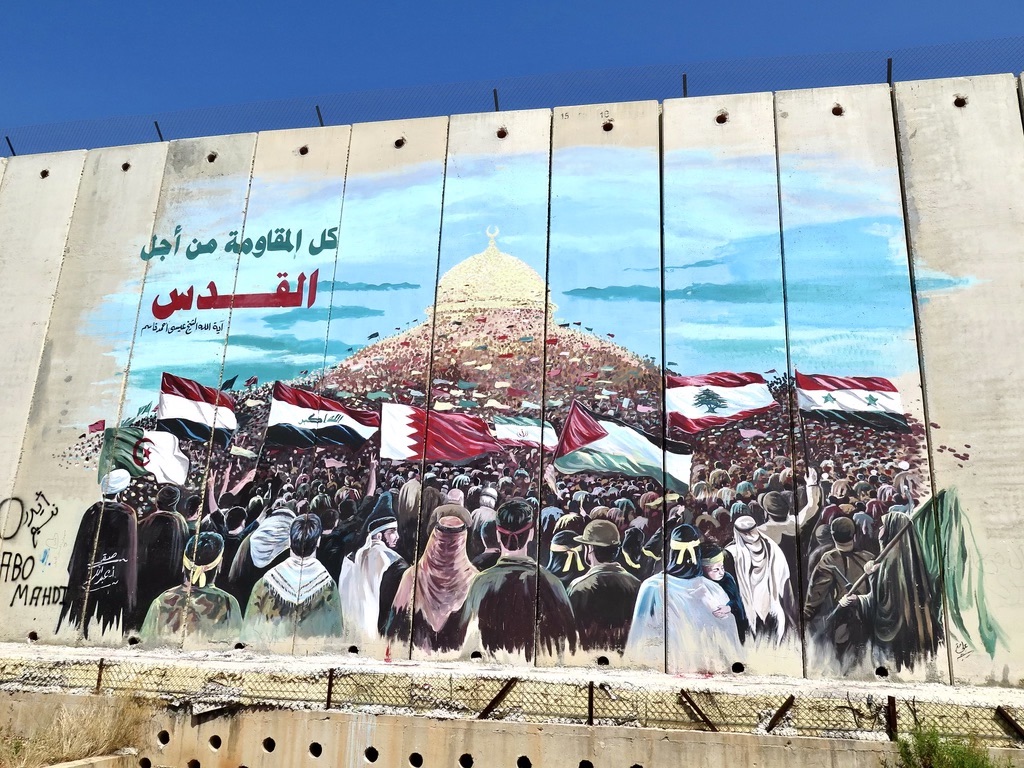
Committing to Palestine was, for Amil, a question of orienting life in struggle. The bearing of this struggle in Lebanon was occasioned by the Palestinian cause insofar as the latter transgressed, as it still does today, the “natural” order of the Lebanese polity, which subsists in what Amil termed the “colonial relation”—the constellation of forces in the Mashriq that he names as imperialism, reactionism, and Zionism. This conjuncture is evident today where one sees the strong desire to relegate and contain “the Palestinian cause” to an extraneous element, naturally outside of Lebanon’s national situation. The Palestinian cause subsequently appears “within” Lebanon only as the religious fetish of a specific “sect.” This relegation—common today, for example, in the discourse of the anti-communist Kataeb Party and in American-led efforts to enforce UN Resolution 1701—is also practiced in the specific actions of the war by the IDF: the bombing of Beirut and other parts of Lebanon as well as its invasion in the south are seen as merely military actions directed toward “Shi’i” areas—“the South,” the Beqaa, or Dahieh—that are described as Hezbollah “strongholds.” The result is that the war, rather than pivot on the cause of Palestinian liberation, becomes understood as a “sectarian” battle, a metonym of the intractable conflict between East and West, civilization and barbarism, Islam and Christianity, or religion and modernity, for which Zionism is a late vehicle.
Amil was the Lebanese Communist Party’s most prolific writer during the years of Lebanon’s wars (1975-1990), which were in a large part determined by the contours of Palestinian struggle after the defeat of 1967 and the expulsion of 1970. What that “determination” means was (as it remains) a crucial problematic into which Amil consistently intervened. Indeed, Hicham Safieddine (2020: 10) notes that it was one of Amil’s earliest teachers, Shafiq al-Hout—one of the founders of the PLFP and later a prominent member of the PLO—who introduced him to Marx’s writings.
This enjambment of anti-colonial struggle and the class struggle would persist as a problematic in Amil’s theoretical practice. While studying in France and teaching in revolutionary Algeria he developed the concept of the “colonial mode of production” for this overdetermined structure, one characterized by a relation of “dependency” for capitalist domination “in” the colony on imperial capital. The ideological articulation of this structure he termed the “colonial relation,” and it is there, on the question of the matter of that relation, that “sectarianism” and “the Palestinian Cause” collide.
Amil’s return to Lebanon from Algeria was compelled by the defeat of 1967. During the ensuing years the LCP was rearticulating its relationship to anti-colonial struggle and the Soviet Union (a major issue being the latter’s acceptance of the 1948 partition of Palestine). And when in 1975 the fighting began in Lebanon—instigated, we must recall, by the conflict between fishermen in Saida and state organized capitalist expropriation (Traboulsi 2008, 323)—Amil looked to articulate the relationship between “sectarian thinking,” Arab state reactionaries, and Zionism as a question of the class struggle, anticipating the constellation of forces that would eventuate in the Syrian (nominally, the Arab Deterrent Force’s) occupation of Lebanon from 1976 and the Israeli invasion of 1982.
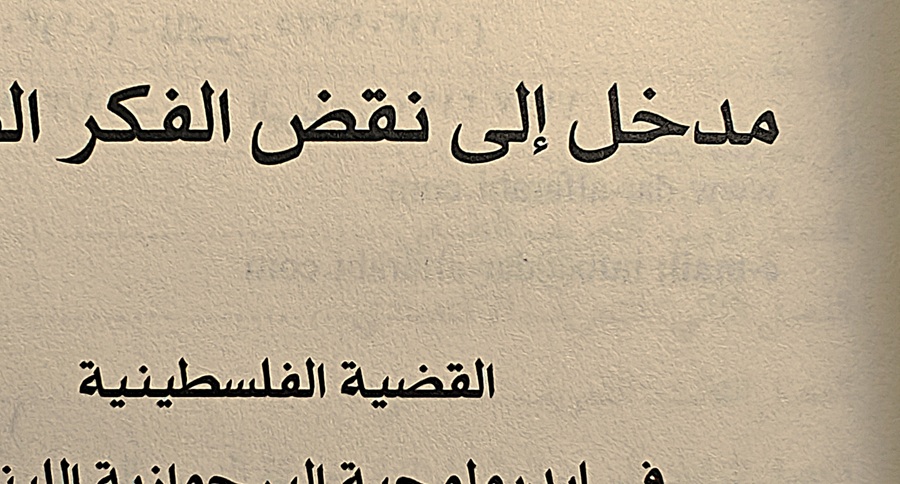
Between these two pivotal military interventions Amil composed and published his 1980 Madkhal ilā naqḍ al-fikr al-ṭā’ifī: al-qaḍiyya al-filastīniyya fī aydiyūlūjiyāt al-burjuwaziyya al-lubnāniyya (An Entryway into Overturning Sectarian Thinking: The Palestinian Cause in the Ideology of the Lebanese Bourgeoisie) in which “the Palestinian cause” occasions the falling away of the spontaneous ideology of the ruling class (sectarianism). It does this not through a ‘critique’ of how one ‘views’ the Palestinian cause, but by allowing sectarian thinking’s own mistaking of the Palestinian cause as a ‘sectarian’ problem to prevail. It is for that reason that the Madkhal is largely made up of a symptomatic reading of the texts of the Lebanese bourgeoisie, from the writings of Michel Chiha (1891–1954), the Mandate-era banker and phalangist politician, to Amil’s contemporary Pierre Gemayel (1905-1984) and other writings of the latter’s Kataeb Party.
The formation of the Lebanese National Movement (LNM), a coalition of reformists and revolutionaries that constituted the chief antagonist of the reactionary Lebanese Front (LF), was largely premised on the constitutional reform of the country’s politics. It was oriented, according to Karim Mroué, a Political Bureau Member of the LCP, toward “eliminating the domination of a kind of religious autocracy” (quoted in Ismael and Ismael 1998, 102n8). However, the Madkhal shows such bourgeois “sectarian thinking” to be undone in its own grasping of “the Palestinian cause.” Hence, while Amil was at pains to show that militant support for the PLO and the Rejectionist Front, with whom the LNM was allied, was the miḥwar, the“axis,” of the national and anticolonial class struggle in Lebanon and not an external element, the Madkhal was to effect a change in thinking—to show that the Palestinian cause as it is articulated in the ideology of the dominant class leads to the latter’s ideological armor, sectarian thinking, to fall away, as Marx says, “like rotten touchwood [wie mürber Zunder].” (1976 [1867], 932). Indeed, while naqḍ in modern Arabic gives the strong sense of a juridical interdiction, earlier meaning of the word directly invoked the unravelling of a cord. This work of unravelling, of the falling away of sectarian thinking, Amil showed, is affected in the Palestine cause. Why this is the case can only be briefly adumbrated here, by setting out the axioms that programmatically orient Amil’s theoretical work in answering the inaugural query of the Madkhal: “How do the Lebanese bourgeoisie, from the vantage of their class ideology, view the Palestinian cause?” (Amel 1980: 11). [1]
The Madkhal takes as its first axiom the orientation of class struggle, which bifurcates (rather than pluralizes) into the position of “dominant class” and the “revolutionary class.” The “ideological position of the labouring class” is what enables “seeing” the ideological practice of the Lebanese bourgeoisie as the political necessity of domination—it follows that the question of which“sect” is dominant (“the Maronites,” “the Sunni,” etc.) not only cannot see the class struggle but participates in the very sectarian thinking that obfuscates it. Moreover, the result of the breakdown of this domination in maintaining the colonial relation was the then-ongoing military action: “the bourgeoisie did not find another way to treat this political crisis of theirs but to ignite civil war; it is the logic of the dying bourgeoisie, ever urging them to descend into the abyss of their intractable crisis” (Amil 1980: 23). It is incumbent upon us to note how successful the ‘civil war’ and threat of its return has been in maintaining this domination in Lebanon over the past half-century.
The second axiom of the Madkhal is that this class-ideological position is the adequation of thinking to a real force of negation. Against the theoretical humanism of a mirrored subject/object—wherein “the Palestinian cause” is an object that can be composited properly by collating these different ‘perspectives’ (whether “one-“ or “two-state” solutions, for example)—the “soil” of this “actual field” is the class struggle that is “in the mode of overturning [naq
].” Breaking with this thinking, then, “consists specifically in bringing to presence this, the political that the ideological absents.” In other words, “seeing” the “Lebanese bourgeois ideological-conceptual structure…in its relation with this political necessity,” bears the activity of overturning it.
It is from these axioms that Amil sets up the relationship between the activity of “overturning” the class ideology of the Lebanese bourgeoisie and “the Palestinian cause”:
Viewing the Palestinian cause is not possible—no matter the position from which we view it—apart from the national liberation movement of the Arab peoples. The Palestinian national movement is an inseparable part of this movement; the internal mechanism that governs the common Arab national movement is itself what governs the Palestinian national movement, the mechanism being the liberation from imperialism, Zionism, and Arab reactionism. (Amil 1980, 12)
In this sense the Palestinian cause condenses the “colonial relation,” the specific conjuncture of forces (imperialism, the Arab capitalist class, and Zionism) that ideologically articulates the colonial mode of production in Lebanon. Hence Amil’s thinking is already disabused of the (idealist) tendency to systematize and absolutize the distinction between “post-colonial” and “Marxist” thought in the so-called Global South. The overdetermined structure of the “colonial mode of production” exists in the collision of these forces.
But this is precisely why it is the question of the overdetermined colonial structure itself that the Palestinian cause occasions for thinking:
Therefore, determining the Lebanese bourgeoisie’s class position on this axial cause (the Palestinian cause) in the struggle of the Arab peoples, required by necessity determining its class position on the Arab liberation movement. For in the light of this position the other position is determined, especially since the Palestinian resistance movement did not manifest, in an actual way, in the Lebanese arena (that is, in the field of the specific class conflict in the Lebanese social structure), and would not become a foundational element therein, until after the defeat of June 1967. (Amil 1980: 12)
The existence of the Palestinian cause as anterior to the anti-colonial class struggle in Lebanon does not mean that it is a genetic outgrowth of the situation, even if it is “determined” by it. Here, Amil is notinterested in instructing a historicism. Rather, he shows how the Palestinian cause’s status as, at once, contingent and axial in Lebanon’s national situation proves to be a decisive obstacle for ‘sectarian’ thinking:
It is an error, then, on the methodological level, not to show the necessary correlative relationship in the Lebanese bourgeois ideology between the position on the Arab liberation movement and the position on the Palestinian cause; as, in truth, this position is a natural, logical consequence of that position that finds, for its part, its explanation in the structure of the existing colonial relations of production in the Lebanese social structure, and in the class relation of dependence that ties the dominant bourgeoisie within it to imperialism. But if we establish a partition between the two positions, not attributing the second to the first, and we do not bring to light that the practice of the outright hostility of the Lebanese bourgeoisie toward the Palestinian resistance and the Palestinian cause is a result of the hostile relationship and class warfare that stamps its relationship to the Arab liberation movement, we would at that time fall into the trap of its class ideology, instead of being capable of overturning it. (Amil 1980: 13)
The position of these liberation movements thus turns on the Palestinian cause which articulates with them to become the symptomatic point specific to the national situation of Lebanon. It becomes the axis of a set of contradictions and of political struggle; it carries the force of the real movement of negation. But it is for precisely this reason that it cannot be thought outside the class struggle internal to Lebanon’s national situation. “We will not,” Amil writes succinctly, “overturn ‘sectarian thinking’ through sectarian thinking” (Amil 1980: 17).
In other words, the Palestinian cause, its pain and therefore its history, is one site that makes the overdetermination of the capitalist mode of production in the present, that is, modern colonisation, thinkable as what can be overturned. “The class struggle is the motive power of history; history is not moved in accordance with the dominant class’s system of class control but in the struggle against it” (Amil 1980: 22). Witnessing the current attempts to obliterate Palestine and its present existence-as-cause as well as its covering-over by the ideological practice of sectarian thinking in Lebanon today, the need to articulate the falling away of sectarian thinking is no less pressing.
Aaron F. Eldridge is a Postdoctoral Fellow in the Department of Anthropology at the University of Toronto. He studies collective responses to cultural destruction and social precarity in the Middle Eastern and Muslim/Eastern Christian world.
Notes
[1] We should note here the polysemy of al-qaḍiyya al-filasṭīniyya in Arabic. It is not only “the Palestinian cause” but also “the Palestinian issue” and “the Palestinian question,” terms which, in English, ramify into terrains of political transformation or armed struggle, social antagonism, and juridical dispute respectively. This question of translation is relevant because what is at stake for Amil, following his contemporary Palestinian comrades in their articulation of resistance, is precisely the transformation of a juridical “question” (to be resolved in the future by statist, international law) into a material “cause” that articulates present time, situated in what Omid Mehrgan aptly describes in this feature as “the remnants of life today.”
References
Amil, Mahdi. 2020. Madkhal ilā naqḍ al-fikr al-ṭā’ifī: al-qaḍiyya al-filastīniyya fī aydiyūlūjiyāt al-burjuwaziyya al-lubnāniyya (An Entryway into Overturning Sectarian Thinking: The Palestinian Cause in the Ideology of the Lebanese Bourgeoisie). Beirut: Dar-al Farabi
Ismael, Tareq Y. and Jacqueline S. Ismael. 1998. The Communist Movement in Lebanon and Syria. University Press of Florida.
Jameson, Fredric. 1982. The Political Unconscious: Narrative as a Symbolically Social Act. Ithaca, NY: Cornell University Press.
Marx, Karl. 1976 [1867]. Capital: A Critique of Political Economy. Translated by Benjamin Fowkes. New York: Vintage.
Safieddine, Hicham. 2020. “Introduction: The Anti-Colonial Intellectual.” In Arab Marxism and National Liberation: Selected Writings of Mahdi Amel, edited by Hicham Safieddine and translated by Angela Giordani, 3–9. Leiden: Brill.
Traboulsi, Fawwaz. 2008. Tarikh lubnān al-ḥadīth [A History of Modern Lebanon]. Beirut: Dar Riad El-Rayyes.
Cite as: Eldridge, Aaron F. 2025. “The Palestinian Cause Contra Sectarian Thinking” Focaalblog October 6. https://www.focaalblog.com/2025/10/06/aaron-f-eldridge-the-palestinian-cause-contra-sectarian-thinking/