Tag Archives: Iran

Ahmad Moradi: Iran, Year 1404: Chronicles of Planned Chaos

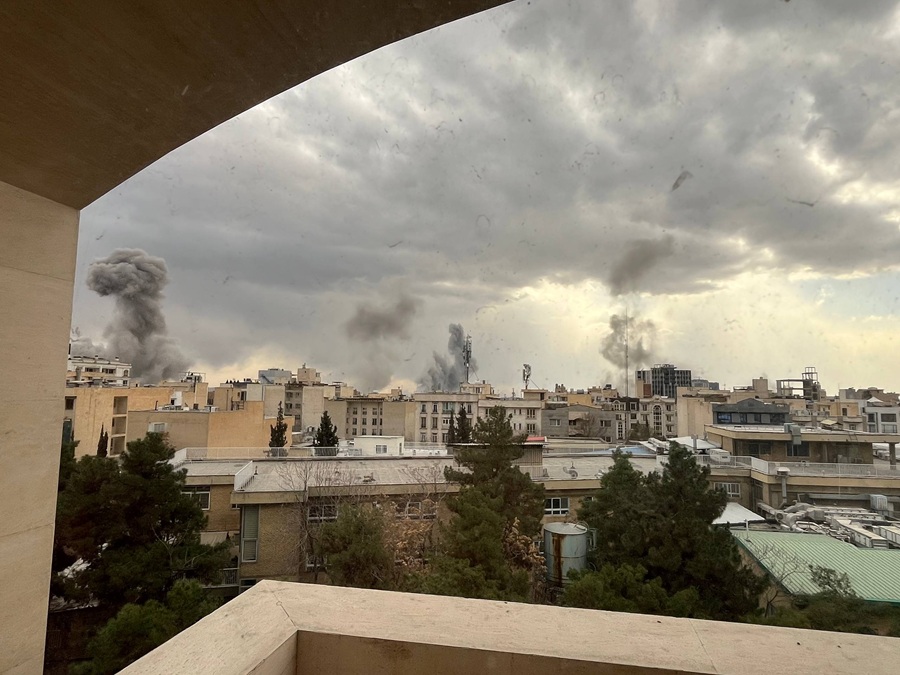
Image 1: Bombing scene in Tehran, 2 March 2026. Anonymous photographer. Shared via the Telegram channel Vahid Online.

No, dear Rira,
my letter must be short,
must be simple,
with no talk of ambiguity or mirrors.
I will write to you again:
We are all well—
but do not believe me.

(Ali Salehi, Iranian poet)

The Sense of an Ending — April 26, 2025

Thick black smoke is rising over the port of Bandar Abbas, where Iran’s largest port is located. A massive explosion has just torn through the area. Authorities urge people to stay indoors, warning of airborne toxins possibly spreading across the city.

We’re watching a local TV station livestream the explosion site. Ambulances move back and forth, firefighters enter and leave the frame, and there is a constant stream of water aimed at the large black billows rising into the sky. “War must be really scary. I’ve thought about it often, for a long time. But yesterday, I realised war is truly terrifying,” Javid tells me. Although we were born during the Iran-Iraq War in the 1980s, we have no clear recollection of the bombings and explosions.

Despite the shock of yesterday, friends call, describing an eerie stillness in the city. The blast was so powerful it shook windows; many initially thought it was an earthquake—a frequent occurrence in this part of Iran. Speculation runs rampant: some fear sabotage by Israel, recalling the devastating 2020 Beirut blast; others blame incompetence by the corrupt regime. The only shared certainty in this divided society is the overwhelming reality of the explosion itself and how devastatingly powerful it was.

I had landed in Bandar Abbas just hours earlier, flying from Tehran. The plane was old, part of Iran’s aging air fleet, historically hampered by years of Western sanctions. Its engines rattled and the seats were worn out, but it got us here. Like much of Iran’s infrastructure, it was fragile, underfunded, yet stubbornly functional. Whatever that means.

Julian Barnes’ book title The Sense of an Ending keeps coming to mind. The explosion feels like a prelude to war, echoing the trajectory of Beirut: first the port explosion in 2020, then full-scale conflict.

Yet my sense of looming catastrophe doesn’t fully align with the general mood of those around me. My family continues to rely heavily on the healthcare system. My mother visits the hospital twice a week for kidney dialysis. Another relative is undergoing cancer treatment. They return home relieved, even cheerful, knowing most of their medical expenses are still covered by public insurance. People persist in their routines, driving their children from school to the gym to music lessons. They adapt. They press on. Rent consumes an entire salary. I keep asking nearly everyone I meet how they make ends meet. Hardly anyone knows precisely how daily life holds together. Nothing quite works, yet everything somehow remains in place. Politically, the atmosphere feels similarly precarious.

In many respects, Iran seems to be experiencing a rare period of calm. For now, a delicate peace holds between the state and society. In Tehran, women without hijabs walk openly through the streets. At night, new cafés buzz with conversation, laughter, and young people lingering into the late hours. A cautious optimism lingers in the air.

Iran and the U.S, the archenemies for over four decades, appear closer than ever to resolving their hostilities. Iran might agree to curb its nuclear ambitions, while the U.S. is expected not only to lift sanctions but also to commit billions of dollars in investment. Such steps would strongly reassure Iran that the U.S. won’t abruptly withdraw again, as it did in 2018 when the Trump administration unilaterally abandoned the JCPOA—the nuclear agreement meticulously negotiated during President Obama’s administration.

The Blown Up Table — June 13, 2025

Except it wasn’t.

Israel launched an unprovoked assault on Iran. In the first few minutes, several high-ranking military commanders and nuclear scientists were assassinated. At that moment, Iran and the U.S. were gearing up for the sixth round of indirect negotiations, with Oman serving as intermediary. Looking back, it is easy to believe the growing reports that the U.S.-initiated talks were a cover for Israel’s surprise attack.

The assault began exactly on the sixty-first day of the two-month deadline Trump had set earlier in a letter to Iran’s Supreme Leader. On June 20, days after Iran’s renewed discussions with the European powers—Germany, the UK, and France—the U.S. joined the Israeli offensive. The U.S. bombed three main nuclear facilities. Other targets included security command centers and the so-called “centers of oppression”—among them Basij bases, where I had conducted fieldwork since 2015. These sites range from military compounds to humble bureaucratic offices dispersed throughout neighborhoods. They form a sprawling network under the Revolutionary Guards’ control. For years, these bases played a crucial role in surveilling ordinary citizens, especially during unrest. Now, they are under bombardment, just like military bases, the notorious Evin prison, and state TV headquarters.

They claim it is a liberatory act—aiming to set the Iranian people free. How strangely familiar this rhetoric sounds. The Iraqi invasion déjà vu.

5. Politics of Rightful Killing — June 21, 2025

An old woman in her seventies darts across a shopping store in Berlin, shouting to her companion in Farsi: “Look, good news. Israel has continued the bombing of Iran.” She is referring to events that unfolded just hours after the announcement of a ceasefire between Israel and Iran, brokered by the U.S. and Qatar. News circulating on social media reports that the Israeli government instructed a fleet of jets to bomb targets in Iran, allegedly in response to a missile launched from Iran into Israel shortly after the ceasefire began.

A sense of disgust washes over me. Nausea, as Sartre describes it.

In a second episode that day, a friend calls and asks for advice on how to respond to a voice message she has just received. The internet has finally come back after the ceasefire. The message explains that the sender had to rush back to Iran—despite the closure of the airspace—for the funeral of his brother. “He passed away,” the voice says, referring to one of the recent attacks. My friend tells me she has no idea how to respond to the message from her colleague. “Was her brother a member of the security forces in Iran?” she asks. She explains that her colleague had once hinted at her family’s involvement and alignment with the Iranian regime. “Now,” she continues, “I wonder how to respond. If her brother was part of the regime, wouldn’t he have been involved in the mass oppression and killing of protesters just a couple of years ago?”

I suggest she let it go—for now. People from all walks of life were killed in the attacks. I tell her to focus on the simple fact that her colleague has lost a brother. Just offer condolences.

She agrees, reluctantly, and ends the conversation with a quiet question: “In the absence of the regime, how would people treat those who aligned with it?”

Resentment runs deep, and revenge seems to be the only instinct left in our repertoire. Some call it the politics of rightful killing.

6. Snapback- 28 August 2025

All U.N. sanctions have been reimposed, one of the harshest sanctions regimes laid against any country. Iran has already been under Western-imposed sanctions for decades. It is not yet clear what the effect is going to be.

7. Lottery — January 12, 2026

It is Monday evening. My phone finally rang. It is my sister’s voice. It has been more than four days of complete blackout. No internet in Iran, no chance to call family back home from abroad. Videos of dead bodies under black covers in the central morgue of Kahriyak in Tehran have been trickling in since Saturday. Those of us abroad with internet have been searching for loved ones in the videos. Someone has smuggled the video out, and then shared it on a Telegram channel. Hundreds of dead bodies have been laid out in the yards of the morgue, and many more are lined up in the compound. I have paused and replayed the videos many times, checking to see if there is a familiar face.

In this total communication darkness, there are reports from Persian-speaking TV channels giving mounting numbers of the murdered. They were all killed with live ammunition on the 8th and 9th of January. Shortly after the beginning of massive protests on the streets of Iran and the internet shutdown, the security forces, the Basij, and members of the Revolutionary Guards Corps, in a coordinated act, opened fire.

There were Mossad agents among the protesters. This is what the Iranian state claims. No one knows. The number of dead keeps piling up, by thousands. From the morning of January 12, we know that phones are being restored, and some people on social media say that their families were able to call them from Iran. No word from Tehran yet—does this mean that we have lost a loved one? “It is a lottery,” a friend in Berlin tells me on the phone, waiting impatiently for a call from inside Iran. “When you receive the call, you will ask, ‘Is everyone safe?’ You may hear yes or no. Even if you hear a yes, you are sure that many will hear a no.”

8. Stockpile — February 27, 2026

“We are going to be fine,” my brother tells me. “They will reach an agreement at the last minute. Badr bin Hamad Al Busaidi is in Washington to offer what the U.S. wants.”

“We have stockpiled food for a few weeks,” my brother tells me. “But we have already eaten half of it,” my sister says in the background. “It’s been two months since Trump has wanted to make his decision.”

It is not clear if Iran is refusing to hand in its highly enriched uranium to the US, or according to Badr bin Hamad Al Busaidi, the Omani foreign minister and mediator, Iran has accepted ‘zero stockpile.’

9. Having a Blast? — February 28, 2026

They blew up the negotiating table again. The supreme leader, Ali Khamenei, is dead.

I have to confess that for over thirty years, every Newruz, the Iranian new year that happens on 20 March, when all family members rush to come together and make a wish during the countdown, I too always rushed, my mind bubbling, not knowing what I had to wish for. In that moment of chaos, I always wished that this year Khamenei would be dead.

Until the year 1404. This year, I joked to my German friends who are visiting us: “This year I’m not going to wish for his death. For thirty years it was not granted. I won’t do it this year, and maybe that will make my wish come true.”

In the evening of 28 February, it is Netanyahu first, and then Trump, who confirm Khamenei’s death. After several hours, Iranian outlets confirm it too. I have a whirlwind of emotions. There are videos of some Iranians having a blast on the streets. There are other videos of a school ruined by several blasts by the US-Israeli strikes. There are 21 days left until Newruz.

We are only 24 hours into the U.S.-Israel war against Iran. I am not sure when the war will end. The consequences are deeply uncertain and potentially chaotic. Violent chaos may very well be the only true objective Trump and Netanyahu have for this country.


Ahmad Moradi is a Senior Research Fellow at the Leibniz-Zentrum Moderner Orient in Berlin. He has conducted ethnographic research with the paramilitary organization of the Basij, as well as with Afghan refugees in Iran who fought in the Syrian civil war and were wounded there. His broader research interests include revolutionary politics and the politics of care in contexts of protracted conflict and displacement in the Middle East.


Cite as: Moradi, A. 2026. “Iran, Year 1404: Chronicles of Planned Chaos” Focaalblog March 5. https://www.focaalblog.com/2026/03/05/ahmad-moradi-iran-year-1404-chronicles-of-planned-chaos/
Omid Mehrgan: Palestine the Wound: A Report on the Iranian Reception of the Cause

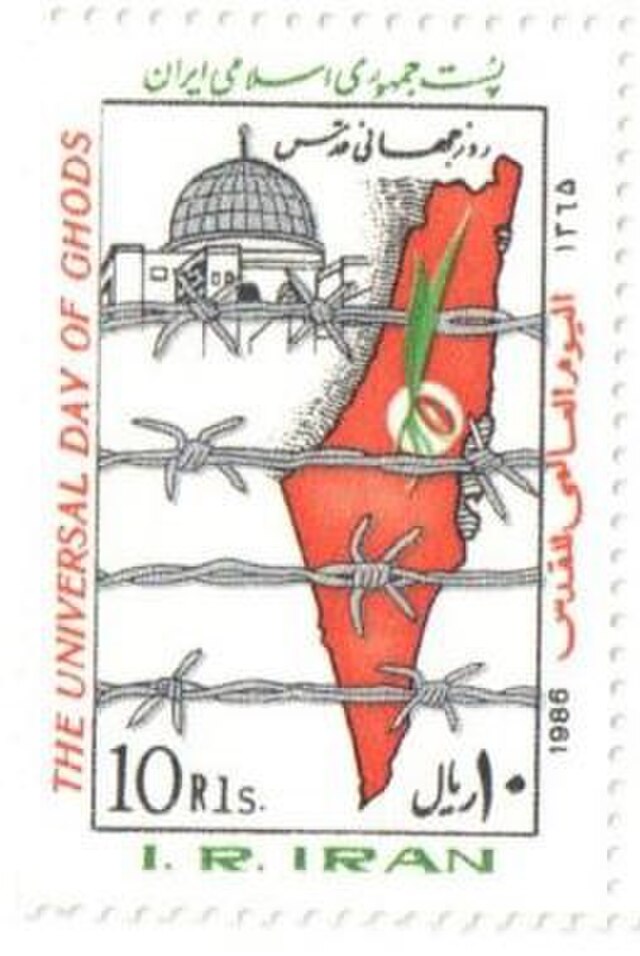
Image 1: Stamp of Iran memorizing the Day of Qods, printed 1986

A Postscript Note: I finished writing this piece prior to the Israeli-US attacks on Iranian cities and nuclear facilities, which killed over a thousand people. There is, therefore, no trace of that consequential war in the piece. Another event also took place between the time of writing this and the onset of that war: the “For Palestine” rally on the 22nd of May in front of the University of Tehran to protest the Gaza Genocide. Though modest in size, this marked “a moment when a diverse group of citizens, without any formal call, unaffiliated with power centers, and beyond prevailing ideological frameworks, raised their voices in defense of the human dignity of the Palestinian people” (Shabani 2025). When I speak of the losses of the Iranian Left in the following paragraphs, I would like to remember such delicate gains, too.

Taking stock of the Iranian response to the Palestinian cause since the Nakba can point out a history of militant solidarity but must also face the melancholic realization that the Iranian Left has lost something big. What mediated the two—and this can be the great irony of Middle Eastern history—was 1979 Revolution in Iran. An epoch–making event that emerged as a resistant block against imperialist forces and a powerful state backer of Palestinians in its secular and religious strains, the Revolution went on to transform the very meaning of relating to Palestinian anticolonial resistance. Whether, and how exactly, the government that was established in its wake helped Palestinians since is a convoluted topic with many chapters, yet to be studied. What is less obscure is the fact that the Iranian Left—a material, discursive, and cultural force in giving birth to modern revolutionary Iran—no longer possesses any seductive and material forces for performing a necessary double task today: building a working class movement strong enough to push back against the increasingly harsh oligarchic capitalism inside Iran, and helping resist the US–Israeli aggression in the region that is piling up ruins after ruins in its trail. Iran’s Islamic Republic has largely alienated the real forces on the ground from which it once appropriated the Palestinian cause. Those forces that it has instead recruited and organized—legions of the unemployed and of undocumented immigrants from Afghanistan and Pakistan to be deployed to Syria during the 2010s (Azizi and Vazirian 2022)— it has not done so based on labor. But nor have the progressive forces inside or outside Iran succeeded to win the marginalized and increasingly impoverished masses who periodically take to the streets only to face brutal repression.

The net result has been the loss of a political identity in Iran that could understand itself in a collective way by identifying its real sources of vitality. An epitome of this phenomenon which can be called apolitical radicalization, the Diaspora Opposition politics of “subversion” (barandaazi) in the past Iranian long decade (from 2009 Green Movement to when Iranian forces left a fallen Syria in 2024) has shifted toward the right to the bewildering extent that siding with Israel has become a form of performing resistance against the Islamic Republic (Shams 2025). The war industry has recruited its own figures from the exiled (Shohadaei 2023). Many, many people embrace them, apparently. But, under the black sun of Gaza that has cut through all statuses, identities, positions, forcing each to reckon with itself anew, Iranian political culture too is bound to find itself re-evaluated for its own actors and observers. And because the word “Palestine” has for decades permeated official discourses of politics in Iran to the point of exhaustion, speaking to it in relation to emancipatory politics is exceptionally difficult.

In such an atmosphere, writing about Iran in English is more aporetic for me today than ever before. By “today” I mean a moment in history marked by two consequential events that have changed much about Iran: The Women, Life, Freedom (WLF) movement (following the death-in-custody of the young Kurdish woman Mahsa Jina Amini in Tehran in September 2022) and the Al-Aqsa Flood Operation. Months after the women and girls’ life-and-death historic fights in the streets with the riot officers over the mandatory hijab (with clear socio-political victories) were widely repressed, October the 7th took place. On around the anniversary of the Palestinian assault on Israeli settlements near Gaza’s borders, a video came out showing the correspondent of the London-based TV Iran International writing the movement’s slogan in Persian on the wall of a destroyed home in Gaza (Middle East Monitor 2024). The obscene contrast between the message and the medium, between the words life, woman, freedom, and that context of suffocating blockade, lethal masculinity, and death, posed the question: How could those words be allowed to travel to the abyss of Gaza with pure affirmation and total blindness to its setting? The smiling ease with which the Israel-based Iranian reporter performed the act in front of the camera demonstrated a secure confidence in the public reception of his horrid message. He probably felt it like an act of resistance rather than pervert violation. Reportedly, the news outlet, funded by Saudi Arabia’s Mohammed bin Salman, is being watched by millions of Iranian households, having widely been preferred over the standard BBC Persian and a host of hopeless national TV channels (Gamaan 2023). Was there no symbolic counterforce defying this messaging? Apparently, not. The vocal figures of the WLF movement did not voice any visible solidarity with Palestinians, nor articulated any radical critique of Israeli aggression to prepare people for protecting themselves against identifying with the aggressors. The Nobel Peace Prize winner and prominent activist who spent years in jail and has been particularly vocal about solitary confinement and death penalty in Iran did not mention the word Gaza in a statement she issued from Evin prison where he called for an end to ”war.” The media coverage of her statement in English added the word “Gaza” (IranWire, November 1, 2023).

All this shift to the right in mainstream Iranian opposition politics, if not in people themselves, shows an astounding departure from the pre-Revolutionary times when Palestine shaped the discourse of both the Marxist left and the radical Shia’ clergy as well as Muslim intellectuals. Recent scholarship has shed light on the indebtedness of Iranian political culture to the Palestinian cause from around the time of the Nakba onward (Alavi 2019, Elling and Haugbolle 2024, Sadeghi-Boroujeni 2025). This was in the aftermath of the US-sponsored 1953 Coup that blocked the path of a popular national independence movement. In attempts to break through the total political blockage of the post-Coup era beyond traditional party politics already crushed by the Shah, Iran’s guerrilla movement (1970-79) learned tactics of armed struggles from Palestinian fighters in the refugee camps of Lebanon and Syria, gaining insights into the deep ties that linked capitalism, imperialism, and colonialism in the region—places destined to define the future trajectory of Iran’s political life for decades to come (Vahabzadeh 2010: 12-15, Montazeri 2024). The Palestinian cause effectively contributed to a revolution in Iran, having ended the Monarchy’s alliance with America and Israel. In this way, it seems, Iran in its turn shaped the trajectory of the Palestinian cause by becoming the first state officially incorporating it into its very identity—and that in the wake of Camp David’s deal with Israel which lost Egypt for Palestinians. Did this victory come with a curse?

The Cause after the Revolution rapidly moved from the streets to the institutions and the law in Iranian politics. Such a shift took place in the context of a bloody fight for power primarily between the Leftist parties and the Islamic Republic Party (IRP) in the first couple years after the 1979 Revolution. The IRP clerics reluctantly had to deal with the more secular, nationalist Palestine Liberation Organization (PLO) leadership. To win over the socialist, guerrilla forces who had legitimate claims to the Revolution, the IRP moved to rid the Palestinian cause of its leftist discursive elements. One telling example was when their official newspaper Jomhuri-ye Eslami published the headline “Arafat pleads to Muslims of the world against Israel’s expansive offensives,” while Arafat’s 26 August 1979 plea addressed diverse universal identities including “public conscious around the world” and “resisting nations of the world.” (Alemzadeh 2024, 12) It was a real case of inclusive exclusion or exclusive inclusion. Yasser Arafat’s unfortunate decisions in key moments, from trying to mediate the releasing of the American hostages held by Iranian revolutionaries during the Hostage Crisis to siding with the invader in the Iraq-Iran war, only facilitated such a move.

“Felesteen” in Persian thus started losing its original socialist ring, becoming more and more Islamic—a tendency that culminated in the Islamic Republic’s consequential rapport with the Islamic Jihad and then Hamas a couple decades later. These were, of course, the contingent tendencies in Palestinian history within various contexts to which the Iranian support adapted. The nature of this support has been reported not to have dictated internal politics of Palestinian movements. Nizar Banat, the Palestinian intellectual killed by Palestinian Authority forces, said: “Whether Fatah, PLFP, Communists, anyone; it [Iran] never intervened in the ideological conceptions of our resistance.” (Banat [2021]) Even so, the name of Palestine did not enjoy such political diversity inside postrevolutionary Iran. With the violent suppression of the Left during the 1980s, Iran’s popular politics inevitably moved towards a liberal-democratic rights-centered activism in civil society in the Reformist Era (1995-2004). The pro-government forces, in turn and in effect, started building up a new security practice and discourse that gave rise to the Axis of Resistance in the aftermath of failed American interventionist projects that generated a vacuum in which floated many fragmented forces sponsored by regional and international powers. Palestine was won for national security and largely lost for justice and freedom (Alemzadeh 2025).

In terms of security—in the post-9/11 world, where the US-led Coalition forces invaded countries to the left and the right of Iran (Gregory 2004)—Palestine appeared in the depth of a fortified field seen from the heights of Iranian plateau. The “offensive defense” strategy brought Iranians extremely close to Israeli fortifications around the Golan Heights—perhaps too dangerously close. Iran’s oldest ally through decades, Syria, made this progression possible. The same troublesome route that Iranian guerrilla fighters during the sixties and the seventies took from Tehran to Beirut to join PLO militants was upgraded in the mid-2010s into a highway trodden by the Islamic Revolutionary Guard Corps (IRGC) overseas forces (Magnier 2021). The story of Iran’s intervention in the Syrian War, its human toll, political economy, and geopolitical import, is yet to be told. But the claim on the part of the Islamic Republic has been that we are defending our borders against imperialist and Zionist assaults at military, cultural, social, media levels. Intellectuals, activists, artists, and the entire middle-class cultural makers were never fully convinced. The presence of American-Israeli footprints in any major national disaster from the eight-year Iran-Iraq War to devastating sanctions and terror attacks throughout the past four decades has been documented, and yet Palestine is absent from the most progressive political discourses in Iran.

A central question for the highly fragmented, disorganized Iranian leftists today is why many Iranians appear to go along with the cruelest forces in the world today. A big bulk of answers given do not pose the question or clarify its premises adequately or in good faith, providing instead conclusions that only beg the question anew. They tend to use the language normally deployed by pro-Israeli platforms. For instance, Ali Afshari, a former organizer of the Iranian student movement turned regime-change activist, asks why there is no sympathy with Palestinians in Iran without discussing in any terms what it is they should sympathize with. This is because the author cannot even name the situation: the genocidal killings of a people daily. It is either “Israel’s war” or a “conflict.” And yet, he reserves the naming for Hamas, summing up his answer by setting the equation thus: “Meanwhile, the atrocities of Oct. 7, 2023, against Israelis by Hamas only reminded the Iranian people of their government’s ideological, turbulent, and costly foreign policy.” (Afshari 2024) In this piece as in several others about the topic of Palestine and Iran, authors tend to draw on one slogan first heard chanted in the 2009 protests: “Neither Lebanon, Nor Gaza, I’ll give my life for Iran.” (Ziaberi 2025) It is presented as a confirmation of the Iranians’ judgment on the fate of the Palestinian cause in Iran. The texts omit the other slogan that I heard in the streets of Tehran that same year also within the Green Movement: “People, why are you sitting down, Iran has become Palestine.” The origin of the slogan goes back to the time of the Iranian Revolution. It signified the understanding that Palestine has a universal import, shedding light on any situation where an indigenous population is being suffocated by forces of the state or states. The generational continuity between 1979 and 2009, evident not least in their shared slogans, was broken in the long decade following when Iran went to Syria. The relation to Palestine both made and broke it. (In a correspondence, Akbar Masoumbaigi, a prominent intellectual and a veteran organizer in the Iranian leftist movement, told me about the origin of the slogan which he had heard in the streets of Tehran at least as early as 1979. Before the date, he said, similar slogans were common.)

Today, while there have been statements from Iranian feminists, artists, scholars, and activists against the Gaza Genocide (A Call to Action 2024, Moezidis 2025), most Iranian identifications with the suffering of Palestinians much more resemble a spirit of appropriation: “We too are undergoing genocide. We too are occupied. We too are under (gender) apartheid. We too are colonized, even if by a regime which we brought to power through a revolution.” Iranian protests proclaim such positions in the BBC Persian service or on Iran International, much of it is also echoed in recent works by scholars on “internal colonialism,” “gender apartheid” used for Iran without naming Israel (Eskandari 2023, Seltzer 2023, Elyasi 2024; for a critique, see Shohadaei and Mehrgan 2024). Or conversely, at its worst, as in Afshari’s piece quoted above, they go for the equation: Hamas represents for Israelis what the Islamic Republic means to Iranians living under its rein. Although the reason for this has much to do with how official apparatuses of power, policy, and media in Iran have failed to incorporate the Palestinian cause they inherited from a revolution into projects of social justice domestically, many individuals and groups in civil society, too, have participated in what can be called a pervert relation to Palestine: absolute negation or absolute cooptation.

Disappearing with the Left is thus the very possibility of the solidarity of singular experiences of oppression and empire. What has been lost is the very possibility of an Iranian political identity. Palestine is not only a moral or humanistic cause—which, given the incredible ethical indifference at the global institutional level to the daily massacres and starvation in Gaza, can only mean coming catastrophes. It is rather also a mode of relating to the politics of material conditions of life that touches all forms of politicization in the globalized ecologies of war and of remnants of life today. The Iranian Left realized with much pain through Palestine: Anti-imperialism without class struggle is empty, and class struggle without anti-imperialism is blind. In the case of Iran today, the double task has pressed the Left, or any real progressive politics (the women’s movement in particular) to the point of collapse as it must deal with this: an oligarchic capitalism backed by state repression inside and genocidal imperialist forces outside against which, well, that very repressive state has posed a resistance—for now.


Omid Mehrgan is a philosopher teaching in the Department of Liberal Studies at New York University. He is the author of The Narrowest Path: Antinomies of Self-Determination in Four Aesthetic Studies (Brill, 2024) and the translator of several key philosophical texts into Persian.


References

‘A Call to Action: Against the Imposed ‘New Order’ in the Middle East’. No-to-Genocide, October 2024, https://www.no-to-genocide.com/english.

Afshari, Ali. 2024. ‘Why are So Many Iranians Seemingly Indifferent to the War in Gaza?’, Stimson, May 13, 2024. https://www.stimson.org/2024/why-are-so-many-iranians-seemingly-indifferent-to-the-war-in-gaza/.

Alavi, Seyed Ali. 2019. Iran and Palestine: Past, Present, Future. New York: Routledge.

Alemzadeh, Maryam. 2024. “The Islamic Republic Party and the Palestinian Cause, 1979-1980: A Discursive Transformation of the Third-Worldist Agenda,” in Rasmus C. Elling and Sune Haugbolle, eds., The Fate of Third Worldism in the Middle East: Iran, Palestine and Beyond (Oneworld Academic, 2024)

Alemzadeh, Maryam. 2025. ‘Iran, Palestine and the Axis of Resistance’,Middle East Report, no. 313, Winter 2024. https://merip.org/2025/01/iran-palestine-axis/

Azizi, Hamidreza, and Amir Hossein Vazirian. 2022. ‘The Role of Armed Non-State Actors in Iran’s Syria Strategy: A Case Study of Fatemiyoun and Zainabiyoun Brigades.Journal of Balkan and Near Eastern Studies 25 no.3: 540–57. https://doi:10.1080/19448953.2022.2143864.

Elling, Rasmus C. and Sune Haugbolle, eds. 2024. The Fate of Third Wordlism in the Middle East: Iran, Palestine and Beyond. London: Oneworld Academic.

Elyasi, Arefe. 2024. ‘Gender Apartheid: Unraveling Systemic Segregation and Its Socio-Legal Implications’. Master’s thesis, Global Campus of Human Rights, 2024. https://repository.gchumanrights.org/handle/20.500.11825/2779

Eskandari, Sarah 2023. ‘Internal Colonialism in Iran: Gender and Resistance against the Islamic Regime’, International Journal of Middle East Studies 55, no. 4 (November 2023): 739–743.

Gamaan. 2023. ‘Iranians’ Attitudes Toward Media 2023’. September 8, 2023. https://gamaan.org/2023/09/08/iranians-attitudes-toward-media-2023/

Gregory, Derek. 2004. The Colonial Present: Afghanistan, Palestine, Iraq. London: Blackwell.

Magnier, Elijah J. 2021. ‘The Axis of Resistance’s road from Tehran to Beirut is open and secure’, The Cradle, August 12, 2021. https://thecradle.co/articles-id/5976.

Moezidis, Ciara. 2025. ‘(Dis)Entangling Iran and Palestine/Israel: The Lesser-Known Narrative of the Pro-Palestine Iranian Diaspora in the U.S.’ Jadaliyya, 28 January 2025. https://www.jadaliyya.com/Details/46477

Montazeri, Omid. 2024. ‘Abandoned Legacy: The Left of Iran and Palestinians’, Verso Blog, June 12, 2024. https://www.versobooks.com/blogs/news/abandoned-legacy-the-left-of-iran-and-palestinians?srsltid=AfmBOooi5BMPMWFD8brHOu9HBoHLQyTfVPIcfiBIyGNhrJWIorw2_AXm.

Nizar Banat. [2021]. ‘Nizar Banat on Iranian support of Palestinian resistance’, The East Is a Podcast YouTube Channel. https://www.youtube.com/watch?v=eHqSH7Gwc7g&t=3s. Accessed September, 21, 2025.

Sadeghi-Boroujeni, Eskandar. 2025. ‘Iran and the “Axis of Resistance”: A Brief History’, Jadaliyya, May 19, 2025. https://www.jadaliyya.com/Details/46685/Iran-and-the-%E2%80%98Axis-of-Resistance%E2%80%99-A-Brief-History.

Seltzer, Lena Yasmine 2023. ‘Gender Apartheid in the Islamic Republic of Iran: The Intersection of Religion and Human Rights’. Master’s thesis. Università degli Studi di Padova, 2023. https://thesis.unipd.it/handle/20.500.12608/50102

Shabani, Azadeh. 2025. ‘From Tehran, “For Palestine”: Disrupting the State’s Discursive Monopoly on Anti-Imperialism and Pro-Palestine Solidarity’, Jadaliyya, June 11, 2025. https://www.jadaliyya.com/Details/46777/

Shams, Alex. 2025. ‘Our Man for Tehran’, Boston Review, August 6, 2025. https://www.bostonreview.net/articles/our-man-for-tehran/

Shohadaei, Setareh, and Omid Mehrgan. 2024. ‘“Apartaidi jensiati”, “jang alayhi zanan”, ya tasahobi dobareyi muqavemati zanan?’ [‘Gender Apartheid’, ‘War on Women’, or the Reappropriation of Women’s Resistance?] Radiozamaneh, May 27, 2024. https://www.radiozamaneh.com/818312/

Shohadaei, Setareh. 2023. ‘Is Masih Alinejad Really the Voice of the Iranian Women’s Movement?’, Public Seminar, September 13, 2023. https://publicseminar.org/2023/09/is-masih-alinejad-really-the-voice-of-the-iranian-womens-movement/

Vahabzadeh, Peyman. 2010. A Guerrilla Odyssey Modernization, Secularism, Democracy, and Fadai Period of National Liberation in Iran, 1971-1979. Syracuse: Syracuse State University.

Ziaberi, Kourosh. 2025. ‘Iranians Have Become Desensitized to the Question of Palestine’, New Line Magazine, November 17, 2025. https://newlinesmag.com/spotlight/iranians-have-become-desensitized-to-the-question-of-palestine/


Cite as: Merghan, Omid 2025. “Palestine the Wound: A Report on the Iranian Reception of the Cause” Focaalblog October 6. https://www.focaalblog.com/2025/10/06/omid-mehrgan-palestine-the-wound-a-report-on-the-iranian-reception-of-the-cause/