Born on US soil to citizen parents, I applied for my first passport at age 12, when my grandma took me with her to visit Italy and Greece for two weeks. My biggest concern then was packing my best clothes and how the passport picture unfortunately highlighted my crooked teeth and frizzy hair. Ten years later, I renewed the passport to make my second trip overseas, this time to go to India to do independent student research on a grant from my university. Imagine my awe and confusion when—thanks to a letter of introduction by an Indian government official whom I met through a professor—I was able to bypass the customs and immigration lines with a police escort at the airport in New Delhi and get my passport stamped without question in a back office before being shuttled into a gleaming white ambassador car to meet with a senior police officer. These early experiences crossing international borders were therefore smooth. They contrast dramatically with experiences shared by people who have long been Othered and constructed as suspect in various ways. Precisely this sensory experience has become more salient for me recently.
On an episode of The Chris Hedges Report podcast, Canadian writer Omar El Akkad talks about growing up with a “cultural survival kit” that (in large part) traces back to his witnessing a soldier interrogating his father at a checkpoint in Egypt. He says he is always anxious to go through airport border security, and points to how so many people more or less like him (i.e., brown skinned and/or naturalized citizens, with names indexing certain national or religious identities, perhaps with different accents to their spoken English) are “regularly dragged into secondary” inspection at US (or other) border crossings. El Akkad shares that this pervasive experience involves things like “pre-emptively preparing” for interactions with government agents “and trying to put them at ease” so as to suggest to them “don’t be scared” of me. He notes how over time he realized that it would behoove him to behave less “yes, sir, no sir” formally with border security officers, and instead act “more casual because that’s how people who are from here are behaving”. He remarks how only some feel “the cumulative effect” of how border securitization intersects with racism and other forms of discrimination. This is just one account of ways that marginalized peoples sense and embody insecurity at official border crossings globally through consciously altered comportment—never mind the millions who annually attempt to migrate unofficially or illegally, often risking or losing their lives.
I moved to Toronto for work over a decade ago and am now a dual citizen of both Canada and the US. Until recently, crossing between these countries felt easy, oiled by trusted traveler programs and historically friendly political economic relations. The only thing that ever “detained” me was a lonely border agent posted at a remote intersection of western Quebec/upstate New York, who was thinking of going back to school and wanted to chit-chat when he asked about my business and I told him about my scholarly research and teaching on police. He got an impromptu 20 minutes “office hours” session, and it was mildly endearing since that afternoon I was not in a rush while returning to Akwesasne from doing some fieldwork with members of their sister community in Kahnawà:ke, which is a Kanien’kehá:ke (Mohawk) territory near Tiohtià:ke (Montreal). The first time I felt significant anxiety about crossing this complex international boundary was a few days later, when I was informed by Canadian border agents that I could be fined thousands of dollars and my car seized because I had inadvertently not followed proper reporting procedures while conducting research in Akwesasne, a territory that straddles both the US-Canada border, and also the provincial border between Ontario and Quebec.
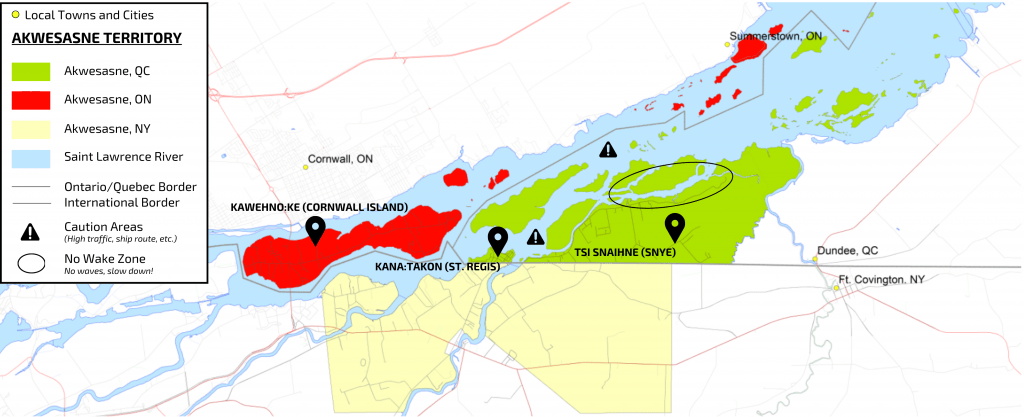
Akwesasne’ronon (the Kanien’ké:ha word for members of this Indigenous community) experience the insecurity, jurisdictional confusion, and exclusionary power of international border enforcement every day, since boundary lines zigzag irregularly through their land (Image 1). People joke about homes where the kitchen is in Canada and the living room is in the US, and relate far less amusing struggles over which problematic governing agreements dictate action on everything from commercial licenses to speeding tickets and the illegal trafficking of drugs, firearms, and human beings through the territory. As members of a sovereign First Nation recognized by both Canadian and US federal governments, Akwesasne’rono have special rights to move around their territory as needed without incident or incrimination. Unlike US or Canadian citizens—and with the exception of several designated crossings where there are special “express” lanes only accessible to Indigenous people with “native status” cards—Akwesasne’rono are not required to “check in” with officials when they traverse the border, not least since it would be impractical, often impossible to do so. But even people with all of their status documents in order have shared countless stories about being routinely questioned, detained, investigated, or otherwise inconvenienced—and reminded of their colonized Other-ness—by government agents on all sides. One community member with a status card even reported that he had to sit for several hours at a checkpoint one weekday after getting a medical X-ray, since agents detected radiation on him and classified it as suspicious and indicative of a potential security threat.
It is hardly news that even some of the most supposedly “friendly” and “porous” borders for some—especially persons privileged to have passports from globally powerful countries or other types of legitimating documentation—have long been places of anxiety, uncertainty, frustration, fear, paranoia, and terror for others, particularly people identified with groups facing prejudice and discrimination on the basis of indigeneity, nationality, race, religion, and other markers of cultural difference. Many in this latter category have become used to embodied experiences of sensing insecurity in a liminal space of exceptional, arbitrary, and mostly unchecked power meted out by state authority figures.
Recently however, and increasingly so, persons in the former (privileged) category, including myself, have begun sensing insecurity in borderlands as well. A stark case followed the re-election of Donald Trump as US President on a platform that included hard-line anti-immigrant and blatantly racist ideologies. Many have watched with horror as these ideologies play out in constant news streams about ICE (Immigration and Customs Enforcement) raids leading to the kidnapping and deportation of thousands of people across the US. Simultaneously, there are many stories circulating more or less publicly about increasingly arbitrary allegations of “anti-Americanism” and “national security threats” suspicions against persons who express dissent against or negative evaluations of some of the regime’s destructive and incoherent policies.
There are now many news accounts of foreign nationals getting caught up in the US immigration-detention dragnet since the beginning of 2025, sometimes allegedly due to procedural errors or miscommunications. Governments, NGOs, universities, business corporations, and others have been issuing travel warnings to their constituents, advising on how to respond to increased surveillance, search and seizure of electronic devices, denial of entry, and possible detention depending on one’s citizenship status. Stories have been circulating about people having their passports marked with a five-year ban from entering the US simply for being critical of the Trump regime. All of this is of course alarming for millions of people who have any sort of relationship with or reason to travel to the US. And it has dramatically shifted my own sense of in/security, even as someone with all of the (supposed) rights of US citizenship, and the privileges associated with being a well-educated descendent of white European settlers with no criminal record. Before traveling to the US, I now always anticipate interrogation. I carefully review the content of all of my devices; rehearse what I might say if questioned; and even give my children instructions on what (not) to say and do when we travel together. I have never been so anxious when passing through Canada-US border checkpoints, sometimes to the point of feeling physically ill, or unable to eat, bordering on panic attacks, even though I know “rationally” that I have done nothing wrong or anything that should warrant increased scrutiny or sanction.
My exponential increase in anxiety around crossing into the US is not simply speculative paranoia based on distant doomster social media stories and second-hand rumors. It emerges out of two specific circumstances related to expressed recognition of state violence. Foremost is a history of speaking out against occupation, apartheid, and genocide in Palestine/Israel (Bangstad 2025), to the extent that I have been profiled alongside thousands of others on the defamatory Canary Mission website with false charges of being antisemitic and pro-Hamas, and of allegedly supporting “terrorism”. I have viewed documented evidence of persons listed on this untrustworthy propaganda website being interrogated about it explicitly in secondary inspections at the US border; and in some cases, if someone was not a US citizen, they were reportedly banned and denied entry to the US. This is part of a larger pattern of the current US government’s weaponization of antisemitism as a smoke screen to try to bring universities and other institutions to heel with threats of rescinding of federal funding, canceling of work and study visas, and banning international student admissions as punishments or “warnings” for not falling in line with regime policies or allowing open protest of war crimes and atrocities. I admit to feeling afraid even now as I write this, and hope this will not cause harm in the future.
The other key factor that has amplified my sense of anticipatory insecurity about border crossings more generally relates back to my decades of research in India on police and security infrastructure. After some critical comments I made in independent media about harmful discriminatory policies and practices of the Hindutva (Hindu nationalist) government that has now been in power there for more than a decade, representatives from the Indian consulate came to my house in Toronto and issued me a “show cause notice”, criminalizing me for alleged “anti-national” activities that violate “the sovereignty and integrity of India”, and accusing me of “clandestine activities” in relation to my research. The charges are as absurd as they are baseless, and a Delhi-based lawyer has done their best to set me up well to fight these allegations in court as needed. But the government’s strategy of harassment and intimidation has compelled me to self-censor. While I still write candidly in scholarly sources about my research, I am more hesitant to respond to inquiries from journalists requesting comments on politically sensitive matters. And while many friends and colleagues already know about this old “news” of my essentially being blacklisted from a place I have considered another home for decades, this is the first time that I’m sharing it publicly in writing, more than three years after state officials first darkened my doorstep. Meanwhile, I have not attempted to return to India, even though I technically still have what is known as OCI (Overseas Citizenship of India) status. I have read and heard about many stories of other persons with this status having their cards revoked, and I fear arriving at that airport—where, recall, I was once able to bypass the long lines of foreign passport holders even though I had never before set foot in the country—only to be deported immediately, like other colleagues who have been unfortunately caught up in the Indian government’s dragnet of nationalistic hyper-securitization.
This is how state harassment and repression of dissent have always worked, of course; through instilling generalized suspicion along ideological divides, engendering amorphous anxiety that accumulates like moss, and shapeshifts into intensified fear and paranoia that spreads like a contagion. Rapidly changing technological capacities aside, most of the routine and exceptional tactics, strategies, and outcomes of potential and actual state violence are not new. But their sensory impact on new populations, and in relation to US power specifically, indicates substantive and seismic shifts. One key feature of these shifts is the increasingly blurry “border” between a palpable fear of mere “inconvenience” (perhaps I’ll miss a flight, or my phone will be seized at the border and I won’t ever get it back) versus the probability of a seriously harmful impact on peoples’ lives (perhaps I’ll be detained indefinitely, or they’ll do a full forensic image of my seized device that will lead to serious legal or financial complications, never mind the violations of privacy). Scaling up and out, it also seems that we are witnessing significant realignments and sea changes in the global order of political economic power, heretofore dominated by the US through what some have called “empire” in the post 1945-era.
Returning to El Akkad’s reflections, he acknowledges that as someone with the privilege of Canadian citizenship, his border-crossing fears have been, if not “silly” (his word), then still mostly about trying to ensure “as few headaches as possible” and to prevent the potential hassle of losing time, money, or equipment. For me as a dual citizen, I would like to continue to feel that the worst I might suffer at the Canada-US border is a short period of detention until I could obtain legal representation. But there is a growing sense that what appears to be intensified and unpredictable border interrogations of anyone and everyone—not just the “usual suspects”, which of course has always been “unjust”—may only get worse, and that the “normal” national and international legal protections may not hold, such that even citizens who don’t protest too much may be subject to extraordinary rendition. It feels like I now know more people than not who express some version of this fear on a regular basis, and especially in the lead up to a trip crossing the US border—or in a decision to avoid going to the US altogether, which also now seems far more common. The boundary between nuisance and violence has become more than a little insecure.
The (again) not new or unique, and yet intensified and arguably more-prevalent-than-ever, sense of insecurity around crossing borders into the US is also indicative of concerns well beyond just mobility and migration. It indexes the decline and fall of political economic forms and cultural ways of life that many people, including some of the wealthiest and heretofore well-protected and well-served by the US-led global order, have long enjoyed and don’t want to let go. Among other touchstones of security, it seems that US-based global and national governing institutions, free speech, legal and regulatory bodies, human and civil rights, social services, educational opportunities, and trust in mediated knowledge production are disintegrating across the board. Many try to go on as before, hoping for a savior in litigation, legislation, or perhaps a new leader, assuming the next US national election occurs on schedule. This mass tendency to “keep calm and carry on” seems to have a deeper sensory structure than mere maintenance of morale in the face of widespread and ongoing degeneration. Perhaps it exhibits something more akin to what Alexei Yurchak (2005) has called “hypernormalization” in the context of the end of Soviet Russia, wherein people expressed a strong sense that things would always continue as they had, even as their world was falling apart around them. I cannot predict with any precision the long-term or even immediate future of the US-led Global Order. But the fluctuations and increasing sense of creeping dread and acute terror that I now feel every time I approach the border of the country of my birth signify the insecurity, if not the complete implosion, of so much that so many of us have always thought to be true and trusted.
Beatrice Jauregui is Associate Professor at the University of Toronto Centre for Criminology and Sociolegal Studies. She is author of Provisional Authority: Police, Order, and Security in India and co-editor of the Sage Handbook of Global Policing and Anthropology and Global Counterinsurgency.
References
Bangstad, Sindre 2025. “The IHRA Working Definition of Antisemitism and Academic Freedom” Focaalblog 28 March, https://www.focaalblog.com/2025/03/28/sindre-bangstad-the-ihra-working-definition-of-antisemitism-and-academic-freedom/
Yurchak, Alexei. 2005. Everything Was Forever Until It Was No More. The Last Soviet Generation. Princeton University Press.
Cite as: Jauregui, B. 2025. “Anxious Anticipations: Border-crossing In/security and the Implosion of the US-led Global Order” Focaalblog December 22. https://www.focaalblog.com/2025/12/22/beatrice-jauregui-anxious-anticipations-border-crossing-in-security-and-the-implosion-of-the-us-led-global-order/