No, dear Rira,
my letter must be short,
must be simple,
with no talk of ambiguity or mirrors.
I will write to you again:
We are all well—
but do not believe me.(Ali Salehi, Iranian poet)
The Sense of an Ending — April 26, 2025
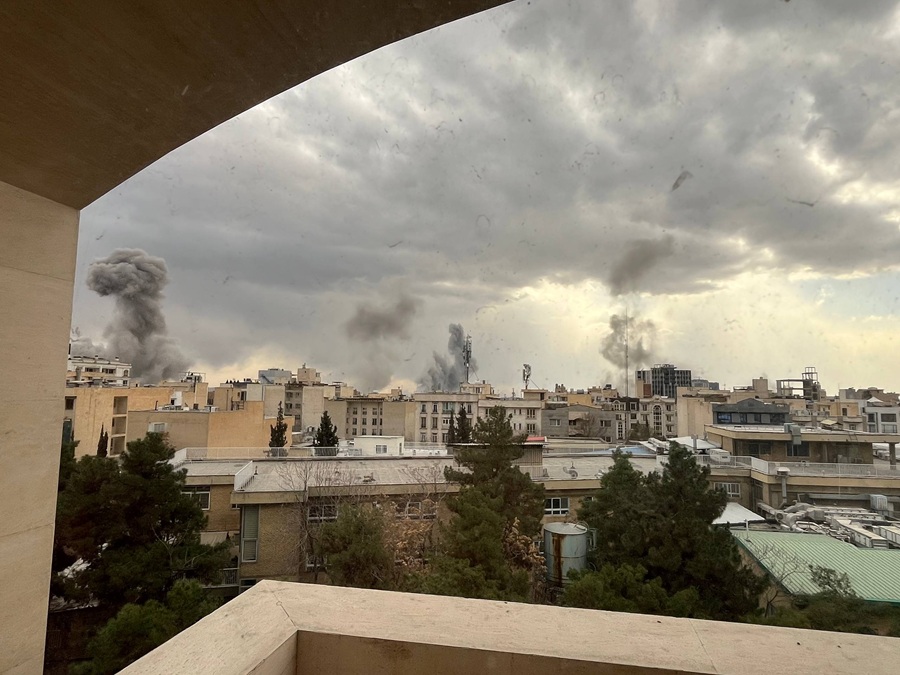
Thick black smoke is rising over the port of Bandar Abbas, where Iran’s largest port is located. A massive explosion has just torn through the area. Authorities urge people to stay indoors, warning of airborne toxins possibly spreading across the city.
We’re watching a local TV station livestream the explosion site. Ambulances move back and forth, firefighters enter and leave the frame, and there is a constant stream of water aimed at the large black billows rising into the sky. “War must be really scary. I’ve thought about it often, for a long time. But yesterday, I realised war is truly terrifying,” Javid tells me. Although we were born during the Iran-Iraq War in the 1980s, we have no clear recollection of the bombings and explosions.
Despite the shock of yesterday, friends call, describing an eerie stillness in the city. The blast was so powerful it shook windows; many initially thought it was an earthquake—a frequent occurrence in this part of Iran. Speculation runs rampant: some fear sabotage by Israel, recalling the devastating 2020 Beirut blast; others blame incompetence by the corrupt regime. The only shared certainty in this divided society is the overwhelming reality of the explosion itself and how devastatingly powerful it was.
I had landed in Bandar Abbas just hours earlier, flying from Tehran. The plane was old, part of Iran’s aging air fleet, historically hampered by years of Western sanctions. Its engines rattled and the seats were worn out, but it got us here. Like much of Iran’s infrastructure, it was fragile, underfunded, yet stubbornly functional. Whatever that means.
Julian Barnes’ book title The Sense of an Ending keeps coming to mind. The explosion feels like a prelude to war, echoing the trajectory of Beirut: first the port explosion in 2020, then full-scale conflict.
Yet my sense of looming catastrophe doesn’t fully align with the general mood of those around me. My family continues to rely heavily on the healthcare system. My mother visits the hospital twice a week for kidney dialysis. Another relative is undergoing cancer treatment. They return home relieved, even cheerful, knowing most of their medical expenses are still covered by public insurance. People persist in their routines, driving their children from school to the gym to music lessons. They adapt. They press on. Rent consumes an entire salary. I keep asking nearly everyone I meet how they make ends meet. Hardly anyone knows precisely how daily life holds together. Nothing quite works, yet everything somehow remains in place. Politically, the atmosphere feels similarly precarious.
In many respects, Iran seems to be experiencing a rare period of calm. For now, a delicate peace holds between the state and society. In Tehran, women without hijabs walk openly through the streets. At night, new cafés buzz with conversation, laughter, and young people lingering into the late hours. A cautious optimism lingers in the air.
Iran and the U.S, the archenemies for over four decades, appear closer than ever to resolving their hostilities. Iran might agree to curb its nuclear ambitions, while the U.S. is expected not only to lift sanctions but also to commit billions of dollars in investment. Such steps would strongly reassure Iran that the U.S. won’t abruptly withdraw again, as it did in 2018 when the Trump administration unilaterally abandoned the JCPOA—the nuclear agreement meticulously negotiated during President Obama’s administration.
The Blown Up Table — June 13, 2025
Except it wasn’t.
Israel launched an unprovoked assault on Iran. In the first few minutes, several high-ranking military commanders and nuclear scientists were assassinated. At that moment, Iran and the U.S. were gearing up for the sixth round of indirect negotiations, with Oman serving as intermediary. Looking back, it is easy to believe the growing reports that the U.S.-initiated talks were a cover for Israel’s surprise attack.
The assault began exactly on the sixty-first day of the two-month deadline Trump had set earlier in a letter to Iran’s Supreme Leader. On June 20, days after Iran’s renewed discussions with the European powers—Germany, the UK, and France—the U.S. joined the Israeli offensive. The U.S. bombed three main nuclear facilities. Other targets included security command centers and the so-called “centers of oppression”—among them Basij bases, where I had conducted fieldwork since 2015. These sites range from military compounds to humble bureaucratic offices dispersed throughout neighborhoods. They form a sprawling network under the Revolutionary Guards’ control. For years, these bases played a crucial role in surveilling ordinary citizens, especially during unrest. Now, they are under bombardment, just like military bases, the notorious Evin prison, and state TV headquarters.
They claim it is a liberatory act—aiming to set the Iranian people free. How strangely familiar this rhetoric sounds. The Iraqi invasion déjà vu.
5. Politics of Rightful Killing — June 21, 2025
An old woman in her seventies darts across a shopping store in Berlin, shouting to her companion in Farsi: “Look, good news. Israel has continued the bombing of Iran.” She is referring to events that unfolded just hours after the announcement of a ceasefire between Israel and Iran, brokered by the U.S. and Qatar. News circulating on social media reports that the Israeli government instructed a fleet of jets to bomb targets in Iran, allegedly in response to a missile launched from Iran into Israel shortly after the ceasefire began.
A sense of disgust washes over me. Nausea, as Sartre describes it.
In a second episode that day, a friend calls and asks for advice on how to respond to a voice message she has just received. The internet has finally come back after the ceasefire. The message explains that the sender had to rush back to Iran—despite the closure of the airspace—for the funeral of his brother. “He passed away,” the voice says, referring to one of the recent attacks. My friend tells me she has no idea how to respond to the message from her colleague. “Was her brother a member of the security forces in Iran?” she asks. She explains that her colleague had once hinted at her family’s involvement and alignment with the Iranian regime. “Now,” she continues, “I wonder how to respond. If her brother was part of the regime, wouldn’t he have been involved in the mass oppression and killing of protesters just a couple of years ago?”
I suggest she let it go—for now. People from all walks of life were killed in the attacks. I tell her to focus on the simple fact that her colleague has lost a brother. Just offer condolences.
She agrees, reluctantly, and ends the conversation with a quiet question: “In the absence of the regime, how would people treat those who aligned with it?”
Resentment runs deep, and revenge seems to be the only instinct left in our repertoire. Some call it the politics of rightful killing.
6. Snapback- 28 August 2025
All U.N. sanctions have been reimposed, one of the harshest sanctions regimes laid against any country. Iran has already been under Western-imposed sanctions for decades. It is not yet clear what the effect is going to be.
7. Lottery — January 12, 2026
It is Monday evening. My phone finally rang. It is my sister’s voice. It has been more than four days of complete blackout. No internet in Iran, no chance to call family back home from abroad. Videos of dead bodies under black covers in the central morgue of Kahriyak in Tehran have been trickling in since Saturday. Those of us abroad with internet have been searching for loved ones in the videos. Someone has smuggled the video out, and then shared it on a Telegram channel. Hundreds of dead bodies have been laid out in the yards of the morgue, and many more are lined up in the compound. I have paused and replayed the videos many times, checking to see if there is a familiar face.
In this total communication darkness, there are reports from Persian-speaking TV channels giving mounting numbers of the murdered. They were all killed with live ammunition on the 8th and 9th of January. Shortly after the beginning of massive protests on the streets of Iran and the internet shutdown, the security forces, the Basij, and members of the Revolutionary Guards Corps, in a coordinated act, opened fire.
There were Mossad agents among the protesters. This is what the Iranian state claims. No one knows. The number of dead keeps piling up, by thousands. From the morning of January 12, we know that phones are being restored, and some people on social media say that their families were able to call them from Iran. No word from Tehran yet—does this mean that we have lost a loved one? “It is a lottery,” a friend in Berlin tells me on the phone, waiting impatiently for a call from inside Iran. “When you receive the call, you will ask, ‘Is everyone safe?’ You may hear yes or no. Even if you hear a yes, you are sure that many will hear a no.”
8. Stockpile — February 27, 2026
“We are going to be fine,” my brother tells me. “They will reach an agreement at the last minute. Badr bin Hamad Al Busaidi is in Washington to offer what the U.S. wants.”
“We have stockpiled food for a few weeks,” my brother tells me. “But we have already eaten half of it,” my sister says in the background. “It’s been two months since Trump has wanted to make his decision.”
It is not clear if Iran is refusing to hand in its highly enriched uranium to the US, or according to Badr bin Hamad Al Busaidi, the Omani foreign minister and mediator, Iran has accepted ‘zero stockpile.’
9. Having a Blast? — February 28, 2026
They blew up the negotiating table again. The supreme leader, Ali Khamenei, is dead.
I have to confess that for over thirty years, every Newruz, the Iranian new year that happens on 20 March, when all family members rush to come together and make a wish during the countdown, I too always rushed, my mind bubbling, not knowing what I had to wish for. In that moment of chaos, I always wished that this year Khamenei would be dead.
Until the year 1404. This year, I joked to my German friends who are visiting us: “This year I’m not going to wish for his death. For thirty years it was not granted. I won’t do it this year, and maybe that will make my wish come true.”
In the evening of 28 February, it is Netanyahu first, and then Trump, who confirm Khamenei’s death. After several hours, Iranian outlets confirm it too. I have a whirlwind of emotions. There are videos of some Iranians having a blast on the streets. There are other videos of a school ruined by several blasts by the US-Israeli strikes. There are 21 days left until Newruz.
We are only 24 hours into the U.S.-Israel war against Iran. I am not sure when the war will end. The consequences are deeply uncertain and potentially chaotic. Violent chaos may very well be the only true objective Trump and Netanyahu have for this country.
Ahmad Moradi is a Senior Research Fellow at the Leibniz-Zentrum Moderner Orient in Berlin. He has conducted ethnographic research with the paramilitary organization of the Basij, as well as with Afghan refugees in Iran who fought in the Syrian civil war and were wounded there. His broader research interests include revolutionary politics and the politics of care in contexts of protracted conflict and displacement in the Middle East.
Cite as: Moradi, A. 2026. “Iran, Year 1404: Chronicles of Planned Chaos” Focaalblog March 5. https://www.focaalblog.com/2026/03/05/ahmad-moradi-iran-year-1404-chronicles-of-planned-chaos/
Discover more from FocaalBlog
Subscribe to get the latest posts sent to your email.