
Tag Archives: welfare

Maja Sisnowski: Gut Feeling, Adrenaline and Fried Onions: Sensing Aggression in German Health and Welfare Services

Image 1: Bunk beds in shared accommodation. Photo by Luistxo

“I don’t know how to explain it”, Caro told me in an interview, “but you develop a sense [Gespür] for when you can keep standing in front of the person, because you know: Okay, they are going to shout at you for ten minutes, and then they have used the valve that they needed. And then there are situations where you feel: Okay, I better take a step back, because it might not stay like that.”

Caro was working in one of several emergency shelters in which I observed, participated in daily tasks, and interviewed staff members as part of an ethnographic study on de-escalation practices in German health and welfare services. De-escalation is a common answer in health and welfare facilities to the question of how staff should react to aggressive behavior in a professional setting. My research project asks how de-escalation is promoted as a workplace safety measure, how it is learned and taught in de-escalation training, and how it is practiced on the ground – specifically in overnight emergency shelters for unhoused people in Berlin.

A remarkable aspect of de-escalation, especially in the context of health and welfare settings, is that it approaches aggression at a conflux of care and security practices. Many of my interlocutors, staff members in shelters and de-escalation trainers alike, understood aggression in health and welfare contexts as both potentially dangerous and as a stress response in need of caring intervention. This understanding appears even in the minute sensitivities, such as the awareness of interpersonal space, that Caro brought to situations with palpable tension: she considered both the potential needs of the other person to express frustration and the risk of the argument turning physical. For Caro as for other staff members, sensing aggression in the shelter environment was an integral part of their job. At the same time, their daily work was not in fact defined as security work, but revolved around issues such as organizing food, clothing, and access to places to sleep. In this blog post, I trace how aggression is sensed in the shelters to show how the sensing of in/security is entangled with institutional care and welfare provision.

Security, following Laufenberg and Thompson (2022) and the long line of feminist, anti-racist and abolitionist thinkers they draw on, is a powerful and expansive formation of governance, deeply intertwined with capitalist modes of producing crisis and insecurity. A critical analysis of security asks what versions of security and safety are being produced, whose safety is prioritized, and who is constructed as a threat. Such questions are integral to studying how aggression is sensed and encountered, given the uneven attribution of aggression in conjunction with the production of gendered, racialized, classed and dis/abled difference (Longino 2013; Metzl 2011; Rollins 2021; Chen 2023). In the context of health and social welfare services, the production of difference in relation to aggression is also enmeshed with the apprehension and management of aggression in institutional spaces, especially those designated for particular populations, such as homeless people. Tracing how emergency shelter staff senses aggression can help articulate how aggression is present in institutional spaces, and how it is apprehended in caring and securitizing registers.

A Situated Sensorium for Aggression

The shelters in my research formed part of a perpetually precarious and semi-professional emergency service meant to protect people from cold-related harm at night. They were usually sought out by people who could not access housing and were excluded from or rendered precarious within Germany’s regular social support system. Winter emergency shelters require people to eat and sleep in shared, crowded and regulated spaces that are usually only open during the winter months and during the night. Responsible for enforcing the rules of shelter space, shelter staff were also tasked with keeping the space “free of violence”. This entailed intervening in case of conflict and asking people who were violent to leave the premises. In many shelters, this was done in cooperation with externally hired security staff. In this context, many staff members told me that they were attentive to loud voices to detect a potentially escalating situation. Susanne shared:

When I sit in the office for example, or also at night when I sleep there, then I always listen a lot to what is happening. So I hear when people are having a conversation, and I really pay attention to whether someone is raising their voice, and then I always have to wait whether that is part of the conversation, because someone is telling a story, or whether that is because a conflict is happening.

Aggression, in other words, was not simply heard, it was actively listened for. This active sensing was not practiced in isolation, but in a particular spatial arrangement and within an institutional context where staff could not be everywhere all at once yet bore responsibility to intervene when someone showed aggressive behavior. Sensing aggression, this example shows, is a matter of practice, to be distinguished from the idea of sensing as a passive perception of a given object which comes to the senses. While people in my research certainly had different sensitivities and attunements to aggression, there were commonalities as well, shaped by institutional roles– one could call it a situated sensorium. Notably, as with the sensitivity for raised voices, this sensing of aggression amidst everyday interactions such as a loud conversation also constituted a form of low-tech surveillance in the shelters.

Sensing Stress, Constituting Risk

A situated sensorium encompasses multiple sensitivities, for sounds, touch, embodied states, and institutional routines and atmospheres. Another staff member, when I asked if escalating situations could be sensed beforehand, explained:

Yes, when an argument blows up a bit, then you can hear from the kitchen that it’s somehow getting louder in the eating area, then yes. Of course adrenaline enters into it as well: “Oh God, I’ll go check what is going on there.”

As “adrenaline enters into it”, this staff member’s description introduces a sense of her own embodied response. The sensorial repertoire of sensing aggression in the shelter importantly included such interoceptive sensitivities. Adrenaline was one shorthand way of describing physical sensations of stress (Roberts 2024) to be sensed in oneself, but potentially also in others. Interestingly, adrenaline itself is given agency in this description, causing an impulse to go and check out what the noise is about. Several staff members explained how being aware of their own stress was important for them to be effective de-escalators, and de-escalation training would usually sensitize participants to the signs that they themselves were under stress.

But even more central to staff members was the stress of others. They often described having an awareness for people’s moods as well as for more general atmospheres. They sensed risks of aggression in long waiting times in cold weather, cramped spaces, interrupted sleep, and the small violences of what Goffman has aptly called “batch living” (Goffman 1961 [2022], 10) remarking that certain experiences would make them angry and impatient, too. This sensitivity, I would argue, renders aggression palpable as material-semiotically constituted risk in the institutional space of the shelters, not simply monitored and managed, but also related to vital needs such as sleep, warmth and dignity.

Dis/orienting Gut Feelings

Another register of interoceptive sensing within staff’s situated sensorium, and one I encountered frequently in my research, was gut feeling. Like adrenaline and stress, gut feeling presents as an internal sensation, metaphorically sitting in the pit of the stomach. Akin to the sense [Gespür] that Caro described, gut feeling and related notions were used by research participants to describe modes of knowing that, being grounded in experience and context, resisted articulation in general terms. In the realm of police work, the use of neurobiological discourse (Keesman 2022), as well as reliance on experiential knowledge (Abdul-Rahman et al. 2020, 34) has been critically analyzed as to how it can function as a refusal of articulation and accountability (see also Elbek 2025). In my research, where staff had markedly different mandates and powers, gut feeling served to denote a sense of being oriented and secure in one’s fast and intuitive assessments. In this vein, for example, several staff members explained that they would tell new colleagues to rely on and follow their gut feeling, especially to sense whether a situation was dangerous.

For me as a researcher, gut feeling became especially tangible when I noticed my own senses of in/security morph and shift throughout my research. This happened for example when I moved from a small shelter where I had previously worked to larger shelters with more security staff, or when I noticed myself grow impractically sensitive to the risk of aggression after participant observation in a great number of de-escalation training sessions. Having prior work experience in a shelter, these small disorientations made me aware of how much I did rely in practice on a well-working gut feeling, but they also gave me an embodied notion of how senses of in/security are grounded in specific social arrangements.

Entanglements of Care and Security

Importantly, within the context of the shelter environment, as well as in de-escalation training, I also came across registers of sensing in/security that were not oriented towards sensing danger. When I asked Britta about whether escalating situations announced themselves beforehand, our conversation turned to food:

When [people] know good food is coming, they are looking forward to it. But when it’s announced that there is rice…or couscous…! (Laughter). We are not friends anymore then. […] The first time in my life, I was homesick because I was on a trip and the food was bad […] One time, I was frying onions for dinner, really a lot of onions. And onions always smell so incredibly delicious. And then, [X] came in, and said: (sniffing the air) Home, sweet Home. Polska. Or something like it, he signaled that it smells like home […] And that’s a good feeling, because I think everyone knows this, some smells are just familiar and the smell of fried onions brings humanity together. (Laughter)

Throughout my research, I came not only across sensitivities towards danger and risk, but also encountered sensitivities to smells, tastes, or touch, that feel safe or give a sense of home, connection or pleasure. Including such sensitivities in a sensorium for in/security sheds light on entanglements of care and security while also opening possibilities of thinking security beyond efforts of securitization and surveillance. Laufenberg and Thompson describe how abolitionist and care-ethical criticisms of contemporary security regimes attempt to redefine security: “In this vein, not more carceral security – and hence more police, more punishment, more surveillance and more sealing of borders – is the appropriate answer to (social) insecurity, but more care – and thus more resonance, connection, and responsivity, more care, responsibility and solidarity.” (Laufenberg and Thompson 2022, 32, my translation).

What, against this backdrop, does it mean to grow sensitive to loud voices, to prize gut feeling, sense adrenaline, and smell the fried onions?

For one, attending to staff’s situated sensorium for aggression in the shelters highlights the ambivalences and confluences of care and security within the asymmetrical power relations of institutional encounters. It shows subtle ways in which policing and securitization is present in spaces of care or welfare provision. At the same time, I suggest, this sensorium can be read as reaching – without being able to transcend its institutional context – for ways of feeling safe beyond carceral security.


Maja Sisnowski is a PhD candidate with the Health, Care and the Body research group at the University of Amsterdam. Her research interests move in the fields of feminist science and technology studies, critical disability studies, care and security.


References

Abdul-Rahman, Laila; Espín Grau, Hannah; Klaus, Luise and Tobias Singelnstein. 2020: Rassismus und Diskriminierungserfahrungen im Kontext polizeilicher Gewaltausübung. Zweiter Zwischenbericht zum Forschungsprojekt „Körperverletzung im Amt durch Poli-zeibeamt*innen“ (KviAPol). Ruhr-Universität Bochum, 11.11.2020, https://kviapol.rub.de.

Chen, Mel Y. 2023. Intoxicated: Race, Disability, and Chemical Intimacy across Empire. Anima: Critical Race Studies Otherwise. Durham: Duke University Press. doi:10.1215/9781478027447.

Elbek, Laust Lund. 2025. “Sniffing Out Trouble? What and How The ‘Police Nose’ Smells.” FocaalBlog, December 24 https://www.focaalblog.com/2025/12/24/laust-lund-elbek-sniffing-out-trouble-what-and-how-the-police-nose-smells/

Goffman, Erving. 1961 [2022]. Asylums: Essays on the Social Situation of Mental Patients and Other Inmates. Penguin Modern Classics. Penguin Books.

Keesman, Laura Danique. 2022. “Primordial Brains and Bodies: How Neurobiological Discourses Shape Policing Experiences.” Body & Society 28 (4): 80–105. doi:10.1177/1357034X221134440.

Laufenberg, Mike, and Vanessa Eileen Thompson, eds. 2022. Sicherheit: rassismuskritische und feministische Beiträge. 1. Auflage. Forum Frauen- und Geschlechterforschung, Band 49. Münster: Westfälisches Dampfboot.

Longino, Helen E. 2013. Studying Human Behavior: How Scientists Investigate Aggression and Sexuality. Chicago: The University of Chicago Press.

Metzl, Jonathan Michel. 2011. The Protest Psychosis: How Schizophrenia Became a Black Disease. Boston, Mass: Beacon.

Roberts, Celia. 2024. “Adrenaline.” In Hormonal Theory: A Rebellious Glossary, edited by Andrea Ford, Roslyn Malcom, Sonja Erikainen, Lisa Raeder, and Celia Roberts, 15–23. Bloomsbury UK.

Rollins, Oliver. 2021. Conviction: The Making and Unmaking of the Violent Brain. Stanford, California: Stanford University Press.


Cite as: Sisnowski, M. 2025. “Gut Feeling, Adrenaline and Fried Onions: Sensing Aggression in German Health and Welfare Services” Focaalblog January 24. https://www.focaalblog.com/2026/01/23/maja-sisnowski-gut-feeling-adrenaline-and-fried-onions-sensing-aggression-in-german-health-and-welfare-services/
Janne Heederik: The Voluntarisation of Welfare in Manchester: A Blessing and a Burden

This post is part of a feature on “Urban Struggles,” moderated and edited by Raúl Acosta (LMU Munich), Flávio Eiró (Radboud University Nijmegen), Insa Koch (LSE) and Martijn Koster (Radboud University Nijmegen).

As a result of welfare reform and continuing budget cuts, social service agencies in the UK have struggled to make ends meet and match the still-growing demand on their services. Local councils and the voluntary sector have both suffered cuts. The former are increasingly looking to the voluntary sector for help, while the latter used to rely heavily on grants from statutory bodies and suffers from increased funding restrictions. In the context of welfare reform, a model of active citizenship and participation has emerged. This model focuses on decreasing citizen dependence on welfare and social services while encouraging the ‘responsibilisation’ of citizens (Verhoeven & Tonkens, 2013). This policy agenda, supported by successive UK governments, has painted a picture of the ‘active citizen’ as a solution and improvement to the budget cuts in the voluntary sector. Citizens are encouraged to ‘take more responsibility’ instead of ‘depending on remote and impersonal bureaucracies’. As part of this responsibilisation, volunteers have taken center stage and their positive impact on communities is emphasized and celebrated (Schinkel & Van Houdt, 2010). Volunteers play an increasingly crucial role in welfare provision and the welfare system relies heavily on their work.

The extent of this reliance became clear during my fieldwork in Manchester in 2018 – 2019. I conducted ethnographic fieldwork in Manchester for 16 months, during which I worked with several advice centers in Greater Manchester. In November 2018, I attended a ‘Volunteer Day’ organized by the advice center I had been volunteering at for the past year. This annual event celebrates volunteers and gives paid staff and management a chance to thank volunteers for their work and commitment. The day was opened by a speech from Jack Puller, member of the charity Manchester Alliance for Community Care (MACC), who ‘supports and encourages local people to be active citizens through volunteering and other forms of participation’. His speech focused on impact and how to measure it. In numbers, he states that more than 110,000 people in Manchester volunteer, putting in a total of 278,000 hours of work each week, and having a total worth of 252 million pounds. Puller also mentioned that impact cannot be measured in numbers alone. Volunteers are vital to social services, arguing that they reflect the spirit of Manchester and are crucial to the existence of places like the advice center.

While this still presents a positive image of the impact of volunteering, the reality is that many advice centers can no longer survive without volunteers and there is a constant need for more volunteers to fill the gaps in advice services. Advice centers, along with other social services, have suffered from a ‘double squeeze’:  a withdrawal of public services has led to an increase in demand, while they simultaneously have to work with shrinking budgets (Evans, 2017). As a result, many depend on the work of volunteers more than before and even then, many fail to meet the demand and have to send people looking for their help away on a daily basis, as I experienced during fieldwork. Voluntarism in British welfare provision is thus not as straightforward and romantic as Puller depicted it, and both volunteers and paid advisers often struggle to navigate their workload and the relationship between them. The double squeeze on advice centers has not only made them more dependent on volunteers but has also changed the role of volunteers, who have become central more in the advice centers. In this contribution, I further analyze how the dependence on volunteers has changed their role within advice centers, showing how this affects the relationships between paid advisers and volunteers and analyzing how narratives of active citizenship often translate into different realities. Specifically, I lay bare how a politics of austerity has resulted in a paradoxical relationship with volunteers, where they are perceived as both a blessing and a burden.

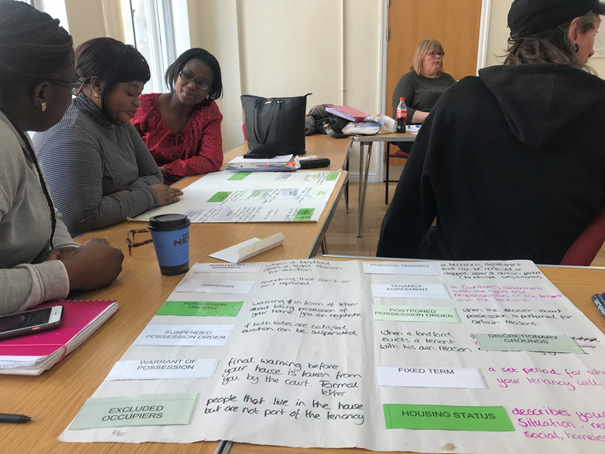
Many social services, including advice centers, have aimed to bridge the growing gap between demand and capacity by relying more heavily on the work of volunteers, with some advice centers I worked with even being completely volunteer-run. This gap is usually characterized as a gap in more professional work, where paid advisers can no longer cover all their tasks due to lack of time and resources. As a result, the growing reliance on volunteers in the provision of social services is also characterized by the increasingly professional nature of the work volunteers do. As Verhoeven and Bochove note, volunteers are now expected to do more than provide complimentary work to the work paid advisers do, they are increasingly expected to take over parts of the paid advisers’ responsibilities, referred to as the ‘volunteer responsibilisation’ (Verhoeven & Van Bochove, 2018). However, my fieldwork showed that many volunteers are underprepared when they first start their work and are not able to carry out those responsibilities, which complicates the working dynamics at the center. At an advice center in the North of Manchester, where about two thirds of staff members are volunteers, all prospective volunteers must attend a training program to prepare them for volunteer responsibilities. I volunteered here as well and attended the 9-week training program, with one training day a week. The training aimed to prepare volunteers for both the practical and emotional labor ahead of them, but often proved insufficient once volunteers started their voluntary activities at the advice center. The large majority of volunteers felt underprepared for the complexities and intensities of advice work. For example, a former volunteer named Susan told me that she enjoyed helping clients with more straightforward form-filling, but struggled with more complex cases. For her, it resulted in high levels of anxiety and guilt, to the extent that she eventually stopped volunteering as an adviser. ‘It felt like I was just sitting there with my hands cut off, watching someone in front of me die’, she told me.

Figure 1: Volunteers during their weekly training on the welfare system and advice sector (photo: Janne Heederik, 2018)

Welfare advisers often have to deal with difficult and complex situations, with their clients struggling to make ends meet and often coming to the advice center feeling desperate and upset. It is the task of advisers to guide their clients through the welfare system, approach authorities on their behalf, and manage benefit outcomes to their best ability. However, the welfare system has grown increasingly complex, and advisers often have to engage in a ‘complex web of relations’ to assist their client (Forbess & James, 2014:80). For volunteers like Susan, the practical skills and emotional labor required to do good advice work, often feel like too big a responsibility to carry. Similarly, during my time as a volunteer at this advice center, I had to help clients who were about to be evicted, clients who had lost all their income, clients who had escaped abusive relationships, and clients who were depressed and sometimes even suicidal. While the training program provides basic information on how the welfare system operates and how advisers navigate it, these intricacies of advice-giving are too complex to teach in a course. Many volunteers, like Susan, are in need of more guidance, but more often than not volunteers are thrown into the deep-end and have to cover tasks previously done by professionals. Unlike their paid colleagues, however, they have to do without the financial or practical support: they do not receive monetary pay, nor do they receive the proper training to teach them how to deal with the complex client cases and the emotional labor that comes with it. In addition, the high demand and the lack of space, time, and resources, means that there is little time to process such events. Volunteers I spoke to often felt alone in dealing with some of the hardship they were faced with when seeing clients. One volunteer described how he often felt inadequate and how this resulted in him researching ongoing developments and policy changes at home:

I feel like I am always at the limits of my knowledge, and I already know a lot more than the average person. Volunteers like me have to put in a lot of time. You don’t just do your hours here. I often have to research stuff at home too.

Whilst active citizenship is thus envisioned as an enriching and fulfilling experience, for many volunteers this is only part of the story. The work they take on is more intense and demanding then initially anticipated and some volunteers struggle with the pressure they feel to respond to the demand adequately. These high expectations of volunteer work and the contradictory lack of training and preparation imply that volunteers can no longer be seen as amateurs supporting social services, but as professionals who deliver unpaid yet essential work (Coule & Bennett, 2018; Verhoeven & Van Bochove, 2018). It is an attempt for voluntarism to strengthen the welfare system despite reform and budget cuts, but it falls short in its assumption that welfare advice can be done by anyone at any time.  

Advice centers thus need volunteers to fill certain gaps in their work capacity, but at the same time struggle with the knowledge that volunteers often cannot fill these gaps with the same level of professionalism as paid advisers. Volunteers often turn to paid advisers for both practical and emotional support. Advisers might have to jump in or even take over appointments from volunteers who are unable to help their clients sufficiently. The manager of one of the advice centers expressed her concern regarding the center’s reliance on volunteers, stating it worried her that ‘this type of work is done by volunteers. Such overly complicated issues like almost all benefit cases rely on volunteers’. She worried for the clients, who might not get the right help if volunteers tried to solve client’s cases on their own, but was equally worried about volunteers and whether they were able to cope. Furthermore, often having to rely on assistance from paid advisers, the use of volunteers within advice centers often leads to an increase in workload for paid advisers. This leads to a paradoxical situation, where advisers must rely on volunteers for the survival of the advice center, but at the same time experience an increase in their workload as many volunteers need guidance and training.

This paradox is further complicated by the fact that relying on volunteers always comes with certain levels of insecurity as volunteers are not bound to contracts and employment conditions like paid advisers are. The turnover of volunteers was high at all the advice centers I visited, with volunteers staying anywhere between weeks and months, but rarely longer than a year. Additionally, coming from a wide variety of backgrounds, volunteers often had a wide range of skills and abilities, meaning not every volunteer could handle the same tasks and paid advisers spent a lot of time figuring out what volunteer would cover which task.

For permanent staff and management, relying on volunteers is thus necessary for the survival of the advice center, but never easy. And it can at times be burdensome. Volunteers cannot fulfill certain roles and end up sitting around and doing nothing, while at the same time there is never enough staff to do everything that needs doing. As a result, staff end up having to spend more time helping volunteers then they might gain form their presence. This situation forces paid advisers to engage in ‘volunteer management’ (Verhoeven & Van Bochove, 2018). Volunteer management involves the dividing of tasks among volunteers according to their skills and abilities, keeping track of who will be present on what day and making sure volunteers are spread out evenly across the week, checking in with volunteers to make sure they can cope with the demand and emotional labor of their work, and assisting volunteers in their work whenever necessary.

In addition, volunteer management also impacts the relationship between volunteers and advisers. Dividing tasks among volunteers often resulted in an unequal distribution of tasks, where more highly educated or experienced volunteers would be given many and more complex tasks, whereas other volunteers struggled to get any tasks at all. During a volunteer meeting at one of the advice centers, volunteers had the chance to raise any questions or issues they had. One volunteer mentioned an incident where she had been asked to see a client, but she did not feel comfortable taking on the tasks as she felt unqualified to deal with the complexity of the client’s case. Another volunteer had offered to step in, but the adviser assigning the task would not listen. ‘I was essentially told to just get on with it’, the volunteer said, adding that it had made her feel very uncomfortable and hesitant to ask the adviser for any tasks in the future. Volunteers who were given more complex tasks mentioned that they often felt they were not prepared for the difficulties of these cases, and struggled to deal with them emotionally and practically. On the other hand, volunteers who struggled to stay busy, mentioned that they were bored, could not develop their skills, and felt they could not help as much as they had wanted to. The paradox of volunteers being both a blessing and a burden resulted in difficulties for paid advisers and volunteers and affected their relationship. However, despite having tensions in the workplace, where advisers sometimes feel volunteers just add to their workload and volunteers feel left to their own devices, these tensions did not seem to translate into frustration with one another. Volunteers were always acutely aware of the workload that paid advisers had to carry and understood that they simply lacked time to train volunteers. Furthermore, whilst being aware that as volunteers they sometimes added to this workload, volunteers said they felt respected and accepted by their paid colleagues. Advisers were always grateful and positive about the volunteers, highly aware of the advice center’s dependence on their work: ‘We would be closing our doors without them’, one adviser said. Similarly, the manager of the advice center stated: ‘Volunteers have played more and more of a key role, they are at the front of our service’.

However, the paradox of the volunteer as a blessing and a burden remains, and many advisers felt frustrated with their working conditions. Rather than resulting in frustration towards volunteers, this frustration was predominantly aimed at the government, and there was a strong sentiment that the government had failed the voluntary sector while at the same time having offloaded its responsibility onto citizens under the banner of active citizenship. The key issue advisers pointed to was almost always funding. As one adviser stated:

If they want this [advice work] to be free, they need to provide the proper funding […] Look at us, advisers can’t help you properly because they are busy with five other cases, volunteers are taking on responsibilities they shouldn’t be, and we are all overworked. And it’s the government that is to blame.

These tensions between advisers and volunteers are therefore more than workplace quarrels; they are political. They reflect the everyday reality on the frontlines of a policy agenda of budget cuts and ‘citizen activation’. The responsibilisation of voluntary work is therefore problematic not just in the heaviness of the responsibilities that volunteers have to carry and its effect on their relationship with advisers, it also lays bare the problematic nature of a policy agenda that aims to offload government responsibilities onto the voluntary sector and citizens, without providing them with the necessary financial assistance and substantive support. The experiences of paid advisers and volunteers tell a clear story: advice services – among many other social services in the UK – are in crisis, but as important as volunteers are, it should not be their role to rescue these services. However, the outcry for change is still predominantly focused on those they are trying to help: they protest and advocate for the rights of welfare claimants, and in the process forget to advocate for their own rights. Individual voluntary commitment can be a blessing, but the overall use of voluntarism as a solution to budget cuts and welfare reform is a burden.


Janne Heederik is a PhD Candidate in Anthropology and Development Studies at Radboud University and a member of a ERC-funded research project on participatory urban governance. Based on ethnographic research in Manchester, UK, her research explores welfare, poverty, and brokerage in contemporary Britain.

This project has received funding from the European Research Council (ERC) under the European Union’s Horizon 2020 research and innovation programme (grant agreement No. 679614).


BIBLIOGRAPHY

Coule, T., & Bennett, E. (2018). State-Voluntary Relations in Contemporary Welfare Systems: New Politics or Voluntary Action as Usual? Nonprofit and Voluntary Sector Quarterly, 47(4), 139–158.

Evans, S. (2017). A Reflection On Case Study One: The Barriers to Accessing Advice. In S. Kirwan (Ed.), Advising in Austerity: Reflections on Challenging Times for Advice Agencies (pp. 23–27). Bristol: Policy Press.

Forbess, A., & James, D. (2014). Acts of Assistance: Navigating the Interstices of the British State with the Help of Non-profit Legal Advisers. Social Analysis, 58(3), 73–89. https://doi.org/10.3167/sa.2014.580306

Schinkel, W., & Van Houdt, F. (2010). The Double Helix of Cultural Assimilationism and Neo-liberalism: Citizenship in Contemporary Governmentality. British Journal of Sociology, 61(4), 696–715. https://doi.org/10.1111/j.1468-4446.2010.01337.x

Verhoeven, I., & Tonkens, E. (2013). Talking Active Citizenship: Framing Welfare State Reform in England and the Netherlands. Social Policy and Society, 12(3), 415–426. https://doi.org/10.1017/S1474746413000158

Verhoeven, I., & Van Bochove, M. (2018). Moving away, toward, and against: How front-line workers cope with substitution by volunteers in Dutch care and welfare services. Proceedings of the International Astronomical Union, 47(4), 783–801. https://doi.org/10.1017/S0047279418000119


Cite as: Heederik, Janne. 2020. “The Voluntarisation of Welfare in Manchester: A Blessing and a Burden.” FocaalBlog, 2 October. http://www.focaalblog.com/2020/10/02/janne-heederik-the-voluntarisation-of-welfare-in-manchester-a-blessing-and-a-burden/