

This year, COP30 took place in Brazil. Unlike last year’s COP29 in Azerbaijan, this one aimed to be an inclusive climate summit. The Brazilian COP organizers explicitly welcomed activists, while a large people’s summit was also unfolding simultaneously. Yet, the predominant trend of climate summits of the past years has been one of diminishing space for fishers’ and agrarian movements. This blog post looks back at the shrinkage of space for food movements (used here as a shorthand term to refer to both agrarian and often neglected fishers’ movements) over the past years that culminated in an extremely weak presence of fishers’ and agrarian movements at last year’s COP29 held in Baku (Visser and Swen 2024, Visser and Swen 2025). This, despite its venue at the shore of the Caspian Sea, in front of artisanal fishers. The case of food movements, which often represent small-scale food producers on the front line of climate change effects, reflects broader tendencies that social movements and NGOs face at climate summits. I examine whether the significantly more open COP30 summit suggests a change of course or merely a temporary aberration from a downward trend in food movements at COPs and other summits.
COP30 Brazil: inclusivity
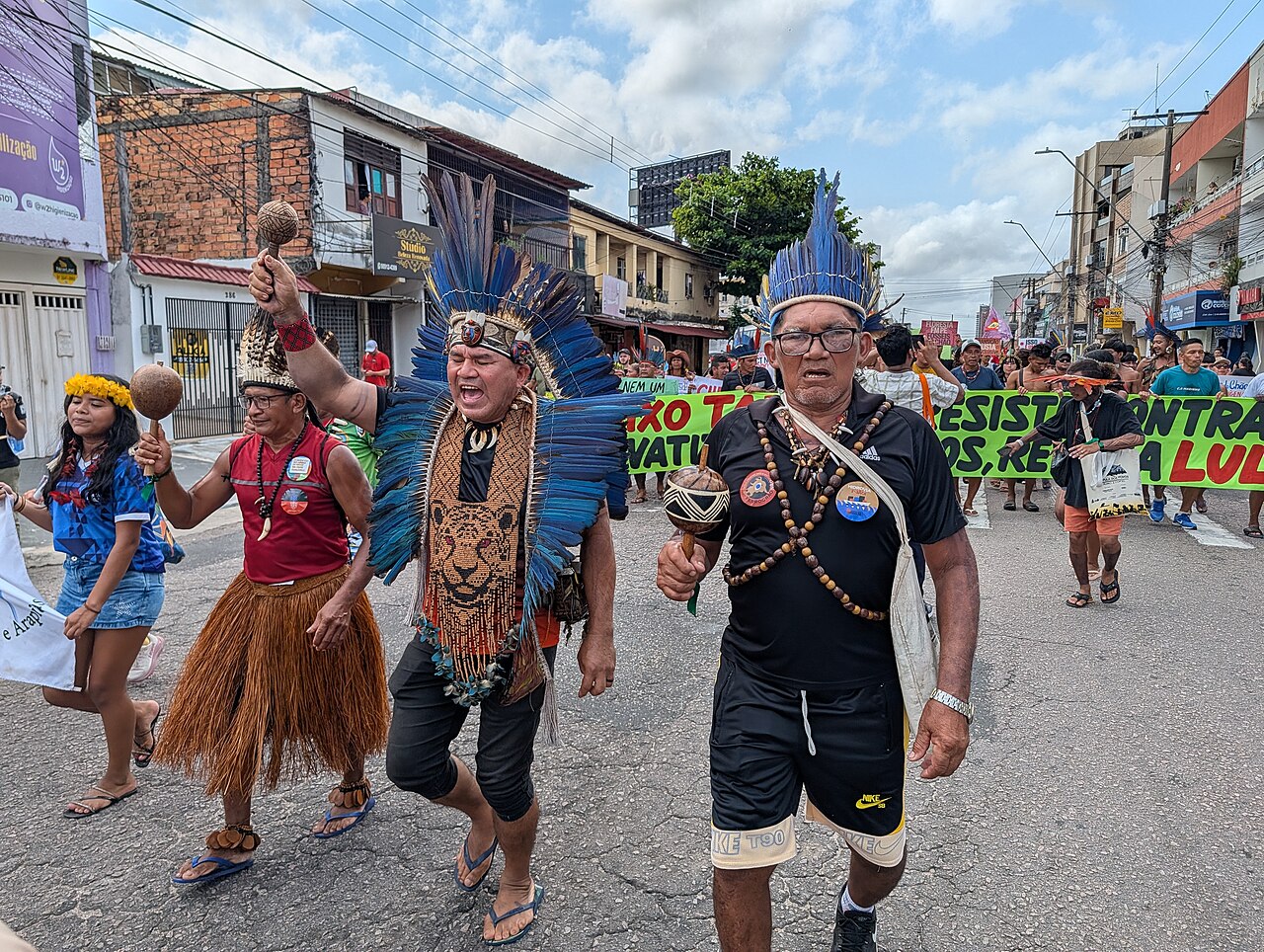
“COP30 is where lived experience must translate into urgent climate action”, stated Ambassador Corrêa do Lago, COP30 President-Designate, in the run-up to the meetings. “We want people from every walk of life”, including “activists and artists” (..) “to join us in Belém to take collective action”, was the welcoming invitation of COP30’s CEO, Ana Toni, explicitly extended to civil society actors. This annual meeting, organized by the UN Climate Change (UNFCCC) secretariat since 1995, was accompanied by a People’s Summit attended by 1,300 civil society organizations, including numerous food movements, and some 30,000 participants.
Social movements in the sphere of food and agriculture responded positively to Brazil’s hosting of the COP. La Via Campesina, the world’s largest movement of small-scale food producers, stated that “COP30 takes place in a context favourable to popular organization, in Brazil, a land of great social movements that do not give up and that welcome us with open arms and hearts in struggle.” More than in the past year, social movements actively organized in the run-up to COP30. Fishers’ movements and NGOs (WFFP, COAST foundation, FIAN International) organized a pre-COP in Dhaka, shortly before the COP commenced in Brazil.
Voices from civil society critiqued the COP30, however, for not living up to the promise of inclusivity. Critiques focused on the representation of indigenous people from the Amazon, especially since the COP took place in the Brazilian Amazon city of Belém. During the first week of the proceedings, indigenous people forced their way into the COP venue to demand more voice in negotiations, notably about the management of the Amazon forests. They urged a meeting with the Brazilian President, an action which led to clashes with security guards.
Overall, however, statements regarding this COP’s inclusivity have mostly been moderately positive. “This effort we [social movements] have made to be at the Summit is going well – with great difficulty, but still going well,” said People’s Summit organizer and trade union representative Ivan González. Following up several smaller protests–including by indigenous people–in the preceding days, tens of thousands of activists hit the streets on Saturday, 15 November, in the ‘Great People’s March’. A participant stated that “After two years without public demonstrations during COPs, this is a new era, it is very motivating and engaging to have civil society on the streets again.” Given that the planet has already overcome a heating of 1.5 degrees Celsius, it’s more urgent than ever that civil society is mobilized. In fact, it’s already been four years since the last big demonstration was held at a COP (in Glasgow), with the COPs in states with little tolerance for dissent, such as Egypt, the UAE, and Azerbaijan in between.

COP29: restricted societal space
In the run-up to the COP29 the previous year in Baku, an official video promoted it as “a truly inclusive COP where all voices are heard” (COP29 Azerbaijan 2024). Yet, foreign media and civil society organizations widely criticized the restrictive approach to civil society by the COP29 organization. They spoke of a ‘charade of openness’, with international civil movements’ presence being severely limited and Azerbaijani movements being denied access, with no single local or regional fishers’ movement present.
Just offshore of Azerbaijan’s capital, Baku, COP delegates could witness the major challenges Caspian artisanal fishers face. COP attendees could see the nearby oil rigs, which hamper the fishers in their movements. A knowledgeable visitor could observe how the Caspian coastline has receded due to climate change (because of increased evaporation) and a range of other factors. The latter includes large dam construction in the rivers that flow into the Sea, as well as widespread irrigation based on water from these rivers.
The result is a falling water level, in contrast to the rising sea level in most parts of the world (the Caspian Sea is strictly speaking not a sea as it is not linked to an ocean, and its water is less salty than normal seas). The Caspian water level falls some 7 cm per year. In some places, the coastline has moved back horizontally by 12 meters already. With the receding coastline and the warming of the sea water, many fish species have moved to deeper waters. These deeper parts of the sea are further offshore and risky to reach for artisanal fishers in their small boats.
Despite the major changes that Caspian fishers face, as in most places, the voice of artisanal fishers has been marginal, in this Caspian case, even absent, in marine policy-making (Visser and Swen 2025). The establishment of marine zones where fishing is prohibited, such as conservation zones and oil extraction (and planned offshore wind turbines) areas, is conducted without consultation with artisanal fishers. Caspian fishers consider the government’s marine policies, such as the process of the establishment of zones, quotas, and moratoria (for instance, for sturgeon and beluga), to be flawed and unjust.
In sum, artisanal fishers in the Caspian are already starkly affected by the negative consequences of climate change. As such, the issues discussed at the COP29 climate summit near their fishing grounds, but inaccessible to the local fishers, were of great importance to them.
COPs, climate & ocean summits: declining space for movements?
International movements of small-scale food producers and low-capital processers (fishers, fish workers, peasants, farm workers, pastoralists) do have representation at the COPs. The COP summit with the largest imprint of civil organisations was the COP21, at which the Paris Agreement to keep the temperature rise at 1.5 degrees Celsius was reached. A simultaneous society-led summit took place. Numerous food movements, including 15 representatives from fishers’ movements (Mills 2021), participated in it. The side-summit closed with a large demonstration with over 30.000 participants.
A few years before that, another remarkable milestone regarding the inclusion of small-scale food producers in global fora was reached with the opening of the World Committee for Food Security (CFS) of the UN to societal organisations and other non-state actors. Activists from agrarian and fishers’ movements managed to raise attention for the needs of small-scale producers, such as the demand for ‘food sovereignty’.
However, since Paris, the representation of food movements (and of social movements generally) at global summits has been eroding. In the CFS, multinationals have expanded their presence, putting the voice of movements “under threat” (Duncan et al. 2022). Regarding the COPs, a trend towards stringent visa regulations and increased repression of civil society by host countries of ‘less than democratic’ nature, such as Egypt (COP27), UAE (COP28), and Azerbaijan (COP29), has constrained civil society’s role. Regarding agrarian movements specifically, even their presence at COP30 pales compared with delegates from the fossil fuel industry (every 1 in 25 delegates, amounting to some 7000 delegates, come from this sector alone). The same is true for the large agribusinesses, like Bayer and Yara, which are deeply invested in continuing conventional agriculture based on chemicals and fertilizer, as well as for large processing firms like Nestlé and PepsiCo. One of the discussions in the COP booths and lounges of these BigAg firms will be on (foreign) investment for the plan to convert millions of hectares of Brazilian pastureland in the Cerrado into large-scale, intensively worked soy fields. This plan has been widely criticized by local and transnational agrarian movements.
In terms of fisheries movements specifically, the UN Oceans Conference (UNOC) summits show a downward trend. At the ICSF side event of the UNOC 2025 summit in Nice, it was noted that “fishers have faced serious barriers to participation, including being turned away from ocean action panels due to insufficient space for civil society and lack of interpretation in side events.”
Looking ahead
The inclusive approach of the COP30 hosted by Brazil is in stark contrast with the overall trend. With the upcoming COPs to take place in Turkey (COP31) and India (COP32), the global climate summit will be hosted by countries that, while not having such a vibrant civil society as Brazil, are more open to civil society deliberation than the UAE and Azerbaijan. Yet freedom of speech is declining in both India and Turkey. The democratic profile of the host countries suggests that the inclusivity of the forthcoming COPs will be somewhere in between the low point of COP28 and COP29 and the high openness of COP30 in Brazil. But it is not only the nature of the host country and the COP that determines the space at global summits for fishers and wider food movements. At the CFS, social movements are also encountering headwind, and at the latest UNOC, held in France, the country of the vibrant 2015 COP with the Paris Agreement, fishers’ movements faced multiple obstacles to their participation. In sum, while the inclusivity of COP30 is a much-needed breath of fresh air for social movements, the overall openness of UN summits for fishers’ organizations and other social movements is likely to remain under threat.
Oane Visser is associate professor in agrarian, food & environmental studies at the International Institute of Social Studies (ISS) of Erasmus University Rotterdam, and research associate at the Independent Social Research Foundation, London.
References
Duncan, Jessica, Nadia Lambek and Priscilla Claeys 2021. The committee on World Food Security. Advances and challenges 10 years after the reform. Un monde sans faim: Gouverner la sécurité alimentaire. Paris: SciencePo Les Presses.
Mills, Elyse (2021) The politics of transnational fishers’ movements, Journal of Peasant Studies, 50 (2): 665-690.
Visser, Oane and Nina Swen (2024) COP29, climate politics and Caspian fisheries, Focaalblog, November 12.
Visser, Oane and Nina Swen (2025) Artisanal fishers and COP29. Climate summit politics in Azerbaijan’s Caspian sea, Anthropology Today, 41 (5): 15-18. https://rai.onlinelibrary.wiley.com/doi/10/1111/1467-8322.70019
Cite as: Visser, Oane 2025. “COP30 and the shifting spaces for food movements at global summits” Focaalblog November 27. https://www.focaalblog.com/2025/11/27/oane-visser-cop30-and-the-shifting-spaces-for-food-movements-at-global-summits/