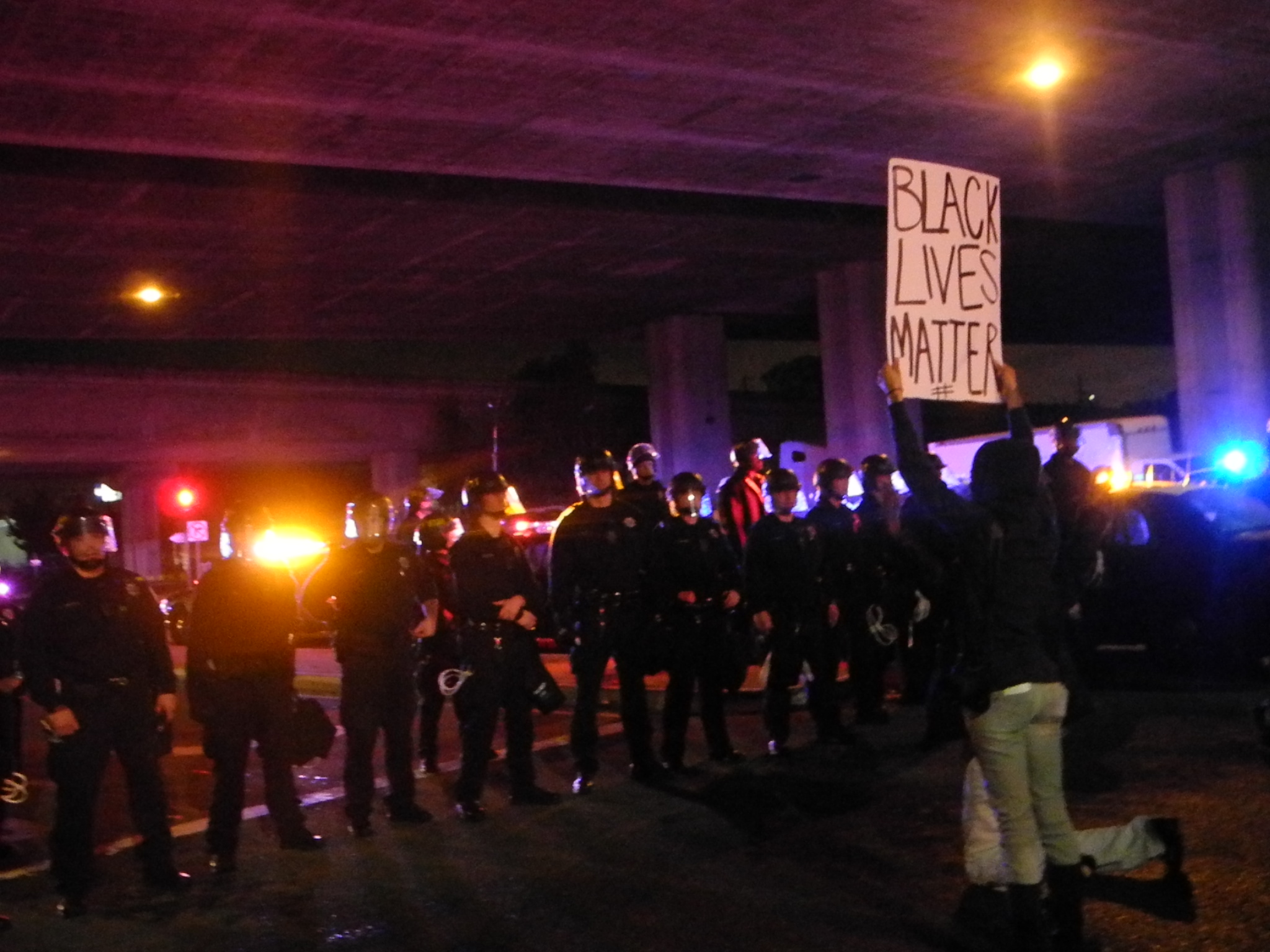
Part 2. Breaking windows and broken windows policing:
“Do we have the same level of outrage when a young black person gets killed as we do when a window gets broken? And if not, then why is that?”
—Alicia Garza, co-founder of #blacklivesmatter
Trader Joe’s In Berkeley, California, on a warm night in mid-December 2014, I stood in stalled traffic and watched as protestors smashed the windows of the Trader Joe’s grocery store on University Avenue—part of the ongoing protests in the aftermath of the NYPD’s murder of Eric Garner and the non-indictment of Darren Wilson, the officer who killed Michael Brown in Ferguson, Missouri. Continue reading →
Since the summer of 2014, there have been sustained protests across the United States surrounding issues of police violence, systematic racism, and the devaluation of Black life. What started as protests over the non-indictment of the white police officers who killed Michael Brown and Eric Garner, in Ferguson, Missouri, and Staten Island, New York, respectively, quickly grew into a nationwide uprising that employed highly disruptive direct action tactics. These protests are expressions of collective outrage, anger, and grief that have forced a much needed, nationwide conversation about race, racism, and the value of Black life in America. They have also become important sites of political education and experimentation as people joined together, night after night, in demonstrations of collective power and rage to “shut shit down.” Continue reading →
This text stems from a historical study. The research focused on the cultures and practices of leadership and authority between 1890 and 1940 in France, Germany, the United States, and the Soviet Union (Cohen 2013). Fieldwork, mostly in Brazil but also in Russia and France, must be added to the latter study.1 This historical study can be connected to present-day movements because the question of authority and leadership seemed central in a lot of them since the 2000s (antiglobalization) and mostly since 2010 all over the world. This reflection is shared here, trying to draw some cross-movement ideas in order to think about the contemporary.
I. Introduction The study of urban activist practices has recently gained currency within anthropology (see Graeber 2013; Harvey 2012; Karakatzanis 2013; Lazar 2008; Nash 2004; Smith 1999). In line with this trend, the anthropological interest in urban activism has increased also in South Asia (Aiyer 2007; Baviskar 1998; Dorron 2008; Subramaniam 2009). However, much of this new scholarship remains trapped in a “methodological nationalism” that focuses explicitly on India. Gellner’s (2010) volume on the varieties of activist experiences—which covers areas other than India, including Nepal, Bangladesh, and Sri Lanka—remains a notable exception. Yet, for urban small towns in Nepal, there remains a relative public dearth of published scholarship despite an existing urban activist scene.1
The ontological question of social movements—what are social movements?—is particularly important given that one of the fundamental aspects of the scientific approach consists in defining its object of study, elucidating its nature, finding its essential properties in order to better understand it.