Tag Archives: sensorial anthropology

Ana Ivasiuc: ‘I can’t explain, you need to see for yourself’: Matters and senses of insecurity in the campi nomadi of Rome

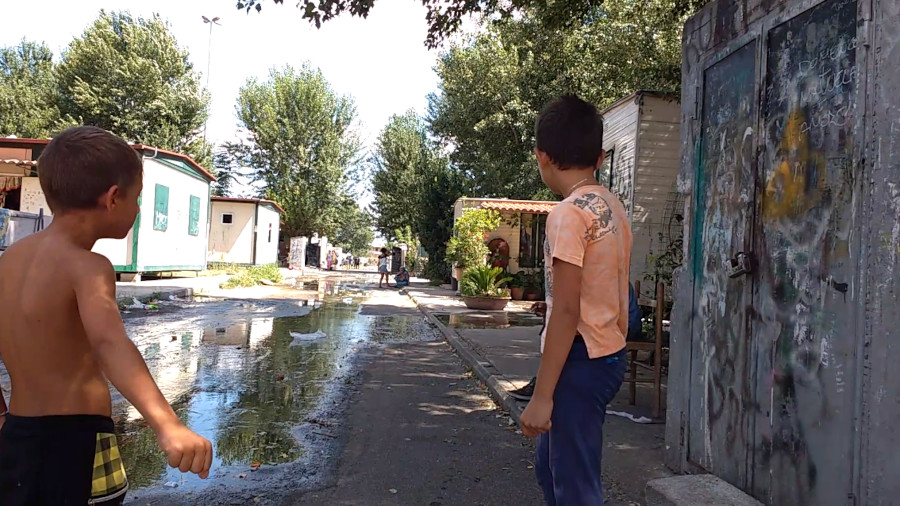
Image 1: Salone camp 2017. Photo by author

‘What is it like to work with Roma?’ I asked the police officer. He gestured widely, shaking his head and raising his arms and shoulders, suggesting that words could not describe what he was trying to convey. ‘You would have to seefor yourself. Once you see how they live, how they smell, what the camp looks like, you will understand everything about the Gypsies. I can’t tell you more. You just have to see yourself, that’s it’. Other officers at the police precinct nodded in agreement. They were all part of a special police unit set up in 2010 by far-right mayor Gianni Alemanno to police Roma encampments in Rome.

The officer’s suggestion that I have to see – and smell – for myself what it was like to work as a police officer in Roma camps dovetails with insights informed by a Latourian approach to materiality and literature subsumed under the umbrella of new materialisms. The securitization of the Roma across Europe is rarely only a mental construct. Rather, material infrastructures and sensorial experiences effectively co-produce (in)security beyond mere representations of danger. Matter and its sensorial perceptions quietly fabricate (in)security, rendering the Roma as dangerous subjects to be perpetually governed through exceptional and ever-multiplying security measures, among which the racial policing that I witnessed in my ethnographic work.

Nomad emergency

In April 2008, the newly elected Berlusconi government triggered the state of emergency in an episode that would be known as the emergenza nomadi (nomad emergency), motivating its decision by the ‘social alarm’ produced by the presence of informal camps of migrant Roma settled in the peripheries of Italy’s largest conurbations. Following the declaration of the state of exception, local authorities received power and resources to set up urban security measures as they saw fit. In Rome, this amounted, among other measures, to the establishment of the special police unit within which I carried out part of my research on the securitization of the Roma in Italy.

In its beginnings, the unit was tasked with policing Roma camps – the authorized encampments set up by the state, but also new informal camps and old, ‘tolerated’ settlements that the authorities let be in the interstices of Rome. Initially, the title of the unit contained the word ‘nomadi’ – the term generally, though erroneously used to refer to Roma in Italy, despite activists’ efforts to debunk the myth that Roma continue to be a nomadic people. The initial title suggests that the unit was set up as a racial police; however, in 2011 its title was changed to ‘Public Security and Emergency-related unit’, and new tasks were added to its mandate. Notably, its portfolio included policing related to unaccompanied minor migrants, as well as the task of carrying out squat evictions.

The unit is composed of about 60 police officers, some of whom have longstanding experience in policing Roma. Consider, for instance, the commander of the unit at the time of my research, Antonio Di Maggio. In an interview he granted me in 2015, he mentioned his 25-year long experience of dealing with Roma encampments. As several officers explained, the setup of the unit in 2010 allowed the commander to gather ‘his men’ up: police from other units with whom he had previously worked, some of whom had also been involved in specific actions of policing the Roma. The officers of the unit are known among Roma in camps; they refer to them as ‘Di Maggio’s men’.

Salone

The camp of Salone sits in isolation beyond the city’s ring road. The nearby train station of Salone is almost always deserted, and only two trains stop – one in the morning, on the way to Rome, one in the evening, returning from the capital. In one of the trains that did not stop in Salone, I overheard someone explain to their friend that the train does not make a halt ‘because of the Gypsies’ (zingari): it isn’t safe. The materiality of a desolate train station where trains do not stop conveys to thousands of commuters daily that Salone is a dangerous place.

Originally designed to host 600 people temporarily, the camp saw its numbers swell to nearly 900 following the aggressive eviction policies around the mid-aughts that gentrified Rome and sanitised the capital’s space of the presence of undesirables. The camp housed diverse and often rival Roma groups, from Serbian and Bosnian families arrived as early as the 1970s, to those from Kosovo and Montenegro who fled the violence that marked the dissolution of Yugoslavia, and more recent arrivals from Romania following its accession to the EU. Metal and PVC boxes arranged in equally spaced rows, resembling shipping containers, serve as housing units. In fact, that is the name of the ‘houses’: container. Most of them display graffiti, and some bear marks of violence: overcrowding and conflicts over the use of space sometimes result in feuds that leave material traces. Streams from broken water pipes traverse the main alleyway, forcing people to zigzag over puddles and mud. At the entrance of the camp, on the right side, overfilled rubbish dumpsters greet the rare visitors.

Sensorial Securitization

The accumulation of waste surrounding camps – broken objects, car carcasses, construction debris – is a complex phenomenon resulting from neglect, refuse dumping practices, and cost-reducing strategies by non-Roma firms and individuals. Yet, this waste is frequently conceptualized as a cultural marker for Roma, reifying them as abject and connecting them to epithets like ‘peoples of landfills’ (Piasere 1991). The subsequent combustion of this waste, often generating toxic smoke (roghi tossici), becomes the centerpiece of a securitarian discourse in Rome that overtakes concerns of petty criminality. Smoke is infused with meaning through the powerful mediator of dioxin, ingrained in collective memory through the 1976 Seveso industrial accident. Dioxin is a dangerous substance that can be inhaled to one’s unbeknownst. Vigilantes and neighbourhood committees from areas in the proximity of campi nomadi post on social media visualizations of rising smoke – often describing their neighborhood as ‘under siege’ or a ‘zone of war’ where ‘chemical weapons’ are being deployed. Such photos and the accompanying comments generate intense social alarm and fears. They provide fuel for incitement to violence, including exhortations to ‘burn down the camps with everyone inside’, as a comment on Facebook suggested. The powerful connection of fear to sensorial regimes of securitization led authorities to institute fixed surveillance services and police patrols specifically to control the fires.

This racialized landscape is always paired with a smell. The olfactory connects the Roma body, space, and materiality to an inferiority that ‘does not belong in and to Europe’ (Racleș and Ivasiuc 2019). Non-Roma interlocutors routinely distinguish Roma by a specific ‘gypsy’ smell (Racleș 2021) as an olfactory distinction that they cannot explain nor describe, but that allegedly ‘everyone knows’.

During police patrols around campi nomadi, officers engage in a ritual of repulsion involving grimaces, covering their noses, and making comments regarding the “puzza” (stench) that they discern upon approaching the camp. This olfactory disgust finds anchors in the materiality of the camp: heaps of waste, overflowing rubbish dumpsters, rats. The officers interpret this squalor as proof that inhabitants are uncivilized and that ‘living like this’ must be a cultural trait. The fear of contamination is visceral: after incursions in camps, police officers half-jokingly invoke the need for ‘epidemiologic checkups’ and the need for disinfection.

In an incident that I recount in more detail elsewhere (Racleș and Ivasiuc 2019), a policewoman, hastening to use disinfectant gel after strip-searching a Roma woman, suggested that the smell ‘stays with you regardless of how much you wash your hands’. The sensorial-material nexus ensures that the spatial segregation and policing of the Roma are repeatedly justified and reified as necessary measures against an inherently abject and dangerous threat at the most intimate, molecular level.

The inhabitants of the camp deplore its material conditions too. They complain about the waste and the irregularity of public services in removing it from the camp and repairing faulty pipelines and sewage. The rats, the foul smells rising up in the hot Roman summers from waste heaps and broken sewage, all of these material conditions are not of their own making and they develop strategies to combat them. One of the women in the camp explained that to combat foul smells and discourage rats from approaching her container, she uses large quantities of bleach on a daily basis: ‘I use a bottle of chlorine a day to clean, it’s so clean you can eat off the floor’. Yet camp inhabitants are painfully aware that their living conditions are leveraged against them to solidify racial stereotypes of uncleanliness and ‘uncivilisedness’.

Conclusion

Processes of securitization are deeply entangled with the sensorial realm. More specifically, sight and olfaction, as expressed by the police officer quoted in the opening vignette, serve as mediators reassembling the Roma in specifically racialized ways. Leonardo Piasere (1991) invokes sensorial perceptions of Roma as ‘antigypsy senses’ (sensi antizingari): racialization patterns where senses are involved in the production of racist tropes of nuisance that must be contained. In Rome, sight and smell quietly fabricate insecurity by linking the Roma body and inhabited space to fears of contamination and pollution. While such fears have been examined in relation to the racialization of the Roma on the symbolic realm, elsewhere I show how contamination and pollution constitute fears that cannot be disentangled from the material realm (Ivasiuc 2019).

As this piece has shown, the materiality of the camp and the sensorial registers used to apprehend it act to embody the Roma as ontologically dangerous. Human and non-human actors (waste, dioxin, vigilantes, police, social media platforms. etc.) are continuously drawn into chains of association, re-assembling the Roma as inherently dangerous, uncontainable, and ungovernable, and producing insecurity in a processual and self-perpetuating way. This quiet fabrication ensures that the politics of policing and exceptionality multiply, requiring constant security measures against a threat that is simultaneously material, sensorial, and ontological.


Ana Ivasiuc is a Teaching Fellow at University College Dublin and a Researcher at the University of Ostrava. She carried out an ethnography of formal and informal policing of Roma migrants in the peripheries of Rome.


References

Ivasiuc, Ana. 2019. “Reassembling (In)security: The Power of Materiality.” In Regina Kreide and Andreas Langenohl (eds.). Conceptualizing Power in Dynamics of Securitization: Beyond State and International System. Baden Baden: Nomos, pp. 367–94.

Piasere, Leonardo. 1991. Popoli delle discariche: Saggi di Antropologia zingara [Peoples of the Landfills: Essays of Gypsy Anthropology]. Rome: CISU.

Racleș, Andreea, and Ana Ivasiuc. 2019. Emplacing Smells: Spatialities and Materialities of ‘Gypsiness’. Anthropological Journal of European Cultures 28 (1): 19–38. https://doi.org/10.3167/ajec.2019.280105.


Cite as: Ivasiuc, A. 2026. “‘I can’t explain, you need to see for yourself’: Matters and senses of insecurity in the campi nomadi of Rome” Focaalblog March 3. https://www.focaalblog.com/2026/03/03/ana-ivasiuc-i-cant-explain-you-need-to-see-for-yourself-matters-and-senses-of-insecurity-in-the-campi-nomadi-of-rome/
Alice McAlpine-Riddell: Zap, Dazzle and Pink! The Aesthetic and Vibrant Enchantment of Tasers

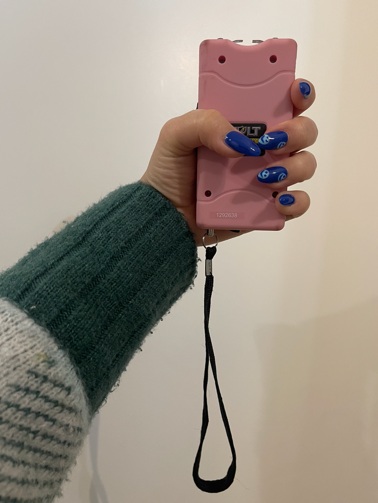
Image 1: Marysol holding one of her pink tasers. Photo by author.

It is the summer of 2022, and I am volunteering with Wes at a queer multi-purpose community space in Brooklyn, New York City. The space is bright pink, adorned with colourful rainbow motifs, hand-painted floating clouds, and neon signage. Today, our responsibilities are to keep the space open for community members to hang out and to sell thrifted, donated, and locally made clothing. Wes is performative, energetic, and talkative. He is an aspiring musician, and we often spend our time together styling him in the clothes for sale in the space which he wears to perform trending dances for his TikTok videos.

Wes grew up in a Haitian household in Connecticut. During his upbringing, safety was rarely discussed, as his family would turn to prayer to address concerns instead. Upon moving to the city, he rarely feels safe: “I don’t think I’m ever really safe, walking around in Brooklyn, to be honest with you.” To provide a certain sense of safety, Wes employs certain safety practices while moving through the city, and this includes carrying a pink taser, a hand-held weapon that uses electrical current to temporarily incapacitate a person.

His pink taser is revealed to me during that afternoon after a young woman walks in and exclaims, “I had to come in cos this place looks gay as hell!” before sitting on the couch and chatting with us. Within a few minutes, seemingly unprompted, she whips a baby-pink object out of her bag. She turns the object, which I’m unable to identify, on. It makes a loud crack and sets off a bright white flash, like an aggressive fly-zapper. I jump, but Wes remains calm, and without missing a beat, he proclaims: “I have the exact same taser!” forging a connection through the sonic and the pink. They both smile knowingly at each other, acknowledging the shared experience, before the conversation moves on.

When discussing this encounter with him later on, I mention that the noise and lights really took me by surprise. He responds, “Yeah, that’s actually helpful, because when people see it, they are like ‘oh okay!’ and I’ve never had to use mine on anyone, but I’ve walked with it ready to go. I’ve just felt better walking and holding it”. For Wes, the jarring crackle and bright white lights attract attention, signalling caution to be taken by others walking on the street while simultaneously instilling a sense of well-being in himself. He concludes, “plus it has a little flashlight too. And it’s pink!”

My conversation with Wes highlights the sensorial nature of objects of security, of pink tasers which zap, crackle, and flash. During my ethnographic fieldwork in Brooklyn, I regularly encountered the ownership of safety gadgets amongst my female and queer interlocutors. These safety gadgets include tasers, pepper sprays, and kubotans, which are plastic blunt stabbing objects frequently attached to keychains.

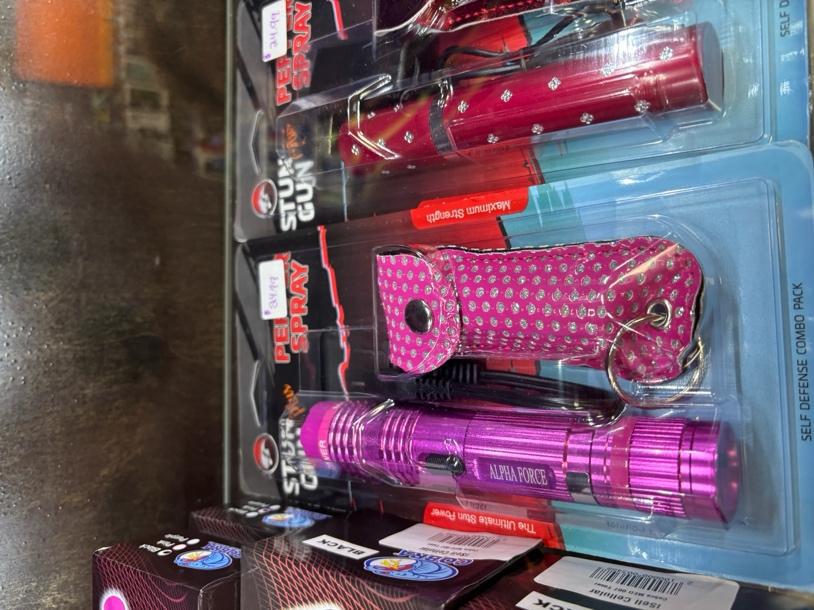
These security objects are often coded as feminine, by both the producers and consumers, from pink tasers and pocketknives adorned with text reading ‘PRINCESS’ to kubotans shaped like cat’s ears and alarms described as looking like “cute Tamagotchi’s”, small handheld digital pet games prolific in the early 2000s. Like Wes, my other interlocutors commonly reference pinkness and cuteness in conversations about their gadgets/weapons, expressing feelings of enchantment, comfort, safety, and excitement.

In this piece I explore the power of pinkness and other captivating visuals, alongside the jolting zap of the taser, to dissect the aesthetics and sensations of (in)security that operate powerfully in the potential. Seeing as none of my interlocutors have ever used their gadgets functionally in self-defence they rather operate across multiple enactments; infusing senses of reassurance and wellbeing, enabling sociality and connection while also securitizing imagined Others on the street who are situated as a potential threat.

Image 2: Pink and sparkly stun guns and pepper sprays for sale in the U.S. Photo by author.

Security aesthetics and enchanting technology

Security is not just a force to be subjected to but also an aesthetic, a mode of sense perception. Security feels, smells, looks, sounds, and tastes certain ways. It encompasses subjective judgements of taste (Ghertner, et al., 2020) and normative aesthetic assumptions, like the statement ‘pink guns are for girls.’ From enclosed architectures of gated communities to the haptics of drone warfare, encountering and performing security is an embodied and sensorial experience. To feel unsafe or insecure itself is an intuitive and embodied sensation, often described as a gut instinct or a sixth sense (Elbek, 2025; Sisnowski, 2026).

Safety gadgets like Wes’ taser are technologies of security that entice the senses. Situating pink tasers as a security aesthetic connects to Alfred Gell’s theory of art and agency. Gell gives the example of an elaborately decorated Trobriand canoe in which the decoration appears impossibly intricate, serving to beguile, intrigue, and impress, enhancing the social and political power of the canoe and its creators.

Gell uses this example to develop his theory of technologies of enchantment. The enchanting power of art lies in the technical processes they embody. In turn, technical processes cast a spell over us, making the world appear enchanted (2006, 163). The pink taser exhibits this two-way technological enchantment as both an aesthetic and technical object, as captivation through pinkness and brightness and as an electrifying weapon.

Similarly to the design of the Trobriand canoe, pinkness enacts power. As an aesthetic, pink is potent and over-determined, saturated with normativity and intersecting power dynamics. It is the socially constructed colour of vulnerability, femininity, and cuteness. Pink is of the body, it allures and entices as ‘the pan-racial color of erotic orifices,’ (Yano, 2013, 34), sites of pleasure and pain, of birth and shame. Pink can also be ironic and seditious, operating as a defiant punk aesthetic that winks back (Yano, 2013) at sexual normativity and gender stereotyping. Similarly, cuteness evokes powerlessness or weakness but also a secondary sense of exploitation or manipulation (Ngai, 2012), and a feeling of being hood-winked. In this sense, pinkness mobilizes expectations of passivity and pliancy which can function as a means of subversive protection.

Such pinkness is enacted in diverse ways. For example, for Rosa, a young trans woman, visibly carrying her pink pepper spray on the street adds to her level of ‘passing’ and her sense of safety, due to the normative gendered association of pink as an aesthetic choice. For both Wes and Rosa, the pinkness of their safety gadgets subversively winks back, as what appears cute and pink and therefore, vulnerable, unthreatening, and unassuming, are in fact the very opposite, as potentially harmful weapons.

As the potential for violence is concealed, power dynamics become troubled, as categories like aggressor and aggressed increasingly blur. In this sense gender and sexuality are at once mediated and weaponized, performed and subverted, through safety gadgets as technologies of aesthetic security.

Dazzling weapons

Gell further describes art as weapons of psychological warfare which dazzle (2006). A historical example being the dazzling camouflage painted onto warships in WW1 to confound and beguile submarine periscopes, as waves crashed confusingly against the ship’s razzle dazzle designs. Similarly enchanting designs are now being employed by anti-surveillance artist-protestors to avoid facial recognition technology (Roderick, 2019 – 2021).

Image 3: Photograph of British Kil class patrol gunboat HMS Killour painted in dazzle camouflage. Photo by Oscar Parkes from the Imperial War Museum collections.

Dazzling pink and zapping, flashing tasers capture attention while simultaneously producing perplexity, as a technology of enchantment that captivates as both a psychological weapon and a weapon in potential. The visceral sounds and visuals further exude a vitality. It radiates what Jane Bennett describes as thing-power (2010) which demands attention, provoking both joy and fear through its presence. In this sense, materiality has the capacity to act and affect, to vibrantly exert power, and do things in the world across assemblages of entangled people, objects, relationalities, and modalities (Bennett, 2010). In the case of the pink taser, such vibrancy and vitality allure the senses, enacting a sense of well-being and safety for Wes while affecting other bodies in diverse manners, from shock or excitement to connection or attention.

The power of the potential

These vibrant and pink security aesthetics in turn also (de)construct and socially situate divergent bodies. Queered and gendered bodies vibrate between insecure and threat, as the visual wink of the pink plays on the supposition of vulnerability interrupted by crackles of potential violence.

The term potential is of significance here, as the location of such enchantment and vitality. The power and potency of the pink taser operates in its potential to harm, as Wes states above, he walks with his taser “ready to go” but he has never discharged it and stunned anyone in self-defence.

Rather, for Wes a feeling of improved well-being is achieved through just “walking and holding” his taser, as enchantment functions through (in)animation in the sense that the aesthetics and vitality of the taser simultaneously animates the object and instils the potential to inanimate and disarm others.

While operating in the potential, the taser is enacted in multiple ways; as a technology of enchantment but also as a means of sociality, as a vibrant accessory to present to and connect with others. The aesthetic potency of sound, colour, and brightness entices the senses across divergent relations; between Wes and the unknown other on the street, and between Wes and the other taser owner; but also between myself and Wes, as an ethnographic learning opportunity through my moment of shock, and as an encounter with self, as Wes exclaims “and its pink!” demonstrating his own enchantment.

Indeed, none of my interlocutors have ever discharged their safety gadgets functionally to disarm, stun, or stab. Unlike Wes, sometimes other safety gadgets remain unused at the bottom of their handbags. For example, Fernanda is a born and bred New Yorker who grew up on Staten Island. She is very safety conscious and attributes this to her upbringing in an immigrant family, where conversations surrounding personal safety were constant throughout her childhood. Fernanda owns an array of safety gadgets including a kubuton, which she describes as a “stabby stick” and is often relegated to the bottom of her bag.

As she explains, “walking with friends and everyone else is fine and you are there walking with this little shank in your hand, it’s weird, it’s uncomfortable for everyone.” Objects mediate social relations, and this includes expectations and normativity. Fernanda doesn’t feel comfortable having her kubuton out of her bag. In her hand, the kubuton runs contrary to the social norms of her friendship group and she worries that her modality of feeling (un)safe misaligns with those of her friends which could make them feel uncomfortable.

Another young woman, Marysol, is in her late twenties and moved to Brooklyn for her postgraduate studies. She owns two pink tasers and usually carries one with her whenever she is moving through the city. One day she witnesses a violent subway attack. When she tells me about the incident she concludes exclaiming, “the one day I don’t have my taser, I legit see someone get stabbed!”

Here her taser is noticeable in its absence, however, I am left thinking what would she have done if she had her taser with her as she normally does? Intervening and inserting herself in the situation with a taser has the potential to make herself and those around her more unsafe. Others shared my concerns, in particular worries about being disarmed, a lack of training, and the close combat that necessitates use of certain safety gadgets. Perhaps the comfort of things (Miller, 2008) is a comfort of the presence and potency of safety gadgets in the potential; of a stabby stick at the bottom of a handbag to avoid social discomfort and judgement, of the reassurance of just having one’s taser with them or carrying it flashing and zapping as a warning to potential or imagined attackers.

To conclude, safety gadgets like pink tasers demonstrate the entanglement of (in)security and the sensorial. From the attention-grabbing pinkness and brightness of a zapping taser that entices the senses to senses of well-being, comfort, and enchantment produced by carrying tasers on oneself while moving through the city. By operating in the potential, these gadgets infuse a sense of reassurance into their carriers while also securitizing imagined Others on the street who are sensed and situated as a potential threat.

Moving beyond care or control, protection or punishment, Wes’ pink taser exists at an intersection of security, sensoriality, and sociality. It is an object that invokes excitement, connection, and enchantment, but also attention, caution, and violence. The pink taser troubles which bodies are imagined as insecure and as threatening, by playing into tropes of queer sexuality, femininity, and vulnerability, intermixed with a fear of the Other, by a dazzling wink of the pink and a crackle and zap with the potential to electro-cute.


Alice McAlpine-Riddell is an anthropologist and early career researcher whose work focuses on practices and experiences of safety, security, and surveillance for gendered and queered bodies in urban spaces.


References

Bennett, J., (2010) Vibrant Matter: A political ecology of things, London: Duke University Press.

Elbek, L. L. (2025) ‘Sniffing Out Trouble? What and how the ‘Police Nose’ Smells’, Focaalblog December 24. https://www.focaalblog.com/2025/12/24/laust-lund-elbek-sniffing-out-trouble-what-and-how-the-police-nose-smells/

Ghertner, D. A., McFann, H. and Goldstein, D. M., (2020) ‘Introduction: Security Aesthetics of and beyond the Biopolitical’, Futureproof: Security Aesthetics and the Management of Life, New York, USA: Duke University Press.

Gell, A., (2006) The Art of Anthropology: Essays and Diagrams, London School of Economics Monograph on Social Anthropology, E. Hirsch (eds). Oxford: Berg.

Miller, D. (2008) The Comfort of Things, London, UK: Polity Press.

Ngai, S., (2015) Our Aesthetic Categories: Zany, Cute, Interesting, Cambridge, MA: Harvard University Press.

Roderick, E., (2019 – 2021), ‘The Dazzle Club, 2019 – 2021’, Emily Roderick (website) https://emilyroderick.com/work/the-dazzle-club/

Sisnowski, M., (2026), ‘Gut Feeling, Adrenaline and Fried Onions: Sensing Aggression in German Health and Welfare Services’, Focaalblog January 24. https://www.focaalblog.com/2026/01/23/maja-sisnowski-gut-feeling-adrenaline-and-fried-onions-sensing-aggression-in-german-health-and-welfare-services/

Yano, C., (2013) Pink Globalization: Hello Kitty’s Trek Across the Pacific, Durham, NC: Duke University Press.


Cite as: McAlpine-Riddell, A. 2026 “Zap, Dazzle and Pink! The Aesthetic and Vibrant Enchantment of Tasers” Focaalblog January 26. https://www.focaalblog.com/2026/01/26/alice-mcalpine-riddell-zap-dazzle-and-pink-the-aesthetic-and-vibrant-enchantment-of-tasers/