‘What is it like to work with Roma?’ I asked the police officer. He gestured widely, shaking his head and raising his arms and shoulders, suggesting that words could not describe what he was trying to convey. ‘You would have to seefor yourself. Once you see how they live, how they smell, what the camp looks like, you will understand everything about the Gypsies. I can’t tell you more. You just have to see yourself, that’s it’. Other officers at the police precinct nodded in agreement. They were all part of a special police unit set up in 2010 by far-right mayor Gianni Alemanno to police Roma encampments in Rome.
The officer’s suggestion that I have to see – and smell – for myself what it was like to work as a police officer in Roma camps dovetails with insights informed by a Latourian approach to materiality and literature subsumed under the umbrella of new materialisms. The securitization of the Roma across Europe is rarely only a mental construct. Rather, material infrastructures and sensorial experiences effectively co-produce (in)security beyond mere representations of danger. Matter and its sensorial perceptions quietly fabricate (in)security, rendering the Roma as dangerous subjects to be perpetually governed through exceptional and ever-multiplying security measures, among which the racial policing that I witnessed in my ethnographic work.
Nomad emergency
In April 2008, the newly elected Berlusconi government triggered the state of emergency in an episode that would be known as the emergenza nomadi (nomad emergency), motivating its decision by the ‘social alarm’ produced by the presence of informal camps of migrant Roma settled in the peripheries of Italy’s largest conurbations. Following the declaration of the state of exception, local authorities received power and resources to set up urban security measures as they saw fit. In Rome, this amounted, among other measures, to the establishment of the special police unit within which I carried out part of my research on the securitization of the Roma in Italy.
In its beginnings, the unit was tasked with policing Roma camps – the authorized encampments set up by the state, but also new informal camps and old, ‘tolerated’ settlements that the authorities let be in the interstices of Rome. Initially, the title of the unit contained the word ‘nomadi’ – the term generally, though erroneously used to refer to Roma in Italy, despite activists’ efforts to debunk the myth that Roma continue to be a nomadic people. The initial title suggests that the unit was set up as a racial police; however, in 2011 its title was changed to ‘Public Security and Emergency-related unit’, and new tasks were added to its mandate. Notably, its portfolio included policing related to unaccompanied minor migrants, as well as the task of carrying out squat evictions.
The unit is composed of about 60 police officers, some of whom have longstanding experience in policing Roma. Consider, for instance, the commander of the unit at the time of my research, Antonio Di Maggio. In an interview he granted me in 2015, he mentioned his 25-year long experience of dealing with Roma encampments. As several officers explained, the setup of the unit in 2010 allowed the commander to gather ‘his men’ up: police from other units with whom he had previously worked, some of whom had also been involved in specific actions of policing the Roma. The officers of the unit are known among Roma in camps; they refer to them as ‘Di Maggio’s men’.
Salone
The camp of Salone sits in isolation beyond the city’s ring road. The nearby train station of Salone is almost always deserted, and only two trains stop – one in the morning, on the way to Rome, one in the evening, returning from the capital. In one of the trains that did not stop in Salone, I overheard someone explain to their friend that the train does not make a halt ‘because of the Gypsies’ (zingari): it isn’t safe. The materiality of a desolate train station where trains do not stop conveys to thousands of commuters daily that Salone is a dangerous place.
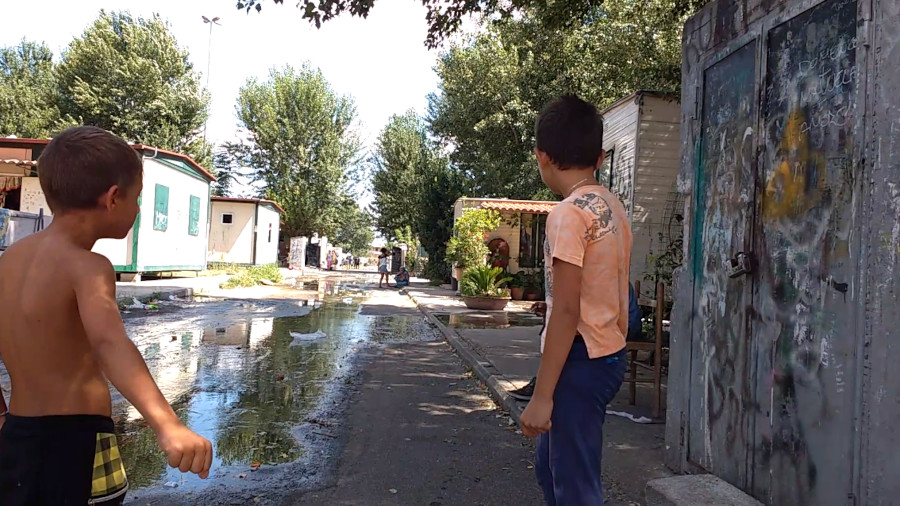
Originally designed to host 600 people temporarily, the camp saw its numbers swell to nearly 900 following the aggressive eviction policies around the mid-aughts that gentrified Rome and sanitised the capital’s space of the presence of undesirables. The camp housed diverse and often rival Roma groups, from Serbian and Bosnian families arrived as early as the 1970s, to those from Kosovo and Montenegro who fled the violence that marked the dissolution of Yugoslavia, and more recent arrivals from Romania following its accession to the EU. Metal and PVC boxes arranged in equally spaced rows, resembling shipping containers, serve as housing units. In fact, that is the name of the ‘houses’: container. Most of them display graffiti, and some bear marks of violence: overcrowding and conflicts over the use of space sometimes result in feuds that leave material traces. Streams from broken water pipes traverse the main alleyway, forcing people to zigzag over puddles and mud. At the entrance of the camp, on the right side, overfilled rubbish dumpsters greet the rare visitors.
Sensorial Securitization
The accumulation of waste surrounding camps – broken objects, car carcasses, construction debris – is a complex phenomenon resulting from neglect, refuse dumping practices, and cost-reducing strategies by non-Roma firms and individuals. Yet, this waste is frequently conceptualized as a cultural marker for Roma, reifying them as abject and connecting them to epithets like ‘peoples of landfills’ (Piasere 1991). The subsequent combustion of this waste, often generating toxic smoke (roghi tossici), becomes the centerpiece of a securitarian discourse in Rome that overtakes concerns of petty criminality. Smoke is infused with meaning through the powerful mediator of dioxin, ingrained in collective memory through the 1976 Seveso industrial accident. Dioxin is a dangerous substance that can be inhaled to one’s unbeknownst. Vigilantes and neighbourhood committees from areas in the proximity of campi nomadi post on social media visualizations of rising smoke – often describing their neighborhood as ‘under siege’ or a ‘zone of war’ where ‘chemical weapons’ are being deployed. Such photos and the accompanying comments generate intense social alarm and fears. They provide fuel for incitement to violence, including exhortations to ‘burn down the camps with everyone inside’, as a comment on Facebook suggested. The powerful connection of fear to sensorial regimes of securitization led authorities to institute fixed surveillance services and police patrols specifically to control the fires.
This racialized landscape is always paired with a smell. The olfactory connects the Roma body, space, and materiality to an inferiority that ‘does not belong in and to Europe’ (Racleș and Ivasiuc 2019). Non-Roma interlocutors routinely distinguish Roma by a specific ‘gypsy’ smell (Racleș 2021) as an olfactory distinction that they cannot explain nor describe, but that allegedly ‘everyone knows’.
During police patrols around campi nomadi, officers engage in a ritual of repulsion involving grimaces, covering their noses, and making comments regarding the “puzza” (stench) that they discern upon approaching the camp. This olfactory disgust finds anchors in the materiality of the camp: heaps of waste, overflowing rubbish dumpsters, rats. The officers interpret this squalor as proof that inhabitants are uncivilized and that ‘living like this’ must be a cultural trait. The fear of contamination is visceral: after incursions in camps, police officers half-jokingly invoke the need for ‘epidemiologic checkups’ and the need for disinfection.
In an incident that I recount in more detail elsewhere (Racleș and Ivasiuc 2019), a policewoman, hastening to use disinfectant gel after strip-searching a Roma woman, suggested that the smell ‘stays with you regardless of how much you wash your hands’. The sensorial-material nexus ensures that the spatial segregation and policing of the Roma are repeatedly justified and reified as necessary measures against an inherently abject and dangerous threat at the most intimate, molecular level.
The inhabitants of the camp deplore its material conditions too. They complain about the waste and the irregularity of public services in removing it from the camp and repairing faulty pipelines and sewage. The rats, the foul smells rising up in the hot Roman summers from waste heaps and broken sewage, all of these material conditions are not of their own making and they develop strategies to combat them. One of the women in the camp explained that to combat foul smells and discourage rats from approaching her container, she uses large quantities of bleach on a daily basis: ‘I use a bottle of chlorine a day to clean, it’s so clean you can eat off the floor’. Yet camp inhabitants are painfully aware that their living conditions are leveraged against them to solidify racial stereotypes of uncleanliness and ‘uncivilisedness’.
Conclusion
Processes of securitization are deeply entangled with the sensorial realm. More specifically, sight and olfaction, as expressed by the police officer quoted in the opening vignette, serve as mediators reassembling the Roma in specifically racialized ways. Leonardo Piasere (1991) invokes sensorial perceptions of Roma as ‘antigypsy senses’ (sensi antizingari): racialization patterns where senses are involved in the production of racist tropes of nuisance that must be contained. In Rome, sight and smell quietly fabricate insecurity by linking the Roma body and inhabited space to fears of contamination and pollution. While such fears have been examined in relation to the racialization of the Roma on the symbolic realm, elsewhere I show how contamination and pollution constitute fears that cannot be disentangled from the material realm (Ivasiuc 2019).
As this piece has shown, the materiality of the camp and the sensorial registers used to apprehend it act to embody the Roma as ontologically dangerous. Human and non-human actors (waste, dioxin, vigilantes, police, social media platforms. etc.) are continuously drawn into chains of association, re-assembling the Roma as inherently dangerous, uncontainable, and ungovernable, and producing insecurity in a processual and self-perpetuating way. This quiet fabrication ensures that the politics of policing and exceptionality multiply, requiring constant security measures against a threat that is simultaneously material, sensorial, and ontological.
Ana Ivasiuc is a Teaching Fellow at University College Dublin and a Researcher at the University of Ostrava. She carried out an ethnography of formal and informal policing of Roma migrants in the peripheries of Rome.
References
Ivasiuc, Ana. 2019. “Reassembling (In)security: The Power of Materiality.” In Regina Kreide and Andreas Langenohl (eds.). Conceptualizing Power in Dynamics of Securitization: Beyond State and International System. Baden Baden: Nomos, pp. 367–94.
Piasere, Leonardo. 1991. Popoli delle discariche: Saggi di Antropologia zingara [Peoples of the Landfills: Essays of Gypsy Anthropology]. Rome: CISU.
Racleș, Andreea, and Ana Ivasiuc. 2019. Emplacing Smells: Spatialities and Materialities of ‘Gypsiness’. Anthropological Journal of European Cultures 28 (1): 19–38. https://doi.org/10.3167/ajec.2019.280105.
Cite as: Ivasiuc, A. 2026. “‘I can’t explain, you need to see for yourself’: Matters and senses of insecurity in the campi nomadi of Rome” Focaalblog March 3. https://www.focaalblog.com/2026/03/03/ana-ivasiuc-i-cant-explain-you-need-to-see-for-yourself-matters-and-senses-of-insecurity-in-the-campi-nomadi-of-rome/