When I started fieldwork in neighborhoods in Rio de Janeiro’s North zone in December 2021, the first thing my Brazilian friends told me was to be very careful. The area where I was based was notorious for its high number of armed robberies and for its proximity to a cluster of favelas. Shortly before my arrival in Brazil, the drug trafficking group that effectively controlled the favelas had expanded its territory by blocking roads and installing armed checkpoints at various street corners across the neighborhoods. The local leader (dono) of the group, who identified as a Pentecostal Christian, was accused of orchestrating disappearances, homicides, and extortions, and of destroying temples dedicated to Afro-Brazilian religious practices.
It was against this backdrop of violent events that I conducted an interview with Catarina, a frequent visitor of a local Umbanda center. Umbanda is an Afro-Brazilian religion that contains influences from Roman Catholicism, West-African religious traditions, indigenous beliefs, and Kardecist spiritism. In Umbanda, spiritual guides provide guidance and support on matters of health, money, love, and wellbeing. Catarina lived with her teenage daughter in a commercial district some 15 minutes away from the center, outside the zone of influence of the drug trafficking gang. As we sat in the patio of the center, shaded by the trees that surrounded the open space in front of the terreiro (indoor place of worship), I asked Catarina whether she hadn’t considered visiting a center located closer to her home in an area that was considered less dangerous. She responded the following:
There is a center close to me, which I visit sometimes, but I am not from that center. And I feel very much at peace here. Inside here, it doesn’t feel like I am in this particular neighborhood. It is as if a microclimate (microclima) was created inside here, with the trees and all that. Even if it takes forever for the sessions to start. If you arrive all worked up, inside here you are able to relax, think about life. And thank God, nothing has ever happened to us here. I think that is our protection (é proteção mesmo). Protection that the center gives, which the spirits (entidades) from here give until we arrive at our house. Because nothing ever happened when we left here. While everything is deserted, everything is black.
I was intrigued by Catarina’s attention to the atmospheric qualities of protection. Like other Umbanda practitioners whom I spoke to, Catarina spoke about the protection offered by the center as a material and embodied reality where the dangers of the street were temporarily kept at bay. This is a material and embodied reality that emerges through a series of ritual practices that involve an interplay between objects, bodies, and spirit entities, amongst other things. I offer two examples to illustrate the interplay between these different materialities inside the center.
Champagne and cigarettes
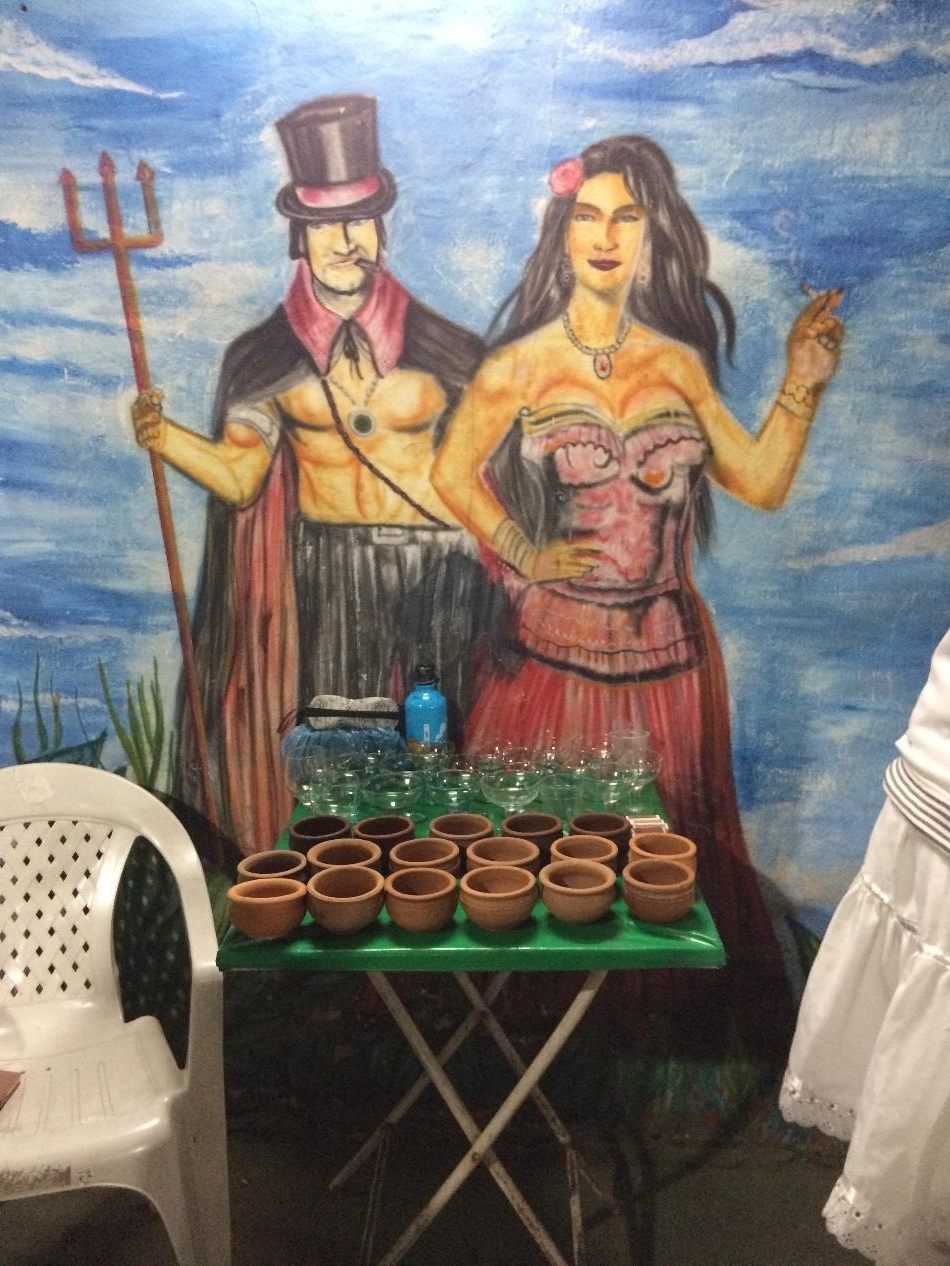
The largest altar in the Umbanda center was dedicated to a group of spirits known collectively as the spirits of the streets (povo da rua). It was located inside a separate building in the courtyard, closed off with an opaque door. The outside wall depicted a large mural painting of the Exú Tranca Rua, protector of the terreiros, and the pomba-gira Maria Padilha das 7 Encruzilhadas, guardian of love, protection, and courage (Image 1). Both figures play an important role in the center as they are called upon to cleanse the center from negative energies (limpar), to open new ways of thinking and being (abrir caminhos) and to shield practitioners from harm (proteger). Because of their ability to protect, the povo da rua are also referred to as guardian spirits (guardiões).
Different from other kinds of spirits, who emphasize benevolence and humility, the povo da rua embody sensuality as well as force. When they incorporate the bodies of the spirit mediums, they dance, smoke, drink, and flirt. To outsiders, the spirits’ human appetites are sometimes mistaken for sinful behavior and for provoking “bad things” (fazer mal). But for my interlocutors, “exú only does good things” (faz bem).
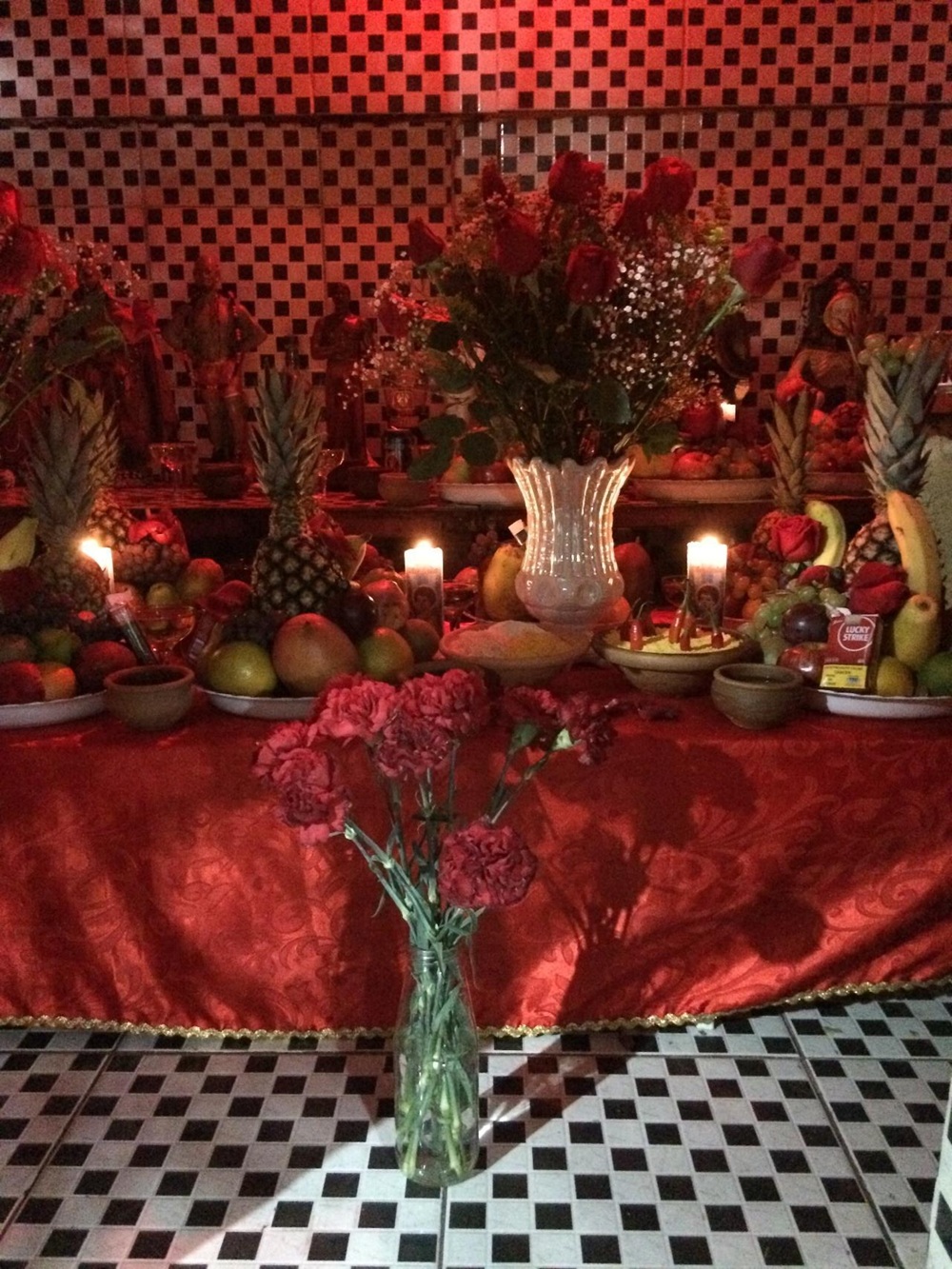
Inside the altar of the povo, a faint red light revealed a row of thirteen statues, representing particular spirits worshipped in the center. Twice a year, the povo receive an extensive offering (oferenda) from the spirit mediums to request guidance and protection for themselves or on behalf of a friend or a family member.
The offerings that I witnessed followed a specific order and were carried out individually. First, a big plate filled with tropical fruits was brought to the altar. The medium then took a pull of a cigarette to appease thefemale spirits. The remaining packet of cigarettes was placed alongside the plate of fruits on the altar. Next, the medium filled a glass of champagne. After taking a sip of the glass, the glass was also placed in front of the statues. To appease the male spirits, the medium took a pull of a cigar and exhaled in the shape of a circle. He or she then filled a glass of cachaça (white rum), took a sip, and placed it on the altar. In the final step, the spirit medium placed a handful of coins in a clay bowl. One of the coins was used to slowly move it over the body, starting with arms crossed, and then directing the coin over the head, knees, legs, and under one of the feet.
The individual offerings were complemented by the traditional food offering for exús, prepared in the small on-site kitchen: a big bowl of toasted manioc flour prepared in Dendê oil, filled with red chili peppers. Softly burning candles and vases filled with red roses and small white flowers were tucked in between the offerings (Image 2). According to the mediums, each of the items placed on the altar to feed the spirits absorbs the spirits’ capacity to cleanse and protect and contributes to the circulation of positive energy and spiritual force inside the center.
The process of preparing the offerings and placing them inside the altar took several hours. After about two weeks, once the offerings were received and “eaten” by the spirits, they were removed from the altar. The rotten fruits were discarded, and the ones that were still edible were taken back home. The flowers, cigarettes, candles, and manioc flower were dispatched near one of the city’s highway intersections, to serve those who wander through the city.
According to Zezé, one of the mediums who works at the center, the offerings to the spirits were not made in vain. When I spoke to him in an interview, he said the following:
The guardian spirits protect those who have faith. Up until today, inside here nothing bad has ever happened, while in the meantime a lot of bad things have happened outside. We’ve had cases where violence happened outside of the gate, shots were being fired, but not even the bullet shells made it in here. That, to me, is proof that this is a protected place.
Zezé’s words echoed those of Catarina. Despite the dangers that surrounded the center, in the comforting presence of the povo da rua, no bullets would pierce the center’s walls.
The swords of Ogum
Besides offerings to the spirits, mediums also channeled spiritual energy through incorporation sessions (giras). One of the sessions I attended at the center was dedicated to Ogum, an orixá associated with strength, courage, and battle. Inspired by African deities, orixás are at the top of the spiritual hierarchy in Umbanda. The session for Ogum was held in the indoor space adjacent to the courtyard where all the spirit incorporations took place. The entire room was painted light blue. Walls were covered with paintings, photos of mediums and visitors, and small spirit altars. A small sign right behind the door read “negative energies prohibited.”
Just like the other sessions, the session for Ogum started with a short prayer followed by drumming. The repetitive drum rhythm worked to induce a trance-like state amongst the mediums and the visitors. One by one, the spirits announced themselves through the bodies of the mediums, which were slowly moving towards the center of the room, with one leg lagging the other and their index fingers pointed out. Their reception was welcomed by the audience, whose clapping and singing grew louder as more spirits descended onto the room:
| Eu tenho sete espadas pra me defender | I have seven swords to defend myself |
| Eu tenho Ogum em minha companhia | I have Ogum in my company |
| Eu tenho sete espadas pra me defender | I have seven swords to defend myself |
| Eu tenho Ogum em minha companhia | I have Ogum in my company |
| Ogum é meu pai | Ogum is my father |
| Ogum é meu guia | Ogum is my guide |
| Ogum é meu pai | Ogum is my father |
| Na fé de Zambi | In the name of Zambi (the Creator) |
| E da Virgem Maria | And the Virgin Mary |
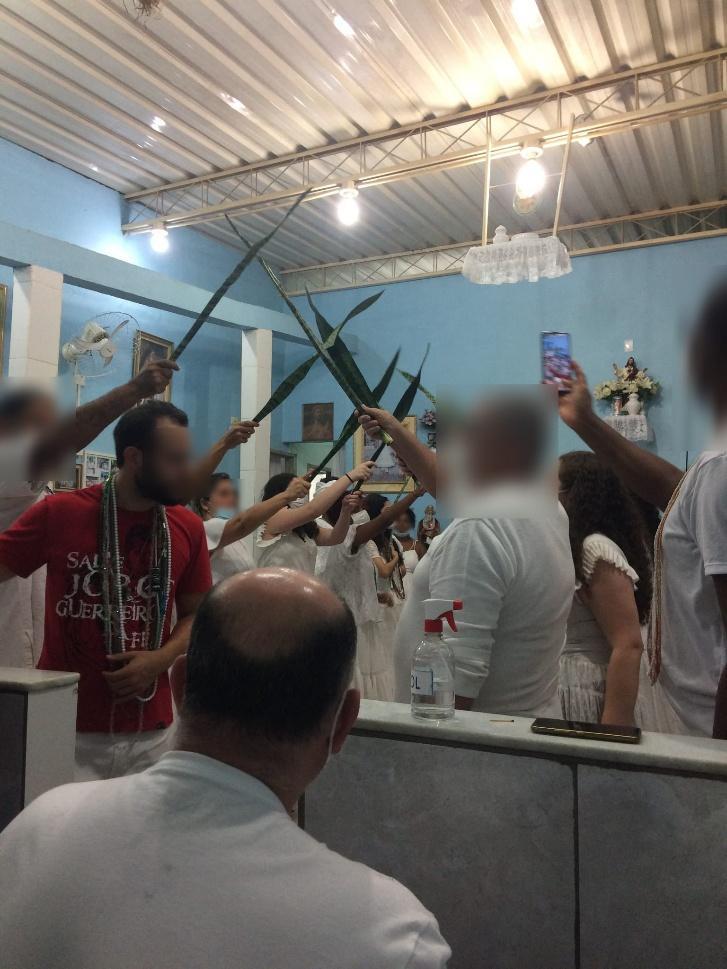
By the time Ogum finally announced his presence through the body of a medium it was already close to midnight. A spiritual caretaker guided Ogum to a room in the back of the building to prepare his costume. In the meantime, the other spirit mediums took a single leaf each from the sansevieria plant in the front of the room. A few moments later, Ogum re-entered the room with the air of a dignified man, wearing a red cape, a sword, and a knight’s helmet adorned with a red feather. The other mediums held up their leaves in the air and formed an arch (image 3). Carefully, Ogum was led under the arch and made his way to the front of the altar, where he greeted the mediums and the visitors with an embrace.
Towards the end of the session, the mediums handed each of the visitors one of the leaves to take back home and place it in front of their house. The “swords”, I was told, were considered as an extension of the protective power of Ogum cultivated during the session and served to protect the house from negative energies and to attract prosperity (prosperidade).
Reflections
There is no shortage of people seeking protection and guidance in Brazilian cities, which statistics show are among the most violent on earth. Trapped between militias, drug trafficking groups, and the state, urban residents cultivate spaces where they feel safe, comfortable, and cared for. These spaces of security and comfort are rarely secular. They are inhabited by a range of otherworldly entities who are called upon to protect and to heal (see also Amoruso 2025. Willis 2024), including Afro-Brazilian spirits.
I have illustrated how Afro-Brazilian spirits and the mediums who incorporate them engage in affective relationships that contribute to a sacred, intimate space shielded from the dangers of the street. Each of the objects placed within the center takes part in this affective relationship in different ways: not merely in a symbolic manner, but by absorbing and circulating the spirit’s powers to cleanse, heal, and protect. The champagne and cigarettes on the altar dedicated to the guardian spirits become charged with spiritual powers, while the swords of Ogum, represented by the sansevieria leaves, become an extension of the protective power of the orixá.
My analysis moves from an understanding of security as something that is produced on the level of the state towards an understanding of security as something that is lived and felt in everyday interactions (see also Ghertner, McFann & Goldstein 2020: 3). Moreover, like Anderson (2009), I draw attention to the atmospheric quality of security as an affect that emerges between objects, bodies, and spaces. For ethnographers, it is essential to do justice to the ways in which the senses shape our everyday experiences and ontological realities.
Jolien van Veen is a PhD researcher at the department of Cultural Anthropology at Utrecht University. Her PhD is part of the ERC-funded project “Sacralizing Security: Religion, Violence and Authority in Mega-Cities of the Global South”. She has published in City & Society and the European Review of Latin American and Caribbean Studies.
References
Amoruso, Michael. 2025. Moved by the Dead: Haunting and Devotion in São Paulo, Brazil. University of North Carolina Press.
Anderson, Ben. 2009. “Affective Atmospheres”. Emotion, Space and Society 2: 77-81. DOI:10.1016/j.emospa.2009.08.005
Ghertner, D. Asher, Hudson McFann, and Daniel M. Goldstein, 2020. Futureproof: Security Aesthetics and the Management of Life. Duke University Press.
Willis, Laurie Denyer. 2023. Go With God: Political Exhaustion and Evangelical Possibility in Suburban Brazil. University of California Press.
Cite as: Veen, Jolien van 2025. “Atmospheric Security in Rio de Janeiro” Focaalblog December 22. https://www.focaalblog.com/2025/12/22/jolien-van-veen-atmospheric-security-in-rio-de-janeiro/