
How do companies handle responsibilities to people and the environment when they operate abroad? What tools do they use, and what are the effects? These have been throughgoing concerns in my work during the last 10-15 years of research in Turkey. I have investigated how the ‘corporate social responsibility’ work of Austrian energy company OMV helped them gain social license to operate in a community in Turkey, and how the Norwegian energy company Statkraft sought to address ‘project affected people’ in a hydropower project through ‘IFC performance standards’. This research agenda culminated in the comparative project Energethics and the book Corporate Social Responsibility and the Paradoxes of State Capitalism (Knudsen 2023). When I realized a few years back that the construction of Norwegian boats in Turkey had become big business, I became curious about how Norwegian boat owners and state institutions handled the ethical dilemma involved in the praiseworthy effort of constructing ‘green ships’ under less praiseworthy labour conditions in Turkey. How is responsibility handled in such a context?
Dependent on Turkish shipyards
The green shift in the Norwegian maritime sector is largely considered a success. The electrification of car ferry connections is particularly highlighted: there are now over 80 battery ferries in operation in Norway. The authorities have provided significant support for this shift in order to achieve goals for reducing CO2 emissions, but also to position the Norwegian maritime industry for export within a new fossil-free maritime future. Through direct support via state institutions such as ENOVA (tasked to facilitate the energy transition in Norway) and Innovation Norway (promoting Norwegian export), ‘battery surcharges’ on ferry concessions from the Norwegian Public Roads Administration, and loan guarantee support from Eksfin (Eksport Finance Norway), the Norwegian authorities have made this green transition possible. However, Norwegian shipyards have not had the capacity to build all these new green boats and have been dependent on foreign shipyards, especially in Turkey. In addition, Norwegian shipowners save 10-30% when building at Turkish shipyards. In 2021, Turkish shipyards surpassed Norwegian shipyards in terms of volume of Norwegian newbuilds.
One may reasonably claim that the green shift in the maritime sector in Norway is partly being carried by underpaid and accident-prone Turkish workers. With 100,000 workers in the Turkish shipyard industry and an unclear social and political landscape, it is very difficult for shipping companies to clarify whether the conditions for the workers are satisfactory. With a background as a social anthropologist with good knowledge of Turkey, I have written a comprehensive report that attempts to deepen and nuance knowledge about the conditions at shipyards in Turkey. This blog post is based on that report.
Subcontractors
The most important thing to know about the shipyard industry in Turkey is that 80-90% of the workforce works for subcontractors. These workers are often migrant workers from other parts of Turkey, they work on short contracts, change shipyards frequently, live in overcrowded ‘bachelor dormitories’, and feel most connected to other workers from the same hometown and linguistic-ethnic group (many workers are Turkish Kurds and Arabs). These workers are paid daily wages, and as seasonal workers they prefer to work as much as possible. Some manage to establish small businesses themselves that have contracts with the shipyards, but most struggle with poor and unstable wages and are exposed to dangerous working conditions in many shipyards.
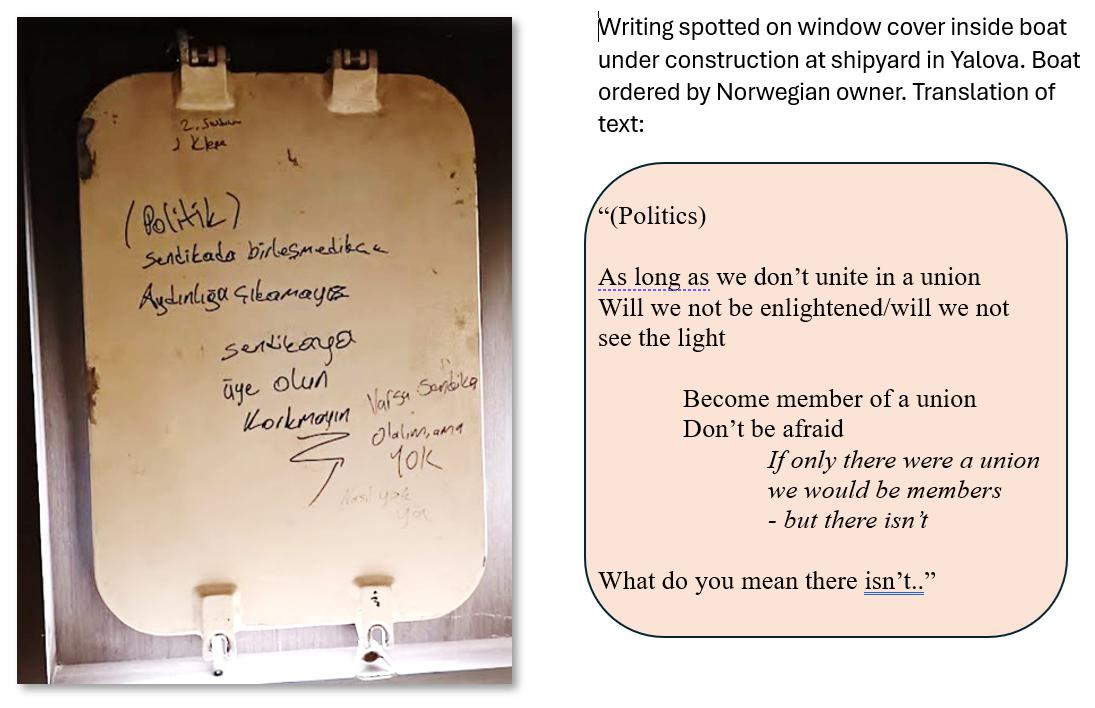
Under such conditions, it is difficult for workers to cooperate and organize. It also does not help that laws and regulations in Turkey make effective union organizing in this sector difficult. There are two active unions at the shipyards in Turkey. The largest, DOK Gemi-İş, is politically and religiously conservative and relatively close to the authorities. They organize workers ‘on the floor’ who are directly employed by the shipyards, and have collective agreements with many shipyards. The other union, Limter-İş, has very few members, is politically positioned far out on the left, and mainly organizes workers employed by subcontractors. They often take an active role in coordinating and leading the many spontaneous protests that arise in response to lack of pay or in reaction to fatal accidents. Some shipyards actively oppose unions, and one of the largest shipyards, which also builds a lot for Norwegian shipowners, has even forced the conservative union out of their shipyard.
While the workers are very poorly organized, the employer side is represented by three organizations with significant resources and great influence with the political environment and authorities. In contrast to the union representatives, employees in the employer organizations are highly educated, have good command of English, and often represent the shipyards in international contexts. Recently, however, the Turkish Competition Authority opened an investigation into two of these organizations as well as 33 shipyards for alleged collusion to hold down the wages of shipyard workers.
Occupational accidents
Turkish shipyards have been notorious for many accidents and deaths. There are various explanations for this. While shipyard owners and their organizations, the conservative trade union, authorities and some academics point to a lack of education and ‘culture’, the radical trade union and other academics focus on structural reasons, particularly related to government policies and the large subcontracting sector. In the report, I argue that both of these explanations are valid. Since 2010, a number of measures have also been implemented that have improved conditions to some extent. It is likely that pressure from Norwegian shipowners has contributed to this. Nevertheless, the death toll has been on the rise again. According to the NGO Health and Safety Labour Watch/Turkey (İSİG), there were 19 and 17 deaths in fatal accidents at shipyards in 2022 and 2023 respectively (no official registration). By 2025, the number had fallen to ten deaths. However, these numbers exclude accidents in the large and often informal side industries. In December 2025, at one O’clock at night, a 16-year-old youth died in a fire in a workshop located in the ship industry site in Tuzla in the outskirts of Istanbul. They were producing pumps for ships.
What are Norwegian shipowners and authorities doing?
Many Norwegian shipowners have received loans from Eksfin for their construction projects in Turkey. In such cases, the shipowners must comply with a detailed guide for assessing employee rights at shipyards. This involves extensive ‘due diligence’ and follow-up inspections, which gives Eksfin and the shipowners ample opportunity to guide and, if necessary, put pressure on the shipyards.
Although there are probably significant differences between the shipyards, it is also difficult to know which shipyards are preferable. It also does not help that Norwegian shipowners who have boats built in Turkey rarely mention this in their reports in accordance with the Norwegian Transparency Act. Some shipowners with large construction contracts at Turkish shipyards do not mention at all that they build a lot in Turkey. At the same time, it is also the case that neither the Norwegian Public Roads Administration, ENOVA nor Innovation Norway set any special requirements for due diligence assessments. It is time for Norwegian shipowners and other relevant institutions to take a closer look at how they can together contribute to ensuring that the conditions at the shipyards they use in Turkey are satisfactory.
The limits of soft governance
Standards, certification and audits as operationalized by for example Eksfin may have some impact on labour conditions and safety, but these tools only enable insight into and influence over certain ‘immediate’ concerns, some of which are results of deeper dynamics which are beyond the reach of these tools. The subcontracting system, for instance, is one major driver for many of the challenges in the sector. However, the way shipbuilding is socially organized is beyond the reach of standards, certification and audits. Thus, the structural frames that ensure that the subcontracting system is reproduced, including the politics upholding those frames, and the capitalist system itself, are not addressed. Rather, the particular way of organizing capitalism in Turkey may indirectly be legitimized through these exercises.
Ståle Knudsen is professor at Department of Social Anthropology, University of Bergen where he pursues work in political ecology based on ethnographic work in Turkey and Norway. Recent thematic interests include energy, aquaculture, shipbuilding and corporate responsibility.
References
Knudsen, Ståle. (ed.)(2023). Corporate Social Responsibility and the Paradoxes of State Capitalism. Berghahn Books.
Cite as: Knudsen, S. 2026. “The Invisible Hard Toilers of The Green Transition in The Maritime Sector: Shipyard Workers in Turkey” Focaalblog January 28. https://www.focaalblog.com/2026/01/28/stale-knudsen-the-invisible-hard-toilers-of-the-green-transition-in-the-maritime-sector-shipyard-workers-in-turkey/