It is the summer of 2022, and I am volunteering with Wes at a queer multi-purpose community space in Brooklyn, New York City. The space is bright pink, adorned with colourful rainbow motifs, hand-painted floating clouds, and neon signage. Today, our responsibilities are to keep the space open for community members to hang out and to sell thrifted, donated, and locally made clothing. Wes is performative, energetic, and talkative. He is an aspiring musician, and we often spend our time together styling him in the clothes for sale in the space which he wears to perform trending dances for his TikTok videos.
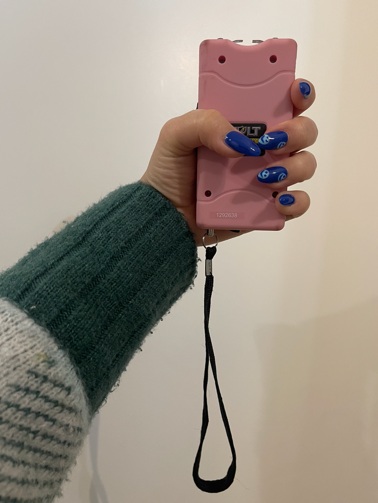
Wes grew up in a Haitian household in Connecticut. During his upbringing, safety was rarely discussed, as his family would turn to prayer to address concerns instead. Upon moving to the city, he rarely feels safe: “I don’t think I’m ever really safe, walking around in Brooklyn, to be honest with you.” To provide a certain sense of safety, Wes employs certain safety practices while moving through the city, and this includes carrying a pink taser, a hand-held weapon that uses electrical current to temporarily incapacitate a person.
His pink taser is revealed to me during that afternoon after a young woman walks in and exclaims, “I had to come in cos this place looks gay as hell!” before sitting on the couch and chatting with us. Within a few minutes, seemingly unprompted, she whips a baby-pink object out of her bag. She turns the object, which I’m unable to identify, on. It makes a loud crack and sets off a bright white flash, like an aggressive fly-zapper. I jump, but Wes remains calm, and without missing a beat, he proclaims: “I have the exact same taser!” forging a connection through the sonic and the pink. They both smile knowingly at each other, acknowledging the shared experience, before the conversation moves on.
When discussing this encounter with him later on, I mention that the noise and lights really took me by surprise. He responds, “Yeah, that’s actually helpful, because when people see it, they are like ‘oh okay!’ and I’ve never had to use mine on anyone, but I’ve walked with it ready to go. I’ve just felt better walking and holding it”. For Wes, the jarring crackle and bright white lights attract attention, signalling caution to be taken by others walking on the street while simultaneously instilling a sense of well-being in himself. He concludes, “plus it has a little flashlight too. And it’s pink!”
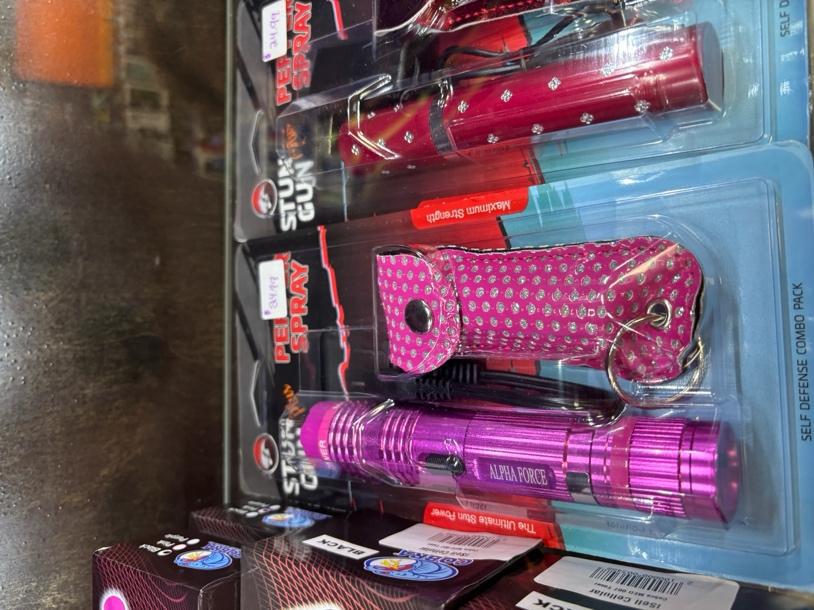
My conversation with Wes highlights the sensorial nature of objects of security, of pink tasers which zap, crackle, and flash. During my ethnographic fieldwork in Brooklyn, I regularly encountered the ownership of safety gadgets amongst my female and queer interlocutors. These safety gadgets include tasers, pepper sprays, and kubotans, which are plastic blunt stabbing objects frequently attached to keychains.
These security objects are often coded as feminine, by both the producers and consumers, from pink tasers and pocketknives adorned with text reading ‘PRINCESS’ to kubotans shaped like cat’s ears and alarms described as looking like “cute Tamagotchi’s”, small handheld digital pet games prolific in the early 2000s. Like Wes, my other interlocutors commonly reference pinkness and cuteness in conversations about their gadgets/weapons, expressing feelings of enchantment, comfort, safety, and excitement.
In this piece I explore the power of pinkness and other captivating visuals, alongside the jolting zap of the taser, to dissect the aesthetics and sensations of (in)security that operate powerfully in the potential. Seeing as none of my interlocutors have ever used their gadgets functionally in self-defence they rather operate across multiple enactments; infusing senses of reassurance and wellbeing, enabling sociality and connection while also securitizing imagined Others on the street who are situated as a potential threat.
Security aesthetics and enchanting technology
Security is not just a force to be subjected to but also an aesthetic, a mode of sense perception. Security feels, smells, looks, sounds, and tastes certain ways. It encompasses subjective judgements of taste (Ghertner, et al., 2020) and normative aesthetic assumptions, like the statement ‘pink guns are for girls.’ From enclosed architectures of gated communities to the haptics of drone warfare, encountering and performing security is an embodied and sensorial experience. To feel unsafe or insecure itself is an intuitive and embodied sensation, often described as a gut instinct or a sixth sense (Elbek, 2025; Sisnowski, 2026).
Safety gadgets like Wes’ taser are technologies of security that entice the senses. Situating pink tasers as a security aesthetic connects to Alfred Gell’s theory of art and agency. Gell gives the example of an elaborately decorated Trobriand canoe in which the decoration appears impossibly intricate, serving to beguile, intrigue, and impress, enhancing the social and political power of the canoe and its creators.
Gell uses this example to develop his theory of technologies of enchantment. The enchanting power of art lies in the technical processes they embody. In turn, technical processes cast a spell over us, making the world appear enchanted (2006, 163). The pink taser exhibits this two-way technological enchantment as both an aesthetic and technical object, as captivation through pinkness and brightness and as an electrifying weapon.
Similarly to the design of the Trobriand canoe, pinkness enacts power. As an aesthetic, pink is potent and over-determined, saturated with normativity and intersecting power dynamics. It is the socially constructed colour of vulnerability, femininity, and cuteness. Pink is of the body, it allures and entices as ‘the pan-racial color of erotic orifices,’ (Yano, 2013, 34), sites of pleasure and pain, of birth and shame. Pink can also be ironic and seditious, operating as a defiant punk aesthetic that winks back (Yano, 2013) at sexual normativity and gender stereotyping. Similarly, cuteness evokes powerlessness or weakness but also a secondary sense of exploitation or manipulation (Ngai, 2012), and a feeling of being hood-winked. In this sense, pinkness mobilizes expectations of passivity and pliancy which can function as a means of subversive protection.
Such pinkness is enacted in diverse ways. For example, for Rosa, a young trans woman, visibly carrying her pink pepper spray on the street adds to her level of ‘passing’ and her sense of safety, due to the normative gendered association of pink as an aesthetic choice. For both Wes and Rosa, the pinkness of their safety gadgets subversively winks back, as what appears cute and pink and therefore, vulnerable, unthreatening, and unassuming, are in fact the very opposite, as potentially harmful weapons.
As the potential for violence is concealed, power dynamics become troubled, as categories like aggressor and aggressed increasingly blur. In this sense gender and sexuality are at once mediated and weaponized, performed and subverted, through safety gadgets as technologies of aesthetic security.
Dazzling weapons
Gell further describes art as weapons of psychological warfare which dazzle (2006). A historical example being the dazzling camouflage painted onto warships in WW1 to confound and beguile submarine periscopes, as waves crashed confusingly against the ship’s razzle dazzle designs. Similarly enchanting designs are now being employed by anti-surveillance artist-protestors to avoid facial recognition technology (Roderick, 2019 – 2021).


Dazzling pink and zapping, flashing tasers capture attention while simultaneously producing perplexity, as a technology of enchantment that captivates as both a psychological weapon and a weapon in potential. The visceral sounds and visuals further exude a vitality. It radiates what Jane Bennett describes as thing-power (2010) which demands attention, provoking both joy and fear through its presence. In this sense, materiality has the capacity to act and affect, to vibrantly exert power, and do things in the world across assemblages of entangled people, objects, relationalities, and modalities (Bennett, 2010). In the case of the pink taser, such vibrancy and vitality allure the senses, enacting a sense of well-being and safety for Wes while affecting other bodies in diverse manners, from shock or excitement to connection or attention.
The power of the potential
These vibrant and pink security aesthetics in turn also (de)construct and socially situate divergent bodies. Queered and gendered bodies vibrate between insecure and threat, as the visual wink of the pink plays on the supposition of vulnerability interrupted by crackles of potential violence.
The term potential is of significance here, as the location of such enchantment and vitality. The power and potency of the pink taser operates in its potential to harm, as Wes states above, he walks with his taser “ready to go” but he has never discharged it and stunned anyone in self-defence.
Rather, for Wes a feeling of improved well-being is achieved through just “walking and holding” his taser, as enchantment functions through (in)animation in the sense that the aesthetics and vitality of the taser simultaneously animates the object and instils the potential to inanimate and disarm others.
While operating in the potential, the taser is enacted in multiple ways; as a technology of enchantment but also as a means of sociality, as a vibrant accessory to present to and connect with others. The aesthetic potency of sound, colour, and brightness entices the senses across divergent relations; between Wes and the unknown other on the street, and between Wes and the other taser owner; but also between myself and Wes, as an ethnographic learning opportunity through my moment of shock, and as an encounter with self, as Wes exclaims “and its pink!” demonstrating his own enchantment.
Indeed, none of my interlocutors have ever discharged their safety gadgets functionally to disarm, stun, or stab. Unlike Wes, sometimes other safety gadgets remain unused at the bottom of their handbags. For example, Fernanda is a born and bred New Yorker who grew up on Staten Island. She is very safety conscious and attributes this to her upbringing in an immigrant family, where conversations surrounding personal safety were constant throughout her childhood. Fernanda owns an array of safety gadgets including a kubuton, which she describes as a “stabby stick” and is often relegated to the bottom of her bag.
As she explains, “walking with friends and everyone else is fine and you are there walking with this little shank in your hand, it’s weird, it’s uncomfortable for everyone.” Objects mediate social relations, and this includes expectations and normativity. Fernanda doesn’t feel comfortable having her kubuton out of her bag. In her hand, the kubuton runs contrary to the social norms of her friendship group and she worries that her modality of feeling (un)safe misaligns with those of her friends which could make them feel uncomfortable.
Another young woman, Marysol, is in her late twenties and moved to Brooklyn for her postgraduate studies. She owns two pink tasers and usually carries one with her whenever she is moving through the city. One day she witnesses a violent subway attack. When she tells me about the incident she concludes exclaiming, “the one day I don’t have my taser, I legit see someone get stabbed!”
Here her taser is noticeable in its absence, however, I am left thinking what would she have done if she had her taser with her as she normally does? Intervening and inserting herself in the situation with a taser has the potential to make herself and those around her more unsafe. Others shared my concerns, in particular worries about being disarmed, a lack of training, and the close combat that necessitates use of certain safety gadgets. Perhaps the comfort of things (Miller, 2008) is a comfort of the presence and potency of safety gadgets in the potential; of a stabby stick at the bottom of a handbag to avoid social discomfort and judgement, of the reassurance of just having one’s taser with them or carrying it flashing and zapping as a warning to potential or imagined attackers.
To conclude, safety gadgets like pink tasers demonstrate the entanglement of (in)security and the sensorial. From the attention-grabbing pinkness and brightness of a zapping taser that entices the senses to senses of well-being, comfort, and enchantment produced by carrying tasers on oneself while moving through the city. By operating in the potential, these gadgets infuse a sense of reassurance into their carriers while also securitizing imagined Others on the street who are sensed and situated as a potential threat.
Moving beyond care or control, protection or punishment, Wes’ pink taser exists at an intersection of security, sensoriality, and sociality. It is an object that invokes excitement, connection, and enchantment, but also attention, caution, and violence. The pink taser troubles which bodies are imagined as insecure and as threatening, by playing into tropes of queer sexuality, femininity, and vulnerability, intermixed with a fear of the Other, by a dazzling wink of the pink and a crackle and zap with the potential to electro-cute.
Alice McAlpine-Riddell is an anthropologist and early career researcher whose work focuses on practices and experiences of safety, security, and surveillance for gendered and queered bodies in urban spaces.
References
Bennett, J., (2010) Vibrant Matter: A political ecology of things, London: Duke University Press.
Elbek, L. L. (2025) ‘Sniffing Out Trouble? What and how the ‘Police Nose’ Smells’, Focaalblog December 24. https://www.focaalblog.com/2025/12/24/laust-lund-elbek-sniffing-out-trouble-what-and-how-the-police-nose-smells/
Ghertner, D. A., McFann, H. and Goldstein, D. M., (2020) ‘Introduction: Security Aesthetics of and beyond the Biopolitical’, Futureproof: Security Aesthetics and the Management of Life, New York, USA: Duke University Press.
Gell, A., (2006) The Art of Anthropology: Essays and Diagrams, London School of Economics Monograph on Social Anthropology, E. Hirsch (eds). Oxford: Berg.
Miller, D. (2008) The Comfort of Things, London, UK: Polity Press.
Ngai, S., (2015) Our Aesthetic Categories: Zany, Cute, Interesting, Cambridge, MA: Harvard University Press.
Roderick, E., (2019 – 2021), ‘The Dazzle Club, 2019 – 2021’, Emily Roderick (website) https://emilyroderick.com/work/the-dazzle-club/
Sisnowski, M., (2026), ‘Gut Feeling, Adrenaline and Fried Onions: Sensing Aggression in German Health and Welfare Services’, Focaalblog January 24. https://www.focaalblog.com/2026/01/23/maja-sisnowski-gut-feeling-adrenaline-and-fried-onions-sensing-aggression-in-german-health-and-welfare-services/
Yano, C., (2013) Pink Globalization: Hello Kitty’s Trek Across the Pacific, Durham, NC: Duke University Press.
Cite as: McAlpine-Riddell, A. 2026 “Zap, Dazzle and Pink! The Aesthetic and Vibrant Enchantment of Tasers” Focaalblog January 26. https://www.focaalblog.com/2026/01/26/alice-mcalpine-riddell-zap-dazzle-and-pink-the-aesthetic-and-vibrant-enchantment-of-tasers/