Tag Archives: class politics

Aaron F. Eldridge: The Palestinian Cause Contra Sectarian Thinking

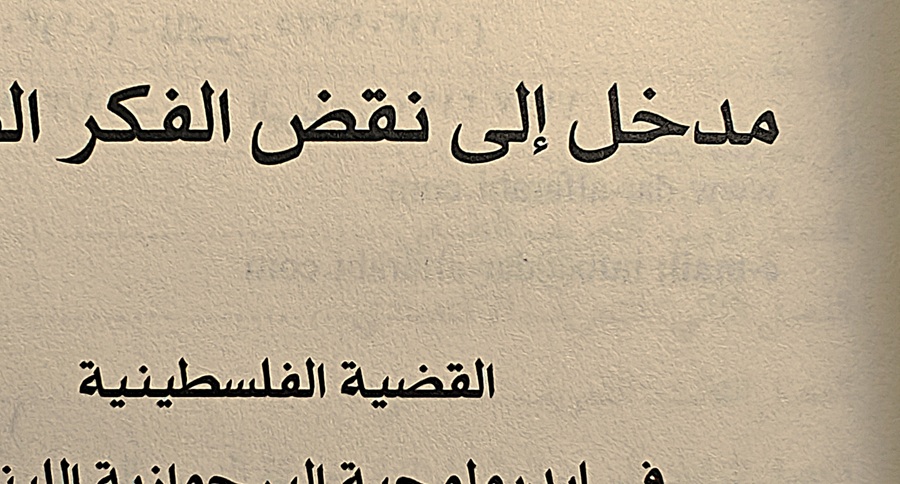
Image 1: “The Palestinian Cause” from the subtitle of Mahdi Amil’s 1980 book, An Entryway into Overturning Sectarian Thinking. Photo by Aaron F. Eldridge

“History is what hurts,” stated Frederic Jameson; “it is what refuses desire and sets inexorable limits to individual as well as collective praxis” (1982, 102). And the situation today in Lebanon is a painful one, indeed. For many, the settler-colonial Zionist efforts to bring about the total obliteration of Palestine and the invasion and bombing of Lebanon can scarcely be spoken of without already appropriating the situation through what the communist thinker Mahdi Amil (1936-1987) critiqued as al-fikr al-ṭā’ifī —“sectarian thinking.” This dominant mode of thinking lays out an (idealist) eternalization of the essence of “sects” and their statist “balance”; that is, their becoming “nature.” In this thinking, what becomes seemingly self-evident is that nothing can change—and from this, the moral injunction emerges: nothing should change. At the same time, Amil averred that it is precisely al-qadiyya al-filastiniyya—“the Palestinian cause” which overturns this thinking.

Committing to Palestine was, for Amil, a question of orienting life in struggle. The bearing of this struggle in Lebanon was occasioned by the Palestinian cause insofar as the latter transgressed, as it still does today, the “natural” order of the Lebanese polity, which subsists in what Amil termed the “colonial relation”—the constellation of forces in the Mashriq that he names as imperialism, reactionism, and Zionism. This conjuncture is evident today where one sees the strong desire to relegate and contain “the Palestinian cause” to an extraneous element, naturally outside of Lebanon’s national situation. The Palestinian cause subsequently appears “within” Lebanon only as the religious fetish of a specific “sect.” This relegation—common today, for example, in the discourse of the anti-communist Kataeb Party and in American-led efforts to enforce UN Resolution 1701—is also practiced in the specific actions of the war by the IDF: the bombing of Beirut and other parts of Lebanon as well as its invasion in the south are seen as merely military actions directed toward “Shi’i” areas—“the South,” the Beqaa, or Dahieh—that are described as Hezbollah “strongholds.” The result is that the war, rather than pivot on the cause of Palestinian liberation, becomes understood as a “sectarian” battle, a metonym of the intractable conflict between East and West, civilization and barbarism, Islam and Christianity, or religion and modernity, for which Zionism is a late vehicle.

Amil was the Lebanese Communist Party’s most prolific writer during the years of Lebanon’s wars (1975-1990), which were in a large part determined by the contours of Palestinian struggle after the defeat of 1967 and the expulsion of 1970. What that “determination” means was (as it remains) a crucial problematic into which Amil consistently intervened. Indeed, Hicham Safieddine (2020: 10) notes that it was one of Amil’s earliest teachers, Shafiq al-Hout—one of the founders of the PLFP and later a prominent member of the PLO—who introduced him to Marx’s writings.

This enjambment of anti-colonial struggle and the class struggle would persist as a problematic in Amil’s theoretical practice. While studying in France and teaching in revolutionary Algeria he developed the concept of the “colonial mode of production” for this overdetermined structure, one characterized by a relation of “dependency” for capitalist domination “in” the colony on imperial capital. The ideological articulation of this structure he termed the “colonial relation,” and it is there, on the question of the matter of that relation, that “sectarianism” and “the Palestinian Cause” collide.

Amil’s return to Lebanon from Algeria was compelled by the defeat of 1967. During the ensuing years the LCP was rearticulating its relationship to anti-colonial struggle and the Soviet Union (a major issue being the latter’s acceptance of the 1948 partition of Palestine). And when in 1975 the fighting began in Lebanon—instigated, we must recall, by the conflict between fishermen in Saida and state organized capitalist expropriation (Traboulsi 2008, 323)—Amil looked to articulate the relationship between “sectarian thinking,” Arab state reactionaries, and Zionism as a question of the class struggle, anticipating the constellation of forces that would eventuate in the Syrian (nominally, the Arab Deterrent Force’s) occupation of Lebanon from 1976 and the Israeli invasion of 1982.

Between these two pivotal military interventions Amil composed and published his 1980 Madkhal ilā naqḍ al-fikr al-ṭā’ifī: al-qaḍiyya al-filastīniyya fī aydiyūlūjiyāt al-burjuwaziyya al-lubnāniyya (An Entryway into Overturning Sectarian Thinking: The Palestinian Cause in the Ideology of the Lebanese Bourgeoisie) in which “the Palestinian cause” occasions the falling away of the spontaneous ideology of the ruling class (sectarianism). It does this not through a ‘critique’ of how one ‘views’ the Palestinian cause, but by allowing sectarian thinking’s own mistaking of the Palestinian cause as a ‘sectarian’ problem to prevail. It is for that reason that the Madkhal is largely made up of a symptomatic reading of the texts of the Lebanese bourgeoisie, from the writings of Michel Chiha (1891–1954), the Mandate-era banker and phalangist politician, to Amil’s contemporary Pierre Gemayel (1905-1984) and other writings of the latter’s Kataeb Party.

The formation of the Lebanese National Movement (LNM), a coalition of reformists and revolutionaries that constituted the chief antagonist of the reactionary Lebanese Front (LF), was largely premised on the constitutional reform of the country’s politics. It was oriented, according to Karim Mroué, a Political Bureau Member of the LCP, toward “eliminating the domination of a kind of religious autocracy” (quoted in Ismael and Ismael 1998, 102n8). However, the Madkhal shows such bourgeois “sectarian thinking” to be undone in its own grasping of “the Palestinian cause.” Hence, while Amil was at pains to show that militant support for the PLO and the Rejectionist Front, with whom the LNM was allied, was the miḥwar, the“axis,” of the national and anticolonial class struggle in Lebanon and not an external element, the Madkhal was to effect a change in thinking—to show that the Palestinian cause as it is articulated in the ideology of the dominant class leads to the latter’s ideological armor, sectarian thinking, to fall away, as Marx says, “like rotten touchwood [wie mürber Zunder].” (1976 [1867], 932). Indeed, while naqḍ in modern Arabic gives the strong sense of a juridical interdiction, earlier meaning of the word directly invoked the unravelling of a cord. This work of unravelling, of the falling away of sectarian thinking, Amil showed, is affected in the Palestine cause. Why this is the case can only be briefly adumbrated here, by setting out the axioms that programmatically orient Amil’s theoretical work in answering the inaugural query of the Madkhal: “How do the Lebanese bourgeoisie, from the vantage of their class ideology, view the Palestinian cause?” (Amel 1980: 11). [1]

The Madkhal takes as its first axiom the orientation of class struggle, which bifurcates (rather than pluralizes) into the position of “dominant class” and the “revolutionary class.” The “ideological position of the labouring class” is what enables “seeing” the ideological practice of the Lebanese bourgeoisie as the political necessity of domination—it follows that the question of which“sect” is dominant (“the Maronites,” “the Sunni,” etc.) not only cannot see the class struggle but participates in the very sectarian thinking that obfuscates it. Moreover, the result of the breakdown of this domination in maintaining the colonial relation was the then-ongoing military action: “the bourgeoisie did not find another way to treat this political crisis of theirs but to ignite civil war; it is the logic of the dying bourgeoisie, ever urging them to descend into the abyss of their intractable crisis” (Amil 1980: 23). It is incumbent upon us to note how successful the ‘civil war’ and threat of its return has been in maintaining this domination in Lebanon over the past half-century.

The second axiom of the Madkhal is that this class-ideological position is the adequation of thinking to a real force of negation. Against the theoretical humanism of a mirrored subject/object—wherein “the Palestinian cause” is an object that can be composited properly by collating these different ‘perspectives’ (whether “one-“ or “two-state” solutions, for example)—the “soil” of this “actual field” is the class struggle that is “in the mode of overturning [naq

].” Breaking with this thinking, then, “consists specifically in bringing to presence this, the political that the ideological absents.” In other words, “seeing” the “Lebanese bourgeois ideological-conceptual structure…in its relation with this political necessity,” bears the activity of overturning it.

It is from these axioms that Amil sets up the relationship between the activity of “overturning” the class ideology of the Lebanese bourgeoisie and “the Palestinian cause”:

Viewing the Palestinian cause is not possible—no matter the position from which we view it—apart from the national liberation movement of the Arab peoples. The Palestinian national movement is an inseparable part of this movement; the internal mechanism that governs the common Arab national movement is itself what governs the Palestinian national movement, the mechanism being the liberation from imperialism, Zionism, and Arab reactionism. (Amil 1980, 12)

In this sense the Palestinian cause condenses the “colonial relation,” the specific conjuncture of forces (imperialism, the Arab capitalist class, and Zionism) that ideologically articulates the colonial mode of production in Lebanon. Hence Amil’s thinking is already disabused of the (idealist) tendency to systematize and absolutize the distinction between “post-colonial” and “Marxist” thought in the so-called Global South. The overdetermined structure of the “colonial mode of production” exists in the collision of these forces.

But this is precisely why it is the question of the overdetermined colonial structure itself that the Palestinian cause occasions for thinking:

Therefore, determining the Lebanese bourgeoisie’s class position on this axial cause (the Palestinian cause) in the struggle of the Arab peoples, required by necessity determining its class position on the Arab liberation movement. For in the light of this position the other position is determined, especially since the Palestinian resistance movement did not manifest, in an actual way, in the Lebanese arena (that is, in the field of the specific class conflict in the Lebanese social structure), and would not become a foundational element therein, until after the defeat of June 1967. (Amil 1980: 12)

The existence of the Palestinian cause as anterior to the anti-colonial class struggle in Lebanon does not mean that it is a genetic outgrowth of the situation, even if it is “determined” by it. Here, Amil is notinterested in instructing a historicism. Rather, he shows how the Palestinian cause’s status as, at once, contingent and axial in Lebanon’s national situation proves to be a decisive obstacle for ‘sectarian’ thinking:

It is an error, then, on the methodological level, not to show the necessary correlative relationship in the Lebanese bourgeois ideology between the position on the Arab liberation movement and the position on the Palestinian cause; as, in truth, this position is a natural, logical consequence of that position that finds, for its part, its explanation in the structure of the existing colonial relations of production in the Lebanese social structure, and in the class relation of dependence that ties the dominant bourgeoisie within it to imperialism. But if we establish a partition between the two positions, not attributing the second to the first, and we do not bring to light that the practice of the outright hostility of the Lebanese bourgeoisie toward the Palestinian resistance and the Palestinian cause is a result of the hostile relationship and class warfare that stamps its relationship to the Arab liberation movement, we would at that time fall into the trap of its class ideology, instead of being capable of overturning it. (Amil 1980: 13)

The position of these liberation movements thus turns on the Palestinian cause which articulates with them to become the symptomatic point specific to the national situation of Lebanon. It becomes the axis of a set of contradictions and of political struggle; it carries the force of the real movement of negation. But it is for precisely this reason that it cannot be thought outside the class struggle internal to Lebanon’s national situation. “We will not,” Amil writes succinctly, “overturn ‘sectarian thinking’ through sectarian thinking” (Amil 1980: 17).

In other words, the Palestinian cause, its pain and therefore its history, is one site that makes the overdetermination of the capitalist mode of production in the present, that is, modern colonisation, thinkable as what can be overturned. “The class struggle is the motive power of history; history is not moved in accordance with the dominant class’s system of class control but in the struggle against it” (Amil 1980: 22). Witnessing the current attempts to obliterate Palestine and its present existence-as-cause as well as its covering-over by the ideological practice of sectarian thinking in Lebanon today, the need to articulate the falling away of sectarian thinking is no less pressing.


Aaron F. Eldridge is a Postdoctoral Fellow in the Department of Anthropology at the University of Toronto. He studies collective responses to cultural destruction and social precarity in the Middle Eastern and Muslim/Eastern Christian world.


Notes

[1] We should note here the polysemy of al-qaḍiyya al-filasṭīniyya in Arabic. It is not only “the Palestinian cause” but also “the Palestinian issue” and “the Palestinian question,” terms which, in English, ramify into terrains of political transformation or armed struggle, social antagonism, and juridical dispute respectively. This question of translation is relevant because what is at stake for Amil, following his contemporary Palestinian comrades in their articulation of resistance, is precisely the transformation of a juridical “question” (to be resolved in the future by statist, international law) into a material “cause” that articulates present time, situated in what Omid Mehrgan aptly describes in this feature as “the remnants of life today.”


References

Amil, Mahdi. 2020. Madkhal ilā naqḍ al-fikr al-ṭā’ifī: al-qaḍiyya al-filastīniyya fī aydiyūlūjiyāt al-burjuwaziyya al-lubnāniyya (An Entryway into Overturning Sectarian Thinking: The Palestinian Cause in the Ideology of the Lebanese Bourgeoisie). Beirut: Dar-al Farabi

Ismael, Tareq Y. and Jacqueline S. Ismael. 1998. The Communist Movement in Lebanon and Syria. University Press of Florida.

Jameson, Fredric. 1982. The Political Unconscious: Narrative as a Symbolically Social Act. Ithaca, NY: Cornell University Press.

Marx, Karl. 1976 [1867]. Capital: A Critique of Political Economy. Translated by Benjamin Fowkes. New York: Vintage.

Safieddine, Hicham. 2020. “Introduction: The Anti-Colonial Intellectual.” In Arab Marxism and National Liberation: Selected Writings of Mahdi Amel, edited by Hicham Safieddine and translated by Angela Giordani, 3–9. Leiden: Brill.

Traboulsi, Fawwaz. 2008. Tarikh lubnān al-ḥadīth [A History of Modern Lebanon]. Beirut: Dar Riad El-Rayyes.


Cite as: Eldridge, Aaron F. 2025. “The Palestinian Cause Contra Sectarian Thinking” Focaalblog October 6. https://www.focaalblog.com/2025/10/06/aaron-f-eldridge-the-palestinian-cause-contra-sectarian-thinking/
Alexandrine Royer: ‘In Kigali, life is expensive’: how everyday inflation talk gives voice to political and class frustrations 

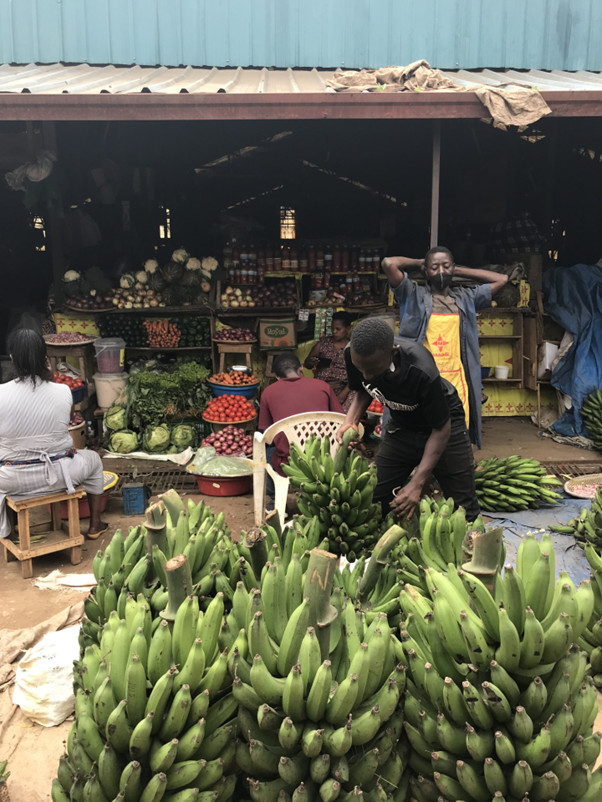
Image 1: Food vendors at Kigali’s central Kimironko market, photo by author

I encountered the phrase ‘in Kigali, life is expensive’ everywhere during my 15 months of fieldwork within the tech ecosystem of Rwanda. Official government figures stated that the price of common food staples had increased by 35% but residents estimated it to be much higher. Gas, electricity and housing prices were also soaring. My interlocutors asked whether I knew the cost of potatoes, bus transport, and rent, wondering if as a muzungu (white foreigner), I was shielded from these economic pressures. In Rwanda, where politics is an uneasy and potentially threatening topic, inflation was a shared device through which individuals across social classes could comfortably voice critiques of rising social and class inequality. I build on Amri’s (2023) concept of ‘inflation-talk’ to argue that small talk on the rising cost of living, with its outward apolitical nature and indefinite causes, provided a safe discursive space for disclosing class and political frustrations.

When I asked around the tech ecosystem why life in Kigali was getting so expensive, responses generally converged around the hypothesized causes of inflation, such as the war in Ukraine, low local agricultural productivity, and the continuous devaluation of the Rwandan franc. As one person commented, ‘there’s huge inequality now. The rich get richer, and the market follows the haves’. The rising inequality in Rwanda sat awkwardly with the Government of Rwanda’s confirmation of the country’s teleological trajectory towards becoming a prosperous ICT-based economy as outlined in the guiding policy document Vision 2050. During tech conferences, held in nicely air-conditioned halls with swanky Afro-fusion decorations, international delegates and heads of state would praise President Paul Kagame for his vision in transforming Rwanda from a country once torn apart by genocidal violence towards becoming a continental leader for ICT development. Yet, outside such spaces, interlocutors commented on how the rising cost of living made their participation in this tech universe more difficult. Founders let go of staff, cancelled their coworking memberships and confessed their worries about possible consequences for their social and business reputations.

In the economic literature, financial crises and a rapid rise in food prices are frequently correlated with civic action and social unrest (see Bellemare 2015). But very few of my interlocutors in Kigali openly criticized the Rwanda Patriotic Front (RPF), Rwanda’s ruling party for the past 30 years. Returnee diaspora, which made up a sizeable portion of the tech ecosystem, would actively participate in the online defence of president Kagame, most virulently on X, with hashtags such as #TeamPK. Following the announcement on 15 July 2024 of Kagame’s re-election with 99% of the vote, Rwandans were quick to defend the results after Human Rights Watch reported a lack of genuine political competition. As one tweet stated, “Rwanda is a sovereign country and its President doesn’t have anything to answer to Western colonisers trying to impose their so called order on it…”. The RPF’s post-genocide ‘Ndi Umunyarwanda’ (Kinyarwanda for ‘I am Rwandan’) strategy of national reconciliation criminalized references to ethnic identity and further obliged Rwandans to reject all forms of social division (Purdeková & Mwambari 2022) to embrace a front of unity. Lists of permissible and forbidden citizen behaviours were pasted on the walls of schools and at the entrance of villages. Talking negatively about the country was identified as subject to discipline and punishment. Publicly voicing political critiques could result in accusations of anti-patriotism or worse, of harbouring genocidal ideologies.

In studies of Rwanda, scholars, most notably Thomson (2013), have sought to identify through James C. Scott’s ‘weapons of the weak’ (1985) instances of resistance towards the Rwandan state. Yet, as Rollason (2019) underscores, such studies pre-suppose defiance in citizens’ engagements with authorities and reify a division between the ruling and the ruled. Yet, many of my interlocutors, like Rollason’s, navigated the same social circles as government functionaries and held varying levels of political privilege gained through patronage or familial connections. In private conversations, they expressed an ambivalence towards the country’s politics rather than a stark opposition or deference to power. Some Rwandans expressed continued indebtedness to Kagame for allowing their families’ return, whilst other African nationals saw restricted political freedom as part of a trade-off for government effectiveness, saying ‘here at least you know where the money is going’. Paul Kagame’s presidency was part of an accepted order that could just as easily be toppled over. As a friend related, ‘everyone here says that they are for the president. But the last president, before the genocide, he also got 99% of the vote’. There was a longer history of dissimulation in Rwanda and maintaining an image of stability in contrast to its more turbulent neighbours.

It is in this climate of ‘quiet insecurity’ (Grant 2015) that conversations about the cost of living, first described in apolitical economic terms as concerns over rising food prices or other essentials, became an avenue by which people voice political and class frustrations. When housesitting for friends in a predominantly expat neighbourhood, I was approached by their cleaner, Hope, who asked whether I was looking for additional house help. I awkwardly replied no but promised to keep an ear out. Mopping the floors of the study, Hope would occasionally pause to volunteer bits of her familial history. She narrated the loss of her father and siblings during the genocide, with herself and surviving members fleeing to Uganda before eventually settling back in Kigali in the early 2000s. Hope struggled to cover her monthly rent and feared eviction. As usual for discussions on politics in Rwanda, she began with praise for the President to avoid reproach before delving into frustrations. She said, “I like Kagame because he saved many people, but Rwanda has too many rules…working three days a week is not enough, the cost of food in Rwanda is now very high. I support my mother…. It’s very difficult being poor in Rwanda, the genocide was not nice, very sad. In Uganda, the poor can sell food on the street, the women can make money, but in Rwanda it’s illegal, you can get into big trouble…” Hope was referring to the RPF’s criminalization of hawking, petty trading and street food vending (Finn 2017). Such measures aimed at making Kigali a ‘clean and modern city’ constrained the urban poor’s ability to multiple hustles and weather rising costs.

More privileged Rwandans also felt government policies were often out of touch with the socio-economic realities of most Kigalians. I met up with a founder friend over lunch, Shema, who recounted how his startup had experienced some recent financial setbacks. He mentioned that the new school budgets introduced by the Ministry of Education were barely adjusted for inflation, leaving little room for schools to spend on ed-tech products. School directors were more concerned with retaining quality teaching staff than investing in e-learning. As Shema explained, “the cost of Irish potatoes for one 1kg has now gone up to 1500 Rwf [approx. 1.50 USD] but the average salary for a teacher in Rwanda is now 70 000 Rwf [approx. 70 USD], how can people afford that?”

Being the youngest child of a single-parent household, Shema was proud of how he had risen from kitchen staff to managerial positions in the hospitality industry before dedicating himself to his startup. He felt the city’s rich kids, who often occupied key positions in the Presidential office, would likely not understand his, or his clients’, financial struggles: “It’s almost as if these guys are not Rwandans, they can sometimes barely speak Kinyarwanda and in their summers, they go on vacation to France or the US or Canada…these guys have probably never shopped at Nymirambo market, they go and get their groceries from Sawa Citi or Simba [supermarket chains]… They are the ones who then go study abroad and come back and make policies, but they don’t know what life is like in Rwanda. You know Claire Kamanzi [CEO of Rwanda Development Board], she wasn’t even in Rwanda before, how can they know the country, they only know about it from reading reports…”. Picking up on his comments, I inquired further as to what needs to change in Rwanda, to which he replied, “it would be if the system was for the masses, here it is the elites who in charge”. As reflected in the conversation with Shema, talk on the felt effects of inflation opened a portal to discussions on middle-class and elite urban divides and how such schisms mapped onto political decision-making.

The rising cost-of-living further hindered my interlocutors’ aspirations to attain or preserve middle-class living in Kigali and its accompanying social norms. Like Nairobi’s peri-urban population studied by Lockwood (2020), current socio-economic inequalities in Kigali were not seen as a permanent condition, but as part of a challenge to ‘make it’ and achieve the standard of living possessed by others. Foreign entrepreneurs from the Global North could weather the franc’s continuous devaluation and primarily resided in upmarket neighbourhoods.

But local young founders, predominantly men, complained about how it was now impossible to save for a house within your twenties, adding that girls now were more interested in dating older men with money. Male homeownership in Rwanda remained a prerequisite for marriage and the social transition to adulthood. Many mentioned how their irregular incomes had caused issues with their girlfriends, as they cynically joked that ‘it was becoming too expensive to adult’. Some were equally forced to relocate to neighbourhoods on the outskirts of Kigali and expressed feeling squeezed out of the city. Economic pressure further caused a series of aches and pains, as colleagues and entrepreneurs complained of burnout, fatigue and anxiety.

In a context where politics is laden with couched terms, speaking on inflation and its felt effects allowed interlocutors to share pointed political critiques and reveal class-based social tensions. The cost-of-living crisis threatened the aspirational livelihoods of my predominantly middle-class interlocutors and undid the image of a prosperous nation that the government endeavoured to maintain. For my interlocutors, commentary on inflation did not stand alone; it provided a means of contextualizing and reflecting on the socio-economic, gendered and political make-up of life in post-genocide Kigali and its resultant inequalities. It further opened questions on who would ultimately profit from the country’s push towards modernization.


This text is part of the feature The Social Life of Inflation edited by Sian Lazar, Evan van Roeckel, and Ståle Wig. 


Alexandrine Royer is a doctoral candidate in Social Anthropology at the University of Cambridge. Her work centres on digital economies, startup culture and development practices in East Africa, with a focus on Rwanda.


References

Bellemare, M. F. (2015). Rising Food Prices, Food Price Volatility, and Social Unrest. American Journal of Agricultural Economics, 97(1), 1–21.

Grant, A. M. (2015). ‘Quiet Insecurity and Quiet Agency in Post-Genocide Rwanda’. Ethnofoor 27(2): 15-36

Finn, B. (2017). Quietly Chasing Kigali: Young Men and the Intolerance of Informality in Rwanda’s Capital City. Urban Forum (Johannesburg), 29(2), 205-218.

Lockwood, P. (2020). The Greedy Eaters: A moral politics of continuity and consumption in urbanising central Kenya [Apollo – University of Cambridge Repository]. https://doi.org/10.17863/CAM.65545

Purdeková, A. & D. Mwambari (2022) Post-genocide identity politics and colonial durabilities in Rwanda, Critical African Studies, 14:1, 19-37, DOI: 10.1080/21681392.2021.1938404

Rollason, W. (2019) ‘Motorbike People Power and Politics on Rwandan Streets’. Lanham: Lexington Books. 

Thomson, S. 2013. Whispering Truth to Power: Everyday Resistance to Reconciliation in Postgenocide Rwanda. Madison: University of Wisconsin Press.


Cite as: Royer, Alexandrine 2024. “‘In Kigali, life is expensive’: how everyday inflation talk gives voice to political and class frustrations” Focaalblog 10 December. https://www.focaalblog.com/2024/12/10/alexandrine-royer-in-kigali-life-is-expensivehow-everyday-inflation-talk-gives-voice-to-political-and-class-frustrations/

Ida Susser: Melenchon: the creation of a left political bloc

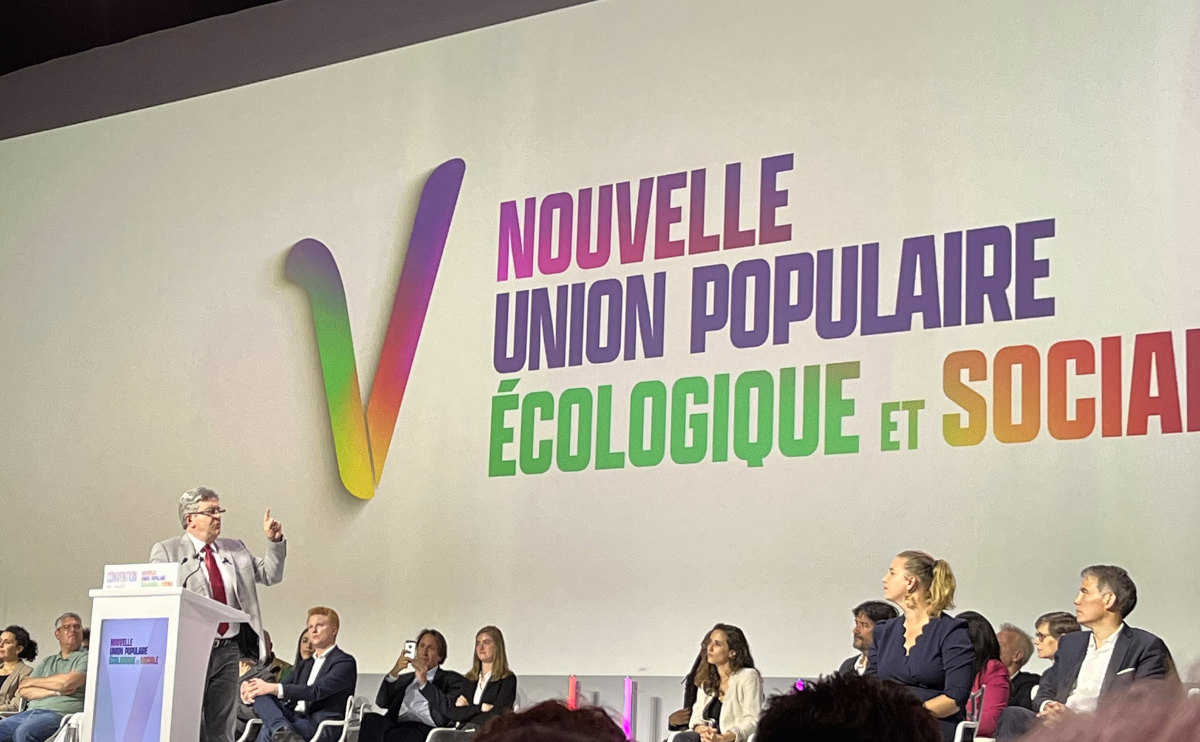
On June 19, 2022, the united left party, NUPES (New Ecological and Social Popular Union), cobbled together by Jean-Luc Melenchon in less than two months, won enough seats to become the official opposition in the French National Assembly. How should we understand the growth of this left alliance in France which seems to have taken political pundits by surprise?

Since 2015, I have been conducting ethnographic research on progressive social transformation in Paris and, in fact, documenting the emergence of the counter-hegemonic bloc represented in this alliance. I have focused on what has been called “commoning” (Nonini 2007; Stavrides 2015; Susser 2016, 2017, 2018; Dardot and Laval 2019), the process of creating commons, to consider the ways in which this form of popular contestation is transforming political subjects, generating collective ethics, and reconfiguring democracy.

Image 1: Jean-Luc Melenchon delivering a speech at the NUPES convention on 7 May 2022, photo by Hugo Rota

Two aspects of commoning help to illuminate the current elections. The first is the creation of a new political subject and a political vision through a process of sharing and community activities. The second is the process of thresholding or crossing of transitional space that led to alliances among groups who had not previously recognized common interests. I argue that both aspects contributed to the creation of a public oriented in the direction of social justice, inclusivity and a collaborative left leaning political bloc.

To illustrate these processes, I focus on the Gilets Jaunes, a movement which emerged in November 2018.  From the start there was much debate in France and internationally about whether to characterize the Gilets Jaunes as right or left in the context of Brexit, Trump, and most significantly, Marine Le Pen, head of the extreme right party in France (Rogozinski 2019, Balibar 2019 and many others). It is this dilemma that made these protests particularly important from an analytic and practical political perspective.

Historical Conjuncture and Crisis

In 2016, the Socialist government of Francois Hollande, with Emmanuel Macron as economy minister, initiated legislation to change the labor laws. Although policies to reduce public spending and increase the flexibility of employment had been gradually implemented for some time, this major effort by a Socialist government to change the labor laws set off a political crisis.

Because of this crisis, a new era of street protest emerged in Paris. The first of the protests was Nuit Debout, which began on March 31, 2016. This movement echoed the historic squares occupations of Southern Europe in 2011, although it took place five years later.  As previously, in Spain, the call to action was initially to join the unions in support of the traditional labor laws that a socialist government proposed to relax.

The attempt to change the labor laws, and the protests in response, dramatically undermined the legitimacy of the Socialist Party. The political conjuncture of this event with allegations of fraud on the traditional right opened the way for a new political configuration in France. In this vacuum, the newly created party led by Macron, the left party created by Jean-Luc Melenchon in 2012, and the marginal far right, reincarnated by Marine Le Pen, re-oriented the national arena.

Taking advantage of the wide-open field, in May 2017, Macron, without a traditional party but strongly supported by corporate funding, was elected President for the first time. He rapidly began to implement far-reaching changes. In the interests of workforce flexibility, he weakened employment security and later tried to alter the calculation of union pensions as well as increase the age for pension entitlements. Student admissions to public universities were re-organized and health workers and teachers faced layoffs. The threat of worker disciplining in the interests of capital became widely feared. Each change was accompanied by massive social movements and street uprisings.

Over the years of the first Macron presidency, many different groups under different kinds of pressures opposed the new changes. Resistance took the form of both organized strikes and wildcat worker strikes, the occupation of squares, student sit ins and street rebellions. In November 2018, the Gilets Jaunes uprising began. Finally in 2019, a mass movement was organized by unions to oppose the dismantling of the national pension plans. I analyze the Gilets Jaunes within this broader historical arena as well as in contrast or comparison with the protest movements I have been observing in the United States.

The Gilets Jaunes and Commoning

The Gilets Jaunes began as a one issue protest, against the gas tax. The message was spread through Facebook, and other platforms. Still organizing around one issue, the protesters began to meet in real time, at roundabouts, crossroads and along highways in many parts of France. Next, Gilets Jaunes took to the streets of Paris in enormous and unprecedented marches on successive Saturdays for over eighteen months.

As people who lived near one another but had not necessarily met before began to meet regularly, they began to build a shared sense of community. Starting out as a mixture of pensioners, and many poor and disabled people from the provinces, including disengaged socialists and Le Pen supporters, the Gilets Jaunes can be seen as negotiating positions over time. Negotiations took place within the space of the commoning experience during the occupations, the general assemblies, the assemblies of assemblies and the massive Saturday demonstrations.

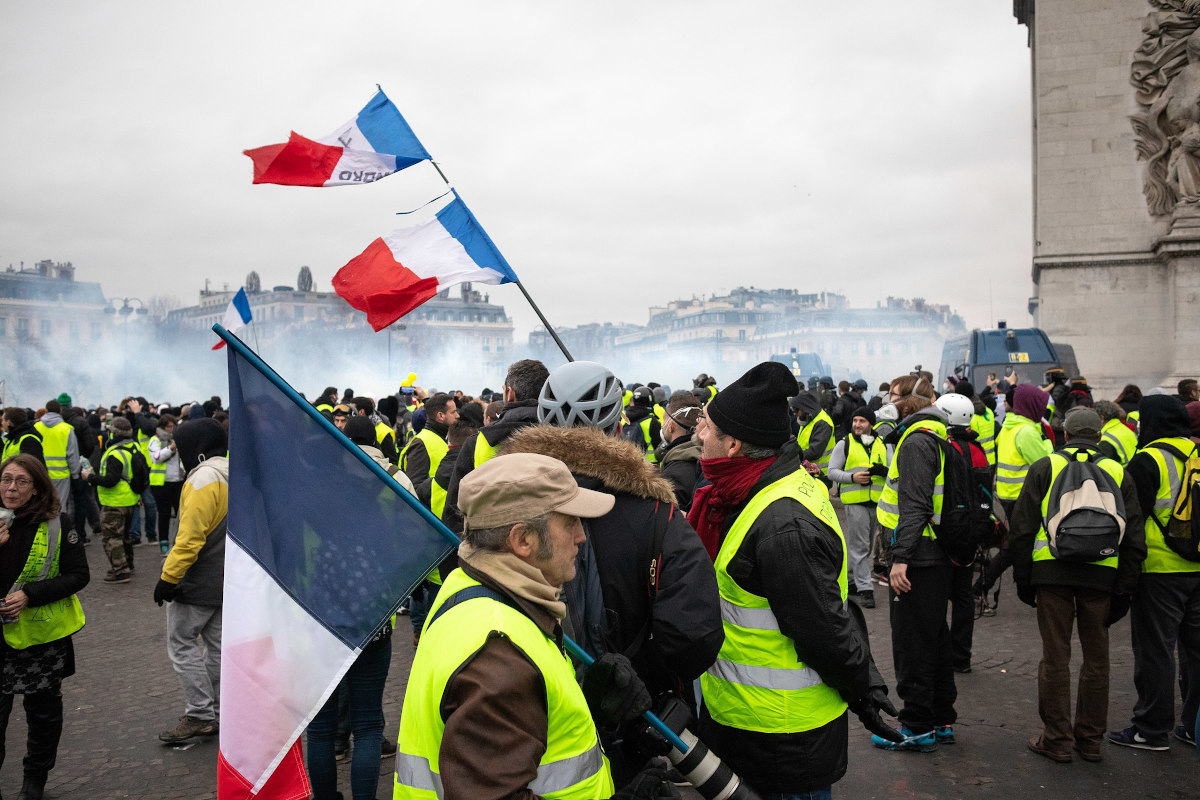
Image 2: Gilets Jaunes – Acte IX at Place de l’Etoile in Paris on 12 January 2019, photo by Olivier Ortelpa

The community was built in multiple ways: by barbecues and picnics, by bringing children to play in the environment, by building cabins, sometimes making them comfortable for wintry stays. Saturday afternoons were spent grouping close together in the cold to keep warm in wind, rain and snow, and some Saturday evenings around fires and in cabins. Gilets Jaunes wrote personal statements and commentaries on the backs of their vests. They spray painted slogans and arrayed tags, posters, and banners as well as other forms of graffiti (Le Comité de soutien 31 2019) along the routes of the demonstrations. The yellow vests and the songs such as the ever-present “On est la” generated a sense of belonging and became a signal that Gilets Jaunes were present in whatever guise they happened to be. Over time, singing the song simply indicated that people emulated and echoed the Gilets Jaunes in other demonstrations.  Experiences such as this can be seen as the commoning process of the Gilet Jaunes.

Through meeting several times, a week, sharing narratives, singing Gilets Jaunes songs and, dressing in the familiar yellow vests, group members built a, possibly fragile, sense of solidarity in ways that crisscrossed over divisions of family, income, color, and age, and maintained a strong belief that the disabled were part of the community. Negotiations involved a recognition that poverty and distress need not be shameful but were a product of changing circumstances and uncaring or destructive government policies. As a result, in difficult, often physically uncomfortable, conditions, principles of cooperation were established along with a belief in horizontalism and an aversion to political leaders.

Où sont les neiges d’antan? (Where are the snows of yesteryear?)

Analysts have discussed the solidarity of factory floors or assembly lines and even nostalgia with respect to that solidarity (Muehlenbach 2017). Following Lefebvre there has also been a recognition of the solidarity of the streets and public spaces (Lefebvre 1971, Harvey 2012, Susser and Tonnelat 2013). The experience of the Gilets Jaunes points to the creation of a critical public at the roundabouts which generated or echoed the affect of the lost village community.

Such nostalgia has historically generated conservatism as well as revolutionary ideas (Susser 2008, Williams 1983). The question became, in what ways would this community be invested with emotions? It could generate an exclusive nationalism (as today in Hungary, Romania, or Poland) or a wider sharing sense of the needs of the poor and disabled.

In an ever-evolving process, people came to the roundabouts and talked among one another of their economic challenges and domestic hardship. They managed to escape the individual humiliations of poverty and household desperation, of their unrelenting work for not enough pay, their exhaustion and lack of belief in their own or their children’s future. Instead, they talked collectively about the degradation of everyday life – the loss of a village center, a post office, a bakery, and a public square; the loss of local schools; the need to drive long distances for employment and childcare; and the endless drudgery of work which did not allow sufficient time or provide the means to help their children, their elderly or disabled neighbors and relatives or meet their friends (Susser 2020). Their nostalgia recalled the loss of a social existence centered around local services and a secure welfare state and became the basis of their rage against Macron’s neoliberal policies.

Thresholding

The second aspect of commoning which contributed to a progressive or left positioning on the spectrum was what has been called thresholding (Stavrides 2015). Analysts (Stavrides 2015) have talked of “thresholds” to distinguish commoning from more right wing or nationalist movements claiming territory. The idea was that open doors or thresholds connected different groups which allowed for inclusivity while at the same time recognizing ethnic and other identities upon which the different groups were based. If commoning creates groups which are built on experiences of sharing in new ways, thresholds are a basis for sharing across groups. Thresholding be understood in much the same way as rites of passage which Arnold Van Gennep (1960) saw as taking place in three stages, separation, transition, and incorporation (see also Turner 1958).

We might consider moments of liminality, such as occupations, freezing afternoons at roundabouts or possibly the common experience of violence in the streets as the moments of separation and transition. These represent challenging and bonding processes taking place in liminal or temporarily undefined space. In sharing such trying circumstances, people cross thresholds of trust and build bridges across unusual groups, in processes of incorporation.  Thus, what might be understood as prefigurative politics which emerged in the practice of street protests included both commoning and the recognition of many autonomous groups working together: In other words, inclusivity, and thresholds to new populations.

Environment, convergence, and thresholding

Thresholding among the Gilets Jaunes occurred with respect to the environmental movement. Emmanuel Macron had announced the gas tax as an effort to curb the use of this gas for environmental reasons. Consequently, the Gilets Jaunes protest against the gas tax was interpreted by the government and the media as a protest against ecology. Over the next two years, much time and effort were put into convergence. Environmentalists who were also Gilets Jaunes and others who organized joint marches, teach ins and conferences worked to counteract stereotypes and to build thresholds between the two movements.

In February 2019, the environmental movement staged a demonstration on a Saturday afternoon in Paris which the Gilets Jaunes joined. They started together. However, after the first few blocks the Gilets Jaunes parted ways from the permitted route of the ecological demonstration and made their way on a “wild” protest (undeclared) towards the Champs Élysées. Later all the groups met again listening to passionate speeches at La Place de la République. Some youthful Gilets Jaunes were sitting in the square wearing flowers in their hair reminiscent of green protests over many decades. After about 6pm, as dusk settled, violence suddenly erupted, traffic was stopped, and the square was closed off by police. From the point of view of the Gilets Jaunes, the violence was in response to police arrests in the square.

In spite, or possibly because, of the evening clashes, this demonstration clearly opened portals between the Gilets Jaunes and the environmentalists. From early 2019, “The end of the month and the end of the world” became a characteristic slogan of the Gilets Jaunes. Climate activists continued their efforts towards convergence. The Gilets Jaunes never became a climate movement, but the polarization claimed by the government was not supported by later events. Rites of passage in shared marches and other experiences had opened thresholds for collaboration.

Police brutality and thresholds of race

As I described in a previous post in FocaalBlog (Susser 2020), the #BlackLivesMatter protests in the US were followed by massive demonstrations against police brutality in France. Although police brutality was a long-time theme of the Gilets Jaunes, this time the Paris protests, while including the Gilets Jaunes, focused specifically on the brutality against youth and people of color. This recognition of common problems represented newly possible thresholding between the Gilets Jaunes and people of color from the banlieues.

Here, thresholds were opened between so-called but no longer stable working classes, the imagined middle classes also at risk of instability, and the super-exploited subjects divided by racism, sexism, colonialism, citizenship, and other forms of historical subordinations.

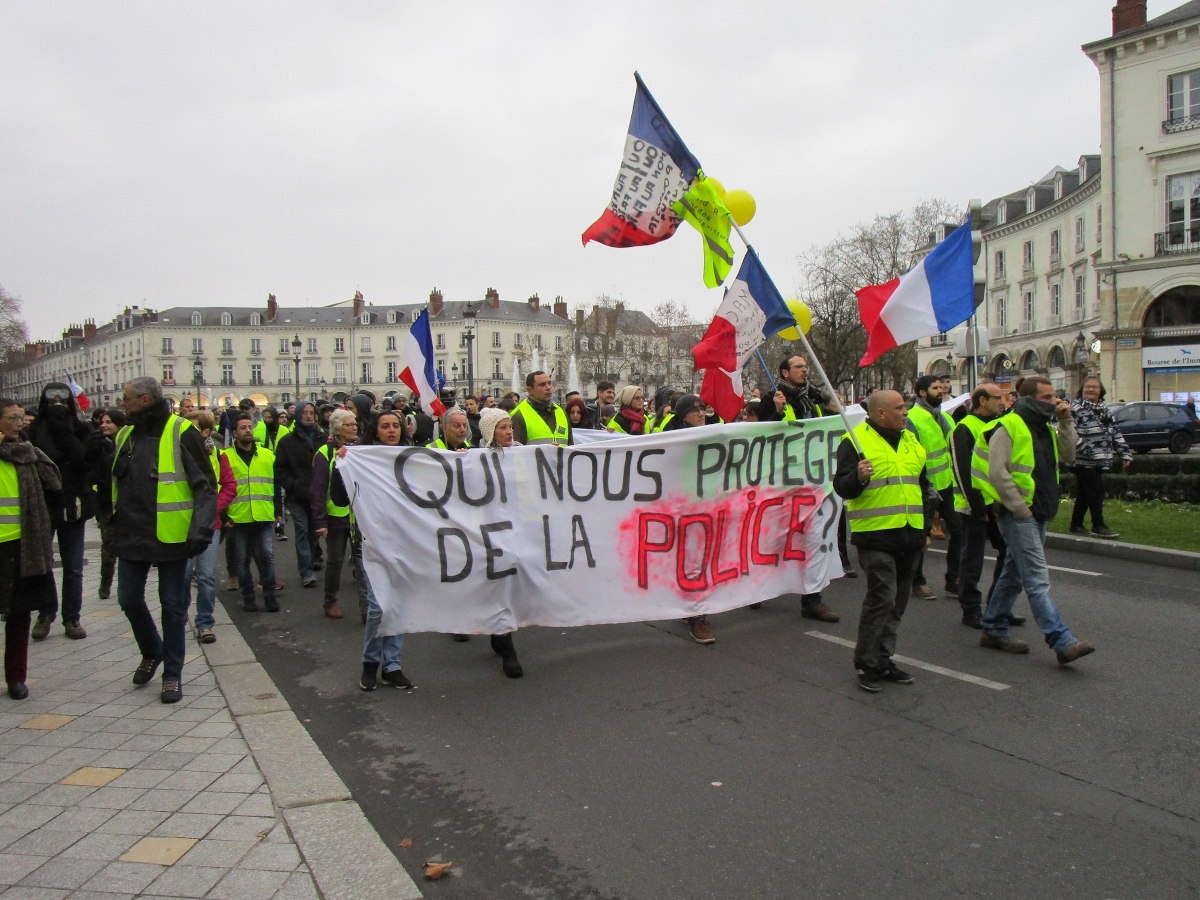
Joint marches between Gilets Jaunes and people of color most subject to police brutality were not an ongoing phenomenon but again this demonstrated the opening of a portal for common understandings.

Image 3: “Who protects us from the police?” Gilets Jaunes protest in Tours on 12 January 2019, photo by Guillame70

Unions and strikes: thresholding on the left

Many Gilets Jaunes were suspicious of unions and many unions refused to officially march with Gilets Jaunes. However, despite this contentious relationship, there were collaborative efforts on May Day marches and elsewhere. Gilets Jaunes picketed many early mornings with bus drivers when they were out on strike. After the strike, the bus drivers organized a barbecue in front of a bus headquarters for Gilets Jaunes who had come out on those cold winter mornings: one of many thresholding events among strikers and Gilets Jaunes.

The silence of others: a more controversial example of thresholding

While there was openness among the Gilets Jaunes about not having enough to live on and many domestic challenges, Gilets Jaunes avoided talking about the politics of left and right. Their reticence over political persuasions was not surprising in the polarized political situation of France. In 2017, Macron had successfully used the fear of fascism and the history of the Vichy government to mobilize voters in opposition to Marine Le Pen in the second-round elections.

In 2018, as hundreds of thousands of Gilets Jaunes poured into Paris from the provinces, both Le Pen, on the extreme right, and Jean-Luc Melenchon, on the left, pledged support. Reporters and participants claimed that in ACTE 3, Le Pen nationalists led the assault on the Arc de Triomphe. The international leftist Black Bloc may have led the attack on the elite restaurant Le Fouquet a few months later. The participation of many on the left in the protests, and the roundabouts over time led to a movement that called for a diverse democratic voice and the extreme right became marginalized.

While the Gilets Jaunes expressed their rage in breaking windows and other property and participated in attacks on the Arc de Triomphe and Le Fouquet, they did not accept political leadership from either the far right or the left. Silence with respect to political affiliation and the rejection of an official leadership remained a determined response.

Although disagreeing in fundamental ways, Gilets Jaunes were more or less uniform in their hatred of Macron. They believed that he was “stealing the state” with his privatization policies and cutbacks in funding for services and public employment.  They blamed the government for the destruction of a middle-class lifestyle either for themselves or for their children.

Collaboration for a political bloc was not based on a romantic image of common identity. Rather it was built on a restrained acceptance of political difference in a common rage about the loss of accustomed living conditions. This contrasts sharply with the US where polarization between left and right has become more extreme.

Trump, class, and thresholds in the United States

Although the presidential campaign of Bernie Sanders certainly raised the possibility (Susser 2018), no political bloc has yet emerged to work across the vicious polarization in the United States. Trump demonstrators also come from the shrinking middle class and displaced affluent working class partially represented in the Gilets Jaunes. However, they have moved to the right and responded to the Trumpian rhetoric of anti-immigrants, whispered racism, antisemitism and now even the adoption of theories of the Great Replacement. What can explain these different reactions to some similar circumstances?

Analysts have been concerned that Gilets Jaunes, like Trump supporters, were opening an avenue for the antisemitism, racism, and anti-immigrant rhetoric expressed by the growing far right. Indeed, in recognition of the popularity of Le Pen, Macron adopted some rightwing exclusive rhetoric. A popular surge to the right was a frightening possibility. However, the Gilets Jaunes did not evolve into a movement fundamentally based on hatred of the other. Instead, as a movement they focused their desperation and rage against Macron’s shredding of the welfare state and reduction in investment in areas outside gentrified Paris (Hazard 2020). They demanded a more receptive democracy and not an authoritarian state.

Conclusions

As political pundits have finally noticed, a new political bloc or a working class with consciousness or agency is emerging. Commoning and the generation of shared values as well as thresholding across autonomous groups were particularly significant in the long-term building of this oppositional left bloc. An important part of this thresholding was the ability to by-pass the polarization of the extreme right and the extreme left. This unusual collaboration, rarely the product of any explicit negotiations, allowed the extraordinary and inspirational mass movement of the Gilets Jaunes to avoid the exclusive and racist nationalism evident in the US.

In the presidential elections of 2022, Le Pen, as in 2017, made it through to the second round. However, Melenchon came in a close third. Macron, lacking the broad support evident in 2017, relied on the anti-fascism of the left to pull him through the second round. The power of the left to support Macron against Le Pen was finally negotiated into NUPES, a united left front for the deputy elections for the National Assembly in June 2022. 

In the June elections, NUPES won enough seats to become an official opposition and deny Macron his majority in the National Assembly. Some of Macron’s nominated ministers did not even make it into the Assembly. Macron was no longer able to pass the much-hated changes in pensions or his other policies. Marine Le Pen also won more seats than previously.   Nevertheless, the success of NUPES clearly represents an unheard-of situation in the fifth French Republic where the President is generally rubber stamped by a weak National Assembly. This new powerful counter-hegemonic political bloc should come as no surprise. It has been formed over five years of extraordinary protest including the collaborative politics of commoning, thresholding and silence in the Gilets Jaunes collective efforts. The forthcoming regime will have to take these progressive voices into account.

Ida Susser is Distinguished Professor of Anthropology at Hunter College and the Graduate Center, City University of New York. Her most recent book is The Tumultuous Politics of Scale, co-edited with Don Nonini.

References

Balibar, Etienne. 2019. Le sens du face-à-face. In Joseph Confavreux (ed.). Le Fond de l’Air Est Jaune. Editions Seuil

Dardot, Pierre and Christian Laval. 2019. Common: On Revolution in the 21st Century. Bloomsbury Publishing.

Hazard, Benoit. 2020. Lorsque les ‘sans-parts’ se rallient au ‘pouvoir vivre’. Ethnographie des associations des gilets jaunes sur les ronds-points de l’Oise. Condition Humaine/ Condition Politique 1 https://revues.mshparisnord.fr/chcp/index.php?id=237#text

Lefebvre, Henri 2003. The Urban Revolution. University of Minnesota Press.

Muehlebach, Andrea. 2017. The Body of Solidarity. Heritage, Memory, and Materiality in Post-Industrial Italy. Comparative Studies of Society and History 59(1), 96-126.

Comité de soutien 31. 2019. La rue etait noire de jaunes – 500 slogans, tags, affiches, pancartes, dessins, photos, banderoles….  Éditions du croquant.

Nonini, Donald M. (ed.) 2007. The Global Idea of ‘The Commons’. Berghahn

Books.

Rogozinski, Jacob. 2019. Démocratie Sauvage. Lignes 59, 23-36.

Stavrides, Stavros. 2015. Common Space as Threshold Space: Urban Commoning in Struggles to Re-Appropriate Public Space. Footprint 9(1), 9–19.

Susser, Ida. 2016. Considering the urban commons: Anthropological approaches to social movements. Dialectical Anthropology 40(3), 183–198.

Susser, Ida. 2017. Commoning in New York City, Barcelona, and Paris: Notes and Observations from the Field. Focaal 79, 6-22.

Susser, Ida. 2018 Re-envisioning Social Movements in the Global City: from Fordism to the neoliberal era. In Don Kalb and Mao Mollona (eds.). Worldwide Urban Mobilizations. Class struggles and Urban Commoning. Berghahn Books.

Susser, Ida. 2020. Covid, police brutality and race: are ongoing French mobilizations breaking through the class boundaries? FocaalBlog, December 3, https://www.focaalblog.com/2020/12/03/ida-susser-covid-police-brutality-and-race-are-ongoing-french-mobilizations-breaking-through-the-class-boundaries/

Susser, Ida. 2021. “They are Stealing the State”. Commoning and the Gilets Jaunes in France. In Moritz Ege and Johannes Moser (eds.). Urban Ethics. Conflicts Over the Good and Proper Life in Cities. Routledge.

Susser Ida, and Stéphane Tonnelat. 2013. Transformative cities: The three urbans

commons. Focaal 66,105-121.

Turner, Victor. 1958. Schism and Continuity. Manchester University Press.

Van Gennep, Arnold. 1960. The Rites of Passage.University of Chicago Press.

Williams, Raymond. 1983. Culture and Society, 1780–1950. Columbia University

Press.


Cite as: Susser, Ida. 2022. “Melenchon: the creation of a left political bloc.” Focaalblog, 21 June. https://www.focaalblog.com/2022/06/21/ida-susser-melenchon-the-creation-of-a-left-political-bloc/

Florin Poenaru: Romanian protests: A cake with three layers (and a cherry on top)

In the past four weeks, Romania has witnessed some of the biggest protests in the post-communist era. Hundreds of thousands of people in cities across the country took to the streets to protest a government bill that would potentially decriminalize corruption offenses and therefore help the case of the ruling Social Democratic Party leader. Hence, at home and in the international press, the protests were framed as a struggle between the corrupt government and the people pushing for anticorruption and for the respect of the rule of law. By virtue of this collective and spontaneous reaction against a government decree, the Romanian protests were cherished as a “beacon of hope” for democracy tout court. This was quite a staggering achievement: Romania was simultaneously portrayed as one of the most corrupt countries in Europe and as a silver lining for the world. It encapsulates the massively contradictory character of the protests that, despite the catchphrases and punch lines of the media, cannot be conveniently reduced to a single narrative or to a clear-cut conflict. I will try to articulate here the complexities of these protests via a metaphor: a cake with three layers and a cherry on top. Can the Romanians have their cake and eat it too?
Continue reading